HIL091540
PEER REVIEWED
COMING TO GRIPS WITH STUDENT MOBILITY AND POLICY IMPLICATIONS: A CASE STUDY FROM REGIONAL QUEENSLAND
Angela Hill, Fiona Navin and Andrea Lynch James Cook University
( [email protected], [email protected], [email protected] )
Abstract:
In 2008, in what could be considered a significant shift in Australian education policy, Rudd and Gillard stated that, “‘business as usual’ in Australian schools will not, by itself,
substantially lift educational outcomes, particularly in low SES communities” (2008, p. 26). They highlighted the need for schools to not only “commit to excellence in teaching and learning within the classroom, but . . . be prepared to address the range of external factors that impact on students’ ability to engage in learning” (ibid).
This paper summarises some of the issues exposed through a collaborative research project with schools related to one set of external factors in lower socio-economic communities – student mobility or movement of students between schools. Taking a policy research perspective, informed by Dale (1989), Rist (2003) and Ball (1994), the paper examines the relationship between ‘wider policies of the state’ in particular marketisation and considers how mobility plays out in school sites, specifically school sites marked by poverty.
The paper firstly presents an overview of the issues related to the measurement of mobility outlining the various ways stability within school populations has been measured. The paper argues for a measurement tool that reflects both the transactional pressure student mobility creates for schools and teachers but also the complexity conferred by poverty, suggesting that current metrics effectively mask issues of mobility within such communities.
The paper then presents research findings on the work of schools and teachers in relation to mobile students. Through a detailed analysis of this work, actions are located as serving the interests of the state - technical transactions related to the Education (General Provisions) Act 2006, practical requirements related to inducting students to a new school and, most
importantly, critical actions related to student learning and support needs. The use of this framework to examine the work of teachers exposes the ‘complex interplay of interests’ (Ball, 1997) that require visibility within any policy reform.
Using Rist’s (2003) notion of research as having an ‘enlightenment function’ the paper argues that sustained collaborative research with schools can expose the complexities of such
phenomena as student mobility. In the context of renewed commitment to ‘needs based funding’, the paper concludes with suggested directions to support individual case management of mobile students within a social justice framework and a call for the
Introduction:
This paper presents some of the findings from a case study of a cluster of state primary schools in regional Queensland. The schools are involved in an ongoing collaborative research project, which since 2005 has sought to identify how disadvantage intersects with students’ lives and teachers’ work in a range of ways. In this paper, our purpose is to suggest that policy responses to the issue of student mobility, that is students moving from one school to another, particularly at non-standard times, needs substantial revision, particularly in the context of disadvantaged communities. We argue this after a sustained period of engagement with the schools and note that the complexity of student mobility within a marketised
education framework creates a set of demands for schools, largely invisible to policy makers. As Dale (1989) and Ball (1997) argue, exposing how policy impacts in a local setting can suggest ways forward – and it is our intent in this paper to indeed outline some of these possible actions, based on a trial project that is part of this research.
Our case study relates to a community where according to the Australian Bureau of Statistics (2006) housing ownership - those either purchasing or owning their home outright - is below 14%, compared to a national average of around 30% and where almost 28% of dwellings are categorised as public housing compared to 14.9% nationally. These housing and other income indicators locate the community in the lowest third of the state in relation to economic
resources
Since 2005, we have worked with the schools in the study to support their work with mobile students. Our attention was drawn this issue as a result of interviews with teachers and school administrators at a ‘turning point’ in Queensland’s policy making history with the
introduction of the policy framework around Queensland State Education (QSE) 2010 and associated legislation including the Education (General Provisions) Act 2006 . This era, as Singh and Taylor (2007) note has had a simultaneous focus on the ‘individualised case management’ of students ‘at risk’ coupled with a revised equity agenda asserting a new role for the state, that of steering from a distance (Dale, 1989). The new policy landscape requires that teachers and schools identify ‘students at risk’ but places the responses required for these students firmly with the school staff. The results are measured by examining a range of output measures - including student retention to Year 12, national test results and apparent retention rates.
In the context of this policy landscape, there are two key assumptions in relation to the work of schools. Firstly, schools can and will collect data to support identification of students with a variety of needs, particularly as these needs might relate to educational risk. On
identification of need, a second assumption is that schools will be sufficiently resourced to intervene for each individual. We contend in this paper that schools are not sufficiently resourced to work with the complexities of student mobility and that much data collection in relation to student mobility has not been helpful to support teachers’ work or students who are mobile.
In an evidence-based policy environment there is a need to generate more knowledge about the issue of mobility, knowledge that serves to ‘enlighten’ a policy response Rist (2003). This is particularly important we suggest, in considering that student mobility is often
In acknowledging the evidence base required to suggest change in policy, we draw upon both qualitative and quantitative methods and the structure of this paper reflects this approach. The paper firstly briefly summarises pertinent literature on student mobility in the context of disadvantaged communities. We then turn to the issues associated with measurement of student mobility and note our concerns with the existing measures and attempt to add to the understanding of the impact of mobility in Queensland schools. We then turn to qualitative data and examine what is involved in some of the tasks in enrolling students in schools to demonstrate that schools in disadvantaged contexts with high mobility require a dedicated additional resource.
Previous literature on student mobility in disadvantaged contexts:
There is limited international research that focuses on the intersections between mobility and poverty and what this means for the work of teachers and schools. What is known is that “high mobility schools tend to have higher proportions of disadvantaged children” (Dobson, Henthorne, & Lynas, 2000, p. 81) and that while the root causes of mobility might lie beyond the influence of schools and teachers there are strategies that can be enacted at the school and classroom level that work to mitigate the potentially negative impacts of student mobility, for both the students and the school. Rumberger (2003) calls on research from the United States of America to describe an extensive set of strategies shown to be effective in reducing mobility and in the transition of new students. In England, a number of large-scale projects have been undertaken to determine the patterns of student mobility (see Dobson, et al., 2000; Office for Standards in Education, 2002; United Kingdom Department for Education and Skills, 2003). This research has led the Department for Education and Skills (2003) to produce a comprehensive guide to working in highly mobile (although not necessarily disadvantaged) contexts. In this volume they provide a systematic approach to managing mobility, including inducting new students, enabling curriculum access and involving external agencies.
In Australia, state jurisdictions have also made efforts to measure and monitor student mobility. In South Australia, the Department of Education, Training and Employment (South Australia. Department of Education Training and Employment, 1996) produced a guide for supporting mobile students and more recently the Commonwealth government has produced a series of booklets aimed at smoothing school transitions (Department of Education Science and Training, 2006). Yet, while there is a body of work that describes what can be done to mitigate the impacts of mobility there remains a dearth of comprehensive data that accurately presents the extent and nature of student mobility within states or within the nation.
Student Mobility: measuring the transactional pressure on schools and teachers
Different studies use different terms, including mobility, transience, itinerancy, turbulence and relocation, sometimes interchangeably, sometimes in particular ways. In addition to varied naming, student mobility has been examined in previous studies in differing ways. Some researchers have measured mobility as a characteristic of schools (Demie, Lewis, & Taplin, 2005; Kerbow, Azcoitia, & Buell, 2003), while others have examined mobility as a characteristic of students (DEST & DoD, 2002; Heinlein & Shinn, 2000). This is further complicated by varying conceptualisations of mobility with the inclusion of students transitioning to the next phase of learning in some research and only those making ‘non-promotional’ changes in others.
In Queensland, the Department of Education and Training monitors both school student mobility and school population mobility. The department assigns each enrolling student a unique student identifier (USI) that enables the department to track each student individually. This tracking occurs at the three census points in the school year, in the months of February, July and November. This has been the case since 2001 – prior to this time enrolment
collections were undertaken in February and July. While this tracking provides some
indication of the movements and frequency of movements of students attending state schools, it gives no insight into movements that may occur between these collection points. For
example, our data collection shows a student enrolling at one of the three schools on March 13, 2008 and exiting May 2, 2008, returning on September 9, 2008 and exiting again October 24, 2008 – this student was not present at any of the collection dates and his movements are unrecorded under the departmental data collection system. There are several similar examples each year in this school and others in the cluster. As Prout (2008) confirms, this lack of rigour around basic measures of such things as attendance, “renders comparisons from school to school, system to system (state/private/independent), and jurisdiction to jurisdiction, […] virtually baseless” (p. 26).
The Queensland department also collates this movement data as a characteristic of schools and a measure of the school population’s enrolment stability and mobility. The Department of Education and Training describes this as:
School Student Enrolment Stability and Mobility are characteristics of a school based on students individually. The data is point in time and measures how many changes of school a student has had (Student Enrolment Mobility Index) and how often a student has been enrolled at a particular school (Student Enrolment Stability Index) up until the point in time specified. These two measures are not directly comparable. (G. Swayn, personal communication, May 8, 2006).
Neither of these measures accurately account for the number of transactions through enrolments and exits in a school. We contest that it is the transactions associated with mobility that place considerable pressure on the time resources of any school. Dobson, Henthorne and Lynas (2000) noted the pressure and significant consequences of high mobility for both material and human resources. Further, we suggest that the measures currently used may significantly underreport the level of mobility.
and Families to establish a consistent measure for mobility across all schools. Our use of the JPL formula has been applied around a particular definition of mobility, that is where students are making “non-promotional school changes” (Rumberger, 2003, p. 6) and are moving “into and out of schools at times other than the usual ones for joining and leaving” (McAndrew & Power, 2004, p. 3). It measures the aggregate of individual movements after the first census of the school year. In Queensland, and for our study, this date is referred to as the Day 8 census. This is the date that traditionally the school population is reported for the purposes of resource allocation - including teacher numbers.
The JPL formula is:
students joining the school + students leaving the school x 100 total school roll on the census date
In an extensive research project conducted across Britain, Dobson, Henthorne and Lynas (2000) found that while mobility rates vary across a wide range, schools with a mobility rate above 20 are a minority and schools with a very high mobility rate, that is those above 35, are a small minority. Following this research report, the Office of Standards in Education
declared that, “Using this calculation, high mobility is considered to be more than 20% whilst very high mobility is in excess of 35%” (United Kingdom Department for Education and Skills, 2003, p. 20).
We have used student enrolment and exit data from the participating schools to identify rates of mobility and to benchmark them against the established indicators developed in the United Kingdom, as well this data is used to profile mobile students and to identify patterns of movement. The analysis of the data has enabled a targeted intervention and the evaluation of the intervention over time.
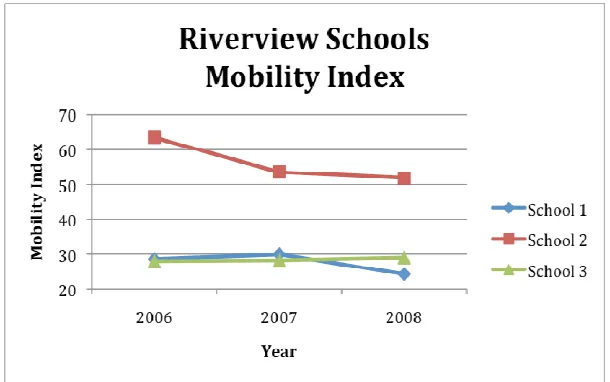
[image:5.595.144.449.580.771.2]Figure 1 notes the levels of mobility in three schools since 2006. Schools 1 and 3 have consistently recorded mobility indices (as measured by the JPL formula) at just below 30, or at least high levels of mobility as measured by the British study. School 3 has mobility at over 60 in 2006 reducing to 52 by 2008. This level of mobility is in the exceptionally high range according to the index. While research conducted by the Office for Standards in Education using the JPL measure (2002) reports huge differences between schools in the extent of pupil mobility, ranging from 0 to 80 percent, their research (conducted across 3300 English primary schools) reports a median of 11.1 percent in primary schools.
The collection of this data has not been straight forward, and at present would be difficult to duplicate at other school locations without considerable guidance. Each school management system (SMS), while technically consistent across the entire state system, has its own idiosyncrasies. Staff have evolved ways of inputting data that differ in small yet significant ways to the methods of their colleagues in other schools, dates are formatted differently, descriptive codes are used in particular ways and school specific innovations are used to reflect the local context. Also, duplicate entries appear randomly and manual checking is required to ensure they are not carried forward into the analysis.
There are also significant issues around the archiving of data and the ‘roll over’ of information in the SMS at the conclusion of the school year as is noted in internal
Departmental research (Simons, Bampton, Findlay, & Dempster, 2007). The data for this project is collected throughout the school year providing a cumulative data set, this is because the ‘roll over’ process causes data relating to repeat enrollers to ‘disappear’. Therefore, data for 2008 cannot be collected in 2009 – once the system rolls over a significant aspect of mobility is lost – those students who enrol, leave and enrol again, sometimes a number of times, within a school year.
We contend then, that the current measures of mobility have underestimated the extent of the issue within schools and therefore the response required to adequately work with the levels of transactions apparent. The analysis of the work involved in these ‘transactions’, as revealed through interviews and observation of key actors within the school is now documented in the next section of the paper.
Responding to student mobility: what does it take?
As part of the collaborative research work in this project, a trial of a new position, a Mobility Support Officer, is funded by the Queensland Department of Community Renewal for a two-year period. The Mobility Support Officer, or MSO, is based loosely on the work of the Mobility Induction Worker in the British study (Dobson, et al 2000), and is designed to ease the transactional pressure of enrolment. The MSO is a qualified teacher, who is charged with a number of tasks, but significantly, ensures that the transition of enrolling students,
particularly students enrolling at non-standards times is positive. The position is also charged with supporting exiting students.
Our work with the schools makes plain that enrolment transactions within primary schools in disadvantaged contexts are tasks that are often unable to be prioritised by existing personnel. Dealing with issues of child safety, student behaviour, or parent need, for example, require all the energy of limited administrative staff, yet the process of enrolling students in schools falls squarely on time poor administrators or Principals.
Tracking the work of the MSO however, makes visible the variety of tasks involved in the enrolment process and this discussion focuses on coming to grips with what is involved in the enrolment process.
The requirements under the Education (General Provisions) Act 2006, the legislative
The Act specifies numerous tasks to be undertaken including assessing the attributes of the child, sighting documents such as a birth certificate, carer signature of documents, discussion of school policies and receipt of a Transfer Note. The enrolment requirements outlined in the Education (General Provisions) Act 2006 appear straightforward, however enactment is much more difficult in the context of poverty, placing greater transactional pressure on the school.
There are a number of assumptions within the legislation in relation to the myriad of technical requirements. Firstly, there is the suggestion that the student will arrive with all necessary technical information. From our study this is most unlikely, and highly variable. Some children will arrive with reports and work samples from the previous school, whereas others may have only been in the care of the enrolling adult for a day and as such, arrive with limited knowledge of the child's background. The new enrolment procedure enacted by MSOs requires that students begin the day after their enrolment interview. This procedure allows the MSO to ring previous schools to gather some background information on the student, provide the classroom teacher with relevant information, and organise for furniture to be placed in the classroom. Each of these steps supports a smooth transition for the student into the school.
While such technical knowledge is necessary to ensure standardisation in the enrolment procedure across schools, prescriptive application fails to recognise the sentience of social life. Much practical activity is contained in the enrolment interview process founded on interpretive understanding that can inform and guide practical judgement within the school setting. The MSO, as enabled by dedicated time, often makes situational judgements in determining the most appropriate action for each family that enters the school, enabling an education that is responsive to the child's needs.
For some mobile students individualised case management requires immense practical action, as was the case for Carl. His story as recounted by the MSO is below:
During the enrolment interview Carl’s mother outlined that he struggled with learning. I rang the previous school, spoke with the Principal and was told that they had been going through the process of an Intellectual Impairment diagnosis but it had not been finalised. I spoke to the Guidance Officer and Special
Education Unit to get the ball rolling again and get support in place. Otherwise it would have been a case of waiting for the files to arrive. When he began, Carl had been exhibiting extreme behaviours because he was not coping with the work, supports were not in place. Now that we have supports in place to meet his learning needs the behaviours have ceased and he is able to complete his work.
Socially Carl was having difficulty as well. He was not making any friends as the other kids saw him as a ‘naughty boy’. They didn’t realise there was a problem there, that his brain does not work the same as their brains work. Now he is in a classroom with other special needs children, and they all understand that they learn differently and that their brains work differently, so it is just a different culture in the classroom, the whole class is very supportive. He’s not struggling academically and socially anymore. (MSO, May 12, 2008)
information on the needs of a student. Such information is contained with the student file, which can take six to eight weeks to arrive at the new school. In Carl's case, a six to eight week timeframe before his new school were aware that an Intellectual Impairment assessment process was in place would have resulted in no action or support for Carl during his time at the school, and in less than two months Carl had moved towns. The MSO raised the concern that it may have been another six months before someone realised that Carl required extra assistance and began another assessment, when the original had been so close to finalisation. The role of the MSO, as a catalyst for providing timely practical support is clear in this example.
The MSO role has made the transfer of student information, the assessment of student needs and the transition of students into a new school more efficient, providing a more supportive environment for students and their families, as well as relieving the Principal, administrators and teachers of a substantial amount of work.
A second example of a mobile student highlights the nature of the engagement required by school staff to support complex students. In this second example the role of the MSO goes beyond the technical implementation of legislation and practical gathering of information, it extends into the critical realm of working with the information that is gathered/action guided by information, knowledge that links to transformation of student lives.
Sam presented as high needs. At first, information was not forthcoming
because he’d been living with mum in parks so auntie just wasn’t aware. There were a lot of issues at his previous school and high absenteeism so he is in Year 3, but more likely at a Year 1 level. He does not know how to sit at a desk or do the work . . . He gets very frustrated and takes his anger out by trashing the classroom. He will climb onto the roof and a lot of the phrases that come out of his mouth are ‘park’ phrases, so not appropriate for a child to be saying but you can understand where they have been picked up from. When this happens either I go walk around the school with Sam, or release the classroom teacher, and we’ll discuss you know, ‘Sam, this is not how you behave at school’. He is now more willing to have his calming down time in the office and then return to the classroom. And the school now has Sam in the routine that he does not go home until he has cleaned up the mess in the classroom, so little steps are being made . . . [Through teacher release] The classroom teacher has been able to connect with the family straight away so we are working together to ease the transition and build up the knowledge that school is a safe place, and that he is cared for in school. (MSO, May 12, 2008)
As shown by the examples above, often supporting mobile students requires individual case management and the role of the MSO exposes the complexity of tasks hidden in the
Conclusion:
The MSO enables student transitions to look quite different for students such as Sam. With time to develop a relationship with carers and students, and a role to support teachers in establishing learning needs, the MSO is able to engage with critical reflective actions. Such action is integral in addressing the complexity of need which students and families often present with in disadvantaged communities. With student mobility at very high levels we have expressed concern in this paper regarding current measurements of mobility and find that previous research has ‘engineered’ largely silent policy responses. As Angus, Olney and Ainley (2007) note in their report on the status of Australian primary schools, only six percent of Principals noted they had sufficient resources to meet the need of their schools’
communities. In this paper we suggest resources to support high levels of mobility in schools serving disadvantaged communities warrants new attention.
References:
Angus, M., Olney, H., and Ainley, J. (2007). In the balance: The future of Australia’s primary schools. ACT: Australian Primary Principals Association.
Australian Bureau of Statistics (2006). Basic Community Profile 2006. Retrieved June 30, 2008 from http://www.censusdata.abs.gov.au
Ball, S. J. (1994). Education Reform: A critical and post-structural approach. Buckingham: Open University Press.
Ball, S. J. (1997). Policy sociology and critical social research: A personal review of recent education policy and policy research. British Educational Research Journal, 23(3), 257-274.
Commonwealth Department of Education Science and Training, & Department of Defence (2002). Changing Schools: Its impact on student learning. Canberra: Commonwealth of Australia.
Dale, R. (1989). The state and education policy. England: Open University Press.
Demie, F., Lewis, K., & Taplin, A. (2005). Pupil mobility in schools and implications for raising achievement. Educational Studies, 31(2), 131-147.
Department of Education Science and Training (2006). Changing schools: an information booklet for parents. Canberra: Australia. Dept of Education, Science and Training (DEST), 2006.
Department for Education and Skills. (2003). Managing pupil mobility: A handbook for induction mentors. Retrieved September 8, 2006. from
www.standards.dfes.gov.uk/sie/documents/pmguidance.pdf
Department of Education Science and Training and Department of Defence (DEST & DoD). (2002). Changing schools: Its impact on student learning. Retrieved 16 July 2007. from
http://www.dest.gov.au/sectors/school_education/publications_resources/profiles/cha nging_schools_impact_on_student_learning.htm
Department of Education and Training (DET). (2007). Enrolling you child. Retrieved January 12, 2009 from http://education.qld.gov.au/schools/about/enrolling.html
Dobson, J., Henthorne, K., & Lynas, Z. (2000). Pupil Mobility in Schools: Final Report: Migration Research Unit, University College.
Gillard, J. (2008). Quality education: The case for an education revolution. Retrieved September 2, 2008 from
Habermas, J. (1971). Knowledge and human interests. Boston: Beacon Press.
Heinlein, L. M., & Shinn, M. (2000). School mobility and student achievement in an urban setting. Psychology in the schools, 37(4), 349-357.
Kerbow, D., Azcoitia, C., & Buell, B. (2003). Student mobility and local school improvement in Chicago. The Journal of Negro Education, 72(1), 158-163.
Machin, S., Telhaj, S., & Wilson, J. (2006). The mobility of English school children. London: Centre for the Economics of Education.
McAndrew, E., & Power, C. (2003). The role of the induction mentor: An evaluation. London: Department for Education and Skills.
Office for Standards in Education (2002). Managing Pupil Mobility. Retrieved March 12, 2007 from http://www.ofsted.gov.uk/Ofsted-home/Publications-and-research/Browse- all-by/Education/Leadership/Governance/Managing-pupil-mobility/(language)/eng-GB
Prout, S. (2008). On the move? Indigenous temporary mobility practices. Canberra: Centre for Aboriginal Economic Policy Research
Queensland Government. (2006). Education (General Provisions) Act 2006. Retrieved February 25, 2009, from http://www.legislation.qld.gov.au/OQPChome.htm
Rist, R. (2003). Influencing the policy process with qualitative research. In N. K. Denzin & Y. S. Lincoln (Eds.), Collecting and interpreting qualitative materials (2nd ed., pp. 619-644). London: Sage.
Rumberger, R. (2003). The causes and consequences of student mobility. Journal of Negro Education, 72(1), 6-21.
South Australia. Department of Education Training and Employment (1996). Student
transience: Moving frequently between schools in South Australia. Adelaide: Author. Singh, P., & Taylor, S. (2007). A new equity deal for schools: a case study of policy-making
in Queensland. British Journal of Sociology of Education, 28(3), 301-315.