SPEEL
Study of Pedagogical Effectiveness
in Early Learning
Janet Moyles, Siân Adams, Alison Musgrove
School of Education Research and Development
Anglia Polytechnic University
Research Report
No 363
SPEEL
Study of Pedagogical Effectiveness
in Early Learning
Janet Moyles, Siân Adams, Alison Musgrove
School of Education Research and Development
Anglia Polytechnic University
The views expressed in this report are the authors' and do not necessarily reflect those of the Department for Education and Skills.
CONTENTS
page
Table of Contents i.
List of diagrams, figures and tables ii.
Glossary iv.
Section 1 Introduction and background 1
Section 2 Research design and methodology 9
Section 3 Analysis of the Data and source of Framework statements
24
Section 4 The Framework with exemplification for practitioners 48
Section 5 The Validation of the Framework 74
Section 6 The Literature Review 102
Section 7 Findings, Discussion and Recommendations 129
Section 8 References 139
Appendix A Interview Schedules: Practitioners and Managers/Heads (Layer 1)
149
Appendix B Interview Schedules: Managers/Head-teachers (Layers 2 and 3)
153
Appendix C Reflective Dialogues: Concept paper. Introduction to Researchers. RD process information for practitioners.
160
Appendix D Early analysis: Practice level detailed statements 168
LIST OF DIAGRAMS, FIGURES and TABLES
page
Diagram A SPEEL Framework Model 4
Figure 1 Key Term Descriptor for Pedagogy 5
Figure 2 Key Term Descriptor for Practice 5
Figure 3 Key Term Descriptor for Principles 5
Figure 4 Key Term Descriptor for Professional Dimensions 5
Figure 5 Key Term Descriptor for Effectiveness 8
Figure 6 Representation of the research design and conduct 11
Figure 7 Practice Level Overview Chart (January 2001) 26
Figure 8 ‘4Ps’ Model’ of Early Years Pedagogy 28
Figure 9 Detailed analysis of ‘Collaboration’ from Layer 1 transcripts
29
Figure 10 Practice Level showing data reduction process 31
Figure 11 Example of Nud*Ist generated nodes for analysis
(Layer 1) 32
Figure 12 Data Reduction – ‘Collaboration’ 33
Figure 13 Penultimate version of Practice Level Key Statements 34
Figure 14 Statements from initial Framework used within Layer 2
Heads’/Managers’ Interviews 36
Figure 15 Reduced ‘3Ps’ Model’ 38
Figure 16 Conceptualising and articulating young children’s thinking skills
44
Figure 17 Triangulation of Methods 77
Figure 18 Two example Case Studies from SPEEL Project 81
Figure 19 Triangulation through data collection 105
Figure 20 Moyles and Suschitzky's Planning, Evaluation and
Assessment Model 113
Table 1a Background of EAG 6
Table 2a Potential types of providers 10
Table 2b Authorities involved in the SPEEL research 12
Table 2c Analysis of LA personnel criteria for selection of
settings 12
Table 2d 74 settings identified for effective practice by
LA/Partnership personnel 13
Table 2e Data on the sample of 27 effective settings involved in
SPEEL research 14
Table 2f Biographical details of practitioners 16
Table 2g Socio-economic background of children/families 18
Table 2h Percentage of ethnic-minority children across three
layers 18
Table 2i Type of accommodation by setting 19
Table 2j Documentation gathered from 27 settings 23
Table 3a Parents response to Qu.19 39
Table 3b Activities observed over Layers 2 and 3 46
Table 5a Response to web-based feedback and evaluation 80
Table 5b Chart showing sources of Key Statements in final Framework
page
Graph 1 Average of all parents’ responses to Questionnaire 40
Graph 2 Female/male parents responses compared 41
Graph 3 Married/partnered parents response compared to
single parents 41
Graph 4 Overall parents’ responses compared with those of
GLOSSARY
Adult-led activities: adult decides what the child does;
Area of Focus: each of the 3 main elements of the Framework, each of which is further sub-divided into 3 parts
Articulate: ability to talk with confidence about practice and its underpinning beliefs, values and understandings
Child-initiated activities: child decides what activities to do
Curriculum: everything the child experiences in the setting – planned and unplanned
CGFS: Curriculum guidance for the foundation stage
Definition: descriptor for particular terms used in the research
Development: general pattern in the way that child functions and matures (physical, linguistic; social/emotional areas and cognitive areas)
Developmentally Appropriate: implies curriculum is congruent with child's developmental levels
Dispositions to learning: an approach to learning typified by e.g. curiosity, creativity or independence
EAG: Expert Advisory Group – early years experts in range of child related areas
Early Years (EY): The Foundation Stage – for children aged between 3 and 5+ years
EPEY Effective Pedagogy in the Early Years Project
Framework: overall synthesis of 129 Key Statements representing the core competences in effective early years pedagogy
Interaction: ways in which practitioners communicate (verbal and non-verbal) to adults and children
Teaching: ranging from specific transmission of knowledge to change behaviour or supporting children's learning, sometimes through play
ICT: Information and Communications Technology
Key Statements: list of non-hierarchical statements of competence [in effective early years pedagogy) under 3 headings (Areas of focus) within Practice, Principles and Professional Dimensions
Layer 1 – 3: division within SPEEL project involving examining proportion of settings within each of three terms
Learning environment: includes the physical environment of the setting and the nature of the learning atmosphere within the setting – informed by values, beliefs and understanding of the practitioner
Manager/headteachers: managers of playgroups or nursery units, heads of centres,headteachers of schools
Pedagogy: based in practice, includes management and organisational factors and demands specific set of knowledge, skills, techniques and values which inform the education and care of learners. See definition in Section 1
Practice: all that the pedagogue does within the teaching and learning context. See definition in Section 1
Principles: underpin/ inform practice and are based upon informed knowledge and theories of early childhood education. See definition in Section 1
RD: reflective dialogue
Reflective Dialogue: focused interview guided by researcher based on practitioner's selection and control of video episodes taken in settings. See more comprehensive definition of RD method in Appendix Ci
SEN: Special Educational Needs
Settings: school reception class or unit; nursery class or school; pre-school playgroup, day nursery or childminder; combined centre
Skills: small units of behaviour that are easily observed
SECTION 1
SECTION ONE
Introduction
This section introduces the final report for the Study of Pedagogical Effectiveness in Early Learning (SPEEL) Project. It gives some basic factual information about how the research has been conceptualised by those involved. It explores the language of the project and contains descriptors of the key terms used. The contribution of the various participants is outlined. Finally it outlines the aims, objectives and achievements of the research and indicates where adaptations were necessarily made to meet the expectations of settings and enable the research to be completed within the defined timescale.
1.1 This ethnographic study began on the 1st November 2000 and was completed on the 31st October 2001. The research has sought to identify the components of effective pedagogy which are embedded within the practices and thinking of those adults who work with 3- to 5-year-old children within the context of the new Foundation Stage (FS). The research was commissioned by the then DfEE, which became DfES in the course of the research. Both DfEE and DfES are used in the report, since some of the early research ‘instruments’ of necessity incorporated the DfEE logo.
Objectives and outcomes of the research
1.2 The research has at its root the view that children and families, whatever the setting, have the same entitlement to teaching by effective practitioners. Our objectives for the research were to:
i. identify the embedded characteristics of effective pedagogy in the early years through an extensive literature review covering national and international sources; ii. validate these characteristics through extensive analysis and interrogation by
identified effective practitioners and by an Expert Advisory Group;
iii. link these with the contents of the Curriculum guidance for the foundation stage
(CGFS)/Early Learning Goals (ELGs);
iv. gather information on effective practitioners’ understanding within five specifically defined aspects, those we have termed ‘DfES 5 areas’, i) outdoor learning; ii) special / individuals needs, including gender/equal opportunities; iii) care and education links; iv) thinking skills development; and v) Information and Communications Technology (ICT).
v. develop a working Framework of characteristics of effective pedagogy;
vi. refine this Framework by working with practitioners from 27 case study effective settings to develop and extend it;
vii. further refine the Framework by a) observing effective practice and reflecting on this with practitioners and b) scrutiny of the Expert Advisory Group;
viii. develop a final Framework of Effective Pedagogy for use alongside the CGFS in identifying performance indicators for early years practitioners.
(EPEY/EPPE) project’s main concentration on child factors – the SPEEL research focus
increasingly evolved as a concentration on identifiable components of pedagogy and the adult role. Video evidence of practitioners’ roles has given clear insights into their understanding and ability to:
• reflect upon that practice;
• interrogate their own principles underpinning practice;
• reflect upon their own qualities, knowledge and thinking and how these impact upon practice;
• articulate their own understanding of effective pedagogy.
1.4 Whilst we acknowledge that the practitioner’s role can in no way be isolated from the effects upon children’s learning, our focus has been on the attitudes, skills, knowledge and understanding of the practitioners themselves in their work with children, team members and families, rather than upon child outcomes (a point to which we return later). A main reason for this decision arose because of this and other research in which members of the SPEEL team have been involved (e.g. Moyles and Suschitsky 1997a and b; Moyles and Adams 2001) which has shown the difficulty experienced by practitioners in focusing upon their own impact upon
children’s learning as opposed to making practical provision, e.g. laying out materials from which children can make choices.
1.5 Evidence from the SPEEL research supports this focus shift in at least two ways:
i) practitioners found it far easier to talk directly about practice involving provision for children – hence this was the first Area of Focus developed within the Framework; and ii) transcriptions of Reflective Dialogues undertaken with practitioners (the aim of which was to engage practitioners directly in observing themselves and identifying the underpinnings to their practice), offer evidence of many practitioners struggling to explain the rationale behind their actions and reactions. Most practitioners in looking at the video immediately identified features of a child’s behaviour rather than their own, reactions to themselves being often at a very personal level rather than the level of identifying, for example, professional knowledge or skills. Asked how she knew that the practice was effective, one early years teacher thought long and hard and then responded
‘How do we know? We just know – we just do’. So it would seem that a focus on the teacher role is now ripe for investigation.
1.6 We conjecture later – with evidence from the literature review – that this inability to articulate may put a significant constraint upon effective pedagogical practices. Just as we now expect children to be engaged in the metacognitive process exemplified in Bruner’s work, this must apply equally to the practitioners if they are to further hone and develop their professional skills:
Modern pedagogy is moving increasingly to the view that the child should be aware of her own thought processes, and that it is crucial for the pedagogical theorist and teacher alike to help her to become more meta-cognitive, to be aware of how she goes about learning and thinking as she is about the subject matter she is studying. (Bruner 1996: 64)
1.7 Given the focus on pedagogy, we found it necessary to generate a definition (or descriptor) of pedagogy which has emerged from both the literature review and the practitioners. This was later refined as a result of scrutiny and comment by all those involved in the research as ‘experts’ as well as by managers/headteachers in settings. The final descriptor is shown in Figure 1.
1.8 The main outcome of the research has been the development of the Framework for Effective Pedagogy presented in Section 4 in user-friendly format. The Framework contains 139
‘Practice’, ‘Principles’ and ‘Professional Dimensions’ – into which we have classified the Framework data. They contain 43, 35 and 51 Key Statements respectively. Each of the Areas of Focus is sub-divided into three further headings. Diagram A shows an overall representation of the Framework with the Areas of Focus and sub-headings. Figures 2-4 show the descriptors for each of the Areas of Focus.
1.9 The research process has been exciting, informative and as exhaustive as possible within the context of 27 early years settings and 12 months of extensive data gathering, analysis and interpretation. The researchers have been impressed by the willingness and openness of the settings and practitioners with whom we have conducted the field work. All the practitioners have welcomed the focus on their role as pedagogues and, whilst a major part of that role (as they have continually emphasised) is the focus upon the individual child and family, it has become clear that practitioners are increasingly taking an interest in their own roles and in developing their own knowledge and understanding:
… we really do need documents like this to put the focus back on teaching…
I think this project is a wonderful opportunity to put the jigsaw pieces [of curriculum, children’s learning and the teaching role] back together and look at pedagogy more holistically.
That this is happening from a variety of perspectives and from a basis of highly differentiated experiences has been very evident within the research. Many of these issues emerge at different points in this Report.
Figure 1 – Key Term Descriptor for Pedagogy
PEDAGOGY is both the behaviour of teaching and being able to talk about and reflect on teaching. Pedagogy encompasses both what practitioners actually DO and THINK and the principles, theories, perceptions and challenges that inform and shape it. It connects the relatively self-contained act of teaching and being an early years educator, with personal, cultural and community values (including care), curriculum structures and external influences. Pedagogy in the early years operates from a shared frame of reference (a mutual learning encounter) between the practitioner , the young child and his/her family.
Figure 2 – Key Term Descriptor for Area of Focus: PRACTICE
PRACTICE is all that the pedagogue does within the teaching and learning context on a daily, weekly and longer-term basis to promote effectiveness. Practice includes planning, evaluating and assessing children’s play and other learning experiences both indoors and outdoors. Practice is the application of practitioners’ qualities, knowledge, thinking and underpinning principles and involves making both conscious and intuitive judgements. Practice is flexible, based on establishing and maintaining effective relationships through anticipating, observing, interpreting and evaluating the actions and behaviours of children and other adults. Practice represents the fluent performance of a complex and dynamic interaction, involving communication with and between children and adults, including parents.
Figure 3 – Key Term Descriptor for Area of Focus: PRINCIPLES
PRINCIPLES underpin practice and are based upon informed knowledge and theories of early childhood development, education and care, including management and organisational factors. Principles are at the heart of practitioners’ values and beliefs. They are the ideological base for practitioners’ thoughts and actions and are reflected in their visions, aims and goals. Practitioners who are reflective and on-going learners, recognise that principles are capable of adaptation and change in the light of further evidence.
Figure 4 – Key Term Descriptor for Area of Focus: PROFESSIONAL
DIMENSIONS
PROFESSIONAL DIMENSIONS: Effective early years practitioners are those who possess particular professional qualities, knowledge and thinking which they bring to their role. Professional qualities are attributes and skills both brought to, and developed within, the role of the effective early years pedagogue and are underpinned by a sense of self-efficacy. Professional knowledge – intuitive and explicit – is that understanding which practitioners have and employ to develop a wide range of learning experiences for young children (including those within the
1.10 The research has benefited in a variety of ways by the inclusion of a wide range of people:
• The practitioners themselves (detailed information is contained in Section 2) who come from a variety of settings and have varied qualifications, as do the Managers and Headteachers also involved in the research.
• The parents who were involved as respondents to questionnaires and who gave permission for their children to be part of the videos made of practitioners’ work and expressed (unrecorded) interest in the research.
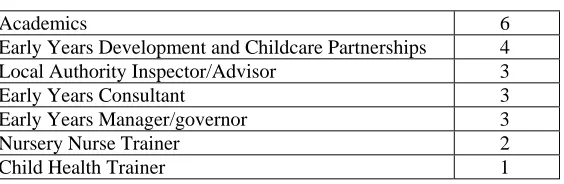
[image:13.595.182.464.367.459.2]• The Expert Advisory Group (EAG), consisting of 10 early years experts, has included those with expertise in developmental psychology, child health, information and communications technology, language and communication, mathematics, assessment, management, special educational needs, equal opportunities, teamwork and early years policy. The backgrounds of these 10 people are also varied, with many overlapping roles (See Table 1a). The EAG and researchers have held four full-day meetings and, in addition, had direct communication via e-mail, telephone, correspondence and face-to-face contact with individuals has occurred on several other occasions. They have offered expert suggestions for literature, input their ideas into the Framework, questioned and challenged meanings, and advised on descriptors.
Table 1a – Background of EAG
Academics 6 Early Years Development and Childcare Partnerships 4
Local Authority Inspector/Advisor 3 Early Years Consultant 3 Early Years Manager/governor 3
Nursery Nurse Trainer 2
Child Health Trainer 1
• The DfES Steering Group, similarly with a range of backgrounds and differential knowledge of research, policy, practice and personnel in the early years.
We are grateful to all these people for giving their time and expertise to the complex task of identifying effective early years pedagogy. Together with the three researchers (two with an early years teaching and research background, including a High/Scope trainer, and one with Montessori training and policy development experience), all those groups and individuals have supported the evolving Framework particularly in ensuring, amongst other things, its validity and reliability.
1.11 A major aim within the research has been the attempt to identify ‘effectiveness’ and/or ‘quality’ practice from an ‘inclusionary paradigm’ (Moss and Pence 1994: 173) rather than from the basis of teacher-input/pupil-output measures. Our (apparent) rejection within the SPEEL research of the latter stems from the known difficulties in adequately assessing young children’s learning and development between the ages of 3-5 years (see, e.g. Drummond 1993; Pascal and Bertram 1997; Webster-Stratton 1999) and the lack ofsuitable measures of adult effects upon young children’s attitudes and experiences.
process is dynamic and difficult to locate in only one paradigm. This we feel is epitomised in the Framework. Its components are drawn from the early years community, have been validated by early years practitioners and experts and will later be evaluated by all those involved in
considering effective pedagogy. The following are examples of exploring effective practitioner issues from managers’/headteachers’ interviews in response to the question ‘What are you looking for in terms of effective practitioners?’.
I think one of the key things that we would be looking for is somebody who … likes children, loves children, respects children but also [has] a knowledge about children and about how children learn and develop. I suppose alongside that for me would be … I mean nobody is going to have all those answers, but a willingness to learn.
(Nursery Manager)
If I was appointing a practitioner, whoever it was, whether it was a teacher, a nursery nurse, support assistant, I would be looking for enthusiasm about children, new children, and the way children learn. A commitment and an understanding about how children learn as well, what they've got to offer those children, and ... how they express themselves when they set out to work in a partnership with the children.
(Headteacher)
When…we're looking to appoint, we look at a wide range of understandings. We are, are looking for people who have a good knowledge of how children learn, the process by which children learn. And so, and are clear about the learning process, using very much the ideas of people like Vygotsky and Bruner, and to inform them, and also Froëbel …. So those sorts of ideas about how children learn, so that's one thing we're looking for. We're looking for people that have an understanding about the adult's role within that process, so they, they see learning and development as something that's co-constructive, and something that happens in a social context. So, people that are aware not only of the process the child is going through, but how they and other children and other adults will relate and inter-relate with that process. We're also interested in…people's understanding of the needs and interests of children at different ages and stages of development. So do people have an idea about say how a 6-month-old is going to explore water and its properties and how a five-year-6-month-old is going to explore water and its properties? And therefore, what they as adults need to be doing in order to support that learning. So, the learning process, understanding of child development as it relates to children's needs … (Early Excellence Centre
Headteacher)
We are looking for people who can be flexible … people who are prepared to think about their job. That is, people who can actually transfer skills from their training to their practice, so that they don’t compartmentalise …(Independent Nursery Manager)
1.12 It is suggested in the literature (see Section 6) that effective pedagogy is:
• practice-based, demanding specific skills and techniques which involve, for example, collaboration and the fostering of partnerships between practitioners, children and the wider community (Siraj-Blatchford 1999; Nurse and Headington 1999).
• dependent on pedagogical perception, a complex cognitive and affective process, rooted in reflective practice (Mailhos 1999).
1.13 The SPEEL research within its methodology has utilised all three aspects. Just as ‘beauty is in the eye of the beholder’ so effectiveness is related to what knowledgeable observers deem to be ‘effective’. The research has involved a wide representation of those with a stake in early years education in establishing a common core of values and objectives in relation to effective pedagogy. Practitioners reflected upon the effectiveness of their own practice: the EAG examined video footage against the evolving Framework and it became clear that it was possible to identify effective and less effective practices through such examination.
1.14 In this way we have introduced rigour into what may be considered as a subjective description of effectiveness. For, as Woodhead (1996) suggests, although issues such as quality and effectiveness are subjective, they are not arbitrary provided that indicators (of the kind identified in the Framework) are available. Siraj-Blatchford and Wong (1999: 14) suggest that terms such as quality and effectiveness are at the same time both objective in terms of
characteristics and subjective in terms of views’.
1.15 Examination of the Framework against videos of practice suggested that effectiveness operates along a continuum from what might be conceived of as generally ‘good’ practice to that which is ‘excellent’. Given that the personalities of all practitioners will vary – and also their levels of training are very diverse – this is to be expected (it must also be true of teachers across all phases). Placing the Key Statements into hierarchies would not solve this challenge as it seems that practitioners achieve teaching/learning relationships with children which vary but are equally effective.
1.16 Our final descriptor for ‘effectiveness’ is shown in Figure 5. This, together with the descriptor for pedagogy shown in Figure 1, should be used alongside the Framework by practitioners as the basis for analysing and identifying effective pedagogy.
Figure 5 – Key Term Descriptor for Effectiveness in relation to early years
pedagogy
SECTION 2
SECTION TWO
Research design and methodology
The research design has comprised four strands: i) fieldwork in a sample of 27 geographically spread FS settings specifically identified as having effective pedagogical practices; ii) a literature review; iii) an exhaustive, constant comparison methodology to establish levels of internal consistency (see Cohen et al 2000: 115-117); iv) interrogation and interpretation of emerging findings by researchers and EAG members. The on-going literature review acted as a supporting structure to the emerging Framework as well as validating content. The research methods used have included: interviews; video stimulated reflective dialogues; a questionnaire survey of parents; documentary analysis; and a web-based validation. This section describes how the research was conducted and gives details of the regions, settings and practitioners who were involved.
Types of providers and sample of settings
2.1 It was decided from the outset that if we were to achieve a Framework based on currently identified effective pedagogy, then only settings with effective practices would be included in the sample. This proved interesting as it became clear to the researchers in filming and observing practice within the settings (and to the EAG who saw some video of practice) that effectiveness covers a range of different practices and levels of practice. This led to extensive discussions about the outcome Framework and its use in identifying effective pedagogy and comprising a set of core competences.
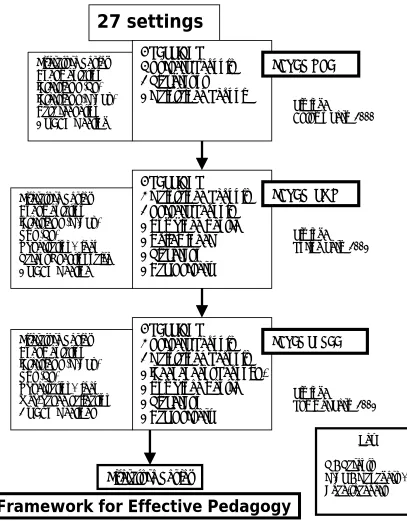
2.2 A three-layered approach has been used with 9 settings involved within each layer. The literature review and responses from the EAG contributed throughout the three layers. The overall design and conduct of the research is shown diagrammatically in Figure 6.
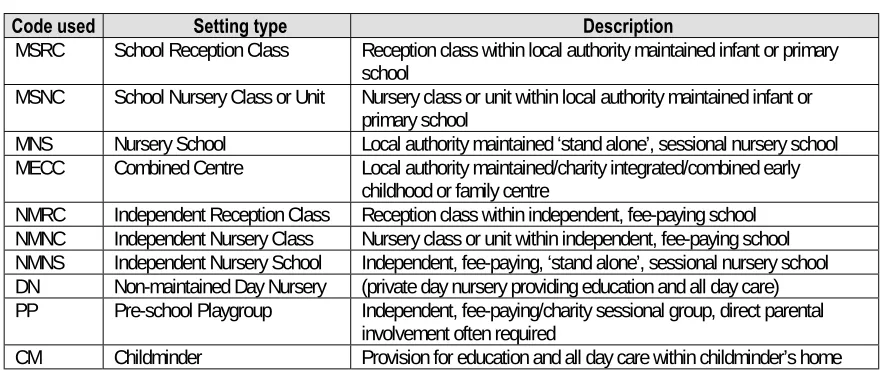
[image:17.595.83.525.528.713.2]2.3 A comprehensive list of potential types of providers was formulated by the research team (see Table 2a) so that the final selection of settings would include the widest variety of settings and practitioners as possible within the 27 case studies.
Table 2a – Potential types of providers
Code used Setting type Description
MSRC School Reception Class Reception class within local authority maintained infant or primary school
MSNC School Nursery Class or Unit Nursery class or unit within local authority maintained infant or primary school
MNS Nursery School Local authority maintained ‘stand alone’, sessional nursery school MECC Combined Centre Local authority maintained/charity integrated/combined early
childhood or family centre
NMRC Independent Reception Class Reception class within independent, fee-paying school NMNC Independent Nursery Class Nursery class or unit within independent, fee-paying school NMNS Independent Nursery School Independent, fee-paying, ‘stand alone’, sessional nursery school DN Non-maintained Day Nursery (private day nursery providing education and all day care) PP Pre-school Playgroup Independent, fee-paying/charity sessional group, direct parental
involvement often required
CM Childminder Provision for education and all day care within childminder’s home
web-based reports which gave a sufficiently broad geographical range and covered the different types of provision.
Figure 6: Diagrammatic representation of the research design and conduct
2.5 As effectiveness has the potential to differ according to the geographical location within England and to the type of setting and its community, it was decided to focus the sampling process
Literature Review
Literature ReviewDocumentation Interviews (Ps) Interviews (M/HTs) Data reduction 1 x EAG Meeting
27 settings
9 SETTINGS
6 Nursery Schools
2 Playgroups
1 Maintained School
LAYER ONE
9 SETTINGS
3 Maintained Schools
2 Nursery Schools
1 Combined Centre
1 Childminder
1 Playgroup
1 Day Nursery
LAYER TWO
9 SETTINGS
3 Nursery Schools
2 Maintained Schools
1 Independent School N.
1 Combined Centre
1 Playgroup
1 Day Nursery
LAYER THREE
Framework for Effective Pedagogy
Literature ReviewDocumentation Interviews (M/HTs) RDs (Ps)
Observation/Video Parent Questionnaire 1 x EAG Meeting
Literature Review Documentation Interviews (M/HTs) RDs (Ps)
Observation/Video Web-based validation 2 x EAG Meetings
Timing:
Autumn Term 2000
Timing:
Summer Term 2001 Timing:
Spring Term 2001
Key
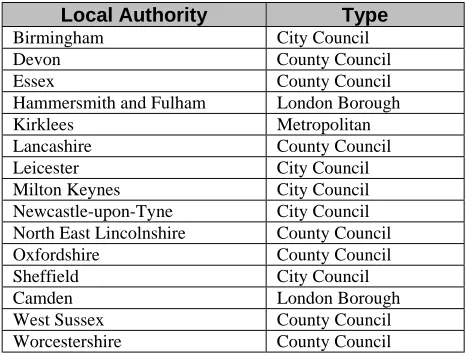
on local authorities (LAs) where personnel were known to the researchers and expressed an interest in their authority and Early Years Development and Childcare Partnership (EYDCP) being
[image:19.595.183.416.192.370.2]involved. This resulted in a spread of authorities across the north, south, east, west and central England, including two London Boroughs (see Table 2b).
Table 2b – Authorities involved in the SPEEL research
Local Authority Type
Birmingham City Council
Devon County Council
Essex County Council
Hammersmith and Fulham London Borough
Kirklees Metropolitan
Lancashire County Council
Leicester City Council
Milton Keynes City Council Newcastle-upon-Tyne City Council North East Lincolnshire County Council Oxfordshire County Council Sheffield City Council
Camden London Borough
West Sussex County Council Worcestershire County Council
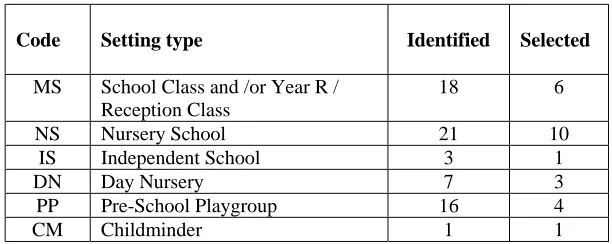
[image:19.595.93.500.507.749.2]2.6 Each authority member provided a list of up to six Foundation Stage settings which they had identified as having effective pedagogical practices (see Table 2c for selection criteria). It can be seen that OfSTED Reports are rated highly within the selection process. This compilation of settings resulted in 74being identified from which a sample of 27 (plus 3 reserves) was drawn which included all the main types of providers (see Table 2d).
Table 2c – Analysis of Criteria for Selection of settings by LA personnel
Criterion Number
Quality of teaching / learning 27
Good / excellent OfSTED inspection report 24
Strong leadership 22
Strong staff 21
Reflective practitioner 14
EEL Project involvement 11
Good Atmosphere, good outdoor facilities 10
Child-initiated /centred, good relationships between staff, good indoor facilities, high level of involvement of parents / carers
9
Good relationships with children, good professional development experiences, recommendation of peers/colleagues
8
Consistent approach to teaching and learning 5
Good level of community involvement, good local reputation, socio-economic mix 4 Good range of experiences, strength in Knowledge and Understanding, links with LEA,
Reggio Emilia practices, special education needs
3
Appropriate provision, assessment, Beacon School, good progress from low Baseline, High/Scope practices, how children learn, PSLA Scheme, progress made towards ELGs
2
Creative development, data analysis, DfEE Centre of Excellence, EYDCP programme, focus on gender issues, Greenshoots Project, High School links, Investors in People, involved in previous research, language development
1
Table 2d – 74 settings identified for effective practice by LA/Partnership
personnel
Code Setting type Identified Selected
MS School Class and /or Year R / Reception Class
18 6
NS Nursery School 21 10
IS Independent School 3 1
DN Day Nursery 7 3
PP Pre-School Playgroup 16 4
CM Childminder 1 1
2.7 These 27 settings were invited by letter and telephone call preceding each of the three layers to join the research. The settings were asked to provide background information on a range of characteristics including type, accommodation, length of session, numbers and qualifications of staff, numbers and ages of children (including those with special educational needs (SEN)) and information on socio-economic backgrounds and ethnicity of families. Over the three Layers of the research only two substitutions were necessary. Table 2e (next page) shows the final sample of 27 settings by type and distribution over the three layers.
2.8 The ‘layered’ approach to the research meant dividing the 27 settings into 3 groups of 9 and visiting one group of settings during each of the 3 terms covering the academic year 2000-2001. This was intended to enable the evolving Framework to be checked at each stage in its development with the next layer of practitioners and managers. As the data from each layer was very rich, this process became somewhat problematic as significant time was needed to transcribe, analyse and interpret data from each layer in order to present an acceptable draft to the next. To overcome this problem, we used partial elements from Layer 1 data for use in Layer 2 interviews with managers. Similarly, partial elements from Layer 2 data were used in Layer 3 interviews with managers/head-teachers (see Appendix B). Through this process, we were able to cover elements of both Practice and Principles effectively. Feedback on Professional Dimensions (not completed until the end of the Summer Term 2001) was achieved through the SPEEL web-site which was set up specifically to gain further evaluation and validation of the Framework in its final draft format (see Section 5, Table 5a for details).
2.9 Full day visits were made to the 9 settings in Layer 1 to gather basic practitioner-based data for the Framework. During Layers 2 and 3, two-day visits were made to settings during which interviews and Reflective Dialogues (RDs) were conducted. Observational video was taken on Day 1 with RDs undertaken on Day 2. Interviews with managers/head-teachers were conducted at times and in locations convenient to the individuals.
2.10 Basic informational data was gathered before, during and after each visit to give a
comprehensive picture of the settings and practitioners involved in the research. Whilst no attempt was made to identify effective practice in relation to particular setting or practitioner
Table 2e – Data on the sample of 27 effective settings involved in SPEEL research
TEACHING STAFF
QUALS AGES of children SEN of children No: LAYER TYPE
of Setting
HOURS each day
TYPE of
Accom-modation No. F-T P-T P1 P2 P3 3+ 4+ 5+ State-mented
Non- st’d
SOCIO-ECONOMIC BACKGROUND (%) of
parents
% ETHNIC ‘Minority’
Legend for Codes
SETTING TYPE ACCOMMODATION TYPE STAFF QUALIFICATION SOCIO-ECONOMIC BACKGROUND MS School Nursery/Year R/
Reception Class
PB Purpose built QT Qualified Teacher a. Professional
NS Nursery School H Hall NN Nursery Nurse (NNEB/BTEC) b. Skilled (non-manual) IS Independent School PC Portacabin DP Pre-School Practice Diploma c. Skilled (manual) CC Combined Centre CH Childminder's home N3 NVQ3 (EY Care/Ed) d. Semi/non-skilled DN Day Nursery CB Converted building N2 NVQ2 (EY Care/ Ed) e. Unemployed/Student PP Pre-School Playgroup OC Other Certs/short courses
The sample of practitioners
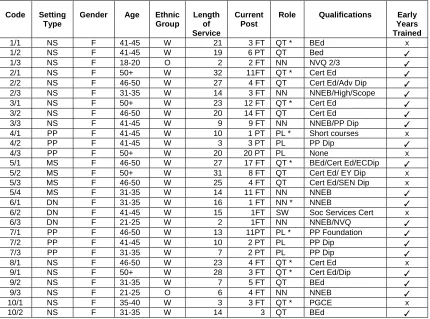
2.11 In all, 75 adult subjects were involved in the research (managers/head-teachers, heads of centres and practitioners). In the case of the childminder, she was both practitioner and manager. One other manager of a playgroup was also interviewed additionally as a practitioner. The anonymised biographical details of all 75 practitioners involved directly in the research are shown in Table 2f. It can be seen that the majority of these practitioners are female (only 3 males) and all but 4 practitioners categorised themselves as being ‘white’. As can be seen other factual
information can be extrapolated from Table 2f:
• 58 are early years (EY) trained (77%): 17 are not trained for this age group (23%)
• 47 of the managers and practitioners have qualified teacher status (63%)
• 16 of the managers and practitioners are trained as nursery nurses (21%)
• 9 managers/practitioners were Pre-School Learning Alliance (PLA trained) (12%)
• 6 have 30+ years length of service (8%); 22 have between 20-29 years (29%), 19 have 11-19 years (25%), and 16 have 5-10 yrs service (21%)
• 12 have less than 5 years of experience (16%)
• 4 managers/practitioners have higher degrees but interviews revealed that several more (not shown) are working towards these.
[image:23.595.78.508.432.751.2]The sample appears to contain rather more qualified teachers than the national average for this population. We conjecture that this may be the result of local authority and EYDCP personnel choosing the most effective settings/practitioners for involvement in the research.
Table 2f – Biographical details of practitioners directly involved with the
research
Code Setting
Type
Gender Age Ethnic
Group
Length of Service
Current Post
Role Qualifications Early
Years Trained
1/1 NS F 41-45 W 21 3 FT QT * BEd x
1/2 NS F 41-45 W 19 6 PT QT Bed ✓
1/3 NS F 18-20 O 2 2 FT NN NVQ 2/3 ✓
2/1 NS F 50+ W 32 11FT QT * Cert Ed ✓
2/2 NS F 46-50 W 27 4 FT QT Cert Ed/Adv Dip ✓
2/3 NS F 31-35 W 14 3 FT NN NNEB/High/Scope ✓
3/1 NS F 50+ W 23 12 FT QT * Cert Ed ✓
3/2 NS F 46-50 W 20 14 FT QT Cert Ed ✓
3/3 NS F 41-45 W 9 9 FT NN NNEB/PP Dip ✓
4/1 PP F 41-45 W 10 1 PT PL * Short courses x
4/2 PP F 41-45 W 3 3 PT PL PP Dip ✓
4/3 PP F 50+ W 20 20 PT PL None x
5/1 MS F 46-50 W 27 17 FT QT * BEd/Cert Ed/ECDip ✓
5/2 MS F 50+ W 31 8 FT QT Cert Ed/ EY Dip x
5/3 MS F 46-50 W 25 4 FT QT Cert Ed/SEN Dip x
5/4 MS F 31-35 W 14 11 FT NN NNEB ✓
6/1 DN F 31-35 W 16 1 FT NN * NNEB ✓
6/2 DN F 41-45 W 15 1FT SW Soc Services Cert x
6/3 DN F 21-25 W 2 1FT NN NNEB/NVQ ✓
7/1 PP F 46-50 W 13 11PT PL * PP Foundation ✓
7/2 PP F 41-45 W 10 2 PT PL PP Dip ✓
7/3 PP F 31-35 W 7 2 PT PL PP Dip ✓
8/1 NS F 46-50 W 23 4 FT QT * Cert Ed x
9/1 NS F 50+ W 28 3 FT QT * Cert Ed/Dip ✓
9/2 NS F 31-35 W 7 5 FT QT BEd ✓
9/3 NS F 21-25 O 6 4 FT NN NNEB ✓
10/1 NS F 35-40 W 3 3 FT QT * PGCE x
Code Setting Type
Gender Age Ethnic
Group Length of Service Current Post
Role Qualifications Early
Years Trained
10/3 NS F 46-50 W 24 12 QT Cert Ed ✓
11/1 MS F 50+ W 30 4 FT QT * Cert Ed x
11/2 MS F 26-30 W 4 4 FT QT PGCE ✓
11/3 MS M 41-45 W 2 1 FT TA NN Qualification x
12/1 CM F 31-35 W 7 3 FT CM * NNEB/CM accred ✓
12/1 CC F 41-45 W 22 2 FT QT * Bed/Dip/MA/D32-3 ✓
12/2 CC M 36-40 O 7 7 FT QT PGCE/MEd ✓
12/3 CC F 31-35 W 8 1 FT QT PGCE/MA x
13/1 MS F 41-45 W 21 21 FT QT * Cert Ed ✓
12/2 MS F 41-45 W 22 3 PT QT Cert Ed/BEd ✓
12/3 MS F 41-45 W 20 3 PT QT PGCE ✓
13/1 DN F 50+ W 12 8 FT QT * BEd/BA/PGCE/MEd ✓
13/2 DN F 21-25 W 1 1 FT NN NVQ3 ✓
13/3 DN F 21-25 W 3 3 FT NN NNEB ✓
14/1 PP F 31-35 W 9 5 FT QT * Cert Ed/NN Dip ✓
14/2 PP F 36-40 W 8 8 FT PL PP Dip ✓
14/3 PP F 41-45 W 4 1 PT NN NN Dip ✓
15/1 NS F 46-50 W 28 6 Ft QT * Cert Ed ✓
15/2 NS F 36-40 W 15 15 FT QT BEd/MEd ✓
15/3 NS F 41-45 W 23 23 FT NN NNEB ✓
16/1 MS M 41-45 W 20 5 FT QT * BEd x
16/2 MS F 31-35 W 11 4 FT QT BEd ✓
16/3 MS F 26-30 W 3 2 FT QT BEd/BA/MEd/Ma ✓
17/1 NS F 46-50 W 27 6 FT QT * Cert Ed/BSc ✓
17/2 NS F 50+ W 28 5 FT QT Cert Ed ✓
17/3 NS F 31-35 W 12 2 FT QT BEd ✓
18/1 IS F 50+ W 7 7 FT QT * Cert Ed x
18/2 IS F 50+ W 10 10 FT NN NNEB ✓
19/1 NS F 50+ W 17 6 FT QT Cert Ed/BEd/Dip ✓
19/2 NS F 41-45 W 24 3 FT QT Cert Ed ✓
20/1 CC F 50+ W 34 7 FT QT * Cert Ed/PP Dip ✓
20/2 CC F 31-35 W 6 6 FT QT Cert Ed ✓
20/3 CC F 21-25 O 4 2 FT NN NVQ 2/3 ✓
21/1 PP F 46-50 W 12 12 PT PL * PP Dip ✓
21/2 PP F 31-35 W 3 1 PT PL NNEB/Mont Dip ✓
22/1 NS F 50+ W 31 4 FT QT * Cert Ed/Dip ✓
22/2 NS F 36-40 W 5 5 FT QT PGCE ✓
22/3 NS F 31-35 W 12 2 FT QT BEd x
23/1 MS F 50+ W 30 11 FT QT * MA ✓
24/1 MS F 36-40 W 16 2 FT QT BEd ✓
25/1 MS F 41-45 W 8 3 FT NN BTEC ✓
26/1 DN F 31-35 W 16 11 FT NN * NNEB/D32/3 ✓
26/2 DN F 26-30 W 8 1 FT QT BEd/NNEB ✓
26/3 DN F 31-35 W 6 6 FT NN NVQ 2/3 ✓
27/1 MS F 41-45 W 24 13 FT QT * BEd/BA/MA/MEd x
27/2 MS F 41-45 W 21 10 FT QT Cert Ed x
27/3 MS F 26-30 W 6 6 FT QT PGCE x
Code – Practitioner Code Setting Type – MS School Nursery/Year R Role – QT Qualified Teacher
NS Nursery School NN Nursery Nurse IS Independent School PL Play Leader
✓ = early years trained . CC Combined Centre CM Childminder x = not early years trained DN Day Nursery TA Teaching Assistant PP Pre-School Playgroup SW Social Worker
CM Childminder * Setting Manager/Headteacher Ethnic Group – W White
O Other
The sample of children and families
occupation of the main householder was used, constructed from an alignment of three
[image:25.595.94.484.189.279.2]classifications. Table 2g shows the socio-economic background as a percentage across the three layers in accordance with this classification. (N.B. data were not held for two of the settings.)
Table 2g –
Socio-economic background of children in settings across the
three layers as a percentage of the total
Layer 1
(9 of 9 settings) (8 of 9 settings) Layer 2 (8 of 9 settings) Layer 3 Average over 3 Layers
Professional 20% 34% 41% 32% Skilled (non-manual) 14% 12% 21% 16% Skilled (manual) 16% 12% 15% 14% Semi/non-skilled 26% 20% 8% 18% Unemployed/Student 24% 22% 15% 20%
2.13 Managers/head-teachers indicated the proportion of Foundation Stage children in
attendance whose parents were described as having minority ethnic backgrounds. Classification of ethnic minority was based on the annual Schools’ Census (Form 7) for January 1999. Table 2h shows settings grouped according to the percentage of minority ethnic children in attendance across the three layers. The percentage shown is of children/families described as ‘other than White UK Heritage, White European or White Other’. In all three layers settings involved in the fieldwork varied according to the number of minority ethnic children. There appeared to be a reasonable spread for the purposes of this research. Overall, just over half of the settings had between 1% and 10% minority children, four settings had no minority ethnic children, four settings had between 11% and 50% and four settings had over 50% minority ethnic children. Of the latter, two settings had over 90% minority ethnic children.
Table 2h – The percentage of ethnic minority children in settings across the
three layers
Number of Settings % Minority Ethnic
Children
Layer 1 Layer 2 Layer 3
Total over 3 Layers
0% - 2 2 4
1%-10% 5 5 5 15
11%-20% - - -
21%-30% 1 - 1
31%-40% 1 1 -
41%-50% - - -
4
51%-60% 1 1 -
61%-70% - - -
71%-80% - - -
81%-90% - - -
91%-100% 1 1
4
Accommodation in which settings were housed
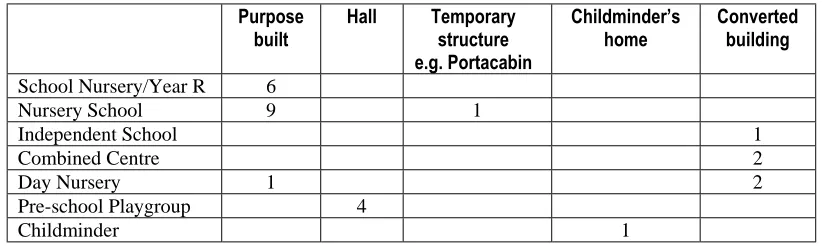
[image:25.595.134.467.508.677.2]environment on a daily basis, which they noted had a significant effect on the type of equipment which they were able to set up, e.g. computers and other ICT equipment and the pedagogy
[image:26.595.98.509.173.296.2]surrounding them. Similarly, converted buildings were also noted as having an effect on pedagogy.
Table 2i – Type of accommodation by setting
Purpose
built Hall Temporary structure e.g. Portacabin
Childminder’s
home Converted building
School Nursery/Year R 6
Nursery School 9 1
Independent School 1
Combined Centre 2
Day Nursery 1 2
Pre-school Playgroup 4
Childminder 1
2.15 In the original proposal, we had intended to video a number of target children who had been identified by practitioners as covering a range of capabilities and needs within the setting. These children would be selected from the records kept by the settings, the intention being to monitor how individual needs are handled by practitioners on a daily basis and how effective practitioners’ monitor and record individuals’ progress. It was felt that it may then have been possible to observe the practitioner in action with these children and develop a clearer perception of what constituted effective intervention. We were ultimately unable to take this approach because it was quickly recognised that:
• longer duration visits would have been needed for appropriate tracking of individual children and the conduct of video stimulated reflective dialogues with practitioners;
• in sessional contexts, individual children actually being present in the setting on the days of the visits was going to be hard to predict and impossible to control; • the sensitive nature of this type of information meant that we would need the
full co-operation of parents, and this was likely to extend the time-scale for each visit. Clearly this was not possible in a project of this short duration.
2.16 It also became apparent, through the earlier research in both Layers 1 and 2, and the collection of documentation that, whilst in some settings extensive individual records were kept, in others record-keeping was very minimal. Early video observation also revealed that, although practitioners were able orally to identify children with specific needs, in the name of ‘treating all children the same’ little by way of differentiated practice appeared to occur in most settings. Records tended to be summative rather than formative and few settings appeared to use their records for overtly planning progressive experiences to meet individual children’s identified needs. (We would venture that this warrants further investigation as there may be less overt practices being pursued which were not evident in our visits.)
Research Methods
2.17 Audio-taped interviews were conducted with all 27 settings’ managers/head-teachers which ranged in duration from 1-hour to well over 2-hours. (The Layer 1 Interview Schedules are shown in Appendix A and the Layers 2 and 3 in Appendix B). This has resulted in some 63.5 hours of transcribed interviews. In at least a quarter of the settings, managers/head-teachers sought further opportunities to give information and to share thoughts with the visiting researcher.
2.18 In Layer 1, two practitioners were interviewed in each of the settings (n=18) to establish their perceptions of effective pedagogy (see Appendix A). These audio-taped interviews similarly lasted between 1- and 2-hours and some 28 hours were transcribed and analysed.
2.19 All interviews from Layer 1 resulted in substantial information being extrapolated on all interviewees’ perceptions of effective early years pedagogy, which formed the basis of the initial draft Framework.
Reflective Dialogues and Video Observation
2.20 Reflective Dialogues were used in both Layer 2 and Layer 3 settings (the original proposal suggested that RDs would only occur in Layer 3). This change was made to facilitate deeper exploration of effectiveness issues with practitioners earlier in the research as it was recognised from Layer 1 interviews that many practitioners were finding it extremely difficult to articulate in standard, semi-structured interview situations, their knowledge and understanding of effective practice. It was decided that by having video of their own practice immediately to hand, and as a focus of ‘friendly’ dialogue, practitioners would be encouraged to explore their practice more freely and deeply, and from different perspectives (see conceptual paper in Appendix C(i)). Practitioners were given prior information about the purposes and nature of the RD process via a personal letter (see Appendix C(ii)).
2.21 On Day 1 of both Layers 2 and 3 visits, practitioners decided upon 20 minutes or thereabout of effective practice which they would like the researcher to video. This produced around 16 hours of video observation data across the two Layers. Digital cameras were used by two of the three researchers and a small camcorder was used by the third. In order to reduce observer bias, the camera was focused on the practitioner and filming moved to children only where the practitioner was in direct interaction with the children (see Prosser 1999). The practitioner then took the video away for ‘private’ viewing alongside a pre-prepared paper identifying the types of questions s/he might wish to think about regarding their practice during viewing (see Appendix C(iii)). Researchers were also able to view the video independently. On the second day of the visit, time was set aside for the research-partners (practitioner and researcher) to view the video together, share their perceptions of effective practice and challenge the observed practice. In Layer 3, particular prompts were added in relation to the ‘DfES 5 areas’ (see Section 1) as these were otherwise rarely seen and, therefore, rarely discussed.
2.22 Because the cameras were small and unobtrusive, filming could be undertaken discretely and few children or practitioners showed overt awareness of the camera. The potential use of radio microphones was limited in a wide number of settings because of the physical circumstances under which they operate. The use of microphones would also have meant time spent acclimatising both children and practitioners to the equipment at the expense of other forms of data collection
considered more beneficial to the development of the Framework. For this reason, whilst still photographs can be extracted from the video for use in exemplifying the Framework (see Section 4), the videos lack sufficient aural clarity to be used more widely.
There was a ‘settling down’ period at the start of the session in which parents and children were welcomed and practitioners chatted with parents about a variety of current issues that took most of the first half-hour. Snack-time occupied at least a further half-hour in the middle of the session and story time often took yet another significant period of time towards the end of the session. This ‘bitty’ nature of sessions meant that filming often occurred in snatched moments when the practitioner indicated that s/he was going to undertake activities with the children.
2.24 Additionally, it was felt that, as practitioners were to watch the video in their own time over the course of one evening, it was too much to expect that they would watch a whole hour of video. In fact, as many practitioners watched the video several times to highlight aspects of their practice for discussion with the research-partner the following day, an hour’s video could have meant several hours being spent on that activity which could have alienated practitioners from the RD process. In all, approximately 16 hours of video became available for analysis.
Parent Questionnaire
2.25 An original intention was to interview parents during Layer 3 data collection to gauge their views on the final draft Framework. However, an interesting set of findings from Layer 1 data analysis revealed a majority of practitioners felt very strongly about their role in supporting families and in working in partnership with parents. We felt the need to establish earlier than planned whether parents substantiated this perception so that relevant inclusions were made to early drafts of the Framework. It was decided that the views of parents should be gathered through a questionnaire to be distributed by all Layer 2 settings to FS parents. It was still hoped to
interview at least a small number of parents from Layer 3 settings, but the manager/headteacher interviews in Layer 3 proved very lengthy given that they had so many informative (and positive) things to share regarding the draft Framework and time became an inhibitive factor.
2.26 A questionnaire was designed to be distributed to all Foundation Stage parents in the nine Layer 2 settings (n=527 parents) – see Appendix E. It was distributed to settings two weeks prior to visits on estimated numbers of (FS) parents provided by managers/head-teachers. 213
questionnaires were returned, giving a response rate of 41%. This is an acceptable level in educational research (Oppenheim 1992). Of these, 15 responses were from fathers and 198 from mothers. There was known ‘wastage’ in terms of distribution by settings, mainly related to misunderstanding by some settings that all parents – rather than FS-only parents – were to be surveyed and, therefore, only around 80% of the original 527 questionnaires were distributed. A recalculated response rate (based on a distribution of c.400) would be nearer 53.5% returns.
2.27 Questions were designed to include 18 statements which would confirm, or otherwise, the emerging views of practitioners and managers/head-teachers from Layer 1 data analysis of the importance of close links and relationships with parents for effective pedagogy to be taking place, with 3 further open-ended questions (see Section 3).
Documentary Analysis
2.28 A range of documents was collected from settings (see Table 2j) with the intention of identifying other aspects of practice that may not be apparent within interviews and reflective dialogues. This proved to be so, in that the main Areas of Focus under the heading Principles, were manifest in the documentation, which often described the ethos of the setting and the rationale for its practices, both of which informed the ‘Principles’. For example, aims for practitioners often included:
• To provide a safe environment in which each child can learn, explore and develop;
• To encourage independence and plan wide range of educational play activities;
• To develop a two-way partnership that benefits parent, child and teacher.
Other principles evident in the documentation included:
• Build on what children already know and can do;
• Great emphasis placed upon learning through play;
• Teaching approach can then be designed for the child being aware of each child’s individual needs, interests and preferred learning styles;
• Curriculum being child-centred encouraging self-respect and a positive self-image;
• Promotes the necessary skills to enable individuals to play an effective part in building more just and peaceful relationships, encouraging co-operation and consideration towards others;
• Philosophy to have a positive outlook on gender, race, additional educational need and discipline … a wish to eliminate stereotyping and bias in resources and own practice.
The documentation also proved useful in identifying the diversity of record-keeping practices.
Literature Review
2.29 Using book- and web-based sources both national and international, a literature review was commenced early in the project. Initially, we trawled all the literature relating to early years practice, philosophy, principles and teacher perceptions (using an earlier version of Diagram A as our overall model). Gradually, as the Model was reviewed and revised, the literature review become more focused on the three Areas of Focus shown in Diagram A. The full literature review related directly to the Framework is included in Section 6.
Ethics
2.30 The ethical conduct of the research was carefully conceived and at each stage all
Table 2j – Documentation gathered from 27 settings
1 NS 2 NS 3 NS 4 PP 5 MS 6 DN 7 PP 8 NS 9 NS 10 NS 11 MS 12 CM 13 CC 14 MS 15 DN 16 PP 17 NS 18 MS 19 NS 20 IS 21 NS 22 CC 23 PP 24 NS 25 MS 26 DN 27 MSPlanning ✓ ✓ ✓ ✓ ✓ ✓ ✓ ✓ ✓ ✓ ✓ ✓ ✓ ✓ ✓ ✓
Curriculum planning ✓ ✓ ✓ ✓ ✓ ✓ ✓ ✓ ✓ ✓ ✓ ✓ ✓ ✓ ✓
Mission statement/aims ✓ ✓ ✓ ✓ ✓ ✓ ✓ ✓ ✓ ✓ ✓ ✓ ✓ ✓ ✓
OfSTED summary ✓ ✓ ✓ ✓ ✓ ✓ ✓ ✓ ✓ ✓ ✓ ✓ ✓ ✓ ✓ ✓ ✓ ✓ ✓ ✓
Evaluation ✓ ✓ ✓ ✓ ✓ ✓ ✓ ✓
Information for parents ✓ ✓ ✓ ✓ ✓ ✓ ✓ ✓ ✓ ✓ ✓ ✓ ✓ ✓ ✓ ✓ ✓ ✓ ✓ ✓ ✓ ✓
Individual records of children
✓ ✓ ✓ ✓ ✓ ✓ ✓ ✓ ✓ ✓ ✓ ✓ ✓ ✓
Records of observations ✓ ✓ ✓ ✓ ✓ ✓ ✓ ✓ ✓
Records of reporting ✓ ✓ ✓ ✓ ✓ ✓ ✓ ✓ ✓
Child profiles ✓ ✓ ✓ ✓ ✓ ✓ ✓ ✓ ✓
Teaching and learning policy
✓ ✓ ✓ ✓ ✓ ✓ ✓ ✓ ✓ ✓
Planning policy ✓ ✓ ✓ ✓ ✓ ✓
Curriculum areas policy ✓ ✓ ✓ ✓ ✓ ✓ ✓ ✓ ✓ ✓ ✓ ✓ ✓
Outdoor policy ✓ ✓ ✓ ✓ ✓ ✓ ✓ ✓ ✓
Play policy ✓ ✓ ✓ ✓ ✓ ✓
Assessment policy ✓ ✓ ✓ ✓ ✓ ✓ ✓ ✓
Record keeping policy ✓ ✓ ✓ ✓ ✓ ✓ ✓
SEN policy ✓ ✓ ✓ ✓ ✓ ✓ ✓ ✓ ✓ ✓ ✓ ✓ ✓ ✓ ✓ ✓
Equal Opportunities policy
✓ ✓ ✓ ✓ ✓ ✓ ✓ ✓ ✓ ✓ ✓ ✓ ✓ ✓ ✓ ✓ ✓
Settling in/home visits policy
✓ ✓ ✓ ✓ ✓ ✓ ✓ ✓ ✓ ✓ ✓ ✓ ✓
Parental involvement policy
✓ ✓ ✓ ✓ ✓ ✓ ✓ ✓ ✓ ✓ ✓
Behaviour policy ✓ ✓ ✓ ✓ ✓ ✓ ✓ ✓ ✓ ✓ ✓ ✓ ✓
Monitoring and evaluation policy
✓
ICT development plan ✓
Job descriptions ✓ ✓ ✓ ✓ ✓ ✓ ✓ ✓
SECTION 3
Analysis of Data and
Source of Framework
SECTION THREE
Analysis of Data and Source of Framework Key
Statements
In this Section we outline the various stages in the process of handling and analysing the data gathered through the interviews, questionnaires, reflective dialogues, documentation and literature review. It is presented according to the Layers within which different data were obtained.
Layer One
3.1 Tape-recorded interviews with practitioners (n=18) and with managers/head-teachers (n=9) resulted in approximately 47 hours of transcription which included a plethora of data about what constitutes effective pedagogy and the characteristics of the effective pedagogue. Initially we used manual coding of the statements and phrases under the headings Pedagogy (general ideas), Characteristics, Skills and Knowledge. Appendix D(i) shows two examples of this type of analysis. This strategy began the process of extracting relevant information for the initial draft of the Framework. The categories appeared to overlap considerably and much discussion occurred between the researchers and the EAG as to other potential categories which could result from the transcription data. For example, pedagogy and characteristics were ‘catch all’ categories at this point.
3.2 A further review of the transcriptions revealed that many of the statements extracted and coded related to pedagogical practice, provision and management of activities and resources. This seemed to be the largest category. Typically, practitioners spoke of effectiveness as being related to the way they:
‘present activities in a stimulating way’, ‘manage children's learning’
‘use play as a vehicle for learning’
‘make equal provision for indoor/outdoor classroom’ ‘share knowledge of individual children with parents’.
3.3 As ‘Practice’ was the dominant and overwhelming theme, this was the first Area of Focus to be developed from Layer One. The Practice-level overview chart is shown in Figure 7. The initial Practice-level detailed statements are shown in Appendix D(ii).
3.4 The refining process also involved the transfer of transcriptions to Nud*Ist (1997), a software tool through which the researcher is able to manage documents by creating and exploring categories within the data. It is first necessary to establish categories as we had previously done. Through the additional capacity of Nud*Ist, we were able continually to add to the evolving categories, comparing at each stage, until they became saturated (see 3.15 to 3.18 below). During this process it emerged that there were certain features we were in danger of neglecting in our original categorisation.
3.5 Amalgamation of other statements and phrases used by practitioners suggested that Practice was affected by the ways in which practitioners perceive themselves as effective pedagogues, how they reflect on that role and what they understand by their role, for example:
‘ability to set standards for children/staff’
‘accurately interpret children's outcomes/expressions’ ‘understanding of how children acquire knowledge and skills’ ‘knowing and using knowledge about child development’ ‘ability to articulate own practice’
EVALUATION (E)
Evaluation of and reflection about quality of practice and provision
i. Evaluating the quality of the learning environment ii. Evaluating the provision of learning opportunities iii. Evaluating organisation and management iv. Evaluating quality of teaching
v. Developing reflective/reflexive practice vi. Developing practice
TEACHING (T)
The ways in which practitioners teach children (practitioners doing rather than providing)
i. Teaching skills and knowledge directly ii. Teaching through modelling behaviour iii. Teaching through interacting with children iv. Teaching through scaffolding
v. Teaching through communicating vi. Teaching through giving children feedback vii. Teaching through questioning
viii. Teaching through intervening
ix. Teaching through responding to children x. Motivating children and fostering their interests xi. Encouraging children’s enquiry
xii. Encouraging children to think about their learning
CREATING THE LEARNING ENVIRONMENT (CLE)
The ways in which practitioners provide for children’s learning (rather than what
practitioners provide, as that is the curriculum)
i. Providing a positive learning atmosphere
ii. Providing an environment which is conducive to learning iii. Balancing care and education
iv. Providing for children as individuals
v. Providing learning opportunities that challenge children appropriately vi. Providing opportunities for active exploration
vii. Providing a balance and variety of activities viii. Grouping children
ix. Positioning adults
x. Providing opportunities to promote children’s personal, social and emotional development xi. Providing opportunities to promote children’s communication, language and literacy development xii. Providing opportunities to promote children’s mathematical development
xiii. Providing opportunities to promote children’s knowledge and understanding of the world xiv. Providing opportunities to promote children’s physical development
xv. Providing opportunities to promote children’s creative development
ASSESSMENT (A)
The what and how of assessment activity
i. Planning assessment opportunities ii. Assessing children
iii. Assessing activities
iv. Using assessment to plan next steps v. Setting targets based on assessment
vi. Developing and maintaining records based on assessment vii. Sharing information gained from assessment
COLLABORATION (C)
Collaborative practice with children, their families, the team and with others
Collaboration with Children:
i. Supporting and working alongside children
ii. Supporting children to lead and make decisions about their own learning iii. Supporting children’s thinking and reflection collaboratively
iv. Supporting children’s communication collaboratively v. Using what the child brings
vi. Teaching children to listen to others and value what they say vii. Teaching children to share
viii. Teaching children to co-operate and work with others Collaboration with Families:
ix. Establishing relationships with parents x. Working in partnership with parents
xi. Establishing good communication links with parents xii. Supporting parents
Collaboration with Team:
xiii. Supporting effective teamwork through communication with each other xiv. Supporting effective teamwork through involvement
xv. Supporting effective teamwork through shared practice xvi. Supporting effective teamwork through shared sense of purpose xvii. Supporting effective teamwork through good relationships xviii. Demonstrating collaborative teamwork
Collaboration with Others:
xix. Establishing good working relationships with other agencies xx. Establishing good working relationships with receiving schools xxi. Establishing links with other settings in the partnership xxii. Establishing links with the community
[image:34.595.83.767.74.525.2]SPEEL Framework ~ Practice Level
Overview showing Areas of Focus
3.6 When practitioners were speaking of their practices and their own knowledge and understanding, it became evident that they were also steeped in underlying principles and
philosophies/theories upon which they based the activities, for example:
‘all children should be valued as individuals’ (principle)
‘you have to start from the child’ (principle)
‘it’s vital to have respect for the child and the family’ (principle)
‘we do things the Reggio / High/Scope way here’ (philosophy/theory)
‘we try to scaffold children’s learning’ (philosophy/theory)
A very few practitioners mentioned, for example, specific theorists such as Piaget or Bruner but the underlying notions of learning theories such as behaviourism, constructivism or multiple
intelligences were apparent and it seemed, at this early stage of the research, that they may be very significant as underpinning knowledge through which practitioners provided for children’s learning and developed their own practices. However, practitioners expressed themselves in very different ways according to their training, backgrounds, beliefs and priorities and we were intent upon categories to whi