1
Assessment of Operability and Maintainability Success Factors
in Provision of Extended Constructability Principles
Ehsan Saghatforoush
1, Bambang Trigunarsyah
2, Eric Too
31- PhD Candidate, Faculty of Built Environment and Engineering, Queensland University of Technology, Brisbane, Australia
2- Assoc. Prof., Faculty of Built Environment and Engineering, Queensland University of Technology, Brisbane, Australia
3- Lecturer, Faculty of Built Environment and Engineering, Queensland University of Technology, Brisbane, Australia
Abstract
The concept of constructability integrates individual construction functions and experiences through suitable and timely inputs into early stages of project planning and design. It aims to ease construction processes for a more effective and efficient achievement of overall project objectives. Similarly, the concepts of operability and maintainability integrate the functions and experiences of Operation and Maintenance (O&M) into project planning and design. Various studies suggested that these concepts have been implemented in isolation of each other and thus preventing optimum result in delivering infrastructure projects. This paper explores the integration of these three concepts in order to maximize the benefits of their implementation. It reviews the literature to identify the main O&M concerns, and assesses their association with constructability principles. This provides a structure to develop an extended constructability model that includes O&M concerns. It is anticipated that an extended constructability model that include O&M considerations can lead to a more efficient and effective delivery of infrastructure projects.
Keywords: Constructability, Operability, Maintainability, Infrastructure Projects, Success Factors
1.
INTRODUCTION
Successful delivery of an infrastructure project requires project stakeholders’ involvement in the whole project life cycle from planning, designing and constructing, as well as operating and maintaining. Constructability concept plays an important role in minimising construction related issues and problems; whilst different models have been proposed to optimize Operation and Maintenance (O&M) issues [1-6]. A well designed project should result in meeting all project stakeholders’ needs during construction stage, as well as O&M stages [7]. Plockmeyer [8] suggested that it is more important for owners to conduct post-occupancy assessments into planning and design phases in order to increase effectiveness of their construction programs. However, current operability and maintainability models have not explicitly addressed and integrated all the issues during the O&M phases. To address the concerns of project stakeholders, there is a need to explore an integrated model that considers issues throughout the whole project life cycle. This paper aims to extend the concept of constructability and develop an integrated model that includes operability and maintainability. Following this introduction, this paper is organized in the following manner: Next section will examine the need to extend the constructability principles. This is followed by the identification of the O&M issues and development of a preliminary extended construability model. These issues form the basis for the development of proposed extended constructability model that can be used in infrastructure projects.
2.
CONSTRUCTABILITY PRINCIPLES: THE NEED FOR EXTENSION
Constructability/Buildability is a term widely used in many construction projects around the world. Construction Industry Institute [9], the pioneer of this concept, defines it as “the optimum use of construction knowledge and experience in the conceptual planning, detailed engineering, procurement and field operations phases to achieve the overall project objectives”.
2
sixteen design principles [16]. Construction Industry Institute-CII in the United States extends these principles to seventeen by giving more attention to owners’ viewpoints [17]. Construction Industry Institute of Australia-CIIA [18] , as the pioneer of studying constructability concept in Australia develops constructability concept into 12 detailed principles in collaboration with CII. These principles are designed based on a series of local case studies over 25 to 30 years. These 12 principles include: (1) Integration, (2) Construction knowledge, (3) Team skills, (4) Corporate objectives, (5) Available resources, (6) External factors, (7) Program, (8) Construction methodology, (9) Accessibility, (10) Specifications, (11) Construction innovation, and (12) Feedback [19]. Review of literature shows that implementation of these principles have resulted in more efficient planning, enhanced procurement, more effective design, easier construction methods, improved site management, stronger team working, job satisfaction and higher performance for Australian construction projects.
An infrastructure project should be designed to be fitted for its final use. Planners and designers should understand how the final project will look like and what its ultimate purposes are [20]. This is the focus of the concept of operability. It aims to ease the operation phase and fits the project for its intended use. In a similar vein, maintenance of infrastructures increases the life of infrastructure assets [21, 22]. Maintainability concept is concerned with the ease of maintenance of the projects by bringing experience of the possible maintenance concern and issues during the planning stage. In fact, research suggest that these two phases collectively contributed around 50% to 80% of the total life cycle costs [23]. This suggests that the O&M stakeholders have potential to contribute to the project objectives by bringing their experiences and knowledge in the early design and planning stages.
In brief, constructability, operability and maintainability are the concepts that can lead to successful delivery of infrastructure projects [7]. However they have been implemented separately, isolated from each other. Constructability focuses only on ease of construction phase; operability concentrates on omitting reworks and problems during the operation phase; and maintainability is more concern on making PLC longer by eliminating the failures during the maintenance phase. Geile [24] argues that by early understanding and identifying the needs of people who are responsible for check-out, start-up, operation and maintenance, many savings can be realised. The lack of integration throughout the PLC phases shows that there is an urgent need for a model that can prevent, or at least reduce it as much as possible [25]. This research seeks to bridge this gap by examining how the three distinct yet interrelated concepts can be integrated to deliver an optimum outcome for infrastructure delivery. To do so, having a deep understanding of the current O&M problems and their association with the available constructability principles is necessary. These O&M issues can serve as a foundation for the development of an integrated model.
3.
O&M PROBLEMS/CAUSES: ASSICIATION WITH THE CONSTRUCTABILITY
PRINCIPLES
[image:2.595.144.485.582.752.2]Complex designs and services have always been a major issue confronting O&M practitioner [26]. It can have impact on buildings, their finishes, fittings, contents and services [26]. To overcome the complexity, Lateef [27] suggested the need for proper planning, managing and systematizing critical issues. O&M problems are not only limited to complexity of the designs and planning, but many other issues are also reported by significant number of researchers and practitioners from all over the world. In order to extend the constructability principles to incorporate O&M considerations, it is important to identify the major causes of current O&M issues. Saghatforoush et al. [25] categorised these issues and their causes in five categories namely (1) Technical, (2) Managerial, (3) Political and legal, (4) Environmental and biological, and (5) Social and cultural. Figure 1 illustrates these five categories.
3
The following sub-sections describe these operability and maintainability issues and their probable association with the latest available constructability principles.
Technical Factors
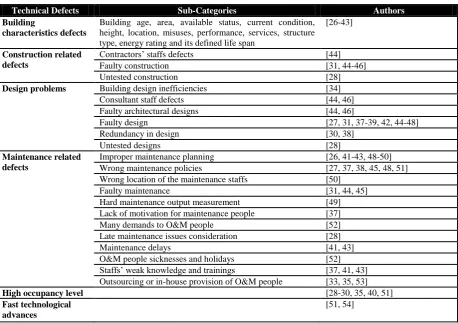
Technical factors are significant sources of critical and expensive reworks during O&M phases of infrastructure projects. Table 1 represents a list of technical defects, available in different types of infrastructure projects.
[image:3.595.83.542.334.657.2]Building characteristics and design defects mostly arise the need for extension of initial three principles of integration, construction knowledge and team skills, whilst construction related issues occurs because construction knowledge and methodologies extremely need to be O&M oriented. Maintenance related issues strongly state that maintainability review sessions need to be an integral part of the project plan, exactly the same as constructability program. Getting to know corporate objectives of clients can also affect better maintenance implementation. In order to do so, using maintenance people’s skills and knowledge at early stages of feasibility studies or conceptual design can have significant influences on decreasing the number of maintenance people’s problems and mistakes. Having a realistic and O&M sensitive program for the entire project can reduce amount of reworks resulted from high occupancy level and fast technological advances in the projects. As another approach, using innovative O&M ideas can also overcome their influences on achievement of total project objectives.
Table 1: Technical Factors
Technical Defects Sub-Categories Authors
Building
characteristics defects
Building age, area, available status, current condition, height, location, misuses, performance, services, structure type, energy rating and its defined life span
[26-43]
Construction related defects
Contractors’ staffs defects [44]
Faulty construction [31, 44-46]
Untested construction [28]
Design problems Building design inefficiencies [34]
Consultant staff defects [44, 46]
Faulty architectural designs [44, 46]
Faulty design [27, 31, 37-39, 42, 44-48]
Redundancy in design [30, 38]
Untested designs [28]
Maintenance related defects
Improper maintenance planning [26, 41-43, 48-50] Wrong maintenance policies [27, 37, 38, 45, 48, 51] Wrong location of the maintenance staffs [50]
Faulty maintenance [31, 44, 45]
Hard maintenance output measurement [49] Lack of motivation for maintenance people [37]
Many demands to O&M people [52]
Late maintenance issues consideration [28]
Maintenance delays [41, 43]
O&M people sicknesses and holidays [52] Staffs’ weak knowledge and trainings [37, 41, 43] Outsourcing or in-house provision of O&M people [33, 35, 53]
High occupancy level [28-30, 35, 40, 51]
Fast technological advances
[51, 54]
Managerial Factors
4
[image:4.595.75.545.207.434.2]Resolving project management failures strongly needs consideration of O&M people’s concerns. They can be grouped as external factors which can significantly affect project plans and must be considered in final extended constructability model. After that, economical and financial problems get critical when project planning underestimates O&M phases’ costs. It shows that the principle of programming is so important to be O&M sensitive, as well as covering construction phase. Having efficiency in developing project specifications might also enhance economical and financial aspects of operability and maintainability implementation. Then, a detailed planning and design is needed in order to analyse available resources for a more efficient operability and maintainability implementation. It helps for a more beneficial management of resources based on clients’ real needs.
Table 2: Managerial Factors
Managerial Defects Sub-Categories Authors
Project management defects
Incomplete construction documents [36]
Interdepartmental boundaries [41]
Late sustainability issues consideration [38]
Organizational constraints [26]
Poor relationship and communication [26, 37, 46]
Site management problems [37]
Unclear decision making process [28, 41] Lack of time: Including uncertainty in needed time,
time pressures, and repair time distribution defects
[26, 36, 37, 49]
Economical and financial defects
Low budget: Including low capital costs/expensive maintenance costs, upward trending maintenance costs, low maintenance cost estimating, and cost implication of delaying repairs
[27, 29, 30, 32, 34, 36-38, 41-43, 45, 49, 51, 54]
Unsustainable market condition [34]
Resource
management defects
Equipments and materials defects [37, 43-45] Human resources problems: Including poor
workmanship, manpower requirements failures, low work execution level and human aspects’ failures
[26, 27, 29, 37, 41, 43-45, 47]
Resources and materials limitations [27-29, 33, 35, 40, 47-49, 51-53]
Political and Legal Factors
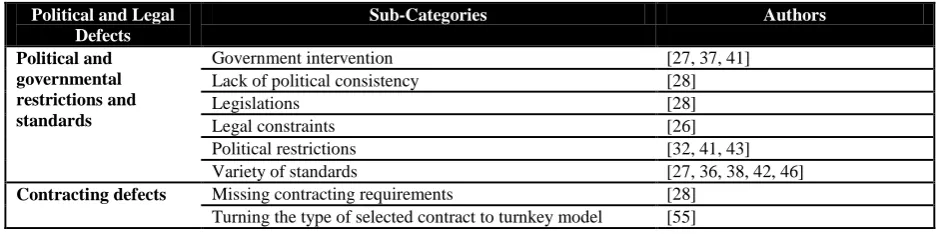
The political and legal factors are illustrated in Table 3. These factors include either political or governmental restrictions/standards, and contracting defects. They cause similar problems for O&M stakeholders of infrastructure projects, which result in an inefficient and ineffective management process. Both political and legal factors seem to be among external factors which are often forgotten to be concerned during planning and programming of the projects. So extending CIIA constructability principle of external factors to concern about political, legal and governmental restrictions is supposed to be a solution for this hidden problem.
Table 3: Political and Legal Factors
Political and Legal Defects
Sub-Categories Authors
Political and governmental restrictions and standards
Government intervention [27, 37, 41]
Lack of political consistency [28]
Legislations [28]
Legal constraints [26]
Political restrictions [32, 41, 43]
Variety of standards [27, 36, 38, 42, 46]
Contracting defects Missing contracting requirements [28]
Turning the type of selected contract to turnkey model [55]
Environmental and Biological Factors
[image:4.595.77.547.581.698.2]5
[image:5.595.78.543.431.605.2]Integration of maintenance people with feasibility and planning staff, using maintenance people’s knowledge and integration of their skills with other project stakeholders can make significant changes in current environmental and biological situation of the projects. Environmental defects are also among those external factors that need to be considered in extended CIIA constructability model. A wider programming is needed in order to include environmental factors, as well as others. Review of O&M people’s feedbacks on environmental and biological factors of a project might also be a good way of resolving their negative influences on achievement of total project objectives, as well as facilitating an easier and smoother successful delivery of the project.
Table 4: Environmental and Biological Factors
Environmental and Biological Defects
Sub-Categories Authors
Biological defects [46]
Environmental defects Degradation [47]
Environmental friendliness constraints [29]
Indoor and outdoor environmental changes [37, 39, 44-48]
Social and Cultural Factors
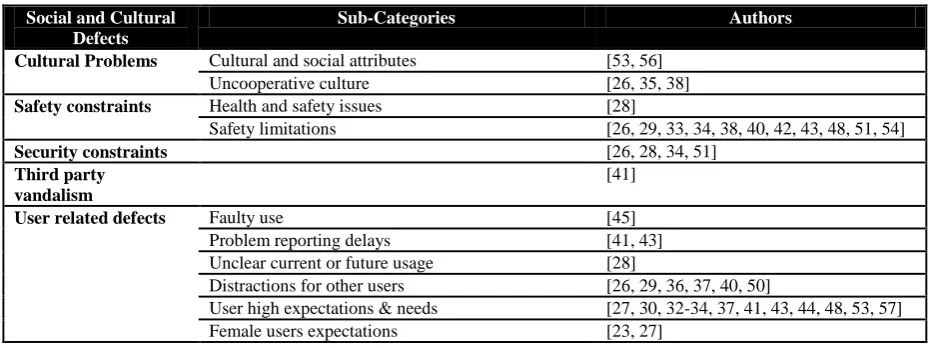
Safety and security of end-users have been two major critical issues for O&M people for many years. They are the skeleton of other social and cultural defects which are stated in different literature. Table 5 represents a list of different social and cultural factors having direct influence on operability and maintainability implementation process.
Having safety and security review sessions at initial stages of PLC can be an effective method for better project planning. Consideration of both users’ corporate objectives and project aims at the same time is another important issue whichshould be considered in extension of CIIA constructability principles.
Table 5: Social and Cultural Factors
Social and Cultural Defects
Sub-Categories Authors
Cultural Problems Cultural and social attributes [53, 56]
Uncooperative culture [26, 35, 38]
Safety constraints Health and safety issues [28]
Safety limitations [26, 29, 33, 34, 38, 40, 42, 43, 48, 51, 54]
Security constraints [26, 28, 34, 51]
Third party vandalism
[41]
User related defects Faulty use [45]
Problem reporting delays [41, 43]
Unclear current or future usage [28]
Distractions for other users [26, 29, 36, 37, 40, 50]
User high expectations & needs [27, 30, 32-34, 37, 41, 43, 44, 48, 53, 57]
Female users expectations [23, 27]
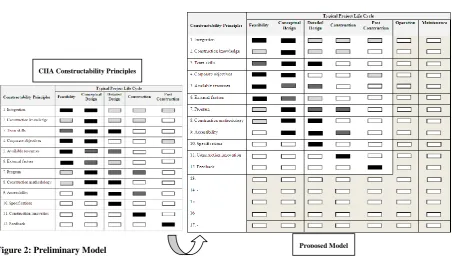
All the O&M issues identified above need to be systematically examined and evaluated during the planning and design phases to ensure the optimum delivery of infrastructure project. However, these have been ignored by current constructability principles. Hence, these principles are to be included in the extended constructability model in order to deliver an effective operability and efficient maintainability implementation process. For this reason, there is a need to incorporate these principles from O&M aspects into existing CIIA constructability principles.
6
Figure 2: Preliminary Model
4.
CONCLUSIONS
This paper identifies the O&M issues, their causes and associations with current constructability principles in the provision of infrastructure projects. Through the review of the literature, it found that current O&M issues need to be incorporated with the constructability principles. Through these O&M issues identified, a preliminary extended constructability model incorporating the O&M issues was proposed. This model is aimed to provide a guide for project stakeholders that facilitate the integration of the whole PLC phases, so that project planners and designers can have a better understanding of O&M problems and failures. This condition is expected to result in well-designed infrastructure projects that are constructible, operable and maintainable.
5.
REFERENCES
1. Keller, A.Z. and S.J. Al-Saadi, Reliability assessment of fire-fighting vehicles, and equipment.
International Journal of Quality and Reliability Management, 1992. 9(2): p. 42-51.
2. Madu, C., An economic design for optimum maintenance float policy. Journal of Computers & Industrial Engineering, 1990. 18(4): p. 457-469.
3. Thomas, L.C., Replacement of systems and components in renewal decision problems. Operations Research, 1985. 33(2): p. 404-411.
4. Valdes-Flores, C. and R.M. Feldman, An improved policy iteration algorithm for semi-Markov maintenance problems. IIE Transactions, 1992. 24(1): p. 55-63.
5. Cooke, R. and J. Paulsen, Concepts for measuring maintenance performance and methods for analyzing competing failure modes. Reliability Engineering and System Safety, 1997. 55: p. 135-141.
6. Kobbacy, K.A.H., et al., Full history hazards model for preventive maintenance scheduling. Quality and Reliability Engineering International, 1997. 13(4): p. 187-198.
7. Trigunarsyah, B. and M. Skitmore, Chapter 21: The key to successful implementation: project management of sustainable infrastructure provision, in Sustainable urban and regional infrastructure development. 2010, Information Science Reference Publication: Hershey . New York.
8. Plockmeyer, D.R., Building performance analysis, the missing element in project management. 1988, University of Meryland: College Park, Md.
9. Construction Industry Institute, Constructability: a primer. Vol. 3-1. 1986, Austin, TX.
7
10. Tatum, C.B., J.A. Vanegas, and J.M. William, Constructability improvement using prefabrication, preassembly, and modularization. 1986, Stanford University: Stanford, California.
11. CIRIA, Buildability: an assessment. 1983, UK: Special Publication.
12. CIIA, The development of constructability principles for the Australian construction industry. 1996.
13. O'Connor, J.T. and R.L. Tucker, Industrial project constructability improvement. Journal of Construction Engineering and Management, 1986. 112(1): p. 69-82.
14. Nima, M.A., Constructability factors in the Malaysian construction industry. 2001, University Putra Malaysia.
15. Trigunarsyah, B., Constructability practices among construction contractors in Indonesia. Journal of Construction Engineering and Management, 2004. 130(5): p. 656-669.
16. Adams, Practical buildability. 1989, Butterworth's: London.
17. Russell, J.S. and J.G. Gugel, Comparison of two corporate constructability programs. Journal of Construction Engineering and Management, 1993. 119(4): p. 769-784.
18. Griffith, A. and A.C. Sidwell, Development of constructability concepts, principles and practices.
Engineering, Construction and Architectural Management, 1997. 4(4): p. 295-310. 19. CIIA, Constructability principles files. 1993: Adelaide, Australia.
20. Frame, J.D., Projects in organizations : how to make the best use of time, techniques, and people. 3 ed. 2003, San Francisco: Jossey-Bass.
21. Blanchard, D. Verma, and E.L. Peterson, Maintainability: a key to effective serviceability and maintenance management. 1995, New york, US: John Wiley & Sons.
22. Nayanthara, d.S., et al., Improving the maintainability of buildings in Singapore. Journal of Building and Environment, 2004. 39: p. 1243-1251.
23. Griffin, J.J., Life cycle cost analysis: a decision aid. 1993, London: Blackie Academic and Professional.
24. Geile, R.J., Constructability "The Strech Version". 1996: Transaction of AACE International.
25. Saghatforoush, E., et al. Extending constructability concept to include operation and maintenance issues. in 1st International Construction and Business Management Symposium. 2011. Kuala Lumpur-Malaysia.
26. Al-Zubaidi, H., Assessing the demand for building maintenance in a major hospital complex.
Journal of Property Management, 1997. 15(3): p. 173-183.
27. Lateef, O.A., Cases for alternative approach to building maintenance management of public universities. Journal of Building Appraisal, 2009. 5(3): p. 201-212.
28. Shen, Q., A comparative study of priority setting methods for planned maintenance of public buildings. Journal of Facilities, 1997. 15(12/13): p. 331-339.
29. Lam, A.P.C. Chan, and D.W.M. Chan, Benchmarking success of building maintenance projects.
Journal of Facilities, 2010. 28(5/6): p. 290-305.
30. Williams, J.A. and D.G.N. Clark. Current issues in public hospital maintenance. in Maintenance Engineering Conference. 1989. Albury-Wodonga.
31. Souponitski, S.Z., S.V. Sniatvok, and S.E. Grigoriev, Early reinforced concrete constructions in Russia specific faults and causes of failure. Engineering Failure Analysis, 2001. 8: p. 201-212. 32. Lavy, S. and I.M. Shohet, Integrated healthcare facilities maintenance management model case
studies. Journal of Facilities, 2009. 27(3/4): p. 107-119.
33. Shohet, I.M., S. Lavy-Leibovich, and D. Bar-On, Integrated maintenance monitoring of hospital buidlings. Journal of Construction Management and Economics, 2010. 21(2): p. 219-228.
34. Arditi, D. and M. Nawakorawit, Issues in building maintenance property managers perspective.
Journal of Architectural Engineering, 1999. 5(4): p. 117-132.
8
36. Uhlik, F.T. and J. Hinze, Trends in the construction needs of hospital facilities. Journal of Architectural Engineering, 1998. 4(4): p. 132-134.
37. Josephson, P.E. and Y. Hammarlund, The causes and costs of defects in construction a study of seven building projects. Automation in Construction, 1999. 8: p. 681-687.
38. Lam, Design for maintenance from the viewpoint of sustainable hospital buildings. The Australian Hospital Engineer, 2007. 30(1): p. 30-34.
39. Kalamees, T., Failure analysis of 10 year used wooden building. Engineering Failure Analysis, 2002. 9: p. 635-643.
40. Shohet, I.M., S. Lavy-Leibovich, and D. Bar-On. Integrated maintenance management of hospital buildings in Israel. in 17th International Symposium of the International Federation of Hospital Engineering. 2002. Bergen.
41. El-Haram, M.A. and M.W. Horner, Factors affecting housing maintenance costs. Journal of Quality in Maintenance Engineering, 2002. 8(2): p. 115-123.
42. Christer, A.H. and J. Whitelaw, An operational research approach to breakdown maintenance problem recognition. The Journal of the Operational Research Society, 1983. 34(11): p. 1041-1052. 43. Azlan Shah, A., et al., Factors affecting housing maintenance cost in Malaysia. Journal of Facilities
Management, 2010. 8(4): p. 285-298.
44. Assaf, S., A.-M. Al-Hammad, and M. Al-Shihah, Effects of faulty design and construction on building maintenance. Journal of Performance of Constructed Facilities, 1996. 10(4): p. 171-174. 45. Flores-Colen, I. and J.d. Brito, A systematic approach for maintenance budgeting of buildings
façades based on predictive and preventive strategies. Journal of Construction and Building Materials, 2010. 24: p. 1718-1729.
46. Al-Hammad, A., S. Assaf, and M. al-Shihah, The effect of faulty design on building maintenance.
Journal of Quality in Maintenance Engineering, 1997. 3(1): p. 29-39.
47. Duling, J.J.M., C.E. Cloete, and E. Horak, The application of Neuro-Fuzzy methodology to maintenance of buildings. The ICEC Cost Management Journal, 2006.
48. Allen, D., What is building maintenance? Journal of Facilities, 1993. 11(3): p. 7-12.
49. Duffuaa, S.O., et al., A generic conceptual simulation model for maintenance systems. Journal of Quality is Maintenance, 2001. 7(3): p. 207-219.
50. Paz, N.M. and W. Leigh, Maintenance scheduling issues, results and research needs. International Journal of Operations & Production Management, 1993. 14(8): p. 47-69.
51. Lavy, S. and I.M. Shohet, Integrated maintenance management of hospital buildings a case study.
Journal of Construction Management and Economics, 2004. 22(1): p. 25-34.
52. Al-Zubaidi, H. and A.H. Christer, Maintenance manpower modeling for a hospital building complex. European Journal of Operational Research, 1997. 999: p. 603-618.
53. Lai, J.H.K. and F.W.H. Yik, Monitoring building operation and maintenance contracts. Journal of Facilities, 2007. 25(5/6): p. 238-251.
54. Pintelon, L.M. and L.F. Gelders, Maintenance management decision making. European Journal of Operational Research, 1992. 58: p. 301-317.
55. Ivory, C.J., A. Thwaited, and R. Vaughan, Design for maintainability: the innovation process in long term engineering projects, in The Future of Innovation Studies. 2001: Eindhoven, Netherland.
56. Al-Arjani, A.H., Impact of cultural issues on the scheduling of housing maintenance in a Saudi Arabian urban project. International Journal of Project Management, 1995. 13(6): p. 373-382. 57. Al-Momani, K.R., M.D. Al-Tahat, and E.T. Joradat, Performance measures for improvement of
![Figure 1: O&M Problems and their Causes [25]](https://thumb-us.123doks.com/thumbv2/123dok_us/167301.44445/2.595.144.485.582.752/figure-o-m-problems-causes.webp)