Plan Permutation Symmetries as a Source of Planner Inefficiency
Derek Long and Maria Fox
Department of Computer and Information SciencesUniversity of Strathclyde, Glasgow, UK
Abstract
This paper briefly reviews sources of symmetry in planning and highlights one source that has not previously been tack-led: plan permutation symmetry. Symmetries can be a sig-nificant problem for efficiency of planning systems, as has been previously observed in the treatment of other forms of symmetry in planning problems. We examine how plan per-mutation symmetries can be eliminated and present evidence to support the claim that these symmetries are an important problem for planning systems.
Introduction
Symmetry is a phenomenon that arises in a wide range of combinatorial problems, such as CSPs (Gent & Smith 2000; Backofen & Will 1999; Joslin & Roy 1997; Craw-ford et al. 1996), model-checking (Ip & Dill 1996) and other areas (Audemard & Benhamou 2002). It is also com-mon in planning problems. Where combinatorial problems that are tackled by systematic search techniques (including heuristic search techniques) symmetry is a source of inef-ficiency because the search can examine different choices that are symmetrically equivalent. This inefficiency can be exponentially expensive, since it is common for sym-metries to give rise to factorial-function factors in the size of search spaces, resulting from the permutations of sym-metric choices that can be searched independently of one another. Several authors have explored the possibilities for eliminating symmetries from planning problems (Joslin & Roy 1997; Fox & Long 1999; 2002; Rintanen 2003; Long & Fox 2003). In this paper we examine the sources of symmetry in planning problems and highlight one that has not been previously addressed: plan permutation
symme-try. We explore the elimination of this form of symmetry
and demonstrate that it can lead to improvements in perfor-mance.
Sources of Symmetry in Planning Problems
A symmetry is a function that maps the structure of a prob-lem into itself. That is, a symmetry is an automorphism of the problem definition.A
C
B
D
Figure 1: A simple initial state configuration for four blocks.
One of the primary sources of symmetry in planning problems is the naming of distinct objects that are all func-tionally equivalent. For example, if a problem involves transporting cargoes from one location to various destina-tions, the distinct cargoes will be named and distinguished, although any cargoes that start at the same place and must end at the same place, with no distinguishing features other than their names, are symmetrically equivalent. This sym-metry has also been called functional equivalence (Fox & Long 1999), because it is a relationship between objects that can substitute one for another in their functional roles within a plan. This form of symmetry leads to simple sym-metry groups, consisting of complete permutation groups on the objects that exhibit the symmetric qualities.
A second source of symmetry is a generalisation of the first: configurations of objects can be symmetric with one another. For example, in Figure 1 the blocks A and B are not symmetric with one another because a simple ex-change of these two blocks leaves the initial state con-taining the propositions {on(A, D), on(B, C)} in place of {on(A, C), on(B, D)}. However, a mapping that ex-changes AwithB andC withD is a symmetry, since it
acts as an identity mapping when applied to the initial state. Symmetries of this kind can lead to more complex symme-try groups. Research on these symmetries in planning is reported in (Joslin & Roy 1997).
sym-Initial state
p
q
p,q r
B Pre: Add: q
A Pre: Add: p
B Pre: Add: q
A Pre: Add: p
[image:2.612.162.451.102.177.2]C Pre: p,q Add: r Del: p,q
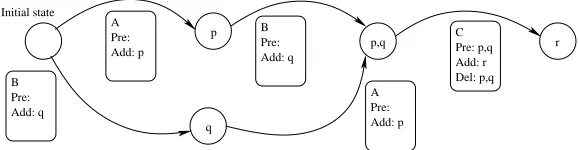
Figure 2: Symmetry between plans.
metry is related to the symmetries in transition systems ex-plored by Emerson and Sistla (Emerson & Sistla 1996). It is also closely associated with the possibility for concur-rency in plans, such as is considered in the Graphplan sys-tem (Blum & Furst 1995) or in partial-order planners (Bar-ret et al. 1996). Any set of action instances that are ap-plied concurrently within a plan can obviously be permuted without changing their collective behaviour, since the ac-tions in a single time point are not considered to be or-dered in any particular way (although some researchers have chosen to adopt the converse view that actions can be sequenced at a single time point (Bacchus & Kabanza 1998; McDermott 2003). Non-interference between actions is most apparent when the actions involved refer to proposi-tions that form entirely disjoint sets. In principle, a planning problem that can be decomposed into disjoint sub-problems will induce a symmetry in which the disjoint components are freely permuted. However, not all such decompositions form the basis for symmetries since the disjoint compo-nents may not be structured in a way that allows a map-ping between them that induces mapmap-pings between plans. Emerson and Sistla considered automorphisms on transi-tion structures in which the symmetries are described by permutations on states and transitions (relations on pairs of states). The permutation of disjoint sub-problems is not of this form, since it is not always the case that the mapping can be extended to permute individual transitions.
Symmetry between different orderings of actions is tan-talising, since there are many problems in which ineffi-ciency is introduced by considering actions in different or-ders when the order does not actually matter. Commuting actions are an obvious cause of this form of symmetry. Un-fortunately, it is often the case that actions can be permuted without impact on the plan, but the actions involved do not commute. This happens when the effects of the actions that change according to the order of execution are irrelevant to execution of the plan or to achievement of the goals. For example, if the domain illustrated in Figure 2 were to also contain an action,D, with preconditionpthen the transpo-sition ofAandBis no longer a symmetry, since the plan A;Dwould be mapped to the invalid structureB;D.
We call symmetries of this third form plan permutation
symmetries. We now proceed to consider the possibilities
for detecting and eliminating these symmetries.
Identifying and Eliminating Plan Permutation
Symmetries
Work on symmetry elimination in the context of CSPs has mainly concentrated on managing symmetries once they have been supplied to the system, rather than on identi-fying them automatically. Symmetries are generally de-scribed by adding appropriate additional constraints to the description of a problem. In planning, particularly domain-independent planning, the emphasis has been on using an unadorned problem description. This places a far greater importance on the automatic identification of symmetries and techniques that have been used to perform this task have been based on the identification of type structure (Fox & Long 1999) or finding graph automorphisms on graphs describing initial and goal states of problems (Joslin & Roy 1997).
The identification of plan permutation symmetries in general is a difficult problem. However, a subset of the symmetries are relatively easy to find: any pair of actions that will commute in all situations leads to a symmetry be-tween plans in which the pair of actions are both present and adjacent to one another, either applied simultaneously or sequentially. Actions commute in all situations if they are non-mutex. The following definitions are taken from the account of the semantics ofPDDL2.1 (Fox & Long 2003).
Definition 1 Ground Action Given a planning instance, I, containing an action schemaA∈AsI, the set of ground
actions for A, GAA, is defined to be the set of all the structures,a, formed by substituting objects for each of the schema variables in each schema,X, inf latten(A)where
the components ofaare:
• Name is the name from the action schema,X, together
with the values substituted for the parameters of X in
forminga.
• Prea, the precondition ofa, is the propositional precon-dition ofa. The set of ground atoms that appear in Prea is referred to as GPrea.
a.
• Dela, the negative postcondition ofa,is the set of ground atoms that are asserted as negative literals in the effect ofa.
• NPa, the numeric postcondition ofa, is the set of all as-signment propositions corresponding to the numeric ef-fects ofa.
The following sets of primitive numeric expressions
(PNEs) are defined for each ground action,a ∈ GAA:
• La={f|fappears as an lvalue ina}
• Ra ={f|f is a PNE in an rvalue inaor appears inP rea}
• L∗a ={f| f appears as an lvalue in an
additive assignment effect ina}
Definition 2 Mutex Actions Two grounded actions,aand
bare non-interfering if
GP rea∩(Addb∪Delb) =GP reb∩(Adda∪Dela) =∅
Adda∩Delb=Addb∩Dela=∅
La∩Rb=Ra∩Lb=∅
La∩Lb⊆L∗a∪L∗b
If two actions are not non-interfering they are mutex.
Proposition 1 ActionsP andQcommute if they are non-mutex.
Proof: Suppose that the actions are non-mutex but do not commute. This means that there is some stateS =hV, Fi
(whereV is a valuation on propositions andF is a metric valuation on primitive numeric expressions) such thatP;Q applied toS yields a different result toQ;P applied toS. LetP;QyieldhV1, F1iandQ;P yieldhV2, F2i. Then
ei-therV16=V2or elseF16=F2(or both).
Suppose thatV1 6=V2. Then there is some proposition, p, such that, without loss of generality,V1(p) = trueand V2(p) =f alse. IfV(p) =truethen one ofP orQmust
havepon their delete effects in order thatV2(p) =f alse.
But sinceV1(p) =trueit must be thatP deletespandQ
reachieves it. Then AddQ∩DelP 6=∅, which is a
contra-diction. IfV(p) =f alsethen a similar argument leads to the same conclusion.
Therefore, it must be thatF1 6= F2. So there is some
expression,e, such thatF1(e)=6 F2(e). If neitherPnorQ
affects the value ofethenF1 = F = F2, so at least one
must affect the value. If both actions affectethen, since the actions are non-mutex, it must be that the effects are both additive effects and they must, therefore, commute, which is a contradiction. If only one ofP orQaffects the value ofethen, without loss of generality, let it beP. Thus,P updateseaccording to some expression,e0 (appearing on
the right of the updating effect). IfQdoes not affecte0 in any way then it is clear thatP andQcommute, so it must be thatQaffectse0. But thenLQ∩RP 6= ∅and this is,
once again, a contradiction.
This completes all cases and allows us to conclude the proof.
Identification of this special case leading to plan permu-tation symmetries is compupermu-tationally trivial and can be per-formed in a preprocessing phase prior to planning — in-deed, this analysis is conducted by many planners already in order to properly identify situations in which concur-rency may be validly exploited. We will refer to this special case as commuting-step permutation symmetries, or CSPS.
Exploitation
Exploitation of symmetries in systematic search algorithms involves pruning branches of the search that would visit parts of the space that are symmetrically equivalent to parts that have already been explored. There are two main ap-proaches (Roy & Pachet 1998; Gent & Smith 2000): addi-tion of constraints to a problem prior to search in order to prevent exploration symmetric branches and, alternatively, the enforcement of pruning by modification of the search algorithm itself. This latter approach admits variants, but essentially the idea is to record choices and to recognise attempts to use symmetric choices as they occur.
In the context of a planning system, addition of con-straints is not straightforward unless the architecture uses a general constraint solving approach, such as a SAT-solver (for example, Rintannen uses this approach (Rin-tanen 2003) and Joslin and Roy also use a similar tech-nique (Joslin & Roy 1997)). Symmetry breaking during search is generally more straightforward in a dedicated planning architecture (Fox & Long 1999; 2002). CSPS can be handled by a combination of two mechanisms. Firstly, in the case where commuting actions are considered for ad-dition at the same time point in a plan we want to ensure that only one ordering is actually searched. This can be achieved by the common symmetry-breaking strategy of in-troducing a lexicograhical ordering constraint: the actions can only be tried in lexicographically ordered sequences, where the actions are assigned arbitrary positions within a predetermined ordering. Thus, if we have actionsA, Band C to consider for application at the same point in a plan, we will only allow the sequences: hAi,hBi,hCi,hA;Bi,
p
q
r A
B
D C
[image:4.612.139.206.100.169.2]Action layer Fact layer
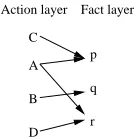
Figure 3: A Graphplan search problem that generates plan permutation symmetry.
achievesq,CachievespandD achievesr(see Figure 3). Then the following possible sequences will be tried, in the order listed:
Noopp; Noopq; Noopr
Noopp; Noopq;A
Noopp; Noopq;D
Noopp;B; Noopr
Noopp;B;A
Noopp;B;D
A; Noopq
A;B
C; Noopq; Noopr
C; Noopq;A
C; Noopq;D
C;B; Noopr
C;B;A C;B;D
Notice that whenAis used to achievepthen the usual im-plementations of Graphplan will recognise thatris already satisfied and not, therefore, introduce an action to achieve it separately. It can be seen that there is redundancy in this list: the second and fifth sets are subsumed by the seventh and eighth sets. Some implementations of Graphplan will check that the action set is minimal and will therefore prune the second and fifth sets (because Noopp is unnecessary
whenA has been added). However, it is also possible to see these sets as related by symmetry, ignoring the noop ac-tions. A simple mechanism that can be employed to avoid this form of symmetry: to prevent two actions from being applied at the same time if they achieve a common effect. This is, in fact, correct behaviour under the semantics of PDDL2.1, in any case, in which mutexes are extended to in-clude common effect propositions of any kind (Fox & Long 2003).
The second mechanism is concerned with preventing commuting actions from being tried in different orders
se-quentially. This is a far more subtle problem because the
pair might not both commute with other actions that are be-ing considered for inclusion in the plan at the same time point as one or other of the commuting pair. This means
that it is not correct to simply impose a lexicographical con-straint on the pair irrespective of the context in which they are applied. A slightly weaker constraint, but one that is correct, is to insist that no action may be applied in imme-diate sequence with a collection of (simultaneous) actions, unless it is mutex with at least one of them. That is, if an action can be applied simultaneously with a collection of actions then it cannot be applied at an adjacent time point. This constraint is only applicable to a planner that is capa-ble of scheduling actions at the same time point, such as Graphplan variants. Enforcing this constraint ensures that an action that commutes with all actions at a given time point must be pushed to a time point that is not adjacent to them — enforcement at successive time points will pre-vent the action from being inserted at all until something has been added to the plan with which it does not commute. The effect of this constraint is then to make steps in a plan move forward (or backward, depending on the direction of search) through commuting sets of actions until it is adja-cent to a time point at which non-commuting actions are applied (or they are at one end of the plan). In a Graphplan framework this is easy to implement as a check that an ac-tion being considered for inserac-tion into a plan, to achieve a goal that is present as the precondition of a noop, is mutex with an action applied in the previous search layer (which, due to the backward search in Graphplan, will be the suc-ceeding layer of actions). In this check we are not interested in the mutex with the noop that introduced the goal in the first place. Consider the problem depicted in Figure 3. If we suppose that actionBis not mutex with any of the other actions then this constraint will prevent a plan being con-structed in whichBis executed in one layer and thenAin the immediately succeeding layer (assuming no other steps are involved). Similarly, none ofA,CorDmay appear in a layer adjacent to a layer containingB (again, assuming no other actions are involved).
In the context of Graphplan, this technique must be im-plemented carefully to avoid a damaging interaction with no-good learning, including the EBL/DDB technique of Kambhampati (Kambhampati 2000). The reason for there being interaction is that goal sets created by gathering pre-conditions of actions from a layer might be determined to be unsatisfiable because of the removal of a choice of an ac-tion by the symmetry eliminaac-tion. This could lead to a goal set being inapproproiately marked as unsolvable. In prac-tice, the goal sets that can be marked in this way are very unlikely to arise in a different context during an attempt to satisfy the same original set of top-level goals.
ac-tions and to impose the constraint that when such acac-tions appear adjacent to one another in a plan then they must ap-pear in the order implied by this artifical ordering. This simply ensures that only one instance of each symmetric set of actions will be generated. FF manages to avoid the exponential growth in symmetric plan structures in this sit-uation by recording the visited states as they are generated, but checking for revisiting states is a more expensive test than to simply ensure that commuting actions appear in the correct order.
Results
In order to confirm that elimination of CSPS in this way can achieve a useful pruning effect in a Graphplan search, we implemented the mechanism in a version of STAN (Long & Fox 1999) and explored its performance in a collection of problem instances. A common difficulty arising in the exploitation of symmetry is that the overhead of monitor-ing symmetries and managmonitor-ing the process of elimination turns out to be greater than the benefits achieved by avoid-ing the search in redundant parts of the search space. This can be caused, in part, if the search in the pruned branches would actually have terminated quickly in any case, due to other search control strategies working to reduce the search problem. Thus, we wanted to compare the behaviour of STAN with and without the new symmetry pruning mecha-nisms. It should be emphasised that our tests in STAN were influenced by the ease with which we can manipulate the behaviour of this system, but that the mechanisms we have described are not restricted to use in a Graphplan frame-work.
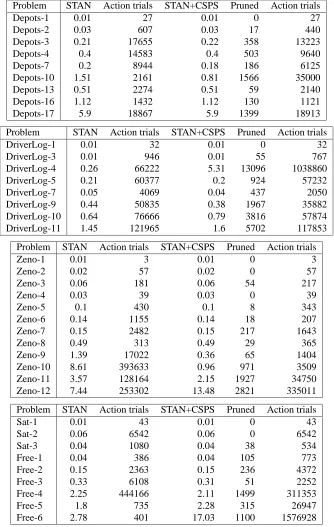
Our results confirmed that in STAN the first symmetry (action set symmetry) is already eliminated effectively by the behaviour of Graphplan. Thus, we present here, in Fig-ure 4, only results for the second type of symmetry elimi-nation.
The results reflect behaviour on a subset of problems from the 3rd IPC. The majority of the results show a sig-nificant reduction in the number of actions tried in the search for a plan. A few results are somewhat anomalous. Driverlog-4 and Zeno-12 lead to the generation of plans that are one layer longer than the plans generated without sym-metry. This is not easily explained, and we are still attempt-ing to uncover the precise reasons, but it appears possible that it is caused by the interaction with nogood learning. A second interesting observation is that it is not always the case that larger numbers of actions tried will automatically imply a longer time spent in search. This is somewhat sur-prising, but it is linked to the depth of the branches explored during the search and to the numbers of goals and mutexes generated by the actions tried. In several cases, the number of actions is dramatially reduced by the use of symmetry elimination, but the search time is not improved, or even
slightly worsened. One part of the explanation for this is that the current scheme for elimination pushes actions to the end of the plan, but the search strategy favours pushing ac-tions earlier. This means that the search can explore many branches that are doomed to fail before finally attempting one that could succeed. A better organisation of this search sequence could exploit the symmetry reduction more effec-tively. The results for Free-5 and Free-6 are also somewhat anomalous, the last one in particular showing a massive bur-den in increased action testing. We cannot explain this situ-ation satisfactorily, at present, but are continuing to explore the behaviour in more detail.
Over all, although there are anomalies, the results show that there is a very significant potential reduction in the number of action applications searched available through the use of the symmetry elimination. We suspect that a closer analysis of the interactions with other mechanisms in STAN will reveal the reasons for the odd cases that gen-erate significantly increased search spaces, running counter to the behaviour shown in the majority of cases.
Further Work
We wish to explore several other avenues. One is the im-plementation of these ideas within other planning frame-works, in order to demonstrate its versatility and broader utility. A second is to expand the forms of symmetry with which we are working. We have now considered forms of functional symmetry (Fox & Long 1999) between objects, dynamic symmetry (Fox & Long 2002) arising between ob-jects during the development of plans and, in this paper, cer-tain forms of plan permutation symmetry. There is clearly scope for extending the plan permutation symmetries we identify and exploit, but we are also interested in develop-ing techniques to handle a different problem: almost
sym-metric objects. This idea is explored in more depth in (Long
& Fox 2003), along with the possibilities for extension of the idea to a broader range of combinatorial search prob-lems.
Problem STAN Action trials STAN+CSPS Pruned Action trials
Depots-1 0.01 27 0.01 0 27
Depots-2 0.03 607 0.03 17 440
Depots-3 0.21 17655 0.22 358 13223
Depots-4 0.4 14583 0.4 503 9640
Depots-7 0.2 8944 0.18 186 6125
Depots-10 1.51 2161 0.81 1566 35000
Depots-13 0.51 2274 0.51 59 2140
Depots-16 1.12 1432 1.12 130 1121
Depots-17 5.9 18867 5.9 1399 18913
Problem STAN Action trials STAN+CSPS Pruned Action trials
DriverLog-1 0.01 32 0.01 0 32
DriverLog-3 0.01 946 0.01 55 767
DriverLog-4 0.26 66222 5.31 13096 1038860
DriverLog-5 0.21 60377 0.2 924 57232
DriverLog-7 0.05 4069 0.04 437 2050
DriverLog-9 0.44 50835 0.38 1967 35882
DriverLog-10 0.64 76666 0.79 3816 57874
DriverLog-11 1.45 121965 1.6 5702 117853
Problem STAN Action trials STAN+CSPS Pruned Action trials
Zeno-1 0.01 3 0.01 0 3
Zeno-2 0.02 57 0.02 0 57
Zeno-3 0.06 181 0.06 54 217
Zeno-4 0.03 39 0.03 0 39
Zeno-5 0.1 430 0.1 8 343
Zeno-6 0.14 1155 0.14 18 207
Zeno-7 0.15 2482 0.15 217 1643
Zeno-8 0.49 313 0.49 29 365
Zeno-9 1.39 17022 0.36 65 1404
Zeno-10 8.61 393633 0.96 971 3509
Zeno-11 3.57 128164 2.15 1927 34750
Zeno-12 7.44 253302 13.48 2821 335011
Problem STAN Action trials STAN+CSPS Pruned Action trials
Sat-1 0.01 43 0.01 0 43
Sat-2 0.06 6542 0.06 0 6542
Sat-3 0.04 1080 0.04 38 534
Free-1 0.04 386 0.04 105 773
Free-2 0.15 2363 0.15 236 4372
Free-3 0.33 6108 0.31 51 2252
Free-4 2.25 444166 2.11 1499 311353
Free-5 1.8 735 2.28 315 26947
[image:6.612.140.474.147.674.2]Free-6 2.78 401 17.03 1100 1576928
of functionally equivalent objects or object configurations, symmetries between objects are usually a consequence of abstractions in the description of planning domains. For example, the symmetry between the blocks in Figure 1 is a consequence of the abstraction that ignores precise posi-tions of blocks on the table. If the posiposi-tions were included then a symmetry that included the configuration of the pairs of blocks together with their corresponding table positions would still depend on the abstraction of the relative proper-ties of the table positions, such as the distances to the edges of the table. In fact, symmetries in planning domains almost always follow from abstractions made by the domain engi-neer that describe objects in terms of just those features that the domain engineer knows to be relevant to the problem. By leaving out the irrelevant details, the domain engineer offers the planner the opportunity to exploit symmetries.
As planning domains become more complex the domain engineer’s job will become harder. Appropriate abstrac-tions will not always be obvious: to be certain of which properties are relevant or irrelevant to the solution of a given planning problem can require, in the worst case, that the problem be solved in advance. In order to support reusable domain encodings, it is also important that encod-ings should not be engineered only for the solution of one specific problem. This might mean that a domain should in-clude details about the properties of objects that could have a bearing on one problem but that are irrelevant in the so-lution of another. For example, if the blocks in Figure 1 are only intended to be stacked in different orders then their relative positions are all that matter, but if they are also to be used in solving a problem of supporting heavy weights then their relative rigidity will be relevant, and if they are to be used in block-paving then their colour and material will become relevant.
Nebel, Dimopolous and Koehler (Nebel, Dimmopoulos, & Koehler 1997) have shown that it is possible to apply filtering techniques (RIFO) to isolate the relevant features of a planning problem using a static analysis on the do-main prior to planning. Using this technique prior to the identification of symmetries will reduce the possibility that symmetries are lost because of properties included in the domain that are not required in the solution of the specific problem. The approach is straightforward: we apply the filtering technique to strip out irrelevant initial state infor-mation and then apply the symmetry identification to the re-duced initial state and goal state, using TIM to derive types for the reduced domain. Note that it is important to apply TIM after the domain is filtered because the type structure can relax as a result of the filtering (TIM will differentiate types of objects based on their properties, so if properties are removed then type distinctions can be lost).
Some forms of irrelevance are more subtle than those de-tected by the RIFO techniques. These include features that
are irrelevant because they cannot make a difference to the
efficient solution of a problem. This is closely linked to a
property we call almost symmetry: in many planning prob-lems, objects begin in slightly different configurations, or are required to reach slightly different configurations, but the majority of their behaviour is essentially equivalent to the behaviour of other objects of the same type. For exam-ple, consider the problem of transporting a collection of car-goes from one location to another. Suppose that the carcar-goes must all end up at the same place and they all start at the same place, but that they begin stacked in several separate piles. Then, the plan will involve unstacking the cargoes, loading them into the transport, delivering and unloading them. Notice that the majority of the task is the same for ev-ery cargo: the loading, delivering and unloading will have to executed for every cargo. Unfortunately, the fact that the cargoes all begin stacked in different piles will mean that there is no symmetry at all of the single-object kind, and probably very little of the object configuration kind, despite the fact that the human observer can see that there is a high degree of symmetry in the body of the problem.
in which all the cargoes are simultaneously unstacked. In general, almost symmetries can be seen as symmetries constructed by adding to or removing from the properties in the initial state and goal formula. It is possible to identify the objects for which symmetry is almost present by exam-ining the type structure, but it is harder to determine what editing of the initial state and goal formula is a safe abstrac-tion to introduce symmetry. Notice that modificaabstrac-tion of the goal formula by addition of properties will make the prob-lem harder (possible unsolvable) while removal of proper-ties will require that a plan post-fix be added to manage the achievement of the abstracted goals. Similarly, removal of initial state facts will make the problem harder, while addi-tion of new facts can create an unreachable state (such as the state in which all the cargoes are clear in the preceding example).
Exploration of an appropriate handling of this abstrac-tion mechanism is ongoing research. We have identified the relevant concept of n-symmetry, which hold between two objects if they can be made symmetric by the appli-cation ofnactions. We believe that for small values ofn this concept leads to constrained edits of the initial state and goal formula which compromise between the opportunities to exploit symmetry and the cost of accounting for the ab-straction in the final plan.
Conclusions
Symmetry in search problems is an exciting area of cur-rent research, particularly in the UK, where recently two EPSRC-funded grants have been awarded to support work in symmetry1. Symmetry in planning has already stimu-lated several pieces of work, but there is scope for much more. In this paper we have introduced the notion of plan permutation symmetry. It is a symmetry that arises in many planning problems. There is clearly work to be done on understanding the right way to exploit the symmetry elim-ination technique in Graphplan and, presumably, in other architectures, but the results show a preliminary indication that the symmetry is there to be eliminated and to offer gains if it can be harnessed successfully.
References
Audemard, G., and Benhamou, B. 2002. Reasoning by symmetry and function ordering in finite model genera-tion. In Voronkov, A., ed., Proceedings of the 18th
In-ternational Conference on Automated Deduction (CADE-18), volume 2392 of LNCS, 226–240. Springer Verlag.
Bacchus, F., and Kabanza, F. 1998. Planning for
tempo-1Ian Gent and Steve Linton have been awarded a grant to
ex-plore the use of GAP to provide a group-algebra foundation on which to build symmetry pruning in CSPs. The authors have also been awarded a grant to work on symmetry in planning.
rally extended goals. Annals of Mathematics and Artificial
Intelligence 22:5–27.
Backofen, R., and Will, S. 1999. Excluding symmetries in constraint-based search. In Proceedings of CP-99, volume 1713 of LNCS. Springer-Verlag.
Barret, A.; Christianson, D.; Friedman, M.; Golden, K.; Penberthy, J.; Sun, Y.; and Weld, D. 1996. UCPOP v4.0 user’s manual. Technical Report TR 93-09-06d, Dept. of Computer Science and Engineering, University of Wash-ington, Seattle, WA.
Blum, A., and Furst, M. 1995. Fast Planning through Plan-graph Analysis. In Proceedings of 14th IJCAI.
Crawford, J.; Ginsberg, M.; Luks, E.; and Roy, A. 1996. Symmetry breaking predicates for search problems. In Proceedings of the Fifth International Conference on
Knowledge Representation and Reasoning (KR ’96), 148–
159.
Emerson, E., and Sistla, A. 1996. Symmetry and model-checking. Formal methods in system design 9 (1/2).
Fox, M., and Long, D. 1999. The detection and exploita-tion of symmetry in planning problems. In Proceedings of
16th IJCAI.
Fox, M., and Long, D. 2002. Extending the exploitation of symmetries in planning. In Proceedings of AIPS’02.
Fox, M., and Long, D. 2003. An extension toPDDL for expressing temporal planning domains. Journal of AI
Re-search Forthcoming.
Gent, I. P., and Smith, B. 2000. Symmetry breaking dur-ing search in constraint programmdur-ing. In Proceeddur-ings of
ECAI.
Hoffmann, J., and Nebel, B. 2001. The FF planning sys-tem: Fast plan generation through heuristic search. JAIR 14.
Ip, C. N., and Dill, D. L. 1996. Better verification through symmetry. Formal Methods in System Design 9.
Joslin, D., and Roy, A. 1997. Exploiting symmetry in lifted CSPs. In Proceedings of 14th National Conference
on AI (AAAI-97).
Kambhampati, S. 2000. Planning graph as (dynamic) CSP: Exploiting EBL, DDB and other CSP techniques in graphplan. Journal of Artificial Intelligence Research 12:1–34.
Long, D., and Fox, M. 1999. The efficient implementation of the plan-graph inSTAN. JAIR 10.
McDermott, D. 2003. Reasoning about autonomous pro-cesses in an estimated-regression planner. In Proceedings
of the International Conference on Automated Planning and Scheduling (ICAPS’03).
Nebel, B.; Dimmopoulos, Y.; and Koehler, J. 1997. Ig-noring irrelevant facts and operators in plan generation. In
Proc. of 4th European Conference on Planning, Toulouse.
Rintanen, J. 2003. Symmetry reduction for SAT represen-tations of transition systems. In Proceedings of the 13th
International Conference on Planning and Scheduling.
Roy, P., and Pachet, F. 1998. Using symmetry of global constraints to speed up the resolution of CSPs. In
Work-shop on Non-binary Constraints, ECAI.