Single-Determinant Theory of Electronic
Excited States and Many-Electron
Integrals for Explicitly Correlated
Methods
Giuseppe Maria Junior Barca
June 2017
A thesis submitted for the degree of Doctor of Philosophy
of the Australian National University
c Copyright by Giuseppe Maria Junior Barca 2017
Declaration
The work described in this thesis, to the best of my knowledge, is original and does
not contain material that has been submitted for a degree or diploma at any other
University or College.
Giuseppe M. J. Barca
Acknowledgements
Now let me dispel a couple of rumors so they won’t fester into facts ... Yes! Before
beginning this doctorate I had a passion for mathematics and quantum mechanics. And
no, at the time when my supervisor, Prof. Peter Gill, first met me, I was not the man of
science you see before you. He found me in a dying country, where only the lovely bones
of an ancient intellectuality remain. “I was the intellectual equivalent of a 98-pound
weakling. I’d go to the beach and people would kick copies of Byron in my face.”
This doctoral candidacy has represented the opportunity of my life and I am indebted
with my deepest gratitude to my supervisor. Peter believed in me when my own people
did not. During this three years and a half, not only he has been an one-o↵scientific
mentor, but also and especially a friend and a father to me. His combination of scientific
acumen and unshakeable patience provided a fertile ground where my creativity and
analytic skills thrived reaching unprecedented levels.
My heartfelt thanks go also to Dr. Andrew Gilbert. His outstanding technical and
theoretical aid and his extreme thoughtfulness were crucial factors for the successful
fulfilment of my doctorate. I will always retain in my heart countless hours of scientific
discussions that he endured with great lenience. I will never forget his precious friendship,
but this is another story.
I am extremely grateful to my friend Dr. Pierre-Francois Loos (Titou). His very
hard-working attitude and enthralling enthusiasm for the field engaged me in many exciting
and productive ‘theoretical’ adventures. Without Titou’s support and collaboration a
good part of the research work included in this thesis would have not been possible at
all.
Thanks to the past and present members of the Gill group whom I have had the
particular Dr. Caleb Ball, who has been a very enjoyable and benevolent companion
for more than three years now, and Simon McKenzie, who, inter alia, together with Dr.
Ball, had the bravery of proofreading this thesis.
Special thanks to Prof. Jacob Katriel for providing me with many very useful
comments on this thesis.
I am also grateful for the generous financial support I received for the duration of
my doctoral studies in Canberra, and, in particular, the University Research Scholarship
from the Australian National University.
I wish also to thank Dr. Jia Deng for his unselfish friendship and his extraordinary
private support.
Furthermore, I wish to thank the entire Gill family for welcoming me as one of them.
I am greatly thankful to my wife for morally sustaining me in this and many other
hard choices, and for tolerating me during these years. Thank you for your courage and
your love.
I thank my parents who supported with great patience my pursuit of manifold
interests and encouraged me to endure when all seemed unsurmountable.
Last but not least, I thank my grandfather. He inspired me throughout my life,
instilling the seeds of perseverance, courage and dignity. I owe to him who I am today.
Giuseppe M. J. Barca
nobody has yet thought concerning that which everybody sees.”
Abstract
The aim of this thesis is twofold.
Its first part, Part A, is concerned with the development and assessment of a
single-determinant theory for electronic excited states. The theory is based on two simple
algorithms for finding excited-state solutions to self-consistent field (SCF) equations,
the Maximum Overlap Method (MOM) and the Initial Maximum Overlap Method
(IMOM). The extent to which these higher SCF solutions are useful approximations
to excited states is examined in diverse case studies, including challenging instances
such as double excitations, conical intersections and charge-transfer states. Results
indicate that single-determinant models yield, in most cases, accurate approximations to
electronic excited states, even for difficult excitations where other low-cost excited-state
methods either perform poorly or fail completely.
In Part B, we present efficient methods for the accurate evaluation of many-electron
integrals arising in the explicitly correlated electronic structure theory. In our
com-putational schemes efficient screening techniques, which adopt newly developed upper
bounds, are used to sift out the tiny fraction of integrals which are significant. Then,
non-negligible integrals are evaluated via recurrence relations that represent the
general-ization to three and four-electron integrals of two-electron integrals contraction-efficient
schemes such as the Head-Gordon-Pople and PRISM algorithms. In this way, we
devel-oped general computational schemes for integrals arising from the use of a wide class
of multiplicative correlation factors of the form f12 = f(|r1 r2|) and more specific
methods for many electron integrals involving Gaussian Geminals. Our results support
the evidence that our Gaussian-Geminal-based schemes yield a dramatic reduction of
List of Publications
The following manuscripts have been published as a direct consequence of the work
undertaken for this thesis:
Chapter 3 : G. M. J. Barca, A. T. B. Gilbert, and P. M. W. Gill
“Hartree-Fock description of excited states of H2”,
J. Chem. Phys. (Communication) 141, 111104 (2014).
Chapter 4 : G. M. J. Barca, A. T. B. Gilbert, and P. M. W. Gill “Simple models for difficult electronic excitations”,
J. Chem. Theory Comput.,submitted.
Chapter 5 : G. M. J. Barca, A. T. B. Gilbert, and P. M. W. Gill
“The excitation number: A tale of misassigned multiply excited states”,
J. Chem. Theory Comput. (Letter),submitted.
Chapter 7 : G. M. J. Barca, P.-F. Loos, and P. M. W. Gill
“Many-electron integrals over Gaussian basis functions. II. Upper bounds”,
J. Chem. Theory Comput.,in preparation.
Chapter 8 : G. M. J. Barca, P.-F. Loos, and P. M. W. Gill
“Many-electron integrals over Gaussian basis functions. I. Recurrence relations for
three-electron integrals”,
J. Chem. Theory Comput. 12, 1735 (2016).
Chapter 9 : G. M. J. Barca, and P.-F. Loos
“Recurrence relations for four-electron integrals over Gaussian basis functions”,
Adv. Quantum Chem., in press (2017), available online: https://doi.org/10.
Chapter 10 : G. M. J. Barca, and P. M. W. Gill “Two-electron integrals over Gaussian geminals”,
J. Chem. Theory Comput. 12, 4915 (2016).
Chapter 11 : G. M. J. Barca, and P.-F. Loos
“Three- and four-electron integrals involving Gaussian Geminals: fundamental
integrals, upper bounds and recurrence relations”,
Contents
Acknowledgements v
Abstract ix
List of Publications xi
1 Fundamentals of Quantum Chemistry 1
1.1 From Schr¨odinger to Quantum Chemistry . . . 2
1.2 Preamble on notation and units . . . 6
1.3 Canonical Approximations . . . 7
1.3.1 The Born-Oppenheimer Approximation . . . 7
1.3.2 The Variation Method . . . 8
The Linear Variational Problem . . . 9
Hylleraas-Undheim-MacDonald theorem . . . 10
1.3.3 Orbitals . . . 11
1.3.4 Slater Determinants . . . 11
1.3.5 Linear Combination of Atomic Orbitals, Basis Functions and Basis Sets . . . 13
1.4 Wave-Function and Density Formalisms . . . 16
1.5 Wave-Function Methods . . . 18
1.5.1 Hartree-Fock Theory . . . 18
Restricted Hartree-Fock: The Roothan-Hall Equations . . . 20
Unrestricted Hartree-Fock: The Pople-Nesbet Equations . . . . 22
The Self-Consistent Field Procedure . . . 24
1.5.2 Electron Correlation . . . 27
Unrestricted Hartree-Fock, correlation and spin contamination . 29 1.5.3 Configuration Interaction . . . 30
1.5.4 Coupled Cluster . . . 33
1.5.5 Perturbation Theory . . . 37
1.6 Density-Functional Methods . . . 39
1.6.1 Early approaches . . . 39
1.6.2 The Kohn-Sham Method . . . 41
1.6.3 Exchange-Correlation Functionals . . . 42
43 Introduction to Part A . . . 45
2 A Short Introduction to Excited-State Methods 47 2.1 Introduction . . . 47
Multi-Reference and Multi-Configurational Methods . . . 49
2.2 Single-Reference Methods . . . 51
2.2.1 CIS . . . 51
2.2.2 TD-HF . . . 52
2.2.3 TD-DFT . . . 55
Fundamentals of TD-DFT . . . 55
Time-Dependent Kohn-Sham Method . . . 56
TD-DFT for Excited States . . . 57
2.2.4 Coupled-Cluster Methods . . . 58
Equation-Of-Motion Coupled Cluster . . . 58
Linear-Response Coupled Cluster (CCn) . . . 61
Performance of EOM-CC and CCn Methods . . . 61
2.3 Multi-Reference Methods . . . 63
2.3.1 MRSCF . . . 63
2.3.2 MRCI and MRPT . . . 65
3.2 The Maximum Overlap Method . . . 71
3.3 Hartree-Fock Description of Excited States of H2 . . . 72
3.3.1 Method and Results . . . 72
3.3.2 Discussion . . . 74
3.4 Concluding Remarks . . . 78
4 Single-Determinant Models for Difficult Excitations — The Initial Maximum Overlap Method 81 4.1 Introduction . . . 81
4.2 The Initial Maximum Overlap Method . . . 82
4.3 Double Excitations . . . 85
4.3.1 The H2 molecule . . . 85
4.3.2 Polycyclic hydrocarbons . . . 86
4.4 Charge-Transfer States . . . 88
4.4.1 Ethylene + Tetrafluoroethylene . . . 89
4.4.2 Bacteriochlorin + Zn-Bacteriochlorin . . . 90
4.5 Conical Intersections . . . 92
4.5.1 The H3 molecule . . . 92
4.5.2 Retinal . . . 93
4.6 Concluding Remarks . . . 96
5 The excitation number 97 5.1 Introduction . . . 97
5.2 The Excitation Number ⌘ . . . 99
5.3 Hole and Particle Densities . . . 101
5.4 Numerical Results . . . 104
5.5 Discussion and Misassignements . . . 106
5.5.1 The 21Ag state of trans-(1,3)-butadiene (C4H6) . . . 107
5.5.2 The 11E2g valence state of benzene (C6H6) . . . 108
5.5.3 A note on the low-lying double excitation of MnO4– . . . 108
110
Introduction to Part B . . . 112
6 An Overview of Explicitly Correlated Methods 115 6.1 Introduction . . . 115
6.2 Hylleraas-Type Wave Functions: the Emergence of Three- and Four-Electron Integrals . . . 117
6.3 Slater Geminal . . . 119
6.4 Gaussian Geminals . . . 119
6.5 Exponentially Correlated Gaussians Method . . . 120
6.6 Gaussian-Geminals MP2 . . . 120
6.7 MP2-R12 . . . 122
6.8 MP2-GG with Pre-Optimized GGs (GG(n) method) . . . 126
6.9 MP2-F12 . . . 128
6.9.1 SP Ansatz with the Rational Generator . . . 129
6.9.2 MP2-R12 versus MP2-F12 . . . 129
6.10 F12-Coupled-Cluster . . . 131
6.11 Strategies for the Approximated Evaluation of Many-Electron Integrals 132 6.11.1 Resolution of the Identity . . . 132
6.11.2 Density Fitting . . . 133
6.11.3 Numerical Quadrature . . . 135
7 General Notation and Upper Bounds 137 7.1 Introduction . . . 137
7.2 Gaussians, Shells and Integrals . . . 139
7.3 Operators . . . 141
7.4 Bounding Gaussians . . . 142
7.4.1 Shell-bounding Gaussians . . . 142
7.4.2 Shell-pair-bounding Gaussians . . . 143
7.5 Types of Upper Bound . . . 144
7.5.2 Class bounds . . . 145
7.5.3 Shell-mtuplet bounds . . . 146
7.6 Intermediates . . . 146
7.7 Upper Bounds . . . 148
7.7.1 Theory . . . 149
7.7.2 Performance . . . 152
One-electron integrals . . . 152
Two-electron integrals . . . 153
Three-electron integrals. . . 156
7.8 The Contraction Problem . . . 156
7.9 Algorithms . . . 159
7.10 Concluding Remarks . . . 161
7.11 Appendix A: Bounding Slater Geminal Integrals . . . 164
7.11.1 Upper bound for the product of two Slater functions . . . 164
7.11.2 Primitive factors . . . 164
7.11.3 Contracted factors . . . 165
7.12 Appendix B: Computation of [b1]f g and hb1if g . . . 165
8 Recurrence Relations for Three-Electron Integrals 167 8.1 Introduction . . . 167
8.2 Three-Electron Integrals . . . 168
8.2.1 Three-electron operators . . . 168
8.2.2 Permutational symmetry . . . 169
8.3 Algorithm . . . 169
8.3.1 Construct shell-pairs, -quartets and -sextets . . . 170
8.3.2 Step O. Form fundamental integrals . . . 171
8.3.3 Step T1. Build momentum on centerA3 . . . 173
8.3.4 Step T2. Build momentum on centerA2 . . . 174
8.3.5 Step T3. Build momentum on centerA1 . . . 175
8.3.6 Step C. Contraction . . . 175
8.3.7 Steps T4 to T6. Shift momentum to ket centers . . . 176
8.5 Appendix: Derivation of VRRs . . . 176
9 Recurrence Relations for Four-Electron Integrals 179 9.1 Introduction . . . 179
9.2 Four-Electron Integrals . . . 180
9.2.1 Four-electron operators . . . 180
9.3 Fundamental Integrals . . . 180
9.4 Recurrence Relations . . . 183
9.4.1 Vertical recurrence relations . . . 184
9.4.2 Transfer recurrence relations . . . 186
9.4.3 Horizontal recurrence relations . . . 187
9.5 Algorithm . . . 188
9.6 Concluding Remarks . . . 190
10 Two-Electron Integrals Over Gaussian Geminals 193 10.1 Introduction . . . 193
10.2 Additional Notation and Rys Integrals . . . 196
10.3 Algorithm . . . 197
10.3.1 Significant shell-pairs . . . 197
10.3.2 Significant shell-quartets . . . 199
10.3.3 Construct [00|00] . . . 199
10.3.4 Construct hc1c2|00i by late contraction . . . 200
10.3.5 Construct hc1c2|00i by early contraction . . . 201
10.3.6 Construct ha1a2|b1b2i . . . 203
10.4 Examples: Forming ahpp|ppi Class . . . 203
10.4.1 The late path . . . 204
10.4.2 The early path . . . 204
10.5 Computational Costs . . . 207
10.6 Concluding Remarks . . . 209
10.7 Appendix: Forming hdd|ddi& hff|ffi on the Late Path . . . 210
11.2 Three- and Four-Electron Integrals . . . 215
11.2.1 Three- and four-electron operators . . . 215
11.3 Fundamental Integrals . . . 216
11.4 Upper Bounds . . . 218
11.4.1 Primitive bounds . . . 219
11.4.2 Contracted bounds . . . 221
11.5 Recurrence Relations . . . 223
11.5.1 Vertical recurrence relations . . . 223
11.5.2 Transfer recurrence relations . . . 224
11.5.3 Horizontal recurrence relations . . . 225
11.6 Algorithm . . . 225
11.7 Concluding Remarks . . . 229
Fundamentals of Quantum
[image:21.595.146.491.395.718.2]Chemistry
1.1
From Schr¨
odinger to Quantum Chemistry
In principle, the electronic structure and the properties of any molecule in whichever
of its quantized states can be determined by solving the Schr¨odinger equation. The
equation reads
ı~@
@t =H (1.1)
whereHis the Hamiltonian for the system, ~is Planck’s constant divided by 2⇡ and ı
is the imaginary unit. The elusive entity denoted by is the so-called wave function,
a function of the spatial and spin coordinates of the particles (and of time), and it
encloses all the information about the system. The latter fact is also known as the first
postulate of quantum mechanics.
It is certainly one of the eccentricities of quantum mechanics that even if the state
of a system is completely specified by , the wave function itself does not have any
physical interpretation. However, the accepted view, which goes back to Born, is that
the square of the absolute value of wave function | |2 represents a probability density
distribution.
At first glance Eq. (1.1) might seem innocuous to the reader, however much
complexity is hidden in the Hamiltonian term. For isolated molecules, ignoring relativity
and electromagnetism, the Hamiltonian takes the form
H⌘H(r,R)
=
N
X
i
~2
2mer
2
i M
X
A
~2
2MAr
2
A N
X
i M
X
A
ZAe2
|ri RA|
+
N
X
i<j
e2
|ri rj|
+
M
X
A<B
ZAZBe2
|RA RB|
(1.2)
wherer2
i is the Laplacian operator,
r2i =
@2
@x2
i
+ @
2
@y2
i
+ @
2
@z2
i
, (1.3)
M is the number of atomic nuclei,N is the number of electrons in the system,RAis the
me andeare the electronic mass and charge as well asMAandZA are the nuclear mass
and charge of theA-th nucleus.
The notation H(r,R) in Eq. (1.2) is to explicitly highlight the dependence of the
Hamiltonian operator on the entire set of electronic and nuclear coordinates r⌘{ri}
andR⌘{RA}. It also suggests a significant fact: the Hamiltonian is time-independent.
This implies that Eq. (1.1) is separable in time and space-spin parts, i.e. its solution
can be written as the product
(x,R, t) = (x,R)⇥(t) (1.4)
of a purely spatial-spin part (x,R) and a purely temporal term⇥(t), where x⌘{xi}
is a shorthand notation to compactly represent the dependence on all the variables
xi⌘{ri, si}, withsi being the spin of the i-th electron.
Using the ansatz of Eq. (1.4) for the wave function and solving the di↵erential
equation for ⇥(t) yields
⇥(t) = exp
✓
ıEt
~ ◆
(1.5)
which leaves us with the time-independent wave equation[1, 2]
H(r,R) (x,R) =E (x,R) (1.6)
Equation (1.6) is an eigenvalue equation. For any physically meaningful system the
H(r,R) operator is Hermitian, and in order for Eq. (1.6) to yield physically acceptable
solutions, the wave function (x,R) must satisfy the following normalization condition
Z
| (x,R)|2dxdR= 1 (1.7)
which ultimately stems from the probabilistic interpretation. Since the integral must be
finite, the wave function is also required to comply with a square integrability boundary
condition. Solving the equation is then guaranteed to yield a spectrum of real eigenvalues
Ekand of corresponding eigenfunctions k, the latter forming a complete orthogonal set.
Each eigenfunction k provides a complete description of the k-th quantized stationary
There is no doubt that the time-independent Schr¨odinger equation (TISE) (1.6) is
the key to the entire molecular structure problem. On the one hand its solutions would
yield a complete description of the system, on the other solving the equationexactly is
impossible, barring a lilliputian number of exceptions.
This situation was known since the early days of quantum mechanics, in fact Dirac
himself in 1929 stated[3]
“The underlying physical laws necessary for the mathematical theory of a large part
of physics and the whole of chemistry are thus completely known, and the difficulty is
only that the exact application of these laws leads to equations much too complicated to
be soluble. It therefore becomes desirable that approximate practical methods of applying
quantum mechanics should be developed, which can lead to an explanation of the main
features of complex atomic systems without too much computation.”
Here is the foundation of an entire discipline: quantum chemistry. This is a branch
of applied mathematics entailing the development and the implementation of electronic
structure methods which o↵er an approximate and computationally efficient solution of
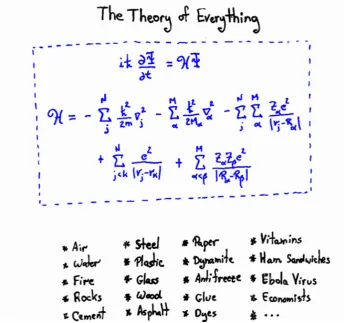
Figure 1.2: A chart of quantum chemistry (“Pople diagram”).[4]
Figure 1.2 is the two-dimensional chart of quantum chemistry introduced by Pople
in 1965[4] to present “a projection of the whole subject in which each calculation of a
molecular wave function is represented by a point with two coordinates”. The horizontal
coordinate corresponds to the size of the molecule measured by the number of electrons.
The vertical coordinate measures the level of sophistication of the quantum-mechanical
method used, which is also a measure of its accuracy. The computational complexity of
an electronic structure approximation increases considerably with both the size of the
system and the level of accuracy required. In particular, the curve correlating the level
of sophistication with the number of electrons of a quantum chemical calculation is a
hyperbola. In fact, due to their characteristic computational cost dependence, highly
accurate calculations (in extremis solving exactly the Schr¨odinger equation) are possible
only for small system scales, and vice-versa large molecular sizes are treatable only with
lower accuracy methods.
This is the Gordian knot of quantum chemistry, a discipline which is torn between
two extreme forces: accuracy and scalability.
As computer architecture and calculative capabilities evolve, the role of the quantum
compromise between accuracy and scalability.
This is the ultimate goal of this thesis. In this pursuit, we first briefly present a
number of well-established and ubiquitous approximations and methods that constitute
the fundamentals of quantum chemistry, laying the condicio sine qua non on which the
new theory is based.
1.2
Preamble on notation and units
At this stage, it is beneficial to clarify our notation for integrals. Unfortunately, in
quantum chemistry two notations are commonly adopted for one- and two-electron
integrals: physicists’ notation and chemists’ notation.
In physicists’ notation one- and two-electron integrals are defined by
hi|ji=h i| ji=
Z
i(x1)† j(x1)dx1 (2.8)
hij|kli=h i j|f12| k li=
ZZ
i(x1)† j(x2)†f12 k(x1) l(x2)dx1dx2 (2.9)
where i(x1) is a function of the electronic coordinatesx1 of electron “1” and f12⌘
f(x1,x2) is a function of the electronic coordinates of both electron “1” and “2” . Also
antisymmetrized two-electron integrals of the kind
hij||kli=hij|kli hij|lki (2.10)
are common. In chemists’ notation these integrals read
(i|j) = ( i| j) =
Z
i(x1)† j(x1)dx1 (2.11)
(ij|kl) = ( i j|f12| k l) =
ZZ
i(x1)† j(x1)f12 k(x2)† l(x2)dx1dx2 (2.12)
In order to avoid any inconsistency we eschew chemists’ notation altogheter. All
integrals will be in physicists’ notation.
1.3
Canonical Approximations
1.3.1 The Born-Oppenheimer Approximation
The “clamped nuclei” approximation proposed by Born and Oppenheimer in 1927[5] is
applied in the vast majority of quantum-chemical methods. In order to elucidate it, we
rewrite the Hamiltonian in Eq. (1.2) as
H(r,R) =Te(r) +TN(R) +VeN(r,R) +Vee(r) +VN N(R) (3.13)
wherer and Rdenote the sets of electronic and nuclear coordinates, respectively. The
terms Te andTN are the electronic and the nuclear kinetic energy operators, whileVeN,
Vee and VN N are the electron-nuclei attraction potential and the electron-electron and
nuclei-nuclei repulsion potentials, respectively.
The solution of the TISE (1.6) is not separable in electronic and nuclear parts because
of the coupling term VeN(r,R). The Born-Oppenheimer approximation assumes that
this nuclear and electronic separation is approximately correct, that is
(r,R)⇡ e(r;R) N(R) (3.14)
where e and N are the electronic and the nuclear part of the wave function and
the notation (r;R) indicates that e depends only parametrically on the location of
the nuclei. The approximation relies on the observation that nuclei are roughly 2000
times heavier than electrons. This means that in practice the electrons will respond
instantaneously to any movement of the nuclei, and therefore we can fix the nuclear
configuration at some set of values R⇤ and solve the “clamped nuclei” TISE for the
electronic wave function
He(r;R⇤) e(r;R⇤) =Ee(R⇤) e(r;R⇤) (3.15)
where the electronic Hamiltonian
is obtained from H(r,R) by neglecting the nuclear kinetic energy operator TN(R), as
the nuclei are assumed to be fixed. Note that the total energyEe includes the electronic
energy and also the nuclear repulsion energy VN N.
Once the electronic problem is solved, the nuclear problem can be cast as
HN(R) N(R) =E N(R) (3.17)
where the nuclear Hamiltonian is
HN(R) =TN(R) +Ee(R). (3.18)
The total energy Ee(R) provides a potential for the nuclear motion which is usually
referred to as the potential energy surface (PES) of the system. Solutions to the nuclear
TISE (3.17) describe the vibrational, rotational and translational modes of a molecule,
and E, which is the Born-Oppenheimer approximation to the total energy, includes
electronic, vibrational, rotational and translational energy.
In this thesis we are concerned solely with the electronic problem (Eq. (3.15)).
Therefore in the remainder of this work the electronic wave function will be reported
simply as , that is omitting the subscript “e”.
1.3.2 The Variation Method
The variation method is a powerful tool for obtaining approximate solutions to eigenvalue
equations which is based on a theorem known as the variational principle.[6] The theorem
states that, for any trial wave function |˜i that satisfies the appropriate boundary
conditions of the problem, the expectation value of the Hamiltonian (i.e. the energy) is
an upper bound to the exact ground-state energy, Eexact,
Eexact E[ ˜ ] = h
˜|Hˆ|˜i
h˜|˜i (3.19)
where the notation E[ ˜ ] emphasises that the energy is a functional of the trial wave
function. Thus the minimization of E[ ˜ ] with respect to all allowed trial wave functions
cannot be solved exactly except in a very small number of special cases, such a principle
is of paramount importance as it provides a criterion to assess the quality of a trial
wave function and allows for a systematic improvement towards the exact solution.
The Linear Variational Problem
The typical application of the variation method is to the particular case in which only
linear variations of the trial wave function are allowed, that is
|˜i=
N
X
i=1
ci| ii (3.20)
where { i} is a fixed set ofN orthonormaln-electron basis functions.
Using the Lagrangian multiplier formalism
L(c1, . . . , cN, E) =h˜|H|˜i E(h˜|˜i 1) (3.21)
where the multiplier E imposes the normalization condition
h˜|˜i=X
i
c2i = 1 (3.22)
then the variational problem takes the form
@L
@ci
= 0 i= 1, . . . , N (3.23)
The goal is now to find the optimum set of coefficients {ci}. If we define the matrix
representation of the Hamiltonian in the{ i} basis as
(H)ij =Hij ⌘ h i|H| ji (3.24)
the problem can be recast in the standard eigenvalue problem for theH matrix
Hc=Ec (3.25)
SinceH is a Hermitian matrix, Eq. (3.25) can be solved to yield N orthonormal
eigenvectorsc↵ and corresponding eigenvalues E↵, which for convenience are arranged
in ascending order, that is
Hc↵=E↵c↵ ↵= 0,1, . . . , N 1 (3.26)
with
E0E1. . .EN 1. (3.27)
Hylleraas-Undheim-MacDonald theorem
Remarkably, the variation method can be extended to all the eigenstates of a system,⇤
if they are modeled via a linear vector space, by virtue of a special case of Cauchy’s
interlace theorem,[7] known as the Hylleraas-Undheim-MacDonald theorem.[8, 9] In
order to illustrate the theorem, consider two linear variational spaces which constitute
two orthonormal sets of n-electron basis functionsS0 ={ 0i}and S00={ 00i}, where the
first space is a subset of the second, that isS0 ⇢S00. The matrix eigenvalue equations
in the two basis set are
H0c0↵ =E↵0c0↵ ↵ = 0,1, . . . , N 1 (3.28)
H00c00↵ =E↵00c00↵ ↵ = 0,1, . . . , N 1, N (3.29)
where we have again assumed that the eigenvalues are sorted in ascending order and,
without loss of generality, thatS00 contains one more basis function than S0. Then the
Hylleraas-Undheim-MacDonald theorem states that
E000 E00 E100E10 · · ·EN00 1 EN0 1EN00 (3.30)
which relates the eigenvalues of two variational spacesS0 ⇢S00 in such a way that those
of the larger space are always lower bounds to their homologous in the smaller basis set.
⇤This statement is restricted to those eigenstates which have a finite number of eigenstates below
1.3.3 Orbitals
A common form for the trial wave function ˜ is a linear combination of orthonormal
n-electron basis functions i, however we have not discussed yet the mathematical
structure of the latter. We will soon see that quantum chemists mostly use the Slater
determinant to this purpose, and before considering many-electron wave functions, it is
beneficial to discuss how wave functions for a single electron are modelled.
In order to completely describe an electron it is necessary to specify its spatial
distribution and its spin.
Aspatial orbital i(r) is a function of the position vectorrand describes the spatial
distribution of an electron. The physical implication of this definition is that| i(r)|2dr
represents the probability of finding the electron in the infinitesimal volume element dr.
Since we are concerned with the molecular electronic structure, from now on we will
refer to the function i(r) as a molecular orbital (MO).
Once the spatial distribution of the electron is determined we need to specify its spin.
A complete set for describing the spin of an electron consists of the two orthonormal
functions ↵(s) and (s), one for spin up and the other for spin down.
The wave function which describes a single electron in its entirety is a spin orbital
i(x), where x, as previously reported, represents both space and spin coordinates.
Thus, from a set ofN MOs{ i}one can form a set of 2N spin orbitals by multiplication
with either the ↵(s) or (s) spin functions, that is
i(x) = i(r)↵(s) (3.31)
i+1(x) = i(r) (s) (3.32)
Assuming that the set of MOs { i} is orthonormal so is the homologous set of spin
orbitals{ k}.
1.3.4 Slater Determinants
Suppose that we want to reasonably approximate the wave function of an n-electron
system by using combinations of spin orbitals. Then adopting an appropriate set of n
product as an n-electron wave function
H(x
1, . . . ,xn) = n
Y
i=1
i(xi) (3.33)
The wave function in Eq. (3.33) is known as a “Hartree product” as it was first proposed
by Hartree in 1927.[10] The physical picture originating from it definitely has its allure
as each electron simply occupies a single spin orbital.
Unfortunately nature is not as simple and intuitive in this case. Electrons are
fermions and as such these particles i) are indistinguishable, ii) follow Fermi-Dirac
statistics.[11, 12] Hartree products do not satisfy either of these two physical aspects of
electrons.
Since the Hamiltonian is spin free, the fermionic behaviour must be built directly
in the wave function. A satisfactory theory can be obtained if we make the additional
requirement that the many-electron wave function be antisymmetric with respect to the
interchange of any two electronic coordinates, that is
(x1, . . . ,xi, . . . ,xj, . . . ,xn) = (x1, . . . ,xj, . . . ,xi, . . . ,xn) (3.34)
This requirement is the so-calledantisymmetry principle, which is essentially a
mathe-matical consequence of the well known Pauli exclusion principle.[13]
In 1930 Fock[14] and Slater[15] independently proposed a n-electron wave function
that takes the form of a so-called Slater determinant
S(x
1,x2,· · · ,xn) = p1
n!
1(x1) 2(x1) · · · n(x1) 1(x2) 2(x2) · · · n(x2)
..
. ... . .. ...
1(xn) 2(xn) · · · n(xn)
This determinant easily satisfies the antisymmetry requirement because if two rows
are exchanged, which is equivalent to exchanging two electrons, then the sign of the
determinant, and thus the wave function, is changed.
Since then Slater determinants have become the building blocks of the vast majority
for the trial wave function ˜ the fixed set of N orthonormaln-electron basis functions
in Eq. (3.20) is made of N orthonormal Slater determinants, namely
i = Si (3.35)
thus, usually ˜ is just a linear combination of Slater determinants
|˜i=
N
X
i=1
ci| Sii (3.36)
For this reason in the remainder of this thesis the symbol indicates a Slater determinant,
where we omit the superscript “S” for brevity.
1.3.5 Linear Combination of Atomic Orbitals, Basis Functions and
Basis Sets
We have just seen that ordinarily the trial many-electron wave function ˜ is a linear
combination of Slater determinants i. These are normalized determinants of spin
orbitals i(xi) = i(ri) (si), where the MO i(ri) is a spatial distribution and (si) is
a spin function (either↵(si) or (si)).
In general, it is convenient to introduce a further approximation in which MOs are
expanded in a basis{ µ(r)} of N atomic orbitals (AOs)
i(r) = N
X
µ=1
Cµi µ(r) (3.37)
This expansion is known as a Linear Combination of Atomic Orbitals (LCAO).
The atomic basis set is usually referred to just as the ‘basis set’. In principle,
there exists a wide array of candidates that one can use to construct such a basis
set. Ideally, the basis functions should be chosen to allow for a systematic and rapid
improvement towards completeness, easy algebraic manipulation and efficient computer
implementation. However, in practice, compromises have to be made in order to strike
a balance between accuracy and computational cost.
functions (SFs) as atomic basis functions
|a]SF ⌘&aA(r) =nSFa
" Y
t=x,y,z
(t At)at
#
e ↵|r A| (3.38)
with exponent↵, centerA= (Ax, Ay, Az), normalization constant nSFa , and, with an
abuse of notation, angular momentum a = (ax, ay, az) and total angular momentum
a= (ax+ay+az). SFs are the natural choice for atomic systems as fora= 0,1, and with
the correct choice of↵ they are exact solutions to the hydrogenic Schr¨odinger equation.
Another attractive feature of these basis functions is that they can reproduce two
characteristic behaviours of any exact wave function i) the cusp at the electron-nucleus
coalescence point,[17] ii) the exponential decay.[18]
Despite their useful physical features, after an initial successful use in atomic
calculations, SFs could not be easily extended to molecular systems because of difficulties
in the evaluation of multi-centre two-electron integrals, which are of crucial importance
to modern quantum chemistry.
A breakthrough came in 1950 with Boys’ proposal of approximating Slater functions
with contracted Gaussian functions (CGFs)[19]
|ai ⌘ Aa(r) =
Ka
X
i=1
|a]i (3.39)
which are linear combinations ofKa( known as the “degree of contraction” of the CGF)
primitive Gaussian fuctions (PGFs)
|a]i⌘'Aa(r) =Dainia
" Y
t=x,y,z
(t At)at
#
e ↵i|r A|2 (3.40)
whereDia is a contraction coefficient and nia a normalization factor. We will usually
suppress the primitive indexi.
PGFs, unlike SFs, o↵er neither the correct nuclear cusp nor decay behaviour.
Nonetheless, it has been established both theoretically and empirically that a ‘brute
force’ saturation of function space, including Gaussians with suitably large and small
Formally this means that many more integrals must be computed than for SFs.
However, GFs have other very desirable and unique properties that still make the
evaluation of integrals over CGFs far superior to those over SFs.[20] In Part B we will
explore these properties in detail.
Thus GF basis sets are the most used basis sets in quantum chemical calculations.
Among them, the most popular are those developed by Pople and co-workers, the
correlation-consistent families of Dunning and co-workers, and the polarization-consistent
families of Jensen.
The Pople basis sets are arguably the most widely used for routine applications
because of the good compromise between computational expense and the resulting
accuracy. The Pople basis sets are generally of a split-valence nature.[21, 22] Symbols
like 6-31G or 6-311G represent double and triple splits of the valence shell. The acronym
is interpreted as 6 being the number of GFs for the inner shells and 31 or 311 being the
number of GFs in the contractions of the valence shells. The Pople basis sets can be
augmented with di↵use (+) and polarization functions for an improved description of
electronic structure.
The Dunning correlation-consistent basis sets, denoted cc-pVXZ (X = D, T, Q ),
are developed specifically for recovering the correlation energy.[23, 24, 25]. These basis
sets are constructed by adding shells of s, p, d,. . . functions to the atomic Hartree-Fock
orbitals in a systematic manner. Since each function within each shell contributes nearly
an equal amount to the correlation energy, the correlation-consistent basis sets are
well-defined with respect to increases in size and accuracy.
Finally, there are the Jensen polarization consistent basis sets, denoted pc-x (x=0,1,
2, 3, 4), whose design philosophy is similar to that of cc-pVXZ, but with a main emphasis
on Hartree-Fock and Density Functional Theory calculations.[26, 27, 28]
In general the correlation-consistent and polarization-consistent basis sets can be
expected to converge smoothly to the complete basis set (CBS) limit. This allows
1.4
Wave-Function and Density Formalisms
As discussed in Section 1.3.2, the total energy for a molecular system is a functional
of the wave function, that isE =E[ ˜ ]. Furthermore, every eigenstate with energy Ek
and wave function k is an extremum of the functional E[ ˜ ]. In other words, satisfying
the Schr¨odinger equation (1.6) is equivalent to solving the variational problem
E[ ˜ ] = 0 (4.41)
with the constraint of ˜ being normalized. Most of the contemporary calculations
on electronic structures use this wave-function formalism and for this reason they are
known as wave-function methods.
In 1964 Hohenberg and Kohn[29] showed that there exists an alternative but
rigorous formalism that allows to replace the complicated n-electron wave function
(x1,x2, . . . ,xn) and the associated variational procedure with the much simpler
one-electron density
⇢(r1) =n
Z
. . .
Z
(x1,x2, . . . ,xn)† (x1,x2, . . . ,xn)ds1dx2. . . dxn (4.42)
and its associated calculation scheme. Despite the huge simplification made in going
from the wave function, which is a 4n-dimensional mathematical construct, to the
density, which is just three-dimensional, no intrinsic information is lost.[29] In fact the
electronic Hamiltonian in Eq. (3.16) can be rewritten as
H=Te+ n
X
i=1
Vext(ri) +Vee+VN N (4.43)
where it is completely determined by the external potentialVext, which usually can be
identified with the nuclear potential.
In particular, Hohenberg-Kohn[29] proved that for an n-electron system with a
given external potential Vextthe variational theorem establishes a procedure to uniquely
determine the ground-state wave function 0, where the ground state energyE0 is a
functional of nand Vext
Their first theorem states
“The external potential Vext is determined within a trivial additive constant by the
electron density ”
and, in turn, the ground state energy is determined by Vext, then the ground state
energy itself must be a functional of the density
E0=E[⇢] (4.45)
This is more formally stated by the second Hohenberg-Kohn theorem which defines the
variational principle for the density
“For a trial density ⇢(˜r) such that⇢(˜r) 0 andR ⇢(˜ r)dr=n,
E[˜⇢] E0 ” (4.46)
Over the last few decades, quantum chemical methods that use this density formalism,
known as density-functional methods, have not only become widespread but arguably
the most widely used for routine applications because of the good compromise between
the computational cost and the resultant accuracy.
The aim of the remaining sections of this chapter is to introduce the reader to the
1.5
Wave-Function Methods
1.5.1 Hartree-Fock Theory
In the Hartree-Fock (HF) approximation the trial wave function takes its simplest form,
a single Slater determinant
˜ HF⌘ =| 1 2. . . a b. . . ni (5.47)
where| 1 2. . . a b. . . ni is a shorthand notation for a Slater determinant of nspin
orbitals { a}.
According to the variational principle, we are interested in minimizing the energy
expectation value calculated with a as a functional of the occupied spin orbitals
a, subject to the constraint that the set of orbitals remains orthonormal during the
variation.
Assuming an n-electron closed-shell system, this is achieved by minimizing with
respect to the spin orbitals{ a} the Lagrangian
L[{ a}] =E[{ a}] n
X
a=1
n
X
b=1
✏ab(h a| bi ab) (5.48)
where✏ab constitute a set of unknown Langrange multipliers and
E[{ a}] =
n
X
a=1
h a| ai+1
2
n
X
a=1
n
X
b=1
h a b| a bi h a b| b ai (5.49)
is the expectation value of the Hamiltonian over the single determinant .
Performing this variation (that is solving L[{ a}] = 0) one arrives at the following
set of integro-di↵erential equations, known as the Hartree-Fock equations,
f(x1) a(x1) =
n
X
b=1
✏ba b(x1) a= 1,2, . . . , n (5.50)
where theFock operator
f(x1) =
"
h(x1) +
n
X
b=1
Jb(x1) Kb(x1) #
is the combination of other three operators. The core-Hamiltonian operator
h(x1) =
1
2r
2 1
X
A
ZA
|r1 RA|
(5.52)
which is constituted by the kinetic energy operator and the nuclear potential of a single
electron chosen to be electron “1”. TheCoulomb operator
Jb(x1) = Z †
b(x2) b(x2)
|r1 r2|
dx2 (5.53)
which represents the average local potential at x1 arising from an electron in b, and
theexchange operator
Kb(x1) a(x1) =
"Z †
b(x2) a(x2)
|r1 r2|
dx2
#
b(x1) (5.54)
which has no classical interpretation as it arises from the antisymmetry of the wave
function.
From the form of the Fock operator in Eq. (5.51), it can be shown that the essence
of the HF approximation is to replace the many-electron problem by a one-electron
problem in which the electron repulsion is treated in an averaged way. In fact the
quantity
VHF(xi) = n
X
b6=i
Jb(xi) Kb(xi) (5.55)
known also as the HF potential, is the average field experienced by electron “i” due to
the presence of the remaining electrons. For this reason the HF method is often defined
as a mean-field approximation.
The wave function is a determinant and as such it is invariant to unitary
transfor-mations of the spin orbitals. It follows that the Fock operator is also invariant to such
transformations and consequently the optimal spin orbitals are not uniquely defined. It
is possible therefore to obtain an equivalent set of Lagrange multipliers {✏cab} and of
spin orbitals{ c
sets{✏ab} and { a}, by means of a unitary transformation
c a=
X
b
bUba (5.56)
✏c =U†✏U with U†=U 1 (5.57)
such that the matrix ✏c which contains the new multipliers {✏c
ab}is diagonal. In this
way the Hartree-Fock equations reduce to their simpler, canonical form
fc(x1) ca(x1) =✏ca ca(x1) a= 1,2, . . . , n (5.58)
Henceforth, we will drop the superscript “c” for conciseness.
Restricted Hartree-Fock: The Roothan-Hall Equations
Although Hartree-Fock theory was formulated in the 1930s, for a long time numerical
solutions were only possible for atoms. The breakthrough in molecular calculations was
due to Hall and Roothaan in 1951,[30, 31] who transformed the Hartree-Fock system
of integro-di↵erential equations into a much more computationally e↵ective matrix
eigenvalue equation.
Let us assume that we are dealing with a closed-shell system with 2n electrons,
n with ↵ spin and n with spin. We can choose two types of spin orbitals for this
problem: restricted spin orbitals, which are constrained to have the same MOs (spatial
functions) for ↵ and electrons; and unrestricted spin orbitals, which have di↵erent
MOs for ↵ and spins.
The Roothan-Hall method adopts restricted spin orbitals, which have the form
i(x) = j ⌘ j(r)↵(s) (5.59)
i+1(x) = ¯j ⌘ j(r) (s) (5.60)
Thus, the closed-shell determinant can be written as
By using this ansatz for the wave function, it is possible to integrate over all
spin coordinates to obtain the closed-shell spatial Hartree-Fock or simply restricted
Hartree-Fock (RHF) equations
f(r1) j(r1) =✏j j(r1) j = 1,2, . . . , n (5.62)
where the closed-shell Fock operator has the form
f(r1) =h(r1) +
n
X
a
2Ja(r1) Ka(r1) (5.63)
and the closed-shell Coulomb and exchange operators are
Ja(r1) =
Z
a(r2)† a(r2) |r1 r2|
dr2 (5.64)
Ka(r1) i(r1) =
Z
a(r2)† i(r2) |r1 r2|
dr2 a(r1) (5.65)
Even if spin-free, (5.62) still remains a system of integro-di↵erential equations with
no practical procedures for obtaining numerical solutions for molecules.
Roothaan’s contribution was to show that by expanding the MOs in a set of N
known spatial basis functions, the di↵erential equations would become a set of algebraic
equations which is solvable by standard matrix techniques. In particular, if we apply
the LCAO approximation
i = N
X
µ=1
Cµi µ i= 1,2, . . . , N (5.66)
then Eq. (5.62) takes the form
N
X
⌫=1
Fµ⌫C⌫i =✏i
N
X
⌫
Sµ⌫C⌫i i= 1,2, . . . , N (5.67)
where the elements of the overlap matrix are
Sµ⌫ =
Z
and those of the Fock matrix are
Fµ⌫ =
Z
µ(r1)†f(r1) ⌫(r1)dr1 (5.69)
Equations (5.67) are known as the Roothaan-Hall equations, and they can be written
more compactly in the famous matrix form
F C =SC✏ (5.70)
whereC is the MO coefficients matrix containing all the orbital expansion coefficients
{Cµi}.
Unrestricted Hartree-Fock: The Pople-Nesbet Equations
Obviously, not all molecules, nor all states are can be described by a closed-shell
electronic configuration. In order to model open-shell systems, we need to use an
unrestricted set of spin orbitals
i(x) = ↵j ⌘ ↵j(r)↵(s) (5.71)
i+1(x) = ¯j ⌘ j(r) (s) (5.72)
That is the↵electrons are described by a set of spatial orbitals{ ↵
j}, and the electrons
are described by a di↵erent set of spatial orbitals{ j}.
In this case, the wave function is the unrestricted determinant
=| 1 2. . . i i+1. . .i=| 1↵¯1 . . . i↵¯i . . .i (5.73)
The adoption of these unrestricted spin orbitals in Eq. (5.58) yields, after integration
over spin variables, the following unrestricted Hartree-Fock (UHF) equations
f↵(r1) j↵(r1) =✏↵j j↵(r1) (5.74)
where the ↵ and spatial Fock operators are
f↵(r1) =h(r1) +
n↵
X
a
[Ja↵(r1) Ka↵(r1)] +
n
X
a
Ja(r1) (5.76)
f (r1) =h(r1) +
n
X
a
h
Ja(r1) Ka(r1)
i
+
n↵
X
a
Ja↵(r1) (5.77)
with n↵ and n being the number of ↵ and electrons, respectively. The new
spin-specific Coulomb and exchange operators are defined as
Ja(r1) =
Z
a(r2)† a(r2) |r1 r2|
dr2 (5.78)
Ka(r1) i(r1) =
Z
a(r2)† i(r2) |r1 r2|
dr2 a(r1) (5.79)
where 2{↵, }.
From the definitions for f↵ and f , we notice that the two sets of equations (5.74)
and (5.75) are coupled and cannot be solved independently.
In order to solve the UHF equations, we proceed as in the RHF case by introducing
an atomic orbital basis for the expansion of the MOs
↵
i = N
X
µ=1
Cµi µ↵ i= 1,2, . . . , N (5.80)
i = N
X
µ=1
Cµi µ i= 1,2, . . . , N (5.81)
This leads to the formulation of the UHF equation in the matrix form
F↵C↵ =SC↵✏↵ (5.82)
F C =SC ✏ (5.83)
which are known as the Pople-Nesbet equations.
The Pople-Nesbet equations represent a generalization of the Roothan-Hall equations,
in fact the former collapse into the latter when{ ↵
i }={ i}, that is when the↵ and
the MOs are identical. For this reason we will now discuss only the procedure to solve
The Self-Consistent Field Procedure
As just discussed, the problem of determining the unrestricted Hartree-Fock molecular
orbitals{ ↵
i }and { i} and their orbital energies{✏↵i} and{✏i}, involves solving the
matrix equations (5.82) and (5.83).
However, to proceed with the solution methodology we first need the explicit
expressions for the ground state energy E0 and for the Fock matrices. These are best
expressed in terms of the ↵ and density matrices P↵ and P , whose elements are
defined by the equations
Pµ↵⌫ =
n↵
X
a=1
Cµa↵ (C⌫↵a)† (5.84)
Pµ⌫ =
n
X
a=1
Cµa(C⌫a)† (5.85)
The definition of a total density matrix, PT, as
PT=P↵+P (5.86)
is beneficial to our task.
Using these definitions the ground state energy can be written as
E0 =
1 2
N
X
µ=1
N
X
⌫=1 h
P⌫TµHµcore⌫ + +P⌫↵µFµ↵⌫ +P⌫µFµ⌫i (5.87)
with the↵ and Fock matrix elements being
Fµ↵⌫ =Hµcore⌫ +
N
X
=1
N
X
=1
PThµ |⌫ i P↵hµ | ⌫i (5.88)
Fµ⌫ =Hµcore⌫ +
N
X
=1
N
X
=1
PThµ |⌫ i P hµ | ⌫i (5.89)
where the elements of the core-Hamiltonian matrix are trivially
Hµcore⌫ =
Z
The UHF problem is solved when the optimal spin orbitals are found. Once the
atomic basis is introduced, the problem translates in finding the optimal MO coefficients
{Cµi↵}and {Cµi}. In fact, from these one can form the density matricesP↵,P and
PT, which are needed for the evaluation of the Fock matricesF↵ andF , and therefore
of the energyE0.
However, since the Fock matrices depend on the density matrices or equivalently on
the MO coefficients, which are also the solution to the problem, that isF↵ =F↵(C↵,C )
and F =F (C↵,C ), the Pople-Nesbet equations are nonlinear
F↵(C↵,C )C↵=SC↵✏↵ (5.91)
F↵(C↵,C )C =SC ✏ (5.92)
and must be solved iteratively.
The iterative scheme adopted to solve the Pople-Nesbet equations in known as the
self-consistent-field (SCF) procedure. For a given molecular system and atomic basis
set { µ}, in broad terms, it consists of the following steps:
1. Calculate all required integrals,Sµ⌫,Hµcore⌫ and hµ |⌫ i;
2. Obtain an initial guess for the MO coefficients and therefore for the density
matrices P↵ and P ;
3. Calculate the Fock matricesF↵ andF ;
4. Diagonalize the Fock matrices to obtainC↵,C ,✏↵ and ✏ ;
5. Form two new density matrices P↵ and P usingC↵ and C ;
6. Determine whether the procedure has converged, where the most common
con-vergence criterion relies on the fact that at concon-vergence the commutator relation
[SP F,F P S] = 0 becomes true;
(a) If [SP F,F P S] = 0, then the procedure has converged and the resultant
solution represented by C,P,F can be used to compute the energyE0 in
(b) If [SP F,F P S] 6= 0, then the procedure has not converged, therefore it
returns to step (4).
Forming trial density matrices and the aufbau protcol. Before concluding our treatment of Hartree-Fock theory, it is beneficial to analyse step (5) of the SCF more in
depth. Suppose we are dealing with a molecular system containing n↵ ↵-spin electrons
andn -spin electrons. Every time the Fock matrices are diagonalized in step (4) of
the SCF, N ↵-spin and N -spin MOs are obtained, where N is the dimension of the
atomic basis set. In particular, the MOs are specified by the column of the C↵ andC
matrices resulting from the diagonalization. Now, in order to ensure a decent accuracy
N > n↵, n . This implies that there are more MOs than electrons.
Since the density matrices use only the occupied spatial orbitals (see Eqs. (5.84)
and (5.84)), in step (5) one needs to choose which MOs to occupy in order to form the
new density matrices.
In order to converge to the ground state wave function one follows the aufbau
protocol which dictates that one simply occupies, at each cycle in step (5), then↵ and
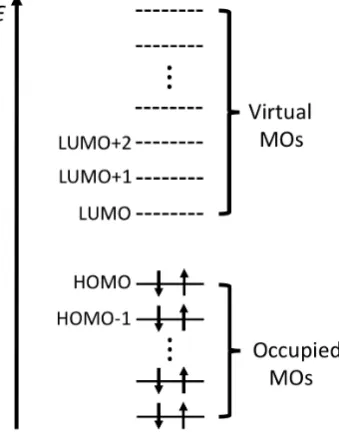
[image:46.595.197.367.483.704.2]n orbitals with the associated lowest orbital energies ✏↵j and✏j.
The resulting orbital picture is sketched in Fig. 1.3, where the MOs of an RHF
calculation for a closed-shell 2n-electron system are ordered according to their orbital
energies. Following the aufbau protocol the 2nlowest energy MOs are used to form the
new density matrices at step (5).
Once the calculation is converged, the orbitals which are occupied are called (guess
what!) the occupied orbitals, while the remaining, unoccupied MOs are the virtual
orbitals (or simply virtuals). The highest energy occupied MO is known as the Highest
Occupied Molecular Orbital (HOMO) and the lowest energy virtual is the Lowest
Unoccupied Molecular Orbital (LUMO). We will see soon that virtual MOs play an
important role in correlated methods.
1.5.2 Electron Correlation
The HF method treats the electron-electron interaction using a mean-field approximation,
that is the interaction is accounted only in an average fashion. In a large basis set
HF accounts for 99% of the total energy of a system, however it turns out that the
remaining 1% is extremely important for describing its chemistry.
The di↵erence between the exact non-relativistic energy of a system,Eexact, and the
restricted Hartree-Fock energy ERHF obtained in the limit that the basis set approaches
completeness was defined by L¨owdin in 1959 [32] as the correlation energy
Ecorr=Eexact ERHF (5.93)
This energy is due to a specific kind of correlation (Coulomb correlation) of the
electrons, which is not taken into account by the HF potential VHF in Eq. (5.55). In
fact, quoting L¨owdin,[33] between two electrons “iand j there is in reality a potential
Hij which, particularly for small distances rij ⇡0, may be tremendously large. If this
potential is repulsive, like the Coulomb potentialHij =e2/rij, it tries naturally to keep
the particles apart, and, since this correlation is entirely neglected in forming the Slater
determinant, the corresponding energy is a↵ected by an error which is usually called
the ‘correlation energy’.”
1. Coulomb correlation: as just highlighted by L¨owdin’s quote, there is a Coulomb
interaction between the electrons that generally decreases the probability of finding
two electrons (of any spin) close to each other. Thus, for each couple of electrons
“i” and “j” the correct wave function must be such that its ij-pair probability
density
⇢ij(ri,rj) =
Z
(x1, . . . ,xn)† (x1, . . . ,xn)dx1. . . dxi 1dsi. . . dxj 1dsj. . . dxn (5.94)
is zero at their coalescence point, that is
lim
rij!0
⇢ij(ri,rj) = 0 (5.95)
This depression in the pair probability density is called theCoulomb hole and it is
at the origin of the famous and paramount electron-electron coalescence conditions
derived by Kato in 1957.[17]
2. Fermi correlation: electrons are indistinguishable and obey Fermi-Dirac
statis-tics, which imposes the antisymmetry requirement to the wave function. This
implies that two same-spin electrons cannot be found simultaneously at the same
point in space and consequently that the probability of finding one in the
immedi-ate vicinity of the other is close to zero. In this sense the correct wave function is
such that its pair probability density exhibits a “hole”, the Fermi hole.
Fermi correlation is taken into account “automatically” by using Slater determinants.
Thus, the correlation energy in Eq. (5.93) refers only to Coulomb correlation.
A minor distinction is worth making betweensame-spin correlation and
opposite-spin correlation. Same-spin correlation is the Coulomb correlation between electrons
having the same spin (not to be mistaken for Fermi correlation). Instead, opposite-spin
correlation is between electrons having opposite spin. Since the mathematics of a Slater
determinant is such that same-spin electrons are already “kept apart”, the contribution
to the correlation energy Ecorr due to same-spin correlation is usually minor and its
Another distinction is between dynamic and static correlation. Dynamic correlation
is associated with an instantaneous repulsion between the electrons, such as those
occupying either the same MOs or nearly spatially equal MOs. The static correlation
is usually associated with electrons avoiding each other on a permanent basis, such as
those occupying two energetically degenerate orbitals with di↵erent spatial distributions.
A typical example of where static correlation is very significant is bond breaking.
Eventually, the distinction between static and dynamic correlation remains nebulous
and mathematically not well-defined.
The coming sections dedicated to wave-function methods will be dealing with
“correlated methods”, that is methods which take into account either partially or fully
electronic correlation.
Unrestricted Hartree-Fock, correlation and spin contamination
Before proceeding with the established correlated methods, it is worth making a note on
the correlation problem in the context of unrestricted Hartree-Fock theory. A well-known
observation is that RHF cannot properly describe the bond breakage as it usually yields
wrong dissociation limits, that is the RHF energy of the system, close to dissociation,
is larger than the sum of energies of the isolated component molecules. On the other
hand, UHF is known to correctly model dissociation.
This success of UHF is due to the fact that the↵ and MOs involved into the bond
are not constrained to be spatially degenerate. As the bond is stretched the MOs break
their spatial degeneracy allowing for the localisation of the electrons on the molecular
fragments. Since the electronic localisation is energetically favourable during the bond
breakage, this event is associated with a lowering of the UHF energy below the RHF
one. The point where the RHF and UHF descriptions start to di↵er is often referred to
as a RHF/UHF instability point.
Since, in this situation, the UHF energy is lower than the RHF one, according to
definition (5.93) the UHF wave function has partly introduced electron correlation.
However, this correlation comes with a price: spin contamination. Once the MOs spatial
symmetry is broken, the wave function is not a pure spin state anymore, but it is
inferred from the expectation value of the S2 operator, usually denoted by the symbol
hS2i. Its correct expectation value for a pure spin state is hS2i=Sz(Sz+ 1), that is 0
for a singlet, 0.75 for a doublet, 2 for a triplet, etc. An UHF singlet, for example, might
contain some amount of triplet, quintet and so on.
ThehS2i value of the UHF wave function can be calculated using the formula
hS2i=Sz(Sz+ 1) +n
occ. X
ij
|h i↵| ji|2 (5.96)
from which it can be easily verified that the RHF wave function will always yield, for
example, pure singlet spin states.
1.5.3 Configuration Interaction
The HF method provides the energetically best single-determinant many-electron trial
wave function within aone-electron basis of atomic orbitals. As the size of the basis
set is increased up to its completeness, the lowest possible single-determinant energy,
known as the Hartree-Fock limit, is reached. No further amelioration is possible by
variation of the one-electron basis.
However, as previously discussed, a convergedn-electron closed-shell RHF calculation
within anN-dimensional basis set yields N MOs, of which nare doubly occupied and
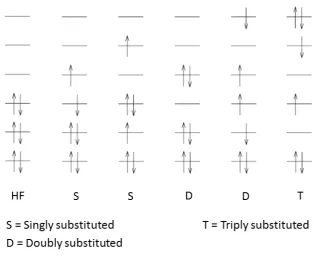
the remaining (N n) virtuals are left unoccupied. As sketched in Fig. 1.4, from
theseN converged MOs, a set of additionalh Nn 1iorthonormal Slater determinants
can be constructed by promotion of a number of electrons from the occupied to the
virtual MOs. Determinants which are obtained by promoting one, two, three, . . . , n
electrons in this way are namedsingly,doubly,triply, . . . ,n-tuply substituted (or excited)
Figure 1.4: MO diagram for HF and substituted determinants.
In the Configuration Interaction (CI) method, which was devised by Condon in
1930,[34] the many-electron basis for the trial wave function is systematically improved
by linearly combining the reference wave function 0 (usually the HF ground state
determinant) with a certain number of substituted determinants
˜ CI⌘c0 0+X
ir
cri ri +X
i<j r<s
crsij rsij +· · · (5.97)
where the c0, cri, crsij, . . . , coefficients are the so-called CI amplitudes, ri are singly
substituted determinants in which an electron has been promoted from thereference
state occupied MO i to the virtual MO r, rsij are doubly substituted determinants
and so forth.
Since the CI wavefunction is just a linear combination of Slater determinants, the
TISE can be solved in this basis by following the “linear variational method” described
in Section 1.3.2, that is by diagonalization of the Hamiltonian matrixH as defined in
Eq. (3.24).
is referred to as CI-Singles (CIS), if it includes all the singly and doubly substituted
determinant CI-Singles-Doubles (CISD) and so forth, up to when all possible substituted
determinants are incorporated to form the so-called Full CI (FCI) wave function.
The FCI solution yields the best possible solution within a given one-electron basis.
To be more specific it recovers the maximum amount of correlation energy within the
basis set. Furthermore, as the size N of the basis set increases the resulting
many-electron basis of substituted determinants approaches completeness. It can be shown
that, in the limit N ! 1, that is for a sufficiently large one-electron basis, the FCI
wave function converges to theexact solution of the TISE.
Figure 1.5: CI convergence to the exact solution.
In this sense, the major advantage of CI over other correlated methods is that it
o↵ers a systematic manner to improve the accuracy of the trial wave function towards
exactitude. However, accuracy in CI comes at an high price. In fact, it can be shown
that a CI which includes up to m-tuply substituted determinant scales as
O(nmV2+m) =
8 > < > :
O N2m+2 if n⇡V >> m
O Nm+2 if V >> n, m
(5.98)
where nis the number of electrons, N is the size of the one-electron basis andV is the
CISDTQ scale as O(N4),O(N6) andO(N10), respectively, for typical cases.
When the level of electron promotion m becomes comparable with the size of the
basisN, that is for FCI or nearly FCI, the computational scaling becomesO(Ndetn2N2),
where Ndet is the product of the number of determinants for the alpha and beta
electrons separately. Thus, for a system with kalpha and kbeta electrons, where kis a
large number, the following number of determinants can be obtained via the Stirling
approximation for factorials
Ndet(N = 2k)⇡
16k
k⇡ k large (5.99)
This exponential scaling makes FCI unrealistic except for quite small molecules.
Furthermore, even if the truncated versions (CISD, CISDT, etc.) formally are much
lower scaling, these methods violate bothsize-consistency,[35] which establishes that
the energy of a system should equal the energy sum of the separate subsystems at the
bond dissociation limit, and the more generalsize-extensivity requirement,[36] for which
the energy should scale linearly with the number of particles in the system.
It is in this necessity of size-extensivity that the next wave-function method finds
its origin.
1.5.4 Coupled Cluster
The Coupled-Cluster (CC) set of methods stems from a motivation to find an improved
theory to truncated CI theory which is inherently size-extensive. It invokes a non-linear
expansion of the wave function, which defines a set of non-linear partial di↵erential
equations that need to be solved using iterative techniques. For this reason, CC theory
is much more involved than the linear expansion analogue of configuration interaction.
Since its introduction, first in nuclear physics[37] and then into quantum chemistry
in 1966 by Cizek,[38] CC has established its status as perhaps the most reliable yet
computationally a↵ordable approximation to the full CI expansion.
![Figure 1.2: A chart of quantum chemistry (“Pople diagram”).[4]](https://thumb-us.123doks.com/thumbv2/123dok_us/1808299.135993/25.595.171.456.103.350/figure-chart-quantum-chemistry-pople-diagram.webp)