A SEMI-BLIND CHANNEL EQUALISATION STRATEGY FOR THE UMTS-TDD
DOWNLINK
Mahmoud Hadef and Stephan Weiss
School of Electronics & Computer Science
University of Southampton
Southampton SO17 1BJ, UK
m.hadef,s.weiss @ecs.soton.ac.ukABSTRACT
In this paper, we propose a semi-blind channel equalisa-tion scheme for the downlink time-division duplex (TDD) component of the universal mobile telecommunication sys-tem (UMTS). The main two concepts introduced consist of: first exploiting the constant modulus carried by the decoded symbols of all active users ; and second making use of the inactive users to load a suitable number of pilot signals. In response to this scenario, a semi-blind equalisation is per-formed in the data fields, whereby the equaliser weights are updated by minimising a hybrid CM/MSE cost function based on the constant modulus (CM) criterion for all ac-tive users and a mean square error (MSE) criterion for both absent users and pilot signals. Computer simulations are used to assess and analyse the channel equalisation strategy in terms of MSE and BER performance over a quasi-static dispersive channel
1. INTRODUCTION
The time division duplex (TDD) component of the univer-sal mobile telecommunication system (UMTS) provides a high transmission rate, an efficient use of the spectrum and a flexible capacity allocation. It has previously become the basis for the third generation (3G) standard, and most likely will be selected as the main duplex mode operation for the fourth generation (4G) systems [1].
In the UMTS TDD mode the transmitted users are mul-tiplexed by orthogonal codes, which provide intrinsic pro-tection against multi-access interference (MAI). Neverthe-less, transmission over a dispersive channel destroys the mutual orthogonality of these codes, and as a result, the received and code-demultiplexed user signals are subject not only to inter-symbol interference (ISI) due to channel dispersion but also to MAI caused by the loss of code or-thogonality. Consequently the conventional code-matched filter receiver suffers from sever performance degradation; hence better detection strategies are required. Thus,
sig-nificant efforts have been directed towards developing mul-tiuser detection /equalisation techniques to suppress MAI and ISI [2]. Optimum detection in the maximum likeli-hood (ML) sense [3] is perhaps the most popular technique in spite of the computational complexity which increases exponentially with the number users and the delay spread of the channel [4]. Due to the unrealistic complexity of the optimum detector, several-sub optimum schemes have been proposed, yet all of them require explicit knowledge of the channel impulse response [2, 4]. Alternatively, several blind detection strategies, where no explicit knowledge of the channel or neither pilot signals or training sequences are necessary, offer better spectrum efficiency with reasonable trade-off between performance and complexity [5, 6, 7].
A popular approach to suppress MAI and ISI on a user is the minimum output power (MOE) algorithm which blindly cancels MAI and ISI terms but passes the desired user by code-constraints [8], which is essentially Frost’s linearly constrained minimum variance beamformer [9]. For the DS-CDMA downlink, the recovery of several synchronous users at the same time exploits more knowledge of the sys-tem. Non-blind multiuser schemes, such us using the mean squared error (MSE) criterion, in turn are based either on the knowledge of a pilot [10, 11] or training bursts [12]. Blind schemes have been performed using a constant modu-lus (CM)criterion [13, 14], neglecting either the dispersive-ness of the channel [14] or spreading [13, 6], whereby the later algorithms additionally require mutual decorrelation of the recovered user sequences. In [7], a blind scheme simi-lar to [13, 6] has been developed, whereby the despreading in the DS-CDMA receiver ensures the orthogonality of the recovered sequences, and a CM criterion on all users suf-fices. The algorithm in [7] is however only suitable for a fully loaded system, in which all possible users are active. A hybrid CM/MSE algorithm, appropriate for partial load-ing scenario, has been derived in [15].
performed over the training field, a semi-blind adaptation, similar in structure to [15] is adopted over data fields. In a partially loading scenario, a number of inactive users are exploited as pilots, in order to eliminate the phase ambi-guity and to enhance the system performance. In Sec. 2 a description of the UMTS TDD physical channel is given. Based on the definition of a signal model in Sec. 3, the hy-brid CM/MSE cost function is derived in Sec. 4. Sec. 5 presents a stochastic gradient algorithm used for the semi-blind adaptation. The performance of the proposed scheme in terms of MSE and BER in both fully and partially loaded systems are presented in Sec. 6 through various simulations, and finally conclusions are drawn in Sec. 7.
2. UMTS TDD PHYSICAL CHANNEL
The UMTS TDD mode provides up- and downlink services within the same frequency band, and separated in time through the use of different time slots, each of which can support parallel spreading codes with a maximum spreading fac-tor of 16 [16]. 15 of these time slots are gathered in one frame, whereby each frame has a duration of 10 ms [16] as shown in Fig. 1(a). Within every time slot users can transmit their signals simultaneously by means of different spreading codes. The time slot contribution from a single user is re-ferred to as a burst.
The UMTS TDD physical channel is a combination of two data fields, a midamble, and a guard period. There are two burst types proposed in [16], namely burst type 1 and type 2. As illustrated in Fig. 1(b), both types have the same length of 2560 chips and are terminated by a guard period of 96 chips in order to avoid overlapping with consecutive time slots. Burst type 1 has a longer midamble suitable for cases where long training periods are required for adaptation and tracking.
3. SIGNAL MODEL
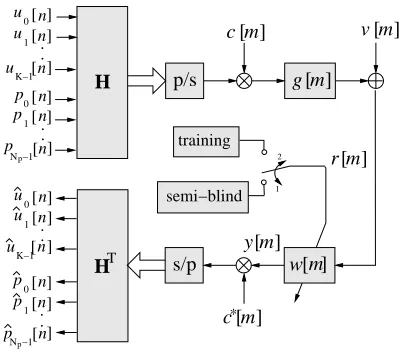
We consider the UMTS-TDD downlink model in Fig. 2 with
a maximum of symbol-synchronous active users. We
as-sume that in the following, and for simplicity that
users have the same rate. In the case of a partially loaded
system with , we assume the first users with
sig-nals, , to be active, and the following
!" to be pilots with signals#,$%&'()*
while the remaining+,-,( user signals are assumed
to be zeros. The signals are code multiplexed using
Walsh sequences of length extracted from a Hadamard
matrix. . The resulting chip rate signal, running at times
the symbol rate, is further scrambled by/01* prior to
trans-mission over a channel with dispersive impulse response
2
13 and corruption by additive white Gaussian noise413,
38400 chips= 10 ms
Frame
Slot #0 Slot #1
2560 chips
data field 1
midamble
data field 2
512 chips 976 chips
976 chips
burst type 2
GP
GP
burst type 1
data field 2 midamble
256 chips data field 1
Slot #2 Slot #14
(a)
1104 chips 1104 chips
[image:2.595.331.523.71.278.2](b)
Fig. 1. Time structure in UMTS TDD: (a) basic frame
struc-ture, and (b) burst structure.
which is assumed to be independent of the transmitted
sig-nal561*.
The dispersive channel2
13 destroys the orthogonality
of the Walsh codes, such that direct decoding of the received
signal7813 with descrambling by/'9:13 and code-matched
filtering by.<; will lead to MAI and ISI corruption of the
decoded user signals= ,>?'@ . In order to
re-establish orthogonality of the codes, a chip level equaliser
A
1* can be utilised [11]. The equalisation is performed
in both midamble period and data fields — in the former by means of the training sequence at the chip rate in the MSE sense, in the latter by using a semi-blind scheme. In the following, we propose a semi-blind updating scheme for
the equaliser coefficientsA
13.
[m] [m]
c
s/p
r [m]
[m]
c* [m]
y
[ ] u
0 n
[ ] u
1 n
K−1[n]
u . .
[ ]
0 n
p [ ] p
1 n.
. ] [n p
N −1p
0[ ]
u n
1[ ]
u n
u [ ]
K−1n
[ ] p
0 n
[ ] p
1 n
. . ] n p
N −1p [
[m]
v
g
H p/s
HT w[
1 2
m]
. .
semi−blind training
[image:2.595.325.525.520.698.2]4. SEMI-BLIND EQUALISATION CRITERIA
We first derive the detected user signals=
and the pilot
signals#= as a function of the equaliser
A
13. Based on
this, we state a suitable cost function based on which the equaliser can be adapted.
4.1. Demultiplexed User and pilot Signals
For the decoding, Walsh sequences are used as matched
fil-ters. The sequence for decoding theth user, contained in a
vector , can be taken from an< Hadamard matrix,
. ; ?
; (1)
Theth user is thus decoded as
= ;
/ 9 $<
/ 9 $
. .. / 9 $ 3 $< $ .. . $ 3 ! ; $ " #$ #$ . .. #$
7 $<
78$
.. .
78$&% ('
whereby the descrambling code / 9 1* has been absorbed
into a modified and now time-varying code vector $ ,
and
#*),+-contains the equaliser’s% chip-spaced
com-plex conjugate weights. Rearranging#
and $< yields
= # $ ; $< ); $< . .. ; $ 78$< 78$ .. .
78$&% (' # $
.<$ ".0/ 21 (2)
with. $<
)3+ -465 87
-:9
being a convolutional
ma-trix comprising of theth either user’s modified code vector
); and.0/
);+ 87
. Similarly, (2) holds for theth
decoded pilot signal#= , whereby . $< contains the
pilot’s modified code vector.
4.2. Cost Function
Since the modulation scheme used for UMTS-TDD is mainly the quadrature phase shift keying (QPSK), or in some cases
8-PSK [16], the active user signals consist of
sym-bols with a constant modulus< . Therefore, by forcing all
re-ceived user symbols= onto the constant modulus< and
the received pilot symbols#= onto the known
transmit-ted ones# , a semi-blind cost function= is proposed to
−2 −1 0 1 2 −2 −1 0 1 2 −20 0 20 40 60 80 100
imag(w )
ξ
10*log( )
[image:3.595.311.543.73.251.2]real(w )0 0
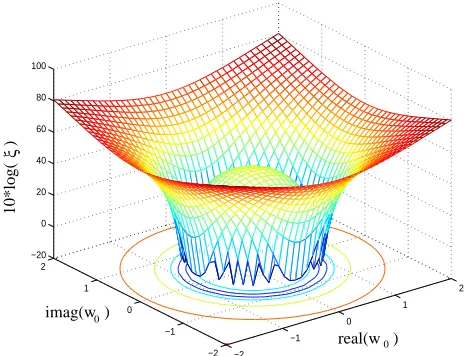
Fig. 3.Cost function> in dependency of a single complex valued
coefficient?A@,for a fully loaded system withBDCFEHG users.
adapt the equaliser weights and potentially track any
chan-nel variations. Note that the remaining@ @
inac-tive users should be taken into consideration, otherwise the equalisation criterion is under-determined and the correct signals would not necessarily be extracted in the despread-ing operation. It was found to be best in terms of conver-gence speed, steady state error and transmit power to force the inactive users to zeros in the MSE sense, thus ensuring that the overall system is fully determined [15].
Therefore the proposed cost function consists of three
terms and is formulated as= ,
= JILKNM
O
P
Q<R TS= USR:R"VWXIZY [\
^]_^
O
`P
S#& #= aSR6bc
d I Y [\ ^ O P M 7^e]
S= USR bc
d
1 (3)
whereIgfh`i denotes the expectation operator. The equaliser
coefficients in#
can be determined such that the above cost function is minimised,
#(jlknm
porqtsvu(wyx
z
=
(4)
Note that in the absence of any pilot signals, a manifold of solutions exists for (4) due to the indeterminism of the CM criterion to rotations in phase.
4.3. Phase ambiguity
Since an ambiguity with respect to a complex rotation{}|l~ (
)
H'0 ) cannot be resolved by CM criteria, the rotation
−2 −1
0 1
2
−2 −1 0 1 2 −20 0 20 40 60 80 100
imag(w )
ξ
10*log( )
[image:4.595.53.284.73.251.2]real(w )0 0
Fig. 4.Cost function> in dependency of a single complex valued
coefficient? @, for a partially loaded system with 10 active users
and 6 pilots.
with a pilot signal. However, this solution is valid only for partially loaded scenarios and issues such as the use of dif-ferential encoding or the transmission of a synchronisation word may still persist.
Example. In order to give an idea of the cost function
and to show pilots remove the phase ambiguity, the fol-lowing example is presented. Firstly, we assume a fully
loaded system with users employing QPSK with
<! over a distortionless and delayless channel
2
13
13 with a signal to noise ratio (SNR)of 20 dB. Fig. 3
shows the cost function= in dependency of an equaliser
#
with a single complex coefficientA
. The cost function
shows that there is a manifold of optimal solutions
satisfy-ing S
A
jlknm
S . Secondly, we assume that the system is
partially loaded by active users and 6 pilots. Thus,
as shown in Fig. 4, the cost function= reduces to a single
global optimumA
jtkm
and the phase ambiguity has
been removed.
5. SEMI-BLIND ADAPTATION
Simple adaption rules for the equaliser can be obtained by considering a stochastic gradient descent technique, whereby an iterative update rule is utilised for the equaliser
coeffi-cient vector#
/ at time ,
#
/ 7
#
/
=
= (5)
where is the algorithm step size, and the gradient
opera-tor applied to an instantaneous cost function =
= . The latter
is obtained from (3) by dropping the expectation operation. The gradient term of the instantaneous cost functions can be
derived by using equations (3) and (2), yielding
=
=
#
9
'gM
O
P
< R TS= aSR . $<". / -=
9
e]_
O
P
.<$<".0/ #&& #&=
9
^
O
P
M
7^ ]
. $ . / -= 9
(6)
The first term in (6) is equivalent to a blind version of this algorithm for a fully loaded system [7], which differs from the standard CM algorithm [17] or its extension in [13] by
the inclusion of a code filtered term . $<(._/ rather
than just the equaliser input78. The resulting structure is
known as a filtered-X [18] or a filtered-error filter-regressor structure [11] in the context of LMS-type algorithms. The additional two terms in (6) are due to pilot signals and to force the output of inactive code filters to zero.
6. SIMULATION RESULTS
The stochastic gradient algorithm derived in Sec. 5 is
ex-perimentally tested and evaluated below for the
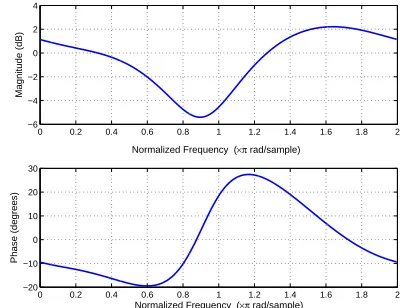
UMTS-TDD physical channel presented in Sec. 2, by using both burst types 1 and 2. Simulations are performed over one frame of 10 ms, whereby all 15 bursts are dedicated to downlink mode only. The dispersive channel is consid-ered static over this frame with frequency response given
by in Fig. 5. The length of the equaliser is%+ , and
the step size is experimentally chosen to be about an order of magnitude below the onset of divergence. In Sec. 6.1 we assume a fully loaded scenario and compare the proposed scheme with a basic strategy based on a chip rate equali-sation performed in the training period, in terms BER and
0 0.2 0.4 0.6 0.8 1 1.2 1.4 1.6 1.8 2
−20 −10 0 10 20 30
Normalized Frequency (×π rad/sample)
Phase (degrees)
0 0.2 0.4 0.6 0.8 1 1.2 1.4 1.6 1.8 2
−6 −4 −2 0 2 4
Normalized Frequency (×π rad/sample)
[image:4.595.324.524.528.682.2]Magnitude (dB)
0 1000 2000 3000 4000 5000 6000 7000 8000 −80
−70 −60 −50 −40 −30 −20 −10 0
iteration (chips)
MSE (dB)
only training (burst type 1) only training (burst type 2) CMA + training (burst type 1) burst 1 burst 2 burst 3
MSE ( dB )
iteration n
burst 1 burst 2 burst 3
[image:5.595.60.273.74.217.2]1 2 2
Fig. 6.MSE curves of the proposed algorithm for aBDCFEHG users
UMTS-TDD system over a duration of three bursts for the shorter burst type 2, compared to an LMS-type training based method for both burst types.
0 2 4 6 8 10 12 14 16
10−4
10−3
10−2
10−1
100
channel SNR
BER
Matched filters training mode only enhanced by CMA
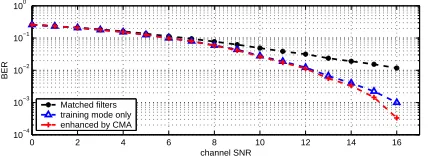
Fig. 7.BER performance of the proposed algorithm in burst type 2 mode, compared to training based equalisation for burst type 2, and a receiver without equalisation only based on code-matched filtering.
MSE performance. Later in Sec. 6.2 we evaluate the perfor-mance enhancement achieved by the introduction of pilots in the partially loaded system.
6.1. Fully loaded Scenario
For the fully loaded UMTS TDD system all possible 16 QPSK user signals are transmitted and no pilots are used. In order to achieve an optimum response, the adaptation is initialised with the first coefficient in the weight vector set to unity. The proposed adaptation scheme is implemented in a noise-free channel by using bursts of type 1, which have the shortest training period (256 chips). As it is shown in Fig. 6, the proposed algorithm outperforms the two other schemes when the equalisation is performed in both burst types but only over the training period. The remaining error floor is due to model truncation. This means that by using the pro-posed scheme the spectral efficiency could be raised by ap-proximately 13% by using burst type 2 instead of burst type 1 at a similar MSE performance albeit a somewhat higher computational cost. Fig. 7 exhibits the BER performance of the proposed algorithm, matched filters with no equalisa-tion, and the training equalisation with type 2 bursts. It can
be noticed that for low SNRs there is no benefit from using equalisation, however for medium or relatively high SNRs the proposed scheme shows increasing benefit compared to the two other methods.
6.2. partially loaded scenario
For a partially loaded system with user signals,
ei-ther 4 or 6 pilots are transmitted under similar channel con-ditions presented in Sec.6.1. Note that with the introduction of pilots, no phase correction is needed and the choice of the initial weight vector is not crucial. In the following, the second coefficient is set to unity. The MSE curves repre-sented in Fig. 8 are obtained over a noise-free channel. It can be seen that the introduction of 6 pilots exhibits a faster convergence than either schemes where 4 pilots or none are used. In noisy channels, the introduction of pilots enhances the BER performance of the system for relatively medium to high SNRs, as shown in Fig. 9.
7. CONCLUSIONS
A semi-blind equalisation approach for a UMTS-TDD down-link scenario has been presented, with the aim of enforcing CM conditions on the various active user signals and MSE criteria on either introduced pilots or the remaining inactive users. The algorithm presents better convergence behaviour over the basic training equalisation even with longer train-ing periods, whereby a gain of data rate and spectrum effi-ciency can be achieved. It has been shown through various simulations that the implementation of pilots enhances the system performance in terms of MSE and BER and resolves the typical CM phase ambiguity.
8. REFERENCES
[1] R. Esmailzadeh, M. Nakagawa, A. Jones, “TDD-CDMA
for the 4th Generation of Wireless Communication,” IEEE Transactions on Wireless Communications, vol. 10, Issue: 4 pp. 8–15, Aug 2003.
[2] S. Verdu, “Multiuser Detection,” Cambridge, UK: Cam-bridge University Press 1998.
[3] H. Cirpan, and M. Tsatsanis, “Stochastic Maximum Like-lihood Methods for Semi-Blind Channel Estimation,” IEEE Trans. Signal Processing Lett , vol. 5, pp. 21–24, Jan. 1998.
[4] M. Morelli, U. Mengali, and A. Masciarelli, “Pilot-Assisted Channel Estimation for the Downlink of the UMTS-TDD Component,” IEEE Transactions on Communications, vol. 52, no. 4, pp. 595–604, April. 2004.
[image:5.595.63.277.277.358.2]0 500 1000 1500 2000 2500 3000 3500 4000 4500 5000 −80
−70 −60 −50 −40 −30 −20 −10
0 without pilots 4 pilots
6 pilots
MSE ( dB )
burst 2 burst 1
[image:6.595.59.274.73.208.2]iteration n
Fig. 8.MSE curves of the proposed algorithm in 10 users UMTS-TDD environment with or without pilots over two bursts of type 2.
0 1 2 3 4 5 6
10−3
10−2
10−1
100
channel SNR
BER
SNR=5dB SNR=10dB SNR=15dB
number of pilots
Fig. 9. effect of the number of pilots on the BER performance corresponding to the case of 10 active users.
[6] S. Lambotharan, J. A. Chambers, and A. G. Constantinides, “Adaptive Blind Retrieval Techniques for Multi-User DS-CDMA Signals,” IEE Electronics Letters, vol. 35, no. 9, pp. 693–695, April 1999.
[7] S. Weiss and M. Hadef, “Blind Chip-Rate Equalisation
for DS-CDMA downlink Receiver,” in Signals, Systems
and Computers, 2003 The Thrity-Seventh Asilomar Confer-ence,Vo. 2 , pp. 1283 - 1287, Nov. 2003.
[8] R. Schober, W. H. Gerstacker, and L. H. J. Lampe, “Com-parison of MOE and blind LMS,” IEEE Communications Letters, vol. 7, no. 5, pp. 204–206, May 2003.
[9] O. L. Frost, III, “An Algorithm for Linearly Constrained Adaptive Array Processing,” Proceedings of the IEEE, vol. 60, no. 8, pp. 926–935, August 1972.
[10] F. Petre, M. Moonen, M. Engels, B. Gyselinckx, and H.D.
Man, “Pilot-Aided Adaptive CHip Rate Equalizer
Re-ceiver for Interference Suppression in DS-CDMA Forward
Link,” in IEEE Vehicular Technology Conference, Sept.
2000, vol. 1, pp. 303–308.
[11] P. Schniter and A. R. Margetts, “Adaptive Chip-Rate Equal-ization of Downlink Multirate Wideband CDMA,” in Asilo-mar Conference on Signals, Systems, and Computers, Mon-terey, CA, November 2002, pp. 1228–1232.
[12] I. Stirling, D. Garcia-Alis, S. Weiss, G. Rice, and R.W. Stew-art, “A Joint Adaptive MMSE Downlink Receiver,” in Asilo-mar Conf. Sig. Sys. Comp., Nov. 2000, 2:1436-1440.
[13] C. Papadias and A. Paulraj, “A Constant Modulus Algorithm for Multiuser Signal Separation in Presence of Delay Spread Using Antenna Arrays,” IEEE Signal Processing Letters, vol. 4, no. 6, pp. 178–181, June 1997.
[14] Y. Huang and P. M. Djuri´c, “Multiuser Detection of Syn-chronous Code-Division Multiple-Access Signals by Perfect Sampling,” IEEE Transactions on Signal Processing, vol. 7, no. 50, pp. 1724–1734, July 2002.
[15] M. Hadef and S. Weiss, “A Blind Synchronous Multi-user DS-CDMA Equaliser with Partial Loading ,” in in Interna-tional Symposium on Control, Communication, and Signal Processing , Hammamet, Tunisia, 21-24 March 2004.
[16] TS. 25.233, 3GPP, “Spreading and Modulation (TDD),”
Third Generation Partnership Project, vol.5.3.0 , April 2003.
[17] C. R. Johnson, P. Schniter, T. J. Endres, J. D. Behm, D. R. Brown, and R. A. Casas, “Blind Equalization Using the Con-stant Modulus Criterion: A Review,” Proc. IEEE, 86(10): 1927–1950, 1998.
[18] S.J. Elliott, I.M. Stothers, and P.A. Nelson, “A Multiple Er-ror LMS Algorithm and its Application to the Active Con-trol of Sound and Vibration,” IEEE Trans. Acoustics, Speech Sig. Proc., 35(10):1423–1434, 1987.
[19] S. Lasaulce, P. Loubaton, and E. Moulines, “A
[image:6.595.63.274.257.374.2]