GROUPING IN STATISTICAL INFERENCE
by
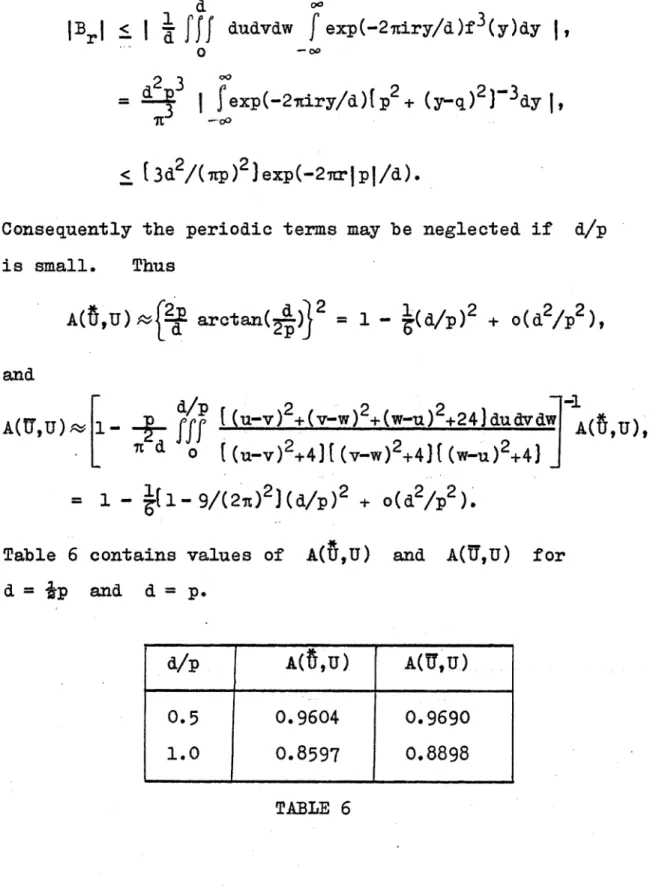
Donald Roy McNeil
A thesis submitted for the degree of Doctor of Philosophy in the Australian
National University
This thesis considers various problems in
statistical inference when the data are grouped, with particular reference to the loss in efficiency due to the grouping. I was introduced to this subject by my supervisor, Professor P.A.P. Moran, who suggested many of the problems considered here and who guided me
throughout in their investigation. I am greatly indebted to him.
I am also indebted to the other members of staff of the two departments of statistics at the Australian National University. There is not one of them who has not helped me at some stage on some aspect of this research investigation. In particular I thank
Professor W.J. Ewens, Professor E.J. Hannan and Dr. D. Vere-Jones. I also wish to thank Professor G.
Newstead, who suggested to me the problem on signal detection.
Page
SUMMARY (i )
CHAPTER Is ESTIMATION OP UNKNOWN PARAMETERS 1
1. Historical Background 1
2. The Bias in making no Grouping
Correction 2
3. Consistent Estimation of O when the
Sample is Grouped 5
4. The Asymptotic Efficiency of g ^(t) 7 5. Mean Value of Normal Distribution 9 6. Location Parameter in Extreme-Value
Distribution 13
7. Location Parameter in Laplace
Distribution 16
8. Mean Value in Negative Exponential
Distribution 18
9. The Case of more than one Unknown
Parameter 21
CHAPTER 2: PARAMETRIC TESTS 24
1. Student’s t-test 24
2. Hotelling's T^-test 29
3. Multivariate Sign Tests 38
The Normal-theory Test 39
Bennett's Sign Test 41
4. The P-test 50
5. Chi-squared Test for Equality of
Several Variances 53
CHAPTER 3: DISTRIBUTION-PREE TESTS 56
1. Wilcoxon's Test 56
Cauchy Distribution 63
Laplacian Distribution 65
2. Mood's W-test 66
3. Mann's Test for Randomness 69 4. Pitman's Independence Test 71
CHAPTER 4: SEQUENTIAL TESTS 76
1. Wald's Probability Ratio Test 77 2. Standard Deviation of Laplacian
Distribution 78
3. A Sequential Sign Test for Independence 79 4. Departures from Assumption 82 5. Mean Value of Normal Distribution 84 6. Variance of Normal Distribution 88 7. Parameter in Negative Exponential
Distribution 92
CHAPTER 5: INFERENCE IN STATIONARY TIME SERIES 94 1. Estimation of the Covariance Function 95 Case when the Variance is Known 99 Case when the Variance is Unknown 104 2* Testing that p(u) = 0 111 3. Estimation of the Spectral Density
Function 115
4. Other unknown Parameters 122 CHAPTER 6: A SIGNAL DETECTION PROBLEM 125 1. The Statistical Model 126 2. Definitions of Statistics 128 3. A Comparison of the Efficiencies
of C^ and O2 132
4. The Effect of Digitization 139
SUMMARY
This thesis presents an investigation of the effect of data grouping (also called digitizing, roundingsoff, quantizing or clipping) on some of the standard procedures in statistical estimation and hypothesis testing. The
six chapters form a consecutive discussion of the problems considered. At the same time each chapter is largely self-contained and treats a particular facet of the main discussion. To simplify the mathematics, the discussion is limited to situations in which the data are grouped at the mid-points of equispaced intervals and, as an extreme case of this, situations in which the data are grouped according to sign.
Generally speaking, the effect of data grouping is two-fold: it gives rise to bias in the estimator or test
statistic; and it reduces the efficiency or power of the statistic. The former effect is because grouping alters the expectation of the statistic, the latter because grouping alters the variance. The bias (which does not disappear as the sample size becomes large) must be
statistic may be biased by the grouping. The loss in efficiency is of interest, since in some situations it may be advisable to group the data purposely, in order to reduce computation, say, or because accurate measurement is difficult. For estimation problems the efficiency loss may be expressed in terms of the fractional gain in asymptotic variance of the estimator; for hypothesis testing it is expressed, where possible, in terms of Pitman's asymptotic relative efficiency.
The chapters may be summarized as follows: Chapter 1 presents an account of the problem of estimating an unknown parameter with grouped data, and a method is given for removing the asymptotic bias in the estimator. Some examples from specific distributions are worked out in detail. In Chapter 2 the hypothesis testing problem is taken up. The tests considered in detail are Student's
2
t-test, Hotellings T -test, and the F and chi-squared tests for equality of variances. Particular emphasis is given to the loss in Pitman efficiency caused by the
grouping. Distribution-free tests are discussed in
e f f i c i e n c y i s s m a l l ( e v e n f o r c l a s s i n t e r v a l s c o m p a r a b l e w i t h t h e s t a n d a r d d e v i a t i o n o f t h e d i s t r i b u t i o n ) no m a t t e r w h i c h o f t h e s t a n d a r d t i e - b r e a k i n g p r o c e d u r e s i s u s e d . As a c o n s e q u e n c e o f t h i s , t h e a v e r a g e - r a n k m et h od
o f b r e a k i n g t i e s , o f t e n p r e f e r r e d t o ran dom o r d e r i n g o f t i e d r a n k s b e c a u s e o f i t s g r e a t e r e f f i c i e n c y , may i n f a c t be i n f e r i o r i n v i e w o f t h e s i m p l i c i t y o f t h e l a t t e r m e t h o d . C h a p t e r 4 p r e s e n t s a n a c c o u n t o f t h e c o m p l i c a t i o n s c a u s e d by g r o u p i n g i n s e q u e n t i a l t e s t s . The two p o s s i b l e m e t h o d s
f o r d e a l i n g w i t h g r o u p e d d a t a - e i t h e r a d j u s t i n g t h e t e s t s t a t i s t i c t o a l l o w f o r t h e g r o u p i n g o r p r o c e e d i n g a s i f t h e d a t a w e r e n o t g r o u p e d and a d j u s t i n g t h e p r o b a b i l i t y l e v e l s - a r e e x a m in e d w i t h p a r t i c u l a r r e f e r e n c e t o t h e e f f e c t on t h e power c u r v e i n e a c h c a s e .
The l a s t two c h a p t e r s a r e c o n c e r n e d w i t h t i m e s e r i e s . G r o u p i n g , o r c l i p p i n g a s i t i s c a l l e d h e r e , o f t h e r e c o r d i s p a r t i c u l a r l y i m p o r t a n t a s a means o f r e d u c i n g t h e
c o m p u t a t i o n s . I n C h a p t e r 5 c o n s i s t e n t e s t i m a t o r s o f t h e c o v a r i a n c e a nd s p e c t r a l d e n s i t y f u n c t i o n s o f a s t a t i o n a r y t i m e s e r i e s f r o m a c l i p p e d r e c o r d a r e d e r i v e d , an d t h e l o s s i n e f f i c i e n c y i s i n v e s t i g a t e d . A p r o b l e m i n s i g n a l
ESTIMATION OF UNKNOWN PARAMETERS
In this first chapter we discuss methods of estimating unknown parameters with independent observations from a
distribution of known form. It will be assumed that these observations are grouped at the mid-points of equispaced intervals. The main discussion is concerned with a method which leads to consistent estimators, and with the loss in
asymptotic efficiency due to grouping. The following account is based on a paper by the author (1966a).
1 . HISTORICAL BACKGROUND
Sheppard's corrections, for the effect of equispaced grouping of the values of a random variable on the moments, are well known to statisticians. If one wishes to estimate one of the moments of a continuous distribution when the sample is grouped, a traditional method is to apply
Sheppard's corrections (where applicable) to the same function of the grouped values as some suitable estimator (say the maximum likelihood estimator) is of the ungrouped values, and use this as an estimator. This method was
shown by Fisher (1922) to give very efficient estimates in the case of the moments of the normal distribution.
corrections apply to population moments and not to
estimators, and in any case it does not provide a technique for estimating a parameter which is not a moment. He
suggested a new approach, namely to solve the maximum
likelihood equations by Newton's iteration formula, thereby obtaining a first approximation to a consistent and
asymptotically efficient estimator. The maximum likelihood estimator has also been discussed by Kulldorff (1961), for exponential distributions.
While Lindley's method furnishes useful estimators when the width of the grouping intervals is small, it does not provide consistent estimators, and it becomes very
complicated if one wishes to proceed beyond the first approximation. We proceed to investigate a method which leads to a consistent estimator, no matter how large the group width. Compared with the maximum likelihood estimator
the computation is simpler, while the loss in asymptotic efficiency is generally small.
2. THE BIAS IN MAKING NO GROUPING CORRECTION
independent sample values x-^,X2>..,xn , that is, t tends in probability to ö as n tends to infinity. Denote by
*
x^, i=l,2,...,n, the grouped sample values. These are
grouped, or 'digitized', in such a way that they differ only by integral multiples of a*fixed real number d > 0. The case when an x^ is half-way between two consecutive digit ized values may be neglected, as this event has probability zero. Thus
(1.1) x ± = qd+£ if ( q-|)d+£ < i ( q+i)d+£, ( q=0, ±1, ±2, . . . ),
where £ is fixed and —J-d < £ 6 id. £ and d respectively represent the 'origin' and 'width' of the grouping grid.
-x- ■&
Denote by t the same function of the x. as t is of
° n i n
the x^, that is
(1.2) t^ = t^(x-^,X2>• • • > ) •
*
If we are looking for a function of t which is a
consistent estimator of 0, conditions must be imposed on
*
t^. For example, if t is the median of the sample, tn
*
takes discrete values only, and there is no function of t which is a consistent estimator of 0. Assume that t
(1.3)
n
E « x ) , i=l
where E [k( )] = 9, and var[k(x^)j = v ( 0 ) < o o . It follows that t is consistent, since its variance is 0(n~^). Let
*
us evaluate the bias in using t to estimate 0. This is equivalent to incorrectly assuming that the sample is not grouped. Erom equations (1.2) and (1.3)
(1.4) 1
n ZZk(x ). i=l 1
Using equations (1.1) and (1.4)
(1.5) E(tn )
oo
J2
k(qd+t)q=-oo
(q+i)d+e
f
f(x,0)dx.(q-i)d+t
The right-hand side of equation (1.5) may be expressed as a Fourier series in i, following Fisher (1922). Thus
(
1.
6)
where
(1.7)
OO
E(t ) = Y 1 Ar exp( 27Tire/d), r=-x>
1 d
i ^ (q+i)d+c
I exp(-2irir6/d )de k(qd+£) J f(x, 0)dx,
o ( q - i ) d + e
id
oof
dxJ
exp[2irir(x-y)/d] k(y-x)f(y,9)dy.-id -oo
fact that t is unbiased, the bias due to grouping is
» “
(1.8) E(tn-e) = g-
Y1 Jdx
J exp [2TTir(£+x-y)/^k(y-x)f(y,e)dy r=-®±
-id -w
In the special case k(x) = x, equation (1.8) becomes
(1.9) E(t -0) = - ^
Y1
exp( 27Tirs/d) 0(-2TTr/d, 6), rwhere 0(u,0) is the characteristic function of x^, that is 0(u, 0) = E [exp( iux^)] , and denotes summation over all integers except zero. In this case, for fixed d and
£, the magnitude of the bias depends on how rapidly 0(u,©) tends to zero as |u| tends to infinity. Similar, though more complicated, results follow for the case when k(x) is
a polynomial.
3. CONSISTENT ESTIMATION OF 0 WHEN THE SAMPLE IS GROUPED Prom equations (1.1) and (1.4)
r oo
(q+i)d+& ^ '(1.10) var(tn ) = i| E k 2(qd+£)
J
f(x,0)dx - E 2(*n ) >.(•q_“co (q.-i)d+e
J
Put E( t ) = g(0) and n var(t ) = h(0). Prom equation (1.8) oo -J-d
(1.11) h(0) = ^ L
f
dx f exp[änLr(£+x-y)/d]k2(y-x)f(y,0)dy-g2(0).r=-og 1 I
There does not seem to he any general relation between the conditions v( 0) < oo and h( ©)«:;», hut we mention that a sufficient condition for v(9)^^° to imply h(0) ^°o is that the function k(x) he monotonic increasing for large values of |x| and satisfy
k(x-Hg-d) = 0(k(x)) for large values of x, and
k(x—J-d) = 0(k(x)) for large values of -x.
Provided h(0)<oo, it follows from the central limit theorem that the distribution of
[tn - g(©)] [n/h( 0)]^
is asymptotically standard normal. Suppose g ( .) has the unique inverse g ^(.). Then the distribution of
g 1 (©) [g_1 (tn ) - 0] [n/h( 0)] 2
_ 1 * .
is also asymptotically standard normal, and g (t ) is a consistent estimator of 0.
If f(x,0) is completely specified except for © and e and d are known, the function g ( . ), and thus g .), is given by the first term in the right-hand side of
equation (1.8).
existence of g'"(0), we have hy Taylor's theorem, ignoring terms which are o(n~"*~) as n tends to infinity
E[g-
1
(tn )]= e +|g'(ö)]-
1
E[tn-g(e)] - fe"(e)jg'(e)]-
3
E|tn-g(e)] ?
It follows that the bias is given hy
(1.12) e [g x (tn ) -
e]
= -i g"(e)h(e) [g'(e)]
3 + o(n 1 ).4. THE ASYMPTOTIC EFFICIENCY OF g - 1 (t)
The asymptotic relative efficiency of two consistent estimators t and t' of the same parameter is defined as
n n ^
(1.13) eff (t ', t ) lim var(tn )
n-+o° var ( t^) *
_i ■jf 1 / %
Since t and g (t ) have asymptotic variances —v(0) and ^ h ( © ) |g'(0)] respectively, the asymptotic relative
_1 * .
efficiency of g (t ) to t is, from equation (1.13)
(1.14) eff (g 1 (t), t) = [g'(e)]2 V (0)/h(0).
This provides a measure of the loss in efficiency due to grouping. If t is an asymptotically efficient estimator of 0, that is, for any other estimator t^, eff (t', t ) $ l ,
—1 *
efficiency of g (t ). However even when t is asymp totically efficient, there m a y he other functions of the digitized sample values which have greater asymptotic
_ 1 .* . A
efficiency than g (t ). Suppose 0 is the maximum
likelihood estimator of 0 from the grouped sample, defined as the solution in 0 to the equation
n -v *
Y^
ae log p(x±»e) = o,
z+id
where p(z,0) = f f(x,0)dx.
z-id
- 1/ * \
(Ö is the estimator to which Lindley (1950) obtained a first a p p r o x i m a t i o n . ) Under certain very general conditions (stated by Cramer (1946), p500), ^ is an asymptotically efficient estimator of © from the grouped sample, and the distribution of
is asymptotically standard normal. Consequently the A
asymptotic relative efficiency of ©n to t is, from equation (1.13)
eff (0, t) = -v(0)E
ae
2 loS p(x± ,0) oO= -v(0) Y p(qd+£,e) q=-oo
Assuming the Euler-Maclaurin formula to he valid, equation
(1.15) becomes
° ° 2
(1.16) eff (§, t) = - Jp(y,0) rfgr log p(y,0)dy. — 00
This is equivalent to writing eff (0, t) as a Fourier series in t and ignoring the periodic terms. Under mild regularity conditions on f(x,0) we have
p(y,0) = df(y,0) + f"(y,0) + 0(d5 ),
the dash denoting differentiation with respect to the first argument, and equation (1.16) becomes
(1.17) eff("0, t ) = 1 - V(©) E
where f = f(x^,©). This result is due to Lindley (19 50). In the following sections some particular cases will be discussed in detail.
5. MEAN VALUE OF N0BM.AL DISTRIBUTION
If f(x, ©) = ( 2l\ar )~2exp [—J-( x-0) /er'
J
,
where<r is known, the sample mean x is a consistent estimator
00 2
(1.18) g(9) = 0 + ~ z (-l)r r"1 sr sin[2nr(9-e)/dj , 77 r=l
2 2 2
where a = exp(-27T o' /d ). Differentiating with respect to 9 equation (1.18) “becomes
oo 2
(1.19) g r(0) = 1 + 2 l (-l)r ar cos [*27Tr(©-£ )/d] . r=l
g*(0) is the theta function ^ (1T( 0-9)/d, a), which has no real zeros (see Whittaker and Watson (1935), pp463-4). Since g * (9+-§-d) > 0, g * ( 0 ) > O for all real 0, and so g(0) has a unique inverse, which may “be written
(1.20) g ^(t) = t + ^ a sin [2tt( t-£)/dj + O(a^).
Even for fairly large values of d, the above approximation is extremely good: when the grid width is three standard deviations, a^ = 0.0001, approximately. Figure 1 shows graphs of g ”^(t) against t for d = (T, 4^", and 6<r, when
£ = 0. Using equations (1.11) and (1.18)
2 . 9
M e ) = v2 + X2 + ^ t49“2 + (r F )2f - a)r cos(2rcc)
(
1.
21)
r=l
+ £ 9 W r 1(-a )r sin( 2ra)l,
H
-ft
o f 3 H H - 3 P
CSJ P B CD M o c+ P^ H
-P H - O c+ CO 3
c+ CQ 4
H - O tj.
P CJ1 1
o P H
H - o f / —-3 H - c + * ( f t O ____
3
p ^ S P
H -o f o
P 3 J o
S 3
p^ psr CO 3 H
-o CO o f * 3 c f 3 CD 3 H - < c+ CO p
3 CO c+ H * o f
F P P
CD 3 c+
o H*
P CD CO < o f CD q . H
-3 O
p
( f t H j CD c+ O
& 3 O CD
H j CD
CO CO c+ P o f 3 ^ 3 H -CD * n 3
M P
P^ CD o f
H - H*
( f t 3 H - P ( f t c f M H - P c f N CD 3 " CD CO CD P^
P 3
CD
P CD e
H 3
£
CD O
where oc = 7T(©-s)/d. Thus, from equations (1.14), (1.19)
__ "I
and (1.21), the asymptotic efficiency of g (t ), eff g_1(t), is
{
1+2 Z (-a)r r=l2 00 rs 2 2 /■ QO 2
1+lir2+r?i,-4+(^ ) J(-a ) r °os(2ra) + ^ " ( l q 5 ^ (-a)r sin(2r«)
F
The above expression is a periodic function of 0 with period d, and may he shown, by simple differentiation, to have extreme values at 0 = £ , (minimum) and 0 = £ + -J-d
(maximum). These points almost certainly correspond to least and greatest values of eff g (t), in which case
2-\ 2
{ l + 2 Z ( - a ) r } r=l
12u r=l nTa^ J
“2^.eff g~\ t) ^
(l+ 2 f: a-2}2 L r=l J
r 2
However it seems difficult to prove this. Even for a
moderately large grid width the above inequality is extremely narrow. Eor example, when d = 2a, it becomes
0.7463 ^ eff g-1(t) 6 0.7538.
Graphs of eff t) against 6 for d = cr, 2cr, 3<r, 4<r and 6cr and 6 = 0 are depicted in Figure 2. If d is
r 2
n e g l e c t e d ,
( 1 . 2 2 ) e f f g 1 ( t ) =
From e q u a t i o n ( 1 . 1 5 ) t h e a s y m p t o t i c e f f i c i e n c y o f t h e maximum l i k e l i h o o d e s t i m a t o r i s
l
2 { e x p | - b 2 ( q + l ) ] - e x p [ - b 2 ( q )]_[ 2 ( 1 . 2 3 ) e f f 0 = - 2 _ ; ------- --- r--- ,
q=-oo e r f [b( q + 1 )] - e r f [ h ( q ) j
w h e r e b ( q ) = ( 2cr2 ) ~ z [( q—iJ-)d+e-0j . E q u a t i o n ( 1 . 1 7 ) r e d u c e s t o
2
e f f § = 1 --- + 0 ( d 4 ) . 12cr^
T h i s may he c o m p a r e d w i t h e q u a t i o n ( 1 . 2 2 ) . T a b l e 1
_1 * a
d e m o n s t r a t e s t h e c l o s e n e s s o f e f f g ( t ) a n d e f f 9, a nd - 1/ * \ t h u s t h e t r i f l i n g l o s s i n e f f i c i e n c y i n u s i n g g ( t )
d e / d o . 1 . 2 . 3 .4 .5
1
e f f g -1( t ) .9 2308 e f f 6 . 9 2 3 0 8
. 9 2 3 0 8 . 9 2 3 0 8
. 9 2 3 0 8 . 9 2 3 0 8
. 9 2 3 0 8 . 9 2 3 0 8
. 9 2 3 0 8 . 9 2 3 0 8
. 9 2 3 0 8 . 9 2 3 0 8
2
e f f g _1( t ) . 5 0 2 2 3 e f f 9 . 5 0 2 3 0
. 5 1 5 5 4 . 5 1 7 0 2
. 5 5 1 8 8
. 5 6 2 5 7
. 5 9 8 4 3 . 6 0 1 8 0
. 6 3 6 5 7 . 6 3 9 1 7
. 6 5 1 1 6 . 6 5 4 3 2
3
e f f g ' t t ) . 0 9 8 9 6 e f f 0 . 0 9 8 9 6
. 1 4 4 3 7 . 1 4 5 4 0
. 2 7 1 5 6 . 2 7 2 0 9
. 4 3 8 9 8 . 4 3 9 1 3
. 5 8 1 0 3 . 5 8 1 7 2
. 6 3 6 6 3 . 6 3 6 6 3
r a t h e r t h a n the m a x i m u m l i k e l i h o o d estimator. V a l u e s are
g i v e n for the case 6 = 0 , in w h i c h each f u n c t i o n is s y m m e t
r i c a l a b o u t 9 = -J-d, and v a l u e s for only h a l f the p e r i o d
n e e d he shown.
P r o m e q u a t i o n (1.19)
g"(e) = H sin [2tt( 0-e )/d] exp( -2rr2o~2/ d 2 ) + c K a 4").
I n s e r t i n g this in e q u a t i o n (1.12), and u s i n g e q u a tions
(1.19) and (1.21), the f i n i t e - s a m p l e bias in u s i n g
-1/ * \
g (t ) is g i v e n by
2
E[g-1(tn)
-e]=
-I
^sin[2n-(e-£)/d](cr2+ ^ ) exp(-2T(3r2/a2 ) + 0(a4),i g n o r i n g terms w h i c h are o(n ^ ). Thus, to the first order,
the b i a s is small and has a v e r a g e v a lue zero if 0 is
a s s u m e d to be u n i f o r m l y d i s t r i b u t e d over a g r o u p interval.
6. L O C A T I O N P A R A M E T E R IN E X T R E M E - V A L U E D I S T R I B U T I O N
C o n s i d e r the e x t r e m e - v a l u e d i s t r i b u t i o n (see, for
example, K i m b a l l (1956)) f(x) = a exp [-a( x - m ) - e _ a ^ x ~m ^ ],
-oo<x<3o. If the scale p a r a m e t e r a is known,
oo t
n “ / L ex P( -a x i ) n i=l 1
is a s u f f i c i e n t s t a t i s t i c f o r the e s t i m a t i o n of m, and
a g r o u p e d s a m p l e . From e q u a t i o n ( 1 . 3 ) k ( x ) = e a x , and p u t t i n g t h i s i n e q u a t i o n ( 1 . 8 ) we f i n d
g ( e )
( 1 . 2 4 )
-&• > ;
f
dx |e x p [ 2 l T i r ( £ + x - y ) / d - 2 a y + a x - © 1e ayJd y ,T = - ° ° - u
L
f f s i n h ( _ i ) r r ( 1 + 2 E | £ ) e 2 i r i r / ( a d ) e2 r t V a r=-oo
H e n c e , d i f f e r e n t i a t i n g e q u a t i o n ( 1 . 2 4 ) w i t h r e s p e c t t o Ö,
( 1 . 2 5 ) g f ( 0 ) = s i n h ( - 1 )r T ( 2+ ~ ^ ) exp | ^ ^ ( l o g e + a e ) l
T — — OC I- J
DO
s i n h f f ; ( - l ) r J xl + 2 T T i r / ( a d ) ^ x + T T i r h ^
_2_
ad
r=-oo
w h e re h = ^ - ( l o g © + a e ) . I n t e r c h a n g i n g t h e o r d e r o f s u m m a tio n a n d i n t e g r a t i o n we g e t
g ' ( 0 ) _2_a d s i n h a d2
DO ,s
OO '
/ x e - x { l +2 Z . ( - 1 )r o o s[fr r (h + 2- i f f x | dx.
The e x p r e s s i o n i n c u r l y b r a c k e t s i s t h e t h e t a f u n c t i o n o9(h+ 2 1)> w h i c h i s n o n - n e g a t i v e , a s we saw i n t h e
p r e v i o u s s e c t i o n . I t f o l l o w s t h a t g * ( 6 ) > 0 a n d s o t h e f u n c t i o n g ( . ) h a s a u n i q u e i n v e r s e . P u t t i n g
r X l + i x ) = eU( c o s V + i s i n V ) ,
(1.26)
g(e)
= | | sinh ^ | l + 25T(
-1 )rexp[ü(j]
cos[TTrh+V(Using the well-known identity
ra+z)ru-z)
simrzit follows that
eU(x)
=|r(l+ix)i =
(S3^ S ) * ~ ( 2 i « ) * e - ^ ,and so the infinite series in the right-hand side of equation (1.26) rapidly converges as r tends to infinity. Furthermore the functions U(x) and V(x) are tabulated (National Bureau of Standards (1954)),
facilitating numerical computation of the function g ^(.). Graphs of g~^(t) against t for the cases d = 0, 2/a, 4/a and t = 0 are shown in Figure 3.
Neglecting terms periodic in t (this corresponds to neglecting terms involving exp fu(-|j^p)] ^or r ^ 1) equation
(1.11) becomes
(1.27) h(0) = 0‘ sinh(ad) - (^~)2sinh2( ^ )
Hence, using equations (1.14), (1.25) and (1.27), the -1 *
C
+
’K
estimating -9 = e from an extreme-value distribution with location parameter m and known scale parameter a,
(1.28) eff g 1 ( t)
/ 2 x 2 . ,2/ ad %
(jd}
sinh
_________
^ s i n h ( a d ) - ( ^ - ) 2sinh2(
1 - (ad)
E
+ 0(d4 ).On the other hand, the asymptotic efficiency of the maximum likelihood estimator is, from equation (1.17)
eff @ = 1 - + 0(d4 ).
Hence, ignoring terms which are 0(d4 ) as d tends to
- 1 / * x A
zero, g (tn ) and 9^ are equivalent in asymptotic efficiency.
7> LOCATION PARAMETER IN LAPLACE DISTRIBUTION
Suppose f(x,9) = (2a2 )“^exp[-x/2|x-e|/cr], < x < oo, where g- is known. Because of the discontinuity in
f 1(x,9) at x = 9, B i n d l e y 1s method of finding breaks down. The sample m e a n x is a consistent estimator of 9 from the ungrouped sample. The maximum likelihood
estimator is actually the sample median, which is asymptot ically efficient provided the sample size is odd. However because the sample m e dian is not expressible in the form of equation (1.3), we use x.
* 1 *
Butting t = — 2_ x . , whence k(x) = x, we have from 1 i=l 1
(1.29) g ( 0 ) = 0 + .^ 51 r -1 )r ( l+2ir2crLr ^ / d 2 ) ^sin [2rrr( 0-e)/d]. r=l
Differentiating equation (1.29) with respect to Ö we find
(1.30) g'(0) = 1 + 2 ( -1 )r ( l+27r~(T"r2/ d 2 ) 1 cos [2irr( 0- e)/d] . r=l
g'(0) is the Fourier expansion of
^ cosech( j^~) cosh J2{ 0-S - p d )
cT
where p is the largest integer less than (0-e)/d (see Dwight (1950), p84). Thus g'( ©) is strictly positive and g(©) has a unique inverse. It follows also that equation (1.29) m a y he written
(1.31) g(0) = p d + I c o s e c h ( ^ ) sinh J2( 0-fc-pd)
simplifying computation of the function g 1 (.). Equation (1.11) reduces to
2 . n 2 // - 2 2
h( 0) = cr2 + ^ 2 + ( -1 )r — +.d. A -^TT0r J n cos( 2ra) r=l
(1.3 2)
(l + 27rV2r 2/d2)2
f oo aq
+ £2-- £ + - 51 (-l)r r"1 (l+27T2T 2r 2/ d 2 )"1 sin( 2roc)l.
c r=l J
The asymptotic relative efficiency of g_ 1 (l ) to t is
now obtained by substituting equations (1.30) and (1.32) into equation (1.14), with v(0) = . Graphs of
eff (g~^(t), t) for the values d/cr = 0(1)4, when £ = 0, are shown in figure 4. We observe from these graphs the surprising fact that for values of © near e +-j§-d,
/ — 1/ ** \ \
eff (g (t), t)> 1. This means that for certain values of 9 we actually gain efficiency by grouping. However it must be remembered that t = x is not asymptotically
efficient. In fact the asymptotic relative efficiency of t to the sample median, which is asymptotically efficient, is -I-. Consequently the asymptotic efficiency of g""^(t ) is -g- eff (g (t), t), and this quantity never exceeds 1, although it approaches unity as d tends to infinity when 0-e—g-d is an integral multiple of d. The explanation of the latter lies in the fact that when testing the hypothesis that the location parameter of a Laplace distribution is zero, the sign test (which corresponds to extreme grouping, that is the limiting case as d tends to infinity) is
asymptotically efficient.
8. M E M VALUE IN NEGATIVE EXPONENTIAL DISTRIBUTION
If f(x,9) is the negative exponential distribution defined over (0,oo) with mean value 0, the sample mean is
* 1 *
an efficient estimator of 0, so we may put t = — > x^ n i=l 1
*
sufficient statistic for estimating 0 from the digitized sample values, since the likelihood function of the grouped
*
sample factorizes into a function of t and a function of 0. This means that the maximum likelihood estimator
*
is a function of t only, and clearly
g( 0) is obtained directly from equation (1.5)» which becomes
is strictly positive for all 0 > 0, g ( .) has a unique (1.33) = £ + id e £//^ cosech^g-).
Since
(1.34) g*(e) = i(d/02 )e [e + id coth(id/0)]
When £ = -gd,
(1.36) g ^ t )
-
2
, V
l+2t/dJ_-1
1
which agrees with Kulldorff (1961) p26. In a similar manner we obtain from equation (1.10)
(1.37) h(0) = d2e-(£+* d V e [ 1+e-d/ e-e-(f+*d )/e][l+e-d/ e] - 2 .
—1 *
The asymptotic efficiency of g (t ) is now obtained hy substituting equations (1.34) and (1.37) into equation (1.14) and using the fact that v(0) = 0. We find
(1.38) eff g d (t) e +£d coth(£d/e)\2
0 2{l + e-d/ e-e-t£ '
- 1/ * \
Some numerical values of eff g (t) are given in Table 2. Case (a), when
t -
0, is more efficient than case (b), wheni
= -|d. This is to be expected, because sample values nearest the origin contain the most information about 0.&/
g0
1 2 3 4 5 6(a) 1.0000 .9326 .8264 .7413 .6597 .5700 .4751
w
1.0000 .9207 .7241 .4963 .3041 .1707 .0897- 1 / * V
The f i n i t e - s a m p l e bias in u s i n g g (t ) is given,
to the first order, b y e q u a t i o n (1.12), and u s i n g equ a t i o n s
(1.34) and (1.37) we find
&-l,*
(tn ) - e]
ni 2e_
d2 r
c o th (-g-d/ 0) — 20/d s i n h 2 (^-d/0) + o ( n 1)
w h e n £ = id. In this case the bias is al w a y s negative,
since coth x > 1 / x for all x * 0.
9. THE C A S E O F M O R E T H M ONE U N K N O W N P A R A M E T E R
If we w i s h to esti m a t e m o r e than one p a r a m e t e r of a
d i s t r i b u t i o n (or a p a r a m e t e r in the p r e s e n c e of u n k n o w n
n u i s a n c e p a r a m e t e r s ) we e n c o u n t e r a d i f f i c u l t y in a p p l y i n g
the above m e t hod. Suppose that the u n k n o w n p a r a m e t e r s
are ©lf 6m , and that t-^ t 2 , ..., tm are
c o n s i s t e n t e s t i m a t o r s of the 0's w h e n the sample is n o t
grouped. If we d e n o t e these estimators, c o n s i d e r e d as
f u n c t i o n s of the d i g i t i z e d s ample values, b y t^, w h e r e
i=l, 2,..., m, then the m e a n v a l u e of the l i m i t i n g
d i s t r i b u t i o n of e a c h t. ( p r o v i d e d it exists) g e n e r a l l y
i n v o l v e s all the 0's, n o t just ©.. In order to find
0
f u n c t i o n s of the t^ w h i c h are c o n s i s t e n t es t i m a t o r s of
the © i we w o u l d h a v e to solve for the 0 ± the s y s t e m of
(1*39) — gj_( Go* • * *9 i 1 * 2,.«., m,
where g^ is defined by the condition that each of
Vn(t^-g^), i = l , 2,..., m, have a limiting distribution with mean zero as n tends to infinity. Even when there are only two unknown parameters the inversion of equations (1.39) is generally difficult. For example let us
consider the estimation of the variance of a normal
distribution from a grouped sample when the mean is unknown. Let f(x,©2 ) = ( 2rr©2)”^ exp[-(x-©^)^/( 2©^)] , where —oc>< x < 30 and ©^ is unknown. fhe statistics t^ = x
1 JO, 2
and t2 = ^yjr (x^-x) are consistent estimators of ©-^ i=l
and ©2 respectively when the sample is not grouped. Accordingly we put
Using the central limit theorem it may be shown that the distributions of 7n[t^- ECx^jJ and Vn[t2 -var(x^)] are each asymptotically normal with mean zero. E(x^) and
■X-var(x^) are given by equations (1.18) and (1.21) 2
respectively, with © and <7 respectively replaced by ©^ and ©£. A first approximation to the expression for
■X X
w h e n r ^ 2. T h e n to the f i r s t order
(1.40) g 1 = ~ a sin( 27T(ei -^)/d)
and
(1.41) g 2 = e2 + d2/12 - 4 | e 2 +
i(d/r)2J
a cos( 2Tr(e1-fc)/d).S u b s t i t u t i n g the e x p r e s s i o n for 0-^ from e q u a t i o n (1.40)
into e q u a t i o n (1.41) we find, to the first approximation,
exp |-2TT2g 2/ d 2 j cos 12?r(g^-£)/a].
It f o l l o w s that, p r o v i d e d exp( - 4 t 21T^/d2 ) is s u f f i c i e n t l y
small to be neglected, an a p p r o x i m a t e l y c o n s i s t e n t e s t i m a t o r
of © 0 is
t^ - + 4 exp(rr2/6) jt^ — ” ~^Jex^)[""2^ ^2^^] cosC^n'(t-^--£)/dj.
The m e t h o d of e s t i m a t i n g a n u n k n o w n p a r a m e t e r w i t h
d i g i t i z e d data, o u t l i n e d in the above sections, is e a s i l y
e x t e n d e d to the case w h e r e the d i s t r i b u t i o n is m u l t i v a r i a t e .
A n e x a m p l e of this, n a m e l y the e s t i m a t i o n of the c o r r e l a t i o n
c o e f f i c i e n t i n a b i v a r i a t e n o r m a l distribution, will be
CHAPTER 2 PARAMETRIC TESTS
In this chapter we continue our discussion of statist ical inference with grouped data by considering parametric tests. In the previous chapter it was shown that grouping of the data gives rise to biased estimators, and that some adjustment is required to provide a consistent statistic. However in the case of testing hypotheses it is often
unnecessary to make any grouping correction. Two particular tests will be discussed in detail:
(a) testing the equality of means of two multivariate normal distributions, and
(b) testing that the variances of several normal populations are all equal.
In the former case no adjustment need be made to the normal theory test to provide a consistent test with grouped data, but this is no longer true for case (b). We shall also investigate the loss in power due to grouping for the above tests, expressed in terms of the Pitman asymptotic relative efficiency. The main part of the following account is based on a paper by the author (1967b).
1. STUDENT1S t-TEST
f(x,G) = ( 2iicr2 )“ 2exp j—1( x-G^/o"2] , -oocx*- o°9
zr "being unspecified. Given a sample of n independent observations (x-p X2> ••• » xn ), most power ful test is obtained by using Student*s statistic
(2.1) t = n 2 x
A
- x 2Hg-large values being significant (see, for example, Kendall & Stuart (1961), Vol2, pl97). Since the denominator in
the right-hand side of equation (2.1) tends in probability to cr as n tends to infinity, it follows from the
central limit theorem that the distribution of t - n 2G/r is asymptotically standard normal.
Let the sample values be digitized according to equation (1.1) and define
(2.2 ) n 2 xvr ^
sir
± < h
n ± i=l 1Standard normal, g(©) is given by equation (1.18), whence
OO
(2.3) g(0) = - - 2 (-l)rr“1exp(-2;r2r 2a'2/d2 )sin(2(Tr^/d). ' r=l
Prom equation (2.3) it follows that g(0) = 0 if and
1 *
only if i = 0 or -g-d, so t provides a consistent test of Hq against for these two values of £ only. However these values, particularly the former, are those most likely to occur in practice.
Assuming £ = 0 or -J-d, the limiting distributions of
*
t and t are identical under H Q, and consequently for large samples the significance level need not be altered to allow for the grouping. In this case let us evaluate the loss in power due to grouping. We use Pitman's (1948) definition of asymptotic relative efficiency, which may be summarised, in a slightly less general form, as follows:
Suppose we are testing the hypothesis H q: © = ©Q against the sequence of alternatives Hn : © = 0 = ©Q + kn"^,
b > 0, and that t is a statistic associated with which
functions M(0), V(©) exist such that
( I I I ) t h e r e g u l a r i t y c o n d i t i o n s
l i m ^ V = l i m = 1
n-*» M1
(0
) n >oov( 8 7
o o
a r e s a t i s f i e d .
F o r tw o t e s t s t a t i s t i c s t a n d t ' r e q u i r i n g t h e same
n n
v a l u e o f 3 , a n d h a v i n g t h e sam e s i g n i f i c a n c e l e v e l s , P i t m a n show ed t h a t t h e i r p o w e rs a g a i n s t t h e sam e a l t e r n a t i v e s a r e a s y m p t o t i c a l l y e q u a l when t h e i r r e s p e c t i v e s a m p le s i z e s n a n d n* s a t i s f y
( 2 . 4 ) l i m £ = l i m { ß ( t ^ ) / R ( t n )} 1/S,
w h e re
( 2 . 5 ) R ( t n ) = n;>M ' ( e 0 ) / V ( e 0 ).
The r i g h t - h a n d s i d e o f e q u a t i o n ( 2 . 4 ) i s c a l l e d t h e ( p i t m a n ) » a s y m p to tic r e l a t i v e e f f i c i e n c y * o f t ^ t o t n , a n d w i l l he d e n o te d b y A ( t ' , t ) .
( 2 . 6 ) A ( t , t ) = j g ' ( 0 ) } 2 cr2/ h ( 0 ) .
g ' ( 0 ) a n d h ( 0 ) a r e g i v e n b y e q u a t i o n s ( 1 . 1 9 ) a n d ( 1 . 2 1 ) , an d p u t t i n g t h e s e e x p r e s s i o n s i n e q u a t i o n ( 2 . 6 ) we o b t a i n
| l + 2 ^ ( + )r exp( -2TT2r 2rr2/ d 2
)J
2i 2 ' r > i < { '
w h e re t h e p o s i t i v e ( n e g a t i v e ) s i g n i n ( + ) i s t a k e n
w hen £ = -g-d ( 0 ) . I n s p e c t i o n o f e q u a t i o n ( 2 . 7 ) a n d t h e
—1 *
e x p r e s s i o n f o r e f f g ( t ) , a t t h e t o p o f p a g e 1 1 , r e v e a l s *
t h a t A( t , t ) i s g i v e n ( f o r v a r i o u s v a l u e s o f d /cr) b y t h e m axim a ( £ = -g-d) a n d m in im a ( £ = 0 ) o f t h e g r a p h s d e p i c t e d
i n F i g u r e 2 . C l e a r l y t h e l o s s i n a s y m p t o t i c p o w er i s g r e a t e r w hen £ = 0 t h a n w hen £ = -g-d. I n t h e l a t t e r c a s e , f o r l a r g e d
A ( t , t ) ~ { f V e x p ( - 2 i I 2r 2rr2/<i2 ) ) 2/ { T^ T +
r —-JL
-— > ^ w hen d —roo,
s i n c e ~ ^ T ^ e x p ( - 2 ir 2r 2cr2/ d 2 ) t e n d s t o ( 2 i r ^ ) ” ^ w hen d
suitably scaled, is simply the sign test, which is well known to have asymptotic relative efficiency 2/tt
compared v/ith Student's t-test for this problem.
If Student's t-test were used to test the equality of means in two normal populations, given two independent
ft
samples { x_^} and {y^}, then t would be consistent
*
for every value of £, for in this case t is a function
5T *
of (x - y), whose expectation is always zero under the null hypothesis provided each sample is grouped in the
same way. This problem will now be investigated in the more general situation where each sample comes from a multivariate normal distribution.
2. HOTELLING-' S T -TEST
1 yr j} (r = 1, 2, ... , n; Let X = ixr;jy, Y
d = 1, 2, ... , p) be matrices representing a sample of size n from each of two p-variate normal distributions. The (column) vectors of mean values associated with X and Y, } and respectively, are unknown, and
J 1 d
the covariance matrices are also unknown. Put z
= x. . - y .. ’Wien testing the hypothesis H : = rn .
^ d d ® d *■ d
d = 1, 2, ... , p, it is common to use Hotelling's statistic, which is defined as
where is sample mean vector and Sn the sample covariance matrix of the z ., r = 1, 2, ... , n. Under
J
2
H , (n-p)T /(np-p) has an F-distribution with degrees of freedom p and n-p respectively (see Anderson (1958) for a proof of this result), and consequently when p is fixed 1 has a limiting distribution as n tends to infinity which is chi-squared with p degrees of freedom
< * * > •
If x . and y . are digitized as in equation (1.1)
-*• J d
*2 * 2
and 1 denotes the same function of the z . as T is
J * p
of the z ., then (n-p)T /(np-p) does not have an
F-dist--*• J
*2 2
ribution. However it will be shown that T and T have identical limiting distributions under H q, and thus if one is interested in large sample methods, it is not necessary to devise a special test to allow for the grouping. One
*2
slight drawback in this approach is that T has positive probability of being infinity, while is finite with
*2 2
probability one. However if ! and T have the same limiting distribution, Probjl^ = ooj may be neglected for sufficiently large samples. It is of interest to compare
2 *2
The h y p o t h e s i s Hq : 0 = 0 i s b e i n g t e s t e d a g a i n s t t h e s e q u e n c e o f a l t e r n a t i v e s © = ©n = k n 2 . t ^ n , 3 = 1 , 2, . . . , m a r e s t a t i s t i c s w i t h m e a n s jj. ^ 0 ) a n d
c o v a r i a n c e s o^n ( ©) G [jn ( 0 ) ^ n ( ©), i> 3 = 1 » 2, . . . , m, s a t i s f y i n g t h e c o n d i t i o n s
( I ' ) t h e j o i n t d i s t r i b u t i o n o f t h e t . , 3 = 1 , 2, d ^
. . . , m, i s a s y m p t o t i c a l l y m u l t i v a r i a t e
n o r m a l a s n oo a t b o t h 0
=
0 a n d ©=
©,
( I I ' )pjn(o)
=o, Kj^(o) = o,
( I I I 1) l i m f t ' n ^ ® n ^ = l i m = l i m n w 7 ^ T 0 F n-»oo cr.n ( C) a-*00
and l im K j n ' ^ = c . =f 0 ,
n-*°°Jha-n (C ) 3
P u t
A n(e) =
A-y^ö)
a n dA =
l i m A ^ O ) .Aj.-jn^ = 1 ,
X j n ( C )
i , j — 1 , 2 , . .
Then H a n n an s h o w ed t h a t
,m.
( 2 . 9 ) l 4 = ( V ^ O ^ ^ O l t ^ / c r ^ O ) }
2
h a s a l i m i t i n g d i s t r i b u t i o n w h i c h i s X u n d e r H a n d
° ' m o
n o n - c e n t r a l c h i - s q u a r e d w i t h m d e g r e e s o f f r e e d o m a n d n o n -2
c e n t r a l i t y p a r a m e t e r a (Xm( a ) ) u n d e r H , w h e r e
-Prom this result the asymptotic power of the test based on K is obtainable, Por two statistics of the form (2.9)
(with the same value of m) requiring the same signific ance level, Hannan showed that their powers against the same alternatives are asymptotically equal when their respective sample sizes n and n' satisfy
(2.11) n/n* A/ (a/a1)^*
The right-hand side of equation (2.11) is the asymptotic relative efficiency of the second test relative to the first.
Let us return now to the problem of testing that the mean vectors [f A and [ nl - \ of "two p-variate normal
distributions are equal, given a sample of size n from each. If we base our test on the sample differences Z = X - Y only, this is equivalent to testing that the mean vector { 0 of a p-variate normal distribution with
J
unknown covariance matrix {cr. <j -f. , say, is the null * 0 ^3
vector. The null hypothesis is
H q: = 0, 3 = 1 , 2, ... , p.
Hn : öj — k^n ^ 9 Ö *" 2, ...» p*
Hq and Hn may be reduced to hypotheses involving a singLe parameter by defining 0. = k.9, in which case the
right-J 0
hand side of equation (2.10) may involve all the k.. The
J
p
asymptotic power of a test based on T will be in fact independent of the k. since this test is rotationally
J
*2
invariant. The same is not true for T , as will be shown later. Let us assume for the moment that k. = k, all j.
J
Define
(2.12) z. -I
and
(2‘13) sij = k g _ (zri - zi>(zrj - zj
}-It is easily shown that the statistics n 2z., j =1,..., p,
J
satisfy the conditions (I*), (II*) and (III*), with covariances , and
(2.14) c. = 1 /cry
Thus
n^z^/o'^y.AI j
z
where-A
=has a
limiting1 v 2.
distribution which is Y under H and A(a) under H ,
where
(2.15) a = kUl/cr^j' A -1 {l/cv}] K
2 2
(In fact the distributions are exactly V and y (a)
' J r 1
respectively for all n. ) Since Sn = s ^ converges in probability to {o\ <r. p^.} as it follows that
njz./'x} j C ^ { z . / c7.} has the same limiting distribution
J J J J
p
as 1 % given by equation (2.8). The asymptotic power
p
of T is obtained by using equation (2.15).
*
Consider now the digitized observations zT y The grouped p-variate normal distribution has means g.(0.)
J J
and variances h.(©.), where the functions g. and h.
J J J J
are given by equations (1.18) and (1.21) respectively, w i t h <r replaced by cr. and £ = 0. ( £ = 0 because each of the samples X and Y is supposed digitized in the same way.) Denote by A = { p — } the correlation m a t r i x of the grouped distribution. It m a y be shown that
conditions (I'), (II*) and (III') are satisfied by the 4*
statistics n 2z., with
J
(2.16) c ^ = gj(0)[tu(0)} 2'
follows that the statistic
( 2.17) $2 = n{2 y S ^ H S p
has a limiting distribution which is under Hq and
.2/ *
■y (a) "under H , where
rv
n(2.18)
t
2 = k{g!(0)[h,(0)]"^]'A_1{g!(0)lh.(0)]_ij.Using equations (2.11), (2.15) and (2.18), the asymp totic relative efficiency of to T^ is
*2 fg-.(0)[h,(0)J-*l/A " 1 {gf(0)[h,(0)]-i| (2.19) a(t2,t2 ) = l-3--- a--- --- V - J --- a--- •.
*
The matrix A is obtained by using the expression for *
? ± y given by equation (5.21) of Chapter 5. In partic- ular, if terms involving exp{-2« cn cr.qvd i , q ^ l , are
sufficiently small to be neglected, equation (5.22) may be used, whence
(2.2 0)}±i= {hi(0)h;j(0)}“M<ri orj pij+ d2Ej,
I n t h i s c a s e , u s i n g e q u a t i o n s ( 1 , 1 8 ) a n d ( 1 . 2 1 ) , we f i n d
( 2 . 2 1 ) g » ( 0 ) = 1 ,
a n d
( 2 . 2 2 ) h . ( 0 ) = erf + d 2/ 1 2 .
J J
A f t e r i n s p e c t i o n o f e q u a t i o n ( 2 . 2 0 ) i t i s c l e a r t h a t
I = 1 f o r IF j I = 1 • F o r a d i s c u s s i o n o f t h i s s e e D a n i e l s ( 1 9 4 7 ) . U s i n g
e q u a t i o n s ( 2 . 2 1 ) a n d ( 2 . 2 2 ) e q u a t i o n ( 2 . 1 9 ) b e co m es max ,* .( . 1 u n l e s s cr\ - 0 \ , when \p*
id
( 2 . 2 3 ) A( T2 T2 )
d 2/ 1 2 ) _4j /A " ;L{ ( a 2 + d 2/ 1 2 ) “ * }
________________________________________ lJ_________________ ________ ____
{ l / c r . j X 1 } ! / ^ }
*
t h e e l e m e n t s o f A b e i n g g i v e n b y e q u a t i o n ( 2 . 2 0 ) .
EXAMPLE - B IV A R IA T E NORMAL D IS T R IB U T IO N
When p = 2 e q u a t i o n ( 2 . 2 3 ) b e c o m e s
( 2 . 2 4 ) A (T 2 T2 )
( 1 - p 2 ){<r2 - 2o^<j2 p <r2 + d 2 ( l / 6 - 2E)} ~ ~ --- ---- " 1 ' ... ... --- " " ' ' ■ ' ... .
( 1 - p 2 )(<x2 - 2<r1 cr2 p + o-2 )
the value of a, given by equation (2.15),
increases without limit and consequently the power of the test based on T approaches unity. But if op
f
cr^ 'tiie value of a, given by equation (2.18), is bounded since* 2
its denominator is 1 - p, and thus the power of the test based on T does not tend to unity as
\p\
->1. Prom this it is clear that the asymptotic relative efficiency of T to T should approach zero as \p|->
1.Next consider the case cr^ = a^. Equation (2.24) reduces to
(2.25) A(T2 T2 ) ___________________________ 1 . + P ______________________________ 1 + f + (a/o-)2(l/l2 + E)
and this expression tends to zero when j> -» -1, but not when p-» 1. Its maximum value is slightly greater than -[1 + dv(12c/ )} , and this occurs between
f -
0 and p = 1.*2 One might conclude from the above results that T gives a more powerful test when the correlation is posit ive. However it must be remembered that the power of a test depends on the alternative hypothesis, and the
alter-i
native we have chosen, namely H : 0. = k .n 2, where
J J
k. = k, j s 1, 2, is a special case. If we had chosen
J
right-hand side of equation (2.24) would he reversed, and the maximum value of A( Tf T ) would occur when the correlation is negative, A similar comment applies to the more general multivariate case. This verifies the
*2
earlier statement that the test based on T is not rotationally invariant.
3, MULTIVARIATE SIGN TESTS
When the z . are grouped according to sign, so
* / \
that zr j = sgn(zr j), two procedures are available: (a) to proceed as if the abservations were not
*2
grouped, that is to use the normal theory test T ; or (b) to devise a special test to allow for the grouping, as did Bennett (1962).
The two methods are still available, of course, for digitized data, and we have investigated the first possibility only. But for digitized observations the first procedure would be complicated, and it is doubtful whether there would be any appreciable gain in efficiency
3.1 THE NOBI/IAL THEORY TEST
The arguments used in section 2 carry over, in toto,
¥r . ,
to the case when = sgn(zr _j). In this case we have
oo
g.(0) = / sgn(x) f {(
x-e
)/sr } dx,^ — 50 "
where f(x) is the probability density function of a standardised normal variable. Thus
o 00
S'AO) = -
J
f 1 (x/v. )dx - ~J
f ' ( x/ <r- )dx,J -oo 3 O j o 3
(2.26) = - f(0) = (2/k I V " 1 .
D J
Clearly h.(0) = 1, d = 1,2,...,p, and by Sheppard's 0
formula for normal correlations (see equation (5.31))
(2.27)
fij
~ arcsin fid*Hence equation
(2.28) A(T2 T2 )
(2.19) becomes
=
2{l/^Y A-hl/crj}
*
fij}-EXAMPLE 1 - BIVARIATE DISTRIBUTION
When p = 2, e q u a t i o n ( 2 . 2 8 ) r e d u c e s t o
( 2 . 2 9 ) A( T2 T2 ) 1 - f 2_
l - ( 2/iz ) a r c s i n ^
2 2
fTl ” ^2^a r c sinf +^2
L ~ 2ol cr2j + ( T 2
I n s p e c t i o n o f t h e r i g h t - h a n d s i d e o f e q u a t i o n ( 2 . 2 9 )
r e v e a l s t h a t i f ^ ^ t h e a s y m p t o t i c r e l a t i v e e f f i c i e n c y t e n d s t o z e r o a s l f | -> 1 , a n d i s e q u a l t o 2/m when j* = 0 . I f h o w e v e r, A( T, T ) t e n d s t o z e r o a s
p
- 1 , h u t n o t w henp
—> 1 w h e re i t s v a l u e a p p r o a c h e s 2/r. I nF i g u r e 5 c u r v e s o f A( Tf T ) a s a f u n c t i o n o f
p
a r e show n f o r v a r i o u s v a l u e s o fEXAMPLE 2 - MULTIVARIATE DISTRIBUTION WITH EQUAL VARIANCES
I f
p
•• =f ,
i =f j , t h e n i t may h e show n h y i n d u c t i o n t h a t t h e sum o f t h e e le m e n t s o fjC^~
i s p / { l + ( p - l ) } .H en ce i f cr. = cr, j = l , 2 , . . . , p , e q u a t i o n ( 2 . 2 8 ) b eco m es
J
( 2 . 3 0 ) A( T2 rJ?2 ) 2 1 + ( p - 1 )________ 7T 1 + ( 2 /tc)( p - 1 ) a r c s i n p ’
w h ic h , fcp? e a c h v a l u e o f p , i n c r e a s e s fro m z e r o a t
P
= - l / ( p - l ) t o a u n i q u e maximum b e tw e e n p = 0 an dp
= 1 .e f f i c i e n c y o f t h e s t a t i s t i c b a s e d on t h e s i g n s o n l y r e l a t i v e t o H o t e l l i n g ’ s t e s t on t h e mean o f a b i v a r i a t e
j l y .
n o r m a l d i s t r i b u t i o n w i t h v a r i a n c e s or , 01 and c o r r e l a t i o n y .
c Z "
- O ? - O i > 1 o p
Suppose now that p ^ , all the variances being equal. This would be the case when testing the hypothesis that the mean of a first-order autoregression is zero, since if
x . r x i_i
-where the £. are independent N ( © , c r ) variates, then
J
corrCXj^, x .) =
.
It is not difficult to show that equation (2.28) becomes
(9 r n m2 ') - 2 f 1 f f_______ifp(l -(2/rr)arcsin p) +(4/rr)sin
1 ' ” Ti|r'+ ( 2/ini") arc sin p j \ p(l-p) + 2p
which increases from zero at f = -1 to a maximum value, unique for each p, between
ß = 0 and
f = 1, and then
decreases to 2/ru at p = 1.3.2 BENNETT1S SIGN TEST
For data grouped according to sign, Bennett (1962) considered a test of Hq valid for p ^ 3 » and for p > 3 if the correlations are small. We will now evaluate the asymptotic power of this test and compare it with that of
2 *2
CASE 1 - BIVARIATE NORMAL DISTRIBUTION
-ft -X*
Let n^ be the number of pairs (zrl, zr2^ o:f form (1, 1), n 0 the number of the form (1, -1),
n^ (-1, 1) and n^ (-1, -1), so that ni+n2+n3+n4 = n. Then
k 2 _ (nl~ n4)2 (n 2~ n 3)2 2 n^+ n^ n^+ n^
p
is asymptotically distributed as ~/2 under H q, and is the statistic proposed by Bennett to test B Q in the case
2
p = 2. Reverting to the earlier notation K 2 may be written
(2.32) k:
n(z1 + z 2 )
* *
2(l+si2+z-Lz2)
* * 2
11(2!- 22)
* * * 2( 1— 2"” ^1^ 2
It is easily shown, using the central limit theorem and the convergence in probability of the denominators, that
i ^In = n fc(z1+ z2 )/(2 + 2s12+ 2z1z2
)-and t 2n = n^z-^- z 2 )/(2 - 2s1 0 - 2z^z2 )^
satisfy conditions (I*), (II*) and (III*)» with asymptotic covariance zero, and
= ( l / c r ^ - l / c r ^ ) / (tc - 2 a r c s i n _p)2 , 2
T h u s , fro m e q u a t i o n ( 2 . 1 0 ) , i s a s y m p t o t i c a l l y d i s t r i b u t e d a s u n d e r Hn w i t h
( 2 . 3 3 ) a ‘ 2k*TT
- 2 2
O i - 2 o i 2 / rr) a r c s i n -p + cr2 a ^ c r ^ l ( 2 /7 r ) 2a r c s i n ‘}>j
-U s i n g e q u a t i o n s ( 2 . 1 1 ) , ( 2 . 1 5 ) a n d ( 2 . 3 3 ) t h e a s y m p t o t i c r e l a t i v e e f f i c i e n c y o f t o T2 i s
( 2 . 3 4 ) A(k| , T2 ) = §
1 -_p' f( J l~ ^ a l rr2^ E i n ’ r 'V /" + a f ’
2 2 n p 2
1 - ( 2 /tt) a rc s in ^ J L <7^ - 2Gi a 2f +cr2
* p p
w h i c h i s t h e same a s A (T f T ) when p = 2 . T h e r e f o r e B e n n e t t ' s s i g n t e s t i s a s y m p t o t i c a l l y e q u a v a l e n t i n p o w e r
*2
t o T i n t h e b i v a r i a t e c a s e .
A(K2 , T2 ) w as o b t a i n e d b y B h a t t a c h a r y y a ( 1 9 6 6 ) f o r m o re g e n e r a l a l t e r n a t i v e s t h a n b i v a r i a t e n o r m a l s .
CASE 2 - TRIVABIATE NORMAL DISTRIBUTION
P u t t i n g n^ = n u m b er o f t r i p l e t s ( z r q> z r ° ’ z r 3 ^ o f t h e fo rm ( 1 , 1 , 1 ) , n Q ( 1 , 1 , - 1 ) , n ^ ( 1 , - 1 , 1 ) ,
n4 (-1, 1, 1), n5 (1, -1, -1), n6 (-1, 1, -1),
, p r 2 _ (nl~ n8 )2 , (n2~ n7 )2 , (n3~ n6 )2 , (n4~ n5 )2
U - jJ) ^ 4 ni+ n 8 n 2+ n7 n 3+ n & n 4+ n 5
Equation (2.35) may be written
(2.36) = tfn + + t23n + t2n ,
where t
and
h2n = - ( 4 V * zi +
* Z2 + *
V *
z123 ) 2/ d + * z12+ * Z23+ * Z31
4 n - 4- n ( * zi +
*
z 2- *z 3- *z123 ) 2/ ( l + *z1 2" z 23”* *Z31
t ?
3n = 4<n/ * zi + *
z 3 -*
z 2- *z123 ) 2/ ( l - *z 12“ *z23+
* Z31
t 2
4n - £( " 41 * z 2" * zl + * z 3" *
z123 ) 2/ ( l -*
z12+ *Z23" *Z31
* z . .
i j 1 n
Ä * * > z . z r t i r l :r j ’
* z123
_ 1 n .
n
2
r=l* * zr l z:
* r 2 zr 3 '►
Again it is easily shown that the t. satisfy conditions (I1), (II’) and (III’), and consequently that the
distrib-2 2
ution of converges to a ^ distribution under H q,
2/v\ A/
and a distribution under Hn , where
-1 3 '
k 2
(a” + + o y - + (cr'
2i\
1 + > 1 2 + f 2 3 + } 3 1 1 +
+
(cr” 1 - or2 1 + cr“ 1 - ^ ) 2
* * *
( T i
1
-i 1 2 ” -P23+ f31
■Pi2“ -P2 3 -P31
L- cr~1 +