Exploring Communication Strategies used
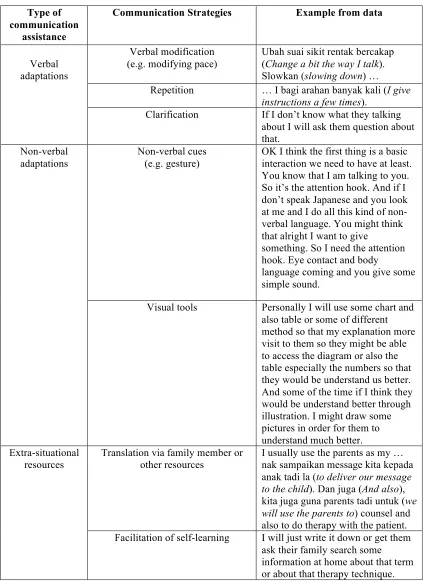
by Speech-Language Pathologists in
Multilingual Contexts in Malaysia
Master of General and Applied Linguistics (Advanced)
The Australian National University
Khadijah Khalid
November, 2017
This thesis is submitted in partial fulfilment of the requirements for the degree of Master of General and Applied Linguistics (Advanced) in the
College of Arts and Social Sciences
Declaration
Parts of this thesis have previously been submitted as assessments for
coursework in the Master of General and Applied Linguistics at the
Australian National University. Small segments of Chapters 1, 2 and 5 were
submitted as assessments for LING8026 Qualitative Research Methods in
Language Studies, Semester 1, 2017.
I hereby declare that, except where it is otherwise acknowledged in the text,
the thesis represents my own original work. All versions of the submitted
thesis (regardless of submission type) are identical.
Khadijah Khalid
Table of Contents
Declaration ... ii
Table of Contents ... iii
List of Tables ... v
List of Figures ... vi
Acknowledgments ... vii
Abstract ... viii
Chapter 1: Introduction ... 1
1.1 Purpose of the Research and Research Objectives ... 3
1.2 Background and Rationale of the Study ... 5
1.2.1 Language Ecology of Malaysia ... 5
1.2.2 Speech-Language Pathologist (SLP) ... 8
1.2.3 Communication Strategies ... 9
1.3 Organisation of the Thesis ... 11
Chapter 2: Literature Review ... 13
2.1 Communication in Monolingual and Multilingual Communities ... 14
2.2 Impacts When SLPs and Clients Have Different Language(s) ... 17
2.3 Recommended Practice with Multilingual Clients ... 18
2.4 SLPs in Malaysia ... 23
2.5 Use of Communication Strategies ... 25
Chapter 3: Methodology ... 29
3.1 Research Design: Qualitative Methodology ... 30
3.2 Research Protocol ... 32
3.2.1 Research Instrument – Semi-Structured Interviews ... 32
3.2.1.1 Participants ... 33
3.2.1.2 Piloting the Interview Protocols ... 34
3.2.1.3 Interview Questions ... 36
3.3 Research Procedure ... 38
3.4 Data Analysis ... 39
Chapter 4: Findings ... 41
4.1 Background Information of Participants ... 41
4.1.1 Northern region ... 45
4.1.2 East coast region ... 46
4.1.3 Central region ... 46
4.1.4 Southern region ... 46
4.1.5 Borneo ... 47
4.2 Results ... 47
4.2.1 The SLPs’ Consultation Language Preferences ... 48
4.2.2 Issues in Assessment, Diagnosis, Intervention and Consultation ... 50
4.2.3 Reported Practices Related to Assessment and Intervention ... 54
4.2.4 The Kinds of Communication Strategies that SLPs Currently Use ... 60
Chapter 5: Discussion ... 67
5.1 Managing language proficiency issues ... 67
5.1.1 A Suggested Framework ... 67
5.2 Working with Translators ... 70
5.3 Assessment Practices ... 71
5.4 Intervention Practices ... 75
Chapter 6: Conclusion and Recommendations ... 79
6.1 Recommendations ... 80
6.2 Study Limitations ... 82
References ... 83
Appendix 1 – A Codebook ... 93
Appendix 2 – Demographic Questionnaire ... 96
Appendix 3 – Interviews ... 101
Appendix 4 – Approval Letters ... 197
List of Tables
List of Figures
Acknowledgments
This thesis would not be possible without the will of God. Although my
name was written on the front page of this thesis, a significant number of
people contributed to its realisation. I would like to express my deepest
gratitude for everyone who helped me along the journey to complete my
degree.
I owe a tremendous appreciation to both my beloved and caring
supervisors, Dr Susy Macqueen and Professor Diana Slade for their endless
support, encouragement, advice, and invaluable knowledge and idea. Their
kindness and patience as well as their academic experience and expertise
have helped me to overcome all difficulties.
To all my participants in this study, I truly appreciate your time and effort
to share your experiences. I learned a lot throughout the way and indirectly
you give me an inspiration to be a better clinician.
Last but most importantly, I would like to thank my parents, Khalid Zakaria
and Noreha Mohamad Noh, my siblings, and my grandparents who have
Abstract
Communication is critical to the work of speech-language pathologists
(SLPs). In highly multilingual societies like Malaysia, the complexity of
communication is distinct from SLP practices in more
monolingually-oriented jurisdictions, especially in terms of professional discourse. The
issue of unshared or limited overlapping linguistic repertoires between
professionals and clients is common in Malaysia. This may contribute to a
high risk of misinterpretation and miscommunication, which could lead to
misdiagnosis and improper management. Therefore, research on how to
systematically manage SLP-client interactions where participants lack a
language variety in common is essential. Currently, there is no
documentation as to what kinds of strategies Malaysian SLPs use to
compensate for the communication gap between them and their clients
when they have limited or no shared language. Hence, the aim of this study
is to gather such information and to recommend broad policy guidelines in
relation to multilingual SLP-client interactions. Data were collected through
semi-structured interviews with 10 SLPs across Malaysia from diverse
practice backgrounds. Qualitative content analysis was used to analyse
transcribed data and generate themes. Findings include 1) current practices
and recommendations relating to assessment and intervention when there
is limited or no shared language between clients and SLPs, 2) strategies that
can be used to facilitate effective communication with these clients, and 3)
recommended practices when working with ad hoc and professional
The significant of this study is that it offers some important insights into
multilingualism issue present in Malaysia, regarding the professional
discourse in the healthcare contexts and provides an opportunity to
advance our knowledge on language proficiency management, particularly
Chapter 1: Introduction
Malaysia, like many other countries in the world, is well known for its
multilingual and multicultural society. The country of 13 states with three
federal territories consisting of two parts, West Malaysia (Peninsular
Malaysia) and East Malaysia (Borneo), is home to more than 24 ethic
groups. Malay, Chinese, and Indian ethnic groups comprise the majority in
Peninsular Malaysia; Iban, Malay, and Chinese in Sarawak; Kadazan-Dusun,
Murut, and Bajau in Sabah (Department of Statistics Malaysia, 2010). The
current Malaysian population is estimated at approximately 31 million
(World Bank, 2017). More than 70 languages are spoken across West and
East Malaysia, which can be categorised into indigenous (Bumiputera) and
non-indigenous (non-Bumiputera) languages (Haji Omar, 1983). Each
ethnic group in Malaysia has different spoken languages and different
regions have different dialects. With regards to diversity, it is accepted that
a majority of Malaysian people are either bilingual or multilingual (Hassan,
2005).
Multilingualism provides intellectual (see Bialystok, Craik, & Luk, 2012;
Diamond, 2010), cultural and economic benefits (see Grenier, 2015), to
Malaysia as a whole, hence it is and has been experienced as a positive
factor. However, it has also brought with it complexities in terms of
professional discourse. As a result, people of many professions speak many
languages in order to meet the demands of their clients’ linguistic diversity.
miscommunication is increasingly high, especially in healthcare contexts
(see Kagawa-Singer & Kassim-Lakha, 2003; Sutcliffe, Lewton, & Rosenthal,
2004). In the field of speech-language pathology in particular,
Speech-Language Pathologists (SLPs) use communication for interaction as well as
diagnosis. Clinicians have to use all resources available to diagnose and
deliver information even though they may possess different language
proficiencies or have a different first language (L1) from those of their
clients.
Currently, there are 37 out of 169 government hospitals around Malaysia
which offer speech-language therapy services. The Speech-Language
Pathologist Association of Malaysia estimated that the 362 practicing SLPs
in Malaysia work in both government and private sectors (SPEAK, 2016). Of
these, more than half are from Malay and Chinese ethnic groups, in which
most are bilingual or multilingual in Malay, English, and Mandarin. Due to
limited numbers of SLPs, it is predicted that there is a discrepancy between
the language used in each regional client base and the SLPs’ competency to
cater to various languages across Malaysia. Speech-language pathology in
Malaysia is still under development as a profession (Alkaf, 2002), with a
Malaysian Allied Health Professionals Act still being discussed in
parliament (Ahmad, 2010).
In this thesis, I will be focusing on my professional context, speech-language
of language proficiency in addition to the communication difficulties and
disorders exhibited by the clients.
1.1 Purpose of the Research and Research Objectives
The purpose of this thesis is to make a contribution to current
speech-language pathology practices in Malaysia and to recommend broad policy
guidelines in relation to multilingual practices; it is important to ensure that
services provided not only satisfy the speech-language pathology standard
requirement but more importantly, meet the needs of clients from different
backgrounds.
Generally, this thesis aims to investigate the nature and function of
communication strategies in bridging the language proficiency gaps
between SLPs and their clients. More specifically, it aims to:
• explore current SLP practice policies both internationally and in
Malaysia specifically policies concern with linguistically and
culturally diverse clients.
• explore the experience of how SLPs interact with clients in context
where there is unshared or limited overlapping linguistic
repertoires between SLPs and clients.
• identify how SLPs address issues related to language proficiency in
kinds of communication strategies that they currently use to
compensate for gaps in language proficiencies.
• determine and detail the kinds of communication strategies that
SLPs can use to compensate for the gap between them and their
clients when they have limited or no shared language.
• develop a basis for policy recommendations relating to linguistically
diverse clients for SLPs in Malaysia.
To achieve the research objectives, I will review the professional
speech-language pathology documents and policies, and conduct semi-structured
interviews with 10 SLPs. The 10 SLPs were spread across every region in
Malaysia - north, south, central, and east coast of Peninsular Malaysia and
Borneo. This is to gain insight into communication difficulties that occur
due to different levels of language proficiencies between SLPs and clients
according to geographical area. The exploration, from the perspective of a
professional and cultural insider allows a deeper understanding of how the
level of language proficiency affects the speech-language pathology
therapeutic process and what the SLPs do to improve communication
breakdowns that occur in their session. The professional documents and
policies, on the other hand, aid the understanding of operational mandate
pertaining to speech-language pathology practice in particular the choices
of language and approaches taken with clients with diverse languages and
1.2 Background and Rationale of the Study
1.2.1 Language Ecology of Malaysia
As the majority of Malaysian people are either bilingual or multilingual,
code switching and shifting are common. Code switching and shifting occur
in both formal and informal contexts of communication in Malaysia (see
David, Abdullah, Rafik-Galea, & Mclellan, 2009; Muthusamy, 2010). When
mixed language groups engage in conversation, two languages in particular
are used (How, Chan, & Abdullah, 2015): Bahasa Malaysia (Malay language)
and English. Each language performs crucial functions in Malaysian society.
Bahasa Malaysia is the national language of Malaysia, the mother language
of the dominant Bumiputera (the Malays), and the primary language of
education, social interaction, and administration (Gill, 2009). English, on
the other hand, has a special position in education and some aspects of
administration especially in the private sector (see Gill, 2004, 2005; Kassim
& Ali, 2010; Ridge, 2004). This is due to the history of British colonisation
in Malaysia, and the position of English as the language of globalisation.
In fact, Malaysian language policy changes almost every ten years (see Heng
& Tan, 2006; Le Ha, Kho, & Chng, 2013; Tan, 2005), back and forth to
determine the position of the national language. Even the two core subjects
taught in school, mathematics and science, keep changing between Malay
and English as the language of instruction. Despite the frequent changes of
language choice in the educational system, Zhou and Xiaomei (2017) claim
Bahasa Malaysia as the national language and in accommodating
multilingualism” (p. 9). This implies that Malaysian people from different
linguistic backgrounds who attend school know how to interact at least at
the basic level of proficiency in Malay language.
Apart from this, there are several minority languages spoken around
Malaysia representative of which ethic group an individual belongs to. For
example, Mandarin is the most spoken language used by the Chinese
community because it is the lingua franca used in Chinese vernacular
schools. Additionally, Chinese dialects such as Hokkien, Hakka and
Cantonese are commonly used in informal domains among the Chinese
community. Like Mandarin, Tamil also has a special position in the Indian
community for its role as the primary language of instruction in the Indian
vernacular schools. In addition to Tamil, Punjabi, Telugu, Sindhi, and
Malayali are the languages spoken by the Indian community. Sam and Wang
(2011) reported that languages spoken by Chinese and Indian communities
are heterogeneous, completely different from one another in terms of
language structure and organisation. Aboriginal languages spoken by the
Bumiputera in Peninsular Malaysia and Borneo are also different and
heterogeneous.
For that reason, ‘diversity in unity’, the national building agenda,
established in 1990s is a very important aspect in the formulation of
(other ethnicity) populations. In addition, the construction of Bangsa
Malaysia ‘Malaysian nation’ was a turning point in the unification of
Malaysian citizens to develop a shared sense of belonging to Malaysia since
Malaysian independence in August 1957, despite diverse languages and
cultures. This indicates the tolerance and acceptance of Malaysian people in
sharing the same lingua franca despite their differences.
Although Malay and English are preferred, it is not always the case that
everyone is proficient in both or either. The level of language proficiency for
every individual is different, depending on the level of exposure to a certain
language and the environment that enhances the development of the
language (Hoff & Core, 2013). For example, an Ethnic Malay who attends a
Chinese vernacular school might have a better proficiency in Mandarin than
an Ethnic Chinese who speaks Cantonese at home and attends a Malay
medium mainstream school. Therefore, language selection and choice in
any given situation, especially in addressing language problems, is difficult.
Malaysian SLPs experience this tricky situation on a daily basis in their
practice to a greater or lesser extent, depending on their work setting and
clients encountered. Due to limited resources, e.g. trained translators
(easier to find in developed countries such as the United States and the
United Kingdom) and the small number of SLPs in Malaysia, SLPs do not
have any option except to engage with their clients directly and to attempt
1.2.2 Speech-Language Pathologist (SLP)
The need to engage and to be competent in culturally-appropriate practice
with clients from culturally and linguistically diverse backgrounds is critical
for SLPs around the world, as recognised in a number of key professional
documents (see American Speech-Language-Hearing Association, 2004a;
Speech Pathology Australia, 2009). Several past works have shown that
there is a strong tendency to misdiagnose multilingual clients, resulting in
them either being unnecessarily placed in the caseload (Adler, 1990;
Kritikos, 2003) or dismissed from the session due to misinterpretation of
speech and language problems as communication variations (Verdon,
McLeod, & Wong, 2015). This indicates the importance for SLPs to really
understand the interactions that take place within their sessions, including
the willingness of SLPs to take extra initiatives in considering and/or
providing alternatives that can help the effective comprehension or
delivery of information between client and practitioner.
Additionally, the speech therapy process requires continuous interaction
between SLPs and clients. It usually takes more than one therapy or
intervention session once an individual has been identified and diagnosed
with speech and language problems to implement practical assistance or
intervention. Hence, SLPs have to build a good rapport with clients and their
families, as the clinician-client relationship is one of the primary
determinants of the success of SLP services (Ebert, 2017; Ebert & Kohnert,
communication. When the clinician is able to understand the information
reported by the client, it reduces the risk of misdiagnosis, and when the
client is able to understand the information given in the therapy session,
they are better able to use advice given regarding treatment. Through each
of these, the clinician earns trust from the client which further facilitates a
smooth therapy process.
Many studies in the SLP field emphasise the role of SLPs in improving the
communication of children and adults with physical and/or neurological
problems including the usage of augmentative and alternative
communication (ASHA, 2004b). Particularly, recent studies in the field of
SLP in Malaysia have only focused on practice patterns of SLPs in managing
a specific disorder in a particular group e.g. speech and language delay in
children and dysphagia in adults (see Joginder Singh, Chan, & Ahmad Rusli,
2016; Mustaffa Kamal, Ward, & Cornwell, 2012). Only a few numbers of
research deal with multilingualism in SLP profession on the international
platform and there have been no known studies that have focused on
multilingualism in SLP practice in Malaysia. This research attempts to fill
the gap and aims to provide useful clinical recommendations especially for
SLPs who work in highly-multilingual countries like Malaysia.
1.2.3 Communication Strategies
In the last ten years, there has been a significant increase in awareness
internationally on critical importance of communication in healthcare. In
ineffective communication between clinicians and patients. Those studies
manifest adverse effects on patients’ care if the health practitioners were
less able to transfer the information effectively (see Araújo & Silva, 2012;
de Negri, Brown, Hernández, Rosenbaum, & Roter, 1997; Hull, 2016).
Asnani (2009) states that “extensive research has shown that no matter
how knowledgeable a clinician might be, if he or she is not able to initiate
good communication with the patient, he or she may be of no help” (p. 357).
This implies that effective communication between clinicians and their
patients is crucial to improve patients’ overall satisfaction and long-term
health outcomes.
Communication is a key element in the SLPs’ scope of work, i.e. if
communication breakdowns occur in any stage of the therapy process, it
has a potential to result in negative outcomes for the clients. There are
several risks in interacting with clients who have limited or no shared
language. One of these is that the clinician might misinterpret the
information provided by the client during case history. In cases of
interaction involving a client who does not have the same level of language
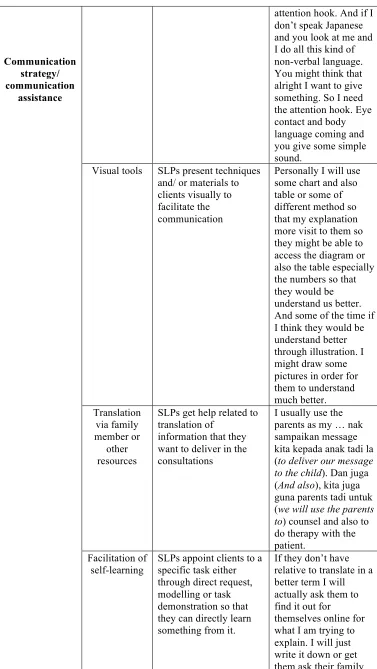
proficiency, the clinician will often need to use communication strategies.
Corder (1983) defines communication strategies as “a systematic technique
employed by the speaker to express his meaning when faced with some
difficulty i.e. the speaker’s inadequate command of the language used in the
interaction” (p.16). Oweis (2013) defines communication strategies as
situations, e.g. when a speaker is unable to convey his message due to
different level of proficiencies with the listener. Extending and modifying
those definitions, I contextualise communication strategies as adjustment
or changes in communication made by the SLPs as an alternative to improve
the interaction between SLPs and clients in any stage of speech therapy
process when communication breakdowns occur due to different level of
language proficiency between SLPs and clients. Examples of
communication strategies are adjustments, such as repetition and
rephrasing of instructions during an assessment if the client does not
understand instructions given.
Therefore, in this thesis, I will identify in further and detail different
communication strategies for SLP practice in particular in the multilingual
contexts of Malaysia.
1.3 Organisation of the Thesis
There are five chapters following this introduction chapter. Chapter 2 will
review a communication model in order to set a foundation of
understanding on how language proficiency issues affect SLP service
delivery. From there, the chapter then examines the current practice
policies recommended by SLP professional bodies when dealing with
clients with diverse languages and cultures. This section identifies the
Chapter 3 explains in detail the research design and procedures used in this
study including the participant inclusion criteria, the interview protocols,
and the process to analyse the data. Chapter 4 discusses the findings
obtained from the data and highlights the main results through themes and
categories.
Chapter 5 explains the findings in detail by making comparisons with other
studies and evaluating their importance. Finally, chapter 6 summarises the
major arguments within the thesis and briefly outlines the significance of
Chapter 2: Literature Review
Chapter 1 has introduced the language ecology and multilingual contexts of
Malaysia and emphasised the issue of unshared and overlapping linguistics
repertoires between SLPs and clients. The main purpose of this chapter is
to review in detail the impacts of this issue on the SLP profession, how the
current and available practice policies address this issue, and determine the
research gaps that need to be filled in by this research. There are two
primary gaps that are highlighted in this review: 1) when SLPs and clients
do not have sufficient proficiency in a common language, basic
communication, i.e. the use of verbal language alone, is not enough and 2)
the multilingual phenomena in Malaysia and Western countries are
different but most SLP research and evidence-based practices are carried
out in or based on Western contexts. Thus, cultural and linguistic
establishment need to be obtained to ensure that the SLP practices are
effective for the population of interest. In this chapter, I will first
contextualise the communication models for monolingual and multilingual
communities followed by recommendation practices for clients with
linguistically and culturally diverse that have been outlined by the SLP
professional bodies, and theoretical discussion about communication
2.1 Communication in Monolingual and Multilingual Communities
SLPs use communication on a daily basis working with different kinds of
communities. As communication is a key element in SLPs’ scope of work,
the understanding of theory and concept of communication with different
communities is crucial to begin with.
In the last of a half century, Chomsky has conceptualised the notion of
communicative competence in a linguistically homogenous community
which is not suitable for multilingual community that typically exist in
South Asia. Chomsky traditional communication model draws attention to
the concept of community based on a shared language and culture. This idea
has been opposed by several linguists from the South Asian region (see
Bhatia & Ritchie, 2004; Khubchandani, 1997) who believe that community
in South Asia is based on a shared space, i.e. “language diversity is the norm
and not the exception in non-western communities” (Canagarajah & Wurr,
2011, p. 2). This indicates that people in the South Asian region frequently
encounter different people who speak different languages in their daily
interactions. Hence, having a common language is not necessarily the norm.
In this multilingual society, non-verbal communication is required to help
verbal. This particular communication is referred by Khubchandani (1997)
as “a autonomous device, communicating in symphony with other
non-linguistic devices; its full significance can be explicated only from the
communication is a meaning-making activity which requires intuition,
perception, context, and other communicative devices to convey
information between interlocutors. Thus, it is suggested that these
non-verbal cues in communication help people in the multilingual society to get
the message across even though there might be some contradiction in terms
of language proficiency between them.
Besides that, a shared grammar is also not a reason that makes people able
to communicate with each other. However, communicative practices and
strategies is a form of resourcefulness in information transfer when a
common language code is not available between speakers (Canagarajah &
Wurr, 2011). These practices and strategies are essential in multilingual
countries like Malaysia, which practice multilingual communication as a
norm (Haji Omar, 1987). Since many languages are spoken across Malaysia,
the shared grammar only is not sufficient to achieve intelligibility in
communication. The orientation of communication in Malaysia is also
different from the countries who have monolinguals as the majority. Hence,
Canagarajah and Wurr (2011) propose of inserting ecology such as
communicative contexts, paralinguistic cues, e.g. intonation, gestures, and
facial expression, and objects in the setting as a resource to facilitate the
communication.
Although the ecology is very helpful as a resource in multilingual
disorders. This is where the involvement of trained professionals who are
expert in the area of communication disorders, the SLPs are necessary to
help in reducing the complexity. The American Speech-Language Hearing
Association (ASHA) describes SLPs as the professionals “who engage in
clinical services, prevention, advocacy, education, administration, and
research in the areas of communication and swallowing across the life span
from infancy through geriatrics” (ASHA, 2016, p. 1).
The two areas that SLPs have responsibility for are essential in human life.
Communication is accepted to be one of important elements in learning
process (Barnes, 1992). Without proper communication skills, an
individual misses the opportunity to develop and learn effectively.
Swallowing, on the other hand, is a human necessity – being unable to eat
normally contributes to frustration and possibly malnutrition due to loss of
appetite (see Larsson, Hedelin, & Athlin, 2003; Poels, Brinkman-Zijlker,
Dijkstra, & Postema, 2006).
SLPs also strive to achieve their ultimate goal on improving the quality of
life of an individual by tailoring their services to suit an individual’s need.
This is because each individual views problems and disorders differently
due to the influence of culture and their upbringing (Isaac, 2002). This is
especially true when it comes to communication. A study by Garcia, Mendez,
and Ortiz (2000) show how maternal beliefs influence the early childhood
in this study regard speech delay as something that usual for young
children. Hence, they were not concerned for the children to get an early
intervention. The way communication functions from one family to another
is also different. This suggests that every individual who requires the SLP
services will have different needs in addition to different linguistic abilities
and environmental supports.
2.2 Impacts When SLPs and Clients Have Different Language(s)
A good SLP services will give a positive change to people’s lives. However,
“gaps in cultural and linguistic competency may lead to negative
perceptions and attitudes towards clients, which may hinder the
effectiveness of service delivery “(Perry, 2012, p. 1).
When SLPs and clients do not speak the same language(s), this situation
contributes to a risk of misdiagnoses (see Bird & Deacon, 2012).
Misdiagnoses in this kind of clients typically occur due to misinterpretation
of information during the case history and assessment as the clients might
interpret the instructions and questions asked differently from what the
SLPs expected. The likelihood that clients and their carers would be silent
throughout the session is because they might have a difficult time to express
themselves, resulting in SLPs not having enough information and leading to
There is also a possibility that the information explained by SLPs might not
be understood by clients. Since there is a mismatch in language between the
SLPs and clients, there is no exact percentage that the clients would
comprehend the message correctly. In extreme cases such as a swallowing
case, this situation might cause death as clients and their carers might not
understand the information on how serious the problem is if the clients
consume the food through mouth when the swallowing mechanism has
been affected due to malformation or injury to the brain which can lead to
pneumonia. In fact, many literatures demonstrate that language barriers
and misunderstandings of healthcare information could also happen even
with clients who have the same first language (Graham, & Brookey, 2008).
This insinuates that the situation might be even worse in a scenario with
clients having a different language.
2.3 Recommended Practice with Multilingual Clients
The problem has been recognised by the SLP professional bodies.
Therefore, the development of policies to satisfy the requirements and
standard of practices when working with clients with diverse culture and
linguistic backgrounds have been developed.
Currently, it is an offense if SLPs refuse to provide their services due to a
different language issue between SLPs and clients which was the situation
more than two decades ago. According to ASHA Principles of Ethics I, Rule
services”. This principle emphasises on the right of an individual to get a
professional service regardless of any reason including the presence of a
mismatch in language with the clinician. This indicates that SLPs are
obligated to deliver their services in any circumstances.
There are several requirements that have been outlined for the SLPs to
work with clients from diverse culture and linguistic backgrounds,
stipulated in the following excerpt:
1. Professionals are sensitive to cultural and linguistic differences that
affect the identification, assessment, treatment, and management of
communication disorders/differences.
2. Professionals are obligated to provide culturally and linguistically
appropriate services to their clients and patients, regardless of the
clinician’s personal culture, practice setting, or caseload
demographics.
3. Professionals are able to identify the appropriate service provider
for clients/patients.
4. Professionals who are not competent to provide services to bilingual
clients are still responsible for ensuring that a client receives
5. Professionals are able to obtain the knowledge base needed to
distinguish between typical and disordered language of
clients/patients.
6. Professionals are knowledgeable about normal bilingual
development, disorders in bilingual populations, myths associated
with diverse populations, and best practices to employ with these
populations.
7. Professionals are able to identify/assess typical and disordered
language.
(ASHA, 2004a, p. 2-3)
From the excerpt above, it can be concluded that SLP professionals are
required to equip themselves with knowledge and skills regarding cultural
and linguistic differences in order to provide the services that are up to
standard. This also includes the need for SLPs to get familiar with the
resources and language ecology where they work in and are willing to take
initiatives to continue learning.
Apart from that, SLPs are required to have the linguistic proficiency, i.e. they
have to be proficient in the terminologies and processes involved in the
areas of communication and swallowing. This includes speech and language
areas, and implementation of intervention strategies that can support the
clients and their family members. If there is no shared language between
SLPs and clients, it is recommended that the communication is mediated by
an interpreter (Isaac, 2005). Ideally, this option is to maximise
communication when a barrier due to language differences has been
determined.
For assessments in particular, SLPs have been recommended to use the
alternative assessments. Alternative assessments refer to other procedures
that the SLPs typically perform to measure clients’ speech and language
skills (Laing & Kamhi, 2003), which are basically norm and criterion-based
assessments. This includes language sampling and the use of dynamic
assessment. Kohnert (2013) agrees to the concept of dynamic assessment
in which clients who speak more than one language to be assessed using
various measures at different points in time. This approach is more
equitable to determine the clients’ abilities to learn and acquire language as
a whole. In addition, the case history for these clients should include a
comprehensive language profile, i.e. “the age at which the child was exposed
to each language, the amount of exposure to and use of each language on a
typical day, the people who speak each language to the child (e.g., parents,
siblings, teacher, grandparents, or friends), the settings or context for
language use (e.g., home, religious settings, community groups, or school),
the child’s preferred language (e.g., for music, dreams, counting, or
function of partner, purpose, and context)” (McLeod, Verdon, & IEPMCS,
2017, p. 3).
SLPs are advised to conduct speech and language assessments that target
all of the clients’ languages. McLeod et al. (2017) argue that the clients’
language history varies by language, i.e. “they might begin to acquire each
language at different time points, resulting in acquisition differences in each
language” (p. 4). They believe that SLPs will have a clear picture and
understanding of clients’ overall language skills which subsequently
contribute to a better assessment outcome in terms of a valid and reliable
diagnosis. From there, they can move forward to link all the information
that they obtain from the assessment to decide whether there is a need for
further intervention. Hence, a comprehensive data gathering of the
assessment is necessary to obtain an accurate diagnosis.
SLPs are not encouraged to adapt speech and language assessments from
one language to another. They should be aware that different languages
have different forms, phoneme inventories, contents, and uses. Available
standardised speech and language assessments are generally designed and
normalised to a specific population (Capone, 2010). For instance, the test
scores of the language assessment that specifically develop for American
English-speaking clients are invalid for a client who speaks Arabic as their
home language as they are not reflected in the normative group for the
instructed procedure. It is highly predictable that the client will have lower
score than the sample. Thus, it is unjust to diagnose a client without an
appropriate use of the test instrument.
Practising SLPs worldwide frequently raise the question of which language
to use during speech and language interventions especially when they work
with clients who are multilingual. This issue has been well explained by
Thordardottir (2010) as she presents a hard evidence that ASHA, the
Canadian Association of Speech-Language Pathologists and Audiologists
(CASLPA), and the International Association of Logopedics and Phoniatry
(IALP) have different position statements on this issue. Both CASLPA and
IALP stand in favour of multilingual intervention for clients who are
multilingual. ASHA, on the other hand, did not make any explicit statement
on which kind of intervention is ideal. However, these associations agree to
the fact that the choice of language should be made in a joint collaboration
with the clients’ carers.
2.4 SLPs in Malaysia
In Malaysia, the SLP profession is still developing. Only three public
universities in Malaysia, Universiti Kebangsaan Malaysia (UKM), Universiti
Sains Malaysia (USM), and the International Islamic University of Malaysia
(currently recruiting their first batch of students this semester), are offering
the SLP-trained program locally. Speech services in Malaysia were first
time possessed the educational knowledge acquired from abroad (Lian &
Abdullah, 2001). The first batch of locally-trained SLPs was graduated in
1999. After three years, in 2002, the speech therapy services in the
government sector under the Ministry of Health Malaysia was opened.
Unlike many other countries, “there are no statutory licensing
requirements for SLPs to practise” (Joginder Singh, Chan, & Ahmad Rusli,
2016, p. 560) at this moment. However, individuals who are eligible to
practise as SLPs in Malaysia are individals who have completed at least a
bachelor degree in speech science or speech pathology, and completed
standard clinical hours as a part of the degree requirements (Ahmad,
Ibrahim, Othman, & Vong, 2013). The current SLP practices in Malaysia
have not changed much from the first time the SLP program was set up in
1994. They are still predominantly-influenced by literatures and practices
from Western countries. This might be related to the early stage of the SLP
program development wherein almost all the faculty members or
instructors were from the UK (Ahmad et al., 2013).
The current practices are mixed between evidence-based and traditional
service delivery models. The evidence-based practices are not fully
implemented in Malaysia due to lack of resources and literatures available
specifically for Malaysian population. Lian and Abdullah (2001) claim that
“the cultural practice of multilingualism allows a Malaysian SLP to function
“multilingualism is not perceived as barrier to delivery of assessment and
intervention services” (p. 5). Since several languages are often used within
a conversation, linguistic criteria are not used to identify a language delay
or disorder, a communication competency criterion of receptive and
expressive language skills is used instead. This might be due to the linguistic
criteria of Malaysian languages which are not only diverse but also
heterogenous.
A range of challenges in speech and language assessments are present in
the field of speech therapy. As in Malaysia, there exists a lack of suitable
assessment tools for evaluating speech and language skills of a majority of
children who are majority is multilingual; hence leading to children being
over-identified or under-identified with language impairments (Bedore &
Peña, 2008; Williams & McLeod 2012). In addition, according to
Amar-Singh (2008), the resources available to Malaysian SLPs are not
equally-distributed across the country and work settings, e.g. government hospitals
in urban areas are likely to have more resources compared to those in rural
areas, and this in turn could have affected assessment practices and led to
lack of consistencies.
2.5 Use of Communication Strategies
Since the SLP scope of work is predominantly involved communication, the
need to identify ways to improve the process is essential. Research on this
gap between each other has been well described in the field of applied
linguistics as communication strategies.
Communication strategies have been defined in several typologies, e.g.
psycholinguistic problem-solving, interactional, and discourse (see Ting &
Phan, 2008) by researchers in this area depending on the concept and
approach of their study. Dörnyei and Scott (1997) claim that “researchers
originally saw communication strategies as verbal or nonverbal first-aid
devices used to compensate for gaps in the speaker’s second language (L2)
proficiency” (p. 177). This indicates that the early development of
communication strategies revolved around the L2 learners.
Further development of this area brings forward to the use of
communication strategies as a mechanism or a set of procedures to help the
speakers cope with any potential language-related problem which they
were aware of during the course of communication in order to reach a level
of communicative competence. ‘Communicative competence’ has several
definitions (see Gałajda, 2017). Some similar key terms regarding
communicative competence that can be derived from each definition as
cited in Gałajda (2017) are knowledge, performance in a social situation,
and translating intentions into words. It is proposed that the use of
communication strategies might be beneficial for a speaker to achieve a
In Malaysian SLP-client interaction for instance, the communication
strategies used by SLPs are most likely grouped under the conscious
communication strategies category. Tarone (1977) clasifies the typology of
conscious communication strategies into five main types: 1) avoidance, e.g.
topic avoidance and message abandonment, 2) paraphrase, e.g.
approximation, word coinage, and circumlocution, 3) conscious transfer,
e.g. literal translation and language switch, 4) appeal for assistance, and 5)
mime. These five types of communication strategies reflect the primary
concept of conscious communication strategies, encompassing the use of
techniques and/or acts which are done intentionally in order to achieve a
specific communicative goal; the concept is applicable to the SLPs practice
as SLPs have an explicit communicative aim in the session.
Communication strategies, however, have a drawback wherein they can
only be effectively used if the speaker has at least basic knowledge and
proficiency in a certain language. For example, in a case of an SLP who is
proficient in Malay and English and has a client who speak Iban as his L1 –
if the client is at least able to follow a simple command in Malay or English,
communication strategies will be useful for the interactions. If the client
does not have a common language and cannot even follow a simple
instruction, the use of communication strategies is meaningless. Thus, these
kinds of clients will benefit more to the interaction that is mediated by a
Chapter 3: Methodology
As detailed in Chapter 1, this research has five specific aims: 1) to explore
current SLP practice policies both internationally and in Malaysia
specifically policies concern with linguistically and culturally diverse
clients, 2) to explore the experience of how SLPs interact with clients in
context where there is unshared or limited overlapping linguistic
repertoires between SLPs and clients, 3) to identify how SLPs address
issues related to language proficiency in assessment, diagnosis,
intervention, and consultation including the kinds of communication
strategies that they currently use to compensate for gaps in language
proficiencies, 4) determine and detail the kinds of communication
strategies that SLPs can use to compensate for the gap between them and
their clients when they have limited or no shared language, and 5) to
develop a basis for policy recommendations relating to linguistically
diverse clients for SLPs in Malaysia.
To pursue the aims of the study, a qualitative research approach is believed
to be the most appropriate methodology in order to explore and examine in
detail on how SLPs manage the language proficiency issue with their clients.
This chapter details a qualitative method used in this study, the
3.1 Research Design: Qualitative Methodology
Qualitative methodologies are “a form of systematic empirical inquiry into
meaning” (Shank, 2002, p. 5). ‘Systematic’ means a study which requires a
careful plan following rules and ethical considerations agreed by the
research community. ‘Empirical’ refers to enquiry that is grounded in the
world of experience. ‘Inquiry into meaning’, on the other hand, refers to an
attempt to comprehend how others make sense of their experience. It is
designed to elucidate phenomena extensively within authentic contexts
which involve an interpretive and naturalistic approach, i.e. the main
objective of the qualitative methodologies is “to address questions
concerned with developing an understanding of the meaning and
experience dimensions of humans’ lives and social worlds” (Fossey, Harvey,
McDermott, & Davidson, 2002, p. 717). Hence, this approach is suitable for
researchers who are interested in studying a specific topic or issue in depth,
especially from the experience of individuals who are directly involved in
the topic of interest.
There are three main areas which qualitative research questions focus on:
“1) language as a means to explore processes of communication and
patterns of interaction within particular social groups, 2) description and
interpretation of subjective meanings attributed to situations and actions,
and 3) theory-building through discovering patterns and connections in
qualitative data” (Tesch, 2013, p. 55). Within these focus areas, qualitative
instruments. As this study focuses on the field of SLP, the advantages of
conducting qualitative research in SLP field (see Damico &
Simmons-Mackie, 2003) are:
• assist in filling a gap with respect to the explanation and
interpretation of complexity in communication disorders and SLP
clinical practice.
• offer more flexibility to link between research and clinical practice
as researchers can follow unexpected ideas during research and
explore processes in-depth and effectively.
• provide sensitivity to contextual factors such as diversity in society,
i.e. the nature of SLP work requires SLPs to understand linguistic,
cultural, and experiential differences which can affect the language
and communication development of their clients.
According to Heigham and Croker (2009), there are six common ways to
collect qualitative data: observation, interviews, open-resource items on
questionnaires, verbal reports, diaries, and discourse analysis. They argue
that “in most qualitative research, researchers do not control the research
setting at all, as they are interested in authentic behaviour in natural
settings” (p. 18). However, the control still exists through the degree to
which the researchers structure the process of collecting the data.
purpose of using semi-structured interviews is as a way to explore
Malaysian SLPs’ views and experiences in managing cases of different levels
of language proficiency in their daily practice.
3.2 Research Protocol
3.2.1 Research Instrument – Semi-Structured Interviews
‘Semi-structured interviews’ is a typical approach used in qualitative
research (Morse, 2012). It consists of a set of open-ended questions which
has been planned and framed to elicit a rich verbal information from the
participants. It is often being used when the researcher knows what to ask,
but does not know what answers to expect (Edwards & Holland, 2013).
Dörnyei (2007) regards semi-structured interviews as a compromise, since
they have potential to promote reliability and consistency (same as
structured interviews), but still allows a degree of freedom and adaptability
in getting the information needed. This suggests that, in semi-structured
interviews, the researchers will ask some similar key questions to each
interviewee but the order of the questions asked would not be the same,
depending on responses given by the participants.
In addition, the semi-structured interview process is not only flexible but
also permits a richness of information in the data. This notion is supported
by Rubin and Rubin (2005) as they believe that the semi-structured
interviews “allow depth to be achieved by providing the opportunity on the
part of the interviewer to probe and expand the interviewee's responses”
When conducting this kind of interview, researchers are recommended to
use a checklist (see Berg, 2007) that would help to cover all relevant areas.
The advantage of using the question checklist as Berg (2007) emphasises is
that the checklist “allows for in-depth probing while permitting the
interviewer to keep the interview within the parameters traced out by the
aim of the study” (p. 39). In fact, the use of checklist is very useful to avoid
key questions from left behind or not asking by the researchers. Hence, the
credibility of qualitative studies can be maintained because all questions
and important components of the study have been addressed.
The purpose of interview sessions in this study are twofold: 1) to explore
the experience of how SLPs interact with clients in context where there is
unshared or limited overlapping repertoires between SLPs and clients and
2) to identify how SLPs address issues related to language proficiency in
assessment, diagnosis, intervention, and consultation including the kinds of
communication strategies that they currently use to compensate for gaps in
language proficiencies. All interviews were carried out by the researcher,
who is a Malaysian SLP.
3.2.1.1 Participants
Ten participants, two representatives of SLPs from each region in the
Peninsular Malaysia (north, south, central, and east coast regions) and
Borneo were selected to participate in the interviews. The participants
were qualified practising SLPs, working in Malaysia. They have been chosen
contexts in Malaysia. The SLPs were from diverse backgrounds in terms of
language background (most of SLPs are at least bilingual in Malay and
English but some of them are proficient in more than three languages),
working experience (between less than a year and more than 20 years),
work setting e.g. hospital and rehabilitation centre, and its language ecology
e.g. in Peninsular Malaysia SLPs encounter three major ethinicities, the
Malay, Chinese and Indian but in Borneo they have more clients from the
Malaysian indigenous group.
3.2.1.2 Piloting the Interview Protocols
In order to ensure the interview process runs smoothly, researchers are
recommended to conduct a pilot (Turner III, 2010). The purpose of piloting
the interviews is to test the research instrument prior to the actual data
collection by simulating rapport, process, consent, space, recording, and
timing (Baker, 1994). Through a pilot interview, the researcher will know
the approximation of duration of the interview, identify potential problems
to the protocols (see Van Teijlingen & Hundley, 2001), and determine the
questions that appropriate to be asked to the selected participants.
Merriam (2009) pointed out that the “best way to tell whether the order of
your questions works or not is to try it out in a pilot interview” (p. 104).
Hence, a pilot interview with Helen (a pseudonym), an SLP from Kuching
was conducted on 2nd September 2017. She has three years’ work
experience and specialises in Auditory Verbal Therapy for clients with
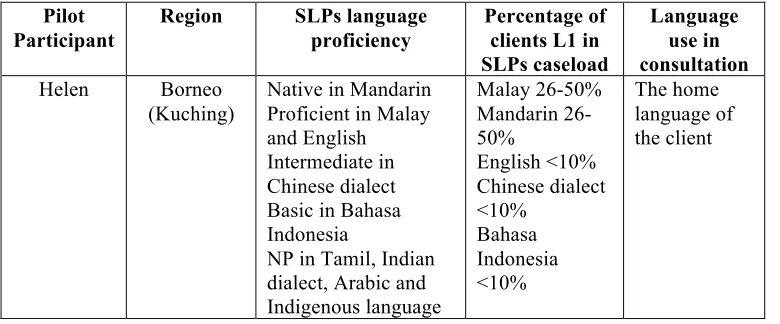
interview session). The interview session last for 25 minutes. Table 1 below
shows the information of Helen’s language proficiency in regards with
[image:45.595.113.503.206.368.2]percentage of first language (L1) of clients in her caseload.
Table 1 Language Data of a SLP and Her Clients (Pilot)
Pilot Participant
Region SLPs language
proficiency
Percentage of clients L1 in SLPs caseload
Language use in consultation
Helen Borneo (Kuching)
Native in Mandarin Proficient in Malay and English Intermediate in Chinese dialect Basic in Bahasa Indonesia
NP in Tamil, Indian dialect, Arabic and Indigenous language Malay 26-50% Mandarin 26-50% English <10% Chinese dialect <10% Bahasa Indonesia <10% The home language of the client
There are few issues that were identified to change from the interview
based on the feedback and discussion during the pilot interview. Firstly, add
‘none’ to the answer options for Question 8 in the background
questionnaire online (refer Appendix 2) that ask about the percentage of
clients on their caseload. As the interviewee states that: (Table 1 above
shows the language data obtained after the revision).
… I do not have Indian client actually but you do not have the choices of zero percent. So that’s why I indicated it less than ten percent …
The interviewee stressed that even though the participant has been
provided with background questionnaire, the interview should start with a
brief discussion about SLPs’ background, work setting, standard operation
a scene or context of discussion and avoid assumptions. The example of a
brief discussion in the beginning of the interview as follows:
Interviewer: I see that you often but less than ten percent patients who use Tamil. You said that you have no proficiency for Tamil or any Indian speaking clients… for example... How would you describe the nature of interactions you have with clients who speak Tamil or some other language you are not proficient in?
Helen: Honestly speaking is very different in Sarawak which we have very limited numbers of Indian…
If the interviewer did not set any context in the beginning of the interview
about the language ecology, she might end up with assumptions that SLPs
in East Malaysia and West Malaysia have similar language ecology to
encounter. Thus, this discussion part is necessary to be included in the
protocol.
3.2.1.3 Interview Questions
As a result of the pilot, the interview protocol and questions were revised
as follows:
[Start the interviews by setting up a scene or context of discussion] - Based
on the information that you provided in the questionnaire, you have A years
of experience in the SLP profession and currently work in B and specialise
in C. I see that you often have clients who speak X, which is not a language
you say you are proficient in.
1. How would you describe the nature of interactions you have with clients
Probe: If you do not have shared language or only minimally do, how do
you communicate with your clients?
2. For SLPs in particular, communication is not just for efficiency and
interpersonal aspects, but also for diagnosis. Tell me about assessment
and intervention protocols for clients whom you do not have a shared
language with or only minimally do.
3. What kinds of problems present in this context?
4. What do you do when the problems happen/ to compensate for a gap in
language proficiency?
5. As you and your client have different levels of language proficiency, how
do you know whether your client is exactly having a language problem
not a language variation?
6. In a situation when you have a 7-year-old X speaking client with speech
and language impairment. This client is accompanied by his parents in
the session who are also native in X and have limited proficiency in M
and N, the language you are proficient in.
• What language would you use?
7. In any consultation, the diagnoses and recommended treatment are
critical for clients and their carers to understand. Give me examples of
communication strategies you would use to ensure that your client or
carer have understood the interaction in particular the diagnoses and
recommended treatment?
8. Is there anything else you would like to say before we end our interview
today?
Probe: Any recommendations or ideas?
The list of interview questions as stated above are the key questions that
have been asked in the interviews. It works as a guideline in the interview
process.
3.3 Research Procedure
Ethical approval from the ANU human ethics committee was granted on
29th August 2017 (refer Appendix 4). Once the approval was granted, a pilot
study was conducted. A link to a background questionnaire online was
advertised through a post in the Malaysian Speech-Language Therapists
group on Facebook a week later. Thirty-three SLPs have answered the
background questionnaire online, in which 25 of them agreed to be
contacted for the interviews. Ten SLPs (two SLPs from each region) were
recruited to participate in the interviews based on language ecology they
data collection time frame. A direct text message was sent to the
participants to confirm their availability. An invitation, a consent form
(refer Appendix 6), and an attached participant information sheet (refer
Appendix 5) were then emailed to the recruited participants. The interview
was conducted through a video call, online, one-to-one at the time indicated
by the participants. The average time taken for each interview session was
20 to 25 minutes.
3.4 Data Analysis
Data analysis in qualitative research is defined as a systematic collection
process of searching and arranging the interview transcripts, observation
notes, and/or other non-textual materials to increase researchers’
understanding of the studied phenomenon (Bogdan & Biklen, 2007). The
process primarily involves coding and categorising the data. Fereday and
Muir-Cochrane (2006) suggest six stages of coding in qualitative analysis:
1) developing the code manual, 2) testing the reliability of codes, 3)
summarising data and identifying initial themes, 4) applying template of
codes and additional coding, 5) connecting the codes and identifying
themes, and 6) corroborating and legitimating coded themes. Generally,
qualitative analysis involves a process of making sense of large amounts of
data by reducing the quantity of raw information (Patton, 2005). This can
be done by identifying significant patterns and drawing meaning from the
Since this research is an exploratory study, an inductive approach
(data-driven analyses) to the content analysis was primarily used. The
information derived from the interviews and professional documents will
become a focus of discussion and eventually be set up as a parameter for
clinical implications and policy recommendations. Nvivo, a computer
software package will be used to analyse the interview data in order to
explore the language proficiency issues in the SLP profession and strategies
that SLPs use to improve communication in their session in more details.
Nvivo is a common tool used by researchers nowadays to analyse
qualitative data (AlYahmady & Alabri, 2013). It is helpful in reducing a great
number of manual tasks and gives the researcher more time to spend with
more important tasks such as discovering tendencies and identifying
themes (Wong, 2008). In this study, Nvivo was used to manage the
interview data and code the data into several broad themes (refer Appendix
1).
Throughout this chapter, the semi-structured interviews method of the data
collection has been explicitly described. This includes the planning and
recruitment process of the data collection, the description of the
participants involved, and the approach used in analysing the data. The
changes that have been made to the instrument has also been discussed. In
the next chapter, Chapter 4, the findings that have been obtained from the
Chapter 4: Findings
4.1 Background Information of Participants
The ten participants who participated in this study were SLPs working in
Malaysia, two male participants and eight female participants. Five
participants were Malay, three participants were Chinese, one was Indian,
and one participant came from Kadazan-Dusun ethnicity. There are two
participants representing each of the five regions in Malaysia (north, south,
central, and east coast regions of Peninsular Malaysia and borneo). The
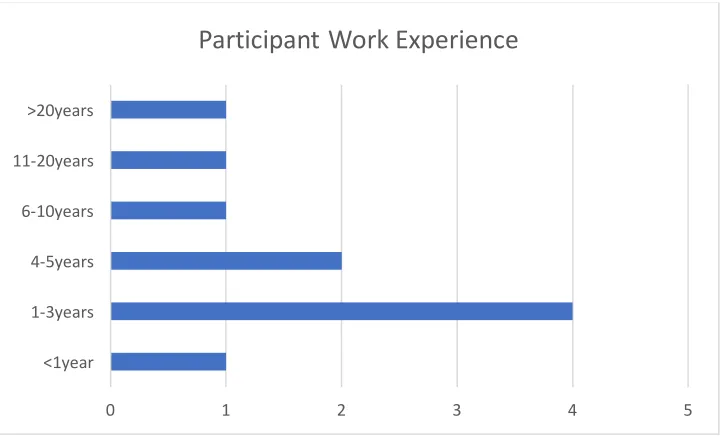
professional experience of participants ranges from less than a year to more
[image:51.595.114.476.390.608.2]than 20 years as shown in Figure 1 below.
Figure 1 Work Experience Data
The client base of each work setting varies considerably in terms of the L1
and L2 concentrations, typical levels of education and socioeconomic status
and the incidences of particular communication and/or swallowing
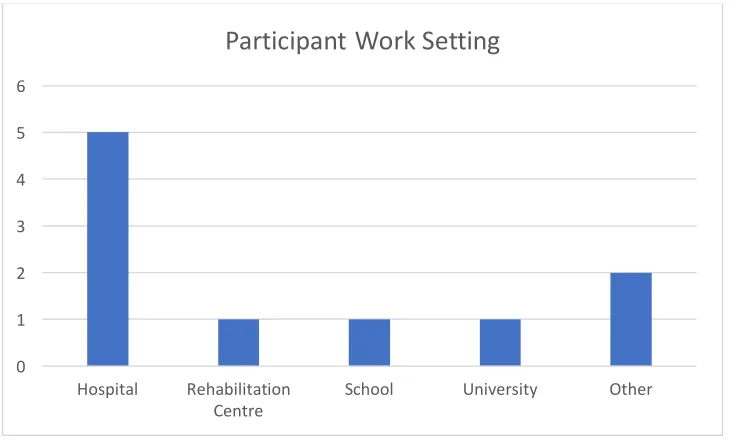
difficulties. Figure 2 below shows different settings that the participants
0 1 2 3 4 5
<1year 1-3years 4-5years 6-10years 11-20years >20years
work in. Five participants work in hospitals (two from government
hospitals, two from university hospitals, and one from a private hospital).
The other five participants work in a rehabilitation centre, a school, a
university clinic, a private centre, and a private speech and language clinic
[image:52.595.98.463.244.465.2]respectively.
Figure 2 Work Setting Data
All participants reported that they have experienced and encountered
clients with whom they have limited or no shared language to a greater or
lesser extent on a daily basis. Shun and Yein experience more clients with
limited or no overlapping languages as compared to the other participants.
Amani, on the other hand, reported that she only has a few Tamil-speaking
clients and clients whom she has problems to communicate with due to
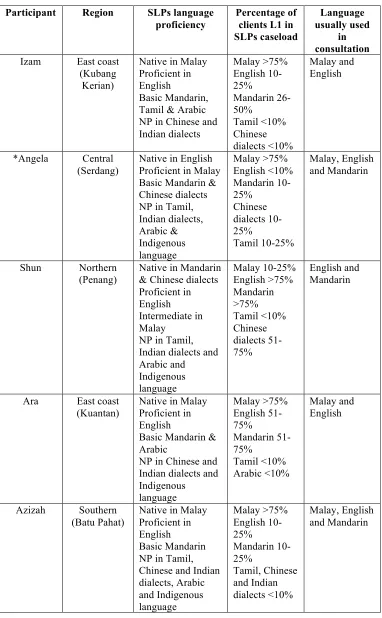
mismatch of language proficiency. Table 2 below shows the information of
SLPs self-reported L1 and L2 proficiencies, the percentage of the L1s of their
clients, and the languages that they usually used in their consultation.
0 1 2 3 4 5 6
Hospital Rehabilitation
Centre School University Other