August 2008
EUROPEAN UNION – RWANDA CO-OPERATION
FINAL
JOINT ANNUAL REPORT
2007
August 2008
1. Update of the current Political, Economic and Social Situation...1
1.1 Update of the Political Situation ...1
1.1.1 Institutional Developments ...1
1.1.2 Regional Security...2
1.1.3 Regional Integration...2
1.2 Update on the Economic Situation ...3
1.2.1 Macroeconomic Developments and Structural Reforms ...3
1.2.2 Quality of Management of Public Finances...4
1.2.3 Integration into the world economy, including Rwanda's latest position in the EPA negotiations ...4
1.3 Update on the Poverty and Social Situation ...4
1.3.1 Education ...6
1.3.2 Health ...6
1.3.3 Rural Development and Food Security...7
1.3.4 Cross-cutting Issues ...7
2. Overview of Past and Ongoing Co-operation ...7
Rural Development ...8
Institutional Support, Trade and Private Sector...11
Governance, Justice and the Rule of Law...11
Thematic Budget Lines ...12
3. Policy Coherence for Development (PCD)...13
4. Joint EU-Africa Strategy...14
5. Donor Coordination and harmonisation...15
6. Dialogue in-country with the NSAs; local authorities and the national parliament ...15
7. Conclusions...16
August 2008
Acronyms AEP Alimentation en Eau Potable (réseau d') AT Assistance Technique (TA)
AfDB African Development Bank (BAD)
AIDS Acquired Immunodeficiency Syndrome (SIDA) ANT Assemblée Nationale de Transition
APER Accord de Partenariat Economique Régional APRM Africa Peer Review Mechanism
BAD Banque Africaine de Développement (AfDB) BEI Banque Européenne d’Investissement (EIB) BNR Banque Nationale du Rwanda
BSPR Budget Support for Poverty Reduction CBI Cross Border Initiative
CDC Comités de Développement Communautaire/Community Development Committees CDF Community Development Fund (FDC)
CDMT Cadre des Dépenses Budgétaires à Moyen Terme (MTEF)
CE Commission Européenne
CEEAC Communauté Economique des Etats d'Afrique Centrale CEPGL Communauté Economique des Pays des Grands Lacs CHK Central Hospital of Kigali
CNDH Commission Nationale des Droits de l'Homme
CNUR Commission Nationale pour l'Unité et la Réconciliation COMESA Common Market of Eastern and Southern Africa CSP Cooperation Strategy Paper
CUNR Commission d'Unité Nationale et de Réconciliation (NURC) CWIQ Core Welfare Indicators Questionnaire
DAO Dossier d’Appel d’Offres DHS Demographic and Health Survey DTIS Diagnostic Trade Integration Study EAC East African Community
EIB European Investment Bank (BEI)
ECHO European Commission Humanitarian Office EDF European Development Fund (FED)
EICV Enquête Intégrale sur les Conditions de Vie des Ménages (Integrated Household Survey) EMIS Education Management Information System
EPA Economic Partnership Agreement ESA Eastern and Southern Africa ESSP Education Sector Strategy Paper
FARAP Financial Accountability Review and Action Plan FARG Fonds d'Aide aux Rescapés du Génocide
FBCF Formation Brute de Capital Fixe
FDC Fonds de Développement Communautaire FED Fonds Européen de Développement (EDF) FER Fonds d'Entretien Routier
FMI Fonds Monétaire International (IMF) FPR Fonds Patriotique Rwandais
FRPC Facilité pour la Réduction de la Pauvreté et pour la Croissance (PRGF)
FRW Franc Rwandais
FTA Free Trade Area
Gacaca Tribunal Populaire traditionnel (jugera les personnes accusées de génocide) GDP Gross Domestic Product (PIB)
HIMO Haute Intensité de Main d’Oeuvre HIPC Highly Indebted Poor Country (PPTE) HIS Health Information System
HIV Human Immunodeficiency Virus (VIH)
ICTR International Criminal Tribunal for Rwanda (TPI) IDA International Development Association
August 2008
INP Indicative National Programme (PIN) MDTF Multilateral Debt Trust Fund
M€ Million d'Euros
MINECOFIN Ministry of Finance and Economic Planning MINEDUC Ministry of Education
MINISANTE Ministry of Health
MTEF Medium Term Expenditure Framework (CDMT) NAO National Authorising Officer (ON)
NCFHE National Council for Higher Education NEPAD New Partnership for African Development NGO Non-Governmental Organisation (ONG) NHRC National Human Rights Commission NPRP National Poverty Reduction Programme NPV Net Present Value
NURC National Unity and Reconciliation Commission
OBK Organisation pour l'Amélioration et le Développement du Bassin de la Kagera OMC Organisation Mondiale du Commerce (WTO)
ON Ordonnateur National
ONG Organisation Non-Gouvernmentale (NGO)
ORPI Office Rwandais de Promotion des Investissements (RIPA) PDRR Programme de Démobilisation, Réintégration, Réinstallation PEPFAR President’s Emergency Plan for AIDS Relief
PFM Public Financial Management PIB Produit Intérieur Brut (GDP) PIN Programme Indicatif National (NIP) PMIP Poverty Monitoring and Information Plan PNB Produit National Brut (GNP)
PPGE Programme Prioritaire de Génération d'Emplois PPTE Pays Pauvre Très Endetté
PRGF Poverty Reduction and Growth Facility PRS Poverty Reduction Strategy
PRSC Poverty Reduction Support Credit PRSP Poverty Reduction Strategy Paper
PRS-PR Poverty Reduction Strategy Progress Report RES Rural Economy Strategy
RIFF Regional Integration Facilitation Forum
SAP Structural Adjustment Programme (Appui budgétaire/Budget support) SFAR Student Financing Agency of Rwanda
SIBET Système du budget de l’Etat SPA Strategic Partnership with Africa
SPPMD Strategic Planning and Poverty Monitoring Department (MINECOFIN) STABEX Stabilisation of Export Earnings
SWAp Sector Wide Approach TA Technical Assistance
TPI Tribunal Pénal International (Arusha) (ICTR) UNDAF United Nations Development Assistance Framework
VAT Value Added Tax
August 2008
1.
U
PDATE OF THE CURRENTP
OLITICAL, E
CONOMIC ANDS
OCIALS
ITUATIONUpdate of the Political Situation
Institutional Developments
2007 saw continued consolidation of economic and political governance in Rwanda amidst a somewhat troubled regional context. The administrative reform is now complete and a substantial decentralisation process is being implemented, with the districts having increased responsibilities. All district development plans have been approved in 2008. The next major item on the path towards administrative reform is land reform. Rwanda has passed a law on land reform in 2007 and a series of application decrees are now being passed as well.
The 10th EDF Country Strategy Paper was finalised and signed on 9th December 2007 at the European Union-Africa summit in Lisbon. Rwanda has been allowed 25% extra funds as part of the incentive tranche (the maximum being 30%) and an additional 5% for having completed the African Peer Review Mechanism (APRM) of NEPAD. With these extra 30%, the total 10th EDF National Indicative Programme for Rwanda over 2008-2013 stands at 290 million euro. The EDPRS was finalised in parallel with the 10th EDF CSP and approved by the Cabinet in September 2007. The EDPRS was then approved by the November 2007 Development Partners Meeting and is now in place.
Major progress was made in the justice sector. The judgement phase of the Gacaca process has been fully underway, but various delays have led to the completion date being pushed back to the end of 2008. With over 800,000 people being accused of genocide-related crimes and offences, prison overpopulation was becoming a major issue with a peak at nearly 100,000 inmates in mid-2007. Drastic measures were taken with the systematic implementation of TIG (Travaux d'Intérêt Général) as a substitute to prison, or as part of a combined sentence, and the number of inmates has fallen to 59,000 at the end of the year and should decrease further to 40,000 in 2008 (17,000 of whom are common law prisoners).
Rwanda abolished the death penalty on 24th July 2007. The move was welcomed in the international community and paves the way for the transfer of major genocide cases from Arusha when the ICTR shuts down its operations at the end of 2008. This should also help other genocide cases being transferred from national jurisdictions. At ICTR at the end of 2007, 30 cases are either complete or undergoing appeal; 27 cases are in progress and only 7 are pending. 13 suspects are still at large including a few high profile cases. These results show significant progress compared with last year.
Rwanda's diplomatic relations with France were cut in November 2006 following the release of the Bruguière report and have not been restored yet. However, relations have shown slow signs of improvements. There have been high level informal meetings resulting in a visit by foreign minister Bernard Kouchner to Rwanda in January 2008. 5 genocide suspects who were at large in France have been arrested in 2007 and are awaiting trial in France or transfer to Arusha. At the same time, the expected report on the activities of France during the genocide has been completed but its public release has been postponed.
The United States and China continue to deploy a high level of activity in Rwanda. The US built a large new embassy in Kigali which was inaugurated by President George W. Bush in February 2008. China is involved in major building works (Ministry of Foreign Affairs, Rwandan Health Insurance company) and maintains a high profile presence in Rwanda.
August 2008
representatives at Parliament: 24 seats provided for women to meet the minimum of 30% as per constitution requirements, 2 for youth and one for the handicapped. Political parties have started organising elections throughout the country to have their representations confirmed ahead of the 2008 parliamentarians’ elections. A new electoral code is being drafted with support from the Swiss. It might not be ready in time for the legislative elections in late 2008, but should be in place well in time for the 2010 Presidential elections. A process of registration for new ID cards is ongoing, which will also be used to elaborate a voters' list. Up to 4 million people have been registered as potential voters.
Drafts for a NGO law, Press law, and Anti-Human-Trafficking law have been elaborated and are still undergoing consultations. A bill on divisionism has been passed by the chamber of deputies and is now at the Senate.
The media continues to grow and has now reached 39 print media, 15 local radio stations and 3 international radio stations. Two draft laws on the press and the High Council of the Press were adopted by Cabinet. They foresee minimum qualifications for journalists and a transfer of attributions from the Minister for Information to the HCP for accreditation of journalists and temporary suspension of media. Independent media continue to face capacity and financial constraints due to low levels of readership.
Regional Security
The regional context was volatile in 2007, with some of the hopes raised in 2006 proving premature largely due to the situation in DRC, but the situation improved at the very end of 2007. 2007 saw a massive military build up of the DRC armed forces (FARDC) in eastern DRC (more than 30,000 army personnel) which culminated in a military clash in December with over 1,500 casualties. It is estimated that more than 500,000 people were internally displaced during this period. There have been reports of large scale human rights violations.
In parallel, diplomatic activity has been intense and achieved at least two results: the Nairobi Communiqué (November 2007) and the Goma Conference on peace and security in North and South Kivu (January 2008). In the former the countries of the region agreed to make dealing with the FDLR1a joint priority, whereas the Goma Conference, which involved all DRC stakeholders in the Kivu crisis, came up with a DRC Government commitment to a political solution after the failure of military action in December.
Rwanda, in the course of these developments, has shown remarkable restraint and has been consistently acting in favour of peace in the region. There is no doubt that the FDLR remains the primary obstacle to the return of peace in the region and, as a result, FDLR should be dealt with as a matter of priority.
Regional security has also been impacted by the precarious situation in Burundi as well as the developments in Kenya, which have caused disruption of the flow of supplies arriving in Rwanda, particularly fuel.
Rwanda has increased its participation in the joint UN-AU peacekeeping mission in Darfur (AMIS) and offered to train Somali Police troops in Rwanda to maintain peace and security in their country.
Regional Integration
On the 30th November 2006, the 8th EAC Heads of State Summit admitted Rwanda and Burundi to the EAC. This admission took effect from 1st July 2007 after ratification of an Accession Treaty. Apart from EAC, Rwanda is also a member of COMESA and CEPGL, and pulled out of ECCAS and withdrew her application from SADC in May 2007. The approach to
1
August 2008
EAC integration is a step by step one (customs union, common market, monetary union and finally ultimately political federation). After accession to the East African Community, Rwanda agreed to migrate to the customs union by June 2009. The negotiations of the EAC Common market protocol are expected to be concluded by December 2008 so that the implementation starts in January 2010 in accordance with the EAC Summit directives.
The Rwanda Regional Integration Committee established in 2006 aims at advising the Government of Rwanda on regional integration options and providing the necessary coordination and support to a number of sectoral committees put in place to deal with specific areas of negotiations. This institution is supported under the RISEM project.
Update on the Economic Situation
Macroeconomic Developments and Structural Reforms
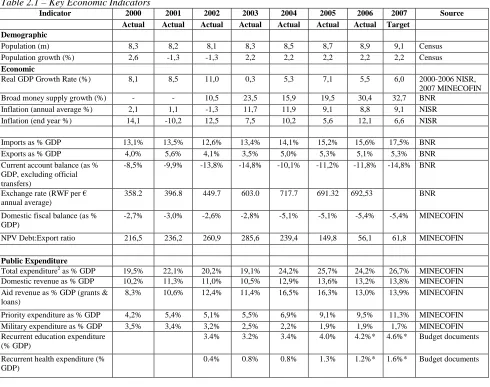
Rwanda experienced good macroeconomic performance in 2007 in spite of the effects of the poor harvests in agriculture and high international fuel prices. Real GDP growth for 2007 is estimated to have reached 6%, despite a drop in agricultural output of 1%. Core inflation increased to 9 per cent compared to 4 per cent a year earlier, significantly driven by increasing housing rents and higher utilities and transport prices. Rwanda successfully concluded the 3rd review under the current IMF PRGF programme.
[image:7.595.62.552.378.765.2]Key economic trends are shown in table 2.1 below (more detail is provided in annex 1).
Table 2.1 – Key Economic Indicators
Indicator 2000 2001 2002 2003 2004 2005 2006 2007 Source
Actual Actual Actual Actual Actual Actual Actual Target Demographic
Population (m) 8,3 8,2 8,1 8,3 8,5 8,7 8,9 9,1 Census
Population growth (%) 2,6 -1,3 -1,3 2,2 2,2 2,2 2,2 2,2 Census
Economic
Real GDP Growth Rate (%) 8,1 8,5 11,0 0,3 5,3 7,1 5,5 6,0 2000-2006 NISR, 2007 MINECOFIN Broad money supply growth (%) - - 10,5 23,5 15,9 19,5 30,4 32,7 BNR
Inflation (annual average %) 2,1 1,1 -1,3 11,7 11,9 9,1 8,8 9,1 NISR Inflation (end year %) 14,1 -10,2 12,5 7,5 10,2 5,6 12,1 6,6 NISR Imports as % GDP 13,1% 13,5% 12,6% 13,4% 14,1% 15,2% 15,6% 17,5% BNR
Exports as % GDP 4,0% 5,6% 4,1% 3,5% 5,0% 5,3% 5,1% 5,3% BNR
Current account balance (as % GDP, excluding official transfers)
-8,5% -9,9% -13,8% -14,8% -10,1% -11,2% -11,8% -14,8% BNR
Exchange rate (RWF per€ annual average)
358.2 396.8 449.7 603.0 717.7 691.32 692,53 BNR Domestic fiscal balance (as %
GDP)
-2,7% -3,0% -2,6% -2,8% -5,1% -5,1% -5,4% -5,4% MINECOFIN NPV Debt:Export ratio 216,5 236,2 260,9 285,6 239,4 149,8 56,1 61,8 MINECOFIN
Public Expenditure
Total expenditure2as % GDP 19,5% 22,1% 20,2% 19,1% 24,2% 25,7% 24,2% 26,7% MINECOFIN
Domestic revenue as % GDP 10,2% 11,3% 11,0% 10,5% 12,9% 13,6% 13,2% 13,8% MINECOFIN Aid revenue as % GDP (grants &
loans)
8,3% 10,6% 12,4% 11,4% 16,5% 16,3% 13,0% 13,9% MINECOFIN Priority expenditure as % GDP 4,2% 5,4% 5,1% 5,5% 6,9% 9,1% 9,5% 11,3% MINECOFIN Military expenditure as % GDP 3,5% 3,4% 3,2% 2,5% 2,2% 1,9% 1,9% 1,7% MINECOFIN Recurrent education expenditure
(% GDP)
3.4% 3.2% 3.4% 4.0% 4.2%* 4.6%* Budget documents Recurrent health expenditure (%
GDP)
0.4% 0.8% 0.8% 1.3% 1.2%* 1.6%* Budget documents
2
August 2008
*These figures are 2006 targets. Actuals will be available after the ongoing IMF assessment.
Quality of Management of Public Finances
During 2007, Rwanda underwent a PEFA assessment, which observed that the PFM reform achievements over the last decade in Rwanda have been wide ranging and impressive given the circumstances, resources and capacities of the country during this period and the nature and extent of the reform challenges facing the Government. It particularly mentions as an achievement the establishment from scratch of external and internal audit functions, which previously had not existed at all. It is observed that the low PEFA scores for the associated indicators for these (and other) areas mask much of the achievement that has been made in the relatively very short time since their inception. Areas in which the reform efforts have already translated into positive PEFA scores include the establishment and operation of the Rwanda Revenue Authority, the establishment and implementation of (modern) budget and MTEF processes, and accounts reconciliation. Low PEFA scores for accounts preparation and associated reporting are directly attributed to the scale of the challenge facing the Government. The report sums up that "in brief, there are very few (if any) countries in the world that have been faced with, and have responded to, such a wide-ranging set of reform requirements with such limited resource availability. The scores for the PEFA indicators must be interpreted with these facts in mind for a clear understanding of their meaning." Following the PEFA assessment, government is intending to elaborate a new PFM action plan.
Integration into the world economy, including Rwanda's latest position in the EPA negotiations
On 20th November, EAC Partner states signed an Interim Framework Agreement on the Economic Partnership Agreement with the EU. Whereas the duty and quota free access to EU markets under the Cotonou Agreement lapsed on 31 December 2007 pursuant to WTO rules, the purpose of the Interim Framework Agreement is precisely to avoid trade disruption for exports of the EAC Member States to the EU.
Update on the Poverty and Social Situation
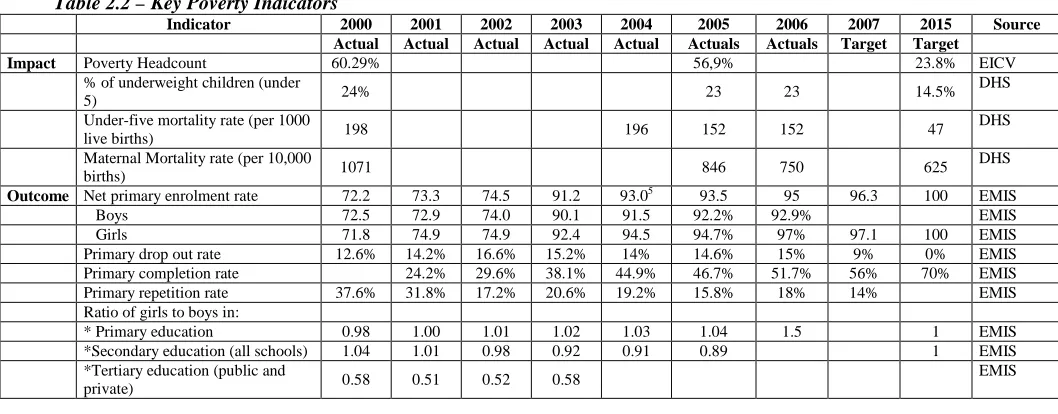
The Rwanda MDG country report 2007 confirmed results of previous surveys like the 2005 household living conditions survey (EICV2) and the 2005 Demographic and Health Survey. Details are provided in annex 1 but the headlines are:
Poverty Headcount3: figures have fallen from 60.4% to 56.9% in the last five years (2000-01 to 2005-06) – a 3.5% reduction over five years. But given that population growth has averaged 3% per annum, the total number of people living in poverty has increased from 4.8 million to 5.4 million during the same period.
Regional distribution of poverty: Over 90% of the poor in Rwanda live in rural areas. Poverty headcount has fallen in most urban and rural areas during the period, except in the Southern province, where it has risen marginally.
Depth of poverty: Extreme poverty (the line below which household’s total consumption expenditure falls below the cost of the minimum food basket) fell from 41.3% to 36.9%. That is about 2/3rd of the population below poverty line is living in extreme poverty.
3
August 2008
Inequality: Inequality has risen somewhat during the period (increase in Gini coefficient from 0.47 to 0.51). Inequality decreased in the urban areas while it increased in the rural areas.4 As growth over the period was accompanied by increasing inequality, this reduced its impact on poverty reduction.
Vulnerability: There was a 6% decline in the poverty figures for female and widow headed households – better than the national average of 3.5%.
Net enrolment: Net enrolment at primary school has increased from 74.5% in 2001/2 to 95% in 2006. Enrolment of girls (97%) is better than that for boys (92.9%). Net enrolment at secondary school has increased from 6.9% to 10%. Even in the city of Kigali this figure is only 29%. However, higher drop out rates for girls means that the ratio of girls to boys in secondary schools has been declining in recent years.
Health: Women receiving antenatal care during last pregnancy have increased from 82% to 86.1%. Malaria accounts for one-third of the total burden of disease.
Drinking water and sanitation: important progress in the water sector since the 2005 surveys. Access rate to potable water would have reached 70 % at the end of 2007 (after 63 % in 2006 and 57 % in 2005). However, 30% of the population still relies on ‘unprotected’ sources. Progress in the sanitation sector is less significant: even if 80 % of the population have access to latrines, most of them are not hygienic and only 10 % would have accessed to hygienic latrines. Sensitization and education to hygiene are continuing with PHAST and HAMS programmes.
Employment: Proportion of the working population falling into the category of ‘agricultural and fishery workers’ has declined from 88.6% to 79.6%. Most other categories have seen marginal changes.
[image:9.595.36.565.511.718.2]Table 2.2 below presents basic poverty indicators, based on the Government’s PRS Annual Progress Report published in September 2005, and data made available since then. Government has adopted a system of proxies that can be measured on an annual basis where data on the MDGs themselves are available at less regular intervals. For most sectors, at the time of drafting it was too early to obtain final data for 2007.
Table 2.2 – Key Poverty Indicators
Indicator 2000 2001 2002 2003 2004 2005 2006 2007 2015 Source
Actual Actual Actual Actual Actual Actuals Actuals Target Target
Impact Poverty Headcount 60.29% 56,9% 23.8% EICV
% of underweight children (under
5) 24% 23 23 14.5%
DHS Under-five mortality rate (per 1000
live births) 198 196 152 152 47
DHS Maternal Mortality rate (per 10,000
births) 1071 846 750 625
DHS
Outcome Net primary enrolment rate 72.2 73.3 74.5 91.2 93.05 93.5 95 96.3 100 EMIS
Boys 72.5 72.9 74.0 90.1 91.5 92.2% 92.9% EMIS
Girls 71.8 74.9 74.9 92.4 94.5 94.7% 97% 97.1 100 EMIS
Primary drop out rate 12.6% 14.2% 16.6% 15.2% 14% 14.6% 15% 9% 0% EMIS Primary completion rate 24.2% 29.6% 38.1% 44.9% 46.7% 51.7% 56% 70% EMIS Primary repetition rate 37.6% 31.8% 17.2% 20.6% 19.2% 15.8% 18% 14% EMIS Ratio of girls to boys in:
* Primary education 0.98 1.00 1.01 1.02 1.03 1.04 1.5 1 EMIS
*Secondary education (all schools) 1.04 1.01 0.98 0.92 0.91 0.89 1 EMIS *Tertiary education (public and
private) 0.58 0.51 0.52 0.58
EMIS
4
At the national level, the growth incidence curve for the period 2000/01 to 2005/06 shows a fairly flat pattern up to the 75thincome percentile, with average annual growth varying between 1 and 2%. Above the 75thercentile, the growth incidence curve increases sharply to average about 5% for those with the highest incomes.
5
August 2008
Indicator 2000 2001 2002 2003 2004 2005 2006 2007 2015 Source
Actual Actual Actual Actual Actual Actuals Actuals Target Target Births attended by skilled health
personnel (%) 30.5 38.8 34.2% 39.8% 49.6%
SIS Utilisation of curative services 0.25 0.28 0.31 0.39 0.47 0.60 SIS Proportion of 1 year old children
immunised against measles 77% 82% 89% 84% 75% 84%
MDG report 2007 HIV Prevalence among 15-49 year
old pregnant women 13.7 11.2 13.5 10.5 9.5
6 3 UNAIDS
% population with sustainable
access to an improved water source 67.2%
Census
* Figures are targets, actuals not available yet.
Rwanda is very likely to attain the MDGs on achieving universal primary education, promoting gender equality, combating AIDS, malaria and other diseases as well as ensuring environmental sustainability. However, Rwanda is unlikely to eradicate extreme poverty and hunger by 2015. Similarly, the country is lagging behind with regard to MDG 8 concerning putting in place a global development partnership for development.
Education
Access to education has improved at all levels of the system. With reference to the MDG’s, net enrolment rate in primary schools has now reached 95% and the percentage of girls students is over 50%.7Enrolment continued to increase at primary level by 5.8%. Primary net enrolment rate for girls reached 97% in 2006 compared to 94.6% in 2005. Important pro-poor measures have been introduced that are enabling a greater number of children to attend primary schools. But the costs of schooling are still too high for poor families, and the percentage of children who actually complete a full cycle of primary school is below the Sub-Saharan average.
The introduction of fee-free primary education in 2003, plus the direct transfer of capitation grant funds to primary schools has enabled grater access to primary school and relieved part (but not all) of the financial burden felt by poor families. The pupil to qualified teacher ratio has been reduced (from 73.6% in 2005 to 72.7% in 2006). As a result, completion rates are increasing (from 46.7% in 2005 to 51.7% in 2006) whilst repetition and drop out rates are falling.
Health
The evolution of health indicators confirms the cautious optimism expressed after the 2005 survey. Child mortality is down to 152 ‰ and maternal mortality is down to 750 per 100,000, although the data collection methodology leaves space for a substantial error margin.
The health sector witnessed significant progress in the past two years, as evidenced by a number of 2006 health indicators. The rate of utilisation of curative services increased from 46.8% in 2005 to 60.7% in 2006. Over the same period, membership of the mutuelle health insurance scheme continues to expand rapidly and included almost ¾ of the population by 2006, up from less than half in 2005. Similarly, the rate of births assisted by qualified personnel increased from 37% to 49%. Overall, it is expected that the significant improvement in these health input and output indicators would have a strong positive impact on the health status of the Rwanda population.
The national HIV/AIDS prevalence rate remains at 3,1% and specialists agree this new figure, backed by a UNAIDS survey on 15,000 people, is a solid one. Nevertheless, Rwanda’s health indicators (particularly maternal and child mortality) remain poor, and the MDG targets are still distant.
The human resources shortage is being addressed as the Government carries on the roll-out of performance based contracting schemes and implements its plan to train, attract and retain health
6UNAIDS 2004 report estimates HIV prevalence in Rwanda at 5.1% 7
August 2008
personnel. In October 2007, the GoR through the Ministry of Health and its donor partners signed a MoU to put in place a SWAP in the health sector with the general objective to build a stronger donor partnership, to support country-led programmes and to improve performance of country institutions and harmonise procedures within the health sector.
Rural Development and Food Security
Poverty continues to be a largely rural phenomenon in a country where 83 percent of the population lives in rural areas and 87 percent are farmers. Since June 1997 when Fewsnet stopped its activities, the analysis of food security is based on data collected by MINAGRI. The recent Crop Assessment has allowed the evaluation of the season 2008A and highlights the following trends:
1. Season 2008A national food crop production is estimated to be 941,000 MT of cereals-equivalent, 4.6 percent higher than season 2007A production.
2. This level of food production is comparable to 1,764 kilocalories (Kcal) per person per day, which is 84% of the globally recommended daily requirement of 2,100 Kcal/person. 3. Significant progress was observed in terms of cereal harvest. This is linked to the crop
intensification programme which puts emphasis on agricultural regionalisation focusing on specific crops (cereal, export crops…).
4. Other food production also registered improvement with the notable exception of vegetables where production has slightly decreased. This should have consequences on nutritional quality. This decrease had been previously observed and was reflected in food prices which increased substantially in the second semester of 2007.
5. Population needs for the next six months should be covered for 85% by local production. The government foresees however that a deficit of 51.000 tons will persist despite the WFP support and additional imports which will be made.
It seems that agricultural intensification programmes and the increase in the use of animal resources have had a positive impact on food security, although some changes in the statistical methodology prevent effective comparison. A new initiative linked to land preservation should start to have a positive effect in the near future. An agricultural SWAP is envisaged for 2008.
The decentralisation process continues to be a key element of the development strategy of Rwanda. All the district development plans were approved by august 2007, the district capacity building plans will be finalized early 2008. Funding through the CDF has improved in quantity and quality.
Cross-cutting Issues
Rwanda continues to perform well on gender issues. The gender gap in literacy has been reduced from 10% in 2000 to 0.1% in 2005/06, and 48.8% of the parliamentary seats are held by women, the highest rate in the world. However, there is a continued need for more gender-disaggregated data to better understand gender disparities in other domains. The use of wood in energy consumption is still high (40%), while pressure on land remains a constraint for a sustainable land use management. This is attested by a limited number of people living in urban areas (17%). 40% of land is now protected against erosion using terraces.
Building on the evaluation of the first PRSP, which found that a proliferation of cross-cutting issues actually resulted in the marginalisation of each individual issue, 5 cross-cutting issues were prioritised and systematically mainstreamed into the EDPRS. These were Gender, Social Vulnerability, HIV/AIDS, Environment, and Youth.
August 2008
2007 was another successful year in European Commission-Rwanda cooperation. All remaining 9thEDF funds are now fully committed, sunset clause requirements have been met and 10th European Development Fund programming is well underway. All 2007 financial targets have been achieved and stand within +/- 10% of the July 2007 forecast: Primary commitments stand at€37.8M (compared with a €38.7 forecast). Secondary commitments stand at €51.2M (€47.2M forecast). European Development Fund Payments (NIP) stand at €51.2M (€49.4M forecast). Consolidated payment figures (including NIP, RIP, Stabilisation of Export Earnings (STABEX) and Thematic Budget Lines) amount to€61.9M, which is in line with the forecasts and on a par with 2006. RAL has been further reduced by€14.6M and now stands at €98.1M. Old RAL has also been further reduced from€11.3M on 1stJanuary 2007 to€8.4M on 1stJanuary 2008.
The 9thEDF ETR addendum and the 10th EDF CSP/NIP were both signed. An addendum n°2 to the Country Strategy Paper and National Indicative Programme has been signed in July 2007. This exercise of End Term Review and release of all de-commitments from the 9th EDF and previous EDFs allowed reallocating additional funds on the existing programs. The new Indicative allocation of the 9thEDF after the ETR stands at€218M.
Work started on 10th EDF programming, particularly on the primary commitments pipeline. Three commitments are forecasted for 2008 (TCF III and Budget Support as well as a rider to the EDF 9 Road Transport sector programme). Project Fiches have already been submitted to HQ. Preparatory work has started in order to submit up to 8 project fiches in May for the 2009 AAP. EDF regional payments have reached €2M, reflecting the beginning of 9 RPR 99 operations (Communauté Economique des Pays des Grands Lacs (CEPGL). Stabilisation of Export Earnings (STABEX) payments have reached€3.0M, which is below target but an improvement vs. 2006€2.7 figure.
The Delegation has improved the quality of aid delivery. For the general budget programme, 98% of the variable tranche for 2007 was disbursed. The key question in view of the 10th EDF implementation is the readiness of our two focal sectors (infrastructure and rural development) for sectoral budget support. Technical Assistance is likely to be needed in 2008-2009 to increase the readiness of sectors. A broad-based capacity strengthening programme with 4 lots was contracted in November, following an international tender to cover the key needs of the road subsector. The multi-annual technical audit contract for the road project was signed, with a first mission taking place in December.
A ROM mission took place in June. 10 projects were reviewed (6 EDF primaries, 3 budget lines contracts and the COM STABEX). The results show not a single "d" grade and a high proportion (76%) of grades "a" or "b". These results are well within targets set by AIDCO E (cf. note 18255 dated 4 September 2007). The average grade stands at 2.88 which is above the AIDCO 2006 average of 2.76.
Capacity has yet to meet its full potential in many technical Ministries, agencies and decentralized institutions. The latter has an impact in terms of the time frame and sustainability of our activities implemented at district level. Procurement procedures, particularly for service contracts, continue to pose difficulties, leading to ineligibility of expenditure. This is now being addressed through the establishment of a network of EDF imprest accountants and administrators and the provision of training in the latter half of 2007. Also, there is a growing number of complex claims on infrastructure projects as well as undue delays in definitive receptions of large infrastructure. This creates a risk of legal action and tends to discourage potential tenderers, limiting competition and increasing prices. This is partially being addressed by the external technical audit for the main road project.
Rural Development
August 2008
of the district development plans (approved in August 2007). All the training activities were completed by May. The implementation phase of the campaign is progressing normally, the quality of the village projects has improved and diversity is larger. By the end of the year about 25% of the projects were at an advanced stage, some of them already completed. Financial management and reporting is satisfactory and Ubudehe is appearing as a major contributor to the decentralisation process at grassroots level. However, the financial closure of PE1 has been a significant problem. A large nationwide data collection campaign was organized to collect missing supporting documents. Also a significant amount of late disbursement were identified. Final audit and closure of the PE is expected for the first semester of 2008. All (but one) contracts foreseen under EP2 district have been signed. Implementation goes on normally and should be completed within time limits. The Ubudehe has been nominated late 2007 for the annual UN Public Service Award. The programme has been selected for the final phase of evaluation.
Support to the DDP has improved. The entire backlog project from DP1 has been completed. Through improvements in the procurement process, it was possible to contract 14 new projects for about 2.5M Euros. It is anticipated that these will be completed before mid 2008. The Mpazi (Nyarugenge) and Gasabo projects have been delayed and are financially affected by the national cement shortage and price increases. As a consequence, the completion of the two projects depends on developments in these external constraints but both projects should be completed by the end of 2008. The DPRPR is likely to disburse all funding by the end of its operational phase.
9 ACP RW 03 (Programme of actions for the economical and social reintegration of the demobilised soldiers and vulnerable women, widows or heads of family – PARES): activities, including audit, are completed. Given that a program extension is being funded through 9 ACP RW 4, the final evaluation is postponed to mid 2008.
STABEX
The deadline for implementing the Stabilisation of Export Earnings (STABEX) programme is fixed at 31 December 2010, with agreements needing to be signed before 31 December 2008. The last Programme Estimate (PE) must be signed during the last quarter of 2008 and will have a validity period of 18 months. The period registered some progress in the implementation of almost all subcomponents despite a low disbursement rate.
For the coffee component, support led to the production of about 34 millions of plants, contributing to a total of 61 millions of plants since the beginning of the project. This represents an area of about 30,000 hectares replanted, with the cutting back (stumping) of 6,734,142 coffee shrubs and the uprooting of 450,000 old trees. Deliveries of fifty thousand litres of insecticides or their equivalent took place in November 2007. The tender for the supply of 1,000 tones of fertilizer was cancelled after Rwanda Coffee Office (OCIR Coffee) obtained another financing source. Support of cooperatives continued mainly through training sessions provided to members of cooperatives and OCIR specialized technicians, as well as support for the preparation of coffee campaigns. Subsidies were also provided to 20 cooperatives to help them implement their own micro-projects. One coffee washing station was built in NYAMURE and has been operational since April 2007. Four others will be established early 2008. The building of the laboratory in vitro Rwanda Agricultural Research Institute (ISAR) as well as the cleansing of the laboratory periphery was provisionally received whereas the building of the two greenhouses has been completed.
Regarding the tea sector, rehabilitation activities of the draining framework, drainage of the tea estates, sheds, and storing houses were carried out using the Haute Intensté de Main d'Oeuvre (HIMO) method. Training sessions were provided to tea farmers, tea SACCOS, factory engineers and tea makers. The demarcation operation continues with those tea sites that are not yet privatized.
August 2008
make up for delays in the execution of the program, especially the hiring of an agriculture engineer and two technicians, and sensitization of local authorities to join the action.
Two new activities were launched under the diversification programme: a call for proposals for 1.2 M Euro for new initiatives and diversification projects in the agro sector, and a 2.5 M Euro large scale terracing campaign (from 1200 to 1600 hectares) in 5 districts.
Infrastructure
8 ACP RW 32 (Alimentation en Eau Potable (AEP Bugesera) - Works and supervision contracts are almost completed, with a partial provisional handover in November 2007. The remaining part is already functional with the handover scheduled for January 2008. All contractual issues were solved and riders and adjustments to both contracts were made. Technical assistance supporting the management of the clean water supply system was awarded. Tender documents for a management delegation were prepared in October. The contract should be awarded by November 2008. Meanwhile, an arrangement with temporary administrative management by MINITERRE is in place.
National Assembly (9 RW 5)-Following adjustments to the scope of works, and a FA budget increase, the contracts (works and supervision) were adjusted and work is ongoing. Due to supply delays on the contractor side, and the extension of the scope of works, the provisional handover is now foreseen for May 2008. Supreme Court (9 RW 5)-All contracts are ongoing. A late modification from the supervisor about the roof type led to a 3 months delay. The contractor is also still facing cash flow difficulties and some of the supplies are still missing. A provisional handover is likely to take place in July. Tribunals of first instance - The technical studies for the tribunals programme have been completed (funded by TCF). The programme covers 45 sites and includes rehabilitation, construction and extension. The works is funded partly on 9 RW 11 (support to the rule of law) project and partly through the Belgian and Dutch cooperation programmes. Calls for tenders were launched in November. The contracts should be awarded by March 2008.
8 ACP RW 17 (Technical and Institutional support to MINECOFIN) - The work is completed and the building was inaugurated by Commissioner Louis Michel in November. Some contractual issues regarding liquidated damages and a claim by the contractor are to be solved by the contracting authority. Minor defects are to be corrected by the contractor. Provisional handover is foreseen for February 2008.
Gitarama-Butare-Akanyaru Road - Handover for additional works took place in July. The main contract provisional handover was also approved. The final handover of the project is now foreseen for July 2008. Rwanda Road Infrastructure Support Programme (9 ACP RW 12) - The restricted tenders for TA MININFRA, the Road Maintenance Fund and the audit of maintenance programmes were completed and contracts signed in November. Contractors should be in place by January 2008. The Ruhengeri-Gisenyi works are ongoing according to planning.
Economics
August 2008
GoR Cabinet in September 2007. EC Recommendations focussed on efforts to reduce the pupil to qualified teacher ratio.
Institutional Support, Trade and Private Sector
As an important step to advance the governance agenda, the Government of Rwanda has decided to undertake a Joint Governance Assessment (JGA), financed by DfID and the EC through a UNDP managed basket fund (9 RW 11). The EC contribution amounts to€185 200. An addendum to the Rwanda Institutional Support for Economic Management (RISEM) Financial Agreement aiming to commit 1.8M EUR has been approved by the EC in July 2007. The JGA looks at the systems which are in place to ensure the accountability of those exercising state power, their responsiveness to the needs and reasonable aspirations of the citizens, and the building of the capacities needed to meet these. Governance is assessed in terms of what it contributes to Rwanda's development and human rights objectives, and how it relates to international norms and principles. The assessment started towards the end of 2007 is expected to yield a final report during the first half of 2008.
The EC is also supporting the Government of Rwanda in strengthening the statistical system through a multi-donor (DfID, EC, UNDP) basket fund managed by UNDP in support of the National Institute of Statistics (9 RW 10-7). This pooled fund was set up in June 2007 and the EC will contribute€1.9 for the period 2007 – 2009. In the area of PFM, the EC contributes to a World Bank managed Trust Fund in support of PFM reforms, pooling resources from DfID, the World Bank, and the EC. An annual report for the period 1 July 2006 to 31 June 2007 was received in August 2007 (9 RW 10-2).
Regarding trade, institutional support, was provided to the Ministry of Commerce. An international tender for laboratory equipment, apparatus and reagents standards for the Rwanda Bureau of Standards was launched. Other support is ongoing in the area of Business Development Services.
The EC also contributed to the UNDP managed "Integrated Support Project" in support of the Ministry of Finance (MINECOFIN), which pools resources from DfID, UNDP, BTC, SIDA and the EC (9 RW 2). Support to the NAO Unit continued, complemented with TA to the Public Accounts Unit focussing on the production of Financial and Accounting manuals and the training of budgeting and accounting personnel. The EC also supported the 2ndConference of AU Ministers in charge of Regional Integration (9 RW 10-6,€145 000 in July 2007).
Governance, Justice and the Rule of Law
August 2008
Thematic Budget Lines
In the course of 2007, payments under the thematic budget lines reached€5.7M (index 94 vs. the target of€6.1M). This represents a 30% increase compared to 2006 (€4.4M). All contracts due to be concluded by 31/12/2007 were signed by end of November. The Delegation managed 63 contracts in 2007 (40 under the EIDHR and 23 under the ONG-PVD budget line). A total of 11 new contracts were signed in the course of 2007 for a total of€3.1M. The Delegation closed 10 contracts over the past year, bringing the number of on-going projects to 53 by year end. 46 of the projects fall within the governance portfolio, addressing issues such as justice, unity and reconciliation, civil society, media, human rights, indigenous people, gender, vulnerable children and health issues. 7 projects focus on rural development issues (agriculture, environment, food security and decentralisation). The Rwanda Delegation launched a Call for proposals under the new EIDHR Country Based Support Scheme in December 2007 (EIDHR/126372) and proceeded to a consultation with the civil society on the priorities for the forthcoming Call for proposals for actions in Rwanda under the "Non-State Actors and Local Authorities in Development" new budget line over December 2007/January 2008 (call was published on 22 January 2008). In September 2007 the Delegation organised a workshop for grant beneficiaries on contractual and financial aspects of grant contracts with a view to facilitating project implementation.
Water facility
Three national projects and one regional (total budget +/- 20 M Euro, grants +/- 10 M Euro) have been selected after the second call for proposals. Two financing agreements (9 ACP RPR 178: "Programme d’abduction d’eau potable en milieu rural Province du Sud – Districts de Nyaruguru, Huye et Gisagara", number 317 to the EUWF, and 9 ACP RPR 209: "Rwanda Water Supply & Sanitation Fund", number 144 to the EUWF) have been drafted by the EC delegation after a negotiation period and signed by the Director Aidco C at the end of December 2007. Both financing agreements were signed by the NAO in January 2008 and the implementation is about to start. One grant contract (9 ACP RPR 50- 21: "Intervention pour le renforcement du réseau hydraulique, pour la protection de l’environnement et la sensibilisation à un usage responsable en collaboration avec le District de Gicumbi dans la Province du Nord", number 138 to the EUWF) has been drafted and signed at the end of 2007 with the Italian NGO AVSI (Associazione Volontari per il Servizio Internazionale, Italy). It was not possible to finalize the last regional project with the Water and Sanitation Program Nairobi (Word Bank) due to a disagreement between the parties on the maximum percentage for indirect eligible costs: see letter and decision taken by the Director Aidco C.
Energy facility
August 2008
Regional Cooperation
The revival programme of the 'Communauté Economique des Pays des Grands Lacs' (CEPGL) was approved in April 2007 and the Financing Agreement was signed in June, giving the Delegation centralised management mandate. Given the high priority of the project the delegation has anticipated the signature and prepared the three grant contracts for the institutional component (l'Energie des Pays des Grands Lacs (EGL), SE-CEPGL and IRAZ), which were signed immediately after the FA enabling activities to start 1 July (1 August for IRAZ). Following an international tender the service contract for the Ruzisi study was awarded in November. The fieldwork started in December and should go on for 24 months. The scope of the study covers two hydro power plants sites: Feasibility study and detailed design documents for 82 MW at the RD site and Pre-feasibility study for 205MW at the SISI site. Terms of reference for studies of two international bridges over the Ruzisi river, linking Cyangugu (RW) and Bukavu (DRC), were prepared with SE/CEPGL and proposed to the two countries. The service tender is foreseen for February 2008 and the contract for July 2008. A specific €3.0M budget has been allocated under the ESA B envelope to cover the Rwandan part of this project (9 ACP RSA 36). It should also cover urban road rehabilitation inside Cyangugu. Consultants recruited by IRAZ delivered the strategic development plan for this institution in December. The action plan will be discussed during an international seminar planned in Gitega (Burundi) in January 2008. An important outstanding matter is the nomination by the DRC Government of officials for the three reserved executive positions in the Secretariat.
The 9 RPR 54 project (African Transboundary River Basin Support Programme – Akagera River Basin sub programme) has not started yet. The implementation modalities are still in discussion at HQ. It is now likely that a Basket Fund managed by the World Bank will be created, limiting the Delegation's role to a mere follow-up.
3.
P
OLICYC
OHERENCE FORD
EVELOPMENT(PCD)
The new CSP that was signed in Lisbon in December 2007 contains a detailed and comprehensive PCD section with systematic links with programming and other EU policies. Policy coherence for development will advance in a number of areas. The aim is for all EU non-aid policies to make a positive contribution to developing countries' efforts to attain the MDGs.
When it comes to trade the key constraints on Rwanda's participation in the global economy (as raised in the Diagnostic Integration Study) relate to transport costs, energy and water prices, and access to credit. The Government (with donor support) has produced a Diagnostic Trade Integration Study (DTIS), which provides an analysis of barriers to internal and external trade, identifies the potential impact of trade on growth and poverty, and presents recommendations for overcoming these constraints, that have been integrated into the EDPRS.
August 2008
The Country Strategy will provide support for infrastructure to increase Rwanda's physical access to regional and world markets while increasing competitiveness. Support for rural development will address supply side constraints. Support for trade and regional integration will facilitate trade negotiations and compliance with regional agreements, and will address key non-tariff barriers. ICT capacity building issues will be addressed at sub regional level.
As for agriculture, few agricultural commodities covered by the CAP enter into competition with Rwandan export products. Nevertheless, since the Rwandan economy is a predominantly agricultural economy there is a strong interest for the liberalisation of international agricultural markets. Since EU sanitary and phyto-sanitary standards are a significant barrier to Rwandan exports, the response strategy includes measures to help Rwandan exporters to meet these standards and capacity support is therefore provided to the Rwandan Bureau of Standards.
Environmental issues are a major concern in Rwanda and are addressed by ensuring that rural development interventions are aimed at reducing environmental pressures and that infrastructure investments minimise environmental damage. This is ensured through support to the focal sectors Rural Development and Support to Infrastructure for Regional Connectivity. The Rwanda Road Infrastructure Programme has an environmental component. In addition, an environmental project is being implemented in Rwanda as part of the Environment Thematic Budget Line (TBL) and environmental projects can be submitted under the Non-State Actors/Local Authorities TBL call for proposals.
On the Social Dimension of Globalisation, focus is on addressing the issues that will ensure that Rwanda is well-placed to gain economically and socially from globalisation. Improved infrastructure will help Rwanda to take its place in the world economy, and increased funding of education through budget support will help to ensure that Rwandans are able to benefit from advances in information and communication technology.
In the light of the events of the 1990s Rwanda's security situation is crucial for the whole Great Lakes Region. Poverty reduction and broad-based economic growth is key to achieve long-lasting reconciliation and peace in Rwanda. This is consistent particularly with the focal sector Rural Development and also facilitated by support provided through the thematic budget lines to Civil Society especially for actions focused on reconciliation.
Migration between the EU and Rwanda is a minor issue. Migration from Rwanda to the rest of the region may be one benefit of regional integration. During 2007 the Delegation have evaluated proposals for the thematic budget line AENEAS programme (now replaced by the Asylum and Migration program) aimed at making remittances cheaper.
The framework agreement on the EPAs contains an extensive fisheries chapter, mainly aiming at reinforcing cooperation on sustainable use of resources.
4.
J
OINTEU-A
FRICAS
TRATEGYGeneral budget support is used to increase the resources available for service delivery in areas critical for the MDGs and the successful implementation of the EDPRS, especially health, education and water, support continued reforms, and to ensure macroeconomic stability.
August 2008
On Peace and Security, previously 2.8 million Euros have been used from envelope B as a contribution to the EU-Africa Peace Facility. The activities of the first Support Programme to the reintegration of demobilised soldiers are completed and an extension programme is ongoing.
Rwanda has completed the NEPAD's African Peer Review Mechanism (APRM) and the APRM Plan of Actions was integrated into the EDPRS in 2007. For actions on the strengthening of investment, growth and prosperity through regional integration and closer economic ties please consult section 2.3 (PCD).
5.
D
ONORC
OORDINATION AND HARMONISATIONProgress during 2007
Rwanda's Development Partners and in particular the EU member states have made strong progress in their efforts to reduce transaction costs in 2007: the Netherlands is phasing out cooperation in health and social protection; Sweden and the Netherlands are acting as silent partners in education; and Germany, the Netherlands, and the Education for All Fast Track Initiative are beginning to disburse sector budget support. Although the EC has no formal delegated cooperation agreements with member states, discussions on a division of labour and donor comparative advantage are ongoing and have been put on the agenda of the 2008 Development Partner's retreat. The Delegation continued participating actively in cluster meetings co-chaired by the Government and donor representatives. The Delegation co-chairs the Infrastructure cluster.
Close cooperation between the EC Delegation and the Member States present in Kigali (UK, Germany, Belgium, Netherlands, and Sweden) continued in 2007, in particular with the EU Heads of Mission and Heads of cooperation meetings held in the premises of the Delegation. Cooperation with other donors is also continuing. The Delegation is a member of the Steering Committee (along with the Netherlands, Sweden and the World Bank) of the "One UN" project under the joint chairmanship of UNDP and MINECOFIN. The project, which aims at harmonising and coordinating UN agencies in Rwanda, is progressing on schedule.
The structured work relationship with the NAO put in place at the end of 2004 (technical meetings led by the operational sections and quarterly steering committees jointly chaired by the NAO and the Head of Delegation aimed at taking decisions on problems that cannot be solved at technical level) continue to ensure ownership and a smooth and timely implementation of the EC external aid assistance.
Perspectives for 2008
2008 is expected to mark a step change in the relationship between the GoR and the development partners in enhancing mutual accountability. A common performance assessment framework is expected to be finalised in early 2008, which will become the main reference document for all budget support donors to evaluate government performance. Similarly, a donor accountability matrix, building on the Paris Declaration indicators, will be agreed and integrated into the regular dialogue between the GoR and the development partners.
6.
D
IALOGUE IN-
COUNTRY WITH THENSA
S;
LOCAL AUTHORITIES AND THE NATIONAL PARLIAMENTAugust 2008
Delegation organised a workshop for grant beneficiaries on contractual and financial aspects of grant contracts with a view to facilitating project implementation. The workshop was attended by 74 participants who globally rated it as "very useful".
The Delegation launched 2 thematic networks of EC grant beneficiaries working on similar topics, respectively "indigenous people" and "media" so as to ensure cross-fertilisation and sharing of good practice. It is envisaged to launch further networks during 2008.
Del Rwanda was the first Delegation to launch a call for proposals under the new EIDHR Country Based Support Scheme, in December 2007 (EIDHR/126372). The deadline for submission of concept notes is 27/02/2008. It also proceeded with a consultation of civil society on priorities for the forthcoming call for proposals for actions in Rwanda under the "Non-State Actors and Local Authorities in Development" new budget line over December 2007/January 2008 (The call was launched on 22 January 2008). In February 2008 the Delegation will organise an information seminar regarding the two different calls for proposals and a further workshop is previewed for later in the year.
The Delegation is envisaged to include in the 10thEDF programming an important capacity building support to the Parliament in order to improve its involvement in the decision making process and monitoring of implementation issues.
7.
C
ONCLUSIONSAlthough Rwanda made good progress towards most MDGs, progress needs to be speeded up in certain areas, particularly poverty reduction and the underlying need for broad-based economic growth. Growth has slowed down, poverty has only been reduced marginally, and agricultural growth was negative in 2007. GoR realises this and the new EDPRS approved in 2007 reflects this with increased attention to the productive sectors. Rwanda is also seeking to close the judicial aftermath of the genocide with the Gacaca courts, and remains politically stable in a context of regional volatility. As part of EAC, it has agreed an EPA framework agreement with the EU. 2008 will be an important year with parliamentary elections, agreement with donors on a common performance assessment framework for budget support, the conclusion of a joint governance assessment, and the conclusion of a full EPA agreement. With a new GBS programme that would follow the MDG-Contract approach, and sector budget support programmes for transport and decentralisation, it will also be an important year for the EC Delegation.
Political, economic, social, and poverty reduction developments in 2007
Politically, the country remains stable despite the high pace of reforms (consolidation of the constitutional and judicial reforms, far-reaching reform of local government structures, follow-up of public service reform). The Gacaca process proved effective in rendering post-genocide justice without lasting damage to unity and reconciliation. Regionally, the political and security situation was volatile during most of 2007, but the situation improved in the context of the Nairobi Communiqué and the Goma conference for Eastern DR C. A new factor was the spill over effects of unrest in Kenya,
which led to some fuel shortages. Rwanda's accession to EAC took effect 1stJuly 2007 and it agreed to
August 2008
is lagging behind with regard to MDG 8 concerning putting in place a global development partnership for development.
Results in focal sectors and relevant programmes
2007 was a successful year in EC-Rwanda cooperation. All remaining 9thEDF funds are
fully committed. 98% of the variable tranche for general budget support was disbursed. All 2007 financial targets were achieved with consolidated payments amounting to 61.9m euros. The results of a ROM mission were positive with 76% of programmes having a grade A or B score.
The 10th EDF CSP/NIP was signed. Work started on the preparation of sector budget support
programmes for the focal sectors, transport and decentralisation, and a successor general budget support programme which would follow the new MDG-Contract modalities.
Policy Coherence for Development
A number of priority actions have been implemented through EC support, particularly for regional integration and export-related standards with support to the Rwanda Bureau of Standards. Rwanda has also benefited from resources made available to COMESA for trade negotiations, and from the all-ACP funds for trade-related assistance. The Economic Community of the Great Lakes (CEPGL) has been revived through EC support.
EU Actions Related to the Joint EU-Africa Strategy
Rwanda has completed the NEPAD African Peer Review Mechanism and its plan of action was integrated in the EDPRS in 2007. General budget support and complementary programmes are used to speed up progress against the MDGs. ICT and Science and Technology capacity-building issues are addressed at regional and sub-regional level. 2.8m from the B envelope were used as a contribution to the EU-Africa Peace Facility. An extention of the reintegration programme for demobilised soldiers is ongoing.
Involvement of NSAs, local authorities, MS coordination and donor harmonisation
August 2008
ANNEXES
Annex 1: Country at a Glance
- Key Macro-economic performance indicators - Key MDG indicators
Annex 2: Retrospective financial situation
- 9thEDF and any previous EDFs as per closure FY 2007 - Sector Concentration of 9thEDF engagements
Annex 3a: Financial Perspective for 2007-2008 Annex 3b: Africa partnership under EDF 10
Annex 4: Aid Effectiveness
August 2008
Annex 1: Country at a Glance
a) Key Macro-economic performance indicators
2003 2004 2005 2006 2007 2008 2009
Basic data actual actual actual actual proj proj proj
1 Population (in 1000) 8,31 8,49 8,68 8,87 9,06 9,26 9,47
- annual change in % 2,2 2,2 2,2 2,2 2,2 2,2 2,2
2a Nominal GDP (in millions€) 1.596 1.596 1.889 2.304 2.449
2b Nominal GDP per capita (in€) 191 186 209 248 257
2c - annual change in % -2,5% 12,5% 18,9% 3,6%
3 Real GDP (annual change in %) 0,3 5,3 7,1 5,5 6,0 7,1 7,3
4 Gross fixed capital formation (in % of
GDP) 13,9 15,0 15,8 16,3 18,6 19,8 20,6
International transactions
5 Exports of goods and services (in %
of GDP) 7,9 10,1 10,3 9,6 9,4 9,3 9,4
- of which coffee (in % of GDP) 0,8 1,6 1,6 1,9 1,1 1,4 1,5
6 Trade balance (in % of GDP) -9,8 -9,1 -10,0 -10,4 -12,3 -12,4 -12,9
7 Current account balance (in % of
GDP) -10,5 -2,2 -2,9 -7,3 -6,9 -7,6 -6,3
8 Net inflows of foreign direct
investment (in % of GDP) 0,3 0,4 0,4 1,1 2,3 2,5 2,3
9 External debt (in % of GDP) 88,5 85,1 63,5 14,8 14,6 14,3 13,3
10 Service of external debt (in % of exports of goods
and non-factor services) 32,0 28,1 22,9 22,3 - -
-11 Foreign exchange reserves (in months of imports of
goods and non-factor services) 4,0 5,7 6,2 6,4 6,7 5,8 5,9
Government
12 Revenues (in % of GDP) 18,2 23,9 26,3 23,7 25,7 26,2 25,7
- of which: grants (in % of GDP) 7,6 11,0 12,7 10,6 12,0 13,0 12,9
13 Expenditure (in % of GDP) 19,1 24,2 25,7 24,2 26,7 27,6 25,8
- of which: capital expenditure (in %
of GDP) 5,9 7,9 9,1 7,5 10,1 10,9 10,4
14a Deficit (in % of GDP) including grants -1,0 -0,2 0,7 -0,4 -0,9 -1,4 -0,1
14b Deficit (in % of GDP) excluding grants -8,6 -11,2 -12,1 -11,0 -12,9 -14,4 -13,0
15 Debt (in % of GDP) 30,50% 27,10% 25,50%
- of which: external (in % of total
public debt) 54,75% 60,52% 61,96%
Other
16 Consumer price inflation (annual
average change in %) 11,7 11,9 9,1 8,8 9,1 8,5 6,0
17 Interest rate (for money, annual rate in %)
18 Exchange rate (annual average of
national currency per 1€) 598,6 713,0 702,4 687,0 745,8
19 Unemployment (in % of labour force, ILO definition)
20 Employment in agriculture (in % of total employment)
August 2008
b) Key MDG Indicators
Indicator 1990 2000 2004 2005 2006 2007 2008 2010 2012 2015
Basic data actu
al
actu al
actu al
actu al
targ et
targ et
targ et
targ et
targ et
1. Poverty Headcount8(%) 60 56.9 52.3 30.2
2. Prevalence of underweight children (under-five years of age) (%)
24 23 23 14 14.5
3. Under-five mortality rate (per 1000 live births) 198 196 152 152 66 50
4. Net enrolment ratio in primary education 72.2 939 93.5 95 96.3 100 100
5. Primary Completion Rate (%) 24.2 44.9 46.7 51.7 56 100 100
6. Ratio of girls to boys in:
primary education- 0.98 1.03 1.05 1.5 1
secondary education- 1.04 0.91 0.89 1
tertiary education 0.58
7. Proportion of births attended by skilled medical personnel (%)
39.8 49.6
8. Proportion of one-year-old children immunised against measles (%)
84 75 84 100
9. HIV prevalence among 15- to 24-year-old pregnant women
10. Proportion of population with sustainable access to an improved water source
64 64 80 82
Data source(s): EICV2, EMIS, SIS, MDG Country 2007 report, EDPRS document
8The National poverty line of RWF 250/day is equal to about $0.45/day.
9
August 2008
[image:25.595.67.450.101.300.2]Annex 2: Retrospective financial situation
Figure 4.1 – Trends in individual commitments (EDF NIP only)
-20.000.000 40.000.000 60.000.000 80.000.000 100.000.000 120.000.000 140.000.000
2003 Act 2004 Act 2005 Act 2006 Act 2007 Act 2008 Fcst
The trend in individual commitments improved in 2007 due to the delayed contracting of the Ruhengeri-Gisenyi road and post-ETR amendments to Financing Agreements, which generated a wave of secondary commitments. The large increase in 2008 is due to the forecasted commitment of the multi-annual General Budget Support in one single block as well as the beginning of 10th EDF contracting.
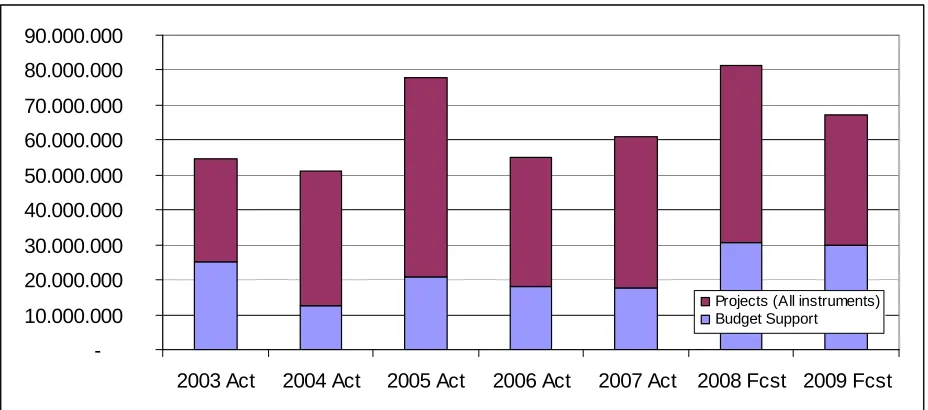
Figure 4.2 – Trends in payments by type of support (all instruments)
-10.000.000 20.000.000 30.000.000 40.000.000 50.000.000 60.000.000 70.000.000 80.000.000 90.000.000
2003 Act 2004 Act 2005 Act 2006 Act 2007 Act 2008 Fcst 2009 Fcst
Projects (All instruments) Budget Support
[image:25.595.66.530.409.614.2]August 2008
Figure 4.3 – Trends in payments by instrument
-10.000.000 20.000.000 30.000.000 40.000.000 50.000.000 60.000.000 70.000.000 80.000.000 90.000.000
2003 Act 2004 Act 2005 Act 2006 Act 2007 Act 2008 Fcst 2009 Fcst
EDF NIP EDF Regional
EDF - STABEX Budget Lines
The table of payments by instrument above shows generally speaking an increase of STABEX and Thematic Budget Lines payments over recent years.
The STABEX payments are related to the current revised FMO and the phasing-out of that instrument as of end 2010. Considering the STABEX RAL, sustained payment levels of€5M per annum or above are forecasted until 2010 and specific disbursement plans are in place.
Thematic Budget Lines payments reflect the increased space of these centralised instruments in the EU-Rwanda Cooperation, concerning almost entirely Non State Actors. Sustained payment levels around€6M are expected for the forthcoming 5 years, involving the management by the Delegation of an average of 60 NGO contracts on a going basis.
Regional (RIP) payments have peaked in 2005 as they were an important component of several road projects that had a substantial regional impact. They have slowed down in 2006/2007, but will pick up again in 2008-2010 with the implementation of the CEPGL project and the Water and Energy facilities as well as, starting in 2010, the expected regional contribution to 10thEDF road projects.
August 2008
EDF 9 sectoral breakdown country: Rwanda
STRATEGY FOR AFRICA EUROPEAN CONSENSUS SUB SECTOR AND PART SBS in euro x 1000
total cumulative commitments 31.12.07
governance 12,800
Human rights and governance
governance,human rights and support to economic and institutional reforms
economic and institutional reforms 6,577
Non State Actors 500
Peace and security
conflict prevention and fragile
states conflict prevention and fragile states 3,000
European Partnership Agreements
Economic growth, regional
integration and trade trade and regional integration regional economic integration 1,557
private sector development 760
infrastructure,communication and
transport infrastructure,communication and transport 53,580
water and energy water 3,860
energy
unspecified
social cohesion and employment social cohesion and employment
environment and sustainable management of natural resources
environment and sustainable management of natural resources
investing in people
rural development, territorial planning, agriculture and food
security rural development and territorial planning 34,000
agriculture
food security
health
human development primary education
education unspecified
other TCF TCF 1,146
support to NAO support to NAO 906
unspecified unspecified
Budget Support GBS General Budget Support 99,764
TOTAL TOTAL TOTAL 218,450
largest sector + GBS 70%
Two largest sectors + GBS 86%
Three largest sectors + GBS
Level of sector concentration
percentage of 9th EDF commitments covered by largest sectors of concentration plus GBS
Four largest sectors + GBS
Five largest sectors + GBS
nr of sectors + GBS to reach 85% of NIP 2