pressure-sensitive soil.
.
White Rose Research Online URL for this paper:
http://eprints.whiterose.ac.uk/142712/
Version: Published Version
Article:
Dade-Robertson, M. orcid.org/0000-0001-7752-9605, Mitrani, H.
orcid.org/0000-0001-9845-3291, Corral, J.R. et al. (4 more authors) (2018) Design and
modelling of an engineered bacteria-based, pressure-sensitive soil. Bioinspiration &
Biomimetics, 13 (4). 046004. ISSN 1748-3182
https://doi.org/10.1088/1748-3190/aabe15
[email protected] https://eprints.whiterose.ac.uk/
Reuse
This article is distributed under the terms of the Creative Commons Attribution (CC BY) licence. This licence allows you to distribute, remix, tweak, and build upon the work, even commercially, as long as you credit the authors for the original work. More information and the full terms of the licence here:
https://creativecommons.org/licenses/
Takedown
If you consider content in White Rose Research Online to be in breach of UK law, please notify us by
© 2018 IOP Publishing Ltd
1. Introduction
Biological systems are highly energy efficient, responsive and adaptable to change. For this reason, engineers often turn to biology for inspiration in the construction of human engineered systems. Modern computation and highly controllable fabrication processes such as 3D printing allow structures to be produced with spatially variable material properties, more similar to those found in nature, giving for example variable stiffness to a piece of furniture (Oxman 2010). This process is known as Material Based Design Computation (MBDC). Taking this MBDC idea further, responsive materials, which change their properties or geometry in response to external stimuli, offer potential for a more sustainable built environment which can adapt to changes in
environmental conditions and requires less energy to construct, operate and maintain. Examples include passive architectural skins inspired by fir cones, which use hygromorphic materials to open and close in response to changes in ambient humidity (Holstov et al
2015, Reichert et al2015). Some responsive materials go a step further and utilise living microorganisms which respond to environmental change. For example, self-healing concrete includes dormant bacteria and nutrients in the concrete mix which respond to cracking by precipitating calcium and closing the crack (Jonkers 2007).
We suggest that the next frontier in the develop-ment of adaptable materials is to utilise engineered biological systems so that computation, material syn-thesis and fabrication are combined into materials that are part living. This would go beyond bio-mimicry
Design and modelling of an engineered bacteria-based,
pressure-sensitive soil
Martyn Dade-Robertson1 , Helen Mitrani2,6 , Javier Rodriguez Corral1, Meng Zhang3 , Luis Hernan1,
Aurelie Guyet4 and Anil Wipat5
1 School of Architecture Planning and Landscape, Newcastle University, Newcastle upon Tyne, NE1 7RU, United Kingdom 2 Civil Engineering, School of Engineering, Cassie Building, Newcastle University, Newcastle upon Tyne, NE1 7RU, United Kingdom 3 Department of Applied Sciences, Northumbria University Newcastle, Newcastle-upon-Tyne, NE1 8ST, United Kingdom 4 Centre for Bacterial Cell Biology, Medical School, Newcastle University, Newcastle upon Tyne, NE2 4AX, United Kingdom 5 School of Computing, Urban Sciences Building, Newcastle University, 1 Science Square, Science Central, Newcastle upon Tyne, NE4
5TG, United Kingdom
6 Author to whom any correspondence should be addressed.
E-mail: [email protected], [email protected], [email protected],
[email protected], [email protected], [email protected] and [email protected]
Keywords: responsive materials, material based computation, biological sensors, synthetic biology, cementation, computational modelling
Abstract
In this paper, we describe the first steps in the design of a synthetic biological system based on the use of genetically modified bacteria to detect elevated pressures in soils and respond by cementing soil particles. Such a system might, for example, enable a self- constructed foundation to form in response to load using engineered bacteria which could be seeded and grown in the soils. This process would reduce the need for large-scale excavations and may be the basis for a new generation of self-assembling and responsive bio-based materials. A prototype computational model is presented which integrates experimental data from a pressure sensitive gene within Escherichia coli bacteria with geotechnical models of soil loading and pore water pressure. The results from the integrated model are visualised by mapping expected gene expression values onto the soil volume. We also use our experimental data to design a two component system where one type of bacteria acts as a sensor and signals to another material synthesis bacteria. The simulation demonstrates the potential of computational models which integrate multiple scales from macro stresses in soils to the expression of individual genes to inform new types of design process. The work also illustrates the combination of in silico (silicon based computing) computation with in vivo (in the living) computation.
PAPER
Original content from this work may be used under the terms of the Creative Commons Attribution 3.0 licence. Any further distribution of this work must maintain attribution to the author(s) and the title of the work, journal citation and DOI.
R E C E I V E D
19 November 2 017
R E V I S E D
2 8 March 2 018
AC C E P T E D F O R P U B L I C AT I O N
13 April 2 018
P U B L I S H E D
or the use of naturally occurring organisms and mat-erials to the development of biological systems which perform in ways which they do not do in nature. Our ultimate objective is to construct a responsive material which uses engineered bacteria as biological sensors to detect mechanical changes in their environment and to respond by synthesising new materials. An applica-tion of this would be, for example, to ‘automatically’
construct building foundations by bacteria within the soil matrix detecting changes in pressure and cement-ing the soil in response.
Using Synthetic Biology approaches to create bacte-ria capable of cementing soil in response to pressure is a promising scenario for two main reasons. Firstly, micro-bial activity is already important to many geotechni-cal processes, although this area has only been studied relatively recently (Mitchell and Santamarina 2005). Microbial activity is known to have a significant impact on the fertility of soils in the upper layers and bacteria are known to move freely through many types of soils through pore ‘throats’ which form a network of gaps between sediment grains. In unsaturated sediments bacteria tend to live at the surface in the area below the organic layer and activity decreases by one or two orders of magnitude with 2 m of depth. However, in saturated sediments the reduction in numbers of bacteria is more moderate (Mitchell and Santamarina 2005).
Secondly, bacteria have already been widely shown to cause the binding together of soil particles. Some bacteria can become attached to particles and form bio-film of single species or multi-species bacteria colonies. This build-up of biofilms can lead to greater adhesion of sediment particles. Bacteria are also responsible for cementing soils with known species such as Sporo-sarcina pasteurii and Bacillus megaterium producing ammonia which, in turn, causes calcium carbonate to precipitate (Decho 2010). This has been studied exten-sively as a promising method of ground improvement and microbial induced calcium precipitation (MICP) has been shown to produce significant enhancement in the mechanical properties of soils, both at small scale and in field tests (Dejong et al2006, Whiffin et al
2007, van Wijngaarden et al2011). This work shows the importance of factors such as bacterial concentration, pH, reactant concentration, temper ature, and nutri-ent availability on the success of MICP, which high-lights the complexity of biological cementation meth-ods. However, these bio-cements are not responsive to their environment. Using these methods, cementation occurs wherever the bacterial solution is injected, not in response to an external input, such as pressure.
This paper presents the initial steps towards this application domain in the form of a design process which integrates gene expression data from a new engineered pressure-responsive bacterium into a comp uter model of mechanical soil behaviour. Using such a model we can potentially design the macro behaviour of soils by engineering the behaviour of microorganisms within the soil (micro scale) by
alter-ing their genes at the nano scale. The model considers a scenario where a raft applying a uniform load over its area is placed on a homogeneous, saturated volume of soil. The soil volume is saturated with water containing the engineered pressure sensitive bacterium. Ordinar-ily, when the soil is loaded, the water would be pushed out of the pores and the soil would consolidate, caus-ing local settlcaus-ing of the ground surface and foundation and some increase of soil strength. However, in the proposed system, the bacteria respond to elevated pore water pressures induced by the load on the soil. In the model presented the response to pressure is demon-strated by raised levels of a reporter enzyme, green flu-orescent protein (GFP), which we use to measure the response of our gene of interest. However, if a synth etic biological system was built where pressure sensitivity was connected to a system of material synthesis, these areas of increased GFP would represent regions of the soil model to be bio-cemented. This bio-cementation would bond the soil grains together, prevent settlement and increase the soil strength beyond any strengthen-ing which consolidation would cause. The limitations of this model and next steps in the development of such a system are also discussed.
2. Background
2.1. Biological aspects
While there have been studies of the genetic response of bacteria to elevated pressure there have not been attempts to engineer a pressure sensing strain and there is little data on the response of bacteria to low levels of elevated pressure (up to 1 MPa). The first step towards creating such a pressure sensor is to identify and characterise genes which show a genetic response to elevated pressures. This can be done using a technique called RNA-Seq to characterise the response of the entire genome to pressure changes and search for potential pressure sensitive genes. We then use techniques from molecular biology to build a gene circuit and characterise the sensitivity of the genetic response.
2.1.1. Background to Synthetic Biology
ribonucleic acid (RNA). By recombining promoters with genes that express different proteins we can create new genetic circuits. Expression profiles can be mapped for specific genes showing the genetic response (in terms of gene expression level) against a given input. In our case, we are interested in potentially pressure sensitive genes—i.e. genes that are regulated by changing pressures in the environment.
2.1.2. Bacteria based pressure sensor
The growth, survivability and adaptation of bacteria to pressure have been studied in terms of low pressures (below atmospheric pressure of 0.1 MPa), for example for Bacillus subtilis (Nicholson et al2010, Waters et al2014), moderate pressures (<100 MPa) and high pressures (>100 MPa), especially Escherichia
coli (E. coli). In geotechnical contexts we are unlikely to see pressures of more than 10 MPa (in practice more likely to be between 0.1–1 MPa) and there is a lack of data for these low levels of elevated pressure. In a connected study, we identified and characterised pressure sensing genes in a lab strain of E. coli, focussing on gene responses at low elevated pressures (up to 1 MPa). The data and methods are fully described in Guyet et al (2018). Briefly, using RNA-Seq experiments, we identified 75 genes that displayed a significant change in expression under pressure treatment with a cut-off of fold change ⩾3. Among these, 69 genes were upregulated when the cells were exposed to 1 MPa up to 30-fold difference and 6 genes downregulated up to 5-fold, compared to untreated cells. Nearly half of the upregulated genes (30) were also found upregulated when E. coli cells were exposed to higher pressures (30 MPa, 50 MPa and 100 MPa). We then chose one gene candidate that showed a significant gene expression change (azuC) to create a pressure sensitive GFP reporter strain PazuC
azuC-gfp. We successfully monitored the pressure response of the E. coli AG1319 strain (PazuC
azuC-gfp) by measuring the GFP signal under pressures of 0 MPa, 0.2 MPa, 0.4 MPa, 0.6 MPa, 0.8 MPa and 1 MPa. The signal was measured in relative fluorescence units (RFUs) with increased fluorescence indicating an increase gene activity in response to pressure. The
results are reproduced in table 1 and the normalised signal data were used in our computational model, as described in section 3.2.
2.2. Background to soil mechanics
In saturated, unloaded soils, where all the pore spaces are filled with water, a hydrostatic pressure distribution with depth exists. However, as the saturated soil is loaded, localised increases in pore pressure, known as excess pore pressures, can occur before water is able to flow out of the pores and pressure is equalized throughout the system. Pore pressure is therefore a function of:
– The magnitude of the applied vertical stress
– How quickly the pore water is able to drain, which depends on the permeability of the soil and the length of the drainage path (Powrie 2014).
This dissipation of excess pore pressures is accom-panied by compression of the soil matrix. The restruc-turing process of a soil under loading is known as consolidation (Terzaghi 1925). Consolidation is most apparent in clay soils underneath building founda-tions and other structures, where water can only drain slowly, as the process happens almost immediately in more permeable soils such as sands. The
[image:4.595.117.553.54.183.2]equa-Figure 1. Diagram of a genetic ‘device’ consisting of a promoter which is the starting point of a gene transcription that ends at the terminator and generates a messenger ribonucleic acid (mRNA) and a ribosome binding site which recruits the ribosome which initiates the process of translation of the mRNA into a protein. The diagram is drawn using the graphical standard: SBOL Visual.
Table 1. Engineered strain response to different pressures after 3 h exposure to elevated pressure.
Pressure range (MPa)
Engineered pressure sensitive straina (RFU.OD−1
600)
Under pressure
No pressure (control)
1 4039.57 2841.80
0.8 3267.09 2621.15
0.6 3322.25 2573.26
0.4 3534.06 2896.22
0.2 3196.22 2846.09
0 2934.53 2892.84
aE. coli AG1319 strain (P
azuCazuC-gfp), expression of gfp was
[image:4.595.346.548.271.412.2]tions governing this process and used in the computer model are described in the following sections.
3. Methods
3.1. Development of the computational model
There are two main components to this model: the biological behaviour of the bacteria in response to pressure and the mechanical behaviour of the soil. The biological behaviour is based on gene expression data outlined above (obtained using the in vivo experiments described fully by Guyet et al (2018)) as well as using hypothetical data to explore different design scenarios. The mechanical behaviour of the soil, in this case consolidation behaviour, is represented by a static model of total vertical stress combined with a time-dependent model of pore pressure.
The program used to develop the model was Pro-cessing (v.3.0.1). This software is based on the Java lan-guage and is mainly used for visualisation. The code implements a type of finite element analysis where the area underneath the loaded foundation is split into voxels. This is done by building a 3D array consisting of a grid of points below the area of the foundation for a given depth. At each point in the grid, vertical stress, pore pressure and gene expression is calculated.
3.1.1. Vertical stress under a foundation
The vertical stress at any point in a soil, due to a point load at the surface can be calculated using Boussinesq’s analytical solutions (Boussinesq 1885). These solutions assume a homogeneous, isotropic, weightless and elastic solid material, in an infinitely
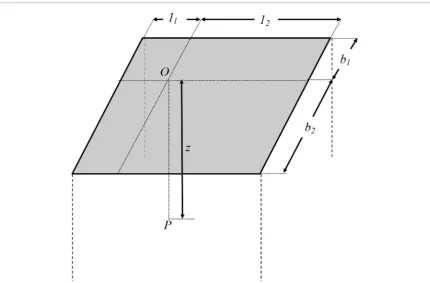
large half-space which is free of initial stress and deformation. Furthermore, the modulus of elasticity may be assumed to be constant and the principle of linear superposition is assumed valid. In the case of a rectangular raft foundation, integration of Boussinesq’s solutions, as derived by Fadum (1948), gives the value of the vertical stress at the corner of the rectangle, assuming the pressure applied is uniform, normal and applied at the surface of the soil. Therefore, in order to calculate the vertical stress at any point beneath the raft foundation, it must be divided into four rectangles and the principle of superposition used to find the stress at the desired point (Fadum 1948). This is illustrated in figure 2, where P is the point of interest and the contribution of each rectangle is given by an influence value (I), calculated using equation (1) below (Fadum 1948, Poulos and Davis 1974).
I= 1
2π !
arctan
" m
∗n √
m2+n2+1 #
+
" m
∗n √
m2+n2+1
# " 1
1+m2 + 1
1+n2 #$
.
(1) In equation (1),
m=b
z (2)
n= l
z (3)
[image:5.595.121.552.54.337.2]where b is the breath of the resulting rectangle once the foundation is split into four, l is the length of the resulting rectangle and z is the depth at the point of interest (see figure 2).
The vertical stress at point P due to the external loading applied is then:
σz=q∗(I1+I2+I3+I4) (4)
where q is pressure over the foundation.
3.1.2. Excess pore pressure dissipation
The duration and spatial distribution of excess pore water pressure is important for this study as the proposed system depends on the soil maintaining elevated pore pressures long enough for the bacteria to detect and respond to high pressure levels. Values of excess pore pressure over time are calculated using Terzaghi’s one-dimensional (1D) consolidation equation (Terzaghi 1943) (equation (5)).
∂2u
∂z2 cv=
∂u
∂t (5)
where u refers to the excess pore pressure at the time t and depth z and cv is the coefficient of consolidation, a
measure of the rate at which the consolidation process proceeds, and is expressed as
cv=
k
ρw·g·mv (6)
where k is the permeability of the soil, ρw is the water density, g is gravitational acceleration and mv is the
coefficient of compressibility.
Terzaghi’s 1D consolidation equation is solved using a mathematical solution in terms of Fourier series (Taylor 1948). A simplified version of this is used (equation (7)) in order to easily implement the differ-ential equation in a coding environment (Abid and Pyrah 1988).
uz,t+∆t = uz,t+β∗[uz−1,t+uz+1,t−2∗uz,t] (7) where u is the pore water pressure at depth z and time t, and β is expressed as follows:
β =cv∗∆t
∆z2 (8)
where cv is the coefficient of consolidation, as given by equation (6).
The consolidation equations described above rely on several assumptions:
– The voids of the soil must be completely filled with water.
– Both water and soil grains are perfectly incompressible.
– Darcy’s law applies, i.e. the flow of water being squeezed out of the soil depends on the permeability of the soil and the hydraulic gradient in the direction of the flow (Darcy 1856).
– The coefficient of permeability k, is constant.
– The drainage of water is only vertical, i.e. 1D consolidation applies. Although this is not true in real situations, the results obtained with the computational simulations are accurate enough
and give an insight into the magnitude and duration of excess pore pressures.
– The excess pore water pressure at the drainage surface(s) after the initial load is applied is equal to 0.
3.2. Integrated simulation
Using the models of soil stress and pore pressure described in the previous section, we can then map values of gene expression for individual bacteria within the soil, given expression values for a pressure sensitive gene. Enzyme activity in this instance is described in terms of fluorescence. This allows us to integrate actual data from our in vivo experiments (Guyet et al2018) where we have used a gene which encodes for GFP to visualise the activity of our pressure sensing gene. In practice, we imagine that our genes of interest are either producing a product to bind soil grains (for example initiating biomineralisation or producing polymers) or a chemical which signals to another bacterium which, in turn is responsible for the synthesis of a material. To this end we have modelled variations of two scenarios:
1. In Scenario 1 we have a single bacteria type (Device 1) with a gene promoter which causes the production of a bio-cement in response to pressure.
2. In Scenario 2 the pressure sensing bacteria (Device 1) produces a signalling molecule which is received by another bacteria type which, in turn, is responsible for the material synthesis (Device 2). In this scenario, Device 2 is under the control of a promoter which is sensitive to signalling molecule produced by Device 1.
The model calculates values for pore water pres-sure throughout the soil volume at a given time, maps these values to predicted gene expression for the pres-sure sensing gene at that time and displays a matrix of boxes, the sizes of which are proportional to the gene expression we would expect to see at different points within the soil. Using this model, we can produce 2D sections through the soil volume, indicating zones of high gene expression, which correspond to cemented zones of soil, as shown in figure 3.
4. Results
A 10 m × 10 m × 10 m volume of soft clay was modelled with a constant uniform load of 1 MPa applied at the surface and a coefficient of consolidation of the soil, cv = 3 m2 yr−1. This value was chosen to be
representative of a typical clay soil (Terzaghi and Peck
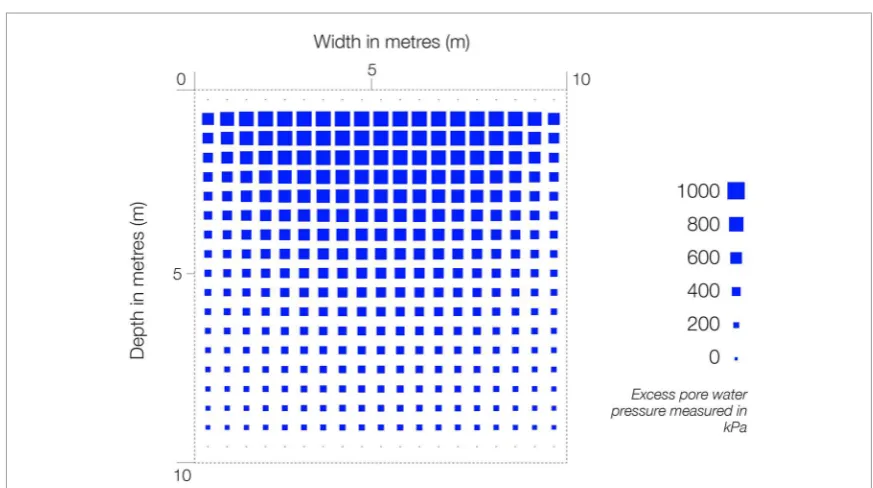
The pore pressures in the soil induced by the applied loading at this time point are shown in figure 4.
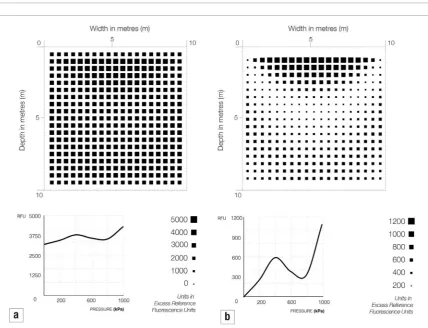
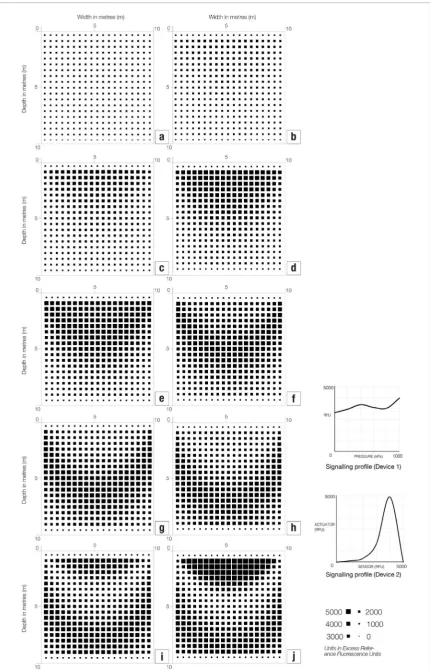
The following results are from modelling vari-ations on two scenarios. In Scenario 1 we have single bacteria (Device 1) both sensing pressure and synthe-sising material in response. In this scenario we simu-lated a linear increase in the pressure response (figure
5(a)) and a specific sensitivity to a range of pressures (figure 5(b)).
We also applied our data from the azuC-gfp
engi-neered strain (shown in table 1) both in terms of absolute expression (figure 6(a)) and as relative increase in expres-sion to indicate the change more clearly (figure 6(b)).
Scenario 2 is based on a two-device system. In this scenario, the first bacteria (Device 1) has a pressure sensing promoter connected to a gene which codes for
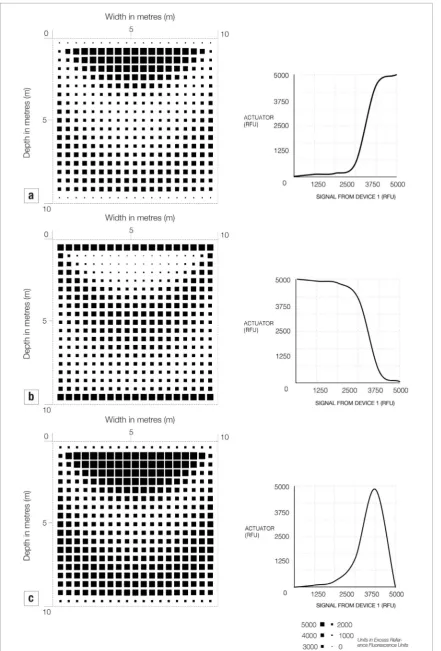
a signalling molecule and Device 2 constitutes a cell with a promoter that is sensitive to the signalling mol-ecule expressed by Device 1. We describe Device 2 as the actuator device. Known signalling systems include for example subtilin which is used to signal between B. subtilis bacteria (Bongers et al2005). We took the data obtained from the in vivo experiments on our pressure sensing gene (Guyet et al2018) and input this profile for the signalling device. This signal is then picked up by a second actuator device. Figure 7 shows three dif-ferent hypothetical actuator profiles and the potential patterns of gene expression in the soils.
[image:7.595.120.551.56.253.2]Finally in a series of independent simulations, we applied loads of 0.1 MPa to 1 MPa to the volume of soil, in increments of 0.1 MPa and used the profile of the azuC gene to sense pressure changes in conjunction
Figure 3. Output of our synthetic bio-cementing simulation with a 1000 m3 volume of soil evenly loaded and divided into 6859
voxels. The voxel size is proportional to the gene expression in a population of engineered bacteria. The full volume is sectioned through the centre to produce a 2D sectional map.
Figure 4. Visualisation to show excess pore pressure over a section of 1000 m3 of soil loaded with 1 MPa. The section is taken midway
[image:7.595.116.553.306.550.2]Figure 5. Visualisations to show gene expression values over sections of 1000 m3 of soil loaded with 1 MPa. The sections are taken
midway through each soil volume and the grid of squares is drawn proportional to the enzyme activity from two hypothetical pressure sensitive promoters where (a) has a linear increase in pressure response and (b) shows a sensitivity to a range around 500 kPa.
Figure 6. Visualisations to show gene expression values over sections of 1000 m3 of soil loaded with 1 MPa. The sections are taken
midway through each soil volume and the grid of squares is drawn proportional to the enzyme activity for the pressure sensitive gene
[image:8.595.123.552.412.740.2]Figure 7. Visualisations to show gene expression values over sections of 1000 m3 of soil loaded with 1 MPa. Sections are taken
midway through each soil volume and the grid of squares is drawn proportional to the enzyme activity for three hypothetical promoters under the influence of a signalling molecule whose expression is mapped onto the profile for the pressure sensitive gene
with the signal sensing promoter profile (the actuator) from the example shown in figure 7(c). The results are shown in figure 8.
5. Discussion
The computational model described in this paper illustrates a new type of design process which integrates the nano behaviour of individual bacteria cells in terms of gene expression and the macro behaviour of soils under load. Figure 5(a) shows the expected pattern of expression for a hypothetical promoter where gene expression is linearly increased in response to elevated pressure. In this case, the highest expression occurs in the areas of highest pressures. We therefore might expect that, if this gene profile was connected to a process of material synthesis, most bio-cementation would occur where the stresses in the soil were greatest, which would be ideal for civil engineering applications. However, we are very unlikely to find this situation. In Kato et al (1994) for example, a pressure sensing promoter in E. coli was discovered which has a specific sensitivity range where increased expression was triggered at a relative narrow range of pressures (albeit at higher elevated pressure than we are interested in). In our own gene of interest azuC we also see a non-linear pressure responsiveness with a gene which is constitutively expressed irrespective of pressure and shows a sensitivity to specific ranges. The model allows us to visualise the implications of these complex relationships between elevated pressure and gene expression and, as we begin to develop a potential library of pressure sensitive genes, to select appropriate sensitivity profiles for a given context.
5.1. Integration of biological data into the computational model
We have also run the simulation with real biological data. In figure 6 we show two visualisations: one with absolute experimental data where the gene of interest is expressed even at 0 kPa of elevated pressure and a version with relative data which only shows elevated expression with the expression of the control set as zero. We see two bands of increased expression associated with the two peaks at approximately 400 kPa and continually rising to 1 MPa. If we associate these values with levels of cementing in the soil we would expect a zone of high cementation at the top of the soil volume with a crescent shaped void associated with low levels of expression below and then another region of increased cementation lower in the soil. Although this is not optimal from a civil engineering perspective, cementation is still achieved at the top of the soil volume where it is most required.
In our final visualisations we show the response of the azuC-gfp gene fusion as part of a two component system in which one cell signals under the control of the pressure sensor to another cell which, in response
to the signalling molecule initiates material synthesis. There are two reasons why such a system may be imple-mented. First, engineering bacteria to make additional enzymes (such as signalling molecules, polymers or enzymes associated with biomineralisation such as Urease) places a metabolic load on the bacteria (Glick
1995) and may impede their function and survivability. By separating sensing and material synthesis into two separate cells, therefore, we spread the metabolic load between two separate systems. Secondly, separating the two functions creates two gene expression profiles. Bacteria containing Device 1 has a sensitivity to pres-sure and bacteria containing Device 2 has a sensitivity to the sensing product of Device 1. By combing differ-ent profiles, we can create differdiffer-ent patterns of cemen-tation in the soil. In our example in figure 7 we use the pressure sensing profile of the azuC gene fusion for the signalling bacteria and combine these with three dif-ferent hypothetical profiles for our actuator bacteria. Combined with different profiles we see that different patterns of cementation may be generated in the soils. We can use this information to design an appropriate system by selecting an appropriate actuator for a given load condition. Figure 8 shows, for example, the pat-tern of gene expression under a number of different loading conditions. These visualisations show that the actuator amplifies the signal from the azuC gene and will perform optimally at between 100 kPa and 400 kPa before the effects of the decreased expression. In this case our simulation can be used to design an optimum actuator which effectively amplifies the signal for the pressure ranges we are interested in and mitigates the uneven nature of the pressure sensitivity of our azuC gene.
5.2. Limitations and future work
While the integrated computational model is novel and based on real (although preliminary) biological findings, the contexts we are using are abstract and still some distance from a real geotechnical scenario. The application of the biological data and integrated modelling should therefore be seen as illustrative of the potential of the system rather than properly predictive.
Figure 8. Visualisations to show gene expression values for over sections of 1000 m3 of soil loaded with pressures from 0.1 MPa
to consider whether the promoter could be refined to be more pressure specific. We also recognise that, while E. coli represents a useful model bacterium, it is not adapted to life in the soil. Developing our system will require the use of a bacteria species such as B. subtilis which is found living naturally in soils and also has the capacity for bio-cementing.
The computational model assumes a homog-enous consistency of soil throughout the volume and an even distribution of bacteria. In a real geotechni-cal context we would expect highly heterogeneous soil properties as well as much greater bacterial cell activity at the surface soil layers where there is best access to nutrients. The model does also not account for the micro-scale physics of transporting molecules of the bacteria cells (signalling molecules of enzymes responsible for material synthesis) or the micro forces which would begin to affect the cells as materials are made. This biological behaviour is also time depend-ent and, at the momdepend-ent, our model takes a snapshot at a point in time rather than considering time depend-ent biological processes including variability of gene expression, cell growth and cell death. In addition, the values for pore pressure used are obtained from standard formulas based on soils which are satur-ated with water. A bacteria mix is likely to be thicker than water and therefore the liquid flow through the soils will be slower—thus maintaining higher pres-sures in the soil for each condition longer. This also has an implication for potential applications. In this instance, the proposal is based on a notion that bac-teria would be seeded into an existing volume of soil. This seeding process would likely involve the injec-tion of a liquid culture of bacteria into the soil under high pressures through, for example, a deep irrigation system. Pressures associated with injecting the liquid through the soil must be taken into account because the pressure sensitive bacteria may become prema-turely active when high pressures are being used. However, if fine-grained soils with a low coefficient of permeability are used it could take month or even years to properly irrigate the soil at low pressures.
These limitations aside we have succeeded in inte-grating biological data and geotechnical models—
illustrating the relationships of multiple scales and beginning to implement a new type of design frame-work which accounts for these relationships.
6. Conclusions
The integration of in silico and in vivo work across multiple scales of system design is novel and integrates design processes for synthetic biology and geotechnical engineering, which have not been combined before.
The computational (in silico) work has approached the problem at the macro scale relevant to human construction. The key contribution here has been to integrate geotechnical behaviour with biological data in a general model which can be refined and adapted
to explore the behaviour of a pressure-responsive bio-cementation system. In the computer model, changes in gene expression have the potential to lead to sub-stantial changes in the pattern of bio-cementation in the soil. Even small changes in promoter sensitivity might fundamentally change the behaviour of the sys-tem at the macro scale. Overcoming this challenge but also exploring its potential could become an impor-tant part of the design process.
There is the potential for a great deal of further work in analysing the gene expression data and in developing the computer model. A key challenge is to develop an understanding of this system at interme-diate scales, including factors such as the likely distri-bution of bacteria cells in the soil. As the work moves towards an implemented physical demonstrator, a bet-ter understanding of the behaviour of bacbet-teria cells as colloids within different types of soil is necessary, as well as the development of models which include data on the chemical composition of soils which are likely to have a radical effect on the outcome of such a system.
While there are limitations in the work described here, it illustrates a new design process in which the analysis of soil conditions leads to the design of micro-organisms to improve soil stability and strength and even cause specified patterns of cementing. As our in vivo work develops we should be able to plot promoter sensitivity for a selection of our known pressure sensi-tive genes and, in the future, we may be able to edit pro-moters to give us the desired sensitivity profile— sculpt-ing material responses to pressure by altersculpt-ing sequences of DNA and through the interaction of many different genetic devices and engineered organisms.
Acknowledgments
This work was supported by the UK Engineering and Physical Sciences Research Council, grant number EP/ N005791/1.
ORCID iDs
Martyn Dade-Robertson
https://orcid.org/0000-0001-7752-9605
Helen Mitrani https://orcid.org/0000-0001-9845-3291
Meng Zhang
https://orcid.org/0000-0003-1089-6464
Anil Wipat https://orcid.org/0000-0001-7310-4191
References
Abid M M and Pyrah I C 1988 Guidelines for using the finite element method to predict one-dimensional consolidation behaviour Comput. Geotech.5213–26
Bongers R S, Veening J, Van Wieringen M and Kuipers O P 2005 Development and characterization of a subtilin-regulated expression system in Bacillus subtilis: strict control of gene expression by addition of subtilin Appl. Environ. Microbiol.
Boussinesq J 1885 Application des potentiels a l’étude de l’équilibre et du mouvement des solides élastiques (Paris: Gaulthier-Villard) Decho A W 2010 Overview of biopolymer-induced mineralization:
what goes on in biofilms? Ecol. Eng.36137–44
Dejong J T, Fritzges M B and Nüsslein K 2006 Microbially induced cementation to control sand response to undrained shear
J. Geotech. Geoenviron. Eng.1321381–92
Fadum R E 1948 Influence values for estimating stresses in elastic foundations Proc. 2nd Int. Conf. SMFERotterdam vol 3 pp 77–84
Glick B R 1995 Metabolic load and heterogenous gene expression
Biotechnol. Adv.13247–61
Guyet A, Dade-Robertson M, Wipat A, Casement J, Smith W, Mitrani H and Zhang M 2018 Genetic response of Escherichia coli to mild elevated pressure PLoS One submitted
Holstov A, Bridgens B and Farmer G 2015 Hygromorphic materials for sustainable responsive architecture Constr. Build. Mater.
98570–82
Jonkers H 2007 Self healing concrete: a biological approach Self Healing Materials: An Alternative Approach to 20 Centuries of Materials Science (Berlin: Springer) pp 194–204
Kato C, Sato T, Smorawinscka M and Horikoshi K 1994 High pressure conditions simulate expression of chloramphenical acetyltransferase regulated by the lac promoter in Escherichia coli FEMS Microbiol. Lett.12291–6
Mitchell J K and Santamarina J C 2005 Biological considerations in geotechnical engineering J. Geotech. Geoenviron. Eng.
1311222–33
Nicholson W L, Fajardo-Cavazos P, Fedenko J, Ortíz-Lugo J L, Rivas-Castillo A, Waters S M and Schuerger A C 2010 Exploring the low-pressure growth limit: evolution of Bacillus
subtilis in the laboratory to enhanced growth at 5 kilopascals
Appl. Environ. Microbiol.767559–65
Oxman N 2010 Structuring materiality: design fabrication of heterogeneous materials Archit. Des.8078–85
Poulos H G and Davis E H 1974 Elastic Solutions for Soil and Rock Mechanics (New York: Wiley)
Powrie W 2014 Soil Mechanics: Concepts and Applications 3rd edn (Boca Raton, FL: CRC Press)
Reichert S, Menges A and Correa D 2015 Meteorosensitive architecture: biomimetic building skins based on materiality embedded and hygroscopically enabled resonsiveness Comput. Des.6050–69
Taylor D W 1948 Fundamentals of Soil Mechanics (New York: Wiley)
Terzaghi K 1925 Principles of soil mechanics Engineering News Record 95 874–8
Terzaghi K 1943 Theoretical Soil Mechanics (New York: Wiley) Terzaghi K and Peck R B 1967 Soil Mechanics in Engineering Practice
(New York: Wiley)
van Wijngaarden W K, Vermolen F J, van Meurs G A M and Vuik C 2011 Modelling biogrout: a new ground improvement method based on microbial-induced carbonate precipitation Transp. Porous Media87397–420
Waters S M, Robles-Martínez J A and Nicholson W L 2014 Exposure of Bacillus subtilis to low pressure (5 kilopascals) induces several global regulons, including those involved in the SigB-mediated general stress response Appl. Environ. Microbiol.
804788–94
Whiffin V S, van Paassen L A and Harkes M P 2007 Microbial carbonate precipitation as a soil improvement technique