This is a repository copy of A splitting of the virtual class for genus one stable maps.
White Rose Research Online URL for this paper:
http://eprints.whiterose.ac.uk/152247/
Version: Submitted Version
Article:
Coates, T. and Manolache, C. (Submitted: 2018) A splitting of the virtual class for genus
one stable maps. arXiv. (Submitted)
© 2018 The Author(s). For reuse permissions, please contact the Author(s).
[email protected] https://eprints.whiterose.ac.uk/
Reuse
Items deposited in White Rose Research Online are protected by copyright, with all rights reserved unless indicated otherwise. They may be downloaded and/or printed for private study, or other acts as permitted by national copyright laws. The publisher or other rights holders may allow further reproduction and re-use of the full text version. This is indicated by the licence information on the White Rose Research Online record for the item.
Takedown
If you consider content in White Rose Research Online to be in breach of UK law, please notify us by
arXiv:1809.04162v1 [math.AG] 11 Sep 2018
GENUS ONE STABLE MAPS
TOM COATES AND CRISTINA MANOLACHE
Abstract. Modulispaces of stable maps to a smooth projective variety
typ-ically have several components. We express the virtual class of the moduli space of genus one stable maps to a smooth projective variety as a sum of virtual classes of the components. The key ingredient is a generalised functo-riality result for virtual classes. We show that the natural maps from ‘ghost’ components of the genus one moduli space to moduli spaces of genus zero stable maps satisfy the strong push forward property. As a consequence, we give a cycle-level formula which relates standard and reduced genus one Gromov–Witten invariants of a smooth projective Calabi–Yau theefold.
Contents
1. Introduction 2
Outline of the proof 3
Relation to other works 6
2. Notation 7
3. Reduced Gromov–Witten Invariants 8
3.1. Embeddings of ¯M1,n(Pr, β)after Ciocan-Fontanine–Kim 8
3.2. The Vakil–Zinger desingularization of ¯M1,n(Pr, β) 9
4. A further blow-up 12
5. A virtual class of the correct dimension 13
5.1. Reduced restricted obstruction theories onBl(M˜X(P))λ 14
5.2. A new virtual class onBl(M˜(P)) 18
6. Deformations of obstruction theories and cone stacks 19
6.1. A deformation of the obstruction theory onBl(M˜(X)) 20
7. The deformation space and its blow-up 21
7.1. A blow-up of the deformation space 25
8. The main theorem 26
8.1. Proof of Theorem 8.1 27
9. Contributions from ghost components 32
9.1. Virtual push forwards 32
9.2. A local calculation for CY threefolds 35
Acknowledgements 36
References 37
1. Introduction
Let X be a smooth projective variety inPr. Let ¯Mg,n(X,d) be the moduli space of stable maps toX with genusg and homology classd ∈H2(X;Z)[14].
Then ¯Mg,n(X,d) has virtual dimension
vdim=n+(1−g)(dimX −3)+c1(T X) ·d
and a virtual class[M¯g,n(X,d)]virt∈Avdim(M¯g,n(X,d)): see [3, 17, 18]. Gromov–
Witten (GW) invariants of X are intersection numbers against this virtual class. They are related to counts of curves inX of genusg and classd.
For g > 0, GW invariants also encode some contributions from degenerate lower genus stable maps. These contributions are fairly well understood for genus one GW invariants of threefolds. In genus one, Zinger and Li–Zinger prove a formula which expresses GW invariants in terms of reduced invari-ants (which are closely related to BPS numbers) and degenerate contributions. From now on, we restrict ourselves to the genus-one case.
The degenerate contributions reflect the structure of the moduli space of stable maps, which has many components, some of which contribute to GW invariants. For example, the moduli space of stable mapsM(P)=M¯1,n(Pr,d) has a main component M(P)0, whose generic point is a map from a smooth genus one curve, and several other components
M(P)λ ≃M1,k+n0(P
r,0) ×
Pr M¯0,1+n
1(P
r,d
1) ×Pr . . .×Pr M¯0,1+n
k(P
r,d
k)Γλ.
Hereλ denotes the combinatorial data(k;n0, . . . ,nk;d1, . . . ,dk)and Γλ is the
(finite) automorphism group of this data. With this notation we haveM(P)= M(P)0∪Ðλ∈I M(P)λ for an appropriate index setI.
The first step in the analysis is the definition of reduced invariants [27, 30]. The idea is to construct a blow-up ˜M(P) of the moduli space of stable maps, which induces a blow up ofM(X). Consider
˜
M(X)=M˜(P) ×M(P)M(X)=M˜(X)0∪
Ø
λ∈I
˜ M(X)λ.
On ˜M(X)0 it is possible to define a virtual class [27, 30]. Reduced GW invari-ants are intersection numbers against this virtual class.
Following [5, 11], we will refer to ˜M(P)λ and ˜M(X)λ, λ ∈I, as ‘ghost
com-ponents’. In this paper, we define virtual classes on the ghost components ˜
M(X)λ and prove:
Theorem 1.1. We have the following equality in A∗(M˜(X)): (1) [M˜(X)]virt=[M˜(X)0]virt+
Õ
λ∈I
[M˜(X)λ]virt.
There is a natural projection from the boundary component ˜M(X)λ to the
space
P(X)λ =M¯0,1+n1(P
r,d
1) ×Pr . . .×Pr M¯0,1+n
k(P
r,d k)Γλ,
which forgets the collapsed genus-1 component.P(X)λcarries a natural virtual
Theorem 1.2. Let X be a smooth projective threefold. Then, the morphisms qλ : ˜M(X)λ(X) →P(X)λ
satisfy the strong virtual push-forward property.
Theorems 1.1 and 1.2 together give a cycle-level proof of the Zinger/ Li–Zinger formula [20, 29, 30].
Theorem 1.3. Let X be a Calabi–Yau threefold. Then, the reduced invariants and GW invariants of X are related by the formula
GWX1,β =GWX1,β,red+ 1
12GW
X
0,β.
Theorem 1.3 is a particular case of [30] which holds forX any compact sym-plectic manifold of dimension 2 and 3 and of [29] which holds for X any compact symplectic manifold of any dimension. A similar statement appears in [19,20]. Algebraically it has been proved by Chang and Li [5], forX the quin-tic threefold, using a slightly different definition for reduced Gromov–Witten invariants to Zinger [30]. See below for a detailed discussion.The algebraic method uses the moduli space of maps with fields [4]. Note that unlike [5, 20] we do not requireX to be a complete intersection.
Outline of the proof. The key ingredient in our splitting of the virtual class (1) is a functoriality property for virtual classes. This generalises the func-toriality result of Kim–Kresch–Pantev [13, 21]. Their setting is the following. Suppose that we are given
• DM-type morphisms of stacksi:F →G and j:G →H;
• a compatible triple (E∨
F/G, E
∨
F/H, E
∨
G/H) of perfect dual obstruction
theories, that is, perfect dual obstruction theoriesEF∨/G, EF∨/H, EG∨/H which sit in a commutative diagram
i∗EG/H //
EF/H //
EF/G +1 //
i∗LG/H //LF/H //LF/G +1 //
where the rows are distinguished triangles. Let us write
EF/G =h1/h0(EF∨/G), EF/H =h1/h0(E
∨
F/H), EG/H =h1/h0(E
∨
G/H)
for the vector bundle stacks determined by the obstruction theories. These data determine
(1) a morphismF ×P1→DefG H; and
(2) a perfect dual obstruction theoryEF×P1/DefGH;
where DefGH is the deformation to the normal cone [8, 15]. In turn, these
determine a family of cone stacks [3], and an embedding of this family into a vector bundle stack. On the general fiber, this is
and the special fibre
CFlim/H →EF/G ⊕i∗EG/H.
satisfies
[CFlim/H]=[CF/CG/H].
The latter equality holds in the Chow group of the double deformation space DefF×P1DefGH. It follows that
i![G]virt=[F]virt.
We would like to apply this withF =M(X),G =M(P), andH equal to the Picard stackPic, and then argue that, sinceM(P)has components, this gives a splitting of the virtual class:
[M(X)]virt=i![M(P)0]+Õ λ∈I
i![M(P)λ]virt.
The problem with this is thatEM(X)/M(P)is not perfect, and so in particulari! does not make sense. Also, we do not have a perfect dual obstruction theory EM(X)×P1/Def
M(P)Pic. However, inspired by cosection localisation [12], we will
resolve these problems by blowing up.
The first step is to replaceM(X),M(P), andPicby the Vakil–Zinger blow-ups ˜M(X), ˜M(P), and ˜Pic. The dual obstruction theoryEM˜(X)/M˜(P)is still not perfect but it is now a union of vector bundles, which have different ranks on the different components ˜M(X)λ,λ ∈0∪I. Focus now on a ghost component
˜
M(X)λ. The restriction to ˜M(X)λ ofE
˜
M(P)/Pic˜ is too large to sit in a compatible
triple (of restrictions)
E∨M˜(X)/M˜(P),EM∨˜(X)/Pic˜ ,EM∨˜(P)/Pic˜ .
so we would like to construct a reduced version ofEM˜(P)/Pic˜ on ˜M(X)λ. To
do this, we take further blow-upsBl(M˜(P))of ˜M(P)andBl(M˜(X))of ˜M(X). After restricting to the ghost componentBl(M˜(X))λ ofBl(M˜(X)), there is a
compatible triple
EBl∨(M˜(X))/Bl(M˜(P)),EBl∨(M˜(X))/Pic˜ ,Eλ,∨red of dual obstruction theories, whereE∨
λ,redis a complex defined onBl(M˜(X))
λ
which plays the role of a reduced dual obstruction theory. The complexE∨
λ,red is perfect, and allows us to define virtual classes on the ghost components1. It also solves the second problem mentioned above, at least on the ghost components:Eλ,∨redinduces a perfect dual obstruction theory
(2) EBl(M˜(X))×P1/Def
Bl(M˜(P))Pic˜
Bl(M˜(X))λ.
1There is a small lie here. In the main text we define the virtual classes of ghost components
after passing to the further blow-up Def′
Bl(M˜(P))Pic˜ . But we could have usedE ∨
It remains to consider the main componentBl(M˜(X))0. In this caseE∨
Bl(M˜(P))/Pic˜
has the correct rank, but it fails to sit in a distinguished triangle
EBl∨(M˜(X))/Bl(M˜(P)),EBl∨(M˜(X))/Pic˜ ,EBl∨(M˜(P))/Pic˜
and the induced obstruction theory
(3) EBl(M˜(X))×P1/Def
Bl(M˜(P))Pic˜
Bl(M˜(X))0
fails to be perfect along a divisorδin the special fiberBl(M˜(X)) × {0}. These are essentially the same problem. We resolve it by blowing up the deformation space DefBl(M˜(P))Pic˜ alongδ, obtaining a new space DefBl′ (M˜(P))Pic˜ , and then truncating the pullback of the obstruction theory (3). By construction this truncation is perfect; it has the same general fiber as before, but a different special fiber.
WriteZ(X)0 for the blow-up ofBl(M˜(X))0×P1andZ(X)λ for the blow-up
ofBl(M˜(X))0×P1. At this point we have vector bundle stacks
H0 →Z0 built from the obstruction theory (3) and
Hλ →Zλ.
built from the obstruction theory (2). These vector bundle stacks contain families of cones, with general fibres
C0
Bl(M˜(X))/Pic˜ supported onBl(M˜(X))
0 and
Cλ
Bl(M˜(X))/Pic˜ supported onBl(M˜(X))
λ.
The class of special fibre supported on the main component can be written as
[CBl(M˜(X))0/C0
Bl(M˜(P))Pic˜
]+[correction class]
inA∗(H0)and the class of the special fibre supported on the ghost components can be written as
[CBl(M˜(X))λ/Cλ
Bl(M˜(P))Pic˜
]+[correction class]
inA∗(Hλ). HereCBl0(M˜(P))Pic˜ andCBlλ(M˜(P))Pic˜ denote the components ofCBl(M˜(P))Pic˜
supported on the main component and on the ghost component respectively. We show that when we sum over λ in {0} ∪I, the correction classes cancel. This is done in the proof of Theorem 8.1.
The classes
[CBl(M˜(X))0/C0
Bl(M˜(P))Pic˜
] ∈A∗(H0) and [CBl(M˜(X))λ/Cλ
Bl(M˜(P))Pic˜
] ∈A∗(Hλ) define virtual classes that satisfy:
[Bl(M˜(X))]virt=[Bl(M˜(X))0]virt+Õ λ∈I
Pushing this splitting forward to ˜M(X)proves Theorem 1. The final step is to show that the splitting behaves well with respect to push forward. This is the content of section §9.
Theorem 1.1 is a particular case of a functoriality property for virtual classes in the presence of a 3-term obstruction theory. We expect that a more general functoriality statement would solve many related questions. For example, this would apply to derive an analogue of Theorem 1.3 in higher genus. We will address these topics in future work.
Relation to other works. Reduced genus 1 invariants are the output of a long and impressive project. Reduced invariants were defined, using symplec-tic methods, and compared to Gromov–Witten invariants by Zinger [28–30,32]. Li–Zinger showed [19, 20] that reduced Gromov–Witten invariants are the in-tegral of the top Chern class of a sheaf over the main component ofM(P); this is an analog, for reduced genus 1 invariants, of the quantum Lefschetz hyper-plane property [19, 20]. In view of [30] this also gives a proof of Theorem 1.3. The algebraic definition requires a blow-up construction for the moduli space of stable maps to projective space due to Vakil and Zinger [26, 27]. Explicit local equations for this blow-up are given in [11, 32]. A modular interpre-tation of reduced invariants via log maps has been given by Ranganathan, Santos-Parker and Wise [25]. More recently, reduced invariants for the quintic threefold have been compared to Gromov–Witten invariants using algebro-geometric methods by Chang and Li [5]. As we do, Chang–Lidefine reduced invariants as the integral against the top Chern class class of a sheaf but, as discussed above, this gives the same reduced invariants as [30]. The algebraic comparison relies on the construction of maps with fields due to Chang and Li [4], and on Kiem–Li’s cosection localised virtual class [12]. A new proof of this comparison for complete intersections in projective spaces appears in [16]. Zinger has computed reduced invariants of projective hypersurfaces via local-isation [31]. See [33] for a survey from the symplectic perspective.
2. Notation
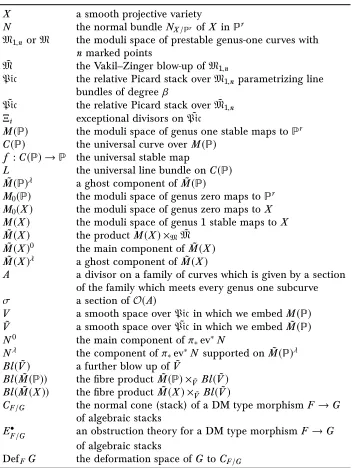
The following is a table of the most frequently used notations in the paper.
X a smooth projective variety
N the normal bundleNX/Pr ofX in Pr
M1,n orM the moduli space of prestable genus-one curves with
nmarked points ˜
M the Vakil–Zinger blow-up ofM1,n
Pic the relative Picard stack overM1,n parametrizing line
bundles of degree β ˜
Pic the relative Picard stack over ˜M1,n
Ξi exceptional divisors on ˜Pic
M(P) the moduli space of genus one stable maps toPr C(P) the universal curve overM(P)
f :C(P) →P the universal stable map
L the universal line bundle onC(P)
˜
M(P)λ a ghost component of ˜M(P)
M0(P) the moduli space of genus zero maps toPr M0(X) the moduli space of genus zero maps toX
M(X) the moduli space of genus 1 stable maps toX
˜
M(X) the productM(X) ×MM˜
˜
M(X)0 the main component of ˜M(X)
˜
M(X)λ a ghost component of ˜M(X)
A a divisor on a family of curves which is given by a section
of the family which meets every genus one subcurve
σ a section ofO(A)
V a smooth space overPic in which we embedM(P)
˜
V a smooth space over ˜Pic in which we embed ˜M(P)
N0 the main component ofπ∗ev∗N
Nλ the component ofπ
∗ev∗N supported on ˜M(P)λ Bl(V˜) a further blow up of ˜V
Bl(M˜(P)) the fibre product ˜M(P) ×V˜Bl(V˜) Bl(M˜(X)) the fibre product ˜M(X) ×V˜Bl(V˜)
CF/G the normal cone (stack) of a DM type morphismF →G
of algebraic stacks
EF•/G an obstruction theory for a DM type morphismF →G
of algebraic stacks
[image:8.612.132.491.156.624.2]DefFG the deformation space ofG toCF/G
3. Reduced Gromov–Witten Invariants
In this section we define the genus-one reduced Gromov–Witten invariants of a smooth projective variety X, following Vakil–Zinger [26, 27]. This is an algebro-geometric version of the symplectic story developed in [30]. We begin by explaining how to embed the moduli spaceM(P)of genus-one stable maps to projective space into a smooth stack, giving a construction due to Ciocan-Fontanine–Kim [6]. We then introduce the Vakil–Zinger blow-up of the moduli spaceM(P), and use it to define the reduced invariants ofX.
3.1. Embeddings ofM¯1,n(Pr, β)after Ciocan-Fontanine–Kim. We will now
describe an embedding ofM(P)into a smooth stackV, following [6]. LetM1,n
denote the stack of prestable genus-one curves withn marked points, and let Pic →M1,n denote the relative Picard stack of line bundles of degree β. It is
well known that M1,n is a smooth Artin stack of dimensionn. The stack Pic
is smooth over M1,n of relative dimension zero, by [23, Remark 2.5]; thusPic
is also smooth of dimension n. Let π: C → Pic be the universal curve and L→C be the tautological line bundle. LetPicstdenote the open substack of Pic obtained by imposing the stability condition
ωπ(P1+· · ·+Pn) ⊗L3is π-relatively ample
whereP1, . . . ,Pn are the divisors inC defined by the marked points. Slightly abusing notation, we will denote by π: C→Picstthe universal curve, and by L→Cthe tautological line bundle.
We now construct a smooth Deligne–Mumford stackV into which M(P)
will embed. The stackM(P)parametrizes, up to isomorphism, tuples C;p1, ...,pn;L;u0, . . . ,ur
where
(i) C is a nodal curve of arithmetic genus one;
(ii) p1, . . . ,pn are distinct marked smooth points onC;
(iii) L is a line bundle onC of degree β ·H; (iv) u0, . . . ,ur are global sections ofL;
such thatωC(p1+· · ·+pn) ⊗L3 is ample and that the base locus ofu0, . . . ,ur
is empty. Let π: C(P) → M(P) denote the universal family. Choose a π -relatively very ample effective Cartier divisor on the universal familyC→Pic. Let A →C denote the corresponding line bundle andσ:C →A denote the corresponding section. The mapM(P) →Picthat classifiesL induces a map C(P) → C, and we pull back A along this map. This gives a line bundle
˜
A→C(P) which is very ample on each fiber ofC(P) →M(P); we have that R1π∗(L⊗A˜)vanishes onM(P).
Consider now the total space X of the bundle π∗ L ⊗ A⊕(r+1) over Picst. This is an Artin stack which parametrizes, up to isomorphism, tuples
C;p1, ...,pn;L;v0, . . . ,vr
(i) C is a nodal curve of arithmetic genus one;
(ii) p1, . . . ,pn are distinct marked smooth points onC;
(iii) L is a line bundle onC of degree β ·H;
(iv) v0, . . . ,vr are global sections ofL⊗A, where ˜˜ A:=A|C.
LetV be the open substack ofXobtained by insisting that the sectionsv0, . . . ,vr
have only finitely many basepoints, and let ̟:V →Picst denote the projec-tion. The stackV is of Deligne–Mumford type. It carries a perfect obstruction theory relative to̟ given by the dual toR•π∗(L⊗A)⊕(r+1); thusV is smooth. To embedM(P)intoV, consider the sheafEonCdetermined by the exact sequence
0 //L ·σ //L⊗A //E //0
where the labelled map is multiplication by the section σ. The vector bundle
N:=̟∗π∗E⊕(r+1)
overV comes equipped with a tautological section induced by the morphism L ⊗ A → E. Let Z be the zero locus of this tautological section. On Z, the sectionsvi ofL ⊗A˜are all divisible by our chosen section σ|C of ˜A; let
ui ∈ H0(C,L) denote the result of dividingvi by this chosen section. Then
we have thatM(P)is the open substack ofZ obtained by imposing the stable map non-degeneracy condition: thatu0, . . . ,ur have no basepoints.
Ifmσ: M(P) →V is the embedding just constructed then the complex dual
to[m∗σTV →mσ∗N] gives a perfect obstruction theory forM(P) relative to̟.
This coincides with the usual perfect obstruction theory relative to ̟, which is given by the complex dual toR•π∗ev∗O(1)⊕(r+1) where
C(P) ev //
π
Pr
M(P)
is the universal family.
3.2. The Vakil–Zinger desingularization ofM¯1,n(Pr, β). We now review the
construction, due to Vakil–Zinger [27] and Hu–Li [11], of a partial desingular-ization ˜M(P)ofM(P). We give a variant of their construction, which sits in a Cartesian diagram
(4)
˜
M(P) s //
˜
ν
M(P)
ν
˜
Pic //Pic
Picalong∆1,∆2,. . . , in that order, obtaining ˜Picas the final blow-up. Diagram (4) shows that ˜νcarries a perfect obstruction theory. By construction ˜Pic is smooth of dimensionnand therefore we can define a virtual class
˜
M(P)virt=ν˜!Pic˜ .
Moreovers is proper, and so by Costello’s push–forward theorem [7]
s∗[M˜(P)]virt=[M(P)]virt.
Remark3.1. The morphism ˜Pic →Picis the analog for the Picard stack of the Vakil–Zinger weighted blow up ˜Mwt→Mwt, where we use notation as in [11]. Indeed ˜Pic is the base change of ˜Mwt → Mwt along the forgetful morphism Pic→Mwt.
The space ˜M(P) has a main component denoted by ˜M(P)0, where the generic map has smooth domain, and other components ˜M(P)λ, λ ∈I; Hu–
Li refer to the ˜M(P)λ, λ ∈ I, as ‘ghost components’. Generic stable maps
in a ghost component ˜M(P)λ have a well-defined number of rational
compo-nents that meet the elliptic componentCE, and so ˜M(P)λ sits over ∆k for
some uniquek; we refer to this numberk of rational components ask(λ). Let ˜
V =V ×PicPic˜ . Then ˜V is smooth and we have a Cartesian diagram
˜
M(P) //
˜ V
M(P) mσ //V such that
[M˜(P)]virt=m!
σ[V˜]. Proposition 3.2. The stackM˜(P)0 is smooth.
Proof. See [27, Theorem 1.1]; it also follows from [11, Theorem 2.18] or the
description in [25].
Let X ֒→ Pr be a smooth projective variety, and let M(X) = M¯1,n(X, β).
Let ˜
M(X)=M˜(P) ×M(P)M(X), M˜(X)0=M˜(P)0×M(P)M(X)
and
˜ M(X)λ
=M˜(P)λ ×M(P)M(X), λ ∈I.
LetN denote the normal bundleNX/Pr, and let j: ˜M(X) →M˜(P)denote the
morphism induced by the embedding ofX in Pr.
rank of the vector bundle Nλ is
(
β·degX λ =0
β·degX +codimX otherwise.
Proof. See [11, Theorem 2.10] and [27, Theorem 1.2]. LetCP → CP¯ be the contraction of elliptic tails of the universal curve restricted to ˜M(P)0 and let
¯
πX : ¯CX → M˜(X)0 be the projection and ¯ev : ¯CX → X the evaluation. By
cohomology and base change we have that(π¯X)∗ev¯∗N is a vector bundle. The morphismCP→CP¯ induces a morphism
(π¯X)∗ev¯∗N →π∗ev∗N|M˜(X)0.
This morphism is injective in all fibres and thus(π¯X)∗ev¯∗N is a component of the total space of the sheaf π∗ev∗N. Let π
λ :Cλ →M˜(X)λ be the universal
curve. On ˜M(X)λ we have that cohomology commutes with base change, so
in order to show thatπλ∗f∗N is a vector bundle, we show thatH0(C,f∗N)is constant for all(C,f) ∈M˜(X)λ. This follows from the fact thatM
0,n(Pr,d)is
convex. Arguing much as in [11, Theorem 2.18], we see that the restriction of
π∗ev∗N to ˜M(X)λ is a component ofπ∗ev∗N.
Definition 3.4. Set[M˜(X)0]virt = jN!0[M˜(P)0]. Let γi ∈Aki(X) be such that
Ín
i=1ki = vdim ¯M1,n(X, β) = vdim ˜M(X)0. Reduced GW invariants of X are intersection numbers of the form
GWX1,β,r ed(γ1,· · ·, γn)=[M˜(X)0]virt·
n Ö
i=1 evi∗γi.
Remark3.5. Later in the paper we will consider the substack ˜MX(P)ofÐλ∈
I M˜(P)λ
defined by insisting that the collapsed elliptic component maps to X. More precisely, we have that ˜M(P)λ ≃M
1,k×PM˜0,n1+1(P)×P· · ·×PM˜0,nk+1(P). Fix one of the nodes, say the one corresponding to the last marked point of ˜M0,n1+1(P). Letq : ˜M(P)λ →M˜
0,n1+1(P)be the projection, and set
˜
MX(P)λ =q−1
evn−11+1X, M˜X(P)=
Ø
λ∈I
˜ MX(P)λ.
Note that ˜M(X)λ is contained in ˜MX(P)λ. The vector bundlesNλ →M˜(X)λ
extend to vector bundles on ˜MX(P)λ, which we also denote byNλ, and
Propo-sition 3.3 holds over ˜MX(P)=ÐλM˜X(P)λ too. The proof is the same.
classes[M˜(X)λ]virton the ghost components ˜M(X)λ,λ ∈I, in such a way that
˜
M(X)virt= M˜(X)0virt+Õ λ∈I
˜
M(X)λvirt.
4. A further blow-up
It will be convenient to work with blow-upsBl(M˜(P)) of ˜M(P) andBl(V˜)
of ˜V with the property that the coneCBl(M˜(P))/Bl(V˜) is a line bundle. In this section we introduce these blow-ups.
Construction 4.1. Let ˜A be a very ample line bundle as in Section 3.1, let V denote the total space of π∗L(A˜), and let ˜V = V ×Pic Pic˜ . We have an
embedding ˜M(P) →V˜. Recall that the main component of ˜M(P) is denoted by ˜M(P)0, and that the remaining componentsM(P)λ are indexed by λ ∈I.
We fix an order forλ ∈I. We blow up ˜V along ˜M(P)0and then along ˜M(P)λ,
one component at a time in the given order, denoting the resulting blow up by pV˜:Bl(V˜) →V˜. Note thatBl(V˜)is smooth. LetBl(M˜(P))be the exceptional divisor inBl(V˜). Then there is a Cartesian diagram
Bl(M˜(P)) //
pP
Bl(V˜)
pV˜
˜
M(P) //V˜
andBl(M˜(P))has componentsBl(M˜(P))λ,λ ∈ {0} ∪I.
Notation 4.2. LetBl(M˜(X))denote the fiber product ˜M(X) ×M˜(P)Bl(M˜(P)), and let pX : Bl(M˜(X)) → M˜(X) be the morphism induced by pP. Recall
the definition of ˜MX(P)from Remark 3.5. We denote byBl(M˜X(P))the fibre
product ˜MX(P) ×M˜(P)Bl(M˜(P)).
Proposition 4.3.
(i)
EBl• (M˜(P))/Pic˜ :=[TBl(V˜)/Pic˜ →p
∗
Pπ∗L(A˜)|A⊕(˜r+1)] is a perfect dual obstruction theory for Bl(M˜(P))relative toPic˜ .
(ii)
EBl• (M˜(X))/Pic˜ :=[TBl(V˜)/Pic˜ →p
∗
Xπ∗L(A˜)|⊕(˜r+1)
A ⊕p
∗
Xπ∗f∗N(A˜) →pX∗π∗f∗N(A˜)|A˜] is a perfect dual obstruction theory for Bl(M˜(X))relative toPic˜ .
Proof. The vector bundle π∗L(A˜)|⊕(˜r+1)
A is a dual obstruction theory for the
embedding ˜M(P) →V˜ and therefore the vector bundlepP∗π∗L(A˜)| ⊕(r+1)
˜
A is a
perfect dual obstruction theory forBl(M˜(P)) →Bl(V˜). The composition
TBl(V˜)/Pic˜ →pP∗TV˜/Pic˜ →pP∗π∗L(A˜)| ⊕(r+1)
˜
A
gives a complex[TBl(V˜)/Pic˜ →pP∗π∗L(A˜)| ⊕(r+1)
˜
The complex in (ii) is supported in [0,2], but the surjectivity of the map π∗L(A˜)|⊕(˜r+1)
A →π∗f
∗N(A˜)| ˜
A implies that it is in fact supported in[0,1]. Now
argue as in (i).
Proposition 4.3 defines virtual classes onBl(M˜(P))andBl(M˜(X)).
Lemma 4.4. We have that
(pP)∗[Bl(M˜(P))]virt=[M˜(P)]virt
and
(pX)∗[Bl(M˜(X))]virt=[M˜(X)]virt.
Proof. Pull-backs commute with push-forwards.
Lemma 4.5. We have
(pP)∗[Bl(M˜(P))]virt =[M˜(P)0]+(pP)∗
Õ
λ∈I
0E!
Bl(M˜(P))/Pic˜ [C
λ
Bl(M˜(P))/Pic˜ ]
whereEBl(M˜(P))/Pic˜ is the vector bundle stack h1/h0(EBl• (M˜(P))/Pic˜ ).
Proof. Since
[Bl(M˜(P))]virt=0E!
Bl(M˜(P))/Pic˜ [CBl(M˜(P))/Pic˜ ].
we need to show that
(5) (pP)∗0!EBl(M˜(P))/Pic˜ [C 0
Bl(M˜(P))/Pic˜ ]=[M˜(P)
0].
SinceC0
Bl(M˜(P))/Pic˜ is the only component ofCBl(M˜(P))/Pic˜ supported onBl(M˜(P))
0
we have that
(pP)∗0E!Bl(M˜(P))/Pic˜ [C 0
Bl(M˜(P))/Pic˜ ]=K[M˜(P)
0]
for someK ∈Q. Lemma 4.4 gives
(pP)∗[Bl(M˜(P))]virt=[M˜(P)]virt
and thereforeK =1.
5. A virtual class of the correct dimension
Let λ ∈I. The virtual class Bl(M˜(P))virt, when restricted to Bl(M˜(P))λ
and pulled back using Nλ, will have dimension different from the virtual
di-mension ofBl(M˜(X)). In this section we define a new virtual classBl(M˜(P))virtX
5.1. Reduced restricted obstruction theories onBl(M˜X(P))λ. Lemma 5.1. (i) OnM˜X(P)λ, we have a surjective morphism
EM˜(P)/Pic˜ |M˜X(P)λ →h1(π∗f∗N)|M˜X(P)λ.
(ii) On Bl(M˜X(P))λ, we have a surjective morphism
EBl(M˜(P))/Pic˜ |Bl(M˜X(P))λ →p∗Xh1(π∗f∗N)|Bl(M˜X(P))λ.
Proof. We have thatEM˜(P)/Pic˜ =[TV˜/Pic˜ →π∗L(A˜)|A⊕(˜r+1)]. From the direct sum ofr +1 copies of the exact sequence
0→π∗L→π∗L(A˜) →π∗L(A˜)|A˜→R1π∗L→0 we get surjective morphisms
(6) π∗L(A˜)|A⊕(˜r+1) ։R1π∗L⊕(r+1) ։R1π∗f∗N
on ˜MX(P). Thus we get a morphism of two term complexes
[TV˜/Pic˜ |M˜X(P)λ →EM˜(P)/V˜|M˜X(P)λ] → [0→R1π∗f∗N]
supported in[0,1]. This shows the existence of the morphism in (i); surjectiv-ity follows from the surjectivsurjectiv-ity of (6).
We have thatEBl(M˜(P))/Pic˜ =[TBl(V˜)/Pic˜ →pV∗˜π∗L(A˜)| ⊕(r+1)
˜
A ]. ThusEBl(M˜(P))/Pic˜
is obtained by pulling back[TV˜/Pic˜ →EM˜(P)/V˜] alongpV˜ and composing with
TBl(V˜)/Pic˜ →pV∗˜TV˜/Pic˜ . Thus (i) implies the existence of the morphism in (ii).
It remains to prove surjectivity. Consider the exact sequence
0→TBl(V˜)/Pic˜ →pV∗˜/Pic˜TV˜ →i∗Q →0,
whereQ is a sheaf on the exceptional divisor. Restricting toBl(M˜(P))we get 0→G →TBl(V˜)/Pic˜ |Bl(M˜(P))→pV∗˜/Pic˜ TV˜|Bl(M˜(P))→i∗Q|Bl(M˜(P))→0.
This gives two exact sequences
0→G →TBl(V˜)/Pic˜ |Bl(M˜(P))→H →0 and
0→H →p∗˜
VTV˜/Pic˜ |Bl(M˜(P)) →i∗Q|Bl(M˜(P)) →0.
We now consider the commutative diagram
0 //G //
TBl(V˜)/Pic˜ |Bl(M˜(P)) //
H //
0
0 //0 //p∗
˜
VEM˜(P)/V˜|Bl(M˜(P))
/
/
p∗˜
VEM˜(P)/V˜|Bl(M˜(P))
/
/
0
g
HereObsg is the cokernel ofTBl(V˜)/Pic˜ |Bl(M˜(P)) → pV∗˜EM˜(P)/V˜|Bl(M˜(P)) and F is the cokernel ofH → p∗˜
VEM˜(P)/V˜|Bl(M˜(P)). The Snake Lemma gives F ≃Obsg.
Similarly, consider the commutative diagram
0 //H //
p∗˜
VTV˜/Pic˜ |Bl(M˜(P))
/
/
i∗Q|Bl(M˜(P)) //
0
0 //p∗
˜
VEM˜(P)/V˜|Bl(M˜(P))
/
/
p∗˜
VEM˜(P)/V˜|Bl(M˜(P))
/
/
0 //0
F //p∗
˜
VR
1π
∗L⊕(r+1)|Bl(M˜(P))
The Snake Lemma gives thatF →pV∗˜R1π∗L⊕(r+1)|
Bl(M˜(P)) is surjective. Since F ≃Obsg we get that the morphisms
pV∗˜EM˜(P)/V˜|Bl(M˜(P))։Obsg ։pV∗˜R 1π
∗L⊕(r+1)|Bl(M˜(P))
are surjective. Restricting toBl(M˜X(P))and composing with the right-hand
morphism in (6) proves (ii).
Lemma 5.2. (i) Letλ ∈I , let EX,λ
Bl(M˜(P))/Pic˜ denote the kernel of
EBl(M˜(P))/Pic˜ |Bl(M˜X(P))λ →pX∗h1(π∗f ∗N) and let EX,λ
Bl(M˜X(P))/Pic˜ denote the kernel of
EBl(M˜X(P))/Pic˜ |Bl(M˜X(P))λ →p∗Xh1(π∗f∗N) Then EX,λ
Bl(M˜(P))/Pic˜ is a vector bundle stack on Bl(M˜
X(P))λ that contains Cλ
Bl(M˜(P))/Pic˜ |Bl(M˜X(P))λ.
(ii) Let Q be a fixed node as in Remark 3.5. Denote by EX,λ
Bl(M˜X(P))/Pic˜ the vector
bundle stack EX,λ
Bl(M˜(P))/Pic˜ ⊕ π∗f
∗N|
Q and by CBlX,λ(M˜X(P))/Pic˜ the cone stack stack
CX,λ
Bl(M˜(P))/Pic˜ ⊕π∗f
∗N|
Q. Then we have an embedding
CX,λ
Bl(M˜X(P))/Pic˜ ֒→E X,λ
Bl(M˜(P))/Pic˜ ⊕π∗f
∗N|
Q.
Proof. LetU be an open subset of the smooth locus in ˜M(P)λ, and write
Bl(U)=pP−1U, BlX(U)=Bl(M˜X(P)) ∩Bl(U).
We first show the statement forCλ
Bl(M˜(P))/Pic˜ |Bl(U), which is a vector bundle
stack overBl(U). This amounts to showing that the morphism Cλ
Bl(M˜(P))/Pic˜ |BlX(U) →p
∗
Xh1(π∗f∗N)|Bl(U)
is zero. Recall the construction of ˜Pic discussed just below equation 4 and the definition of k(λ) just above Proposition 3.2. Set k = k(λ), so that the component ˜M(P)λ sits over the locus∆
Case 1:k =1. We want to show that the composition
Cλ
Bl(M˜(P))/Pic˜ |BlX(U)→p
∗ PC
λ
˜
M(P)/Pic˜ |BlX(U) →p
∗ P
EM˜(P)/V˜
TV˜/Pic˜ !
|BlX(U)→pX∗h1(N)|BlX(U)
is zero. For this it is enough to show that
(7) CMλ˜(P)/Pic˜ |M˜X(P)∩U →
EM˜(P)/V˜
TV˜/Pic˜
|M˜X(P)∩U →h1(N)|M˜X(P)∩U
is zero. We have that
CMλ˜(P)/Pic˜ ≃
Cλ
˜
M(P)/π∗L(A˜)⊕(r+1)
π∗f ∗L(A˜)⊕(r+1) .
After shrinkingU, if necessary, and passing to an étale cover we may assume that ˜A = A1 +A, where A is a section of the universal curve over ˜Pic, and that there exists some i in {0,1, . . . ,r} such that ui does not vanish on the
contracted elliptic component of the curve. Without loss of generality we take i =0. Let ˜W be the total space ofπ∗L(A)⊕(r+1)over ˜Pic. Then the construction in §3.1 gives a composition of embeddings
U →W˜ →V˜
With this notation,Cλ
U/Pic˜ is locally isomorphic to
CU/W˜⊕CW˜/V˜
TV˜/Pic˜ . Let us describe CU/W˜ on an open set; we will see in particular that U is codimension two in ˜W. Consider now the local charts introduced in [11]. Let Mdiv,d be the
Artin stack of pairs (C,D) whereC is a nodal elliptic curve andD ⊂ C is an effective divisor of degreed; this was denoted in [11] byDd1. Let ˜W′ be the total space ⊕ri=1π∗L(A)overMdiv,d – noting that the indexi runs from 1 not 0 – and observe that ˜W is the total space of⊕ri=1π∗L(A)overMdiv,d+1. We have embeddings
U //W˜′ //
˜ W
Mdiv,d //Mdiv,d+1
where the square is Cartesian and the bottom horizontal map is given by A. The normal bundle ofMdiv,dinMdiv,d+1is isomorphic toπ
∗O(A)|A. The Euler
sequence onPr implies that the following sequence is exact
0→π∗O(A)|A→π∗L(A)|A⊕(r+1)→π∗f∗TP(A)|A →0
By further shrinkingU we may assume that this sequence splits onU; this shows that π∗f∗TP(A)|Ais a dual obstruction theory forU →W˜′.
Let O(ξ) be the line bundle over ˜M(P)λ with fiber at a point (C,f) the
one componentE ofC to the rational partR. With this we have thatCU/W˜′ is
isomorphic toO(ξ). This implies that
CU/Pic˜ ≃
O(ξ) ⊕π∗O(A)|A⊕π∗L(A1)|A⊕(1r+1) π∗L(A+A1)⊕(r+1)
.
With this, (7) becomes
O(ξ) ⊕π∗O(A)|A⊕π∗L(A1)|A⊕(1r+1) π∗L(A+A1)⊕(r+1)
→
π∗TP(A)|A⊕π∗O(A)|A⊕π∗L(A1)|A⊕(1r+1) π∗L(A+A1)⊕(r+1)
→π∗f∗N(A)|A.
(This sequence lives on ˜MX(P) ∩U.) Using π∗O(A)|A ≃ E∨, where E is the
Hodge bundle, we can rewrite (7) as
TQR ⊗E∨⊕E∨⊕π∗L(A1)|A⊕(1r+1)
π∗L(A+A1)⊕(r+1)
→
π∗TP|Q ⊗E∨⊕E∨⊕π∗L(A1)|A⊕(1r+1) π∗L(A+A1)⊕(r+1)
→π∗f∗N|Q ⊗E∨.
(This sequence also lives on ˜MX(P) ∩U.) Since Q ∈ X we have an exact sequence
0→fR∗TX|Q ⊗E∨→ fR∗TP|Q ⊗E∨ →fR∗N|Q ⊗E∨→0
where fR is the restriction of f toR. This shows that the composition in (7)
is zero, as claimed.
Case 2: k > 1. Let Ξk denote the exceptional divisor of ˜Pic →Pic which maps to ∆k. We have that
Cλ
Bl(M˜(P))/Pic˜ |Bl(U)= p
∗ PO(Ξk).
Arguing as in Case 1, but replacing O(ξ) byO(Ξk), we see that we need to show that the composition
(8) O(Ξk) →π∗f∗TP(A)|A→π∗f∗N(A)|A
is zero. (This sequence lives on ˜MX(P) ∩U.) Choose co-ordinates
(C;p1, . . . ,pn;L;u0, . . . ,ur;t1, . . . ,tk)
onU, where(C;p1, . . . ,pn;L;u0, . . . ,ur)are as in §3.1 andt1, . . . ,tk are
projec-tive co-ordinates on the normal bundle to∆iinPic. The tautological sequence on the projectivised normal bundle starts with
0→O(Ξk) → k Ê
i=1
E∨⊗TQ
iRi
where the rational componentRi meets the contracted genus one component
that the morphismO(Ξk) → π∗f∗TP(A)|A in (8) arises from the composition
of the exact sequence above with the map
k Ê
i=1
TQiRi → f
∗TP
Qi
induced by the derivative of the section that definesX. Note that the right-hand side here does not in fact depend on i: the restrictions of f∗TP toQi
coincide for i = 1,2, . . . ,k, since the elliptic component E of the curve is collapsed by f. It follows that the composition (8) is zero.
Remainder of the argument: So far we have shown that the composition
Cλ
Bl(M˜(P))/Pic˜ |Bl(M˜X(P))λ →EBl(M˜(P))/Pic˜ |Bl(M˜X(P))λ →p
∗
Xh1(π∗f∗N) is zero on an open setBl(U). SinceCλ
Bl(M˜(P))/Pic˜ is a line bundle andBl(M˜ X(P))λ
is irreducible, this in fact shows that the composition is zero on all ofBl(M˜X(P))λ.
This proves the Lemma.
Statement (ii) is an immediate consequence of (i).
5.2. A new virtual class on Bl(M˜(P)). We are now in a position to define the new virtual class Bl(M˜(P))virtX onBl(M˜(P)).
Definition 5.3. Let
E0 denote the vector bundle stack associated toE•
Bl(M˜(P))/Pic˜ |Bl(M˜(P))0 EX,λ denote the vector bundle stack associated to the complexEX,λ
Bl(M˜X(P))/Pic˜
C0denote the component ofCBl(M˜(P))/Pic˜ supported onBl(M˜(P))0
CX,λ denote the component ofCλ
Bl(M˜X(P))/Pic˜ supported onBl(M˜ X(P))λ
Recall thatC0is contained inE0, and thatCλ is contained inEX,λ. We define
a virtual class onBl(M˜(P))by:
Bl(M˜(P))0virt=0!
E0
C0
Bl(M˜(P))λvirt
X =0
!
EX,λ
CX,λ
Bl(M˜(P))virt X =
Bl(M˜(P))0virt+Õ λ∈I
Bl(M˜(P))λvirt
X ∈A∗ Bl(M˜(P))
.
Remark 5.4. In general,[Bl(M˜(P))]virt
X is not a pure-dimensional cycle.
Remark5.5. Since the conesC0andCλ are vector bundle stacks, we can write
the virtual class in terms of excess bundles:
Bl(M˜(P))0virt=ctop(Cok0) · Bl(M˜(P))0
Bl(M˜(P))λvirt
X =ctop(Cok λ) ·
Bl(M˜X(P))λ
where Cok0 is the cokernel ofC0 →E0 and Cokλ, λ ∈ I, is the cokernel of CX,λ →EX,λ. Each Cokλ
6. Deformations of obstruction theories and cone stacks
We now give a a construction inspired by Kim–Kresch–Pantev’s proof of functoriality for virtual classes [13].
Construction 6.1. Consider an exact triangle of complexes on an algebraic stack which are supported in degrees [-1,0]
(9) E•→φ F•→G• →E•[1].
We constructF a flat family overP1 defined as follows. Take the morphism
g :E•⊗OP1(−1) →E•⊕F•
with g = (T ·id,U ·φ). HereT and U are coordinates on P1. Define F to be the vector bundle stack associated to the cokernel of g. The general fiber of F is isomorphic to h1/h0(F•)∨ and the special fiber F0 is isomorphic to h1/h0(E•) ⊕h1/h0(G•). We callh1/h0(E•) ⊕h1/h0(G•) thelimit ofh1/h0(F•)
and we use the following notation
h1/h0(F•)∨ h1/h0(E•)∨⊕h1/h0(G•)∨.
Proposition 6.2. The familyF is trivial overA1≃P1\[0 : 1]. Proof. Consider the automorphism
ψ :h1/h0(E•)∨⊕h1/h0(F•)∨ →h1/h0(E•)∨⊕h1/h0(F•)∨
defined by ψ(x,y) = (x,y −U · φ(x)). The cokernel of g is isomorphic to the cokernel of ψ ◦g : h1/h0(E•)∨ → h1/h0(E•)∨ ⊕h1/h0(F•)∨. As ψ◦g is
(T ·id,0)we see that its cokernel is the trivial family A1×F. The associated
vector bundle stack isA1×h1/h0(F•)∨.
Construction 6.3. In notation as above we have
h1/h0(F•)∨ h1/h0(E•)∨⊕h1/h0(G•)∨.
Given C a cone stack inside a vector bundle stack h1/h0(F•)∨ and E•, F• complexes as above. By the above proposition we can consider C ×A1 in A1 ×h1/h0(F•)∨. Let C be the closure of C × A1 in F. Then C is a flat family. We denote the fiber over [0 : 1] byC0 and we call it the limit ofC in h1/h0(E•)∨⊕h1/h0(G•)∨, writing
C C0.
Consider now the special case of Construction 6.3 whereX →Y →Z are DM morphisms of stacks,E• is a perfect obstruction theory forX →Y, F• is a perfect obstruction theory forX →Z,G• is a perfect obstruction theory forY →Z, andC =CX/Z. We thus obtain embeddings of cones
CX/Z ֒→h1/h0(F•)∨
and a special fiber
In the fiber ofF over zero we also have an embedding
CX/CY/Z ֒→h
1/h0(E•)∨⊕
h1/h0(G•)∨.
Kim–Kresch–Pantev proved that[C0] =[CX/CY/Z]in A∗(F). However, in
gen-eral it is not true that the limit ofC0isCX/CY/Z.
6.1. A deformation of the obstruction theory on Bl(M˜(X)). Let us now apply the general theory just discussed to the obstruction theoryEBl(M˜(X))/Pic˜ .
This will construct a deformation of the coneCBl(M˜(X))/Pic˜ .
Notation 6.4. Recall that onX we have a surjective morphism fromO(1)⊕(r+1)
toN. LetF denote the kernel of this morphism.
Lemma 6.5. Let N0and Nλ,λ ∈I , be as in Remark 3.5. Let(N0)•be the complex
[0→N0]supported in[0,1]and(Nλ)•be the complex[0→Nλ]supported in[0,1].
Then, we have morphisms of complexes onM˜(X)0 andM˜X(P)λ: (N0)• →R•π∗f∗F (Nλ)• →R•π∗f∗F (10)
and morphisms of complexes on Bl(M˜(X))0and Bl(M˜X(P))λ:
pP∗(N0)
•→
Bl(F)• pP∗(N
λ)•→
Bl(F)•
(11)
where Bl(F)• is the complex
[TBl(V˜)/Pic˜ →p
∗ P
π∗L(A˜)|A⊕(˜r+1)⊕π∗f∗N(A˜)
→p∗Pπ∗f∗N(A˜)|A˜]
supported in[0,2].
Remark 6.6. As we will see in the proof,Bl(F)• is in fact quasi-isomorphic to a complex supported in[0,1].
Proof. We replaceRπ∗f ∗F with the quasi-isomorphic complex
[π∗L(A˜)⊕(r+1) →π∗L(A˜)|A⊕(˜r+1)⊕π∗f∗N(A˜) →π∗f∗N(A˜)|A˜]
supported in [0,2]. The morphism N0 → π∗f ∗N(A˜) given by multiplication by σinduces a morphism
0 //
π∗L(A˜)⊕(r+1)
N0 //π
∗L(A˜)|A⊕(˜r+1)⊕π∗f∗N(A˜)
π∗f∗N(A˜)| ˜
A
The arguments forNλ, p∗ P(N0)
•, and p∗ P(N
λ)• are the same.
Lemma 6.7. Let(G0)•and(Gλ)•be the mapping cones of the morphisms in(10), and let Bl(G0)•and Bl(Gλ)• be the mapping cones of the morphisms in(11). Then
Proof. Let λ ∈ {0} ∪I. The mapping cone of the morphism in (10) is the complex
[π∗L(A˜)⊕(r+1)⊕Nλ →
π∗L(A˜)|⊕(˜r+1) A ⊕π∗f
∗N(A˜) →
π∗f ∗N(A˜)|A˜]
supported in[0,2]. This is quasi-isomorphic to the complex of vector bundles
[π∗L(A˜)⊕(r+1)⊕Nλ →K] supported in [0,1], where K is the kernel of
(12) π∗L(A˜)|⊕(˜r+1)
A ⊕π∗f
∗N(A˜) →π
∗f∗N(A˜)|A˜.
Let us write
Ffor the vector bundle stackh1/h0(Rπ∗f∗F)
Bl(F)for the vector bundle stackh1/h0(Bl(F)•)
Gλ for the vector bundle stackh1/h0((Gλ)•) λ ∈ {0} ∪I Bl(G)λ for the vector bundle stackh1/h0(Bl(Gλ)•) λ ∈ {0} ∪I
Dualizing the preceding discussion and applying the construction in §6 gives deformations
F˜
M(X)0 N0⊕G0 and F
˜
MX(P)λ N
λ ⊕Gλ
.
Here we used the fact that, forλ ∈ {0}∪I, the vector bundle stackh1/h0((Nλ)•) is just the vector bundleNλ. Similarly there are deformations
Bl(F)Bl(M˜(X))0 p ∗
PN0⊕Bl(G)0
and
Bl(F)Bl(M˜X(P))λ p
∗ PN
λ ⊕
Bl(G)λ.
7. The deformation space and its blow-up
Notation 7.1. Let F andG be Artin stacks. Given a morphism F →G of Deligne–Mumford type, Kresch [15] defines a stackMF◦G together with a flat morphismM◦
FG →P1 with general fibreG and fibre over 0∈P1 the normal
coneCF/G. This is a generalisation of Fulton–MacPherson’sdeformation to the
Remark 7.2. There is a commutative diagram
F ×P1
%
%
❏ ❏ ❏ ❏ ❏ ❏ ❏ ❏ ❏ ❏ ❏
/
/Def
FG
P1
where the diagonal arrow is projection to the second factor.
Let us now analyse the obstruction theory ofBl(M˜(X))×P1in DefBl(M˜(P))Pic˜ . Observe first that there are morphisms of complexes on ˜M(X)0and ˜MX(P)λ
(G0)•→R•π∗L⊕(r+1) (Gλ)• →
R•π∗L⊕(r+1)
(13)
This follows by considering the morphism
π∗L(A˜)⊕(r+1)⊕Nλ //
π∗L(A˜)⊕(r+1)
K //π
∗L(A˜)|⊕(˜r+1)
A
where the upper horizontal arrow is the projection; the lower horizontal arrow is the embedding K → π∗L(A˜)|⊕(˜r+1)
A ⊕ π∗f
∗N(A˜) followed by projection to
π∗L(A˜)|⊕(˜r+1)
A ; the vector bundleK was defined in (12); andλ ∈ {0} ∪I. There
are also canonical morphisms of complexes on ˜M(X)0 and ˜MX(P)λ
R•π∗F →R•π∗L⊕(r+1) R•π∗F →R•π∗L⊕(r+1) (14)
and
R•π∗F → (G0)• R•π∗F → (Gλ)•
(15)
Here (14) arises from applyingR•π∗ to the mapF →L⊕(r+1) and (15) arises from the construction of(Gλ)•as a cone,λ ∈ {0} ∪I.
Dualising (14) and applying Construction 6.1 yields morphisms
h :(R•π∗L⊕(r+1))∨⊗OP1(−1) → (R•π∗L⊕(r+1))∨⊕ (R•π∗F)∨
over ˜M(X)0 × P1 and ˜MX(P)λ × P1, λ ∈ I. Dualising (15) and applying Construction 6.1 yields morphisms
g :(G0)∨⊗OP1(−1) → (G0)∨⊕ (R•π∗F)∨ over ˜M(X)0×P1
Consider the commutative diagram
(R•π
∗L⊕(r+1))∨ //
(R•π ∗F)∨
j∗L•˜
M(P)/Pic˜
/
/L• ˜
M(X)/Pic˜
where j is the inclusion of ˜M(X) in ˜M(P). Applying Construction 6.1 to the bottom morphism yields
l : j∗L•˜
M(P)/Pic˜ ⊗OP1(−1) → j
∗L• ˜
M(P)/Pic˜ ⊕L
• ˜
M(X)/Pic˜
over ˜M(X) ×P1, and applying the Four Lemma to the morphism
j∗(E•˜
M(P)/Pic˜ )
∨⊗OP(−1) h //
j∗(E•˜
M(P)/Pic˜ )
∨⊕ (R•π∗F)∨ //
c(h)
j∗L•˜
M(P)/Pic˜ ⊗OP1(−1)
l // j∗L•
˜
M(P)/Pic˜ ⊕L
• ˜
M(X)/Pic˜
/
/c(l)
of distinguished triangles gives an embedding of cones
h1/h0(c(l)∨)֒→h1/h0(c(h)∨).
Writingc(h)≥−1for the[−1,0]truncation of the complexc(h), we see that there is an embedding of cones
h1/h0(c(l)∨)֒→h1/h0((c(h)≥−1)∨).
Lemma 7.3. The cone stack h1/h0(c(h)≥−1)∨overP1 is isomorphic to h1/h0(R•π∗f∗F) ×A1
overP1\0, and the fibre over0∈P1isπ∗f ∗N ⊕ j∗EM˜(P)/Pic˜ .
Proof. Locally, we have thatc(h)is the complex
(R•π∗L(A)|A⊕(r+1))∨⊗OP1(−1)
⊕ (π∗f∗N(A)|A)∨
(R•π∗L(A)⊕(r+1))∨⊗OP1(−1)
⊕ (R•π∗L(A)|A⊕(r+1))∨⊕ (R•π∗L(A)|A⊕(r+1))∨⊕ (π∗f∗N(A))∨
(R•π∗L(A)⊕(r+1))∨⊕ (R•π∗L(A)⊕(r+1))∨
supported in [−2,0]. The result follows.
There is an entirely analogous story on the blown up moduli spaces. There are morphisms of complexes onBl(M˜(X))0 andBl(M˜X(P))λ
as well as
Bl(F)•→EBl• (M˜(P))/Pic˜ Bl(F)•→EBl• (M˜(P))/Pic˜ (17)
and
Bl(F)•→ (Bl(G0))• Bl(F)•→ (Bl(Gλ))•
(18)
Here (16) arises by arguing as in the proof of Lemma 6.7; (17) arises by arguing as in the proof of Lemma 6.5; and (18) arises from the construction of(Gλ)•as a cone,λ ∈ {0} ∪I. Dualising (17) and applying Construction 6.1 yields morphisms
Bl(h):(EBl• (M˜(P))/Pic˜ )∨⊗OP1(−1) → (E•
Bl(M˜(P))/Pic˜ )
∨⊕ (
Bl(F)•)∨
overBl(M˜(X))0×P1andBl(M˜X(P))λ×P1,λ ∈I. Dualising (18) and applying Construction 6.1 yields morphisms
Bl(g):(Bl(G0))•∨⊗OP1(−1) → (Bl(G0))•∨⊕ (Bl(F)•)∨ overBl(M˜(X))0×P1 and
Bl(g):(Bl(Gλ))•∨⊗OP1(−1) → (Bl(Gλ))•∨⊕ (Bl(F)•)∨
overBl(M˜X(P))λ×P1,λ ∈I. The morphism (16) induces a morphism of com-plexes between the mapping conesc(Bl(g))andc(Bl(h)). As before, applying Construction 6.1 to the morphism of cotangent complexes
j∗LBl(M˜(P))/Pic˜ →L
•
Bl(M˜(X))/Pic˜
yields
Bl(l): j∗L•
Bl(M˜(P))/Pic˜ ⊗OP1(−1) → j
∗L•
Bl(M˜(P))/Pic˜ ⊕L
•
Bl(M˜(X))/Pic˜
overBl(M˜(X)) ×P1, and there is an embedding of cones h1/h0(c(Bl(l))∨)֒→h1/h0((c(Bl(h))≥−1)∨).
Lemma 7.4. The cone stack h1/h0((c(Bl(h))≥−1)∨)overP1is isomorphic to h1/h0(Bl(F)•) ×A1
overP1\0, and the fibre over0∈P1isπ∗f ∗N ⊕ j∗EBl(M˜(P))/Pic˜ .
Proof. Locally, we have thatc(Bl(h))is the complex
p∗P(R
•π∗L(A)|⊕(r+1)
A )
∨⊗OP 1(−1)
⊕p∗P(π∗f
∗N(A)|
A)∨
T∨
Bl(V˜)/Pic˜ ⊗OP1(−1)
⊕pP∗(R •π
∗L(A)|A⊕(r+1))∨⊕p∗P(R •π
∗L(A)|A⊕(r+1))∨⊕pP∗(π∗f
∗N(A))∨
T∨
Bl(V˜)/Pic˜ ⊕T
∨
supported in [−2,0]. The result follows.
7.1. A blow-up of the deformation space. The complexc(Bl(h))fails to be perfect on a codimension-2 subset of DefBl(M˜(P))Pic˜ . We therefore consider the blow-up of the deformation space along this locus, and twist the analogous complex on the blow-up so that it becomes perfect.
Construction 7.5. Consider the blow-up of DefBl(M˜(P))Pic˜ along the locus CBl(M˜(P))/Pic˜
Bl(M˜(P))0∩Bl(M˜(P))λ
in the fibre over 0∈P1. We denote the blown up space by p : Def′Bl(M˜(P))Pic˜ →DefBl(M˜(P))Pic˜
and the exceptional divisor byD. Consider the Cartesian diagram
(19)
Z //
pZ
DefBl′ (M˜(P))Pic˜
p
Bl(M˜X(P)) ×P1 //Def
Bl(M˜(P))Pic˜
where the bottom horizontal map arises from Remark 7.2. LetDZ denote the
exceptional divisor forpZ.
Let us extend the Cartesian diagram (19) to a larger Cartesian diagram
(20)
Z(X) //
pZ(X)
Z //
pZ
DefBl′ (M˜(P))Pic˜
p
Bl(M˜(X)) ×P1 //Bl(M˜X(P)) ×P1 //Def
Bl(M˜(P))Pic˜ .
Lemma 7.6. Let c(h˜) denote the complex p∗Zc(Bl(h))≥−1. Then there are embed-dings of cones
CZ(X)/Def′
Bl(M˜(P))Pic˜ ֒→h
1/h0(c(Bl(l))∨)
֒→h1/h0(c(h˜)∨)
where c(h˜)is the mapping cone ofh.˜
Proof. Recall the definition of Bl(l) just above Lemma 7.4. Kim–Kresch– Pantev prove that there is an embedding of cones [13, Proposition 1]
CZ(X)/Def′
Bl(M˜(P))Pic˜ ֒→h
1/h0(c(Bl(l))∨) .
The discussion just before Lemma 7.4 shows thath1/h0((c(Bl(h))≥−1)∨) con-tainsh1/h0(c(Bl(l))∨), and we have that p∗Zc(Bl(h))≥−1=c(h˜).
Lemma 7.7. h1/h0(c(Bl(g))∨)contains the abelian cone stack NM˜(X)×P1/Def˜
M(P)Pic˜ |Bl(M˜(X))λ
associated to the normal sheaf ofM˜(X) ×P1 inDef˜
Proof. By [13, Proposition 1] we have thatNM˜(X)×P1/Def˜
M(P)Pic˜ ≃h
1/h0(c(Bl(l))∨). As before, there is a morphism of distinguished triangles
Bl(Gλ) ⊗OP
1(−1)
Bl(g)
/
/
Bl(Gλ) ⊕ (Bl(F))∨ //
c(Bl(g))
j∗LBl(M˜(P))/Pic˜ ⊗OP1(−1) Bl(l)
/
/ j∗L
Bl(M˜(P))/Pic˜ ⊕LBl(M˜(X))/Pic˜
/
/c(Bl(l))
overBl(M˜(X)) ×P1. The Four Lemma implies the conclusion.
8. The main theorem
Let Kλ, λ ∈ I, denote the vector bundle on Bl(M˜X(P))λ given by the
kernel ofpP∗N
λ →p∗ Pπ∗f
∗N|
Qλ, whereQλ is a node on the contracted elliptic
component E that separates E from a rational component R of the curve. Define:
[Bl(M˜(X))0]virt=0!p∗
XN0
CBl(M˜(X))0/[Bl(M˜(P))0]virt
[Bl(M˜(X))λ]virt=0K!λ
CBl(M˜(X))λ/[Bl(M˜X(P))λ]virt [M˜(X)λ]virt=pX∗[Bl(M˜(X))λ]virt
We are now in a position to state and prove our main result.
Theorem 8.1. There is an equality
[Bl(M˜(X))]virt=[Bl(M˜(X))0]virt+
Õ
λ∈I
[Bl(M˜(X))λ]virt
in A∗(Bl(M˜(X))).
This implies the promised decomposition of the virtual class on ˜M(X).
Corollary 8.2. There is an equality
[M˜(X)]virt =[M˜(X)0]virt+
Õ
λ∈I
[M˜(X)λ]virt
in A∗(M˜(X)).
Proof of Corollary 8.2. Combine Theorem 8.1, Lemma 4.5, and the definition of the virtual class on ˜M(X)λ.
Remark8.3. We could also define[M˜(X)0]virt=pX∗[Bl(M˜(X))0]virt, by analogy with the definition of[M˜(X)λ]virt. Since pullback commutes with pushforward in the Cartesian diagram
Bl(M˜(X))0 //
pX
Bl(M˜(P))0
pP
˜
we see that this agrees with the Vakil–Zinger definition
[M˜(X)0]virt=0!N0[CM˜(X)0/M˜(P)0].
8.1. Proof of Theorem 8.1. Consider now
DD′:=DefZ(X)DefBl′ (M˜(P))Pic˜ .
By construction we have a morphism DD′→P1×P1. Restricting to zero we get a morphismCZ(X)/Def′
Bl(M˜(P))Pic˜
→ P1. This morphism may not be flat; it has general fiberCBl(M˜(X))/Pic˜ . Restricting in the other direction we get a flat
morphism
DefZ(X)0Def
′ 0 →P1
where Def′0andZ(X)0are the fibres over 0∈P1of, respectively, DefBl′ (M˜(P))Pic˜ andZ(X)in the following diagram:
Z(X) pZ(X) //
Bl(M˜(X)) ×P1
DefBl′ (M˜(P))Pic˜ p //
%
%
❑ ❑ ❑ ❑ ❑ ❑ ❑ ❑ ❑ ❑
DefBl(M˜(P))Pic˜
y
y
rrrr rrrr
rrr
P1
The fibre Def0′ is the union ofCBl(M˜(P))/Pic˜ and the exceptional divisorDforp.
Commutativity of intersection with divisors gives that
[CBl(M˜(X))/Pic˜ ]=[CZ(X)0/Def′0]
inA∗(DD′).
We now write the fibre Def′0 as a union of components. As Bl(M˜(P))is a union of components
Bl(M˜(P))0∪Ø
λ∈I
Bl(M˜(P))λ
the coneCBl(M˜(P))/Pic˜ is also a union of components, which are supported on
the components ofBl(M˜(P)). We write
CBl(M˜(P))/Pic˜ =CBl0(M˜(P))/Pic˜ ∪ Ø
λ∈I
CBlλ(M˜(P))/Pic˜ .
This splitting is unique asCBl(M˜(P))/Pic˜ does not have components supported
at intersections of components ofBl(M˜(P)): this is clear from the Hu–Li local equations [11, Theorem 2.19]; cf. [2, Example 3.4]. Thus
Def′0=CBl0(M˜(P))/Pic˜ ∪ Ø
λ∈I
Cλ