This is a repository copy of
Shorter gate sequences for quantum computing by mixing
unitaries
.
White Rose Research Online URL for this paper:
http://eprints.whiterose.ac.uk/114642/
Version: Accepted Version
Article:
Campbell, E. (2017) Shorter gate sequences for quantum computing by mixing unitaries.
Physical Review A, 95 (4). 042306. ISSN 2469-9926
https://doi.org/10.1103/PhysRevA.95.042306
[email protected] https://eprints.whiterose.ac.uk/ Reuse
Unless indicated otherwise, fulltext items are protected by copyright with all rights reserved. The copyright exception in section 29 of the Copyright, Designs and Patents Act 1988 allows the making of a single copy solely for the purpose of non-commercial research or private study within the limits of fair dealing. The publisher or other rights-holder may allow further reproduction and re-use of this version - refer to the White Rose Research Online record for this item. Where records identify the publisher as the copyright holder, users can verify any specific terms of use on the publisher’s website.
Takedown
If you consider content in White Rose Research Online to be in breach of UK law, please notify us by
Earl Campbell1,∗
1
Department of Physics and Astronomy, University of Sheffield, Sheffield, UK
Fault-tolerant quantum computers compose elements of a discrete gate set in order to approximate a target unitary. The problem of minimising the number of gates is known as gate-synthesis. The approximation error is a form of coherent noise, which can be significantly more damaging than comparable incoherent noise. We show how mixing over different gate sequences can convert this coherent noise into an incoherent form. As measured by diamond distance, the post-mixing noise is quadratically smaller than before mixing, without increasing resource cost upper bounds. Equivalently, we can look for shorter gate sequences that achieve the same precision as unitary gate-synthesis. For a broad class of problems this gives a factor1/2reduction in
worst-case resource-costs.
The constraints of fault-tolerant quantum computing mean that the available quantum gates form a discrete set. Such a gate set is said to be universal if it generates a group that gives a dense cover over all unitaries. That is, any target unitary can be approximated to any desired level of precision with a sufficiently long sequence of gates. The Solovay-Kitaev [1–4] theorem ensures that whenever we have a universal gate set, we can achieve a circuit depth that is poly-logarithmic in the inverse precision. The Solovay-Kitaev theorem is a very pow-erful and general result, but in practice yields very long gate sequences. Remarkable progress beyond Solovay-Kitaev has been made in recent years by focusing on gate-sets that natu-rally arise in fault-tolerant quantum computing, in particular the Clifford+T gate set, with the flourishing topic becoming known as gate-synthesis [5–8].
A common feature of both new and old approaches to gate-synthesis is the approximation of the target unitary with a dif-ferent unitary. Then the approximation error is a form of co-herent noise, which has attracted attention as being especially pernicious to quantum computations [9, 10]. It has, however, been observed several times that mixing over equivalent cir-cuits can average out coherent noise into less damaging in-coherent noise [11–15]. For instance, when the individual gates suffer from coherent noise, randomized compiling has been shown to quadratically reduce this noise source [14]. In the context of gate synthesis, the approximation error appears even when the components of our gate set are perfect, and so a different approach is required.
Here we give the first general set of tools for mixing out the approximation errors in gate synthesis. Quantifying this noise by the diamond norm, we find our approach reduces noise fromǫtoO(ǫ2), without increasing the any worst-case metric of resource cost. To be clear, by worst-case resource cost we mean the tightest available upper bound on resource cost. Alternatively, we can achieveO(ǫ)noise with reduced worst-case resource cost. If the worst-case resource cost of unitary gate-synthesis scales asAlog(ǫ−1)γ, then using quan-tum channelsǫnoise can be attained with resource costs upper bounded byA(1/2)γlog(ǫ−1)γ in the smallǫlimit. Many re-cent gate-synthesis algorithms haveγ = 1scaling, and so in these setting we cut worst-case costs in half. This is an
exten-∗[email protected]
sion of the notion of magic state dilution in Ref. [16], but here applied to synthesis of operations, rather than states. When completing this work, some similar insights were reported by Hastings [17], though without the explicit convex hull finding algorithm provided here.
I. NOTATION
We use ||. . .|| throughout for the operator norm, so that ||X|| is the largest singular value ofX. We also make use of the Schatten 1 norm on operators denoted||. . .||1, which equals the sum of the singular values. Throughout we make use of several norm properties discussed in standard texts [18, 19]. For a quantum channel we use the diamond norm||. . .||⋄
where
||E||⋄:= sup{||(E ⊗1l)(X)||;||X||1≤1}. (1)
The diamond norm induces the diamond distance between two channelsEandE′, so that
d⋄(E,E′) :=
1
2||E − E
′
||⋄, (2)
and is widely used [20] to quantify how well an imperfect channelE′approximates an ideal, target channelE. The
dia-mond distance is well behaved under composition of channels, allowing it to be used in rigorous proofs, including proofs of the threshold theorem for fault-tolerant quantum comput-ing [21]. Despite the average fidelity gaincomput-ing popularity and being easily measurable by randomised benchmarking [22– 25], various commentators have observed that average fidelity is less meaningful than the diamond distance [9].
In inexact gate synthesis, a sequence of available gates are composed to produce someUthat gives a good approximation to a target unitaryV. Techniques for gate synthesis typically report the precision of these approximations by takingU−V
and evaluating some norm. This prompts us to ask how this notion of precision corresponds to the more versatile diamond distance. Denoting,UandVas the channels corresponding to
UandV, we have
d⋄(U,V)≤ ||U−V||, (3)
2
U =Vand sod⋄(U,V) = 0. However, these pathologies only
arise when||U −V||is large, and many families of unitaries are well behaved. Consider, for instance, unitaries of the form
U =eiθZandV =eiθ′Z
, for small|θ−θ′|we find||U−V||is
very close to the diamond distance (see App. B of Ref. [16] for more a more detailed discussion). So while unitary precision and diamond distance are very different measures, they often coincide.
Throughout we will useGto denote the available gate set, andC : G →R+ for the associated cost function. To assess
the depth of a circuit we would use a constant cost function
C(V) = 1for allV ∈ G. However, for the Clifford+T gate
set theTgates can be significantly more expensive than Clif-ford gates due to the resource overhead of magic state distil-lation [28–31]. In this setting, one often takesC(T) = 1and C(C) = 0for allCin the Clifford group. The cost of a gate
sequence is then taken to be the numerical sum of the com-posite gate costs. We also usehGifor the group generated by setG. We say a gate set is finite whenGcontains a finite num-ber of elements. Lastly, we will useConv[. . .]to denote the convex hull of a set of operators.
II. RESULTS
Here we present two main results of this paper
Theorem 1 LetLbe someddimensional Lie group, which is a subgroup of a unitary groupSU(D). LetGbe a finite gate set with cost functionC :G → R+, such thathGiis a dense
cover ofLandhGi ⊂ L. Assume we have a unitary synthesis algorithm: for every V ∈ L and all ǫ > 0 the algorithm outputs a finite sequence U = W1W2. . . WN ∈ hGi, such that
||U−V|| ≤ǫ, (4)
N
X
j=1
C(Wj)≤f(ǫ), (5)
wheref is the worst case cost of the unitary synthesis algo-rithm. It follows that we can construct a channel of the form
E(ρ) =
n
X
j=1
pjUjρUj†, (6)
where all Uj ∈ hGiand each have cost upper bounded by
f(ǫ), and providedǫ <0.01the post-mixing noise satisfies
d⋄(E,V)≤10ǫ2. (7)
Therefore,O(ǫ2)error in the diamond norm.
The simplest setting is thatL = SU(D), sod=D, but we also allow for subgroups withd < D. Few gate-synthesis techniques exist for multi-qubit or qudit problems, but our results apply there also. It directly applies to the familiar problem of performing general single-qubit rotations from the Clifford+T gate set. The natural cost function of this gate set
isC(T) = 1andC(C) = 0for allCin the Clifford group. For
such a cost function, Ross and Selinger [7] showed that effi-cient gate synthesis of any single qubit gate is possible with
fRS(ǫ) = 9 log2(ǫ−1) +O(log2(log2(ǫ))). Using quantum channels, and no more gates, we can ensure10ǫ2precision in diamond distance.
We use the terminology axial rotation for single qubit rota-tions about theZaxis, and denote the groupLax. For such ro-tations the above findings apply with the functionfRS. How-ever, the Ross and Selinger algorithm can generate axial rota-tions at a slightly lower cost with leading order3 log2(ǫ−1), and other algorithms have been tailored to this special case. So one might anticipate that resource savings could be made by tailoring our approach to axial rotations. We find this is indeed the case, but we cannot blindly apply the above result to algorithms for axial rotations. Note that Thm. 1 does not apply in this setting since the generated grouphGicontains gates outsideLax. That is, withGas the Clifford+T set, the generated group has gates outside the axial rotation group, so
hGi 6⊂ Lax. However, our techniques are straightforwardly
extended to such scenarios.
Theorem 2 LetLaxbe the group of axial rotations. LetGbe
a gate set with cost functionC: G →R+ with PauliZ ∈ G andC(Z)=0. Assume we have a unitary synthesis algorithm: for everyV ∈ Laxand allǫ >0the algorithm outputs a finite
sequenceU =W1W2. . . Wn∈ hGi, such that
||U −V|| ≤ǫ, (8)
N
X
j=1
C(Wj)≤fax(ǫ), (9)
wherefaxis the worst case cost of the unitary synthesis
algo-rithm. It follows that we can construct a channel of the form
E(ρ) =
4
X
j=1
pjUjρUj†, (10)
where allUj ∈ hGi and each have cost upper bounded by
fax(ǫ), and providedǫ <0.01the post-mixing noise satisfies
d⋄(E,V)≤5ǫ2. (11)
Therefore,O(ǫ2)error in the diamond norm.
This result has a slightly better5ǫ2instead of10ǫ2, but more importantly benefits from usingfaxwhich gives a smaller re-source overhead than for general qubit rotations.
Let us reflect on how this free error suppression can be swapped in exchanged for cheaper gate sequences. We instead run our protocol and use gate sequences of cost not exceeding
f(p
-10 -15 -20 -25 -30 -35 -40 0.52 0.54 0.56 0.58 0.60 Cα , 0.50
post-mixing diamond distance
10 10 10 10 10 10 10
cos t r educ tion f ac tor
α= 10
[image:4.612.71.280.55.176.2]α= 5
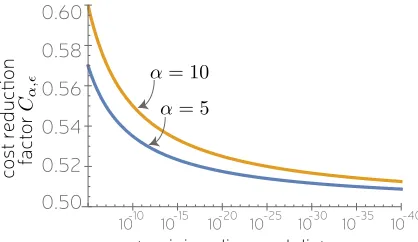
FIG. 1. The resource savings of our approach over unitary gate-synthesis isCγ
α,ǫand here we showCα,ǫ(see Eq. (13)) forα= 5,10
and a range of post-mixing error rates. The differentαcorrespond to different constant factors in Eq. (7) and Eq. (11).
problem instances, though such anomalies are probably quite rare. We proceed on the mild assumption that improved worst-case resource costs accurately reflect actual resource savings, and next give a precise account of this saving.
The form offfor unitary gate-synthesis is typicallyf(ǫ)∼
Alog(ǫ−1)γupto a smallO{log[log(ǫ−1)}contribution. Our reduced cost is then
f(pǫ/α)∼Alog((ǫ/α)−1/2)γ
(12)
∼A
log(ǫ−1) + log(α) 2
γ
∼Alog(ǫ−1)γ
1 2 1 +
log(α) log(ǫ−1)
γ
.
Therefore, our resource savings are a factorCγ
α,ǫwhere
Cα,ǫ=
1 2 1 +
log(α) log(ǫ−1)
(13)
collects the terms in the square bracket of Eq. (12). In the smallǫlimit we haveCα,ǫ →1/2. Typically,ǫis very small with many algorithms requiringǫ ≪ 10−10 and soC
α,ǫ ∼ 1/2is a reasonable approximation. Convergence toward1/2 is shown in Fig. 1, with the speed of convergence dictated by
α. When proving our theorems we focus on clarity rather than minimisingαand believe smallerαis plausible. Lastly, recall that for single qubit problems known algorithms haveγ= 1, but in other settings differentγmay appear.
III. THE MIXING LEMMA
Here we prove a Lemma that underpins both Thm. 1 and Thm. 2, and may also enable further extensions.
Lemma 1 LetV be a target unitary, with associated channel V(ρ) =V ρV†. Leta, b >0and{U
1, U2, . . . , Un}be a set of unitaries such that
1. for allj∈ {1, . . . , n}we have||Uj−V|| ≤a;
2. there exist positive numbers{pj}such thatPnj=1pj = 1and||(P
jpjUj)−V|| ≤b.
It follows thatE =P
jpjUjsatisfies
||E − V||⋄≤a2+ 2b. (14)
We will find constructions wherea=O(ǫ)andb=O(ǫ2), so that the diamond norm is upper bounded byO(ǫ2).
For now, we prove the above Lemma. We begin by defining
δj :=Uj−V so that||δj|| ≤a. We also have
X
j
pjδj =
X
j
pjUj
−V, (15)
with condition (2) of the lemma entailing that||P
jpjδj|| ≤
b. The channelEacts as
E(X) =X
j
pjUjXUj†, (16)
=X
j
pj(V +δj)X(V†+δ†j).
Since the diamond norm is unitarily invariant, we have
d⋄(E,V) =d⋄(V†◦ E,1l)where
(V†◦ E)(X) =X
j
pjV†UjXUj†V (17)
=X
j
pj(1l + ˜δj)X(1l + ˜δ†j)
=X
j
pj(X+ ˜δjX+X˜δj†+ ˜δjXδ˜†j),
whereδ˜j := V†δj. Since the operator norm is unitarily in-variant, we have||P
jpjδ˜j|| =||Pjpjδj|| ≤b. Compared to the identity channel1l, and usingP
jpj= 1, we have
(V†◦ E −1l)(X) =X
j
pj(˜δjX+X˜δj†+ ˜δjXδ˜†j). (18)
Taking the 1-norm and using the triangle inequality, we have
||(V†◦ E −1l)(X)||1≤||
X
j
pj˜δjX||1+||
X
j
pjX˜δj†||1
+X
j
pj||δ˜jXδ˜†j||1. (19)
Using the H¨older inequality and||X||1≤1, we have
||(V†◦ E −1l)(X)||
1≤ ||
X
j
pj˜δj||+||
X
j
pj˜δj†|| (20)
+X
j
pj||δ˜j|| · ||˜δj†||.
Noting the property ||M|| = ||M†|| and condition (1) of
4
the last sum of terms is upper bounded bya2. The first two summations are likewise bounded bybby virtue of condition (2). Therefore,
||(V†◦ E −1l)(X)||1≤a2+ 2b, (21)
which is true for allX. If we tensor the channels with the identity this does not affect the proof except to burden the notation, and so
||((V†◦ E − I)⊗ I)(X)||
1≤a2+ 2b. (22) Since this is true for allX the diamond norm is also upper bounded bya2+ 2b. This completes the proof.
IV. GENERAL ROTATIONS
We show here that Thm. 1 follows from Lem. 1. First, let Gǫbe the subset ofhGisuch that they can be synthesized with cost not exceeding f(ǫ). We have thatGǫ is an ǫ-cover of L. That is, for allV ∈ Lthere exists aU ∈ Gǫ with||U −
V|| ≤ǫ. Since we work with a unitarily invariant norm this can be restated as||V†U −1l|| ≤ǫ. We shift to a Hermitian
representation and define aH such that U = V eiH. Since
U ∼V we can chooseHto have small norm, which we verify later. Our goal is to not just find a singleU close toV but a whole set{Uj}jthat allows us to use the following
Lemma 2 Let {Hj}j be a set of bounded Hermitian oper-ators ||Hj|| ≤ c for all j. Assume, the origin lies within the convex hull0∈Conv[{Hj}j]with convex decomposition 0 =P
jpjHj. It follows that
1. ||eiHj−1l|| ≤c+c 2
2 for allj;
2. ||P
jpjeiHj−1l|| ≤ c 2 2.
WhenUj = V eiHj for some unitaryV, this can be restated as
1. ||Uj−V|| ≤c+c 2
2 for allj;
2. ||P
jpjUj−V|| ≤ c 2 2.
Clearly, such a set of Hermitian operators would allow us to use Lem. 1 with constants related bya=c+c22 andb= c22, yielding an upperbound ofa2+ 2b = O(c2). The lemma is proved by expanding the exponentials into a power series and using standard norm properties, as shown in App. A.
The key point is that we seek a set of Hermitian oper-ators, such that the origin is contained within the convex hull of these points. Next, we present an explicit method for finding such a convex decomposition of Hermitian operators. We assume access to an oracle performing the relevant gate-synthesis decompositions. We outline the al-gorithm for finding a suitable convex set containing the origin.
Convex hull finding algorithm
1. Call oracle to findU1such that||U1−V|| ≤ǫ;
2. Find principleH1such thatU1=V eiH1;
3. Setn= 2and loop the following
(a) Findµn ∈ Conv[{Hj}1≤j≤n−1]with minimum
||µn||;
(b) If||µn||= 0then EXIT LOOP;
(c) DefineWn =V eiτnwhereτn:=−rǫµn/||µn||; (d) Call oracle to findUnsuch that||Un−Wn|| ≤ǫ; (e) Find principleHnsuch thatUn=V eiHnand
ap-pend to set{Hj}1≤j≤n−1;
(f) n→n+ 1and return to start of loop.
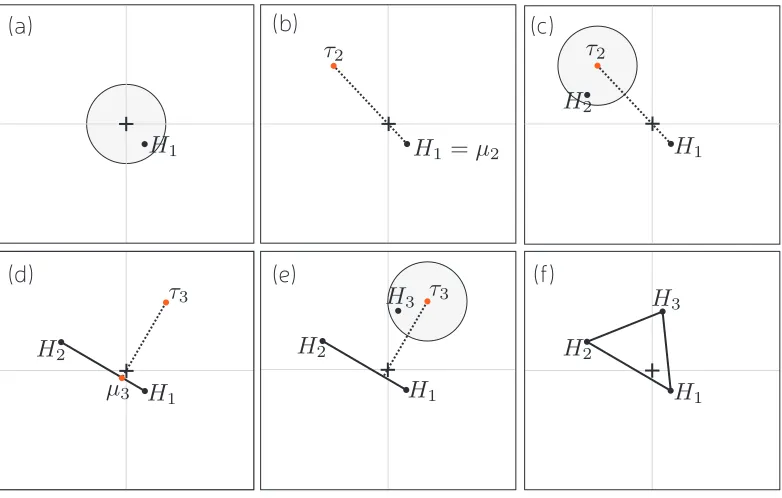
The calculation in step 3(a) is a convex optimisation problem and can be solved using standard interior-point methods. The whole algorithm has two free parametersǫandr(see step 3b). In our analysis we assumeǫ≤0.01, and for all practical ap-plications this is easily satisfied. We taker= 2for simplicity, and the exact constants in our bounds and convergence rates depend on this choice. The algorithm behaves qualitatively the same for differentrsettings, assumingǫ−1≫r >1. The algorithm has two important properties that we discuss below, leaving technical details until the appendices. The basic geo-metric intuition behind the algorithm is illustrated in Fig. 2.
First, for allHjfound by the algorithm we have
||Hj|| ≤3ǫ+ 7ǫ2, (23)
which we show in App. B. This provides us with the value
c= 3ǫ+ 7ǫ2to be substituted into Lem. 2, which traced back leads to the diamond norm upper bound
d⋄(E,U)≤
1 2(a
2+ 2b) = 1 2
"
c+1 2c
2
2
+c2
#
(24)
≤10ǫ2,
where the last line usesǫ < 0.01to simplify higher order terms. This gives the upper bound stated in Thm. 1.
The second important property of the algorithm is that it eventually terminates. EachUn is distinct, and in particular itsHn falls outside the convex hull of previous points (see App. C for proof). If we further assume that there are a finite number of distinct points with bounded resource cost, then there are only a finite number of possibleUnfor the algorithm to output. Since each is distinct, the algorithm must terminate in a finite number of steps. The additional assumption of a finite number of suitable points is very mild, and is satisfied both for the Clifford+T gate set and also any gate set where all gates have non-zero cost. Furthermore, below we see that the algorithm need not terminate, but that sufficient iterations will work equally well.
A finite number of steps may still be very many, but we have evidence the converge is very fast. First we note that in a
(a)
(b)
(c)
(d)
(e)
(f)
H
1H
1τ
2τ
2H
2H
1H
2τ
3µ
3H
1=
µ
2H
1H
2τ
3H
3H
1H
2 [image:6.612.116.507.60.309.2]H
3FIG. 2. The geometric intuition of the convex hull finding algorithm. The cross marks the origin corresponding toV. (a) We find aU1=V eiH1
so thatH1is near the origin. (b) We extrapolate fromµ2=H1through the origin to a pointτ2. (c) We find aU2=V eiH2
close toV eiτ2 , so thatH2is near toτ2. (d) We form the convex hull ofH1andH2and find the pointµ3, which is closest to the origin. From here we extrapolate out through the origin to the pointτ3. (e) We find aU3 =V eiH3 close toV eiτ3, so thatH3 is near toτ3. (f) We form the convex hull of H1, H2andH3and find the origin lies inside the hull, and so the algorithm terminates. Note that none of theHjcan stray far from the origin.
the analogous setup in Euclidean geometry hints that it will always find an enclosing simplex ind+ 1iterations, though it is unclear whether this carries over to the topology induced by the operator norm. We can be more quantitative by consid-ering the quantity||µn||, which measures the distance from the convex hull. Recall that the convex hull finding algorithm halts when||µn||= 0. Further evidence of rapid convergence is that ||µn|| decreases exponentially fast. Specifically, we find there exists aw >0.62such that
||µn||<6ǫe−wn, (25)
so the convergence toward zero is exponentially fast. Even ex-ponentially small||µn||may be nonzero, but once||µn|| ≪ǫ2 the preceding proofs can be adapted to account for nonzero ||µn||with negligible influence on the upper bounds. All con-vergence proof details are given in App. C.
V. AXIAL ROTATIONS
We now consider a setting where the targetV is an axial rotation of a single qubit. The only assumption we make about the generating gate set is that it contains PauliZ as a free resource. Given a protocol for axial-synthesis, for all such
V =eiθZ and anyǫ >0there exists at least oneU
1such that ||U1−V|| ≤ǫand whereU1 has cost not exceedingfax(ǫ) for somefax. Recall thatfax is polylogarithmic inǫ−1. For
instance, the Ross-Selinger algorithm satisfies the worst case boundfax(ǫ) ≤4 log2(1ǫ), and3 log2(1ǫ)on average. It will prove useful to considerV†U
1and expand in the Pauli basis
V†U
1=α1l1l +iαXX+iαYY +iαZZ. (26) We sayU1is an over-rotation ifαZ ≥0and an under-rotation ifαZ <0. We require a second unitaryU2such that the pair {U1, U2} contains one over-rotation and one under-rotation. We can assumeαZ 6= 0as otherwise the second rotation is not needed. For the second rotation, we will use the Pauli expansion
V†U
2=β1l1l +iβXX+iβYY +iβZZ. (27) Gate-synthesis only ensures one unitary such that||U1−V|| ≤
ǫ, but a suitableU2 can be found only slightly further away. Specifically, there must exist a suitableU2 with cost below
f(ǫ). To verify this, one first constructs an axial rotationV′
with||V −V′||=ǫand||U
1−V′||> ǫ. Specifically, using
V =eiθZ andV′ =ei(θ+δ)Zthen the two values
δ=±2 arcsin(√ǫ/2), (28)
both ensure that||V −V′||=ǫ. Choosing the the sign ofδto
match the sign ofαZ, it follows that||U1−V′||>||V−V′||=
ǫ. Unitary gate synthesis must then provide aU26=U1within
ǫofV′, such that||U
6
andU4=ZU2Z, with
V†U3=α1l1l−iαXX−iαYY +iαZZ, (29)
V†U
4=β1l1l−iβXX−iβYY +iβZZ.
Considering the set{U1, U2, U3, U4}it follows immediately that they satisfy condition (1) of Lem. 1 witha= 2ǫ. Next, we assign them weights{pj}={1−q
2 , q 2,
1−q 2 ,
q
2}where0≤
q≤1will be fixed later. The linear combination is
X
j
pjV†Uj =((1−q)α1l+qβ1l)1l (30)
+i((1−q)αZ+qβZ)Z.
Subtracting the identity and taking the operator-norm squared,
||X
j
pjV†Uj−1l||2=((1−q)α1l+qβ1l−1)2 (31)
+ ((1−q)αZ+qβZ)2.
We now fixqto eliminate the second term. Considering the variables{αZ,βZ},one is positive (an over-rotation) and the other negative (an under-rotation), so zero sits within the con-vex hull of these variables and suitableqcan be found. Specif-ically
q= αZ
αZ−βZ
, (32)
satisfies 0 ≤ q ≤ 1. With the second term cancelled and taking square roots we have
||X
j
pjV†Uj−1l||=|q(β1l−α1l) + (1−α1l)|. (33)
By the triangle inequality and|q| ≤1, we have
||X
j
pjV†Uj−1l|| ≤ |β1l−α1l|+|α1l−1|. (34)
Inserting1−1 = 0, so thatβ1l−α1l= (β1l−1) + (1−α1l), and again using the triangle inequality, we arrive at
||X
j
pjV†Uj−1l|| ≤ |β1l−1|+ 2|α1l−1|. (35)
From||V†U
1−1l|| ≤ǫwe can infer that
||(α1l−1)1l +iαXX+iαYY +iαZZ||2≤ǫ2. (36)
Evaluating the left hand side, we obtain
(α1l−1)2+α2X+α2Y +αZ2 ≤ǫ2. (37)
Unitarity ofV†U
1entails thatα21l+α2X+α2Y +α2Z = 1and after some simplification, we find
(α1l−1)2+α2X+α2Y +αZ2 = (α1l−1)2+ (1−α21l), = 2(1−α1l)≤ǫ2. (38)
From which we infer |1 −α1l| ≤ ǫ2/2. Similarly, from
||V†U
2−1l|| ≤2ǫwe can infer|1−β1l| ≤2ǫ2. Substituting into Eq. (35), we have
||X
j
pjV†Uj−1l|| ≤3ǫ2, (39)
Therefore, we have demonstrated both the necessary condi-tions of Lem. 1 witha = 2ǫ and b = 3ǫ2. Applying the Lemma, our channel satisfies
d⋄(E,V)≤
1 2(a
2+ 2b)
≤5ǫ5. (40)
A smaller factor than 5 is likely to be provable.
VI. CONCLUSIONS
We have seen that worst-case resource costs of fault-tolerant quantum computing can be reduced by switching to a randomised approach to gate-synthesis. It may seem coun-terintuitive that a randomisation process can be advantageous. However, convexity of the diamond distance naturally entails that mixing over channels of similar noise levels can only re-duce the noise.
We presented a convex hull finding algorithm for finding the suitable mixing ratios. While this algorithm is exponen-tially fast, it is plausible that a constant time algorithm exists. We suspect that a variant of Delaunay triangulation could be used to quickly identify a suitable simplex. However, our liter-ature search on Delaunay triangulation has only found results on Euclidean space and we have yet to ascertain if such tools carry over to the operator norm topology.
This work has only considered mixing over unitary chan-nels, which prompts the question whether more general quan-tum channels might be useful. Probabilistic quanquan-tum circuits with fallback [8] is an approach to gate-synthesis that is not entirely unitary, though it makes use of an ancillary qubit and works very differently to the approach presented here. As re-marked earlier, mixing can be useful in preparation of differ-ent magic states [16]. We ponder whether all these approaches can be understood within a single framework of quantum channel synthesis.
Acknowledgements.- We thank Yuan Su, Vadym Kliuch-nikov, Steve Flammia, Jens Eisert, Mark Howard, Luke Heyfron, Neil J. Ross, Mark Pearce and Scott Vinay for re-lated discussions. Several of these discussions were facilitated by the Centro de Ciencias de Benasque. This work was sup-ported by the EPSRC (EP/M024261/1).
Appendix A: Convex hull proof
|λk| ≤ ||M||for allk. We consider the operator
eiM−(1l +iM) =
∞ X
n=2 1
n!(iM) n.
(A1)
This can be diagonalised in the eigenbasis of M and has eigenvaluesfM(λk) :=eiλk−1−iλk. Therefore, we have
||eiM−(1l +iM)||= maxk|fM(λk)|. (A2)
On the interval|x| ≤π, one can verify that|eix−1−ix| ≤ 1
2x
2, and so provided||M|| ≤πwe have
||eiM−(1l +iM)|| ≤ 12||M||2. (A3)
Now turning specifically to Lem. 2, we have
||eiHj−1l||=||
∞ X
n=1 1
n!(iHj) n
|| (A4)
≤ ||Hj||+||
∞ X
n=2 1
n!(iHj) n
||. (A5)
Since we always choose the principleHj, we have||Hj|| ≤π and we can use Eq. A3 to find
||eiHj −1l|| ≤ ||H
j||+1 2||Hj||
2
≤c+1
2c 2.
(A6)
Recall that in Lem. 2 we defined c so that||Hj|| ≤ c for all Hj, which explains the second inequality. Therefore,
||eiHj|| ≤c+c
2
2. This shows property (1) of Lem. 2. Next we consider the convex sum of unitaries,
X
j
pjeiHj = 1l + (
X
j
ipjHj) +
X j pj ∞ X n=2 (iHj)n
n! , (A7)
which is split into zeroth, first and higher order terms. By assumption the linear terms vanish. Therefore,
||X
j
pjeiHj−1l||=||
X j pj ∞ X n=2 (iHj)n
n! ||, (A8)
≤X j pj|| ∞ X n=2 (iHj)n
n! ||
≤X j pj c2 2 = c2 2.
Going from second to third line, we have again used Eq. A3. This proves Lem. 2.
Appendix B: Bounding||Hn||.
We wish to upper bound ||Hn|| in terms of ǫ, the preci-sion to which gate synthesis is assessed. The operatorHn is chosen so that eiHn provides a certain unitary, U
n, and the
eigenvalues are chosen within the interval[−π, π). Further-more, on this interval one has that all eigenvaluesθ satisfy
|θ| ≤ |eiθ−1|+1
2|e
iθ−1|2. It follows that
||Hn|| ≤ ||eiHn−1l||+1 2||e
iHn−1l||2. (B1)
Next, we note that for eachn >1we have
||eiHn−1l||=||U
n−V|| (B2)
≤ ||Un−Wn||+||Wn−V||
≤ǫ+||eiτn−1l||
≤ǫ+||τn||+||τn||
2 2
≤3ǫ+ 2ǫ2.
Then= 1case is similar but without the||Wn−V|| contri-bution. Combining this with Eq. (B1) we have
||Hn|| ≤ 3ǫ+ 2ǫ2
+1
2 3ǫ+ 2ǫ 22
. (B3)
Assumingǫ <0.01this can be simplified to
||Hn|| ≤3ǫ+ 7ǫ2, (B4)
as reported in the main text. This gives the value ofc for Lem. 2.
Appendix C: Convergence proof
Next we show that eachUnis new by showing the strictly monotonic decrease of||µn||. Furthermore, we show expo-nential decrease of||µn||withn. We begin by translating the closeness ofUntoWninto the space of Hermitian operators. We define
∆n:=Hn−τn, (C1)
and later will find an upper bound on||∆n||. First we use these operators to construct a point in the new convex hull. Mixing
Hnandµngives a point in the convex hull, which must have norm no larger than||µn+1||, so that
||µn+1|| ≤ ||λHn+ (1−λ)µn|| (C2)
=||µn
1−λ
1 + 2 ǫ
||µn||
+λ∆n||.
If we consider when
λ=
1 + 2 ǫ
||µn||
−1
= ||µn||
||µn||+ 2ǫ, (C3)
then it is easy to see0 < λ <1and that the square bracket vanishes so that
||µn+1|| ≤λ||∆n||= ||
µn||
8
This iteration begins withµ2=H1. Further progress requires an upper bound on||∆n||, which we now take a lengthy detour to find.
Adding several terms of the form0 = (x−x)to∆n, we have
∆n =(−i1l +Hn+ieiHn) + (iV†Wn−ieiHn) (C5)
+ −iV†Wn+i1l−τn.
Taking the norm and applying triangle inequality, we get
||∆n|| ≤||1l +iHn−eiHn||+||V†Wn−eiHn|| (C6)
+||1l +iτn−V†Wn||
=||1l +iHn−eiHn||+||Wn−Un||
+||1l +iτn−eτn||. (C7)
For the middle term we know||Wn −Un|| ≤ǫ, and for the first and last terms we again use Eq. A3, so that
||∆n|| ≤ 1
2||Hn||
2+ǫ+1 2||τn||
2
(C8)
≤ 12(3ǫ+ 7ǫ2)2+ǫ+1
2(2ǫ) 2.
We can again use ǫ ≤ 0.01 to bound higher order terms to
obtain
||∆n|| ≤ǫ+ 7ǫ2. (C9)
Plugging this in Eq. (C4), we have
||µn+1|| ≤ ||µn||
ǫ+ 7ǫ2
||µn||+ 2ǫ (C10)
<||µn||1
2(1 + 7ǫ),
where we have used that0<||µn||. Iterating this argumentn times we find exponential behaviour
||µn+1||<||µ2||e−w(n−1), (C11)
wherew= ln(2)−ln(1 + 7ǫ). Using our earlier assumption that0 < ǫ <0.01guarantees that0.69315> w >0.62548. In most instances convergence will be much faster than en-sured by this proof, often jumping to ||µn+1|| = 0 within only a few iterations. Last we note thatµ1 = H1 and that
||H1|| ≤ ||V −U1||+12||V −U1||2≤ǫ+12ǫ2, which gives
||µn||< ǫ
1 +1 2ǫ
e−w(n−2)
(C12)
=ǫ
1 + 1 2ǫ
e2w
e−wn.
Sincee−w>1/2, we havee2w<4. Combined withǫ <0.01 we know the square bracket cannot exceed 6, which leads to Eq.(25).
[1] A. Y. Kitaev, A. Shen, and M. N. Vyalyi, Classical and quantum computation, Vol. 47 (American Mathematical Soci-ety Providence, 2002).
[2] C. M. Dawson and M. A. Nielsen, Quantum Info. Comput.6, 81 (2006).
[3] A. G. Fowler, Quantum Information and Computation11, 867 (2011).
[4] T. T. Pham, R. Van Meter, and C. Horsman, Physical Review A87, 052332 (2013).
[5] V. Kliuchnikov, D. Maslov, and M. Mosca, Phys. Rev. Lett. 110, 190502 (2013).
[6] M. Amy, D. Maslov, M. Mosca, and M. Roetteler, Computer-Aided Design of Integrated Circuits and Systems, IEEE Trans-actions on32, 818 (2013).
[7] N. J. Ross and P. Selinger, Quantum Information and Computa-tion16, 901 (2016).
[8] A. Bocharov, M. Roetteler, and K. M. Svore, Phys. Rev. Lett. 114, 080502 (2015).
[9] Y. R. Sanders, J. J. Wallman, and B. C. Sanders, New Journal of Physics18, 012002 (2015).
[10] R. Kueng, D. M. Long, A. C. Doherty, and S. T. Flammia, Phys. Rev. Lett.117, 170502 (2016).
[11] E. Knill, arXiv preprint quant-ph/0404104 (2004).
[12] O. Kern, G. Alber, and D. L. Shepelyansky, The European Physical Journal D-Atomic, Molecular, Optical and Plasma Physics32, 153 (2005).
[13] V. Kliuchnikov, D. Maslov, and M. Mosca, IEEE Transactions on Computers65, 161 (2016).
[14] J. J. Wallman and J. Emerson, Phys. Rev. A94, 052325 (2016). [15] G. C. Knee and W. J. Munro, Phys. Rev. A91, 052327 (2015). [16] E. T. Campbell and J. O’Gorman, Quantum Science and
Tech-nology1, 015007 (2016).
[17] M. B. Hastings, “Turning gate synthesis errors into incoherent errors,” ArXiv:1612.01011v1.
[18] R. A. Horn and C. R. Johnson,Matrix Analysis (Cambridge, 2006).
[19] R. Bhatia,Matrix analysis, Vol. 169 (Springer Science & Busi-ness Media, 2013).
[20] A. Y. Kitaev, Russian Mathematical Surveys52, 1191 (1997). [21] D. Aharonov and M. Ben-Or, inProceedings of the twenty-ninth
annual ACM symposium on Theory of computing(ACM, 1997) pp. 176–188.
[22] J. Emerson, R. Alicki, and K. ˙Zyczkowski, Journal of Optics B: Quantum and Semiclassical Optics7, S347 (2005). [23] J. Emerson, M. Silva, O. Moussa, C. Ryan, M. Laforest,
J. Baugh, D. G. Cory, and R. Laflamme, Science317, 1893 (2007).
[24] E. Knill, D. Leibfried, R. Reichle, J. Britton, R. B. Blakestad, J. D. Jost, C. Langer, R. Ozeri, S. Seidelin, and D. J. Wineland, Phys. Rev. A77, 012307 (2008).
[26] D.-S. Wang, D. W. Berry, M. C. de Oliveira, and B. C. Sanders, Phys. Rev. Lett.111, 130504 (2013).
[27] D.-S. Wang and B. C. Sanders, New Journal of Physics 17, 043004 (2015).
[28] S. Bravyi and A. Kitaev, Phys. Rev. A71, 022316 (2005). [29] S. Bravyi and J. Haah, Phys. Rev. A86, 052329 (2012). [30] A. M. Meier, B. Eastin, and E. Knill, Quant. Inf. and Comp.
13, 195 (2013).