White Rose Research Online URL for this paper:
http://eprints.whiterose.ac.uk/141778/
Version: Published Version
Article:
de Sousa, P., Sellwood, W., Fien, K. et al. (6 more authors) (2018) Mapping early
environment using communication deviance: A longitudinal study of maternal sensitivity
toward 6-month-old children. Development and Psychopathology. pp. 1-11. ISSN
0954-5794
https://doi.org/10.1017/S0954579418001189
[email protected] https://eprints.whiterose.ac.uk/ Reuse
This article is distributed under the terms of the Creative Commons Attribution (CC BY) licence. This licence allows you to distribute, remix, tweak, and build upon the work, even commercially, as long as you credit the authors for the original work. More information and the full terms of the licence here:
https://creativecommons.org/licenses/
Takedown
If you consider content in White Rose Research Online to be in breach of UK law, please notify us by
Regular Article
Mapping early environment using communication deviance: A
longitudinal study of maternal sensitivity toward 6-month-old
children
Paulo de Sousa1, William Sellwood2, Kirsten Fien1, Helen Sharp1, Andrew Pickles3, Jonathan Hill4, Kate Abbott1,
Louise Fisher1 and Richard P. Bentall5
1School of Psychology, University of Liverpool, Liverpool, UK;2Institute of Psychiatry, Division of Health Research, Lancaster University, Lancaster, UK;3King
’s College London, London, UK;4School of Psychology and Clinical Language Sciences, University of Reading, Reading, UK and5Department of Psychology, University of Sheffield, Sheffield, UK
Abstract
Communication deviance (CD) reflects features of the content or manner of a person’s speech that may confuse the listener and inhibit the establishment of a shared focus of attention. The construct was developed in the context of the study of familial risks for psychosis based on hypotheses regarding its effects during childhood. It is not known whether parental CD is associated with nonverbal parental behaviors that may be important in early development. This study explored the association between CD in a cohort of mothers (n= 287) at 32 weeks ges-tation and maternal sensitivity with infants at 29 weeks in a standard play procedure. Maternal CD predicted lower overall maternal sensi-tivity (B=–.385;p< .001), and the effect was somewhat greater for sensitivity to infant distress (B=–.514;p< .001) than for sensitivity to nondistress (B=–.311;p< .01). After controlling for maternal age, IQ and depression, and for socioeconomic deprivation, the associations with overall sensitivity and sensitivity to distress remained significant. The findings provide new pointers to intergenerational transmission of vulnerability involving processes implicated in both verbal and nonverbal parental behaviors.
(Received 30 July 2017; revised 16 July 2018; accepted 31 July 2018)
Communication Deviance (CD)
The concept of CD, first proposed by Lyman Wynne and Margaret Singer (e.g., Wynne & Singer, 1963a, 1963b) in an attempt to understand familial predictors of psychosis, refers to qualities of communication, usually coded from parental speech, that leave a listener uncertain, puzzled, and unable to share a focus of attention with the speaker. It is defined in terms of a range of verbal-linguistic atypicalities that are believed to disrupt the establishment and maintenance of focus of attention during communication. These atypicalities are argued to impair the development of conversational alignment between interlocutors, compromising shared meaning and grounding (i.e., mutual knowledge, beliefs, and assumptions; Miklowitz & Stackman,
1992; Nuechterlein, Goldstein, Ventura, Dawson, & Doane,
1989; Singer & Wynne, 1965a, 1965b; Wynne & Singer,1963a,
1963b; Wynne, Singer, Bartko, & Toohey,1977). They are subtle and can range from ambiguous linguistic references (e.g., “Kid
stuff that’s one thing but something else is different too”;
Velligan, Goldstein, Nuechterlein, Miklowitz, & Ranlett, 1990, p. 18) or contradictions (e.g., “I didn’t get much sleep last
night. [Interviewer: Are you tired?] Yeah, I ain’t tired”;
Docherty,1993, p. 753) to more overarching nonverbal character-istics at the level of the pragmatics of communication (e.g., mis-timed turn taking; Wynne et al.,1977).
The concept of CD possibly overlaps with other constructs measured in developmental longitudinal studies, but has some specific elements. For example, there is a substantial literature on the relationship between parents’ mental representations of
attachment, coded from their accounts of their own childhood attachment-related experiences and their sensitivity to their infants’attachment signals (van Ijzendoorn, Juffer, & Duyvesteyn,
1995; Verhage et al.,2016). The concept of narrative coherence, which is rated from the Adult Attachment Interview in terms of representations of attachment that are well integrated, clear, rele-vant, and reasonably succinct, appears similar to the concept of CD. However, CD differs from narrative incoherence because it is defined entirely in terms of the quality and formal aspects of the speech and communication of the parent (e.g., unintelligible remarks, odd word usage, etc.). Similarly, some developmental studies have measured maternal expressed emotion (EE) with one study showing a significant association between parental EE, measured during pregnancy, and lower levels of sensitive par-enting when the child was aged 4 (Lucassen et al., 2015). However, EE is defined in terms of parental overinvolvement,
Author for correspondence:Helen Sharp, Institute of Psychology, Health and Society, University of Liverpool, Eleanor Rathbone Building, Bedford Street South, Liverpool, L69 7ZA, UK; E-mail:[email protected].
© Cambridge University Press 2018. This is an Open Access article, distributed under the terms of the Creative Commons Attribution licence (http://creativecommons.org/licenses/by/ 4.0/), which permits unrestricted re-use, distribution, and reproduction in any medium, provided the original work is properly cited.
criticism, or hostility, and not the parents’quality of
communica-tion or speech, and the two constructs appear to be readily distin-guishable from each other (Velligan, Goldstein, Nuechterlein, Miklowitz, & Ranlett,1990).
Wynne (1981) proposed that CD in the caregiver, in interac-tion with genetic vulnerability in the offspring, would lead to the escalation of the cognitive and affective abnormalities, espe-cially thought disorder (TD), later observed in schizophrenia. Consistent with this hypothesis, a recent meta-analysis of 20 stud-ies (N= 1,753) found a large magnitude (g= .97) association between maternal (but not paternal) CD and offspring diagnosis of psychotic disorder (de Sousa, Varese, Sellwood, & Bentall,
2014). Moreover, in a longitudinal study of children attending a child guidance service, Goldstein (1987) found that both CD and EE were independently strong predictor of later psychosis.
The relationship between CD and genetic risk for schizophre-nia was explored by Wahlberg et al. (1997, 2000), who used an adoption study design to show that the interaction between hav-ing a biological mother diagnosed with schizophrenia and adop-tive parents’CD was a significant predictor of TD in the adoptee.
In this study, high genetic risk alone did not predict TD (high genetic-risk adoptees, when exposed to low CD parents, displayed less TD than low-risk adoptees).
Despite these important findings, it is important to acknowl-edge that it remains unclear whether parental CD is a risk factor specific to TD, schizophrenia, or a wider range of psychiatric conditions (Roisko, Wahlberg, Miettunen, & Tienari, 2014). Furthermore, it is possible that CD may reflect an important envi-ronmental risk for a range of mental health disorders (Wahlberg et al.,2004).
The Influence of CD on Cognitive and Social Development
Given that parental, especially maternal CD is associated with later psychiatric symptoms in offspring, it is important to inves-tigate mechanisms that could account for this relationship. Wynne and Singer argued that parental CD has this effect through its pervasive impact on the offspring’s social and
cogni-tive development during formacogni-tive years (Wynne et al., 1977). According to them, this development is embedded in different facets of family relatedness such as caregiving, problem solving, mutuality, and intimacy, and these facets represent evolving and increasingly complex levels of interconnected dyadic and familial interaction (Wynne,1984,1988). Within this framework, children learn to share and sustain foci of attention, and thereby derive meaning from the world around them, through communication with their caregivers (Wynne, 1981, 1984). Atypicalities at the level of communication in the caregiver can therefore disrupt very early development through their expression at the more basic level of relatedness with the infant during early preverbal dialogues (Wynne, 1968). In this context, CD is conceptualized as a risk marker for parental mental processes that might give rise to disruptions to the caregiving system (Singer & Wynne,
1966a,1966b).
However, empirical evidence on mechanisms linking CD to specific developmental processes in early childhood has so far been limited. Cross-sectional studies have found that CD in the caregiver is associated with poorer social, cognitive, and emo-tional development in the 7- and 10-year-old children of parents diagnosed with severe mental health disorders (Doane et al.,
1982), and with social withdrawal and behavioral problems in 9-year-olds (Velligan, Christensen, Goldstein, & Margolin,
1988). Drawing from data collected in a high-risk longitudinal study (the University of Rochester Child and Family Study; Wynne, Cole, & Perkins, 1987), Wynne and his colleagues reported associations between parental communication that is vague, contradictory, and unresponsive and both anxiety (Wichstrøm, Holte, & Wynne, 1993) and poorer social compe-tence in 7- and 10-year-old children (Wichstrøm, Holte, Husby, & Wynne,1993,1994). In the same high-risk cohort, but at longer follow-up (≥18 years of age), unresponsive communication in
parents significantly predicted psychological distress, poorer well-being, and global mental health in the offspring (Wichstrøm, Anderson, Holte, Husby, & Wynne, 1996), and disconfirmatory communication, which ignores or rejects what the child says, was a significant predictor of poor interpersonal functioning and mental health hospitalization (Wichstrøm, Anderson, Holte, Husby, et al.,1996).
The study of parental representations may provide further clues about the likely developmental impact of CD. An important body of literature on the Working Model of the Child Interview (WMCI; Vreeswijk, Maas, & van Bakel,2012) emerging during the last decade has shown that distorted maternal representations of offspring are a predictor of atypical and noncontingent mater-nal behaviors (Schechter et al.,2008) and poorer quality of dyadic interactions between the caregiver and the child (Korja et al.,
2010). In this literature, distorted representations are character-ized by descriptions of the child that are incoherent, confused, contradictory, or even bizarre (Vreeswijk et al.,2012). Of partic-ular significance for the present purposes, some studies have explored mothers’ representations of their future children using
a prenatal version of the WMCI, observing that distorted maternal representations during pregnancy are associated with higher levels of hostility and anger in caregiver’s interaction
with the infant at 12 months postpartum (Dayton, Levendosky, Davidson, & Bogat,2010) and more disengagement and less sen-sitive and warm parenting (Theran, Levendosky, Bogat, & Huth-Bocks,2005).
Maternal Sensitivity
Maternal sensitivity is defined in terms of the extent to which the caregiver’s responses to infant cues are contingent, appropriate,
interested, and warm (Bornstein & Tamis-Lemonda, 1997). Its importance during infancy is supported by diverse findings. For example, low maternal sensitivity during infancy predicts harsh parental discipline during toddlerhood (Joosen, Mesman, Bakermans-Kranenburg, & van Ijzendoorn,2012), and interacts with monamine oxidase A (MAOA) polymorphisms in offspring to predict temperamental anger proneness (Pickles et al., 2013), and with dopamine D4 receptor (DRD4) polymorphisms in off-spring to predict child externalizing behaviors (Bakermans-Kranenburg & van Ijzendoorn,2006).
socioeconomic factors and child’s sex (Raby, Roisman, Fraley, &
Simpson,2014). Van der Voort et al. (2014) addressed the possi-bility of genetic confounding in a longitudinal study of children adopted in infancy and found that maternal sensitivity during infancy predicted internalizing symptomatology during adoles-cence. A causal role for maternal sensitivity is further supported by clinical trials of attachment-based interventions that show that rates of insecure or disorganized attachment can be reduced by increasing maternal sensitivity (Juffer, Bakermans-Kranen-burg, & van Ijzendoorn,2005; van Ijzendoorn et al.,1995).
Methods of assessing maternal sensitivity vary considerably in the extent to which they use home or lab-based observations, whether the conditions are standardized, their coding, or the duration of the observations. It may be that these broad character-izations ignore possible issues of domain specificity whereby aspects of sensitivity that entail different processes may have dif-ferent developmental consequences (Grusec & Davidov,2010). In particular, maternal sensitivity to infant bids for reciprocity in playful interactions are likely to promote joint exploration and joint attention (Hobson, Patrick, Crandell, Perez, & Lee,
2004) and hence cognitive development (Bornstein & Tamis-Lemonda,1997) but does not appear to contribute to attachment security (Murray et al.,2008). In contrast, sensitive and comfort-ing responses to infant distress are associated with attachment security (Leerkes, 2011) but not cognitive development (McElwain & Booth-Laforce, 2006). Moreover, it has been sug-gested that sensitivity to distress and nondistress may have differ-ent anteceddiffer-ents, with the later being significantly associated with sociodemographic factors (e.g., age, education, income, or unin-volved partner) and the former with the caregiver’s emotional
and cognitive competencies and responses to the infant’s negative
emotions (Leerkes,2010; Leerkes, Crockenberg, & Burrous,2004; Leerkes, Weaver, & O’Brien,2012).
Current Study
Previous studies have typically measured parental CD during the child’s early years and have therefore failed to consider the
possi-bility that the association between CD and offspring’s
develop-ment might have been confounded by the evocative effect of child’s behavior on the parents’ communication (Miklowitz &
Stackman, 1992). Just as important for the present purposes, Wynne (1968) originally conceived CD to be a risk marker for parental mental processes that disrupt early caregiving (Singer & Wynne,1966b), but this possibility is difficult to test in studies that focus exclusively on verbal communication between parents and verbally competent children.
In this study, we addressed both of these issues by investigating whether CD measured during pregnancy (in primiparous mothers) was a significant predictor of caregiver–infant
interac-tion at 29 weeks. Given the more recent research that has shown that maternal representations during pregnancy that are incoherent, confused, contradictory, or bizarre, measured with the WMCI, are associated with later parenting characterized by disengagement and less sensitivity and warmth (Theran et al.,
2005), we predicted that increased CD at 32 weeks gestation would be associated with decreased maternal sensitivity during early caregiver–infant dyadic communication and that these
effects would not be accounted for by plausible confounders. Moreover, as maternal sensitivity in the context of infant distress and nondistress may each have distinct antecedents, and different
consequences to the infant’s social and cognitive development, we
examined the contribution of CD to each.
Method
Design
The current study draws on data from the Wirral Child Health and Development Study (WCHADS; Sharp et al., 2012), a pro-spective longitudinal study that aims to identify early social, emo-tional, and biological risks involved in the development of childhood conduct problems.
In the WCHADS, first-time mothers were recruited to estab-lish a general population (extensive sample) from which an inten-sive subsample was drawn. The exteninten-sive sample comprised primiparous mothers (≥18 years of age and English speaking) who sought antenatal care at 12 weeks gestation between February 2007 and October 2008 at the Wirral University Teaching Hospital. The intensive subsample was stratified by psy-chosocial risk (partner psychological abuse), and both samples were then followed in tandem. A detailed flowchart of the sam-pling and recruitment procedure can be found elsewhere (Sharp et al., 2012). This two-stage stratified design enables intensive measurement in the subsample (including the assessment of CD and maternal sensitivity), while collection of other measures across the extensive sample allows weighting back of the findings from the intensive subsample to give general population estimates. At 32 weeks, mothers in the intensive sample provided 5-min speech samples in which they spoke without interruption about their anticipated relationship with their as yet unborn child (Leeb et al.,1991), as described in more detail below. This meth-odology, adapted from a method used to measure EE in patients, has been previously used to measure EE during pregnancy (e.g., Lambregtse-van den Berg et al., 2013; Lucassen et al., 2015). The speech samples were audio-recorded, transcribed by mem-bers of the WCHADS team, and later coded for CD.
At 29 weeks into the postnatal period, mothers completed a 15-min play protocol with their babies in the research base (NICHD Early Child Care Research Network, 1999). Maternal sensitivity was coded from these interactions. Approval for the procedures was obtained from the local Research Ethics Committee.
Recruitment and sample
the intensive sample using methods described in the Statistical Analysis section.
Measures and procedure
CD at 32 weeks of pregnancy
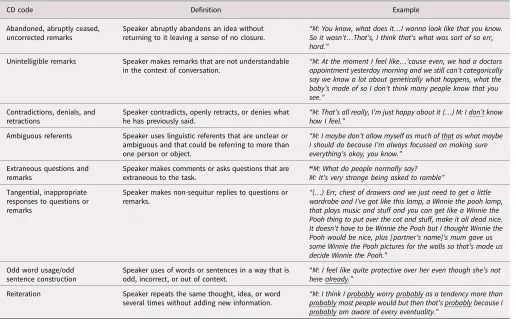
The CD coding system was originally developed for family inter-actions (Velligan,1985) and captures eight different types of com-municational atypicalities that were identified in previous work on CD (Doane & Singer, 1977; Singer & Wynne, 1965a, 1965b,
1966b; Wynne et al., 1977; Wynne & Singer, 1963a, 1963b); namely:
1. Abandoned, abruptly ceased, uncorrected remarks; 2. Unintelligible remarks;
3. Contradictions, denials, and retractions; 4. Ambiguous referents;
5. Extraneous questions and remarks;
6. Tangential, inappropriate responses to questions or remarks; 7. Odd word usage or odd sentence construction; and
8. Reiterations.
Table 1shows definitions and examples for the different codes. CD scores were calculated as the number of instances of CD divided by the number of words spoken to account for verbosity (as recommended by previous researchers; Hirsch & Leff,1971; Miklowitz & Stackman, 1992). This coding protocol has been shown to have good reliability and construct validity (Velligan et al., 1990), and has been previously used with clinical (Velligan, Funderburg, Giesecke, & Alexander, 1995; Velligan et al., 1996) and high-risk populations (Velligan et al., 1988). The system has also been previously applied to 5-min speech samples (Kymalainen, 2005; Kymalainen, Weisman, Rosales, & Armesto,2006), and to natural speech samples (Docherty,1993). The 5-min speech sample used in this study is an adaptation of the procedure developed for use with parents in which they are asked to talk about how they get along with their child (Magaña et al.,1986). The instructions for the original measure are “I’d like to hear your thoughts about [patient’s name] in
your own words and without my interrupting you with any ques-tions or comments. When I ask you to begin, I’d like you to speak
for 5 minutes, telling me what kind of a person [patient’s name] is
and how the two of you get along together. After you have begun to speak, I prefer not to answer any questions. Are there any ques-tions you would like to ask me before we begin?”In adapting this
for use in pregnancy, Lucassen et al. (2015) changed the initial wording to “I would like you to tell me about your unborn
child. What I would like to hear from you is what you expect or hope your child will be like and how you would like to relate to your child.”In view of the emphasis in the original version,
the speakers’ view of the present rather than the future, we
wrote a version that focused on the present and also was appro-priate in pregnancy:“I would like to hear your thoughts and
feel-ings about your baby at the moment, in your own words without me interrupting. When I ask you to begin, I would like you to speak for 5 minutes, tell me what your impressions have been of your baby whilst you’ve been pregnant.”
For purposes of training, the first (P.S.) and third authors (K.F.) both coded 31% (90) of the speech samples. This training period was preceded by the careful reading of relevant papers in the field of CD (Singer & Wynne,1966b) and the coding manual that was kindly provided by its author (Velligan, 1985). Both
coders were only provided with anonymized transcripts and audio-recordings (the only other information available was the participants id number), hence remaining blind to any back-ground information about the mothers and study hypotheses. Following training, both coders independently scored a subset of 30 speech samples (∼10%). Some of the CD codes were very infre-quent (e.g., reiteration) but the estimated reliability was good (intraclass correlations for the different items ranged from .77 to .97). After reliability was established, the first author (P.S.) coded the remainder of the speech samples, including those used in the training. All coding of CD was conducted independently of the coding of maternal sensitivity and blind to all other measures.
Maternal sensitivity at 29 weeks
Maternal sensitivity was assessed with a 15-min standardized laboratory-based protocol (NICHD Early Child Care Research Network, 1999). Mothers were asked to play with their infants seated in a reclining chair or on the floor mat, as they would at home. The protocol started with the following prompt:“Play as
you might usually do with your baby.”
During the initial 7 min, mothers were instructed to play with their babies using a toy of their choice. After this period, a researcher knocked on the door and instructed the mother to play for an extra 8 min with a set of standardized toys provided by the WCHADS team, resulting in a total of 15 min of video-recorded play. The camera was placed so that full-face view of the infant and the mother could be captured (to enable the team to code eye-to-eye contact between mother and infant).
Maternal sensitivity to distress and maternal sensitivity to nondistress were rated using a 5-point scale, ranging from 1 (not at all characteristic) to 5 (highly characteristic) reflecting mothers’ appropriate, supportive, warm responding to infant
communications, playful bids, or distress.
An investigator from the NICHD Early Child Care Research Network trained the raters, who then coded sensitivity from the video recordings blind to all other study measures of this report. Each rater (K.A. and L.F.) achieved good interrater reliability for maternal sensitivity on a subset of 30 assessments (intraclass cor-relations ranged from .85 to .91). All ratings of maternal sensitiv-ity were made by different coders than those who rated CD, and blind to all other measures.
The video recordings in which distress was observed were also rated for duration of distress (207 in total). The interrater reliabil-ity for distress duration on a subset of 20 recordings was .92 (intraclass correlations). The duration of distress varied across the sample (129.86 s; SD= 115.90), with the child spending an average of 14.7% (SD= 13.6%) of the 15 min of the assessment period distressed. The validity of the maternal sensitivity con-struct was explored by testing the association between sensitivity to distress and nondistress in each quartile of the distribution of the duration of distress (as a percentage of the assessment period). Correlations were all sizable and significant across the four quar-tiles (Spearman’s correlations varied between .64 and .75)
sup-porting the validity of the sensitivity to distress measure. A more detailed analysis can be found elsewhere (Wright, Hill, Sharp, & Pickles,2018).
Confounders
and therefore were included as potential confounders. Although CD has been found to be unrelated to IQ and depression in pre-vious studies (e.g., Doane, West, Goldstein, Rodnick, & Jones,
1981; Velligan et al., 1988), this has not been tested in studies with samples similar to the WCHADS, and so maternal verbal IQ and depressive symptoms were accounted for in analyses with confounds.
Index of Multiple Deprivation (IMD). Socioeconomic status was determined using the revised IMD (Noble et al., 2004). According to this system, postcode areas in England are ranked from the most deprived (IMD of 1) to the least deprived (IMD of 32,482) based on seven domains of inequality: income depriva-tion; employment deprivadepriva-tion; health deprivation and disability; education, skill, and training deprivation; barriers to housing and services; living environment deprivation; and crime. All mothers were ranked according to their area postal code and assigned to a quintile based on the UK distribution of deprivation.
Verbal IQ. Verbal IQ in mothers was measured with the Wechsler Test of Adult Reading (WTAR). The WTAR is a neuro-psychological test that takes approximately 10 min to complete and that assesses premorbid intelligence through the use of 50 irregularly spelled words. During the test, the examiner presents a series of cards with the words prompting the participant for a single pronunciation of the word. The test is stopped when the participant gives 12 consecutive incorrect pronunciations. Each correct pronunciation is given a score of 1 with the maximum raw score of 50. The raw score is then standardized by age and
education using published guidelines (Holdnack, 2001). WTAR scores are strongly correlated with measures of verbal IQ, verbal comprehension, and full-scale IQ (Strauss, Sherman, & Spreen,
2006).
Maternal depression in pregnancy and at follow-up. Symptoms of depression were assessed with the Edinburgh Postnatal Depression Scale (EPDS; Cox, 1996). The EPDS includes 10 items that cover different symptoms of depression (e.g., anhedo-nia, low mood, or thoughts of self-harm) in the last 7 days. Questions are answered on a 3-point severity scale, and total scores can range from 0 to 30. Scores above a threshold of 12 are likely to indicate clinical depression in the mother (Cox, Holden, & Sagovsky,1987).
Statistical analysis
[image:6.594.45.561.78.397.2]In order to make inference about the general population from our sample, we applied inverse probability weights that accounted for both the stratified sample and sample attrition associated with maternal age, education, depression score at booking and in preg-nancy, smoking, and marital status (Dunn, Pickles, Tansella, & Vázquez-Barquero, 1999). We then ran three separate linear regressions with the CD as the predictor variable for the three dif-ferent maternal sensitivity scores (overall sensitivity and sensitiv-ity in and out of the context of infant distress, with different weights to account for the fact that a substantial proportion of the infants did not become distressed during the observation). These analyses were carried out in a stepwise fashion with
Table 1.Definitions and examples of the communication deviance codes (Velligan,1985).
CD code Definition Example
Abandoned, abruptly ceased, uncorrected remarks
Speaker abruptly abandons an idea without returning to it leaving a sense of no closure.
“M: You know, what does it…I wanna look like that you know.
So it wasn’t…That’s, I think that’s what was sort of so err,
hard.” Unintelligible remarks Speaker makes remarks that are not understandable
in the context of conversation.
“M: At the moment I feel like…’cause even, we had a doctors
appointment yesterday morning and we still can’t categorically
say we know a lot about genetically what happens, what the baby’s made of so I don’t think many people know that you see.”
Contradictions, denials, and retractions
Speaker contradicts, openly retracts, or denies what he has previously said.
“M: That’s all really, I’m just happy about it (…) M: I don’t know
how I feel.” Ambiguous referents Speaker uses linguistic referents that are unclear or
ambiguous and that could be referring to more than one person or object.
“M: I maybe don’t allow myself as much of that as what maybe I should do because I’m always focussed on making sure
everything’s okay, you know.” Extraneous questions and
remarks
Speaker makes comments or asks questions that are extraneous to the task.
“M: What do people normally say? M: It’s very strange being asked to ramble” Tangential, inappropriate
responses to questions or remarks
Speaker makes non-sequitur replies to questions or remarks.
“(…) Err, chest of drawers and we just need to get a little
wardrobe and I’ve got like this lamp, a Winnie the pooh lamp,
that plays music and stuff and you can get like a Winnie the Pooh thing to put over the cot and stuff, make it all dead nice. It doesn’t have to be Winnie the Pooh but I thought Winnie the
Pooh would be nice, plus [partner’s name]’s mum gave us
some Winnie the Pooh pictures for the walls so that’s made us decide Winnie the Pooh.”
Odd word usage/odd sentence construction
Speaker uses of words or sentences in a way that is odd, incorrect, or out of context.
“M: I feel like quite protective over her even though she’s not
here already.” Reiteration Speaker repeats the same thought, idea, or word
several times without adding new information.
“M: I think I probably worry probably as a tendency more than probably most people would but then that’s probably because I
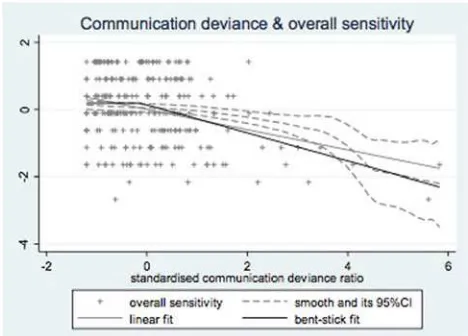
estimation of an initial unadjusted model and then with adjust-ment for confounders (i.e., maternal age, verbal IQ, and IMD quintile). As the sample size was somewhat reduced for analyses including prenatal and postnatal depression (seeTable 2), they were included as additional confounds in separate analyses. Finally, we checked for nonlinearity in the association of CD and overall maternal sensitivity using a LOWESS regression smooth (Cleveland, 1979) and a “bent-stick” regression that
hypothesized that the association was limited to only part of the range of CD scores (Bacon & Watts, 1971). All analyses were carried out in Stata 13 by the fifth author (A.P.).
Results
Characteristics of the sample
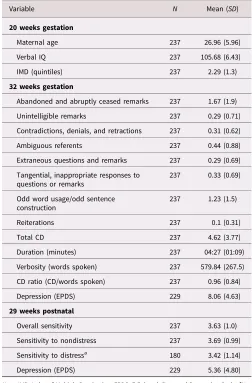
Table 2shows the mean and standard deviation for the key vari-ables of the study. The mean age of the mothers was 26.96 years (SD= 5.96) and the mean IQ score was 105.68 (SD= 6.43). Regarding the IMD, mothers in the sample ranked on average in the second lowest quintile (2.29,SD= 1.3) consistent with the high levels of deprivation in the study catchment area. In
Table 2, we also present the means and standard deviations for the depression and maternal sensitivity scores, the different CD codes, duration of speech samples, and word count.
The means and standard deviations for CD in our study are considerably lower than CD scores previously published by Kymalainen et al. (2006). However, in their study, the authors tested relatives of patients diagnosed with schizophrenia from dif-ferent ethnic groups (White Americans: mean = 2.89, SD= 2.12; Afro-Americans: mean = 3.22, SD= 2.18; and Latinos: mean = 1.27,SD= 1.35).
CD and maternal sensitivity scores
Bivariate correlations between the study variables are provided in the online-only Supplementary Materials.Table 3shows the sum-mary of the regression analysis testing the associations between CD at 32 weeks gestation and the different maternal sensitivity scores at 29 weeks, before and after adjustment for confounders. An initial regression with CD predicting overall maternal sen-sitivity score showed a highly significant association (p < .001), suggesting that a 1 SD increase in CD was associated with a 0.385SDdecrease in maternal sensitivity, 95% confidence interval (CI) [–0.567,–0.203];F(1, 236) = 17.38;p< .001;R2= .078. The
effect of CD on overall maternal sensitivity score remained signif-icant (p< .005) after adjustment for confounders (maternal age, verbal IQ, and IMD quintile) despite the smaller estimated coef-ficient of–0.216, 95% CI [–0.365,–.067]. Of note is the significant
association between the confounders and overall sensitivity scores (pvalues ranging fromp< .001 top= .015), especially maternal age. The inclusion of these confounders led to an overall improve-ment of the model,F(4, 233) = 19.30, p< .001;R2= .266.
In our second set of analyses, we repeated the same procedure but this time with the maternal sensitivity to nondistress as the outcome variable. The initial model, without confounders, revealed that CD was significant predictor of maternal sensitivity to nondistress: –0.311, 95% CI [–0.547, –0.076], p= .01. After
adjustment for confounders, CD remained a significant predictor of sensitivity to nondistress: –0.185, 95% CI [–0.346, –0.024], p= .024. Again, the confounders were significantly associated with the outcome variable (p values ranging from p < .001 to
p= .036) especially maternal age and verbal IQ. The overall model with all the variables proved to be highly significant explaining 24.7% of the observed variance, F (4, 233) = 17.65,
p< .001,R2= .247.
In order to draw the comparison with sensitivity to nondi-stress, we then tested the association between CD and maternal sensitivity in the context of infant distress. In this analysis, the effect estimate, without adjustment for confounders, was not only significant but also substantially larger, –0.514, 95% CI
[–0.767,–0.262],p< .01, than the one reported for the association
between CD and maternal sensitivity to nondistress. After adjust-ment for confounders, CD remained a highly significant predictor (p< .001) despite the smaller estimate coefficient,–0.293, 95% CI
[–0.421,–0.164]. However, in this model maternal age and verbal
IQ were not significantly associated with maternal sensitivity in the context of infant distress (p= .257 andp= .243, respectively); only IMD quintile was (p= .006). Again, the overall model was highly significant,F(4, 176) = 11.36,p< .001;R2= .216.
CD and maternal sensitivity with maternal depression as a confounder
In order to explore the potential confounding effect of maternal depression on the association between CD and the maternal sen-sitivity scores, we ran another set of analyses additionally adjust-ing for mothers’scores on the EPDS at 32 weeks of pregnancy and
at 29 weeks postnatal.
For overall sensitivity, the Nfell to 229, but the effect of CD remained significant,p= .023. For maternal sensitivity to nondi-stress, theNfell to 229, and the coefficient for CD was no longer significant,p= .094. Finally, for maternal sensitivity in the context of infant distress, theNfell to 173, but CD remained a highly sig-nificant predictor,p< .001. In none of the three cases did either depression score significantly predict sensitivity.
Testing nonlinearity in the association between CD and maternal sensitivity
Figure 1shows the fitted regression model together with a nonlin-ear regression (locally weighted scatterplot smoothing; LOWESS). The LOWESS suggested that the association might be restricted to the upper end of the distribution of CD scores. A “bent-stick”
regression was estimated, which allowed for the lower end of the distribution of CD scores to have no effect. The distribution is shown in Figure 1. This suggests that the point of inflection in the regression, though appearing quite close to the lower end of the range of raw scores, fell at the 48th percentile (close to the middle of the distribution) because of the skew of the distri-bution. The 95% confidence interval for this break point or threshold spanned from the 37th to the 60th percentile. A formal test of the superiority of this model in our stratified sample was not straightforward.
Discussion
CD in first-time pregnant women, assessed as the use of confus-ing verbal constructions when describconfus-ing their anticipated infants, predicted lower sensitivity to infant cues approximately 9 months later. This association was stronger in the context of their infant’s
during pregnancy or at the time of the sensitivity assessment. The findings could have implications for our understanding intergen-erational transmission of developmental vulnerabilities, and for the study of processes that may influence both verbal and nonver-bal parenting behaviors.
Previous research has suggested that maternal sensitivity in the context of infant’s nondistress cues is significantly predicted by
sociodemographic risk factors (Leerkes et al.,2012). Our analyses supported this assertion by revealing significant associations between maternal sensitivity to nondistress cues and maternal age, verbal IQ, and deprived living conditions. In contrast, mater-nal sensitivity in the context of infant distress may be more related to the emotional and cognitive competencies of the mother (e.g., negative emotions in response to infant crying or better skills at detecting infant distress; Leerkes,2010). The results of the present study suggest that CD and, generally speaking, communicational difficulties are associated with more basic early relational difficul-ties between mothers and their infants, particularly in emotionally stressful contexts, such as when there is a need to respond to the infant’s distress.
The findings should be interpreted in the larger context of pre-vious studies that have reported associations between disrupted
communication during face-to-face interactions between care-givers and their infants, and carecare-givers’difficulties in sensitively
attuning to their 4-month-old’s distress cues (Crockett, Holmes,
Granger, & Lyons-Ruth, 2013) and initiating and sustaining joint attention bids from the infant (Annie Yoon, Kelso, Lock, & Lyons-Ruth,2014; Schechter et al.,2010). Relevant in this con-text as well is the robust association observed in previous studies between a caregiver’s disrupted communication (12 to 18 months)
and disorganized attachment styles in children (Madigan et al.,
2006). In these studies, disrupted communication was conceptu-alized as the caregiver’s failure to grasp and respond to the
inten-tions conveyed in the infant’s communication. It therefore seems
likely that disrupted communication and CD reflect broader impairments in the cognitive and emotional processes that are important in attuning to and responding to infant distress (Leerkes & Crockenberg,2006).
A possible interpretation of our results is that both maternal CD and low maternal sensitivity reflect limitations in“
mentaliz-ing”(the ability to think about the mental states of others). For
[image:8.594.41.293.79.462.2]example, it has been argued that mentalizing is important for repairing misunderstandings during conversation (e.g., clarifying
Table 2.Means and standard deviation for the key variables (unweighted)
Variable N Mean (SD)
20 weeks gestation
Maternal age 237 26.96 (5.96) Verbal IQ 237 105.68 (6.43) IMD (quintiles) 237 2.29 (1.3)
32 weeks gestation
Abandoned and abruptly ceased remarks 237 1.67 (1.9) Unintelligible remarks 237 0.29 (0.71) Contradictions, denials, and retractions 237 0.31 (0.62) Ambiguous referents 237 0.44 (0.88) Extraneous questions and remarks 237 0.29 (0.69) Tangential, inappropriate responses to
questions or remarks
237 0.33 (0.69) Odd word usage/odd sentence
construction
237 1.23 (1.5) Reiterations 237 0.1 (0.31)
Total CD 237 4.62 (3.77)
Duration (minutes) 237 04:27 (01:09) Verbosity (words spoken) 237 579.84 (267.5) CD ratio (CD/words spoken) 237 0.96 (0.84) Depression (EPDS) 229 8.06 (4.63)
29 weeks postnatal
Overall sensitivity 237 3.63 (1.0) Sensitivity to nondistress 237 3.69 (0.99) Sensitivity to distressa 180 3.42 (1.14)
Depression (EPDS) 229 5.36 (4.80)
[image:8.594.309.556.104.479.2]Note:IMD, Index of Multiple Deprivation. EPDS, Edinburgh Postnatal Depression Scale.aNot all infants became distressed so sensitivity to distress is available for only a subset of mothers.
Table 3.Linear regression with communication deviance (CD) as a predictor of overall maternal sensitivity, sensitivity to nondistress, and distress before and after controlling for confounders (weighted for sample stratification and attrition)
Coefficient (standard error) pvalue
Overall sensitivity
Unadjusted
CD −0.385 (0.092) <.001
Adjusted
CD −0.216 (0.076) .005
Maternal age 0.041 (0.010) .000
Verbal IQ 0.027 (0.011) .012
IMD quintile 0.123 (0.050) .015
Sensitivity to nondistress
Unadjusted
CD −0.311 .010
Adjusted
CD −0.185 (0.082) .024
Maternal age 0.040 (0.010) .000
Verbal IQ 0.030 (0.011) .006
IMD quintile 0.106 (0.050) .036
Sensitivity to distress
Unadjusted
CD −0.514 <.001
Adjusted
CD −0.293 (0.065) <.001
Maternal age 0.016 (0.014) .257
Verbal IQ 0.014 (0.012) .243
IMD quintile 0.164 (0.059) .006
deictic references that the listener finds ambiguous or vague) and that both mentalizing and alignment, although dissociable pro-cesses, contribute to successful communication (Brennan, Galati, & Kuhlen,2010). Consistent with this hypothesis,“
mater-nal mind-mindedness,”defined in terms of the caregivers’ability
to “read” their infants’ thoughts and feelings accurately during
play and to comment on their internal states in an attuned way, has been found to be an important predictor of children’s
socio-cognitive development (Meins et al.,2002,2003).
Our findings therefore broaden the possible range of interpre-tations of the associations between parental CD and poor social and emotional outcomes in children (e.g., Wichstrøm, Anderson, Holte, Husby, et al., 1996; Wichstrøm, Anderson, Holte, & Wynne, 1996) and psychopathology in adults (de Sousa et al.,
2014), outlined earlier. If parental CD is a stable trait, it is possible that the associations we have observed reflect an intergenerational process in which prenatal CD is linked to low maternal sensitivity in infancy, which is a key developmental influence on later adjust-ment. If this is the case, there are implications not only for the tim-ing of the effects of CD but also for the mechanisms. Associations between CD and child mental health outcomes are typically inter-preted as effects of verbal communication on the verbal child. However, our findings offer the alternative possibility that CD is a marker for nonverbal communication patterns during infancy, and also possibly during childhood, which also influence develop-ment. Further research is required to address questions raised by this possibility. For example, to what extent is CD regarding an anticipated infant in pregnancy a “traitlike” reflection of a
ten-dency to speak in this way about people in general, or does CD vary depending on the person the speaker is referring to?
Important strengths of this study included that both the pre-dictor and the outcome measures were based on observation, and coded by independent raters, blind to all other measurement, and that potential confounding effects of maternal depression were accounted for. Assessment of CD during pregnancy elimi-nated the possibility of evocative effects of infant behavior on the parent, a weakness previously identified in the CD literature (Miklowitz & Stackman,1992). A limitation of the study is that we were not able to rule out some plausible confounds such as previous trauma or current stressors experienced by the mothers. While the case was made earlier that elevated expressed emotion, and coherence of attachment representations, are different con-structs, the extent of their overlap with CD is unknown, and
controlling for them may have altered the association between CD and maternal sensitivity. Five-minute speech samples are not an everyday conversation; they reflect soliloquies rather than dialogues, and it could be argued that CD scores were con-founded by the constraints of the experimental condition (e.g., anxiety and self-consciousness). Furthermore, the version of the 5-min speech sample used in this study is an adaptation from the original, which refers to the relationship between a parent and a living child, which may limit the generalizability of the findings.
Thus far, research on CD has been largely carried out by researchers interested in environmental and developmental influ-ences on later psychopathology, especially schizophrenia (Bentall,
2003; Bentall et al.,2014; Bentall & Fernyhough, 2008; de Sousa et al.,2014). The present findings suggest that CD may be a useful concept in understanding the impact of maternal characteristics on early child development. Future studies should examine mater-nal characteristics associated with CD and its associations with a wider range of developmental processes in children.
Acknowledgments. This study was funded by UK Medical Research Council Grant G0400577 (to J.H. and H.S.) and Fundação para a Ciência e a Tecnologia Grant SFRH/BD/ 77379/2011 (to P.S.). This work was also sup-ported by Wirral University Teaching Hospital NHS Foundation Trust, Cheshire and Wirral Partnership NHS Foundation Trust and Wirral Community NHS Foundation Trust, the NIHR Biomedical Research Centre for Mental Health at the South London and Maudsley NHS Foundation Trust, and King’s College London. The views expressed are those of the
authors and not necessarily those of the funders, the NHS, theNIHR or the UK Department of Health. The authors would like to thank Professor Dawn Velligan for advice on the assessment of communication deviance. We are very grateful to all participating families and to the research staff who contrib-uted to this work.
Supplementary material. The supplementary material for this article can be found athttps://doi.org/10.1017/S0954579418001189
References
Annie Yoon, S., Kelso, G. A., Lock, A., & Lyons-Ruth, K. (2014). Mother–
infant joint attention and sharing: Relations to disorganized attachment and maternal disrupted communication. Journal of Genetic Psychology: Research and Theory on Human Development,175, 494–510. doi:10.1080/
00221325.2014.964170
Bacon, D. W., & Watts, D. G. (1971). Estimating the transition between two intersecting straight lines. Biometrika, 58, 525–534. doi:10.1093/biomet/
58.3.525
Bakermans-Kranenburg, M. J., & van Ijzendoorn, M. H. (2006). Gene-environ-ment interaction of the dopamine D4 receptor (DRD4) and observed maternal insensitivity predicting externalizing behavior in preschoolers.
Developmental Psychobiology,48, 406–409. doi:10.1002/dev.20152
Bentall, R. P. (2003).Madness explained: Psychosis and human nature. London: Allen Lane.
Bentall, R. P., de Sousa, P., Varese, F., Wickham, S., Sitko, K., Haarmans, M., & Read, J. (2014). From adversity to psychosis: Pathways and mechanisms from specific adversities to specific symptoms. Social Psychiatry and Psychiatric Epidemiology,49, 1011–1022. doi:10.1007/s00127-014-0914-0
Bentall, R. P., & Fernyhough, C. (2008). Social predictors of psychotic experi-ences: Specificity and psychological mechanisms.Schizophrenia Bulletin,34, 1012–1020. doi:10.1093/schbul/sbn103
Bornstein, M. H., & Tamis-Lemonda, C. S. (1997). Maternal responsiveness and infant mental abilities: Specific predictive relations.Infant Behavior and Development,20, 283–296. doi:10.1016/S0163-6383(97)90001-1
[image:9.594.46.280.66.234.2]Brennan, S. E., Galati, A., & Kuhlen, A. K. (2010). Two minds, one dialog: Coordinating speaking and understanding. Psychology of Learning and Motivation,53, 301–344. doi:10.1016/S0079-7421(10)53008-1
Campbell, S. B., Matestic, P., von Stauffenberg, C., Mohan, R., & Kirchner, T. (2007). Trajectories of maternal depressive symptoms, maternal sensitivity, and children’s functioning at school entry.Developmental Psychology,43,
1202–1215. doi:10.1037/0012-1649.43.5.1202
Cleveland, W. S. (1979). Robust locally weighted regression and smoothing scatterplots.Journal of the American Statistical Association,74, 829–836.
doi:10.2307/2286407
Cox, J. (1996). Validation of the Edinburgh Postnatal Depression Scale (EPDS) in non-postnatal women. Journal of Affective Disorders, 39, 185–189.
doi:10.1016/0165-0327(96)00008-0
Cox, J. L., Holden, J. M., & Sagovsky, R. (1987). Detection of postnatal depres-sion: Development of the 10-item Edinburgh Postnatal Depression Scale.
British Journal of Psychiatry,150, 782–786. doi:10.1192/bjp.150.6.782
Crockett, E. E., Holmes, B. M., Granger, D. A., & Lyons-Ruth, K. (2013). Maternal disrupted communication during face-to-face interaction at 4 months: Relation to maternal and infant cortisol among at-risk families.
Infancy,18, 1111–1134. doi:10.1111/infa.12015
Dayton, C. J., Levendosky, A. A., Davidson, W. S., & Bogat, G. A. (2010). The child as held in the mind of the mother: The influence of prenatal maternal representations on parenting behaviors.Infant Mental Health Journal,31, 220–241. doi:10.1002/imhj.20253
de Sousa, P., Varese, F., Sellwood, W., & Bentall, R. P. (2014). Parental com-munication and psychosis: A meta-analysis. Schizophrenia Bulletin, 40, 756–768. doi:10.1093/schbul/sbt088
Doane, J. A., Jones, J., Fisher, L., Ritzler, B., Singer, M., & Wynne, L. (1982). Parental communication deviance as a predictor of competence in children at risk for adult psychiatric disorder.Family Process,21, 211–223.
Doane, J. A., & Singer, M. (1977).Communication deviance scoring manual for use with consensus Rorschach. Unpublished manuscript, University of Rochester.
Doane, J. A., West, K. L., Goldstein, M. J., Rodnick, E. H., & Jones, J. (1981). Parental communication deviance and affective style: Predictors of subse-quent schizophrenia spectrum disorders in vulnerable adolescents.
Archives of General Psychiatry,38, 679–685.
Docherty, N. (1993). Communication deviance, attention and schizotypy in parents of schizophrenic patients.Journal of Nervous and Mental Disease,
181, 750–756. doi:10.1097/00005053-199312000-00007
Dunn, G., Pickles, A., Tansella, M., & Vázquez-Barquero, J. L. (1999). Two-phase epidemiological surveys in psychiatric research: Editorial.
British Journal of Psychiatry,174, 95–100. doi:10.1192/bjp.174.2.95
Fraley, R. C., Roisman, G. I., Booth-LaForce, C., Owen, M. T., & Holland, A. S. (2013). Interpersonal and genetic origins of adult attachment styles: A lon-gitudinal study from infancy to early adulthood.Journal of Personality and Social Psychology,104, 817–838. doi:10.1037/a0031435
Goldstein, M. J. (1987). The UCLA high-risk study.Schizophrenia Bulletin,13, 505–514.
Grusec, J. E., & Davidov, M. (2010). Integrating different perspectives on socialization theory and research: A domain-specific approach. Child Development,81, 687–709. doi:10.1111/j.1467-8624.2010.01426.x
Hirsch, S. R., & Leff, J. P. (1971). Parental abnormalities of verbal communi-cation in the transmission of schizophrenia. Psychological Medicine, 1, 118–127.
Hobson, R. P., Patrick, M. P. H., Crandell, L. E., Perez, R. M. G., & Lee, A. (2004). Maternal sensitivity and infant triadic communication.Journal of Child Psychology and Psychiatry,45, 470–480.
Holdnack, H. A. (2001).Wechsler Test of Adult Teading: WTAR. San Antonio, TX: Psychological Corporation.
Joosen, K. J., Mesman, J., Bakermans-Kranenburg, M. J., & van Ijzendoorn, M. H. (2012). Maternal sensitivity to infants in various settings predicts harsh discipline in toddlerhood. Attachment & Human Development,14, 101–
117. doi:10.1080/14616734.2012.661217
Juffer, F., Bakermans-Kranenburg, M. J., & van IJzendoorn, M. H. (2005). The importance of parenting in the development of disorganized attachment: Evidence from a preventive intervention study in adoptive families.
Journal of Child Psychology and Psychiatry and Allied Disciplines, 46, 263–274. doi:10.1111/j.1469-7610.2004.00353.x
Korja, R., Ahlqvist-Björkroth, S., Savonlahti, E., Stolt, S., Haataja, L., Lapinleimu, H., … Lehtonen, L. (2010). Relations between maternal
attachment representations and the quality of mother-infant interaction in preterm and full-term infants.Infant Behavior and Development, 33, 330–336. doi:10.1016/j.infbeh.2010.03.010
Kymalainen, J. A. (2005).Expressed emotion and communication deviance in Anglo-American, Latino-American and African-American families with schizophrenia. (Unpublished manuscript, University of Massachusetts, Boston).
Kymalainen, J. A., Weisman, A. G., Rosales, G. A., & Armesto, J. C. (2006). Ethnicity, expressed emotion, and communication deviance in family mem-bers of patients with schizophrenia.Journal of Nervous and Mental Disease,
194, 391–396. doi:10.1097/01.nmd.0000221171.42027.5a
Lambregtse-van den Berg, M. P., Lucassen, N., Kuipers-Nap, M. F., Dingemans, P. M. A. J., Jaddoe, V. W. V, Hofman, A.,…Tiemeier, H.
(2013). Assessing expressed emotion during pregnancy.Psychiatry Research,
205, 285–288. doi:10.1016/j.psychres.2012.08.037
Leeb, B., Hahlweg, K., Goldstein, M. J., Feinstein, E., Mueller, U., Dose, M., & Magana-Amato, A. (1991). Cross-national reliability, concurrent validity, and stability of a brief method for assessing expressed emotion.Psychiatry Research,39, 25–31. doi:10.1016/0165-1781(91)90005-A
Leerkes, E. M. (2010). Predictors of maternal sensitivity to infant distress.
Parenting,10, 219–239. doi:10.1080/15295190903290840
Leerkes, E. M. (2011). Maternal sensitivity during distressing tasks: A unique predictor of attachment security. Infant Behavior and Development, 34, 443–446. doi:10.1016/j.infbeh.2011.04.006
Leerkes, E. M., & Crockenberg, S. C. (2006). Antecedents of mothers’
emo-tional and cognitive responses to infant distress: The role of family, mother, and infant characteristics.Infant Mental Health Journal,27, 405–428.
Leerkes, E. M., Crockenberg, S. C., & Burrous, E. (2004). Identifying compo-nents of maternal sensitivity to infant distress: The role of maternal emo-tional competencies.Parenting: Science and Practice,4, 1–23.
Leerkes, E. M., Weaver, J. M., & O’Brien, M. (2012). Differentiating maternal
sensitivity to infant distress and non-distress. Parenting, 12, 175–184.
doi:10.1080/15295192.2012.683353
Lucassen, N., Tiemeier, H., Luijk, M. P. C. M., Linting, M., Bakermans-Kranenburg, M. J., van Ijzendoorn, M. H., … Lambregtse-Van den
Berg, M. P. (2015). Expressed emotion during pregnancy predicts observed sensitivity of mothers and fathers in early childhood. Parenting, 15, 158–165. doi:10.1080/15295192.2015.1053316
Madigan, S., Bakermans-Kranenburg, M. J., van Ijzendoorn, M. H., Moran, G., Pederson, D. R., & Benoit, D. (2006). Unresolved states of mind, anomalous parental behavior, and disorganized attachment: A review and meta-analysis of a transmission gap. Attachment & Human Development, 8, 89–111. doi:10.1080/14616730600774458
Magaña, A. B., Goldstein, M. J., Karno, M., Miklowitz, D. J., Jenkins, J., & Falloon, I. R. (1986). A brief method for assessing expressed emotion in relatives of psychiatric patients.Psychiatry Research,17, 203–212.
McElwain, N. L., & Booth-Laforce, C. (2006). Maternal sensitivity to infant distress and nondistress as predictors of infant-mother attachment security. Journal of Family Psychology, 20, 247–255.
doi:10.1037/0893-3200.20.2.247
Meins, E., Fernyhough, C., Wainwright, R., Clark-Carter, D., Das Gupta, M., Fradley, E., & Tuckey, M. (2003). Pathways to understanding mind: Construct validity and predictive validity of maternal mind-mindedness.
Child Development,74, 1194–1211.
Meins, E., Fernyhough, C., Wainwright, R., Das Gupta, M., Fradley, E., & Tuckey, M. (2002). Maternal mind-mindedness and attachment security as predictors of theory of mind understanding.Child Development, 73, 1715–1726.
Miklowitz, D. J., & Stackman, D. (1992). Communication deviance in families of schizophrenic and other psychiatric patients: Current state of the con-struct.Progress in Experimental Personality and Psychopathology Research,
15, 1–46.
Murray, L., Fiori-Cowley, A., Hooper, R., & Cooper, P. (1996). The impact of postnatal depression and associated adversity on early mother-infant inter-actions and later infant outcome. Child Development, 67, 2512–2526.
doi:10.1111/j.1467-8624.1996.tb01871.x
Murray, L., Hentges, F., Hill, J., Karpf, J., Mistry, B., Kreutz, M.,…Green, R.
mother-infant interactions and infant development. Journal of Child Psychology and Psychiatry and Allied Disciplines, 49, 115–123. doi:10.
1111/j.1469-7610.2007.01833.x
NICHD Early Child Care Research Network. (1999). Child care and mother-child interaction in the first 3 years of life. NICHD Early Child Care Research Network.Developmental Psychology,35, 1399–1413.
Noble, M., Wright, G., Dibben, C., Smith, G., McLennan, D., Anttila, C.,…
Lloyd, M. (2004).The English Indices of Deprivation 2004 (revised). Report to the Office of the Deputy Prime Minister. London: Neighbourhood Renewal Unit.
Nuechterlein, K. H., Goldstein, M. J., Ventura, J., Dawson, M. E., & Doane, J. A. (1989). Patient-environment relationships in schizophrenia. Information processing, communication deviance, autonomic arousal, and stressful life events.British Journal of Psychiatry,5(Suppl.), 84–89.
Pickles, A., Hill, J., Breen, G., Quinn, J., Abbott, K., Jones, H., & Sharp, H. (2013). Evidence for interplay between genes and parenting on infant tem-perament in the first year of life: Monoamine oxidase A polymorphism moderates effects of maternal sensitivity on infant anger proneness.
Journal of Child Psychology and Psychiatry,54, 1308–1317. doi:10.1111/
jcpp.12081
Raby, K. L., Roisman, G. I., Fraley, R. C., & Simpson, J. A. (2014). The endur-ing predictive significance of early maternal sensitivity: Social and academic competence through age 32 years. Child Development, 86, 695–708.
doi:10.1111/cdev.12325
Roisko, R., Wahlberg, K. E., Miettunen, J., & Tienari, P. (2014). Association of parental communication deviance with offspring’s psychiatric and thought
disorders.A systematic review and meta-analysis.European Psychiatry,29, 20–31. doi:10.1016/j.eurpsy.2013.05.002
Schechter, D. S., Coates, S. W., Kaminer, T., Coots, T., Zeanah, C. H., Davies, M.,…Myers, M. M. (2008). Distorted maternal mental
representa-tions and atypical behavior in a clinical sample of violence-exposed mothers and their toddlers. Journal of Trauma and Dissociation, 9, 123–147.
doi:10.1080/15299730802045666
Schechter, D. S., Willheim, E., Hinojosa, C., Scholfield-Kleinman, K., Turner, J. B., McCaw, J.,…Myers, M. M. (2010). Subjective and objective
measures of parent-child relationship dysfunction, child separation distress, and joint attention.Psychiatry,73, 130–144. doi:10.1521/psyc.2010.73.2.130
Sharp, H., Pickles, A., Meaney, M., Marshall, K., Tibu, F., & Hill, J. (2012). Frequency of infant stroking reported by mothers moderates the effect of prenatal depression on infant behavioural and physiological outcomes.
PLOS ONE,7. doi:10.1371/journal.pone.0045446
Singer, M., & Wynne, L. (1965a). Thought disorder and family relations of schizophrenics: III. Methodology using projective techniques.Archives of General Psychiatry,12, 187–200.
Singer, M., & Wynne, L. (1965b). Thought disorder and family relations of schizophrenics: IV. Results and implications. Archives of General Psychiatry,12, 201–212.
Singer, M., & Wynne, L. (1966a). Communication styles in parents of normals, neurotics, and schizophrenics. Some findings using a new Rorschach scor-ing manual. Psychiatric Research Reports of the American Psychiatric Association,20, 25–38.
Singer, M., & Wynne, L. (1966b). Principles for scoring communication defects and deviances in parents of schizophrenics: Rorschach and TAT scoring manuals.Psychiatry,29, 260–288.
Strauss, E., Sherman, E. M., & Spreen, O. (2006).A compendium of neuropsy-chological tests: Administration, norms, and commentary. New York: Oxford University Press.
Theran, S. A., Levendosky, A. A., Bogat, G. A., & Huth-Bocks, A. C. (2005). Stability and change in mothers’internal representations of their infants
over time.Attachment and Human Development,7, 253–268. doi:10.1080/
14616730500245609
van der Voort, A., Linting, M., Juffer, F., Bakermans-Kranenburg, M. J., Schoenmaker, C., & van Ijzendoorn, M. H. (2014). The development of adolescents’internalizing behavior: Longitudinal effects of maternal
sensi-tivity and child inhibition. Journal of Youth and Adolescence, 43, 528–
540. doi:10.1007/s10964-013-9976-7
van Ijzendoorn, M. H., Juffer, F., & Duyvesteyn, M. G. C. (1995). Breaking the intergenerational cycle of insecure attachment: A review of the effects of
attachment-based interventions on maternal sensitivity and infant security.
Journal of Child Psychology and Psychiatry and Allied Disciplines,36, 225–
248. doi:10.1111/j.1469-7610.1995.tb01822.x
Velligan, D. I. (1985).Communication deviance coding manual for coding family confrontations. Unpublished manuscript, University of California at Los Angeles. Velligan, D. I., Christensen, A., Goldstein, M. J., & Margolin, G. (1988). Parental communication deviance: Its relationship to parent, child and family system variables.Psychiatry Research,26, 313–325.
Velligan, D. I., Funderburg, L. G., Giesecke, S. L., & Alexander, A. L. (1995). Longitudinal analysis of communication deviance in the families of schizo-phrenic patients. Psychiatry—Interpersonal and Biological Processes, 58, 6–19.
Velligan, D. I., Goldstein, M. J., Nuechterlein, K. H., Miklowitz, D. J., & Ranlett, G. (1990). Can communication deviance be measured in a family problem solving interaction?Family Process,29, 213–226.
Velligan, D. I., Miller, A. L., Eckert, S. L., Funderburg, L. G., True, J. E., Mahurin, R. K.,…Hazelton, B. C. (1996). The relationship between
paren-tal communication deviance and relapse in schizophrenic patients in the 1-year period after hospital discharge: A pilot study.Journal of Nervous and Mental Disease,184, 490–496.
Verhage, M. L., Schuengel, C., Madigan, S., Pasco Fearon, R. M., Oosterman, M., Cassibba, R., … van Ijzendoorn, M. H. (2016).
Narrowing the transmission gap: A synthesis of three decades of research on intergenerational transmission of attachment. Psychological Bulletin,
142, 337–366. doi:10.1037/bul0000038
Vreeswijk, C. M. J. M., Maas, A. J. B. M., & van Bakel, H. J. A. (2012). Parental representations: A systematic review of the working model of the child interview. Infant Mental Health Journal, 33, 314–328. doi:10.1002/
imhj.20337
Wahlberg, K. E., Wynne, L., Hakko, H., Läksy, K., Moring, J., Miettunen, J., & Tienari, P. (2004). Interaction of genetic risk and adoptive parent communication deviance: Longitudinal prediction of adoptee psychiatric disorders.Psychological Medicine,34, 1531–1541. doi:10.1017/S00329170
4002661
Wahlberg, K. E., Wynne, L., Oja, H., Keskitalo, P., Anais-Tanner, H., Koistinen, P.,…Tienari, P. (2000). Thought disorder index of Finnish
adoptees and communication deviance of their adoptive parents.
Psychological Medicine,30, 127–136.
Wahlberg, K. E., Wynne, L., Oja, H., Keskitalo, P., Pykalainen, L., Lahti, I.,…
Tienari, P. (1997). Gene-environment interaction in vulnerability to schiz-ophrenia: Findings from the Finnish adoptive family study of schizophrenia.
American Journal of Psychiatry,154, 355–362.
Wichstrøm, L., Anderson, A. M., Holte, A., Husby, R., & Wynne, L. C. (1996). Confirmatory and disconfirmatory family communication as predictor of offspring socio-emotional functioning. A 10 to 14 year follow-up of chil-dren at risk. Acta Psychiatrica Scandinavica, 93, 49–56. doi:10.1111/
j.1600-0447.1996.tb10618.x
Wichstrøm, L., Anderson, A. M., Holte, A., & Wynne, L. C. (1996). Disqualifying family communication and childhood social competence as predictors of offspring’s mental health and hospitalization. A 10- to
14-year longitudinal study of children at risk of psychopathology.Journal of Nervous and Mental Disease, 184, 581–588.
doi:10.1097/00005053-199610000-00001
Wichstrøm, L., Holte, A., Husby, R., & Wynne, L. C. (1993). Competence in children at risk for psychopathology predicted from confirmatory and disconfirmatory family communication. Family Process, 32, 203–
220.
Wichstrøm, L., Holte, A., Husby, R., & Wynne, L. C. (1994). Disqualifying family communication as a predictor of changes in offspring competence: A 3-year longitudinal study of sons of psychiatric patients. Journal of Family Psychology,8, 104–108. doi:10.1037/0893-3200.8.1.104
Wichstrøm, L., Holte, A., & Wynne, L. C. (1993). Disqualifying family com-munication and anxiety in offspring at risk for psychopathology.Acta Psychiatrica Scandinavica,88, 74–79.
Wynne, L. (1968). Methodologic and conceptual issues in the study of schizo-phrenics and their families. Journal of Psychiatric Research,6(Suppl. 1), 185–199.
Wynne, L. (1981). Current concepts about schizophrenics and family relation-ships. Journal of Nervous and Mental Disease, 169, 82–89. doi:10.1097/
00005053-198102000-00003
Wynne, L. (1984). The epigenesis of relational systems: A model for under-standing family development.Family Process,23, 297–318.
Wynne, L. (1988). An epigenetic model of family processes. In C. J. Falicov (Ed.), Family transitions: Continuity and change over the life cycle
(pp. 81–106). New York: Guilford Press.
Wynne, L., Cole, R. E., & Perkins, P. (1987). University of Rochester child and family study: Risk research in progress.Schizophrenia Bulletin,13, 463–476.
Wynne, L., & Singer, M. (1963a). Thought disorder and family relations of schizo-phrenics: I. A research strategy.Archives of General Psychiatry,9, 191–198.
Wynne, L., & Singer, M. (1963b). Thought disorder and family relations of schizophrenics: II. A classification of forms thinking.Archives of General Psychiatry,9, 199–206.
Wynne, L., Singer, M., Bartko, J., & Toohey, M. (1977). Schizophrenics and their families: Research on parental communication. In J. M. Tanner (Ed.), Developments in psychiatric research (pp. 254–286). London: