This is a repository copy of Using the size and position of drumlins to understand how they grow, interact and evolve.
White Rose Research Online URL for this paper: http://eprints.whiterose.ac.uk/120713/
Version: Accepted Version
Article:
Ely, J. orcid.org/0000-0003-4007-1500, Clark, C.D., Spagnolo, M. et al. (2 more authors) (2017) Using the size and position of drumlins to understand how they grow, interact and evolve. Earth Surface Processes and Landforms. ISSN 0197-9337
https://doi.org/10.1002/esp.4241
This is the peer reviewed version of the following article: Ely, J. C. et al (2017) Using the size and position of drumlins to understand how they grow, interact and evolve. Earth Surf. Process. Landforms, which has been published in final form at doi: 10.1002/esp.4241. This article may be used for non-commercial purposes in accordance with Wiley Terms and Conditions for Self-Archiving
[email protected] https://eprints.whiterose.ac.uk/
Reuse
Items deposited in White Rose Research Online are protected by copyright, with all rights reserved unless indicated otherwise. They may be downloaded and/or printed for private study, or other acts as permitted by national copyright laws. The publisher or other rights holders may allow further reproduction and re-use of the full text version. This is indicated by the licence information on the White Rose Research Online record for the item.
Takedown
If you consider content in White Rose Research Online to be in breach of UK law, please notify us by
Using the size and position of drumlins to understand how they
1
grow, interact and evolve
2
Jeremy C. Ely,1* Chris D. Clark,1 Matteo Spagnolo,2,3 Anna L.C. Hughes4 and Chris R.
3
Stokes5.
4
1
Department of Geography, The University of Sheffield, Sheffield, S10 2TN, UK
5
2
School of Geosciences, University of Aberdeen, Aberdeen, AB24 3UF, UK
6
3
Department of Earth and Planetary Science, University of California at Berkeley, Berkeley,
7
CA 94709, USA
8
4
Department of Earth Science, University of Bergen and Bjerknes Centre for Climate
9
Research, Bergen N-5020, Norway
10
5
Department of Geography, Durham University, Durham, UK, DH1 3LE, UK
11
12
Abstract 14
Drumlins are subglacial bedforms streamlined in the direction of ice flow. Common in
15
deglaciated landscapes, they have been widely studied providing rich information on their
16
internal geology, size, shape, and spacing. In contrast with bedform investigations elsewhere
17
in geomorphology (aeolian and fluvial dunes and ripples for example) most drumlin studies
18
derive observations from relict, and thus static features. This has made it difficult to gain
19
information and insights about their evolution over time, which likely hampers our
20
understanding of the process(es) of drumlin formation. Here we take a morphological
21
approach, studying drumlin size and spacing metrics. Unlike previous studies which have
22
focussed on databases derived from entire ice sheet beds, we adopt a space-for-time
23
substitution approach using individual drumlin flow-sets distributed in space as proxies for
24
different development times/periods. Framed and assisted by insights from aeolian and fluvial
25
geomorphology, we use our metric data to explore possible scenarios of drumlin growth,
26
evolution and interaction. We study the metrics of the size and spacing of 36,222 drumlins,
27
distributed amongst 71 flow-sets, left behind by the former British-Irish Ice Sheet, and ask
28
whether behaviour common to other bedform phenomena can be derived through statistical
29
analysis. Through characterising and analysing the shape of the probability distribution
30
functions of size and spacing metrics for each flow-set we argue that drumlins grow, and
31
potentially migrate, as they evolve leading to pattern coarsening. Furthermore, our findings
32
add support to the notion that no upper limit to drumlin size exists, and to the idea that
33
perpetual coarsening could occur if given sufficient time. We propose that the framework of
34
process and patterning commonly applied to non-glacial bedforms is potentially powerful for
35
understanding drumlin formation and for deciphering glacial landscapes.
36
Natural processes often organise phenomena into regular and repetitive patterns (e.g.
38
Ball, 1999). This regularity deceptively gives the impression of a simplistic formation
39
process, but pattern-forming processes are often non-linear, with patterns emerging through
40
self-organisation due to complex, and sometimes stochastic, interactions between elements
41
(Pearson, 1993; Werner, 1999; Murray, 2003; Hillier et al., 2016). Aeolian, fluvial and
42
submarine bedforms are often held up as exemplars of natural patterns (Anderson, 1990;
43
Kocurek et al., 2010; Seminara, 2010), occurring as fields of morphologically similar and
44
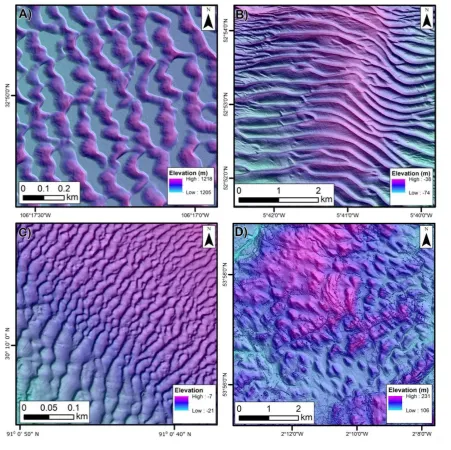
regularly spaced features (Figures 1A, B and C).
45
Drumlins are subglacial bedforms elongated in the direction of ice flow (e.g. Clark et
46
al., 2009). The term drumlin is used to define the most common variant in a morphological
47
continuum of subglacial bedforms (Ely et al., 2016), and they are typically 250 to 1000 m
48
long, 120 to 300 m wide and 0.5 to 40 m in relief (Clark et al., 2009; Spagnolo et al., 2012).
49
The formation and development of drumlins remains an unanswered question of great
50
relevance to both geomorphology and glaciology, as the processes which occur at the ice-bed
51
interface govern the mechanics of fast ice flow (e.g. Clarke, 1987; Kyrke-Smith et al., 2015).
52
A plethora of hypotheses have been proposed to explain their initiation (e.g. Smalley and
53
Unwin, 1968; Boulton, 1987; Shaw et al., 1989; Hindmarsh, 1999). However, in this paper
54
we focus on the development of drumlins after they have initiated. Contrary to many prior
55
assertions and analyses that regarded drumlins as randomly positioned individuals or clusters,
56
they have recently been demonstrated to exhibit a regular and repetitive spatial organisation
57
that is characteristic of a patterned phenomenon (Clark et al., 2017; Figure 1D). This is
58
potentially important, because although the concept of patterning is long established in
59
geomorphology (e.g. Anderson, 1990; Werner and Hallet, 1993; Nield and Bass, 2007),
60
drumlins have mostly eluded consideration within this context. Thus, unlike their aeolian,
61
fluvial and marine counterparts, reviews of patterning processes do not generally consider
subglacial bedforms within the wider patterning context (e.g. Murray et al., 2014), perhaps
63
due to the immaturity of patterning as a line of enquiry within the subglacial bedform
64
literature. This is likely a consequence of their static and often time-integrated appearance on
65
palaeo-ice sheet beds (e.g. the superimposition of several ice flow patterns), and the alteration
66
of drumlinised landscapes by other geomorphological processes after their exposure, making
67
the identification of any patterning processes which occurred during their formation
68
challenging. Though the concept of subglacial bedforms forming as a field has been
69
considered before (e.g. Smalley and Unwin, 1968; Dunlop et al., 2008; Barchyn et al., 2016),
70
Clark et al. (2017) are the first to demonstrate that patterning is a ubiquitous property of
71
drumlins. Therefore, Clark et al. (2017) opens a new avenue of enquiry for glacial
72
geomorphologists to study drumlins, more akin to how fluvial, aeolian and marine bedforms
73
are considered, whilst simultaneously providing the wider geomorphological community with
74
an interesting, although challenging opportunity to study patterning processes. Here we build
75
upon the work of Clark et al. (2017) by using the size and shape metrics of drumlins formed
76
in different flow events to ask whether behaviour common for bedforms formed by
non-77
glacial geomorphic agents occurs during drumlin formation.
78
Unlike for fluvial, aeolian or marine bedforms, direct observation of subglacial
79
bedforms beneath (or emerging from) a modern ice mass is logistically challenging and
80
limited to a few examples (Smith et al., 2007; King et al., 2009; Johnson et al., 2010).
81
Furthermore, repeat imaging of active drumlin fields from which bedform formation and
82
pattern evolution could be deciphered has yet to be achieved. Although no longer evolving,
83
the exposed beds of palaeo-ice masses provide numerous examples of drumlin patterns that
84
are likely to preserve information about the processes that created them. This rationale, that
85
the arrangement of a field of bedforms contains information regarding their development, is
86
often adopted to decipher the arrangement of aeolian dunes within a pattern (e.g. Ewing et al.,
2006; Ewing and Kocurek, 2010). Recent work on subglacial bedforms has begun to consider
88
how pattern interactions may influence their size-frequency distributions. Hillier et al. (2013)
89
hypothesised that randomness during ice-sediment-water interaction at multiple locations
90
combined with simple rules could explain characteristics of their size-frequency distributions.
91
A statistical model of this was then developed in Fowler et al. (2013) and evaluated in
92
combinations with a variety of models in Hillier et al., (2016). Although exposed drumlin
93
fields are relict, making any identification of pattern-forming interactions challenging, the
94
premise of this paper is that, hidden in the size metrics of relict drumlins, there are
95
measurable properties that provide insight into the time-varying state and evolution of
96
drumlin patterns (Hillier et al., 2016). Here we study the size and spatial arrangement of
97
36,222 drumlins distributed across 71 different flow-sets of the last British-Irish Ice Sheet
98
(Clark et al., 2009; Hughes et al., 2010; 2014). Unlike previous studies that focussed on the
99
entire database (Clark et al., 2009; Hillier et al., 2013; Fowler et al., 2013), we group
100
drumlins by flow-set prior to analysis. The logic here being that flow-sets or fields represent
101
sets of drumlins at various, as yet unknown, stages of development. This allows us to further
102
examine whether behaviour commonly observed in other natural patterns can be invoked to
103
explain the arrangement and morphology of drumlins.
104
105
2. Background and Rationale 106
Patterns often evolve through interactions between their constituent elements (e.g.
107
Muthukumar et al., 1997; Wootton, 2001). The nature of these interactions leads patterns to
108
evolve in different ways and exhibit different overall behavioural states. Several types of
109
patterning behaviour have been observed in geomorphic systems (Kocurek et al., 2010;
Murray et al., 2014), providing a useful framework for this investigation into drumlins, which
111
we now briefly summarise.
112
If a pattern remains stable at the wavelength at which it initiates, this is known as
113
simple stabilisation (e.g. Cherlet et al., 2007; Murray et al., 2014). However, if individual
114
elements (e.g. dunes) typically migrate and/or grow laterally, this can lead to merging and/or
115
competition between adjacent elements and thereby reducing the number of elements in the
116
pattern. This is known as ‘coarsening’ and may stop when a stable wavelength is reached
117
(e.g. Werner and Kocurek, 1999; Coleman et al., 2005; Murray et al., 2014). Alternatively,
118
coarsening could continue perpetually until the pattern is composed of very few or, indeed, a
119
single element (e.g. Andreotti et al., 2009; Murray et al., 2014). For drumlins, we use a
120
quantification of their preserved dimensions and spacing (i.e. metrics) to address the
121
following four questions pertinent to their development within a pattern:
122
i) Do drumlins stabilise at an initial scale? In the scenario of simple stabilisation,
123
drumlins are seeded (or initiated) throughout the landscape and remain in their original
124
position without interactions occurring.
125
ii) Do drumlin patterns evolve through the growth of their elements (drumlins)? Phases
126
of drumlin growth might cause neighbouring drumlins to merge and become amalgamated,
127
i.e. coarsening.
128
iii) Do drumlins migrate? Migration of drumlins could lead to collisions and
129
coarsening.
130
iv) If there is evidence for (ii) and/or (iii), do drumlin patterns evolve toward a stable
131
coarsened state or do they perpetually coarsen? Growth (ii) and/or migration (iii) could lead
132
to either temporary coarsening, until a new stable state of the drumlin pattern is achieved, or
perpetual coarsening, whereby subglacial conditions favour the continuous evolution of the
134
drumlin pattern.
135
136
3. Methods 137
3.1. Data acquisition
138
Here we study the size and spacing metrics of relict drumlins, on the premise of Hillier
139
et al. (2016) that analysis of these measurable properties should provide insight into drumlin
140
evolution. As noted above, we are presently unable to fully observe drumlin formation and
141
evolution under ice sheets at appropriate time-scales (although see Johnson et al., 2010;
142
Benediktsson et al., 2016 for small sample sizes), and so we substitute space for time, which
143
is a widely-used concept elsewhere in geomorphology for deciphering landscape evolution
144
(e.g. Paine, 1985; Micallef et al., 2014). We assume that drumlin flow-sets (i.e. groups of
145
drumlins interpreted to have been formed during the same ice-flow phase), and the drumlins
146
contained within them, likely represent different (as yet unknown) stages of drumlin
147
formation, e.g. some are likely to have more mature forms, perhaps due to higher ice
148
velocities or a longer duration of flow, whereas others may contain drumlins that represent a
149
more immature stage of development. It is likely that other factors, such as sediment
150
rheological properties, sediment thickness and subglacial hydrological changes could also
151
influence the rate of drumlin pattern development. Indeed, numerical models of both
152
subglacial bedforms (Barchyn et al., 2016) and aeolian dunes (Eastwood et al., 2011) point to
153
sediment availability as being key to pattern development. These factors will be discussed
154
later. For now, our premise is that different flow-sets represent a diversity of drumlin pattern
155
maturity, but that many factors may influence pattern development. From this premise, we
156
build conceptual models of how patterning interactions may have influenced size and spacing
metrics of drumlins within discrete flow-sets, and compare these to measured size and
158
spacing frequency distributions.
159
In order to decipher how patterning occurs in drumlin fields, we study the size and
160
spacing metrics of drumlins formed beneath the former British sector of the British-Irish Ice
161
Sheet (Hughes et al., 2010). For each drumlin, the length, width and relief have been
162
measured previously (see Clark et al., 2009; Spagnolo et al., 2012). Here we calculated the
163
lateral (across-flow) and longitudinal (along-flow) spacing of each drumlin using the method
164
described in Stokes et al. (2013b). These measures are the shortest Euclidian distances
165
between the centre points of adjacent drumlins with respect to ice-flow direction, which is
166
defined as the average azimuth of the neighbouring 10 drumlins (Ely, 2015). Unlike previous
167
studies, which grouped all drumlins into a single database (e.g. Clark et al., 2009; Hillier et
168
al., 2013; Fowler et al., 2013), we retain the categorisation of drumlins into 100 flow-sets,
169
which were used to build a palaeo-glaciological reconstruction (Hughes et al., 2014). Thus,
170
flow-set numbers and locations are from Hughes et al. (2014) (see Table S1 for more
171
information). For the purposes of this study, we discard 29 flow-sets due to the low number
172
(< 30) of drumlins which they contain, or due to poor preservation (e.g. through cross cutting
173
or post-formational modification). The remaining 71 are analysed here, together containing
174
36,222 drumlins.
175
176
3.2. Data processing
177
In order to characterise the frequency distribution of each size and spacing metric
178
(length, width, relief, lateral and longitudinal spacing) within each flow-set, we extract
179
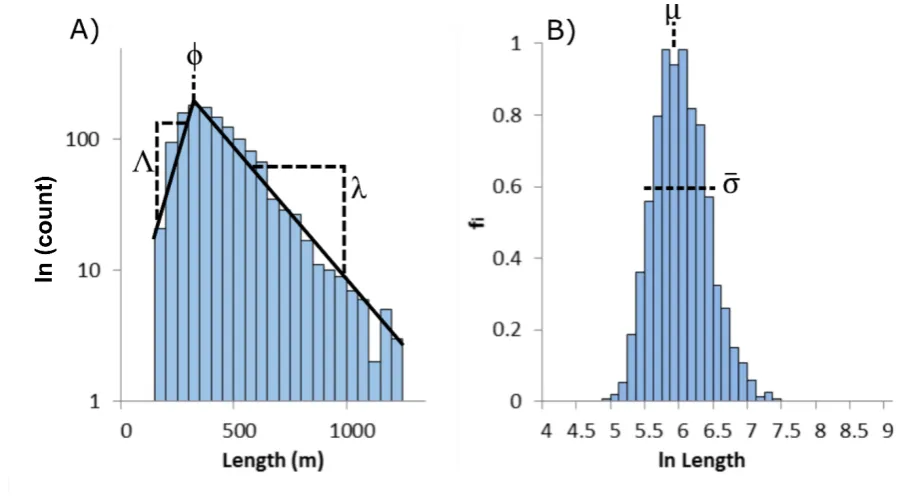
parameters based upon the description of our data following both gamma ( , and ) and
180
lognormal ( and distributions (Figure 2) (Hillier et al., 2016). First, using the
moment estimators detailed in Hillier et al. (2013), we compared our measurements to a
182
gamma distribution using frequency histograms (Figure 2A). The modal value ( ) was
183
calculated using the method-of-moments (Hillier et al., 2013):
184
(1) 185
where is the mean of the distribution and is the standard deviation of the data. The
186
maximum likelihood estimator of gradient of the positive tail of the distribution ( ) was
187
calculated by removing all data from the original dataset below to produce a subset dataset
188
ki (Appendix A of Hillier et al., 2013). is then:
189
(2)
190
191
To characterise the shape of the distributions before the mode, we also define , the
192
slope of the distribution before the mode. This involved removing all values above from the
193
original dataset, to produce Ki, and then applying the equation:
194
) (3)
195
Therefore, is a mirrored version of , with a statistical justification equivalent to that
196
for (see Hillier et al., 2013). Thus, describes a modal value per flow-set, and the
197
parameters and describe the shape of the distribution of the flow-set. and are
198
independent of each other. However, may be influenced by as we are studying scalar
199
variables.
200
A second set of parameters based upon the log-normal distribution were derived using
201
the method of Fowler et al. (2013). To calculate these parameters, the distributions were first
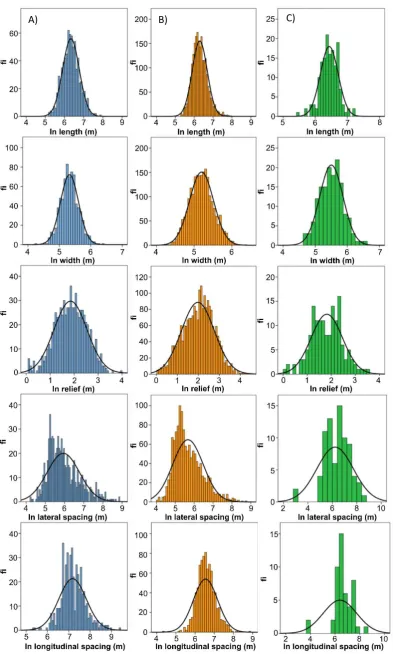
represented as histograms of frequency intensity (fi), modified to approximate probability
203
density after Fowler et al. (2013):
204
(4)
205
where ni is the number of drumlins in each bin, ∆ is the bin width and n is the total
206
number of the sample (Fowler et al., 2013). Bin width was kept the same for each histogram.
207
These frequency intensity histograms (Figure 2B) were visually compared to a normal
208
distribution curve in order to verify their log-normality. Secondly, the mean and variance,
209
and , respectively, of each spacing and size variable per flow-set were defined by:
210
ln (5)
211
ln (6)
212
3.3. Scenario-testing
213
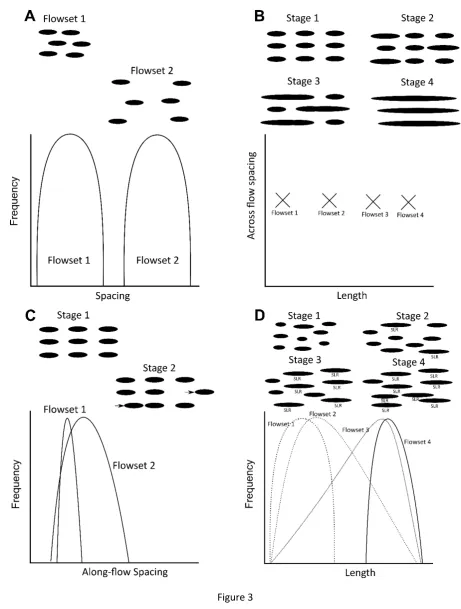
Figure 3 outlines several conceptual scenarios of possible drumlin patterning
214
behaviour, halted at different stages of development in different flow-sets. Figure 3A outlines
215
our conceptual model of two different sets which undergo simple stabilisation. In
flow-216
set 1, drumlins are initially formed and stabilise at a single size and distance apart. Different
217
ice-bed conditions in flow-set 2 mean that drumlins are formed and stabilise at a different
218
scale. This is illustrated in Figure 3A as a difference in spacing, but could equally be
219
manifested in drumlin size. Under this scenario, assuming conditions across a flow-set are
220
similar, the spread of the distributions ( , and ) is defined by little variability between
221
flow-sets, but average measures ( and may vary. In this case, the two flow-sets do not
222
represent different stages of maturity with a common evolution.
Figure 3B outlines a second conceptual model outlining a scenario whereby most
224
drumlins evolve through time by simply growing longer and without migrating, which may
225
lead to coarsening and collisions. At each successive stage drumlins grow longer, but remain
226
the same distance apart, eventually colliding and merging. If this is the behaviour that
227
characterises drumlin pattern evolution across all flow-sets, then different flow-sets, frozen at
228
different stages of growth, may show different levels of coarsening (Figure 3B). A similar
229
coarsening effect could also occur if drumlins grow wider, colliding/merging with lateral
230
neighbouring drumlins or if drumlins migrate at different rates, colliding with their upstream
231
neighbours.
232
Figure 3C illustrates a conceptual model of drumlins initially forming a set distance
233
apart, from which they then deviate due to migration, with each drumlin migrating at its own
234
pace. This assumes that migration can only occur parallel to ice flow. In this paper, we refer
235
to migration as being the movement of both the stoss and lee of drumlin (i.e. whole drumlin
236
movement), from growth of either side leading to a change in the location of the drumlin
237
centre. In the model, this leads to more variability in the longitudinal spacing of drumlins and
238
general coarsening. Again, in this conceptual model, different stages of this process are
239
imagined to be recorded in different flow-sets which have had different periods of time to
240
evolve to their observed state.
241
While the previous two cases are examples of pattern evolution that might lead to
242
perpetual coarsening, a further scenario of limited coarsening should also be tested. This is
243
the “significant pattern coarsening en route to a saturated wavelength” scenario of Murray et
244
al. (2014: p. 62), whereby interactions between elements cause the pattern to approach a
245
steady-state. Figure 3D illustrates a conceptual model of drumlins initially coarsening (as in
246
Figure 3B), but then reaching a size or spacing beyond which they can no longer grow. In this
247
conceptualisation, as more drumlins reach the size and spacing limit would increase, as the
formation of a tail in the distribution would be inhibited. Similar thresholds may also exist for
249
spacing, width and relief. This would lead to multiple ‘mature’ flow-sets at which drumlins
250
have reached a stable length (Figure 3D). Note that all four conceptual models are based upon
251
simplifications of drumlin development. It may be that more complex interactions, or none of
252
the proposed cases, occur and therefore dilute the signal of these simplistic expectations.
253
254
4. Results 255
In order to explore how drumlin size and spacing metrics vary between flow-sets, and
256
potentially decipher evolutionary sequences, the relationships between shape parameters for
257
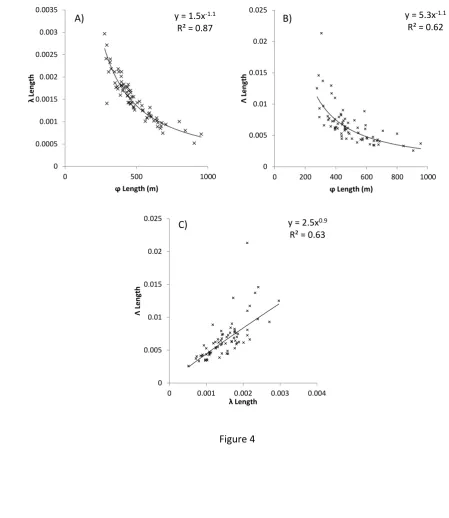
drumlin length, derived following the method of Hillier et al. (2013), are plotted on Figure 4.
258
Similar relationships were found for width, relief, lateral and longitudinal spacing (Figures S1
259
to S4). All were found to be significant to p ≤ 0.05 (f-test). The strongest relationships occur
260
between the parameters and (Figures 4A and S1 to S4), taking the form of
negatively-261
correlated power laws. This indicates that as the size or spacing of drumlins increases, the
262
gradient of the positive tail of the distribution decreases (Figure 4A). Similarly, and are
263
significantly highly-correlated through negative power-law relationships (Figure 4B).
264
Therefore, as drumlins get larger, or further apart, the gradient before the mode decreases.
265
This relationship is weaker for the width parameter (Figure S1). There are also significant
266
and strong correlations between and , this time taking the form of positive power laws
267
(e.g. Figure 4C). For each variable, is always greater than , indicating that the probability
268
distributions are always positively skewed. Therefore, the gamma-distribution metrics
269
indicate that size and spacing parameters change in a predictable manner between flow-sets.
270
To determine whether drumlin flow-sets are different from one another, which would
271
undermine the assumption that they represent different stages of drumlin evolution, we
performed analysis of variance (ANOVA) tests. Although inter-flow-set variation occurs,
273
these ANOVA tests show that there is no significant separation of flow-sets into different
274
groups or single entities (e.g. Figure 3A), despite the wide range of modal values for different
275
flow-sets (~220-740 m for length, ~100-350 m for width and ~4-12 m for relief). This means
276
that we find no highly-distinct flow-sets. Instead, they all show subtle variations from each
277
other. This is despite flow-sets being formed separately in time in space, and exhibiting a
278
range of different characteristics such as their total area, sedimentary substrate, or varying
279
degrees of underlying topographic influence.
280
To explore whether the log-normal distribution (commonly used to infer growth) can
281
describe the size and spacing of drumlins within flow-sets, we plot histograms of each metric
282
against log-normal distribution curves (Figure 5). Log-normal distributions have previously
283
been found for whole drumlin populations (Fowler et al., 2013), yet their applicability to the
284
metrics of individual flow-sets is unknown. Such distributions are often taken to infer that
285
stochastic phases of growth have occurred (Limpert et al., 2001; Fowler et al., 2013). Figure
286
5 shows how the frequency distributions of flow-sets are approximately log-normal for the
287
variables of length, width and relief. The shape of the distributions for these three variables
288
remains approximately log-normal, even for flow-sets which contain low numbers of
289
drumlins, despite the smaller sample size (Figure 5). However, the distributions of lateral and
290
longitudinal spacing do not fit a log-normal shape (Figure 5). Therefore, and are poor
291
descriptors for the two spacing variables.
292
To ascertain how the shape of the distributions differs between flow-sets and, in turn,
293
establish whether any patterning interactions have occurred (Figure 3), Figure 6 plots
294
against for length, width and relief. We found significant positive correlations (p ≤ 0.05,
F-295
test) for length and width, indicating that as drumlin length or width increases on average, the
spread of the distribution also increases (Figure 6A and B), although this relationship is
297
weaker for width. However, no such relationship was found for relief (Figure 6C).
298
To further visualise differences and the potential evolution in the shape of the
299
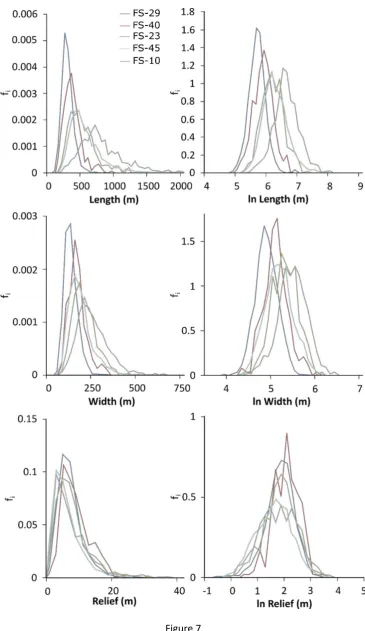
frequency distributions for each flow-set, Figure 7 overlays the frequency distributions of 5
300
flow-sets (see also Figure S5) chosen due to their large sample size and to characterise the
301
range of observed drumlin size metrics. For length and width, as the modal value increases,
302
its amplitude gets smaller and the spread increases (Figure 7). Conversely, modal relief
303
remains similar between flow-sets (Figure 7).
304
305
5. Discussion 306
We now return to the conceptual models and four questions posed in Section 2, and
307
discuss the extent to which scenarios described in Section 3.3 and illustrated in Figure 3 are
308
supported by our results.
309
310
5.1. Do drumlins stabilise at an initial scale?
311
One simple explanation for drumlin patterns might be that they stabilise at a set scale
312
and spacing, without pattern coarsening. Under this scenario, the varying shape of drumlin
313
size and spacing distributions between flow-sets would indicate that drumlins at different
314
locations were ‘printed’ at different scales onto the landscape. However, rather than
315
producing flow-sets with significantly different size and spacing metrics, we find no
316
separation of flow-sets into different statistical populations. Instead, the size and spacing
317
metrics of drumlins co-vary in an apparently continuous manner between flow-sets (Figures
318
4, S1 and S2). When characterised as gamma (Figure 4) or log-normal (Figure 7)
distributions, drumlin size distributions indicate that when the modal value increases, the
320
distribution becomes more widely spread. Such distributions could arise from varying
321
conditions at the ice-bed interface, or differences in process leading to a wider spread of the
322
drumlin size, shape and spacing within a flow-set as a result of simple stabilisation. However,
323
and although the mechanics of the following systems are different, similar variations in
324
distribution shape have been observed for stages of a time evolutionary sequence for other
325
phenomena (see Limpert et al., 2001), such as raindrop size (e.g. Srivastava, 1971), grain size
326
in volcanic rocks (Fowler and Scheu, 2016) and crystal size during crystallisation (e.g. Teran
327
et al., 2010; Ng, 2016). Furthermore, we find it unlikely that differences in the conditions at
328
the ice-bed interface and/or spatial variations in processes would lead to the smoothly
co-329
varying metrics that we observe here. Hence, we interpret our results as showing that drumlin
330
size and spacing evolves during development rather than from near-instantaneous ‘printing’
331
at a set scale, and we rule out simple stabilisation as a cause of differences in drumlin metrics
332
between flow-sets (Figure 3A). Indeed, we note that simple stabilisation is rarely the case for
333
natural patterns, which more often than not require evolution - growth, shrinking, interaction
334
- to yield a specific geometry or arrangement (see Murray et al., 2014; Clark et al., 2017 and
335
references therein), and are thus autogenic in nature (Clifford et al., 1993; Werner et al.,
336
2003; Pelletier et al., 2004), i.e., the pattern that emerges does so due to interactions from
337
elements within the pattern itself.
338
339
5.2. Do drumlins grow and/or shrink?
340
Drumlin metrics amalgamated from multiple flow-sets display log-normal or
341
exponential frequency distributions (Hillier et al., 2013; Fowler et al., 2013). This has been
342
used to infer that drumlins grow and/or shrink over time, through analogy with other
phenomena which display log-normal distributions (Limpert et al., 2001) and through
344
replicating the distributions predicted by statistical models (Hillier et al., 2016). Previous
345
analyses have based this interpretation on amalgamated samples from multiple ice-flow
346
events (Hillier et al., 2013; 2016; Fowler et al., 2013), which likely formed under a wide
347
variety of subglacial conditions. Rather than growing and/or shrinking over time, an
348
alternative explanation for the log-normal distribution of these multiple flow-set datasets is
349
that this simply reflects stochastically distributed subglacial parameters (e.g. effective
350
pressure, ice velocity, sediment thickness) across the multiple flow-sets from which the
351
metrics are extracted (Dunlop et al., 2008; Hillier et al., 2013; Fowler et al., 2013; Barchyn et
352
al., 2016). Our analysis of samples from individual flow-sets builds on the analysis of Hillier
353
et al., (2016), who studied the size metrics of a single flow-set and an amalgamated sample of
354
multiple flow-sets, and argued that the characteristics of drumlin frequency distributions
355
could be linked to subglacial parameters, if drumlin growth rate is known. Our work
356
indicates that drumlin size metrics are consistently positively skewed with near log-normal
357
distributions (Figures 5 and 7). This lends strong support to the hypothesis that drumlins
358
grow (or shrink) over time within the same flow-set, where one might suggest that similar
359
subglacial conditions have influenced drumlin development. While the positively skewed and
360
log-normal distributions demonstrate that either growth and/or shrinkage have occurred, the
361
fact that drumlin patterns are not the result of simple stabilisation, but are achieved through
362
drumlin interactions, indicates that these landforms must either grow and/or migrate.
363
If we assume that drumlins originate as small features (see Hillier et al., 2016), and
364
interpret different drumlin flow-set size and shape distributions as displaying an
365
evolutionary-sequence (e.g. Figures 3 and 7), then our data support the notion that there is a
366
general tendency for drumlins to get longer and wider as they develop (e.g. Figures 4, 6 and
367
7). This is consistent with the ‘cone-shaped scatter plot’ of drumlin length and width in Clark
et al., 2009 (see their Figure 10), and statistical models of drumlin formation (Fowler et al.,
369
2013; Hillier et al., 2016). The tight apex of the cone at lower values (and the lack of
370
datapoints below them) was taken as a fundamental initiation scale (100 metres) from which
371
drumlins were inferred to grow in length and width in various proportions to yield the overall
372
cone-shaped scatter. Consistent with the idea that drumlins originate as small features,
373
Dowling et al. (2016) propose that a set of small drumlins formed within a few years,
374
suggesting that drumlins initiate small and would naturally grow if given enough time (in this
375
case they formed as ice was quickly retreating from the region). Therefore, we interpret the
376
flow-sets with low modal size values as containing less mature drumlins.
377
Although the frequency distributions suggest that drumlin flow-sets which have had
378
more time to evolve contain longer, wider drumlins (e.g. Figure 7), we cannot rule out that
379
this general trajectory of drumlin growth is interspersed with phases of shrinking, i.e. erosion
380
(e.g. Smith et al., 2007; Hillier et al., 2016). Drumlin shrinking may even be an important
381
mechanism in drumlin pattern evolution, causing to the eventual eradication of some
382
drumlins within a pattern which would lead to pattern coarsening. Furthermore, purely
383
bedrock forms exist, which require an entirely erosional mechanism, but the extent to which
384
they are analogous to drumlins formed of unconsolidated sediments is less clear.
385
When drumlins are longer and wider within a flow-set, the spread of length and width
386
is also larger (Figures 4, 6 and 7). We interpret this as showing that, rather than all drumlins
387
growing uniformly in a flow-set, some drumlins grow longer and wider than others. Such
388
behaviour is replicated in statistical (e.g. Fowler et al., 2013; Hillier et al., 2016) and
389
numerical models (Barchyn et al., 2016). This could be related to either a variable sediment
390
supply controlling drumlin growth (e.g. Rattas and Piotrowski, 2003; Ó Cofaigh et al., 2013),
391
or drumlins initiating at different times during pattern development and thereby leading to a
392
mixed age population (e.g. Stokes et al., 2013b), or a combination of the two. The
preferential growth of some drumlins, at the expense of others, may lead to pattern
394
coarsening (see Section 5.5).
395
Drumlin spacing varies between flow-sets in a manner similar to the variable length
396
(Figures 4, S3 and S4), but the shapes of the distributions of spacing are not log-normal
397
(Figure 5). Therefore, drumlin spacing does not vary in the same manner as drumlin size
398
metrics. Perhaps the non-log-normal spacing distributions are a consequence of factors
399
independent from drumlin growth initially determining their placement. This is consistent
400
with a mix of regularly-seeded drumlins and ‘clones’ anchored to more randomly distributed
401
bedrock perturbations described by Clark (2010), which would produce non-log-normal
402
distributions. Another possibility is that drumlin spacing is altered due to post-formational
403
modification. That spacing is not uniform between flow-sets and varies at different locations
404
indicates that the scenario of drumlins growing longer without changing lateral spacing was
405
not detected (e.g. Figure 3B). This inference is based upon the assumption that simple
406
stabilisation does not account for the observed patterns in frequency distributions (see Section
407
5.1.). Instead, changes to the arrangement of drumlins may occur during pattern development,
408
with potential mechanisms for this being growth, erosion leading to the eradication of some
409
drumlins, amalgamation of one or more drumlins, and migration.
410
We envisage that drumlins (i.e. their relief) can grow in both net erosional and
411
depositional settings (see Clark, 2010; Stokes et al., 2013a). Where mobile sediment is
412
readily available, accretion in both the stoss and lee of a drumlin may occur (e.g. Dardis et
413
al., 1984; Fowler, 2009; Knight, 2016). Indeed, drumlins have often been reported to have
414
lee-side cavity infills (e.g. Dardis and McCabe, 1983; Dardis et al., 1984; Fisher and Spooner,
415
1994; Stokes et al., 2011; 2013a; Spagnolo et al., 2014b), indicating that lee-side deposition
416
would be an obvious mechanism via which drumlins could grow (Barchyn et al., 2016).
417
Where erosion co-exists with deposition, it is likely that sediment is transported to, and
deposited at, the lee of a drumlin, perhaps at the expense of relief and width (e.g. Stokes et
419
al., 2013a; Eyles et al., 2016).
420
421
5.3. Do drumlins migrate?
422
This question is difficult to solve using relict drumlins, but the earlier (Section 5.2.)
423
results on drumlin growth are helpful because these could also be partially or fully achieved
424
by drumlin migration. Our expectation of drumlin migration (that the spread of drumlin
425
along-flow/longitudinal spacing metrics would increase) in Figure 3C is supported by our
426
results (Figure 4). However, the spread in longitudinal spacing metrics could be attributed to
427
preferential growth of some drumlins and destruction of others. Although our data cannot
428
resolve whether or not drumlin patterns evolve through migration, a number of observations
429
from the literature are relevant to this issue. For example, some drumlins are known to be
430
composed of bedrock or gravel cores (Schoof, 2007; Stokes et al., 2011; Dowling et al.,
431
2015), indicating that the drumlin is ‘anchored’ on a core which is unlikely to have moved
432
during formation, though the surrounding sediment may have changed shape. However, other
433
drumlins contain sedimentary structures (e.g. large deformation structures) which suggest
434
they could have migrated (Boulton, 1987; Hart, 1997; Knight, 2016), and numerical models
435
predict that migration can occur (e.g. Chapwanya et al., 2011; Barchyn et al., 2016). If
436
migration or growth leads to collision, we would expect to find examples of relict drumlins
437
about to collide, or paused in mid-collision. Such arrangements are readily observed for
438
migratory dunes (Hersen and Douady, 2005; Kocurek et al., 2010), with numerical models of
439
bedforms suggesting that collisions are a key factor for regulating bedform size distribution
440
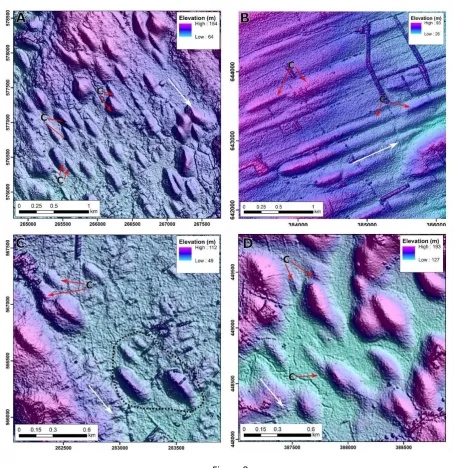
(Barchyn et al., 2016).
Figure 8 shows potential examples of drumlins possibly about to collide. Although
442
perhaps not as common in drumlin fields, similar typologies to those on Figure 8 have been
443
observed and modelled for colliding barchan dunes (e.g. Hugenholtz and Barchyn, 2012;
444
Parteli et al., 2014), and here we suggest that similar arrangements may be caused by drumlin
445
migration and collision. We further note that growth and migration may provide feasible
446
mechanisms to explain compound or fused drumlin typologies (e.g. Knight, 1997) and are
447
consistent with observations of downstream changes in drumlin density or ‘packing’ (Clark
448
and Stokes, 2001). Collisions may therefore be a mechanism by which pattern coarsening
449
occurs in drumlin fields. Further sedimentological and morphological studies are required to
450
examine if and how any such mobile drumlins interact.
451
452
5.4. Do drumlins patterns evolve toward a stable coarsened state?
453
If drumlin patterns evolve, a logical question is when do they stop evolving; do they
454
reach a final form or steady state? None of the frequency distributions observed here conform
455
to our expectation of stabilisation outlined in Figure 3D. Indeed, that all the distributions of
456
the size variables are approximately log-normal, and modal drumlin size changes from
flow-457
set to flow-set, suggests that size metrics continue to evolve (Figure 6). A similar result was
458
found in the statistical modelling of Hillier et al. (2016). This apparent lack of an upper limit
459
for drumlin length is consistent with the idea of a subglacial bedform continuum (Aario,
460
1987; Rose, 1987; Ely et al., 2016), whereby drumlins merge into mega-scale glacial
461
lineations (e.g. Stokes et al., 2013b; Spagnolo et al., 2014a; 2016; Barchyn et al., 2016). That
462
relief does not show the evolutionary sequence displayed by length and width, but maintains
463
a log-normal shape with a comparable mean in all flow-sets (Figure 6 and 7) is intriguing.
464
Perhaps relief is prevented from growing higher by some, yet unknown, glaciological cause,
leading to early stabilisation of drumlin relief. One possibility is that this limit is imposed by
466
sediment supply, and is reached when all available sediment is contained within drumlins
467
preventing further upward growth.
468
469
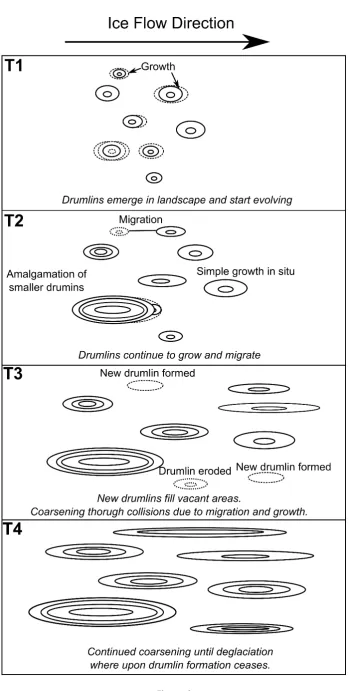
5.5. Drumlin Pattern Evolution
470
Interpretation of our analysis of drumlin pattern interactions is summarised in Figure 9.
471
We find that drumlins do not stabilise at their initial scale (Figure 9-T1). It is more likely that
472
they initiate at a length-scales of around 100 m (Clark et al., 2009) from which they then
473
evolve and coarsen (Figure 9-T2). Coarsening is achieved through a mixture of drumlins
474
growing longer (and bumping into each other) and migrating, with some drumlins growing at
475
the expense of others (Figure 9-T3). New drumlins are continually formed during the
476
formation period, if accommodation space and sediment becomes available. Growth of
477
drumlins, especially in a lengthwise direction, leads to perpetual coarsening until conditions
478
change radically (e.g. a change in basal thermal regime from warm-based to cold-based) or
479
deglaciation occurs (Figure 9-T4). This picture of an evolving ice-bed interface is consistent
480
with numerical and statistical modelling (Chapwanya et al., 2011; Fowler et al., 2013;
481
Barchyn et al., 2016; Hillier et al., 2016) and repeat geophysical imaging of cognate
482
subglacial bedforms beneath modern ice masses, which indicates changes at decadal
483
timescales (e.g. Smith et al., 2007; King et al., 2009).
484
That pattern development occurs in drumlin fields, implies that interactions between
485
drumlins is required to create the ordered landscapes and pattern characteristics observed (see
486
also Clark et al. 2017). In dunes, these bedform interactions (or ‘communications’) are
487
facilitated by interactions at the fluid, bedform and grain scale (Kocurek et al., 2010). For
488
example, flow separation in the lee of dunes can cause scouring in the stoss of upstream
dunes (Endo and Taniguchi, 2004). For drumlins, a lack of observations leaves the
490
mechanisms of communication unclear, but several possible candidates exist. At the fluid
491
scale, the drag induced by the sliding of ice over drumlins (see Schoof, 2002) may alter the
492
sediment entrainment rates via shear stress alteration. At the bedform scale, the development
493
of lee-side drumlin cavities (e.g. Fowler, 2009) may regulate drumlin growth and migration
494
(Barchyn et al., 2016), in turn controlling the size and spacing of resultant drumlins.
495
Sediment supply variations may also control inter-drumlin interactions and drumlin
496
positioning. At the simplest level, sediment must be available for bedforms to initially form,
497
and be either supplied to or recycled within the system for patterning interactions to occur.
498
Inter-drumlin interactions determined at the grain scale may occur due to the streaming of
499
sediment around the flanks of a drumlin, caused by the development of drumlin relief (e.g.
500
Boyce and Eyles, 1991). This may cause spatial variability in sediment availability, whereby
501
sediment deflected around upstream drumlins leads to an increased supply downstream of an
502
inter-drumlin area. The presence of a cavity would also introduce a region in the lee of a
503
drumlin where sediment supply is limited, thus inhibiting drumlin growth directly
504
downstream. Which, if any, of the above is the cause of drumlin interaction should be the
505
topic of further study.
506
That patterning interactions occur in drumlin fields also has implications for drumlin
507
formation hypotheses, of which there are many (see Clark, 2010 for a recent review). The
508
order and predictability of patterns seems at odds with polygenetic formation hypotheses of
509
subglacial bedforms, whereby differences in sediment composition are inferred to mean that a
510
large number of equifinite, processes are responsible for subglacial bedform formation (e.g.
511
Lindén et al., 2008; Sutinen et al., 2010). Möller and Dowling (2016) provide a framework
512
for understanding how sedimentological differences may arise due to a variety of processes,
513
given the morphological similarity of drumlins. Their ‘unifying polygenetic’ model suggests
that differences in boundary conditions (such as sediment thickness and ice velocity) are
515
regulated by a complex set of growth and shaping processes. Here we have shown that such
516
complex processes (growth, migration, collisions) are likely to occur. However, patterning
517
provides a useful framework for understanding these processes. The ubiquity of patterning in
518
drumlin fields that we and Clark et al. (2017) find, suggests that any site-specific
519
sedimentological differences that would otherwise lead to the conclusion of polygenesis,
520
should be considered within the context of the development and interaction of the drumlin
521
pattern. The erodent layer hypothesis (Eyles et al., 2016) proposes that all drumlins are
522
formed by the abrasion of a layer of subglacial sediment into the underlying substrate. This is
523
not necessarily at odds with the observations of patterning presented here; for example,
524
erosional bedforms can also migrate and grow over time (e.g. Richardson and Carling, 2005).
525
It is, however, difficult to reconcile with observations of subglacial bedforms where sediment
526
has accreted over time (e.g. Dardis and McCabe, 1983; Knight, 1997; Spagnolo et al., 2016).
527
The instability hypothesis of drumlin formation views drumlins as the consequence of the
528
coupled flow of ice, water and sediment at the ice-bed interface and allows for both accretion
529
and erosion of bedforms (e.g. Fowler and Chapwanya, 2014). This hypothesis is rooted in the
530
observation that drumlins are arranged in patterns, and is therefore easily suited to explain
531
patterning interactions. Numerical models of ribbed moraine formation demonstrate
532
migration and coarsening occurring (Chapwanya et al., 2011), but have not yet been adapted
533
to produce such interactions for drumlins. However, the instability hypothesis is yet to be
534
supported by sedimentological observations (Spagnolo et al., 2016; McCracken et al., 2016).
535
More generally, the results presented here suggest that advances in understanding drumlin
536
formation should come from numerical modelling that includes the possibility for
inter-537
drumlin interactions (e.g. Barchyn et al., 2016).
538
6. Summary and Conclusions 540
Here we study the frequency distributions of the size and shape metrics of 36,222
541
drumlins from 71 flow-sets of drumlins to seek inferences about patterning interactions.
542
Based on concepts applied to bedform patterns in other fields, we ask whether drumlins i)
543
stabilise at an initial scale; ii) grow; iii) migrate; and, through growth and or migration, iv)
544
evolve to a stable coarsened state or perpetually coarsen. Through examination of the size
545
and spacing metrics of drumlins per flow-set, and using space-for-time substitution, our
546
interpretation is that:
547
i) Drumlins do not exhibit simple stabilisation, i.e. they are not fixed by a
548
wavelength that is determined during their initial growth.
549
ii) Drumlins likely grow over time: a process which leads to pattern coarsening.
550
iii) There is potential for drumlins to migrate during pattern development, which
551
likely contributes to pattern coarsening.
552
iv) A lack of an observable upper limit on drumlin geometry (with the possible
553
exception of their relief) leaves the potential for perpetual coarsening to occur.
554
The approach of using size, shape and positioning metrics of relict drumlins to infer
555
dynamic inter-drumlin interactions as they grow is, of course, challenging. Nevertheless we
556
suggest that the patterning that exists in drumlin fields (Clark et al., 2017) arises from
557
drumlin growth and migration, leading to pattern coarsening. This has important
558
ramifications for modelling the formation of subglacial bedforms, and demonstrates that it is
559
misleading to consider drumlins as a collection of individual landforms. Rather, models
560
should ideally address their spatial interactions within a drumlin field.
561
Acknowledgements 563
JCE would like to thank Kathy and Chris Denison for supporting his PhD. This work was
564
initiated and supported by NERC grant NE/D011175/1 led by CDC. A.L.C.H acknowledges
565
BGS NERC PhD studentship (NE/S/A/2004/12102). Colm Ó Cofaigh and Andrew Sole are
566
thanked for their comments during JCEs viva, and Andrew Fowler is thanked for useful
567
discussions. John Hillier, an anonymous reviewer and the editorial team are thanked for their
568
constructive comments.
569
570
References 571
Aario R. 1977. Classification and terminology of morainic landforms in Finland. Boreas,
572
6(2): 87-100. 573
Anderson RS. 1990. Eolian ripples as examples of self-organization in geomorphological
574
systems. Earth-Science Reviews, 29(1): 77-96.
575
Andreotti B, Fourriere A, Ould-Kaddour F, Murray, B, Claudin, P. 2009. Giant aeolian dune
576
size determined by the average depth of the atmospheric boundary layer. Nature,
577
457(7233): 1120-1123. 578
Baitis, E, Kocurek, G, Smith, V, Mohrig, D, Ewing, RC, Peyret, AP. 2014. Definition and
579
origin of the dune-field pattern at White Sands, New Mexico. Aeolian Research, 15:
580
269-287.
581
Ball P. 1999. The Self-made Tapestry: Pattern Formation in Nature. Oxford: Oxford
582
University Press.
Barchyn, T.E., Dowling, T.P., Stokes, C.R., Hugenholtz, C.H. 2016. Subglacial bed form
584
morphology controlled by ice speed and sediment thickness. Geophysical Research
585
Letters 43 2016GL069558. DOI.https://doi.org/10.1002/2016GL069558.
586
Benediktsson, Í.Ö., Jónsson, S.A., Schomacker, A., Johnson, M.D., Ingólfsson, Ó., Zoet, L.,
587
Iverson, N.R., Stötter, J. 2016. Progressive formation of modern drumlins at
588
Múlajökull, Iceland: stratigraphical and morphological evidence. Boreas 45: 567-583
589
Boulton, G.S. 1987. A theory of drumlin formation by subglacial sediment deformation. In
590
Menzies, J. and Rose, J. (eds.) Drumlin Symposium, Balkema, Rotterdamn; 25-80.
591
Chapwanya, M., Clark, C. D., Fowler, A. C. 2011. Numerical computations of a theoretical
592
model of ribbed moraine formation. Earth Surface Processes and Landforms, 36(8):
593
1105-1112.
594
Cherlet, J., Besio, G., Blondeaux, P., Van Lancker, V., Verfaillie, E., Vittori, G. 2007.
595
Modeling sand wave characteristics on the Belgian Continental Shelf and in the Calais
596
Dover Strait. Journal of Geophysical Research: Oceans, 112(C6).
597
Clark, C. D. (2010). Emergent drumlins and their clones: from till dilatancy to flow
598
instabilities. Journal of Glaciology, 56(200), 1011-1025.
599
Clark, C.D., Stokes, C.R. 2001 Extent and basal characteristics of the M’Clintock Channel
600
Ice Stream. Quaternary International, 86 (1), 81-101.
601
Clark, C. D., Hughes, A. L., Greenwood, S. L., Spagnolo, M., Ng, F. S. 2009. Size and shape
602
characteristics of drumlins, derived from a large sample, and associated scaling laws.
603
Quaternary Science Reviews, 28(7), 677-692.
Clark, C.D., Ely, J.C., Spagnolo, M., Hahn, U., Hughes, A.L.C., Stokes, C.R. 2017. Spatial
605
organisation of drumlins. Earth Surface Processes and Landforms,
606
doi: 10.1002/esp.4192. [online] Available from:
607
http://onlinelibrary.wiley.com/doi/10.1002/esp.4192/full.
608
Clarke, G. K. 1987. Subglacial till: a physical framework for its properties and processes.
609
Journal of Geophysical Research: Solid Earth, 92(B9), 9023-9036.
610
Clifford, N.J., 1993. Formation of riffle—pool sequences: field evidence for an autogenetic
611
process. Sedimentary Geology, 85(1), pp.39-51.
612
Coleman, S. E., Zhang, M. H.,Clunie, T. M. 2005. Sediment-wave development in subcritical
613
water flow. Journal of Hydraulic Engineering, 131(2), 106-111.
614
Dardis, G. F., McCabe, A. 1983. Fades of subglacial channel sedimentation in late
615
Pleistocene drumlins, Northern Ireland. Boreas, 12(4), 263-278.
616
Dardis, G. F., McCabe, A. M. Mitchell, W. I. 1984. Characteristics and origins of lee side
617
stratification sequences in late pleistocene drumlins, northern Ireland. Earth Surface
618
Processes and Landforms, 9(5), 409-424.
619
Dowling, T. P. F., Spagnolo, M. Möller, P. 2015. Morphometry and core type of streamlined
620
bedforms in southern Sweden from high resolution LiDAR. Geomorphology, 236,
54-621
63.
622
Dowling, T. P. F., Möller, P. Spagnolo, M. 2016. Rapid subglacial streamlined bedform
623
formation at a calving bay margin. Journal of Quaternary Science, 31, 8, 879-892.
624
Dunlop, P., Clark, C. D. and Hindmarsh, R. C. (2008). Bed ribbing instability explanation:
625
testing a numerical model of ribbed moraine formation arising from coupled flow of ice
and subglacial sediment. Journal of Geophysical Research: Earth Surface (2003–
627
2012), 113(F3).
628
Ely, J.C. 2015. Flow Signatures on the Bed and the Surface of Ice Sheets, Unpublished PhD
629
Thesis. University of Sheffield; 300 pp.Ely, J.C., Clark, C.D., Spagnolo, M., Stokes,
630
C.R., Greenwood, S.L., Hughes, A.L., Dunlop, P. and Hess, D. (2016). Do subglacial
631
bedforms comprise a size and shape continuum? Geomorphology, 257, pp.108-119.
632
Endo N., Taniguchi K. 2004. Observations of the whole process of interaction between
633
barchans by fume experiments. Geophysical Research Letters 31: L12503.
634
Ewing, R.C., Kocurek, G. and Lake, L.W., 2006. Pattern analysis of dune field
635
parameters. Earth Surface Processes and Landforms, 31(9), pp.1176-1191.
636
Ewing, R.C. and Kocurek, G.A., 2010. Aeolian dune interactions and dune field pattern
637
formation: White Sands Dune Field, New Mexico.Sedimentology, 57(5), pp.1199-1219.
638
Eyles, N., Putkinen, N., Sookhan, S. and Arbelaez-Moreno, L., 2016. Erosional origin of
639
drumlins and megaridges. Sedimentary Geology, 338, pp.2-23.
640
Fisher, T.G. and Spooner, I., 1994. Subglacial meltwater origin and subaerial meltwater
641
modifications of drumlins near Morley, Alberta, Canada. Sedimentary Geology, 91(1),
642
pp.285-298.
643
Fowler, A. C. (2009). Instability modelling of drumlin formation incorporating lee-side
644
cavity growth. In Proceedings of the Royal Society of London A: Mathematical,
645
Physical and Engineering Sciences, 465, 2109, 2681-2702.
Fowler, A. C., Spagnolo, M., Clark, C. D., Stokes, C. R., Hughes, A. L. C., and Dunlop, P.
647
(2013). On the size and shape of drumlins. GEM-International Journal on
648
Geomathematics, 4(2), 155-165.
649
Fowler, A. C. and Chapwanya, M. (2014). An instability theory for the formation of ribbed
650
moraine, drumlins and mega-scale glacial lineations. In Proceedings of the Royal
651
Society of London A: Mathematical, Physical and Engineering Sciences, 470, No.
652
2171, 20140185.
653
Fowler, A.C. and Scheu, B. (2016). A theoretical explanation of grain size distributions in
654
explosive rock fragmentation. In Proceedings of the Royal Society of London A:
655
Mathematical, Physical and Engineering Sciences, 472, No. 2190, 20150843.
656
Hart, J. K. (1997). The relationship between drumlins and other forms of subglacial
657
glaciotectonic deformation. Quaternary Science Reviews, 16(1), 93-107.
658
Hersen, P. and Douady, S., 2005. Collision of barchan dunes as a mechanism of size
659
regulation. Geophysical Research Letters, 32(21).
660
Hillier, J. K., Smith, M. J., Clark, C. D., Stokes, C. R. and Spagnolo, M. 2013. Subglacial
661
bedforms reveal an exponential size–frequency distribution. Geomorphology, 190,
82-662
91.
663
Hillier, J.K., Kougioumtzoglou, I.A., Stokes, C.R., Smith, M.J., Clark, C.D. and Spagnolo,
664
M.S., 2016. Exploring explanations of subglacial bedform sizes using statistical
665
models. PloS one, 11(7), p.e0159489.
666
Hindmarsh, R.C., 1999. Coupled ice–till dynamics and the seeding of drumlins and bedrock
667
forms. Annals of Glaciology, 28(1), pp.221-230.
Hugenholtz, C.H. and Barchyn, T.E., 2012. Real barchan dune collisions and
669
ejections. Geophysical Research Letters, 39(2).
670
Hughes, A. L., Clark, C. D. and Jordan, C. J. (2010). Subglacial bedforms of the last British
671
Ice Sheet. Journal of Maps, 6(1), 543-563.
672
Hughes, A. L., Clark, C. D. and Jordan, C. J. (2014). Flow-pattern evolution of the last
673
British Ice Sheet. Quaternary Science Reviews, 89, 148-168.
674
Johnson, M. D., Schomacker, A., Benediktsson, Í. Ö., Geiger, A. J., Ferguson, A. and
675
Ingólfsson, Ó. (2010). Active drumlin field revealed at the margin of Múlajökull,
676
Iceland: a surge-type glacier. Geology, 38(10), 943-946.
677
King, E. C., Hindmarsh, R. C. and Stokes, C. R. (2009). Formation of mega-scale glacial
678
lineations observed beneath a West Antarctic ice stream. Nature Geoscience, 2(8),
585-679
588.
680
Knight, J., 1997. Morphological and morphometric analyses of drumlin bedforms in the
681
Omagh Basin, north central Ireland. Geografiska Annaler: Series A, Physical
682
Geography, 79(4), pp.255-266.
683
Knight, J., 2016. Subglacial processes from drumlins in Clew Bay, western Ireland. Earth
684
Surface Processes and Landforms, 41(2), pp.277-288.
685
Kocurek, G., Ewing, R. C., and Mohrig, D. (2010). How do bedform patterns arise? New
686
views on the role of bedform interactions within a set of boundary conditions. Earth
687
Surface Processes and Landforms, 35(1), 51-63.
Kyrke Smith, T.M., Katz, R.F. and Fowler, A.C., 2015. Subglacial hydrology as a control on
689
emergence, scale, and spacing of ice streams. Journal of Geophysical Research: Earth
690
Surface, 120(8), pp.1501-1514.
691
Limpert, E., Stahel, W.A. and Abbt, M., 2001. Log-normal distributions across the sciences:
692
Keys and clues on the charms of statistics, and how mechanical models resembling
693
gambling machines offer a link to a handy way to characterize log-normal distributions,
694
which can provide deeper insight into variability and probability—normal or
log-695
normal: That is the question. BioScience, 51(5), pp.341-352.
696
Lindén, M., Möller, P. and Adrielsson, L., 2008. Ribbed moraine formed by subglacial
697
folding, thrust stacking and lee side cavity infill. Boreas, 37(1), pp.102-131.
698
McCracken, R.G., Iverson, N.R., Benediktsson, Í.Ö., Schomacker, A., Zoet, L.K., Johnson,
699
M.D., Hooyer, T.S. and Ingólfsson, Ó., 2016. Origin of the active drumlin field at
700
Múlajökull, Iceland: New insights from till shear and consolidation
701
patterns. Quaternary Science Reviews, 148, pp.243-260.
702
Micallef, A., Ribó, M., Canals, M., Puig, P., Lastras, G. and Tubau, X., 2014. Space-for-time
703
substitution and the evolution of a submarine canyon–channel system in a passive
704
progradational margin. Geomorphology, 221, pp.34-50.
705
Möller, P. and Dowling, T.P., 2016. Streamlined subglacial bedforms on the Närke plain,
706
south-central Sweden–areal distribution, morphometrics, internal architecture and
707
formation. Quaternary Science Reviews, 146, pp.182-215.
708
Murray, A. B., Goldstein, E. B. and Coco, G. (2014). The shape of patterns to come: from
709
initial formation to long term evolution. Earth Surface Processes and Landforms,
710
39(1), 62-70.