,
3--y,,)
Lf32.JI
fJJ,OO/tV
33?,JZl~3
j3D~J .~//. ~30,)EVALUATING EU
EXPEND-ITURE
PROGRAMMES:
A GUIDE
Ex post and Intermediate Evaluation
First edition, January 1997
XIX/02 - Budgetary overview and evaluation
flr"
4'
A great deal of additional information on the European Union is available on the Internet. It can be accessed through the Europa server (http://europa.eu.int)
Cataloguing data can be found at the end of this publication
Luxembourg: Office for Official Publications of the European Communities, 1997
ISBN 92-827-9436-9
© European Communities, 1997
Reproduction is authorized, except for commercial purposes, provided the source is acknowledged
Foreword
·Evaluation is an essential part of modern public sector management practice. It is for this reason that the systematic evaluation of European Union expenditure programmes is one of the key components of the Commission's
Sound and Efficient Management 2000 initiative.
With the adoption of the Communication on Evaluation on 8 May 1996, the Commission outlined a series of concrete steps to p"romote best practice in this field. Whilst recognising that the operational services are first and foremost responsible for ensuring the evaluation of their own programmes, the Communication charged the financial services with the responsibility of developing a number of instruments of support. Among these instruments were instructional manuals for use by non-specialists, setting out the purpose, management and design of evaluation, some essential methodological questions and basic standards of good professional practice.
The present guide looks at intermediate and ex post evaluation of expenditure programmes. It is aimed at programme managers within the Commission services, as well as others who require a general introduction to the theory and practice of evaluation.
I hope that this guide will be both a useful contribution to the work of a wide range of services as well as a clear indication of the development of an
evaluation culture within the Commission.
E. Liikanen
Table of contents
The first evaluation
1. Introduction
1.1. What is evaluation?
1.1.1. Towards a definition of evaluation 1.1.2. What evaluation is not
1.2. Why are programme evaluations conducted? 1.3. The evaluation of EU programmes
2. Key concepts and definitions
2.1. What can be evaluated?2.2. What issues are raised by evaluations?
2.2.1. The programme and its intervention logic 2.2.2. Key evaluation issues
2.2.3. Other important issues 2.3. Who is involved in the evaluation? 2.4. What types of evaluations are there?
2.4.1. Formative and summative evaluations 2.4.2. Intermediate and ex post evaluations 2.4.3. Internal and external evaluations
3. Preparing and managing evaluations
3.1. Establishing a management structure 3.2. Elaborating the evaluation project3.2.1. Identifying the goals of the evaluation 3.2.2. Delineating the scope of the evaluation 3.2.3. Formulating the analytical agenda 3.2.4. Setting benchmarks
3.2.5. Taking stock of available information 3.2.6. Mapping out a work plan
3.2. 7. Selecting the evaluator 3.3. Drawing up the terms of reference
3.3.1. The legal base and motivation for the evaluation 3.3.2. The uses and users of the evaluation
3.3.3. The description of the programme to be evaluated 3.3.4. The scope of the evaluation
3.3.5. The main evaluation questions
3.3.6. The methodologies to be followed in data coUection analysis
3.3.7. The work plan! organizational structure and budget 3.3.8. The structure of the final evaluation report
4. Conducting evaluations
4.1. Introducing evaluation designs
4.1.1. Causality and the ideal experimental design 4.1.2. Threats to causal inference
4.1.3. The causal approach to evaluation designs
4.1.4. The descriptive approach to evaluation designs 4.2. Data collection techniques
4.2.1. Classifying data 4.2.2. Surveys
4.2.3. Case studies
4.2.4. Natural observations 4.2.5. Expert opinion
4.2.6. Reviews of programme documents 4.2.7. Literature reviews
4.3. Data analysis techniques 4.3.1. Statistical analysis 4.3.2. The use of models 4.3.3. Non-statistical analysis· 4.3.4. Judgement techniques
5. Reporting and disseminating evaluations
5.1. Maximizing the use of evaluations5.2. The presentation of the evaluation report 5.2.1. The structure of the evaluation report 5.2.2. The clarity of the evaluation report 5.3. The dissemination of evaluations
References
Annexe 1. Glossary of evaluation terms
Annexe 2. Judging the quality of evaluation reports
Annexe 3. Some evaluation do's and don'ts
Select bibliography
Index
60 62 62 63 65 66 68 68
69
69
69
72 72
73
75 75
76
76
78 81
85
87
105
107
111
The first evaluation
In the beginning God created the heaven and the
earth.
And God saw everything that He made. "Behold,"
God said, "it is vety good." And the evening and the
morning were the sixth day.
And on the seventh day God rested from all His
work. His archangel came then unto Him asking,
"God, how do you know that what you have created
is 'vety good'? What are your criteria? On what data
do you base your judgement? Aren't you
a
little
close to the situation to make
a
fair and unbiased
evaluation?"
God thought about these questions all that day and
His rest was greatly disturbed.
1. Introduction
Evaluation may be regarded by some as a diabolical exercise. However, if evaluations are well conducted, and if the results of evaluations are used by decision-makers, they can contribute to improved public programmes, as well as to increased transparency, accountability and cost-effectiveness.
Evaluation is not new. In some areas of EU activity, it has been established for several years now. Similarly, some Member States have a relatively long record of conducting evaluations and acting on their results. In other countries, both in Europe and in the rest of the world, it is increasingly being introduced.
The European Commission's Sound and Efficient Management 2000 initiative (known as SEM 2000) includes the use of evaluation as a key element in improving the management culture of the Commission itself. A key innovation of SEM 2000 is the requirement that systematic evaluation be
introduced for all EU programmes. This requirement was reinforced by the
Commission in its Communication on Evaluation, which was adopted on 8 May 1996. Apart from setting out the obligations which services are required to meet in terms of evaluation, the Communication also provided for a number of instruments to be put at the disposal of services to assist them in this task. This present guide is one of these instruments.
This guide is intended to introduce officials to the main aspects involved in managing evaluations and to provide a broad overview of the main technical issues. It is aimed at the average programme manager within the Commission, rather than the evaluation specialist, i.e. someone who wishes to understand how to manage external evaluations or to perform basic internal evaluations of EU expenditure programmes. Evaluations of interventions without budgetary consequences are not covered, nor does the guide examine the evaluation of projects or policies. However, many of the concepts used in this guide will also be of interest to those who are concerned with evaluating projects or policies.
The main focus of this guide will be on ex post evaluations (conducted either on or after the completion of an intervention) and on intermediate evaluations
(conducted during the implementation of an intervention). A separate guide will be issued on ex ante evaluations (conducted before the implementation of an intervention), which are sometimes referred to as appraisals.
The structure of the guide is as follows:
• Chapter 2 introduces some key evaluation concepts and definitions:
• what can be evaluated?
• who is involved in the evaluation?
• what types of evaluations are there?
• Chapter 3 is concerned with preparing and managing evaluations. It gives advice on:
• establishing a management structure for an evaluation
• preparing an evaluation project
• drawing up the terms of reference
+
Chapter 4 deals with conducting evaluations. It introduces the reader to the main issues involved in:• evaluation designs
• data collection techniques
• data analysis techniques
• Finally, chapter 5 covers reporting and disseminating evaluations. In particular, it looks at
• maximizing the use of evaluations
• the presentation of the evaluation report
• the dissemination of evaluations
The remainder of this first chapter addresses two main questions:
• what is evaluation?
• why are programme evaluations conducted?
It is followed by a general discussion of some of the special factors which should be taken into account in the evaluation of EU programmes.
1.1. What is evaluation?
1.1.1. Towards a definition of evaluation
been put forward, each with its own merits. Here is a selection of possible definitions:
"A critical and detached look at objectives and how they are being mef'2
((The examination of whether the legal, administrative and financial means put into place by a programme have enabled it to produce the effects it was supposed to produce and to attain the objectives which were assigned to it"3
"A process which seeks to determine as systematically and objectively as possible the relevance, efficiency and effect of an activity in terms of its objectives"4
"The systematic application of social research procedures for assessing the conceptualisation, design, implementation and utility of public programmes"5
"An independent, objective examination of the background, objectives, results, activities and means deployed, with
a
view to drawing lessons that may be more widely applicable"6"The judgement of public interventions according to their results, impacts and the needs they aim to satisfy"7
((The process of forming
a
judgement on the value ofa
programme"8
Given that it is probably impossible to arrive at a single definition of 'evaluation' which will have universal appeal, we have chosen instead to identify some crucial elements which should normally characterise evaluations:
• evaluations should be analytical - they should be based on recognized research techniques;
• evaluations should be systematic - they require careful planning and consistent use of the chosen techniques;
• evaluations should be reliable- the findings of an evaluation should be reproducible by a different evaluator with access to the same data and using the same methods of data analysis;
• evaluations should be user-driven - this just means that successful evaluations should be designed and implemented in ways that provide useful information to decision-makers, given the political circumstances, programme constraints and available resources.
1.1.2. What evaluation is not
If it is not very easy to say precisely what evaluation is, itA is easier to say what it is not.
Firstly, evaluations differ from scientific studies. Both should be analytical, systematic and reliable. However, whereas scientists may undertake research in order to expand the sum of human knowledge and frequently confine themselves to one highly specialized discipline, evaluations are undertaken for more practical reasons. They are intended to be of practical use by informing decisions, clarifying opti.ons, reducing uncertainties and generally providing information about programmes within their own specific contexts. They also can draw on a wide range of analytical approaches.
Neither is evaluation the same as audit. Audit is primarily concerned with verifying the legality and regularity of the implementation of resources (inputs) in a programme. Evaluation, on the other hand, is necessarily more analytical. It examines the programme from the point of view of society (defined from different possible perspectives). It looks at the validity of the strategy followed and whether objectives are appropriate given the problems to be solved and the benefits to be achieved. Auditors tend to have coercive powers, sometimes defined in legal texts, whereas evaluators must often rely on "good will" and the power of their arguments.
Audit has traditionally covered activities such as the verification of financial records (financial audit). A more recent innovation is known as performance audit, which is conceptually closer to evaluation. Performance audit is strongly concerned with questions of efficiency (of a programme's direct outputs) and good management. Performance audit and evaluation share the same aim of improving the quality of programmes, but evaluation goes much further. It also looks at issues such as sustainability, relevance and the longer -term consequences of a programme.
Finally, evaluation must be distinguished from monitoring. Monitoring examines the delivery of programme outputs (the goods and services produced by the programme) to intended beneficiaries. It is a continual process, carried out during the execution of the programme, with the intention of immediately correcting any deviation from operational objectives. Evaluation, on the other hand, is specifically conducted at a discrete point in the life cycle of a programme, and consists of an in-depth study. Monitoring is of key importance to improving programme performance, and
successful evaluation often hinges upon successful monitoring, for
1.2. Why are programme evaluations conducted?
Programme evaluations are, of course, conducted with the general aim of improving programmes. They may also be conducted with the intention of
identifying the effects of a programme on society, or to allow decision-makers to arrive at a judgement about the programme's value.
In this guide, we will move beyond these general reasons for conducting programme evaluations and distinguish between the following three specific reasons:
• to improve management;
• for reasons of accountability; and
• to assist in the allocation of budgetary resources.
Ex post and intermediate evaluations are often undertaken for managerial
reasons, i.e. a concern with assessing and improving a programme's
implementation. Typically, those involved in managing a programme need to know what its strengths and weaknesses are, how it can be improved, which aspects of the programme are functioning adequately and which aspects are not, and what are the reactions of clients, staff and others to the programme. This can also lead programme managers and decision-makers to reconceptualize the underlying problems which a programme is meant to address.
Accountability is another important reason, particularly in the EU context
where there is increasingly a legal requirement for evaluation. Evaluation is of interest to both supporters and opponents of programmes, as well as to the ordinary citizen. Evaluations conducted for accountability purposes typically focus on the programme's impact (the degree to which it produces its desired outcomes) and its cost-effectiveness, and are meant to improve transparency.
Finally, evaluations can also be used to improve the allocation of financial
resources within organizations. In the EU context, this reason is clearly
1.3. The evaluation of EU programmes
There are a number of important special factors which should be taken into account in the evaluation of EU programmes. We have summarized these as follows:
• decentralized management- the more decision-making is removed from day-to-day management and from the ultimate programme beneficiary, the greater the need at the centre for evaluation. In the case of many EU programmes, the distance (geographical and hierarchical) between decision-making, management and impact on the ground is rather large. Some programmes are administered by regional or local agencies in different countries. This creates a potential information gap. Evaluation can help to fill this gap.
• subsidiarity- article 3b of the Treaty on European Union (the Maastricht Treaty) states that
"In areas which do not fall within its exclusive competence, the Community shall take action, in accordance with the principle of subsidiarity, only if and in so far as the objectives of the proposed action cannot be sufficiently achieved by the Member States and can therefore, by reason of the scale or effects of the proposed action, be better achieved by the Community."
By shedding light on the value-added of different programmes, evaluation can contribute in a very meaningful way to the decision on whether it is appropriate for any given programme to be conducted at the EU level.
• programme renewal- in general, EU programmes tend to have a definite life span which is determined by the specific piece of legislation setting them up, i.e. the legal base. A new legal base is required if a programme is to renewed after this time. This allows for ineffective programmes to be discontinued and for effective programmes to be renewed or extended. Evaluation can be a useful input to this decision-making process.
Decision-making in the EU is complicated, and it inevitably has a strong political dimension. Evaluation cannot . substitute for this process. Instead, it seeks to enlighten it.
With this in mind, this guide offers practical advice to programme managers who wish to benefit from evaluation with a view to improving and justifying their work.
Where to look for more information
2. Key concepts and definitions
In this chapter we will briefly examine some of the key concepts involved in evaluation. We will introduce these concepts by addressing the following important questions:
• what can be evaluated?
• what issues are raised by evaluations? • who is involved in the evaluation? • what types of evaluation are there?
The reader can also refer to Annexe 1 of this guide, which provides a glossary of technical terms.
2.1. What can be evaluated?
Evaluation is a very wide-ranging concept, and at a general level virtually anything can be evaluated. In practice, however, we usually find that the term is applied specifically to public sector interventions at one or more of the following levels:
• project -a single, non-divisible intervention with a fixed time schedule and dedicated budget.
examples: a project to improve the irrigation system in a particular
province of a developing country;
a training course targeted at a specific group of unemployed workers in a particular region of a Member State.
• programme - a set of organized but often varied activities (a programme may encompass several different projects, measures and processes) directed towards the achievement of specific objectives. Programmes also tend to have a definite time schedule and budget.
examples: the MEDIA programme designed to encourage
development in the production, distribution and financing of television programmes;
the LEADER Community Initiative (Structural Funds programme) designed to promote the development and structural adjustment of rural areas;
the Phare programme designed to encourage
economic transition in the associated countries of Central Europe and promote their eventual accession to the EU.
objectives or goals. Unlike projects and programmes, a policy is usually not delimited in terms of time schedule or budget.
examples: the Common Agricultural Policy;
the Common Foreign and Security Policy.
The present guide focuses on programme evaluation. There are particular aspects associated with the evaluation of projects and policies which are beyond the scope of this guide. However, many of the points raised in the discussion of programmes will also be of interest to those who are concerned with evaluating projects or policies. The guide will also be relevant to those who are interested in so-called thematic evaluations, i.e. evaluations of one or more themes common to several different programmes or activities (e.g. effects on the environment or on small and medium-sized enterprises).
2.2. What issues are raised by evaluations?
2.2.1. The programme and its intervention logic
The evaluator must describe the programme being evaluated. This includes determining the needs which it seeks to address, the objectives which have been set and the indicators which allow us to judge its performance. However, evaluations must go beyond merely describing the programme. A key task for the evaluator is to examine the validity of the programme's
intervention logic. We will briefly discuss each of these concepts.
Programmes are always conceived with a given set of needs in mind. These needs are the socio-economic problems which the programme seeks to address, expressed from the point of view of its particular target population(s), i.e. its intended beneficiaries. Consider a programme aimed at reducing unemployment among the long-term unemployed (the target population). This group may suffer from a lack of relevant job skills (the socio-economic problem that has to be addressed). Hence, there is a need to improve their employment opportunities.
In order to tackle the socio-economic problems and address the needs of the target population, programmes pursue certain objectives (desired effects).
For expenditure programmes, objectives can be expressed either in terms of:
• outputs (the goods and services funded and directly produced by the programme);
• impacts (the socio-economic changes brought about by the programme).
To emphasize this distinction, we can say that
We will further divide impacts into:
• results (the initial impact of the programme); and
• outcomes (the longer-term impact of the programme).
Corresponding to the distinction between outputs, results and outcomes, there are three types of objective:
• operational objectives - are expressed in terms of outputs (e.g. to provide professional training courses to the long-term unemployed);
• specific objectives - are expressed in terms of results (e.g. to improve the employability of the long-term unemployed by raising their skill level). NB a programme may have different target populations corresponding to its different specific objectives; and
• general objectives - are expressed in terms of outcomes (e.g. to reduce unemployment among the previously long-term unemployed).
How do we know if a programme has met its various objectives? In order to judge the performance of a programme in this respect, we need to rely on indicators. For our purposes, an indicator is a characteristic or attribute
which can be measured to assess a programme in terms of outputs or impacts. By necessity, indicators are simplifications of a more complex
reality. They can be either quantitative (e.g. per capita GOP) or qualitative (e.g. trainees' opinions of the usefulness and relevance of a training course).
Output indicators are normally straightforward, since the programme managers will usually have information on the goods and services which the programme produces. This is, after all, the task of the monitoring system. Impact indicators may be more difficult to derive, e.g. because it may not be easy to determine what effects have genuinely been caused by a programme or because it would be costly and time-consuming to measure these effects
directly.
For these reasons, it is often appropriate to rely on indirect indicators. Consider the example of a programme designed to raise literacy levels across an entire country. It may be costly or time-consuming to assess the reading skills of the population across different points in time. Instead, one could rely on figures for the sales of newspapers and books, bearing in mind that there can also be problems in interpreting indirect indicators. For example, the sales of newspapers and books will also be affected by competition from radio and television.
This leads us to the concept of the programme's intervention logic~. This refers to the conceptual link from a programme's inputs (the human and
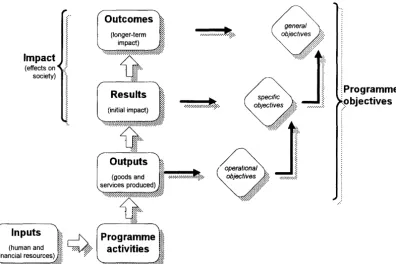
achievement of the programme's results and outcomes. A comprehensive evaluation will systematically examine the validity of this logic. Figure 2.1. below shows how one should conceptualize the intervention logic of a typical programme (NB the intervention logic of a project or a policy will be somewhat different).
In plain language, the intervention logic of a programme is simply an explanation of what the programme is supposed to achieve and how it is supposed to achieve it.
[image:21.587.98.494.370.634.2]The examination of the programme's intervention logic will be of central importance in most evaluations. The evaluator needs to ask how the inputs devoted to the programme lead to the various outputs, and how these outputs, in turn, lead to the results and outcomes which are expected of the programme. In other words, how does the programme achieve its specific objectives, and how do the specific objectives contribute to the attainment of the general objectives?
Figure 2.1. The intervention logic of a programme
Impact
(effects on society)
Inputs ;~::
(human and
~f ~:::·
financial resources) .J :~=····=~=================================================::M::·
Programme t~ activities
f
··:::::;:;:;:;:;:;:;:;:;:;:;:;:;:;:;:;:;:;:;:;:;:;::::::&J
···=~::::. objectives general
[Programme ::pbjectives
Typically, a programme's intervention logic will contain hidden assumptions (about causal links between the programme and its supposed effects and about how the programme influences, and is influenced by, other factors). An
An explanation of what the programme is
supposed to achieve and how it is supposed
to achieve it
(CC
/~-•n
~
~~
C ~-" ... ~"\--" , _12.2.2. Key evaluation issues
Once the evaluator has described the programme and examined its intervention logic, he will typically move on to address several, if not all, of the following key evaluation issues:
• relevance - to what extent are the programme's objectives pertinent in relation to the evolving needs and priorities at both national and EU level.
• efficiency - how economically have the various inputs been converted into outputs and results?
• effectiveness - how far have the programme's impacts contributed to achieving its specific and general objectives?
• utility - how do the programme's impacts compare with the needs of the target population(s)?
• sustainability - to what extent can the positive changes be expected to last after the programme has been terminated?
Figure 2.2. below shows how each of these key evaluation issues relates to the programme being evaluated9. The diagram is divided into three different
levels. The lowest level is that of judgement. Each of the above five issues are the responsibility of the evaluator. He has to use sound analytical techniques to arrive at judgements as to each of them.
The second level is that of the programme itself. The objectives behind the programme are what motivates it. To meet these objectives, human and financial resources (inputs) are devoted to the programme, and are allocated to various p~ograrnme activities. This process leads to the generation of goods and services by the programme, which are its outputs.
The highest level is that of socio-economic problems. It is at this level that we should consider the needs of the target population and the particular
problems which the programme is designed to address. The programme's
results and outcomes are placed at this level because they affect these needs and problems. The dashed lines serve to indicate that the three levels are conceptually distinct from one another. For example, it may be difficult to identify what effects are genuinely caused by a programme and to separate these effects from the myriad of other influences on the socio-economic problems.
Let us now return to the level of judgement, and examine each of the key
future. The discussion of future relevance normally entails an examination of alternatives to the programme.
As we have seen, efficiency compares inputs (resources) with the programme's outputs (the goods and services it provides) and results (its initial impact). An examination of efficiency involves asking: could the same benefits have been produced using fewer inputs? Alternatively, could the same inputs have produced greater benefits? Discussions of efficiency necessarily entail comparisons with alternatives to the programme. The main difficulty in this area is therefore the choice of appropriate benchmarks. The evaluator will need to specify which benchmarks the efficiency of a programme is being measured against. A difficulty can arise when there are no comparable programmes and the evaluator has no previous experience with similar programmes. Chapter 3 includes a more in-depth discussion of benchmarks.
Another important point to bear in mind is that even if a programme is efficient, it can still be poorly designed. This brings us to the discussion of
effectiveness (comparing a programme's impacts with its objectives). It is worth remembering that in the case of such poorly designed programmes, objectives may not have been stated sufficiently clearly or may even be missing altogether. The evaluator may therefore be called upon to transform vague or general goals into verifiable objectives.
In addition, it must also be remembered that effectiveness is concerned with only one aspect of a programme's impact: the positive, expected effects. A programme may also have positive, unforeseen effects as well as negative effects (both expected and unforeseen). An evaluator will typically want to go beyond effectiveness in order to assess a programme's total impact, even if establishing causality is often difficult.
In order to assess the total impact of a programme, an evaluator is required to infer causality between it and the positive and negative, expected and unforeseen changes which have come about. Attributing causality is a key problem in the design of evaluations. Other possible explanations for the effects which are to be attributed to the programme must be identified and, wherever possible, eliminated so that the evaluator can show that the positive effects would not have arisen anyway. Causality is examined in more detail in Chapter 4.
This brings us to the concept of utility, in which we compare the impact of a programme with the needs which gave rise to it. Programmes will only be useful if they manage to bring about changes in society which are beneficial given the needs of the target population.
Effectiveness - how far have the
programme's impacts contributed to
Relevance
Figure
2.1.
Key
evaluation
issues
socio-economic
problems
---
---judgement
-Effectiveness
Utilitv
and
A particular problem with the concept of utility is that, given that there is a multiplicity of different interests associated with public interventions, it is difficult to arrive at a universally acceptable definition of needs. Unemployed workers may define their own retraining needs in quite a different way from those administering the retraining programme.
Finally, we come to sustainability, which is closely related to utility. Even if a programme generates benefits which are in tune with the needs of its target population, it may be of little value unless these benefits are still being enjoyed at some stage in the future. Sustainability is therefore concerned with what happens after a programme has been completed. For example, there is little value in training unemployed workers in skills which are likely to become obsolete after a few years. If a programme is to be of lasting value, it must
generate sustainable benefits for its target population(s).
To return to figure 2.2. above, it will be seen that each of the issues which we have examined in this section involve~ the evaluator making a technical evaluation judgement about either:
• the programme itself - relevance and efficiency (when it simply looks at how inputs are converted into outputs); or,
• the programme and the socioeconomic problems it seeks to address
-efficiency (when it compares inputs with results rather than merely outputs),
effectiveness, utility and sustainability.
We have drawn a conceptual distinction between the level of judgements, the level of the programme's operation and the level of socio-economic problems. This distinction is very important. A programme's outputs should be directly
identifiable, but identifying its results and outcomes may be far more difficult. Both results and outcomes arise through a series of potentially
complex interactions between the programme and society. Furthermore, there are also likely to be a myriad of other factors at work. The evaluator needs to rely on sound analytical techniques to establish how the programme changes SOciE?ty.
2.2.3. Other important issues
Moving beyond the five key evaluation issues which were discussed above, an evaluation may also be concerned with addressing other important issues. These other issues will be largely a function of the particular features of the programme (or programmes) being evaluated. Thematic evaluations, for example, focus on one or more common themes in the evaluation of different programmes or activities (e.g. effects on the environment or on small and medium-sized enterprises).
Three issues which are particularly relevant to evaluations of public expenditure programmes are deadweight, displacement and substitution. We will briefly di.scuss each of these.
result of inadequate programme delivery mechanisms (the organizational arrangements which provide the goods and services funded by the programme to its intended beneficiaries). In particular, these mechanisms fail to target the programme's intended beneficiaries sufficiently well. As a result, other individuals and groups who are not included in the target population end up as recipients of benefits produced by the programme. For example, a retraining programme aimed at the long-term unemployed may benefit some people who would have undertaken retraining even without the programme (e.g. by pursuing higher education ·or privately-financed training programmes) and may not be genuinely long-term unemployed.
For many programmes, deadweight may be to some extent inescapable. However, it is an important issue in evaluating expenditure programmes because there is a concern both with identifying the extent to which the programme· is meeting the needs of its target population and with reducing waste and inefficiency in public expenditure. It should be clear that the issue of deadweight is closely related to that of efficiency, discussed above: deadweight is really a special case of programme inefficiency.
Displacement and substitution are two closely related terms which are used to describe situations where the effects of a programme on a parlicular individual, group or area are only realised at the extent of other individuals, groups or areas. Consider, for example, the case of a programme to provide employment subsidies. In a firm which benefits from this programme, subsidised workers may take the place of unsubsidised workers who would otherwise have been employed by that firm. This is known as substitution. Alternatively, a firm benefiting from the employment subsidies may win business from other firms which do not participate in the scheme. Thus, the jobs created in the participating firm may be partly or wholly offset by job losses in other firms. This is known as displacement.
Displacement and substitution are really special cases of negative
programme effects, mentioned above. An analysis of the total impact of a
programme needs to take these negative effects into account.
2.3. Who is involved in the evaluation?
The evaluator, the person directly responsible for conducting the evaluation, needs to be aware that there are whole range of different individuals and groups who may have a legitimate interest in his work. The term stakeholders is sometimes used to describe the various individuals and organizations who are directly and indirectly affected by the implementation and results of
a
given programme, and who are likely to have an interest in its evaluation. ·A list ·of stakeholder groups who may either directly participate or have an interest in the evaluation process could include the following:
• policy-makers and decision-makers;
• those responsible for the evaluation of the p~ogramme;
(
(Programmes will only be useful
if
they
manage to bring about changes in society
which are beneficial given the needs of the
target population
,e , , • •
-~
• programme managers and administrators; and
• other individuals and groups with a legitimate interest in the programme.
The evaluator will normally be chosen by, and be directly responsible to, the
evaluation sponsors. They have overall responsibility for the evaluation. In the case of EU programmes, this will normally be the managing Directorate-General or service within the European Commission. Chapter 3 provides a more detailed discussion of the relationship between the evaluator and the various stakeholder groups.
Those who write evaluation reports must demonstrate an understanding of the different information needs of the various stakeholder groups, as well as the relative importance of the different stakeholders at various stages of the evaluation. This is discussed in more detail in Chapter 5.
2.4. What types of evaluations are there?
This section is divided into three parts. Firstly, the distinction between formative and summative evaluations is explained. Before considering whether to conduct an evaluation, it is important to be clear about whether it will be mainly formative or mainly summative. Secondly, we will examine the distinction between intermediate and ex post evaluations. Thirdly, there is a discussion of the differences between internal and external evaluations.
2.4.1. Formative and summative evaluations
The type of questions which an evaluation asks will to a large extent be determined by who its intended users are and what their reasons are for requiring it. To illustrate this, it is helpful to distinguish between:
• formative evaluations - these are concerned with examining ways of
improving and enhancing the management and implementation of programmes. Formative evaluations tend to be conducted for the benefit of those managing the programme with the intention of improving their work; and
• summative evaluations - these are concerned with determining the essential effectiveness of programmes. Summative evaluations tend to be conducted for the benefit of external actors (groups who are not directly involved in the management of a programme}, for reasons of accountability
or to assist in the allocation of budgetary resources.
Although the distinction between formative and summative evaluations may appear to be clear-cut, in practice it is often blurred. A general concern with improving public programmes usually requires a combination of both approaches. In the present guide, we will be mainly concerned with summative evaluations, or at least evaluations with a strong summative focus.
2.4.2. Intermediate and ex post evaluations
• intermediate evaluations - are conducted during the implementation of a programme.
• ex post evaluations - are conducted either on or after the completion of an intervention.
In many cases, intermediate evaluations often focus on a programme's outputs and do not attempt a systematic analysis of its impact. They therefore tend to rely quite strongly on information provided by the monitoring system. Intermediate evaluations may also tend to have a formative bias, e.g. a concern with improving the programme's delivery mechanisms. In other cases, intermediate evaluations do look at impact, but only in a limited way.
Ex post evaluations are more likely to be summative in nature, and are often conducted with the express intention of analysing a programme's impact. However, since the information needed to assess a programme's impact may often not be fully available until several ye_ars after the end of the programme, even ex post evaluations can be limited in the extent to which they can provide a complete assessment of impact. Since many EU programmes are replaced by successor programmes of a different generation, there can also be a legitimate interest in formative issues at the ex post stage.
2.4.3. Internal and external evaluations
A key decision in any evaluation plan is whether to opt for an internal evaluation
or an external evaluation. These two terms can be defined as follows:
• internal evaluations - are performed by members of the organization which is conducting the activity being evaluated
• external evaluations - are performed by persons outside the organization managing the intervention.
In the EU, by far the greater part of evaluation undertakings are contracted out to external consultants, and this is especially the case for ex post and intermediate evaluations. There are, of course, tremendous advantages in using external consultants. They should normally be able to express an independent viewpoint on EU programmes. In other words, external evaluators should be able to evaluate objectively. External evaluators also tend to have an expertise in evaluation practice, and contracting out the evaluation task to an external consultant may be the most practical and cost-effective solution.
Internal evaluations can also have their benefits. In particular, internal evaluations may promote 'learning by doing' since managing services themselves are closely involved in questioning the 'how' and the 'why' of their activities. However, for many intermediate and ex post evaluations, internal evaluations may not be practical, cost-effective or even desirable. For example, it may be difficult to convince other stakeholders that an internal evaluation has been conducted objectively. There is therefore a reliance on external evaluations in many Commission services.
In order to ensure that external evaluations are conducted properly, services must pay particular attention to drafting the terms of reference. Furthermore, unless there is propet supervision of the external evaluator during the conduct of the evaluation by the evaluation sponsors, a number of problems can arise. For example:
• evaluation reports prepared by external consultants may produce misguided recommendations, because the report has been prepared by people with insufficient knowledge of the EU organizational or political context; and
• there may be problems of communication: external evaluators may be too far removed from the chain of management for their findings to be taken into account;
On the other. hand, there is an important need to ensure that the supervision of external evaluators by the sponsoring service does not compromise the evaluator's independence. A steering group can be of
tremendous help in this respect.
There are obviously trade-offs to be considered when choosing between an internal and an external evaluation. The technical competence and supposed independence of an external consultant should be weighed against any potential advantages from conducting an evaluation in-house. Chapter 3 includes more practical advice on the choice of the evaluator.
Where to look for more information
There is an important need to ensure that
the supervision of external evaluators
by
the sponsoring service does not
compromise the evaluator's independance
(r
'"---1,
);
I)
---3. Preparing and managing evaluations
Evaluation is sometimes called "applied common sense". Unlike common sense, however, evaluations have to be well prepared and properly managed.
• when evaluations are not well prepared, there is a danger that they can be carried out inefficiently. It is very easy to ignore important questions (is the programme at all evaluable? what is and what is not to be evaluated? for what purpose? how? by whom? for when? with what resources?) before evaluations are launched. These questions may seem obvious after the evaluation has taken place, but they need to be properly addressed beforehand.
• when evaluations are not well managed, there is a similar danger. Even in an evaluation which is well prepared, things can go wrong or circumstances can change in an unforeseen way. Sound management practices have to be followed when this happens.
Evaluations which are not well prepared and well managed may also suffer from
problems of credibility. This reduces the chances of obtaining a broad endorsement of conclusions and recommendations from the interested parties (the stakeholders). In these circumstances, the evaluation will only be o_f limited
use.
In this chapter, we will discuss each of the main components involved in preparing and managing evaluations. These are shown in Box 3.1. below.
Box 3.1. The main components in preparing and managing evaluations
• establishing a management structure - this involves setting up a clear
hierarchy, which allows for overall management of an evaluation.
• elaborating an evaluation project- this involves a sequence of logical steps
from the basic problems and interests motivating the evaluation to the questions which can be addressed in an analytically acceptable way.
• drawing up the terms of reference - this involves defining the relationship
between those responsible for commissioning the evaluation (the evaluation sponsors) and those responsible for actually conducting it.
We will examine each of these components in more detail.
3.1. Establishing a management structure
reference for the evaluation (see section 3.3 below), in particular if the latter is entrusted to an external expert.
As a minimum, such a management structure must involve:
• the programme management; and
• the unit, sector, or official inside the same DG or service responsible for evaluation.
However, it is often helpful to widen the management structure by creating a
steering group. This applies especially when programmes are of major
budgetary significance, or of a controversial nature, or when the evaluation's focus is not simply confined to the implementation of the programme but also looks at the programme's effectiveness and future relevance.
Apart from the DG or service in charge of the programme, such a steering group usually includes other DGs and services, such as those with a specific interest in the programme or with a general evaluation responsibility. There might also be representatives of the Council of Ministers and European Parliament in their capacity as branches of the legislative and budgetary authority. Significant
stakeholders outside the EU institutions may also be represented. In addition, there could be independent experts, with the task of assisting in the elaboration of complex evaluation projects or ensuring a degree of quality control on the evaluation itself.
A key question to be addressed when setting up a steering group is whether or not to include representatives of those who are responsible for the actual implementation of the programme (e.g. implementing agencies). If they are included, it is important to ensure that the independence of the evaluation is not compromised.
A steering group has several advantages:
• it encourages active involvement in the evaluation by the various stakeholders;
• it reduces the chances that programme managers will become too closely associated with the evaluator, thus compromising his independence; and
• it allows for quality control of the evaluation by experts.
Creating a steering group helps to ensure that the evaluation is viewed as an
inclusive process. Stakeholders are then more likely to have confidence in the evaluation's conclusions and recommendations, especially if they have had the opportunity to influence the design of the evaluation. However, it is important to
Regardless of whether or not a steering group has been created, it is the responsibility of the management structure to deal with problems or changes in circumstances which can arise once an evaluation is underway. These can include:
• disagreements between the steering group and the evaluator on some basic aspect of the evaluation design. It is not uncommon for steering groups to ask for the impossible, e. g. evaluations which are both formative and summative and which will pronounce upon the effectiveness of a programme despite the fact that the data necessary to form such judgements will not be available for several years. Ideally, these sorts of problem can be avoided at the outset if the evaluation project is properly elaborated.
• the evaluator may discover that the original evaluation design cannot be fully carried out within the time required. This can happen even if the evaluation is fairly well planned. Alternatively, the evaluator may want to suggest that the original design is changed so that more time can be allowed to examine features of the programme which were not part of the original design.
• once the evaluation is underway, the evaluator may encounter resistance from programme administrators, programme beneficiaries or other stakeholders. For example, they may refuse to make data available.
The management structure needs to be aware of the potential for such problems to arise once an evaluation is underway.
3.2. Elaborating the evaluation project
The evaluation project is a sequence of logical steps, starting out from the formulation of problems and interests motivating the evaluation and arriving at a series of questions that can be addressed in an analytically acceptable way.
The seven steps involved in elaborating an evaluation project are as follows:
• identify the goals of the evaluation; • delineate the scope of the evaluation; • draw up the analytical agenda;
• set benchmarks;
• take stock of available information; • map out the work plan; and
• select the evaluator.
These seven steps should be gone through in virtually all evaluations. We will now discuss each of them in turn.
3.2.1. Identifying the goals of the evaluation
The question to be asked before any other. when preparing an evaluation
It is not uncommon for steering groups to
ask for the impossible
I ;
The answers to this first question will have a strong bearing on the replies to the subsequent ones.
Evaluations often have to be carried out because of an obligation laid down in the programme's legal base, stipulating typically that a report should be available prior to the expiry of the programme.
Since the adoption of the Communication on Evaluation (on 8 May 1996) in the framework of the SEM 2000 initiative, the general rule has been introduced that a proposal to renew a multi-annual programme has to build on the results of an evaluation of its achievements to date. Operational expenditure outside a multi-annual framework has to be reviewed at least every six years.
As mentioned in Chapter 1, there. are three specific reasons why programme evaluations are conducted:
• to improve management;
• for reasons of accountability; and
• to assist in the allocation of budgetary resources.
The contents of the evaluation and the style of the report will differ according to where the relative emphasis is put between these elements,. If stress is laid on improving management, screening the implementation and delivery mechanisms of the programme will occupy a central position in the evaluation. The report can stay quite technical as its customers are mainly the Commission services, intermediary offices and direct beneficiaries.
If accountability is at the forefront, the evaluation is likely to focus on the effectiveness of the programme as reflected by empirical evidence and in the perception of the main stakeholders, as well as on possible side-effects and specific issues associated with, for example, equity and transparency. The style should take into account the fact that the wider audience may lack the specialist vocabulary and detailed technical knowledge associated with the programme.
If, as in the case of evaluations springing from SEM 2000 obligations, part of the emphasis is on programme renewal and related budgetary needs, the goal of the evaluation should be, among other things, to shed light on the cost-effectiveness ot the programme, its continued relevance, and (possibly) a comparative analysis of alternatives. Here again, the style should ensure good legibility for decision-makers and opinion-formers.
progress report containing an assessment of outputs and very preliminary indications on results. On the other hand, programmes in their second generation or beyond should be evaluable in terms of results and outcomes, and thus evaluations should be able to address key issues such as effectiveness.
Other factors can affect the attainability of an evaluation's goals, for instance its budget. In addition, in some cases, the controversy surrounding a programme can be such that as soon as fundamental matters are broached, the risk of the evaluation becoming entangled in the political cross-fire may become large. This would reduce the evaluation's credibility. In such cases, it may be wiser to scale down the ambitions of the evaluation.
3.2.2. Delineating the scope of the evaluation
Delineating the scope of an evaluation means asking the question: what is to be evaluated? Regardless of how comprehensive one intends an evaluation to be, delineating its scope is a vital part of the evaluation project. It would simply be an endless task to look into every imaginable facet of a programme, or into all its actual or potential ramifications with other programmes at a European or national level. For instance, if one were to evaluate, in a truly comprehensive manner, EU policy on the development of rural areas, one should not only evaluate the effects of Objective 5b expenditure under the Structural Funds, but also the impact on rural areas of the entire set of European policies as well as the interaction of these policies with those at the national level.
Typically, an evaluation's field of investigation, particularly the part to be dealt with in depth, has to be circumscribed from an institutional (EU vs. national or local level), temporal (period reviewed) and geographical (part of the EU territory) point of view.
A second major issue of scope, related to the comments above on the goals of an evaluation, is which key evaluation issues one plans to observe and measure. As explained in section 2.2.2., these are relevance, efficiency, effectiveness, utility and sustainability. Apart from the reply given to the previous question on goals, this choice will be influenced by factors such as the availability of data, time constraints and limitations on financial resources.
3.2.3. Formulating the analytical agenda
Once there is a clear idea about what purposes an evaluation should serve and what major issues it should address, the next step in the preparation of an evaluation is to draw up the analytical agenda. This is a logical structure imposed on the different questions to be asked in the evaluation.
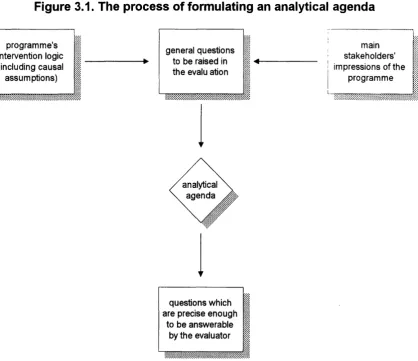
[image:40.588.80.499.246.607.2]The aim of an analytical agenda is to transform the general, often vague, questions which those calling for the evaluation have in mind into questions which are precise enough to be manageable by evaluation research methods (based, invariably, on research methods derived from economics, social sciences, management science, and so on). This process is shown in Figure 3.1. below.
Figure 3.1. The process of formulating an analytical agenda
j
j
questions which
li1
are precise enough llM to be answerable ~~~m by the evaluator l]:::::::::::::::::::::::::::::::::::~::::::::::~~::::::::::::::::::::::::::::~::1!1!1!
l. ..
main \:!:
'.::~~:~:~=:~~~:J
The analytical agenda is simply a way of transforming the general questions into more precise questions. The two main sources for the general questions are:
• the programme's original intervention logic, i.e. the "theory" of what it is supposed to achieve and how it is supposed to achieve it; and
• the impressions of the main stakeholders.
In relation to the intervention logic, special attention needs to be paid to the
supposed effects, and the state of the programme's external environment (i.e.
how it relates to other policy interventions and other external factors).
Retrieving the original intervention logic of a programme is sometimes easier said than done. Official documents often do not contain any systematic description of causal assumptions. Even the programme's objectives may only be stated in a very limited fashion. Furthermore, the collective memory of Commission services may not be that long (e.g. because of a high turnover of programme officials). Often, substantial documentary research may well be needed in order to retrieve the correct interpretation of official goals. In any event, when a programme's objectives are not given a sufficiently transparent and precise meaning, it can be very difficult to judge its success.
Where the general and specific objectives of a programme have to be reconstructed from scratch, this should be done transparently by the management structure, preferably under the responsibility of a steering group.
A second useful input into the process of drawing up the analytical agenda is to collect and present the main stakeholders' impressions about the programme (its successes, failures, evolving context etc.). These should then be examined critically as "working hypotheses" in the evaluation. This process will both enrich the analytical agenda for the evaluation and reinforce its focus on utility. It should not, however, prejudge the conclusions to be reached by the evaluation.
Once the general questions have been identified, the analytical agenda should be drawn up. Essentially, this means arriving at a set of precise questions which can be answered by an evaluator using accepted research methods. The analytical agenda imposes a logical structure on the various questions which should be addressed. The simplest logical structure for our purposes is a
hierarchy.
At the lowest level of this hierarchy are the most detailed and refined questions. These are sufficiently precise and well-defined to be answerable by accepted research methods. As one moves up the hierarchy, it should be clear that the more detailed questions towards the bottom provide a basis for investigating the more general questions towards the top. A simple example of such a hierarchy is given in Figure 3.2., which is based on a project-based evaluation of a publicity campaign designed to raise awareness of road-safety in a medium-sized town.
The campaign was directed at the general public, but with particular attention to school children, especially those in 'high-risk' areas and male drivers aged 18-24. The evaluator was asked to find out who the campaign reached and whether it changed the behaviour of motorists. For the sake of simplicity, we have chosen an example involving the evaluation of a project, the same sort of principles apply to establishing analytical agendas for the evaluation of a
Figure 3.2. An analytical agenda imposes a hierarchy on the questions raised in an evaluation Example: a publicity campaign designed to promote awareness of road-safety Did the campaign reach its target audience? Did it change the behaviour of road-users? What proportion of children were
reached?
/.
What proportion of children in schools in 'high-risk' areas were reached? What proportion of motorists were reached? Has the number of accidents fallen? What proportion of male drivers aged 18-24 were reached? Have accidents in 'high-risk' areas fallen more sharply than overall accidents? Has the average speed
fallen?