This is a repository copy of Nonlinear modal analysis via non-parametric machine learning tools.
White Rose Research Online URL for this paper: http://eprints.whiterose.ac.uk/135608/
Version: Accepted Version
Article:
Dervilis, N. orcid.org/0000-0002-5712-7323, Simpson, T.E., Wagg, D. et al. (1 more
author) (2018) Nonlinear modal analysis via non-parametric machine learning tools. Strain. ISSN 0039-2103
https://doi.org/10.1111/str.12297
This is the peer reviewed version of the following article: Dervilis N, Simpson TE, Wagg DJ, Worden K. Nonlinear modal analysis via non parametric machine learning tools. ‐ Strain, which has been published in final form at https://doi.org/10.1111/str.12297. This article may be used for non-commercial purposes in accordance with Wiley Terms and Conditions for Self-Archiving.
Reuse
Items deposited in White Rose Research Online are protected by copyright, with all rights reserved unless indicated otherwise. They may be downloaded and/or printed for private study, or other acts as permitted by national copyright laws. The publisher or other rights holders may allow further reproduction and re-use of the full text version. This is indicated by the licence information on the White Rose Research Online record for the item.
Takedown
If you consider content in White Rose Research Online to be in breach of UK law, please notify us by
Nonlinear modal analysis via non-parametric machine
learning tools.
N.Dervilis∗
, T.E. Simpson, D.J.Wagg, K.Worden
Dynamics Research Group, Department of Mechanical Engineering, University of Sheffield, Mappin Street, Sheffield S1 3JD, UK.
Abstract
Modal analysis is an important tool in the structural dynamics community; it
is widely utilised to understand and investigate the dynamical characteristics
of linear structures. Many methods have been proposed in recent years
regarding the extension to nonlinear analysis, such as nonlinear normal modes
or the method of normal forms, with the main objective being to formulate a
mathematical model of a nonlinear dynamical structure based on observations
of input/output data from the dynamical system. In fact, for the majority
of structures where the effect of nonlinearity becomes significant, nonlinear
modal analysis is a necessity.
The objective of the current paper is to demonstrate a machine learning
approach to output-only nonlinear modal decomposition using kernel
inde-pendent component analysis and locally linear embedding analysis. The key
element is to demonstrate a pattern recognition approach which exploits
the idea of independence of principal components from the linear theory
by learning the nonlinear manifold between the variables. In this work the
importance of output-only modal analysis via “blind source” separation tools
is highlighted as the excitation input/force is not needed and the method
can be implemented directly via experimental data signals without worrying
about the presence or not of specific nonlinearities in the structure.
Keywords: pattern recognition, nonlinear dynamical systems, modal
decomposition, manifold learning.
1. Introduction
The machine learning methods that are presented in this paper aim to
address the problem of validity that surrounds the modal analysis of nonlinear
structures. Modal analysis is an important tool in structural dynamics as it is
widely used to understand the dynamical characteristics of linear structures.
Many methods have been proposed in recent years regarding nonlinear analysis,
such as nonlinear normal modes or the method of normal forms [1–9].
It is evident through time, that linear modal analysis tools have been, and
continue to be, the dominant methods that are used for the analysis of linear
dynamic structures (or weakly nonlinear systems). However, as structural
technology is moving towards lighter, greener aerospace structures, new
materials and large civil infrastructure, the effect of nonlinearity becomes
significant, and a working theory of nonlinear modal analysis would potentially
shed light on the dynamical challenges of this new era.
If one checks the literature, one will face the argument that a term nonlinear
modal analysis is very diffuclt to formulate [10], as in the the original
theoret-ical foundation of a mode, was a diagonalisable linear system with imaginary
eigenvalues. As a result, in diagonalised form, the system reduces to a family
of linear SDOF oscillators. In practice, that leads, in the original coordinates,
modes each with its own frequency. These independent modes mean that
they do not interact and that the system is linear.
In reality, if someone moves away from this philosophical journey then one
will realise that this argument is not entirely true. Of course, it is not
mathematically and practically possible to preserve all the distinct properties
of what is called a linear normal mode [11] when one is moving to a nonlinear
normal mode. However, at this point it is vital to make it very clear that one
can choose a different, yet consistent definition of a nonlinear normal mode;
this can be based on the foundations of the Rosenberg normal mode [6] or the
Shaw-Pierre normal mode [7]. It is the latter idea that this investigation is
generally based on; the idea that for a nonlinear system, the nonlinear normal
modes are defined in terms of invariant manifolds i.e states that if motion is
initiated on such a manifold it stays there for all time.
In this work a new approach is investigated through the use of unsupervised
pattern recognition techniques such, as kernel independent component analysis
(KICA) and locally-linear-embedding manifold learning (LLE). These methods
serve two purposes, a reduction in the dimensionality by mapping the data
from high-dimensional spaces to lower-dimensional spaces, and a revealing
of the hidden features of the data by learning the structure of the nonlinear
manifold between the variables of interest. Of course this dimensionality
reduction is accompanied by a loss of some information, therefore, the goal in
dimensionality reduction should be to preserve as much relevant information
as possible.
It has to stated at this point that this work is a different approach to another
recent method of learning a transformation into ‘normal modes’ directly
framework and a polynomial expansion that was proposed in [12] (a little
more discussion can be found in the conclusions).
The methods share the same good, i.e to create uncorrelated variables, but
retain the maximum possible variance of the original observations. The effect
of structural nonlinearity on linear modal analysis is critical. Specifically,
decoupling of the system into SDOF systems is lost and in turn superposition
is lost. It is of critical importance to mention that these clever and advanced
unsupervised algorithms can work with output-only data and can play a
significant role in the model updating of nonlinear systems by giving crucial
insight into the dynamical behaviour of the system.
It has to be crystal clear that in the literature and in the machine learning
community one can find hundreds of methods and their variants, for
unsu-pervised learning and the purpose of this work is not to compare all of them
(as this would not be a research paper or hit the target of this work), but
to identify the most practical and representative ones for nonlinear modal
analysis (or even operational modal analysis) so the dynamics community
can benefit and utilise pattern recognition methodologies in a simple manner
without complicated algebraic analysis, or even without a priori equations
of motion. Furthermore, as the title dictates, this paper will try to shed
some light on how useful machine learning methods are for nonlinear modal
analysis via unsupervised blind separation and manifold learning tools.
To make things simpler for the reader and to add more clear context in
“layman’s terms”, throughout this work a variety of representative machine
learning algorithms (or tools that any reader can use or apply similarly) are
demonstrated for operational output-only modal decomposition for nonlinear
via pure data analysis. This category of manifold learning algorithms in simple
terms, are used to find patterns and structure in presented data and the tools
utilised here mainly are used to extract patterns (linear or nonlinear) and
hence unmask and recognise the complexity of patterns between data. In the
context of this paper these algorithms are very useful tools that are introduced
in a comprehensive way for the first time for nonlinear systems as generally,
structures vibrate with certain shapes/patterns (e.g. mode shapes) and at
specific frequencies (e.g. natural frequencies). These patterns and associated
frequencies manifest as complex relationships in the output measurement data
and it is these specific complex patterns which are extracted with manifold
learning tools (either linear, like PCA, or nonlinear, like LLE). The tools
mentioned are important and require more attention as they do not use any
of physics or require any algebraic equations of the structural system to give
predictions but rely only to statistical methods and the available measured
data.
To add a link with classic modal analysis, these uncorrelated variables found
by manifold learning algorithms can be referred to as the modal coordinates
of the system, with the statistical independence of the variables
account-ing every time for the manifold “definition” that the extracted modes are
invariant. Invariant modes just mean that a motion in one mode will not
affect the motion of the other modes and this is exactly and simply what
statistically uncorrelated variables mean in a machine learning context. As
a final remark, these algorithms find the uncorrelated variables using just
output data when the forcing is difficult to define or not known (and not the
dimensionality reduction itself that this algorithms are usually utilised for in
pattern recognition community).
of extended linear modal analysis using linear decoupling methods such as
principal component analysis, while Section Three discusses an alternative
approach of independent component analysis (ICA). Section Four presents a
new approach based on measured data - the locally-linear-embedding method.
Sections Five and Six give an example of nonlinear modal analysis based on the
unsupervised learning techniques that are mentioned in previous sections and
discuss how PCA and kernel independent component analysis (KICA) break
down for multi-degrees-of-freedom systems (MDOF) with high nonlinearity.
The paper finishes with an example of experimental validation and some
overall conclusions.
2. Principal Component Analysis or Principal Orthogonal
Decom-position
The majority of the methods mentioned in the introduction are based on
knowledge of the algebraic equations of motion of the system. In contrast
here, the authors shed some light via some fast and simple machine learning
algorithms motivated by the decomposition of modes, by utilising time series
data of randomly-excited systems.
As a first step, the method of principal component analysis (PCA), that
can be used in linear modal analysis is presented, then nonlinear statistical
independence is considered via kernel component analysis and a powerful and
simple method of nonlinear manifold unfolding like locally-linear-embedding
is investigated finally.
PCA removes linear correlations among the data and is only sensitive to
second order statistics. It is, however, very common to deal with data sets
systems would need statistics of order three or higher). PCA is a linear
multivariate data analysis method that gives a linear transformation from
a set of physical variables (as here) to a new set of transformed variables.
The linear transformation constructs a set of orthonormal vectors (principal
vectors) and the associated variance for the orthonormal vectors (principal
values). These scaling terms act as the weight, or one could say the importance
of each orthonormal vector. These vectors are orthogonal to one another
(which means they have no projection or relationship to one another, and
thus represent a type of modal decomposition).
PCA takes a multivariate data set and maps it onto a new set of variables
called “principal components”, which are linear combinations of the old
variables. The first principal component will account for the highest amount
of the variance in the data set and the second principal component will
account for the second highest variance in the data set independent of the
first, and so on. The importance of the method arises from the fact that,
in terms of mean-squared-error of reconstruction, it is the optimal linear
tool for compressing data of high dimension into data of lower dimension.
The unknown parameters of the transformation can be computed directly
from the raw data set and, once all parameters are derived, compression and
decompression are small operations based on matrix algebra [13–15]. One
has,
[X] = [K][Y] (1)
Where [Y] represents the original input data with size p×n, with p the
number of variables and n the number of data sets, [X] is the scores matrix
of reduced dimension q×n where q < p contains the transformed variables
corresponding to the largest eigenvalues of the covariance matrix of [Y]. The
covariance matrix is equal to,
[S] =Eh {Y} − {Y¯}
{Y} − {Y¯}Ti
(2)
whereE is the expectation operator and ¯Y is the mean value.
The original data reconstruction is performed by the inverse of equation (1),
[ ˆY] = [K]−1
[X] (3)
The information loss of the mapping procedure is calculated in the
recon-struction error matrix,
[E] = [Y]−[ ˆY] (4)
For further information on PCA, readers are referred to any text book on
multivariate analysis (examples being references [13, 14]).
3. Kernel independent component analysis
Independent component analysis (ICA) is a tool that recovers a latent random
vector{x}= (x1, ..., xm) from measurements ofmunknown linear functions of
that vector. The components of {x}are required to be mutually independent.
As a result an observation {y}= (y1, ..., ym) is modelled as [16–18],
{y}= [A]{x} (5)
If [W] = [A]−1
is the parameter matrix inverse then the estimate of [W] can
be calculated by giving an estimate of the latent independent components
such as,
{xˆ}= [W]{y} (6)
It can be shown [16–18], that minimising the mutual information between
the components of (6) is essentially a contrast function minimisation.
Contrast functions [19] are statistical functions that are capable of separating
or extracting independent components from a data mixture [18]. If a contrast
function (cf) is derived by the F-correlation statistics, it can be defined as
the maximum correlation between the tested random variablesf1 andfm [18]
and can be written as:
cf = max
f1,fm∈f
corr(f1(x1), fm(xm)) = max f1,fm∈f
cov(f1(x1), fm(xm))
(varf1(x1)) 1
2(varfm(xm)) 1 2
(7)
for eachi...m, of estimated source vectors such as{x}= (x1, ..., xm). cov is the
covariance function (or kernel functions in the machine learning community
and can take any specified form of kernel from the user) and var is the classic
variance function. This contrast function is equal to zero only if the variables
are independent.
Different methods have been introduced in the literature regarding ICA that
make use of different nonlinear contrast functions [16–18]. The nonlinear ICA
method that is used in this study is kernel independent component analysis
(KICA) which makes use of the “kernel trick” which is an algorithm that
uses multiple nonlinear functions, but through an entire function space of a
functions to work in a reproducing kernel Hilbert space, for further information
on ICA and Kernel ICA, readers are referred to [16–18]. The “kernel trick”
is widely known in the mathematical and in the machine learning community
so, there is no purpose on further commenting on it but here it is important
as in order to utilise the F-correlation as a contrast function for ICA, one
needs to be able to find canonical correlations (see further below) in the given
space and at the same time being able to optimise these correlations.
Canonical correlation is a well-known method in the multivariate analysis
of correlation (that is used a lot in linear independent component analysis
(ICA)). Canonical refers to the statistical term for inferencing the latent
variables (variables that are not directly observed) that usually are able to
represent the variables that are directly observed. Please note for example,
that the well-known Discriminant Analysis is a just a special case of the
canonical correlation analysis where one has a set of binary variables with a
set of continuous variables.
In order to help the reader further, the F-correlation refers directly to the
F-distribution and F-test statistics. The F-distribution is described as
the ratio of two estimates of variance and it can be used to calculate the
probability values in the analysis of the variance (and this simple ratio is what
equation (7) is displaying). The probability density function that is used as an
analysis of the variance, is a function of the ratio of two independent random
variables and is divided by the number of degrees of freedom. A common
example that F-statistic can be used, is when one runs an “ANOVA” test or
a regression model in order to discover if the means between two populations
are significantly different.
If one assumes [Y] = ({y1}, ...,{ym}) of data vectors and the parameter
matrix [W] of equation (6), and sets {X} = [W]{Y} then one can derive
a set of estimated source vectors such as [X] = ({x1}, ...,{xm}). The m
components of these vectors lead to a set of mcentered kernel Gram matrices,
[K1], ...,[Km].
Briefly, a Gram matrix can be generally defined via Kij =K(xi, xj), which
is a positive-semidefinite Kernel matrix [18]. This kernel matrix [K] is
accompanied by a mapping of a function Φ,
K(x, y) = hΦ(x),Φ(y)i (8)
This kernel can be then used to compute the inner product in the F
-distribution space. This is often called the kernel trick. These kernel matrices
can then be used in order to define a contrast function [18]:
C(W) = ˆIcf([K1], ...,[Km]) (9)
where ˆIcf is a contrast function given by:
ˆ Icf =−
1 2log
1− max
f1,f m∈fcorr(f1(x1), fm(xm))
(10)
This valid contrast function is derived byF-correlation statistics and is defined
as the maximum correlation between the tested random variables f1 and fm.
These fuctions have very useful properties as it is nonnegative and is equal
to zero only if the variables are independent (classic assumption for an F
-statistic). The kernel ICA algorithm involves minimising this function C(W)
with respect to the matrix [W], this is called kernelised canonical correlation
analysis (KCCA) [18] (which is mainly used in this study). Canonical
cor-relation analysis (CCA) is a multivariate method similar in nature to PCA.
The main difference is that while PCA works with a single random vector
and maximises the variance of projections of the observations, while CCA
works with a set of m random vectors by maximising the correlation between
sets of projections [18]. PCA solves an eigenvalue problem, CCA solves a
generalised eigenvalue problem.
Another contrast function which can be defined is via the kernel generalised
variance (KGV) algorithm which suggests defining a corresponding quantity
for kernelised canonical correlation analysis [18].
The basic concept that one has to remember is that ICA can remove
correla-tions and higher-order dependences between the variables compared to PCA
(which can only go up to second-order statistics).
4. Nonlinear manifold learning via locally-linear embedding
Locally-linear embedding (LLE) is introduced here [20–23] as an effective
method of nonlinear manifold learning that can be used in nonlinear modal
analysis where more complicated nonlinear correlations are exposed in the
geometric manifold space (as will be investigated later).
Other very strong methods can be applied in such complex nonlinear
mani-folds, such as nonlinear principal component analysis via the usage of
in structural health monitoring (SHM) can be seen in [26]. For the current
study, LLE is used, as it is a much simpler tool and more effective for
non-linear modal decomposition. The reason that it is a more effective in terms
of decomposition is due to the nature of an auto-encoder. The AANN is a
type of (multi-layer perceptron) MLP whose target outputs are the same
as the input. Generally, the auto-associative neural network consists of five
layers including the input, mapping, bottleneck, demapping and output layers
[24, 25, 27–30]. A restriction of the mentioned topology is that the bottleneck
layer must have less neurons than the input and output layers and this allows
compression. This neural network architecture was motivated by Nonlinear
Principal Component Analysis (NLPCA) which is a robust and powerful
statistical method for feature extraction and dimension reduction.
However, the critical point is that the bottleneck layer must simply have
less neurons than the input and output layers and this alone means that the
components-variables from the bottleneck layer are not in any way proven to
be statistically independent. If the firing neurons in the bottleneck layer have
the same neurons as the input and output layers then there is no learning
performed in terms of decomposition as there is pure reconstruction of the
input space and as a result no nonlinear modes. A good study that shows how
AANNs can be utilised in nonlinear modal analysis as an important feature
extraction tool can be seen in [31].
An extensive overview of the LLE algorithm can be found in [20, 21], briefly,
and for the purposes of this paper, a short description is given.
The LLE method is based on simple geometric intuition. If the observations
consist ofN real-valued vectors{xi}with dimensionsDand they are sampled
its neighbours is expected to lie on or close to a locally formed patch of
the manifold. This local geometry can be characterised by finding linear
coefficients that can reconstruct each data point with respect to each set of
neighbours.
If one establishes K nearest neighbours per data point, then the load
recon-struction error is given by a cost function,
error(W) =X
i
{xi} −
X
j
[Wij]{xj}
2 (11)
where [Wij] is the weight contribution of the jth data point to theith
recon-struction. In order to compute these weights the cost function has to be
minimised under the following constraints. The reconstruction errors that
are subject to the constrained weights should be invariant to rotations and
rescaling. In turn, in order that the LLE algorithm preserves this invariant
manifold idea as a final step of the method, each measurement {xi}should be
mapped to lower dimensional vector {Yi} that minimises the cost function:
error(Y) =X
i
{Yi} −
X
j
[Wij]{Yj}
2 (12)
The main difference with the previous cost function is that here the weights
are fixed but the {Yi} co-ordinates are optimised.
5. A two-degree-of-freedom system
The system of interest here will be a nonlinear two-DOF lumped parameter
algorithm and the excitation was chosen to be a Gaussian white noise sequence
with zero mean and 5.0 units variance and the associated displacements were
extracted. m 0 0 m ¨ y1 ¨ y2 +
2c −c
−c 2c
˙ y1 ˙ y2 +
2k −k
−k 2k
y1 y2
+k3
y3 1 0 = x1 0 (13)
The model parameters adopted were: m = 1, c = 0.1, k = 10, k3 = 1500
and {y}is the vector of displacements, {y˙} is a vector of velocities, {y¨} is a
vector of accelerations and{x}is a vector of forcing. The nonlinearity that is
assumed is cubic. It should be noted that the damping here is proportional, so
the underlying linear system uncouples. Data were simulated with a sampling
frequency of 100Hz. In total, 100,000 points were simulated; these were
mainly used in order to estimate the spectral densities shown later and, only
2000 points were used for the training of the machine learning algorithms.
The method that is used in order to calculate the power spectral densities
(PSDs) which follow, is the Welch method based on time averaging over short,
modified periodograms which could decolour the effect of different random
excitation inputs [32]. The signals are split into sections and the periodograms
of each section are averaged. Through the Welch method, these data sections
are overlapped and a window, such as the Hanning window is applied in order
to filter each section. The overlapping of the signal sections is usually either
50% (as in this paper) or 75%.
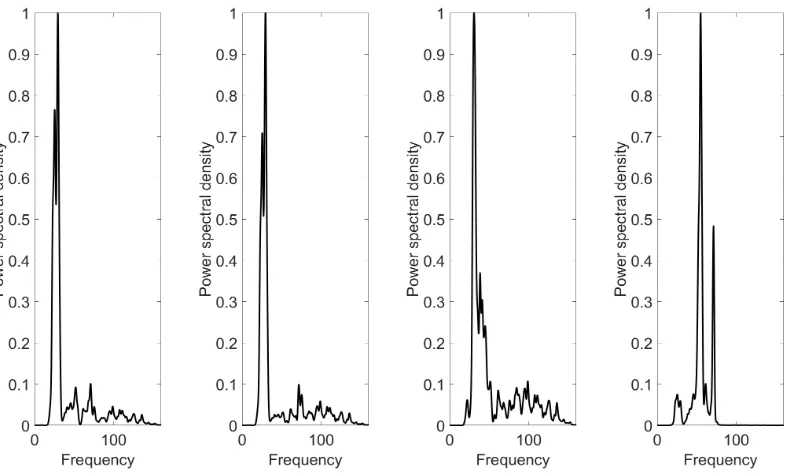
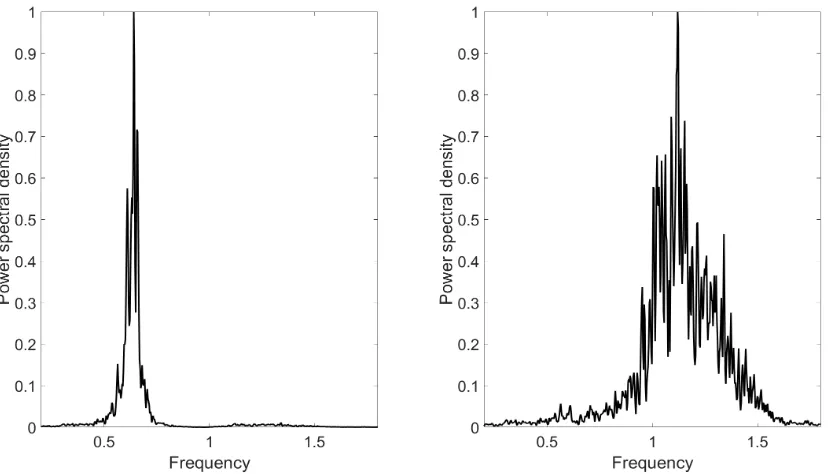
Fig.2 shows the results of PSDs for the simulated physical variables. Both
modes are present in the PSDs for the physical coordinates, which shows that
PSD of displacement and the frequency is in Hz.
As can be seen in Fig.3, PCA fails in decoupling the nonlinear system (standard
linear modal analysis) but kernel ICA, as seen in Fig.4, has successfully
decoupled the nonlinear system into two SDOF systems due to the removal
of the higher order statistical dependence. Standard linear modal analysis
is equivalent to PCA in this case as the mass matrix is diagonal. PCA
as already mentioned can compute the new transformed variables (called
principal components) as linear combinations of the original variables. The
first principal component is required to have the largest possible variance. This
approach means that PCA can decompose only up to second-order/moment
statistics where all components that are computed, are under the constraint
of being orthogonal to the first component and to have the largest possible
inertia. And this is the basic reason that PCA is under-performing when
strong nonlinearities are present as the dependencies are moving away from
second-order statistics correlations.
Furthermore, in Fig.5 LLE gives even better results for KICA, as the
decou-pling, is even more visual and effective and this is something that the reader
should keep in mind as it will be presented in the next sections.
To be very clear the results are presented in order of natural frequencies of
the examined system and the associated decoupled SDOF systems from the
Figure 1: Nonlinear two-DOF lumped parameter system.
[image:18.595.128.543.416.656.2]Figure 3: PSDs for transformed variables: linear modal analysis (PCA).
[image:19.595.133.543.443.683.2]Figure 5: PSDs for transformed variables: local linear embedding.
6. A three-degree-of-freedom system
In order to validate the results further, a more complicated system in terms
of degrees of freedom is discussed. The system of interest will be a nonlinear
three-DOF lumped parameter system. Data were simulated using a 4th-order
Runge-Kutta algorithm and the excitation was chosen to be a Gaussian
displacements were extracted.
m 0 0
0 m 0
0 0 m
¨ y1 ¨ y2 ¨ y3 +
2c −c 0
−c 2c −c
0 −c 2c
˙ y1 ˙ y2 ˙ y3 +
2k −k 0
−k 2k −k
0 −k 2k
y1 y2 y3
+k3
y3 1 0 0 = x1 0 0 (14)
The model parameters adopted were: m = 1, c = 0.1, k = 10, k3 = 1500.
Again, the damping is proportional, so the underlying linear system uncouples.
In total, 100,000 points were simulated; these were mainly used in order to
estimate the spectral densities as shown later and, only 2000 points were used
for the training of the machine learning algorithms.
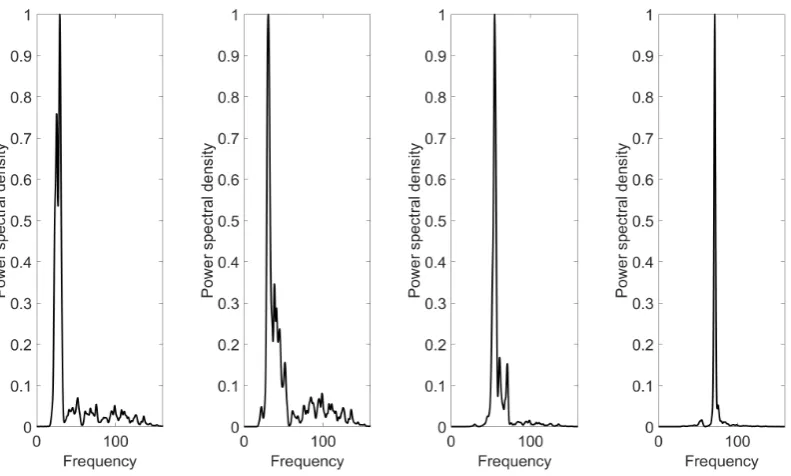
As can be seen in Figs. 6-8, both PCA and kernel ICA lack efficiency and
performance in decoupling the nonlinear modes of the system. This is the
reason that a novel approach to structural dynamics is introduced next in
the form of the local linear embedding method. In Fig.9 the LLE method is
shown to successfully decouple the modes as it was able to unfold and learn
the underlying nonlinear manifold.
As can be seen in this section, the combination of stronger nonlinearity
with multi-degree of freedom systems makes the performance of both the
PCA and ICA algorithm very weak (see Fig. 6-8). Neither of them can
decouple successfully the nonlinear modes. This is the reason that
locally-linear- embedding is adapted as a quick, very simple and effective method of
Figure 6: PSDs for physical variables.
Figure 8: PSDs for transformed variables: Kernel ICA.
[image:23.595.134.543.446.686.2]7. An experimental validation
The final case study is a further investigation of the methods based on an
experimental setup (see Fig.10). The full description of the experiment can be
viewed in [33, 34]. Briefly, the measurements were collected from a ‘bookshelf’
structure at the Engineering Institute from Los Alamos National Laboratories
[33, 34]. The model is a three-storey base-excited structure. Within the remits
of this linear structure, it is possible to introduce nonlinear dynamics via a
bumper mechanism between the top two floors, which introduces a nonlinear
contact mechanism. The broadband base excitation was between 20-150 Hz
and in relative co-ordinates this gives three ‘modes’, but the time series of
the four accelerations are used as all of them carry important information for
the transformations.
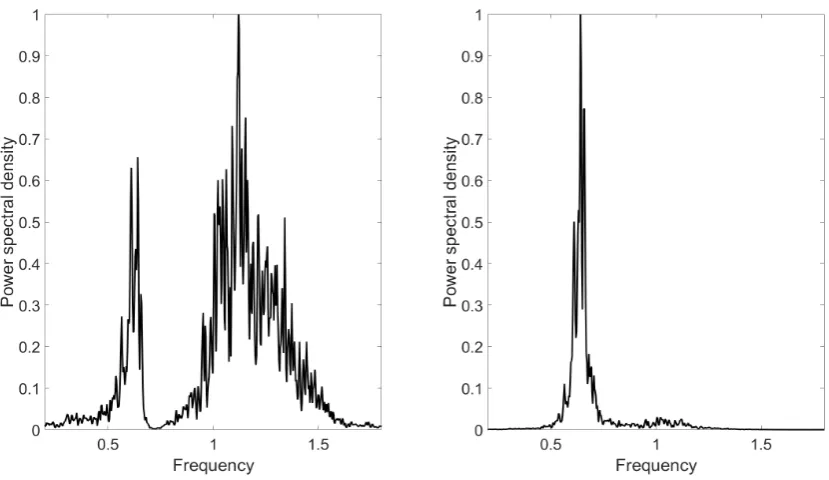
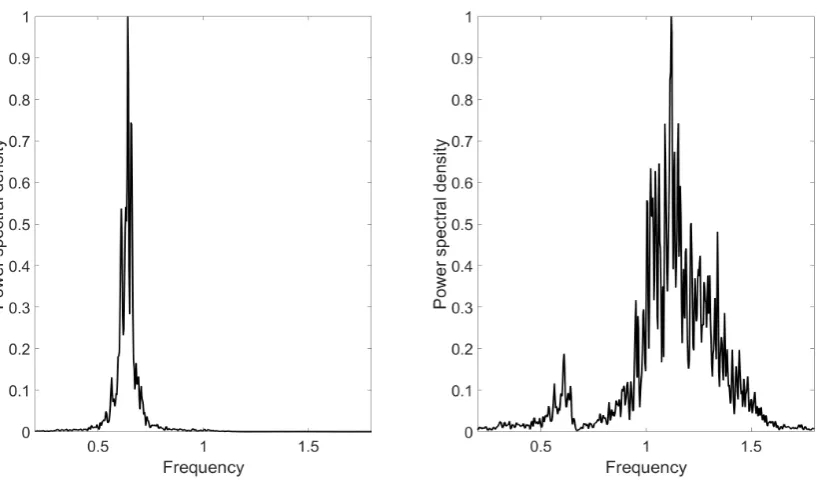
It is evident from Figs.11-14, that the conclusions derived from the previous
simulated models, are also valid in the experimental investigation. PCA fails
in decoupling the nonlinear system but kernel ICA and LLE compete in
effectiveness with the LLE being slightly more powerful overall due to its
Figure 10: Test structure architecture [33, 34].
[image:25.595.144.540.444.680.2]Figure 12: PSDs for transformed variables: linear modal analysis (PCA).
[image:26.595.144.539.450.687.2]Figure 14: PSDs for transformed variables: local linear embedding.
8. Conclusion & discussion
The purpose of this paper is to highlight the key utility of some advanced
and representative machine learning methods, not only for dynamic analysis
of structures but also as a method of dimension reduction for nonlinear
mechanical systems. The main benefit of the approach taken here is that
complicated algebraic analysis is not necessary. Furthermore, the physical
equations of the system are not needed.
At this point the authors need to include a comment about some previous
work in [12], as this paper is a continuation of [12], via another perspective and
path. In [12], one has to form a cost function and an optimisation problem.
This cost function (or objective function) has to be defined by the user by
which minimised all correlations up to third order is implemented in [12]
where to simplify the computation, the terms with velocities were disregarded.
Furthermore, a penalty function was used to impose orthogonality on the
polynomial coefficient vectors obtained after the optimisation. However, it
is cloudy what constraints should be used for the nonlinear problem as the
transformation is nonlinear. Also, as the authors use the same case studies
as in [12] one can see that the results are giving a slightly better resolution
and separation compared to the previous mentioned work (especially for the
three-DOF system and the experimental case study).
The biggest advantage of the approach presented here is that one needs
not necessarily worry about the majority of the analytical formulations.
Furthermore one can build for several datasets, the nonlinear subspace learning
only once and construct directly a forward and inverse transformation in an
unsupervised and nonparametric black-box path. Also, one can even use
supervised regression techniques like Gaussian processes as in [12] (which is a
very clever way to construct an inverse problem in a semi-supervised learning
manner).
A significant disadvantage regarding LLE for example (compared to ICA), is
that LLE, although it can easily be trained with small data sets and then
project new data as it comes it can not project low-dimensional data back
into the data space as back projection/reconstruction can be implemented
easily for linear techniques or ICA or AANN ([22, 23]) but not for sparse
spectral dimensionality reduction techniques like LLE or Laplacian eigenmaps.
PCA (or ICA in some extent), for example, can go forward or backward
into the space because it forms an eigendecomposition of a full matrix. But
LLE as described computes a graph representation of the data points and
local properties leads to an embedding of non-convex manifold by writing the
high-dimensional data as a combination of their nearest neighbours and as
a result in the low-dimensional representation of the data, LLE attempts to
retain the reconstruction weights making the direct and accurate projection
of low-dimensional data back into high-dimensional space very difficult or
impossible [22, 23]. But one can use a similar clever path as in [12] for an
inverse formulation.
Another big contribution of this work is that it opens the path for nonlinear
operational modal analysis through video or image data (as in [35, 36]) using
pure machine learning unsupervised techniques for blind source separation. As
a result, this machine learning approach is suited to experimental investigation
of nonlinear systems using only the measured output responses. Obviously,
the methods presented here are not a panacea and the purpose of this
study is to promote the usage of such tools that share a machine learning
nature for nonlinear dynamics in an potential practical application away from
conventional and classic methods.
Acknowledgments
The support of the UK Engineering and Physical Sciences Research Council
(EPSRC) through grant reference number EP/J016942/1 and EP/K003836/2
is gratefully acknowledged.
References
[1] G. Kerschen, J.-C. Golinval, A. F. Vakakis, L. A. Bergman, The method
order reduction of mechanical systems: an overview, Nonlinear dynamics
41 (1-3) (2005) 147–169.
[2] A. F. Vakakis, Non-linear normal modes (nnms) and their applications in
vibration theory: an overview, Mechanical systems and signal processing
11 (1) (1997) 3–22.
[3] G. R. Tomlinson, K. Worden, Nonlinearity in structural dynamics:
de-tection, identification and modelling, CRC Press, 2000.
[4] K. Worden, G. R. Tomlinson, Nonlinearity in experimental modal
analy-sis, Philosophical Transactions of the Royal Society of London A:
Math-ematical, Physical and Engineering Sciences 359 (1778) (2001) 113–130.
[5] K. Worden, P. L. Green, A machine learning approach to nonlinear
modal analysis, in: Dynamics of Civil Structures, Volume 4, Springer,
2014, pp. 521–528.
[6] R. M. Rosenberg, The normal modes of nonlinear n-degree-of-freedom
systems, Journal of applied Mechanics 29 (1) (1962) 7–14.
[7] S. W. Shaw, C. Pierre, Normal modes for non-linear vibratory systems,
Journal of sound and vibration 164 (1) (1993) 85–124.
[8] S. A. Neild, D. J. Wagg, Applying the method of normal forms to
second-order nonlinear vibration problems, in: Proceedings of the Royal Society
of London A: Mathematical, Physical and Engineering Sciences, Vol. 467,
The Royal Society, 2011, pp. 1141–1163.
[9] F. Poncelet, G. Kerschen, J.-C. Golinval, D. Verhelst, Output-only modal
analysis using blind source separation techniques, Mechanical systems
[10] J. Murdock, Normal forms and unfoldings for local dynamical systems,
Springer Science & Business Media, 2006.
[11] D. J. Ewins, Modal testing: theory and practice, Vol. 15, Research
studies press Letchworth, 1984.
[12] K. Worden, P. L. Green, A machine learning approach to nonlinear modal
analysis, Mechanical Systems and Signal Processing 84 (2017) 34–53.
[13] C. M. Bishop, Pattern Recognition and Machine Learning,
Springer-Verlag New York, 2016.
[14] C. M. Bishop, Neural networks for pattern recognition, Oxford university
press, 1995.
[15] I. Nabney, NETLAB: algorithms for pattern recognition, Springer Science
& Business Media, 2002.
[16] A. Hyv¨arinen, E. Oja, A fast fixed-point algorithm for independent
component analysis, Neural computation 9 (7) (1997) 1483–1492.
[17] H. G¨avert, J. Hurri, J. S¨arel¨a, A. Hyv¨arinen, The fastica package for
matlab, Lab. of Computer and Information Science, Helsinki University
of Technology.
[18] F. R. Bach, M. I. Jordan, Kernel independent component analysis, The
Journal of Machine Learning Research 3 (2003) 1–48.
[19] D. T. Pham, Contrast functions for blind separation and deconvolution
[20] L. K. Saul, S. T. Roweis, An introduction to locally linear embedding,
Available at: http://www. cs. toronto. edu/˜ roweis/lle/publications.
html.
[21] S. T. Roweis, L. K. Saul, Nonlinear dimensionality reduction by locally
linear embedding, science 290 (5500) (2000) 2323–2326.
[22] L. Van Der Maaten, E. Postma, J. Van den Herik, Dimensionality
reduction: a comparative, J Mach Learn Res 10 (2009) 66–71.
[23] L. v. d. Maaten, G. Hinton, Visualizing data using t-sne, Journal of
machine learning research 9 (Nov) (2008) 2579–2605.
[24] H. Bourlard, Y. Kamp, Auto-association by multilayer perceptrons and
singular value decomposition, Biological cybernetics 59 (4-5) (1988)
291–294.
[25] M. Scholz, R. Vig´ario, Nonlinear pca: a new hierarchical approach., in:
ESANN, 2002, pp. 439–444.
[26] N. Dervilis, M. Choi, S. Taylor, R. Barthorpe, G. Park, C. Farrar,
K. Worden, On damage diagnosis for a wind turbine blade using pattern
recognition, Journal of sound and vibration 333 (6) (2014) 1833–1850.
[27] N. Japkowicz, S. J. Hanson, M. A. Gluck, Nonlinear autoassociation is
not equivalent to pca, Neural computation 12 (3) (2000) 531–545.
[28] M. A. Kramer, Nonlinear principal component analysis using
autoasso-ciative neural networks, AIChE journal 37 (2) (1991) 233–243.
[29] K. Worden, Structural fault detection using a novelty measure, Journal
[30] L. Tarassenko, A. Nairac, N. Townsend, I. Buxton, P. Cowley, Novelty
detection for the identification of abnormalities, International Journal of
Systems Science 31 (11) (2000) 1427–1439.
[31] G. Kerschen, J.-C. Golinval, Feature extraction using auto-associative
neural networks, Smart Materials and Structures 13 (1) (2003) 211.
[32] P. Welch, The use of fast fourier transform for the estimation of power
spectra: a method based on time averaging over short, modified
peri-odograms, IEEE Transactions on audio and electroacoustics 15 (2) (1967)
70–73.
[33] E. Figueiredo, G. Park, J. Figueiras, C. Farrar, K. Worden, Structural
health monitoring algorithm comparisons using standard data sets, Tech.
rep., Los Alamos National Lab.(LANL), Los Alamos, NM (United States)
(2009).
[34] E. Figueiredo, E. Flynn, Three-story building structure to detect
nonlin-ear effects, Report SHMTools data description.
[35] Y. Yang, C. Dorn, T. Mancini, Z. Talken, G. Kenyon, C. Farrar, D.
Mas-care˜nas, Blind identification of full-field vibration modes from video
measurements with phase-based video motion magnification, Mechanical
Systems and Signal Processing 85 (2017) 567–590.
[36] S. Dasari, C. Dorn, Y. Yang, C. Farrar, A. Larson, D. Mascare˜nas,
Extraction of full-field structural dynamics from digital video
measure-ments in presence of large rigid body motion, in: Shock & Vibration,
Aircraft/Aerospace, Energy Harvesting, Acoustics & Optics, Volume 9,


![Figure 10: Test structure architecture [33, 34].](https://thumb-us.123doks.com/thumbv2/123dok_us/1951127.155539/25.595.144.540.444.680/figure-test-structure-architecture.webp)