City, University of London Institutional Repository
Citation
:
Abdelmalik, A. A., Fothergill, J., Dodd, S. J., Abbott, A. P. and Harris, R. C.
(2011). Effect of side chains on the dielectric properties of alkyl esters derived from palm
kernel oil. Proceedings - IEEE International Conference on Dielectric Liquids, ISSN
2153-3725
This is the unspecified version of the paper.
This version of the publication may differ from the final published
version.
Permanent repository link:
http://openaccess.city.ac.uk/1380/
Link to published version
:
Copyright and reuse:
City Research Online aims to make research
outputs of City, University of London available to a wider audience.
Copyright and Moral Rights remain with the author(s) and/or copyright
holders. URLs from City Research Online may be freely distributed and
linked to.
Effect of Side Chains on the Dielectric Properties of
Alkyl Esters Derived from Palm Kernel Oil
A.A. Abdelmalik, J.C. Fothergill, S.J. Dodd
Department of Engineering University of Leicester Leicester, LE1 7RH, UK
A.P. Abbott, R.C. Harris
Department of Chemistry University of Leicester Leicester, LE1 7RH, UK
Abstract— Alkyl ester derivatives were synthesized from laboratory purified palm kernel oil. The steps in the synthesis involved transesterification of palm kernel oil to produce a methyl ester, followed by epoxidation and then the grafting of side chains by esterification with propionic and butyric anhydride. The dielectric and thermal properties of the ester derivatives were analyzed and compared with the methyl ester. The melting point of the ester derivatives were found to reduce with side chain attachment and antioxidant improved its thermal stability. The dielectric loss was dominated by mobile charged particles and the chemical modification appeared to increase the rate at which electric double layer was formed at the electrode-liquid interface. The esters possessed excellent breakdown strengths suggesting that the processing to optimize their physical properties did not have a negative influence on their electrical breakdown strength. This product may prove useful as an insulation fluid in Electrical Power Transformers.
Keywords- ester derivatives; palm kernel oil; viscosity; thermal stability; dielectric response; dielectric breakdown
I. INTRODUCTION
Vegetable oil can be classified into two major classes; one with higher concentration of saturated fatty acids which is more stable to oxidation but possesses a higher melting point, and the other with higher concentration of unsaturated fatty acids which is highly susceptible to oxidation but possesses lower melting point. Efforts in using natural esters for insulation in distribution and power transformers have focused mainly on vegetable oils with higher concentration of unsaturated fatty acids. This may possibly be due to their low melting and pour points. The use of the existing commercial natural ester dielectric fluid (with higher ethylenic unsaturation) is restricted to hermetically sealed transformers to prevent oxidation [1]. One of the challenges in using a natural ester as dielectric fluid is synthesizing an ester dielectric fluid with favorable low temperature properties (e.g. pour point), and high oxidative stability at high temperature. Vegetable oils with a higher percentage composition of saturated fatty acids have always been ignored, even though they are more resistant to oxidation. The reason may be because they solidify at much higher temperatures. Abeysundra et al made an attempt to use purified coconut oil as transformer oil [2], but efforts to reduce the pour point were
not successful. Solidification of insulation fluids in transformers could result in the formation of voids during a cold start leading to partial discharges (PD). PD initiation will weaken the insulation and may eventually lead to electrical breakdown. Attaching molecular side chains through the C=C bond of vegetable oil may lead to an improvement of the low temperature properties of the oil. The side chains may limit the ability of the fatty acids to be closely packed [3,4]. Modification of the chemical structure of vegetable oils with high composition of unsaturated fatty acids may produce a viable base stock for sustainable insulating fluids.
This work presents the characteristics of optimized alkyl esters of palm kernel oil. The steps in the synthesis involved transesterification of palm kernel oil to produce a methyl ester, followed by epoxidation. Side chains were then grafted via the epoxy site by esterification with propionic and butyric anhydride respectively. The thermal properties, viscosity, dielectric response and electrical breakdown properties of the processed oils are presented.
II. EXPERIMENTAL
A. Sample Preparation
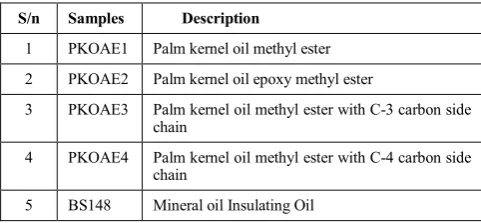
[image:2.595.313.554.599.710.2]An alkyl ester (PKOAE1) was synthesized from laboratory purified palm kernel oil by transesterification with methanol. Epoxy alkyl ester (PKOAE2) was then synthesized by epoxidation of PKOAE1 with an insitu peracetic acid [5]. Branched alkyl esters (PKOAE3 and PKOAE4) were then prepared in using an acid-catalyzed ring-opening reaction of PKOAE2 and acid anhydrides, see Table 1. PKOAE3 and PKOAE4 were then treated with acidified clay. The samples were dried by degassing at reduced pressure in a vacuum oven
Table 1: Sample description
S/n Samples Description
1 PKOAE1 Palm kernel oil methyl ester
2 PKOAE2 Palm kernel oil epoxy methyl ester
3 PKOAE3 Palm kernel oil methyl ester with C-3 carbon side
chain
4 PKOAE4 Palm kernel oil methyl ester with C-4 carbon side
chain
at temperature of 85˚C for 2 hours. Sample of BS148 mineral insulating oil was also dried by degassing in a vacuum oven at a temperature of 85˚C for 2 hours.
B. Thermo-Physical properties
The dynamic viscosity is defined as the product of kinematic viscosity and density of the liquid. The kinematic viscosity of the samples was determined using a suspended-level capillary viscometer of calibration constant 2.518 × 10⁻² cSt/sec. The viscometer was suspended in a temperature controlled water bath allowing measurements to be obtained at different temperatures from 20˚C – 60˚C. The corresponding density of the samples was determined using a Paar DMA 40 digital density meter at a controlled temperature.
Thermal analysis of the samples was carried out using Differential Scanning Calorimetry (DSC). The low temperature behavior of the samples was analyzed to determine the melting point, while the high temperature behavior was analyzed to determine the thermal stability of the samples. This was carried out using Mettler Toledo DSC1 instrument. The thermal analysis was carried out using STARe software. All measurements were repeated three times and the average of the three scans were taken.
C. Dielectric Properties
The dielectric properties of the samples were measured in a bespoke test cell. Liquid test cells always come with complicated problems such as leakage, thermal expansion of the oil sample etc. The cell was designed such that the electrodes are suspended in the oil sample and having enough space to accommodate sample expansion. The cell was placed in an oven controlled by a cooling and heating system to vary the temperature of the sample to within 0.1˚C . The dielectric response of the samples was measured using Solartron 1255 Frequency Response Analyzer and 1296 Dielectric Interface controlled by a desktop computer. Dielectric measurements were taken over the frequency range10-3 Hz to 106 Hz and at number of fixed temperatures within the range 20˚C to 80˚C.
D. Breakdown Strength
An AC voltage was applied using a 50kV step-up transformer. During each experiment the applied voltage was increased manually from zero at a rate of approximately 0.4 kV/s until breakdown occurred. A transformer control unit (TCU) monitored the cell current and interrupted the supply voltage to the step-up transformer when breakdown occurred in the sample cell. The cell was designed to take small sample volumes (≈5ml) with a sphere electrode gap of 1 mm compared to the volume required using the IEC 156:1995
standard designed cell (350 ml to 600 ml). For each specimen, five breakdown measurements were carried out at 20 ˚C.
III. RESULTS AND DISCUSSION
A. Thermal Analysis
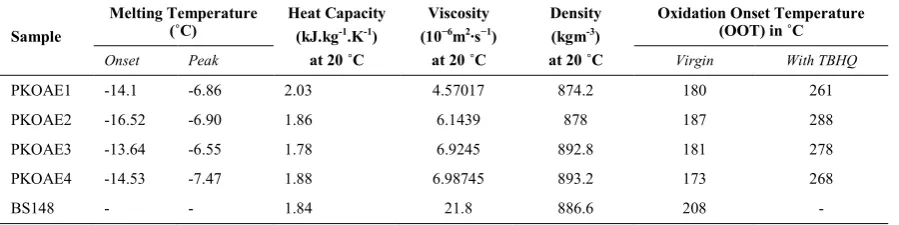
Vegetable oil has a melting range and not a sharp melting point and hence the melting point is often defined as the temperature at which the oil is free of crystals [5]. The peak of the reaction endotherm of the thermogram at low temperature is often taken as the melting point [5]. The peak melting temperature of PKOAE1 and PKOAE2 which were both -6.9˚C occurs at a significantly lower temperature than the melting point of purified palm kernel oil which was earlier reported to be about 26˚C [6]. The separation of glycerol from the fatty acids reduced the melting temperature of the esters. The melting peak temperature of PKOAE3 with C-3 side chains was still about the same with that of PKOAE1 and PKOAE2. Increase in chain length (PKOAE4) was observed to slightly increase the melting peak temperature by 1˚C. The little impact of the side chain on the melting behavior of the ester may be due to low percentage composition (about 17%) of unsaturated fatty acid in the ester. The side chain limits the ability of the fatty acids to be closely packed because of the bends and kinks introduced into the hydrocarbon. Addition of pour point depressant may further decrease the melting point. The specific heat capacity of the samples which was evaluated from the DSC data showed that the samples had a similar heat capacity and it’s within the same range with BS148 mineral oil.
[image:3.595.75.525.625.737.2]The oxidation onset temperature (OOT [˚C]) of a sample which is defined as the temperature at which a rapid increase in the rate of oxidation occurred is determined by extrapolating a tangent line drawn on the slope of the reaction exotherm of the thermogram [7]. PKOAE2 was found to posses higher OOT. However, a decrease was observed after grafting of side chains. OOT further reduced with increase in the length of the side branch. The pathway for oxidative degradation of saturated alkyl esters is considerably slower and could occur at any point along the fatty acid backbone since the entire backbone possess similar C-H bonds, with the exception of the terminal alky group [8]. This is responsible for the high oxidative stability of alkyl esters of short chain length. The low percentage composition of unsaturated fatty alkyl ester (17%) in the oil is responsible for its higher oxidative stability compared to vegetable oil of higher composition of unsaturated fatty acid such as sunflower oil and rapeseed oil [9]. The oxidation onset temperature of PKOAE1 and PKOAE2 is 180 and 187 ˚C respectively, while that of PKOAE3 and PKOAE4 is 181 ˚C and 173 ˚C respectively. The systematic decrease in the OOT of the branched alkyl esters with chain length was because the
Table 2: Physico-chemical properties of samples
Sample
Melting Temperature
(˚C) Heat Capacity (kJ.kg-1.K-1) at 20 ˚C
Viscosity (10−6m2·s−1)
at 20 ˚C
Density (kgm-3) at 20 ˚C
Oxidation Onset Temperature (OOT) in ˚C
Onset Peak Virgin With TBHQ
PKOAE1 -14.1 -6.86 2.03 4.57017 874.2 180 261
PKOAE2 -16.52 -6.90 1.86 6.1439 878 187 288
PKOAE3 -13.64 -6.55 1.78 6.9245 892.8 181 278
PKOAE4 -14.53 -7.47 1.88 6.98745 893.2 173 268
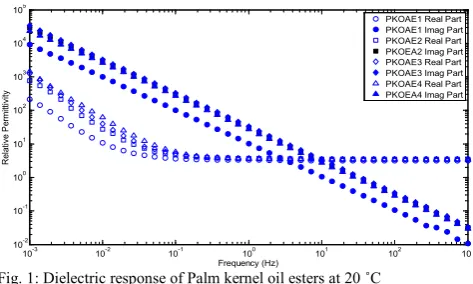
Fig. 1: Dielectric response of Palm kernel oil esters at 20 ˚C
10-3 10-2 10-1 100 101 102 103 10-2
10-1 100 101 102 103 104 105
Frequency (Hz)
Re
la
tiv
e P
er
m
itt
iv
ity
PKOAE1 Real Part PKOAE1 Imag Part PKOAE2 Real Part PKOEA2 Imag Part PKOAE3 Real Part PKOAE3 Imag Part PKOAE4 Real Part PKOEA4 Imag Part degree of susceptibility of fatty acids to oxidation increases
with chains length [10]. Oxidation onset temperature of BS148 mineral oil was 13 ˚C higher than PKOAE2 at 20 ˚C.
The effect of antioxidant additive on the thermal stability of the palm kernel oil ester derivatives were studied with the addition of tertiary butilated hydroxyquinone (TBHQ) in the ester samples. The percentage of additive that yields optimum performance was determined by varying the amount of the additive. The effect of the antioxidant was evaluated by comparing the onset temperature of oxidation on the DSC thermogram with the oxidation onset temperature of the same sample without antioxidant (Table 2). While 4% (w/w) tertiary butilated hydroxyquinone (TBHQ) in PKOAE1 was found to yield optimum OOT, only 3% (w/w) was required for the other ester samples above which there was no significant change in OOT. The antioxidant suppressed the thermal degradation of C-H bonds of the fatty acid backbone. This result demonstrates that antioxidant is able to protect the oxidative degradation of
the long and branched carbon chains to a much higher temperatures. This suggests that the addition of antioxidant has a significant improvement on the oxidative stability of palm kernel oil ester derivatives. PKOAE2 appeared to be a more stable alkyl ester to oxidative degradation.
Vegetable oil was reported to have density and kinematic viscosity of about 913 Kgm-3 and 44 cSt [6]. Splitting of the oil into its respective fatty acids (PKOAE1) resulted to a change in the physical properties. The density and kinematic viscosity reduced to 874.2 Kgm-3 and 4.57 cSt respectively. The incorporation of an epoxy ring at the double bond site resulted in an increase in the density and kinematic viscosity of the alkyl ester to 878.0 Kgm-3 and 6.14 cSt respectively at 20 ˚C. Addition of side chains to the alkyl ester led to a slight increase in both the viscosity and density. The density and kinematic viscosity of the alkyl ester increased to 892.8 Kgm-3 and 6.92 cSt respectively at 20 ˚C with the grafting of C -3 side chain. Grafting of C-4 side chain increased the density and kinematic viscosity of the alkyl ester to 893.2 Kgm-3 and 6.99 cSt respectively at 20 ˚C. The viscosity of the alkyl esters is considerably lower than mineral insulating oil whose viscosity is 16 cSt at the same temperature. Since viscosity often has an overwhelming effect on the heat transfer capability of a fluid which is a strong function of temperature, alkyl ester may be very good in heat transfer and dissipation as low viscosity enhances good heat transferability
B. Dielectric Response
Fig 1 shows the dielectric spectrum (i.e. a Bode plot) of the alkyl ester samples at 20 ˚C. Above approximately 10-1 Hz the real part is constant (i.e. independent of frequency) and the imaginary part is inversely proportional to frequency. This is symptomatic of a constant capacitance in parallel with a conductance – i.e. a conduction mechanism dominates in this frequency range. The charges responsible for conduction in the liquid result from the dissociation of ionic and solid impurities in the liquid. At lower frequencies, the real part acquires a slope that falls between -2 and -1, whilst the imaginary part maintains a slope of -1. This is indicative of Maxwell-Wagner interfacial polarization [11]. The electrode polarization results from the electric double layer created from the accumulated charges at the electrode-liquid interface. This behavior may be describe as a low-loss universal capacitor at the electrode liquid interface and can be modeled with a frequency dependent capacitance, Cn
in series with parallel volume conductance and capacitance and where the value of exponent, n, is between 0 and 1 [12]. This term dominates dielectric response at low frequency. Fig 1 displayed a slight shift in the onset of interfacial effect from PKOEA1 through PKOEA4. There seems to be no significant difference in dielectric loss in PKOAE2, PKOAE3 and PKOAE4, but PKOAE1 has lower dielectric loss. This increase may be due to impurities introduced in the samples during processing.
C. Dielectric Breakdown Strength
[image:4.595.309.557.618.722.2]The results on the electrical breakdown tests of PKOAE1, PKOAE2, PKOAE3, PKOAE4 and BS148 samples are summarized in Table 3. The mean breakdown strength of mineral oil, 26.4 kV/mm, obtained with the bespoke breakdown test cell with standard deviation of 1.8 kV/mm is comparable with the breakdown strength of mineral insulating oil reported in literature using the standard ASTM test cell. Insulating oil in Electric equipment with voltage rating of 345 kV and above was reported to have electrical breakdown strength of 26 kV/mm [13]. The standard deviation of 1.8 kV/mm is approximately 7% of the breakdown strength value. The percentage of standard deviation of breakdown strength as recommended by ASTM should not exceed 10%. Also shown in Table 3, are the results obtained for the ester derivatives. The mean breakdown voltage of the esters, 42 kV, is compared with
Table 3: Electrical Breakdown test
Samples No. of
Breakdown Mean BDV (kV) Standard Deviation (kV)
BS148 5 26.4 1.83
PKOAE1 5 42.2 1.41
PKOAE2 5 42.6 0.98
PKOAE3 5 42.4 2.60
the minimum mean breakdown voltage recommended in the literature for natural ester (as-received) insulation fluid measured using standard test methods ASTM D1816. A natural ester based dielectric fluid is recommended to have a minimum mean breakdown voltage of 35 kV (1 mm gap) for voltage class of 345 kV and above [14]. However, in this study the mean breakdown voltage for the synthesized alkyl ester has a breakdown voltage that exceeds this limit by a significant amount.
IV. CONCLUSION
The alkyl esters have a considerably lower melting point and the viscosity is about 2.5 times less than that of BS148 mineral insulation oil. The melting point decreases with increasing the length of the side chain. But the side chain does not seem to have much impact on the melting behavior of the alkyl esters. Addition of pour point depressant may further improve the low melting behavior. The low viscosity value will enhance efficient heat transfer since viscosity often has an overwhelming effect on the heat transferability of a fluid. The viscosity and specific heat capacity of the alkyl esters suggest that it could serve as an effective dielectric coolant. Thermal and oxidation degradation studies demonstrate that the alkyl esters, especially PKOAE2 possessed good thermal and oxidative stability. Addition of anti-oxidant compliments the natural antioxidant in the esters to increase the onset temperature of oxidative degradation. The dielectric losses of the alkyl esters are due to on the migrating charge carriers resulting from the dissociation of impurities which drift towards the electrode-liquid interface at low frequency electric fields to form electrical double layer. The dielectric response suggests that ester with longer side branch has lower relaxation time. Palm kernel oil alkyl esters display an excellent breakdown voltage. This indicates that the chemical modification does not have any negative influence the breakdown strength. The results suggest that the synthesized natural ester may serve as a viable alternative insulating fluid.
ACKNOWLEDGMENT
This study was sponsored by Islamic Development Bank under the IDB Merit Scholarship Programme for High Technology. It was also supported by National Grid, UK.
REFERENCES
[1] S. Tenbohlen, D. Vukovic, J. Harthun, S. Barker and R. Frotscher,
Application of vegetable oil-based insulating fluids to hermetically
sealed power transformers, Cigre session (2008) paper A2-102.
[2] D.C. Abeysundra, C. Weerakoon, J.R. Lucas, K.A.I. Gunatunga and
K.C. Obadage, Coconut Oil as an Alternative to Transformer Oil, ERU
Symposium, 2001.
[3] J. McMurry, Organic Chemistry, Brooks/Cole, USA., 2000.
[4] H. S. Hwang and S. Z. Erhan, Modification of Epoxidized Soybean Oil
for Lubricant Formulation with Improved Oxidative Stability and Low
Pour point, J. Am. Oil Chem. Soc. 78 (2001) 1179-1184.
[5] Foubert, K. Dewettinck, D. Van de Walle, A. J. Dijkstra & P. J. Quinn,
Physical Properties: Structural and physical Characteristics, in: F.D.
Gunstone, J.L. Harwood, A. J. Dijkstra (Third Edition), The Lipid
Handbook, CRC Press, pp. 471-534, 2007.
[6] A.A. Abdelmalik, A.P. Abbott, J.C. Fothergill, S. Dodd& R.C. Harris,
“Synthesis of a Base-Stock for Electrical Insulating Fluid based on Palm
Kernel Oil”, Industrial Crops and Products, 33, 532–536, 2011.
[7] B. R. Moser, 2009, Comparative Oxidative Stability of Fatty Acid Alkyl
Estersby Accelerated Methods, J. Am Oil Chem Soc, Vol. 86, pp 699–
706.
[8] N.H. Jayadasa and K. Prabhakaran Nairb, 2006, Coconut oil as base oil
for industrial lubricants—evaluation and modification of thermal,
oxidative and low temperature properties, Tribology International, Vol.
39, pp 873–878.
[9] P. Simon and J. Cvengros, 2010, Thermooxidative stability of vegetable
oils refined by steam vacuum distillation and by molecular distillation,
Eur. J. Lipid Sci. Technol. Vol. 112, Pp. 1236–1240.
[10] B. R. Moser, B. K. Sharma, K. M. Doll, S. Z. Erhan, 2007, Diester from
Oleic Acid: Synthesis, Low Temperature Properties, and oxidation
Stability, J. Amer. Oil Chem. Soc. 84, 675-680. J. Am. Oil Chem. Soc.
Vol. 84, pp. 675-680.
[11] A.K. Jonscher, 1983, Dielectric relaxation in solids, Chelsea Dielectric
Press, London.
[12] A. K. Jonscher, 1996, Universal Relaxation Law, Chelsea Dielectrics
Press, London.
[13] C.T. Dervos, C.D. Paraskevas, P. Skafidas, P. Vassiliou, 2005,
Dielectric Characterization of Power Oils as a Diagnostic life Prediction
Method, IEEE Insulation Magazine, Vol. 21, No. 1
[14] IEEE Std C57.147-2008, IEEE Guide for Acceptance and Maintenance