Chemistry
REVIEW
Cite this:Polym. Chem., 2015,6, 7231
Received 22nd May 2015, Accepted 17th July 2015
DOI: 10.1039/c5py00771b
www.rsc.org/polymers
Hypercrosslinked materials: preparation,
characterisation and applications
N. Fontanals,*
aR. M. Marcé,
aF. Borrull
aand P. A. G. Cormack
bThis review article provides an overview of hypercrosslinking technology. In particular, it covers the prepa-ration and characterisation of hypercrosslinked materials and their applications. The synthesis section examines the different monomers, precursor polymers and reagents used to prepare hypercrosslinked materials, but also the different synthetic approaches disclosed in the literature. The various chemical modification reactions relevant to this area are also reviewed. Several examples of applications for hyper-crosslinked materials are described; these applications are grouped into thematic areas such as chrom-atography, gas storage and the trapping of organic contaminants.
1.
Introduction
Macroporous poly(styrene-co-divinylbenzene)s (PS-DVB) with high specific surface areas (SSAs) can be prepared by suspen-sion polymerisation, provided that higher levels of crosslinker
(DVB) are used (typically >50 vol%) together with an appropri-ate amount of a suitable solvent ( porogen). However, when very high levels of crosslinker are used then a significant number of vinyl groups remain unreacted and are present in the final materials as pendent vinyl groups; this is because steric congestion and phase separations are an impediment to their complete consumption through crosslinking. Thus, the efficiency of the crosslinking process diminishes significantly as polymerisations ensue, and the products of polymerisation have lower effective levels of crosslinking than one would anticipate based upon the monomer feed.1 Davankov
intro-N. Fontanals
Dr Núria Fontanals received her PhD at Universitat Rovira i Virgili (URV) in 2005 in the Chromatography and Environ-mental Applications research group under the supervision of Prof. Francesc Borrull and Prof. Rosa M. Marcé, following a post-doctoral period with Prof. D. C. Sherrington and Prof. Peter A. G. Cormack in the University of Strathclyde in the Polymer Research Group. In 2007, Fonta-nals reincorporated in the same research group at URV, where in collaboration with the Strathclyde research group, leads a research line devoted to the development of novel materials to be applied in different analytical methods in order to enhance the sensitivity and selectivity in the determi-nation of challenging compounds in complex samples.
R. M. Marcé
Dr Rosa M. Marcé is Full Pro-fessor in Analytical Chemistry at the Universitat Rovira i Virgili since 2010. Her main interest is the development of new chroma-tographic methods to determine contaminants in environmental samples. This interest includes the development of new materials for the extraction tech-niques and, since 1999 she has collaborated with Prof. D.C. Sherrington and Prof. P.A.G. Cormack in the development and application of new materials including molecular imprinted poly-mers, and polar and mixed-mode hypercrosslinked polymers. These materials have been used in different sorptive extraction techniques and combined with high-tech liquid chromatography-mass spectrometry techniques, to solve environmental analytical problems. She has supervised several PhD theses in collaboration with Strathclyde University’s group.
a
Departament de Química Analítica i Química Orgànica, Universitat Rovira i Virgili, Campus Sescelades Marcel·lí Domingo, s/n, 43007 Tarragona, Spain.
E-mail: [email protected]; Fax: (+34) 977 55 84 46; Tel: (+34) 977 55 86 29 b
WestCHEM, Department of Pure and Applied Chemistry, University of Strathclyde, Thomas Graham Building, 295 Cathedral Street, Glasgow, G1 1XL Scotland, UK
Open Access Article. Published on 23 July 2015. Downloaded on 27/10/2015 10:59:13.
This article is licensed under a
Creative Commons Attribution 3.0 Unported Licence.
duced a distinctly new method for the production of porous polystyrenes, a method which comprised the extensive post-crosslinking of linear PS chains by means of a Friedel–Crafts (F–C) reaction. This process installed numerous structural bridges between neighbouring aromatic rings whilst the PS was in a highly swollen state, and yields resins which have a hypercrosslinked (HXL) structure, high micropore content and very high SSAs (up to∼2000 m2g−1). Another very character-istic, and unusual, feature is that the HXL products display a high propensity for solvent uptake of both polar and non-polar solvents.2 Their porous characteristics – high SSA in
combination with a high micropore content – make HXL
resins much more retentive than conventional macroporous polymers when applied in sorption processes. The Davankov hypercrosslinking procedure just described, which relies upon external electrophiles, was developed further by Jerábek3 and Sherrington4in studies which involved the production of HXL resinsviainternal electrophiles. More specifically, a reac-tive comonomer, vinylbenzyl chloride (VBC), was exploited, wherein pendent chloromethyl residues present within a swel-lable precursor polymer served as a source of internal electro-philes in hypercrosslinking reactions. This strategy allows for better control over the physical format of the hypercrosslinked products.
Since their original discovery, HXL materials have evolved, and more sophisticated properties have been installed to enable the materials to fulfil a yet broader range of applications, and this includes the storage of gases,5the retention of organic com-pounds present in water6in sorption extraction techniques, and as novel stationary phases in chromatography.7–9
A number of research groups have worked in the HXL field. David Sherrington contributed considerably to the field through both the development of novel synthetic approaches and through his involvement in the applications of HXL
materials. In this review we outline the field as a whole, but draw particular attention to the innovations and developments which have come out of the Sherrington research group over the past years.
2.
Synthetic approaches
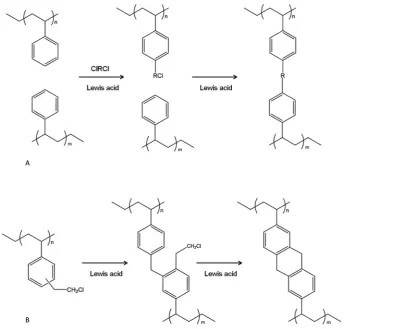
Originally, HXL networks were obtained via the post-cross-linking of polystyrenic chains/structures in an expanded/ swollen state by using external crosslinkers. These external crosslinkers bridge between adjacent aromatic residues, setting in place short, rigid (hyper)crosslinks, and these are very often installed through F–C reactions. Fig. 1A shows the different steps involved during a post-crosslinking reaction of PS. The structure of a typical HXL polymer is a rigid and expanded three-dimensional network. The main structural element of this network is a spatially non-planar cycle formed by crosslinking bridges, and very short chain segments con-fined between the branching points. By using an external crosslinker together with a F–C catalyst almost all of the aro-matic rings can be crosslinked/bridged and ultra-high SSAs achieved. The resulting hypercrosslinked network displays a high degree of crosslinking, low packing density due to the number of rigid spacers holding the polymer chains apart, and an extremely high SSA (up to∼2000 m2g−1) arising from a big population of very small pores (mean pore diameter = 2–4 nm).7
The typical morphological properties of HXL materials are as outlined above; however, since the original synthetic pro-cedure was disclosed by Davankov, several variables have been considered and tested. This section will review the different variables and reagents used during the preparation of HXL materials. In addition, the changes in polymer properties
F. Borrull
Dr Francesc Borrull is Full Pro-fessor in Analytical Chemistry at the Universitat Rovira i Virgili (URV) since 2003 and he is the head of the research group of Chromatography and Environ-mental Applications of the URV since its formation in 1992. His research interests are focussed on the separation techniques, including gas and liquid chrom-atography and capillary electro-phoresis, mainly applied to the environmental analysis. He has also significantly contributed to the development and application of new materials for sample treatment techniques to improve analytical methods, and the fruitful collaboration with Prof. D.C. Sherrington and Prof. P.A.G. Cormack has involved the supervision of several PhD theses in collaboration with their group.
P. A. G. Cormack
Peter Cormack is Professor of
Polymer Chemistry in
WestCHEM, Department of Pure and Applied Chemistry, at the University of Strathclyde in Glasgow. He graduated from the University of Strathclyde with BSc (Hons) (1992) and PhD (1996) degrees, completing his PhD degree under the supervi-sion of Professor David C. Sherrington and Dr Barry D. Moore. He spent postdoctoral research periods at the Univer-sities of Cambridge and Lund, before returning to the University of Strathclyde as ICI Lecturer in Polymer Chemistry (1998). His research interests concern the synthesis of functional organic poly-mers. He works closely with the URV scientists on polymer applications.
Open Access Article. Published on 23 July 2015. Downloaded on 27/10/2015 10:59:13.
This article is licensed under a
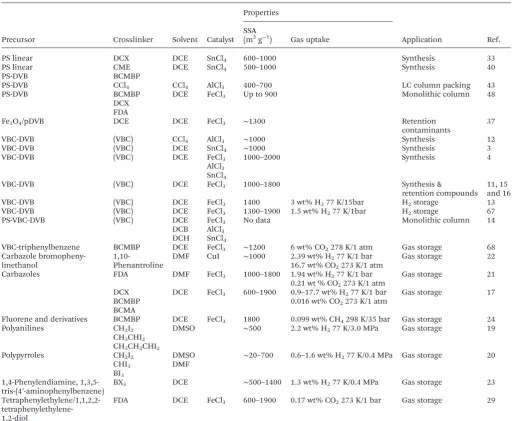
which can arise from these modifications to the original pro-cedure will be discussed; these modifications include systematic variations in the reagents used, the electrophiles, the catalysts and the solvents. These parameters, and how they can influence the synthesis and the final properties of HXL materials, will be discussed in the following sections. Table 1 provides illustrative examples of HXL materials which have been synthesised using distinct synthetic approaches. This table also identifies the intended application for each HXL material.
2.1 Polymer precursors
The first polymer precursor used was linear PS, dissolved in solution in a swollen/expanded state arising from the rational selection and use of a good solvent.2During the course of the crosslinking reaction, the initial solution of polymer in solvent is transformed into a gel and eventually in a solid, monolithic block, which, if so desired, is subsequently ground to produce HXL particles which are irregular in shape and size. Given an objective to produce spherical particles from this protocol rather than irregular particles, the PS precursor can be a lightly crosslinked, gel-type bead, with DVB (0.3–2%) as cross-linker. Such gel-type beads will also swell in the presence of good solvents although they will not normally dissolve. The low DVB content allows the beads to swell, whilst their spheri-cal shape is maintained as the hypercrosslinking reaction
pro-ceeds. In a different approach, PS-DVB macroporous polymers (containing up to 30% of DVB) were also hypercrosslinked.2,10 This makes it possible to install crosslinking points additional to those set in place already by the crosslinking agent (DVB). In addition, such HXL polymers will be expected to exhibit bimodal pore size distributions, since micropores will be derived from the hypercrosslinking process and macropores from the synthetic protocol used to prepare the precursor polymer.4 In any case, the degree of crosslinking achievable from a macro-porous precursor is lower due to steric impediments.
Poly(vinylbenzyl chloride-co-DVB) (VBC-DVB) has been shown to be another excellent precursor polymer for the syn-thesis of HXL materials, where the chloromethyl (–CH2Cl)
sub-stituent is the source of the internal electrophile used to install bridges between adjacent aromatic rings.3,11 Fig. 1B shows the procedure used to obtain HXL materials from VBC-DVB precursors. As can be seen in Fig. 1B, when VBC-DVB is employed as precursor the crosslinking process is intramolecular, and this leads to extremely efficient reactions as reported by Ahnet al.4They found that a gel-type, VBC-DVB resin prepared by suspension polymerisation could be almost fully hypercrosslinked within 15 minutes only, as evidenced by a considerable decrease in the chlorine content, from∼19 wt%
to ∼2 wt%, and a concomitant increase in the SSA from
∼0 m2g−1to∼1200 m2g−1. They suggested that the last step
Fig. 1 HXL reaction: (A) of PSviaexternal crosslinker; (B) of VBC-DVBviainternal electrophile.
Open Access Article. Published on 23 July 2015. Downloaded on 27/10/2015 10:59:13.
This article is licensed under a
[image:3.595.126.525.47.376.2]in this hypercrosslinking process (Fig. 1B) is extremely favour-able since the aromatic ring to be substituted is already doubly alkylated and thus electron rich. More importantly, formation of the final product is further enhanced as the ensuing cyclisa-tion reaccyclisa-tion results in the formacyclisa-tion of a highly favoured six-membered ring. Over the past years, most of the HXL resins prepared were synthesised using VBC-DVB polymers as precursors.3,11–15
Sherrington’s group16 tested different isomers of VBC in
the production of swellable polymer precursors and reported substantial differences between the isomers when suspension polymerisation was used. In this regard, when polymers were prepared from the pure para-isomer of VBC (pVBC) or a
70 : 30 mixture of para- and meta-isomers (mixVBC), diff er-ences in the chlorine content of the polymers were found (∼8.5 wt% Cl forpVBC and∼22.8 wt% Cl for mixVBC). The low chlorine content of the former was ascribed to preferential hydrolysis of thepara-isomer of VBC under the synthesis con-ditions used.
The use of different isomers of dichloroxylene (DCX) (i.e., oDCX,mDCX andpDCX) as self-condensing precursors for the preparation of high SSA materials for H2 storage was also
explored.17The incorporation ofo-DCX was consistently
detri-mental to the development of SSA in these materials, both
when used individually or in mixtures with the p- and
[image:4.595.41.554.71.492.2]m-isomers. This finding is associated with the lower degree of
Table 1 Information related to the reagents used in the preparation of different HXL materials, their properties (SSA and gas storage data) and their
principalfield of application
Precursor Crosslinker Solvent Catalyst
Properties
Application Ref.
SSA
(m2g−1) Gas uptake
PS linear DCX DCE SnCl4 600–1000 Synthesis 33
PS linear CME DCE SnCl4 500–1000 Synthesis 40
PS-DVB BCMBP
PS-DVB CCl4 CCl4 AlCl3 400–700 LC column packing 43
PS-DVB BCMBP DCE FeCl3 Up to 900 Monolithic column 48
DCX FDA
Fe3O4/pDVB DCE DCE FeCl3 ∼1300 Retention
contaminants
37
VBC-DVB (VBC) CCl4 AlCl3 ∼1000 Synthesis 12
VBC-DVB (VBC) DCE SnCl4 ∼1000 Synthesis 3
VBC-DVB (VBC) DCE FeCl3 1000–2000 Synthesis 4
AlCl3 SnCl4
VBC-DVB (VBC) DCE FeCl3 1000–1800 Synthesis &
retention compounds 11, 15 and 16
VBC-DVB (VBC) DCE FeCl3 1400 3 wt% H277 K/15bar H2storage 13
VBC-DVB (VBC) DCE FeCl3 1300–1900 1.5 wt% H277 K/1bar H2storage 67
PS-VBC-DVB (VBC) DCE FeCl3 No data Monolithic column 14
DCB AlCl3
DCH SnCl4
VBC-triphenylbenzene BCMBP DCE FeCl3 ∼1200 6 wt% CO2278 K/1 atm Gas storage 68
Carbazole bromopheny-lmethanol
1,10-Phenantroline
DMF CuI ∼1000 2.39 wt% H277 K/1 bar Gas storage 22
16.7 wt% CO2273 K/1 atm
Carbazoles FDA DMF FeCl3 1000–1800 1.94 wt% H277 K/1 bar Gas storage 21
0.21 wt % CO2273 K/1 atm
DCX DCE FeCl3 600–1900 0.9–17.7 wt% H277 K/1 bar
0.016 wt% CO2273 K/1 atm
Gas storage 17
BCMBP BCMA
Fluorene and derivatives BCMBP DCE FeCl3 1800 0.099 wt% CH4298 K/35 bar Gas storage 24
Polyanilines CH2I2 DMSO ∼500 2.2 wt% H277 K/3.0 MPa Gas storage 19
CH3CHI2 CH3CH2CHI2
Polypyrroles CH2I2 DMSO ∼20–700 0.6–1.6 wt% H277 K/0.4 MPa Gas storage 20
CHI3 DMF
BI3 1,4-Phenylendiamine, 1,3,5-tris-(4′-aminophenylbenzene)
BX3 DCE ∼500–1400 1.3 wt% H277 K/0.4 MPa Gas storage 23
Tetraphenylethylene/1,1,2,2- tetraphenylethylene-1,2-diol
FDA DCE FeCl3 600–1900 0.17 wt% CO2273 K/1 bar Gas storage 29
PS: polystyrene; PS-DVB: polystyrene-divinylbenzene; VBC-DVB: vinylbenzyl chloride-divinylbenzene; DCX: dichloroxylene; CME: chloromethyl methyl ether; BCMBP: 4,4′-bis(chloromethyl)-1,1′-biphenyl; FDA: formaldehyde dimethyl acetal; BCMA: bis-chloromethylantracene; DCE: dichloroethylene; DCB: dichlorobutene; DCH: dichlorohexane; DMF: dimethylformamide; DMSO: dimethyl sulfoxide.
Open Access Article. Published on 23 July 2015. Downloaded on 27/10/2015 10:59:13.
This article is licensed under a
condensation (i.e., crosslinking) achieved with o-DCX com-pared to the other two DCX isomers. In general, bothm-DCX andp-DCX gave rise to materials with quite similar SSAs under comparable reaction conditions.
Polyaniline18,19and polypyrrole20precursors were evaluated by the Fréchet and Svec groups. They selected these precursors since a preliminary study showed that polyaniline was a poten-tial H2 storage material; however, the SSAs reported prior to
their reports were not higher than 100 m2g−1. In their hyper-crosslinking approach, polyaniline was crosslinked using either diiodomethane or paraformaldehyde to form methyl-ene-bridged networks; they obtained HXL porous polyanilines with SSAs up to 632 m2 g−1.19Later, polyanilines were cross-linkedviaUllman and Buchwald coupling reactions, reactions which yielded networks linked by aromatic rings.18 Finally, they prepared different HXL resins by targeting the highest SSA achievable for each methodology (632 m2 g−1 for the di-iodomethane route, 480 m2g−1for the formaldehyde route, and 316 m2 g−1 for the Ullman and Buchwald strategy). After the synthesis, the most promising HXL materials were tested for H2
adsorption at elevated pressures. They found that the HXL poly-aniline material prepared using the diodomethane-based pro-cedure displayed an adsorption capacity of 2.2 wt% H2at 77 K/
3.0 MPa. Another interesting finding was that protonation of HXL polyaniline severely diminished its ability to physisorb H2.
The explanation given to rationalise this observation was that aromatic rings which contain electron-donating functionalities adsorb H2more readily than those bearing
electron-withdraw-ing groups. Thus, while the aniline functionality is strongly elec-tron-donating, protonated anilines are electron-withdrawing and thus decrease the H2sorption capacity.19
Cognate strategies were used for the hypercrosslinking of polypyrroles20 using diiodomethane, triiodomethane, and triiodoborane, to produce porous structures with CH2, CH and
B crosslinks, respectively. The highest SSA reported was only 732 m2g−1. In spite of this, the authors found these strategies to be valuable, since precursors that contain aryl amines pro-vided shorter crosslinkes and the presence of electron-donat-ing groups (amine) in the aromatic relectron-donat-ings enhance the H2-polymer interactions (i.e., increases their ability to physisorb
hydrogen).19 Recently, polycarbazole has been proposed as a precursor resin for hypercrosslinking reactions through FeCl3
-promoted carbazole-based oxidative coupling polymerisations. The resulting polycarbozole-based HXL resins provide very inter-esting values of surface area (up to 1800 m2g−1) as well as H2
(1.94 wt% at 77 K/1.13 bar) and CO2(0.21 wt% at 77 K/1.13 bar)
uptake, and the resins were synthesised using a protocol that the authors claimed to be cost-effective, high yielding, and which involved the use of an inexpensive catalyst and a single monomer only.21,22 Reich and co-workers23prepared different borozine-linked polymers through the thermolysis of aryl-amine-boron trihalides by employing 1,4-phenylenediamine or 1,3,5-tri-(4′-aminophenyl)benzene in dichloroethane (DCE) as solvent with BCl3 or BBr3. The resulting polymers were highly
porous (SSA up to 1400 m2g−1), but offer moderate low-pressure H2storage capacity (0.7 to 1.3 wt% at 77 K/1 bar).
Rigid, non-functional aromatic precursors such as fluorene and derivatives (9,9′-spirobi(fluorine), dibenzofuran and dibenzothiophene were also used in the generation of porous copolymer networks obtainedviaco-condensation with 4,4′-bis (chloromethyl)biphenyl (BCMBP) under F–C catalytic con-ditions.24 The monomers were incorporated successfully into the polymers, as shown by FT-IR spectroscopy and13C CP-MAS
NMR spectroscopy. The polymers showed high CH4 (up to
0.099 wt% at 298 K/35 bar) and H2 (0.016 wt% at 77 K/1 bar)
uptake, as well as a highly porous structures (up to 1800 m2 g−1). Aromatic precursors, including benzene,25,26 polythio-phene, polypyrrole and polyfuran,27aniline26and hydroxylated and bishydroxymethyl monomers28were also employed using a similar strategy to deliver HXL materials. All these materials were evaluated for their gas storage potential.
Tetraphenylethylene-based HXL networks were synthesised successfullyviaF–C alkylation using a dimethyl acetal crosslin-ker. Moreover, the material properties, in terms of SSA and CO2 uptake, outperformed the corresponding polymer based
on 1,1,2,2-tetraphenylethane-1,2-diol (modified with two hydroxyl moieties).29 1,7-Dicarbadodecaborane was reacted further with two chloromethyl functional groups (DCE or BCMBP); the resultant precursor was subsequently self-condensed under F–C conditions. The resulting HXL materials displayed SSAs around 1000 m2 g−1, and their maximum H2
up-take at 77 K/1 bar ranged from 0.021 to 0.028 wt%, depend-ing upon the specific precursor.30
Other strategies and precursors have been developed in order to fine tune the final properties of HXL resins according to their final intended applications. For instance, benzyl chlor-ide-terminated double-four-ring cubic siloxane cages were evaluated as suitable precursors since the HXL networks gave extremely high SSAs (ca. 2500 m2g−1). The realisation of such high SSA values was attributed to the simultaneous polymeri-sation of the organic functional groups and the destruction of the siloxane cages during synthesis.31In addition, this porous
siloxane–organic hybrid material provided H2 uptake
(∼1.2 wt% at 77 K/1 bar) similar to other materials designed for storage applications (i.e., metal–organic frameworks and porous organic polymers). Wuet al.32developed a new class of nanostructured porous network materials, which are based on the use of well-defined hairy nanoparticles as network precur-sors. Hairy nanoparticles (acted as core–shell network building blocks) were prepared by grafting PS chains from the surface of silica nanoparticles using surface-initiated atom transfer radical polymerisation, followed by intra-/interparticle carbo-nyl crosslinking, and eventually carbonisation. Thus, the range of precursors which is available and appropriate for use in HXL reactions seems to be ever-expanding.
2.2 Precursor polymerisation
Davankov applied the hypercrosslinking methodology to linear or slightly crosslinked PS precursors. This process yields a monolithic block of polymer as the product. If so desired, this monolithic block can be converted, though grinding pro-cedures, into HXL particles which are irregular in size and
Open Access Article. Published on 23 July 2015. Downloaded on 27/10/2015 10:59:13.
This article is licensed under a
shape.2,33 However, other groups have exploited precursor materials (mainly styrenic-based) which are in beaded form
and derived from, for example, suspension
polymeri-sation.4,12,16In these examples, if a porous resin is used as pre-cursor, then the product ought to contain not only the original pores (macropores) but also those generated during the hyper-crosslinking process (micropores) and thus a bimodal pore size distribution may be anticipated.4
HXL resin particles preparedviasuspension polymerisation are usually polydisperse (mean diameter of ca. 10–500 µm), which may limit their practical applications in certain fields. Therefore, polymerisation methods other than suspension polymerisation have been used to prepare HXL materials with more uniform particle size distributions. Fig. 2 shows microscopy images of HXL materials where the precursors were preparedviapolymerisations other than suspension poly-merisation (Fig. 2A).4 In this way, Sherrington’s group pio-neered the application of emulsion polymerisation which delivered spherical particles of ∼420 nm in diameter which had a near monodisperse particle size distribution (Fig. 2B).11 Non-aqueous dispersion (NAD) polymerisation (spherical par-ticles with diameters in the range 4–10 µm) (Fig. 2C)15and
pre-cipitation polymerisation (PP) (monodisperse spherical
particles with∼4 µm) (Fig. 2D)15 have been employed in an analogous fashion. In each case, relatively uniform particles with high SSAs and a range of diameters governed by the poly-merisation approach employed were obtained.
The authors have had particular success with HXL materials of low mean particle diameter in the micron range, especially when HXL materials derived from PP precursors (known as HXLPP) were used as SPE packing materials for the on-line enrichment of polar compounds from aqueous
samples. These sorbents showed greater efficiency and
capacity than the commercially available Lichrolut EN HXL material, which has a considerably larger particle size and broader particle size distribution (40–120 µm).34 Since the morphological properties (hydrophobic and SSA ∼1000 m2 g−1) of the resins that were compared were similar, the only significant difference being the particle size (∼4 µm for HXLPP sorbents and 40–120 µm for Lichrolut EN), it could be con-cluded that the particle size and shape characteristics of the HXLPP materials led to more efficient packing in the sorbent bed, preventing voids, and eventually leading to a more efficient and reproducible extraction procedure, as it was earlier predicted by the Vam Deemter equation.35
Apart from differences in the particle shape and size, we have also examined how the properties of HXL resins varied as a function of the VBC content depending on the type of poly-merisation adopted. In this regard, HXL resins derived from different ratios of VBC to DVB in the monomer feed were pre-pared. For instance, for polymer precursors in particulate form generated from both non-aqueous dispersion (NAD) polymeris-ation and precipitpolymeris-ation polymerispolymeris-ation (PP), it was found that the VBC content had to be 50 wt% or higher in order to gene-rate HXL materials with SSAs in excess of 1000 m2 g−1.15In
contrast, precursor polymers generated from suspension poly- Fig.
2 SEM images of di ff er ent HXL ma terials, for which the pr ecursors w e re deliv er ed using di ff er ent polymerisa tions: (A) suspension polymerisa tion; (B) emulsion polymerisa tion; (C) non-aqueous dispersion polymerisa tion; (D) pr ecipita tion polymerisa tion; (E) polymerisa tion in situ in a capillary column. R eprinted fr om: (A) Ma cr omolecules , 2006, 39 , 627 – 632; copyright (2006) American Chemical Society . (B) Ma cr omolecules , 2006, 39 , 5381 – 5384; copyright (2006) American Chemical Society . (C) and (D) Adv. Ma ter. , 2008, 20 , 1298 – 1302; copyright (2008) W ile y-VCH; (E) J. Ma ter. Chem. , 2007, 17 , 4989 – 4997; copyright (2007) R o y a l Society of Chemis try .
Open Access Article. Published on 23 July 2015. Downloaded on 27/10/2015 10:59:13.
This article is licensed under a
merisation with 20% of VBC in the monomer feed gave porous, HXL products with SSAs over 1000 m2g−1. Neverthe-less, the highest SSAs were obtained from gel-type polyVBC precursors crosslinked with 2% DVB under suspension poly-merisation conditions; SSAs of up to 2090 m2 g−1 were reported.4Therefore, the method of polymerisation also influ-ences in the final morphological properties.
Magnetic HXL microspheres have been developed as well, and have been demonstrated to be highly retentive materials for the extraction of target compounds. Gaoet al.36used the PP approach to obtain magnetic HXL particles based on methacrylic acid (MMA)-VBC-DVB; these particles had a core– shell architecture, with Fe3O4/SiO2at the core. These magnetic
microspheres (mean particle size of ∼800 nm) were applied successfully as a sorptive material to retain illegal drugs present in urine. Zhanget al.37synthesised uniform magnetic polyDVB particles (∼8 µm) with SSAs up to 1300 m2 g−1 via
membrane emulsification-suspension polymerisation and
post-crosslinking reaction. These magnetic HXL materials were applied successfully to the extraction of a group of organic contaminants.
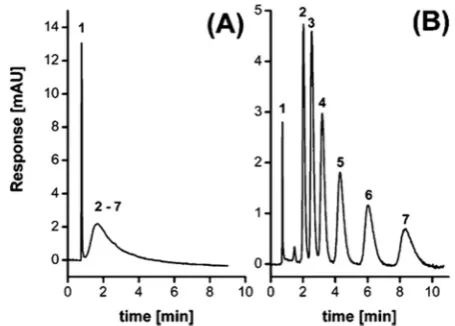
The Fréchet and Svec groups prepared HXL materials in form of monolith8,19 (Fig. 2E), and later went a step further with the in situ hypercrosslinking of monoliths in capillary columns.38 Their first attempt to obtain a monolithic HXL column was successful in that the polymer in the HXL column exhibited a SSA more than one order of magnitude higher than the value measured for the precursor column. Moreover, since it was a mesoporous material, the column afforded good separation for the selected analytes (alkylbenzenes). Fig. 3 compares the isocratic separation of this group of alkyl-benzenes using the monolithic column before and after the hypercrosslinking reaction.
The morphological properties provided in each polymeri-sation approach are similar, and this suggests that the hyper-crosslinking methodology is generic and can be initiated from precursors derived from distinct polymerisation strategies.
2.3 External crosslinkers
External crosslinkers are exploited whenever precursor poly-mers are not set-up for internal crosslinking reactions. Initially, the most commonly used external crosslinker was chloromethyl ether (CME),39–42 however, due to its carcino-genic properties it was progressively replaced by other reagents, such as: carbon tetrachloride (CCl4),32,43,44
mono-chlorodimethyl ether (MCDE),42,45 dichloroxylene (DCX),17,33 4,4′-bis(chloromethyl)biphenyl (BCMBP)10,17,24 or dichloro-ethylene (DCE)3,13,33(this reagent can also act as solvent in the synthesis).
Varying the external crosslinker can be exploited to modify the nature of the crosslinked bridge in a HXL polymer, both structurally (variations in the bridge length and rigidity impact on the porous morphology) and chemically (installation of a moiety from the external crosslinker). Therefore, in the selec-tion of an external crosslinker one should consider these aspects. Another parameter to bear in mind is the reaction
kinetics. For instance, CCl4 reacts more slowly and gives a
lower overall conversion than CME.12
The theoretical amount of external crosslinker required for a 100% degree of crosslinking is 0.5 moles of reagent per mole of repeat units ( phenyl rings or structure able to crosslink), as reported by Davankov’s group45who studied the influence of the external crosslinker on the crosslinking degree and the SSA. They showed that under nominally identical conditions, the greater the quantity of external crosslinker used the higher the SSA.
Di- and triiodoalkanes (diiodomethane,19,20diiodoethane19
and diiodopropane19 and triiodomethane20) were also
employed to crosslink precursors with aromatic rings that contain electron-donating groups (e.g., polyanilines, poly-pyrroles,etc.). The authors chose the more reactive diiodoalk-anes in comparison to dichloro- or dibromoalkdiiodoalk-anes to compensate for the limited reactivity of the precursors. All these materials were applied as H2storage materials; significant
pro-gress was reported, although further optimisation needs to be done to compare these materials with PS-based HXL materials.
Four linear diaminoalkanes (1,2-diaminoethane,
1,4-di-aminobutane, 1,6-diaminohexane and 1,8-diaminooctane)
were tested as external crosslinkers in the hypercrosslinking of precursors based on PS-VBC-DVB which were in form of mono-lithic stationary phases.46Apart from the type of crosslinker, other parameters affecting the reaction were optimised. A column with optimal properties was prepared by polymeri-sation for 2 h at 65 °C followed by hypercrosslinking reaction in the presence of 3% of 1,8-diaminooctane for 2 h at 95 °C.
Li et al.25 proposed a new strategy which consists of the “knitting”of rigid building blocks with an external crosslinker. In so doing, they also selected a more environmentally friendly external crosslinker, formaldehyde dimethyl acetal (FDA), which yields methanol as a by-product of the reaction rather than the typical chloromethyl functionalities which release
Fig. 3 Separation of uracil and different alkylbenzenes using precursor
PS-VBC-DVB monolithic column (A) and its HXL counterpart (B). Peaks: uracil (1), benzene (2), toluene (3), ethylbenzene (4), propylbenzene (5), butylbenzene (6), and amylbenzene (7). Reprinted from Anal. Chem., 2010,82, 1621–1623. Copyright (2010) American Chemical Society.
Open Access Article. Published on 23 July 2015. Downloaded on 27/10/2015 10:59:13.
This article is licensed under a
[image:7.595.313.541.49.212.2]HCl. Typically, in this one-step approach, the aromatic monomer (including benzene, phenol or chlorobenzene), the crosslinker (FDA) and the catalyst (FeCl3) were dissolved in
DCE, and heated at 45 °C for 5 h and then at 80 °C for 19 h to complete the condensation. By adjusting the type of monomer and its molar ratio with respect to FDA, differences in the SSA and H2 and CO2 uptake were observed. The largest values
achieved for SSA (∼1400 m2 g−1) and H2(1.45 wt% at 77.3 K/
1.13 bar) and CO2(13.5 wt% at 273.15 K/1 bar) uptake
corre-sponded to a molar ratio of FDA to benzene of 3. Similar approaches using FDA as external crosslinker were later
demonstrated with different monomers such as aromatic
heterocyclics,27hydroxymethylated aromatic molecules,28aniline and benzene,26and tetrahedral monomers,29,47among others.
Recently, Maya et al.48 hypercrosslinked different PS-DVB monoliths using a F–C reaction with FeCl3 involving three
external crosslinkers: BCMBP, DCX and also FDA. Apart from the type of external crosslinker used, they also optimised different reaction variables (temperature, time, amount and ratio of reagents). With all three external crosslinkers, the resulting monolith provided an increase in the SSA with respect to the precursor (PS-DVB), which gave benefits in terms of the column efficiency. The polymer with the highest SSA (∼900 m2 g−1) was obtained using a precursor monolith hypercrosslinked with BCMBP. The performance of the new monolithic column was tested by reversed phase liquid chrom-atography separation of a mixture comprised of acetone and six alkylbenzenes.
2.4 Solvents
As has been outlined already, in a typical hypercrosslinking reaction a linear polymer or a lightly crosslinked polymer is normally dissolved or swollen in a thermodynamically good solvent, since this expands the polymer chains. Rapid cross-linking leaves the polymer chains locked in an expanded form so that when the solvent is removed from the system the col-lapse of the expanded chains is prevented, the solvent space becomes pore volume and a network of interconnected pores is left behind.49
Hildebrand and Hansen parameters provide useful infor-mation for the rational selection of solvent, termed a thermo-dynamically good solvent. DCE is one of the most widely used solvents for hypercrosslinking since it is a good solvent for PS1 and DCE is also compatible with the F–C chemistry, although some other solvents, such as nitrobenzene2,10 and cyclo-hexane,10 have been employed. Sherrington4 examined the effect of using different solvents (including chlorobenzene, hexane, DCE and DCE/hexane) when the swellable polymer
precursor was a macroporous 80%VBC– 20%DVB copolymer.
The results showed that DCE yields the highest SSA (∼1200 m2 g−1), but very interestingly hexane and chlorobenzene (which are bad solvents for PS and would thus not be expected to solvate the polymer resin) also gave reasonable SSA values of
∼600 m2 g−1. The resulting HXL materials were characterised by their very high microporosity and very high dry state surface area. The polymers also displayed interesting solvent uptake
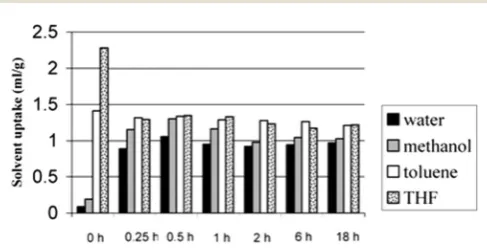
properties, despite the high degree of crosslinking. Moreover, the resins swelled to similar degrees in both good and bad sol-vents for PS, in keeping with the argument that all solsol-vents should return each dried network to its lowest energy state formed under the conditions of hypercrosslinking.4 A good example of the solvent uptake behaviour of HXL materials is depicted in Fig. 4, where the solvent uptake of different sol-vents (including water, methanol, toluene and THF) was moni-tored for polymers produced during the time course of hypercrosslinking of a VBC-2%DVB gel-type resin. At time zero (no hypercrosslinks present) the solvent uptake for THF was high (THF is a good solvent for PS-based polymers) and extre-mely low for water (a bad solvent for PS). Nevertheless, as the reaction proceeded from 0.25 h to 18 h all solvents were sorbed at the same level. Different swelling studies4,10,15have been carried out to test the swelling properties of HXL resins, and the findings from these studies draw similar conclusions: all solvents, including polar protic species such as water and methanol, despite being incompatible with PS-based polymers, are sorbed at almost the same level as toluene and THF (the latter are thermodynamically good solvents for PS).
Another interesting example was reported by Urbanet al.14 wherein different dichloro-based solvents with increasing alkyl chain lengths (which included DCE, 1,4-dichlorobutane (DCB) and 1,6-dichlorohexane (DCH)) were evaluated for the prepa-ration of HXL monoliths in columns. They found that the column permeability decreased when increasing the length of the alkyl chain of the swelling solvent. Therefore, a conclusion which could be drawn is that the solvent may also lead to slightly different properties in the final material.
2.5 Catalysts
The Friedel-Crafts catalyst used in a typical HXL reaction can be either a Lewis acid or a protonic acid such as hydrofluoric acid. In principle, all Lewis acids can potentially catalyse such reactions. Different studies have reported the use of catalysts such as FeCl3,11,13,15,43aluminium chloride (AlCl3),2,4,12,14tin
chloride (SnCl4),2,3,33,40 zinc chloride (ZnCl2)42 and boron
halides (BCl3or BBr3).23Nevertheless, FeCl3is still one of the
Fig. 4 Solvent uptake data of resins isolated at various times during the
hypercrosslinking of gel-type VBC-DVB (98 : 2) precursor resin. Re-printed from Macromolecules, 2006, 39, 627–632. Copyright (2006) American Chemical Society.
Open Access Article. Published on 23 July 2015. Downloaded on 27/10/2015 10:59:13.
This article is licensed under a
[image:8.595.307.551.549.673.2]most widely used. Its use is supported in a study4 where VBC-DVB precursors were hypercrosslinked using a range of catalysts and it was found that FeCl3 was consistently more
active than both AlCl3and SnCl4, giving products with higher
SSAs in all cases. The reason for the differences between cata-lysts is not fully understood, but it was proposed that poor solubility (AlCl3) and steric bulk (SnCl4) may limit the HXL
reactions, therefore FeCl3 may offer the best compromise in
terms of solubility and molecular size. In Fig. 1B, it can be appreciated how steric bulk may affect the reactions as the first crosslink formed can potentially prevent larger Lewis acids from accessing the second chloromethyl moiety to form the second crosslink. Since the crosslinking process used is intra-molecular in nature, the reaction has been shown to be very efficient. It is possible that this step was the limiting step when the relatively large SnCl4 was used as catalyst. FeCl3 is
smaller and seemingly not limited in terms of this reaction; this observation, coupled with the enhanced reactivity towards second bridge formation, could well be the cause of the remarkably short reaction times required for HXL reactions involving FeCl3.
The optimum amount of Lewis acid required to afford high SSA materials was addressed in a study17 where gel-type VBC-DVB copolymers were hypercrosslinked in the presence of DCX. It was shown that when the ratio of monomers related to the reaction feed was 3.75% (w/v), the optimum FeCl3 ratio
was in the range of 0.5–2 mol/mol of monomers. Catalyst ratios below this range led to decreased yields and lower SSAs, whereas much higher catalyst concentrations were detrimental to the SSA of the resulting polymers. If this reaction is catalytic then the FeCl3 concentration should be irrelevant and all
chlorine will be lost. However, this observation (which agrees with the earlier report by Sherrington4) would suggest that the action of the Lewis acid within the reaction is at least partially catalytic.
Urban et al.14studied the effect of the type of catalyst in relation to the final properties of HXL monolithic polymers. In outline, they prepared a series of HXL monoliths based on PS-VBC-DVB using a range of different catalysts (i.e., AlCl3,
FeCl3and SnCl4), and concluded that the column permeability
was similar when FeCl3and SnCl4were used as catalysts, but
decreased significantly when AlCl3(the most reactive F–C
cata-lyst) was used.
3.
Chemical modi
fi
cations of HXL
materials
The HXL materials developed originally were PS-based thus they did not possess any special functional groups besides aro-matic residues, and their applications as sorbents rely on simple adsorption via hydrophobic and π–π interactions. Nevertheless, HXL materials bearing special functional groups can be prepared, and this can lead to wider applications for these materials. Functionalised HXL materials can be pro-duced by using post-polymerisation chemical modification
reactions, either before or after the hypercrosslinking process, else by direct copolymerisation of functional monomers to produce functionalised polymer precursors. Table 2 lists examples of HXL materials bearing a range of distinct chemi-cal moieties, together with the applications explored for each type material.
VBC-derived HXL materials were reported to contain some oxygen due to the partial hydrolysis of chloromethyl groups during the polymer synthesis and/or hypercrosslinking con-ditions. Sherrington16 reported that the hydrolysis of benzyl
chloride moieties would be expected to proceed via an
SN1 mechanism, and thus involve the generation of stabilised
carbocation intermediates followed by nucleophilic attack of water under the typical conditions of the suspension poly-merisation used to prepare VBC-DVB precursors. The degree of hydrolysis of VBC-residues in these HXL materials depended upon the VBC isomer which was employed in the precursor
polymer synthesis. Thus, when pVBC was used as monomer
the HXL resin contained 4.0% oxygen and had an SSA of
∼900 m2 g−1, whereas when a mixture of VBC isomers (30%
pVBC and 70% mVBC) was used as monomer the
corres-ponding HXL resin contained 1.5% oxygen and had a SSA of 1889 m2 g−1. These differences were explained on the basis that the carbocation derived frompVBC would be expected to be more stabilised than that derived from mVBC; the
carbo-cation from pVBC would therefore form more readily and
hence the hydrolysis of pVBC would be expected to proceed more rapidly than that ofmVBC.
The hydrolysis of VBC residues in VBC-DVB was exploited on purpose to promote the polar properties of the hypercross-linked products, to deliver HXL materials with higher affinity towards polar compounds.42,50,51Our research group took full advantage of this phenomenon; HXLGp (derived from pVBC precursor, 4.0 wt% O and 900 m2g−1) and HXLGmix (derived from a mixture of VBC isomers, 1.5 wt% O and 1900 m2g−1) were compared to commercial HXL hydrophobic materials, namely: Amberchrom (900 m2g−1) and Lichrolut EN (1200 m2 g−1) in on-line SPE for a group of polar compounds. In this study, a pre-column was packed with the synthesised HXL resin (40 mg), and 100 mL of sample (spiked at 2 µg L−1with a mixture of polar compounds) passed through the precolumn in on-line mode. Fig. 5 shows the recoveries from different volumes of sample spiked with phenol. The higher the SSA, the higher was the recovery. However, it was clear that the optimal resin for phenol recovery was the hydrophilic hyper-crosslinked resin HXLGp; this resin had an SSA of 900 m2g−1 and hydrophilic character.
Liet al.42reported similar oxygen level contents (6.0 wt%) and SSA (900 m2 g−1) when their precursor polymers were based on chloromethylated PS-DVB. They suggested that the oxygen content could be ascribed to the formation of ethers and ketones; however this suggestion still remains to be veri-fied experimentally.
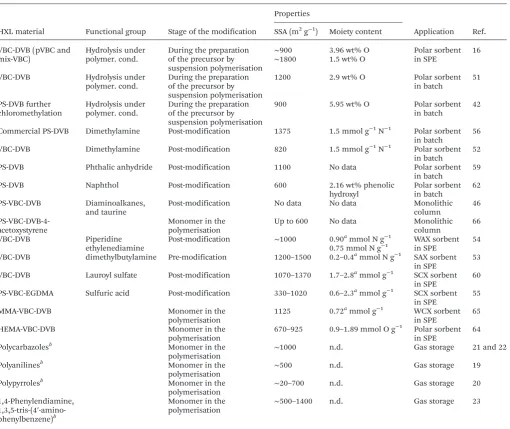
Regarding post-hypercrosslinking chemical modification reactions, when the HXL precursor is based on VBC-DVB several authors have taken advantage of the incomplete
Open Access Article. Published on 23 July 2015. Downloaded on 27/10/2015 10:59:13.
This article is licensed under a
consumption of VBC residues in the hypercrosslinking reac-tion. A portion of pendent chloromethyl groups survive the hypercrosslinking processes and are thus available for chemi-cal modification.52–55 In this way, Li et al.52,56–58 prepared different HXL materials, either by synthesising the VBC-DVB precursors from first principles, i.e., viacopolymerisation of VBC with DVB, or starting from commercially available macro-porous resins; these precursors were hypercrosslinked and modified further with dimethylamine to yield HXL materials with amine functionalities which enhanced the sorption pro-perties of the resins toward polar compounds. In a parallel example, the same research group prepared HXL resins bearing carbonyl moieties which displayed enhanced sorption behaviour similar to the amine functional resins.59
Table 2 Information related to the chemical modifications of HXL materials, their properties (SSA and moiety content) and their principalfield of
application
HXL material Functional group Stage of the modification
Properties
Application Ref. SSA (m2g−1) Moiety content
VBC-DVB (pVBC and mix-VBC)
Hydrolysis under polymer. cond.
During the preparation of the precursor by suspension polymerisation
∼900 3.96 wt% O Polar sorbent
in SPE
16
∼1800 1.5 wt% O
VBC-DVB Hydrolysis under
polymer. cond.
During the preparation of the precursor by suspension polymerisation
1200 2.9 wt% O Polar sorbent
in batch
51
PS-DVB further chloromethylation
Hydrolysis under polymer. cond.
During the preparation of the precursor by suspension polymerisation
900 5.95 wt% O Polar sorbent
in batch
42
Commercial PS-DVB Dimethylamine Post-modification 1375 1.5 mmol g−1N−1 Polar sorbent
in batch
56
VBC-DVB Dimethylamine Post-modification 820 1.5 mmol g−1N−1 Polar sorbent
in batch
52
PS-DVB Phthalic anhydride Post-modification 1100 No data Polar sorbent
in batch
59
PS-DVB Naphthol Post-modification 600 2.16 wt% phenolic
hydroxyl
Polar sorbent in batch
62
PS-VBC-DVB Diaminoalkanes,
and taurine
Post-modification No data No data Monolithic
column
46
PS-VBC-DVB-4-acetoxystyrene
Monomer in the polymerisation
Up to 600 No data Monolithic
column
66
VBC-DVB Piperidine
ethylenediamine
Post-modification ∼1000 0.90ammol N g−1 WAX sorbent
in SPE
54 0.75 mmol N g−1
VBC-DVB dimethylbutylamine Pre-modification 1200–1500 0.2–0.4ammol N g−1 SAX sorbent
in SPE
53
VBC-DVB Lauroyl sulfate Post-modification 1070–1370 1.7–2.8ammol g−1 SCX sorbent
in SPE
60
PS-VBC-EGDMA Sulfuric acid Post-modification 330–1020 0.6–2.3ammol g−1 SCX sorbent
in SPE
55
MMA-VBC-DVB Monomer in the
polymerisation
1125 0.72ammol g−1 WCX sorbent
in SPE
65
HEMA-VBC-DVB Monomer in the
polymerisation
670–925 0.9–1.89 mmol O g−1 Polar sorbent in SPE
64
Polycarbazolesb Monomer in the
polymerisation ∼
1000 n.d. Gas storage 21 and 22
Polyanilinesb Monomer in the
polymerisation ∼
500 n.d. Gas storage 19
Polypyrrolesb Monomer in the
polymerisation ∼
20–700 n.d. Gas storage 20
1,4-Phenylendiamine, 1,3,5-tris-(4′ -amino-phenylbenzene)b
Monomer in the
polymerisation ∼
500–1400 n.d. Gas storage 23
PS: polystyrene; PS-DVB: polystyrene-divinylbenzene; VBC-DVB: vinylbenzyl chloride-divinylbenzene; EGDMA: ethylene glycol dimethacrylate; MMA: methyl methacrylic acid; HEMA: hydroxyethyl methacrylateaIon-exchange capacity.bAlready in Table 1.
Fig. 5 Recovery values when 100 mL of a standard solution spiked with
phenol, at a constant amount injected of 0.2 µg, was percolated through a precolumn packed with HXL materials in SPE-LC-UV-Vis.
Open Access Article. Published on 23 July 2015. Downloaded on 27/10/2015 10:59:13.
This article is licensed under a
[image:10.595.47.290.538.682.2]We adopted this strategy for the preparation of a family of ion-exchange HXL materials.53–55 Materials were synthesised via post-hypercrosslinking chemical modifications for strong cation exchange (SCX), strong-anion exchange (SAX), and
weak-anion exchange (WAX) resins. The ion-exchange
materials were prepared from HXL structures, which enhance RP interactions through their high SSA (1000–1500 m2 g−1). Specifically, the HXL materials were prepared from VBC-DVB precursors obtained by PP, which produced low micron size particles that were eminently well-suited for SPE applications. The precursor particles prepared by PP, named as PP, were hypercrosslinked (to give products named HXLPP) by means of F–C reactions which exploited the chemistry of the VBC residues.
With particular regards to the synthesis of the SCX material, the HXLPP resins were post-functionalised with either acetyl sulfate or lauroyl sulfate, with the latter proving to be the most effective reagent for the sulfonation. After optimising different synthetic variables, three HXLPP-SCX resins were prepared with different sulfur contents as governed by the percentage of the sulfonation reagent used in the chemical modification (15%, 20% and 50%). It was found that the HXLPP-SCX sorbent modified with 50% of the sulfonation reagent dis-played the highest ion-exchange capacity (IEC) (2.5 meq g−1) and the highest SSA (1370 m2 g−1) even although the possi-bility of sulfone bridge formation could not be excluded.60
Similar HXL SCX particles were reported by the same authors. In this case, the swellable precursors used were based on
poly-mers with different VBC-ethylene glycol dimethacrylate
(EGDMA) ratios, and were synthesisedviaNAD polymerisation rather than by PP. Later, the HXLNAD particles were sulfo-nated using sulfuric acid. The resulting HXLNAD materials displayed SSAs from 330 up to 1000 m2g−1and IECs from 0.6
to 2.1 mmol g−1. Comparing both types of material
(HXLPP-SCX versus HXLNAD-SCX) in terms of retention pro-perties towards ion-exchangeable compounds, both materials provided similar retention behaviour.55
The synthetic procedures used to obtain the HXLPP-SAX
resins (modified with 5% and 10% dimethylbutylamine –
DMBA) were somewhat different. In this case, DMBA, in an appropriate ratio, was first reacted with the VBC-DVB precursor (obtainedviaPP) to install the SAX character. The quaternised precursors (PP-SAX) were then hypercrosslinked following the usual procedures and HXLPP-SAX resins obtained. The authors discovered that amination was less efficient after hypercrosslinking due to the bulky nature of the tertiary amine (DMBA) which restricted the access of amine to free chloro-methyl groups; therefore, amination was conducted prior to hypercrosslinking.53Fig. 6A outlines the synthetic route used for preparing the HXLPP-SAX sorbents; this is an example of
post-polymerisation chemical modification prior to
hypercrosslinking.
Fig. 6 Synthetic approaches to modify different HXL materials with ionic moieties: (A) HXLPP-SAX; (B) EDA and
HXLPP-WAX-piperazine.
Open Access Article. Published on 23 July 2015. Downloaded on 27/10/2015 10:59:13.
This article is licensed under a
[image:11.595.54.541.384.691.2]In contrast, post-hypercrosslinking chemical modification reactions were used in order to prepare HXLPP-WAX (modified with piperazine, HXLPP-WAX-piperazine, and ethylenedi-amine, HXLPP-WAX-EDA) (Fig. 6B). In these cases, the amine moieties were introduced via chemical modification of the residual chloromethyl groups in the HXLPP resins For this, the HXLPP resins were wetted with dried toluene and a 5-fold molar excess of the amine (either EDA or piperazine) relative to the chloromethyl group added and reacted for 18 h at 85 °C.54
Recently, an HXL material (900 m2 g−1), synthesised from an F–C alkylation between carbazole and α,α′ -dibromo-p-xylene, was subjected to a post-hypercrosslinking synthetic modificationvia sulfonation to yield an HXL-SO3H material.
Upon sulfonation, the material was transformed into a very efficient solid acid catalyst for the production of biodiesels.61
Janků et al.46 hypercrosslinked PS-VBC-DVB monolithic stationary phases by a nucleophilic substitution reaction. Four
linear diaminoalkanes (1,2-diaminoethane,
1,4-diamino-butane, 1,6-diaminohexane and 1,8-diaminooctane) were eval-uated, as mentioned previously in section 2.3. Furthermore, they also modified the residual chloromethyl groups with 2-aminoethanesulfonic acid (taurine) in order to prepare stationary phases with dual retention mechanisms (hydro-philic and reversed-phase interactions) which were able to separate highly polar compounds such as thiourea. However, as the columns were prepared in situ, the authors did not provide any characterisation information on the HXL materials in terms of IEC or SSA, presumably because they were inter-ested primarily in the properties related to column efficiency. Yuanet al.62prepared an HXL material from a PS-DVB precur-sor and used bromoethane as external crosslinker since it is a less toxic reagent than MCDE. Thereafter, they modified the HXL material with 2-naphthol; this installed phenolic moi-eties, which provided better sorption when contacting to polar compounds.
Other approaches involve the selection of precursor mono-mers that already contain the polar moiety to enhance the expected properties of the HXL material. As listed in section 2.1, different reagents (aniline,19 pyrrole,20 aminobenzene,63 carbazole22) containing a heteroatom were used successfully to prepare different HXL materials which were then applied pri-marily as gas storage materials. In these cases, the presence of nitrogen moieties in the network favours the formation of a narrow pore system and a heteroatom-rich pore surface, which leads to high gas adsorption capacity and high selectivity.27
A set of hydrophilic HXL materials were generated from the hypercrosslinking,viaF–C alkylation, of a hydrophilic precur-sor resin based on 2-hydroxyethyl methacrylate (HEMA)-VBC-DVB prepared by PP. The HXL materials had a SSA of
∼900 m2 g−1 and ∼1.5 mmol g−1 O content derived from hydrophilic HEMA residues. This blend of properties meant that they were well-suited for the sorption of polar compounds from aqueous samples, since they provided better recovery values than the commercial materials when used for similar purposes.64
Continuing with the family of ion-exchange HXL materials prepared through PP, for the synthesis of an ion-exchange WCX (HXLPP-WCX) material the carboxylic acid moieties which give rise to WCX character were introduced by copoly-merisation of a functional monomer (methacrylic acid–MAA). In this work, the terpolymer MAA-VBC-DVB (10/50/40 w/w% ratio of monomers in the feed) was the precursor polymer in this hypercrosslinking reaction.65 In this way, the carboxylic acid moieties were present from the beginning of the synthetic process and, as their incorporation into the HXLPP-WCX was satisfactory (equivalent to an IEC of 0.72 meq g−1), the authors did not require to evaluate the possibility of introducing the carboxylic group in a post-hypercrosslinking modification step. Moreover, it should be mentioned that the IEC obtained
for the HXLPP-WCX (0.72 meq g−1) was similar to that
reported for commercially available sorbents such as Oasis WCX (0.75 meq g−1) and Strata-X-CW (0.74 meq g−1). However, the SSA was higher (1125 m2g−1for HXLPP-WCX compared to
∼800 m2g−1for both Oasis WCX and Strat-X-CW).
Porous polymer monoliths derived from four monomers (PS-VBC-DVB-4-acetoxystyrene) were also hypercrosslinked, which delivered materials containing both chloromethyl and acetoxy groups. The acetoxy groups were then deprotected to convert them into phenolic groups, without affecting the mor-phology of the material. The ratio of each monomer could be varied to balance the SSA properties with the presence of hydroxyl moieties in the final material. This monolithic column with balanced SSA and hydroxyl moieties delivered useful chromatographic properties since it could establish both reversed-phase and normal phase interactions.66
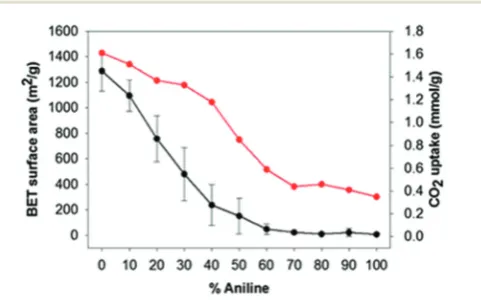
A series of networks, using benzene and aniline as precur-sors in the presence of FDA using F–C alkylation, were pre-pared. Aniline was added to the material since it was reported already that aniline may improve the selectivity for CO2. The
SSAs of the materials were measured (Fig. 7). As expected, the SSA decreased with increasing aniline content (the 100% aniline material was essentially non-porous), and the highest
Fig. 7 Surface area (black) and CO2 uptakes (red) of the
aniline-benzene HXL materials depending on the feed ratio. Error bars calcu-lated from measurements of three nominally identical networks at each % aniline. Reprinted fromPolym. Chem., 2012,3, 2034–2038. Copyright (2012) Royal Society of Chemistry.
Open Access Article. Published on 23 July 2015. Downloaded on 27/10/2015 10:59:13.
This article is licensed under a
[image:12.595.310.551.513.663.2]SSA (∼1300 m2 g−1) was achieved when 100% benzene was used. However, a significant amount of aniline (up to 40%) could still be incorporated into the polymer without decreas-ing so markedly the CO2uptake (Fig. 7). In addition, the diff
er-ence in the rate at which the SSA decreased and the rate at which the CO2uptake decreased suggested that these
benzene-aniline copolymers had good selectivity for CO2/N2.26 Thus,
the modification of the original HXL materials with functional groups may provide different type of final properties, which can be potentially be tuned.
4.
Conclusions and future
perspectives
The HXL material field has experienced a great expansion since the first reports by Davankov. As a proof of this, a number of research groups, including the one led by David Sherrington, have been working in the area with very interesting findings. It is very clear to see that the hypercrosslinking methodology seems to be a generic one, and there is no doubt at all that HXL materials are very useful in terms of applications.
Several applications have exploited the high retention pro-perties offered by HXL materials. When functional groups are installed into HXL materials the range of applications can be expanded. For example, installation of polar groups can enhance the hydrophilicity of the materials, a chemical modifi-cation which tunes the selectivity of the HXL materials towards the capture of polar compounds.
Further approaches and applications are expected in the coming years, involving a broader range of HXL materials pre-pared in a range of physical formats with yet more
sophisti-cated properties. One interesting direction for future
development will be to enhance the capture selectivity of HXL materials for pollutants/gases. In respect of the selective reten-tion of pollutants, this characteristic will facilitate their use as sorbents in environmental analysis work, however applications in larger-scale purification operations, for example in water treatment works, are an attractive prospect too. In the gas storage field, the capture mechanisms should be addressed in more detail so that the HXL materials are able to work reversi-bly at practically useful temperatures and not only under cryo-genic conditions. We also anticipate that the achievements reported in the capillary monolith field will be expanded to other simple formats, such as thin layers, as suggested by Svec and co-workers.48Another evolving field of application is the implementation of HXL materials as electrode materials in sensing devices, which is a relatively unexplored field with huge potential. More generally speaking, however, exerting tighter synthetic control over the porous character of the HXL materials (e.g., pore size), expanding the range of chemical functional groups which can be supported, and exploring the potential for the production of HXL materials on a larger scale, are all interesting research challenges just waiting to be tackled in the future.
Acknowledgements
The authors would like to thank the Ministry of Economy and Competitiveness, Spain (Project CTQ2014-52617-P) for the financial support given. We are very proud to be part of this Special Issue dedicated to David Sherrington. More than 15 years ago, Dave brought us the opportunity to collaborate. Since then, we have shared enthusiastically in the field of polymers for analytical applications, and we have enjoyed a scientific trip together which was full of very interesting achievements.
References
1 D. C. Sherrington,Chem. Commun., 1998, 2275–2286. 2 V. A. Davankov, V. Rogozhin and M. P. Tsyurupa, US Pat,
3729457, 1969.
3 P. Veverka and K. Jerábek,React. Funct. Polym., 1999, 41, 21–25.
4 J.-H. Ahn, J.-E. Jang, C.-G. Oh, S.-K. Ihm, J. Cortés and D. C. Sherrington,Macromolecules, 2006,39, 627–632. 5 R. Dawson, A. I. Cooper and D. J. Adams,Prog. Polym. Sci.,
2012,37, 530–563.
6 N. Fontanals, R. M. Marcé and F. Borrull,J. Chromatogr. A, 2007,1152, 14–31.
7 V. A. Davankov and M. P. Tsyurupa, in Comprehensive
Analytical Chemistry, 2011, vol. 56, pp. 1–648.
8 J. Urban, F. Svec and J. M. J. Fréchet,J. Chromatogr. A, 2010, 1217, 8212–8221.
9 S. Xu, Y. Luo and B. Tan,Macromol. Rapid Commun., 2013, 34, 471–484.
10 V. A. Davankov and M. P. Tsyurupa,React. Polym., 1990,13, 27–42.
11 F. S. Macintyre, D. C. Sherrington and L. Tetley, Macro-molecules, 2006,39, 5381–5384.
12 J. Hradil and E. Kralova,Polymer, 1998,39, 6041–6048. 13 J. Y. Lee, C. D. Wood, D. Bradshaw, M. J. Rosseinsky and
A. I. Cooper,Chem. Commun., 2006, 2670–2672.
14 J. Urban and V.Škeříková,J. Sep. Sci., 2014,37, 3082–3089. 15 N. Fontanals, P. Manesiotis, D. C. Sherrington and
P. A. G. Cormack,Adv. Mater., 2008,20, 1298–1302.
16 N. Fontanals, J. Cortés, M. Galià, P. A. G. Cormack, R. M. Marcé, F. Borrull and D. C. Sherrington, J. Polym. Sci., Part A: Polym. Chem., 2005,43, 1718–1728.
17 C. D. Wood, B. Tan, A. Trewin, H. Niu, D. Bradshaw, M. J. Rosseinsky, Y. Z. Khimyak, N. L. Campbell, R. Kirk, E. Stockel and A. I. Cooper,Chem. Mater., 2007,19, 2034– 2048.
18 H.-L. Wang, J.-L. Chen and Q.-X. Zhang, Adsorpt. Sci. Technol., 2006,24, 17–28.
19 J. Germain, J. M. J. Fréchet and F. Svec, J. Mater. Chem., 2007,17, 4989–4997.
20 J. Germain, J. M. J. Fréchet and F. Svec, Chem. Commun., 2009, 1526–1528.
Open Access Article. Published on 23 July 2015. Downloaded on 27/10/2015 10:59:13.
This article is licensed under a
21 X. Yang, M. Yu, Y. Zhao, C. Zhang, X. Wang and J.-X. Jiang, RSC Adv., 2014,4, 61051–61055.
22 L. Pan, Q. Chen, J.-H. Zhu, J.-G. Yu, Y.-J. He and B.-H. Han, Polym. Chem., 2015,6, 2478–2487.
23 T. E. Reich, K. T. Jackson, S. Li, P. Jena and H. M. El-Kaderi,J. Mater. Chem., 2011,21, 10629–10632.
24 M. G. Schwab, A. Lennert, J. Pahnke, G. Jonschker, M. Koch, I. Senkovska, M. Rehahn and S. Kaskel,J. Mater. Chem., 2011,21, 2131–2135.
25 B. Li, R. Gong, W. Wang, X. Huang, W. Zhang, H. Li, C. Hu and B. Tan,Macromolecules, 2011,44, 2410–2414.
26 R. Dawson, T. Ratvijitvech, M. Corker, A. Laybourn, Y. Z. Khimyak, A. I. Cooper and D. J. Adams,Polym. Chem., 2012,3, 2034–2038.
27 Y. Luo, B. Li, W. Wang, K. Wu and B. Tan, Adv. Mater., 2012,24, 5703–5707.
28 Y. Luo, S. Zhang, Y. Ma, W. Wang and B. Tan, Polym.
Chem., 2013,4, 1126–1131.
29 S. Yao, X. Yang, M. Yu, Y. Zhang and J.-X. Jiang,J. Mater. Chem. A, 2014,2, 8054–8059.
30 S. Yuan, D. White, A. Mason and D.-J. Liu, Int. J. Energy Res., 2013,37, 732–740.
31 W. Chaikittisilp, M. Kubo, T. Moteki, A. Sugawara-Narutaki, A. Shimojima and T. Okubo,J. Am. Chem. Soc., 2011,133, 13832–13835.
32 D. Wu, C. M. Hui, H. Dong, J. Pietrasik, H. J. Ryu, Z. Li, M. Zhong, H. He, E. K. Kim, M. Jaroniec, T. Kowalewski and K. Matyjaszewski,Macromolecules, 2011,44, 5846–5849. 33 V. A. Davankov, S. V. Rogoshin and M. P. Tsyurupa,
J. Polym. Sci., 1974,47, 95–101.
34 N. Fontanals, R. M. Marcé, P. A. G. Cormack,
D. C. Sherrington and F. Borrull,J. Chromatogr. A, 2008, 1191, 118–124.
35 G. Guiochon and F. Gritti, J. Chromatogr. A, 2011, 1218, 1915–1938.
36 Q. Gao, C.-Y. Lin, D. Luo, L.-L. Suo, J.-L. Chen and Y.-Q. Feng,J. Sep. Sci., 2011,34, 3083–3091.
37 M. Zhang, Q. Zhou, A. Li, C. Shuang, W. Wang and M. Wang,J. Chromatogr. A, 2013,1316, 44–52.
38 J. Urban, F. Svec and J. M. J. Fréchet,Anal. Chem., 2010,82, 1621–1623.
39 R. Law, D. C. Sherrington, C. Snape, I. Ando and H. Kurosu,Macromolecules, 1996,29, 6284–6293.
40 R. Joseph, W. T. Ford, S. Zhang, M. P. Tsyurupa, A. V. Pastukhov and V. A. Davankov,J. Polym. Sci., Part A: Polym. Chem., 1997,35, 695–701.
41 M. P. Tsyurupa, M. M. Ilyin, A. I. Andreeva and V. A. Davankov,Fresenius’J. Anal. Chem., 1995,352, 672–675. 42 A. Li, Q. Zhang, G. Zhang, J. Chen, Z. Fei and F. Liu,
Chemo-sphere, 2002,47, 981–989.
43 B. Gawdzik and J. Osypiuk, Chromatographia, 2001, 54, 323–328.
44 V. V. Azanova and J. Hradil,React. Funct. Polym., 1999,41, 163–175.
45 A. V. Pastukhov, M. P. Tsyurupa and V. A. Davankov, J. Polym. Sci., Part B: Polym. Phys., 1999, 37, 2324– 2333.
46 S. Janků, V.Škeříková and J. Urban,J. Chromatogr. A, 2015, 1388, 151–157.
47 R. Dawson, E. Stockel, J. R. Holst, D. J. Adams and A. I. Cooper,Energy Environ. Sci., 2011,4, 4239–4245. 48 F. Maya and F. Svec,Polymer, 2014,55, 340–346.
49 J. Germain, J. M. J. Fréchet and F. Svec, Small, 2009, 5, 1098–1111.
50 N. Fontanals, M. Galià, P. A. G. Cormack, R. M. Marcé, D. C. Sherrington and F. Borrull, J. Chromatogr. A, 2005, 1075, 51–56.
51 W. Zhang, C. Hong, B. Pan, Q. Zhang, P. Jiang and K. Jia, J. Hazard. Mater., 2009,163, 53–57.
52 F. Liu, J. Chen, A. Li, Z. Fei, J. Ge and Q. Zhang,Adsorpt. Sci. Technol., 2004,22, 13–24.
53 D. Bratkowska, A. Davies, N. Fontanals, P. A. G. Cormack, F. Borrull, D. C. Sherrington and R. M. Marcé,J. Sep. Sci., 2012,35, 2621–2628.
54 N. Fontanals, P. A. G. Cormack and D. C. Sherrington, J. Chromatogr. A, 2008,1215, 21–29.
55 N. Fontanals, N. Miralles, N. Abdullah, A. Davies, N. Gilart and P. A. G. Cormack, J. Chromatogr. A, 2014, 1343, 55–62.
56 B. C. Pan, Y. Xiong, A. M. Li, J. L. Chen, Q. X. Zhang and X. Y. Jin,React. Funct. Polym., 2002,53, 63–72.
57 A. Li, Q. Zhang, H. Wu, Z. Zhai, F. Liu, Z. Fei, C. Long, Z. Zhu and J. Chen,Adsorpt. Sci. Technol., 2004, 22, 807– 820.
58 C. Xu, C. Long, A. Li, F. Liu, W. Yang and Q. Zhang, Adsorpt. Sci. Technol., 2006,24, 65–77.
59 F. Zhenghao, C. Jinlong, C. Jianguo, G. Guandao, L. Aimin and Z. Quanxing,Adsorpt. Sci. Technol., 2004,22, 439–449. 60 P. A. G. Cormack, A. Davies and N. Fontanals,React. Funct.
Polym., 2012,72, 939–946.
61 S. Bhunia, B. Banerjee and A. Bhaumik, Chem. Commun., 2015,51, 5020–5023.
62 X. Yuan, X. Li, E. Zhu, J. Hu, W. Sheng and S. Cao, Carbo-hydr. Polym., 2008,74, 468–473.
63 J. Germain, F. Svec and J. M. J. Fréchet,Chem. Mater., 2008, 20, 7069–7076.
64 D. Bratkowska, N. Fontanals, P. A. G. Cormack,
D. C. Sherrington, F. Borrull and R. M. Marcé,J. Chroma-togr. A, 2010,1217, 3238–3243.
65 D. Bratkowska, R. M. Marcé, P. A. G. Cormack,
D. C. Sherrington, F. Borrull and N. Fontanals,J. Chroma-togr. A, 2010,1217, 1575–1582.
66 F. Maya and F. Svec,J. Chromatogr. A, 2013,1317, 32–38. 67 J. Germain, J. Hradil, J. M. J. Fréchet and F. Svec, Chem.
Mater., 2006,18, 4430–4435.
68 R. Vinodh, E. M. Jung, M. Ganesh, M. M. Peng, A. Abidov, M. Palanichamy, W. S. Cha and H. T. Jang, J. Ind. Eng. Chem., 2015,21, 1231–1238.
Open Access Article. Published on 23 July 2015. Downloaded on 27/10/2015 10:59:13.
This article is licensed under a