City, University of London Institutional Repository
Citation
:
Boon, A., Karuk, V. & Urwin, P. (2011). What Difference Does it Make?:Facilitative Judicial Mediation of Discrimination Cases. Employment Tribunals' Industrial Law Journal, 40(1), pp. 45-81. doi: 10.1093/indlaw/dwq030
This is the accepted version of the paper.
This version of the publication may differ from the final published
version.
Permanent repository link:
http://openaccess.city.ac.uk/6665/Link to published version
:
http://dx.doi.org/10.1093/indlaw/dwq030Copyright and reuse:
City Research Online aims to make research
outputs of City, University of London available to a wider audience.
Copyright and Moral Rights remain with the author(s) and/or copyright
holders. URLs from City Research Online may be freely distributed and
linked to.
City Research Online: http://openaccess.city.ac.uk/ [email protected]
What Difference Does it Make?:
Facilitative Judicial Mediation of Discrimination Cases in Employment Tribunals
Andrew Boon*, Peter Urwin** and Valeriya Karuk***
„… the major thing is the impartial ear, you know what I mean, somebody that has nothing to do with the case, hasn‟t been involved, fresh eyes looking on the case, as it were, because the people that I worked for were so adamant that what I was saying was lies.‟ (Participant 4)
Abstract: Mediation is promoted by government to reduce the volume, cost and formality of dispute resolution, but evidence of these benefits is inconclusive. A number of reports have analysed mediation of contract and similar cases in the County Courts but there has been little empirical work in the employment field. This article considers the findings of an evaluation of (facilitative) judicial mediation, piloted by the Employment Tribunal Service, for discrimination cases starting between June 2006 and March 2007. A matched analysis of the outcomes from one hundred and sixteen mediated cases, relative to an unmediated control group, found no significant impact of early resolution attributable to judicial mediation. This article digs deeper into the additional qualitative and quantitative evidence generated by the study to shed light on the process and outcomes. Detailed mediation reports completed by the judicial mediators and „in-depth‟ interviews are reviewed to describe the outcomes of mediation employment cases against the outcomes offered in law, the views and levels of satisfaction of claimants, respondents and representative are considered. Suggestions are made for either adjusting the facilitative mediation model or seeking an alternative that complements existing dispute resolution services, particularly those provided by ACAS.
Introduction
The steady escalation of the work of employment tribunals1 has stimulated efforts to discourage weak claims, promote settlement and accelerate the flow of cases. Various reports advocate Alternative Dispute Resolution (ADR), and particularly mediation,2 but, despite being widely available in the UK for at least a decade, it has not achieved the presence envisaged by Lord Woolf's review of civil procedure in 1996.3 Nevertheless, in government policy, mediation remains a key strategy for ensuring „… that different types of dispute can be resolved fairly, quickly, efficiently and effectively, without recourse to the expense and
* Professor of Law, Centre for Legal Profession and Legal Services Studies, School of Law, University of Westminster
** Professor of Applied Economics and Director, Centre for Employment Research, Westminster Business School, University of Westminster
*** Research Fellow, Centre for Employment Research, Westminster Business School, University of Westminster
We thank the Ministry of Justice for funding the research. Opinions expressed are those of the authors and not necessarily those of anyone at the Ministry. We thank Elisabeth Michielsens, Avis Whyte, Bernadetta Siara and Seema Kandelia for research assistance and Dora Christodolou and Jochim Dymott for comments on the draft paper.
1
Created by the Industrial Training Act 1964 as „Industrial Tribunals‟ the name was changed from 1 August 1998 by the Employment Rights (Dispute Resolution) Act 1998.
2
See e.g. Michael Gibbons, Better Dispute Resolution: A Review of Employment Dispute Resolution in Great Britain (London: Department of Trade and Industry 2007) 9, the White Paper Transforming Public Services: Complaints, Redress and Tribunals (Cm 6243, 2004) and Delivering justice, rights and democracy. DCA Strategy 2004 – 2009, Brendan Malkin, „LCD Pledges to Cut Costs as Govt. Pushes Mediation Plan‟ (2004) The Lawyer
(15 March) 4. 3
formality of courts and tribunals where this is not necessary‟.4
The literature highlights a range of practical and policy issues, including the effectiveness of mediation,5 the appeal to litigants,6 the denial of formal justice to powerless groups7 the risk of annexation to court processes and the ethics of mandatory participation8 and regulation of the field.9 Mediation is no panacea for the ills of dispute resolution. There are a wide range of approaches available and what works well in one situation may work less well in another.10 Each context presents new challenges.
The research reported here, to evaluate a judicial mediation service piloted by the Employment Tribunal Service (ETS), 11 was commissioned by the Department for Constitutional Affairs (now Ministry of Justice) in 2006. Policy aims of the pilot included reducing the volume of cases for hearing and promoting better industrial relations. It was hoped that litigants would achieve cost-effective and beneficial outcomes, more quickly, with less need for advice, assistance and representation. The quantitative analysis of the pilot data did not establish the effectiveness or efficiency of mediation but, despite the scepticism of interest groups,12 the pilot was regarded as successful.13 Judicial mediation was made available for discrimination cases at Employment Tribunal regional offices in England and Wales from January 2009.14 This article examines qualitative data generated by the fieldwork for the less tangible benefits often claimed for mediation15 and suggests how judicial mediation in discrimination cases might be more effective.
As Table 1 shows, discrimination, and connected jurisdictions like equal pay, are increasing more rapidly than conventional areas16 contributing to the volume of cases,17 to
4
Transforming Public Services (n 2) 6, para.2.3. 5
John Peysner and Mary Seneviratne, The Management of Civil Cases: the Courts and the post-Woolf Landscape
(London: DCA 2005), Lisa Webley, Pamela Abrams and Sylvie Bacquet, Evaluation of the Birmingham Court-Based Civil (Non-Family) Mediation Scheme (London: DCA 2006), Sue Prince and Sophie Belcher, An Evaluation of the Effectiveness of Court-based Mediation Processes in Non-Family Civil proceedings at Exeter and Guildford County Courts (London: DCA 2006), Sue Prince and Sophie Belcher, An Evaluation of the Small Claims Dispute Resolution Pilot at Exeter County Court (London: DCA 2006).
6
Hazel Genn, „Solving Civil Justice Problems: What Might be Best?‟ (paper for Scottish Consumer Council on Civil Justice 19 January 2005), Michael Lind, „ADR and Mediation-Boom or Bust‟ (2001) 151 NLJ 1238, 17 August 2001.
7
Richard Abel, „The Contradictions of Informal Justice‟ in Richard Abel (ed.), The Politics of Informal Justice: The American Experience (New York: Academic Press 1982)
8
Deborah Hensler, „What We Know and Don‟t Know About Court Administered Arbitration‟ (1986) 69 Judic. 270, William Edwards, „No Frills Justice: North Carolina Experiments with Court Ordered Arbitration‟ (1988) 66 NCL Rev. 395 and Andrew Pirie, „The Lawyer as a Third Party Neutral: Promise and Problems‟ in D. Paul Edmonds (ed.), Commercial Dispute Resolution: Alternatives to Litigation (Aurora: Canada Law Books Inc 1989) 27 at 35.
9
Andrew Boon, Richard Earle and Avis Whyte, 'Regulating Mediators?' (2007) 10:1 Legal Ethics 26. 10
Cheryl Dolder, „The Contribution of Mediation to Workplace Justice‟ (2004) 33:4 ILJ 320, Robert Emery, David Sbarra and Tara Grover, „Divorce Mediation: Research and Reflections‟ (2005) 43:1 FCR 22. 11
In March 2006 the ETS joined existing tribunals in the Department for Constitutional Affairs (DCA) to form a new Tribunals Service Agency. This unification was proposed initially by Sir Andrew Leggatt in his report
Tribunals for Users-One system, One Service (August 2001) <http://www.tribunals-review.org.uk/> accessed 7 April 2010.
12 <http://www.human-law.co.uk/Blog/2009/07/Why-Judicial-Mediation-is-a-Letdown-in-Employment-Disputes/> accessed 26 April 2010.
13 Tribunals Service, Annual Report and Accounts 2008-9 (London: The Stationery Office 2009). 14 In Scotland, work began to develop a similar scheme.
15
Peter Urwin, Valeriya Karuk, Paul Latreille, Elisabeth Michielsens, Lionel Page, Bernadetta Siara and Stefan Speckesser with Andrew Boon and Paul-Antoine Chevalier, Evaluating the use of judicial mediation in Employment Tribunals (Ministry of Justice Research Series 7/10, March 2010).
<http://www.justice.gov.uk/publications/judicial-mediation-research.htm> accessed 26 April 2010. 16
Thousands of cases are rejected with around half accepted after re-submission. 17
complexity,18 and to increases in average length of hearing. The pilot focused on these issues, so that, amongst the eligible discrimination cases, only those with single claimants and an expected hearing length of three or more days were prioritised for mediation.
Table 1: Claims Accepted by Employment Tribunals and the mix of jurisdictions disclosed in claims
Apr 07 to Mar 08
2005/6 2006/7 2007/8
Total Claims Accepted 115,039 132,577 189,303
Jurisdiction Mix of Claims Accepted
Nature of Claim 2005/6 2006/7 2007/8
Sex Discrimination 14,250 28,153 26,907
Suffer a detriment/unfair dismissal – pregnancy 1,504 1,465 1,646
Disability Discrimination 4,585 5,533 5,833
Equal Pay 17,268 44,013 62,706
Race Discrimination 4,103 3,780 4,130
Discrimination on Grounds of Religion or Belief 486 648 709 Discrimination on grounds of Sexual Orientation 395 470 582
Age Discrimination n/a 972 2,949
Sub-Total 42,591 85,034 105,462
Working Time Directive 35,474 21,127 55,712
Redundancy Pay 7,214 7,692 7,313
Redundancy – failure to inform and consult 4,056 4,802 4,480
Unfair dismissal 41,832 44,491 40,941
Unauthorised deductions (Formerly Wages Act) 32,330 34,857 34,583
Breach of Contract 26,230 27,298 25,054
Written Statement of Terms and Conditions 3,078 3,429 4,955 Written Statement of Reasons for Dismissal 955 1,064 1,098
Written Pay Statement 794 990 1,086
Transfer of an undertaking – failure to inform and consult 899 1,108 1,380
Part Time Workers Regulations 402 776 595
National Minimum Wage 440 806 431
Others 5,219 5,072 13,873
Overall Total 201,514 238,546 296,963
Taken from Employment Tribunal and EAT Statistics (GB) 1 April 2007 to 31 March 2008.19
Methodology
All sex, race, disability, religion and sexual orientation discrimination claimants at tribunals in London, Birmingham and Newcastle presenting between June 2006 and March 2007, were asked if they were interested „in principle‟ in judicial mediation. Of the one hundred and ninety six cases where both parties agreed in principle to the offer of judicial mediation, the pilot sought mediation for at least half; producing treatment and control groups. Over the ten months of the pilot period, one hundred and sixteen of the one hundred and ninety six willing parties entered mediation within seven weeks of the date that the offer was made. Simultaneously, eighty cases in the parallel „control‟ group continued with the usual process of case development, including conciliation. With an estimated eight hundred and sixty eight cases satisfying the eligibility criteria for inclusion the take up rate (196) was just under one quarter (23%) of the available sample.
18
Mainly because of the range of jurisdictions arising in single claims. Claims involved 1.8 jurisdictions per application on average in 2004-5(Paul Latreille, Julie Latreille and Ben Knight, Employment Tribunals and Acas: evidence from a survey of representative Working Paper 2006).
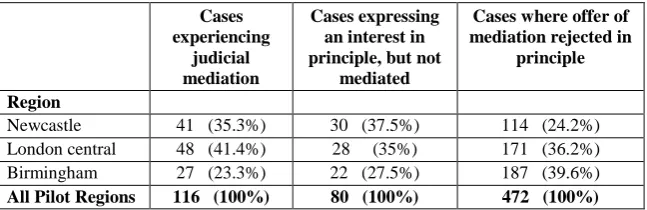
Table 2: Mediated and unmediated cases within the pilot regions
Cases experiencing
judicial mediation
Cases expressing an interest in principle, but not
mediated
Cases where offer of mediation rejected in
principle
Region
Newcastle 41 (35.3%) 30 (37.5%) 114 (24.2%) London central 48 (41.4%) 28 (35%) 171 (36.2%) Birmingham 27 (23.3%) 22 (27.5%) 187 (39.6%) All Pilot Regions 116 (100%) 80 (100%) 472 (100%)
Source: Employment Tribunals Service case management data (ETHOS) & transferred hard copy administrative data.
Analysis of administrative paperwork and ETHOS case management data showed that thirteen of the judicially mediated cases ultimately went to hearing, eleven per cent of all judicially mediated cases, whereas twenty four per cent of the cases expressing an interest, but were not mediated, eventually went to a hearing. Thus, of the one hundred and sixteen cases that experienced judicial mediation, fifty seven per cent arrived at some form of resolution that avoided a hearing, compared to sixty one per cent amongst cases that expressed an interest, but were not mediated and fifty four per cent of cases that rejected the offer in principle. The allocation of one hundred and ninety six „interested in principle‟ cases to the mediated (116) or unmediated (80) group was not random, and therefore Propensity Score Matching (PS Match) was used to tackle the possibility that treatment and control groups exhibit systematic differences in characteristics.20 Taking this into account, however, the analysis found no discernable or statistically significant impact of early resolution attributable to judicial mediation.
This article is not, however, primarily concerned with these data, but with qualitative data generated by the fieldwork. These data include a satisfaction survey of those expressing interest in judicial mediation, which was conducted by telephone during October and November 2007, with thirty five claimants and fifty one employers who had experienced judicial mediation, and forty five claimants and thirty seven employers who had not.21 The most significant qualitative data comprised ninety eight mediation reports completed by judicial mediators. These reports set out common details, such as duration and representation, and an account of the process of mediation by stage, together with the timings of each stage and a brief description of what occurred, for example, what offer or counter offer was made. In most cases this schedule was followed by general comments, usually the mediator's analysis and evaluation of the mediation. There were also eight in-depth interviews with participants selected from the satisfaction survey; four claimants and three respondents with a mixed experience of success in mediation and an „in-house‟ legal representative who had appeared in three employment mediations, one unsuccessful and two successful. The interviews lasted up to an hour and were recorded and transcribed verbatim.
20
It is easiest to envisage the process of matching as attempting to ensure that, for each mediated case, there is an otherwise identical or „matching‟ case in the unmediated group. In practice this involves a „reweighting‟ of the unmediated sample to look like the mediated sample. To achieve this, a range of characteristics are used as explanatory variables in a Probit regression which models whether we observe the case in the mediated or unmediated sample. This allows estimation of a „score‟ reflecting the „propensity‟ for a particular case to be observed in the mediated group – hence „propensity score‟.
Once a propensity score has been estimated for each case in the mediated and unmediated samples, they can be matched accordingly. Thus, we ensure that each mediated case with a propensity of z%, is matched with an unmediated case that has a similar propensity of z% to be observed amongst the mediated group.
The Context
a) Process
Employment Tribunals hear claims made by individual employees [claimants] submitting an „ET1‟ form setting out details of their case. An employer or former employer [the respondent] has twenty eight days to respond by an ET3 form. The case is then reviewed by an employment judge who issues written directions or holds a case management discussion (CMD), to guide the case to hearing. Unsettled cases are heard by a panel, comprising an employer and trade union representative, chaired by a lawyer. Since the mid 1970s the Arbitration and Conciliation Advisory Service (ACAS) has had a statutory duty to provide conciliation in tribunal cases within a timescale that does not apply in discrimination cases.22 In all pilot cases the parties were offered conciliation by ACAS. If the parties expressed interest in judicial mediation, a two week mandatory period was allowed for further ACAS conciliation before the case was formally allocated to judicial mediation. After the point of allocation ACAS conciliation was suspended until judicial mediation had taken place, at which point it could resume. For this pilot, mediation chairs were volunteer tribunal chairs trained by representatives of ACAS in July 2006.
Introducing judicial mediation to the employment tribunals involves choices about timing, referral mode, and process, all key factors in improving mediation outcomes.23 Broad consensus supports early intervention24 and referral was therefore offered at the CMD. The actual mediation followed a four stage format typical in court based processes25; identification of the issues at stake, generating and evaluating options, deciding on one or more alternatives and developing a plan for implementation. At a joint meeting of the parties the mediator explains the process of mediation and either meets each separately or allows each side an opportunity to set out their perspective without interruption. The parties then usually negotiate and meet in turn with the mediator, who seeks common ground between the parties.26
In the context of judicial mediation the most relevant theoretical models are facilitative mediation and evaluative mediation. Facilitative mediation focuses on encouraging the parties' communication and understanding. Like more recent transformative models, it seeks empowerment of individuals through the mediation process and therefore does not impose, or even suggest, solutions. In evaluative mediation, an expert more actively assists the parties anticipate the outcome of their dispute through litigation as part of the mediation process. Issues of control and participation in mediation models and practice are often contested, even controversial.27 Judges in court-annexed mediation may be criticised for bullying parties towards settlement and for intervening in the style of an arbitrator, thus robbing mediation of its vital, consensual ambience. In the pilot, participating judges were trained in facilitative mediation. Parties were told that a trained Tribunal Chairman would „(...)
22
This was during the period of the ACAS statutory duty to conciliate established by the Employment Tribunals Act 1996 (under regulations in force at the time, a fixed period of seven or thirteen weeks). The Gibbons review having concluded that fixed conciliation periods had not promoted more or earlier resolution of disputes, the duty to conciliate was abolished by the Employment Act 2009 and is now discretionary.
23 Kathy Mack, Court Referral to ADR: Criteria and Research (National ADR Advisory Council & Australian Institute of Judicial Administration 2003), Jean Hiltrop, „Factors Associated with Successful Labor Mediation‟ in Kenneth Kressel and Dean Pruitt (eds.), Mediation Research: The Process and Effectiveness of Third Party Intervention (San Francisco: Jossey-Bass Publishers 1989) 215.
24
RoselleWissler, „Court-Connected Mediation in General Civil Cases: What We Know from Empirical Research‟ (2001-2) 17 JDR 641, 677, Jayne Zuberbuhler, „Early Intervention Mediation: The Use of Court-Ordered Mediation in the Initial Stages of Divorce Litigation to Resolve Parenting Issues‟ (2001) 39:2 FCR 203. 25
Richard Ingleby, In the Ball Park: Alternative Dispute Resolution and the Courts (Melbourne: Australian Institute of Judicial Administration 1991) 13.
26
Hazel Genn, Mediation in Action: Resolving Court Disputes Without Trial (London: Calouste Gulbenkian Foundation 1999, 24)
27 Robert Dingwall and David Greatbatch, „Who is in Charge? Rhetoric and Evidence in the Study of Mediation‟ (1993) 15 JSWFL 367, Marian Roberts, „Who is in Charge? Effecting a Productive Exchange Between
remain neutral and try to assist the parties in resolving their dispute‟, would „not make a decision about the case, or give an opinion on the merits of the case‟.28
Riskin suggests that most mediation takes place on a continuum between the evaluative and facilitative model.29 Mediators may have a natural orientation to a place on the continuum, but deploy each model in different circumstances. Another continuum is the range of issues the parties may be open to exploring. These may be narrow, for example, a money outcome reflecting an anticipated court decision, but can broaden to encompass mutual business opportunities, personal or professional considerations or community interests. Both facilitative and evaluative models are adaptable to dealing with narrow or broad issues, but the type of dispute may favour one method over another. Discovery of mutual and broad interests may be assisted by the kind of open questioning associated with facilitative mediation, whereas an evaluative approach may suit a party's needs when the issues are narrow.
Mediation in employment tribunals inevitably takes place in the shadow of the law, providing a potentially narrow frame. Anticipating the likely tribunal decision is a vital element of the parties' calculation, even if it not the decisive factor. The outcome of employment cases is often uncertain, and that in discrimination proceedings particularly so. First, there is a shifting burden of proof. The claimant must establish a prima facie case, whereupon the burden of proof shifts to the respondent to show that it did not discriminate against the claimant. Second, the finding of fact is usually based on circumstantial evidence that a colleagues‟ behaviour, involving covert or unintended behaviour, constitutes either direct or indirect discrimination. Third, unusually rigorous investigation and disclosure procedures might produce unexpected evidence. Claimants can seek disclosure of documents like internal memos or notes made by the employer or prospective employer during interviews and send a questionnaire to the employer asking specific questions about the incident. Employers‟ replies, or refusal to answer these questions, can be used in evidence.
Since the facilitative model limits judges‟ opportunity to express an opinion on the likely success of the case, or its value, the adoption of the facilitative model deprives parties of guidance. This is problematic in Employment Tribunals, which were established with the intention of excluding lawyers and do not indemnify successful parties for the cost of legal advice. It is therefore necessary to consider whether the kinds of cases in the pilot, and the kinds of agreement reached in them, involve narrow or broad issues or simply involve questions of compensation. In the latter case, a more evaluative mediation framework may be desirable. Such a conclusion may be justified if, for example, the facilitative model did not deliver the consensus, understanding or empowerment that is its core rationale.
b) The caseload
Voluntary mediation often suffers from low take-up, perhaps especially in the UK30 compared with other common law jurisdictions.31 There are various reasons why discrimination cases may buck this trend; cost savings, speed and the possibility of a „better deal‟32
together with the fact that the dispute has a personal context, rather than a business one, and the parties
28 Text taken from the documentation provided to claimants, respondents and their representatives.
29 Leonard Riskin, 'Understanding Mediators' Orientations, Strategies and Techniques: A Grid for the Perplexed' (1996) 1:7 Harv. Negot. L. Rev. 7.
30
Hazel Genn, The Central London County Court Mediation Scheme: Evaluation Report (London: Department for Constitutional Affairs 1998) and Hazel Genn, Paul Fenn, Marc Mason Andrew Lane, Nadia Bechai, Lauren Gray, Dev Vencappa, Twisting Arms: Court Referred and Court Linked Mediation Under Judicial Pressure (London: Ministry of Justice 2007) Ch.4.
31
John Baldwin, „“Litigants” Experiences of Adjudication in County Courts‟ (1999)18 CJQ 12 notes a preference for civil adjudication in the UK (but see Marc Lampe and Seth Ellis, „Resolving Small Business Disputes Through Mediation‟(1995) JSBS 85, Jessica Pearson and Nancy Thoennes, „Divorce Mediation: An Overview of Research Results‟ (1985) 19:4 Colum.J.L.& Soc.Probs. 451.
32
might foresee the relationship continuing. One reason why parties may favour mediation of discrimination claims is that claimants can claim compensation for discrimination while remaining employed at an organisation. Another is that, if formerly employed by the respondent, they may seek reemployment, like other claimants alleging unfair dismissal,. Finally, they may be seeking to return to work from a period of sick leave. This range of possible claimants was represented in the judicial mediation reports.
The empirical evidence regarding impact of mediation on disposition and cost suggests that the type of case affects outcome. For example, mediation may have the most dramatic impact on appellate cases,33 but there is some evidence of small costs saving in small claims34 and family cases.35 Whilst quantitative data are not able to clearly establish whether discrimination cases as a class are particularly suitable for mediation, they often have dimensions that, in theory, can be addressed through mediation and some aspirations of the parties that might only be achieved by judgment. Various emotions, a desire for justice, vindication or revenge may play a part. Cases of sex, race and disability discrimination, especially those involving a past employment relationship, might therefore involve difficult circumstances and highly charged emotions. A number of the mediation reports commented on the impact of emotional state, particularly of claimants, on the mediation process. Eight of the mediation reports recorded that the claimant in the case did not want to see anyone, or a particular person, from the respondent organisation during the mediation process. In some, the mediator expressed concern for the frail emotional health of the claimant. One commented that depression or mental health issues appeared to be a factor in an increasing number of cases. In others, the mediator cast doubt on the motives of the respondent, suggesting that, from appearances, they were using the mediation to assess the claimant's evidence and specifically, the claimant.
Settlement
a) Agreements achieved by mediation
Of the possible measures for the success of mediation, reduction of disposal time and cost, „fairness‟ of outcome, settlement of the case and satisfaction of the parties, matter to different degrees to distinct constituencies.36 Volume of disposals is important in itself because, while successful mediation can reduce costs, unsuccessful mediation usually increases costs.37 Improved settlement rates are usually the most pressing policy goal and, while relatively easy to establish, present problems in comparing locations and contexts. The literature suggests a rate of agreement of between fifty and eighty five percent38 but this can be substantially lower.39 Settlement rates can also differ widely between mediated and unmediated groups.40 Our quantitative methodology ensured that the comparator group was as close as possible to the mediation group and the comparison of settlement rate is therefore more meaningful.
33 Nancy Welsh, „Remembering the Role of Justice in Resolution: Insights from Procedural and Social Justice Theories‟ (2004) 54 J.Leg.Ed.49.
34
RoselleWissler, „Mediation and Adjudication in the Small Claims Court: The Effects of Process and Case Characteristics‟ (1995) 29 Law & Soc'y Rev. 323 but see Neil Vidmar, „An Assessment of Mediation in a Small Claims Court‟ (1985) 41 J Soc Issues 127.
35
Joan Kelly, „A Decade of Divorce Mediation Research‟ (1996) 34 FCCR 373. 36
Mack (n 23). 37
n. 30. 38
n 35, Mack (n 23), Julie Macfarlane, Court-Based Mediation for Civil Cases: An Evaluation of the Ontario Court (General Division) (ADR Centre, Windsor, Ontario: University of Windsor 2003).
39 Roselle Wissler, „The Effectiveness of Court-Connected Dispute Resolution in Civil Cases‟ (2004) 22:1/2 Conflict Resol. Q. 55, points to settlement rates that range from as low as 13-22%
40
The quantitative data reveals no significant differences in rates of settlement between the mediated and comparator group. Of the ninety eight mediation reports analysed here, agreement was achieved in fifty five cases by the end of the mediation; a settlement rate of fifty six per cent. However, the overall settlement rate of fifty seven across all mediated cases appears to compare unfavourably with the sixty one per cent achieved amongst the pilot sample of cases that did not undergo mediation (but in which the parties had expressed a willingness to consider mediation „in principle‟). As a result of the lack of a statistically significant difference between these rates of resolution, the analysis carried out as part of the original study suggests an overall direct risk-adjusted net cost to the ETS of £908 per judicial mediation case. Taking into account estimates of time saved amongst claimants and respondents drops this estimate of cost to £880 per case.41 This leads us to look more closely at the qualitative aspects of the study, to understand why cases undergoing judicial mediation may have failed to settle.
b) Failure to settle
The mediated sample contained ten cases, recorded as failed mediations, where there were strong indications that an agreement might be achieved within a short time. This was because the only remaining issue was compensation, and the differences between the parties were small, because of limitations on the authority of the respondents‟ representative to settle or because respondents needed to convince absent managers of the desirability of settlement. The inflexibility of timing for the pilot was a factor in a minority of mediations failing. Indeed, from the mediator‟s reports it was clear that mediation could not have succeeded at that particular point in the litigation. One example was where medical evidence was required to establish continuing incapacity or quantum of loss (MR9, MR28), another where the outcome of criminal and civil proceedings would have a bearing on the valuation of the case (MR38). Additionally, there were a small number of cases where it appeared that claimants were not psychologically strong enough to participate adequately.42
A range of other factors may hinder settlement through mediation, including lack of party commitment to the process,43 motivation to reach settlement,44 parties‟ goals,45 the amount at stake46 and the intensity of conflict.47 These categories overlap and it may be difficult to clearly compartmentalise the reason why settlement failed. Matters of principle are an exception, being typically less amenable to mediation and, usually, obvious.48 There were twenty seven cases in the mediated sample where the parties‟ differences were insuperable, there being no indication at all that settlement might occur after mediation. However, the impediment was rarely expressed as an issue of principle. In fact, there were only two clear examples of an issue of principle preventing settlement. In one a respondent refused to admit
41
It cost the ETS an estimated £136,437 to administer judicial mediation to 116 cases within the pilot period. Even in the absence of judicial mediation, it is expected that between 188 and 251 hearing days would be saved. Given this, the saving of 264 Hearing days under judicial mediation represents a value added of only 13 days, at most. If one then compares this cost saving to the cost of implementation, we arrive at an estimate of -£105,313 for 116 cases. Taking into account the potential savings to employers and claimants only drops the estimate of net costs of delivering 116 cases from -£105,313 to -£102,025, or £880 per case.
42 At least one mediation was abandoned midway because of the claimant‟s ill-health. 43
Jean Hiltrop, „Factors Associated with Successful Labor Mediation‟ in Kressel and Pruitt (n 23). 44
Joan Kelly and Lynn Gigy, „Divorce Mediation: Characteristics of Clients and Outcomes‟ and Saadia Touval and William Zartman „Mediation in International Conflicts‟ in Kressel and Pruitt (eds.) (n 23), Wissler (n 34), Nancy Burrell, Leonard Narus, Katherine Bogdanoff and Mike Allen, „Evaluating Parental Stressors of Divorcing Couples Referred to Mediation and Effects on Mediation Outcomes‟ (2007) 11:4 Mediation Q.339.
45
Sally Merry and Susan Silbey, „What Do Plaintiffs Want? Re-examining the Concept of Disguise‟ (1984) 9:2 Just.Sys.J. 151, Wissler (n 34).
46 n 30. 47
Frank Sander and Stephen Goldberg, „Fitting the Forum to the Fuss: A User-Friendly Guide to Selecting an ADR Procedure‟ (1994) 10 Negotiation J.49.
that their treatment of the claimant was evidence of racism (MR10). Of the other the mediator said:
The mediation was hampered in my view by the fact that the claimant was not being entirely open with his representative, let alone me, and his reason for refusing to accept the final offer was that it meant that 'no-one was being held to account'. I was careful to explain that that was an unrealistic expectation of a mediation, but nevertheless the matter ended there. (JM23)
In many cases the question of whether the claimant returned to work involved an issue of principle. An example was where a respondent refused to reinstate because of the impact on employees willing to give evidence against the claimant (MR41). As in this case, irreconcilability on the issue of return to work usually led to consideration of financial awards as an alternative. In two cases, however, one where the respondent would not offer a job and one where the claimant would not accept the job offered, mediation broke down.
c) Quality of agreement
Measures of mediation success that are difficult to prove quantitatively include degree of movement from initial positions, proportion of issues resolved, rates of compliance, „fairness‟ or „quality‟ of outcome and improvement in the post-mediation relationship or environment.49
These measures are the ultimate justification for mediation50 and the facilitative model, which optimises outcomes by identifying the broadest range of issues. Mediators can encourage parties to consider more complex terms of settlement than would be ordered by courts.51 The mediators were apparently aware of the importance of exploring extra-legal possibilities, for example, as when one stated that „the agreement did include elements which could not have been included in any tribunal award‟ (JM 22). It may be difficult to find novel solutions in employment cases because of the relatively sophisticated range of interventions and remedies available to employment tribunals. Employees can remain in employment with the respondent employer and seek, through the tribunal, compensation and a change in policy or work practices, including assurances about future conduct. The first task of a tribunal considering remedies is to consider ordering reinstatement or re-engagement of employees.52
Reinstatement means restoring a person to the same job they were in before dismissal, with no loss of pay, benefits and full continuity of rights. Re-engagement involves the claimant accepting a different job at comparable level. The tribunal can refuse to make either order if it is not 'reasonably practical' to do so. Where unfair dismissal is found and reinstatement not ordered, financial awards, considered below, can be made instead. In cases of discrimination or harassment, tribunals can make a declaration as to the rights of the parties or a recommendation as to remedial action by an employer. As part of such action the tribunal may appoint an official from ACAS to try and work out a settlement between the two parties. Some claimants continue to work for respondents while bringing discrimination claims, including while on sick leave. Only twenty three per cent of the original six hundred and sixty eight cases included in the pilot (see Table 2) involved claimants that were still employed in the job that was the focus of the ET1. Thirty one per cent of interested (mediated and unmediated) claimants and thirty four per cent of mediated cases reported that they were in the same job. By the time of any mediation event, one would expect, if anything, fewer individuals to be in the job that was the subject of the ET claim.
Analysis of the mediation reports suggested that forty three of the ninety eight mediations recognised some possibility of a continuing relationship between the parties. In
49
See e.g. Thomas Kochan and Todd Jick, „The Public Sector Mediation Process: A Theory and Empirical Examination‟ (1978) J.Conflict Resol.211, Kressel and Pruitt Mediation Research (n 23).
50
Robert Bush, „Defining Quality in Dispute Resolution: Taxonomies and Anti-Taxonomies of Quality Arguments‟ (1989) 66:3 Denv.U.L.Rev. 335.
51
Marc Galanter and Mia Cahill, „Most Cases Settle‟: Judicial Promotion and Regulation of Settlements‟ (1994) 46 Stan.L.Rev.1339.
52
twenty two cases, one of the parties wanted to continue the employment relationship but the other side declined, albeit not always initially. Where claimants declined, they sometimes suggested that they no longer had confidence in the respondents or were not convinced that the situation they would return to had changed, for example, where their old line manager remained in post. When respondents declined it was usually because they could not agree to the terms the claimant sought to impose or the compensation also demanded. Judicial mediators occasionally observed that offers of reinstatement or re-engagement might be tactical. For example, the mediator in one case thought that the respondents would follow up their offer of the claimant's „dream job', which she declined, with a letter, thus establishing the claimant‟s failure to mitigate loss (MR53).
In nineteen of the forty three cases where the possibility of continuing the relationship was raised, the mediation led to re-establishment or continuation of employment. In eight cases the mediation facilitated the reinstatement or re-engagement of the claimant, often from an unpromising starting point. In some cases the mediator directly attributed this to the structural opportunities offered by mediation. Examples were where the mediator recorded that the respondent was initially very unreceptive to the idea (MR7) or where the claimant‟s personal statement favourably impressed the respondent‟s representatives (MR40). In the remaining eleven cases the claimant was already in continuing employment but the mediation resulted in agreement about the future direction of the relationship or provided assurances about structures or opportunities, for example, for promotion. In these cases also, mediation may have provided a setting more conducive to resolution than negotiation.
Where severance was involved the negotiation of the terms of the employer‟s reference was usually an issue. The other most likely point of discussion was a request for a written statement recognising that discrimination had taken place and an apology for such discrimination. Most claimants settled for a package including a letter of regret instead of a letter of apology. Confidentiality clauses were frequently requested by employers and were a term of most of the mediated agreements, but such a clause was central to only one. In that case the claimant accepted £11,000, retaining the right to speak to the press, rather than accept £12,500 with a confidentiality clause (MR73). In another, the respondent offered a good reference and help with the claimant‟s CV plus £6,500, but the claimant finally accepted £8,000 without either (MR81).
Remedies unavailable to an employment tribunal were rare in the mediated agreements. The possible lack of scope for creative solutions was compensated for by the additional control the parties enjoyed over how, for example, reinstatement or reengagement was managed. Cases where employers had failed to make reasonable adjustments for disabled employees seem particularly suited to mediation with a view to continuing employment. Employers have an opportunity to consider adjustments, what other jobs employees might do and what positions may be available. In a few cases detailed negotiation made conventional solutions more appealing to the parties and more likely to succeed. In two cases the employer agreed to provide retraining to facilitate re-engagement. One employer agreed to undertake a risk assessment, create a training and development programme and schedule regular meetings with managers. Another employer agreed to a review of the department in which the claimant had worked. Yet another agreed to address action points on disability. The mediators' analyses suggest that these measures made claimants more comfortable about returning to the respondent organisations and that, in their absence, they may not have returned. Moreover, tribunals may have been disinclined to order re-engagement in these cases because of uncertainty that re-integration would be successful.
necessitate complex terms. An exception was the settlement achieved in one case because the parties were able to reduce the significance of the financial gap between the parties' proposals by „structuring the award for tax efficacy‟ (MR75).
Somewhat contradictorily, costs are a potential remedy in mediation but rarely in tribunal awards. So as to discourage the use of lawyers, costs are awarded in limited circumstances, usually where a party has acted 'vexatiously, abusively, disruptively or otherwise unreasonably, or the bringing or conducting of the proceedings by a party has been misconceived'.53 In 2008-9 there were only three hundred and sixty seven costs awards in employment tribunal cases nationally, one hundred and two to claimants and two hundred and sixty five to respondents. The maximum award was £25,000, the median £1,100 and the average £2,470.54 Although Legal Help55 is available for preparation and advice up to the date of hearing, there is no public funding for representation in cases at first instance.56 As cases have become longer, respondents have to consider the cost and stress for witnesses, including senior managers, being tied up in hearings. All claims have a potential 'nuisance value' and many of the mediation reports contain references to respondents‟ offers being based on „economic considerations‟.
Claimants must also be sensitive to the cost of hearing because, if they choose to be represented, they must usually bear the costs themselves. Although the majority of claimants were represented by solicitors or barristers, the expense of representation was rarely covered by insurance. Some respondents apparently factored claimants‟ risk aversion into their case strategy, one respondent complaining that they had not been warned that a claimant had solicitor and counsel paid under a household policy. While employment tribunals rarely order payment of costs, mediation has no restriction on heads of agreement, allowing parties to agree that costs be paid by one to the other. In one case, for example, costs of £10,000 were agreed, one sixth of the total settlement (MR75). In only a few cases did this occur, however, most parties apparently deciding to absorb their legal costs.
c) The financial dimension
In ordinary cases the Employment Tribunal is empowered to make basic awards. These are currently under £11,400,57 calculated according to age and service.58 Compensatory awards cover actual and proven financial losses suffered because of the dismissal, usually net loss of earnings, future loss of earnings and pension and a small amount of around £250 for loss of statutory rights. This compensatory award also has an overall limit, currently £66,200. The limits in sex and race discrimination cases were abolished in 1993 and 1994 respectively and, theoretically, there is no limit on tribunals' discretion regarding the size of the award as there is with 'ordinary' unfair dismissals. This tends to be significant in relation to maximum awards but less so in the median or average awards in some jurisdictions.59 For example, the largest award for unfair dismissal in 2008-9 was £84,005 whereas the maximum for race discrimination was £1,353,432 and for sex discrimination £113,106. The median award for
53
The Employment Tribunals (Constitution and Rules of Procedure) Regulations 2004 (2004 No. 1861) r.39-40. 54 Employment Tribunal and EAT Statistics (GB) 1st April 2008 to 31st March 2009 (Tribunals Service 2009) Table 12. <http://www.employmenttribunals.gov.uk/Documents/Publications/ET_EAT_Stats_0809_FINAL.pdf> accessed 4 November 2009.
55
Legal Help is a species of legal aid assistance provided by solicitors with a legal aid franchise which covers preparation for cases for tribunal hearings but not the tribunal itself. (See
<http://www.adviceguide.org.uk/nm/index/your_rights/legal_system/help_with_legal_costs.htm#legal_help> accessed 2 December 2009.
56
If the case is then referred to the Employment Appeal Tribunal Public Funding / CLS may be available. 57
From 1st October 2009 58
For every year of service (up to a limit of 20) under 21, half a week's pay; between ages 21 and under 41, a week's pay and between 41 and 65, a week and a half.
59
Employment Tribunal and Employment Appeals Tribunal (EAT) Statistics (GB) 1st April 2008 to 31st March 2009 (Tribunals Service 2009) Tables 5, 6 and 7
unfair dismissal in the same period was £4,269 compared with a median award for race discrimination of £5,172 and a median award for sex discrimination of £7,000. The average award for unfair dismissal in this period was £7,959, compared with £32,115 for race discrimination and £11,025 for sex discrimination.60 Most awards are not, therefore, as large as might be expected with the removal of limits. The new offences of unlawful discrimination on grounds of religious belief or sexual orientation follow similar patterns.
Claimants in discrimination cases, as in all employment tribunal cases, are obliged to mitigate loss by seeking alternative employment. The period for which loss of earnings is awarded is a question of fact in each case.61 Awards tend to be lower where employment continues and/or there is little financial loss. Unlike other claims, discrimination awards include compensation for injury to feelings to compensate victims of unlawful treatment. Depending on the nature of the offence, and the manner in which it was handled, aggravated damages can be awarded. Awards for injury to feelings, as distinct from compensation for psychiatric or similar personal injury, were originally set within brackets by the Court of Appeal. In the period covered by the research these comprised a lower band of between £500 and £5,000, appropriate in less serious cases, moving to between £5,000 and £15,000 for more serious cases and between £15,000 and £25,000 for the most serious cases.62
Financial issues were a factor in most of the claims, even where the claimant remained in employment, and usually the major stumbling block where agreement was not reached. Valuing discrimination cases accurately is potentially more problematic than other employment cases because of the absence of limits on compensation. This may also raise claimants‟ expectations. In fact, most of the settlements achieved were not so large as to exceed the limits on compensation in ordinary employment claims. Of the twenty six cases where the settlement figure was stated in the Judicial Mediator‟s report, nine were settled for under £10,000, nine under £20,000, three under £30,000, two under £40,000 and two under £60,000. There was only one case settled for more than the limit for compensatory awards in non-discrimination cases; a payment of over £500,000 dictated by an exceptionally high salary. Nor, contrary to other research,63 did the distance between the parties' opening offers necessarily affect the ability to reach settlement. For example, bargaining in relation to the settlement of £500,000 opened with the claimant seeking £1.75 million.
These data reflects the fact that mediated damages are likely to be less than would be awarded by courts.64 Disclosure of the claimant's schedule of loss was usually the starting point of the mediation. There is no way of knowing how realistic these schedules were, since they depend on assumptions about the period of future unemployment and mitigation of loss. Claimants tended to reduce the sums claimed in their schedule of loss substantially to achieve agreement, with settlements tipped more towards respondents‟ valuations than claimants‟. In only six of the twenty four cases did the claimant settle for more than half of their opening bid, and in these cases final agreement was reached at nearer half of the full sum claimed. In a fairly typical case, for example, the claimant‟s schedule of loss totalled around £78,000 and the respondent initially offered £5,000, the eventual settlement being £25,000.
In situations where money is the primary element to be negotiated, the negotiation process is usually positional, that is, an exchange of (probably inflated) proposals for settlement met by (probably deflated) counter proposals. If settlement is possible, the proposals move towards a 'contract zone' of overlapping expectations. The familiarity of
60
Employment law statistics (n 59). 61
Ministry of Defence v. Cannock [1995] 2 All ER 449 (UKEAT), [1994] ICR 918, [1994] IRLR 509. 62
Angela Vento v Chief Constable of West Yorkshire [2002] EWCA Civ 1871. Awards of less than £500 are to be avoided because of the risk of devaluing injuries to feelings. Subsequently, in the EAT case of Da’Bell v NSPCC [2009] UKEAT 0227_09_2809, [2009] IRLR 19, [2010] IRLR 19 HHJ McMullen QC, presiding, held that damages for injury to feelings in discrimination cases should be increased to reflect inflation as follows: Lower band: £5,000 to increase to £6,000, Middle band: £15,000 to increase to £18,000; Upper band: £ 25,000 to increase to £30,000.
63 Wissler, „Court-Connected Mediation in General Civil Cases‟ (n 24).
lawyers with this style of bargaining may be one reason why legal representation increases rates of compensation.65 In those mediations recording the settlement figure,66 twenty four recorded the pattern of proposal and counter proposals, a rare opportunity to examine this obscure process. There was no fixed pattern, but it usually began with the claimant putting forward their schedule of loss. Treating this as the initial proposal, and each offer as 'a round', settlement was reached in three rounds in four cases, in four rounds in five cases, in five rounds in four cases, in six rounds in one case, in seven rounds in four cases, in eight rounds in five cases and in ten rounds in two cases.
Sometimes, there was little indication that the figures were justified rationally. In one case of four rounds, for example, the respondent offered £9,500, the claimant then asked the respondent for their final offer, the respondent offered £14,000 and the claimant accepted (MR76). In other cases, however, the exchange of proposals was interrupted by quite lengthy discussions of the merits. In one such case the claimant asked for £55,000 and the respondent offered £15,000. Lengthy justifications of the parties‟ respective positions led to three further rounds before settlement at £30,000 (MR68). It is not clear whether rational argument or resistance wins the day. In one case of a high number of exchanges the mediator described „shuttling‟ of the experienced lawyer negotiators, commenting that that they were anxious to show they „had to be seen to go through enough rounds before reaching an accommodation‟ (MR63). In the cases where there were more rounds, the final rounds were often „fine tuning‟ involving relatively small sums.
The financial award was usually the stumbling block where agreement was not reached. In only one case did the demand for a payment appear to be purely symbolic, with the claimant accepting £250 paid to a charity in settlement of the financial part of the claim. In twenty two of the cases where mediation clearly failed it was because the gap between the parties‟ financial valuations of the claim could not be brought closer together. One of the most notable discrepancies was between a final demand by a claimant of £500,000 and an offer of £30,000. Some of the differences in final figures were not large, given the inconvenience and cost of a hearing. In at least two cases, for example, bargaining ended within £3,000 of agreement, although both cases may have concluded post mediation.
The players
a) The parties
One of the primary justifications of mediation is the satisfaction of the parties, which, although the research evidence is not conclusive, is often high.67 In the questionnaire survey carried out as part of the pilot, employers experiencing mediation reported higher levels of satisfaction with the mediation process (67% either satisfied or very satisfied) than their unmediated counterparts (46%) and were more likely than claimants to say that they would use the process again. A pronounced differential also exists between satisfaction with mediation outcomes amongst mediated employers against their unmediated counterparts (57%, compared to 40%). The in-depth interviews reflect this discrepancy and are helpful in explaining why it might occur. Three of the four respondents had a positive experience of mediation, and would do it again, and the last did not and would be more cautious.
Among the respondent group, Respondent Participant 1 (RP1) was an in-house lawyer who had been involved as representative in three judicial mediations, two of which had been successful. One of the cases settled was for £5,000 which saved a three week hearing. The mediation falling within the pilot group had also been successful. RP1 was very much in favour of mediation as a kind of dress rehearsal for a tribunal, because:
65 Paul Latreille, Julie Latreille and Ben Knight, „Making a Difference? Legal Representation in Employment Tribunal Cases: Evidence from a Survey of Representatives‟ (2005) 34 ILJ 308.
66 Unfortunately the judicial mediators did not record negotiations in the same way, and some did not record the actual settlement figure.
67
(…) sometimes, your clients don‟t always listen to the lawyers, and…being faced with all sorts of issues in a setting like that, I think makes them kind of think and recognise their weaknesses (…) they can be quite arrogant.
RP2 was an in-house lawyer who also appeared as employer in the mediation. There was no settlement on the day because the final positions on compensation were too far apart, but the mediation was useful in 'clarifying a framework for a settlement' that occurred later. RP3 had handled many employment tribunals but was not legally qualified and attended with a solicitor. The mediation was unsuccessful on the day, but helpful in coming to private resolution a week later. RP3 thought that mediation offered claimants 'more power' than ACAS involvement. On this occasion the mediation event had been beneficial because 'there really wasn‟t any communication coming from the person before, any sensible or reasonable communication coming from them, but because of that mediation process, I think they had sensible people advising them that were able to see what they were up against before they went into an employment tribunal'. Regarding the possibility of agreeing to mediation in future she would:
(...) probably respond quite positively to it, but I just know from my experience of the claimants that there are some people who it would be a waste of time with, because they‟d go in with the expectation that they were going to get £500,000 (...) it‟s down to the individuals you‟re dealing with.
The relationship with the claimant was one reason for the negative reaction of RP4, who had agreed to a meeting requested by the claimant through the mediator without lawyers present:
I thought we had had quite a positive discussion, and this was possibly for me, at the time, the best part, the opportunity to speak with the claimant and say, „Listen, this is where I‟m coming from, this is what we‟re doing, and this is why we‟re doing it‟, and have her say the same thing. So I felt quite positive about that, and we agreed – or rather she agreed that, yep, there was, you know, some misunderstandings on her part, and as much as she was looking for compensation, the compensation she was looking to get was just too much. So I left that room kind of feeling a little bit better that, well, I‟d managed to speak with her directly, managed to say what I needed to say, and understood where she was coming from. I felt quite hopeful that she would go back – she said she would speak to her legal person -- and, you know, come back to us quickly. Well, about 20 minutes later, she came back saying that I had said things that I hadn‟t said, and that the amount of money that she was looking for actually had gone up. So I realised at that point that it was just a pointless exercise.
Although the mediation broke down, the case was settled later for, as the participant recalled, half the amount the claimant asked for. RP4 was disinclined to credit the mediation for this, but respondents to the telephone survey reported that mediation often moved them closer to a resolution.
Compared with the high satisfaction ratings of respondents, only 37% of mediated claimants reported that they were happy with outcomes, and rates of satisfaction amongst mediated and unmediated claimants who were not interested in mediation were broadly similar. Mediation was successful for Claimant Participant 1 (CP1) because, she felt, her former employer was afraid of the publicity that might be generated if the case became public. She had been represented by a solicitor who had advised her that she had less than a 50% chance of success in the tribunal. CP2 was represented by a solicitor and a union official. She had settled, avoiding a hearing listed for two weeks, and was satisfied with the outcome and positive about the benefits of mediation over trial:
mean, to get them to stand up in a court situation? I thought (...) if there‟s any possibility of us resolving it prior to going to court, then I was going to take it.
CP3 was the least satisfied of all the participants. She attended the mediation with a solicitor, and accepted less than a year's salary, losing half of that in legal fees:
(...) I wasn‟t satisfied. Afterwards, I felt completely defeated, and I felt like… [it] was kind of like another way of…hurrying up the process and getting rid of this as quickly as you can without wanting to find the truth (...) It would be different if (…) taking your employers to court was something you'd done on a regular basis; you‟d know the system and you‟d learn how to work it, but you‟re not expecting to do that at any time, and you‟re not expecting to ever have to go back again (…) it happens, for most people, once, and that‟s the experience that they get. To me, after finishing with it and thinking back (...) I feel like I was kind of railroaded into just (…) going along with this to make things (…) quick, and get rid of that case and move on (...) They offered another amount and I said no, no, and I went back and he came back with a couple of (…) you know, a thousand more, and I considered it. I had a family member with me, and I said, „You know what, I can‟t take much more of this because I just feel like I‟m broken, because I‟m quibbling over money and this isn‟t about that money!‟ This was about them acknowledging that they‟ve got practices that are not fair. I cannot do this. I can‟t be arguing with these people because it‟s (…) temptation as well. Like I‟m thinking, let me just take that little bit of money and run – I‟ve got two daughters to feed, I‟ve got a home, I want to get away from this whole situation. Do I just grab that money and run and just start afresh, forget them, because I‟m up against something bigger than me? (...) I can‟t do this stress, I can‟t do this twisted stomach, I can‟t do this can‟t eat, I can‟t do this heartache, I can‟t do this tensions and headaches and muscle spasms – can‟t take this stress anymore and let me get out of here.
CP4 had claims under multiple jurisdictions against a major employer and described his compensation as 'potentially very large'. He attended the mediation with two solicitors at a cost of £1,000 for the day and, although it had been unsuccessful he was very positive about the potential of mediation. He attributed failure, and the delay in settlement generally, to respondent‟s tactic of draining his finances and will. The claim had already lasted two years with the internal grievance procedure, and was scheduled for a three week hearing. In P8's view, the respondent 'went there with the view that they wanted to have a look at us and to have a look at how strong I was probably, but also to have a look at my solicitors and see what they…you know, what sort of backbone, if you like, they had'. Since mediation the respondents had made two offers which had been rejected.
The theoretical appeal of mediation to employment tribunal claimants, perhaps more than to respondents, is that it offers opportunities for participation on the claimants' own terms. This is obviously different from a hearing, where the claimant's main contribution is to undergo cross-examination, a prospect that terrified CP3:
I was tempted to just give up completely, because I was led to believe that the full hearing was going to be a really scary experience because the people I‟ve accused will be able to attend, and it will be in a setting where I‟ll have to answer questions and (…) and I just felt like (…) I don‟t even want to have to go through that. I don‟t want to see not one of those people that I worked with. The day I left that – walked out of that place was the last day I‟d ever sit willingly in front of those kind of people ever again. Three years spent with them was enough.
In mediation, a claimant may choose not to participate, an option not available at hearing. A particularly appealing feature of mediation, compared with most negotiations between lawyers, is the availability of repeat opportunities for claimants to express views, opinions and feelings. The importance of being able to express one‟s views to „(...) felt heard, respected, given a chance to say what is important‟, 68
is a recurring feature in the literature,69
68 Joan Kelly, „Family Mediation Research: Is There Empirical Support for the Field?‟ (2004) 22:1-2 Conflict Resol. Q. 3.
69
particularly among potentially less powerful groups.70 The opportunity for catharsis may be especially pertinent in discrimination cases, but amongst our claimant participants it evoked mixed feelings. CP2 was reluctant to see her 'tormentors' but reflected that the experience was positive:
(...) it was one of those directors that I had to meet with, and he was responsible for me actually going home on the evening of my last day, as it were, and thinking to myself I can‟t – I couldn‟t even drive the car after what he‟d done (...) I had to sit in the car for about three hours (...) and then I had to sit opposite him (...) I was still terrified to go into the room, you know what I mean (...) I was distressed, you know, at the time, and they said, „Look, if you don‟t want to go in, you don‟t have to‟, and I thought, no, I do want to go in, because I‟ve got the support there with me, with the solicitor and [the union]. It‟s not like he‟s going to start on me in that situation again, and I‟ve got to sort of stand up for myself (...)?
CP4 was, however, surprised to be thrust into a meeting with the respondents:
After we‟d both put our sides separately to the chairman, the chairman then suggested that we have a face-to-face meeting. Now, I didn‟t particularly want to face the person who I put the grievance in about (...) a nasty piece of work (...) I had to face [the person] with about two feet across a table. It wasn‟t even a big room. It was the most minute, little room we were all crammed into. The whole experience was, you know, very, very stressful I found it (...) I fronted the person out and (…) I said what I wanted to say (…)
In some cases mediators encouraged claimants to address the respondent on their perception of the treatment they had received and why they felt it was discriminatory. This seemed to be because the mediator thought the claimant would come across reasonably and cogently. This was sometimes beneficial, maybe because it evoked respondents‟ empathy or sympathy, or even because the claimant came across as an effective witness. It was not uncommon, however, for the mediation report to record that the claimant did not want to meet someone from the respondent side. In a few instances this may have been problematic, as in the case where the mediator recorded that „a joint meeting would probably have helped matters but the claimant‟s position prevented this happening. I did not press her as it would have contradicted the ethos of willing participation‟ (MR1).
Satisfaction is related to expectation of outcome and to process. Many claimants are sure that they have been mistreated but are unsure what to expect as a consequence. Mediation involves compromise, but some claimants, by settling, do not get the recognition of wrongdoing that they crave. Nor do claimants usually achieve the level of compensation that would make them feel better, and that they feel would punish the respondent. Like CP3, they may well leave the mediation process relieved that they have avoided the trauma of hearing, but with thwarted financial aspirations.
b) TheRepresentatives
Although mediation is supposedly „lay friendly‟, lawyers were more prevalent in the mediated cases than in tribunal hearings. The 2008-09 statistics show that lawyers represented claimants in 85,871 of 151,028 employment tribunal cases, compared with 8,812 being represented by Trade Union officers.71 The mediation reports showed that, in the ninety eight mediated cases, four claimants were represented by both a solicitor and barrister. In a further
70
Michael Fix and Phillip Harter, Hard Cases, Vulnerable People: An Analysis of Mediation Programs at the Multi-door Courthouse of the Superior Court of the District of Columbia (Washington DC: The Urban Institute 1992).
71