Economic
perspectives
Opinions expressed in economic
perspectives are those of the authors and not
necessarily those of the Fraser of Allander
Institute
The effect of PFI
commitments on local
authority finances
Margaret Cuthbert Jim Cuthbert
Introduction
This article looks at the question of how the unitary charge payments of PFI contracts are indexed to allow for inflation over the 25 to 30 year life of the contract. This follows a number of articles and reports in which we have considered other aspects of PFI: among these, for example, were analyses of financial projections, where it was shown that there were high returns to consortia (2008): analyses of PFI contracts, showing inadequacies in the public sector approach, (2010a): and a study of the bidding process, indicating restricted competition, (2010b).
How PFI payments are indexed is a topic is of particular importance, given current financial cutbacks. PFI unitary charge payments are long term contractual commitments, which constitute one of the first claims on local authority budgets. The existence of such ring fenced claims means that it is other parts of local authority services which have to bear the brunt of budget cuts.
What our analysis indicates is that, in Scotland, a large number of local authorities have entered into arrangements which will commit them to increases significantly above the rate of inflation in the contributions that they will need to make to fund their contractual commitments to pay PFI unitary charges. Moreover, although complete information on authorities’ affordability assessments is not in the public domain, the information which is available indicates that a number of authorities in effect have cut corners in their affordability assessments, making assumptions which were unduly optimistic, or failing to assess fully the availability of funding over the whole life of the PFI contract. This means that many authorities will experience considerable difficulty in making their PFI contractual commitments, particularly since central government support to local authorities is likely to be progressively cut in real terms over the foreseeable future. The consequences, both in terms of an increasing squeeze on other local authority services, and in terms of pressure for steep council tax increases, are likely to be severe.
The size of Scotland’s schools PFI commitment
Scotland have undertaken with regard to future unitary charge payments for schools’ PFI projects. To date there have been 37 schools PFI contracts in Scotland, involving the new build or refurbishment of over 275 schools. (To avoid confusion, we should make it clear that for present purposes we include in this total the three projects which have been undertaken under the non-profit distributing variant of PFI). The resulting annual unitary charge payments to the consortia running the PFI schools are expected to rise from around £360 million in 2009-10 to around £430 million in 2011-12, when all existing PFI schools projects are in operation: (HM Treasury, 2010). These payments cover the ongoing cost of operating and maintaining the schools, the debt service and dividend payments to the financial providers, as well as any tax arising.
Scottish local authorities have in fact embraced PFI much more enthusiastically than local authorities in England. According to Partnerships UK, of the 10 UK PFI schools schemes with a capital value of over £150 million, 6 are in Scotland, (Partnerships UK, 2010). Scotland, with just 8.5% of the UK’s population, has 40% of the UK’s PFI schools projects, as measured by capital value. This point is important, because it means that more of the local authority budget is ring-fenced for PFI in Scotland than is the case in England, so any associated financing problems in the era of coming overall budget austerity will be liable to be more pronounced in Scotland.
Background on indexation and the
affordability process
Our primary concern is the handling of inflation over the life of a PFI contract, which typically lasts 25 to 30 years: that is, the question of how unitary charges are indexed to allow for future inflation. But this aspect is closely bound up with the authority’s initial assessment of the affordability of the project. In this section, we give some necessary background on both of these aspects of the PFI process.
Background on indexation for inflation:
The first aspect we look at is that of the provision for inflation in PFI contracts: that is, how the unitary charge payments made by the authority are indexed to compensate the consortium running the project for its exposure to inflation during the concession period of the project. To set this in context, in non-PFI capital procurement schemes the cost of the buildings etc. are paid directly by the public body, and the finance for the scheme is usually obtained from the National Loan Fund at a fixed rate of interest: the principal of the debt, and interest on the debt, are then repaid through time. So, if contributions are paid regularly to reduce the outstanding capital, the annual repayment will be made up of a part which falls through time, (namely, the interest payment), and a part which goes to the repayment of principal. If there is inflation, then through time, both the interest payments and the principal will tend to become relatively less of a burden on the Council’s finances.Now consider a PFI scheme for capital procurement. The most recent Treasury guidance on the handling of inflation in PFI contracts was given in May 2006. (HM Treasury, 2006) The Treasury strongly recommend that there should be a matching of the indexation of the unitary charge to the underlying inflation exposure of the contractor’s costs during the service delivery period of the PFI contract, on the assumption that the contractor’s debt-servicing costs are fixed. So, if 40% of the initial unitary charge relates to capital costs and 60% relates to running costs, then that part of the unitary charge which is indexed is only 60%. The Treasury also pointed out that “over-indexing of the Unitary Charge can erode value for money”: by which they mean, naturally enough, that indexing part of the unitary charge which is not subject to inflation is liable to hand a windfall to the private sector consortium.
Background on affordability:
Before signing a PFI contract, the local authority has to assure itself and the Scottish Executive, not just that the contract represents good value for money, but also that the authority can afford the project: that is, that it has the financial resources to cover the payments which it has contracted to make over the lifetime of the project. (HM Treasury, 1997).
Level playing field support:
The Scottish Executive provides revenue support for PFI projects through the General Revenue Grant to local authorities to assist them in the payment of the unitary charge. This was formerly referred to as level playing field support. The exact amount of support is calculated as part of the PFI submission process: it is fixed and does not go up with inflation. The rest of the funds needed to cover the unitary charge payment have to be found from other council resources.
The data
The data we have studied consist of the final business cases, some contracts, and background documentation, including local authority audits, for all 37 Scottish local authority schools PFI projects signed in Scotland between 1998 and 2009. Most PFI contracts were unavailable for scrutiny by the public until Freedom of Information: and indeed, only a very limited number have since been released. As regards the Final Business Cases, despite a Scottish Executive requirement that Final Business Cases be placed in the public domain, the amount of financial information redacted or removed before publication makes a large number of the publicly available documents almost worthless. Freedom of Information has, however, allowed the authors to access many unredacted final business cases. Finally, the Treasury provides annual information on actual and expected unitary charges for each project.
Indexation in practice
Annual percentage change in RPI and RPIx - Sh
-5 0 5 10 15 20 25
P
e
rc
e
n
t
Date
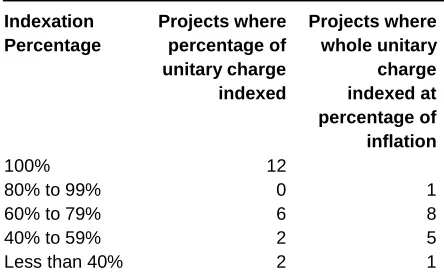
adopted by local authorities basically follows one of two main routes. Some authorities indexed a percentage of the initial unitary charge in line with an index such as RPI or RPIx, leaving the remainder fixed. Other authorities indexed the whole unitary charge, but at some percentage of RPI or RPIx. In both cases, we refer to the percentage chosen as the indexation percentage used by the authority. In 12 of the 37 projects, the indexation percentage was 100%: (obviously, when the indexation percentage is 100%, the two approaches, of indexing a percentage of the unitary charge or indexing the whole unitary charge at a percentage of RPI, are the same.) The large number of projects which are fully indexed is surprising, since this runs counter to the Treasury view that “Under PFI an RPI escalator typically applies to only part of the unitary charge (not including the element relating to initial capex)”: (HM Treasury, 2007).
Of the remaining 27 projects, 10 used the first approach, that is, indexing a percentage of the initial unitary charge: 15 used the second approach, that is, of indexing at a percentage of the chosen inflation index. As we will show later, the distinction between these two different approaches to indexation is important as regards the trajectory of future payments which the authority will have to make.
In a small number of projects, further variations to these two broad approaches were incorporated. For example, in one case a ceiling was put on the rate of increase of the unitary charge. In two cases, an efficiency reduction was explicitly introduced: this took the form of an annual reduction, by a fixed amount, in the relevant index. In the discussion below, we have adjusted our results where appropriate to allow for these cases.
[image:4.612.321.569.435.547.2]The following table shows the number of projects by indexation percentage used under the two broad indexation approaches.
Table 1: Number of projects by indexation type and percentage indexed
Indexation Percentage
Projects where percentage of unitary charge indexed
Projects where whole unitary charge indexed at percentage of inflation
100% 12
80% to 99% 0 1
60% to 79% 6 8
40% to 59% 2 5
Less than 40% 2 1
The percentage increase in the amount that a local authority will have to pay to meet the unitary charge in any given year of the contract will, in general, depend on the particular indexation method used, on the indexation percentage, on the percentage of the unitary charge covered by level playing field support, and on how many years of the project have gone by since the first unitary charge payment.
At the very start of the contract period, however, the annual percentage increase does not depend on the indexation approach used. Specifically, let us define
the parameter
to be the ratio of the indexation percentage to the percentage of the initial unitary charge which the council has to find from its own resources. Then, if inflation is 100 r%, the initial percentage increase in the council’s payments is given by the following formula:Initial percentage increase in council payment =
r
100
.The derivation of this formula is given in the Annex.
Note that, the parameter
has a value greater than 1 when the indexation percentage of the unitary charge is greater than the percentage of the charge which the council has to fund from its own resources. [image:4.612.70.292.574.714.2]The following table shows the values of
for the 37 projects.Table 2: Values of
Number of projects>3 1
2.5 to 2.99 3
2 to 2.49 4
1.5 to 1.99 10
1 to 1.49 16
0.5 to 0.99 3
inflation. So we would expect
to be less than 1. But what is striking about the table is the number ofprojects where
is greater than 1: this occurs in 34 of the 37 projects. This therefore raises questions about local authority procedures, and how well they followed Treasury guidance on indexation.The consequence of the fact that
is greater than 1 for the vast majority of projects is that most authorities will be paying an above inflation increase in their own contribution during the early years of the project.Indeed, since 18 projects have a
value which is greater than 1.5, in these 18 projects the authorities will be paying a contribution which increases initially by over 1.5 times the rate of inflation. Of these 18, eight will be paying at more than twice the rate of inflation, and 1 will be paying at more than three times the rate of inflation. Once the project is past the initial unitary charge payments, the two different indexation schemes produce different trajectories:Schemes where a percentage of the unitary
charge is indexed:
For such schemes, the percentage increase in the local authority contribution will converge through time to the limiting value of theinflation index used. So, if the initial
is greater than 1, this means that the percentage increase paid by the authority will decline each year, but will always be greater than the inflation rate. The rate ofconvergence in these cases is, however, very slow. For example, the time it will take to half the gap between the initial increase in the authority’s contribution and the rate of inflation is over 15 years for 15 of these 17 authorities, assuming inflation continues at 2.5%. If inflation increases, then convergence is somewhat faster.
Nevertheless it is clear that, for authorities where a percentage of the unitary charge is indexed, and for
which
is materially greater than 1, then they can expect to make contributions which increase at a rate well above the rate of inflation for many years.Schemes where the unitary charge is
indexed at a percentage of inflation: these
schemes behave differently. Expressing the indexation percentage as a fraction, then thepercentage increase in the local authority contribution will converge to that fraction of the rate of inflation.
So, if the
for such a scheme is greater than 1, then after a number of years, the percentage increase in the local authority’s payment will drop below the rate of inflation. The Annex gives the formula for thenumber of years until this will happen, (and also gives the algebra justifying the other statements in this and the preceding paragraph).
The following table shows the number of years it will take, for the fourteen projects in this indexation
category, and with a
greater than1, to reach the point where the percentage increase in the local authority’s payment drops to the rate of inflation. Table 3 shows this for two inflation assumptions: 2.5% and 5%.Table 3: For fourteen projects Indexed at a percentage of inflation, number of years until increase in local authority’s payment drops to the rate of inflation
Number of years
Inflation at 2.5% per annum
Inflation at 5% per annum
0 to 5 1
6 to 10 1 5
11 to 15 3 5
16 to 20 2
21 to 25 1
26 to 30 5 1
Over 30 3 1
The contract periods for the projects are mainly thirty years with some at twenty five years. Therefore, it can be seen that, at 2.5% inflation, (which was, in the main, that expected when the contracts were signed), then at least three projects would have had an above inflation increase in the local authority payment throughout the life of the project. Only four out of the fourteen would have reached a below inflation increase during the first half of the project life.
Interestingly, this particular aspect improves if inflation increases: with inflation at 5%, eleven projects would reach a below inflation increase in their first half of the life of the project.
assessment of affordability: or, of course, if the financial situation facing authorities dramatically alters for the worse.
Affordability assessments in practice:
were corners cut?
In this section we consider the evidence from Final Business Cases on the methods and assumptions used by local authorities in assessing the affordability of PFI projects. As central government guidance makes clear, projects should not proceed if affordability is not fully tested. It is to be expected therefore that Final Business Cases should contain a full and thorough assessment of affordability issues. In fact, in many of the business cases, the detail contained in the affordability assessment is
disappointing. This lack of detail is, in itself, a matter of some concern. But from what detail is available, a number of specific issues and problems can be identified. In particular:
Issues in final years of project not
adequately addressed
In a number of the projects, the level playing field support provided by the Scottish government terminates a year or more before the end of the concession period of the project, leaving a substantial funding gap at the end of the project life. Out of the 28 PFI projects for which we have information on this aspect, there were two cases in which level playing field support terminated two years before the end and two cases in which it terminated two and a half to three years before the end – but in none of these is the issue addressed of how this gap is to be filled. For example, in one project the resulting gap amounted to £130 million in nominal terms in total over the last two and a half years of the project, (equivalent to over £60 million in today’s prices).
Savings assumed from demographic
change
In three cases, future savings from demographic change were expected to contribute towards the affordability gap. Given that demographic factors form a significant part of the formula for the allocation of central government revenue support to local authorities, it is difficult to see how authorities can expect to profit significantly from the effect of a falling schools’ population.
Use of schools fund
Eleven authorities stated that they planned to use part of their Schools Fund allocation to help achieve affordability. The Schools Fund was introduced by the
previous Labour/LibDem government as a capital grant to local authorities for the purpose of making improvements to the school estate. It was open to local authorities to use fund monies for the capital investment part of the revenue costs of supporting approved school PPP projects. However, building the assumption of continuing Schools Fund availability into an affordability assessment which extends over twenty-five to thirty years appears optimistic, given that Schools Fund grants were only ever available on a three year rolling basis. As one council put it “the main area of potential risk being in relation to the use of Schools Fund monies which cannot at this stage be predicted to be available for the full thirty years of the contract”.
Using the proceeds of the sales of surplus
land
In eleven projects, part of the funding was assumed to come from the sale of land surplus to requirements. This in itself is entirely legitimate. However, in two cases, the assumptions made by authorities about the proceeds from land sales proved to be unduly optimistic. In both cases, by the time the authority attempted to sell the land, they were caught by the decline in land values caused by the credit crunch. As a result, one of these authorities has had to resort to short term borrowing. (In fact, at least one of these authorities was caught by the tightening of the rules on land sales by the Scottish Executive in 2006. Prior to that date, some authorities had been allowed to use land sale proceeds to make a capital injection to project costs before the end of the construction phase. This ran counter to the philosophy of PFI, that, to avoid risk, payments to the PFI consortium should only start on completion of construction. This
illustrates how, paradoxically, a rule designed to avoid one kind of risk had the effect of exposing this particular council to another type of risk.)
In each case where councils have planned to use land sales income, the benefit from those land sales has been spread over the lifetime of the project, either through a reduction in the unitary charge or through the setting up of some form of sinking fund
arrangement. Where councils have invested land sales proceeds at a variable rate of interest, this does expose them to future interest rate risk.
was given in the Final Business Case as to where the corresponding funds would come from for the remaining years of the project. This £3.5 million gap as from year 2 of the project is particularly worrying as in this case the whole of the unitary charge is indexed at RPI.
Rises in council tax
Five authorities were planning on specific increases in council tax, with a further two considering increases. Again, in itself, this is perfectly legitimate. But in one case, the rises being planned for by the authority, specifically because of their PFI project, were very significant – namely, an extra 1% on council tax each year between 2006/07 and 2017/ 18, followed by a further 0.7% in 2018/19. By 2018/19, therefore, council tax was projected to be 13.5% higher than it would otherwise have been without the PFI project: this higher level would then continue. While this is a local democratic issue, nevertheless, there must be a risk that this particular council is placing itself at the margin of what its local electorate is likely to tolerate, and has therefore placed itself in a position where it has little or no room for manoeuvre if unexpected contingencies were to arise.
The current moratorium on council tax rises must mean that these authorities are having to find other means of funding their affordability gap.
Use of planned refinancing gains
In the case of one project, the Council built into its affordability assessment the potential use of
refinancing gains which it was hoped would accrue to the Council from the very project in question. This means that the Council’s affordability assessment is dependent on the project outperforming its own value for money model. The Council is therefore exposed to risk if the project fails to outperform – in other words project risk is being transferred back to the Council. This runs counter to the whole idea of risk transfer in PFI. Indeed, if the Council was so confident that the project was going to outperform on its original cost projections, then the question arises as to why it did not press the consortium for a better deal in the first place.
Use of other non-indexed funds
In a number of projects, authorities brought in to their affordability calculations other funding streams which they specifically noted were non-indexed. These included fixed sums from the schools fund,
contributions from central property maintenance, and annual fixed sum capital contributions. While it is perfectly appropriate for councils to use whatever finance is available, difficulties could arise if inflation is
higher than that assumed at the time of the
affordability assessment. The greater the amount of finance which comes from non-indexed sources, the greater must be the rate of increase of the residual revenues which the council has to find. Effectively, going back to the discussion above surrounding the
values derived in table 2, use of additional non-indexed sources of finance over and above level playing field support will have the effect of increasingthe
terms as regards the council’s non-indexed contribution.Sculpting of unitary charge to ease
affordability, but leading to mistaken
indexation
In at least one project, the council chose a profile of unitary charge payments which had been sculpted to increase in line with the initially assumed rate of inflation. This approach led to lower payments in the first few years and so gave a more convenient payment profile for the council. This in itself is not necessarily wrong. But the council then appears to have made a mistake in indexing the whole unitary charge at 100% of RPI. A more appropriate approach would have been to convert that part of the unitary charge which was covering loan charges into a profile increasing in line with the original inflation
assumption, (say, 2.5%): and then to specify that this part of the unitary charge would be indexed at a fixed rate of 2.5%, come what may, with the rest indexed at inflation. If inflation increases above 2.5%, then indexing the whole unitary charge at inflation, as the council did, will be more expensive than this approach.
It is clear from the above examples that there are a number of problems with the affordability
assessments carried out by councils. But these are just examples. Because of the amount of information either not supplied in the Final Business Cases, or redacted in those versions released to us under Freedom of Information, it is not possible to achieve a comprehensive overview of the quality of affordability assessments carried out. Nevertheless, there is sufficient information in the above examples to indicate that problems are considerable and widespread.
What Went Wrong?
practice that many authorities have failed to follow this
guidance. In particular, the number of
terms in table 2 which are materially greater than 1 indicates that over-indexation is widespread.Similarly, despite the requirement on authorities to carry out careful assessments of affordability, the evidence in the preceding section indicates that many authorities have cut corners in these assessments.
It is quite clear, therefore, that in this aspect of PFI things have gone quite badly wrong. This points to failure, not just on the part of the local authorities responsible for negotiating PFI contracts, but also on the part of those central bodies, like the Treasury, the Scottish government, and Partnerships UK,
responsible for general oversight of the process. The data on which we have based the research reported here does not provide any evidence as to why these failures occurred. But there is reason to believe that the following may have been among the contributory factors:
a) there appears to have been a generally accepted view at the time that PFI was “the only game in town”. This meant that, if capital investment did not take place through the mechanism of PFI, it was unlikely to take place at all – which would have put the public sector side in negotiations under extreme pressure to secure a deal.
b) it also appears that there was a fairly widely held view that continued economic growth would lead to a benign public expenditure climate in the long term. This is likely to have meant that potential affordability problems, and the overall burden of unitary charge payments in the longer term, would be largely discounted.
One area where Treasury oversight appears to have been particularly deficient is in relation to future variations in inflation. It seems reasonable that authorities should take as their central planning assumption the government’s target inflation forecast, or something close to it. Historically, however, inflation in the UK has been extremely variable, as is
illustrated by the chart, which shows RPI and RPIx inflation since 1969. As the chart shows, in the thirty years, (that is the life of a typical PFI project), before the start of the first Scottish schools PFI scheme, inflation was at times as high as 20 odd percent per annum. Against this historical background, it seems optimistic, to say the least, to assume that the UK has
now entered into a new paradigm of economic management and performance, and that inflation will not depart materially from 2.5% over the next 25 to 30 years. Despite this, in modelling the effects of variant inflation assumptions on their financial projections, authorities typically considered possible variations in inflation which were very small, (often less than 1%). With RPI inflation currently running at almost 5%, and with a real risk that it could go higher, authorities now appear unduly exposed to possible levels of inflation which they have not considered as variants in their PFI modelling. We would regard it as a fundamental responsibility of the Treasury to issue appropriate advice to authorities to ensure that they consider a sufficiently wider range of variant assumptions in their financial modelling. The Treasury has clearly not issued adequate advice on this point: this indicates a significant failure, either of undue optimism, or to adequately monitor what authorities were doing, or both.
Conclusion
As we have seen, councils’ own contributions to PFI projects, (to which they are of course contractually committed), are in many cases projected to increase at a rate which is above inflation: in several cases, the increases will be very significantly greater than inflation for most of the life of the project. This in itself is not necessarily problematic: it is entirely legitimate that councils should budget like this if this reflects their priorities. However, the situation is potentially of concern if either or both of the following hold:
a. if councils’ original affordability assessments were not soundly based
b. if the overall general revenue support that councils get from central government does not rise broadly in line with inflation.
As we have seen in a preceding section, there is considerable evidence that there were considerable problems with the affordability assessments
undertaken by authorities. Moreover, given the current financial cutbacks, there appears little prospect, even in the medium term, of central government support to local authorities rising in line with inflation.
This serious situation appears to have arisen because Treasury guidance, both on the way the unitary charge should be indexed, and on affordability assessment, has been widely breached. There is a clear need for better training for those involved in negotiating on the public sector side of any future PFI or similar contract: and also for much closer scrutiny of contracts and of final business cases by the responsible central departments.
____________________
References
Cuthbert, J.R., Cuthbert, M., (2008). “ The
Implications of Evidence Released Through Freedom of Information on the Projected Returns from the New Royal Infirmary of Edinburgh and Certain Other PFI Schemes”, paper given as evidence to the Finance Committee of the Scottish Parliament, March 2008.
Cuthbert, M., Cuthbert, J. R., (2010a). “The Royal Infirmary of Edinburgh: a case study on the workings of the Private Finance Initiative”, Public Money and Management, Volume 30, Number 6, November 2010.
Cuthbert, M., Cuthbert, J.R. (2010b). "Re-inventing a Faulty Wheel", Scottish Left Review, Issue 56, Jan/Feb 2010.
HM Treasury, (2010), Unitary charges, at
http://www.hm-treasury.gov.uk/ppp_pfi_stats.htm
Partnerships UK, (2010), project database at
http://www.partnershipsuk.org.uk/PUK-Projects-Database.aspx .
H.M. Treasury, (2006), “Interest-Rate and Inflation Risk Issues in PFI Contracts”, May 2006.
HM Treasury, (1997), “The Green Book – Appraisal and Evaluation In Central Government”, 1997 and later editions.
HM Treasury, (2007), “Guidance Note: The Use Of Internal Rates Of Return In PFI Projects” at
http://www.hm-treasury.gov.uk/d/pfi_internalratesguidance1_210307. pdf
Annex: Indexation formulae
a) Where proportion of unitary charge is indexed.
Suppose the initial unitary charge payment in year 0 is 1: suppose a proportion
of the unitary charge is indexed in relation to some suitable index, which increases at 100r% per annum: and suppose that level playing field support from the government represents a proportion p of the initial unitary charge.Then, unitary charge payment in year j =
(1
r)
(1
-
)
j
,and, payment made by council in year j =
(1
r)
(1
-
-
p)
j
.Therefore,
council payment in year (j+1)/council payment in year j
=
[
(1
r)
(1
-
-
p)]/
[
(1
r)
(1
-
-
p)]
j 1
j
(1)
When j=0, the value of expression (1) is
(1
-
p)
r
1
:
therefore, the initial percentage increase in the council’s payment is
(1
-
p)
times the rate of inflation.
As
j
, the value of expression (1) tends to (1+r).So the council payment under this type of indexation starts by increasing at
%
p)
-(1
r
100
per annum: if the factor
p)
-(1
b) Where unitary charge is indexed at a proportion of inflation.
The notation is the same as in case a), except that
now represents the proportion of inflation at which the whole unitary charge is indexed.Then, unitary charge payment in year j =
(1
r)
j
,and, payment made by council in year j =
(1
r)
-
p
j
.Therefore,
council payment in year (j+1)/council payment in year j
=
[(1
r)
-
p]
/
[(1
r)
-
p]
j 1
j
(2)
When j=0, the value of expression (2) is
(1
-
p)
r
1
:
therefore, the initial percentage increase in the council’s payment is
(1
-
p)
times the rate of inflation. (Note that this is the same as case a)).
As
j
, the value of expression (2) tends to(1
r)
.So the council payment under this type of indexation starts by increasing at
%
p)
-(1
r
100
per annum: the percentage
increase then decreases each year, approaching a limiting value of
100
r%
per annum. Assuming(1
-
p)
> 1, this implies that, after a certain number of years, x say, the percentage increase in the council’s payment will drop below 100r% per annum: that is, it will drop below the rate of inflation.
The value of x for which this will happen is the value for which expression (2) = (1+r).
That is, the value of x such that
x 1
x
)
r
r)(1
(1
-r)
(1
= p – p(1+r):That is, such that
x
)
r
(1
=(r
-
r)
pr
=(1
-
)
p
:That is, x =