City, University of London Institutional Repository
Citation
:
Baronchelli, A., Caglioti, E. and Loreto, V. (2005). Measuring complexity with zippers. European Journal of Physics, 26(5), S69 - S77. doi: 10.1088/0143-0807/26/5/S08This is the unspecified version of the paper.
This version of the publication may differ from the final published
version.
Permanent repository link:
http://openaccess.city.ac.uk/2662/Link to published version
:
http://dx.doi.org/10.1088/0143-0807/26/5/S08Copyright and reuse:
City Research Online aims to make research
outputs of City, University of London available to a wider audience.
Copyright and Moral Rights remain with the author(s) and/or copyright
holders. URLs from City Research Online may be freely distributed and
linked to.
arXiv:physics/0605031v1 [physics.ed-ph] 3 May 2006
Measuring complexity with zippers
Andrea Baronchelli†, Emanuele Caglioti‡ and Vittorio Loreto†
†Physics Dept. and INFM-SMC La SapienzaUniversity, P.le A. Moro 2, 00185 Rome, ITALY
‡Mathematics Dept. La SapienzaUniversity, P.le A. Moro 2, 00185 Rome, ITALY
Abstract. Physics concepts have often been borrowed and independently developed by other fields of science. In this perspective a significant example is that of entropy in Information Theory. The aim of this paper is to provide a short and pedagogical introduction to the use of data compression techniques for the estimate of entropy and other relevant quantities in Information Theory and Algorithmic Information Theory. We consider in particular the LZ77 algorithm as case study and discuss how a zipper can be used for information extraction.
1. Introduction
Strings of symbols are nowadays widespread in all the fields of science. On the one hand many systems are intrinsically described by sequences of characters: DNA, written texts, bits in the transmission of digital data, magnetic domains in storage data devices, etc. On the other hand a string of characters is often the only possible description of a natural phenomenon. In many experiments, for example, one is interested in recording the variation in time of a given physical observable (for instance the temperature of a system), thus obtaining a time series, which, suitably codified, results in a sequence of symbols.
Given a string of symbols the main problem is quantifying and then extracting the information it contains. This acquires different meanings in different contexts. For a DNA string, for instance, one could be interested in separating portions coding for proteins from not coding parts. Differently in a written text important information are the language in which it is written, its author, the subject treated etc.
Information Theory (IT) is the branch of science which deals, among other things, with the problems we have mentioned. In a seminal paper dated 1948 Claude Shannon pointed out the possibility of quantifying the information contained in a (infinite) string of characters [1]. Adopting a probabilistic approach, i.e. focusing the attention on the source generating a string, the famous Shannon-McMillan theorem shows that there is a limit to the possibility of compressing a string without loosing the information it brings. This limit is proportional to theentropy (or informatic content) of that string [1, 2].
role became of primary importance also in another field. Historically, the concept of entropy was initially introduced in thermodynamics in a phenomenological context. Later, mainly by the contribution of Boltzmann, a probabilistic interpretation of the entropy was developed in order to clarify its deep relation with the microscopic structure underlying the macroscopic bodies. On his hand, Shannon, generalizing the concept of entropy in the apparently unrelated field of communication systems, was able to establish a self consistent information theory. For a recent excursus about the notion of entropy see [3]. We shall describe more precisely Shannon’s approach in the following section, but we refer the interested reader to [4] for a discussion of the connections between Shannon and microscopic entropies.
A radically different approach to the information problem, namely the Algorithmic Information Theory (AIT) [5, 6, 7, 8], was developed towards the half of the 1960s. It showed again, from a different point of view, that a good way of quantifying the information embedded in a string is that of trying to describe it in the shortest possible way.
In this framework it seems natural to look at those algorithms expressly conceived to compress a file (i.e. a string of bytes), known as zippers. A zipper takes a file and tries to minimize its length. However, as we have mentioned, there is a theoretical limit, represented by the entropy of the considered sequence, to the performance of a zipper. A compression algorithm able to reach this theoretical limit is said to be “optimal”. Thus an optimal zipper can be seen as an ideal tool to estimate the informatic content of a string, i.e. to quantify the information it brings. In this paper we shall discuss this possible application of data compression algorithms together with its shortcomings.
Finally, besides the important scientific problem of measuring how much information is contained in a string, one could ask if it is possible to extract that information. With a slight abuse of the word, we can address the level of the kind of information contained in a sequence as the semantic level. We are then interested in asking whether it is possible to access to the semantic level from a information theoretical, “syntactic”, analysis of a string. We shall show that, under certain assumptions, this is indeed the case in many different circumstances.
The outline of this paper is as follows. In Section II we make a short introduction to some Information Theory concepts; in Section III we describe the optimal compression algorithm LZ77; in Section IV, finally, we illustrate with some examples the possible applications of the illustrated information extraction techniques.
2. Entropy and complexity
Measuring complexity with zippers 3
on the source uniquely. This is a device able to form a message adding one symbol per unit time, chosen in agreement with some probabilistic rules, to the previously emitted ones. Here we consider only cases in which the possible characters are finite in number, i.e. the alphabet X is finite. The source can then be identified with the stochastic process it obeys. Shannon’s IT always deals with ergodic sources. A rigorous definition of ergodic processes is out of the scope of this paper. We shall limit ourselves to an intuitive definition. A source is ergodic if it is stationary (the probability rules of the source do not vary in time) and it holds the following property. If Nl is the number of
occurrences of a generic sequence Y =y1, ..., ys in a string X of lengthl > s, then:
lim
l→∞P{|
Nl
l −P(xi1, ..., xis =y1, ..., ys)|< ǫ}= 1 ∀ǫ, ys (1)
i.e. the averages made over an emitted string, Nl
l , coincide with those made over time
P(xi1, ..., xxs =y1, ..., ys), in the limit of infinite string length.
Now, if x is a n-symbols sequence chosen from the Xn
possible sequences of that length, we introduce the N−block entropy as:
Hn =H(X1, X2, .., Xn) =− X
x∈Xn
p(x) logp(x) (2)
where p(x) is the probability for the string x to be emitted. The differential entropy
hn =Hn+1−Hn represents the average information carried by then+ 1 symbol when
the n previously emitted characters are known. Noting that the knowledge of a longer past history cannot increase the uncertainty on the next symbol, we have thathncannot
increase withn, i.e. it holdshn+1 ≤hn and for an ergodic source we define the Shannon
entropy h as:
h= limn→∞hn= lim n→∞
Hn
n . (3)
The entropy of a source is a measure of the information it produces. In other words
h can be viewed as a measure of the surprise we have analyzing a string generated by a stochastic process. Consider for example the case of a source emitting a unique symbol
A with probability 1. For that source it would hold h = 0, and in fact we would have no surprise observing a new A. On the other hand if the probability of occurrence of the symbol A is quite small our surprise will be proportionally large. In particular it turns out to be proportional to the absolute value of the logarithm of its probability. Thenhis precisely the average surprise obtained by the stochastic process. Remarkably it can be shown that h, apart from multiplicative coefficients, is the only quantity that measures the surprise generated by a stochastic process [2].
More precisely, the role of h as an information measure can be fully recognized in the Shannon-McMillan theorem [1, 2]. Given a N characters-long message emitted by an ergodic source, it states that:
(i) It exists a coding for which the probability for the message to require more than
(ii) It does not exist a coding for which the probability for the message to require less than Nh2 bits tends to one when N tends to infinity.
A completely different approach to information related problems is that of the Algorithmic Information Theory [5, 6, 7, 8]. In this context the focus is on the single sequence, rather than on its source, and the basic concept is the Algorithmic Complexity:
the entropy of a string of characters is the length (in bits) of the smallest program which produces as output the string and stops afterwards. This definition is abstract. In particular it is impossible, even in principle, to find such a program and as a consequence the algorithmic complexity is a non computable quantity. This impossibility is related to the halting problem and to Godel’s theorem [9]. Nevertheless also this second approach indicates that searching for the most concise description of a sequence is the way for estimating the amount of information it contains. As one could expect, in fact, there is a connection between the Algorithmic Complexity of a string and the Entropy of its source, but we refer the interested reader to [9] for a detailed discussion.
Up to this point our attention has been devoted to the characterization of a single string. Both IT and AIT, however, provide several measures of relations of remoteness, or proximity, between different sequences. Among these, it is interesting to recall the notion of relative entropy (or Kullback-Leibler divergence) [16, 17, 18] which is a measure of the statistical remoteness between two distributions. Its essence can be easily grasped with the following example.
Let us consider two stationary memoryless sourcesAandB emitting sequences of 0 and 1: A emits a 0 with probability p and 1 with probability 1−p while B emits 0 with probabilityqand 1 with probability 1−q. The optimal coding for a sequence emitted by
A codifies on average every character with h(A) =−p log2p−(1−p) log2(1−p) bits
(the Shannon entropy of the source). This optimal coding will not be the optimal one for the sequence emitted by B. In particular the entropy per character of the sequence emitted by B in the coding optimal for A will be:
C(A|B) =−q log2p−(1−q) log2(1−p) (4)
while the entropy per character of the sequence emitted by B in its optimal coding is
−q log2q−(1−q) log2(1−q). Eq.(4) defines the so-called cross-entropy per character
of A and B. The number of bits per character waisted to encode the sequence emitted by B with the coding optimal for A is the relative entropy of A and B:
d(A||B) = C(A|B)−h(A) =−q log2
p
q −(1−q) log2
1−p
1−q. (5)
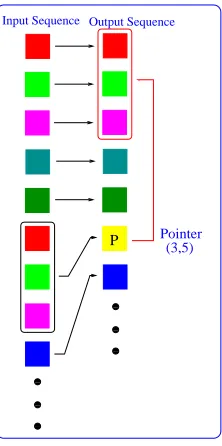
Measuring complexity with zippers 5 00 00 11 11 00 00 11 11 00 00 11 11 0 0 0 1 1 1 0 0 0 1 1 1 0 0 0 1 1 1 Pointer (3,5) P
[image:6.612.240.351.86.309.2]Input Sequence Output Sequence
Figure 1. Scheme of the LZ77 algorithm: The LZ77 algorithm searches in the look-ahead buffer for the longest substring (in this case substring of colors) already occurred and replaces it with a pointer represented by two numbers: the length of the matching and its distance
It is important to remark that the relative and cross entropies are not distances (metric) in the mathematical sense, since they are not symmetric and do not satisfy in general the triangular inequality. Defining a true distance between strings is an important issue both for theoretical and practical reasons (see for some recent approaches [11, 12, 13] and for a short review [21]).
3. Zippers
In the previous section we have seen two different approaches to the characterization of the information, the Classical and the Algorithmic ITs. We have also seen that, despite their profound differences, both of them indicate that the way to quantify the information of a string is to find its shortest description, i.e. to compress it. Driven by this fact, in this paragraph we shall illustrate the LZ77 compression algorithm, that, asymptotically, is able to get to the Shannon limit.
The Lempel and Ziv algorithm LZ77 [14] (see Figure 1) (used for instance by gzip
and zipcommercial zippers) achieves compression exploiting the presence of duplicated strings in the input data. The second occurrence of a string is replaced by a pointer to the previous string given by two numbers: a distance, representing how far back into the window the sequence starts, and a length, representing the number of characters for which the sequence is identical. More specifically the zipper reads sequentially the input
N-symbols sequence,x=x1, ...., xN. Whennsymbols have already been analyzed, LZ77
the stringxn+1, ..., xn+malready appeared inx1, ..., xn. The string found is then codified
with two numbers: its length m and the distance from its previous occurrence. If no already encountered string starts at position n the zipper simply writes the symbol appearing in that position in the compressed sequence and starts a new search from position n+ 1.
From the above description it is intuitive that LZ77 performs better and better as the number of processed symbols grows. In particular, for infinitely long strings (emitted by ergodic sources), its performance is “optimal”, i.e. the length of the zipped file divided by the length of the original file tends to h/ln 2 [15]. The convergence to this limit, however, is extremely slow. Said code rate the average bits per symbol needed to encode the sequence, it holds:
code rate≃h2+O
ln lnN
lnN
!
(6)
Notwithstanding its limitations, LZ77 can then be seen as a tool for estimating the entropy of a sequence. However, the knowledge of h2, though interesting from a
theoretical point of view is often scarcely useful in applications. For practical purposes, on the other hand, methods able to makecomparisonsbetween strings are often required. A very common case, for instance, is that in which one has to classify an unknown sequence with respect to a dataset of known strings: i.e. one has to decide which known strings is closer (in some sense) to the unknown string.
In Section II we have introduced the relative entropy and the cross entropy between two sources. Recently, a method has been proposed for the estimate of the cross entropy between two strings based on LZ77 [11]. Recalling that the cross entropy C(A|B) between two stringsA and B, is given by the entropy per character ofB in the optimal coding forA, the idea is that of appending the two sequences and zipping the resulting file A +B. In this way the zipper “learns” the A file and, when encounters the B
subsequence, tries to compress it with a coding optimized for A. If B is not too long [20, 21], thus preventing LZ77 from learning it as well, the cross entropy per character can be estimated as:
C(A|B)≃ LA+B−LA
LB
(7)
whereLX is the length of the compressed Xsequence. This method is strictly related to
the Ziv-Merhav algorithm [19] to estimate the relative entropy between two individual sequences.
4. Examples and numerical results
Measuring complexity with zippers 7
104 105 106 107
N 3,8
3,9 4 4,1 4,2
[image:8.612.182.406.106.264.2]hestimated
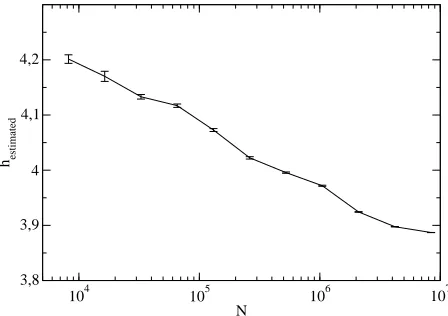
Figure 2. Entropy estimation: The number of bits per characters of the zipped sequence hestimated is plotted versus the length N of the original one. Bernoulli
sequences withK= 10 symbols are analyzed. The zipper performs better with longer strings, but the convergence towards the optimal compression, thought theoretically proved, is extremely slow. The Shannon entropy of the considered sequences is
h2 ≃ 3.32 and, for strings of approximately 8×10⁶ characters, hestimated is 18%
larger than this value.
entropy of such strings is simply logK. From the Figure it is evident that the zipper performs better and better with longer strings, though, as seen in (6), the convergence is extremely slow. It is important to remark how there exist more efficient algorithms to estimate the entropy of a string. We refer the interested reader to [22] for a recent review. It is nevertheless useful to quote the so-called Shannon Game to estimate the entropy of English (see [23] for an applet) where the identification of the entropy with a measure of surprise is particularly clear.
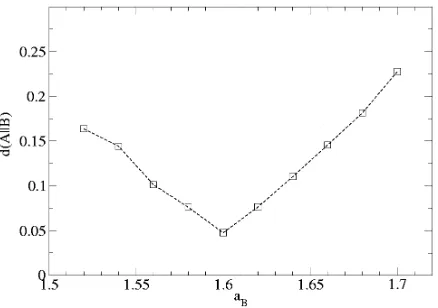
In Figure 3 an experiment of recognition is reported [20]. Here an unknown sequence is compared, in the sense discussed in the previous section, with a number of known strings. The idea to test is that the unknown sequence was emitted by the same source of the closer known one. The source is here a Lozi map, i.e. a dynamical system of the form:
(
xn+1 = 1−a|xn|+yn
yn+1 = bxn
where a and b are parameters. The sequence of symbols used in the following test is obtained taking 0 when x ≤0 and 1 when x > 0. For b= 0.5, numerical studies show that the Lozi map is chaotic fora in the interval (1.51,1.7). For a discussion of the Lozi map, computation of Lyapunov exponents and representation of its symbolic dynamics in terms of Markov chains, see [24].
Figure 3. Recognition experiment: The relative entropy, estimated by means of LZ77 as discussed in text, between an unknown sequence A and a set of known stringsBallows to identify the source ofA. All the sequences are generated by a Lozi map, and the problem is to identify the parameteraA = 1.6 of the source ofA. The
minimum of relative entropy allows clearly to identify this parameters indicating that
Ais closer to the stringB generated withaB=aAthan to any strings generated with
different values ofa.
of sequences, B of length 1000, obtained with Lozi maps with the parameters b = 0.5 andaB varying between 1.52 and 1.7. The quantity computed and reported in the graph
is an estimate of the Kullback-Leibler entropy d(B||A) = C(A|B)−C(B∗
|B), where
C(B∗
|B) is the estimate, in the framework of our scheme, of the entropy rate of B and
B∗
is another set of sequences of length 10000. As it is evident, in our experiment, the closer sequence to the unknown one is the one with a = 1.6 and this means that the recognition experiments was successful.
5. Conclusions
[image:9.612.184.403.86.240.2]Measuring complexity with zippers 9
Acknowledgments
we thank Valentina Alfi, Dario Benedetto, Andrea Puglisi and Angelo Vulpiani for many interesting discussions and contributions to this work. V.L. acknowledges the partial support of the ECAgents project funded by the Future and Emerging Technologies program (IST-FET) of the European Commission under the EU RD contract IST-1940. E.C. acknowledges the partial support of the European Commission through its 6th Framework Programme ”Structuring the European Research Area” and the contract Nr. RITA-CT-2004-505493 for the provision of Transnational Access implemented as Specific Support Action.
Appendix
We report here an example of implementation of LZ77. It must be intended as a didactic illustration, since actual implementations of the algorithm contain several optimizations.
• Build a vectorV whosejth
componentV[j] is thejth
symbol of stringSthat must be compressed;
• Build a vectorI whose jthcomponent,I[j], is the position of the closest previous occurrence of symbolv appearing inV[j], or 0 if symbolv has never appeared before;
• Build an empty vectorC which will contain the processedV (i.e. the processedS);
• definei= 0; while (i <|V|) do:
definep=I[i],lmax= 1, pmax= 0; while (p6= 0) do:
definel= 1;
while (V[i+l] =V[p+l] and (p+l)< i) do:
l=l+ 1;
ifl > lmaxdolmax=l,pmax=p;
p=I[p];
if (l >1) append to vectorC the token (lmax, i−pmax); else, if (l= 1), append to vectorC the token (0,0, V[i]);
i=i+l;
References
[1] C.E. Shannon,The Bell System Technical J.27, 623 (1948).
[2] A.I. Khinchin,Mathematical Foundations of Information Theory (Dover, New York, 1957). [3] M. Falcioni, V. Loreto and A. Vulpiani, in The Kolmogorov Legacy in Physics, R: Livi and A.
Vulpiani eds. Lecture note in Physics, vol. 636 (Springer, 2003). See also G. Parisi’s contribution in the same volume.
[4] G. Parisi,Statistical Field Theory(Addison Wesley, New York, 1988).
[5] G.J. Chaitin,Journal of the Association for Computer Machinery 13, 547 (1966).
[6] G.J. Chaitin,Information, randomness and incompleteness (2nd ed.)(World Scientific, Singapore, 2002).
[7] A.N. Kolmogorov,Problems of Information Transmission 1, 1 (1965). [8] R.J. Solomonov, Information and Control7, 1 and 224 (1964).
[9] M. Li and P.M.B. Vit´anyi,An introduction to Kolmogorov complexity and its applications (2nd. ed.)(Springer, 1997).
[10] T. Cover and J. Thomas,Elements of information theory(Wiley, New York, 1991). [11] D. Benedetto, E. Caglioti and V. Loreto,Phys. Rev. Lett.88, 048702 (2002). [12] H.H. Otu and K. Sayood,Bioinformatics 19, 2122 (2003).
[13] M. Li, X. Chen, X. Li, B. Ma and P.M.B. Vitanyi, IEEE Trans Information Theory 50, 3250 (2004).
[14] A. Lempel and J. Ziv, em IEEE Transactions on Information Theory23, 337 (1977). [15] A.D. Wyner and J. Ziv, Proceeding of the IEEE82, 872 (1994).
[16] S. Kullback and R.A. Leibler,Annals of Mathematical Statistics22, 79 (1951). [17] S. Kullback,Information Theory and Statistics(Wiley, 1959).
[18] T. Cover and J. Thomas,Elements of information theory(Wiley, New York, 1991). [19] J. Ziv and N. Merhav,IEEE Trans. Inf. Th.39, 1270 (1993).
[20] A. Puglisi, D. Benedetto, E. Caglioti, V. Loreto and A. Vulpiani,Physica D180, 92 (2003). [21] A. Baronchelli, E. Caglioti and V. Loreto,J. Stat. MechP04002 (2005).
[22] T. Schuermann and P. Grassberger,Chaos6, 414 (1996).
[23] http://www.math.ucsd.edu/˜crypto/java/ENTROPY/
[24] A. Crisanti, G. Paladin and A. Vulpiani, Products of Random Matrices in Statistical Physics
(Springer-Verlag, Berlin, 1993).