
Taking stock of programme progress: implementation of the Lisbon agenda and lessons for Europe 2020 : IQ-Net Thematic Paper
85
0
0
Full text
(2) European Policies Research Centre University of Strathclyde Graham Hills Building 40 George Street Glasgow G1 1QE United Kingdom Tel: +44 (0) 141 548 3908 Fax: +44 (0) 141 548 4898 E-mail: [email protected] www.eprc.strath.ac.uk/eprc/default.cfm www.eprc.strath.ac.uk/iqnet/default.cfm. January 2011 The University of Strathclyde is a charitable body, registered in Scotland, number SC015263.
(3) Taking Stock of Programme Progress: Implementation of the Lisbon Agenda and Lessons for Europe 2020. PREFACE The research for this paper was undertaken by EPRC in preparation for the 29th IQ-Net meeting to be held in Prague, Czech Republic, on 13-15 December 2010. The paper has been written by Carlos Mendez, Stefan Kah and John Bachtler. It should be noted that the paper was revised following the IQ-Net meeting on 13-15 December to take account of the discussions and conclusions drawn at the meeting. This paper is the product of desk research and fieldwork visits during Autumn 2010. Fieldwork research has entailed an extensive programme with IQ-Net Managing Authorities and implementing bodies. The research on individual countries was undertaken as follows: •. Stefan Kah (Austria, Slovenia). •. Dr Sara Davies (Germany). •. Dr Katja Mirwaldt (Belgium). •. Prof. Ilona Pálné Kovács, Andrea Suvák, Zsuzsanna Zsibók, Ákos Bodor, Zoltán Grünhut (Hungary). •. Dr Marie Macešková, Dr Lucie Jungwiertová (Czech Republic). •. Laura Polverari (Italy). •. Prof. Henrik Halkier (Denmark). •. Dr Martin Ferry (Poland). •. Heidi Vironen (Finland, Sweden). •. Carlos Mendez (Portugal, Spain). •. Frederike Gross (France). •. Rona Michie (United Kingdom). •. Victoria Chorafa, Dimitris Lianos (Greece). EPRC thanks all those who participated in the research. EPRC also gratefully acknowledges the financial support provided by participating Member States and regions, whose contributions are co-financed by technical assistance from the European Structural Funds. The report is, however, the responsibility of the authors alone. The partners in the IQ-Net network are as follows: Austria. •. State Government of Niederösterreich, Economic and Tourism Department. •. State Government of Steiermark, Economic Policy Department. Belgium •. Enterprise Flanders. Czech Republic • Ministry for Regional Development Denmark •. Danish Enterprise and Construction Authority. IQ-Net Thematic Paper 27(2). i. European Policies Research Centre.
(4) Taking Stock of Programme Progress: Implementation of the Lisbon Agenda and Lessons for Europe 2020. Finland. France. •. Alliance of Länsi-Suomi. •. Ministry of Employment and the Economy. •. Délégation interministérielle à l’aménagement du territoire et à l'attractivité régionale (DATAR). Germany • • Greece. •. Hungary • Italy. Nordrhein-Westfalen, Ministry of Economy, SMEs and Energy, EU Affairs Unit Sachsen-Anhalt, Ministry of Finance. Management Organisation Unit of Development Programmes S.A.. Hungarian Enterprise Development Centre (MAG), in association with the National Development Agency (NDA). • • •. Lombardia Region, DG Industry, SMEs, Cooperation and Tourism Ministry of Economic Development Institute for Industrial Promotion (IPI). •. Śląskie Voivodeship (Marshal’s Office). Poland. Portugal • Spain. •. Slovenia •. Sweden •. Financial Institute for Regional Development (IFDR). País Vasco, Provincial Council of Bizkaia, Department of Economy and Finance Government Office for Local EU Cohesion Policy Department. Self-Government. and. Regional. Policy,. Tillväxtverket, Swedish Agency for Economic and Regional Growth. United Kingdom • Department of Communities and Local Government • ONE NorthEast • Scottish Government • Welsh European Funding Office For further information about IQ-Net, and access to the full series of IQ-Net Papers, please visit the IQ-Net website at: www.eprc.strath.ac.uk/iqnet/default.cfm. Disclaimer It should be noted that the content and conclusions of this paper do not necessarily represent the views of individual members of the IQ-Net Consortium.. IQ-Net Thematic Paper 27(2). ii. European Policies Research Centre.
(5) Taking Stock of Programme Progress: Implementation of the Lisbon Agenda and Lessons for Europe 2020. TAKING STOCK OF PROGRAMME PROGRESS: IMPLEMENTATION OF THE LISBON AGENDA AND LESSONS FOR EUROPE 2020 TABLE OF CONTENTS. 1.. INTRODUCTION .............................................................................. 1. 2. 2.1 2.2. THE LISBONISATION OF COHESION POLICY ............................................ 3 New strategic requirements for 2007-13 ................................................... 3 Strategic responses by Member States ...................................................... 6. 3.1 3.2 3.3 3.3.1 3.3.2 3.3.3 3.3.4 3.3.5. LISBON AND THE NSRFS.................................................................. 10 Strategic Reporting: organisation, content and form ...................................10 The socio-economic situation and trends .................................................11 Achievements and future prospects........................................................14 Financial implementation.................................................................16 Outputs and results ........................................................................23 Factors affecting performance...........................................................25 Measures taken to overcome difficulties...............................................27 Improving programme performance.....................................................30. 4.1 4.1.1 4.1.2 4.2 4.3 4.3.1 4.3.2 4.3.3 4.4 4.4.1 4.4.2 4.4.3 4.4.4 4.5 4.5.1 4.5.2. LISBON AND THE OPERATIONAL PROGRAMMES ..................................... 33 Financial implementation....................................................................33 Earmarked allocation vs. earmarked financial implementation....................33 Earmarked vs. non-earmarked financial implementation ...........................35 Outputs and results ...........................................................................39 Factors affecting programme performance ...............................................43 Economic crisis..............................................................................46 Management capacity challenges relating to internal factors......................49 Factors specific to the type of projects ................................................50 Optimising performance: strategic and operational measures.........................52 Formal and informal coordination.......................................................53 Accelerating expenditure .................................................................55 Programme management and administration .........................................57 Project generation, appraisal and selection ...........................................60 Monitoring and Evaluation ...................................................................62 Monitoring ...................................................................................62 Evaluation ...................................................................................65. 3.. 4.. 5.. EXPERIENCES AND LESSONS FOR EUROPE 2020 .................................... 68. Annex I: Earmarking categories ..................................................................... 71. IQ-Net Thematic Paper 27(2). iii. European Policies Research Centre.
(6) Taking Stock of Programme Progress: Implementation of the Lisbon Agenda and Lessons for Europe 2020. IQ-Net Thematic Paper 27(2). iv. European Policies Research Centre.
(7) Taking Stock of Programme Progress: Implementation of the Lisbon Agenda and Lessons for Europe 2020. TAKING STOCK OF PROGRAMME PROGRESS: IMPLEMENTATION OF THE LISBON AGENDA AND LESSONS FOR EUROPE 2020 EXECUTIVE SUMMARY Introduction The 2006 reform of Cohesion policy has marked a watershed in the policy’s history by explicitly aligning its governance architecture with the EU’s overarching growth and jobs strategy, the Lisbon agenda. The aim of this paper is: to examine the progress with implementing the Lisbon agenda at the national and programme levels; to indentify the challenges faced by programme managers in managing and implementing Lisbon-related priorities and interventions; to explore the different strategies and mechanisms employed to facilitate the management and implementation of Lisbon interventions; and to identify lessons for improving the delivery of the Lisbon agenda and to contribute to the Europe 2020 strategy. The Lisbonisation of Cohesion policy Central to the new strategic approach for Cohesion policy in 2007-2013 is the explicit alignment of the policy with the Lisbon agenda. This has been established through three procedural innovations: Community Strategic Guidelines and National Strategic Reference Frameworks; (ii) the earmarking instrument to encourage the allocation of expenditure to Lisbon-related interventions; and (iii) strategic reporting to the Council of Ministers on the achievement of objectives, as well as a closer alignment with annual reporting on the National Reform Programmes. The NSRFs prepared by Member States were mostly broad with less focus and strategic influence than anticipated by the CSG. Many were based on existing domestic policies and strategies. However, comparative analysis of the NSRFs found evidence of the explicit ‘Lisbonisation’ of strategies common to all EU27 Member States. The preparation of coherent, comprehensive, long-term national development strategies was also an innovation for some Member States, especially among the EU12. Analysis of strategies and spending choices at the level of Operational Programmes also found the CSG and earmarking requirements as having a powerful influence on planned Structural Funds expenditure. The most obvious impact was on the importance accorded to innovation, knowledge and entrepreneurship in virtually all programmes. There was less consistency in the way that Member States responded to the guideline relating to regional attractiveness. Changes made to implementation arrangements for the 2007-13 period sought to increase the strategic management of programmes. Project selection systems employed ‘thematic targeting’ on Lisbon-related (and urban) projects, efforts were made to increase the involvement of the private sector, and new monitoring indicators and evaluation practices were introduced. IQ-Net Thematic Paper 27(2). v. European Policies Research Centre.
(8) Taking Stock of Programme Progress: Implementation of the Lisbon Agenda and Lessons for Europe 2020. Strategic reporting on mid-term achievements Member States are required to elaborate two strategic reports by the end of 2009 and 2012, analysing the contribution of their programmes and NSRF towards Cohesion policy objectives, the Community Strategic Guidelines and the Integrated Guidelines for Growth and Jobs. The first strategic reports, produced at the end of 2009, vary in content, length and language. Assessment of the reports by the European Commission indicates that overall progress towards the Lisbon objectives has been slow. Without taking into account the ongoing effects of the crisis, the EU would only reach 75 points by 2010, which is half the speed of change that would have been needed to achieve the targets. At the level of thematic priorities, the main EU-wide findings reported by the Commission included: •. good progress in the innovation and research potential theme in both Convergence and RCE regions, though with striking disparities across Member States;. •. similarly varied performance under the entrepreneurship theme (support for advanced services and self-employed/start-ups), reflected in high commitments in a number of countries;. •. particularly strong progress in the ‘other investment in firms’ with over 40 percent of allocations committed to projects;. •. satisfactory progress under the human capital and labour market thematic priorities, but delays in some Member States under the social inclusion theme; and. •. delays in the capacity building and partnership theme across the EU.. Reporting on outputs and results was patchy, with many reports not providing any quantitative information or qualitative assessment. The reporting of evaluation findings was limited for similar reasons. Despite the limited availability of data or evaluation evidence on achievements, the reports generally presented a positive picture of performance and of the outlook for the rest of the period. Nevertheless, ‘systemic obstacles’ to speedy implementation were reported, including EU-level delays on budget and regulatory agreement, changes in financial control rule, the complexity of managing overlapping programmes, domestic institutional problems, and the effects of the economic crisis. In reviewing the measures employed to overcome any difficulties faced, most reports confirmed the continued relevance of the agreed strategies. Among the main crisis response measures used were administrative simplification to reduce burdens on beneficiaries, the use of internal flexibility within priorities and the modification in financial allocations between priorities or changes in co-financing rates. Many reports did not outline any recommendations for improving performance in the years ahead, beyond the need to accelerate the overall implementation of the NSRF and programmes. From this perspective, the main goal for the future is one of maintaining rather than changing strategic focus. IQ-Net Thematic Paper 27(2). vi. European Policies Research Centre.
(9) Taking Stock of Programme Progress: Implementation of the Lisbon Agenda and Lessons for Europe 2020. Lisbon and the Operational Programmes Analysis of the Annual Implementation Reports at the level of individual programmes reinforces the picture obtained from the strategic reports. Comparisons between the initial programme allocations to earmarked categories and the funds committed to earmarked categories by the end of 2009 show significant differences in progress between programmes. While some programmes, especially in RCE regions, record high levels of funds committed (as a proportion of overall funding allocated, and in absolute terms), others appear to have found the implementation of earmarked funding to be challenging, notably under some Convergence programmes. Qualitative analysis of programme performance since the start of 2007 indicates that IQ-Net programmes have been affected by a range of external and internal factors including compliance issues, the economic crisis, and deficiencies of administrative capacity and experience. The two factors with the most negative impact on the implementation of Lisbon measures are related to the administrative time and effort required for programme implementation, especially the parallel management of 2000-06 programme closure and the 2007-13 programme. Nevertheless, the impact of these factors is not perceived to have had a major impact on programme management and the state of absorption of funds is generally assessed in positive terms. Key trends in the arrangements of many countries and programmes at the start of the 200713 period included stronger strategic management, investment in capacity for programme delivery, changes to partnership arrangements and new coordination arrangements. These trends were by no means universal, with change being far more limited where delivery arrangements were firmly embedded or mature, and where the Lisbon ‘turn’ in Cohesion policy fitted well with existing strategic and implementation frameworks. Early experiences with implementation have generally not required further changes to the delivery arrangements set up at the outset, although measures have been put into effect to deal with some of the challenges reviewed in the previous section. In responding to these challenges and in advancing programme goals more generally, the main strategic and operational measures of relevance are coordination activities, the acceleration of spending, broader programme delivery and administration actions, and project animation and selection processes. With respect to monitoring and evaluation, the Lisbon ‘turn’ has had two key effects on the monitoring of programmes. First, the shift in the thematic content of programmes has, unsurprisingly, led to a shift in the types of indicators used, with a greater focus on Lisbonrelated priorities (RTD, innovation, renewable energies etc.) than in the past, both in terms of context indicators and also in relation to outputs and results. Nevertheless, programme monitoring remains heavily focused on financial performance (spending) rather than policy outcomes (outputs and results). Second, and related, Managing Authorities have had to incorporate the earmarking codes into their monitoring systems, and these are now routinely used for financial planning, monitoring and reporting purposes. However, there is great variation across the programmes in the indicators for measuring outputs and results. There appears to be little consistency in the core indicators used, the IQ-Net Thematic Paper 27(2). vii. European Policies Research Centre.
(10) Taking Stock of Programme Progress: Implementation of the Lisbon Agenda and Lessons for Europe 2020. benchmarks and targets established. Initial plans for monitoring have had to be revised in some cases because of methodological difficulties. From a very small sample of IQ-Net programmes where data were already available, there were several examples of good progress with output achievement. Finally, the Lisbonisation of programme has also influenced evaluation plans. To date, only a limited number of evaluations have been undertaken at programme level and these have often been on operational issues. However, many evaluations are currently being launched or planned at the mid-term stage with a strong focus on Lisbon objectives and themes. Lessons for Europe 2020 The first lesson is the need for Europe 2020 to have a territorial dimension with a clearer spatial strategy and commitment to cohesion. Further, Managing Authorities underlined the importance of securing local and regional understanding and ownership of EU and National Reform Programme objectives and of the implementation of the strategies. A message to emerge from the research and interviews in relation to the strategic planning framework is that more coherence is needed between Cohesion policy strategies, EU objectives and National Reform Programmes. With regard to programming, Managing Authorities tend to agree on the need for greater concentration on clearer and fewer objectives and thematic priorities. Greater concentration on objectives can also be achieved by ensuring that the programme planning process follows a comprehensive and logical framework, encompassing the identification of priorities, interventions and physical indicators. The earmarking instrument provides a useful tool to support concentration efforts, although it is not a sufficient condition in of itself, particularly given the breadth of categories in the classification and the provisions to allow additional categories to be negotiated in NSRFs. A key message that has come through, however, is the need for more precisely defined earmarking categories and uniform reporting of data. Moving from programming to implementation, the core message from Managing Authorities is the need for genuine simplification. Many consider that the main problem relating to ‘Lisbon’ is that the EU-level does not focus sufficiently on the content of the programmes but instead concentrates on bureaucratic rules. Finally, scope for improvement in strategic reporting was identified in three main areas. More coherence and alignment with reporting on national reform programmes is needed. Additionally, there is a need for more proactive involvement of regions in the strategic reporting exercise and to open it up to other interested actors (local authorities, cities, socio-economic partners, NGOs etc.). A coherent and comparable methodological framework of core indicators is required from the start of the next period.. IQ-Net Thematic Paper 27(2). viii. European Policies Research Centre.
(11) Taking Stock of Programme Progress: Implementation of the Lisbon Agenda and Lessons for Europe 2020. IQ-Net Thematic Paper 27(2). ix. European Policies Research Centre.
(12) Taking Stock of Programme Progress: Implementation of the Lisbon Agenda and Lessons for Europe 2020. TAKING STOCK OF PROGRAMME PROGRESS: IMPLEMENTATION OF THE LISBON AGENDA AND LESSONS FOR EUROPE 2020 1.. INTRODUCTION. The 2006 reform of Cohesion policy has marked a watershed in the policy’s history by explicitly aligning its governance architecture with the EU’s overarching growth and jobs strategy, the Lisbon agenda. The key procedural innovations to achieve this were: the establishment of a new planning framework involving the adoption of Community Strategic Guidelines and National Strategic Reference Frameworks centred on the Lisbon agenda; the identification of Lisbon-related categories of expenditure and financial targets through an earmarking instrument; and strategic reporting to the Council of Ministers on achievements. The Lisbon agenda was scheduled to end in 2010, and has now been superseded by a new Europe 2020 strategy for smart, sustainable and inclusive growth. The Commission’s proposals were put forward in March 2010 and agreed by the Council of Ministers in June 2010. What is striking about the process is the speediness of the consultation and the failure by EU institutions to engage in a systematic review of the successes and failures of the Lisbon strategy. 1 Greater understanding of the role of EU Cohesion policy is of particular relevance, being the single most important EU financial instrument for delivering the EU’s Lisbon (and Europe 2020) objectives over the 2007-2013 period. While it is too early to provide a full assessment of the contribution of Cohesion policy at this current midterm juncture, it is possible to review the early experiences with implementation. More specifically, the key objectives of the paper are: •. to examine the progress with implementing the Lisbon agenda through the National Strategic Reference Frameworks and Operational Programmes at the national and programme levels;. •. to indentify the challenges faced by programme managers in managing and implementing Lisbon-related priorities and interventions;. •. to explore the different strategies and mechanisms employed to facilitate the management and implementation of Lisbon-related priorities and interventions; and. •. to identify lessons for improving the delivery of the Lisbon agenda and Europe 2020 strategy.. The paper is based on desk research and an extensive set of fieldwork interviews conducted in September-October 2010 with national and regional Managing Authorities in 16 Member States - Austria, Belgium, the Czech Republic, Denmark, Finland, France, Germany, Greece, Hungary, Italy, Poland, Portugal, Slovenia, Spain, Sweden and the United Kingdom. The desk-based research included analysis of national and Commission Strategic Reports. 1 Pochet P (2020) What’s wrong with EU2020? Intereconomics (2010) Forum on Europe 2020 — A promising strategy?, Volume 45, Number 3, May/June 2010, pp. 136-70.. IQ-Net Thematic Paper 27(2). 1. European Policies Research Centre.
(13) Taking Stock of Programme Progress: Implementation of the Lisbon Agenda and Lessons for Europe 2020. (2009/2010) and data, Annual Implementation Reports (2008 and 2009), evaluations and other programme specific documentation (such as domestic monitoring reports). The paper is structured as follows. It begins in Section 2 with a review of the reform of Cohesion policy in 2006, focusing on its alignment with the renewed Lisbon agenda and the strategic responses by the Member States to the new framework at the start of the programme period. The mid-term achievements at national level are then examined in Section 3, based on national and Commission Strategic Reports and financial implementation data. Section 4 turns to the programme level. It provides a review of financial and physical implementation, the main factors affecting performance, the strategies and measures adopted to optimise performance, and the role of monitoring and evaluation in assessing performance. The final section 5 provides an overall assessment and offers lessons for the future reform of Cohesion policy within the framework of Europe 2020.. IQ-Net Thematic Paper 27(2). 2. European Policies Research Centre.
(14) Taking Stock of Programme Progress: Implementation of the Lisbon Agenda and Lessons for Europe 2020. 2.. The Lisbonisation of Cohesion policy. 2.1. New strategic requirements for 2007-13. Central to the new strategic approach for Cohesion policy in 2007-2013 is the explicit alignment of the policy with the EU’s overarching growth and jobs strategy, the Lisbon agenda. 2 This has been established through three procedural innovations: •. a planning framework involving the adoption of EU goals for the policy (Community Strategic Guidelines) based on the Lisbon agenda and national strategies to guide implementation (the National Strategic Reference Framework);. •. an earmarking instrument to encourage the allocation of expenditure to Lisbonrelated interventions; and. •. strategic reporting to the Council of Ministers on the achievement of objectives, as well as a closer alignment with annual reporting on the National Reform Programmes. The roots of this strategic turn lie in the Lisbon agenda adopted by the European Council in 2000. Its aim was to make the EU “the most dynamic and competitive knowledge-based economy in the world capable of sustainable economic growth with more and better jobs and greater social cohesion, and respect for the environment by 2010”. This overarching goals was translated into an agenda of common objectives and measures, using both traditional EU policy instruments (directives, regulations and Community programmes) and a new open method of coordination involving the benchmarking, monitoring and reporting of Member States progress (e.g. in employment policy). Following a mid-term health check, which criticised the lack of progress on movement towards the set objectives and weaknesses in the delivery model, a renewed growth and jobs agenda was agreed in 2005. This included a streamlined set of integrated guidelines for growth and jobs (see Box 1). These guidelines have, in turn, informed the Community Strategic Guidelines (CSG) for Cohesion policy in the 2007-2013 period (see Box 2). Adopted in 2006, the purpose of the CSG was “to foster an increase in the strategic content of cohesion policy with a view to strengthening synergies with, and helping to deliver, the objectives of the renewed Lisbon agenda.” 3 In line with the Lisbon objectives and the related integrated guidelines for growth and jobs, Cohesion policy would place more priority on “investment in innovation, the knowledge economy, the new information and communication technologies, employment, human capital, entrepreneurship, support for SMEs or access to risk capital financing.”. 2. Mendez C (2011) The Lisbonization of EU Cohesion Policy: A Successful Case of Experimentalist Governance? European Planning Studies, 19: 3, pp. 519-537. 3 Council Decision of 6 October 2006 on Community strategic guidelines on cohesion (2006/702/EC), 21.10.2006, Official Journal of the European Union. IQ-Net Thematic Paper 27(2). 3. European Policies Research Centre.
(15) Taking Stock of Programme Progress: Implementation of the Lisbon Agenda and Lessons for Europe 2020. Box 1: Lisbon Strategy Integrated Guidelines for Growth and Jobs 2005-2008 Macroeconomic policies for growth and jobs 1. To secure economic stability for sustainable growth; 2. To safeguard economic and fiscal sustainability as a basis for increased employment; 3. To promote a growth-and employment-orientated and efficient allocation of resources; 4. To ensure that wage developments contribute to macroeconomic stability and growth; 5. To promote greater coherence between macroeconomic, structural and employment policies; 6. To contribute to a dynamic and well-functioning EMU. Knowledge and innovation - engines of sustainable growth 7. To increase and improve investment in R&D, in particular by private business; 8. To facilitate all forms of innovation; 9. To facilitate the spread and effective use of ICT and build a fully inclusive information society; 10. To encourage the sustainable use of resources and strengthen the synergies between environmental protection and growth; 11. To strengthen the competitive advantages of its industrial base; Making Europe an attractive area to invest and work 12. To extend and deepen the Internal Market; 13. To ensure open and competitive markets inside and outside Europe and to reap the benefits of globalisation; 14. To create a more competitive business environment and encourage private initiative through better regulation; 15. To promote a more entrepreneurial culture and create a supportive environment for SMEs; 16. To expand and improve European infrastructure and complete priority cross-border projects; More and better jobs 17. To implement employment policies aimed at achieving full employment, improving quality and productivity at work, and strengthening social and territorial cohesion; 18. To promote a lifecycle approach to work; 19. To ensure inclusive labour markets, enhance work attractiveness and make work pay for jobseekers, including disadvantaged people, and the inactive; 20. To improve matching of labour market needs; 21. To promote flexibility combined with employment security and reduce labour market segmentation, having due regard to the role of the social partners; 22. To ensure employment-friendly labour cost developments and wage-setting mechanisms 23. To expand and improve investment in human capital; 24. To adapt education and training systems in response to new competence requirements.. Box 2: Community Strategic Guidelines, 2007-13 1. Making Europe and its regions more attractive places in which to invest and work • Expand and improve transport infrastructure • Strengthen synergies between environmental protection and growth • Address Europe’s intensive use of traditional energy sources 2. Improving knowledge and innovation for growth • Increase and improve investment in RTD • Facilitate innovation and promote entrepreneurship • Promote the information society for all • Improve access to finance 3. More and better jobs • Attract and retain more people in employment and modernise social protection systems • Improve adaptability of workers and enterprises and the flexibility of the labour market • Increase investment in human capital through better education and skills • Develop effective administrative capacity • Help maintain a healthy labour force. IQ-Net Thematic Paper 27(2). 4. European Policies Research Centre.
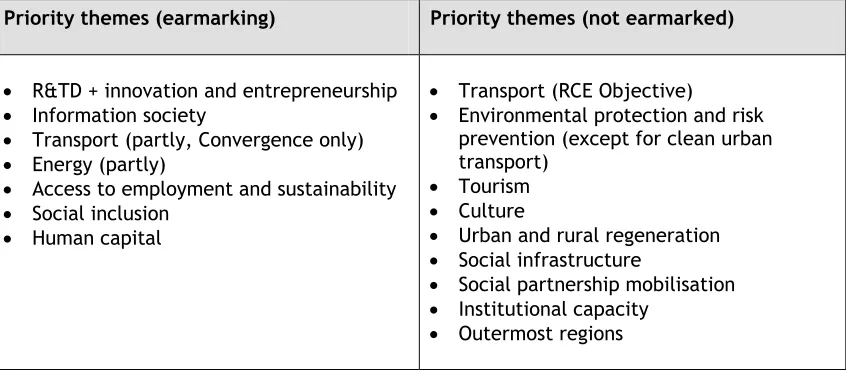
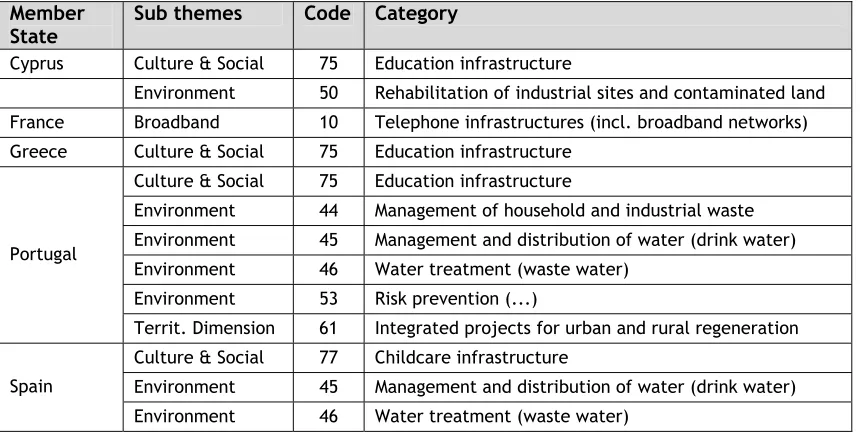
(16) Taking Stock of Programme Progress: Implementation of the Lisbon Agenda and Lessons for Europe 2020. The NSRF has provided a new tool to translate the CSG into national strategies and strategically to steer the design of Operational Programmes towards EU objectives. In practical or operational terms, however, the main tool for achieving concentration on the Lisbon agenda is the earmarking instrument. This requires a minimum share of funding to be allocated to Lisbon-related categories of expenditure, at least 60 percent under the Convergence Objective and at least 75 percent under the Regional Competitiveness and Employment (RCE) Objective for the EU as a whole. The targets are voluntary for the EU12. The Lisbon priority themes and Lisbon earmarking categories are set out in Annex IV of General Regulation 1083/2006, while the full list (including non-Lisbon themes/categories) is set out in Annex II of the Implementing Regulation 1828/2006 (see the Annex to this paper). The list is more restrictive under the RCE Objective, for which 32 out of the total 86 categories of expenditure are classified as being Lisbon-compliant compared with 47 categories under the Convergence Objective. For both Objectives, the main ERDF-funded Lisbon priorities are R&TD / innovation and entrepreneurship, the information society, some energy priority categories (on different forms of renewable energy) and a single category under the environmental protection priority (clean urban transport). The three ESF priorities - access to employment and sustainability, social inclusion and human capital – are classified as being Lisbon compliant in their entirety under both Convergence and RCE Objectives. The more flexible list permitted under the Convergence Objective includes all five categories within the information society priority and some categories within the priorities for energy (trans-European networks) and transport (railways, motorways, multimodal transport, airports, ports and trans-European networks). Table 1: Priority themes for Structural Funds support, 2007-13 Priority themes (earmarking). Priority themes (not earmarked). • • • • • • •. • Transport (RCE Objective) • Environmental protection and risk prevention (except for clean urban transport) • Tourism • Culture • Urban and rural regeneration • Social infrastructure • Social partnership mobilisation • Institutional capacity • Outermost regions. R&TD + innovation and entrepreneurship Information society Transport (partly, Convergence only) Energy (partly) Access to employment and sustainability Social inclusion Human capital. Some Member States have negotiated national exceptions with the Commission (Cyprus, France, Greece, Portugal and Spain). In these countries (see Table 2), additional priority theme codes are earmarked as Lisbon-relevant.. IQ-Net Thematic Paper 27(2). 5. European Policies Research Centre.
(17) Taking Stock of Programme Progress: Implementation of the Lisbon Agenda and Lessons for Europe 2020. Table 2: Additional earmarked categories agreed in specific Member States Member State. Sub themes. Cyprus. Culture & Social. 75. Education infrastructure. Environment. 50. Rehabilitation of industrial sites and contaminated land. Broadband. 10. Telephone infrastructures (incl. broadband networks). France Greece. Portugal. Spain. Code. Category. Culture & Social. 75. Education infrastructure. Culture & Social. 75. Education infrastructure. Environment. 44. Management of household and industrial waste. Environment. 45. Management and distribution of water (drink water). Environment. 46. Water treatment (waste water). Environment. 53. Risk prevention (...). Territ. Dimension. 61. Integrated projects for urban and rural regeneration. Culture & Social. 77. Childcare infrastructure. Environment. 45. Management and distribution of water (drink water). Environment 46 Water treatment (waste water) Source: Annex ‘Analysis of data on priority themes in line with Lisbon Earmarking’ to the Commission’s Strategic Report. The third procedural innovation to support the alignment of EU Cohesion policy with the Lisbon agenda is the introduction of Strategic Reporting. Member States have been required to submit two reports at the end of 2009 and 2012 to assess the achievement of NSRF and programme objectives and the challenges faced. These reports are synthesised by the Commission and sent to the Council and other EU institutions for examination and debate. Links with the reporting process of the broader Lisbon strategy have also been enhanced as the Member States annual reports on the National Reform Programmes now include a section on the contribution of Cohesion policy programmes.. 2.2. Strategic responses by Member States. In preparing their NSRFs, the Member States were required to present a strategy based on analysis of ‘development disparities, weaknesses and potential’, taking a national approach (applicable to both Convergence and RCE regions) and outlining thematic and territorial priorities. IQ-Net research conducted in 2005-6 4 indicated that, in most cases, the NSRFs were broad (especially in federal countries or those with devolved economic development responsibilities), with less focus and strategic influence than anticipated by the CSG. Many were based on existing domestic policies and strategies; new analysis was only really undertaken in the EU12, Greece and Italy. However, they did appear to indicate a convergence of Cohesion policy strategies with the Lisbon agenda, albeit with different development models or overarching approaches to development.. 4. Polverari L, McMaster I and Gross F (2005) A Strategic Approach to Cohesion? Development 2007-2013 Strategies, IQ-Net Thematic Paper No. 17(2), European Policies Research Centre, University of Strathclyde, Glasgow. Polverari L, McMaster I, Gross F, Bachtler J, Ferry M and Yuill D (2006) Strategic Planning for Structural Funds in 2007-13, IQ-Net Thematic Paper No. 18(2), European Policies Research Centre, University of Strathclyde, Glasgow. IQ-Net Thematic Paper 27(2). 6. European Policies Research Centre.
(18) Taking Stock of Programme Progress: Implementation of the Lisbon Agenda and Lessons for Europe 2020. The territorial choices of the NSRFs required a balance between longer-term, Lisbonoriented goals and shorter term, equity-related objectives. This was particularly evident in territorially diversified countries (e.g. Germany, Italy, Portugal, Slovenia). A significant number of countries – such as Austria, France, Greece, Hungary, Italy and Poland – proposed some form of spatial concentration of resources on ‘growth poles’, ‘competitiveness poles’ or ‘excellence poles/systems’, implying a shift from areas in need to areas of potential (also within the areas of need). The territorial choices were particularly sensitive in the RCE regions and in those Member States which were losing significant amounts of funding (e.g. United Kingdom) or where overall Cohesion funding was low (e.g. Denmark, the Netherlands). While it was difficult to establish the relative weight placed on equity (support to lagging regions) or efficiency (national competitiveness and growth), in broad terms Austria, Denmark, Ireland, the Netherlands and the United Kingdom seem more concerned with efficiency, whereas most other countries appeared to be aiming for a balance between competitiveness and cohesion. Overall, comparative analysis of the NSRFs suggested two major strategic shifts from 200006 to 2007-13. First, there was evidence of the explicit ‘Lisbonisation’ of strategies common to all EU27 Member States. 5 For some of the EU15, this was not particularly innovative, as the 2000-06 strategies were considered reasonably well aligned with the Lisbon goals. A second element of relative innovation concerned the preparation of coherent, comprehensive, long-term national development strategies. In the EU12, the NSRFs represented the first comprehensive and long-term strategy linked to substantial resources. The universal goal of all Member State frameworks was higher national growth and competitiveness. This was, however, addressed or interpreted in different ways by Member States in their NSRFs. Seven categories of coexisting, development objectives were identified by the IQ-Net research: 6. 5 6. •. a competitive economy, to be achieved mainly through innovation, R&D and the knowledge economy, but also through support to the business sector (in virtually all Member States);. •. sustainable growth and employment - again found in basically every country, even when not mentioned explicitly as the main strategic goal of the NSRF (as in the case of Denmark);. •. quality of life and/or territorial attractiveness (in Bulgaria, Czech Republic, Hungary, Malta, but also in Austria, Finland, Germany, Sweden and the United Kingdom);. •. development of human capital and more general societal modernisation (in Bulgaria, Czech Republic, Denmark, France, Germany, Greece, Italy, Latvia, Malta, Poland, Romania, Slovenia and Spain);. Mendez C (2011) Op. Cit. Polverari et al (2006) Op. Cit.. IQ-Net Thematic Paper 27(2). 7. European Policies Research Centre.
(19) Taking Stock of Programme Progress: Implementation of the Lisbon Agenda and Lessons for Europe 2020. •. social cohesion (in Bulgaria, Czech Republic, France, Lithuania and Portugal);. •. balanced territorial development/sustainable development (in Austria, Belgium, Bulgaria, Czech Republic, France, Italy, Poland, Portugal, Slovakia, Slovenia, Spain and Sweden); and. •. European or national convergence - an explicit strategic objective in Latvia, Romania, Slovakia among the EU12 and in Germany, Italy and Portugal among the EU15, although European convergence is de facto an overarching objective of the NSRFs of all new Member States.. Analysis of strategies and spending choices at the level of Operational Programmes also found the CSG and earmarking requirements as having a powerful influence on planned Structural Funds expenditure. 7 The most obvious impact was on the importance accorded to innovation, knowledge and entrepreneurship in virtually all programmes. Innovation was universally represented among the main themes set out for the 2007-13 period and, in the case of Regional Competitiveness strategies, innovation was generally the first priority. Programme documents stated that they planned to provide support across the range of interventions anticipated by the CSG - better targeted RTD investment, support for innovation and entrepreneurship, access to finance, information society, and human capital. There were clearly differences in approach to innovation, notably between Convergence and RCE programmes, the latter placing more emphasis on ‘softer’ and systemic interventions. There was less consistency in the way that Member States responded to the guideline relating to regional attractiveness. Several of the interventions under this heading were already an important feature of programmes, notably measures to strengthen the economic environment through investment in infrastructure and environmental improvement. In the NSRFs and OPs for 2007-13, the key distinction was between the Convergence or Phasingout programmes, where investment in major and strategic infrastructure remained eligible and affordable, and the RCE programmes where this is largely ineligible and too costly for programme resources. In the latter case, there was a shift to transport investment in logistics hubs and platforms, travel centres, traffic management systems and transport chains. In the field of ICT, standard interventions were designed to improve broadband connectivity, improve the quality and reduce cost of connections and accessibility, as well as the use of electronic services (e-government, e-commerce, e-learning). Support was also planned to strengthen synergies between environmental protection and growth. A distinctive characteristic of some OPs was the greater emphasis placed on investment in environmental technologies and renewable energy sources. These findings were reinforced by a meta-analysis of half of all ERDF and Cohesion Fund OPs which found a close alignment with the sub-headings of the CSG, but with different. 7. Bachtler J, Ferry M, Mendez C and McMaster I (2007) The 2007-13 Operational Programmes: A Preliminary Assessment, IQ-Net Thematic Paper No. 19(2), European Policies Research Centre, University of Strathclyde, Glasgow. IQ-Net Thematic Paper 27(2). 8. European Policies Research Centre.
(20) Taking Stock of Programme Progress: Implementation of the Lisbon Agenda and Lessons for Europe 2020. rankings of priorities. 8 The Competitiveness programmes tended to focus on ‘entrepreneurship, RTD and innovation’, in line with the knowledge society ethos of the Lisbon agenda. ‘Accessibility’ was generally, but not always, ranked amongst the top priorities of the Convergence programmes in the less developed regions, given their greater needs for basic infrastructure investment. However, this general picture masks wide variation in prioritisation. At least six ‘different paths to Lisbon’ were identified: •. Competitiveness programmes: 1) R&TD and innovation (with limited environmental priority) (Ireland, Denmark, Luxembourg, part of Netherlands); 2) employment, urban regeneration and energy (as well as R&TD and innovation) (Belgium, part of Netherlands, Sweden, Finland, partly Austria, Germany); 3) renewable energy, urban and rural development and tourism (as well as R&TD and innovation) (United Kingdom, France, Italy, Spain, partly Austria and Germany).. •. Convergence programmes: 4) transport and accessibility (Greece, Portugal, Hungary, Czech Republic, Slovenia, Malta, Cyprus); 5) knowledge promotion and accessibility (Estonia, Latvia, Lithuania) and 6) urban/rural infrastructure (Poland, Romania, Bulgaria, Slovakia).. Finally, it is worth noting some of the changes made to implementation arrangements for the 2007-13 period. 9 In particular, improvements were made to the strategic management of programmes, reflecting the regulatory requirements and Commission pressure for a more strategic approach from both policy and financial perspectives. The influence of the CSG was most evident in the project generation, appraisal and selection systems where specific measures to increase ‘thematic targeting’ on Lisbon-related (and urban) projects were introduced. The strategic framework of the Lisbon Agenda also prompted renewed efforts to increase the involvement of the private sector not only on advisory bodies and Monitoring Committees but also as active participants in the implementation process. New monitoring indicators were introduced, reflecting the thematic shifts in spending as well as the need to monitor funding at both OP and NSRF levels; and evaluation planning needed to be rethought to comply with multi-level evaluation requirements and (in some cases) the need to prepare for strategic reporting. 10. 8. Nordregio (2009) Potential for EU Structural Funds to contribute to the Lisbon and Göteborg objectives for growth, jobs and sustainable development, Final Report, DG Regional Policy, Brussels.. 9 Ferry M, Gross F, Bachtler J and McMaster I (2007) Turning strategies into projects: the implementation of 2007-13 Structural Funds programmes, IQ-Net Thematic Paper No. 20(2), European Policies Research Centre, University of Strathclyde, Glasgow. 10. Polverari L, Mendez C, Gross F and Bachtler J (2007) Making sense of European Cohesion policy: 2007-13 on-going evaluation and monitoring arrangements, IQ-Net Thematic Paper No. 21(2), European Policies Research Centre, University of Strathclyde, Glasgow.. IQ-Net Thematic Paper 27(2). 9. European Policies Research Centre.
(21) Taking Stock of Programme Progress: Implementation of the Lisbon Agenda and Lessons for Europe 2020. 3.. Lisbon and the NSRFs. Strategic reporting is one of the main governance innovations in the 2007-13 programme period. It requires the Member States to elaborate two strategic reports by the end of 2009 and 2012, analysing the contribution of their programmes and NSRF towards Cohesion policy objectives, the Community Strategic Guidelines and the Integrated Guidelines for Growth and Jobs. For its part, the Commission is required to draw up a synthesis assessment of the national reports, which is transmitted to EU institutions for examination and debate. The core aim is to make Member States more accountable for the delivery of policy objectives, particularly relating to the overarching Lisbon objectives, and to encourage debate and learning about the effectiveness of Cohesion policy.. 3.1. Strategic Reporting: organisation, content and form. Member States adopted different organisational approaches to strategic reporting. As the Report was required to review the NSRF, the drafting process was undertaken or coordinated at the national level. Some national bodies contracted the work - or parts of it - to external consultants (e.g. Belgium, Germany, Greece, Czech Republic), but most Member States undertook the task in-house, assigning the work to an existing national organisation with a coordination role or political responsibility for Cohesion policy. However, these were not the same organisations as those responsible for reporting on the broader Lisbon strategies (i.e. National Reform Programmes), except for Slovenia where the Managing Authority GOSP was able to exploit the synergies involved in discharging both of these tasks. The elaboration of the reports was seen as being administratively demanding in some countries, requiring additional staff to be employed. However, many national bodies, particularly in the EU12 but also in some of the EU15 (e.g. Greece, Ireland, Italy, Spain, Portugal), were well-accustomed to the coordination of Cohesion policy monitoring and reporting processes. The main strategies or mechanisms used to ensure that the process was well structured, informed and coordinated included: •. setting up strategic reporting working groups (Austria, Czech Republic, Finland, France, Slovenia);. •. embedding the exercise within annual reporting or evaluation planning processes (Austria, Poland, Portugal, Spain);. •. making use of evaluation studies that had been commissioned to feed into the strategic report (France, Portugal); and. •. benefitting from governmental strategic reflections and evidence to territorial reviews of regional (including EU cohesion) policies for the OECD (Portugal and Sweden).. In general, the strategic reporting exercise did not have a high public profile. Domestic accountability for the exercise could have been enhanced though public consultations (as. IQ-Net Thematic Paper 27(2). 10. European Policies Research Centre.
(22) Taking Stock of Programme Progress: Implementation of the Lisbon Agenda and Lessons for Europe 2020. was reportedly the case in Bulgaria, Cyprus, Italy, Malta), but this approach was not used in most Member States. A more pro-active effort was made in Sweden, where the strategic report and the recent OECD Territorial Review were used to draw up a report that was sent to the Parliament for examination and debate, entitled ‘Strategic growth efforts for regional competitiveness, entrepreneurship and employment’. Turning to the content and form of the reports, the General Regulation was relatively unprescriptive, only specifying the need: to review the socio-economic situation and trends; to identify the achievements, challenges and future prospects in relation to implementation of the agreed strategy; and to provide examples of good practice. Nevertheless, the Commission did provide guidance to the Member States, 11 mainly to ensure that certain key topics were covered, such as the response to the economic crisis, and that the Member States provided the Commission with the necessary data to undertake its own pan-EU assessment of financial progress. The key issues raised by the Commission in its guidance were covered in many of the reports, albeit with varying degrees of depth and rigour. The length of the reports, for instance, ranged from fewer than 50 pages (e.g. Belgium, excluding annexes) to over 300 pages (Spain), although page length was not necessarily an indication of quality or rigour. Also of note is that few Member States translated their reports to another EU working language, perhaps surprising given that a key aim of the exercise was to encourage mutual learning across countries. Exceptions include the reports of Austria, Bulgaria, Czech Republic, Hungary, Lithuania and Romania (which were translated into English) and some executive summaries (Greece, Poland, Spain). A further obstacle to accessibility and crossnational dissemination and examination of the findings is that the reports were not all made available on the Commission’s website (unlike the NRP annual monitoring reports, for instance); only a limited number can be directly downloaded from the strategic reporting section of DG Regio’s website, in many cases providing links to national websites instead where the reports are not always easily visible or accessible.. 3.2. The socio-economic situation and trends. The point of departure for the strategic reports is an update of the socio-economic situation and trends since the formulation of the NSRFs. The major development is of course the economic crisis, and most reports discussed the important consequences for economic activity, the business environment, labour market and public finances at national and regional levels. Assessing the impact of the crisis on the regions was not always straightforward, being hampered in many cases by lags in the availability of data at subnational level, with the exception of labour market data. Some reports provided overviews of the changing national and regional policy environment in response to the new scenario, particularly regarding domestic crisis measures at national or regional level (e.g. Spain), but often in a rather general form (e.g. United Kingdom).. 11. DG Regio (2009) Information note: Indicative structure for the national strategic reports 2009, COCOF 09/0018/01-EN, European Commission, Brussels.. IQ-Net Thematic Paper 27(2). 11. European Policies Research Centre.
(23) Taking Stock of Programme Progress: Implementation of the Lisbon Agenda and Lessons for Europe 2020. Different to most other reports, Austria’s socio-economic analysis included a forwardlooking appraisal of future regional policy directions on the basis of prospective studies and discussions within its NSRF monitoring structure (Box 3). Box 3: 2030 Spatial Development Scenarios in Austria The trends and challenges for Austria's regional policy are discussed annually within the so-called ‘STRAT.ATplus’ process. Drawing on this work - including a study on the 2030 spatial development scenarios for Austria 12 and the Commission’s Regions 2020 report 13 - the Austrian Strategic Report highlights the following key messages. Globalisation and the increasingly knowledge-based nature of growth: Austria is undergoing a transition towards growth that is increasingly determined by research, technology and innovation. It has achieved the highest increase in R&D expenditure as a share of GDP in the EU15 since 2000 and is on target to reach the EU’s three percent target. Two challenges are highlighted: addressing the decline in growth which has resulted from the crisis; and designing a forward-looking strategy to ensure that the medium term goal of belonging to the group of leading innovation nations is not threatened. Demographic change: Austria's population is forecast to grow by three percent between 2008 and 2015 (8 percent by 2030) due to migration flows, posing challenges for integration policies. These trends are not evenly distributed: above-average growth for Vienna and Niederösterreich; moderate growth in the Western Länder; and stagnation or decline in the South. Population will continue to grow in agglomerations, reaming stable in rural regions overall (but declining in inner-Alpine peripheral regions/valleys). The ageing population is also a challenge too in the 2030 time-frame. The ESF currently provides an important lever for addressing these challenges. Resources and energy scarcity: Bottlenecks related to the availability of commodities and energy became acute between 2007 and mid-2008, leading to high price rises and shortages. These challenges will intensify in the recovery from the crisis. Support for resource efficiencies, the substitution of commodities as well as the utilisation of alternative energies and new materials will be important fields of activity in the future. The ERDF already contributes to these tasks, but mostly national instruments are used in this context. Climate change: The increasing occurrence of extreme weather and associated damage, along with new scientific insights, have increased awareness of climate change and its consequences. The Commission published a white paper on climate change in April 2009, and several countries have developed corresponding strategies. The Austrian government has anchored the preparation of a national adaptation strategy by 2013 in its government agreement.. The reviews of the socio-economic context and the evolving domestic policy environment were often presented as contextual background information. There was limited effort to distil specific strategic implications for the NSRFs or for longer-term policy directions, beyond general statements about the need for effective and efficient delivery in the difficult economic and budgetary climate. In part, this is due to the fact that many Member States do not use the NSRF as a strategic tool upstream of the programming phase - nor are they obliged to inform the Commission about modifications to their NSRFs where they do play a more substantive role - but also because strategic revisions to the NSRF were not generally seen as necessary. For instance, the updated socio-economic analysis in the Spanish report, one of the countries most acutely affected by the crisis, led to a revision of. 12. ÖROK (2009) Szenarien der Raumentwicklung Österreichs 2030 - Regionale Herausforderungen und Handlungsstrategien, ÖROK-Schriftenreihe 176/II, Vienna. 13 European Commission (2008) Regions 2020 – An assessment of future challenges for EU regions, SEC(2008), Commission Staff Working Document, Brussels. IQ-Net Thematic Paper 27(2). 12. European Policies Research Centre.
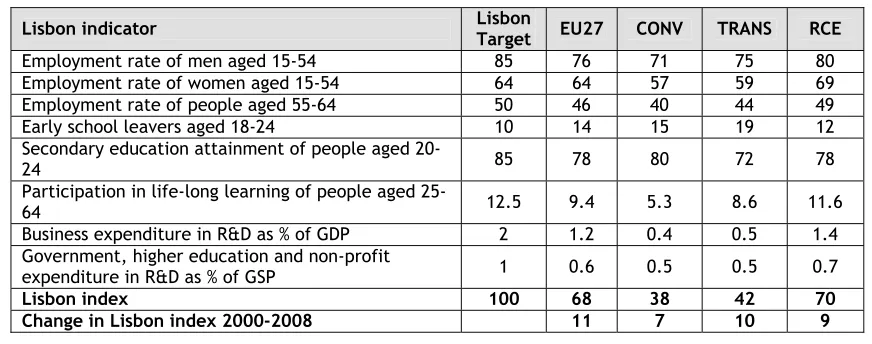
(24) Taking Stock of Programme Progress: Implementation of the Lisbon Agenda and Lessons for Europe 2020. the NSRF’s SWOT analysis, but the report concluded that the strategy remained valid and, moreover, even anticipated some of the challenges faced in the current crisis context. Looking more specifically at Lisbon agenda objectives and indicators, the most recent EUwide analysis of the situation and trends in the regions is provided in the Fifth Cohesion Report. 14 It uses the recently created ‘Lisbon index’, which measures how far regions are from eight Lisbon targets for 2010, to provide a snapshot picture of the situation in 2008 and trends between 2000 and 2008. 15 Beginning with the situation in 2008, the report reveals important variation in attainment. •. The level of Lisbon attainment in Convergence regions was almost half that of the RCE regions average (with average index scores of 38 and 70 respectively) (see Table 3). Transition regions fared better (42) but were still well below the EU27 average (of 68).. •. The top ten Lisbon achievers in 2008 included three Finnish regions (Länsi-Suomi, Etelä-Suomi, Pohjois-Suomi), four Swedish regions (Östra Mellansverige, Västsverige, Sydsverige, Stockholm) two United Kingdom regions (Hampshire and Isle of Wight, Lancashire) and one Danish region (Hovedstaden) scoring between 95 and 100.. •. At the other end of the scale, the bottom ten comprised four Southern Italian regions (Sicilia, Campania, Calabria and Puglia), the two Portuguese island regions (Açores and Madeira), Malta, one Romanian region and two Hungarian regions (Észak-Magyarország and Dél-Dunántúl), all scoring fewer than 15 points on the Lisbon index.. Table 3: Lisbon index 2008 and change 2000-2008 Lisbon indicator Employment rate of men aged 15-54 Employment rate of women aged 15-54 Employment rate of people aged 55-64 Early school leavers aged 18-24 Secondary education attainment of people aged 2024 Participation in life-long learning of people aged 2564 Business expenditure in R&D as % of GDP Government, higher education and non-profit expenditure in R&D as % of GSP Lisbon index Change in Lisbon index 2000-2008. Lisbon Target 85 64 50 10. EU27. CONV. TRANS. RCE. 76 64 46 14. 71 57 40 15. 75 59 44 19. 80 69 49 12. 85. 78. 80. 72. 78. 12.5. 9.4. 5.3. 8.6. 11.6. 2. 1.2. 0.4. 0.5. 1.4. 1. 0.6. 0.5. 0.5. 0.7. 100. 68 11. 38 7. 42 10. 70 9. Source: Fifth Cohesion Report, p. 195. 14 See also Annoni P and Kozovska K (2010) EU Regional Competitiveness Index 2010, JRC Scientific and Technical Reports, European Commission, Brussels. 15 The methodology is explained in more detail in Dikstra L (2010) ‘The Lisbon Index’, Regional Focus, No3/2010, DG Regional Policy, European Commission, Brussels.. IQ-Net Thematic Paper 27(2). 13. European Policies Research Centre.
(25) Taking Stock of Programme Progress: Implementation of the Lisbon Agenda and Lessons for Europe 2020. In terms of trends over time, EU regions have on average improved their score by 11 index points between 2000 and 2008. The 10 regions with the most rapid improvements were Corse in France (albeit from a low starting point), no fewer than seven Spanish regions (País Vasco, Cantabria, Navarra, Galicia, Asturias, La Rioja and Extremadura), Kärnten in Austria, and Liguria in Italy. But overall progress towards the Lisbon objectives has been slow across the board. On the basis of the reported trends, and without taking into account the ongoing effects from the crisis, the EU would only reach 75 points by 2010, which is half the speed of change that would have been needed to achieve the targets. 16. 3.3. Achievements and future prospects. The Strategic Reports employed several methods to assess Cohesion policy achievements and NSRF contributions to Lisbon objectives. A first approach involved examining the relationship between NSRF objectives/priorities and those of the Community Strategic Guidelines, European Employment Strategy and National Reform Programmes. Some reports provided quantitative matrix analyses of relative weightings, financial allocations or implementation progress to demonstrate the linkages (e.g. Austria, Czech Republic, Hungary, Portugal, Spain), while others only provided schematic illustrations of the links or qualitative descriptions. A second source of evidence used to assess achievements was financial implementation data, also sent to the Commission to undertake a comparative EUwide assessment. The link to Lisbon objectives could be accordingly analysed at two levels: earmarking targets and progress in achieving them, which could be labelled a ‘narrow’ Lisbon approach given the restricted fields of intervention covered; and a ‘broad’ Lisbon approach encompassing the full range of priority themes and expenditure categories, all of which can be linked to the Community Strategic Guidelines and Lisbon agenda. A third method to account for actual policy outcomes was through the reporting of outputs and results data, including on the Commission’s core indicators. Aside from these standard monitoring and reporting approaches, a limited number of reports were able to draw on evaluation findings (e.g. France, Hungary, Portugal). The main challenges faced in using these methods and evidence sources for assessing achievements were five-fold.. 16. •. At a conceptual level the Lisbon objectives are rather ambiguous - even though they may be clearly expressed and succinctly stated in EU strategies (the renewed Lisbon agenda and the CSG) and national plans (National Reform Programmes or NSRFs) - and methodologically difficult to assess for causal policy impacts.. •. Financial and physical data were limited – or non-existent in many cases – mainly due to the relatively late launch of the programmes. This explains why the Commission encouraged the Member States to report on projects or operations selected, rather than just payments.. Based on 2000-2007 data: Dikstra L (2010) Op. Cit.. IQ-Net Thematic Paper 27(2). 14. European Policies Research Centre.
(26) Taking Stock of Programme Progress: Implementation of the Lisbon Agenda and Lessons for Europe 2020. Figure 1: The Lisbon Index. IQ-Net Thematic Paper 27(2). 15. European Policies Research Centre.
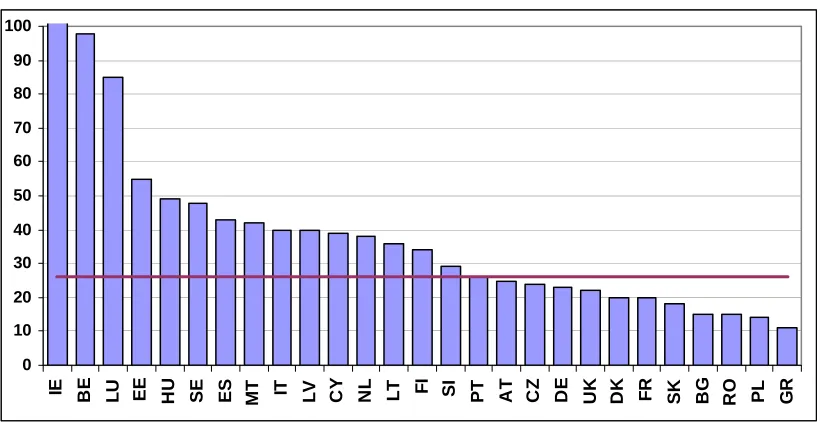
(27) Taking Stock of Programme Progress: Implementation of the Lisbon Agenda and Lessons for Europe 2020. •. Very few evaluation studies of the current programmes had been completed. Where results were available, they were mainly concerned with operationalisation issues (e.g. France, Portugal, Hungary), although macro-economic impact assessments were also included in some of the reports (Hungary, Poland).. •. Some Member States faced challenges in aggregating data at the national level due to the different methodological approaches used across programmes and the logistical challenges in collecting the data (e.g. Germany).. With these caveats in mind, the remainder of this section reviews the key findings of the reports on financial implementation progress, the challenges and measures employed to overcome difficulties, and recommendations for the remainder of the period and beyond.. 3.3.1 Financial implementation As noted above, assessing the financial performance of NSRFs and programmes in relation to Lisbon objectives and themes can be approached from a narrow or broad perspective. The earmarking categories constitute the narrow perspective by focusing on those areas of expenditure considered to be most relevant to the Lisbon agenda. However, the objective of all Cohesion policy spending is to contribute to growth and jobs. Accordingly, the three CSG and their various sub-headings can be linked to all of the thematic spending priorities and sub-divided categories of expenditure. Only some national reports presented financial performance data and analysis in this way (e.g. Austria, Hungary, Portugal), but the Commission published the national-level data sets along with a discussion of the key findings in its synthesis report. Before reviewing the comparative findings on financial implementation, two methodological caveats should be noted. First, the data relate to funding committed to operations (projects) not actual payments to implemented projects and therefore do not necessarily reflect the reality on the ground (to the extent that commitments many not be fully realised). Second, while the Commission requested cumulative data up to September 2009, many Member States provided data relating to a later date (Estonia, France, Slovenia, Spain) or from the end of 2008 (in the case of Germany).. (i). Community Strategic Guidelines: the broad Lisbon perspective. The first CSG is ‘Attractive places to invest and work’ which includes the priority themes of rail, road and other transport, environment, energy, broadband and cultural and social infrastructures. By late 2009, project commitments across the EU were around a quarter of the total allocation to the guideline. Country project selection rates differed widely. Three Member States had already committed above 85 percent of their allocations (Luxembourg, Belgium and Ireland, the latter more than its allocation), while four Member States had not reached the level of 15 percent of their funding allocations (Bulgaria, Romania, Poland and Greece). In examining the commitment profiles of different priority themes, the main messages reported by the Commission included the following: •. although progress in transport was deemed satisfactory, commitments have been imbalanced by favouring roads and motorways over rail projects;. IQ-Net Thematic Paper 27(2). 16. European Policies Research Centre.
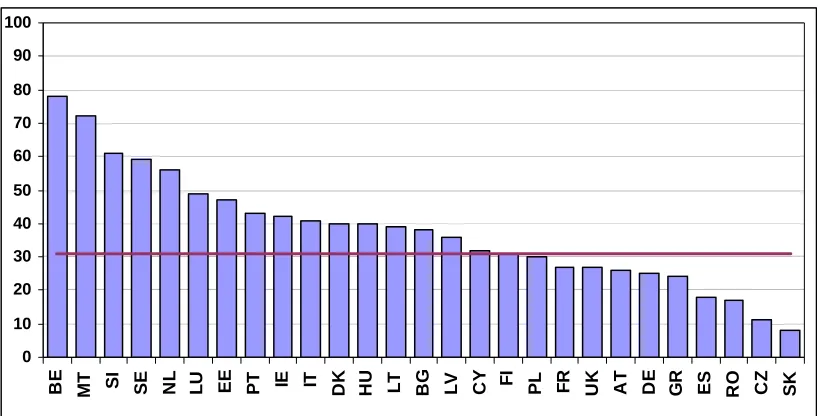
(28) Taking Stock of Programme Progress: Implementation of the Lisbon Agenda and Lessons for Europe 2020. •. there has been underperformance in the environmental theme; and. •. major delays have affected energy sector projects in many Member States (Bulgaria, Spain, Greece, Latvia, Poland, Portugal, Romania, Slovenia, Slovakia, United Kingdom) thus hindering the achievement of EU sustainable development objectives.. Figure 2: Financial implementation of the CSG ‘Attractive places to live and work’ (funding committed to operations as percentage of the total allocation) 100 90 80 70 60 50 40 30 20 10. GR. PL. RO. BG. SK. FR. DK. DE. UK. AT CZ. PT. FI SI. LT. NL. IT. LV CY. ES MT. SE. HU. LU EE. BE. IE. 0. Source: European Commission data. The second CSG - ‘Improving knowledge and innovation for growth’ – is often considered to be the one most aligned with Lisbon agenda, at least at the level of policy discourse. Mainly funded through the ERDF, it encompasses the priority themes of RTDI, entrepreneurship, ICT and other investment in firms. Overall, the project commitment rate (29 percent of funds) was higher than under the other two guidelines. Again, financial performance was particularly high in Belgium, where more than three-quarters of the allocation had been committed (mainly in the ‘other investment in firms’ category), but also in Malta (‘RTD & innovation’ predominantly, for which the entire allocation had been committed). At the other end of the spectrum, seven Member States had committed only 10-20 percent of funding (Greece, Poland, Romania, Bulgaria, Slovakia, France and Denmark). At the level of thematic priorities, the main EU-wide findings reported by the Commission included: •. good progress in the innovation and research potential theme in both Convergence and RCE regions, though with striking disparities across Member States;. •. similarly varied performance under the entrepreneurship theme (support for advanced services and self-employed/start-ups), reflected in high commitments in a number of countries (Belgium, Bulgaria, Finland, Spain, Latvia, Poland, Sweden,. IQ-Net Thematic Paper 27(2). 17. European Policies Research Centre.
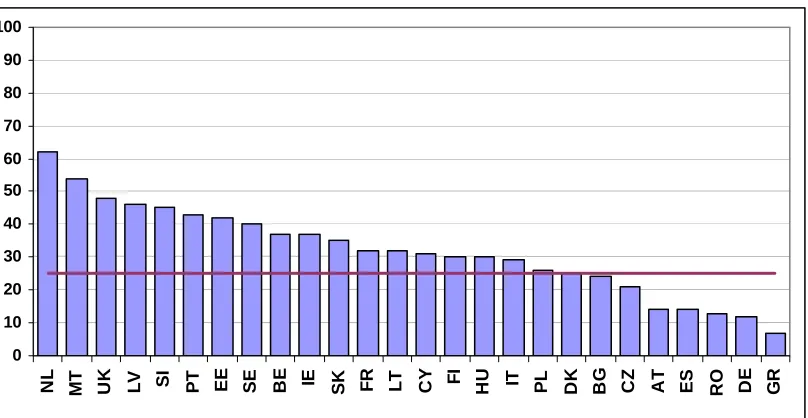
(29) Taking Stock of Programme Progress: Implementation of the Lisbon Agenda and Lessons for Europe 2020. Slovenia, United Kingdom) and slow progress in others (Austria, Spain, Hungary, Italy, Netherlands, Portugal and Romania); •. particularly strong progress in the ‘other investment in firms’ with over 40 percent of allocations committed to projects, largely because this category of expenditure played an important role in national and regional responses to the crisis.. Figure 3: Financial implementation of the CSG ‘Improving knowledge and innovation for growth’ (funding committed to operations as percentage of the total allocation) 100 90 80 70 60 50 40 30 20 10. CZ. SK. ES. RO. DE GR. AT. FR. UK. PL. CY FI. LV. LT. BG. DK HU. IT. IE. EE. PT. NL LU. SI. SE. MT. BE. 0. Source: European Commission data. The third CSG is ‘More and better jobs’, which is strategically anchored in the European Employment Strategy and funded by the ESF. Four priority themes are covered by this guideline: human capital; labour market; social inclusion; and capacity building. At EU level, the commitment rate was 26 percent by late 2009, the same rate as the first CSG. The cross-national range is again wide, although there is a much larger group of countries clustered around the average than under the previous CSGs. The top five countries are Belgium, Malta, Slovenia, Sweden and the Netherlands, all of which had commitment rates above 50 percent of their allocations. At the lower end of the scale were Slovakia, Czech Republic (around 10 percent or less), Romania and Spain (both under 20 percent). In between these two groups, commitment rates ranged between 25 and 45 percent. The key points raised in the Commission’s synthesis report were: •. satisfactory progress under the human capital and labour market thematic priorities, but delays in some Member States under the social inclusion theme (notably in Austria, Slovakia, Spain and Germany); and. •. delays in the capacity building and partnership theme across the EU (especially in Spain, Italy, Lithuania, Portugal and United Kingdom), partly explained by the fact that delivery is through multi-ministerial programmes which can delay decisionmaking.. IQ-Net Thematic Paper 27(2). 18. European Policies Research Centre.
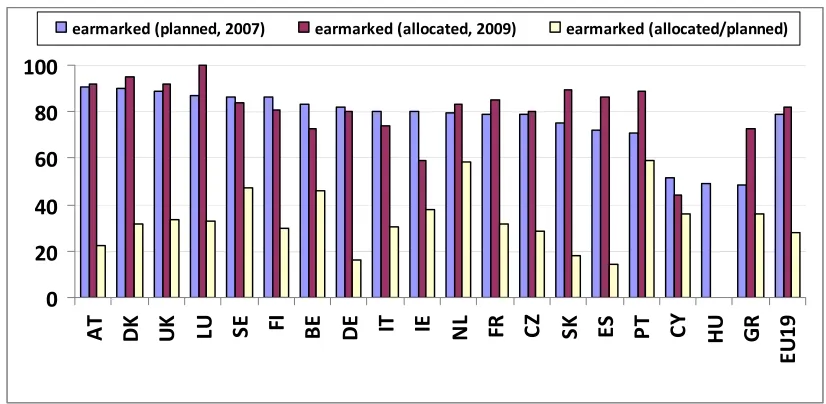
(30) Taking Stock of Programme Progress: Implementation of the Lisbon Agenda and Lessons for Europe 2020. Figure 4: Financial implementation of the CSG ‘More and better jobs’ (funding committed to operations as percentage of the total allocation) 100 90 80 70 60 50 40 30 20 10. DE. GR. ES. RO. AT. CZ. BG. DK. IT. PL. HU. FI. CY. LT. FR. SK. IE. BE. SE. EE. PT. SI. LV. UK. NL. MT. 0. Source: European Commission data. Aside from the three guidelines reviewed above, drawn directly from the EU’s 2005 Renewed Lisbon agenda, the CSG document includes a second section entitled the ‘territorial dimension’. While this dimension is arguably a transversal priority that cuts across many different interventions, the Commission’s Strategic Report identifies the European Territorial Cooperation programmes and four specific expenditure categories as being particularly relevant: assistance to improve tourism services; integrated urban and rural regeneration projects; compensation of any additional costs due to accessibility deficit and territorial fragmentation; specific action addressed to compensate additional costs due to size market factors; and support to compensate additional costs due to climate conditions and relief difficulties. The strategic reporting data showed that project commitments in the first two categories – for tourism and urban/urban regeneration – were strong (35 and 29 percent respectively), while commitments under the European Territorial Cooperation programmes were somewhat lower (around a quarter of their allocations). Summing up, the key priority areas facing delays or variable performance are in the rail sector, certain energy and environmental investments, investment in the area of the digital economy, social inclusion, and governance and capacity building.. (ii). Earmarking: the narrow Lisbon perspective. Turning to the narrower earmarking classification of Lisbon expenditure, the data published by the Commission on 2009 project commitments show that the targets set for the EU are being achieved. Under the Convergence Objective, 65.4 percent of all project commitments were on earmarked expenditure, slightly higher than the 64.5 percent exante targets agreed in the approved programmes (or five percentage points above the 60 percent EU target set in the General Regulation). As can be expected, the overall figures mask wide variation. Of the 20 Member States receiving Convergence funding, just over half had exceeded their ex-ante targets: IQ-Net Thematic Paper 27(2). 19. European Policies Research Centre.
(31) Taking Stock of Programme Progress: Implementation of the Lisbon Agenda and Lessons for Europe 2020. •. by 16 percentage points in the case of Latvia;. •. by 4-7 percentage points in a group of seven Member States (Portugal, Greece, Malta, Lithuania, Italy, Hungary and Estonia); and. •. by a slim margin in the remaining three countries (France, United Kingdom and Slovenia).. Figure 5: Convergence earmarking targets (planned for 2007-13 and achieved in 2009) and earmarking financial absorption (project pipeline, 2009) earmarked (planned, 2007). earmarked (allocated, 2009). earmarked (allocated/planned). 100 80 60 40 20. AT PT UK ES BE DE GR IT SI PL SK CZ FR LV HU LT RO BG EE MT EU20. 0. Source: European Commission data. Countries with spending commitment below ex-ante earmarking targets can be divided into three groups: •. 15 percentage points or more behind (Romania and Austria);. •. 5-10 percentage points behind (Czech Republic, Slovakia, Germany, Bulgaria, Belgium); and. •. marginally behind (Poland and Spain).. The relative rankings are different for earmarked project commitment rates, which arguably provides a better indicator of the relative ease or challenges faced in spending the earmarked allocations during the lifetime of the programmes. Setting Belgium aside, which had already allocated three quarters of its earmarked allocation to projects, four groups can be identified: •. above 50 percent of total funds allocated (Belgium, Estonia, Malta, Hungary);. •. 33-50 percent (Latvia, Italy, Slovenia, United Kingdom, Portugal, Lithuania, Spain);. •. 10-20 percent (Poland, Germany, Bulgaria, Czech Republic, France, Slovakia, Greece); and. IQ-Net Thematic Paper 27(2). 20. European Policies Research Centre.
Figure
+7

Outline
Factors affecting performance
Improving programme performance
Earmarked vs non-earmarked financial implementation
Economic crisis
Factors specific to the type of projects
Formal and informal coordination
Accelerating expenditure
Evaluation
EXPERIENCES AND LESSONS FOR EUROPE 2020
Earmarking categories
Related documents