Al-Hanafy, Waleed and Weiss, S. (2010) Trade-off between complexity and BER performance of a
polynomial SVD-based broadband MIMO transceiver. In: The 27th National Radio Science Conference,
NRSC 2010, 16-18 March 2010, Menouf, Egypt.
http://strathprints.strath.ac.uk/
27157
/
Strathprints is designed to allow users to access the research output of the University of
Strathclyde. Copyright © and Moral Rights for the papers on this site are retained by the
individual authors and/or other copyright owners. You may not engage in further
distribution of the material for any profitmaking activities or any commercial gain. You
may freely distribute both the url (
http://strathprints.strath.ac.uk
) and the content of this
paper for research or study, educational, or not-for-profit purposes without prior
permission or charge. You may freely distribute the url (
http://strathprints.strath.ac.uk
)
of the Strathprints website.
Trade-off between Complexity and BER Performance of a Polynomial
SVD-Based Broadband MIMO Transceiver
Waleed Al-Hanafy
?‡and Stephan Weiss
??Centre for Excellence in Signal & Image Processing, Dept. of EEE, Univ. of Strathclyde, Glasgow, Scotland, UK
‡Electronics & Comm. Eng. Dept., Faculty of Electronic Engineering, Menoufia Univ., Menouf, Egypt
Email: {waleed.alhanafy, stephan.weiss}@eee.strath.ac.uk
Abstract
In this paper we investigate non-linear precoding solutions for the problem of broadband input multiple-output (MIMO) systems. Based on a polynomial singular value decomposition (PSVD) we can decouple a broadband MIMO channel into independent dispersive spectrally majorised single-input single-output (SISO) subchannels. In this contribution, the focus of our work is to explore the influence of approximations on the PSVD, and the performance degradation that can be expected as a result.
1
Introduction
Multiple-input multiple-output (MIMO) technology has recently received considerable attention due to the tremendous increase in system capacity gained by the high spectral efficiency of the spacial dimension utilisation [1, 2]. This mo-tivates the growth of high data-rate applications in the real world of the commercial wireless communication systems. The communication channel of these systems cannot be considered as frequency-flat channel, usually referred to in the literature as broadband channel, and hence incurs inter-symbol-interference (ISI) along with co-channel-interference (CCI). In order to realise the anticipated high capacity gain of MIMO broadband systems a sophisticated transceiver design [3, 4, 5, 6] that combat these interferences as well as do not admit any redundancy is of particular interest.
Therefore, we propose a non-block based approach, which is based on a generalisation of the SVD — optimal in many ways to enable communication over a narrowband MIMO channel [7] — to the broadband case. A recently proposed polynomial SVD (PSVD) [8] is applied to decouple the broadband MIMO system into frequency-selective single-input single-output (SISO) subchannels of ordered quality, similar to [9]. These broadband SISO subchannels are individually equalised using nonlinear Tomlinson-Harashima precoding (THP) [10, 11], whereby the decision delay can be independently optimised for every subchannel. The PSVD decomposition is achieved by an iterative algorithm that is required a large number of algorithmic steps in order to neatly transfer the energy of the channel matrix onto the main diagonal and eliminate the off-diagonal elements of this broadband MIMO channel.
In this work, the effect of the number of PSVD iterations on the performance is investigated aiming to estimate a reasonable cut-off number of iterations that is hardly sacrificing any performance. Furthermore, two THP methods to mitigate the ISI of the resultant dispersive SISO subsystems is presented and compared that showing a transferable property of this two methods with respect to temporal and spatial interferences.
2
System Model
A MIMO frequency selective channel created by N transmit and M receive antennas can be described by a finite impulse response (FIR) filter H[l]or its corresponding transfer function H(z)given by
H(z) =
L
∑
l=0
z−lH[l] . (1)
The matrix-valued character of (1) results in the transmission system suffering from both spatial interference in terms of co-channel interference (CCI) as well as temporal interference in terms of inter-symbol interference. In (1), L is the order of the MIMO system and H[l]is an M×N matrix containing the channel impulse response coefficients at
lag l, such that hmn[l]is the lth complex baseband channel coefficient of the FIR filter describing the path from the nth
transmit antenna to the mthreceive antenna.
In [9, 12] the joint equalisation and precoding of this broadband MIMO system is performed in two steps. Firstly, using a polynomial SVD (PSVD) algorithm [8] the MIMO problem is reduced to decoupled, parallel dispersive spec-trally majorised SISO subchannels, thereby eliminating CCI in this step. Secondly, THP [10, 11] is applied to the resulting SISO subchannels to mitigate their individual ISI. This section reviews both steps, with an emphasis on simplifying the PSVD calculation such that computational cost is reduced at the expense of a poorer approximation of the characteristics of an ideal PSVD. This reduced complexity scheme is combined with two different SISO-THP schemes, which are compared in terms of their BER performance.
2.1
CCI Mitigation via Polynomial SVD
The application of a broadband singular value decomposition algorithm detailed in [8] to the channel matrix H(z)in (1) leads to a decomposition
H(z) =U(z)D(z)V˜(z) (2)
with paraunitary matrices U(z)and ˜V(z)and an approximately diagonalised and spectrally majorised matrix D(z). This decomposition is achieved by an iterative algorithm, which in each step eliminates the largest off-diagonal element by a delay step and a Givens rotation [8]. The algorithm has been shown to converge by transferring the energy of the channel matrix onto the main diagonal, and the approximation is due to limiting the number of algorithmic steps and the order of the resulting polynomial matrices U(z), V(z)and D(z). The iteration steps are defined such that both
U(z)∈CM×M(z)and V(z)∈CN×N(z)are paraunitary (or lossless) by definition, i.e.
˜
U(z)U(z) =U(z)U˜(z) = U(z)UH(z−1) =I
. (3)
The matrix D(z)∈CM×N(z)is diagonal
D(z) =diag{D0(z),D1(z),· · ·,DK−1(z)}, (4)
where K=min(M,N). The diagonalisation in (4) can be ambiguous and has to be tied down by an additional
constraint. As an extension of the ordering of singular values in the standard SVD, the algorithm in [8] aims to spectrally majorise D(z), such that
D0(ejΩ)≥D1(ejΩ)≥ · · · ≥DK−1(ejΩ)∀Ω , (5)
where Dk(ejΩ) =Dk(z)|z=ejΩ. Note that due to the iterative nature and the finite number of steps of the algorithm
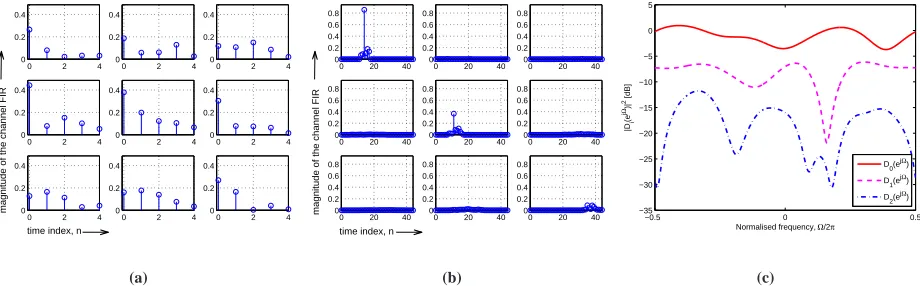
in [8], (4) and (5) may only be approximately fulfilled. This is demonstrated in Fig. 1 for a normalised broadband 3x3 MIMO channel of fourth order with a coefficient profile|hmn[l]|shown in Fig. 1(a). The resulting approximately
diagonalised system D(z)according to (4) is depicted in Fig. 1(b), whereas spectral majorisation according to (5) is highlighted in Fig. 1(c).
Referring to (2) and by defining a precoder P(z) =V(z)and an equaliser E(z) =U˜(z), the overall MIMO broadband system H(z)can be reduced to a diagonalised system D(z)such that for a transmitted data streams X(z)the received data is given by
0 2 4 0
0.2 0.4
0 2 4 0
0.2 0.4
0 2 4 0
0.2 0.4
0 2 4 0
0.2 0.4
0 2 4 0
0.2 0.4
0 2 4 0
0.2 0.4
0 2 4 0
0.2 0.4
0 2 4 0
0.2 0.4
0 2 4 0
0.2 0.4
time index, n
magnitude of the channel FIR
(a)
0 20 40 0
0.2 0.4 0.6 0.8
0 20 40 0
0.2 0.4 0.6 0.8
0 20 40 0
0.2 0.4 0.6 0.8
0 20 40 0
0.2 0.4 0.6 0.8
0 20 40 0
0.2 0.4 0.6 0.8
0 20 40 0
0.2 0.4 0.6 0.8
0 20 40 0
0.2 0.4 0.6 0.8
0 20 40 0
0.2 0.4 0.6 0.8
0 20 40 0
0.2 0.4 0.6 0.8
time index, n
magnitude of the channel FIR
(b)
−0.5 0 0.5
−35 −30 −25 −20 −15 −10 −5 0 5
Normalised frequency, Ω/2π
|D
i
(e
j
Ω)|
2 [dB]
D0(e jΩ
) D1(e
jΩ
) D2(e
jΩ)
(c)
Figure 1: (a) Sample 3x3 fourth order MIMO channel probe and its PSVD, showing (b) an approximately diagonalised system with SISO subsystems and (c) the magnitude responses along the main diagonal.
whereξ(z)represents additive white Gaussian noise at the receiver. Noting that the z-domain representation of a random process does not exist, (6) utilises the z-domain for notational convenience only, while all calculations would be performed in the time domain.
The ideal decoupling of the MIMO system in (6) such that CCI is eliminated requires exact diagonalisation of
H(z)by the PSVD algorithm. However, due to the approximate and iterative nature of the PSVD algorithm this is not necessarily fulfilled and off-diagonal elements of finite size may remain in D(z), which is likely to deteriorate the overall error performance. Therefore, the selection of the number of iteration (NoI) of the PSVD algorithm is important if good performance is to be attained. The effect of NoI on performance is twofold, as off-diagonal elements consume part of the system power, and an imperfectly diagonalised D(z) will admit CCI. Therefore the idealistic approximation in (6) can be more correctly described by the time domain formulation for the ith received symbol stream yi[l], i=0,· · ·,K−1, as
yi[l] =
Li
∑
ν=0
dii[ν]·xi[l−ν] +
K−1
∑
m=0
m6=i
Lim
∑
ν=0
dim[ν]·xm[l−ν] +ξi[l] . (7)
The quantities Liand Limin (7) denote, respectively, the order of the main and off diagonal polynomials of D(z), such
that the majority of system energy is preserved. In the following, we worked with a figure of 99.9%. The second term on the l.h.s. of (7) represents the residual CCI contributed by the off-diagonal terms in D(z).
2.2
ISI Mitigation
After mitigating CCI, ISI incurred through dispersion of individual SISO subchannels remains to be tackled. In [12] the spectral majorisation of the PSVD algorithm is exploited to maximise the overall system throughput by allocating different rates that match the individual qualities of the SISO subchannels, i.e., applying bit loading in a heuristic fashion. However in order to investigate the effect of the NoI of the PSVD algorithm on the system performance, bit loading is ignored in this paper and all SISO subchannels are loaded with the same modulation scheme. THP is used to mitigate the individual ISI of these SISO subsystems (cf. Fig. 2) and overcome the error propagation problem which a DFE scheme would experience. Two different THP methods under the Zero-Forcing (ZF) design criterion are presented, using spectral factorisation [5, 13] and block transmission [14].
2.2.1 Spectral Factorisation Scheme
Fig. 3(a) shows the ZF-THP system designed using the spectral factorisation method detailed in [5, 13] to mitigate ISI of the ith subchannel Di(z)in Fig. 2. Since Di(z)is usually non-minimum phase, the feedforward filter Fi(z)of order
L(Fi)is set to render the end-to-end discrete-time response Di(z)Fi(z)a monic minimum phase system. Thereafter, the
[image:4.612.80.540.66.209.2]D
(
z
)
THP1 THP2 THPi THPK Dec1 Dec2 Deci DecK...
...
...
...
Figure 2: THP applied to SISO subsystems resulting from the approximately diagonalised system D(z), where THPiand Deciblocks are shown in Fig. 3.
means of an iterative feedback loop shown in Fig. 3(a). These two filters along with the decision delay are computed for each Di(z). The decision delay is individually optimised for each SISO subchannel and is generally equivalent to
L(Fi)−1.
The importance of the spectral factorisation scheme lies in its capability of allowing serial transmission between transmitter and receiver. In the next section a second method is introduced, which is based on block transmission.
Di(z)
M(·) xi[n]
THPi
q(·) M(·) yi[n]
Deci
ξi[n] si[n]
ˆ
si[n]
Fi(z)
Bi(z)
(a)
P/S
S/P
s
M(·)
q(·)
N u ˆs N N x y Gi Wi THPi Deci
ξi[n]
N
N+L−1
Di(z)
M(·)
Bi
[image:5.612.96.520.263.451.2](b)
Figure 3: SISO-THP transceivers using (a) spectral factorisation and (b) block transmission schemes.
2.2.2 Block Transmission Scheme
ZF-THP can also be implemented in block transmission mode. Given the ith SISO subchannel from Sec. 2.1 d=
h
d(ii0)dii(1) · · ·d(Li)
ii i
of order Li, the block transmission scheme can be formulated following the procedures presented
in [14] and with the aid of Fig. 3(b) as follows. The block input-output behaviour of the SISO subchannel is formulated as a convolutional matrix
Di=
d(ii0) dii(1) · · · d(Li)
ii 0 · · · 0
0 dii(0) dii(1) · · · d(Li)
ii . .. ...
..
. . .. . .. · · · . .. 0
0 · · · 0 dii(0) dii(1) · · · d(Li)
ii
∈CNb×Nb+Li, (8)
where Nbis the block size of the data streams s, i.e., s=
sNb sNb−1 · · ·s1
T
. This stacking can be easily performed using a serial to parallel (S/P) device as shown in Fig. 3(b). The ZF-THP solution to such a system can be obtained once the feedforward and feedback filter matrices Wiand Bi, respectively, have been evaluated using the QR decomposition
DHi =Qi
Here, Qi∈CNb+Li×Nb+Li is a unitary matrix and Ri∈CNb×Nb is an upper triangular matrix. The feedforward filter Wiis equal to the first Nbcolumns of Qi, while the feedback filter is given by Bi=I−GiRHi , where I is the identity
matrix of size Nband Gi=diag h
r−111,r−221,· · ·,rN−1
bNb
i
with rii being the ith diagonal element of Ri. This translates
ISI into CCI between different elements of the transmitted data block, which can be easily addressed by subspace methods. However, using block transmission is likely to sacrifice some redundancy to remove inter-block interference (IBI) between successive transmit data blocks, and hence can reduce the overall system throughput. In Sec. 3, BER performances of both methods are compared on the basis of identical transmit power.
3
Simulation Results
In this Section, a comparison between the spectral factorisation and block transmission schemes of the SISO-THP is investigated, prior to evaluating the influence of the NoI onto the error performance of a polynomial-SVD based transceiver.
To evaluate the non-linear precoding methods, SISO systems with 5 coefficients are drawn independently from a complex Gaussian distribution. A total of 300 channel realisations with responses obeying an exponentially decaying average power delay profile have been simulated. Fig. 4 shows the BER performance averaged over the outlined simulations. It can be noted that the block transmission scheme outperforms its spectral factorisation counterpart due to the extra redundancy incorporated in the block transmission which, in turn, reduces the system throughput by a factor of Nb
Nb+Li which corresponds to a redundancy of
Li
Nb. Referring to Fig. 4, it is also evident that when NbLi,
the redundancy approaches zero while the throughput reduction factor '1, both block transmission and spectral factorisation BER performances converge to identical curves.
For a broadband MIMO system results, a 3x3 MIMO system with exponential power delay profile is simulated by drawing the coefficients hmn[l]from a random complex Gaussian distribution. One such ensemble probe is shown in
Fig. 1 which is normalised w.r.t. its Frobenius norm
kH(z)kz= s
M
∑
m=1
N
∑
n=1
L
∑
l=0
|hmn(l)|2=1 . (10)
For the ithPSVD-SISO subsystem, the length of the feedforward filter in case of the spectral factorisation scheme is set to twice the channel order i.e., L(Fi)=2×order(Di(z)), while the filter length of the feedback filter is assumed
as L(Bi)=order(Di(z)). Three symbol mappings are conducted using M-QAM for M=4, 16 and 64, i.e. QPSK,
16-QAM, and 64-16-QAM, in order to investigate the performance for different transmission rates. As stated in Sec. 2.2, no bit loading is assumed in this study, therefore different subchannels’ BER performances are expected as a result of the spectral majorisation property of the PSVD algorithm.
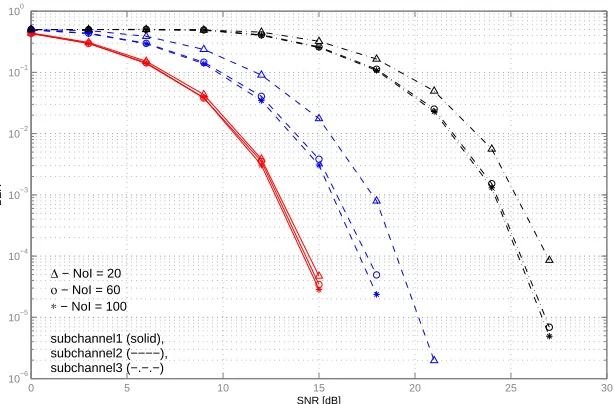
To investigate the effect of NoI within the PSVD algorithm on the BER performance of individual SISO-THP subsystems Di(z), three different NoI values of 20, 60 and 100 are tested. Figs. 5, 6 and 7 demonstrate this effect
for the three transmission rates using QPSK, 16-QAM, and 64-QAM, respectively. This NoI determines how well both decoupling and spectral majorisation can be achieved. The following comments are motivated by the simulation results:
• For all cases and all subchannels, the BER performance is improved by increasing the NoI. Also note that for high NoI, this advantage becomes incremental. This decrease allows for a significant reduction in system complexity by choosing a moderate NoI without any degradation in performance.
0 1 2 3 4 5 6 7 8 9 10 10−4
10−3 10−2 10−1 100
SNR [dB]
BER
[image:7.612.152.460.100.302.2]Spectral−Factorization N = 5 ~ Redundancy = 100% N = 10 ~ Redundancy = 50% N = 20 ~ Redundancy = 25% N = 100 ~ Redundancy = 5%
Figure 4: BER performance comparison of the spectral factorisation and block transmission schemes for SISO-THP system.
0 5 10 15 20 25 30
10−6 10−5 10−4 10−3 10−2 10−1 100
SNR [dB]
BER
∆ − NoI = 20
ο − NoI = 60
∗ − NoI = 100
subchannel1 (solid), subchannel2 (−−−−), subchannel3 (−.−.−)
[image:7.612.153.460.427.629.2]0 5 10 15 20 25 30 10−7
10−6 10−5 10−4 10−3 10−2 10−1 100
SNR [dB]
BER
∆ − NoI = 20
ο − NoI = 60
∗ − NoI = 100
[image:8.612.153.460.99.303.2]subchannel1 (solid), subchannel2 (−−−−), subchannel3 (−.−.−)
Figure 6: SISO-THP performance of the individual subchannels resulting from the application of the PSVD algorithm with varying NoI to a 3x3 MIMO system and “16-QAM” transmission.
0 5 10 15 20 25 30
10−7 10−6 10−5 10−4 10−3 10−2 10−1 100
SNR [dB]
BER
∆ − NoI = 20
ο − NoI = 60
∗ − NoI = 100
subchannel1 (solid), subchannel2 (−−−−), subchannel3 (−.−.−)
[image:8.612.153.460.427.630.2]4
Conclusions
A study on the approximate fulfilment of the novel polynomial SVD (PSVD) algorithm to diagonalise a broadband MIMO system into a number of independent frequency selective SISO subsystems as well as its impact on the system performance is considered. Due to the iterative nature and the finite number of the PSVD algorithm steps, a sufficient number of iteration (NoI) is investigated showing that a reasonable moderate NoI can be used to asymptotically achieve the desired performance of the individual SISO subsystems. Furthermore, two nonlinear ZF-THP precoding alternative schemes for the resultant ISI SISO subchannels are compared demonstrating that further performance improvement is attainable with extra redundancy.
References
[1] G. Foschini and M. Gans, “On Limits of Wireless Communications in a Fading Environment when Using Multiple Antennas,”
Wireless Personal Communications, vol. 6, no. 3, pp. 311–335, March 1998.
[2] I. E. Telatar, “Capacity of Multi-antenna Gaussian Channels,” European Transactions on Telecommunications, vol. 10, no. 6, pp. 585–595, December 1999.
[3] A. Lozano and C. Papadias, “Layered Space-Time Receivers for Frequency-Selective Wireless Channels,” IEEE Transactions
on Communications, vol. 50, no. 1, pp. 65–73, January 2002.
[4] M. Joham, D. A. Schmidt, J. Brehmer, and W. Utschick, “Finite-Length MMSE Tomlinson-Harashima Precoding for Fre-quency Selective Vector Channels,” IEEE Transactions on Signal Processing, vol. 55, no. 6, pp. 3073–3088, June 2007. [5] R. F. Fischer and J. B. Huber, “Equalization Strategies for Transmission over Space and Time,” Electronik und
Informations-technik, vol. 6, pp. 187–195, 2005.
[6] L.-U. Choi and R. D. Murch, “A Pre-BLAST-DFE Technique for the Downlink of Frequency-Selective Fading MIMO Chan-nels,” IEEE Transactions on Communications, vol. 52, no. 5, pp. 737–743, May 2004.
[7] M. Vu and A. Paulraj, “MIMO Wireless Linear Precoding,” IEEE Signal Processing Magazine, vol. 24, no. 5, pp. 86–105, September 2007.
[8] J. G. McWhirter, P. D. Baxter, T. Cooper, S. Redif, and J. Foster, “An EVD Algorithm for Para-Hermitian Polynomial Matrices,” IEEE Transactions on Signal Processing, vol. 55, no. 5, pp. 2158–2169, May 2007.
[9] W. Al-Hanafy, A. P. Millar, C. H. Ta, and S. Weiss, “Broadband SVD and non-linear precoding applied to broadband MIMO channels,” in 42nd Asilomar Conference on Signals, Systems and Computers, Oct. 2008, pp. 2053–2057.
[10] M. Tomlinson, “New Automatic Equaliser Employing Modulo Arithmetic,” IEE Electronics Letters, vol. 7, no. 5/6, pp. 138– 139, March 1971.
[11] H. Harashima and H. Miyakawa, “Matched-Transmission Technique for Channels with Intersymbol Interference,” IEEE
Transactions on Communications, vol. 20, pp. 774–780, August 1972.
[12] W. Al-Hanafy and S. Weiss, “Comparison of precoding methods for broadband MIMO systems,” in 3rd IEEE International
Workshop on Computational Advances in Multi-Sensor Adaptive Processing (CAMSAP), Dec. 2009, pp. 388 –391.
[13] R. F. H. Fischer, “Sorted Spectral Factorization of Matrix Polynomials in MIMO Communications,” IEEE Transactions on
Communications, vol. 53, no. 6, pp. 945–951, June 2005.