Manipulation of Near Earth Asteroids
Alison Gibbings,
1, 2,∗Massimiliano Vasile,
1John-Mark Hopkins,
3Alastair Wayman,
4Steven Eckersley,
4and Ian Watson
21Advanced Space Concepts Laboratory, University of Strathclyde, Glasgow, UK 2Systems, Power and Energy Research Division, University of Glasgow, Glasgow, UK
3Institute of Photonics, University of Strathclyde, Glasgow, UK 4Airbus Defence and Space, Stevenage, UK
compiled: April 8, 2014
Abstract Analysis gained from a series of experiments has demonstrated the effectiveness of laser ablation for the low thrust, contactless deflection and manipulation of Near Earth Asteroids. In vacuum, a 90 W continuous wave laser beam has been used to ablate a magnesium-iron silicate sample (olivine). The laser operated at a wavelength of 808 nm and provided intensities that were below the threshold of plasma formation. Olivine was use to represent a rocky and solid asteroidal body. Assessed parameters included the average mass flow rate, divergence, temperature and velocity of the ejecta plume, and the height, density and absorptivity of the deposited ejecta. Experimental data was used to verify an improved ablation model. The improved model combined the energy balance of sublimation with the energy absorption within the Knudsen layer, the variation of flow with local pressure, the temperature of the target material and the partial re-condensation of the ablated material. It also enabled the performance of a space-based laser system to be reassessed. The capability of a moderately sized, conventional solar powered spacecraft was evaluated by its ability to deflect a small and irregular 4 m diameter asteroid by at least 1 m/s. Deflection had to be achieved with a total mission lifetime of three years. It was found to be an achievable and measurable objective. The laser (and its associated optical control) was designed using a simple combined beam expansion and focusing telescope. The mission study therefore verified the laser’s proof-of-concept, technology readiness and feasibility of its mission and subsystem design. It also explored the additional opportunistic potential of the ablation process. The same technique can be used for the removal of space debris.
xxx
Keywords:Asteroids, Laser, Ablation, Deflection, Exploration, Spacecraft, Experiments
PACS:89.20.Bb
INTRODUCTION
Laser ablation is being investigated as a possible low thrust technique for the contactless deflection and manipulation of Near Earth Asteroids (NEAs). It is achieved by irradiating the surface of an asteroid with a laser light source. Heat from the laser beam is absorbed, enabling the illuminated material to sublimate directly from a solid to a gas. The sublimated material then forms into a plume of ablated ejecta. Similar to the rocket exhaust, the flow of ablated material produces a continuously controlled low thrust. This low thrust can be used to push the asteroid away from an Earth threatening impact; modifying the asteroid’s trajectory and tumbling motion. Other techniques of low thrust, contactless deflection also include the gravitiy tractor [31, 65] and ion beaming [7].
Previous analysis performed by Sanchez et al. 2009 [62] demonstrated the theoretical capability of surface ablation. With a relatively low mass into space, and a short warning time, ablation can provide a controllable deflection action. Here, the energy input is provided by concentrated solar energy. A large space-based solar concentrator can collect, focus and sublimate a small portion of the asteroid’s surface [37, 38]. However launching and operating a large spacecraft is a significant technological challenge. The solar concentrator needs to be manoeuvred at close proximity to the asteroid, under the asteroid’s irregular gravity field. The contaminating effects of the ejecta plume are also unknown.
A simpler and more adaptable solution could be to split the single spacecraft into multiple units. A swarm of small scale, low power spacecraft could fly in formation with the asteroid. Their overlapping beams of light would be used to increase the surface power density, enabling its sublimation [33, 34, 68]. This second approach provides a far more flexible solution, with built in redundancy that can be easily scaled. The number of spacecraft would depend on the size and composition of the asteroid and the warning time before impact. Multiple spacecraft also permit the delivery of a much more powerful system. It reduces the required time needed to achieve a suitable deflection distance and the occurrence of any single point failure. A highly redundant mission scenario is preferable as it accounts for large observational uncertainties in the asteroid’s material and structural composition, and in the mission design parameters [79].
Further research is still required to advance the current understanding of laser ablation as a viable method of asteroid deflection. The ablation model is based on the energy balance of sublimation and was developed from three fundamental assumptions. These assumptions defined the physical formation of the ejecta plume, the composition of a dense and homogeneous target asteroid (with a one-dimensional transfer of heat) and the potential of the ejecta to contaminate any exposed surface [20, 62]. To examine the viability of these assumptions and the general applicability of the ablation and contamination models, a series of laser ablation experiments were performed by the authors [15, 17]. In vacuum, a 90 W continuous wave laser beam was used to ablate a magnesium-iron silicate (olivine) rock. The laser operated at a wavelength of 808 nm and provided intensities that were below the threshold of plasma formation. Olivine was used to represent a rocky and solid asteroidal body. The experiment measured the average mass flow rate, dispersion and temperature of the ejecta plume and the contaminating effects - height, density and absorptivity - of the deposited ejecta. Results were used to improve the ablation and contamination models. Degradation caused by the deposited ejecta is a critical factor. It will affect the performance of the laser beam, its operational lifetime and the overall endurance of the ablation technique. The system performance of the spacecraft will also be affected. The ejection of material will affect the stability and directionality of the resultant thrust vector.
The experiments demonstrated how laser ablation is dominated by the volumetric removal of gaseous material. It is similar in shape and formation to the exhaust in standard methods of rocket propulsion, although the absorptive properties of the deposited material were considerably different. Reported in Gibbings et al, 2013 [17], the absorptivity of the deposited ejecta was 104 m−1 (two orders of magnitude smaller than previously assumed in [20]) and had a deposited density of 250 kg/m3 (previously assumed to be 1000 kg/m3 in [20]). There was also no immediate saturation of the exposed surface, nor the formation of a permanently attached opaque surface layer. The deposited material was loosely bound to the underlying substrate and could be easily removed. The laser beam also provided a self-cleaning action. There was no apparent deposition along the path length of the laser beam. The initial model was found to be overly conservative in an unexpectedly benign environment. It also excluded the additional optical-thermal effects between the laser beam and the ejecta plume, and the occurrence of incoherent ablation from the target’s surface. The improved model, verified through the experimental results, therefore combined the energy balance of sublimation with the energy absorption within the Knudsen layer, the variation of sublimation temperature with local pressure, the temperature dependent thermal conductivity of the target material and the partial re-condensation of the ablated material. These improvements were developed from previous research papers given in Knight, 1979; Bulgakov et al, 1999; Robbie et al, 1982, Ketren et al, 2010; O’Keefe et al, 1971 [10, 22, 23, 42, 57]. They detail laser ablation for non-space applications.
and measurable objective. Mission mass and complexity is saved by the direct ablation of the asteroid’s surface. The same technique can also be applied to the de-orbiting of space debris [47, 48, 52, 54, 56, 70, 71].
The paper will therefore report on the results and analysis gained from the laser ablation experiments. It includes a presentation of the recently advanced ablation model and its overall effect on the design of a space-based ablation system. The laser system was sized from an assessment of the minimal input power, spot size radius, shooting distance (including the degrading effects of the ablated ejecta) and momentum coupling. The size of the laser will directly affect the configuration and subsystem design of the spacecraft. Analysis also explored the additional scientific, exploration an exploitation potential of the ablation process. The necessary technological development needed to fully develop laser ablation into a viable space-based application is also addressed. Work therefore supports the general diversity and durability of using space-based lasers and the applicability of the model’s experimental verification.
LASER ABLATION MODEL
The laser ablation model is based on the energy balance of sublimation. It combines the absorption of the laser beam, the latent heat of complete sublimation and the heat loss through conduction and radiation [20, 51, 62]. Improvements include the energy absorption within the Knudsen layer, the variation of sublimation temperature with local pressure, the temperature dependent thermal conductivity of the target material and the partial re-condensation of the ablated material. Ablation occurs without any ionisation or ejection of solid particles. The target asteroid is also assumed to be a dense, homogeneous structure, which behaves as a black body with an infinite heat sink. Degradation caused by the deposited ejecta is based on the Beer-Lambert-Bougier law. The text below provides a short summary of the ablation and contamination models. It is however given in more detail in Gibbings 2013; Vasile et al, 2014 [15, 74]
Using a one-dimensional energy balance at the illuminated spot, the ablation model derives the mass flow rate per unit area of the sublimation material ˙µ. This is given by:
˙
µ
Ev+1
2v¯
2+C
P(TSU B−T0) +CV(TSU B−T0)
=PI−QR−QC (1)
where Ev is the latent heat of complete sublimation, ¯v is the velocity of the ejecta plume, CP is the specific heat capacity of the ejected gas at constant pressure, TSU B is
the sublimation temperature,T0is the temperature of the material prior to sublimation, CV
is the specific heat capacity of the asteroid at a constant volume andPI is the absorbed laser beam per unit area. QR andQC are the heat loss per unit area through radiation and conduction respectively.
The term CV(TSU B−T0) accounts for the energy needed to increase a layer of the
target material from its initial temperature T0 to the sublimation temperatureTSU B. The
term 12v¯2+CP(TSU B−T0) accounts for the energy that is absorbed by the vapour in the
to the maximum heat capacity according to the Debye-Einstein asymptotic heat capacity for solids [57]. CP is the maximum expected heat capacity value given the range of sublimation temperatures of the target material [41]
The heat loss, per unit area, through radiation and conduction are:
QR=σSBε TSU B4 −TAMB4
(2)
QC= (TSU B−To)
r
CVρAκA
πt (3)
σSBis the Stefan-Boltzmann constant,TAMBis the ambient surrounding temperature and
tis the time that the surface of the asteroid is illuminated under the spot light.ε,ρAandκA
are the black body emissivity, density and thermal conductivity of the asteroid respectively. The thermal conductivity from the sublimated material to the inner core is assumed to be a function of the sublimation temperature. It is achieve through the power law relation:
kA=kA0
298
TSU B 0.5
(4)
The average velocity of the ejecta plume ¯v is calculated by assuming Maxwell’s distribution of an ideal gas. It is defined by the sublimation temperature, the molar mass of the ablated materialMaand Boltzmanns constantkb. This is given by:
¯
v=
s
8kbTSU B
πMa
(5)
The experimental result shows that the olivine sample will ablate and dissociate into diatomic oxides. This has a prevalence of magnesium (Mg) and silicon oxide (SiO), where its molar mass was considered to be 0.06 kg/mol [15, 17]. The forceFSU B acting on the asteroid is therefore given by a product of the ejecta velocity and the mass flow rate of the ablated material. It is expressed as:
FSU B=λv¯m˙SU B (6)
A constant scatter factorλis used to account for the hemispheric, rather than the linear
expansion of the ejecta plume. It is the integral of the trigonometric part in equation (10). The ablation temperature is related to the local pressure through the Clausius-Clapeyron equation:
ln ps pre f =
EV
R
1
Tre f −
1
TSU B
ps is the pressure corresponding to the temperature TSU B and pre f is the pressure
corresponding to the reference temperatureTre f [10, 22]. Ris the universal gas constant. The vapour pressure will increase with the temperature of the irradiated asteroid. The reference temperature was taken to be 3800 K (at 1 atmosphere). Previous research has shown that the sublimation temperature for a range of Mg-Fe and Si-Fe oxides can vary between 3175-3800 K. [42, 77]. A lower sublimation temperature can also be caused by the transparency of pure minerals [40]. The enthalpy of complete sublimation is considered to be constant in the range of temperatures in which equation (7) is valid.
The mass flow rate is also dependent on the local pressure at the interface between the Knudsen layer and the ablated material through the Hertz-Knudsen equation [24]. This is expressed as:
˙
µ= (1−k)ps
1 2πRSTSU B
12
(8)
wherekis the fraction of molecules that re-condense at the interphase. (1-k) is therefore the fraction of vapour molecules that contributes to the pressure of sublimation, but not the sublimated flux. ps is the vapour pressure andRSis the specific gas constant. RScan be expressed as a function of the molecular massMaand the universal gas constant, R = 8.3144 J/molK, whereRS= MR
a. The maximum rate of evaporation not only depends on
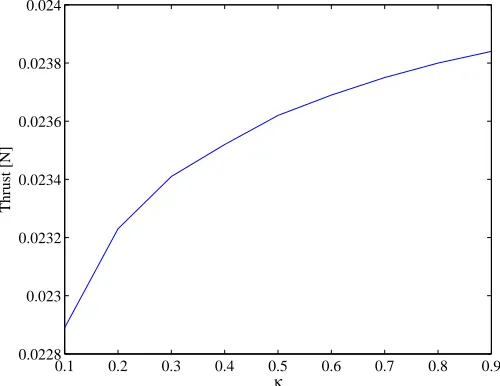
the supply of heat (and therefore its temperature), but must also be accompanied with an increase in the vapour pressure that is caused by the sublimation action. The fraction of molecules that re-condense is expected to increase with the local pressure. However the change in the thrust due to the recondensation is limited. Figure 1 plots the resulting thrust against a wide range of recondensation fractions. The maximum variation in thrust is only 4 %. This can therefore be considered negligible.
0.1 0.2 0.3 0.4 0.5 0.6 0.7 0.8 0.9 0.0228
0.023 0.0232 0.0234 0.0236 0.0238 0.024
κ
[image:6.612.172.422.480.673.2]Thrust [N]
The absorbed laser power per unit areaPI can be defined as:
PI = ττgαMηLPL
ASPOT (9)
ηL is the efficiency of the laser system, ASPOT is the area of the surface spot and PL
is the input power to the laser. αM = (1−εaαs) is the absorption at the spot. This is
dependent on the albedoαsof the asteroid multiplied by the increment in reflectivelyεaat
the wavelength of the laser beam. For a S class (silicates - olivine, pyroxene - and metals) asteroid the albedo is between 0.1 and 0.3. It has a 20 % reflectively peak increment between 750 and 800 nm with respect to the central wavelength at 505 nm [11]. A standard NEA has an average albedo of 0.154 [12]. The reflectivity of an asteroid is dependent on its mineral composition, chemistry, particle size and temperature. Each reflectance spectrum is characterised with wavelength-dependent absorption features, which also varies with the different classes of asteroids (S, C, M and E class). S and C class asteroids are the most common classification within the NEA population. Equation (9) also accounts for the absorption of the laser beamτg within the rapidly expanding and absorbing plume of
ejecta. From the experimental results, it is expected that the ejecta plume will absorb 10-15 % of the incoming laser beam. The input power of the laser beam is also multiplied by a degradation factorτ. This accounts for the degrading effects caused by the re-condensed
deposited ejecta material. The re-condensed material does not directly affect the laser beam, but it can reduce the power input generated by the solar array, or any other power source that uses sunlight. The degradation caused by the ablated ejecta is computed using the model developed by Kahel el al, 2006 [20].
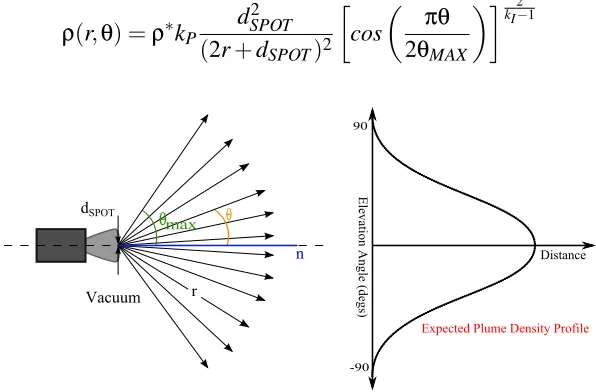
The expected level of degradation is defined by first calculating the plume densityρat a
given distancerfrom the spot location and local elevation angleθfrom the surface normal
(as shown in Figure 2). It is expressed as [20]:
ρ(r,θ) =ρ∗kP
dSPOT2
(2r+dSPOT)2
cos
πθ
2θMAX
2
kI−1
(10)
n
r Vacuum dSPOT
Elevation Angle (degs)
Distance
Expected Plume Density Profile
90
-90
[image:7.612.156.454.485.681.2]o
maxo
dSPOT is the surface spot diameter,kI the adiabatic index (for diatomic molecules this is
1.44),kP is the jet constant (for diatomic molecules this is 0.345) andθMAX is limited to
130.45 degs [20, 28]. The density at the nozzle (at the sublimation point)ρ∗is given by:
ρ∗= m˙SU B
ASPOTv¯ (11)
On any exposed surface, located within the ablation volume, the variation in the cumulative ejecta thickness can be expressed as:
dh
dt
layer
= 2 ¯vρ
ρlayer
cosΨv f (12)
ρlayer is the layer density of the deposited material andΨv f is the geometric view factor.
A factor of two accounts for the increase in velocity due to expansion of gas into a vacuum. From this, the degradation factor τ given by the Beer-Lambert-Bougier-Law
can be expressed as:
τ=e−ηh (13)
η is the absorptivity of the deposited ejecta (absorbance per unit length) and h is
the thickness of the deposited material. In the experiments reported in Gibbings 2013; Gibbings et al, 2013 [15, 17], for the ablation of an olivine sample, the absorptivity and layer density of the deposited ejecta was found to be 104m−1and 250 kg/m3respectively. The mass flow rate of the ablated material can then be computed by integrating ˙µover the surface area illuminated by the laser beam. This is in accordance to the model initially developed by Sanchez et al, 2009 [62], given by:
˙
mSU B=2Vrot
Z ymax
ymin
Z tout
tin
1
Ev∗(PI−QR−QC) dt dy (14)
The new termEv∗is the augmented enthalpy and is equal to:
Ev∗=
Ev+1
2v¯
2
+CP(TSU B−T0) +CV(TSU B−T0)
(15)
The limits [ymin, ymax] and [tin, tout] define the location and duration for which the surface spot is illuminated respectively. Vrot is the velocity of rotation of the asteroid’s surface as it travels under the illuminated spot area.
TECHNOLOGY DEMONSTRATION MISSION
aimed to demonstrate the technological capabilities of laser ablation in providing a sufficiently high and measurable deflection action. The mission objective, to which the performance of the deflection action was compared, was to deflect a small and irregular 4 m diameter asteroid (2006 RH120, S class) by at least 1 m/s. Deflection had to be completed with a total mission lifetime of less than three years, and be developed from highly innovative, yet achievable technologies within the 2025+ timeframe. The mission concept was called LightTouch2and the spacecraft was called AdAM (Asteroid Ablation Mission).
Deflection was assessed by either measuring the integral of acceleration imparted onto the asteroid or through the variation in the asteroid’s orbital position and velocity [72]. Variation is with respect to the nominal, pre-ablated orbit. Each method gives a measure of the imparted ∆v. The following sections detail the specifications of the space-based
laser system and how it was integrated into the subsystem design of the spacecraft. Please see the publications by Vasile et al 2013; Vetrisano et al 2013 [72, 73, 75] for further information on the mission architecture, asteroid selection, orbital analysis, and the guidance, navigation and control (GNC) of the mission. Papers by Gibbings 2013; Vasile et al 2013 [15, 72] detail further information on the secondary payload selection (impact sensor and LIBS) and subsystem design.
Sizing the Laser System
The design of the spacecraft was developed by first considering the performance and specifications of the laser (as its primary payload) and impact sensor. A diode pumped fibre laser was selected to initiate the ablation process. An impact sensor (similar to the instrument flying on the ESA Rosetta mission) would also be used to measure the momentum and deposition effects of the ablated ejecta.
Critical parameters for sizing the laser system included the minimal input power, spot size radius and shooting distance. These factors will affect the overall thrust time of the mission and the required optical alignment, stability and control of the laser system. Power, beam quality and the focusing requirements are other important parameters. Reported in Vasile et al, 2013 [72] the accumulative thrust time required to achieved the necessary deflection of 1 m/s was evaluated at different input powers (850-1000 W), spot side radius (0.8-1 mm) and shooting distances (20-50 m). Analysis included the degrading effects of the ablated ejected.
the asteroid’s surface is used to improve the robustness and reliability of the deflection action. New procedures can be tested and verified. The ablation response can also be monitored throughout. The remaining mission year of operations can be used to increase the robustness (by providing a large contingency margin) of the mission and to perform additional opportunistic science objectives. The latter can be achieved with the inclusion of a combined Raman/Laser Induced Breakdown Spectrometer (LIBS). LIBS can examine the chemical, mineralogical and isotopic composition of the ejecta plume. It will also be supported with the operations of the narrow and wide angle cameras. Both cameras are needed for GNC.
The laser system was therefore assumed to operate with an input power of 860 W (increasing to 1032 W with a 20 % design margin), a temperature of 10 ◦C (based on the diodes), a wavelength of 1070 nm, an overall plug-in efficiency of 55 % and a system mass of 24 kg. Efficiency was based on the performance of electrically pumped, high power (∼1.5 kW) fiber laser systems. Here, high power semiconductor lasers are coupled with a length of doped fibre that is placed in a laser resonator. The efficiency of the diodes (∼ 75 % state-of-the-art) and fibre laser (>70 %), at an output wavelength of 1070 nm (based on existing industrial kilo-watt class lasers), results in a laser with an electrical-to-optical efficiency of 55 %. These values are based on the current and perceived near-future advancement in fibre technology and system efficiencies. For example, recent advancement by nLIGHT Photonics demonstrated, through the DARPA Super Efficiency Diode Sources and Architecture for Diode High Energy Laser Systems programmes, a diode laser pumped efficiency greater than 75 %. These pumped lasers represent the most compact, efficient and highest power currently available for a continuous wave light source. The system mass was based on the performance of existing kilo-watt class industrial lasers, perceived technological development, and the heritage gained from previously flown and therefore space qualified reflective telescopes (for example, the HiRISE instrument on the Mars Reconnaissance Orbiter).
Shown in Figure 3 the laser (and associated optical control) was designed using a simple, combined beam expansion and focusing telescope. With a nominal focus length of 50 m, a collimated beam (that appears as a point source) will be expanded and refocused onto the desired point on the surface of the asteroid. A telescope will expand the collimated output of a high-power fibre laser to about 75 mm in diameter. The laser beam will then be focused by a highly reflective and metallic off-axis parabolic or aspheric mirror, with an approximate diameter of 100 mm. The focusing laser beam will then be reflected from a right-angle, half-cube reflector. This will allow for the final position and orientation of the output laser beam. For repositioning of the exit laser beam, the end optic could be placed in a domed window. Beam steering will be provided by motorised actuators on the focusing optics. This can improve the pointing and stability of the laser beam, and so minimises any focusing errors.
Initial Collimator
Fibre 6 mm Diameter Beam
[image:11.612.136.476.84.251.2]100 mm Diameter Beam XY Mirror mount
Fig. 3.Laser System and Telescope Beam Expander. Image reproduced from [72]
Fig. 4.Beam Behaviour of a 1070 nm Fibre and a f = 50 m Optic. Data reproduced from [72]
the beam diameter at the exit of the focusing mirror and the focused spot radius at 50 m from the surface of the asteroid. For a 100 mm beam diameter the 2ZR value is 2 m.
Therefore, either side of the focus, the beam intensity will not change appreciably over 1 m. Ablation can still occur with a de-focused laser beam. For a 70 mm beam diameter and a 0.8 m spot radius, the 2ZRvalue is over 3 m.
The 2ZR value provides a degree of operational flexibility and control in the focusing
[image:11.612.136.474.297.478.2]Spacecraft Configuration
The AdAM spacecraft was designed to operate in two orbital configurations; either trailing the asteroid or in a radial direction. The two different approaches correspond to the two operational strategies for ablation. It is important to understand how the close proximity operations of the spacecraft would affect the design of the GNC system and the overall performance of the deflection action.
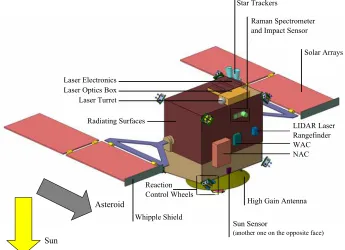
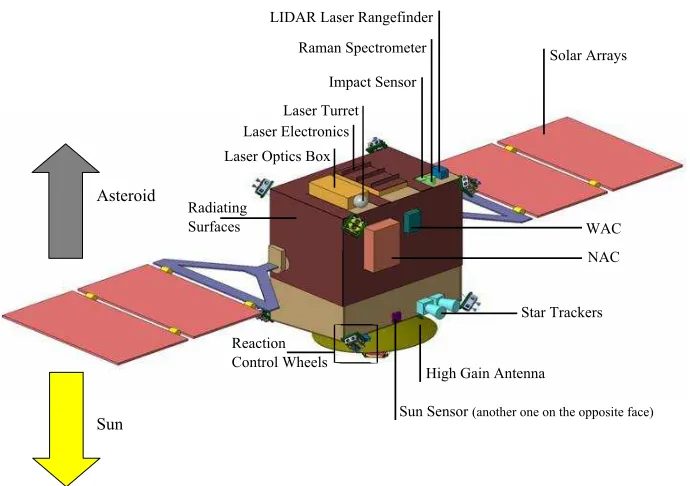
Shown in Figure 5, in the trailing configuration the spacecraft is flying in formation with the asteroid’s along track, trailing or leading by 50 m. This limits the contamination effects of the ejecta plume on the performance of the optics, radiators, multi-layering insulation and solar arrays. In the radial configuration, as shown in Figure 6, the spacecraft is located between the asteroid and the Sun. This reduces the number of actuators by balancing the forces acting on the spacecraft, while still providing a measurable deflection action [73, 75]. Here, the laser beam operates perpendicular to the spacecraft’s solar arrays, from the umbra side. The laser system is located on the top face of the spacecraft; fully exposed to the full formation of the ejecta plume. Any ejecta that does deposit, will do so on the rear of the solar arrays. This poses a negligible risk to the power generating ability of the solar arrays. The two optical cameras point towards the asteroid.
Asteroid
Sun
Radiating Surfaces
High Gain Antenna Reaction
Control Wheels
Sun Sensor
(another one on the opposite face) Solar Arrays Star Trackers
Whipple Shield Laser Electronics
Laser Optics Box Laser Turret
Raman Spectrometer and Impact Sensor
[image:12.612.134.479.348.598.2]LIDAR Laser Rangefinder WAC NAC
Fig. 5.AdAM in the Trailing Configuration - All Externally Mounted Instruments and Units
Asteroid
Sun
Reaction Control Wheels
Sun Sensor (another one on the opposite face) High Gain Antenna
Star Trackers WAC
NAC Solar Arrays LIDAR Laser Rangefinder
Raman Spectrometer
Impact Sensor
Laser Electronics
Laser Optics Box Laser Turret
[image:13.612.134.479.80.323.2]Radiating Surfaces
Fig. 6.AdAM in the Radial Configuration - All Externally Mounted Instruments and Units
spacecraft (and its system performance) from the abrasive effects of the ablated ejecta. A similar solution was implemented on the NASA Stardust mission to comet Wild2 and is currently flying on both the ISS and the Automated Transfer Vehicle. The Whipple Shields provide an innovative and relatively low mass shielding solution. It consists of a thin, multi-layer structure of mylar and kapton that acts as a sacrificial bumper shield.
In both configurations the laser and radiators are always in the shadow cone of the spacecraft. This allows maximum heat dissipation. Radiators (4.3 m2) face into deep space, a high gain antenna (1.3 m) points towards the Earth and the solar arrays (7.5 m2) are orientated towards the Sun. Low cost telemetry, tracking and command is provided by an 12 m X-band telecommunication link (planned upgrade from S-band) with the ESA ground station site at Harwell, England (Malindi, Kenya as the back-up). The spacecraft is 3-axis stabilised with four reaction wheels and sixteen reaction control thrusters. Acquisition and navigation to the asteroid is provided by two star trackers, sun sensors, an inertial measurement unit, a laser range finder and two optical cameras. The GNC subsystem, as reported further in Vertrisano et al 2013; Vasile et al 2013 [72, 73, 75], has been designed to account for the forces of the laser recoil, the gravity of the asteroid, the gravity gradient of the Sun, solar radiation pressure, plume impingement and the induced deflection action. These factors will be used to estimate the spacecraft’s trajectory and the response to the ablation process [75]. Further details on the subsystem analysis and design of the AdAM spacecraft can be found in Vasile et al 2013; Gibbings 2013 [15, 72, 73].
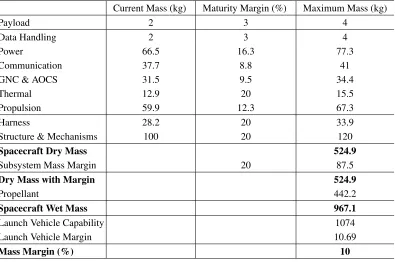
margin for new design units. Each subsystem also included a conservative 20 % mass margin. A 20 % margin was also added onto the nominal dry mass. The allocation of the mass margin is in accordance with ESA standards. Shown in Table 1, the largest proportion of the spacecraft’s mass is the structure, followed by the power and GNC subsystems.
Table 1.Spacecraft Mass Allocation - 860 W Laser Launched by the PSLV XL into GTO
xCurrent Mass (kg)x xMaturity Margin (%)x xMaximum Mass (kg)x
Payload 2 3 4
Data Handling 2 3 4
Power 66.5 16.3 77.3
Communication 37.7 8.8 41
GNC & AOCS 31.5 9.5 34.4
Thermal 12.9 20 15.5
Propulsion 59.9 12.3 67.3
Harness 28.2 20 33.9
Structure & Mechanisms 100 20 120
Spacecraft Dry Mass 524.9
Subsystem Mass Margin 20 87.5
Dry Mass with Margin 524.9
Propellant 442.2
Spacecraft Wet Mass 967.1
Launch Vehicle Capability 1074
Launch Vehicle Margin 10.69
Mass Margin (%) 10
to 0.2 mm. However a 0.2 mm spot size is a very demanding requirement in the optical system. Shown in Figure 4, controlling the beam radius to 0.2 mm (or smaller) is possible, but would require precise control as the 2ZR value drops rapidly below 1 m. A spot size
between 0.6-1 mm is far more reasonable and enables the requirements on the focusing distance to be relaxed.
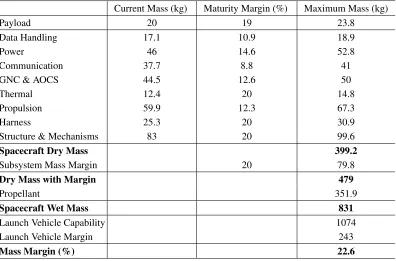
[image:15.612.110.506.285.546.2]Another improvement was to replace the LIDAR range finder with a low-mass and low-power range finder. Shown in Figure 4, the Rayleigh range can also be increased to 3 m. This was used to reduce the navigation requirement of the spacecraft. The spacecraft’s mass was also optimised. This included improvements in the propellant mass, and the thermal, structural and power subsystem mass. It will have a cascade effect on the rest of the spacecraft design. The same margin philosophy was used throughout.
Table 2. Spacecraft Mass Allocation - 480 W Laser Launched by the PSLV XL into GTO
xCurrent Mass (kg)x xMaturity Margin (%)x xMaximum Mass (kg)x
Payload 20 19 23.8
Data Handling 17.1 10.9 18.9
Power 46 14.6 52.8
Communication 37.7 8.8 41
GNC & AOCS 44.5 12.6 50
Thermal 12.4 20 14.8
Propulsion 59.9 12.3 67.3
Harness 25.3 20 30.9
Structure & Mechanisms 83 20 99.6
Spacecraft Dry Mass 399.2
Subsystem Mass Margin 20 79.8
Dry Mass with Margin 479
Propellant 351.9
Spacecraft Wet Mass 831
Launch Vehicle Capability 1074
Launch Vehicle Margin 243
Mass Margin (%) 22.6
Reducing the laser input power decreased the size (and therefore the mass) of the solar arrays, radiators, PCDU and the laser itself. A solar array area reduced to 4.25 m2. The mass of the laser could also be reduced to 5.6 kg. In the previous analysis, over 50 % of the laser mass was a thermal heat sink. This had already been included in the mass of the spacecraft’s thermal subsystem (including radiators, heat pipes and multi-layering insulation). The mass of the optics remained the same.
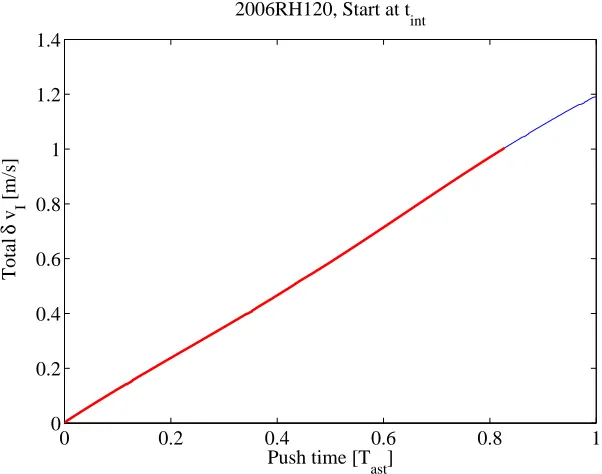
In practice this would be divided into a series of ablation periods, followed by an orbit determination campaign. The push time plotted on the x-axis is measured as a fraction of the orbital period of the asteroid.
0 0.2 0.4 0.6 0.8 1
3.8 4 4.2 4.4 4.6 4.8 5 5.2
Push time [T ast]
Thrust [mN]
[image:16.612.151.450.150.382.2]2006RH120, Start at t int
Fig. 7.Thrust Level for the Reduced 480 W Laser Input
0 0.2 0.4 0.6 0.8 1
0 0.2 0.4 0.6 0.8 1 1.2 1.4
Push time [T ast]
Total
δ
v I
[m/s]
2006RH120, Start at t int
[image:16.612.147.448.442.679.2]If the peak thrust is reduced to 5.5 mN and the input power to the laser is 480 W, the push time increases to 83 % of the orbital period of the asteroid [72, 73]. The accumulative thrust time almost doubles to 302-403 accumulative days. Despite this increase, the time to achieve the 1 m/s deflection action is still achievable within the mission duration of three years.
It should also be noted that the substantial reduction in the laser’s input power does not significantly affect the mass of the spacecraft. Only 136 kg is saved. This relates to a reduction of about 0.12 kg/W of laser power. The dry mass is dominated by the structural mass. Here, for reliability reasons a 20 % mass margin was applied. A 20 % margin was also added to existing flight proven components and industry standard hardware. It included the solar array mechanism, impact sensor and thermal components. A more relaxed 10 % mass margin would lower the spacecraft’s total wet mass to 779 kg and the dry mass to 445 kg. The result is comparable with the NEAR Shoemaker mission.
OPPORTUNISTIC POTENTIAL
Work also demonstrated the additional scientific, exploration and exploitation potential of laser ablation. Experiments performed by the authors showed how laser ablation results in the subsurface tunnelling and volumetric removal of deeply situated and previously inaccessible material [15, 17]. This is due to the formation of a subsurface groove and the ejection of highly volatile material within the ejecta plume. The ablated material is elementally identical to the original source material. However the absorptive properties -deposited ejecta height, density and absorptivity - are considerably different. Deposition results in a fine, powder-like material that can be easily removed.
The exposure, interaction and possible collection of this newly ablated material can maximise the scientific capability of any contactless deflection-based mission. It can also be used to enhance any remote sensing, in-situ or sample return mission. Deep, subsurface material extraction is not currently possible through conventional exploration techniques. Nor is it being considered in any future asteroid missions (i.e. Marco Polo-R). Sample depth (for an asteroid mission), using current state-of-the-art drilling techniques is limited to a few centimetres below the surface [39]. Laser ablation could therefore be used to advance the scientific return of any planetary, exploration or deflection-based mission. This includes detailed elemental, structural, mineralogical and isotopic analysis.
regolith, but could be developed to collect the ablated ejecta [27]. The spacecraft would use the sticky-pad to skim the exposed, ablated surface. Similarly the Stardust mission successfully collected and returned cometary and interstellar material to Earth. Material was captured in aerogel and secured within a sample return capsule.
Laser ablation could also be extended to include the commercial extraction and exploration of resources. The ablation process could be used to mine the extra-terrestrial subsurface material. Any prospecting resource mission would depend on the accessibility of the asteroid, its telescopic spectral analysis, the feasibility of the resource extraction technique and the concentration of material being sought [13]. Analysis performed by Sanchez et al, 2011; Sanchez et al 2012 [58, 60] demonstrated that a substantially large amount of resources (in the order of 1014 kg) can be accessed at a relatively low energy level. Using current technologies, neighbouring asteroids ranging from 2-30 m in diameter can be returned for scientific, exploration and resource utilisation purposes [14]. This can occur across a wide spectrum of energy levels. Some are, in fact, more accessible than the Moon. For example, with only 100 m/s of∆v, approximately 8.5·109 kg of asteroid material could be exploited [61, 76]. This is significantly lower than any lunar exploration activity, which (due to the presence of a gravity well) is limited to a minimum threshold of 2.37 km/s [6, 63].
It is estimated that a C class asteroid contains 60 % of extractable, useful material. This includes a rich mixture of volatile substances (for example, carbon dioxide, nitrogen, ammonia, water, carbon and sulphur), complex organic molecules, dry rocks and metals (for example, iron, nickel, cobalt, platinum group metals, magnesium and titanium) [8, 29, 30, 43]. Other exotic material, with new and unknown properties, might also form in space [5, 32]. Platinum group metals are siderophiles as they dissolve readily in molten iron. This makes them rare, and therefore expensive, as they are mostly trapped in the Earth’s core [21]. The iron content in M class asteroids can be as high as 88 % [44]. They are also believed to be rich in platinum group metals [21]. The iron content for a S class asteroid is reduced to 22 %. It is dominated with silicon dioxide (38 % by mass), magnesium-oxide (24 % by mass) and ion-oxide (10 % by mass) [44]. Extracted material could provide radiation shielding against galactic cosmic rays, distilled for fuel extraction, provide thermal control, space structures, manufacturing and continued life support [16, 18, 36, 50].
Material could either be processed at the in-situ locations, or returned to Earth. Laser ablation could slice the asteroid into multiple, smaller and more manageable segments. Engineering and scientific precursor missions could also be used to test new surface science and extraction techniques. Laser ablation, as a low thrust orbit modification system, could gravitationally capture an asteroid within an Earth or cis-lunar orbit, or around the liberation points of L1and L2[14, 18, 59, 63, 64]. Here, the asteroid could act
the Earth [3, 4, 46, 67]. A cloud of ejected and unprocessed material would become gravitationally anchored at, or around, the L1point [1–3]. By preventing, and controlling
how much sunlight is absorbed into the Earth’s atmosphere, the effects of global warning could be reduced.
TECHNOLOGY DEVELOPMENT
In order to translate the theoretically perceived benefits of laser ablation into a viable space-based application, certain technologies and system design approaches would need to be developed. The most critical component in the design of the AdAM spacecraft (or any other ablation based activity) is the laser system, its associated optics and the cascade effect it has on the design of the power, thermal, GNC and structural subsystems. All other subsystems have a relatively high level of technology readiness. For example, the development of solar arrays and narrow angle cameras are already included in ESA’s technology roadmap for general space missions. Further information on the technology readiness of the AdAM spacecraft and the LightTouch2mission opportunity can be found in Gibbings 2013; Vasile et al 2013 [15, 72].
The development of a highly reliable and efficient (> 80 %), high power laser will also have a significant impact on a range of terrestrial applications. This includes, but is not limited to: cleaning, mining, cutting, surgery and wireless power transmission. The ablation system (including the laser and the optics) must be capable of focusing and steering the beam onto the surface of the asteroid. It must therefore include control algorithms with in-situ dialogistic integration for adaptive control, and an advanced thermal management system for cooling the laser. The system will also have to be space qualified against the effects of radiation, launch loads, thermal cycling, vacuum and electromagnetic compatibility.
The space-based detection, tracking and ablation of small asteroids could be demonstrated through simple precursor missions. This would support the development of a fully developed deflection mission. It could be achieved in low Earth orbit with a dummy asteroid, a piece of space debris or combining it into a rendezvous mission with multiple themes. The mission opportunity could test the integration of the attitude motion’s reconstruction strategy and the in-situ measurement of the asteroid’s rotational state. Alternatively a science dominated precursor mission could test the ability of the laser system to analyse the material properties of an illuminated sample. The opportunistic potential of the laser payload would serve as a technology demonstration of an ablation deflection system. Either option would improve the technology readiness level of the laser, optics and ablation process.
CONCLUSION
ablation model and reassessed the performance of laser ablation in providing a deflection action. It has enhanced the current understanding and modelling of the ablation and contamination process for a dense and rocky body. The improved ablation model combined the energy balance of sublimation with the absorption within the Knudsen layer, the variation of sublimation temperature with local pressure, the temperature dependent thermal conductivity of the target material and the partial re-condensation of the ablated material. The momentum coupling was also found to be a key parameter to assessing performance. Together with the expected level of contamination and the minimum power requirement, it will affect the size of the laser system.
The size of the laser system will then drive the surface spot size radius, the onboard optical control and the shooting distance of the laser. The specifications of the laser will also govern the size and mass of the spacecraft’s solar arrays and radiators, the physical configuration and accommodation of all payload, hardware and supporting units, and its close proximity operations. Analysis has shown how a space-based laser ablation system can be easily integrated into a conventional solar-powered spacecraft. The design maximised the use of near-term technologies and embraced a robust design philosophy of simplicity, reliability and mission heritage. Laser ablation could be used to explore the further scientific, exploration and exploitation of asteroids. The same technology can also be applied to the active removal of space debris.
Future work is still required to fully develop the ablation model and improve the technology readiness level of critical systems. Described in Gibbings 2013 [15] this includes more detailed, inclusive experiments and theoretical modelling. It is important to understand the three dimensional energy balance of sublimation, the inclusion of solid particles within the ejecta plume and the model’s applicability to a greater range of asteroid analogue target material. The scalability of the optical control and the beam quality required to achieve the necessary spot size is also an open issue. It requires further investigation.
ACKNOWLEDGMENTS
References
[1] R Bewick, J.P Sanchez, and C.R McInnes. An l1 positioned dust cloud as an effective method of
space-based geoengineering. In61st International Astronautical Congress, volume 1, pages 1–16.
International Astronautics Federation, 2010.
[2] R Bewick, J.P Sanchez, and C.R McInnes. Gravitationally bound geoengineering dust shade at the
inner lagrange point.Advanced in Space Research, 50(10):1405–1410, 2012.
[3] R Bewick, J.P Sanchez, and C.R McInnes. The feasibility of using an l1 positioned dust cloud as a
method of space-based geoengineering.Advanced in Space Research, 49(7):1212–1228, 2012.
[4] R Bewick, J.P Sanchez, and C.R McInnes. Usage of asteroid resources for space-based geoengineering.
In V Badescu, editor,Asteroids: Prospective Energy and Material Resources, pages 581–603. Springer
Berlin Heidelberg, 2013.
[5] L Bindi, J.M Eiler, Y Gunn, L.S Hollister, P.J Steinhardt, and N Yao. Evidence for the extraterrestrial
origin of a natural quasicrystal. InConference Proceedings of the National Academy of Sciences,
volume 109, pages 1396–1401. National Academy of Sciences, 2012.
[6] R.P Binzel, E Perozzi, A Rivkin, A Rossi, A Arris, S Bus, G Valsecchi, and S Slivan. Dynamical and
compositional assessment of near-earth object mission targets.Meteoritics and Planetary Science, 39:
351–366, 2004.
[7] C Bombardelli and J Pelaez. Ion beam shepherd for asteroid deflection. Journal of Guidance, Control
and Dynamics, 34(4):1270–1272, 2011.
[8] J.R Brophy and L Friedman. Returning an entire near-earth asteroid in support of human exploration
beyond low-earth orbit. InGlobal Space Exploration Conference, pages 1–20. AIAA, 2012.
[9] J.R Brophy and L Friedman. Spacecraft conceptual design for returning entire near-earth asteroids. In
AIAA/ASME.SAW/ASEE Joint Propulsion Conference and Exhibit, pages 1–16. AIAA, 2012.
[10] A.V Bulgakov and N.M Bulgakov. Thermal model of pulsed laser ablation under the conditions of
formation and heating of a radiation-absorbing plasma.Quantum Electronics, 29(5):433–437, 1999.
[11] S.J Bus, F Vilas, and M.A Barucci. Visible-wavelength spectroscopy of asteroids. Asteroids III, 1:
169–182, 2002.
[12] S.R Chesley, P.W Chodas, A Milani, G Valsecchi, and D Yeomans. Quantifying the risk posed by
potential earth impacts.Icarus, 159:423–432, 2002.
[13] M Elvis. Prospecting asteroid resources. In V Badescu, editor,Asteroids: Prospective Energy and
Material Resources, pages 81–130. Springer Berlin Heidelberg, 2013.
[14] D Garcia-Yarnoz, J.P Sanchez, and C.R McInnes. Easily retrievable objects among the NEO
population.Celestial Mechanics and Dynamical Astronomy, 116:367–388, 2013.
[15] A Gibbings. Laser ablation for the deflection, exploration and exploitation of near earth asteroids. PhD Thesis - Glasgow University, UK, 2013.
[16] A Gibbings, M Vasile, J-M Hopkins, D Burns, and I Watson. Potential of laser-induced ablation for
future space applications.Space Policy, 283(3):149–153, 2012.
[17] A Gibbings, M Vasile, I Watson, J-M Hopkins, and D Burns. Experimental analysis of laser ablated
plumes for asteroid deflection and exploitation.Acta Astronautica, 90(1):85–97, 2013.
[18] J.G Hills. Capturing asteroids in bound orbits around the earth: Massive early return on an asteroid
terminal deflection system. InNear Earth Object Interception Workshop, pages 928–934. Workshop
Proceedings, 1992.
[19] V.V Ivashkin. Possibilities of using laser action in a celestial body approaching the earth.Physics, 49:
476–479, 2004.
[20] R Kahle, E Kuhrt, G Hahn, and J Knollenberg. Physical Limits of Solar collectors in deflecting
earth-threatening asteroids.Aerospace Science and Technology, 10:256–263, 2006.
[21] J.S Kargel. Matalliferous asteroids as potential sources of precious metals. Geophysical Research, 99
(10):21129–21141, 1994.
[22] W Ketren, P Vallikul, A Garo, and G Grehan. Numerical simulations on effects of laser fluence on
temporal and time integrated lii-process of soot particles. Sustainable Energy and Environment, 1:
[23] C.J Knight. Theoretical modeling of rapid surface vaporisation with back pressure. AIAA, 15(5): 519–523, 1979.
[24] M Knudsen. Die molekularstrmung der gase durch ffnungen und die effusion.Annalen der Physik, 28:
999–1016, 1909.
[25] D Koschny, A Barucci, M Yoshikawa, H Bhnhardt, J Brucato, M Coradini, E Dotta, I Franhi, S Green, J-L Josset, J Kawaguchi, P Michel, K Muinonen, J Oberst, H Yano, R Binzel, D Agnolon, and J Romstedt. Marco polo - a mission to return a sample from a near earth object - science requirements
and operational scenarios. In 27th International Symposium on Space Technology and Science,
volume 1, pages 1–7. Japan Society for Aeronautical and Space Sciences, 2009.
[26] M.R Lee, C.L Smith, S.H Gordon, and M.E Hodson. Laboratory simulation of terrestrial meteorite
weathering using the Bensour (ll6) ordinary chondrite. Meteoritics & Planetary Science, 41:1–16,
2006.
[27] W.J Lees, N Chabot, D Persons, and T Hartka. Small body sampling techniques being developed at
Johns Hopkins University Applied Physics Laboratory. In57th International Astronautical Congress,
volume 1, pages 1–12. International Astronautics Federation, 2006.
[28] H Legge and R.D Boettcher. Modelling control thruster plume flow and impingement. In 13th
International Symposium on Rarefield Gas Dynamics, 1982.
[29] J.S Lewis. Platinum apples of the asteroids.Nature, 372:499–500, 1994.
[30] J.S Lewis. Mining the Sky:Untold Riches from the Asteroids, Comets and Planets. Helix Books, New
York, USA, 1996.
[31] E Lu and S Love. Gravitational tractor for towing asteroids.Nature, 438:177–178, 2005.
[32] C Ma, O Tschauner, J.R Beckett, G.R Rossman, and W Liu. Panguite (ti4+, sc, al, mg, zr, ca) 1.8o3, a new ultra-refractory titania mineral from the allende meteorite: Synchrotron micro-diffusion and ebsd.
American Mineralogist, 97(1):1219–1225, 2012.
[33] C Maddock, J.P. Sanchez-Cuartielles, M Vasile, and G Radice. Comparison of single and
multi-spacecraft configurations for nea deflection by solar sublimation. InNew Trends in Astrodynamics
and Applications III, pages 303–316. American Institute of Physics, 2007.
[34] C.M Maddock, M Vasile, and C McInnes. Design of a multi-spacecraft swarm for the deflection of
apophis by solar sublimation. InPlanetary Deference Conference, pages 1–5. AIAA, 2009.
[35] D Mazanek. Comet/asteroid protection system: Concept study executive summary. In D Mazanek, C.M Roithmayr, J Antol, S-Y Park, R.H Koons, J.C Bremer, D.G Murphy, J.A Hoffman, R.R Kumar,
H Seywald, L Kay-Bunnell, M.R Werner, M.A Hausman, and J.L Stokum, editors,Comet/Asteroid
Protection System: Preliminary Space-based System Concept and Study Results, pages 1–11. NASA/TM-2005-213758, 2005.
[36] D.D Mazanek, J.R Brophy, and R.G Merrill. Asteroid retrival mission concept - trailblazing our
future in space and helping to protect us from earth impactors. InIAA Planetary Defense Conference
Proceedings, volume 1, pages 1–16. International Academy of Astronautics, 2013.
[37] H.J Melosh and I.V Nemchinov. Solar asteroid diversion.Nature, 336:21–22, 1993.
[38] H.J Melosh, I.V Nemchinov, and Y.I Zetzer. Non-nuclear strategies for deflecting comets and asteroids.
In T Gehrels, editor,Hazards due to Comets and Asteroids, pages 1111–1132. University of Arizona
Press, 1994.
[39] M Mueller, M Delbo, J.L Hora, D.E Trilling, B Bhattacharya, W.F Bottke, S Chesley, J.P Emery, G Fazio, A.W Harris, A Mainzer, M Mommert, B Penprase, H.A Smith, T.A Spahr, J.A Stansberry, and C.A Thomas. ExploreNEOs iii physical characterisation of 65 potential spacecraft target asteroids.
The Astronomical Journal, 141(109):1–9, 2011.
[40] H Nagahara, I Kushiro, and B.O Mysen. Olivine at low pressures and its implications for the origin
of chondrules. InLunar Planetary Science Conference Proceedings XXIII, volume 1, pages 959–960.
Lunar and Planetary Institute, 1992.
[41] A Navrotsky. Thermodynamic properties of minerals. In J Ahrens, editor, Mineral Physics &
Crystallography: a handbook of physical constants, pages 18–28. American Geophysical Union, 1995.
[42] J.D O’Keefe and T.J Ahrens. Shock melting and vaporisation of lunar rocks and minerals. InLunar
[43] B O’Leary. Mining the apollo and amor asteroids.Science, 197(4301):363–366, 1977.
[44] B O’Leary, M.J Gaffey, D.J Ross, and R Salkeld. Retrieval of asteroidal materials, space resources and settlements. NASA SP-428 142-155, 1979.
[45] S.Y Park and D.D Mazanek. Deflection of earth-crossing asteroids/comets using rendezvous spacecraft
and laser ablation.Astronautical Sciences, 53:2–37, 2005.
[46] J Pearson, J Oldson, and E Levin. Earth rings for planetary environment control. Acta Astronautica,
58:44–57, 2006.
[47] C.R Phipps. LISK-BROOM: A laser concept for clearing space debris.Laser and Particle Beams, 13:
33–41, 1995.
[48] C.R Phipps. A laser concept for clearing space junk. In Laser Interaction and Related Plasma
Phenomena, pages 466–8. AIP Conference Proceedings, 1995.
[49] C.R Phipps. Laser deflection of near-earth asteroids and comet nuclei. InProceedings of International
Conference on Lasers 96, pages 580–587. STS Press, McLean, VA, 1997.
[50] C.R Phipps. Laser applications overview: The state of the art and the future trend in the united states. InFocused on Laser Precision Microfabrication, pages 11–19. RIKEN Review No 50, 2002.
[51] C.R Phipps. An alternate treatment of the vapor-plasma transition.International Journal of Aerospace
Innovations, 3(1):45–50, 2011.
[52] C.R Phipps and S.J Sinko. Applying new laser interaction models to the orion problem. In AIP
Conference Proceedings, pages 492–501. International Symposium on High Power Laser Ablation, 2010.
[53] C.R Phipps, T.P Turner, R.F Harrison, G.W York, W.Z Osborne, G.K Anderson, X.F Corlis, L.C Haynes, H.E Steele, K.C Spicochi, and T.R King. Impulse coupling to targets in vacuum by KrF,
HF and Co2 single-pulse lasers.Applied Physics, 64(4):1083–1096, 1988.
[54] C.R Phipps, G Albrecht, H Friedman, D Gavel, E.V George, J Murray, C Ho, W Priedhorsky, M.M Michaelis, and J.P Reilly. Orion: Clearing near-earth space debris using a 20-kw, 530-nm, earth-based,
repetitively pulsed laser.Laser and Particle Beams, 14:1–44, 1996.
[55] C.R Phipps, J.P Reilly, and J.W Campbell. Optimum parameters for launching objects into low earth
orbits.Laser and Particle Beams, 18:661–695, 2000.
[56] C.R Phipps, K.L Baker, B Bradford, E.V George, S.B Libby, D.A Liedahl, B Marcovici, S.S Olivier, L.D Pleasance, J.P Reilly, A Rubenchik, D.N Strafford, and M.T Valley. Removing orbital debris with
lasers.Advances in Space Research, 1:1–37, 2011.
[57] R.A Robbie, B.S Hemingway, and H Takei. Heat capacities and entropies of mg2sio4, mn2sio4 and
co2sio4 between 5 and 380 k.American Mineralogist, 67:470–482, 1982.
[58] J.P Sanchez and C.R McInnes. Asteroid resource map for near-earth space. Spacecraft and Rockets,
48:153–165, 2011.
[59] J.P Sanchez and C.R McInnes. On the ballistic capture of asteroids for resource utilisation. In62nd
International Astronautical Congress, volume 1, pages 1–16. International Astronautics Federation, 2011.
[60] J.P Sanchez and C.R McInnes. Assessment on the feasibility of future shepherding of asteroid
resources.Acta Astronautica, 73:49–66, 2012.
[61] J.P Sanchez and C.R McInnes. Available asteroid resources in the earth’s neighborhood. In V Badescu,
editor, Asteroids: Prospective Energy and Material Resources, pages 439–458. Springer Berlin
Heidelberg, 2013.
[62] J.P Sanchez, C Colombo, M Vasile, and G Radice. Multicriteria comparison among several mitigation
strategies for dangerous near earth objects.Guidance, Control and Dynamics, 23(1):121–142, 2009.
[63] J.P Sanchez, D Garcia-Yarnoz, and C.R McInnes. Near-earth asteroid resource accessibility and future
capture mission opportunities. InGlobal Space Exploration Conference, pages 1–15. AIAA, 2012.
[64] J.P Sanchez, D Garcia-Yarnoz, E.M Alessi, and C.R McInnes. Gravitational capture opportunities
for asteroid retrieval missions. In63st International Astronautical Congress, volume 1, pages 1–15.
International Astronautics Federation, 2013.
[66] Y.J Song, S.Y Park, and K.H Choi. Mission feasibility analysis on deflecting earth-crossing objects
using a power limited laser ablating spacecraft.Advanced in Space Research, 45(1):123–143, 2009.
[67] C Stuck. he feasibility of shading the greenhouse with dust clouds at the stable lunar lagrange points.
Journal of the British Interplanetary Society, 60:82–89, 2007.
[68] M Vasile, C Maddock, G Radice, and C McInnes. Call for ideas: Neo encounter 2009 neo deflection through a multi-mirror system. Final Report, Ariadna Study Contract Number 21665/08/NL/CN, 2009. [69] M Vasile, C Maddock, and L Summerer. Conceptual design of a multi-mirror system for asteroid
deflection. In7th International Symposium on Space Technology and Science, pages 1–5. sukuba,
Japan, 2009.
[70] M Vasile, C Maddock, and C Saunders. Orbital debris removal with solar concentrators. In61st
International Astronautical Congress, pages 1–11. International Astronautics Federation, 2010. [71] M Vasile, I Watson, M Sorel, C Maddock, and A Gibbings. A light touch: Removing debris with solar
light. Study Proposal Ariadan Study Reference No: AO/1-6411/10/NL/CBi, 2010.
[72] M Vasile, A Gibbings, V Massimo, J-P Sanchez, D.G Yarnoz, S Eckersley, A Wayman, J Branco, D Burns, J-M Hopkins, C Colombo, and C McInnes. Light touch2: Effective solutions to asteroid
manipulation.SYSNova Challenge Analysis Final Report, 1:1–164, 2013.
[73] M Vasile, M Vertrisano, A Gibbings, D Yarnoz, J.P Cuartielles, C McInnes, D Burns, and J-M Hopkins. Light-touch2: A laser-based solution for the deflection, manipulation and exploitation of
small asteroids. InIAA Planetary Defense Conference Proceedings, pages 1–16. International Academy
of Astronautics, 2013.
[74] M Vasile, A Gibbings, I Watson, and J-M Hopkins. Improved ablation model for asteroid deflection. Acta Astronautica http://dx.doi.org/10.1016/j.actaastro.2014.01.033, 2014.
[75] M Vetrisano, J Branco, D.G Yarnoz, J Sanchez, and M Vasile. Deflecting small asteroids using laser
ablation: Deep space navigation and asteroid orbit control for the lighttouch2 mission. In AIAA
Guidance, Navigation, and Control Conference, pages 1–25. AIAA, 2013.
[76] D.G Yarnoz and J.P Sanchez. Opportunities for asteroid retrieval missions. In V Badescu, editor,
Asteroids: Prospective Energy and Material Resources, pages 479–550. Springer Berlin Heidelberg, 2013.
[77] J.H Yoo, S.H Jeong, and R.E Russo. Explosive change in crater properties during high power
nanosecond laser ablation of silicon.Applied Physics, 88(1638):1–12, 2000.
[78] S.M Yoo, S.M Song, S.Y Park, and K.H Choi. Spacecraft formation flying for earth-crossing object
deflections using a power limited laser ablation.Advances in Space Research, 12:1873–1889, 2009.
[79] F Zuaini, M Vasile, and A Gibbings. Evidence-based robust design of deflection actions for near earth
![Fig. 3. Laser System and Telescope Beam Expander. Image reproduced from [72]](https://thumb-us.123doks.com/thumbv2/123dok_us/1634492.116736/11.612.136.474.297.478/fig-laser-telescope-beam-expander-image-reproduced.webp)