City, University of London Institutional Repository
Citation
:
Einbond, A., Schwarz, D. & Bresson, J. (2009). Corpus-Based Transcription as
an Approach to the Compositional Control of Timbre. Paper presented at the International
Computer Music Conference, ICMC 2009, August 15-21, 2009, Montreal, Quebec, Canada.
This is the published version of the paper.
This version of the publication may differ from the final published
version.
Permanent repository link:
http://openaccess.city.ac.uk/16733/
Link to published version
:
Copyright and reuse:
City Research Online aims to make research
outputs of City, University of London available to a wider audience.
Copyright and Moral Rights remain with the author(s) and/or copyright
holders. URLs from City Research Online may be freely distributed and
linked to.
CORPUS-BASED TRANSCRIPTION AS AN APPROACH TO THE
COMPOSITIONAL CONTROL OF TIMBRE
Aaron Einbond
Center for New Music and Audio Technologies (CNMAT)
Department of Music, University of California, Berkeley
Diemo Schwarz, Jean Bresson
Ircam–Centre Pompidou CNRS-STMS
1 Place Igor Stravinsky, 75004 Paris
ABSTRACT
Timbre space is a cognitive model useful to address the problem of structuring timbre in electronic music. The re-cent concept of corpus-based concatenative sound synthe-sis is proposed as an approach to timbral control in both real- and deferred-time applications. UsingCataRTand re-lated tools in the FTM andGabor libraries for Max/MSP
we describe a technique for real-time analysis of a live sig-nal to pilot corpus-based synthesis, along with examples of compositional realizations in works for instruments, elec-tronics, and sound installation. To extend this technique to computer-assisted composition for acoustic instruments, we develop tools using the Sound Description Interchange For-mat (SDIF) to export sonic descriptors toOpenMusicwhere they may be further manipulated and transcribed into an instrumental score. This presents a flexible technique for the compositional organization of noise-based instrumental sounds.
1. BACKGROUND
The manipulation of timbre as a structural musical element has been a challenge for composers for at least the last century. Pierre Boulez observes that compared to pitch or rhythm, “it is often difficult to find codified theories for dy-namics or timbre” [1]. Trevor Wishart proposed that “pitch-free materials” could be organized based on their timbres and that computers would provide an invaluable resource for understanding the “topology” of timbre space [11]. Yet a decade later there is still a predominance of tools for orga-nizing pitch and rhythm as compared to non-pitched mate-rials.
Wishart’s observations were informed by research in music perception that suggested timbre could be organized by listeners into a multi-dimensional spatial representa-tion. Wessel and Grey both used multi-dimensional scal-ing to model listeners’ perceptions of timbre into a 2- or 3-dimensional space [10, 6]. Momeni and Wessel have used such low-dimensional models to control computer synthesis based on spatial representations subjectively chosen by the user [7].
We propose an approach to structuring timbre that is based on perceptually-relevant descriptors and controllable
in real-time. Using corpus-based concatenative synthesis (CBCS), a target sound is analyzed and matched to sounds in a pre-recorded database. While this technique can be used for more traditional sounds, it is especially effective for or-ganizing non-pitched sounds based on their timbral charac-teristics. We present the implementation of this technique inCataRTandOpenMusic(OM) and its application in two recent compositions for instruments and electronics.
2. CORPUS-BASED CONCATENATIVE SYNTHESIS
The recent concept of corpus-based concatenative sound synthesis[8] makes it possible to create music by select-ing snippets of a large database of pre-recorded sound by navigating through a space where each snippet is placed ac-cording to its sonic character in terms ofsound descriptors, which are characteristics extracted from the source sounds such as pitch, loudness, and brilliance, or higher level meta-data attributed to them. This allows one to explore a corpus of sounds interactively or by composing paths in the space, and to create novel harmonic, melodic, and timbral struc-tures while always keeping the richness and nuances of the original sound.
The database of source sounds is segmented into short
units, and aunit selectionalgorithm finds the sequence of units that best match the sound or phrase to be synthesised, called thetarget. The selected units are then concatenated and played, possibly after some transformations.
2.1. Real-Time Interactive CBCS
CBCS can be advantageously applied interactively using an immediate selection of a target given in real-time as is im-plemented in theCataRTsystem [9] forMax/MSPwith the extension librariesFTMandGabor,1making it possible to
navigate through a two- or more-dimensional projection of the descriptor space of a sound corpus in real-time, effec-tively extending granular synthesis by content-based direct access to specific sound characteristics.
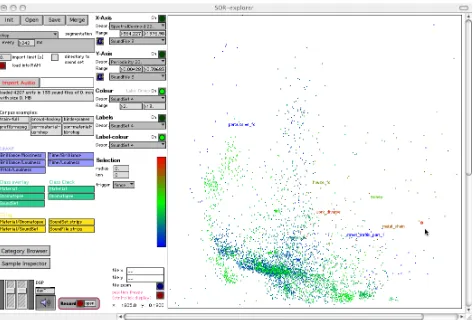
See Figure 1 for an example ofCataRT’s sound brows-ing interface, where grains are played accordbrows-ing to
imity to the mouse- or controller-driven target position in a user-selected 2-descriptor plane.
Figure 1. Screenshot ofCataRT’s 2D navigation interface.
2.1.1. Segmentation and descriptor analysis
The segmentation of the source sound files into units can be imported from external files or calculated internally, ei-ther by arbitrary grain segmentation or by splitting accord-ing to silence or pitch change. Descriptors are either im-ported or calculated in the patch. The descriptors cur-rently implemented are the fundamental frequency, period-icity, loudness, and a number of spectral descriptors: spec-tral centroid, sharpness, flatness, high- and mid-frequency energy, high-frequency content, first-order autocorrelation coefficient (expressing spectral tilt), and energy. For each segment, the mean value of each time-varying descriptor is stored in the corpus. Note that descriptors are also stored describing the unit segments themselves, such as each unit’s unique id, its start time and duration, and the soundfile and group from which it originated.
2.1.2. Selection
CataRT’s model is a multi-dimensional space of descriptors, populated by the sound units. They are selected by calculat-ing the target distance Ct, which is a weighted Euclidean
distance function that expresses the match between the tar-getxand a database unitui
Ct(u i,x) =
K
∑
k=1wt
kCkt(ui,x) (1)
based on the individual squared distance functionsCt kfor
de-scriptorkbetween target descriptor valuex(k)and database descriptor valueui(k), normalised by the standard deviation
of this descriptor over the corpusσk:
Ct
k(ui,x) =
x(k)
−ui(k)
σk
2
(2)
A weightwt
kof zero means that descriptorkis not taken into
account for selection.
Either the unit with minimalCt is selected, or one is
randomly chosen from the set of units withCt<r2when a
selection radiusris specified, or one is chosen from the set of thekclosest units to the target.
2.2. Compositional Application
We use CataRT as a source for real-time electronic treat-ment of a live signal, as well as a resource in deferred time for computer-assisted composition. In the real-time case the target for synthesis is the live audio signal. In deferred time the target may be either an audio signal or an abstract trajec-tory in descriptor space which may be drawn with a mouse or tablet. While the two techniques share similar tools and mechanisms, they yield contrasting results.
3. REAL-TIME PERFORMANCE 3.1. Signal Analysis
To pilotCataRTsynthesis with a live instrument, the audio signal is analyzed in real time with tools from theGabor li-brary according to the same descriptors and parameters used byCataRTfor its analysis of pre-recorded corpora. The list of calculated audio descriptor values, ten currently but with more possible in future versions ofCataRT, are sent to the selection module to output a unit. The relative weights of each of the descriptors used in the selection can be adjusted graphically. At this point the rich possibilities ofCataRT’s triggering methods are available. We have had particularly attractive results with the fence mode, where a new unit is chosen whenever the unit closest to the target changes. The selected unit index is then sent to the synthesis mod-ule to output the result taking into accountCataRT’s granu-lar synthesis parameters. Otherwise the unit indices may be recorded to an SDIF file to be further processed (see below). The rate at which units are synthesized is affected by the analysis window size, the triggering method, and the seg-mentation method of the corpus. Units need not be output in a regular rhythm: for example, in thefencemode not every new target window triggers selection. The analysis frames may be filtered by rate or descriptor value before being sent toCataRT. In particular, loudness and periodicity descrip-tors may be used to gate signal frames with values below desired thresholds.
3.2. Musical Realizations
3.2.1. Beside Oneself
CataRT has been used by several composers to synthe-size fixed electronics, and has been used in improvised performance. However the first work to use it as a tool for pre-composed real-time treatment is Aaron Einbond’s
part of the Cursus in music composition and technologies at IRCAM. Controlled by aMax/MSPpatch incorporating
CataRT and otherGabor andFTM objects, the computer analyzes sounds from the live violist and synthesizes match-ing grains from a corpus of close-miked viola samples. The goal is a smooth melding of live and recorded sound, a gran-ular trail that follows the acoustic instrument. CataRT is also used indirectly in this work to stimulate resonant fil-ters. Target pitches played by the viola are matched to a corpus containing samples of similar pitch. The synthesized result is then passed through resonance models, avoiding the possibility of feedback from the live signal.
3.2.2. What the Blind See
A similar technique of real-time analysis and synthesis can be used when the microphone is turned toward the public in-stead of an instrumentalist. In Einbond’s interactive sound installationWhat the Blind See, presented as part of the ex-hibition “Notation: Kalk¨ul und Form in den K¨unsten” at the Akademie der K¨unste, Berlin, the sounds of the public as well as the installation’s outdoor setting are analyzed as a target for CataRT synthesis from a corpus of filtered field recordings of insects and plants.
4. CORPUS-BASED TRANSCRIPTION
Rather than using the synthesized audio output directly,
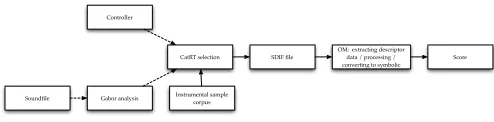
CataRT’s analysis and selection algorithms of can be used as a tool for computer-assisted composition. In this case, a corpus of audio files is chosen corresponding to samples of a desired instrumentation. TheCataRTselection algorithm is called on to match units from this corpus to a given target. Instead of triggering audio synthesis, the descriptors corre-sponding to the selected units and the times at which they are selected are stored and can be imported into a composi-tional environment such asOMwhere they can be converted symbolicaly into a notated score. The goal can be for the in-strumentalist reading the score to approximate the target in live performance. The target used to pilot this process could be an audio file, analyzed as above, or it could be symbolic: an abstract gesture in descriptor space and time, designed by hand with a controller such as a tablet or mouse. This process is summarized in Figure 2.
Soundfile Gabor analysis Instrumental sample corpus CatRT selection SDIF file
OM: extracting descriptor data / processing / converting to symbolic
[image:4.612.52.299.624.685.2]Score Controller
Figure 2. Flowchart for corpus-based transcription.
4.1. Exporting Data with SDIF
The results of theCataRTselection algorithm are recorded to an SDIF (Sound Description Interchange Format) file us-ing a specially-created recordus-ing module. This file can be read by other programs such asOM, or byMax/MSPusing
FTMdata structures and externals. SDIF is an established standard for the well-defined and extensible interchange of a variety of sound representations and descriptors [4, 12]. It consists of a basic data format framework and an extensible set of standard sound descriptions. This flexible and expand-able format suggests a wide range of future applications for exporting audio descriptor data.
The SDIF representation of the selection data is as fol-lows: first, three types of information about the corpus are written to the file header. The list of descriptor names for the data matrix columns are encoded as a custom matrix type definition. The list of sound files with their associated indices, referenced in the data matrices, is stored in a name– value table, as are the symbol lists for textual descriptors such as SoundSet, which can be assigned from the sound file folder name.
Then, for each selected unit, a row matrix containing all its descriptor data is written to a frame at the time of the selection since recording started. Both frame and matrix are of the custom extended type defined in the file header.
4.2. Processing Descriptor Data in OpenMusic
OpenMusic(OM) provides a library of functions and data structures for the processing of SDIF sound description data, which make it possible to link the results of the corpus-based analysis data to further compositional processing [2]. This integration in the computer-aided composition environment also allows the composer to take advantage ofOMobjects for displaying data lists in music notation.
Once imported, the descriptors of choice can be ex-tracted and displayed along with their SDIF time stamps. The SDIF frames can be filtered by descriptor value: for ex-ample to exclude units with loudness below a given thresh-old. They can also be segmented into multiple streams, which can be useful to group units to be played by differ-ent instrumdiffer-ents. Finally, om-quantifycan be used to transcribe the frame time values into traditional rhythmic notation and display the results in avoiceorpolyobject. Some descriptors lend themselves to a more intuitive representation as MIDI notes than others: for example pitch or spectral centroid. However other descriptors can be tran-scribed as a more abstract representation of required infor-mation: for example sound file numbers can be assigned arbitrarily to MIDI note numbers, allowing the user to re-call the sound file source of each unit. This could then be a useful tool for the user to interpret the results of theCataRT
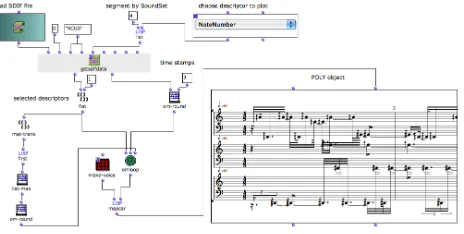
with the development of OM tools to display extra infor-mation on a score page, for example with thesheetobject [3]. However, a final stage of subjective refinement may al-ways be useful before the score is presented to an interpreter. Figure 3 shows anOMpatch to transcribe a score with the
[image:5.612.63.295.167.284.2]polyobject, which can then be exported in ETF format and subjectively-edited inFinale.2
Figure 3.OMpatch including raw score output.
5. DISCUSSION 5.1. Mapping Paradigms
The applications presented proceed from a direct mapping, where parameters of the target are associated with param-eters of synthesis. However other mappings can be pro-posed both to correct for sources of noise, and to allow novel sources of compositional control. Mathematical transfor-mation of a descriptor of an input signal could be used to normalize it to the range of that descriptor in the corpus. This could compensate, for example, for systematic offsets in loudness or other parameters. A more interesting map-ping could be created to “transpose” or “invert” a target be-fore mapping it to a corpus, through an appropriate trans-lation or reflection in descriptor space. Wessel’s research suggests that listeners could be sensitive to such a timbral transposition [10]. A further remove could be achieved by mapping one descriptor of the target analysis to a different descriptor in the corpus output. Rather than a transposition, this would be a kind of gestural “analogy.”
5.2. Playability Constraints
In the transcription stage of our algorithm there are no con-straints based in instrumental playability. Samples of live instruments are selected by the CataRT algorithm accord-ing to spectral characteristics alone, and then transcribed to notation in OM. It would be interesting to incorporate constraints based on speed, register, and playing technique in this process such that the final score would require less manual editing. An example of such constraints on pitch
2ETF may be replaced by the more flexible MusicXML format as the
bridge between future versions ofFinaleandOM.
and rhythm are implemented inOMby Elvio Cipollone [5]; however a more sophisticated system would be necessary to incorporate extended playing techniques.
6. ACKNOWLEDGEMENTS
This work is partially funded by the French National Agency of Research ANR within the project SampleOrchestrator. We thank Alexis Baskind, Eric Daubresse, John MacCal-lum, David Wessel, and Adrian Freed for their assistance implementing the software and their invaluable feedback on the manuscript.
7. REFERENCES
[1] P. Boulez,On Music Today. Cambridge, MA: Har-vard University Press, 1971.
[2] J. Bresson and C. Agon, “SDIF sound description data representation and manipulation in computer assisted composition,” inProc. ICMC, Miami, USA, 2004. [3] ——, “Scores, programs and time representation: The
sheet object in openmusic,”Computer Music Journal, vol. 32, no. 4, 2008.
[4] J. J. Burred, C. E. Cella, G. Peeters, A. R¨obel, and D. Schwarz, “Using the SDIF sound description inter-change format for audio features,” inISMIR, 2008.
[5] E. Cipollone, “CAC as maieutics: OM-Virtuoso and Concerto,” inOM Composer’s Book, vol. 2. Paris: Editions Delatour France / Ircam, 2008.
[6] J. M. Grey, “Multidimensional perceptual scaling of musical timbres,”J. Acoust. Soc. Am., vol. 61, 1977. [7] A. Momeni and D. Wessel, “Characterizing and
con-trolling musical material intuitively with geometric models,” inProc. NIME, Montreal, Canada, 2003. [8] D. Schwarz, “Corpus-based concatenative synthesis,”
IEEE Sig. Proc. Mag., vol. 24, no. 2, Mar. 2007. [9] D. Schwarz, R. Cahen, and S. Britton, “Principles and
applications of interactive corpus-based concatenative synthesis,” inJIM, GMEA, Albi, France, Mar. 2008.
[10] D. Wessel, “Timbre space as a musical control struc-ture,”Computer Music Journal, vol. 3, no. 2, 1979.
[11] T. Wishart,On Sonic Art. London: Harwood Aca-demic Publishers, 1996.