City, University of London Institutional Repository
Citation
:
Marshall, J. (2009). Framing ideas in aphasia: the need for thinking therapy. International Journal of Language & Communication Disorders, 44(1), pp. 1-14. doi: 10.1080/13682820802683507This is the accepted version of the paper.
This version of the publication may differ from the final published
version.
Permanent repository link:
http://openaccess.city.ac.uk/6873/Link to published version
:
http://dx.doi.org/10.1080/13682820802683507Copyright and reuse:
City Research Online aims to make research
outputs of City, University of London available to a wider audience.
Copyright and Moral Rights remain with the author(s) and/or copyright
holders. URLs from City Research Online may be freely distributed and
linked to.
City Research Online: http://openaccess.city.ac.uk/ [email protected]
Framing ideas in aphasia: The need for thinking therapy
Jane Marshall
Department of Language and Communication Science
City University
London EC1V OHB
Acknowledgements
Aspects of the work reported in this paper was supported by an award from Connect,
The Communication Disability Network made to Deborah Cairns. I am grateful to
Deborah Cairns and Shula Chiat for their comments on an early draft of this paper. I
am grateful to Jon Hunt for allowing me to reproduce the image in figure 4. The
Abstract
This paper argues that some of the patterns seen in aphasia may reflect difficulties in
the cognitive preparations for language. In particular, some individuals may be
unable to carry out processes of ‘Thinking for Speaking’ (Slobin 1996), which frame
thoughts for language production. Evidence to support this proposal is presented,
together with signs that such thinking can be assisted with cues and therapy. It is
argued that these preliminary data need to be pursued via a more comprehensive
investigation of thinking therapy.
What this Paper Adds
In order to express our ideas we need to frame them in ways that are compatible with
language. For example, we have to adopt a particular perspective, or chose what to
highlight and what to omit. Such cognition has been termed ‘Thinking for Speaking’
(Slobin 1996). Some of the patterns seen in aphasia, such as the typical advantage of
nouns over verbs, may be due to difficulties with this type of cognition. This paper
offers evidence to support this proposal. Preliminary data are also presented
suggesting that Thinking for Speaking can be cued. In conclusion, it is argued that we
need to pay more attention to the cognitive preparations for language when carrying
It is a truth (almost) universally acknowledged that people with aphasia are not
intellectually impaired. Rather they have a specific language disorder in the face of
generally intact cognition. The evidence for this leaps out from any interaction with
an aphasic person. As an example, here is a conversation between myself and RS. R
had aphasia following a stroke in his early 40s. Before this he ran his own business,
which he was now selling:
J Can you tell me how far you have got with selling your
business R?
R er ………… Mr N (Mrs S: Your accountant)
R Yes … I’ve left it to him
J And how far has he got with it?
R er … one chap has come up with a er ……… fee … but there’s three
more coming
J That’s quite good isn’t it? Are they offers that you can
accept?
R Not really
J So you want slightly more?
R Yes
J How quickly do you want to sell it?
R As soon as possible … just for me to …. call it a day …. but it could
take as long as three months
J What will you do with the capital?
R Put it into the …… one in the …. What’s name …… bank
R er …….. (waves) goodbye … goodbye
(taken from: Marshall, 1989)
R was clearly following the negotiations around selling his business. He was oriented
for time, e.g. knowing that the sale could take months, and was able to judge the value
of the offers. R also had some cunning strategies for coping with his aphasic word
finding difficulties. He substituted a close alternative for a blocked word (‘fee’ for
offer) and used a gesture coupled with ‘goodbye’ to communicate the notion of
redundancies.
We don’t just have to use our observations here. There is plenty of more scientific
evidence. Take the study by Varley and colleagues (2005). They tested 3 people with
severe aphasia who were virtually unable to speak and had language comprehension
problems, particularly with sentences. They also showed difficulties with number
words, at least in terms of production. Despite this, they could carry out eye watering
numerical calculations such as:
50 – [(4+7) x 4) = ?
2 x [(5 x 2) + 10] = ?
36 ÷ (3 x 2) = ?
The individuals could even do a ‘bracket generation task’. Here they were presented
with a string of digits and mathematical symbols, which they had to mark up with
different sets of brackets, then calculate the result. In case anyone is still in doubt,
and Varley, 2007) and Theory of Mind tasks, which involve speculation about other
people’s beliefs (Siegal and Varley, 2006).
Given these data, a defining characteristic of aphasia seems to be a problem in
mapping intact ideas onto a defective language mechanism. Put more simply, aphasic
people can think perfectly well, but have great difficulty expressing those thoughts,
e.g. because they cannot access words or construct sentences.
Yet are the difficulties purely at the language end of the process? We know that in
aphasia certain types of language can be easier than others. Here are some common
patterns:
Automatic, formulaic language, such as social chit chat, serial speech or
swearing, is often relatively preserved, or at least more so than propositional
language (Van Lancker Sidtis and Postman, 2006).
Concrete language is often more intact than abstract, both for production
(Franklin, Howard and Patterson, 1995) and comprehension (Franklin,
Howard and Patterson, 1994; Franklin, Turner, Lambon Ralph, Morris and
Bailey, 1996).
Nouns are often easier than verbs (e.g. Berndt, Mitchum, Haendiges and
Sandson, 1997; Breedin, Saffran and Schwartz, 1998; Bastiaanse and Jonkers,
1998; Edwards and Bastiaanse, 1998; Webster, Morris and Franklin, 2005; see
class, in that verbs taking multiple arguments can be particularly problematic
(Thompson, Lange, Schneider and Shapiro, 1997; Kim and Thompson, 2000;
McCann and Edwards, 2001).
Why do these patterns emerge? A number of factors almost certainly play a role. For
example, automatic language is often constructed from highly frequent words, which
may contribute to its availability in aphasia. Another factor is age of acquisition,
whereby language that is learnt early in life is more resistant to damage than language
that is learnt late (Hirsh and Ellis, 1994). This may help to explain the concreteness
effect, although it is perhaps less explanatory in the case of automatic language and
word class. It also needs to be acknowledged that the patterns although common are
not universal, and may even be inverted. RG, for example, showed a preference for
abstract over concrete words and for verbs over nouns (Marshall, Pring, Chiat and
Robson 1996; Marshall, Chiat, Robson and Pring 1996).
Despite these caveats, I would like to consider another explanation for these very
typical patterns. It could be that production in aphasia, to some extent, depends upon
the ‘cognitive labour’ involved in translating thoughts into language. So at the easiest
end of the continuum is language that is highly automatic and barely mediated by
cognition at all – as is the case for swearing, reciting numbers or trotting out social
phrases. Producing words that correspond in a very direct manner with their
referents, as is the case for concrete nouns, is also relatively straight forward.
Abstract language, on the other hand, requires much more cognitive mediation. Take
‘The Head Teacher heard about the trouble during break and asked staff to
identify the offenders’
Here we have moved away from simple labelling. People are referred to by their job
(‘Head Teacher’, ‘staff’) or in terms of their role in the event and our consequent
reaction to them (‘offenders’). That event has been abstracted as ‘trouble’ (was it a
fight, stealing, drug taking, sexual shenanigans or what?). Finally we are told that
staff have to ‘identify’ the children involved. Again the abstract verb gives us no
indication of how they will do this – interrogation, CTV evidence or an identity
parade? Overall this account is clearly the product of some vigorous cognitive
filtering, a process that is reflected in the abstract terminology used.
What about verbs? On the face of it simple action verbs label events in a fairly one to
one fashion, with none of the abstraction seen with the school incident. Yet this is not
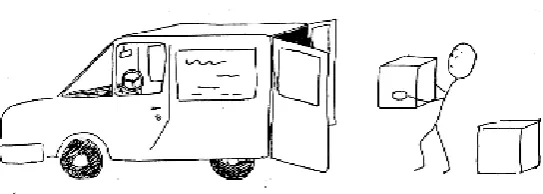
the case. We can illustrate this with the event shown in Figure 1.
Insert Figure 1 here
Despite its concrete nature this event can be construed in a number of ways. To take
just two of the available options, we might focus on what the man is doing with the
boxes or the effect on the van. Each of these construals will map onto different verb
and sentence options. So if the focus is on the movement of the box verbs like ‘lift’
and ‘carry’ will be selected that map theme onto the direct object; whereas if the
object. Even if the same verb is selected, subtle differences in focus can result in
subtle shifts in mapping, as these sentences illustrate:
The man loads the lorry with boxes (implies that lorry is full)
The man loads the boxes into the lorry (implies that the lorry may not be full)
It seems that even a simple action requires considerable selectivity and cognitive
mediation before it can be described. This takes our thinking away from real world
imagery towards the abstracted and pared down structures that map readily onto
language. Here is how Pinker puts it in his recent book:
‘when I think about a typical scenario in everyday life, like putting water into a glass,
my mind has a well fleshed out image – a thirsty person walking over to a faucet with
a clear tumbler in hand and turning a tap to let water flow into it just short of
overflowing. Yet when I talk about the scenario, most of this flesh melts away,
leaving behind one of several skeletons. If I use the verb pour, my field of vision narrows to how the water is caused to move, ignoring its destination; that’s the reason
we can say pour the water but not pour the glass. But if I use the verb fill my field of vision narrows to the fullness of the glass, ignoring the trajectory of the water; that’s
why we say fill the glass but not fill the water’ (Pinker 2007; p 112 – 3)
Pinker argues that whenever we set out to describe an event we have to apply some
rather specialised forms of thinking, a process that has been termed ‘Thinking for
Speaking’ (Slobin, 1996). This thinking re-casts our general thoughts into forms that
perspective taking and selectivity, whereby we home in on some features of the event
or situation while back-grounding others. Levelt (1989; 1999) argues that it also
requires us to build propositional structure, or to delineate the main referents in the
event and the relationships between them. We need additionally to ensure that these
referents correspond with lexical concepts. Depending on the language that we plan
to use there will be further demands. For example, a speaker of a tense marking
language such as English will need to specify the temporal properties of the event.
This last point underlines a further property of Thinking for Speaking. It is not
language independent. Rather, the way in which we frame our thoughts for language
must pay attention to the particular requirements of the language that we plan to use.
Imagine that we are describing an event in which a man takes a stanley knife to a
sheet of paper. In English we can describe this event as ‘cutting’ and so discard the
specific manner and instrument information. This option is less available to users of
British Sign Language (BSL), where the verb is marked for instrument. So there is a
different verb for cutting with a knife, as opposed to cutting with scissors. Thus
people who use BSL have to pay much more attention to instruments than people who
use English. In line with this there is some evidence that BSL users are indeed more
likely to categorise events along instrumental lines than speakers of English
(Vigliocco, Vinson, Woolfe, Dye and Woll, 2005).
So why is this relevant to people with aphasia? If language is underpinned by
specialised, linguistically sensitive cognition, that cognition could be a site of
impairment. The loss of access to language will further impact upon the problem, in
Returning to the example in Figure 1, it is difficult to know which perspective to
adopt when describing a loading event unless we know about the perspectives
available in our verb lexicon. Without access to this information a vicious circle may
be established whereby impaired access to the lexicon deprives us of the very
conceptual constraints that make lexical access possible. This is not to say that
aphasic people are, after all, intellectually impaired, far from it. Rather some of their
problems may reside at the boundary between thought and language, including at the
thinking end of that boundary (see similar arguments in Dipper, Black and Brian,
2005)
By now you will be wanting evidence for this. We need evidence that this form of
cognition has psychological reality. We also need evidence that it can be impaired in
aphasia.
The study by Kita and Ozyurek (2003) offers evidence that the way that we frame
ideas for speaking, and indeed gesturing, is linguistically sensitive. They asked
speakers of English, Japanese and Turkish to describe a series of cartoon events.
They were interested in whether their co-speech gestures would reveal subtle
differences in the way these speakers thought about the events and, in particular,
whether those differences reflected the specific demands of the 3 languages. In one
event a cat attempts to catch a bird by swinging between high buildings on a rope.
This event is interesting because neither Turkish nor Japanese have a verb
corresponding to the English verb ‘swing’. Speakers of these languages, therefore,
are likely to ignore the trajectory of the motion when describing the event. Sure
whereas virtually all the English speakers used ‘swing’. Intriguingly, these
differences also manifested in their gestures. English speakers who gestured
overwhelmingly used arc gestures in isolation, with fewer than 10% employing
straight gestures. In contrast, 70% of the Japanese and 50% of the Turkish speakers
used straight gestures, and very often these occurred in isolation. It seemed that these
speakers had filtered out the arc nature of the movement from their representation of
this event, so much so that this was even eliminated from their gesture.
So what about aphasia? Is there any evidence that this form of cognition can be
impaired? Some of the evidence is rather circumstantial. The noun>verb effect is an
example, as is the evidence that the number of arguments commanded by a verb can
affect production (Thompson et al, 1997; Kim and Thompson, 2000; McCann and
Edwards, 2001). As already discussed, this is in line with the proposal that verbs
involve more cognitive mediation than concrete nouns. Those which entail multiple
arguments describe more complex relationships than those with just one or two,
which raises the cognitive bar even further.
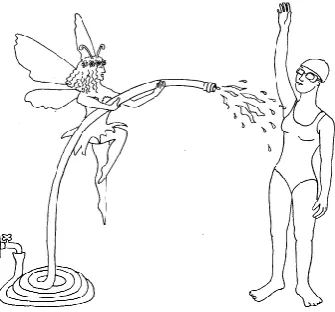
Another manifestation may be a feature that we have termed ‘hyper-naming’. We
have observed that some people with aphasia tend to list often rather extraneous
nouns when they are attempting to describe events. Indeed their noun production far
exceeds that of control participants when carrying out the same task (Marshall, Pring
and Chiat, 1993; Cairns, Marshall, Cairns, and Dipper, 2007). Figure 2 gives an
example. Here ‘Ron’, a man with non-fluent aphasia, is describing an everyday event
Insert Figure 2 here + caption
Rather than homing in on the main event Ron seems to circle it with ever increasing
object detail. It is as if he is unable to plump for a focussed perspective that would at
least give him a chance of verb selection.
While suggestive, the above evidence is far from conclusive. Verb impairments in
aphasia arise for many different reasons (see arguments in Marshall 2003). Problems
with Thinking for Speaking may be just one contributory factor, and one that only
applies in some cases. Similarly, a tendency to hyper-name may point to problems of
focus, or a desire on the part of the aphasic speaker to reveal an aspect of language
that is relatively unscathed.
Such difficulties have motivated more direct attempts to explore the cognitive
underpinnings for language (e.g. Dipper 1999). One such attempt involves a task
called the Role Video (Marshall et al 1993). This requires the person to make
judgements about the roles played by participants in various videoed events, with
judgements signalled by photo selections. So, in one item, the video shows a woman
shooting a man (the event is very obviously staged!). The photos for selection are: the
man dead on the ground (target), the woman dead on the ground (reversal distractor)
and the man wearing a coat (event distractor). Three non-brain injured controls were
tested, with none making any errors. However, MM (Marshall et al 1993) made five.
Her problems were not general. Rather they occurred with reversible items, where
distractor. It seemed that, for her, the processing of event roles was insecure, which,
in turn, made it difficult to express role information in language.
There is, of course, a catch with tasks like the Role Video. The specialist cognition
that we are concerned with occurs only in the run up to language. Yet these tasks
have necessarily floated away from that environment. So, when probing the person’s
knowledge of event roles we had to use a rather contrived task that was disconnected
from language production. It could be argued, therefore, that such tests explore
general cognition rather than the particular cognitive preparations for language.
Cairns (2006) attempted to circumvent this problem though novel tasks that entailed
an element of language production. In one such task she asked people to gesture
action pictures either silently, or immediately after a verb was produced. Cairns
hypothesised that gestures produced after a verb might be less complex than those
produced silently, because now Thinking for Speaking had taken place. In other
words gestures would reflect the discarding of real world detail that necessarily occurs
during such thinking. A further question was whether similar paring down would be
observed in a speaker with aphasia.
The experiment involved 10 controls and Ron, the aphasic person who described the
fairy picture above. Ron was tested because he was hypothesised to have problems
with thinking for speaking. He had difficulties with verb production and made errors
on tasks designed to test event processing, such as the Role Video, on which he
Each participant had to gesture 40 actions in three conditions. In the first condition
this was done silently from a picture. Then, at least a week later, the pictures were
presented again and the person was asked to name the verb and gesture the picture
(condition 2). Finally the person was asked to produce a gesture purely in response to
a given spoken verb (condition 3). Complexity of the gestures was determined by
ratings collected from 11 people who were blind to the purpose of the experiment. In
a separate procedure two raters also coded the gestures qualitatively, i.e. for how they
communicated the nature of the event.
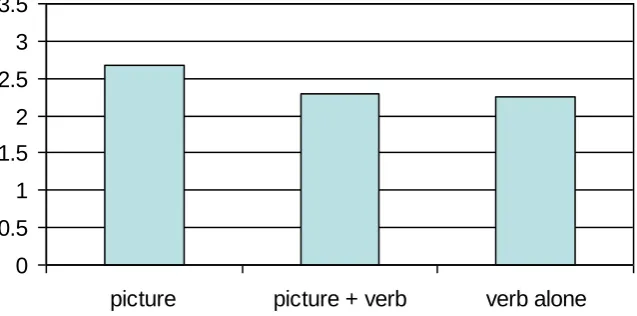
Figure 3 here
Let’s take the control data first. Figure3 shows that the complexity ratings were very
much in line with the prediction, in that once a verb was produced, either by the
participant or the examiner, gestures became less elaborate. A one factor ANOVA
revealed a significant main effect of condition (F (2,18) = 7.47, p <0.01), with
planned comparisons showing that conditions 1 and 2 differed (p<0.01), but not
conditions 2 and 3. In other words gesturing in response to a verb and a picture was
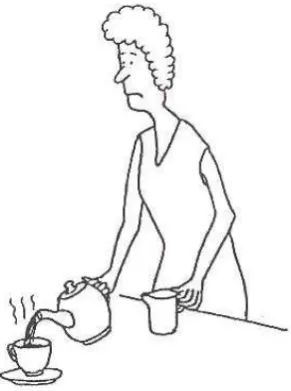
significantly less elaborate than gesturing from a picture alone. One participant’s
response to figure 4 exemplifies the point.
Figure 4 here.
When asked to gesture this just from the picture the person mimed a sequence of
actions: putting out the tea things, picking up the tea pot, pouring tea into the cup,
a whopping complexity rating of 7. When this person had to first label the event with
a verb much of this detail melted away. Now he simply mimed picking up the pot,
pouring and putting it down again, an effort that gained a measly rating of 2.
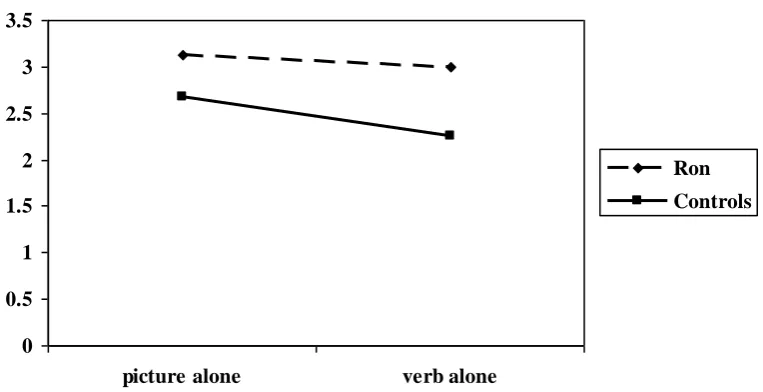
Ron’s results were rather different. First of all his ratings in all conditions were
higher than the controls’, indicating that his gestures were more elaborate. It was also
difficult to interpret his performance in condition 2, where he was required to name
the verb and gesture the picture, since his attempts at verb production were often
unsuccessful. Figure 5, therefore, presents his scores for conditions 1 and 3 only, with
comparative control data. This shows that in condition 3, when the verb was
provided, his gestures were no less complex than when they were produced purely in
response to pictures. There was another qualitative difference in his gestures. Ron
often outlined the objects involved in the actions (for example, he might outline the
shape of the teapot when gesturing figure 4) a strategy that was virtually never used
by the controls.
Insert Figure 5 here
What does this mean? In the case of the controls it seemed that their thinking about
the events became more constrained and stripped of real world detail once a verb was
produced and that, as a result, the complexity of their gestures went down. Ron on
the other hand showed less of this effect. While not wishing to over-interpret, it could
be that Ron finds it difficult to constrain his thinking in the way that is needed for
verb selection. His use of outlining in gesture may offer another clue. This suggests
events, rather than the actions associated with those objects. Once again, his thinking
seems to be out of kilter with the controls’ and taking him in directions away from
verb selection.
So far I have argued that, although general cognition is intact in aphasia, and often
strikingly so, the specialist cognition that frames thoughts for language may not be. If
this is right, then one goal of therapy could be to help aphasic people think about
situations and events in a way that makes them communicable. In particular, some
people with aphasia may need help in formulating the cognitive specifications needed
for verbs.
How might this be done? Cairns and colleagues explored one possible cueing task
called the Sharon and Paul Test (Cairns 2006; Cairns, Marshall and Dipper, in
preparation). In this task participants had to label video events with a single verb.
The stimuli exploited perspective dilemma situations which can be described from
alternative points of view. An example would be a scene in which a man legs it down
the garden, hotly pursued by an irate woman. This can be described by any number of
verbs. But an obvious dilemma is whether to focus on the man, resulting in verbs like
‘run away’ and ‘flee’, or on the woman, resulting in verbs like ‘chase’ and ‘pursue’.
Making perspective decisions such as these is one of the tasks involved in thinking for
speaking, a task that may be particularly problematic for people with aphasia. In line
with this there are a number of accounts in the literature of individuals who seem to
have impaired access to verb perspective information (Byng, 1988; Marshall, Chiat
The main aim of the Cairns et al study was to find out if aphasic people could be
helped to make perspective decisions, with the hypothesis that if they could more
verbs should be forthcoming. Two types of help were explored. One involved
manipulations of filming in such a way that one of the perspective options was given
far greater visual prominence than the other. So in the chase/flee example one
presentation focussed on the unfortunate Paul, while the other zoomed in on the
fearsome Sharon.
The next level of help re-presented the manipulated films, this time accompanied by a
sentence frame cue. So, for the chase/flee example the person saw one film focussing
on Sharon and heard ‘Sharon (buzz) Paul’. Elsewhere in the test they saw a different
film, focussing on Paul, and heard ‘Paul (buzz) from Sharon’. In line with previous
research (Fisher, Hall, Rakowitz and Gleitman, 1994) it was hypothesised that these
sentence cues would act like a ‘zoom lens’ on the event, removing all ambiguity as to
the perspective being adopted.
Of course, one problem with this task is that the person being tested sees the same
events over and over again, albeit with slightly different presentations. If their verb
access improves, therefore, it could simply be due to practice. To investigate this
possibility a 4th condition was administered which re-presented the original neutral
stimuli. If these were named less successfully than the intervening cued conditions
we can dismiss practice as the source of change.
So, to summarise, the experiment had 4 conditions: (1) Neutral; (2) Perspective Cues
accompanied by a sentence frame); (4) Repeated Neutral. In each condition the task
was the same. The person watched the film and had to produce a single verb to say
what happened. There were 19 items in the neutral conditions and 38 in the cued (i.e.
here there were 2 presentations per event, each taking the alternative perspective). Of
interest was whether aphasic verb production would increase in the cued conditions.
If it did, this would suggest that these conditions helped the person to make the
perspective decisions needed for verb access.
The task was carried out with 20 healthy controls and 6 people with aphasia, one of
whom was Ron whom we met above. The aphasic participants all had impaired verb
production in the face of much better access to nouns. They also had difficulties with
verb and sentence comprehension, especially when reversible sentences were
involved.
Unsurprisingly, the controls found the task easy. There were only 2 occasions when a
control failed to produce a verb, out of a possible 2280 responses. The range of verbs
produced was high, in line with the proposal that these stimuli offer multiple
perspective options. For example, across all controls and all conditions the chase/flee
items elicited 12 different verbs (assault, attack, chase, escape, fight, flee, hit, pursue,
quarrel, retreat, run, threaten).
The wide range of control responses encouraged us to adopt liberal scoring criteria
when evaluating the aphasic data. Accordingly a response was judged to be correct if
it:
was a synonym of a control verb for that item (as listed in the New Oxford
Thesaurus of English, 2000)
was judged correct by a naïve external rater, who was blind to the purpose of
the experiment
Insert Figure 6 about here
Using these criteria, figure 6 shows the mean number of correct verbs that the aphasic
people produced in each condition (expressed as a percentage of the total). You can
see that the cued conditions did indeed raise verb access, although most markedly in
the perspective + language condition. The fact that production drops down again in
the 2nd Neutral condition (this condition scored lower than both the cued conditions)
suggests that our participants were not simply benefiting from practice. Rather we like
to think that our cues helped them to organise their focus on these events and so kick
start access to the verb lexicon.
Figure 6 makes it clear that the aphasic participants were helped most by cues that
combined the perspective manipulation with language. It is difficult to know how
these cues worked. It is possible that they simply functioned like a sentence
completion task. However, for six of the items the language cue comprised just one
or two words. For example, the verb ‘fall’ was cued with ‘Paul (buzz)’. Yet these
very minimal cues, which simply highlighted the agent, were as helpful as those that
supplied more syntactic and semantic information, such as ‘Paul (buzz) a radio to
fact help primarily by constraining perspective. In other words they may have offered
an anchoring point from which the event could be described.
Although the direction of the results was in line with our predictions the size of the
effect was very small. You can see that even the best condition (perspective +
language) only raised verb production by just over 10% compared to the first neutral
condition. However, although small this difference was significant (Wilcoxson
signed ranks test, T = 0, p <0.025). It is also important to remember that here
participants were responding purely to a ‘one off’ cue. We think, therefore, that our
optimism is justified. If we can get a small but significant result from cues, what
might we get from therapy?
This question has largely gone unanswered. An exception is our study with MM
(Marshall et al 1993; and see Marshall and Cairns 2005). She had agrammatic speech
in which verbs were almost entirely absent. There were also problems with her
comprehension of verbs and sentences.
There were signs that MM’s problems with verbs might originate, in part, with a
difficulty in framing her thoughts for language. She was an exponent of
hyper-naming and made errors on tasks designed to test event concepts, such as the Role
Video. We therefore embarked on a programme of event therapy. This was heavily
influenced by Jones’s work with BB, which posed a series of questions about written
sentences (Jones 1986). So BB was given a sentence and asked first to identify the
verb, then the person carrying out the action and the object or person affected by it.
a video of an event and asked questions about who was responsible for it, what was
changed or moved, and the nature of the action. The therapy differed from Jones’s
original mapping therapy in that the stimuli comprised videos of events, rather than
sentences, and all the questions could be answered non verbally, e.g. by selecting a
photo of the people carrying out the different roles or by gesturing the action.
This therapy had some positive benefits, in that MM became more able to describe
pictured events. She produced more verbs and more word order structure after
therapy than before and her production became more comprehensible to observers.
So, for example, observers who knew MM could comprehend 26/50 of her picture
descriptions after therapy, compared to just 13/50 before; and there was a similar gain
for observers who were not familiar with her (7/50 pre therapy vs 19/50 post therapy).
However, this skill was limited to simple events, involving no more than 2
participants. The moment she was asked to describe multiple events or events
involving more people her production broke down. Possibly related to this was the
fact that her spontaneous speech showed no signs of change.
So where do we need to go next? We need to develop and investigate a full blown
programme of thinking therapy. This will build upon the cueing and therapy tasks
described in Cairns et al (in preparation) and Marshall et al (1993). So, therapy
stimuli will comprise films of events that are manipulated to help the person make
perspective decisions. In addition to the manipulations already described we need to
explore ‘zooming in’ devices, e.g. to help the person identify the agent over other
These events will be presented for description, with a hierarchy of cues. Initially cues
will comprise the sentence frames of the type employed in the Sharon and Paul Test.
They will then progress to more minimal cues, eg consisting of just the first word.
Therapy will also involve role decision tasks, e.g. where the person has to identify the
agent, theme and other entities in the event. A range of therapy stimuli need to be
developed, progressing from very simple events, (e.g. where a single person acts upon
an object), to more complex (e.g. where a man feeds a child at a table while listening
to his wife, who is also cooking the dinner). A further development might experiment
with distant modes of delivery, so that face to face therapy can be supplemented with
self administered practice. Finally, conversation partners should be involved, e.g. so
that they are trained to ask the sort of questions that help the aphasic person to frame
their thoughts for language.
If the hypothesis presented in this paper is correct, such therapy should help at least
some aphasic individuals to communicate events and relational ideas more
successfully. This should be marked by gains in verb production and word order, but
may also manifest in more structured and effective use of non verbal devices like
gesture. Most importantly effects need to be evaluated not just with clinical tasks, but
also via tasks that mimic real language, such as conveying gossip and explaining why
a 15 year old is not allowed to stay out till 4am.
This paper has argued that aphasic people, despite having generally intact cognition,
may have difficulties in the conceptual preparations for language. Such difficulties
may account for some of the patterns that we see in aphasia, such as the Noun>Verb
be uncovered by specific investigations, such as the Role Video (Marshall et al 1993)
and the gesture task developed by Cairns (2006). If this view is correct then our
therapy needs to take more account of the thinking that occurs just before speaking.
Indeed there is some evidence that this thinking may be helped by cues (Cairns et al,
in preparation) and therapy (Marshall et al, 1993). We now need to act upon these
References
Bastiaanse, R. and Jonkers, R. (1998). Verb retrieval in action naming and
spontaneous speech in agrammatic and anomic aphasia. Aphasiology, 12 (11), 951-969.
Berndt, R.S., Mitchum, C.C., Haendiges, A.N. and Sandson, J. (1997b). Verb retrieval
in aphasia 1. Characterising single word impairments. Brain and Language, 56 (1), 68-106.
Breedin, S.D., Saffran, E.M. and M.F. Schwartz (1998). Semantic factors in verb
retrieval: An effect of complexity. Brain and Language, 63 (1), 1-31.
Byng, S. (1988). Sentence processing deficits: theory and therapy. Cognitive Neuropsychology, 5 (6), 629-676.
Cairns, D. (2006) Processing Events: Investigating Event Conceptualisation in Aphasia. Unpublished PhD Thesis, City University, London.
Cairns, D., Marshall, J., Cairns, P. and Dipper, L. (2007) Event processing through
naming: Investigating event processing in people with aphasia. Language and Cognitive Processes, 22, 210 – 233.
Cairns D, Marshall J and Dipper L (submitted) Sharon and Paul: Unpicking speakers’
Dipper, L. T. (1999). Event processing in non-fluent aphasia: The interaction between verbs, sentences and events - with data from 6 people with non-fluent aphasia.
Unpublished Ph.D. Thesis, University College London.
Dipper, L. T., Black, M., & Bryan, K. L. (2005). Thinking for speaking and thinking
for listening: The interaction of thought and language in typical and non-fluent
comprehension and production. Language and Cognitive Processes, 20(3), 417-441.
Druks, J. (2002). Verbs and nouns - a review of the literature. Journal of Neurolinguistics, 15 (3-5), 289-315.
Edwards, S. and Bastiaanse, R. (1998). Diversity in the lexical and syntactic abilities
of fluent aphasic speakers. Aphasiology, 12 (2),99-117.
Fisher, C., Hall, D.G., Rakowitz, S. and Gleitman, L. (1994). When it is better to
receive than to give: syntactic and conceptual constraints on vocabulary growth.
Lingua, 92, 333-75.
Franklin, S., Howard, D. and Patterson, K. (1994) Abstract word meaning deafness.
Cognitive Neuropsychology, 11, 1-34.
Franklin, S., Turner, J., Lambon Ralph, M., Morris, J. and Bailey, P. (1996) A
Distinctive Case of Word Meaning Deafness? Cognitive Neuropsychology, 13, 1139 - 1162.
Hirsh, K. and Ellis, A. (1994) Age of Acquisition and Lexical Processing in Aphasia:
A Case Study. Cognitive Neuropsychology, 11, 435 – 458.
Jones, E. (1986) Building the foundations of sentence production in a non-fluent
aphasic. British Journal of Disorders of Communication, 21, 63-82.
Kim, M. and Thompson, C.K. (2000). Patterns of comprehension and production of
nouns and verbs in agrammatism: Implications for lexical organization. Brain and Language, 74 (1), 1-25.
Kita, S. and Ozyurek, A. (2003) What does cross-linguistic variations in semantic
coordination of speech and gesture reveal? Evidence for an interface representation of
spatial thinking and speaking. Journal of Memory and Language, 48, 16 – 32.
Klessinger, N., Szczerbinski, M. and Varley, R. (2007) Algebra in a Man with Severe
Aphasia. Neuropsychologia, 45 (8), 1642 – 1648.
Levelt, W.J.M. (1999) Producing spoken language: A blueprint of the speaker. In
C.M. Brown and P. Hagoort (eds) The Neurocognition of Language. Oxford: Oxford University Press.
Marshall, J. (1989) RS - Three specific treatment programmes. The Proceedings of the British Aphasiology Society Therapy Symposium, Cambridge.
Marshall J (2003) Noun-Verb Dissociations: Evidence from Acquisition and
Developmental and Acquired Disorders. Journal of Neurolinguistics, 16, 67 – 84.
Marshall, J., Pring, T. and Chiat, S. (1993) Sentence processing therapy: Working at
the level of the event. Aphasiology, 7, 177-199.
Marshall J, Pring T, Chiat S and Robson J (1996), Calling a Salad a Federation: An
Investigation of Semantic Jargon, Paper 1, Nouns, Journal of Neurolinguistics, 9,
237-250.
Marshall J, Chiat S, Robson J and Pring T (1996). An investigation of Semantic
Jargon, Paper 2, Verbs. Journal of Neurolinguistics, 9,251-260.
Marshall, J., Chiat, S. and Pring, T. (1997) An Impairment in Processing Verbs'
Thematic Roles: a Therapy Study. Aphasiology, 11, 855-876.
Marshall, J. and Cairns, D. (2005) Therapy for sentence processing problems in
McCann, C. and Edwards, S. (2001). Verb production in fluent aphasia. Brain and Language, 79 (1), 134-136.
Pinker, S. (2007) The Stuff of Thought: Language as a Window into Human Nature. London: Penguin.
Siegal, M. and Varley, R. (2006) Aphasia, Language and Theory of Mind. Social Neuroscience, 1 (3-4), 167 – 174.
Slobin, D. (1996). From ‘thought and language’ to ‘thinking for speaking’. In J.
Gumperz and S. Levinson (Eds.), Rethinking linguistic relativity. Cambridge, UK: CUP.
Thompson, C.K., Lange, K.L., Schneider, S.L. and Shapiro, L.P. (1997). Agrammatic
and non-brain-damaged subjects’ verb and verb argument structure production.
Aphasiology, 11 (4/5), 473-490.
Van Lancker Sidtis, D. and Postman, W. (2006) Formulaic expressions in
spontaneous speech of left- and right-hemisphere damaged subjects. Aphasiology, 20
(5), 411- 426.
Varley, R., Klessinger, N., Romanowski, C., and Siegal, M. (2005) Agrammatic but
Vigliocco, G., Vinson, D., Woolfe, T., Dye, M. and Woll, B. (2005) Language and
Imagery: Effects of Language Modality. Proceedings of the Royal SocietyB, 272, 1859 – 1863.
Webster, J., Morris, J. and Franklin, S. (2005). Effects of therapy targeted at verb
retrieval and the realisation of the predicate argument structure: A case study.
Figure 2:
Ron’s Description: ‘tap, hose, and pixies, elf, woman, long hair – no, short – no, bob,
Figure 3: Mean Complexity Ratings of Controls’ Gestures
0 0.5 1 1.5 2 2.5 3 3.5
Figure 5: Mean complexity ratings of gestures produced by Ron and Controls in
response to pictures and verbs
0 0.5 1 1.5 2 2.5 3 3.5
picture alone verb alone
Ron
Figure 6: Mean % of Verbs Produced by Participants with Aphasia in the Sharon and
Paul Test
20 25 30 35 40 45 50 55 60
Neutral 1 Perspective Perspective +
Language