
PAPER
www.rsc.org/obc
| Organic & Biomolecular Chemistry
In situ
generation of Mes
2
Mg as a non-nucleophilic carbon-centred base
reagent for the efficient one-pot conversion of ketones to silyl enol ethers
William J. Kerr,*
aAllan J. B. Watson
aand Douglas Hayes
bReceived 5th February 2008, Accepted 11th February 2008
First published as an Advance Article on the web 25th February 2008
DOI: 10.1039/b802082e
Treatment of commercially available MesMgBr with 1,4-dioxane produces the key Mes2Mg reagent
in situwhich then mediates the deprotonation of ketones to deliver trimethylsilyl enol ethers, at readily accessible temperatures and without any nucleophilic addition, in an expedient and high yielding one-pot process.
Introduction
The use of organometallic reagents to install functionality within molecules is of paramount importance in organic synthesis. Of the wealth of transformations that are possible using organometallic species, the classical use of lithium- and magnesium-based reagents to introduce a particular group in a nucleophilic manner remains a widely used and successful methodology.1 Having stated this, certain problems can arise when attempting the addition of such organometallic reagents into an enolisable carbonyl group. In particular, yields are often reduced due to deprotonation at thea -position, resulting in the formation of an enolate ion, thus lowering the efficiency of the intended addition process (Scheme 1).1 Methods to overcome this enolisation have been developed, and include the addition of cerium salts which can dramatically reduce enolisation and so improve the yields of addition products in such reactions.2
Scheme 1 Reaction of organometallic reagents with carbonyl compounds.
While the enolisation of carbonyl groups is therefore possible using carbon-centred organometallic reagents, this process is generally viewed as a detrimental side reaction which must be avoided. Having stated this, in a series of seminal studies, Schlosseret al.showed how the kinetic basicity of reagents such as n-butyllithium could be appreciably and usefully enhanced by the addition of species such as potassium tert-butoxide to increase deprotonation rates.3 Despite this, scant attention has been directed towards the direct use of magnesium-based reagents as base species. However, when considered more closely, use of carbon-centred organomagnesium reagents has the potential to provide an effective method of performing such deprotonations.
aDepartment of Pure and Applied Chemistry, WestCHEM, University
of Strathclyde, 295 Cathedral Street, Glasgow, Scotland, UK G1 1XL. E-mail: [email protected]; Fax: +44 141 548 4246; Tel: +44 141 548 2959
bGlaxoSmithKline, Medicines Research Centre, Gunnels Wood Road,
Steve-nage, Hertfordshire, UK SG1 2NY
Most importantly, such processes would require fewer added components,e.g.alkoxides (as used in the Schlosser-type systems) or amines (as required in the ubiquitous LDA reagent), thus expediting reaction set-up and generating fewer reaction by-products.4
Results and discussion
Development of magnesium based carbon-centred bases
Following on from that stated above, we recently reported the development of bismesitylmagnesium (Mes2Mg,2) as an effective
reagent for the deprotonation of a range of ketone substrates and the formation of silyl enol ethers.5This reagent was shown to be a non-nucleophilic and thermally stable carbon-centred base, which can be used at more readily accessible temperatures (e.g. 0◦C) and, compared to more standard deprotonation methods, avoids the wasteful use of amine additives. However, one drawback to this technique is that the requisite Mes2Mg reagent is not commercially
available. Nonetheless, this species2can be efficiently prepared in a separate process from 2-mesitylmagnesium bromide6(MesMgBr,
1) and 1,4-dioxane (Scheme 2).7Having stated this, this procedure requires some degree of practical manipulation, including removal of the prepared Mes2Mg solutionviacannula without transferral
of the precipitated MgBr2·1,4-dioxane polymer,3(Scheme 2).
Ad-ditionally, the Mes2Mg solution must then be stored appropriately,
under air- and moisture-free conditions, before use. Therefore, to enhance the applicability of bismesitylmagnesium as a carbon-centred base species, a deprotonation protocol which operates from commercially available MesMgBr solution, and without the prior isolation of Mes2Mg, would clearly be advantageous. Our
endeavours towards this goal are delineated here.
Scheme 2 Preparation of Mes2Mg.
In order to establish a practically more efficient Mes2
Mg-mediated deprotonation protocol, we envisaged the development of a system which combined the preparation of the key Mes2Mg
reagent with the deprotonation and electrophilic quench process. Towards this objective, initial reactions using a combination of MesMgBr and 1,4-dioxane, with an optimised quantity of TMSCl
Downloaded by University of Strathclyde on 12 December 2011
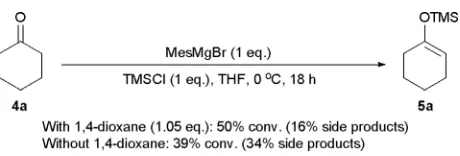
at 0 ◦C,5 provided a moderate 50% conversion to the desired silyl enol ether, using cyclohexanone as the ketone substrate (Scheme 3). However, a 16% conversion to side (addition) products was also noted. Comparatively, without 1,4-dioxane, a decreased 39% conversion to silyl enol ether product was registered, while the conversion to side products increased to 34% (Scheme 3). This indicated that the 1,4-dioxane additive was essential in order to moderate the nucleophilic characteristics of the parent Grignard reagent, presumably by promotion ofin situdisproportionation to the less nucleophilic Mes2Mg reagent.5
Scheme 3 Preliminary one-pot reactions with MesMgBr.
With these somewhat encouraging results in hand, optimisation of the system began with the inclusion of controlled quantities of LiCl. As shown in Table 1, the inclusion of LiCl as an additive, in addition to 1,4-dioxane, within this developing one-pot process, appreciably enhanced the efficiency of the silyl enol ether formation. More specifically, using two molar equivalents of LiCl delivered an almost quantitative conversion to the silyl enol ether5a, now with no trace of side (addition) products (entry 1). If the 1,4-dioxane additive was omitted, conversion increased from the 50% observed in the control reaction to an improved 72%, however, the level of side products also increased to 27% (Scheme 3vs.Table 1, entry 2). Lowering of the LiCl loading level only resulted in less efficient conversion to silyl enol ether (Table 1, entry 3), while halving the quantity of 1,4-dioxane decreased the conversion to product and, once again, increased the side product ratio (Table 1, entry 4).
In addition to the optimisation shown in Table 1, an analysis of reaction time indicated that the conversion to silyl enol ether within the emerging one-pot method proceeded significantly more quickly than when pre-isolated Mes2Mg was employed. As shown
in Scheme 4, the silyl enol ether product is delivered in 93% conversion after only 1 h, compared to the 96% achieved after 8 h using the previously developed protocol with preformed Mes2Mg.5
[image:2.595.314.545.55.120.2]Having established these optimised conditions, we next sought to assess their generality by application to a range of substrates at the readily accessible 0 ◦C reaction temperature (Table 2). Pleasingly, the developed one-pot protocol performed effectively in all cases explored, giving the silyl enol ether products in high isolated yield, with no addition products being detected in any case. This method also delivered some steric selectivity with the
Table 1 Optimisation of LiCl and 1,4-dioxane additives
Entry 1,4-Dioxane/eq. LiCl/eq. Conversion to5a(side products)a
1 1.05 2 98% (—)
2 — 2 72% (27%)
3 1.05 1 81% (—)
4 0.525 2 84% (13%)
aDetermined by G.C. analysis; see Experimental Section.
Scheme 4 Assessment of reaction time.
[image:2.595.51.281.176.254.2]formation of only the kinetic deprotonation product 5f from ketone4f. Furthermore, using these one-pot conditions with the more sensitive ketone, 4-chlorobutyrophenone4h, the silyl enol ether5h was obtained in 80% isolated yield, with no addition, substitution, or elimination products being observed (Table 2, entry 8); with this example the stereoselectivity of the process was also excellent, with only theZ-silyl enol ether isomer,Z-4h, being detected by 1H NMR. Moreover, control reactions have
Table 2 Silyl enol ether formation in a one pot protocol with MesMgBra
Entry Ketone Product Yieldb
1 92%
2 85%
3 96%
4 94%
5 85%c
6 93%d
7 93%
8 80%
9 96%
aSee Experimental section.bIsolated yield after purification.cZ:E4.9 : 1.dThe only product detected was that (5f) from kinetic deprotonation.
Downloaded by University of Strathclyde on 12 December 2011
shown further benefits of this carbon-centred magnesium base protocol over those with analogous lithium reagents: treatment of cyclohexanone with MesLi, under similar conditions at 0◦C, delivered only 13% conversion to the desired enol ether, with the major product beingC-silylated mesitylene.4f Additionally, use of LDA in the reaction with 4-chlorobutyrophenone 4h, under analogous conditions to those employed here, led only to elimination products.
Improvements to the one-pot procedure
Having successfully established this general one-pot process, some further investigations were made in an attempt to enhance the potential overall scope and applicability of this procedure. Firstly, to this stage we had utilised a one hour syringe pump addition of the ketone substrate, since this had been the standard procedure used for all of our previous investigations into asymmetric deprotonation reactions with chiral magnesium amide bases.8 However, it was unknown whether this slow addition procedure was necessary for reactions utilising Mes2Mg, either as a
pre-formed reagent or as generated in situ. To address this, we performed the deprotonation of cyclohexanone, 4a, under the optimised one-pot conditions and with the introduction of the ketone being completed manually over 10 minutes (Scheme 5). Pleasingly, the reaction utilising simple manual addition delivered comparable yields of the desired product5a.
Scheme 5 Manualvs.syringe pump addition.
Following this useful practical development, the scalability of the one-pot Mes2Mg procedure was assessed by carrying out
[image:3.595.320.534.191.269.2]gram-scale reactions under the optimised one-pot conditions with manual addition of the ketone substrates, as detailed in Fig. 1. Gratifyingly, the developed MesMgBr conditions could be successfully applied on enhanced scale to the deprotonation of the substrates illustrated: the benchmark substrate4a(cyclohexanone) and also the more sensitive substrate4h(4-chlorobutyrophenone) gave the corresponding silyl enol ether products 5a and 5h in 90% and 83% yield, respectively. The efficiencies of these gram-scale reactions compare very favourably with the results achieved previously and as delineated above (Table 2).
Fig. 1 Gram-scale one-pot processes.
Consideration of the structure of Mes2Mg·LiCl
Mes2Mg is known to exist as the solvated dimer
Mes2Mg·(THF)2.7a–c However, in the presence of LiCl it is
likely that this structure will change. It is conceivable that, upon introduction of LiCl, Mes2Mg will form an ‘ate-type complex.9
[image:3.595.377.481.349.452.2]Indeed, ‘ate complexes have been suggested as the reactive species in magnesium–halogen exchange reactions mediated by Grignard reagents in the presence of LiCl, as pioneered by Knochel and co-workers.10Two possibile ‘ate complex structures are shown in Fig. 2.
Fig. 2 Possible structures of Mes2Mg·LiCl.
While the charge-separate complex6is a possibility, the Li-bridged structure 7 is considered more likely due to literature precedent for a similar ‘ate complex,8, which has been isolated from the treatment of (2,4,6-iPr
3C6H2)2Mg with (2,4,6-iPr3C6H2)Li
(Fig. 3).7b
Fig. 3 Analogous ‘ate complex [Li(THF)0.6(Et2O)0.4][Mg(2,4,6-iPr3C6H2)3].
Further support for an ‘ate-type structure comes from the observation that ‘ate complexes derived from dialkylmagnesium reagents and cryptands displayed increased nucleophilicity and basicity compared to the parent reagent alone.11 Endeavours towards the isolation and identification of the species generated from Mes2Mg and LiCl are ongoing.
Further applications of Mes2Mg
A final exploratory reaction was performed to expand the possible applications of our developed conditions. Here, Mes2Mg,
preparedin situfrom MesMgBr and 1,4-dioxane, was treated with ethyltriphenylphosphonium bromide and the resultant ylide was used in a Wittig reaction with acetophenone (Scheme 6). Using
Scheme 6 Wittig reaction usingin situgenerated Mes2Mg as the base
reagent.
Downloaded by University of Strathclyde on 12 December 2011
[image:3.595.50.282.359.438.2] [image:3.595.68.263.614.718.2]in situgenerated Mes2Mg, a 97% isolated yield of olefin9was
obtained with 4 : 1 (E:Z) ratio. This promising initial foray into Wittig chemistry has now paved the way for future applications of our developed carbon-centred base protocols.
Conclusions
In conclusion, we have further developed our magnesium-based carbon-centred base protocols to provide a practically more con-venient procedure which operates from a commercially available Grignard reagent. In addition, while employing only 1 equivalent of MesMgBr to generate 0.5 mol of Mes2Mg in situ, this new
procedure delivers the desired products in high yield and with greatly increased efficiency in comparison to our previously de-scribed methods.5Furthermore, these processes can be performed on gram-scale and without the requirement for any slow addition procedures. Throughout, the protocols led to carbon-centred base species which are completely non-nucleophilic, even at the routinely employed temperature of 0◦C.
Experimental
All reactions were carried out using flame dried Schlenk apparatus. Purging refers to an evacuation/nitrogen-refilling procedure. So-lutions and solvents were addedviasyringe. THF and 1,4-dioxane were dried by heating to reflux over sodium wire using benzophe-none ketyl as indicator, and then distilled under N2. Diethyl ether
and light petroleum were used as purchased from suppliers without further purification. Light petroleum (petrol) refers to the fraction of bp 30–40◦C. 2-Mesitylmagnesium bromide,6obtained as a 1 M solution in THF, was standardised using salicaldehyde phenyl-hydrazone as indicator.12Cyclohexanone4a, cyclopentanone4b, cycloheptanone4c, propiophenone4e, 2-methylcyclohexanone4f, acetophenone4g, 4-chlorobutyrophenone4h, anda-tetralone4i, were dried by heating to reflux over calcium chloride and distilled either under reduced pressure or under nitrogen and stored over 4 A˚ molecular sieves under N2. 4-tert-Butylcyclohexanone4dwas
recrystallised twice from dry hexane at 4◦C and stored under N2.
Chlorotrimethylsilane was distilled under N2and stored over 4 A˚
molecular sieves and under N2.
Gas chromatography was carried out using a Hewlett Packard 5890 Series 2 Gas Chromatograph fitted with a Varian WCOT Fused Silica Column containing a CP-SIL 19CB coating and using H2as carrier gas (80 kPa): (i) injector/detector temperature,
200 ◦C; (ii) initial oven temperature, 45 ◦C; (iii) temperature gradient, 20◦C min−1; (iv) final oven temperature, 190◦C; and (v)
detection method, FID. Thin layer chromatography was carried out using Camlab silica plates coated with indicator UV254. These
were analysed using a Mineralight UVGL-25 lamp or developed using a vanillin solution. Flash column chromatography was carried out using Prolabo silica gel (230–400 mesh). IR spectra were obtained on a Perkin Elmer Spectrum One machine.1H and 13C spectra were recorded on a Bruker DPX 400 spectrometer at
400 MHz and 100 MHz, respectively. Chemical shifts are reported in ppm. Coupling constants are reported in Hz and refer to
3J
H–Hinteractions unless otherwise specified. High resolution mass
spectra were obtained using a JEOL JMS-700 high resolution mass spectrometer. The ionization method used was electron impact (EI) with perfluorokerosene (PFK) as the reference compound.
General experimental procedure
A Schlenk tube was charged with LiCl (2 mmol, 85 mg) and flame-dried under vacuum. The tube was purged three times with N2
before cooling to room temperature and charging with MesMgBr (1 M solution in THF, 1 mmol, 1 mL), 1,4-dioxane (1.05 mmol, 88 mg, 0.09 mL) and THF (9 mL). The mixture was stirred for 15 min at room temperature before cooling to 0◦C. TMSCl (1 mmol, 109 mg, 0.13 mL) was added and the mixture was stirred for 5 min before addition of the ketone (1 mmol) as a solution in THF (2 mL) over 1 hviasyringe pump. The reaction mixture was stirred at 0◦C under N2for 1 h before being quenched with sat. aq.
NaHCO3solution (10 mL). The mixture was allowed to warm to
room temperature before extracting with Et2O ((1×40 mL) + (2×
25 mL)). The combined organic extracts were dried (Na2SO4) and
a representative sample was analysed by GC to obtain the ketone to silyl enol ether conversion. The solution was then filtered and concentratedin vacuoto afford a residue which was purified by column chromatography eluting with 1% Et2O–petrol to afford
the silyl enol ether product.
1-Trimethylsilyloxycyclohexene (5a).13,14,15a,16 Using the general experimental procedure above with cyclohexanone 4a gave 1-trimethylsilyloxycyclohexene5aas a colourless oil (157 mg, 92%): mmax (DCM): 1668 cm−1; dH (400 MHz, CDCl3): 0.18 (s, 9H,
Si(CH3)3), 1.48–1.54 (m, 2H, CH2), 1.63–1.69 (m, 2H, CH2), 1.97–
2.03 (m, 4H, 2×CH2), 4.86–4.88 (m, 1H, CH).
1-Trimethylsiloxycyclopentene (5b).13,14,15b,17 Using the general experimental procedure above with cyclopentanone 4b gave 1-trimethylsiloxycyclopentene5bas a colourless oil (133 mg, 85%): mmax (DCM): 1645 cm−1; dH (400 MHz, CDCl3): 0.20 (s, 9H,
Si(CH3)3), 1.82–1.90 (m, 2H, CH2), 2.24–2.29 (m, 4H, 2×CH2),
4.62–4.63 (m, 1H, CH).
1-Trimethylsilyloxycycloheptene (5c).18 Using the general ex-perimental procedure above with cycloheptanone 4c gave 1-trimethylsilyloxycycloheptene5cas a colourless oil (177 mg, 96%): mmax (DCM): 1660 cm−1; dH (400 MHz, CDCl3): 0.18 (s, 9H,
Si(CH3)3), 1.50–1.59 (m, 4H, 2×CH2), 1.66–1.70 (m, 2H, CH2),
1.97–2.01 (m, 2H, CH2), 2.22–2.24 (m, 2H, CH2), 4.86–4.88 (m,
1H, CH).
4-tert-Butyl-1-trimethylsilyloxy-1-cyclohexene (5d).8c,19,20 Using the general experimental procedure above with 4-tert -butylcyclohexanone 4d gave 4-tert -butyl-1-trimethylsilyloxy-1-cyclohexene 5das a colourless oil (213 mg, 94%): mmax(DCM):
1672 cm−1;d
H (400 MHz, CDCl3): 0.19 (s, 9H, Si(CH3)3), 0.90
(s, 9H, 3×CH3), 1.21–1.29 (m, 2H, CH2), 1.78–1.85 (m, 2H,
CH2), 1.98–2.09 (m, 3H, CH+CH2), 4.84–4.86 (m, 1H, CH);dC
(100 MHz, CDCl3): 0.1, 24.1, 24.8, 26.9, 30.6, 31.8, 43.8, 103.6,
150.0.
1-Phenyl-1-silyloxyprop-1-ene (5e).13,17,21,22 Using the general experimental procedure above with propiophenone 4e gave 1-phenyl-1-silyloxyprop-1-ene5eas a colourless oil (175 mg, 85%): mmax(DCM): 1686, 1652 cm−1;dH(400 MHz, CDCl3):Z-isomer:
0.17 (s, 9H, Si(CH3)3), 1.76 (d, 3H, CH3,J=6.9 Hz), 5.35 (q, 1H,
CH,J=6.9 Hz), 7.23–7.49 (m, 5H, 5×ArCH);E-isomer: 0.15 (s, 9H, Si(CH3)3), 1.73 (d, 3H, CH3,J=7.3 Hz), 5.13 (q, 1H, CH,
J=7.3 Hz), 7.23–7.49 (m, 5H, 5×ArCH).
Downloaded by University of Strathclyde on 12 December 2011
6-Methyl-1-trimethylsilyloxy-1-cyclohexene (5f).13,14,16 Using the general experimental procedure above with 2-methyl-cyclohexanone 4f gave 6-methyl-1-trimethylsilyloxy-1-cyclohe-xene5fas a colourless oil (171 mg, 93%):mmax(DCM): 1660 cm−1;
dH(400 MHz, CDCl3): 0.19 (s, 9H, Si(CH3)3), 1.04 (d, 3H, CH3,
J = 7.0 Hz), 1.36–1.41 (m, 1H, CH), 1.45–1.49 (m, 1H, CH), 1.57–1.59 (m, 1H, CH), 1.78–1.82 (m, 1H, CH), 1.98–2.02 (m, 2H, CH2), 2.14–2.15 (m, 1H, CH), 4.81 (td, 1H, CH,J= 3.9,
1.2 Hz).
1-Phenyl-1-trimethylsiloxyethylene (5g).14,15c,23 Using the gen-eral experimental procedure above with acetophenone4g gave 1-phenyl-1-trimethylsiloxyethylene5gas a colourless oil (179 mg, 93%):mmax(DCM): 1620 cm−1;dH(400 MHz, CDCl3): 0.28 (s, 9H,
Si(CH3)3), 4.45 (d, 1H, CH2,J=1.7 Hz), 4.93 (d, 1H, CH2,J=
1.7 Hz), 7.27–7.36 (m, 3H, 3×ArH), 7.60–7.62 (d, 2H, 2×ArH,
J=8.4 Hz).
Z-4-Chloro-1-phenyl-1-trimethylsilyloxybut-1-ene (5h).5 Using the general experimental procedure above with 4-chloro-butyrophenone4hgaveZ -4-chloro-1-phenyl-1-trimethylsilyloxy-but-1-ene 5h as a colourless oil (204 mg, 80%): mmax (DCM):
1649 cm−1;d
H(400 MHz, CDCl3): 0.15 (s, 9H, Si(CH3)3), 2.68 (q,
2H, CH2,J=7.1 Hz), 3.59 (t, 2H, CH2,J=7.2 Hz), 5.27 (t, 1H,
CH,J=7.1 Hz), 7.26–7.34 (m, 3H, 3×ArCH), 7.47 (dd, 2H, 2× ArH,J=6.8, 1.5 Hz);dC(100 MHz, CDCl3): 0.8, 29.9, 44.4, 106.6,
125.8, 128.1, 128.3, 138.9, 151.6. High resolution mass spectrum (EI)m/z:35Cl 254.0890;37Cl 256.0839; C
13H19ClOSi (M+) requires 35Cl 254.0894;37Cl 256.0864.
(3,4-Dihydro-1-naphthyloxy)trimethylsilane (5i).15d,18 Using the general experimental procedure above witha-tetralone4i, gave (3,4-dihydro-1-naphthyloxy)trimethylsilane5i, as a colourless oil (210 mg, 96%):mmax(DCM): 1638 cm−1;dH (400 MHz, CDCl3):
0.38 (s, 9H, Si(CH3)3), 2.42–2.47 (m, 2H, CH2), 2.89 (t, 2H, CH2,
J=7.8 Hz), 5.32 (t, 1H, CH,J=4.6 Hz), 7.21–7.36 (m, 3H, 3× ArCH), 7.54 (d, 1H, ArCH,J=7.4 Hz).
General experimental procedure for non-syringe pump (manual) addition process
A Schlenk tube was charged with LiCl (2 mmol, 85 mg) and flame-dried under vacuum. The tube was purged three times with N2
before cooling to room temperature and charging with MesMgBr (1 M solution in THF, 1 mmol, 1 mL), 1,4-dioxane (1.05 mmol, 88 mg, 0.09 mL) and THF (9 mL). The mixture was stirred for 15 min at room temperature before cooling to 0◦C. TMSCl (1 mmol, 109 mg, 0.13 mL) was added and the mixture was stirred for 5 min before addition of cyclohexanone4a(1 mmol, 98 mg) as a solution in THF (2 mL) manually (by syringe) over 10 min. The reaction mixture was stirred at 0◦C under N2for 1 h before being
quenched with sat. NaHCO3aq. solution (10 mL). The mixture
was allowed to warm to room temperature before extracting with Et2O ((1×40 mL) + (2×25 mL)). The combined organic extracts
were dried (Na2SO4) and a representative sample was analysed
by GC to obtain the ketone to silyl enol ether conversion. The solution was then filtered and concentratedin vacuoto afford a residue which was purified by column chromatography eluting with 1% Et2O–petrol to afford the silyl enol ether product5aas a
colourless oil (148 mg, 87%).
Silyl enol ether preparations on enhanced scale
The general procedure detailed above for manual addition was used in the following preparations:
i) For the gram-scale preparation of 5a: LiCl (22 mmol, 935 mg); MesMgBr (1 M solution in THF, 11 mmol, 11 mL); THF (99 mL); 1,4-dioxane (11.55 mmol, 1.02 g, 0.98 mL); TMSCl (11 mmol, 1.2 g, 1.41 mL); cyclohexanone4a(11 mmol, 1.08 g, 1.14 mL); a reaction time of 2.5 h delivered the product 1-trimethylsilyloxycyclohexene (5a) as a colourless oil (1.68 g, 90%). Spectral details as above.
ii) For the gram-scale preparation of 5h: LiCl (12 mmol, 255 mg); MesMgBr (1 M solution in THF, 6 mmol, 6 mL); THF (99 mL); 1,4-dioxane (6.3 mmol, 555 mg, 0.54 mL); TMSCl (6 mmol, 652 mg, 0.77 mL); 4-chlorobutyrophenone 4h (6 mmol, 1.1 g, 0.96 mL); a reaction time of 2.5 h delivered the product Z -4-chloro-1-phenyl-1-trimethylsilyloxybut-1-ene (5h) as a colourless oil (1.27 g, 83%). Spectral details as above.
2-Phenylbut-2-ene (9)24
A 20 mL round bottomed flask was charged with LiCl (2 mmol, 85 mg) and flame dried under high vacuum. The flask was purged three times and allowed to cool to room temperature. MesMgBr (1 M solution in THF, 1 mmol, 1 mL), THF (5 mL) and 1,4-dioxane (1.05 mmol, 88 mg, 0.09 mL) were added and the solution was stirred for 30 minutes. A separate 50 mL flask was flame dried under high vacuum, cooled and purged with nitrogen then charged with EtPPh3Br (1 mmol, 371 mg) and THF (5 mL) and cooled to
0◦C. The prepared Mes2Mg solution was then introduced to the
second flaskviacannula. The resulting solution was then stirred for 1 h before addition of acetophenone (1 mmol, 120 mg, 0.12 mL) as a solution in THF (2 mL) over 1 hviasyringe pump, followed by stirring at 0◦C for 18 h. The mixture was concentratedin vacuo
to give a residue which was dry loaded onto silica using DCM as the dissolving solvent. Purification by column chromatography using 10% Et2O–petrol afforded the product 9 as a colourless
oil (128 mg, 97%):mmax(DCM): 3025, 1498 cm−1;dH(400 MHz,
CDCl3):E-isomer: 1.82 (dd, 3H, CH3,J=5.4, 1.5 Hz), 2.01 (d,
3H, CH3,J=1.1 Hz), 5.88 (q, 1H, C=CH,J=5.5 Hz), 7.21–7.25
(m, 2H, 2×ArH), 7.30–7.40 (m, 3H, 3×ArH);Z-isomer: 1.61 (dd, 3H, CH3,J=5.4, 1.5 Hz), 2.01 (d, 3H, CH3,J=1.1 Hz),
5.59 (q, 1H, C=CH,J=5.5 Hz), 7.21–7.25 (m, 2H, 2×ArH), 7.30–7.40 (m, 3H, 3×ArH).
Acknowledgements
We would like to thank the EPSRC and the Chemistry Innovation Knowledge Transfer Network (formerly Crystal Faraday) for a studentship (AJBW), GlaxoSmithKline for further financial support, and the EPSRC Mass Spectrometry Service, University of Wales, Swansea for analyses.
References
1 (a) L. Brandsma and H. D. Verkruijsse,Preparative Polar Organometal-lic Chemistry, Springer-Verlag, Berlin, 1987; (b) L. Brandsma and H. D. Verkruijsse,Synthesis of Acetylenes, Allenes and Cumulenes, A Laboratory Manual, Elsevier, Amsterdam, 1981; (c) J. Clayden, N. Greaves, S. Warren and P. Wothers,Organic Chemistry, Oxford University Press, New York, 2001.
Downloaded by University of Strathclyde on 12 December 2011
2 For examples on the use of cerium salts to reduce the basicity of organolithium and organomagnesium reagents, see: (a) Y. Tamura, M. Sasho, H. Ohe, S. Aka and Y. Kita,Tetrahedron Lett., 1985,26, 1549; (b) T. Imamoto, Y. Sugiura and M. Takiyama,Tetrahedron Lett., 1984,
25, 4233; (c) T. Imamoto, T. Kusumoto, Y. Tawarayama, Y. Suiura, T. Mita, Y. Hatanaka and M. Yokoyhama,J. Org. Chem., 1984,49, 3904; (d) T. Imamoto, N. Takiyama, K. Nakamura, T. Hatajima and Y. Kamiya,J. Am. Chem. Soc., 1989,111, 4392.
3 (a) M. Schlosser,J. Organomet. Chem., 1967,8, 9; (b) M. Schlosser,
Pure Appl. Chem., 1988,60, 1627; (c) M. Schlosser, G. Katsoulos and S. Takagishi,Synlett, 1990, 747; (d) B. J. Wakefield,The Chemistry of Organolithium Compounds, Pergamon Press, Oxford, 1974.
4 Only a relatively small number of examples of carbon-centred bases have been described in the literature, presumably due to competing carbonyl addition; in particular, the enolisation of hindered ketones, such as trityl ketones, has been achieved withn-butyllithium and also with trimethylaluminium using, at least, stoichiometric quantities of the organometallic reagent; additionally, the bulky triphenylmethyllithium and triphenylmethylpotassium reagents have been used to mediate the enolisation of certain ketones; mesityllithium has seen rare and atypical usage for the enolisation of specific ketones, and at appreciably low temperatures (e.g. −50◦C); and, more recently, gallium-based reagents, such as GaEt3, have been used to deprotonate methylene
protons with some selectivity, although elevated temperatures (125◦C) and 1.5 molar equivalents of the organometallic reagent are required: (a) D. Seebach, M. Ertas¸, R. Locher and W. B. Schweizer,Helv. Chim. Acta, 1985,68, 264 (nBuLi, AlMe
3); (b) M. Ertas¸ and D. Seebach,
Helv. Chim. Acta, 1985,68, 961 (nBuLi, AlMe
3); (c) E. A. Jeffery and
A. Meisters,J. Organomet. Chem., 1974,82, 307 (AlMe3); (d) H. O.
House and B. M. Trost, J. Org. Chem., 1965, 30, 1341 (Ph3CLi,
Ph3CK); (e) H. O. House and V. Kramar,J. Org. Chem., 1963,28, 3362
(Ph3CK); (f) R. B. Woodward, E. Logusch, K. P. Nambiar, K. Sakan,
D. E. Ward, B.-W. Au-Yeung, P. Balaram, L. J. Browne, P. J. Card, C. H. Chen, R. B. Chˆenevert, A. Fliri, K. Frobel, H.-J. Gais, D. G. Garratt, K. Hayakawa, W. Heggie, D. P. Hesson, D. Hoppe, I. Hoppe, J. A. Hyatt, D. Ikeda, P. A. Jacobi, K. S. Kim, Y. Kobuke, K. Kojima, K. Krowicki, V. J. Lee, T. Leutert, S. Machenko, J. Martens, R. S. Matthews, B. S. Ong, J. B. Press, T. V. Rajan Babu, G. Rousseau, H. M. Sauter, M. Suzuki, K. Tatsuta, L. M. Tolbert, E. A. Truesdale, I. Uchida, Y. Ueda, T. Uyehara, A. T. Vasella, W. C. Vladuchick, P. A. Wade, R. M. Williams and H. N.-C. Wong,J. Am. Chem. Soc., 1981,103, 3210 (MesLi); (g) Y. Nishimura, Y. Miyake, R. Amemiya and M. Yamaguchi,Org. Lett., 2006,8, 5077 (GaEt3).
5 W. J. Kerr, A. J. B. Watson and D. Hayes,Chem. Commun., 2007, 5049. 6 Commercially available from Aldrich Chemical Company, CAS#
[2633–66-1], catalogue no. 227234.
7 B. J. Wakefield, Organomagnesium Methods in Organic Synthesis,
Academic Press, London, 1995. For additional preparations, see: (a) W. Seidel and I. B ¨urger,Z. Anorg. Allg. Chem., 1978,447, 195; (b) K. M. Waggoner and P. P. Power,Organometallics, 1992,11, 3209; (c) D. M. Knotter, D. M. Grove, W. J. J. Smeets, A. L. Spek and G. van Koten,J. Am. Chem. Soc., 1992,114, 3400.
8 (a) M. J. Bassindale, J. J. Crawford, K. W. Henderson and W. J. Kerr,
Tetrahedron Lett., 2004,45, 4175; (b) E. L. Carswell, D. Hayes, K. W. Henderson, W. J. Kerr and C. J. Russell,Synlett, 2003, 1017; (c) K. W. Henderson, W. J. Kerr and J. H. Moir,Tetrahedron, 2002,58, 4573; (d) J. D. Anderson, P. Garc´ıa Garc´ıa, D. Hayes, K. W. Henderson, W. J. Kerr, J. H. Moir and K. P. Fondekar,Tetrahedron Lett., 2001,42, 7111; (e) K. W. Henderson, W. J. Kerr and J. H. Moir,Chem. Commun., 2001, 1722; (f) K. W. Henderson, W. J. Kerr and J. H. Moir,Synlett, 2001, 1253; (g) K. W. Henderson, W. J. Kerr and J. H. Moir,Chem. Commun., 2000, 479.
9 For reviews on ‘ate chemistry, see: (a) R. E. Mulvey, F. Mongin, M. Uchiyama and Y. Kondo,Angew. Chem., Int. Ed., 2007,46, 3802; (b) R. E. Mulvey,Organometallics, 2006,25, 1060.
10 F. Kopp, A. Krasovskiy and P. Knochel, Chem. Commun., 2004,
2288. For recent reviews of this area, see: (a) H. Ila, O. Baron,
A. J. Wagner and P. Knochel,Chem. Commun., 2006, 583; (b) P.
Knochel, W. Dohle, N. Gommermann, K. K. Kneisel, F. Kopp, T. Korn, I. Sapountzis and V. A. Vu,Angew. Chem., Int. Ed., 2003,42, 4302.
11 (a) H. G. Richey, Jr. and B. A. King, J. Am. Chem. Soc., 1982,
104, 4672; (b) E. P. Squiller, R. R. Whittle and H. G. Richey, Jr.,
J. Am. Chem. Soc., 1985,107, 432; (c) H. G. Richey, Jr. and D. M. Kushlan,J. Am. Chem. Soc., 1987, 109, 2510; (d) A. D. Pajerski, M. Parvez and H. G. Richey, Jr., J. Am. Chem. Soc., 1988, 110, 2660.
12 B. E. Love and E. G. Jones,J. Org. Chem., 1999,64, 3755.
13 D. Bonafoux, M. Bordeau, C. Biran, P. Cazeau and J. Dunogues,J. Org. Chem., 1996,61, 5532.
14 H. O. House, L. J. Czuba, M. Gall and H. D. Olmstead,J. Org. Chem., 1969,34, 2324.
15 (a) Commercially available from Aldrich Chemical Co., CAS# [6651– 36-1], catalogue no. 144819; (b) Commercially available from Aldrich Chemical Co., CAS# [19980–43-9], catalogue no. 283126; (c) Com-mercially available from Aldrich Chemical Co., CAS# [13735–81-4], catalogue no. 235040; (d) Commercially available from Aldrich Chemical Co., CAS# [38858–72-9], catalogue no. 540390.
16 I. Kopka and M. W. Rathke,J. Org. Chem., 1981,46, 3771.
17 C. H. Heathcock, S. K. Davidsen, K. T. Hug and L. A. Flippin,J. Org. Chem., 1986,51, 3027.
18 R. Rathore and J. K. Kochi,J. Org. Chem., 1996,61, 627.
19 C. M. Cain, R. P. C. Cousins, G. Coumbarides and N. S. Simpkins,
Tetrahedron, 1990,46, 523.
20 C.-D. Graf, C. Malan, K. Harms and P. Knochel,J. Org. Chem., 1999,
64, 5581.
21 C. H. Heathcock, C. T. Buse, W. A. Kleschick, M. C. Pirrung, J. E. Sohn and J. Lampe,J. Org. Chem., 1980,45, 1066.
22 F. A. Davis, A. C. Sheppard, B.-C. Chen and M. S. Haque,J. Am. Chem. Soc., 1990,112, 6679.
23 Y. Matano, N. Azuma and H. Suzuki,J. Chem. Soc., Perkin Trans. 1, 1994, 1739.
24 Y. Kawai, Y. Inaba and N. Tokitoh,Tetrahedron: Asymmetry, 2001,12, 309.
Downloaded by University of Strathclyde on 12 December 2011
![Fig. 3Analogous ‘ate complex [Li(THF)0.6(Et2O)0.4][Mg(2,4,6-iPr3C6H2)3].](https://thumb-us.123doks.com/thumbv2/123dok_us/1710010.124403/3.595.377.481.349.452/fig-analogous-ate-complex-li-thf-et-mg.webp)