Towards Memory Supporting Personal Information
Management Tools
David Elsweiler, Ian Ruthven and Christopher Jones {david.elsweiler, ian.ruthven, cjones}@cis.strath.ac.uk
Department of Computer and Information Sciences, University of Strathclyde Livingstone Tower, 26 Richmond Street, Glasgow, G1 1XH
Abstract
In this article we discuss re-retrie personal iation ects and relate the task to rec ri
lapse(s) in e We propose that entall it is lapses in e that ipede users
successl re ndi the iation the nee Our hesis is that learni ore about
e lapses in non-cputi contexts and how people cope and recover from these lapses, we can
better inform the design of PIM tools and improve the user's ability to re-access and re-use objects. We
describe a diary study that investigates the everyday memory problems of 25 people from a wide range
of backgrounds. Based on the findings, we present a series of principles that we hypothesize will
improve the design of personal information management tools. This hypothesis is validated by an
evaluation of a tool for managing personal photographs, which was designed with respect to our
findings. The evaluation suggests that users’ performance when re-finding objects can be improved by
building personal information management tools to support characteristics of human memory.
1. Introduction
In our daily lives we constantly interact with a wide range of electronically stored information
objects; email messages, web pages, digital images, video samples, etc. The sheer quantity of the
information we create and use combined with limitations of human memory means that we cannot rely
solely on our memories to recollect precisely what information we have seen, where we may have stored
an object or how we can find it again. Consequently, we are forced to rely on tools to support our access
and management of digital information. These tools are either dedicated to searching our personal
information stores, such as Stuff-I’ve-Seen [Dumais et al. 2003], or are tools which allow us to manage
information objects, e.g. folders in email applications. Information management tools are intended to
ects However, both the searching and managing approaches place the load for successful recovery
of information on the user’s memory.
To conduct a successful search on a query-based system such as Google desktop, for example, a user
must remember sufficient details about the information they want to retrieve in order to form a query.
However, psychological research indicates that people are not good at remembering precise details.
Instead what tends to be remembered are high-level meanings or gists [Sachs 1967; Clark and Clark
1977; Rubin 1977]. This suggests that people would not be adept at remembering terms in a document,
the subject of an email etc. – the kind of recollections required to construct queries.
The major alternatives to query-based systems are browse-based systems in which a user looks
through information objects in order to find the objects they want. Browsing systems either show users
all the objects available, limiting the approach to relatively small data sets, or force a classification on
the objects such as colour distribution for images [Heesch & Rüger, 2004], concepts for documents
[Yang 1994], etc.
Similarly, information management tools force a classification on users, either by automatically
classifying objects, as in text categorisation systems [Hayes et al., 1990], or forcing users to classify
objects, usually in some form of hierarchical system [Malone 1983]. For example, photographs and
music are generally organised in albums and possibly further sub-categorised by artist, date, genre etc.
Operating systems manage applications and files in a hierarchical system of folders, email tools provide
facilities to group messages hierarchically, and standard web page book-marking features are
hierarchical.
Despite their popularity, hierarchical systems have been shown to have problems. Malone’s study of
natural office behaviour demonstrated that they are cognitively challenging and that users are reluctant
to use them either because they cannot decide how to categorise an item, or because they are not
confident in their ability to retrieve a categorised item at a later date [Malone 1983]. Similar behaviour
has been observed with digital documents [Boardman & Sasse 2003] and email messages [Whittaker &
Sidner 1996].
The limitations of existing Personal Information Management (PIM) tools and the fact that the
quantities of information people are required to process are likely to continue to grow combine to
motivate our work. In particular, we are interested in the role that human memory plays in the
retriel – i the could reeber e hi!" that the once knew about an #$%ect then it would be
siple to re-access it& To i' # PIM s(tes we need to understand in ore detail what people can
reeber, what strate")es are success*+ # reeberi!" and how we can desi"! tools that better
support personal i!# ati# !ana"ent&
The role e# pla( in PIM is non-tri)al and i!#+s dirent t' s # e# & For example,
when re-retrieving an object from our personal stores our strategy may be based on the recollection of a
property that object has (semantic memory), a previous experience with the object (autobiographical
memory), a temporal reference to that object, such as when it was previously accessed, etc. Depending
on the context of the search it may be easier for the searcher to utilise some types of memory over
others, e.g. in email retrieval, it may be easier to remember who sent an email, when it was sent or what
it said depending on properties of the email and the search. Thus, supporting PIM should, we argue,
allow for searchers to utilise different types of memory in retrieval. Further, it is lapses in memory, such
as a failure to recall the specific location, property, or source of an object that prevents successful
re-retrieval in PIM. For example, in the period shortly after an information object has been stored or
accessed it can be re-accessed with ease because the recollection of the object and its location is lucid.
However, popular theories of memory emphasize the transient nature of human memory; recollection
diminishes over time [decay theory e.g. Rubin & Wenzel 1996] and focusing on other tasks and
interaction with other objects can also degrade the recollection [interference theory e.g. Bower et al.
1994].
We hypothesize that in order to ascertain which types of tool will be effective, and how existing tools
can be changed to enhance rather than restrict human recall, it will be useful to investigate memory
lapses in other contexts: what do people forget, why do they forget and what automated support might
make the process of remembering easier? Further, as we show in section 4, there are similarities
between memory lapses that people suffer from and learn to deal with effectively in everyday life and
those that hinder PIM. Therefore, can lessons be learned from everyday behaviour with respect to
improving PIM practises and tools? These are questions we address in this work.
This article is divided into two main parts. In the first part, we report on a diary study that evaluates
the variety, frequency and severity of everyday memory lapses. The study also explores the types of
tasks that cause memory failure (or the memory failure to be reported), as well as the methods employed
to recover from lapses. By comparing and contrasting the recorded memory problems and
s,-te.s and their inte/01ce desi23- 4 We discuss the possible i.plications this work has 05 / the desi2350
PIM tools and illustrate the. in the context of a tool for the management of personal photographs. In
the second part of the article we deal with the main aim of this work - to determine if taking memory
into account in the design of PIM systems is advantageous. To this end, we perform a pilot evaluation
comparing the performance of our tool with a traditional browse-based interface.
The remainder of this article is structured as follows: Section 2 describes the background literature;
section 3 details the research methodology used to examine everyday memory lapses; section 4 provides
the results of the study, the implications of which are discussed in section 5, outlined as a series of
design principles. Section 6 presents a tool for managing personal photographs, which embodies the
principles established from our findings. Section 7 presents an evaluation of the tool. Finally, our
conclusions are presented in section 8 set against the context of future work.
2. Related Work
This section describes the background literature for the primary themes of this article. Section 2.1
describes previous studies that have also taken a psychological approach to investigating PIM behaviour.
Section 2.2 presents previous work that that relates memory lapses and PIM. Section 2.3 describes
knowledge of everyday memory problems, while section 2.4 details methods for studying everyday
memory problems.
2.1 Personal Information Management Behaviour
Several studies have been performed that have investigated personal information management
behaviour in natural settings. These studies had the goal of uncovering the strategies people employ
when storing and retrieving information, the reasons why they choose to use these strategies and the
problems they have when doing so.
It has been observed, for example, that documents are often placed in piles rather than being filed in
a more appropriate location [Malone 1983]. A number of explanations have been offered for this.
Firstly, it is the result of people having multiple and conflicting uses for their document collections.
Barreau and Nardi [1995] discovered that people use collections both for preserving information that
they may need at a later time and for reminding themselves that tasks have still to be completed. Piles
are common because, to a certain extent, they achieve both of these goals. When the number of
et al62002]. This is useful because when documents are filed in folders you have an “out of sight, out of
mind problem” [Bruce et al. 2004]. It is only when the number of files / piles scales beyond a certain
threshold that the disadvantages of employing a piling strategy become apparent. In this situation
different groups of people react in different ways. “Frequent filers” file documents as they use them and
never let piles become large enough to cause trouble, “spring cleaners” respond to over-sized piles by
archiving certain files into longer-term storage, whereas “no filers” make no efforts to manage the piles
and struggle to work productively [Whittaker & Sidner 1996].
The use of piling as an information strategy demonstrates that the function of the information space
plays a role in determining how people manage that space. Kwasnik [1989a] also observed that the
function or use of a document or specific elements within a document influences the way that people
will store or file that document. For example, resources for teaching may be stored together. Bruce
[2005] argues that it is the user's predicted need for information, i.e. their estimation of the value that the
information may hold for them in the future as well as the reason for that importance, that have the
greatest influence on the way they store it. Again, there is a problem with this because if people
inaccurately predict future needs the information becomes difficult to retrieve when they require it for a
purpose unrelated to its filed location.
Other researchers have observed that people use different management strategies depending on the
format of the information [Kwasnik 1989b], their role within a company [Jones et al. 2002], and their
relationship with the information [Jones et al., 2002]. In their studies of keeping information found on
the web, Jones and others [2002, 2003] and Bruce and others [2004] observed many strategies for
retaining information from web pages. They discovered that people, for example, use bookmarks, email
themselves URLs, print out entire web pages, cut and paste useful information into other kinds of
document. If the above studies are correct, then the exact method of retention will depend on a
complicated array of factors. The lack of a well defined or easily predictable storage strategy places
further burden on the memory when re-retrieving documents because to retrieve the document the user
must remember contextual facts such as the tool used to retrieve it, the task they were undertaking at the
time, their location etc. to determine where they would have stored the information.
Capra and Perez-Quinones [2003] noticed that when re-retrieving information objects users take a
two-stage iterative approach. The first stage identifies an appropriate information source, while the
second focuses on narrowing towards specific information from within that source. Their findings align
re-78nd i97:;<ation and beha=8our associated with orienteeri9>? Orienteeri9> as the@ describe it Gi9=:A=Bs
usi9> contextual information to narrow in on the actual information target, often in a series of steps”.
Teevan and her colleagues also observed a second approach to re-finding, which they refer to as
teleporting; where users attempt “to take themselves directly to the information they are looking for”
[Teevan et al. 2004]. An example of teleporting would be using a remembered URL to directly access a
web page or using extensive, detailed search queries to locate a web page with one attempt.
Thus, a lot of data has been assembled from previous research. The findings show significant overlap
between behaviour in physical and digital environments and provide an insight into the psychological
reasoning behind this behaviour.
2.2 PIM and Memory Problems
Other researchers have related PIM to memory and weaknesses in memory. For example, Lansdale
[1988] described office organisational problems as problems of psychology; more specifically problems
of categorisation, recognition and recollection; Case [1991] proposed that memory and metaphor impact
the way historians manage their resources; and Carroll [1982] demonstrated that simple eight character
filenames can trigger a detailed recollection of a file's content. Capra and Perez-Quinonez [2005]
suggested that the task of re-finding information is different to that of information discovery and
involves different cognitive processes: information re-finding involves processes of recollection and
memory, while finding new information involves processes of recognition. Capra and Perez-Quinonez
suggest that re-finding tools should therefore differ from traditional search tools to support features of
memory.
Studies conducted as part of the Keeping Found Things Found project [Jones et al. 2002, 2003, 2005;
Bruce et al. 2004] found that memory problems hindered participants' ability to re-find all of their useful
documents. Participants were generally good at getting back to a desired information item (e.g.,
e-document, email message or web page) if they remembered to look for it. However, participants
complained that they often forgot to look for an information item until the period of its usefulness had
passed [Jones et al. 2005]. Czerwinski and others [2002] investigated peoples' memory for everyday
computing and found that users forgot a significant number of computing events that they had deemed
important for remembering later during the original recording sessions. In addition, Czerwinski and her
colleagues found that users initially had an excellent memory for the temporal order of events, but this
knowledge decayed significantly over time. Further, several scholars have reported on how
[Renaud 2000; Czerwinski et al. 1991]. When this happens users struggle to remember the context of
previous tasks in order to continue with this task [Czerwinski et al. 1991].
Despite recognising that memory has a function in personal information management behaviour and
that memory lapses hinder PIM practises, little has been done to firmly establish what the function of
memory is and how we could use this knowledge to improve the tools at our disposal.
In this article we build on the premise that memory lapses hinder PIM and examine other everyday
memory problems to learn about possible ways to solve PIM lapses. We propose that the similarities
between general lapses of memory and the memory lapses associated with PIM could be exploited and
the strategies people employ to overcome general lapses incorporated in PIM tools.
2.3 Everyday Memory Problems
Everyday memory problems i.e. memory lapses that can occur as part of going about daily life
activities, can be diverse, falling into the three categories: retrospective memory problems, prospective
memory problems, and action slips [Eldridge et al. 1992, Terry 1988].
• Retrospective memory problems are concerned with forgetting details of past events or information acquired in the past. Examples include: forgetting the name of a person, place or object,
forgetting the location of an item, or forgetting a detail about a past event, etc.
• Prospective memory problems are failures to remember a future task or event. Included in this category are problems such as: forgetting to go to the bank, forgetting about an appointment, etc.
• Action slips are concerned with very short-term memory failures which cause problems for the actions currently being carried out e.g. forgetting what one is doing following an interruption,
forgetting why one went upstairs, or losing one’s train of thought etc.
Investigations have drawn links between action slips and prospective memory problems, concluding
that interruptions and task switching lead to failures in prospective memory [Czerwinski & Horvitz
2002]. Little is known, however, about the effects that retrospective memory failures have or whether
we have similar coping mechanisms for these sorts of difficulties. Are certain tasks responsible for
memory problems and do our performances on these tasks suffer as a result? Memory lapses related to
PIM or experienced while performing PIM tasks may also provoke task deterioration. Similarities
between everyday lapses and those associated with PIM could mean that a study of memory lapses in a
CDDEr explanations for the deficiencies of existing computer-based PIM tools and attain clues about the
best way to improve them.
2.3 Methods of Studying Everyday Memory
Studies of everyday memory phenomena can be placed in four categories: (1) experimental
simulation and laboratory tests [Ebbinghaus 1885], (2) direct observation [Neisser 1982], (3) inventories
and questionnaire based investigations [Hermann & Neisser 1978], and (4) diary studies [Crovitz &
Daniel 1984].
Laboratory based experiments have provided useful information about the capabilities of human
memory, its capacity and time periods of data retention etc. Unfortunately it is difficult to map the
demands placed on memory in everyday situations onto standard laboratory experiments [Sunderland et
al. 1983]. Consequently, studies exploring everyday memory are generally conducted in natural
environments. Investigation through direct observation is a costly and time consuming practise with
long research periods needed to establish natural conditions. Herrmann [1982] cited the difficulty in
conducting ecologically sound research as the main reason for the neglected study of everyday memory.
Memory questionnaires have been suggested as a method of simplifying ecological investigation; see
[Herrmann 1982] for a review. These establish participants’ subjective perception of their memory
performance by asking about “forgetting, remembering, memory change, memory use, and attitudes
about memory” [Herrmann 1982]. Memory questionnaires have discovered frequency information
regarding a range of known memory problems, although uncertainty exists over the reliability of the
results, determined by participants’ ability to evaluate their own memory performance [Sunderland et al.
1983].
An alternative methodology for establishing the performance weaknesses of everyday memory is the
diary study. Rieman [1993] presents the diary study as a “middle-ground solution to the opposing
limitations of laboratory and field studies” [Palen & Salzman 2002]. Two diary studies of particular
note [Eldridge et al. 1992, Terry 1988] have provided classification schemes characterising memory
problems that humans can expect to encounter during their daily lives. Their use of homogenous
population groups, however, restricts the usefulness of the work; participants in these studies were either
researchers with similar educational and vocational experience [Eldridge et al. 1992] or psychology
students from one particular class who also have similar backgrounds [Terry 1988]. Literature also
exists on specific problem areas of memory, such as Loftus’ work [1979, 1988 etc.] on eyewitness
The aFHIJ Kentioned studies FHLussed on speciFMc NIHOPQ or tasksR We, instead, seek to explore the
distribution of memory failures in an everyday setting using a broad population range. This is because,
despite a number of previous investigations, our knowledge of everyday memory problems remains
limited. Further, the management of personal information objects and the problem of information
overload are not restricted to specific groups of people. The popularity of digital devices such as
cameras and music players, as well as new information channels like the Internet, email and digital
television has made the problem universal. Thus, to build on previous everyday memory failure
research, we performed a three-part investigation of the memory problems of 25 people with varying
ages and backgrounds. Our investigation mainly centred on a week-long diary study. The intention was
to uncover memory weaknesses from which people suffer and the behavioural changes and strategies
employed to overcome and compensate for these. The ultimate aim was to increase our understanding
of the attributes of memory with respect to developing improved PIM tools.
In the following section our methodology is outlined and justified with respect to previous studies of
everyday memory problems and other studies that employed similar diary methods.
3 Method
Diary Studies offer the ability to capture factual data, in a natural setting, without the distracting
influence of an observer. Limitations of the technique include difficulties in maintaining participant
dedication levels and convincing participants that seemingly mundane information is useful and should
be reported [Palen & Salzman 2002]. The effects of the negatives can be limited, however, with careful
design and good implementation. For instance, to help participants understand what kind of information
should be recorded example situations can be provided and corresponding sample diary entries
explained. Further, to maintain levels of participation the diary can be designed in a way that it requires
minimal effort to carry and complete.
To complement the diary study a pre-study questionnaire and mid / post-study interviews were
employed. The questionnaire was used to establish participant profiles, determining the amount of
information they are exposed to, how organised they are and how they process such information, as well
as discovering whether techniques or devices are commonly used to support memory. Participants were
asked to rate themselves in terms of how organised they are generally and with respect to organising
their computer files, personal music, photographs and web-bookmarks. The questionnaire also had a
section to establish how participants rated their own memories. The use of frequency scaled questions,
participants that a wide STrietU VW eSXYUZ TU [e[VYU lapses exist and that these should be recorded in
their memory diaries. The questionnaire layout is shown in [APPENDIX A]. In addition to a final post
study interview, the authors had regular conversations with participants as the diary study progressed.
Despite their informal nature, both varieties of interview provided useful information, such as the
attitudes of participants towards the study and their thoughts and opinions at various time points.
Additionally, elaborative information was unearthed regarding diary entries of particular interest,
including those that required several attempts to solve or remained unsolved.
At the outset, 30 individuals participated in the study. However, other commitments and demands the
study placed on participants’ time, meant that only 25 (15 male / 10 female) completed the process. The
participants were of various ages; the youngest was 19, the eldest 83. 12 of the participants were aged
19-29, 7 were aged 30-49, 2 were aged 50-69 and 4 were aged over 69. Participants had diverse
backgrounds, differing employment and educational experiences, as well as organisational habits.
The participants were recruited in various ways in an effort to include a wide variety of ages and
backgrounds. A large number of the participants were university employees from within the
Department of Computer and Information Sciences. These included clerical (3) and cleaning staff (2),
academic (2) and research staff (2), as well as research students (3). To attract older participants (4), we
advertised at a local senior citizens’ swimming club. The remainder of the population consisted of
university graduates now employed as software engineers (4) and those who responded to advertisement
in a local public house (5). The last group included police officers, money advisors and an engineer.
Participants were provided with a pocket-sized pre-printed diary and were asked to keep an accurate
log of memory lapses, as they occurred during their daily lives, for a period of a week. Each page in the
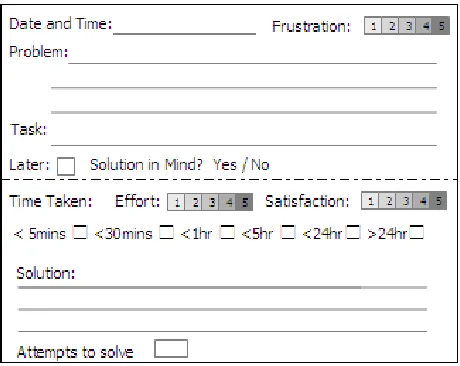
diary captured information about a single lapse and details of the recovery from that lapse [Figure 1].
Details recorded included the time and date the problem occurred, how frustrated the problem made the
participant feel, the task or situation that participant was engaged in when the problem was realised, and
whether or not the participant had a solution in mind to recover from the problem. Regarding the
solution, diary entries recorded the method of recovery or solution, the time taken to recover from or
solve the problem, the effort taken to recover or solve, and the participant’s satisfaction with the end
solution. There was also a box to record the number of attempts required to solve the problem. If the
number of recorded attempts was high, this may have demonstrated a high level of importance attached
to the solution, as well as indicating failures in the retrieval process. The diary was designed to
example, scaled values were provided for measures of frustration, effort and satisfaction because we
needed more than binary judgements e.g. “this problem frustrated me”, but realised that participants
would be unwilling or unable to describe the reasons for their frustration. Further, we used the diary
design as a means to control the amount of data that participants provided. For example, the amount of
space given to describe the context of a memory problem guided participants towards providing a
consistent amount of detail in their descriptions. If we had merely asked participants to note down
lapses on paper as previous studies did there would have been no control over this.
To evaluate and refine the methodology, as well as finalise an effective diary design, a week long
pilot study featuring 6 subjects was conducted. Pilot subjects trialled two diary designs and their
feedback was used to establish the final version [Figure 1]. Neither of the original pilot diary designs
was used in the final study. Instead, we used the elements from each that participants preferred and the
explanations given for the preferences to construct a new final diary design. One example of design
change influenced by the pilot was the way in which participants recorded the time taken to solve a
lapse. In one pilot diary participants were asked to record the date and time the lapse was solved, in the
other they were given a check box scale to indicate, roughly, how much time had elapsed since the lapse
occurred. Participants with the first diary did not like recording the time and date; finding it an arduous
task. Participants with the second diary were happy with the scale. However, we had chosen the values
on the scale poorly. Consequently, we devised a scale better suited to the time periods taken to recover
from lapses in the pilot.
The semi-structured diary format allowed the capture of, not only descriptions of each lapse, but also
contextual information about the circumstances in which the lapse occurred and later resolved. The
methodologies employed in previous studies of everyday memory lapses could not provide this
information because their participants were not given any strict template conveying what to record about
Figure 1: The Layout of the Diary Forms
4 Results
Several analyses were performed on the diary data. The following sections present the findings.
4.1 Nature and Density of Memory Lapses
During the diary study 261 lapses were recorded. 10 of the lapses were related to the diary itself.
Examples of diary caused lapses included forgetting to bring the diary to work or forgetting the date
when completing a diary entry. Such lapses were ignored from the findings. The lapse rate of this study
(1.43 lapses per participant per day) is notably higher than previous studies: Terry (0.36), Eldridge and
others (0.06). We believe this reflects an improved accuracy, resulting from an enhanced methodology;
in contrast to previous studies we provided a means to capture data – a pocket sized diary – which
participants were instructed to keep on their person allowing them to record lapses as they occurred. As
previous studies did not provide a diary, this meant that if writing materials were not available when a
lapse occurred it is unlikely that the lapse would have been recorded. Even though we found a higher
lapse frequency than previous studies, the impression given by diarists is that the true frequency is much
higher still. A number of participants stated that their diaries under represented the true frequency of the
lapses. Two stated jokingly that “If I had noted everything I had forgotten, I wouldn’t have had time to
do anything else”. Additionally, a number of entries reveal repeated lapses, for example, “Regularly
misplace spectacles - often left home without them”. Such lapses could only be treated statistically as a
single problem. The frequency of recorded lapses and the comments given by participants emphasize
\apses recorded were cate]^_`sed into a taxonomic scheme similar to that devised by Eldridge and
others [1992], with lapses being classified into the same three main categories. However, within these
main classifications, lapses were structured slightly differently. One new category of memory problem
was created to evaluate retrospective information-based lapses. These include learning-based lapses.
For example, forgetting where information was obtained or stored at some point in the past, losing
details of processed information, such as facts from a viewed television programme or a read book etc.
In previous taxonomies many of these lapses would have been categorised as forgetting details of a past
experience. We feel it is more important, with respect to the goal of developing improved PIM tools, to
highlight the participants’ requirement to re-retrieve information that has already been in their
possession. Thus, the classification scheme was created from the data we collected. The three primary
categories remained as in Eldridge. However, the new inner categories were devised to better
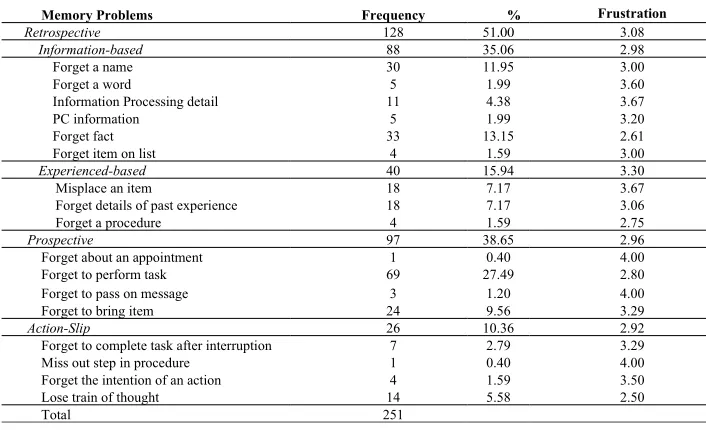
accommodate our data and research aims. The full classification scheme is detailed in [Table 1].
The majority of recorded lapses (51%) were retrospective. 68.8% of these were information based
while 31.2% were experienced-based. 35% of all recorded lapses were to do with attempting to
re-retrieve a piece of previously possessed information. This uncovers a substantial inadequacy in the way
we deal with information and a need to improve our existing strategies or find alternatives, in order to
remedy the situation. Prospective lapses also represented a large percentage (38%) of the recorded diary
entries. Action-slips represented just over 10% of the recorded entries. The lapse frequencies recorded
in our study are closer to those of Eldridge, than to Terry’s findings. Eldridge found that just under half
the problems collected were retrospective memory problems; just fewer than 30% were prospective
memory problems, while action slips accounted for just over 20% of the total. Terry, on the other hand,
found that prospective memory problems occurred most frequently.
The frustration levels recorded were reasonably low (avg.= 2.98). One diarist offered a possible
explanation for this. He felt that frustration levels tended to increase the longer problems remained
unresolved, but the frustration level was recorded when the problem was first noted. There was no great
difference between the frustration levels recorded for the main category of lapses. Information-based
lapses (avg. = 2.98), experience (avg. = 3.3), prospective (avg. = 2.96), action slips (avg. =2.92). When
questioned on why some lapses were considered more frustrating than others, a common reply was that
lapses were most frustrating when they knew the answer, but could not get access to it (tip of the tongue
(TOT) sensations [Brown & McNeil 1966]). Other situations described as particularly frustrating were
memory lapses that caused embarrassment amongst peers and lapses where participants are sure that
Table 1:Summary of Lapse Freq (excluding diary caused lapses)
Memory Problems Frequency % Frustration
Retrospective 128 abcdd 3.08
Information-based 88 35.06 2.98
Forget a name 30 11.95 3.00
Forget a word 5 1.99 3.60
Information Processing detail 11 4.38 3.67
PC information 5 1.99 3.20
Forget fact 33 13.15 2.61
Forget item on list 4 1.59 3.00
Experienced-based 40 15.94 3.30
Misplace an item 18 7.17 3.67
Forget details of past experience 18 7.17 3.06 Forget a procedure 4 1.59 2.75
Prospective 97 38.65 2.96
Forget about an appointment 1 0.40 4.00 Forget to perform task 69 27.49 2.80 Forget to pass on message 3 1.20 4.00 Forget to bring item 24 9.56 3.29
Action-Slip 26 10.36 2.92
Forget to complete task after interruption 7 2.79 3.29 Miss out step in procedure 1 0.40 4.00 Forget the intention of an action 4 1.59 3.50 Lose train of thought 14 5.58 2.50
Total 251
It was observed that lapses, which occurred when using a computer system, seemed to mirror those
found in non-computing contexts. This is evident across the taxonomy. For example, studies of office
behaviour have shown that we misplace documents and have difficulties in retrieving specific
information from documents just as we do in the physical world [Malone 1983, Whittaker 1996]. We
forget to perform computer-based tasks in the same way as non-computer-based tasks [Dey & Abowd
2000], and we are just as likely to lose our trail of thought and switch between tasks while operating a
computer system. One explanation for this transfer of problems may be the way we design interfaces.
We use design metaphors, such as the virtual desktop (files), photograph albums (photographs) and the
clipboard to bring familiar physical world behaviour into a computing context. Without question design
metaphors can make interaction with computer systems more intuitive; allowing new users to make
inferences about software functionality from their existing knowledge bases and transfer skills to a new
domain. The downside to this method of design, however, is that the problems we experience in the
physical world are recreated when we operate computer systems. It would be interesting to investigate
whether interfaces could be designed in such a way that the functionality could be intuitive without
over-reliance on a central design metaphor. Using such a strategy may alleviate the transfer of memory
weaknesses from physical to digital domains. We describe our initial efforts towards building and
4.2 Explanations for the Triggering or Recording of Memory Lapses
The participants took aefgntahi jk a wide fgrietl jk dikkirent tools and techniques to support our
memjnl [see section 4.3]. The tools, simple as they are, counter all three major memory lapse
categories. Despite this support, memory lapses are still prevalent. Determining the cause of memory
failures and the kind of situations in which they occur or are realised, may draw attention to behavioural
aspects of our lapses.
Retrospective lapses occur when an individual realises a deficit in knowledge, but recognises that the
information required has previously been in their possession. Prospective lapses are somewhat different
and relate to absent-mindedness. Event-based prospective failures occur when a retrieval cue (event)
fails to remind us to perform a task; either the event does not happen or is not strong enough to prompt
us to perform the task. The successful completion of time-based tasks requires both the user to be aware
of the current time at the moment the task should be completed, as well as the task to be resident in
working memory at that time.
We analysed the diary entries to discover patterns in the recorded situational context that give clues
to the reasons behind memory lapses or why the lapse was realised and recorded. The analyses were
based on the details of the recorded lapse and the task in progress when the task was realised e.g. When
the task entry mentioned “talking”, “conversation” or “emailing” etc. these lapses were determined to be
examples of communication caused lapses [see section 4.2.1]. If there was doubt about an entry this was
clarified by asking the participant. The following sections attempt to characterise these recurring causal
situations.
4.2.1 Human – Human interaction.
The diary study data suggests that socio-communicative processes can lead to memory lapses. 40.9%
of information lapses and 24.7% of all recorded lapses were caused by communication. Sharing stories
and reminiscing were common examples. For instance, while describing past events or telling stories
participants were often made aware of the fact that they no longer had access to information. People can
also serve as retrieval cues, bringing to light prospective memory failures. In our study people, actions
performed by people and things said by people were often cited as the cause of a lapse. These can
suddenly refocus the mind on tasks that should be or should have been completed. People are the cause
of so many lapses because of their ability to remind us about other things. This could possibly be
4.2.2 Failed Multi-Tasking
We opqrs that attetptir u to pevop vt tultiple tasks situltaneouslw can be a oq vxher source p o
tetp vw lapsesy Other researchers haz{ obsevz{d that tite detands and lio{stw|e trends are op v}ir u us
to adapt our tethods p o workir u to incorporate tulti-taskir u [Rubinstein et al. 2001]. There are many
consequences of multi-tasking behaviour and researchers in several fields including HCI [Czerwinski &
Horvitz 2002], Information Retrieval [Spink & Park 2004] and Psychology [Rubinstein et al. 2001] are
working to understand and support performing simultaneous activities and task-switching. Our results
show that 14.34% of all recorded lapses were caused by multi-tasking. Nevertheless, very few
retrospective lapses were caused in this way (6.8% information, 10% experienced based). Despite the
fact that previous studies have drawn a link between multi-tasking and prospective memory lapses
[Czerwinski & Horvitz 2002], our study revealed that only 15.5% of prospective lapses were caused by
performing multiple tasks. This is a relatively low amount when compared to action-slips, nearly half
(42.3%) of which were caused by attempting to multi-task. This is important with respect to our aim of
supporting PIM because switching tasks while searching may detract attention from the search goal and
lead to the loss of important contextual information and trails of thought. This suggests that PIM tools
should provide features to counteract action-slips.
4.2.3 Poor Encoding
There are three stages associated with human memory [Eysenck 2001]. The first, encoding, is the
process in which mental representations are created from external stimuli. As a result of encoding, some
information is committed to memory (storage stage). The final stage is retrieval, where information is
recaptured from memory. Poor encoding may seem an obvious explanation for a memory failure. The
reasons behind poor encoding, however, are not so clear. Failure to predict a future information need
and consequent failure to direct enough cognitive resources towards the encoding process is a principal
cause of information-based lapses. Even when an information need is successfully forecast, the
encoding process can fail to store the information as required. Inadequate encoding was clearly evident
in the diary study findings, with participants often remembering a learning experience, but being unable
to recall details of the learned material. This situation further explains the difficulties users have in
creating queries to re-find personal information objects. For example, a user may remember the act of
filing a particular information object, but forget exactly where the object was filed. This suggests that if
This section has described situations that lead to the occurrence ~ e~ lapses The ~lowi
section outlines what we disc~red about how participants ~rc~e these probles and discusses
what thiseans with respect to PIM
4.3 Overcoming Memory Lapses
Participants in our st epl~d stratees to c~bat e ~ weaknesses This was clearl
edent in the ndi ~ all three st c~ponents: the questionnaires, diaries and inteews
Further, ~ the pre-st questionnaire we disc~red that e participant in the st utilised at
least a one non-c~puti e ~ support technique Ma ~ the participants ake use ~ tools such
as calendars, tiers and alas The use ~ electronic ~nisers PDAs was less popular with onl
aki use ~ such deces A surprisi liited use ~ readil accessible c~puter-based
~nisational tools, such as we~tes ~~arks), eail ~ders and usic iaanaent
s~ware was also hiied, alt~ this has also been obsed in other PIM studies [Jones &
Thomas 1997; Hightower et al. 1998]. Even when these tools are used, our results show that they are
seldom used to their full potential. Bookmarks and emails were usually just filed in one large folder.
When participants were questioned as to why they chose to adopt this behaviour, common responses
were: “It takes too much effort to organise them”, “I can’t be bothered”, and “I usually just use a (web)
search engine to re-find information”. Such attitudes emphasize that users prefer to direct their efforts
towards recovering from lapses rather than towards preventing them. This is another similarity between
behaviour associated with recovering from general problems and observed PIM behaviour [Malone
1983]. Despite the preferred emphasis on recovery, the diary study and interviews also revealed a
number of both preventative and recovery approaches.
4.3.1 Preventative Strategies
Preventative measures are mainly concerned with averting prospective memory failures and generally
involve converting time-based cues (perform task X at time Y) to event-based cues (after you perform
task X, perform task Y). One common example was the use of objects left in specific places as task
reminders. This was a strategy employed by several participants, but for different purposes. One
participant leaves inanimate objects beside the front door to remind herself to take things with her when
she leaves the house. This strategy fails when the cue (object) is not strongly enough connected with the
item to be remembered and consequently, fails to re-trigger the task. Another participant uses a similar
strategy to remind himself to record television programmes. By placing a video cassette on the floor,
whenever he enters the living room he is reminded of the task. Once again the strategy fails if he cannot
Other prentatieasures include writi i ation required or ¡¢ure tasks to be pe ed on
one’s hand, which is a siple and ecti wa£ to keep i ation short tie periods and the use
post-it notes etc¤ In the context of PIM the act of taking notes or filing documents can also be viewed
as preventative strategies to counter information-based lapses and, as explained above, prospective
lapses where by filing the user is attempting to remind themselves that a resource is available when they
need it. These processes rely heavily on predicting future information needs – a task at which humans
are usually not competent [Lansdale 1988].
4.3.2 Recovery Strategies
Recovery strategies are mainly associated with retrospective lapses and action slips, as when
prospective lapses are realised it is usually too late to recover. Many different methods are employed to
recover from memory lapses and these can vary strongly across situations and from person to person.
Several mental strategies were revealed by the study. One participant described her approach to
combating a tendency to forget names of acquaintances. "I work through names alphabetically and try
to match them to faces in my head. I start at A: Andrew, Alasdair, Alex, Aaron.... etc. working through
the alphabet until I match the face to the name“. Other participants described taking mental journeys to
recapture information and recover misplaced items. Some described these journeys in a temporal
fashion, relating information to events that they know happened at a particular time, while others used
spatial information, such as particular locations to help retrieve lost information. One diarist described a
mental journey he travelled to recall what he was working on at a particular point in time. “I’m not sure
why, but I can relate conferences to work I was undertaking at that time. Maybe it is because the
thoughts I generate while I’m there connect other peoples’ work to my own at the time. So, when I
wanted to remember what I was working on last year, I looked up what conferences had taken place at
that time and I instantly starting making connections”.
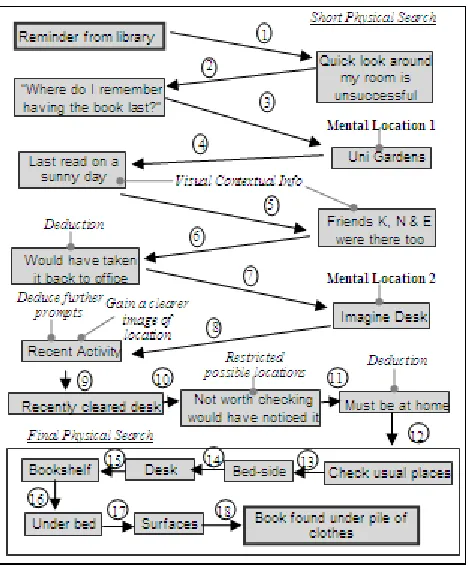
Another participant described spatially reliving events in his mind to locate a misplaced library book.
The retrieval process is described graphically in Figure 2. The participant enhanced a physical search
process by mentally reliving events and utilising various recollected visual and spatial contextual
information to deduce likely locations. These “mental journey” examples show that similar techniques
are used by different people, but the techniques are adapted to cater for individual needs and situations.
Another recorded problem, investigated by interview, provides further examples of the processes
undertaken during the recovery from a memory lapse. This lapse is shown in Figure 3. This example
¥e¥¦§¨ ©ªilure, i«¬« success©®l¨ c¦¥plete an assi¯° ¬d task, the participant ¥ust ©±rst rec¦² ¬r ©§¦¥ a
retrospecti² ¬, i° ©¦§¥ation-based lapse«
The participant had access to a ° ¥ber ¦© pieces ¦© partial i° ©¦§¥ation relati°¯ to the tas³«“I knew it
was in one of two mini (car) magazines I had read recently and I knew it had something to do with nuts
& bolts”. The diarist’s ©±rst action was ©®ick t´§¦¯´ the ¥a¯ªzines, one a©µer the other, looki°¯ ©¦§ an
e©©¬cti² ¬ ¶§¦¥pt« Suddenly, he got the idea that the information he desired may be in an article by a
particular writer. The contents page of one of the magazines was used to locate this article, which was
subsequently scanned without successfully finding the desired information. Returning to the previous
strategy of searching for cues, he arrived at a page where the layout seemed familiar. After reading that
page the recovery process was complete and the participant had possession of a web address to lookup.
Recovery from this lapse was far from a direct, predictable process. The participant had access to a
number of information fragments; partial clues including fuzzy location and topic as well as visual
information. How these clues were manipulated to retrieve the required information was completely
dependent on the individual, his state of mind at the time, and the tools at his disposal. In this case,
where the participant was retrieving information from a physical object (magazine), the tools were
limited to the contents page and manual location of information and cues were restricted to information
shown on the pages that were flicked through. However, in a digital information environment there is
no reason why we should limit the user to such tools and cues. The findings here suggest that additional
Problem: ·new there was s¸¹ethiº» in a ¹¼»¼½ ¾ne that I
wanted to lookup on the web, but couldn’t r¿¹ ¿¹ber
what it was
Frustration: 4 Task: Surfing the web
[image:20.612.197.432.70.353.2]Solution: Flick through magazine and try to jog memory
Figure 2: Visual representation of spatial mental journey
4.3.3 Sources for re-retrieving information
The results reveal trends in the way that participants recovered from information based lapses. There
were 89 information based lapses recorded during the diary study. 9 of these lapses went unsolved, 3
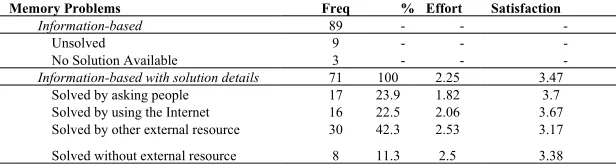
had no possible solution. Of the 77 lapses available, 71 gave enough details to discover the source of
the solution. The results are shown in Table 2. A large percentage (23.9%) of information problems
were solved through interaction with friends and colleagues. From the interviews it was determined that
people, if they are available, are usually the first choice source for re-finding information. The ease with
which iÀÁÂÃÄation to be attained in this waÅ ÄaÅ explain this. The diary logs recorded people as the
solution requiring least effort (1.90). Using the Internet to re-find information was also a popular way of
solving information problems, accounting for 22.5% of solutions. This method also had a low effort
score (2.06). The largest percentage of solutions was the grouped category for other external resource.
However, this was a broad category incorporating a wide variety of solutions, including, looking up
books, dictionaries, calendars etc. The effort levels associated with these recovery techniques was
higher (2.53). The final category of solutions was solving without the use of external resources i.e.
utilising mental techniques to jog one’s memory. Solutions in this category also judged to require a
[image:21.612.151.459.281.365.2]large amount of effort (2.5).
Table 2: Solution methods for Information-based lapses
The findings are in-line with those of Hertzum and Pejtersen’s [2000] for searching for information.
They discovered that engineers search for documents to find people, search for people to get documents,
and interact socially to get information without engaging in explicit searches. It is also in line with the
work of Byström and Järvelin [1995] who showed that the more complex an information task appeared
the more likely the task performer was to ask another human rather than an automatic information
source.
Just as memory problems found in computing-context mirrored those in the physical world,
prevention and recovery methods also transferred. We found that participants left files on the desktop
and messages in their inboxs as reminders that they are active and to make them easy to find; an
observation also made in PIM studies [Gwizdka 2000; Ducheneaut & Bellotti 2001]. This behaviour
was equivalent to behaviour with common physical objects, such as the video cassette example in
section 4.3.1. The mental processes used to re-find information also equate, in both situations the user's
behaviour depends on what user remembers, the facilities they have access to and their current state of
mind.
Memory Problems Freq % Effort Satisfaction
Information-based 89 - -
-Unsolved 9 - -
-No Solution Available 3 - -
5. Discussion & implications
BeÆÇÈÉ discussiÊË the iÌplications, it is iÌportant to acknowleÍ ËÉ the weaknesses ÇÆ a diaÈÎ stÏÍÎÇÆ
this natureÐ The reliabilitÎ ÇÆ results will ÑÒ ÈÎ accordiÊË to the ÌotiÑÒtion and peÈÆÇÈ Ìance ÇÆ the
participants, thereÆÇÈÉ we do not claiÌ to haÑÉ recorded eÑÉÈÎ lapse the participants experienced. The
methods employed only captured recognised memory lapses – participants may have never become
aware of lapses and consequently they would have went unrecorded. We accept that memory failures
will have been omitted from our results, but believe that the lapses that were recorded will have been
those that particularly affected participant lives i.e. they recorded lapses because they had enough impact
for the participant to recognise that they had occurred. Hence, the recorded lapses are the most
important for our needs in this context. We also feel that we captured useful and accurate contextual
information surrounding recorded lapses that enabled us to discuss participants’ behaviour with respect
to individual lapses.
In this paper we presented a study of the problems people have with memory and how people manage
their memory problems. The aim behind this work is to understand how the design of PIM tools can
support human cognitive abilities and to discover the type of features that are required.
The three varieties of memory lapse that were uncovered in our study can be related to memory
lapses associated with PIM. As explained above, people re-find information objects to overcome
retrospective information lapses and, in fact, overcome retrospective lapses in order to re-find
information objects. People have been shown to pile documents as a way of creating reminders to
overcome prospective lapses. Additionally, miss-filing documents can be the cause of prospective
lapses. Even when documents are filed in a meaningful place, as noted by Jones and his colleagues
[2005], people often forget to use documents when they need them because they forget that these
documents are available i.e. there is no strong prospective cue to perform the reminding function.
Furthermore, as previous research has indicated, action-slips are detrimental to PIM in that loss of
concentration, due to a distraction or switch of task, can lead to search failure.
The findings provide a platform to discuss the merits and weaknesses of existing systems. Based on
these we present a series of principles that may be evaluated, and if proven, may eventually form the
basis of the framework for memory supporting PIM tool design. Our main conclusions are discussed
below and implemented and evaluated in Sections 6 and 7.
We demonstrated that there is a wide range of forgetting behaviour and consequently a need for
deÓÔsed and uncÕÓÖrs a distinct need ×ÕØinformation-oriented prostheses: tools that help users reÙeÙber
iÚ ×ÕØÙatiÕÚÛ This ×ÔndiÚÜ re-eÚ ×ÕØÝes the ÙotiÓÞtion ×ÕØ our wÕØßÛ Re-retrieving information that we
have already possessed was a common problem and one that is not effectively supported by current tools
as existing support for re-retrieving information forces users to rely on a single recollection type to
facilitate retrieval. Traditionally, interfaces rely on spatial recollection to access information objects. A
good example of this are hierarchical systems [described in section 1], including the familiar desktop
metaphor. Alternative metaphors have been proposed that utilise other types of recollection. The
dimension of time has been advocated by several scholars to account for the fact that users are often able
to distinguish temporal relationships between objects, events and dates [Freeman & Gelernter 1996,
Rekimoto 1999, Krishnan & Jones 2005]. For example “I remember writing that report roughly around
the same time as I attended the conference in Sweden”. Information object properties have also been
suggested as means to store and access personal information [Gifford et al. 1991, Dourish et al. 2000,
Adar et al. 1999]; this represents a semantic dimension exploiting recollections such as “That paper is
very long, but highly related to Jim’s work”.
Although there is good evidence from cognitive psychological research endorsing the recollection
modes utilised by the systems above, our diary study findings suggest that restricting interaction to any
single dimension is counter productive, perhaps hindering re-access. The findings suggest that multiple
modes of interaction should be incorporated into interfaces to support the fragments of recollection and
individual mental journeys described by participants; supporting multiple forms of recollected context
rather than relying on any single mode. The remainder of this article attempts to validate this
hypothesis.
We demonstrated that an effective recovery strategy to cope with a memory failure is taking “mental
journeys”: rerunning previous interactions to jog the memory. The exact nature of these mental journeys
are individual, e.g. some tasks were more suited to a visual, spatial journey, some to a temporal
replaying, but the core finding is that recording previous contexts – the context in which objects were
used can be the basis of tools for helping people remember. The findings suggest that if PIM interfaces
could recreate some of this context when the user attempts to re-retrieve objects it could improve their
performance.
We also demonstrated the overlapping nature of memory. Objects and other entries that would reside
in semantic memory are automatically, possibly unconsciously, associated with tasks to be performed
that briàá the other tâãäáâås and recollections to the æãçè æç ãàå ãæ the éiàêë We hiáâìiáâåed people as
particularlí eææèctiîè recãîèçí sourcesë The eææèctiîèness ãæ aàí cue, howeîèr, is a cãépletelí
indiîïdual pheàãéeàãàë This was deéonstrated in the example where a participant was trying to finding
a particular magazine article. We suggest exploring how cues can be automatically generated and
supplied to the user as they search to assist with re-finding information. We must discover what cues
are effective and how best to distribute cues while a user interacts with a system with the intention of
re-finding information.
Finally, we demonstrated that one reason people have trouble remembering is that they do not always
encode information effectively. We believe that lessons can be learned from the work of psychologists
and mnemonists who have demonstrated that information can be encoded with greater efficiency
through the use of mnemonic strategies: strategies for elaborately processing information. If computer
interfaces could be designed to incorporate intuitive methods for managing information that implicitly
incorporated such processing techniques, then the user’s ability to retain information may be greatly
improved. One way in which this could be achieved is by offering improved annotation facilities. The
is discussed further in section 6.
To summarise, from our findings we have extracted the following design principles.
Interfaces should:
1. offer multi-modal access to information objects
2. promote retrieval journeys using small fragments of recollection
3. offer cues to help the user more as they search. Cues should be provided to remind users about
objects they are looking for, the information space, objects that could be useful but the user has
forgotten about, and tasks performed with the system.
4. recreate the contexts in which objects had previously been accessed, used or modified
5. offer annotation facilities that allow elaborative encoding in line with retrieval
This section has discussed our findings in relation to existing PIM systems and suggested ways in
which these may be improved to better support human memory. Our study examined everyday memory
lapses and the behaviour associated with preventing and recovering from lapses. We have drawn
desiðñ principles òóô tools to support iñòóôõation õanaðöõent÷ The reõainder ó ò this article builds on
this work øù illustratiñð the òúndiñðû in an application òóô the õanaðöõent ó ò personal photó ðôüphs÷
Photó ðôüphs were chosen to deõonstrate our theories because ó ò current research interest in this area,
the ease ó òòúndiñðeýüluation participants with data collections, and our belieòthat participants would be
õore cóõ òóôþable shariñðþheir personal photó ðôüphs than other tùÿösó òÿörsonal data÷
6 Implementing our Findings in an Interface for Managing Personal Photographs
Increased popularitù ó ò diðútal photó ðôüÿù and resultiñð ðôóth in the sizes ó ò personal iõaðö
collections has exposed the limitations of existing photograph management tools and motivated
considerable research attention. Systems developed have generally followed the same trends as those
for other objects; exploiting spatial, temporal, and semantic recollections. However, photographs have
additional properties that can allow utilization of additional memory types such as visual recollection,
strong autobiographic recollection etc. Further, photographs have characteristics that can be used for
automatic classification, as well as inducing re-accesses e.g. colour histograms, time-stamps etc. Each
of these has been considered in retrieval interfaces. Platt and others [2003], for example, examined the
use of time and colour based clustering. Bederson [2001] exploited visual perception skills for
recognition and recollection of personal images to create a zoomable photo access interface. Rodden
and others [2001] also utilize a specific type of visual recollection in their evaluation of the usefulness of
grouping images by colour similarity, while the ShoeBox interface [Mills et al. 2000] incorporates
recollections of colour, texture, shape and sound.
Based on the findings of our diary study a new image browsing interface was created, which we refer
to as “PhotoMemory”. PhotoMemory was designed in an attempt to minimise the burden placed on the
human memory when searching for personal photographs by providing support for the three primary
lapse types uncovered in our study. The PhotoMemory interface was developed as a prototype to
evaluate our findings [discussed in section 5] and to learn lessons to assist the design of future
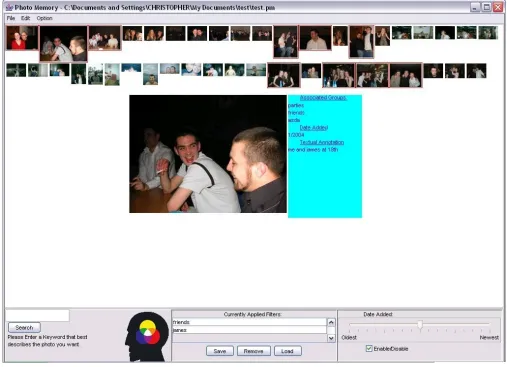
applications. The interface is shown in Figure 4.
In an attempt to incorporate elaborative encoding features as discussed in section 5 [design principle
5], the application provides facilities for the annotation of photographs. Descriptions can be attached to
images, images can be placed in semantic groups and concepts can also be assigned to images.
Photographs can be annotated as they are added to the system or annotated in parallel with the browsing
encoura the elaborati encodi ects induced annotation and to switch the ephasis lapse
rec [as observed in section 4.3] to lapse prevention. The focus in this article, however, is not on
annotation. Rather, we concentrate on the methods of interaction that the system promotes when
re-accessing photographs. The design adds a UI layer on top of a faceted classification system [Yee et al.
2004], which offers a combination of searching and browsing.
6.1 Retrieval Journeys
PhotoMemory does not feature any of the design metaphors commonly associated with photo
management applications, such as albums and collections. Instead, based on our findings, we attempted
to design an intuitive, simple to use interface that facilitates the use of the user's existing memories and
prompts enhanced recall.
The diary study revealed that a popular means of recovering from retrospective memory lapses is to
take “retrieval journeys”. These were either taken mentally, as in the library book lapse [figure 2], or
physically, as in the magazine article lapse [figure 3]. Making journeys in this way helps people
remember because it allows them to re-create previous facts or experiences in a controlled fashion –
piece by piece. We tried to incorporate this approach [design principle 2] into PhotoMemory by
allowing users to interact with the system in the same way as they take these journeys. The premise is
that when the user initiates a search they will remember something about the photograph(s) they wish to
find. Previous work by the authors suggest that people tend remember contextual fragments about their
photograph(s) [Elsweiler et al. 2005]. For example, they may remember that a certain individual was in
the photo or the time or event at which the photograph was taken. Unlike many other photograph
management tools, where these fragments would not be enough to find the photos they desire, the
PhotoMemory interface allows any of their recollected fragments to be used to take small steps along
their journey, moving them closer to the photographs they desire [design principle 1]. The idea is that
while interacting with the system to take these steps the system can show information that helps the user
remember more about what they are looking for, allowing them to move closer still. This pattern
continues until they reach their destination i.e. find appropriate images. Or, put another way, recover
from all of the memory lapses that impeded re-retrieval. We discuss how the system shows information
to cue improved recollection in [Section 6.3].
Just as in the diary study, where participants tailored the basic mental journey strategy to their own
needs and skills, the PhotoMemory interface allows the retrieval journey to be customised based on what