City, University of London Institutional Repository
Citation:
Corte, P. D., Sarno, L. and Thornton, D. (2008). The Expectation Hypothesis of the Term Structure of Very Short-Term Rates: Statistical Tests and Economic Value. Journal of Financial Economics, 89(1), pp. 158-174. doi: 10.1016/j.jfineco.2007.08.002This is the accepted version of the paper.
This version of the publication may differ from the final published
version.
Permanent repository link:
http://openaccess.city.ac.uk/13623/Link to published version:
http://dx.doi.org/10.1016/j.jfineco.2007.08.002Copyright and reuse: City Research Online aims to make research
outputs of City, University of London available to a wider audience.
Copyright and Moral Rights remain with the author(s) and/or copyright
holders. URLs from City Research Online may be freely distributed and
linked to.
Journal of Financial Economics 00 (0000) 000-000
The expectation hypothesis of the term structure of very short-term
rates: statistical tests and economic value
Pasquale Della Corte
a, Lucio Sarno
a,b,c*, Daniel L. Thornton
da
Finance Group, Warwick Business School, University of Warwick, Coventry CV4 7AL, UK
b
Fixed Income and FX Team, AXA Investment Managers, 7 Newgate St., London EC1A 7NX, UK
c
Centre for Economic Policy Research, 90-98 Goswell Road, London EC1V 7RR, UK
d
Research Division, Federal Reserve Bank of St. Louis, PO Box 442, St. Louis MO 63166, USA
Received 30 November 2006; received in revised format 16 July 2007; accepted 2 August 2007
Abstract
This paper reexamines the validity of the expectation hypothesis (EH) of the term
structure of US repo rates ranging in maturity from overnight to three months. We
extend the work of Longstaff (2000b) in two directions: (1) we implement statistical tests
designed to increase test power in this context; (2) more important, we assess the
economic value of departures from the EH based on criteria of profitability and economic
significance in the context of a simple trading strategy. The EH is rejected throughout the
term structure examined on the basis of the statistical tests. However, the results of our
economic analysis are favorable to the EH, suggesting that the statistical rejections of the
EH in the repo market are economically insignificant.
Keywords:
Expectation hypothesis; Term structure of interest rates; Vector
autoregression; Economic value
JEL classifications: G10; E43; F31
________________________________________________________________________
This paper was partly written while Pasquale Della Corte was a visiting scholar at the Federal Reserve Bank of St. Louis, and Lucio Sarno was a visiting scholar at the International Monetary Fund and Norges Bank. We are indebted for useful conversations or constructive comments to Bill Schwert (editor), an anonymous referee, Abhay Abhyankar, Massimo Guidolin, Jim Hamilton, Xing Jin, Francis Longstaff, Thomas Sargent, Ilias Tsiakas, and Nick Webber, as well as to participants in presentations held at the 2007 European Meeting of the Econometric Society, the Policy and Macro System Committee Meeting at the Federal Reserve Bank of St. Louis, and the 7th Annual Missouri Conference at the University of Missouri-Columbia.
1. Introduction
Ever since Fisher (1896) postulated the expectation hypothesis (EH) of the term structure of
interest rates, this simple and intuitively appealing theory has attracted an enormous amount of
attention in …nancial economics. Many authors argue that interest rates at di¤erent maturities move
together because they are linked by the EH, and a number of studies have addressed the empirical
validity of this theory. However, this literature, using a variety of tests and data, generally rejects
the EH (e.g., Roll, 1970; Fama, 1984; Fama and Bliss, 1987; Frankel and Froot, 1987; Stambaugh,
1988; Froot, 1989; Campbell and Shiller, 1991; Bekaert, Hodrick, and Marshall, 1997; Bekaert and
Hodrick, 2001; Clarida, Sarno, Taylor, and Valente, 2006; and Sarno, Thornton, and Valente, 2007).
An important exception is provided by Longsta¤ (2000b), who …nds that the EH is supported
by the data. Longsta¤ (2000b) presents the …rst tests of the EH at the extreme short end of the
term structure, using repurchase (repo) rates with maturities measured in days or weeks. There are
two reasons that Longsta¤’s study is important. First, if the EH cannot explain the term structure
at this extreme short end, it seems unlikely that it can be of value at longer maturities. Second,
the use of repo rates is especially appropriate for investigating the EH because repo rates represent
the actual cost of holding riskless securities. Hence, repo rates provide potentially better measures
of the short-term riskless term structure than other interest rates commonly used by the relevant
literature, such as Treasury bill (T-bill) rates.
This paper revisits the EH using an updated data set of repo rates from the same source as
Longsta¤ (2000b). Our motivation is twofold. First, the literature on testing the EH has made
much progress in recent years by developing increasingly sophisticated testing procedures that are
particularly useful in this context. Given the statistical problems a- icting conventional tests of the
EH, in this paper we employ a test that was originally proposed in Campbell and Shiller (1987) and
made operational in Bekaert and Hodrick (2001).1 Bekaert and Hodrick (2001) develop a procedure
for testing the parameter restrictions that the EH imposes on a vector autoregression (VAR) of the
short- and long-term interest rates. The procedure’s size and power properties have been thoroughly
investigated by Bekaert and Hodrick (2001) and Sarno, Thornton, and Valente (2007). We apply
this test to US repo rates ranging in maturity from overnight to three months over the sample period
from 1991 to 2005.
Second, we move beyond testing the validity of the EH from a purely statistical perspective and
1
provide evidence on whether deviations from the EH are economically signi…cant. Distinguishing
between statistical analysis and economic evaluation is crucial for at least three reasons: in general
statistical rejections of a hypothesis do not necessarily imply economic rejections (e.g., Leitch and
Tanner, 1991); statistical VAR tests of the EH do not allow for transactions costs, which are critical
for exploiting departures from the EH in real-world …nancial markets; and very powerful statistical
tests could reject virtually any null hypothesis in large samples, without necessarily being informative
about the size of departures from the hypothesis tested (Leamer, 1978). All these reasons suggest
that an economic assessment of the deviations from the EH is desirable to complement the statistical
tests.
In a mean-variance framework, we compare the performance of a dynamic portfolio strategy
consistent with the EH to a dynamic portfolio strategy that exploits the departures from the EH.
We use a utility-based performance criterion to compute the fee that a risk-averse investor would be
willing to pay to switch from the EH to a strategy that exploits departures from the EH to forecast
interest rates. As an alternative economic measure, we also employ the risk-adjusted return of these
two strategies. In short, we provide an economic test of the EH by evaluating the incremental
pro…tability of an optimal (mean-variance e¢ cient) strategy that relaxes the restrictions implied by
the EH statement.
To anticipate our results, we …nd that the EH is statistically rejected for all pairs of repo rates
in our sample throughout the maturity spectrum from overnight to three months. Our results di¤er
from Longsta¤ (2000b) presumably because the VAR test is more powerful and our sample period
is somewhat longer than his. However, the results of our economic analysis lend support to the EH
as we …nd no tangible economic gain to an investor who exploits departures from the EH relative
to an investor who allocates capital simply on the basis of the predictions of the EH. Speci…cally,
the evidence in this paper shows that the economic value of departures from the EH is modest
and generally smaller than the costs that an investor would incur if he were to trade to exploit the
mispricing implied by EH violations. Hence, despite the statistical rejections of the EH, we conclude
that the EH provides a fairly reasonable approximation to the repo rates term structure, consistent
with Longsta¤’s interpretation of the functioning of the repo market.
The outline of the paper is as follows. Section 2 brie‡y describes the data and preliminary
statistics on repo rates. Section 3 introduces the EH and the VAR framework within which the
empirical work is carried out, with a description of the essential ingredients of the VAR testing
the EH in Section 4. In Section 5, we outline the framework for measuring the economic value of
departures from the EH in a mean-variance setting and describe the performance measures used to
assess the economic signi…cance of EH violations. Section 6 reports the results on the validity of
the EH using economic value measures. The conclusions are presented in Section 7. The Appendix
provides technical details on the VAR framework and estimation issues.
2. Data
The data set is made up of daily observations of the closing overnight it, 1-week i(1t w), 2-week
it(2w), 3-week i(3t w), 1-month it(1m), 2-month i(2t m), and 3-month i(3t m) general collateral government repo rates, from May 21, 1991 to December 9, 2005. The data are obtained from Bloomberg and
the source of the data is Garban, a large Treasury securities broker. Repo rates are quoted on a
360-day basis and the rate quotations in Bloomberg are given in increments of basis points (bps).
The total number of daily observations available is 3,625 and is essentially an update of the data set
used by Longsta¤ (2000b).2
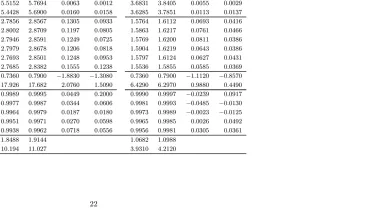
Table 1 reports the summary statistics for repo rates, in level and …rst di¤erence. All variables
are expressed in percentage points per annum. The data display similar properties to those described
by Longsta¤ (2000b) for a shorter sample. The mean of the repo rates displays a mild smile e¤ect
across the term structure. In particular, the mean overnight rate of3:9600is slightly higher than the
mean one-week rate of3:9492, which turns out to be the lowest mean across the di¤erent maturities.
The mean three-month rate is 3:9924, which is approximately3 bpshigher than the mean overnight
rate. Table 1 also reports the mean repo rates for the di¤erent maturities by day of the week and
shows a number of calendar regularities in the data. The mean repo tends to increase from Monday
to Tuesday and to decrease afterward, while the mean on Monday is always higher than the mean
on Friday. For example, the mean overnight rate on Monday is3:9718, which is about5 bpshigher
than the mean overnight rate on Friday, equal to 3:9260. A similar pattern is observed for all other
rates. However, these unconditional means are all close to one another, and the di¤erences are much
smaller than the di¤erences observed on other interest rates typically used in empirical research on
the EH. For example, compare the means of repo rates to the means of T-bill rates. In Table 2 we
report descriptive statistics on daily one-month and three-month US T-bill rates, also obtained from
Bloomberg, both for a long sample from 1961 to 2005 and for the same sample as the repo rates data.
2
The di¤erences in the unconditional means between the one-month and three-month T-bill rates over
the 1991–2005 sample are often about 15 bps, approximately …ve times larger than the maximum
di¤erence observed in repo markets for the same maturities. The di¤erences in unconditional means
for the full sample are even larger, up to 25 bps. Before embarking in our econometric analysis
designed to test the EH, it is worthwhile to note that the tiny di¤erences in the unconditional means
of repo rates at di¤erent maturities suggest that risk premia in repo markets are unlikely to be of
particular economic importance. Put another way, these descriptive statistics are clearly indicative
that the EH is more likely to hold on repo rates than T-bill rates.
[INSERT TABLE 1 AND TABLE 2 ABOUT HERE]
We also report the standard deviations of daily changes in repo rates in Table 1. The overnight
rate displays a standard deviation higher than the rates at other maturities. The standard deviation
of daily changes in the overnight rate is about 18 bps, while the standard deviations for the other
rates range from 5 to 6 bps per day. The standard deviations vary somewhat across days. The
corresponding …gures for T-bill rates, given in Table 2, indicate that changes in T-bill rates display
a substantially higher dispersion than repo rates, with a standard deviation of about 16 bps for
both one-month and three-month rates. However, the standard deviation of the raw variables
(annualized percentage returns) is not the standard deviation associated with an annual holding
period. Therefore, we also report the annualized volatility (a).3 This battery of descriptive
statistics con…rms the Longsta¤ (2000b) argument that repo rates are smaller in magnitude and less
volatile than T-bills.4
3. The expectation hypothesis
The EH of the term structure of interest rates relates a long-term n-period interest ratei(tn) to a
short-termm-period interest ratei(tm). In the case of pure discount bonds, the EH can be stated as
i(tn)= 1 k
k 1 X
i=0
Et[i(tm+mi) ] +c(n;m); (1)
3Following Lo (2002), we compute the annualized volatility as (a) = pV ar[i
t(a)], where it(a) = Pak=01it k(d)
is the sum of the daily returns, and a= 250 is the average number of trading days. The raw data are quoted on a
360-day basis and expressed in percentage points per annum. Hence, we determine the daily return asit(d) =360it100
for a given raw repo rate it. We also report the product of the unconditional mean times the annualized volatility,
M ean (a), because this could be interpreted as the commonly used Black’s volatility for caps under the assumption
of log-normality.
where c(n;m) is the term premium between the n- and m-period bonds (and could vary with the
maturity of the rates);k=n=m and is restricted to be an integer; andEt denotes the mathematical
expectation conditional on information set It available at timet.
In a market in which expectations are formed rationally, an investor could either invest funds
in a long-term n-period discount bond and hold it until maturity or buy and roll over a sequence
of short-term m-period discount bonds across the life of the long-term bond. Under the EH, these
strategies should di¤er only by a constant term. As result, the long-term rate should be determined
by a simple average of the current and expected future short-term rates plus a time-invariant term
premium.5 If the term premium c(n;m) is zero, the resulting form of the EH is often termed the “pure EH.”
While much of the relevant literature relies on single equation tests of the EH, derived by
repa-rameterizing Eq. (1), a number of scholars reconsider the EH in a linear VAR framework and test
the set of nonlinear restrictions that would make the VAR model consistent with the EH (Campbell
and Shiller, 1991; Bekaert and Hodrick, 2001; and Sarno, Thornton, and Valente, 2007).6 However,
while the EH postulated in Eq. (1) is only a statement about how longer-term rates are related
to expected short-term rates, the VAR setting further assumes a joint linear stochastic process for
the dynamics of the long-term and short-term interest rates. This is a convenient assumption to
extract predictions of future short-term rates by using current and past values of interest rates as
information set. The VAR model is also inspired by the a¢ ne term structure literature in which
conditional means are linear in a set of Markovian state variables (Du¢ e and Singleton, 1999; Dai
and Singleton, 2000; Jagannathan, Kaplin, and Sun, 2003; Ahn, Dittmar, and Gallant, 2002; Bansal
and Zhou, 2002; and Clarida, Sarno, Taylor, and Valente, 2006). This literature generally shows that
a¢ ne speci…cations are unable to simultaneously match conditional means and conditional variances,
leading to term premium puzzles.7 Therefore, the linear VAR framework is rooted in a literature
that has the potential to inherit some of the challenges faced by more traditional a¢ ne term structure
5Fama (1984) derives Eq. (1) by assuming that the expected continuously compounded yields to maturity on all
discount bonds are equal, up to a constant, while Shiller, Campbell, and Schoenholtz (1983) show that Eq. (1) is exact in some special cases and that it can be derived as a linear approximation to a number of nonlinear expectation theories of the term structure. For coupon bonds and consols withn=1, Shiller (1979) derives a similar linearized model in which the long-term rate is a weighted average of expected future short-term rate plus a constant liquidity premium. Finally, as shown by Longsta¤ (2000a), all traditional forms of the EH can be consistent with absence of arbitrage if markets are incomplete.
6The VAR methodology has been popular in the context of formulating and estimating dynamic linear rational
expectations models since the 1970s, starting from Sargent (1977), Hansen and Sargent (1980), Sims (1980), and Wallis (1980).
7Another stream of the literature also shows that a¢ ne structures cannot capture what is termed “unspanned
models. This means that one cannot rule out that the impact of these issues on EH tests based on
the VAR framework is substantial. For example, potential biases of the EH tests would arise if the
interest rates data are generated by a process that is not encompassed within the VAR framework
due to nonlinearities or time-varying covariances. In short, EH tests based on a VAR context are
valid only under the maintained hypothesis that a linear VAR accurately describes the process of
the short- and long-term interest rates and the relation between them. This maintained assumption
is questionable due to the well-documented limitations of a¢ ne speci…cations in matching the level
and term premium in bonds simultaneously with the volatility of interest rates.
These caveats notwithstanding, in this paper we rely on the VAR testing framework developed by
Bekaert and Hodrick (2001) because of its desirable power properties in presence of highly nonlinear
restrictions. Speci…cally, we implement the generalized method of moments (GMM) to estimate a
constrained VAR, which forces the data to yield the relation postulated by the EH, and then test
the validity of these restrictions by using the Lagrange multiplier (LM) and distance metric (DM)
statistics.8
3.1. The VAR framework
Consider a bivariate VAR representation for the short- and long-term interest rates measured as
deviations from their respective means:
i(tm) = a(L)i(tm1)+b(L)i(tn)1+u1;t (2)
i(tn) = c(L)i(tm1)+d(L)i(tn)1+u2;t; (3)
wherea(L),b(L),c(L), andd(L)are polynomials in the lag operator of orderp, andu1;tand u2;t are
error terms. For the sake of notational convenience and without loss of generality, we setc(n;m)= 0
in Eq. (1) and use demeaned data in our analysis. This implies that we cannot discriminate between
the standard formulation of the EH and the pure EH with a zero average term premium, but we
focus on testing whether the term premium is constant over time.
The above formulation can be interpreted as a system in which the forecasting Eq. (2) is used
to generate the expected future short-term rate and Eq. (3) determines the current long-term
rate. Simultaneously, the system determines endogenously both sides of the EH statement given in
8A simple alternative would be to estimate the model without restrictions by least squares and to apply a Wald test.
Eq. (1) and allows joint estimation of the parameters. This improves e¢ ciency by incorporating
contemporaneous cross-correlation in the errors (Pagan, 1984; and Mishkin, 1982).
The EH implies a set of nonlinear restrictions on the parameters of the above system. To de…ne
these restrictions, let us simplify the notation by translating the above p-order system into a
…rst-order VAR companion form as
2 6 6 6 6 6 6 6 6 6 6 6 6 4
i(tm) i(tn) i(tm1) i(tn)1
.. .
i(t pm)+1 i(t pn)+1
3 7 7 7 7 7 7 7 7 7 7 7 7 5 = 2 6 6 6 6 6 6 6 6 6 6 4
a1 b1 ap 1 bp 1 ap bp
c1 d1 cp 1 dp 1 cp dp
1 1 . .. 1 1 3 7 7 7 7 7 7 7 7 7 7 5 2 6 6 6 6 6 6 6 6 6 6 6 4
i(tm1) i(tn)1 i(tm2) i(tn)2
.. .
i(t pm) i(t pn)
3 7 7 7 7 7 7 7 7 7 7 7 5 + 2 6 6 6 6 6 6 6 4
u1;t
u2;t
3 7 7 7 7 7 7 7 5 ; (4)
where the blank elements are zeros. In compact form, this VAR can be expressed as
Yt= Yt 1+ t; (5)
where Yt has 2p elements, is a 2p square companion matrix, and vt is the vector of innovations
orthogonal to the information set available at time t, with zero mean and covariance matrix .
Then, the EH subjects Eq. (5) to the following set of nonlinear cross-equation restrictions:
e02 =e01k 1(I m) 1(I n); (6)
where e1 = (1;0; : : : ;0)0 and e2 = (0;1;0; : : : ;0)0 are 2p dimensional indicator vectors.9 Although
Eq. (6) does not have a straightforward intuition, it gives a 2p dimensional vector of restrictions,
nonlinear in the underlying parameters of , such that the predictions of future short-term rates are
consistent with the EH and the resulting constrained VAR collapses to Eq. (1). We can interpret
these restrictions as a concise summary of the main implications stated by the theory. First,
the constrained VAR de…nes the theoretical long-term rate we would observe in a world in which
expectations about future short-term rates are formed rationally. Second, under these restrictions,
the long-term rate contains all relevant information required by the market participants to predict
future short-term rates. Put another way, the long-term rate provides optimal predictions of future
short-term rates and deviations of the actual long-term rate from the theoretical long-term rate are
unsystematic and unpredictable. Then, by rewriting the 2p dimensional vector of restrictions as
a( ) =e02 e01k 1(I m) 1(I n); (7)
9Section A.1 in the Appendix provides further technical details on the restrictions implied by the EH in the VAR
we can de…ne the null hypothesis of rational expectations and constant term premium as
H0:a( ) = 0; (8)
where is formed by collecting the relevant parameters of the companion matrix .10
3.2. The VAR tests
Bekaert and Hodrick (2001) propose a feasible method based on the GMM to estimate the VAR
model under the hypothesis that the EH holds, de…ned by the nonlinear cross-equation restrictions
on the parameters .11
Let yt [i(tm); i
(n)
t ] be the vector of data available at time t, ut be the vector of orthogonal
errors de…ned by the model, and xt 1 be the vector of instruments available at timet 1, formed
by stacking lagged values of yt (and possibly a constant term). Next, de…ne the vector zt
(yt0; x0t 1)0, the vector-valued function of the data and the parameters g(zt; ) ut xt 1, and the
set of orthogonality conditions E[g(zt; )] 0. Using the corresponding sample moment conditions
gT( ) T 1PTt=1g(zt; )for a sample of sizeT, the parameters, , are estimated by minimizing the
GMM criterion function
QT( ) gT( )0 T1gT( ); (9)
where T1is a positive semide…nite weighting matrix (Hansen, 1982).12 To estimate the parameters,
, subjected to the nonlinear restrictions de…ned by Eq. (6), we de…ne the Lagrangian as
L( ; ) = 1 2gT( )
0 1
T gT( ) aT( )0 ; (10)
where is a vector of Lagrange multipliers, andaT( )is the sample counterpart ofa( ). While direct
maximization of the Lagrangian is di¢ cult as the constraints are nonlinear, Bekaert and Hodrick
(2001) develop a recursive algorithm that extends the estimator proposed by Newey and McFadden
(1994).13
If the restrictions have a signi…cant impact on parameter estimation, then the value of the
La-grange multipliers is signi…cantly di¤erent from zero and the null hypothesis that the EH holds is
1 0
Speci…cally, the vector of parameters is de…ned as = (a1; ; ap; b1; ; bp; c1; ; cp; d1; ; dp)0.
1 1
Full maximum likelihood estimation of the restricted model is generally considered as cumbersome (e.g., Bekaert and Hodrick, 2001; and Melino, 2001).
1 2
When T is chosen optimally,bis asymptotically distributed as
p
T(b 0)!N(0; G0T TGT) 1, where 0denotes the true parameters,bthe parameter estimates,GT rgT( )the gradient of the orthogonality conditions, and the
symbol!convergence in distribution.
1 3The GMM estimation is applied to the VAR de…ned in Eqs. (2) and (3), whereas the companion VAR is exclusively
rejected. The hypothesis that the multipliers are jointly zero can be tested using the LM statistic
T ATBT1A0T ! 2(2p) (11)
or the DM statistic
T gT( )0 T1gT( ) ! 2(2p); (12)
where denotes the constrained estimates, and2p is the number of restrictions implied by the EH.
3.3. Small sample properties
Tests of the EH null hypothesis have been known to su¤er severely from problems related to
…nite sample bias estimation errors. In essence, the sampling distribution in …nite sample could be
signi…cantly di¤erent from the asymptotic distribution (e.g., Bekaert, Hodrick, and Marshall, 1997;
Bekaert and Hodrick, 2001; and Thornton, 2005, 2006). Thus, before estimating the unconstrained
and constrained VARs, we follow Bekaert and Hodrick (2001) and use two di¤erent data generating
processes (DGPs). Speci…cally, from the original data set, we simulate via bootstrap two
bias-corrected data sets of 70 thousand observations, with homoskedastic innovations and generalized
autoregressive conditional heteroskedasticity (GARCH) innovations, and we use them throughout
the econometric analysis. See Section A.3 in the Appendix for technical details on the procedure to
account for small-sample bias in our analysis.
4. Empirical results I: the VAR test of the EH
In the empirical analysis, we obtain the unconstrained parameter estimate of , denoted b, by
least squares and its constrained estimate by the constrained GMM scheme for all possible pairwise
combinations of short- and long-term rates such that k=n=m is an integer. To take into account
the day-of-the-week regularities in the short-term repo rates, shown in Table 1, we follow Longsta¤
(2000b) and set the VAR lag length to bep= 5.
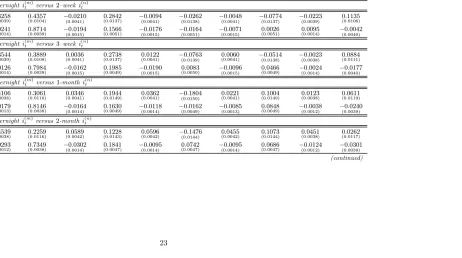
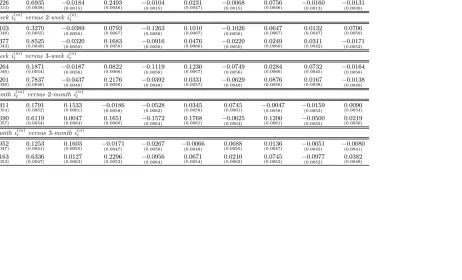
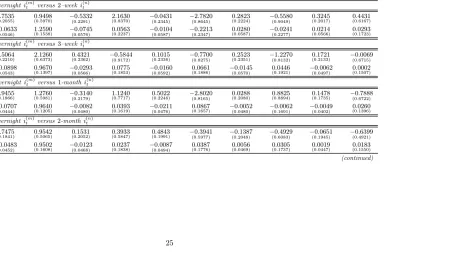
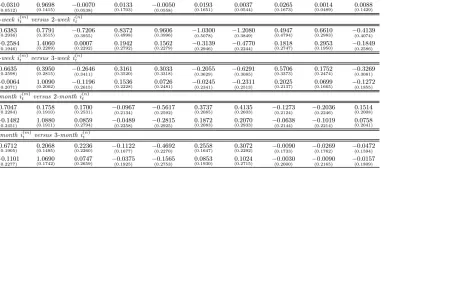
Tables 3 and 4 report bias-corrected coe¢ cients for the unconstrained VARs and the constrained
VARs that satisfy the EH, respectively, when the DGP used to bias correct the parameters assumes
homoskedastic innovations. Comparing the coe¢ cients in Tables 3 and 4, we note that sharp
di¤erences exist in the constrained and unconstrained estimated dynamics. In particular, for each
pairwise comparison, we …nd that the standard errors are large in the constrained VAR. Also, the
absolute size of the constrained coe¢ cients is much larger than the corresponding unconstrained ones,
and, perhaps more important, the constrained coe¢ cients measuring the response of the short-term
estimates. This is prima facie evidence that the EH restrictions could be inconsistent with the data,
although this evidence does not constitute a formal statistical test.
[INSERT TABLE 3 AND TABLE 4 ABOUT HERE]
For robustness, we also carry out estimation of the VAR-GARCH model.14 We …nd that the
factor loadings are statistically signi…cant at standard signi…cance levels, indicating the presence of
GARCH e¤ects. We also notice that the conditional variance turns out to be persistent for the
overnight repo and moderately persistent for the spreads. Hence, departing from the assumption of
homoskedasticity is likely to yield more accurate estimates of the VAR parameters and, consequently,
more precise tests of the EH.
We then estimate the bias-corrected coe¢ cients for the unconstrained VARs and the constrained
VARs that satisfy the EH, respectively, when the DGP used to bias correct the parameters assumes
GARCH innovations. These results are quantitatively di¤erent from but qualitatively identical to
the results for the VAR with homoskedastic innovations given in Tables 3 and 4. Speci…cally, the
standard errors of parameters estimates in the constrained VAR are large, the absolute size of the
constrained coe¢ cients is larger than the corresponding unconstrained ones, and the constrained
coe¢ cients measuring the response of the short-term rate to the long-term rate have sometimes a
di¤erent sign from the corresponding estimates in the unconstrained VAR.
4.1. LM and DM tests of the EH
The LM and DM tests results are presented in Table 5, where we report the p-values for the
null hypothesis that the EH holds for all possible repo rates combinations of the integer k =n=m.
The results in Table 5 indicate that the EH is rejected for each rate pair with p-values that are
well below standard signi…cance levels. Table 5 also reports the p-values from the J-test, which
provides a speci…cation test of the validity of the overidentifying moment conditions. The p-values
are comfortably larger than conventional signi…cance levels, validating the GMM estimation and,
hence, the LM and DM tests.
[INSERT TABLE 5 ABOUT HERE]
1 4
These …ndings di¤er from Longsta¤ (2000b), who does not reject the EH using conventional
tests, because the VAR test is particularly powerful (and, thus, more likely to detect …ne departures
from the null hypothesis in …nite sample) and because our sample is larger than that in Longsta¤
(2000b). However, despite this statistical evidence, a legitimate and unanswered concern is whether
the rejection of the EH could be due to small departures from the null hypothesis (or tiny data
imperfections) that are not economically meaningful but appear statistically signi…cant given the
powerful test statistics and the very large sample size employed.15 Moreover, the VAR tests are not
designed to incorporate the fact that if one wanted to trade on departures from the EH, instead of
assuming that the EH holds in a simple buy-and-hold allocation strategy, transactions costs create
a wedge between returns from an active strategy exploiting departures from the EH and a simple
buy-and-hold strategy. Finally, while the VAR tests rely on the ability of the VAR to capture
the time-series properties of the term structure of repo rates, we are aware that the simple VAR
tests, inspired by the literature on a¢ ne term structure models, is unable to satisfactorily explain
conditional means and volatility of interest rates. Hence, potential model misspeci…cation and model
uncertainty could play an important role in determining the rejection of the EH recorded in Table
5. To address these issues and to shed light on the economic signi…cance of the statistical rejections
of the EH recorded in this section, we proceed to an economic evaluation of the EH departures.
5. Measuring the economic value of deviations from the EH
We wish to measure whether departures from the EH provide information that is economically
valuable, regardless of whether or not they are statistically signi…cant on the basis of econometric
tests. This section discusses the framework we use to evaluate the impact of allowing for deviations
from the EH on the performance of dynamic allocation strategies in the repo market. We employ
mean-variance analysis as a standard measure of portfolio performance assuming quadratic utility.
Ultimately, we aim at measuring how much an investor is willing to pay for switching from a strategy
that assumes that the EH holds (EHstrategy) to a dynamic strategy that conditions on departures
from the EH (DEH strategy). The EH strategy uses the outcome from the constrained VAR to
determine the portfolio allocation, whereas the DEH strategy is based on the unconstrained VAR.
The allocation strategy we consider is simple and intuitive. It consists of taking a position (either
long or short) in a long-term repo, and then hedging it with an o¤setting rolling position in a series of
1 5
short-maturity repos. If the EH governs the relation between the long-term and short-term rates and
an investor takes long positions in long-term repos and short rolling positions in short-term repos,
then following this strategy over time allows the investor to earn the unconditional term premium,
denoted as c(n;m) in Eq. (1). However, if one thinks of all repo rates in deviations from their
unconditional mean (i.e., settingc(n;m)= 0), as we do in our setting below, then this strategy should
earn a return of zero before costs.
Regardless of the EH rejections recorded in Table 5, the tiny di¤erences in unconditional means
of repo rates at di¤erent maturities observed in Table 1 suggest the possibility that the economic
value of trading on deviations from the EH in the repo market might not be as appealing as the
statistical rejections from the VAR tests could imply. The investor using the constrained VAR is
e¤ectively using the simple strategy described above based upon the belief no di¤erences exist in
the returns from investing in the longer repo rate and from investing in a series of shorter repo
rates. However, if the investor does not believe in the EH and hence uses the unconstrained VAR,
the resulting allocation strategy is the outcome of the predictions of the model with respect to
whether the longer-term rate is under or overvalued relative to the series of shorter repo rates over
the maturity of the longer rate. This could be seen as the implementation of the popular carry
trade strategy that attempts to exploit mispricing along the term structure of interest rates. In
other words, using the unconstrained VAR is tantamount to exploiting the deviations from the EH,
which we have recorded in the earlier statistical analysis. If the unconstrained VAR model gives
predictions of short-term repo rates consistent with the EH, the results from theEHstrategy should
be equal to the results from the DEH strategy.16 From this setting we can calculate directly a
variety of common performance measures, in the form of performance fees F (Fleming, Kirby, and
Ostdiek, 2001) and risk-adjusted abnormal returnsM(Modigliani and Modigliani, 1997).
We realize that a portfolio consisting only of repo rates is unlikely to be a realistic portfolio
managed by a US investor. The repurchase agreements involving US Treasury securities are mainly
used by banks to manage the quantity of reserves on a short-term basis and, hence, play an important
role in the Federal Reserve’s implementation of monetary policy. Moreover, the repo market plays a
fundamental role in dealers’hedging activities, and repos are used by investment managers who sell
short Treasury securities to hedge the interest rate risk in other securities. Our main objective is not
to design a realistic (executable) asset allocation strategy, but to measure the economic signi…cance
of deviations from the EH. Our measures of economic value complement the LM and DM tests
1 6
for statistical signi…cance of the EH by showing whether the constraints imposed on the VAR by
the EH have economic value. On the one hand, departures from the EH could be statistically
insigni…cant and yet provide considerable value to an investor. On the other hand, the departures
might be statistically signi…cant but be of little or no economic value to a repo market investor.17
This economic evaluation is easier to carry out and assess by focusing exclusively on a VAR in which
the only assets being modeled are repo rates at various maturities, because the only source of risk
in the resulting repo portfolio is interest rate risk.
5.1. The EH in a dynamic mean-variance framework
In mean-variance analysis, the maximum expected return strategy leads to a portfolio allocation
on the e¢ cient frontier. Speci…cally, consider the trading strategy of an investor who has ak-period
horizon and constructs a daily dynamically rebalanced portfolio that maximizes the conditional
expected return subject to achieving a target conditional volatility. Computing the time-varying
weights of this portfolio requires predictions of the k-period ahead forecast of the conditional mean
and the conditional variance-covariance matrix.
Let rt+k denote the N 1 vector of risky asset returns; t+kjt = Et[rt+k] is the conditional
expectation of rt+k; and t+kjt = Et[(rt+k t+kjt)(rt+k t+kjt)0] is the conditional
variance-covariance matrix ofrt+k.18 At each period t, the investor solves the following problem:
max
wt f p;t+k
=wt t0 +kjt+ 1 wt0 rfg (13)
s.t. p 2=wt0 t+kjtwt;
wherewtis theN 1vector of portfolio weights on the risky assets, p;t+kis the conditional expected
return of the portfolio, p is the target conditional volatility of the portfolio returns, and rf is the
return on the riskless asset.19 The solution to this optimization problem delivers the following risky
asset weights:
wt= pp
Ct
1
t+kjt( t+kjt rf); (14)
whereCt= ( t+kjt rf)0 t+1kjt( t+kjt rf). The weight on the riskless asset is1 wt0 .
By design, in this setting the optimal weights vary across models only to the extent that
predic-tions of the conditional moments vary, which is precisely what the empirical models provide. In our
1 7See Leitch and Tanner (1991) for an early treatment of the relation between statistical signi…cance and economic
value.
1 8
We use the subscriptt+kto indicate an investment horizon ofkperiods ahead, wherek=n=mis an integer that depends on the long- and short-term interest rates.
1 9For simplicity, we drop the subscripttfrom the riskless returnr
setting, we carry out the economic value analysis comparing the outcome from theDEHstrategy (a
strategy that exploits deviations from the EH) with the EH strategy, which assumes that the EH
holds. We compute the calculations for both cases with homoskedastic and GARCH innovations in
the bias-correction DGPs. In short, our objective is to determine whether there is economic value
in using the unconstrained VAR, which relaxes the constraints imposed by the EH.
5.2. Quadratic utility
We rank the performance of the competing repo rate models using the West, Edison, and Cho
(1993) methodology, which is based on mean-variance analysis with quadratic utility. The investor’s
realized utility in periodt+k can be written as
U(Wt+k) =Wt+k
2W
2
t+k=WtRp;t+k
Wt2
2 R
2
p;t+k; (15)
whereWt+k is the investor’s wealth at t+k, determines his risk preference, and
Rp;t+k= 1 +rp;t+k= 1 + 1 wt01 rf +wt0rt+k (16)
is the period t+k gross return on his portfolio.
We quantify the economic value of deviations from the EH by setting the investor’s degree of
relative risk aversion (RRA), t = Wt=(1 Wt), equal to a constant value . In this case,
West, Edison, and Cho (1993) demonstrate that one can use the average realized utility, U( ), to
consistently estimate the expected utility generated by a given level of initial wealth. Speci…cally,
the average utility for an investor with initial wealth W0 is equal to
U( ) =W0
TX1
t=0
Rp;t+k
2 (1 + )R
2
p;t+k : (17)
We standardize the investor problem by assuming the investor allocates $1 in every time period.
Average utility depends on taste for risk. In the absence of restrictions on , quadratic utility
exhibits increasing degree of RRA. This is counterintuitive because, for instance, an investor with
increasing RRA becomes more averse to a percentage loss in wealth when his wealth increases. As in
West, Edison, and Cho (1993) and Fleming, Kirby, and Ostdiek (2001), …xing the degree of RRA, ,
implies that expected utility is linearly homogeneous in wealth: double wealth and expected utility
doubles. Furthermore, by …xing instead of , we are implicitly interpreting quadratic utility as
an approximation to a nonquadratic utility function, with the approximating choice of dependent
Fleming, Kirby, and Ostdiek (2001) framework for assessing the economic value of theDEH andEH
strategies.20
5.3. Performance measures
At any time, one set of estimates of the conditional moments is better than a second set if
invest-ment decisions based on the …rst set lead to higher average realized utility,U. Alternatively, a better
model requires less wealth to yield a given level ofU than the alternative model. Following Fleming,
Kirby, and Ostdiek (2001), we measure the economic value of the interest rate strategies by equating
the average utilities for selected pairs of portfolios. Suppose, for example, that holding a portfolio
constructed using the optimal weights based on the EH strategy yields the same average utility as
holding the portfolio implied by theDEH strategy. The latter portfolio is subject to daily
manage-ment expenses F, expressed as a fraction of wealth invested in the portfolio. Because the investor
would be indi¤erent between these two strategies, we interpretF as the maximum performance fee
the investor would be willing to pay to switch from the EH to the DEH strategy. In general, this
utility-based criterion measures how much an investor with a mean-variance utility function is
will-ing to pay for conditionwill-ing on the deviations from the EH, as presented in the unconstrained VAR
model.21
The performance fee depends on the investor’s degree of risk aversion and is a measure of the
economic signi…cance of violations of the EH. To estimate the fee, we …nd the value of F that
satis…es
TX1
t=0
RDEHp;t+k F
2 (1 + ) R
DEH
p;t+k F
2
=
TX1
t=0
REHp;t+k
2 (1 + ) R
EH
p;t+k
2
; (18)
where RDEHp;t+k denotes the gross portfolio return constructed using the predictions from the
uncon-strained VAR model, andRp;tEH+kis the gross portfolio return implied by the constrained VAR model. In the absence of transactions costs, under the EH, F = 0, while, if the EH is violated, F > 0.
However, when allowing for transactions costs, it is also possible thatF <0if the positive gain from
2 0
A critical aspect of mean-variance analysis is that it applies exactly only when the return distribution is normal or the utility function is quadratic. Hence, the use of quadratic utility is not necessary to justify mean-variance optimization. For instance, one could instead consider using utility functions belonging to the constant relative risk aversion (CRRA) class, such as power or log utility. However, quadratic utility is an attractive assumption because it provides a high degree of analytical tractability. Quadratic utility could also be viewed as a second-order Taylor series approximation to expected utility. In an investigation of the empirical robustness of the quadratic approximation, Hlawitschka (1994) …nds that a two-moment Taylor series expansion “may provide an excellent approximation” (p. 713) to expected utility and concludes that the ranking of common stock portfolios based on two-moment Taylor series is “almost exactly the same” (p. 714) as the ranking based on a wide range of utility functions.
2 1For studies following this approach, see also Fleming, Kirby, and Ostdiek (2003), Marquering and Verbeek (2004),
trading on the information provided by the EH violation is lower than the loss incurred by the more
costly dynamic rebalancing of the DEH strategy.
We also consider the Modigliani and Modigliani (1997) measure M, which de…nes the abnormal
return that theDEH strategy would have earned over theEHstrategy if it had the same risk as the
EH strategy
M= [{EH](SRDEH SREH); (19)
whereSR=E[{]= [{]is the Sharpe Ratio, andE[{]and [{]are the expected value and standard
deviations of the excess return,{, of a selected strategy, respectively. TheDEHstrategy is leveraged
downward or upward, so that it has the same volatility as the EH strategy. Therefore, the
risk-adjusted abnormal return, M, measures the outperformance of the DEH strategy with respect to
theEH strategy while matching the same level of risk.22
5.4. Dynamic strategies, transaction costs and short selling
Consider a US investor who allocates his wealth between a long–term n-period discount bond
and a sequence of kshort-term m-period discount bonds. The long-term bond price is known with
certainty and implies a riskless return, whereas the rolling combination of short-term bonds generates
a risky return, because k 1 future short-term bond prices are not known. Hence, on the basis of
riskless return,rf, and the forecasts of the conditional moments of risky return,rt+kjt, the investor
de…nes his portfolio optimization problem at timet.
We consider two alternative trading strategies. TheEHstrategy assumes that EH holds exactly,
and hence the investor takes a position using forecasts based on the constrained VAR. In this case,
the investor e¤ectively trades assuming that Eq. (1) holds and, in the absence of transactions costs,
he is indi¤erent between investing in the long rate or a series of short rates. However, if transactions
costs are positive and equal for short- and long-rates, the investor prefers investing in the long
rate as this minimizes costs. The DEH strategy uses the forecasts based on the unconstrained
VAR. Speci…cally, each strategy is made up of two steps at time t. First, the investor uses the
selected VAR model to generate the conditional moments of the rolling strategy, t+kjt and t+kjt.
Second, conditional on the predictions of this model and given the riskless returnrf, he dynamically
rebalances his portfolio by computing optimal weights. He repeats this process every day until the
end of the sample period.23
2 2
We also compute a measure that allows for downside risk. However, because the results are qualitatively identical to the performance fees and risk-adjusted abnormal returns, we do not report them here to conserve space.
2 3Because we consider a single risky return,
This setup determines whether using one particular conditional speci…cation a¤ects the
perfor-mance of a short-horizon allocation strategy in an economically meaningful way. The predictions
are all in-sample predictions, because our focus is not to provide forecasting models of the repo term
structure but to evaluate the measured departures from the EH as determined by the unconstrained
VAR model.
With daily rebalancing, transaction costs play an important role in evaluating the relative
per-formance of di¤erent strategies. In particular, we assume that transaction costs at time t equal a
…xed proportion of the value traded in long-term and short-term repos (Marquering and Verbeek,
2004; and Han, 2006). We also assume that the costs are the same for trading short and long rates.
This is consistent with the fact that the bid-ask spread is fairly constant across maturities in the
repo market, in the order of 2 to 5 bps. We report results both with and without transactions
costs and also study the impact of short selling constraints. In the case of limited short selling we
constrain the portfolio weights to be bounded between 1 and 2 (assuming that the investor can
borrow no more than 100% of his wealth), while in the case of no short selling, the portfolio weights
are constrained between 0 and1.
6. Empirical results II: the economic value of EH departures
Given the VAR parameter estimates described above, we assume that a US investor dynamically
updates his portfolio weights daily after reestimating the VAR model with the latest available data.
The key question is whether the dynamic strategy that allows for departures from the EH generates
economic gains relative to a benchmark dynamic strategy that assumes that the EH holds. We
assess the economic value of conditioning on departures from the EH by analyzing the performance
of the dynamically rebalanced portfolio constructed using pairwise combinations of repo rates.24
We compute the performance fee F and the risk-adjusted abnormal return Mfor (1) two target
annualized portfolio volatilities, p = f1%;2%g, which are in a range that includes the observed
annualized standard deviation of the data reported in Table 1; (2) a degree of relative risk aversion
= 5; (3) for each pair of repo maturities where the long maturity is an exact multiple of the
short maturity; and (4) two di¤erent DGPs for the parameter estimates, with homoskedastic and
heteroskedastic innovations.25 Furthermore, we also exploit the impact of transaction costs and
short selling by considering four di¤erent scenarios. In Case 1 transaction costs are ignored and the
weights are unrestricted; in Case 2 the weights are unrestricted but we introduce transaction costs
with = 4 bps, a realistic cost on the basis of the observed bid-ask spread in the repo market; in
2 4For weekends and holidays we consider the rate on the previous business day for which a rate was reported. 2 5
Case 3 we also add a limited short selling constraint by restricting the weights to be between 1
and 2; and in Case 4 we do not allow short selling so that the weights are between0 and 1. The
performance measures,F and M, are reported in annualized basis points.26
6.1. Performance measures
Table 6 presents the in-sample performance fees F and the risk-adjusted abnormal returns M
for the DEH strategy against the EH strategy when the bootstrap experiment for bias correction
assumes homoskedastic innovations. Panel A reports the results for a target volatility p = 1%, and
Panel B for p = 2%.
[INSERT TABLE 6 ABOUT HERE]
The results in Table 6 suggest that the performance fees for switching from a model that assumes
the EH holds to a model that exploits departures from the EH is generally fairly modest when we
do not consider transaction costs and the portfolio weights are unrestricted (Case 1). For example,
if we set the target volatility at p = 1%, the annual performance fee a risk-averse investor would
be willing to pay to switch from the EH strategy to the DEH strategy is at most 1:34 bps. If we
calibrate the target volatility to be p = 2%, the largest annual performance fee reaches 2:70 bps
and occurs when the overnight repo rate is the short-term rate and the one-week repo rate is the
long-term rate.
However, when we introduce transaction costs (Case 2), the performance fees F become even
smaller and are slightly negative at the shorter end of the maturity spectrum. For instance, given
p = 1%and the overnight repo rate versus the three-week repo rate, theDEHstrategy has a negative
annual performance fee of about3bps. This suggests that the higher transactions costs incurred in
the DEH strategy outweigh the bene…t of conditioning on EH violations, with the performance fee
generally decreasing in k =m=n due to the larger number of trades needed in the rolling strategy.
In other words, the EH violations are not economically signi…cant after costs are taken into account.
When we move at the longer spectrum of the maturity and consider one-month versus three-month
repo rates for p = 1%, we notice a performance fee of 0:49 bps. When we combine transaction
costs and limited short-selling (Case 3), the performance measures remain virtually the same as
in Case 2, suggesting that the weights are in the range from 1 and 2. In the fourth scenario,
2 6
we consider dynamic strategies without short selling and with transaction costs (Case 4). In this
case the fees decrease moderately in absolute values con…rming that the short selling constraints are
now binding on the pro…tability of the strategies, but their impact is modest. The risk-adjusted
abnormal returnsMare of similar magnitude as (in some columns identical to) the performance fees
F, leading therefore to the same conclusions.
For robustness purposes, Table 7 reports the same performance criteria, F and M, when we
assume GARCH innovations for the bias correction procedure. The results are qualitatively identical
to the case of the VAR with homoskedastic errors discussed in Table 6, providing evidence that EH
violations are economically unimportant. However, quantitatively the results in Table 7 provide
evidence of even smaller gains from the DEHstrategy, with the performance fee F never reaching 2
bps.
[INSERT TABLE 7 ABOUT HERE]
7. Conclusions
The EH plays an important role in economics and …nance and, not surprisingly, has been widely
tested using a variety of tests and data. Much of the empirical literature has struggled to …nd
evidence supporting the validity of the EH across a variety of data sets and countries and employing
increasingly sophisticated testing procedures. This paper reexamines an important exception in
this literature: the result that the EH appears to …t the behavior of US repo rates at the shortest
end of the term structure, measured at daily frequency from overnight to the three-month maturity
(Longsta¤, 2000b). We innovate in this context on two grounds. First, we extend this research by
testing the restrictions implied by the EH on a VAR of the long- and short-term repo rate using the
test proposed by Bekaert and Hodrick (2001). These results are not encouraging for the EH, which
is statistically rejected across the term structure considered.
Second, we move beyond statistical tests and provide complementary evidence on the validity
of the EH using some economic value calculations. We assess the economic value of exploiting
departures from the EH (i.e., using empirical models that condition on information contained in
EH deviations) relative to the economic value of using a model that assumes the EH holds. The
empirical results indicate that the economic value of departures from the EH is modest and generally
smaller than the costs that an investor would incur to exploit the mispricing implied by EH violations.
The results from economic value calculations are in contrast with the results from VAR tests
reported earlier. This di¤erence con…rms that statistical rejections of a hypothesis do not always
imply economic rejections and raises doubts about the ability of the simple linear VAR framework
to capture the relationship between repo rates at di¤erent maturities. Activities in the repo market
at maturities of days or weeks are largely driven by liquidity considerations and by the attempts of
banks to manage the quantity of reserves and to hedge interest rate risk on a short-term basis, not
to speculate in search of excess returns. Hence, it seems unlikely that investors would be actively
exploiting EH departures on a short-term basis. Our main conclusion is that, even though the EH
could be rejected statistically, it still provides a reasonable approximation to the term structure of
Table 1
Descriptive statistics for daily repo rates
The table summarizes the descriptive statistics for the daily repo rates (Panel A) and daily changes in repo rates (Panel B), from overnight to three-month maturity. The data set consists of 3,625 daily observations of the indicated term government general collateral repo rates from May 21, 1991 to December 9, 2005, quoted on a360-day basis and expressed in percentage points per annum. The period September 10, 2001 to September 30, 2001 is not included. The daily change in repo rate for the indicated weekday is measured from the indicated day to the next business day. ρidenotes thei-th order serial correlation coefficient.
σ(a) =sV ar[it(a)] is the annualized volatility, whereit(a) =Sak−=01it−k(d) is the sum of the daily returns,a= 250 is the average number of trading days, and
it(d) =360it
×100 is the daily return for a given raw repo rateit. All statistics are measured in percentage points per annum.
Panel A. Percent values Panel B. Percent daily changes
it i(1t w) i
(2w)
t i
(3w)
t i
(1m)
t i
(2m)
t i
(3m)
t ∆it ∆i(1t w) ∆i
(2w)
t ∆i
(3w)
t ∆i
(1m)
t ∆i
(2m)
t ∆i
(3m)
t
M ean 3.9600 3.9492 3.9521 3.9544 3.9623 3.9752 3.9924 −0.0004 −0.0005 −0.0005 −0.0005 −0.0005 −0.0005 −0.0004
M eanM on 3.9718 3.9433 3.9420 3.9428 3.9483 3.9599 3.9764 −0.0360 −0.0106 −0.0057 −0.0051 −0.0016 −0.0004 0.0000
M eanT ue 3.9728 3.9628 3.9657 3.9672 3.9757 3.9890 4.0051 −0.0040 −0.0064 −0.0037 −0.0029 −0.0036 −0.0035 −0.0030
M eanW ed 3.9616 3.9496 3.9544 3.9571 3.9650 3.9784 3.9952 0.0036 −0.0022 −0.0049 −0.0039 −0.0037 −0.0022 0.0002
M eanT hu 3.9683 3.9492 3.9526 3.9563 3.9642 3.9780 3.9969 −0.0330 −0.0028 −0.0006 −0.0010 0.0004 −0.0016 −0.0027
M eanF ri 3.9260 3.9403 3.9445 3.9474 3.9565 3.9692 3.9866 0.0643 0.0191 0.0123 0.0103 0.0060 0.0055 0.0033
Std Dev 1.6998 1.6944 1.6973 1.6990 1.7003 1.7007 1.7013 0.1738 0.0648 0.0524 0.0517 0.0488 0.0507 0.0567
Std DevM on 1.7039 1.7008 1.7017 1.7032 1.7023 1.7019 1.7010 0.1533 0.0672 0.0584 0.0621 0.0550 0.0517 0.0656
Std DevT ue 1.6951 1.6927 1.6959 1.6978 1.6999 1.6997 1.7009 0.1818 0.0640 0.0486 0.0498 0.0516 0.0540 0.0609
Std DevW ed 1.7115 1.7015 1.7054 1.7069 1.7072 1.7075 1.7074 0.2081 0.0621 0.0484 0.0448 0.0466 0.0484 0.0492
Std DevT hu 1.6975 1.6884 1.6927 1.6948 1.6978 1.6993 1.7009 0.1383 0.0447 0.0447 0.0463 0.0471 0.0518 0.0570
Std DevF ri 1.6953 1.6935 1.6956 1.6969 1.6991 1.6996 1.7006 0.1580 0.0779 0.0590 0.0535 0.0426 0.0470 0.0500
M in 0.8400 0.8900 0.8800 0.8700 0.8600 0.8300 0.8300 −1.5500 −0.8200 −0.8300 −0.8400 −0.8600 −0.8100 −0.8600
M ax 6.7500 6.7000 6.5000 6.4900 6.4700 6.5000 6.5800 3.4000 1.1000 0.4100 0.6300 0.2900 0.3700 0.6200
ρ1 0.9948 0.9993 0.9995 0.9995 0.9996 0.9996 0.9994 −0.3226 −0.0308 −0.1077 −0.1885 −0.1806 −0.2354 −0.2882
ρ2 0.9929 0.9986 0.9991 0.9992 0.9993 0.9993 0.9992 −0.0921 −0.0150 0.0420 0.0399 0.0209 −0.0158 0.0467
ρ3 0.9920 0.9979 0.9987 0.9989 0.9990 0.9991 0.9989 −0.0287 −0.0650 −0.0112 −0.0200 −0.0449 0.0123 −0.0345
ρ4 0.9914 0.9973 0.9983 0.9986 0.9988 0.9989 0.9987 −0.0041 −0.1112 0.0101 0.0388 0.0491 0.0500 0.0494
ρ5 0.9909 0.9969 0.9979 0.9983 0.9985 0.9986 0.9984 −0.0350 −0.0270 −0.0022 −0.0097 0.0276 −0.0225 0.0019
σ(a) 1.1640 1.1625 1.1654 1.1669 1.1681 1.1687 1.1691
Table 2
Descriptive statistics for daily Treasury bill rates
The table summarizes the descriptive statistics for daily T-bill rates,T bt, and daily changes in T-bill rates,∆T bt, for the one-month(1m)and three-month (3m)maturity, respectively. The data are measured in percentage points per annum. Panel A reports the statistics for the period June 14, 1961 to December 30, 2005 and consists of 11,110 daily observations. Panel B reports the statistics for the period May 21, 1991 to December 9, 2005 and consists of 3,568 daily observations. The daily change in the T-bill rate for the indicated maturity is measured from the indicated day to the next business day. ρidenotes thei-th order serial correlation coefficient. σ(a) =sV ar[it(a)]is the annualized volatility, where it(a) =Sak−=01it−k(d)is the sum of the daily returns,a= 250is the average
number of trading days, andit(d) = 360it
×100 is the daily return for a given raw repo rateit. All statistics are measured in percentage points per annum. Panel A. 1961—2005 Panel B. 1991—2005
T b(1t m) T b
(3m)
t ∆T b
(1m)
t ∆T b
(3m)
t T b
(1m)
t T b
(3m)
t ∆T b
(1m)
t ∆T b
(3m)
t
M ean 5.5130 5.7597 0.0002 0.0001 3.6823 3.8358 −0.0005 −0.0006
M eanM on 5.5339 5.7754 0.0004 0.0018 3.7016 3.8508 −0.0034 −0.0057
M eanT ue 5.5337 5.7798 −0.0044 −0.0103 3.7046 3.8584 −0.0057 −0.0102
M eanW ed 5.5424 5.7864 −0.0176 −0.0079 3.6982 3.8483 −0.0111 −0.0048
M eanT hu 5.5152 5.7694 0.0063 0.0012 3.6831 3.8405 0.0055 0.0029
M eanF ri 5.4428 5.6900 0.0160 0.0158 3.6285 3.7851 0.0113 0.0137
Std Dev 2.7856 2.8567 0.1305 0.0933 1.5764 1.6112 0.0693 0.0416
Std DevM on 2.8002 2.8709 0.1197 0.0805 1.5863 1.6217 0.0761 0.0466
Std DevT ue 2.7946 2.8591 0.1249 0.0725 1.5769 1.6200 0.0811 0.0386
Std DevW ed 2.7979 2.8678 0.1206 0.0818 1.5904 1.6219 0.0643 0.0386
Std DevT hu 2.7693 2.8501 0.1248 0.0953 1.5797 1.6124 0.0627 0.0431
Std DevF ri 2.7685 2.8382 0.1555 0.1238 1.5536 1.5855 0.0585 0.0369
M in 0.7360 0.7900 −1.8830 −1.3080 0.7360 0.7900 −1.1120 −0.8570
M ax 17.926 17.682 2.0760 1.5090 6.4290 6.2970 0.9880 0.4490
ρ1 0.9989 0.9995 0.0449 0.2000 0.9990 0.9997 −0.0239 0.0917
ρ2 0.9977 0.9987 0.0344 0.0606 0.9981 0.9993 −0.0485 −0.0130
ρ3 0.9964 0.9979 0.0187 0.0180 0.9973 0.9989 −0.0023 −0.0125
ρ4 0.9951 0.9971 0.0270 0.0598 0.9965 0.9985 0.0026 0.0492
ρ5 0.9938 0.9962 0.0718 0.0556 0.9956 0.9981 0.0305 0.0361
σ(a) 1.8488 1.9144 1.0682 1.0988
Table 3
Unconstrained vector autoregression (VAR) dynamics with homoskedastic innovations
The table presents the unconstrained VAR parameter estimates adjusted for small-sample bias. The data generating process used for the bias-correction assumes homoskedastic innovations. i(tn) is the n-period (long-term) rate andi
(m)
t is the m-period (short-term) rate. Each panel reports different combinations
of short-term and long-term repo rates such that k=n/mis an integer. Standard errors are reported in parenthesis.
Panel A. Overnight i(tm) versus 1—week i
(n)
t
i(tm−1) i (n)
t−1 i
(m)
t−2 i
(n)
t−2 i
(m)
t−3 i
(n)
t−3 i
(m)
t−4 i
(n)
t−4 i
(m)
t−5 i
(n)
t−5
i(tm) 0.2662
(0.0040) (00..70150086) −(00..0041)0455 0
.0347
(0.0115) −(00..0041)0146 0
.0423
(0.0115) −(00..0041)0093 −0
.0219
(0.0115) −0
.0087
(0.0040) 0
.0548
(0.0087)
i(tn) 0.0462
(0.0018) 0
.9267
(0.0040) −0
.0238
(0.0019)
0.0305
(0.0053) −0
.0034
(0.0019) −
0.0438
(0.0053) −
0.0128
(0.0019) −
0.0427
(0.0053)
0.0008
(0.0018) 0
.1219
(0.0040)
Panel B. Overnight i(tm) versus 2—week i(tn)
i(tm) 0.3258
(0.0039) 0
.4357
(0.0104) −0
.0210
(0.0041)
0.2842
(0.0137) −0
.0094
(0.0041) −
0.0262
(0.0138) −
0.0048
(0.0041) −
0.0774
(0.0137) −
0.0223
(0.0039)
0.1135
(0.0106)
i(tn) 0.0241
(0.0014) (00..87140039) −(00..0015)0194 0
.1566
(0.0051) −(00..0015)0176 −0
.0164
(0.0051) −0
.0071
(0.0015) 0
.0026
(0.0051) (00..00950014) −(00..0040)0042 Panel C. Overnight i(tm) versus 3—week i(tn)
i(tm) 0.3544
(0.0039) (00..38890108) (00..00360041) (00..27380137) (00..01220041) −(00..0139)0763
0.0060
(0.0041) −(00..0138)0514 −
0.0023
(0.0038)
0.0884
(0.0111)
i(tn) 0.0126
(0.0014) (00..79840039) −(00..0015)0162 0
.1985
(0.0049) −(00..0015)0190 0
.0083
(0.0050) −(00..0015)0096 0
.0466
(0.0049) −(00..0014)0024 −0
.0177
(0.0040)
Panel D. Overnight i(tm) versus 1-monthi
(n)
t
i(tm) 0.4106
(0.0038) (00..30610116) (00..03460041) (00..19440149) (00..03620041) −(00..0150)1804 0
.0221
(0.0041) 0(0..10040149) (00..01230038) (00..06110119)
i(tn) 0.0179
(0.0013) (00..81460038) −(00..0014)0164
0.1630
(0.0049) −(00..0014)0118 −
0.0162
(0.0049) −
0.0085
(0.0013)
0.0848
(0.0049) −(00..0012)0038 −
0.0240
(0.0039)
Panel E. Overnight i(tm) versus 2-monthi(tn)
i(tm) 0.4539
(0.0038) 0
.2259
(0.0116) 0
.0589
(0.0042) 0
.1228
(0.0143) 0
.0596
(0.0042) −0
.1476
(0.0144)
0.0455
(0.0042) 0
.1073
(0.0144) 0
.0451
(0.0038) 0
.0262
(0.0117)
i(tn) 0.0293
(0.0012) (00..73490038) −(00..0014)0302 0
.1841
(0.0047) −(00..0014)0095 0
.0742
(0.0047) −(00..0014)0095 0
.0686
(0.0047) −(00..0012)0124 −0
.0301
Table 3(continued) Panel F. Overnight i(tm) versus 3-month i
(n)
t
i(tm−1) i (n)
t−1 i
(m)
t−2 i
(n)
t−2 i
(m)
t−3 i
(n)
t−3 i
(m)
t−4 i
(n)
t−4 i
(m)
t−5 i
(n)
t−5
i(tm) 0.4780
(0.0038) (00..24090106) (00..07860042) (00..06450129) (00..07430042) −(00..0131)1137 0
.0592
(0.0042) −(00..0129)0243 0
.0706
(0.0037) (00..06990108)
i(tn) 0.0226
(0.0014) 0
.6935
(0.0038) −0
.0184
(0.0015)
0.2493
(0.0046) −0
.0104
(0.0015)
0.0231
(0.0047) −0
.0068
(0.0015)
0.0756
(0.0046) −0
.0160
(0.0013) −
0.0131
(0.0039)
Panel G.1-week i(tm) versus 2-week i(tn)
i(tm) 0.6103
(0.0048) 0
.3270
(0.0055) −0
.0389
(0.0056)
0.0793
(0.0067) −0
.1263
(0.0056)
0.1010
(0.0067) −0
.1026
(0.0056)
0.0647
(0.0067) 0
.0132
(0.0047) 0
.0706
(0.0059)
i(tn) 0.0377
(0.0043) (00..85250049) −(00..0050)0320 0
.1683
(0.0059) −(00..0050)0916 0
.0476
(0.0060) −(00..0050)0220 0
.0249
(0.0060) (00..03110042) −(00..0052)0171 Panel H.1-week i(tm) versus 3-week i
(n)
t
i(tm) 0.7264
(0.0046) (00..18710054) −(00..0056)0187
0.0822
(0.0066) −(00..0056)1119
0.1230
(0.0067) −(00..0056)0749
0.0284
(0.0066) (00..07320045) −(00..0058)0164
i(tn) 0.0201
(0.0039) (00..78370046) −(00..0048)0437 0
.2176
(0.0056) −(00..0048)0392 0
.0331
(0.0057) −(00..0048)0629 0
.0876
(0.0056) (00..01670038) −(00..0049)0138 Panel I.1-month i(tm) versus 2-month i
(n)
t
i(tm) 0.6411
(0.0054) (00..17910052) (00..15330061) −(00..0058)0186 −0
.0528
(0.0062) 0
.0345
(0.0058) (00..07450061) −(00..0058)0047 −0
.0159
(0.0053) 0
.0090
(0.0054)
i(tn) 0.1690
(0.0057) (00..61190054) (00..00470064) (00..16510060) −(00..0064)1572
0.1768
(0.0061) −(00..0064)0625
0.1200
(0.0061) −(00..0055)0500
0.0219
(0.0056)
Panel J.1-month i(tm) versus 3-month i(tn)
i(tm) 0.6952
(0.0047) 0
.1253
(0.0041) 0
.1603
(0.0055) −0
.0171
(0.0047) −
0.0267
(0.0056) −
0.0066
(0.0048)
0.0688
(0.0055) 0
.0136
(0.0047) −0
.0051
(0.0045) −
0.0080
(0.0041)
i(tn) 0.1163
(0.0053) (00..63360047) (00..01270063) (00..22960053) −(00..0064)0956 0
.0671
(0.0054) (00..02100063) (00..07450053) −(00..0052)0977 0
.0382