1
Submission for Special Issue of Technological Forecasting and Social Change, an international journal, Ageing2Agility
‘Decommissioned Vessels’ – Performance Management and Older Workers in Technologically-intensive Service Work
Dora Scholarios (corresponding author) University of Strathclyde
Department of Human Resource Management 50 Richmond Street
Glasgow, G1 1XU, SCOTLAND Tel. +44 141 548 3135
[email protected] Philip Taylor
University of Strathclyde
Department of Human Resource Management 50 Richmond Street
Glasgow, G1 1XU, SCOTLAND Tel. +44 141 552 4400
2
‘Decommissioned Vessels’ – Performance Management and Older Workers in Technologically-intensive Service Work
Biographies
Dora Scholarios is Professor of Work Psychology in the Department of Human Resource Management at the University of Strathclyde. Her research activity spans several areas of work psychology and HRM, including HRM and wellbeing, age, work-life boundaries and recruitment, assessment and selection. She has published widely in psychology and management journals. She is currently an Associate Editor of Human Resource Management Journal and on the editorial boards of several management/HRM journals.
3 Research Highlights
Electronic performance monitoring has become a pervasive feature of performance management in technologically-intensive service work
Age stereotyping is shown in performance management based on electronic performance monitoring and forced distribution rating schemes.
4
‘Decommissioned Vessels’ – Performance Management and Older Workers in
Technologically-intensive Service Work
Abstract
Despite increasing policy emphasis on developing and retaining an aging workforce, this paper demonstrates employer use of electronic performance monitoring (EPM) as part of performance management which can adversely affect older workers. We focus specifically on the use of EPM which is used to identify a proportion of the workforce as ‘underperformers', often referred to as forced distribution rating systems. Evidence is presented from union informants representing employees in two technologically-intensive service sectors: the financial sector and telecommunications. These sectors were amongst the first to utilize technology in a way which had transformative implications for work processes and people management in white-collar service work. In both sectors and across clerical and engineering work contexts, the data show the use of EPM by managers to guide punitive performance management for sickness absence and perceived reduced capability. Older workers emerge as a vulnerable group, with manager decisions shown to be based on age stereotypes. We argue that increasingly pervasive use of digitized performance monitoring may intensify age discrimination in performance management.
Keywords
5
‘Decommissioned Vessels’ – Performance Management and Older Workers in
Technologically-intensive Service Work
1 Introduction
Previous technological forecasting focused on the impact of the (then) neglected service sector (Miozzo and Soete, 2001). Technological and organizational innovations in software, control systems, integrated circuits and telecommunications made it possible to generate, analyze and diffuse large quantities of information at minimal costs. This rapid convergence of technologies had transformative implications for business structure and digitization in white-collar service work, especially in financial services and telecommunications (Howcroft and Richardson, 2012).
These transformations simultaneously facilitated the digitization of human resource management (HRM) activities. Electronic HRM (e-HRM), encompassing both administrative (e.g. attendance management) and managerial activities (e.g. performance management), has reached an advanced level of adoption (Strohmeier and Kabst, 2009). However, recent research cautions that it brings new risks as well as opportunities (Parry and Strohmeier, 2014). This paper focuses on the increasing use of digitized data as an integral part of performance appraisals. One outcome of this practice is more rigorous identification of underperformers and their subjection to improvement and/or disciplinary measures (Taylor, 2013). We propose that the increased use of such metrics presents a risk with respect to the fair treatment of older workers.
6
sector (banking and insurance) and telecommunications and of tightened cost constraints following the crash of the dot.com bubble, micro-management was bound up with intensified targets for individual workers (Carter et al, 2011). Thus, a changed direction in HRM policy (Thomspon, 2011) in the post-2008 context of cost cutting and downsizing has motivated the wider adoption of system-generated statistics reflecting individual performance.
Recession and economic restructuring is thought to make older workers more exposed to ‘opportunistic downsizing’ (Minda, 1997). During the most recent economic downturn, there is already evidence that lawsuits related to age discrimination have increased (Rothenberg and Gardner, 2011). More easily accessible, integrated digitized performance data presents further, and as yet under-researched, challenges for older employees due to the potential for misuse as part of wider performance management (PM) systems. Our study focuses on financial services and telecommunications, sectors which embody the rapid digitization of work processes (Miozzo and Soete, 2001) and, simultaneously, HR activities such as PM. We pose two research questions: (1) what is the nature of digitized metrics used for performance evaluation in technologically-intensive service work, and (2) what evidence is there that this aspect of e-HRM for performance management potentially adversely affects older workers?
7
particular concern for older workers. The paper concludes with the implications for practice and policy directed at supporting an aging workforce.
2 Electronic performance monitoring and age
Electronic performance monitoring (EPM) of indicators such as speed, accuracy and errors provides substantial operational advantages for managers in terms of immediacy and consistency of reporting. The socio-technical environment of the call (or contact) centre was an early manifestation of such pervasive monitoring in service work (Bain et al, 2002). Digitized management information systems churned out a plethora of statistics, including Average Handling Times, call waiting or queuing times, and ‘not ready’ and wrap times. Key Performance Indicators in the form of Service Level Agreements became yardsticks against which employee performance was evaluated.
An example of the software which generated the statistics upon which performance targets were based was Siemens’ Blue Pumpkin (Taylor and Bain, 2007). This package had the capability, simultaneously, of optimizing staffing levels, scheduling workflows, measuring output and monitoring adherence, as well as calibrating the ‘precise’ numbers of operators required to meet demand, enabling costly ‘non-engaged’ labour to be eliminated. Contemporary systems incorporate similar technologies, but are more extensive in their span of control (e.g. Verint, 2014). Parallel innovations occurred in retailing through electronic point of sales technologies, and in the increasingly digitized back office (Boreham et al, 2008).
8
subordinates’ performance lower than younger subordinates doing the same job regardless of qualifications (Latham and Mann, 2006), commonly due to stereotypes concerning characteristics such as emotional resilience (Rauschenbach, et al, 2012).
On the other hand, there is evidence of a spillover effect from objective measures, such as sales volume, to subjective evaluations (Bol and Smith, 2011). Supervisors are prone to evaluation ‘halo’ or ‘horn’ effects, where performance on one criterion influences a rating of another (e.g. timekeeping) either positively or negatively, respectively. Underlying such judgments are further cognitive biases. For example, older employees’ poor performance is more likely to be attributed to stable causes (e.g. age-related cognitive decline) and younger employees’ poor performance to controllable causes (e.g. a lack of job knowledge which is trainable) (Cox and Baier, 2014).
EPM also narrows the focus to task performance, ignoring discretionary behaviours, such as organizational citizenship behaviour. Age is generally thought to be an advantage for the latter (Ng & Feldman, 2008). As performance targets become more quantifiable in terms of volume, speed, errors or physical/cognitive effort, appraisals are less likely to consider discretionary behaviours based on values or ‘softer’ skills (Wells, Moorman and Werner, 2007). This shift adversely affects older workers in performance evaluations. More generally, EPM is recommended only for developmental purposes given its potential to intensify work pressure and increase stress (McNall and Roch, 2007; Stanton, 2000).
3 Performance management and the older worker
9
multiple sources. This paradigm has come under increasing strain with pressures for efficiency-enhancing HRM systems. EPM and software generating organizational triggers that drill down to the individual have combined to produce performance improvement and punitive sickness absence measures (Taylor, 2013). In the UK, compromise agreements (CIPD, 2011) provide payments to terminate employment without redress to claims in employment tribunals.
One controversial PM approach is the forced distribution rating system (FDRS) which focuses on relative rather than absolute individual performance appraisals differentiating high, average and low performers. While rewarding the best, FDRSs also terminate a percentage of underperformers annually in order to revitalize organizations. Such systems were prevalent in the US, despite litigation on age-related employment discrimination (Osborne and McCann, 2004), and negative outcomes; e.g. perceived unfairness and turnover intentions (Blume, Baldwin and Rubin, 2009), especially when terminations are involved (Lawler, 2003).
10
Such an approach to PM sits in direct contrast to appeals for age-aware HRM (Kooij, et al, 2013). For example, employers are encouraged to adopt practices which prevent health deterioration; e.g. adapting work schedules and workload (EHRC, 2010). Longitudinal studies indicate that lower mental and physical work-related strain in mid-career maintains ‘work ability’ in mid to late career, which in turn predicts sickness absence and health (Härmä, 2011). However, employers seem reluctant due to cost considerations to maintain good quality of working life for those in the later stages of their careers (White, 2012). Enlarged work demands, which have been shown to be associated with technologically-intensive work (Green, 2006), lead to increased job strain and health problems – significant ‘push’ factors out of employment for older workers (Robroek, et al, 2013).
Such trends, arguably, also amplify managerial stereotypes that work-related stress increases with age (Rauschenbach, et al., 2014), making older workers vulnerable within target-driven PM systems. The additional effect of EPM, with its potential for age stereotyping based on a narrow measure of performance, has yet to be explored.
4 Research questions
11 5 Methods
5.1 Data sources
The data derives from a wider study (2009-2013) investigating the impact of PM on employees in four retail banks (Banks A, B, C, D) and one telecommunications company (Telco). Telco commands a dominant share of the UK telecommunications market while that for retail banking is more evenly distributed amongst a number of players. The banks are four of the five largest UK retail banks following late-1990s/early 2000s and post-2008 crisis restructuring, and responsible for almost 80 per cent of the value of activity in the sector.
We approached the research questions through the lens of the trades unions representing financial services and telecommunications workers. Primary data was drawn from several sources. First, semi-structured interviews were conducted with national and regional full-time officers (FTOs), seconded and lay representatives, and branch officers of three trades unionsi (Unite the Union, Communication Workers’ Union [CWU] and Prospect), the former organization with members in financial services and the latter two with members in Telco. Data for this article comes from 30 interviews (Table 1), 15 from the finance sector and 15 from telecommunications. The national officers were those directly involved in consultation and/or negotiation with their respective companies on terms and conditions that would involve matters relating to performance, grievance and discipline. The reps were broadly typical of the defined groups in these companies, in terms of length of service, experience, gender, area of work and level of engagement with management on performance issues.
Table 1 here
12
evaluation; (2) target-setting and measurement/rating of behaviours/attitudes; (3) use of forced distribution rating systems, definitions of underperformance and the nature of Performance Improvement Plans; and (4) PM’s effect on the workforces for whom the union respondents had responsibility. The latter question was followed by probes on work intensity, job (in)security, stress and ill-health, and whether, in their experience, particular groups of workers (gender, age, disability, ethnicity) were more susceptible to disciplinary measures. Thus, the question of age was not isolated a priori. Respondents were given room to indicate which groups might be affected by PM.
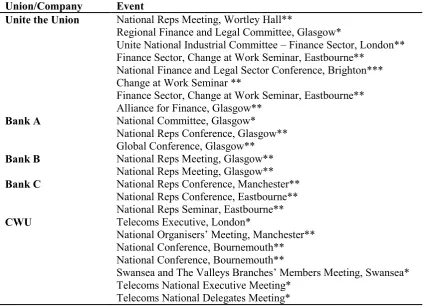
A second data source came from union conferences, seminars and meetings at which PM was either the single agenda item, the subject of a dedicated session or a significant topic of debate (Table 2). Detailed notes were taken in all and relevant debates recorded. This is unprompted testimony, the outcome neither of specific questions, nor of scheduled discussions. Union conferences provide windows into the workplace and a voice mechanism for large numbers of employees. Delegates at Unite the Union’s financial sector conference represented 114,000 employees, and those at the CWU’s telecoms conferences more than 100,000 members.
A third source providing some triangulation is company and union documentation. The former include PM guidelines and handbooks for employees and managers, pro forma, progress schedules, procedural agreements and other HR papers. Such documents must be interpreted critically because practice may diverge from policy prescription. Union documents include circulars and briefings for members, newspapers, digital media, conference resolutions and proceedings, guidelines, codes of practice and company correspondence.
13
of their members and fellow workers. Reps and lay officers ‘reflect the dynamic of change’ in organizational life (Danford et al, 2003), articulating workforce concerns to management. Full-time officers, while not immersed in day-to-day workplace realities, negotiate with companies over PM, pursuing members’ interests and acting on conference mandates. Together, these union actors convey the experiences of a broad employee population.
Certain limitations must be acknowledged. Union sources perforce will deliver a perspective that is partial. If the objective had been to deliver an holistic organizational account of the dynamics and consequences of PM, then it would be legitimate to regard the data as ‘incomplete’. However, the objective was to evaluate experiences of PM in technologically-intensive service sector cases, as articulated through the medium of union officers and reps. It is acknowledged that such an approach focuses on PM as grievance and the perspective of one stakeholder representing a selected group of employees. Rather than indicating bias, though, the data provides a particular and entirely legitimate perspective on PM and its effects on employees, as reported by representatives with knowledge of vulnerable member groups.
Table 2 here
5.2 Data analysis
14 6 Results
Older workers were not the only employee category union respondents identified as having been particularly affected by PM, however, they were the most frequently cited. Moreover, in several cases when interviewees emphasized gender (that women were more likely to be affected than men), it was the combination of gender and age that mattered with the latter being more important. The results, therefore, focus on EPM and PM generally for older workers.
6.1 Financial Services
A majority of interviewees (10 of 15) referred to a step change in PM facilitated by the growth of EPM. A Senior Rep provided vivid testimony.
The call centre was the testing ground in a way, with our members being hit with stats, stats, stats – call waiting, timing, targets – all measured by the system…managers would come to meetings with numbers against every single team member. The system would do the counting, the line managers would enter the figures on the spreadsheets and team leaders would do the enforcing. (Bank A, Senior Rep)
15
of the workforce (or sections thereof) allocated to each category were analogous. Forced distribution (explicit or indicative) applied in each case, and underperformance resulted in some form of corrective action, whether designated Performance Improvement Plan (PIP), Performance Improvement Measure (PIM) or Individual Improvement Plan (IIP).
A National Secretary reflected generally on the changes PM had brought to work and to older workers.
As I was out of the sector between 2007 and 2010, I have the benefit of perspective. Before I left PM was emerging as a difficulty. Managers were using Management Information Systems to generate metrics, which were giving us underperformers right across the banking sector. The banks denied using forced distribution. Some senior managers let it slip they were and sympathetic ones told us off the record. The facts spoke for themselves – the numbers on improvement measures, the numbers failing…When I returned, it was much more obvious…insecurity among good people like never before, frightened of being managed out. In [Bank C] 10% were on a PIP. We challenged them, but it was a downsizing strategy. What stood out was the plight of staff in their 50s and older who were getting the treatment. Supposedly, they were slower, not tech savvy enough, too careful, but this was nonsense. To use an analogy it was like perfectly good navy vessels being de-commissioned. (National Secretary 1)
Twelve of the 15 financial services’ interviewees reported that older workers had either become a specific target for PM or were being treated differentially in a more punitive manner. This observation of Bank C was typical.
16
can’t do that now for legal reasons. Now they get rid of people in a different way, they get performance managed out. (Bank C, Senior Rep)
One National Officer described how reconfigured PM procedures ‘trapped’ vulnerable categories of worker.
Performance management changed as the maximizing performance thing kicked in. A level three rating is where you have overall achieved - straightforward, you’ve done what the business has asked of you. But they shifted it to all areas. To get a level three rating you had to now achieve all objectives, all targets, all behaviours....It was massively subjective. You could see older colleagues falling down on behaviours or attitudes or a physical target. Previously they would have been a three. I think it was deliberately set up to manage out older more expensive workers when the company was downsizing. Do I think it was discrimination? Yes. Could we prove it? It was very hard to. (Bank B, National Officer)
These views meshed with the direct experiences recounted by worker delegates. PM was raised at all the company conferences and at the National Sector Conferences of Unite the Union. The following extract from a debate at Bank A’s conference was typical at all the conferences attended when PM was the subject of discussion.
17
It’s similar in the branches, although here it’s been closure and merger. You go into the branches and you can see the result – front of house, back of house, mostly young, happy shiny people. About two and a half years ago there was this [takes deep breath] shock and awe when they began using managed performance up to the hilt. You could see the oldies – some weren’t that old - dropping like flies, put on 1s or 2s and for many it was 6 to 8 weeks from on a PIP to out the door, mostly women, perfectly good at their job. They’ve kept a token number but that’s kind of like window dressing. (Bank A, Bank Branch, Global Conference, 13 May 2011)
In 2011, related motions on targets, work intensification and PM were unanimously passed. Motions 12 and 13 condemned ‘forced distribution’ and ‘secretive calibration meetings’ which were causing ‘heightened job insecurity’, ‘work-related stress’ and ‘an increase in PM disciplinary hearings and dismissals’. These ‘fundamentally flawed’ policies and practices were discriminatory, as contributors to the debate made clear:
The most vulnerable people are being harassed, those who some managers think they can get away with bullying. It’s inhumane. Sometimes it’s women, maybe if they’ve been off sick or with family demands, sometimes it’s those with a medical condition, sometimes it’s those who they know are a bit quiet and won’t fight back, but the common thing is that they are a bit older, not necessarily old, but a bit older. They get dumped in the underperforming bucket and can’t climb out, but that is the overall objective, not to improve them but to exit them (North West Delegate).
In short, our case studies revealed that older employees were likely to receive (similarly) differential treatment in each of the banks. One of the National Secretaries concluded,
18
older workers are subject to bad practice, right across the piece. No bank is better than an another because they are all doing the same. (National Secretary 2)
6.2 Telecommunications
Telco’s clerical functions consisted mainly of call centres which underwent a similar trajectory in terms of the adoption of computer-telephonic technology as did financial services (Batt and Moynihan, 2002). An earlier phase of aggressive target implementation using EPM created widespread grievance, leading to industrial action in 1999. On the manual side, notably field engineers, jobs had been more recently reconfigured and re-timed, leading to a prioritization of the number of completed cases at the expense of quality of work. Technological controls and EPM took multiple forms, including internet location management (iLM) devices that provided the statistical data for disciplinary outcomes. The CWU magazine, over several years, has reported concerns with the (ab)use of ‘tracker data’ (e.g. 2014: 9). In sum, employees in Telco’s distinctive areas of work had their performance ranked and stacked according to categories, similar to financial services, with the bottom underperforming category subject to improvement or corrective action in the form of PIPs. The outcome, as evidenced by all of the interviews and by union conference debates (CWU and Prospect) was extensive grievance with EPM because of disciplinary outcomes, including ‘managed exits’ for designated underperformers.
19
versus 16 per cent). The vulnerability of older workers is reflected by the following interviewee.
I have lost count of the times I have seen the sorry cycle repeated. The targets get more ‘aggressive’, to use the managers’ word, and some of the older women really struggle to make their targets. Don’t get me wrong – these people are not passengers, they are great with the customers…but they are not firing through the calls quickly enough. It’s very sad because these are really committed people. They internalize the problems and start making mistakes as they never did before. They end up on a PIP which they find very difficult to get out of. (Branch Secretary 2)
For clerical, mainly contact centre, work, a majority of respondents (10 of 15) reported increasing numbers of advisors presenting with symptoms of stress. A common theme was that longer-serving employees were most affected.
They [advisors] are coming to us complaining that they are not able to sleep and are stressed, worrying about their performance. We’re speaking here about people who have been with the business for 20, 25 or even 30 years, people now in their 50s. I was used to getting women and men on a daily basis in my office in tears – more women than men. They were older and had been defined by management as underperformers...The pressure stacking up on people is immense and is very difficult to withstand. The older people are crumbling before our eyes. (Clerical Branch Officer, CWU)
Officers responsible for engineering and manual grades reported similar trends.
20
give reports, they have GSM tracking to stop them deviating and then there’s the mobile phones for chasing them. (CWU National Officer 3)
Very often those who fall foul of PM, the underperformers, are actually the good engineers. They tend to be older, a bit slower and are not doing enough jobs per day. Management say that they ‘over-engineer’ jobs, but you can’t ever get a definition of over-engineering. Now engineers have got high quality and safety standards to meet and they want to avoid things like ‘early life failures’, which engineers are also targeted on. It’s a difficult balancing act, a quality job every time while meeting volume targets. (CWU Regional Officer)
Once again, it was older workers who were reported to be suffering most from the pressures of EPM.
People who are about ten years or so from finishing - all they want to do is come to work, keep their noses clean, do a good job, look forward to retiring and their pension. Now they are frightened because they know they can be caught in a trap if they make one slip and don’t hit the targets. They look about and see that their friends, who they’ve worked with for years have now gone – put on a PIP, didn’t improve, compromise agreement and gone. I am not saying that it is only our older members who are getting this, but I agree with [Manchester Delegate] that it very often is. (CWU Branch Secretary, Birmingham, 25 May 2010)
At CWU Annual Conferences (2010, 2011) motions were passed condemning PM and committing the union to action. Speaking in support of these motions, several delegates stressed the disproportionate effects on older workers. The following extract is typical.
21
occasional performance discipline case but it was not age-related. Now there is a definite pattern where older workers get whacked as underperformers, put on a PIP …It’s like being put in a silo, they’re stuck, can’t improve themselves…we are their last line of defence before they get done on capability. Telco is ruining these people’s lives. (CWU Rep Delegate Manchester, 25 May 2010)
Analysis of CWU conference agendas between 2010-2012 shows how widespread opposition to Telco’s PM had become. For example, motion number 54 to the 2011 Conference referred to ‘discrimination’ towards older workers, while motion number 55 condemned Telco for using ‘underperforming’ and compromise agreements to ‘systematically manage people out of the business’. The proposer of motion 56 described how PM had become more ‘draconian and inflexible’ and that good hard-working older members ‘who perform well above expected standards are fearful for all aspects of their everyday working life’.
A key informant was the National Officer responsible for negotiating with Telco, who reported the recurring characteristic of the cases they appealed was that they involved older workers. In one high-profile instance, action was threatened to prevent the termination of a long-serving and respected field engineer.
22
The question prompted by these reported experiences is the extent to which an underlying organizational purpose has animated Telco’s practices. All those CWU respondents (10 out of 15) who saw age as an important factor, believed that older workers were being deliberately targeted as a prelude to being put on a PIP and then exited after unsatisfactory improvement. Supporting evidence exists.
First, a Prospect rep (and former HR manager) provided ‘insider’ testimony of changed PM practice. In her section of 80 engineers, nine were ‘managed out’ on performance grounds, an exit rate ‘worn by her senior manager as a badge of honour’.
Later in 2008 a new Director was appointed [for Telco section] with responsibility for field engineers. We were told we were not moving people out quickly enough. Managers had what was basically a fortnightly inquisition on how effectively they were dealing with sickness absence cases and underperformers. Managers were given targets on how many people should be exited. The message was clear, ‘If you don’t manage people out of the organization, then you will get managed out yourself’. It was never openly articulated but was as explicit as it could be that it was older workers being targeted. They wanted to remove people on grounds of capability and performance without having to pay their pensions. (ex-Human Resource Manager, Prospect)
23
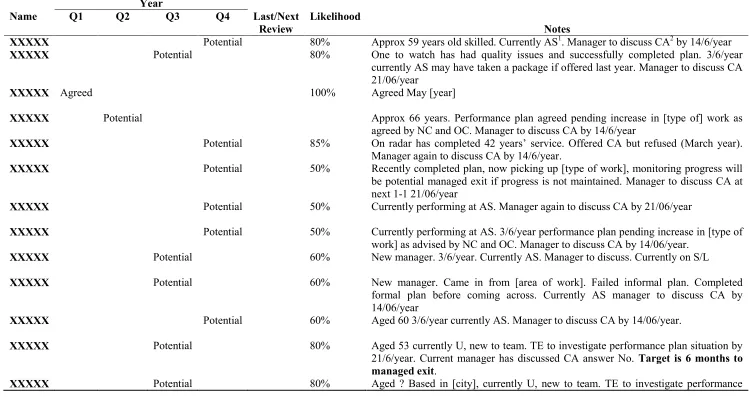
which reflects senior manager evaluations of this objective being realized.iii The ‘notes’ column records in cursory narrative the actions against the identified staff and the rationale.
While age is not the sole reason for action against individuals, it certainly is prominent. Explicit reference is made to age in 11 of the 23 cases. Nor is poor or under-performance, however defined, consistently used as a rationale for the targeting of individuals. Eight of the listed staff were deemed to be ‘Achieving Standards’ (AS) and only two were underperforming (U). In three additional cases where managers were obligated to proceed with compromise agreement discussions, it was acknowledged that ‘no current performance issues’ existed. In at least two cases, managers were expected to facilitate the removal of staff who had medical conditions, even though no performance grounds were cited.
7 Discussion
The findings, first, demonstrate the use of EPM in retail banks and telecommunications across functions and levels (Research Question 1). A majority of interviewees reported that performance indicators increasingly relied on quantitative targets; for example, EPM enabled the ‘tightly timed’ and constantly monitored jobs of the telecommunications engineers. Respondents also reported the use of forced distribution rating systems (FDRS) based on EPM data to manage underperformers, confirming other reports of FDRSs’ growing use (Houldsworth and Jirasinghe, 2006).
24
performance) appeared to drive this practice. While stereotyping in appraisals cannot be confirmed with our data, other research confirms few age differences with respect to quantitative performance criteria (Ng and Feldman, 2012). Moreover, managers based decisions on proxies of objective measures that were not directly related to task performance; e.g., absence, timekeeping, extra effort.
What is compelling about the evidence is the similarity of PM processes and outcomes across our two sectors and the banking case studies. This pattern reinforces the relevance of institutional isomorphism (DiMaggio and Powell, 1983), and in particular the adoption of common technologies which reconfigured work organization in retail banks with the purpose of driving efficiencies, and maximizing profits and shareholder value. Our evidence shows that digitally generated data of diverse kinds produced the metrics upon which individual targets, ultimately, were constructed and against which employees were evaluated. The processes were remarkably similar within and across the four banks in call centres, back office and even elsewhere amongst supervisory and technical grades. So too was there comparability in the ensuing PM policies, the treatment of underperformers and the effects for older workers. In Telco, the clerical and engineering experience demonstrated similar effects in contrasting work contexts.
25
and Roch, 2007). Our evidence suggests that EPM is being used in technologically-intensive work settings to drive PM in a manner contrary to best practice. EPM is shown to increase stress-related illness (Stanton, 2000), which is consistent with the reported cases related to stress caused by PM in our study.
FDRS also was viewed as procedurally unjust and frequently based on metrics which encouraged stereotypes regarding the capabilities of older workers. These stereotypes, for example, regarding health, are not supported by studies which indicate that ‘work ability’ can be sustained in late-career employees given a supportive work environment (Härmä, 2011). Not only does our study highlight the dangers of an increasingly intensified, technologically-driven performance culture, it suggests that age stereotypes are encouraging managed exit from the workplaces.
A final contribution is to present a view of older workers’ experiences which is not conventionally acknowledged in the HRM literature, particularly with respect to the relatively recent impact of e-HRM. HRM literature traditionally encourages employers to adopt formal HR practices, such as frequent performance appraisal for non-managerial employees, as part of a positive, developmental relationship-building process (Armstrong, 2009). Our findings reflect a darker side of such benign indicators of HR and technology adoption, particularly with respect to age discrimination. Specifically, PM demonstrated in this study stands in direct contrast to the frequently cited imperatives to extend working lives and encourage supportive, age-aware HRM practices (Kooij, et al., 2013).
8 Conclusions and implications
26
however, reflect the growing pervasiveness of EPM in technologically-intensive service work and its use for punitive PM, potentially in a discriminatory way. Appropriately positioned HRM can prevent unintended discriminatory practices or biased managerial perceptions. Yet, this has not prevented the emergence of controversial practices, such as FDRSs, despite concerns regarding their legality and effects on employee attitudes (Bass and Green, 2014; Blume, et al., 2009).
Of further concern is that age discrimination remains an issue in an environment of recession and greater competition for jobs (Rothenberg and Gardner, 2011). Furthermore, current observed changes in the demographic composition of the workforce are not temporary. Our study presents one potential prospect for the future; that HRM policies and practices driven by increasingly technologically-intensive work processes and ever more readily available digitized metrics become less, rather than more, aligned to the needs of a multigenerational and increasingly aging workforce.
These issues require multistakeholder attention, not least from policymakers who promote extending working lives while also reacting to issues concerning pension entitlement and less easily accessible early retirement routes. Employers cannot be assumed to be forthcoming, as revealed by reported increases in cases involving punitive PM presented to the unions by their members. Future research should attempt to gain additional perspectives (from employers and employees) to enable EPM data to be used in a way that is mutually satisfying and protects vulnerable groups from adverse impact. For example, EPM may also disadvantage those with disabilities. Trades unions, who already face conflicting pressures with respect to age policy (e.g. protecting pension entitlement, negotiating strategies for easing unemployment) now are faced with what appears to be a further social challenge in terms of age equality.
27 Research participants
Organization Union/Interviewee
Unite the Union (Finance Sector)
National Secretary 1 National Secretary 2
Bank A National Officer
Senior Rep Workplace Rep Senior Rep
Bank B National Officer
Workplace Rep Workplace Rep
Bank C Senior Rep
Workplace Rep Workplace Rep
Bank D Senior Rep
Workplace Rep Senior Rep
Telecoms (Telco) Communication Workers Union
Regional Officer 1 National Organizer Clerical Branch Officer National Officer 1 National Officer 2 National Officer 3 National Officer 4 Branch Secretary 1 Branch Secretary 2 National Organizer
National Officer and Negotiator (CWU) Senior National Officer (CWU)
Prospect
Ex-Human Resource Manager (Prospect) National Officer (Prospect)
28 Table 2.
Union Conferences and Seminars
Union/Company Event
Unite the Union National Reps Meeting, Wortley Hall**
Regional Finance and Legal Committee, Glasgow*
Unite National Industrial Committee – Finance Sector, London** Finance Sector, Change at Work Seminar, Eastbourne**
National Finance and Legal Sector Conference, Brighton*** Change at Work Seminar **
Finance Sector, Change at Work Seminar, Eastbourne** Alliance for Finance, Glasgow**
Bank A National Committee, Glasgow*
National Reps Conference, Glasgow** Global Conference, Glasgow**
Bank B National Reps Meeting, Glasgow**
National Reps Meeting, Glasgow**
Bank C National Reps Conference, Manchester**
National Reps Conference, Eastbourne** National Reps Seminar, Eastbourne**
CWU Telecoms Executive, London*
National Organisers’ Meeting, Manchester** National Conference, Bournemouth** National Conference, Bournemouth**
Swansea and The Valleys Branches’ Members Meeting, Swansea* Telecoms National Executive Meeting*
Telecoms National Delegates Meeting*
29 Table 3.
Individuals targeted for Compromise Agreements and Managed Exits (Telco)
Year
Name Q1 Q2 Q3 Q4 Last/Next
Review
Likelihood
Notes
XXXXX Potential 80% Approx 59 years old skilled. Currently AS1. Manager to discuss CA2 by 14/6/year
XXXXX Potential 80% One to watch has had quality issues and successfully completed plan. 3/6/year
currently AS may have taken a package if offered last year. Manager to discuss CA 21/06/year
XXXXX Agreed 100% Agreed May [year]
XXXXX Potential Approx 66 years. Performance plan agreed pending increase in [type of] work as
agreed by NC and OC. Manager to discuss CA by 14/6/year
XXXXX Potential 85% On radar has completed 42 years’ service. Offered CA but refused (March year).
Manager again to discuss CA by 14/6/year.
XXXXX Potential 50% Recently completed plan, now picking up [type of work], monitoring progress will
be potential managed exit if progress is not maintained. Manager to discuss CA at next 1-1 21/06/year
XXXXX Potential 50% Currently performing at AS. Manager again to discuss CA by 21/06/year
XXXXX Potential 50% Currently performing at AS. 3/6/year performance plan pending increase in [type of
work] as advised by NC and OC. Manager to discuss CA by 14/06/year.
XXXXX Potential 60% New manager. 3/6/year. Currently AS. Manager to discuss. Currently on S/L
XXXXX Potential 60% New manager. Came in from [area of work]. Failed informal plan. Completed
formal plan before coming across. Currently AS manager to discuss CA by 14/06/year
XXXXX Potential 60% Aged 60 3/6/year currently AS. Manager to discuss CA by 14/06/year.
XXXXX Potential 80% Aged 53 currently U, new to team. TE to investigate performance plan situation by
21/6/year. Current manager has discussed CA answer No. Target is 6 months to
managed exit.
30 Year
Name Q1 Q2 Q3 Q4 Last/Next
Review
Likelihood
Notes
plan situation by 21/6/year. Manager has discussed CA answer No. Target is 6
months to managed exit.
XXXXX Potential 80% Aged 62. TE to investigate performance plan situation by 21/6/year. Current
manager has discussed CA answer No. Target is 6 months to managed exit.
XXXXX Potential 80% New to team. Now beginning plan with myself and PR. Target is 6 months to
managed exit.
XXXXX Potential 90% Aged 62, manager has discussed CA, wants to go HR to contact individual.
XXXXX Potential 70% Aged 62 starting a coaching plan. Manager to discuss CA next 1-1.
XXXXX Potential 100% Aged 58. TC to discuss CA potential by 14/06/year. TC spoke to Len, will
definitely take CA in Q4 subject to being able to agree terms (needs 6 months)
XXXXX Potential 85% Liver condition may be medical retirement. 3/6/year no issues at present, could
deteriorate, will progress as managed exit with a view to medical retirement if performance is affected
XXXXX Potential 80% Parkinson’s, no performance issues to date drawing pension (aged 60). Manager
again to discuss CA by 21/06/year.
XXXXX Potential 60% AS performer now reaching retirement age, manager to discuss CA to gauge
interest by 14/06/year.
XXXXX Potential 80% States work making him ill manager monitoring. 3/6/year no current performance
issues, has been asked to complete [performance development plan]. Manager to discuss CA by 14/06/year.
XXXXX Potential 50% Came across from [team] is currently travelling 1.5 hrs to work each way also had
performance issues with role, being coached, manager to discuss CA to gauge interest 14/06/year.
Notes.
31 References
Armstrong, M (2009) ‘The process of performance management’, in M. Armstrong, A Handbook of Human Resource Management, London; Kogan Page, 617-638.
Armstrong-Stassen, M. and Cattaneo, J. (2010) ‘The effect of downsizing on organizational
practices targeting older workers’, Journal of Management Development, 29(4):
344-363.
Bain, P., Watson, A., Mulvey, G., Taylor, P. and Gall, G. (2002) ‘Taylorism, targets and the quantity-quality dichotomy in call centres, New Technology, Work and Employment, 17(3): 154-169
Bass, D. and Green, J. (2014) ‘Microsoft axes bell curve for employee grading in move to foster greater teamwork collaboration’, Bloomberg News, 13 November 2014. http://business.financialpost.com/2013/11/13microsoft-axes-bell-curve-for-emplyees Accessed 03/03/2014
Batt, R. and Moynihan, L. (2002) ‘The viability of alternative call centre production
models’, Human Resource Management Journal, 12(4): 14-34.
Blume, B.D., Baldwin, T.T., and Rubin, R.S. (2009) ‘Reactions to different types of forced distribution performance evaluation systems’. Journal of Business and Psychology, 24: 77-91.
Bol, J.C. and Smith, S.D. (2011) Spillover effects in subjective performance evaluation: Bias and the asymmetric influence of controllability. The Accounting Review, 86(4): 1213-1230.
Boreham, P., Parker, R., Thompson, P. and Hall, R. (2008) New Technology@Work. London: Routledge
Carter, R., Danford, A., Howcroft, D., Richardson, H., Smith, A. and Taylor, P. (2011) ‘"All they lack is a chain": lean and the New Performance Management in the British civil service', New Technology, Work and Employment, 26(2): 83-97.
CIPD (2011) Conflict Management Survey Report. London: CIPD Publications.
Cox, C.B. and Baier, M.E. (2014) ‘Too old to train or reprimand: The role of intergroup attribution bias in evaluating older workers’, Journal of Business Psychology, 29(1): 61-70.
CWU (2010) Telecoms and Financial Services Conference–Agenda, 25 May, London: CWU CWU (2011) Telecoms and Financial Services Conference–Agenda, 24-26 May, London:
CWU
CWU (2014) Voice, Wimbledon: CWU, July-August
Danford, A., Richardson, M. and Upchurch, M. (2003) New Unions–New Workplace, London: Routledge
DiMaggio, P.J. and Powell, W.W. (1983) ‘The iron cage revisited: institutional isomorphism and collective rationality in organizational fields’, American Sociological Review, 48(2): 147-160
EHRC (2010) Working Better: The Over 50s The New Work Generation, London: Equality and Human Rights Commission.
Green, F. (2006) Demanding Work: The Paradox of Job Quality in the Affluent Economy, Woodstock: Princeton University Press
Härmä, M. (2011) ‘Adding more years to the work careers of an aging workforce – what works?’ Scandinavian Journal of Work Environment and Health, 37(6): 451-453.
Houldsworth, E. and Jirasinghe, D. (2006) Managing and Measuring Employee Performance,
Kogan Page Publishers.
Howcroft, D. and Richardson, H. (2012) ‘The back office goes global: exploring connections
and contradictions in shared service centres’, Work, Employment and Society, 26(2):
32
Kooij, D.T., Guest, D.E., Clinton, M., Knight, T., Jansen, P.G., & Dikkers, J.S. (2013) ‘How
the impact of HR practices on employee well‐being and performance changes with
age’. Human Resource Management Journal, 23(1):18-35.
Latham, G. P. and Mann, S. (2006) ‘Advances in the science of performance appraisal:
Implications for practice’. International Review of Industrial and Organizational
Psychology, 21, 295.
Lawler, E.E. (2003) ‘Reward practices and performance management system effectiveness’, Organizational Dynamics, 32(4): 396-404.
Loretto, W. and White, P. (2006) ‘Employers’ attitudes, practices and policies towards older workers’, Human Resource Management Journal, 16(3): 313–330.
Manfred, S. and Vickers, L. (2013) ‘Meeting the challenge of active ageing in the workplace; Is the abolition of the retirement age the answer?’European Labour Law Journal, 4(4): 250-70.
McNall, L. A. and Roch, S.G. (2007) ‘Effects of electronic monitoring types on perceptions of procedural justice, interpersonal justice, and privacy’, Journal of Applied Social Psychology, 37: 658–682.
Minda, G. (1997) ‘Opportunistic downsizing of aging workers: The 1990s version of age and pension discrimination in employment’. 48 Hastings L.J. 511 1996-1997.
Miozzo, M. and Soete, L. (2001) ‘Internationalisation of services: a technological perspective’. Technological Forecasting and Social Change, 67(2): 159-185
Ng, T.W.H. and Feldman, D.C. (2008) ‘The relationship of age to ten dimensions of job performance’. Journal of Applied Psychology, 93(2):392-423.
Ng, T.W.H. and Feldman, D.C. (2012) ‘Evaluating six common stereotypes about older workers with meta-analytical data’. Personnel Psychology, 65: 821-858.
Niessen, C., Swarowsky, C., and Leiz, M. (2010) ‘Age and adaptation to changes in the workplace’, Journal of Managerial Psychology, 25: 356-383.
Osborne, T and McCann, L.A. (2006) ‘Forced ranking and age-related employment discrimination’, Human Rights, 31: 6-9
Parry, E. and Strohmeier, S. (2014) ‘HRM in the digital age – digital changes and challenges of the HR profession’, Employee Relations, 36(4), pp.–(Earlycite).
Pawson, R. and Tilly, N. (1997) Realistic Evaluation, Sage: London.
Perry, E. L. and Finkelstein, L. M. (1999) ‘Toward a broader view of age discrimination in employment-related decisions: A joint consideration of organizational factors and cognitive processes’, Human Resource Management Review, 9(1): 21-49.
Posthuma, R.A. and Campion, M.A. (2009) ‘Age stereotypes in the workplace: common stereotypes, moderators, and future research directions’, Journal of Management, 35(1): 158-188.
Prospect (2013) Performance Management System in Telco. Prospect’s 2013 Survey, London: Propsect.
Pulakos, E.D. and O’Leary, R.S. (2011) ‘Why is performance management broken?’ The Industrial and Organizational Psychologist, 4, 146–164.
Rauschenbach, C., Göritz, A.S., and Hertel, G. (2012) ‘Age stereotypes about emotional resilience at work’.Educational Gerontology, 38(8): 511-519.
Robroek, S. J., Schuring, M., Croezen, S., Stattin, M., and Burdorf, A. (2013) ‘Poor health, unhealthy behaviors, and unfavorable work characteristics influence pathways of exit from paid employment among older workers in Europe: a four year follow-up
study’, Scandinavian Journal of Work, Environment and Health, 39(2).
33
Ryan, G.W. and Bernard, H.R. (2000). ‘Data management and analysis methods’, in N.K. Denzin and Y.S. Lincoln (eds), Handbook of Qualitative Research, Thousand Oaks, CA: Sage.
Stanton, J. M. (2000). ‘Reactions to employee performance monitoring: Framework, review, and research directions’, Human Performance, 13: 85–113.
Strohmeier, S. (2009) “Concepts of e-HRM consequences: a categorization, review and suggestion”, International Journal of Human Resource Management, 20(3): 528-543. Strohmeier, S. and Kabst, R. (2009) ‘Organizational adoption of e-HRM in Europe: An
empirical exploration of major adoption factors’, Journal of Managerial Psychology, 24(6): 482–501.
Taylor, P. (2013) Performance Management and the New Workplace Tyranny, Report for Scottish Trades Union Congress, Glasgow.
Taylor, P. and Bain, P. (2007) ‘Call centre reflections: a reply to Glucksmann’, Work, Employment and Society 21(2): 349-362.
Thompson, P. (2011) ‘The trouble with HRM’, Human Resource Management Journal. 21(4): 355-367.
Verint (2014) Workforce Management–Forecasting, Scheduling and More to Balance Your Workforce with Workload, http://www.verint.com/solutions/enterprise-workforce-optimization/products/workforce-management/index, accessed 27 June 2014.
Wells, D.L., Moorman, R.H., and Werner, J.M. (2007) ‘The impact of the perceived purpose of electronic performance monitoring on an array of attitudinal variables’, Human Resource Development Quarterly, 18: 121–138.
White, M. (2012) ‘Older employees under pressure? Theorizing reasons for declining commitment’, Work, Employment and Society, 26(3):447-463.
i In the UK full-time officers or officials (FTOs) are paid employees who undertake diverse responsibilities on
behalf of the union and its membership. The remit of an FTO can vary according to geography (national or regional level), by sector, industry or company, and/or by function (e.g. research, negotiation). Elected or lay positions are differentiated from FTOs in that they are elected representative of different kinds, including workplace, national [senior rep] or elected branch positions, such as secretary.
ii Staff names have been redacted and details that might reveal the organization, function or location have been
deleted or anonymized.
iii A 100% figure shows that the individual had already formally agreed to leave and a 90% figure that the