City, University of London Institutional Repository
Citation
:
Pratt, A.C. (2004). Creative Clusters: Towards the governance of the creative industries production system?. Media International Australia(112), pp. 50-66.This is the accepted version of the paper.
This version of the publication may differ from the final published
version.
Permanent repository link:
http://openaccess.city.ac.uk/6705/Link to published version
:
Copyright and reuse:
City Research Online aims to make research
outputs of City, University of London available to a wider audience.
Copyright and Moral Rights remain with the author(s) and/or copyright
holders. URLs from City Research Online may be freely distributed and
linked to.
City Research Online: http://openaccess.city.ac.uk/ [email protected]
Andy C. Pratt
Creative Clusters:
Towards the governance of the creative industries production system?
Dr Andy C Pratt,
Department of Geography and Environment
London School of Economics
London WC2A 2AE
Paper re-submitted to Media International Australia incorporating Culture and Policy
21.6.04
Abstract
The aim of this paper is to critically assess the notion of the creative cluster, and to consider
whether it is an appropriate tool for the governance of the creative industries, or even a
suitable point from which to begin an analysis of the creative industries. The paper argues
that creative clusters are formally a sub-set of business clusters. A critique of the business
clusters literature highlights its short comings: namely a focus on individual firm preferences
and a lack of attention to non-economic, situated (temporal and spatial) variables; a lack of
attention to the specificity of particular industries and their associated regulatory peculiarities;
and, finally, information issues associated with the operationalisation of the cluster model.
The paper concludes with a discussion of an alternative approach, namely looking at the
to govern the creative industries and creative clusters.
Introduction
The creative industries1 are increasingly being hailed as the potential economic saviours of
local and regional economies worldwide. Whilst novel data collection in some regions has
provided an evidential basis for these claims the question of which policies, if any, might be
best applied to these industries is still open. The current favourite policy idea and governance
tool is the notion of the creative cluster. This paper sets out to examine if the notion of
creative cluster is both robust and appropriate for such a task. It is important to add a caveat
here. Not all creative industries are market orientated, and even those that are may not be so
all the time: creative industries, and especially their practitioners, are commonly active across
the margins of the arts and economic activities. This fact generates tensions between arts,
social and economic policy makers and practitioners. However, there is not space to deal with
this matter more fully here and this paper deals only with the 'market facing' aspects of the
creative industries.
The paper begins with an examination of the notion of the creative cluster as it has been
interpolated in debates concerning economic policy and strategic development; especially on
those concerning the application and operationalisation of the concept. Practically, this paper
examines the view that creative clusters are a sub-set of business clusters, a concept
articulated in the writings of Michael Porter (see Porter 1990, 1995, 1996; Porter and Ketels
2003) and policy makers in countries such as the USA, UK, Australia and New Zealand.
Whilst I accept that this is a problematic starting point, it is a necessary and pragmatic one.
The notion is problematic for at least four reasons. First, because there are numerous
argued by some academics that Porter's work has an unclear and ambiguous conceptual
foundation (see Martin and Sunley 2002). Third, there is neither agreement on the definition
of, nor the actions that might promote, clusters. Finally, the notion of cluster has been applied
liberally and flexibly by policy makers.
However, it is important to acknowledge that cluster policies and strategies already exist and
have considerable momentum. This requires a pragmatic response. The creative clusters
agenda brings together two aspirations: of promoting local competitive advantage; and using
the creative sector as a region or city’s leading high-growth sector. This combination is a
heady brew for policy makers and politicians. While it is unlikely that this policy juggernaut
can be reversed; the crucial stage of application can be a profitable site for new interventions
aimed at remedying deficiencies in the creative clusters agenda.
The central point of the paper is that weak or poorly articulated concepts are at best difficult,
at worst impossible, to operationalise. In practical terms there is considerable vagueness as
to how to empirically define a cluster (whether in terms of its size, number and co-location of
firms, or social, cultural or economic interactions). Second, even having identified these
interactions it is not clear which criteria of evaluation might be used to assess success of the
clusters per se; and consequentially, what might be done to promote them. Third, there is
dispute as to whether clusters can be created de novo. Fourth, it is not clear whether it is
appropriate to apply a generic policy to all sectors, or whether some industries require
separate treatment.
As such, it is believed that creative clusters should be subject to the same economic forces
and policy responses as all other industries. One response to this position has been to argue
for cultural exceptionalism. This is the argument that creative clusters- or cultural quarters as
they are better known – are not simply, or primarily, focused on economic activities. As such
they should be evaluated and planned for using other criteria.2 A second response and one
employed in this paper, is that if we focus on the market orientated creative industries. This
permits recognition of significant variations in organisation and practice suggesting the need
for specific rather than generic policies for the creative industries. Inter alia, this argument
also indicates the importance of a robust definition of the creative industries.
While the concept of the business cluster is briefly reviewed here; this review is necessarily
schematic rather than exhaustive (for extensive reviews see Martin and Sunley 2002; Gordon
and McCann 2000; and, Pratt 2004 b). It is designed to highlight a key area of weakness in
the cluster literature, namely the lack of attention to business organization. It is on this basis
that I argue that the creative industries might be worthy of being viewed as 'exceptional' with
the broader thrust of the argument being against generic business cluster policy for the
creative industries and beyond. I argue that sensitivity to what are termed here 'governance
issues' could inform a number of positive debates about definitions of clusters, about
production processes, and concerning differences within the creative industries.3 The paper
concludes with a discussion of an alternative approach, namely looking at the creative
industries production system, that would better meets the concerns of those seeking to
govern the creative industries and creative clusters.
Beyond Transactions and Clusters: Governance
Although it is the concept of the moment, the notion of clustering has been around for as long
clustering--transactions and clusters--and point to two areas of weakness--generalization and
the focus on traded costs. I argue that the governance literature concerned as it is with
organizational issues has more insights to offer at least the creative industries, and potentially
all industries.
Transactions
It is useful to refer to this first family of ideas- one that covers a wide range of approaches
which have internal differences- as 'transactions' because they focus on what passes across
and through networks: the interfaces of firms. Early accounts of industrial clustering centred
on industrial districts and highlighted the competition fostered by co-location of competitors
which were seen as facilitating price comparisons, a range of labour pooling benefits through
having a range of skilled workers on hand, and more vague notions of the transmission of
tacit knowledge (see Marshall 1890). Modern neo-classical economics uses the more formal
and limited notion of agglomeration economies such as increasing returns to scale to account
for the same phenomena. However, what might count as a cut off point, below or above
which benefits fail to accrue is empirically unclear (see Fujita, Krugman and Venables 2000).
In significant part this problem can be related back to issues of causality: what exactly is
being minimized through co-location? Traditionally, the answer was transport costs. In more
recent debates this has been elaborated in a whole range of business-to-business
transactions costs. Interestingly, the development of communications technologies offer a
potential critique of the need for co-location. If one assumes that first, goods are becoming
increasingly digital or weightless; and second, that communication costs are falling, then the
conclusion should be that there is minimal economic need for firms to cluster. Arguably, the
fact that firms continue to cluster, and pay good money to do so, offers an immanent critique
non-economic dependencies might account for clustering (see Pratt 2004 c).
A whole sub-literature has developed seeking out examples of trust, social networks, and a
whole range of tacit knowledges that are linked to places (see Lazaric and Lorenz 1998).
Essentially, it might be argued, what these accounts are seeking to do is to account for what
neo-classical economists would consider to be externalities or even residuals. However, in
this case the residual appears to have a greater power of explanation than the primary
relationship. Thus, the problem is what counts as an economic or non-economic factor, what
is inside and what is outside of the explanation. Essentially, this can be viewed as a boundary
problem. Transactions based analysts run into further difficulties when faced with what are
termed the project, or short-life, firm (see Grabher 2003; Pratt 2004c). Project-based firms
may only be extant for a finite project, then disbanded. So, the analytical starting point of 'the
firm' is unlikely to be an ideal position from which to view the bigger picture. As I will note
below, it is just these types of issues that organizational analyses seek to address. But before
exploring this it is necessary to outline the key elements of the influential business cluster
model advanced by Michael Porter.
Business clusters
Porter's (1990; 1995; 1996) concern is with the competitive advantage of the firm. This quality
is in part a relational one concerning, on the one hand, other firms engaged in similar
production practices; and, on the other hand, practices that are 'upstream' or 'downstream' of
those producers. Porter's notion of a cluster is of an interrelated set of industries which are
inter-related by a process which he views analytically through the lens of 'value chains'. Here
Porter sees little, if any, role for space and place, and precious little for organization. Rather
as a result of four inter-related tensions: factor conditions, firm strategy (structure and rivalry),
demand conditions, and related and supporting industries. Porter's focus is precisely on the
firm and its ability to be competitive. In this context he advocates three strategies that may be
adopted in combination in order to achieve the ideal competitive mix: differentiation of
product or service, cost leadership and focus on particular market segments. According to
Porter, place-based effects of clustering are a by-product of a group of firms adopting such a
strategy.
Whilst we can agree with Martin and Sunley (2002) that Porter's position is derivative of
Marshall's, it is unlike Marshall's in that it is concerned with the individual firm’s strategic
development.. Porter argues that the intensity of interaction of his 'competitive diamond' is
improved through geographical localization; although he is very vague as to the issue of
scale. His notion of cluster ranges from a small district, to a city, or even a nation. Porter is at
no point specific or consistent about what the determinants of scale might be. In some
respects Porter is working with a neo-classical notion of the firm, but internalising some of the
organizational resources that constitute ‘strategicality’. In his recent work he has pointed to
the important role that external institutions of coordination play in cluster building (Porter and
Ketels 2003). Here, Porter shifts closer to the ground of institutional and evolutionary
economists. It seems that both neo-classical and the business strategic approaches seem
to be struggling with an 'environmental' variable which accounts for structures within the firm
works across firms. Whilst debatable, Porter's analysis has some utility for the individual firm;
but it is less helpful for a public agency concerned with an industrial system. This last
Governance
The label governance may seem unusual in this context. However, what I want to signal are
the potential competencies of co-ordination that exist at several levels: within firms, between,
and across firms, and at a sectoral level. A range of academic approaches--economic
sociology, evolutionary economics, and political theory--have sought to point to these same
issues (see for example Best 1990; Cooke and Morgan 1998). Arguably, in so doing they
side-step the pitfalls of the boundary problem indicated above. A dominant approach in this
literature has been to explore what is termed the 'embedded economy' that elaborates the
social imbrications of economic processes (see Granovetter 1973). Others argue that even
this approach still cedes too much ground to 'the economic' and stress the need for social
accounts of the economic itself (see Pratt 2004c). Governance approaches address this
analytic space and stress the potential role both of a range of un-traded dependencies (see
Storper 1997) and non-trade dependencies. The former may be classified as social and
cultural transactions that form part of a business exchange, the latter the broad 'buzz' and
experience of being 'in the loop' that often accompanies un-traded dependencies and their
tendency to be rooted in place (see Pratt 2002).
Implicitly, transactions-focused approaches do seek to account for organizational factors.
Williamson's (1985) work, for example, seeks to account for internalisation and
externalisation of tasks in economic terms: the result of which is larger or smaller firms.
However, despite the sophisticated economics of such approaches, economic determinism is
strong, and the grasp of organizational sociologies, and their diversity, is weak. Most
seriously, transactions-focused approaches fail to deal with meta-organisational issues such
course, one of the key characteristics of many creative industries is precisely their extreme
bi-modality between international corporations and micro-enterprises (see Figure 1). A very
clear example would be the music industry (if we consider 'bands' to be the
micro-enterprises). Arguably, the picture is even starker than it appears, as in some creative
industries it is not simply the market place that is dominated by a small number of players;
but these players control access to the market (channels of distribution and retail). In such
cases, and we may accept that the creative industries may be an exception in this respect,
the structure of governance of the market is crucial to an understanding of activities and
possibilities of individual firms. Evolutionary approaches to economics, such as flexible
specialization, have sought to both take account of some organizational, regulatory and
historical factors in the localization of industry (see Storper 1997; Storper and Walker 1989).
Notable work has been carried out on the film industry from this perspective (see
Christopherson and Storper 1986; Scott 2000; Coe 2000, 2001).
[Figure 1 about here]
In a second sense governance may be taken to mean the acts of government by the state4. It
is notable that the creative and arts sector has traditionally been subject to considerable state
governance. The traditional means by which 'non-creative' businesses experience state
governance is through a range of market and competition policies, and sometimes through
indicative industrial policies that may seek to promote their activities through favourable
loans, advice or market making. However, in the creative field, states have sought to regulate
both content and access to cultural products (see Christopherson 2002). So, in the case of
create television markets (the UK experience is a classic case, notably the creation of
Channel 4, and more recently the creation of new TV channels to dilute the public sector and
to strengthen private competition through the establishment of independent production
targets for contracted out work at the BBC, see Deakin and Pratten 2000). Second, there is
the regulation of public taste, or public service, which seeks to govern what may be
broadcast, where and when. Clearly, this broad and complex suite of powers that may be
pursued to a lesser or greater extent has a major impact on the structure of creative markets,
and the relative power of any individual firm to act. At the very least it constitutes a case for
the creative industries to be dealt with uniquely in contrast with those activities not subject to
such regulation.
A clear message that comes out of governance approaches is that researchers need to
attend to both the firm, its organization, and the networks they operate within. Crucially, these
processes are situated in particular places and times (here we include the regulatory
specificities), and significantly, in particular industries. This last point, the 'exceptionalism', or
particularity, of industries is clearly explained by the diversity of production processes as well
as the unique character of regulation in this sector. Thus, we would expect the resultant
forms of 'clustering' to be different in, for example, Steel production compared with Television
production.
The challenge of operationalisation
A much overlooked, but central, issue in relation to business clusters is that of the definition
of industries. Porter recognises this factor more generally in his attempts to map the
co-location of firms. He does register that industrial classifications, the taxonomies that are used
magnified in the case of the creative industries. First, there is little clarity on the conceptual
scope of the creative industries; second, these industries are notoriously poorly described by
industrial classifications (see Pratt 1997, 2001). The central issue is that most industrial
classification systems build a taxonomy around raw materials rather than end products.
Some nation states, the USA for example, are now moving toward the product classification
system and this may offer some considerable improvements. In all other cases the only
recourse is to create a post-hoc product classification system; an example is the cultural
industries production system. The creative industries production system provides a robust
conceptual base, and an indicative range of data needs, although it can do little to
immediately rectify data availability5. Although an important first step in evidence based policy
making, it will be clear both from the above, and from the following discussion of the
production system approach that such co-location data is insufficient for policy development.
To understand why it is necessary to further elaborate the production system.
The creative industries production system
The creative industries production system advanced here attempts to echo a product
classification system in that it allows classification of all of the upstream inputs into a cultural
product output. The metaphor of a production chain captures this notion. A production chain
is basically the steps or cycle that any product or service goes through to transfer it from an
idea through production, distribution, and exchange, to final consumption. At each step, or
link, a transformation takes place. Each link is also dependent upon, and as we will elaborate
below, often interactive with, the other links in the chain. Thus, the production of goods and
services is always situated in that it always happens in a context. For example, simply having
idea is nothing without execution; a product or service is nothing without distribution; and,
distribution is nothing without a site for exchange or an end customer, user or audience. So,
two points can be made. First, that ideas and creative individuals need to be linked into
production chains. Second, that production chains are vital to bring ideas to fruition, and that
not all of those involved in these chains will be ‘creatives’ in any traditional sense.
[Insert Figure 2. about here]
Within the creative industries, a simple, generalised production chain of four key links can be
identified, as illustrated in Figure 2. Creation/Content origination refers to the various
processes by which creative material and intellectual assets are originated and produced.
This stage encompasses arguably the most visible activities of the sector – the creative fields
of authoring in all its forms from books to dance; design from buildings to fashion;
image-creation from digital art, to photography and painting; music composition; and digital content
origination such as multimedia titles, software packages and electronic games. It also covers
activities such as the commissioning of content, the aggregation and packaging of content
(e.g. by broadcasters), and the commercialisation of IPR by, for instance, record labels and
book publishers.
Manufacture concerns the making of ‘one-off's’, or prototypes, which may be reproduced
later. It also relates to the production of specialist goods, materials and infrastructure used
within the creative industries, such as artists’ materials (paints, canvasses, brushes etc.), film
cameras, or the manufacture of musical instruments.
Distribution and mass production refers to the activities associated with channelling creative
associated with reproduction and mass distribution such as printing, CD replication, shipping
and wholesaling etc., but also to newer digital and analogue forms of distribution from
broadcast to digital delivery systems. Commonly, these two modes are integrated.
Exchange refers to both the exhibition function embodied both in venue-based activities such
as concert halls, theatres and cinemas, as well as the retailing of certain creative products
such as books, CDs and videos. In between these lie the informal sites of consumption and
display that are important in the creative production system such as ‘the street’--or, rather,
certain places where novel cultural consumption is visible.
One could, of course, always elaborate further functions and activities within the production
chain, two clear additions might be: preservation and archiving, and the education of both
producers and audiences. These additional elements begin to show the iterative and
recursive nature of the process and thus shift the analogy away from a linear chain to one of
a web, a network, or an ecosystem. Finally, one can address the more familiar issues of
definition of the creative sector: which cultural forms does it include? Again the boundaries
are malleable and developing and a strong case can be made for inclusion of Visual Art,
Performance, Audio-Visual, Books and Press, and perhaps Sport and Health, and Heritage
and Tourism (see DCMS 2003).
The concept of the production system thus helps researchers and policy makers to ‘see’ the
totality of the process and raises awareness that performance in one step may be positively
or negatively affected by activities further up and down the chain. It encourages analysts to
assess the health of particular chains, to explore where chains are interlocked, and thus have
a strategic perspective on the whole system. Policy makers can potentially begin to focus on
relative strengths and weakness of either individual chains, or the system, and examine what
intensive information gathering.
However, as already noted, there is considerable diversity within the creative sector: each
industry, or creative form, has its particular characteristics. In the next section I point to the
fact that the diversity of production chains can be characterised for simplicity as tending to
one of three types.
Three types of production chain6
The notion of a production chain takes us beyond simple mapping of co-location and begins
to open up a space for the analysis of process; something that clearly requires a different
quality of information. As I have already pointed out processes such as in inter-firm
interaction, and the intra-firm organisation of production itself, are highly variable and linked
to materials, technologies and relationship to audiences, as well as to the structure of
markets. It is on this point that we can begin to make a robust case for the exceptionalism of
the creative industries as a whole, and for differences within them. Each industry has
characteristic forms of organisation, markets and regulation. A full account will have to wait
until more research has been carried out in this area. However, we can offer some indicative
views about the varieties of production chains. For the sake of simplicity these can be split
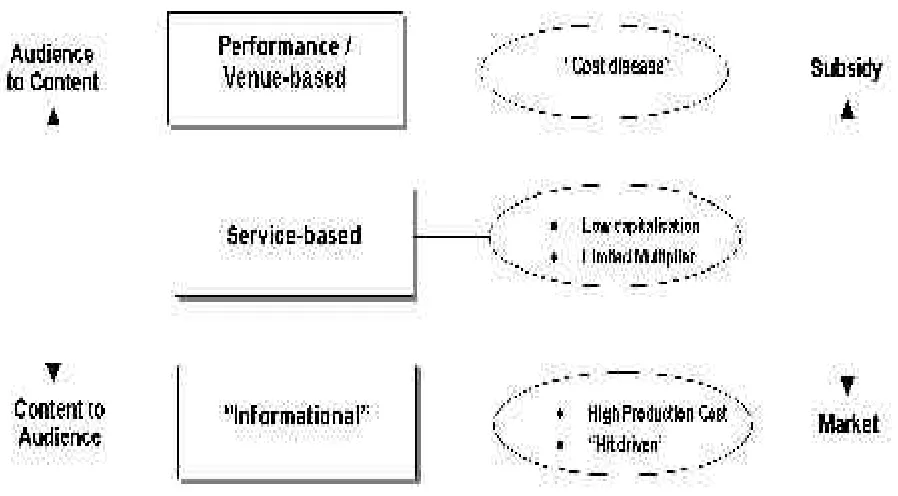
into three types: (1) those that focus on bringing the content to the audience; (2) those that
bring audiences to content; and, (3) service-based activities. This distinction should not be
read as a rigid tripartite division, but rather a continuum along which activities can be placed.
It is a useful distinction as it helps to open up some of the contrasting underlying
characteristics of the governance of the sector.
Activities that are reliant on bringing the audience to content such as live performance, gallery
exhibition and festivals etc. tend to be labour intensive, and, it is often argued, suffer from
intensive activities, it is difficult to benefit from technologically driven productivity increases.
For instance, it requires broadly the same number of people to stage an opera today as it did
one hundred years ago. Similarly, while venues may have increased in size over time, there
are still insurmountable physical limits to their capacity. This argument is commonly used as
the core justification for public subsidy of the arts.
In reality, the picture is not so simple. The cost-disease is neither universal nor irrelevant (see
Throsby 2001). There are ways to escape the cost disease particularly through the
application of particular technologies to increase output (e.g. the use of a synthesiser instead
of a horn section in a live performance8) and the transformation of a creative performance
into a reproducible product (a CD, video etc.)9. The important point to note is that various
creative forms have found ways of incorporating such technologies to a greater, lesser, or nil,
extent than others.
The activities at the other end of the continuum, concerned with bringing content to audience
--in books, newspapers, films, TV and radio programmes, computer games and software,
records/CDs--escape the cost disease as they are based upon a creative product that is
inexpensive to reproduce. However, as with other informational industries, the initial costs of
production tend to be very high. So, while it might have taken Sony Computer Entertainment
Europe four years and a budget estimated to be £5 million to develop the first disc of the
Playstation game The Getaway (Schofield 2002), the second copy will have cost under £2 to
produce for its printing, pressing the CD, packaging and distribution; the game initially
retailed at £45.
This very particular cost structure of high initial investment relative to the low costs of
reproduction, coupled with the high degree of uncertainty and risk, has profound implications
become the norm for managing these cost pressures,10 with a small number of global
companies enjoying a pivotal position in terms of the financing and distribution of cultural
products, for example, the Hollywood Studios, the five ‘major’ record companies, or the ten
major computer games publishers.
The service-based segments of the creative industries such as architecture, advertising and
much design activity are distinct again. For these activities, arguably the key economic
pressure is that they have developed a business model akin to other so-called ‘advanced
producer services’, such as management consultancy. In particular, the main form of revenue
generation, ‘money for time’ (either as a day-rate or a fixed fee) – rather than exploitation of
intellectual property in the form of licenses or royalties – means that companies are under
capitalised and overly vulnerable to changes in personnel. There are also limits to how much
it is possible to ‘sweat the (human) assets’ of such service-based activities. For instance, the
rule of thumb for success in these segments is generally taken to be charge out rates of 2.5
times the employment costs of staff, averaged over the full course of a business cycle.
Finally, the discontinuous work flow, and the need to continually pitch for future work require
a degree of self-funding, or ‘cross-subsidy’, of ‘non-billable hours’. One response to this
organisational form is the preponderance of ‘project-life’ companies and self-employed,
free-lance, contractors11. Figure 3 summarises this range of economic pressures, and plots these
against both creative industry segments and the position on the continuum between audience
to content versus content to audience.
[INSERT FIGURE 3 about here]
Mapping production webs
functional relationships within a discrete vertical market or industry. This approach is very
similar to standard supply chain models used in manufacturing industries, and it is most
suitable for analysing individual companies or sub-sectors. However, this crude model is not
so helpful in capturing the complexities of the many ‘horizontal’ relationships and
interdependencies that exist between different sub-sectors of the creative industries and with
industries and institutions outside the creative industries.
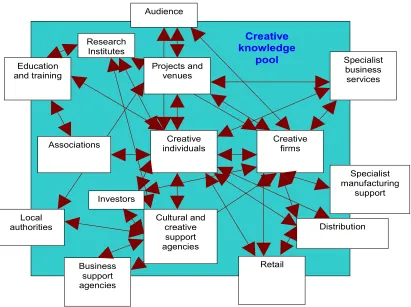
In this case the metaphor of a web rather than a chain is perhaps a more appropriate
metaphor. The project of gaining an overview of the whole process or web is more
challenging than simply acknowledging inputs and outputs; here we need to investigate the
quality as well as the quantity of these linkages. Lest we be confused with the usage of the
term mapping here, we should be clear that creative industry mapping documents have thus
far simply measured quantities at the nodes such as employment and output etc. (see DCMS
2001); a far more challenging task is to investigate the characteristics of the flows and
relationships.
Figure 4 is an indicative plotting of relationships between different elements of the production
chain. The analytical effect of this type of mapping is two fold. First, it serves to identify an
interlinked cluster, or ‘knowledge pool’, approach towards understanding creative production
chains, which stresses the interconnectedness between creative individuals and firms, related
and supporting services, education and training, and the audience. Second, it serves to focus
the need for analysis of the quality and character of these relationships within and across
industries and locations.
The task of carrying out such an analysis has significant resource costs associated with it.
Information on the character and quality of interactions, both directly economic, and
associated, as well as that which such activity is embedded within, is both methodologically
difficult to capture and time-consuming. Moreover, an appropriate fund of such information
does not exist with the result that researchers often start from nothing. Specifically, the range
of information required would include two types of linkage--the traded, and the un-traded.
Traded linkages are the links with key buyers and sellers of inputs, part-finished and
completed product/labour; whereas the important and more intangible un-traded linkages
consist of informal exchange of skills and knowledge, materials and labour. In addition,
information on the employment, organisation and turnover of companies would be necessary;
this is a task that is also challenging due to the short life of many creative 'project-based'
companies.
Finally, we have to see that the production web is rooted in particular places. To take the
example of London, we can note that crudely it has, in comparison to the UK regions, a
greater preponderance of ‘content origination’ than production and reproduction (see GLA
2004; Pratt 1997). Clearly some parts of the production chain have greater 'added value' than
others. This issue needs to be thoroughly investigated12. Thus, crude measures of
employment in the creative sector are less helpful than more detailed breakdowns by
production chain function.
Moreover, there needs to be an awareness of the international and inter-regional nature of
production chains. Taking the London case again, whilst it may be the hub of the UK creative
industries added value it is certainly not the worldwide centre. Examining these sorts of
relationships will point up the particular strengths and weaknesses of a region as well as its'
flows of value between places and parts of the production web it may be also useful, at the
local level, to explore the importance of location in the facilitation of particular linkages.
Research leads us to the expectation that the co-location of film and television
post-production facilities in Soho, London is not chance, nor is it related to low real estate costs
(Nachum and Keeble 2003). Firms choose to locate there, at very high cost, in order to
benefit from rapid exchange of precisely the right goods and ideas. They also pay to remain
‘in the loop’ of informal knowledge exchange that is fuelled by the dense web of multiple
interactions13.
Ideally, both the analytical tools of the production chain and the cluster mapping analysis as
outlined above need to be reworked to overlay their functional analyses on a geography of
production. If applied in turn to each of the creative industries sub-sectors in a locality these
frameworks would then begin to reveal which activities take place and add value within that
location, and those which take place and leak value elsewhere.
However, at present, we know too little about either the spatial dimensions of the constituent
production systems of the creative industries or the particularity of the flow or content –
except that they change rapidly. London once again provides a useful illustration. Soho
contains a world class film post-production cluster that specialises in special effects. In 2002
the largest post-production company took a strategic decision to pull out of work for
international motion pictures and focus on domestic advertising instead (Gibbons 2002). It
would be impossible to assess what the impact of such a shift might be on the cluster without
an understanding of the whole post-production ecosystem, as well as an appreciation of this
company's activities.
The aim of this paper has been to critically assess the notion of the creative cluster, and to
consider whether it is an appropriate tool for the governance of the creative industries, or
even a suitable point from which to begin an analysis of the creative industries. The paper
has highlighted how the creative clusters are formally a sub-set of business clusters. A
critique of the business clusters literature highlighted its short comings: namely a focus on
individual firm preferences and a lack of attention to non-economic, situated (temporal and
spatial) variables; a lack of attention to the specificity of particular industries and their
associated regulatory peculiarities; and, finally, information issues associated with the
operationalisation of the cluster model.
It was for these reasons that the paper argued that the received notion of creative clusters
was not the best place to begin either analysis or policy development. An organisationally
informed production system model was identified as a better place to begin as it was open to
the specificities of industries, and the notion of embedding in and across locations. It is widely
accepted that a 'creative cluster' (the co-location of creative industries) may represent one
aspect of the production system's footprint in one locality; however, the concept fails to
capture the broader spatial, temporal and organisational dynamics of production across the
creative industries.
The paper has repeatedly pointed to the information and evidence deficits that haunt
researchers and policy makers in this field. First, there is the issue of industrial statistical
taxonomies that neither capture the 'new' creative industries, nor, register their full range of
activities from creation through to consumption. Second, even where such data can be
artificially re-combined it still only captures characteristics of firm size, turnover and
employment. This paper has pointed to the need to construct an evidential base of
non-economic character. Moreover, it has stressed the utility of collecting industry specific
information on business organisation, market structure and regulation. These data and
information requirements are likely to remain a stumbling block for some time to come for
agencies intent on creating and effective governance of the creative industries. However, the
potential is to develop both an understanding of the dynamics as well as the way in which
particular localities are implicated within production systems. It is at this stage that it will be
possible to begin to assess local strengths and weakness, and to match those with local
aspirations and resources for these industries. In practice it is more than the simple presence
or absence of the resources in an creative ecosystem; it is as much about how they are made
available and under what terms, and where they are located, physically and structurally, in
appropriate linkages, networks and institutions.
We can characterise the mobilisation of linkages in and between organisational forms on a
simple continuum from individualistic market co-ordination, to collective bureaucratic. In the
creative sector we can point to a clear illustration: to take the UK example again, the
pre-1984 BBC had a bureaucratic form, close to what is termed a Fordist organisation, that
internalised linkages of the whole production chain. Within such a system resources could be
set off for innovation, planning, research and development, as well as training. Such
organisations were generally good a strategic development, but they tended to be weaker on
innovation and cost-sensitivity. Channel 4 is an example of an organisation closer to the
market co-ordination end of the continuum; it contracts out many activities and simply acts as
publisher, the type of organisation commonly described as post-Fordist. Such organisations
can mix and match suppliers (programme makers) and target niches. At the extreme end is
the independent production company that is simply focused on creating one programme or a
macro-context.
Clearly both forms of governance have their strengths and weaknesses; moreover, they
cannot be detached from their context. The revolution that ran through the 1980s and 1990s
created the independent production company, Channel 4 and the new BBC, and was bought
about by regulatory change, this regulatory change whilst driven by macro-economic desires
and neo-liberal political priorities, was also linked to questions about changing market
demand and new technologies. These changes heralded a dramatic change in the locational
form of TV production in London. However, the point I want to stress here is that there are no
ideal, or, fixed forms of innovation and creativity: they are all temporary fixes situated in
space and time. However, being aware of what they are a fix to helps us to consider the local
strengths and weakness of production systems. Thus, forearmed with such insights and
based upon the type of evidential base outlined above it might be possible to construct
‘surgical strikes’ at key elements of a production system. This is likely to be more efficient and
effective that, for example, crude ‘market steering’ represented by subsidy; or, blanket
infrastructure or training policies that are common policy responses.
We might consider, for example, how strategic market knowledge is being gathered and used
in the sector and if it could be improved. In a micro-enterprise environment some collective
provision of future, or non-local, market trends could provide huge strategic advantage;14 its
lack could be a strategic weakness. The same argument may be rehearsed for skills and
training, management expertise, capital goods purchasing decision, business services, etc. In
order for intervention to help facilitate the development of strategic knowledge, it has to
establish agencies that are capable of this – ‘intelligent agencies’15 that have credibility with
the sub-sector because they offer something that is genuinely missing and needed. Each
specialist agencies. As I have pointed out, generic solutions are ineffective as each
sub-sector has to be at the cutting edge requiring particular solutions to particular
barriers/challenges and these change rapidly. Through the development and implementation
of these ideas it may be possible to construct a new form of governance of the creative
industries. Such a form of governance would have a revised 'constituency': one that is open
to internal organisational dynamics, production processes, regulatory forms, and economic
development agendas; within such a mode of thinking there is a further possibility of
Figures
Figure 1: Distribution of employment in the creative industries.
Source: Hackett, P et al. (2000) Banking on Culture. New financial instruments for expanding
the cultural sector in Europe, NW Arts, Liverpool
Figure 2: The creative industries production system. Source Pratt (1997)
Fig 4 The creative industries ecosystem, Source CURDS (2001: 11)
References
Baumol, W., and Bowen, W. (1966) Performing Arts: The Economic Dilemma, Twentieth
Century Fund, NY
Best, M. (1990) The new competition, Polity, Cambridge
Brown, A. (2004) ‘Music by numbers’, The Independent. 16.06.04
Christopherson, S. (2002) “Project Work in Context: Regulatory Change and the New
Geography of Media.” Environment and Planning A, Vol 34:2003-2015.
Creative
individuals Creative firms
Christorpherson, S. and Storper, M. (1986) ‘The city as studio; the world as backlot: the
impacts of vertical disintegration on the motion picture industry’, Society and Space 4.3:
305-20
Coe, N. (2000) ‘The view from out West: embeddedness, inter-personal relations and the
development of an indigenous film industry in Vancouver’, Geoforum, 31.4:391-407
Coe, N. (2001) ‘A hybrid agglomeration? The development of a satellite Marshallian industrial
district in Vancouver’s film industry’ Urban Studies 38.10: 1753-75
Cooke, P. and Morgan, K. (1998) The associational economy: firms, regions and innovation,
Oxford University Press, Oxford
CURDS (2001) Culture Cluster Mapping and Analysis, Report for ONE North East., CURDS,
Newcastle University, UK
DCMS (2001) Creative industries Mapping document, HMSO, London
DCMS(2003) Regional Data Framework for the creative industries, final technical report for
DCMS and Regional Cultural Consortia, Department of Culture, Media and Sport, London
Deakin, S. and Pratten, S. (2000) ‘Quasi-Markets, Transaction Costs and Trust: The
Uncertain Effects of Market Reforms in British Television Production’, Television and New
Media 1,3: 321-354
Fujita, M. Krugman, P. and Venables, A. (2000) The Spatial Economy: Cities, Regions and
International Trade, Cambridge, Mass: MIT Press.
Gibbons, F (2002) 'Media special effects firm fades out of the picture' The Guardian,
21.11.2002
GLA (2004) Measuring creativity: 2004 update if the GLA's creative industry economic data,
GLA economics, London
Social Networks? Urban Studies, 37, 3:513-532.
Grabher, G. (2003) ‘Cool projects, boring institutions: temporary collaboration in a social
context’, Regional Studies 36.3: 205-14
Granovetter, M. (1973) The strength of weak ties’ American Journal of Sociology 76:1360-80
Hackett, P. , Ramsden, P. ,Sattar, D and Guene, C (2000) Banking on Culture. New financial
instruments for expanding the cultural sector in Europe, NW Arts, Liverpool,
http://creativelondon.org.uk/commission/evidence/index.htm
Jessop, B. (2000) ‘Governance Failure’. In: Stoker, G. ed. (2000) The New Politics of British
Local Governance. Houndmills: Macmillan Press. pp. 11-32.
Lazaric, N., and Lorenz, E. (eds) (1998)Trust and economic learning, Edward Elgar,
Cheltenham
Marshall, A. (1890) Principles of economics, Macmillan, London
Martin, R. and Sunley, P. (2002) Deconstructing clusters: chaotic concept or policy panacea?,
Journal of Economic Geography 3, 1:5-35.
Mommaas, H. (2004) 'Cultural Clusters and the Post-industrial City:Towards the Remapping
of Urban Cultural Policy' Urban Studies, 41.3: 507–532,
Nachum, L. and Keeble, D. (2003) ‘Neo-Marshallian clusters and global networks: the
linkages of media firms in central London’, Long Range Planning 36:499-480
Porter, M. (1990) The competitive advantage of nations, Macmillan, London
Porter, M. (1995) The competitive advantages of the inner city, Harvard Business Review,
May-June: 53-71
Porter, M. (1996) Competitive Advantage, Agglomeration Economies and Regional Policy,
International Regional Science Review, 19, 1:85-94.
economics paper, No 3, DTI/ESRC
Pratt, A.C. (1997) ‘The cultural industries production system: a case study of employment
change in Britain, 1984-91 ’, Environment and Planning Vol A 27: 1953-74
Pratt, A.C. (2001) 'Understanding the cultural industries: is more less?' Culturelink, special
issue: 51-68
Pratt, A.C. (2002) ‘Hot jobs in cool places: The material cultures of new media product
spaces; the case of the South of the Market, San Francisco’, Information, Communication
and Society 5.1:27-50
Pratt, A.C. (2004a) ‘The cultural economy: a call for spatialised production of culture
perspectives’, International Journal of Cultural Studies. 7.1: 117-128
Pratt, A.C.(2004b) ‘ Cultural industries: beyond the cluster paradigm’ mimeo, copy available
from the author.
Pratt, A.C. (2004 c) ’Firm boundaries ? The organisation of new media production in San
Francisco 1996-8’ mimeo, copy available from the author.
Pratt, A.C. and Jeffcutt, P. (2002) ‘Managing Creativity in the cultural industries’, Creativity
and Innovation Management 11.4:225-233
Pratt, A.C. and Naylor, R (2003) Winning customers and business: improving production
chains in the creative industries, Mayor’s Commission on the Creative Industries,
Schofield, J. (2002) 'Will Sony get away with it?' The Guardian, 12.9.2002
Scott, A. (2000) The cultural economy of cities, Sage, London
Storper, M. (1997) The regional world, Guildford Press, London
Storper, M. and Walker, R. (1989) The capitalist imperative: territory, technology and
industrial growth, Blackwell, Oxford
1 The term ‘creative industries’ is a contested one; I prefer ‘cultural industries’. However, in contemporary usage the
former term has come to eclipse and replace the latter. This is unfortunate as it glosses over two important differences. First, the empirical differences between the initial notions of ‘creative’ and ‘cultural’ industries. Such elision further compounds the definitional problems of ‘creative clusters’. Second, the debates about politics and representation. There is not space to elaborate on these issues here (see Pratt 2004a). In the pragmatic spirit of the current paper I will simply use the term creative industries to stand for all.
2 See Mommass (2004) for a review of debates concerning cultural quarters and urban
planning. As Mommass elaborates these debates are also mired in confusion.
3 See Pratt (1997) on a discussion of cultural industries and governance.
4 The term ‘governance’ signifies either an actual transition, or a conceptual sensitivity, to network, or multiple
stakeholder government as opposed to formal, state-centric, hierarchies (see Jessop 2000).
5 An example of the operationalisation of such a notion can be found in DCMS (2003)
and GLA Economics (2004).
6 This section of the paper draws upon Pratt and Naylor (2003).
7First discussed by Baumol and Bowen (1966)
8 A contemporary example is the dispute over the use of a new technology called the ‘Sinfonia’ which can substitute
orchestral players/instruments in the production of live musicals (see Brown 2004).
9Crucially, more than technology per se, the key for a creative agent is to expand their
‘envelope’ of activities in order to capture downstream IPR rewards. So, a company concentrating solely on live performance will suffer most; the potential to include licensing rights, and securing control of distribution and replay rights can ‘cross-subsidise’ live activity. Again, this stresses the value of a ‘production chain perspective’.
10The huge costs, and risk of success/failure, mean that a small individual company
cannot sustain such a cash-flow. The classic example is the large film studios that can weather a number of failures as long as it gets a few successes. However, as cost per production increase the relationship between ‘hits and misses’ becomes problematic even for the ‘majors’. Pratt and Jeffcutt (2002) term this organisational form the ‘chart business’.
11A study of new media companies that fit this model can be found in Pratt (2002)
12 An example of this is the film industry. There are many more added value advantages
of having a post-production centre compared to having the city used as a location for shooting. Despite this obvious point, cities and regions compete to act as sites for location shoots.
13 See the example of the new media sector in Pratt (2002)
14 The best examples of this are the way that fabrics and colours for the fashion industry
are known in advance to a select number of major stakeholders; or, the how access to sophisticated first weekend preview analysis of films is used in the US to re-edit and achieve maximum market impact on general release. Accessing such strategic information for a regional ‘club’ (on a subsidised subscription basis) could provide considerable market leverage.