In Reporting Student Achievement:
Making Links Between Educative
Theory and Schools' Reporting
Practices
A thesis submitted as partial fulfilment of the
requirements for the degree of Master of Educational Administration Massey University: Albany
I declare that this thesis represents my own work, except where due acknowledgement is made, and it has not been previously included in a thesis, dissertation or report submitted to this University or any other institution for a degree or any other qualification.
Abstract
This thesis examines how three participant schools reported the achievement of students to parents and the extent to which reporting practices reflected current educative theories and effective partnership. The understanding of parents and teachers of the process of the reporting practices, and how practice promoted or hindered educative partnerships between teachers and parents were examined. Over the past ten years schools, in New Zealand, have spent much time realigning their reporting practices to New Zealand national requirements, and the expectations of their school communities. This research examined what led schools to make their decisions about their reporting practices, comments on the effectiveness of current practices and draws conclusions based on the findings of the research.
Evaluative case study was selected as the methodology for this study. The study is located within three school contexts and involves in-depth examination and analysis of teachers' and parents' perceptions about educative theory, partnership and reporting student achievement. The methodology used provided an opportunity to evaluate current practice, provide feedback to each participant school and allowed the cooperative development of recommendations for improving reporting processes. Issues and themes were identified as data were gathered. Exploration of emerging themes occurred throughout the data gathering phase. Data gathering strategies included parent and teacher questionnaires, individual interviews with senior leaders, teachers and parents and document analysis.
That data revealed a number of themes in relation to educative theory, reporting and partnership. Initial themes included: important educational outcomes identified by parents and teachers, the purpose of reporting identified by parents and teachers, the type of information parents found helpful, the role of teacher-parent interviews, the desire of parents to be actively involved in their children's' learning, and the frequency and timing of personal contact between parents and teachers.
Acknowledgements
As with all research, this thesis is the culmination of the contributions of many people. Without the support of the three school's Board of Trustees, staff and parents this thesis could not have been completed. The openness with which each school community contributed to the research is testament to their own desire to ensure students are at the heart of decision making within each school.
I acknowledge the invaluable support of Jan Hill, IPDER, Massey University who kept me on task and focused. Jan challenged me to extend my thinking and ensured the process of research was rigorous. I also thank Dr Jenny Poskitt for her critique and timely advice in relation to the completion of this study. Andrea Morley provided secretarial and practical support. Coordinating community questionnaires and making contact with appropriate translators was an enormous job and I am grateful to Andrea for managing that aspect of the study so well.
Table of contents
ABSTRACT
ACKNOWLEDGEMENTS
CHAPTER ONE: Introduction
Introduction
The context: reporting The research problem Objectives
The process: evaluative case study and the researcher's role The organisation of this thesis
CHAPTER TWO: Background
Introduction
The evaluation of school's reporting policies and practices Matching the intended message with the message received New Zealand national assessment strategy: a need for change Assessment tools to assist reporting
Legislating for change
ii Ill 1 2 4 5 8 8 10 10 13 14 16 19 Current national guidelines for reporting student achievement to parents 21
Summary 22
CHAPTER THREE: Literature Review
Introduction
Effective partnerships in reporting student achievement Effective practice in supporting student learning
Theories of effective practice in reporting student learning Making the links: a summary
CHAPTER FOUR: The methodology in practice
Introduction
Case study as a research design Case study approaches
Evaluating school programmes Limitations of evaluative case study Evaluative case study tools
Summary
CHAPTER FIVE: Methodology in practice
Introduction
Selection of participants Personal contact with schools Evaluation approach
Evaluative case study tools used Analysis of data
Ethical issues
Limitations of the methodology Summary
CHAPTER SIX: Findings and emergent themes
53 54 56 58 61 62 66 67 68 69 70 71 77 79 84 85
Introduction 87
Key understandings and interpretation of national guidelines and
requirements 88
Articulating purposes of reporting student achievement to parents 93 Articulating and implementing reporting procedures 101 Matching the intended message with the message received by parents 127 Promoting the concept of education as a partnership 128
CHAPTER SEVEN: Making connections and moving
forward
Introduction 133
Purposes of reporting student achievement 134
Education as a partnership 135
Shared understanding of standards 136
Shared responsibility 138
Reviewing progress towards achieving desired goals 139 Incorporating educative theories into reporting procedures 140 Reviewing a school's current reporting practices: a way forward 150
Future research 154
In summary 155
BIBLIOGRAPHY
157APPENDICES
A Information sheet for schools and parents
B Questionnaires for teachers and parents (English)
C Questionnaires for parents translated into Samoan and Tongan
D Expression of interest to be interviewed
LIST OF TABLES
Relationship between formative evaluation and evaluative case study
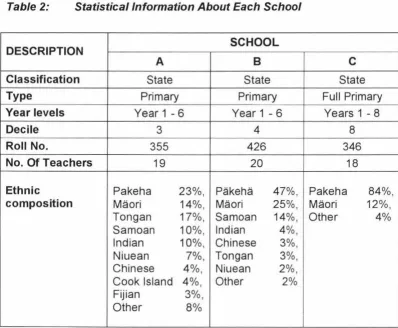
2 Statistical information about each school
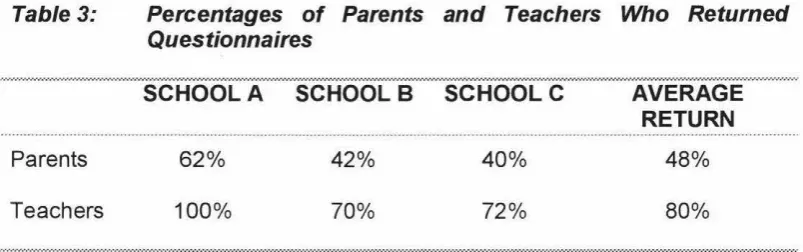
3 Percentages of parents and teachers who returned questionnaires
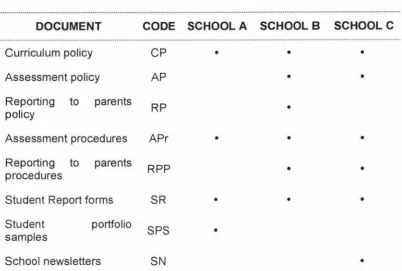
4 Participation in interviews by teachers and parents 5 Documents analysed
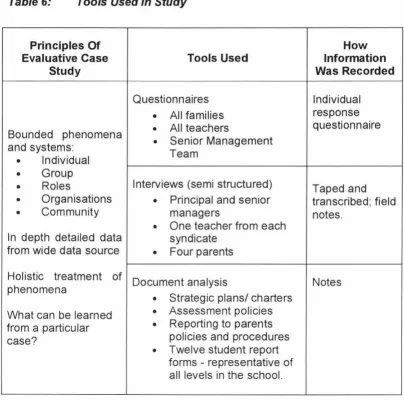
6 Tools used in study
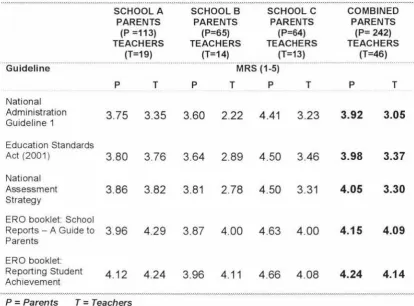
7 Familiarity with national guidelines and legislation
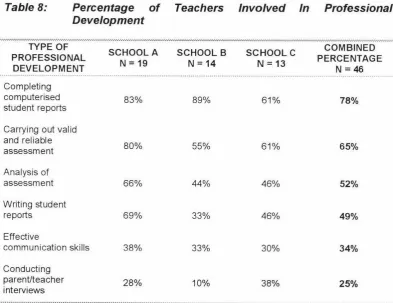
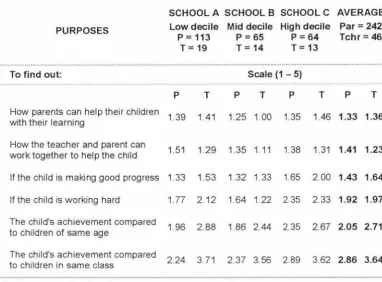
8 Percentage of teachers involved in professional development 9 Purposes of reporting student achievement
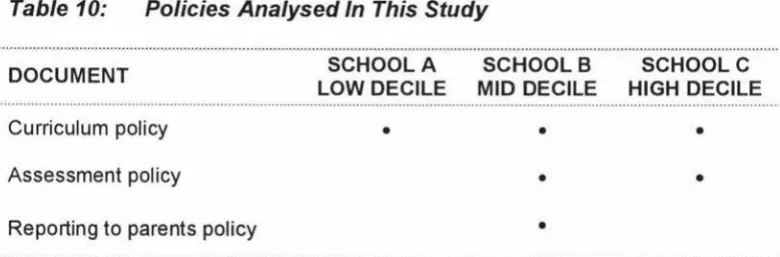
1 O Policies analysed in the study
11 Relationship between participant school's policies and the themes identified in the literature
12 Perception of parents about receiving information on reporting procedures
13 Parents' perceptions about how they receive information about reporting procedures
14 Usefulness of each school's reporting methods 15 Features of reports
16 Parents' perceived level of understanding about their child's learning
17 Parents' and teachers' expectations of educational outcomes 18 School B reading report continuum
CHAPTER ONE
INTRODUCTION
'Reporting is an integral part of the learning process, much like assessment.
It certifies the attainment of learning goals and identifies where additional work is needed.' (Guskey, 1996: 3)
Introduction
The desire to complete this thesis has grown from a deep interest by the researcher in assessment practices and issues schools face in changing their reporting practice to better reflect current research about quality learning and effective partnerships.
The focus for this thesis is on the practice of the participant primary schools in reporting student achievement. The understanding of parents and teachers of the process and outcomes of the reporting practices, and how practice promotes or hinders educative partnerships between teachers and parents are examined.
The Context For Reporting
As already stated, schools have been engaged in a state of rapid change over the past ten years, particularly in the area of assessment and reporting student achievement. In New Zealand, the Education Act 1989 heralded a new era in education under the banner "Tomorrow's Schools'. Parents were elected to Boards of Trustees and the requirement that school charters be written cooperatively by teachers and parents using a process of community consultation was established (Ramsay, Hawk, Harold, Marriott & Poskitt, 1993: 3).
How has this new era in partnerships translated into reporting student achievement? Examining the Education Act as it related to the reporting of student achievement gives us a starting point in answering this question. The Education Act 1989 specified obligations for schools in reporting to parents:
Section 77(b)(i) states that
The Principal of a state school shall take all steps to ensure that
a student's parents are told of matters that, in the Principal's
opinion, are preventing or slowing the student's progress at
school.
Legislation did not however specify the nature or amount of reporting. The question as to what constitutes "all reasonable steps" is open to debate. Most schools would agree, however, that procedures such as written reporting and parent/teacher interviews would form the basis of reporting practice in their schools (Education Review Office
1,
1996: 12).With the introduction of National Administration Guidelines in the early 1990s and the revision of those guidelines in December 1999, schools have
1
endeavoured to interpret the requirements in relation to student assessment and reporting. The national curriculum documents developed during the 1990s required schools and teachers to report in relation to how students
were achieving and progressing against the objectives as stated in the
curriculum documents.
Over time the Ministry of Education2 has attempted to provide some
guidance to schools in reporting student achievement. In 1994 the MoE published a document Assessment: Policy to Practice (MoE, 1994). This
publication provided some guidance to schools in developing assessment
policies and practices. Schools were advised to design reporting procedures as an integral part of the development of policies. Schools were also advised
to review their reporting procedures to ensure they met the needs of their
audiences and were consistent with the emphases of the New Zealand Curriculum Framework and National Education Guidelines (MoE, 1994). In
March 1995, through the Education Gazette, the MoE then advised schools
to use their professional judgement when deciding on which objectives from
the curriculum to assess and report.
In their publication, Reporting Student Achievement (1996), ERO set out to
examine why student achievement is reported and to whom, the current legal
and policy framework for reporting students' educational progress and current issues for schools and policy makers in reporting student achievement. They concluded that the nature of the audience would
determine the information a report contains and the way this is presented.
They also concluded that in order to fulfil their partnership role effectively
parents need "regular, timely and accurate information about their child's
intellectual and personal development" (ERO, 1996:12).
In 1998, the MoE released its policy decisions on assessment in primary
schools (MoE, 1998). At the same time they released a pamphlet to parents
to explain how parents could find out more about how their children were
2
achieving at school. This pamphlet stated that there would be changes to the
assessment tools made available to schools. In particular new tools would be
developed in reading, writing and mathematics (in English and Maori);
examples of student work in each of the learning areas would be developed
to show achievement at each level of the national curriculum (MoE, 1998: 2).
The study for this thesis took place in 2003 just as these assessment tools
were being made available to schools. Each of the schools in the study was
still coming to grips with how they could firstly use the new assessment tools
to inform their teaching and learning programmes and then, secondly, how
they might use these tools to provide information to parents.
At the same time that these developments were happening in New Zealand,
international research was providing clear evidence about the effects of
assessment and reporting on learning. The setting of challenging, meaningful
goals, student participation in assessment, the place of feedback and feed
forward, and the motivational consequences of testing were all identified as
key factors in student learning (Black & Wiliam, 1998, Hattie, 1999,
Assessment Reform Group 2002).
The Research Problem
Added to the research on student learning is the research that highlights the
need for effective home school partnerships in promoting student learning.
With this research has come a new challenge for practitioners about how to
communicate student achievement in order to reflect the learning theories
that positively affect student learning.
The primary objective of this thesis is to highlight the practice of participant
schools in reporting student achievement to parents. It analyses the practices
of the schools in relation to current research on how children learn and
debate about what constitutes effective partnerships in reporting student achievement to parents.
Objectives
In undertaking this research, five focus questions are identified:
1. In what ways have the national requirements or guidelines for reporting student achievement information to parents influenced
school practice?
2. In what ways has current research into effective partnerships,
educative theory and reporting processes informed each school's
policies and practices?
3. How do schools articulate purposes (written and /or verbal) for
reporting student achievement to parents and how are those
purposes translated into procedures?
4. How does the intended message, given when reporting student achievement, match the actual message received by parents?
5. How do school's policies and practices in reporting student
achievement to parents promote the concept of education as a
partnership?
In answering the focus questions, specific areas of interest are identified within the questions.
1. In what ways have the National requirements or guidelines for
reporting student achievement information to parents influenced school practice?
i. What is the level of understanding of the national requirements by: • Principal
ii. How has each school implemented new assessment tools within their reporting processes?
2. In what ways has current research into effective partnerships, educative theory and reporting processes informed each school's policies and practices?
1. To what extent have schools reviewed current literature related to
educative partnerships, educative theory and reporting practices?
ii. How have schools provided opportunities for professional
development in educative theory, educative partnerships and
reporting processes?
iii. In what ways have teachers and parents explored current issues together?
iv. How are current theories reflected in school policies and practices?
3. How do schools articulate purposes (written and /or verbal) for reporting student achievement to parents and how are those purposes translated into procedures?
i. What is the understanding of the purposes of reporting student achievement information by:
• Principal • Teachers • Parents
ii. How are the school's purposes and procedures for reporting student achievement to parents documented?
iii. Are there any differences between the articulated purposes in each of the participating schools?
4. How does the intended message, given when reporting student achievement, match the actual message received by parents?
i. What are the expectations of the outcomes of reporting student achievement information to parents as expressed by:
• Principal • Teachers • Parents
ii. As a result of participating in reporting student achievement to parents what is the resultant understanding of parents in relation to effort, progress and achievement of their children?
iii. What impact does reporting student achievement have on improving learning opportunities for students?
iv. What meaning do parents make from the written report?
v. How do parent-teacher inteNiews contribute to parent understanding of their child's achievement and progress?
5. How do school's policies and practices in reporting student achievement to parents promote the concept of education as a partnership?
1. What are the conditions for educational partnership present in each participant school?
11. How do participant schools interpret current research in relation to
effective partnerships?
iii. In what ways do school's reporting policies and procedures
promote/hinder partnership?
The Process: Evaluative Case Study and The Researcher's
Role
Evaluative case study was chosen as the key methodology as it provided an opportunity to evaluate current practice, provide feedback to each participant school and allowed the cooperative development of recommendations for improving reporting processes. The chosen methodology would provide data about the implementation of the reporting processes in each participant school. The methodology would provide findings and support the learning and decision making within each school.
The participant schools had all indicated a desire to not only learn from the findings of the research but also the research process itself, as each school believed in the need to become more systematically reflective in their practices.
The primary purpose of the research was to provide specific and detailed feedback to each participant school to allow them to make informed decisions about how they might improve their reporting practices and enhance partnerships with parents. The researcher has used the findings from each school to contribute to the current body of research about how what constitutes educative theory and effective partnerships in reporting student achievement to parents might be linked to ensure the theory can be applied in practice.
The Organisation of This Thesis
Chapter Three reviews the literature. It discusses the place of educative
theory, making explicit links between educative theories about what affects
student learning and the implications for both educative partnership and
reporting achievement.
Chapter Four provides a theoretical frame for the methodology of this
research. It describes case study in all its forms and describes approaches
which are consistent with evaluative case study.
Chapter Five applies the theory of case study, with particular emphasis on
evaluative case study principles, within the context of this research study.
Finally Chapters Six and Seven identify the emergent themes and issues that
have been derived from the case study. The findings are discussed in light of
the original research questions and current literature about best practice in
CHAPTER TWO
BACKGROUND
Parents, teachers, and students themselves want reporting strategies that
are more specific, more individualised and, at the same time, more
encompassing. (Watts, 1996: 11)
Introduction
This chapter explores the development of assessment and reporting practices in New Zealand over the past decade. It examines how New Zealand's Ministry of Education has interpreted international research on assessment and reporting and more critically how schools have made sense of guidelines and requirements.
Key issues, which have affected the implementation of assessment and reporting in New Zealand schools are examined. The issues are discussed under the following headings:
1. The evaluation of school's reporting policies and processes 2. Matching intended messages with messages received 3. New Zealand national assessment strategy
4. Assessment tools that assist reporting 5. Legislating for change
6. Current guidelines for reporting
The Evaluation Of School's Reporting Policies And Practices
of parent interviews and written reporting. Most schools supplemented written reporting with portfolio examples of children's work, either used during the interview itself or sent home regularly throughout the year (Timperley et al., 1999). Timperley et al. contended that the descriptive information on reports and portfolio examples of work required parents to have relatively sophisticated knowledge of both the curriculum and the expected standards for a child at a particular age if they were to understand the reports.
Schools involved in Timperley et al.'s (1999) study also identified the need to build parent self esteem. Their concern centred on the parents being upset if they received negative information about their child.
It's our job to make them feel a million dollars. It's the human face that's important. No one feels threatened - that's what we
do well. It's what's not done at secondary school. (Deputy Principal, cited in Timperley, et al., 1999: 85)
The difficulty with this explanation of current practice is the dilemma between reporting accurately and being positive and helpful. For many, the integration of accuracy and positiveness meant only accurate statements that were positive were reported. Timperley and Robinson (2002) comment on this situation further. In their research of the reporting practices of eleven schools they found that many of the schools noted that reports to parents should be accurate in relation to student achievement. Ironically one of the schools did not report student achievement at all. Across the ten schools that reported student achievement there appeared no association between the teacher's evaluative ratings and their nomination of students as low, medium or high achieving students. For example, a low achieving student in one school received twenty-three ticks for 'Achieving a high standard'. The parents interviewed at this school believed that the standard used by the school was a national standard. Therefore, if the report indicated that their child was "achieving at a high standard" then they accepted that meant their child was
As part of the evaluation of the Assessment for Better Leaming (Abel) Contract3 Peddie (2000) commented on the policies and practices of participating schools in reporting student achievement to parents. Peddie argued that school policies should reflect new conceptual understandings of assessment issues at school level. Further school reports should reflect these new understandings in a very practical way.
Nevertheless, while school policies might comment on the
importance of valid and reliable reporting to parents about the
achievement of students, if the reports sent out do not put these
policies into practice, there are some serious questions to be asked. (Peddie, 2000: 79)
Peddie (2000) reported on the data provided by 119 schools in relation to their school policies. The data indicated that the policies were a mix of "this is what we do" to " this is what we ought to do" to some schools noting, "we don't need a policy".
Of the 119 schools that provided copies of their assessment policies 78% stated that teachers should use "varied" or " a wide range of' methods to assess student achievement. No detail was given as to what methods might be included. In relation to reporting achievement to students and parents 62% of schools merely mentioned the need to report to parents, again no detail was provided, and 78% of the schools mentioned reporting to students with no detail as to what this might include (Peddie, 2000: 83).
Peddie (2000) concluded that it is easy to be critical of school policies, particularly when there is a strong indication that policies are sometimes written more as a way of compliance for external expectations than for their active use by the staff and school community.
3
Assessment for Better Learning -A Ministry of Education funded professional development programme offered to schools to support the development of effective assessment and
They also raise questions about variability of teacher professional judgement in relation to national standards and the confusion experienced by parents in interpreting the achievement of their children.
Matching the intended Message With the Message Received
There has been limited research undertaken on the impact of reporting student achievement to parents and the effectiveness of school practice in this area. Peddie (2000), in evaluating the effectiveness of the Ministry of Education contracts Assessment for Better Learning professional development programmes, noted many positive changes in school practice relating to assessment procedures and school self review. However, in relation to reporting to parents, he made the following statement:
The evaluation team have concerns about reporting to parents ...
What matters in both areas (reporting to parents and school
policy) is the actual practice of schools and teachers. As already
made clear, the policies may or may not reflect what happens in
a school .. .Evidence suggests that for many schools, important changes remain to be made (Peddie, 2000: 102).
Peddie's concerns echo the comments made by Timperley et al. (1999). This group of researchers was contracted by the Ministry of Education to evaluate the Strengthening Education in Mangere and Otara initiative. As already indicated, Timperley et al. (1999) focussed their research on the written reporting of eleven schools and they carried out a case study of one school's parent interview process. They concluded that the majority of parents felt they should take an active role in their child's education. However, only two schools were reporting student achievement information in a way that was
"not ambiguous and relatively easy for parents to interpret in relation to a
The problems associated with ambiguous reports that are not
easily interpreted are that the authority is vested with the
teacher and the school. Without knowledge of the basis for
judgements made about their children, parents may not realise
that they are interpreting data inappropriately. (Timperley, et al.,
1999: 86)
It was against a backdrop of local concern about what information was being reported and more critically on what basis teachers were making judgements about student learning that the New Zealand government launched a discussion about the future direction of assessment and reporting in New Zealand. It released a discussion paper and invited interested parties to submit their views on the proposed changes.
New Zealand National Assessment Strategy: A Need for
Change
As a result of international research findings (Crooks, 1988: Broadfoot, 1996; Tunstall & Gipps, 1996; Black and Wiliam, 1998) the Ministry of Education heralded significant changes to the way in which information about students might be collected and reported.
The assessment of student achievement should be ongoing and
geared towards providing teachers, schools, students, and
parents with information that helps to improve the quality of
education and learning outcomes for students. (MoE, 1998: 17)
The MoE had identified information gaps in the current practice of schools in collecting and reporting student achievement:
• Diagnosis of specific learning needs or disabilities.
• How the achievement of students compares with that of similar groups of students at national level.
• Achievement of small groups of students nationwide at a particular year level. For example Pacific Island students.
(MoE, 1998: 18)
As a result of these identified gaps the MoE recommended the introduction of an 'assessment package'. It was proposed that schools would be provided with additional diagnostic tools, national exemplar material, new externally referenced tests and more comprehensive national summary information (MoE, 1998). Various interest party groups were invited to comment and make submissions about the proposals contained in the discussion document.
The most controversial proposal was the call for externally referenced tests and comprehensive national summary information. The MoE (1998) stated that information gained from the New Zealand tests would be to provide reports for various interest groups. That is, government, individual schools and parents. The concern of interest groups was that this move heralded the
introduction of national testing in New Zealand. Responses included
reviewing national testing in the UK where national testing for Key Stages 1, 2 and 3 had been implemented. Concerns about the validity and reliability of Key Stage testing used in the UK had fuelled ongoing debate about testing and the predominant use of summative assessment practices (Broadfoot,
1996). Research by the Assessment Reform Group (2002: 2) found that a
review of 19 studies indicated strong evidence of the negative impact testing has on student motivation. They also found that low achieving students are doubly disadvantaged by tests. Being labelled as a failure impacted on the way they perceived their ability to learn, as well as further lowering their self esteem (Assessment Reform Group, 2002: 5).
information on their child's strengths and weaknesses and to help them
better place how their child is achieving against national standards. They
would also get an indicator of the quality of education at their school (MoE,
1999: 2).
The policy document identified how new policies would help teachers,
schools and government. In particular, teachers would be able to identify
each student's learning needs, monitor literacy and numeracy development,
identify whether their judgements of student achievement were consistent
with national standards, and evaluate the effectiveness of their programmes
(MoE, 1999: 2).
The concern with the direction as documented in 1999 was how the changes
would be manifested in reality and the potential conflict between
demonstrating individual student achievement and school effectiveness.
Assessment Tools to Assist Reporting
The new assessment package identified by the MoE included development of
more diagnostic tools. This was to include a comprehensive study of the
range of tools available in literacy and numeracy. It was anticipated that new
diagnostic tools would be available in both English and Maori (MoE, 1999).
The second aspect of the assessment package was the development of
National Exemplars (MoE, 1999:14). The MoE began the development work
by commissioning an international review and analysis of the international
literature on the use of exemplar material illustrating levels-based
expectations and standards of achievement described in outcomes based
curricula (Peddie, Hattie & Vaughan, 1999: 3).
Exemplars were described as assessed or graded pieces of student work,
better learning by indicating the levels at which students are working (Peddie et al, 1999: 3).
The stated purposes of New Zealand national exemplars provide further insight into the form and role of exemplars (Poskitt et al., 2002: 3). According to the MoE (2002: 1) exemplars will
• Signal important features of student work to watch for, collect information about, and act on to support growth in learning
• Provide students, teachers and parents with a basis for discussing important qualities, aspects of indicators of learning
• Provide reference points that will support teachers' professional judgements about the quality of their students' work.
These purposes demonstrate the intended multi-functional role for exemplars. The key reference frame for national exemplars is that they were to be criterion referenced. A matrix (map of key progressions) was developed for each curriculum. These matrices provide criteria for assessing student work.
The ability to carry out ipsative4 assessment was also to be a feature of exemplars as teachers and students would be able to use both the exemplar and associated matrix to identify areas for development.
The use of exemplars was exhorted to focus teacher attention on key aspects of student learning through observation and action (implying the role of formative assessment rather than summative assessment of standardised testing). This formative aspect is extended by the involvement of students, parents and teachers in discussing learning (another contrast from formal testing) (Poskitt et al., 2002: 3).
4
Of significance, was that feedback gained through the national trials indicated that using national curriculum exemplars encouraged teachers to engage in more focused discussion with students about their work, provide more specific feedback to students, clarify their expectations and success criteria with students (partly through the provision of models of other student work), pinpoint aspects on which students needed to improve and begin to identify ways of moving students forward (Poskitt et al, 2002: 10). These concepts are of significance in the literature relating to educative theories that impac positively on student learning, as outlined by Stipek (1998), Hattie (1999), Schunk (2001 ), Black et al (2002), Clarke, (2002), and Clarke et al (2003).
National curriculum exemplars have now been distributed to all schools in New Zealand in Mathematics and English (writing). Currently research is underway to determine what impact the national curriculum exemplars will have on the assessment practice of schools and teachers, and more importantly the impact on student learning.
The third aspect of the new MoE policy was the independent review of the Assessment Resource Banks (ARBs) (Gilmore & Hattie, 2000). ARBs are collections of assessment tasks, accessed from the worldwide web and are available in English, mathematics and science. The findings of the review indicated that where teachers considered assessment as an integral part of the teaching and learning programme (Black & Wiliam, 1998; Assessment Reform Group, 1999: 7) the use of the Assessment Resource Bank was high. The message was that usage was more a function of the excellence of information derived from using the assessment tools, rather than any function of marvellous attributes such as Internet access, ease of use or quality design (Gilmore & Hattie, 2000: vii).
Auckland University developed the Assessment Tool for Teaching and Learning (asTTle). The tools were developed to assess literacy and numeracy in years 5, 6, and 7 for level 2 to 4 of the New Zealand national curriculum, in English and te reo Maori (Maori language). The tools are designed to enable teachers to track the progress and achievement of both individual students and groups of students against national standards.
The asTTle assessments are pencil and paper based tests and students have 40 minutes to complete the assessment. A feature of the asTTle tools are that they are norm referenced, that is, they can be used for comparing the performance of individual students and groups of students against similar groups of student. The tool is also criterion referenced. A set of indicators has been developed in each test area so that teachers can assess student performance against those indicators.
The issue for schools relates to understanding the links between the various tools being developed, current educative theory and developing effective home school partnerships. For parents the issue is whether they understand the tools being used to assess their children and the differences between the tools.
Legislating for Change
be able to use assessment tools and other rich assessment tasks formatively, as well as measuring achievement for reporting (Hill, 2003: 11 ). Hill (2003) goes on to argue that schools may view the new legislation as a lifting of the assessment stakes, requiring more credence be given to accountability strategies over formative strategies.
This view is strengthened when one considers how the latest assessment tools were released into schools. The New Zealand Minister of Education announced the release of the asTTle tool on the 181h February and described them as a world leading development in boosting education (Minister of Education, 2003: 1 ). The Minister further stated:
Parents and caregivers can also get a much more accurate picture of how their child is doing early on, rather than waiting for gaps in their learning to be picked up well into secondary
school years when it's too late to put them on the right track
(Minister of Education, Hon. Trevor Mallard, 2003: 1 ).
No such announcement was made when the national exemplars were distributed to schools. Rather, the exemplars were simply mailed out to schools with no public acknowledgement by the Minister.
Current
National
Guidelines
for
Reporting
Student
Achievement to Parents
The MoE (2003) published a document Using Information which identified
key features in relation to information required by parents. The document
states that reports should include the actual level of attainment or measure
the school itself uses to monitor progress and an illustrative comment about
what this attainment means in terms of progress and what the next learning
steps should be (MoE, 2003:~). The document further describes what it
believes to be key characteristics of written reports. The document states that
reports should be:
•
•
•
•
•
•
Presented in a professional, meaningful manner and in a format that
is appropriate for the age and stage of the student
Brief and constructive
At intervals that parents feel appropriate
Easily understood
Responsive to cultural and language needs such as those for whom
English is a second language
Based on substantive gathered and documented evidence
(MoE, 2003:~)
In addition to the characteristics listed above the MoE (2003) also argues that
the reports should cover all essential learning areas, comment on attitudes,
values, skills and knowledge, recognise strengths and interests, be
supportive of effective teaching and learning and clearly inform about actual
student progress and achievement.
The MoE also advocates for partnership with parents through the sharing of
valid assessment information. Partnership will allow dialogue to occur about
how parents can support learning at home and what learning goals are most
There are key aspects of reporting highlighted by this MoE document. The first is that reports should be completed 'at intervals that parents feel appropriate'. Many schools have followed an entrenched timing of reporting which includes an end of year report and in some instances a mid year report. Of interest within this study will be whether participant schools have asked their parent communities about when they (parents) would like to receive information and reports. Another issue for schools is to define what 'substantive and documented evidence' will be. How do the participant school decide how they will grade student achievement? What data are collected which supports teacher judgements about student achievement?
Linked to the concept of achievement is the notion of progress. How have schools incorporated progress into their reporting process? Progress is linked to ipsative assessment in that it measures the extent to which a student has grown in knowledge, skills, values and attitude.
Summary
The issues raised throughout this chapter provide a history of the current context in New Zealand as it relates to assessment and reporting student achievement. It provides a backdrop to examine how current research might inform future direction developing links between educative theory, effective partnerships and reporting processes.
CHAPTER THREE
LITERATURE REVIEW
'How do children and young people acquire the skills and the confidence to be leaders, organisers, key players, joiners,
participants in their schools? Are these the same skills and attitudes, which help them cope effectively with the curriculum and to expect success? The answer is that there is very considerable overlap between the joiners and the leaders and the academically successful because both are underpinned by a confidence and sense of self, developed at home, in school and in the interface between the two'. (MacBeath,2000: 143)
Introduction
This thesis involves the examination of a number of key issues relating to the development of processes used by schools in reporting student learning.
The first section of this chapter describes conditions for effective partnership with particular reference to partnership within the reporting process. It explores the role of school, teachers, students and parents in the partnership.
The research related to raising student achievement is then be explored. Current research on relationships, motivation and self efficacy, goal setting, challenging tasks, feedback, feed forward, and self and peer assessment provide insights into the role students, parents, teachers and schools might play in the reporting process.
The key issues are explored under four headings:
1. Effective partnerships in reporting student achievement 2. Effective practice in supporting student learning
3. Theories of effective practice in reporting student learning.
4. Making links between effective partnership, educative theory and reporting
Effective Partnerships In Reporting Student Achievement
Partnership is a term widely used throughout the education sector and it covers a range of situations and circumstances (Bastiani, 1999). Bastiani (1993) argues that its use or overuse, is often uncritical, implying that it is highly desirable, unproblematic and easily attainable. In view of the common usage of the term, Bastiani (1999) goes on to argue that there have been surprisingly few attempts to pin the notion of partnership down in terms of education.
Partnership has been characterised by a "sense of shared purpose, mutual respect, and a willingness to negotiate" (Pugh, 1989, cited in Bastiani,
1993:104). Wolfendale (1989, cited in Bastiani, 1993:105) articulates partnerships as entailing involvement in decision-making, each partner being perceived as having equal strengths and equivalent expertise and a shared responsibility, so that parents and professionals are accountable to each other. Ramsay et al. ( 1993) further develop this concept in their definition of consultation. Ramsay et al. (1993) identify five levels of consultation.
• Level One -to be informed
• Level Two - take part in activities
• Level Three - to be involved through dialogue • Level Four - to help make decisions
In 1993, Bastiani argued that it was now possible to catalogue with conviction, and support with evidence, the advantage and benefit that
improving relationships between families and schools can have for students. Large scale research in the UK, Australia, and the USA, demonstrated that schools in which students do well (as defined by a series of measures of both achievement and positive behaviour) are all characterised by 'good'
home-school relations (Brighouse & Tomlinson, 1991 cited in Bastiani, 1993: 103). These schools go well beyond the basic legal requirement of two-way communication; they are accessible in a variety of ways and at all reasonable times. They work hard to find ways in which parents can support and encourage their children and provide parents with practical help. Above all
else they build a common purpose and shared identity - the beginnings of a
genuine partnership (Bastiani, 1993: 103).
Bastiani (1993) defines partnership in relation to overlapping and distinctive emphases. An effective partnership will involve a sharing of power,
responsibility and ownership. A degree of mutuality is necessary. Mutuality is characterised by a process of listening to each other and incorporates responsive dialogue. Responsive dialogue implies that action occurs as a
result of dialogue. Shared goals and a commitment to joint action in which
parents, students and professionals work together provide a sound
foundation for effective partnership (Bastiani, 1993).
However, perhaps it is more helpful to see partnership as a
process,
a
stage ina
process or something to work towardsrather than something that is
a
fixed state or readily achievable.(Bastiani, 1993: 113)
While the promotion of educational partnership was encompassed in the New
Zealand administrative reforms of 1989, policy documents at the time did not
fairly cursory forms of consulting parents. One of the prime reasons Ramsay et al. give for this is that little research had been conducted on how partnerships could be best forged, what problems and pitfalls there were in collaborative decision making, and what strategies were successful in establishing collaboration (Ramsay et al., 1993: 2).
Research by Ramsay et al. (1993) provides some insight into how partnerships might be forged. They argue that before collaboration can take place careful planning, adequate resources and adequate opportunities for
'quality reflection' must be seen as part of the very important groundwork. They further argue that it is necessary to adapt rather than adopt new ideas and strategies to the needs of the school and its community (Ramsay et al.,
1993: 244).
Timperley, Robinson and Bullard (1999) and Timperley and Robinson (2002) provide further insight into the conditions necessary for what they describe as a "Mutually educative partnership" within the reporting process. Timperley (et al., 1999, 2002) argue that in order for educative partnerships within the reporting context to be in place, four conditions apply.
The first condition is that the report must be an accurate description of the child's current achievement and it must be written in a way that is easily interpreted by parents. A simple statement, but the reality is much more complex. The complexities of this reality will be explained in more detail later in the chapter.
believes to be important. What Timperley et al. imply here is that the standard is set by the schools and agreed to and understood by both parents and school. The question must be asked, to what extent should parents also have input into what standards are desirable? What are the academic goals held by parents for their children? This question will be asked as part of this study.
The third condition relates to shared responsibility for the child's learning. Each partner (parents and school) understands their role in supporting the child to achieve the next step in their learning. Without this condition Timperley (et al, 1999, 2002) argue that it becomes inevitable that one partner will blame the other partner for any shortfall in the child reaching desired standards. This study will explore some of the issues surrounding the role of parent, teacher and student within the reporting process. The understanding of parents and teachers will be ascertained and the impact of that understanding on the concept of partnership.
The fourth and final condition for an educative partnership lies in reviewing the student's progress towards desired standards and to hold each other accountable for agreed actions and contributions to that progress (Timperley et al., 1999).
Bastiani (1993:113) states that "partnership is easy to talk about but much harder to achieve". Too often the partnership between home and school is seen as teachers 'liasing' with parents. This denotes a one-way communication system. Parents are rarely encouraged to liaise with teachers. With this approach and imbalance in the teacher-parent relationship there is little scope for developing a shared systemic exploration of the factors that may affect a child's learning (Dawson & McHugh, 2000:122).
views, and not responsive to the needs of families can be ineffective and
even counterproductive. Programmes which are effective respect parents
and children, are socially responsible, and are responsive to families and the social conditions that shape their lives (Biddulph et al., 2003: 172).
Waller and Waller (1998: 4) refer to the ideal parent-teacher relationship as
being a sharing of expertise. That is, a full sharing of knowledge, skills and
experience between teacher and parent. Dawson and McHugh (2000: 122)
develop this concept further by arguing that a genuine curiosity about how a
child learns and develops both socially and emotionally, if explored by
teachers and parents together, would enrich the educational experience for
everyone. However, this can only be achieved if a number of considerations
are acknowledged. Firstly, teachers must have access to information in which
they can have confidence and which identifies meaningful criteria about what
is important to learning and achievement. Secondly, a prevailing attitude that a student's learning will be enhanced by the participation of parents in the
assessment process and that parents have an undeniable right to access
information that results from that assessment process. There must also be a
preparedness to be honest and to achieve this teachers may need support
and training in advanced communication skills in order to deliver what may
be perceived as difficult messages (Hill, 1999: 122). Difficult messages may include having to tell parents their child is not achieving very well or that their
child is not participating fully in classwork and is disruptive. The degree to
which teachers in this study have accessed professional development to
develop or strengthen their skills in collecting, analysing and reporting
student achievement is an important question to answer.
Biddulph et al. (2003) argue that such constructive partnerships empower
those involved by fostering autonomy and self reliance within families,
schools and communities, building on the strong aspirations and motivation
that most parents have for their children's development and by adding to (not
undermining) the values, experiences and competencies of parents and
children. The evidence is that teachers can do much to initiate such
So far the literature has focused on the partnerships between parents and teachers. Of critical omission is the student from the preceding literature. How might students be involved in the reporting process and how might partnership be extended to include students?
A review of the literature relating to assisting student learning may provide an excellent platform for students, parents and teachers to work together to effect quality partnerships.
Effective Practice In Supporting Student Learning
Relationships: Motivation and self efficacy
In recent times much research has been carried out in relation to what makes a real difference to student achievement. Often educators, researchers, and policy makers attribute lack of student achievement to the environment outside the school (Stevens, 1996:78). Stevens (1996) argues that to solely attribute low achievement to society's ills is to dismiss the very important influences of schools and teachers on student learning.
Studies suggest that students who have a positive, secure relationship with their teachers are engaged more highly in their academic work (Stipek, 1998). Relatedness is one of three basic human needs, along with feelings of competence and self-determination (Connell & Wellborn, 1991 cited Stipek, 1998: 155). Research by Connell and Wellborn (cited in Stipek, 1998: 156) showed that student's feelings of relatedness to their teachers and classmates are strong predictors of their cognitive, behavioural and emotional engagement in classroom activities.
positive relationship with their teacher. This has implications for the relationship between parent and teacher. If parent and teacher do not have a positive relationship what impact might that have on the student teacher
relationship?
Gipps (2002) argues that in an open communicative relationship, communication is oriented towards understanding and respecting the perspectives of others. A positive relationship includes teachers demonstrating an understanding of the worlds of the students, that is, the worlds of home, church, school friends and work. Positive relationships also include respect, fairness, optimism, participation and reciprocity (Hill & Hawk, 2000). This concept is reiterated by Mccaslin and Hickey (2001 ). In a sociocultural analysis, attribution and efficacy theories inform the emergent interaction of motivational dynamics, which are the "stuff' of identity (Mccaslin & Hickey, 2001: 245).
Self-efficacy is also a key indicator of success (Bandura, 1986; Stipek, 1998; Hill &Hawk, 2000; Schunk, 2001 ). The concept of self-efficacy is defined as a belief that you can learn and that you are capable of improvement (Hill and Hawk, 1996; Bandura, cited in Stipek, 1998: 41; Schunk, 2001: 143). Self-efficacy affects student's behaviour, thoughts and emotional reactions (Stipek, 1998).
Students seek out activities and situations which they judge themselves capable. Students who have high levels of self-efficacy are more likely to set higher goals (Locke & Latham, 1990, 1994; Zimmerman & Bandura, 1994; Zimmerman, Bandura, & Martinez-Pons, 1992 cited in Stipek, 1998:43) choose more difficult tasks (Sexton & Tuckerman, 1991 cited in Stipek, 1998: 43), and persist longer with tasks (Schunk, 2001: 127). Students with lower self-efficacy become anxious and preoccupied with feelings of incompetence and are concerned with the notion of failure (Stipek, 1998:43).
student's self-beliefs and therefore increasing the level of self-efficacy. As students work on tasks and are made aware of their progress towards their
learning goals self efficacy levels are changed. Progress indicators "convey to students that they are capable of performing well", which enhances self-efficacy for continued learning (Schunk, 2001: 127).
Linked to self-efficacy is the notion of locus of control. Rotter (cited in Stipek, 1998:58) states that internal locus of control refers to the belief that events or outcomes are contingent on one's own behaviour or on a personal characteristic, such as ability. External locus of control is identified as factors beyond an individual's control, such as the quality of the teacher. Paris,
Byrnes and Paris (2001) believe that children construct beliefs about the control they can exercise in their environments. Outcomes are both desirable and achievable or unobtainable based on their beliefs, and this contributes directly to their theories of ability and effort (Paris, Byrnes & Paris, 2001 ). Independent goal setting and motivation are unlikely if students do not possess beliefs that they can control their actions to achieve their own goals (Johnston & Johnston, 1985 cited in Paris et al, 2001).
Students are motivated by success and intrinsic motivation is a key factor in becoming a life long learner. Learners who see their success or failure as a result of factors within their own control are more likely to be successful than
those who attribute success or failure to external factors (over which they have no control) (Hill & Hawk, 2000).
If students are to see themselves as in control of their learning, they must be
encouraged to participate in the educative partnership. They must have some control over and participate in decision-making about their learning and what and how information about their learning is shared with parents. Parents and teacher must have an understanding of the importance of the student's role
The extent to which students see themselves as in control of their own learning is a powerful determinant in the motivation of students to learn. However, it is also critically important for students to know how to succeed in their learning (Hill and Hawk, 1996).
Goal setting, challenging tasks, feedback and self assessment
The setting of challenging and attainable goals has a direct impact on motivation and self esteem of students (Black & Wiliam, 1998; Assessment Reform Group, 1999: 7). Achievement is enhanced to the degree that students and teachers set and communicate appropriate, specific and challenging goals (Hattie, 1999: 2). As indicated earlier in this chapter, schools that develop effective partnerships with parents find ways in which parents can support and encourage their children and provide parents with practical help (Bastiani, 1993). It follows, therefore, that if setting and communicating appropriate, specific and challenging goals enhances learning, involvement of parents in knowing and supporting the goals set must further enhance the educative partnership between teacher, student and parent.
Stipek (1998) argues that goals which are distal (long-term goals) are important for students to keep in mind but they may be difficult to monitor in terms of progress towards meeting them. Proximal goals (short term goals) may provide the opportunity to make a task seem more manageable, which, in turn, can serve to raise self-efficacy.
Schunk (1996 cited in Schunk, 2001: 141) conducted two studies to identify the extent to which goal setting and self-evaluation affected self regulated learning and achievement. Students worked under the condition of having a
goal, which was either a goal of learning how to solve a problem, or a goal of
achievement outcomes regardless of whether students had identified learning or performance goals.
Appropriate, challenging, and specific goals inform students about the type of level of performance to be attained. This enables the student to direct and evaluate their actions accordingly (Hattie, 1999: 11 ). Clarke (2001: 25) argues for making goals (or targets) visible to students. Clarke (2001) interviewed 72 students and asked if their teachers had shared or discussed targets with them. Most children indicated that this was not the case even though teachers in these classrooms did share targets or goals verbally.
Teachers were then asked to write the targets or goals up for student to see. The difference in student perception of targets and goals was significant. Children indicated that they looked at the success criteria and that reminded them about what they were supposed to be doing (Clarke, 2001; Clarke, Timperley & Hattie, 2003). In other words the visual cues supported student's understanding of the task and provided the scaffolding to succeed within the learning experience or task.
Tasks given in class must be sufficiently challenging to students (Stipek, 1998; Hattie, 1999; 2002; Paris et al, 2001) and support the achievement of goals that have been set. Tasks must be justified in terms of the learning aims they serve, and they are only useful if opportunities for students to communicate their evolving understanding are built into the planning (Black & Wiliam, 1998; Black, Harrison, Lee, Bethan & Wiliam, 2002). Task dimensions, which include variety, diversity, challenge, control and meaningfulness, provide strong motivation for task completion and mastery
(Blumenfeld, 1992; Meeces, 1991 cited in Paris et al, 2001: 271 ). Open-ended tasks characterise this approach. Paris and Turner (1994, cited in Paris et al, 2001: 271) identify open ended tasks as tasks that:
• Provide challenge
• Allow the student to construct personal meaning;
• Provide opportunity for collaboration
This is in contrast to task dimensions which emphasise competition, rote learning, and management. Students engage in a superficial way with these tasks. Such "closed" tasks are characterised by worksheets, rote recall and involve little creativity. Easy tasks do not produce feelings of competence
because no improvement in skill level or understanding is required to achieve
success (Stipek, 1998: 95).
Task dimensions, which include variety, diversity, challenge, control and meaningfulness, create an additional challenge for teachers and students
when they must decide how best to report achievement of those tasks and
the associated learning goals. How does the teacher and/or student capture
the learning to share with parents? As part of this thesis study, how each
school reports achievement of learning goals and complex tasks is explored.
Critical to successful achievement of learning goals and tasks is the notion of feedback. Achievement is enhanced as a function of feedback (Hattie, 1999:
2). Hattie (1999) argues that the simplest prescription for improving education must be "dollops of feedback". That is, providing information that assists
students understand their learning and to identify what directions the student
might take to improve learning. Feedback allows students to set reasonable goals and to track performance in relation to those goals which, in turn,
allows them to make adjustments to their actions, effort and directions.
Hattie (1999: 11) argues that effective feedback:
• Directs attention to relevant tasks or outcomes.
• Energises task performance.
• Motivates individuals to persist in their activities through time.
• Conveys normative information by suggesting or specifying what level of performance the student could be expected to attain.
A combination of goal setting and feedback is most effective (Hattie, 1999; Schunk, 2001 ). The development of parents' understanding of these important factors affecting student learning would provide a platform for partnership. Parents need a clear understanding of how different types of feedback can either positively or negatively affect learning.
Tunstall and Gipps (1996) identify two types of feedback. The first is described as evaluative feedback. This type of feedback does not describe the work itself but serves more as a motivation or demotivation. Evaluative feedback may include a reward (or punishment) such as stickers, comments such as "good girl" or "well done". Descriptive feedback, on the other hand, provides students with information about their work. It is linked to criteria and has improvement as a focus (Tunstall & Gipps, 1996). Effective feedback is clear, specific and informative (Stipek, 1998: 99; Ministry of Education, 2001: 2). Specific feedback about learning, as it is occurring, is one of the most powerful influences on student achievement (Ministry of Education, 2001 ).
The question must be asked 'how might the involvement of parents in knowing the learning goal, supporting the learning goal, understanding the concept of descriptive feedback support and/or increase the student's achievement?' These concepts may promote effective partnerships between teacher, parents and student.
Feedback should include comments about the particular qualities of the student's work, with advice on what the student can do to improve (Black & Wiliam, 1998; 2002). Opportunities for students to follow up comments should be planned as part of the overall learning process (Black & Wiliam, 2002: 9).
If we, as teachers, are to have impact on learning, then we must come to know what our students are thinking so that we can