
Genetic engineering and organic agriculture : perceptions of organice exporters, producers, and consumers : a thesis presented in partial fulfillment of the requirements for the degree of Master of Applied Science in Natural Resource Management
131
0
0
Full text
(2) GENETIC ENGINEERING AND ORGANIC AGRICULTURE: PERCEPTIONS OF ORGANIC EXPORTERS, PRODUCERS, AND CONSUMERS. Anita Barbara Wreford. 2000. A thesis presented in partial fulfillment of the requirements for the degree of Master of Applied Science in Natural Resource Management. Massey University Palmerston North, New Zealand.
(3) Genetic Engineering and Organic Agriculture: Perceptions of Organic Producers, Exporters and Consumers in New Zealand. ii. ACKNOWLEDGEMENTS. I would like to thank the following wonderful people who have helped me directly or indirectly throughout this thesis:. John Holland, my supervisor. John has been a continual source of motivation, support and friendship throughout my studies. His supervisory role extended right across the world, and he is always available with inspiration and enthusiasm.. Terry Kelly, also my supervisor. Terry has provided invaluable advice and guidance for my research, and has worked with John to provide me with an excellent supervisory team.. Uwe Lohman of Wye College, who agreed to supervise me in the United Kingdom. Although I have since changed topics, Uwe was most helpful and obliging in the beginnings of my research.. My parents who have provided me with encouragement, opportunities and experiences throughout my life.. My friends throughout the world, without whose humour and friendship, studying would never have been the wonderful experience it has been, thanks especially to my fellow NRM student Callum Eastwood.. And finally, Tarewa Williams, who has always stood by me with love and understanding..
(4) Genetic Engineering and Organic Agriculture: Perceptions of Organic Producers, Exporters and Consumers in New Zealand. iii. ABSTRACT · Genetic engineering technology is becoming increasingly widespread throughout the world. Since the late 1990s there has been intense controversy regarding its use in food production. Organic agriculture could lose or gain significantly from consumer uncertainty and apprehension regarding the genetic engineering of food products. Concerns about genetic engineering spread across the world, and organic agriculture is in a strong position to exploit consumer concerns about genetically engineered food. However, organic farming is also at risk from the cross-contamination of engineered crops, pest-resistance exacerbated by the technology, and the corruption of organic seedlines. In addition, there has been debate as to whether organic standards should be altered to permit the use of genetically engineered crops .... This study attempts to gauge the attitudes of three key sectors of the organic industry in New Zealand towards genetic engineering, namely producers, exporters and consumers of organic food in New Zealand. Producers of organic food in New Zealand were questioned regarding their views on genetic engineering, and whether they would consider incorporating genetically engineered crops in their food production. Exporters of New Zealand organic produce were questioned on the international organic markets and the exporters own opinions of consumer concerns towards genetically engineered food. "Consumers of organic food were surveyed on their attitudes and beliefs about genetic engineering, and the possibility of genetically engineered organic food. Results for each survey sample were analysed using the statistical package SPSS.. The results show conclusively that 'organic exporters, producers and consumers do not want to eat or grow genetically engineered organic food. This appears to be based on intrinsic and ethical concerns as much as environmental and health concerns. Even if reassured about the safety of genetically engineered food to the environment and to human health, most organic consumers claim they would not eat it.. It is concluded that there is no future for genetic engineering in the organic industry. The industry would be wise to take advantage of the general consumer unease towards genetic engineering., Research into alternative methods of pest control would also be advised.. Keywords: Organic agriculture, Genetic engineering, Genetically modified organism, Consumer perception.
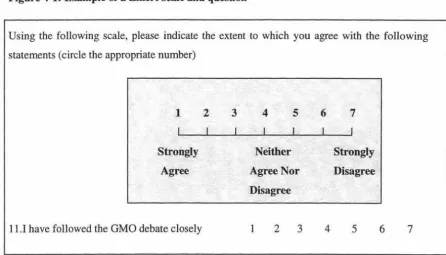
(5) Genetic Engineering and Organic Agriculture: Perceptions of Organic Producers, Exporters and Consumers in New Zealand. 1v. TABLE OF CONTENTS ABSTRACT ................................................................................................................................................ m TABLE OF CONTENTS ........................................................................................................................... IV LIST OF FIGURES .................................................................................................................................. VII LIST OF TABLES .................................................................................................................................. vm 1. INTRODUCTION ................................................................................................................................. 1 1.1. 1.2 1.3 2. BACKGROUND OF TIIE STUDY .... .... ..... .. ....... .. ...... .... ... ..... .... .. ... .. ... .. ..... ........................ .... ... ... ........ . 1 HYPOTHESIS , AIMS AND OBJECTIVES OF THE STUDY .. ... .. .... ...... .............. ... .. ...... ... ..... .. .. ........ ....... .. 2 LAYOUT OF THE THEsIS ... .. .. .. ... ...... ... ............. ... .................. .. ......... .......... .... ........ ...... ......... ..... ..... .. 3. ORGANIC AGRICULTURE AND GENETIC ENGINEERING .................................................... 4 2.1 ORGANIC AGRICULTURE ..... ........... ...... ... ... .... ... ... ........ ........ ..... ... .............. ..... .... ... .. ..... ...... ....... ...... 4 2.1. l What is organic agriculture ? ............................. ....................................................... .............. 4 2.1.2 The origin of the organic movement...... .. .... ... ............ .......... .. .. .......................... ..................... 5 2.1.3 A change in organic principles ...................... ........................ ........ ........................... ............ .. 7 2.1.4 Organic farming in New Zealand....... ..................... ............... ... ..... ..................... .. ... ...... ... .... .. 8 2.1.5 Structure of the New Zealand organic industry............. ............................... .. ........... ..... ......... 9 2.1.6 Standards and regulations .................... .............................. ......... ............................. ........ .. .. 11 2.1.7 Present stance on GMOs ..................... .... .... .............. ....... ........... ...................... ..... ..... .......... 12 2.2 THE GENETIC ENGINEERING CONTROVERSY ...... ..... ....... .. .. .... ....... ... .. .. ... ... .. .... ......... ....... ... ... ..... .. 13 2.2.1 The science ................................................. ............ ... ............................................................ 13 2.2.2 Genetic engineering versus traditional selective breeding ... ............... .. ........... .. ... ...... ....... .. 14 2.2.3 The environment .................... ....... .. .... ...................... ................ ........ ................ ......... ............ 15 2.2.4 Human and animal health .. .... ... .. ......................................... ................................................ . 18 2.2.5 Feeding the world ........ ........... ... ........................................ ........ .... ...... .. ..... ..... ..... .. .. ..... ....... 20 2.2.6 Biotechnology firms ....... .......... ... ... ....................... ........ ...... ....... ... .... ..... .................... ........... . 21 2.2. 7 Social and ethical concerns ..... ... ... ....................................... ................................................. 23 2.2.8 The threat to organic farming from genetic engineering ................................................ ... ... 27. 3. RISK PERCEPTION AND BEHA VIOUR ....................................................................................... 29 3 .1 3.2 3.3. 4. BELIEFS AND ATTITUDES ..... ... .. .. ...... ........... ....... ... ....... ..... ... ... ...... ..... .. .... ... ... ...... ..... .... ...... .. ... .. ... 29 RISK PERCEPTION .. .... .......... ... ........ ........ ..... .... ...... .................. .. ............... ....... .. .... .... ..... ..... ..... .... . 29 THE DIFFERENCE BETWEEN SCIENTIFIC AND PuBLIC PERCEPTIONS OF RISK ... ... ........ .. .. .... .... ... .... 31. RESEARCH MEIBODOLOGY ....................................................................................................... 33 4.1 DEFINING TIIE POPULATIONS ..... .... ..... .. ... .. ..... .... ...... .................. .. ....... ....... ........ ... .... ..... ...... ... .. .. .. 34 4.1.1 The organic producer sample........................................ ........................................................ 34 4.1.2 The organic exporter sample ................................................................................. ....... ......... 34 4.1.3 The organic consumer sample .................................................... .. .............. ........ .... ............... 35 4.1.4 Sample size ........ .............................................. ........................................ ............. ............. .. .. 35 4 .2 QUESTIONNAIRE DESIGN ..... .... ... .. ....... ....................................... .......... .... .. .......... ... ..... .. ..... ........ .. 35 4.2.1 Introduction ......................................................................................................................... .. 36 4.2.2 Question design ................................ ..................................................................................... 36 4.2.3 Demographic questions ........................................................................................................ . 37 4.2.4 Likert scales .......................................................................................................................... 37 4.2.5 Open versus closed questions ..........:..................................................................................... 38 4.2.6 Filter questions ................... .......................................... ......................................................... 39 4.2. 7 Producer questionnaire ......................................................................................................... 39 4.2.8 Exporter questionnaire ......................................................................... ................................. 40 4.2.9 Consumer questionnaire ....................................................................................................... 41 4.2.10 The pilot study .................................................................................................................. ..... 43 4.3 ADMINISTERINGTIIEQUESTIONNAIRES ....... .... ....... .......... .... .............. ... ... ..... .. ...... ..... ...... ...... .... ... 44.
(6) Genetic Engineering and Organic Agriculture: Perceptions of Organic Producers, Exporters and Consumers in New Zealand. v. 4.3.1 Distributing producer questionnaires .. ............................. ................ .... .. ...... ........................ 44 4.3.2 Distributing exporter questionnaires ............. ... ...... ............................................................ .. 44 4.3.3 Distributing consumer questionnaires .............................................. ...... ................ ... .......... . 45 4.4 SELF ADMINISTERED QUESTIONNAIRES .. ...... ........................ .. ...... ....... .. ....... ...... ..... .. ..... .. ... .......... 46 MAIL SURVEYS ......... ....... ...... .. ............. ... .... ......... ...... ........ .. ..... ... .................. ...... .. .... ................. .. 47 4.5 4.5.l Limitations... ............................ ...... .............. ....................... ... ............................. ......... ......... . 47 4.5.2 Response rates ..... .. ....... .................................... .......... ..... .. .... .. .. ............................. ....... ........ 48 4 .6 LIMITATIONS OF SURVEY METHODOLOGY ... .. .... ..... ... ... ....... ..... .... ....... .. .... ....... .. ......... .... ............... 48 ANALYSIS OF THE DATA .. .......... .. ..................................... ... .... ... ..... .... .. ....... ... ... ... .. ......... .. ......... .. 49 4.7 Exploring the relationships ........ ............... ......................................................................... ... 49 4.7.1. 5. RESULTS ............................................................................................................................................ 51 5.1 RESPONSERATE ... ..... .......... .... ... ................. .. .... .. .... ........ .. .. .... .. .. ........... .. ... .... ...... ... .. ............ ... ... .. 51 5.2 MISSING V ARIABLES ..... .. ........ .. .. ... .............. .. ... .. ........... .... ... ..... .... ..... ......... ..... .......... ........ ........... 52 5.3 DEMOGRAPHIC RESULTS (CONSUMER AND PRODUCER ONLY) .................. ....... ................... ......... . 52 PRODUCTION AND EXPORT INFORMATION .... ... .... ......... ...... ...... .. .......... ......... ... .......... ......... ........ .. 54 5 .4 5.4.1 Food types produced. ... ............... ......... ........ ........... ..... ........ ... .. ....... ...................... ...... ......... 55 5.4.2 Reasons for producers farming organically .............. ... .. ............................... .......... ..... ........ . 56 5.4.3 Food types exported ........... ........ ......... ..................... ............... ......... ............................ ......... 57 5.5 ORGANIC CONSUMERS' REASONS FOR PURCHASING ORGANIC FOOD ........ .. ..... ... ...................... .... 58 5.6 GMOS IN THE NEW ZEALAND ORGANIC INDUSTRY ............ .. ............. ..... .. .. ..... .... ..... .... ... .... .... .. ..... 60 5.6.1 Threats to the organic industry .. ..... ........ ............ ......... ................. .................. ...................... 61 5. 7 INTERNATIONAL ORGANIC CONSUMERS .... ............. ........... .. ... .. ... ..... .. .. ............ .. .. .. ........... .... ........ 62 5.7.1 New Zealand's international image ........................................... .. .......... .............. ....... ........... 62 5. 7.2 The international organic industry ....................................... .......... ........ ........ .. ............ .... ..... 63 BELIEFS ABour GM Os .......... .. .......... ... .. ... ........ ..... ...... .......................... ..... .... .. ..... .. ..... .. .. ........... 64 5.8 5.8.l Potential advantages of GMOs.. ......... ................... .................... ......... ........... ......... ........ ...... 64 GMOs and the environment ......................................................... ........................ ... .. .. .......... 64 5.8.2 5.8.3 Consumers and organic food ..................... ..................................................................... ...... 65 5.8.4 Effect on demand for organic food ..... ............ ........ ....... ........................................... .. ........... 66 5.8.5 Political aspects of the debate ..... ..... ............................. ...... .... ... ........... .. .... ... ...................... . 66 Specific producer beliefs .. ............. .. .................... ............ ........... .................. ........ ................. 67 5.8.6 5.8. 7 Specific consumer beliefs .... .. ... ................. ... ....................... .................... ............................ .. 67 5.9 RELATIONSHIPS BETWEEN VARIABLES ....... ......... ... .... ............ ...... .. ....... ................... ..................... 70 5.9.1 Differences between producers ........................................................................................ ..... 70 5.9.2 Perceptions of pesticide residues and GMOs ...... ................................. ................................. 70 5.9.3 Religion and ethics .. .................... ...................... ......... ......... ..... ... ......... .. .......... ..... ........... ... .. 72 5.9.4 Knowledge and beliefs ........ ................................................... ......... ............... .................. .... . 73 5.9.5 Consumption of organic food ...................................................... ....... ..................... ............. . 75. 6. DISCUSSION ...................................................................................................................................... 76 6.1 6.2 6.3. INTRODUCTION ..... ...... ..... ................................... ................................... .. .... .... ... .... ...................... . 76 THE SAMPLE PROFILE ................... ............ .. ........ .... ......... ....................... .. ..... ... .. .. ..... ........... .... ..... 77 BELIEFS, PERCEPTIONS AND ATTITUDES OF PRODUCERS, EXPORTERS AND CONSUMERS OF ORGANIC FOOD TOWARDS GENETIC ENGINEERING. .... ... ....... ... ............... ............. .. .................... 77. Producers ' attitudes and perceptions towards GMOs ........................................................... 78 6.3.1 6.3.2 Exporters' attitudes and perceptions towards GMOs ...... ................................... .................. . 78 Consumers' attitudes and perceptions towards GMOs ......................................................... 79 6.3.3 Misleading claims by the biotechnology firms ...................................................................... 81 6.3.4 REASONS FOR THE REJEcnoN OF GM Os ... ........... ... .......................................... ... .. ..... .... ........ .... .. 82 6.4 WOULD THE ORGANIC INDUSTRY CONSIDER USING AND ACCEPTING GMOS IN THEIR FOOD 6.5 PRODUCTION AND CONSUMPTION? ............... .......................... ... .... ..... .. .. ..... ........ .... ....... .... ...... . 83 6.5.l Pesticides versus GMOs? .................................................... ......................................... ......... 84 6.5.2 The international organic market............................ ............................................................ .. 86 6.6 COMPARISONS WITH 011IBR STUDIES ................. ... .. ...... ......... .... .. ... .............. .. ... ........ ........... .... .. .. 86 6. 6.1 Consumer support for different applications of the technology. ....................... .................... 86 6.6.2 Reasons for buying organic food........................................................................................... 88.
(7) Genetic Engineering and Organic Agriculture: Perceptions of Organic Producers, Exporters and Consumers in New Zealand. 6.7 6. 7.1 6. 7.2. 6.8 7. vi. LIMITATIONS OF THE STUDY .......................................................................................................... 89. Bias.... ..... ........... ......... .. .... ........ ... .............. ...... ...... .................. ... .... ... ...... .. ..... ........ ... .... ... ..... 89 Other limitations ............................ .......... ......... ...... ... ........ ....... ........ ... ..................... ........... . 90 SCOPE FOR FuRTHER REsEARCH ... .. ..... ... ............ ......... ...... ..... .......... .... .................. ...... ........ .. .... .. . 90. CONCLUSIONS AND RECOMMENDATIONS ............................................................................ 91. REFERENCES ............................................................................................................................................ 93 APPENDIX ONE ........................................................................................................ 98 SURVEY INSTRUMENTS APPENDIX TW0 .................................................................................. ... ................. 117 ORGANIC FOOD CONSUMED APPENDIX THREE .............. ..................................................................................... 118 LIKERT SCALE RESULTS.
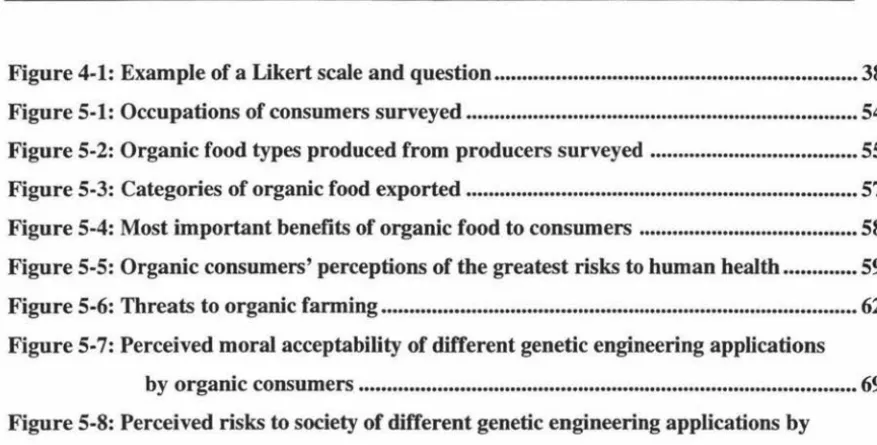
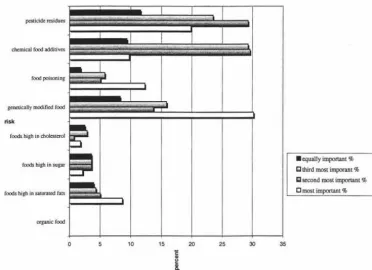
(8) Genetic Engineering and Organic Agriculture: Perceptions of Organic Producers, Exporters and Consumers in New Zealand. vii. LIST OF FIGURES Figure 4-1: Example of a Likert scale and question ................................................................. 38 Figure 5-1: Occupations of consumers surveyed ..................•..............•...•..•............................. 54 Figure 5-2: Organic food types produced from producers surveyed .....•............................... 55 Figure 5-3: Categories of organic food exported ...•......................................................•.•......... 57 Figure 5-4: Most important benefits of organic food to consumers .••••.•.•....•...............•...•••.•• 58 Figure 5-5: Organic consumers' perceptions of the greatest risks to human health ..••......... 59 Figure 5-6: Threats to organic farming .............................•...•..............•..........•......................... 62 Figure 5-7: Perceived moral acceptability of different genetic engineering applications by organic consumers .•........................................................................•.•••••........ 69 Figure 5-8: Perceived risks to society of different genetic engineering applications by organic consumers .........••...••........................•.•....••.....•....•...•......•.............••......... 69.
(9) Genetic Engineering and Organic Agriculture: Perceptions of Organic Producers, Exporters and Consumers in New Zealand. vm. LIST OF TABLES Table 5-1: Response rate for each group of surveys ................................................................. 51 Table 5-2: Demographic results .....•................................................................•.........•.•••...•........ 53 Table 5-3: Reasons why organic producers farm organically •...•.................................•.•.....•.. 56 Table 5-4: Perceptions of the competitiveness of the NZ organic industry .........•..•..•.......••.•. 60 Table 5-5: Perceptions of whether organic growers will be forced to accept GMOs ...•.•.•... 61 Table 5-6: Exporters' perceptions of New Zealand's international image ....•........................ 63 Table 5-7: Exporters' and producers' perceptions of the international organic market ..•.. 63 Table 5-8: Perceptions of possible benefits of GMOs (percent) .............••....................•.......... 64 Table 5-9: Producer and exporter perceptions of consumer demands and behaviour ••....... 65 Table 5-10: Consumer views of GMOs ....•.•........•.............••..••.....•.•.........................•.••.•....•••.••.. 66 Table 5-11: Consumer's familiarity with the GMO topic ( % ) •••••.•••••..•••••••.••••••••.•.•..•••••••.•••.• 68 Table 5-12: Percentages of consumers and producers with religious and ethical concerns about GMOs .....•.....••.........•........................................................................••...•....•....•....•.•.... 72 Table 5-13: Correlation analysis of knowledge about genetic engineiling with all other variables for consumers ....................................................................................................... 7 4. Table 5-14: Correlation analysis of amount of organic food consumed ..••...•.....•.•.•.••••...•...••• 75 Table 6-1: Risks to society of different applications comparisons .•.•..............•............•...•.....• 87 Table 6-2 Moral acceptability comparisons ...•.•....••.•.•..........•.....•••••.••..............•..............•........ 88.
(10) Genetic Engineering and Organic Agriculture: Perceptions of Organic Producers, Exporters and Consumers in New Zealand. 1. 1 INTRODUCTION 1.1. Background of the Study. Genetic engineering has been a controversial topic since the late 1990s. Until it became widely known that food containing engineered genes was being sold, and has been sold for a number of years, the public were largely unaware of the technology. It came as a shock to many people to discover that a considerable amount of food containing genetically modified organisms (GMOs) is consumed on a daily basis throughout the world. The media has played a significant role in bringing the attention of the public to this, and may have influenced people's opinions to a certain extent. The debate continues, with new issues being raised by different groups from around the world. The environmental effects of transgenic crops are largely unknown, and while few human health effects have been recorded, the long-term effects are unproven. Consumers are demanding clear labelling of food, while manufacturers claim this is too difficult. Growers are unsure whether to plant transgenic crops, risking having them ripped out by protestors, or finding that demand for the product has fallen due to consumer unease.. Organic foods do not contain any genetically engineered organisms. However, organic food production is under threat from genetic engineering technology. It is possible that in future, current organic pest control methods may become useless because of the technology, and/or organic crops may become contaminated from genetically modified crops.. It has been. suggested that, involuntarily or voluntarily, the organic industry may have to consider incorporating food grown with altered genes.. Additionally, it has been proposed that. genetically engineered crops could be included in organic standards (Kirschenmann and Kirschenmann 1998). The reaction of the increasingly important organic market to the potential introduction of GMOs into organic food is unknown but crucial to the industry. It may also be the case that this sub-group of the population can provide insights into emerging patterns in the general population.. At present there is no commercial production of genetically modified crops in New Zealand, however, it is almost inevitable that eventually there will be. Before this happens it would be wise for New Zealand to seriously consider all potential situations, including the damage that may be done to the organic ind11stry and the international image of the country..
(11) Genetic Engineering and Organic Agriculture: Perceptions of Organic Producers, Exporters and Consumers in New Zealand. 1.2. 2. Hypothesis, Aims and Objectives of the Study. The aim of this thesis is to investigate the role that GM Os may play in the future of the organic industry.. The hypothesis formulated, based on the situation regarding genetic engineering in New Zealand, and background knowledge of the New Zealand organic industry, is that "organic" consumers do not expect organic produce to contain genetically altered genes - and would not buy it if it did.. The primary objectives are:. 1. To explore the beliefs, perceptions and attitudes of producers, exporters and consumers of organic food in New Zealand towards genetic engineering. 2. To identify the reasons for acceptance or rejection of GMOs by the producers, exporters and consumers of organic food in New Zealand.. The secondary objectives of this study are: 1. To determine whether the organic industry would consider using and accepting GMOs in their food production and consumption 2. To identify the main export markets for organic food and what the expected demands from those consumers would be 3. To compare the results within the organic community with similar data from the general population.. In order to achieve these objectives, a survey of representative groups of the organic industry was undertaken. Producers, exporters and consumers were questioned on their beliefs about genetic engineering, their opinions about organic food and the organic industry, and if they felt there was any future for genetic engineering in organic food. The results were analysed using the Statistical Package for the Social Sciences (SPSS). This research is important because the organic industry is growing in importance in New Zealand, both in the export and to a lesser degree, national markets. If current trends persist, demand for organically grown produce will continue to increase. The organic industry must be aware of consumer demands, and cater for them accordingly. The study is important also to give a clear indication of the beliefs and attitudes of the organic sector. By introducing the commercial growth of genetically engineered organisms, New Zealand may be putting a growing export industry at risk..
(12) Genetic Engineering and Organic Agriculture: Perceptions of Organic Producers, Exporters and Consumers in New Zealand. 1.3. 3. Layout of the Thesis. The thesis consists of six chapters. Chapter two contains the background and literature review of the topic. Chapter three consists of a discussion of risk perception and the theory of attitudes and beliefs. The methodology used is described in chapter four and the reasons for its use are discussed. Chapter five presents the results obtained. Chapter six presents a discussion of the findings from the study, while chapter seven provides a conclusion and recommendations. References and appendices follow .. For the purposes of this thesis, the terms genetic engineering, genetically modified organisms (GMOs), transgenic organisms, and biotechnology, will be used interchangeably. contexts they are used in should not in any way indicate any bias or attitude.. The.
(13) Genetic Engineering and Organic Agriculture: Perceptions of Organic Producers, Exporters and Consumers in New Zealand. 4. 2 ORGANIC AGRICULTURE AND GENETIC ENGINEERING 2.1. Organic Agriculture. This section provides background information about organic agriculture, its origins and the underlying principles of the organic movement. The structure of the New Zealand organic industry is described, as is the position of the organic certification agencies towards genetic engineering at present.. 2 .1.1. What is organic agriculture?. Organic farming is an approach to farming which relies primarily on biological processes, rather than the purchase of chemical inputs, to maintain soil fertility and plant and animal health (MAF 1994). It is based on appropriate stocking rates, consideration of animal welfare, sound rotations using diverse stock and cropping strategies with the extensive but rational use of animal manure and other vegetative residues, and the use of appropriate cultivation techniques. It avoids the use of soluble mineral salt fertilisers, nearly all chemical pesticides, and all genetically modified organisms (BIO-GRO 1998).. Organic agriculture seeks to produce food of optimum quality, and to manage productive ecosystems according to a total concept that endeavours to make them sustainable and nonpolluting to the environment, while providing an appropriate level of income to the producer, families and communities. The main principles employed aim to: 1. Foster beneficial processes and interaction such as occur in natural ecosystems, thus encouraging internal stability rather than heavy reliance on external control measures; 2. Reduce external control to the absolute minimum required for maintaining the chosen state of production. fuputs used should aim to work as far as possible in conjunction with natural cycles, rather than trying to dominate such cycles; 3. Achieve cycles and flows of nutrients and minerals that have as few losses as possible. This requires the conservation and recycling of nutrients and organic material; 4. Sustain and enhance the fertility and life supporting ability of the production medium including its biological, physical and chemical components. For landbased production systems great emphasis is placed on the importance of soil organic matter, and soil flora and fauna; and.
(14) Genetic Engineering and Organic Agriculture: Perceptions of Organic Producer~, Exporters and Consumers in New Zealand. 5. 5. Minimise any deleterious environmental effects of particular management practices including any that may reduce the natural diversity to the detriment of plant and wildlife habitats (BIO-GRO 1998 p3).. Organic farming includes the terms biodynamic and biological. It is an approach to farming that seeks to create an integrated, sustainable and humane agricultural system. The degree to which organic farming achieves these goals varies between different soil, climatic and enterprise types in accordance with the managerial skills and aims of the farmers (MAF 1994).. 2.1.2. The origin of the organic movement. Rudolph Steiner laid the basis for biodynamic agriculture in the 1920s, conducting a series of lectures on alternative agriculture throughout Germany. As a result many farms in Germany, Austria and Switzerland converted to the biodynamic way of farming. Steiner had felt that "during the last few decades the agricultural products on which our life depends have degenerated extremely rapidly. It is not only human moral development that is degenerating, but also what human activity has made of the Earth and of what lies just above the Earth" (Steiner 1924, p3).. Steiner's philosophies make use of a deeper spiritual insight in order to discover what our "increasingly unreliable instincts are now less and less able to supply". They look at the life of plants and animals in a broad way, and also at the life of the Earth itself. In order to arrive at spiritual-scientific methods applicable to agriculture, it is necessary to look at nature, and the spirit's activity in nature, in its entirety, in its most encompassing dimensions (ibid) . The guidelines are based on spiritual, moral and social responsibility, from which guarantees for the quality of the end product are made.. The origins of organic agriculture occurred even before the explosion of the agrichemical revolution and before the environment had really become an issue. Balfour (1975) carried out a large experiment on organic agriculture, the Haughley Experiment, from 1939 through to 1969. The researchers were concerned with health and not environment alone. They paid more attention to building soil fertility and vitality through recycling nutrients within a more or less closed system than they did to the avoidance of mineral salts (Boeringa 1980).. The early practitioners and pioneers of organic agriculture broke away from the narrow confines of the preconceived ideas that dominated the scientific thinking of their day. They.
(15) Genetic Engineering and Organic Agriculture: Perceptions of Organic Producers, Exporters and Consumers in New Zealand. 6. looked at the living world from a new perspective and asked new questions. Instead of the contemporary obsession with disease and its causes, they set out to discover the causes of health. This led inevitably to an awareness of wholeness and to a gradual understanding that. all life is one (Balfour 1978, cited in Woodward 1996).. Health' was thought to be part of a continuum through soil, plant, animal and man. By recycling nutrients through this chain, productivity could be maintained over time and health could be enhanced at all stages, as long as food was consumed fresh and for the most part whole. It should be subjected to little or no processing and to no chemical intervention at any stage (Balfour 1944; Besson and Vogtmann 1978, cited in Woodward 1996).. In all those respects the Organic Movement represented a marked departure from the trend towards the increasing fragmentation of science, the piecemeal application of science through technology, and the unceasing struggle to deal with the ever-changing manifestations of individual diseases, whether in plants, animals or humans.. Balfour (1975) conducted a number of studies of exceptionally healthy cultures, and found that health was related to four factors shared by all the groups. These are: 1. Fresh food 2. Whole food (all edible parts eaten) 3. Food grown on soil to which all organic wastes are returned to complete the cycle 4. Food grown without chemicals or man-made substitutes for natural processes. When the last two factors are put into practice in modem systems of food production, they give rise to the method referred to as 'organic farming'.. The first conference of the International Federation of Organic Agricultural Movements (IFOAM) in 1977 concluded that IFOAM was seeking to: provide an articulate, informed and coherent alternative to contemporary agricultural dogma .. .(and) ... provide further impetus for both the research into, and the practice of, methods of husbandry which are based on the ethic of satisfying need and the obligation to do so by technologies that our planet can sustain (Fisher 1978, cited in Woodward et al. 1999, p21). The major concerns of researchers and founders of the early organic movement were research approaches, soil fertility, nutrient supply, weeds, pests, disease and food quality. Later, the development of standards for organic production were added to the agenda..
(16) Genetic Engineering and Organic Agriculture: Perceptions of Organic Producers, Exporters and Consumers in New Zealand. 7. The main points of "principles of organic agriculture", as adopted at the opening section of the 1F'OAM Basic standards of Organic Production (1981) are: 1. To work as much as possible within a closed system, and draw upon local resources; 2. To maintain the long-term fertility of the soils; 3. To avoid all forms of pollution that may result from agricultural techniques; 4. To produce foodstuffs of high nutritional quality and sufficient quantity; 5. To reduce the use of fossil energy in agricultural practice to a minimum; 6. To give livestock conditions of life that conform to their physiological needs and to humanitarian principles; 7. To make it possible for agricultural producers to earn a living through their work and develop their potentialities as human beings; 8. To use and develop appropriate technology based on an understanding of biological systems; 9. To use decentralised systems for processing, distribution and marketing of products; 10. To create a system which is aesthetically pleasing to both those within and those outside the system; and 11. To maintain and preserve wildlife and their habitats (Woodward et al. 1999 p 23).. These eleven points capture the essential part of the concept of health, which the pioneers of the organic movement espoused. They also provide a description of the goals of "sustainable agriculture," encompassing social, economic and environmental parameters beyond as well as behind the "farm gate" - a comprehensiveness which has only recently been seen as important (ibid) .. 2.1.3. A change in organic principles. The founding concept of health, sustainability, and the concept that, by providing farmers with the skills to grow food organically, we will be developing a crucial vehicle for bringing about a more equitable, healthy and genuinely sustainable world, appear to have been neglected in today's organic agriculture. (Woodward et al. 1999). The organic movement today has retained the prohibition of "chemical intervention" but seems to have neglected the other principles. The revolutionary concept of human health.
(17) Genetic Engineering and Organic Agriculture: Perceptions of Organic Producers, Exporters and Consumers in New Zealand. 8. being one and indivisible with the health of environment, status of animal welfare, and nature of processing, packaging and distribution has been largely unheeded.. Woodward et al. (1999) note that a truth can easily be suborned, undermined, and twisted against itself by appropriating its language, distorting its logic and misapplying its conclusions. They argue that today this has happened with the term "sustainable". The term has been appropriated by government and industry, and used as a code to indicate there is no conflict between growth and environment that cannot be traded off (ibid). The essence of sustainability as described by Balfour (1978 cited in Woodward et al. 1999, p21) is: "the criteria for sustainable agriculture can be summed up in one word - permanence - which means adopting techniques that maintain soil fertility indefinitely; that utilise, as far as possible, only renewable resources; that do not grossly pollute the environment, and that foster life-energy (or biological activity) within the soil and throughout the cycles of all the involved food chains.". The delocalisation of the organic industry, with the proclivity towards highly packaged, homogeneous and shelf-stable food products is one of the least sustainable practices in modern agriculture (Friedmann 1994, cited in Coombes and Campbell 1998).. This is. occurring in the organic industry and is fundamentally antithetical to the beliefs of philosophically committed growers in the alternative agriculture movement (Tovey 1997, cited in Coombes and Campbell 1998). Whether or not this is an inevitable progression or if it is a regression and a slighting of the organic name, it is important to realise that this has happened. Reasons for this will be discussed in the section 'Structure of the industry'.. 2.1.4. Organic farming in New 2.ealand. The organic agriculture movement in NZ arose from a wide coalition of interests: urban food consumers, lifestyle residents in peri-urban areas, European migrants to NZ in the 1950s and 60s, and direct contact with the British soil association. By 1983 this loose coalition had institutionalised itself as the New 2.ealand Biological Producers Council which administered the standards for production under the BIOGRO certification system (Saunders et al. 1997).. There has been a trend in consumer demand towards buying food that is perceived to be healthy, with low chemical residue levels, and produced in environmentally friendly ways with concern for animal welfare (Ministry of Agriculture and Fisheries 1994). Organic food consumption has been linked with subjective factors in consumer purchasing by clearly situating the rise of organic food trading within consumer reactions to food scares and health.
(18) Genetic Engineering and Organic Agriculture: Perceptions of Organic Producers, Exporters and Consumers in New Zealand. 9. concerns (Friedland, 1994; James, 1993, cited in Campbell and Coombes 1999). Alvensleben and Altinann (1987, cited in Beharrell and MacFie 1991) summarise the basic conditions behind the rising demand for organic produce as: 1. The socio-cultural background: changing values m the society ("post-materialism". scepticism against economic growth and modem technology, environmental movement, etc); 2. General discontent with the present food supply (concern about residuals, etc) ; 3. Positive image of organic food (health, taste, etc); 4. Health consciousness of consumers; 5. Discontent with the mass distribution system ("alienation"); and 6. Positive income elasticity, negative price elasticity of demand.. Many consumers perceive that organic products fulfil this demand. Market growth will depend largely on how much of the market for environmentally friendly, low residue products is supplied by organic products (Ministry of Agriculture and Fisheries 1994). Campbell and Coombes (1999) state that the growth in organic food exporting from New '.Zealand is synergistically linked to the environmental and health threats to conventional exporting, and these threats are in tum linked to the continuing contradictions of the last remnants of Fordism 1 and its breakdown.. Between 1983 and 1990, there were a number of changes within the organic agricultural movement.. Within that period, NZ organic agriculture developed stronger links with. international organic bodies such as the IFOAM. In addition to this, the standards for organic production were formalised, and an inspectorate to administer them was set up. The New Zealand Biological Producers and Consumers Council (Inc) was founded in 1984 to promote the interests of organic production in New Zealand. This council now trades as the BIO-GRO New '.Zealand (BGNZ) organisation, and is the main labelling agency in the country. The other certification agency operates under the Demeter label, and is run by the New Zealand Biodynarnic Farming and Gardening Association. The Demeter label was established in 1982.. 2.1.5. Structure of the New '.Zealand organic industry. According to Saunders et al. (1997), two developments in the 1990s have strongly influenced the current structure of the industry. These developments are: the professionalisation of BIOGRO, and the development of organic exporting. BIO-GRO has been a professional inspectorate since 1994, when fees for inspection were significantly increased for that.
(19) Genetic Engineering and Organic Agriculture: Perceptions of Organic Producers, Exporters and Consumers in New Zealand. 10. purpose. New Zealand had very low levels of organic food production prior to 1990. A Ministry of Agriculture and Fisheries (MAF) report estimated that the total value of organic food traded in New Zealand in 1990 was NZ$1.1 million (MAF 1991).. Since that time, organic food production has escalated dramatically. The period from 1990 to the present has been characterised by the conversion of conventional farmers at the bequest of export agribusiness (Coombes and Campbell 1998). In 1990, Wattie Frozen Foods Ltd (later to become Heinz-Wattie NZ) and the New Zealand Kiwifruit Marketing Board (now Zespri International) began to experiment with organic products. They now form the backbone of the new organic food exporting industry. Given that the nature of large corporate firms and that of the organic agriculture movement are apparently incompatible, the relationship was unlikely to be easy. The arrival of the large corporate entities placed pressure on both the institutions behind the organic certification system and the ideological loyalty of many long term members of the organic movement (Campbell and Coombes 1999).. In 1992, a Tradenz Joint Action Group produced a report on the prospects of organic food in export markets.. By 1995, the rate of growth in organic exports was such that Tradenz. fostered the establishment of the Organic Products Exporting Group, and assigned a Tradenz officer to help facilitate the development of organic exporting. These actions were the most significant moves by the NZ government to actively support the development of organic food production in NZ.. The economic structure of organic farming in New Zealand is characterised by two types of farms. The first (and original) organic farm in New Zealand is the interdependent lifestyle, domestic, small-scale production type.. The second type is the export-oriented,. commercialised organic farm (Coombes and Campbell 1998). The traditional organic farm generally supplies the domestic market and is likely to be of the mixed farming type, particularly market gardening.. The motivation for many of these producers to farm. organically appears to be because of philosophical viewpoints. They may have a strong concern for the environment and/or be farming organically for lifestyle reasons, generally not because of strong financial incentives (Saunders et al. 1997).. The second type of farm is largely aiming at production for the export sector. These farms are of two kinds; those producing permanent crops and those on broadacre production systems where the export crop is rotated with other crops (ibid). The number of these export-based. 1. Symbol of mass production.
(20) Genetic Engineering and Organic Agriculture: Perceptions of Organic Producers, Exporters and Consumers in New Zealand. 11. farms has grown since early 1990 with large processing companies such as Heinz Wattie New Zealand and Zespri International marketing organic produce.. Since the early 1990s a number of conventional farmers have been attracted into organic production due to the increase in exports. Initial success in targeting overseas niche markets presented processing companies with the need to encourage a continuity of supply from growers and also to recruit conventional farmers into organic production (ibid).. The. internationalisation of the New Zealand organic industry may be viewed as being oppositional to the philosophy of the organic movement, especially in terms of a lack of producerconsumer accountability and the use of fossil fuels for global transport (Coombes and Campbell 1998).. It has been said that organic farming is conventionalising, with large firms from conventional agriculture "commandeering" the 'organic' label (Buck et al 1997 cited in Coombes and Campbell 1998). Accordingly, the influence of such firms is believed to have regulated organic certification, thereby debasing the meaning of organics to allowable inputs, rather than sustainable practices. This process of 'corporate greening' may negatively transform organic agriculture, with a possible dilution of standards for organic certification. However, Coombes and Campbell ( 1998) maintain that small-scale organic producers can coexist with agribusiness involvement in the organic industry. This is evident as the introduction of agribusinesses in the industry has not been at the expense of the smaller, earlier organic farmers.. The organic producer sector is therefore likely to be made up of two different groups of people who are quite likely to hold varying beliefs and ideologies, which may potentially conflict with each other.. 2.1.6. Standards and regulations. BIO-GRO standards have evolved since 1984, and there are procedures in place which enable these standards to be reviewed. The standards have evolved in dialogue with international organic groups like the IFOAM and the Australian organic agriculture body NASAA. The great majority of exporters have decided to use the BIO-GRO standards rather than the alternative biodynamic Demeter label (Saunders et al. 1997). These standards are held in high regard overseas, and the overall structure of the organic industry is strongly influenced by the certification and labelling system..
(21) Genetic Engineering and Organic Agriculture: Perceptions of Organic Producers, Exporters and Consumers in New Zealand. 12. In addition to the standards for organic production issued by either BIO-GRO or Demeter, all primary producers in New Zealand are obliged to meet the requirements of the New Zealand Resource Management Act 1991, which defines sustainable management as: managing the use, development, and protection of natural and physical resources in a way, or at a rate, that enables people and communities to provide for their social, economic and cultural well being and for their health and safety while a) sustaining the potential of natural and physical resources (excluding minerals ) to meet the reasonably foreseeable needs offuture generations; and b) safeguarding the life-supporting capacity of air, water, soil and ecosystems; and c) avoiding, remedying or mitigating any adverse effects of activities on the environment.. (Resource Management Act 1991). 2.1.7. Present stance on GMOs. Genetically modified organisms are clearly prohibited from BIO-GRO regulations. Under section C: Materials and Practices, it states that "materials must.. ..not be GM Os; and not be products containing or originating from GMOs." (p26).. Section E also states explicitly that genetic engineering is not to be used: Livestock, Poultry, Egg and Dairy Production and Processing states that 'Genetically Engineered Breeds are Prohibited', and that the following products shall not be included in, nor added to, the feed or in any way be given to farm animals: genetically engineered organisms or products thereof (p39). Section F (Cropping, Vegetable, Fruit, and Wine Production and Processing) also indicates that seeds from genetic engineering, and/or transgenic plant material are prohibited (p51).. In Appendix 7: Procedure to evaluate other inputs to organic agriculture, BIO-GRO has the following stance on genetic engineering: Consumers' perception: Inputs should not meet resistance or opposition of consumers of organic products.. An input might be considered by consumers to be unsafe to the. environment or human health, although this has not been scientifically proven. Inputs should not interfere with a general feeling or opinion about what is natural or organic - for example, genetic engineering (p87) (BIO-GRO 1998).. The BIO-GRO position on GMOs is obviously very clear at this point.. Should genetic. engineering become more widespread, with the resulting cross-contamination of plants.
(22) Genetic Engineering and Organic Agriculture: Perceptions of Organic Producers, Exporters and Consumers in New Zealand. 13. becoming common, and possibly contaminating organic crops, they may change their stance. Or, indeed, if GM Os are shown to be beneficial to the environment if used in a certain way, the regulations may potentially be changed. BIO-GRO standards have evolved since 1983 and there are procedures in place which enable these standards to be reviewed.. 2.2. The Genetic Engineering Controversy. This section describes the theory of genetic engineering, and discusses the controversial aspects of the technology. The benefits and risks of each situation are presented and reviewed in order to provide a balanced view of the genetic engineering debate.. The science. 2.2.1. In order to have an understanding of the opposition to genetic engineering, it is first necessary to have some knowledge about genetic engineering.. Genes are contained in every organism, from a single bacteria cell to a human being. All the information the organism needs regarding growth, survival and reproduction are carried in the genes. Genetic engineering involves removing, turning off, or moving between one organism to another, these genes (Independent Biotechnology Advisory Council 1999). The result of this shuffling around means that the information from one organism is now transferred to another. This means the chemical normally produced by the gene in the first organism is may be produced by the second; or the chemical may not be produced if the gene has been removed.. Basic genetic engineering involves identifying the gene for a particular trait, and transferring it from the species it naturally occurs in to another species. The two methods used for this are either vectorless transmission (biolistic {particle gun} delivery), or through the use of a vector. The former can cause physical damage to the cells, and only a small proportion of cells tend to take up the foreign DNA2•. Vectors involve the use of an organism to carry genetic material from one species to another,. ,. and involves the following three steps: 1. Obtaining the desired piece of genetic material from the donor species;. 2. DNA - Deoxyribonucleic acid.
(23) Genetic Engineering and Organic Agriculture: Perceptions of Organic Producers, Exporters and Consumers in New Zealand. 14. 2. Inserting this piece of genetic material into the vector species; and 3. Infecting the species to be genetically engineered with the vector species so that the desired piece of genetic material passes from the vector to the genetically engineered species (Reiss and Straughan 1996).. 2.2.2. Genetic. engine~ring. versus traditional selective breeding. It has been indicated that the process of genetic engineering is not significantly different to that of traditional selective breeding that has been practised for centuries (Connor 1997). Traditional biotechnology' includes all of biotechnology, and is based on activities such as the farming of animals and plants and the use of micro-organisms in the manufacture of beer, wine, cheese.. The distinction appears to be important to opponents and proponents alike.. Reiss and. Straughan (1996) assert that genetic engineering differs from traditional biotechnology in at least three important ways: 1. In traditional biotechnology the species crossed are always closely related to each other. The capacity to combine genes from dramatically different organisms has no precedent in evolution. This is where the big step beyond traditional plant breeding occurs (IBAC 1999). 2. The pace of change in traditional biotechnology is much slower (time scale of years) 3. Genetic change as a result of traditional biotechnology happened to only a relatively small number of species, namely those that provide us with food and drink, such as crop plants, farm animals and yeasts. Genetic engineering is far more ambitious, in that it seeks to change not only the species that provide us with food and drink, but also those involved in sewage disposal, pollution control and drug production.. In addition to these three basic differences between genetic engmeenng and traditional breeding, there are some related and more subtle variances associated with the technology. There is such an enormous pool of genes available for manipulation, scientists are no longer limited to the gene pool of the plants that can specifically interbreed with a crop. This, the opponents allege, will increase the likelihood of something going awry (Rissler and Mellon 1996).. The outcomes may be less predictable than traditional breeding due to the novelty and power of genetic engineering. Unlike the replacement of one version of a gene for another, a wholly new gene may interact with the rest of the plant genome in more unpredictable ways. New. I.
(24) Genetic Engineering and Organic Agriculture: Perceptions of Organic Producers, Exporters and Consumers in New Zealand. 15. traits may enable weeds to overcome ecological limits on population growth, especially since many of the traits established in most crops are ecologically advantageous (ibid).. 2.2.3. The environment. Connor ( 1997) asserts that the three main characteristics that are engineered in most crops world-wide are improved resistance to viruses, insects and herbicides. Others traits being developed include: bacterial and fungal resistance, male sterility and fertility, chilling and freezing tolerance, altered pigmentation, delayed fruit ripening and improved postharvest storage, flavour and nutritional quality. These qualities appear advantageous and beneficial, however their effects on the environment are largely unknown, as the long-term effect of the release of transgenic organisms into the environment has not been assessed. Scientists and environmentalists alike have concerns about the effects these genetically engineered crops will have on the environment. The main considerations that have been raised regarding genetically engineered crops and the environment are discussed in this section.. 2.2.3.1. Bacillus thuringiensis (Bt) resistance. Genetic engineering is a technique used to genetically modify plants for greater natural resistance against pests (Savage and Connor 1994). One technique to improve resistance to insects is to engineer the ability of plants to produce their own insecticides. By far the greatest research effort in developing pest-resistant transgenic crops has gone into expression of Bacillus thuringiensis (Bt) toxins in plants (Gatehouse et al. 1999). Bt is a naturally occurring soil bacterium. The gene for resistance is inserted into the new plant, (mainly corn, potato and rapeseed) which could potentially minimise or reduce the use of pesticides altogether (Kloppenburg and Burrows 1996). "In an attempt to reduce the use of man-made pesticides, pest-resistant cultivars of many vegetable and fruits are being developed" (Savage and Connor 1994).. Engineering plants to produce their own insecticides poses a real threat to organic farmers. Bt sprays have been used for the last 40 - 50 years by organic farmers as an environmentally friendly biopesticide. Bt targets specific groups of insects, such as caterpillars, so is useful in serious pest infestations. Purified Bt toxins are used as an externally applied insecticide. In the form used by organic growers, these biological toxins break down quickly. Now, constant high-dose protection is possible with transgenic plants (Snow and Palma 1997). Constant exposure to the high levels of toxins in the engineered plants is likely to increase the.
(25) Genetic Engineering and Organic Agriculture: Perceptions of Organic Producers, Exporters and Consumers in New 'Zealand. 16. resistance of pest species (Soil Association 1999). Insects are continually exposed to the toxin, and are therefore under constant pressure to develop resistance.. The USEPA. (Environmental Protection Agency) has estimated that most pests targeted by the new generation of transgenic crops will build up resistance within 3 - 4 years (Soil Association 1999). Gatehouse et al. (1999) state that however effective a transgene might be initially, just as with chemical pesticides it is highly likely that the pests will develop resistance to it. The resistance trait is highly stable, and also exhibits broad spectrum cross-resistance to other delta-endotoxins, which undennines many potential options for resistance management (Ho 1998).. Many entomologists regard Bt as an unusually benign pesticide that warrants. extremely careful management, given the lack of acceptable alternatives (Snow and Palma 1994). Its loss may promote the use of more environmentally damaging methods of pest control.. Interestingly, the transgenic crops engineered to produce Bt have not been totally successful in the field. Bt cotton failed to control pests in Australia and in widespread areas throughout the US (Hilder and Boulter 1999). The reasons for this are not yet completely known, possibilities include inadequate expression levels, naturally resistant insect populations, development of resistance, all of which may have been influenced by the environment (Kaiser 1997 cited in Hilder and Boulter 1999).. 2.2.3.2. Herbicide tolerance. A large proportion of research conducted by biotechnology companies has focused on making crops resistant to the company's own broad spectrum herbicides. An argument used by the biotechnology industry to promote genetic engineering, is that the technology will reduce the use of chemical pesticides, or at least reduce the use of the more damaging ones. However, it will allow non-persistent herbicides (for example glyphosphate) to be used more widely and will permit post-emergence spraying of herbicide resistant crops. This could promote greater reliance on herbicides and allow crops to be grown in soil contaminated with hazardous herbicides (Snow and Palma 1997). This creates problems not only for the environment due to excessive herbicide use, but also in the form of pest resistance to these chemicals. Pest insects have shown a remarkable capacity to develop resistance to chemical pesticides with ovl r 500 species of insects now resistant to chemicals (Moberg 1990 cited in Hilder and Boulter 1999). It is possible therefore, that pests will develop resistance to these chemicals as well. A further concern is that selection for resistance to one type of pesticide sometimes.
(26) Genetic Engineering and Organic Agriculture: Perceptions of Organic Producers, Exporters and Consumers in New Zealand. 17. confers cross-resistance to other pesticides (Gould et al. 1982, cited in Snow and Palma 1994).. "Roundup" is the world's best selling weed-killer, and is produced by Monsanto. It is a broad spectrum herbicide and is based on glyphosphate. While it is considered relatively safe for birds and animals, its toxicity for humans is still incompletely understood. Nevertheless, to permit genetically engineered Roundup sprayed crops to be used for livestock fodder, the USEPA has allowed an increase in glyphosphate residues tolerances to go from 6 to 20ppm for raw soybeans and from 100 to 200 ppm for soybean hay and 100 ppm for their hulls (Lappe and Bailey 1999). This indicates that greater amounts of the herbicide will be applied.. The safety of these products to animal life and the environment is also disputed. While Roundup is promoted as an environmentally benign herbicide, the United States Fish and Wildlife Service has identified 74 endangered plant species potentially threatened by excessive use of glyphosphate (Nottingham 1998). Glyphosphate has been shown to kill fish in concentrations of 10 ppm (UNEP 1994), reduce growth of earthworms and increases their mortality, and is toxic to many mycorrhizal fungi which enable nutrient uptake by plants from the soil (Chakravarty and Chatarpaul 1990). There is also some evidence that glyphosphate can combine with nitrates in the stomach secretions and human saliva to become carcinogenic (Weir 1997).. 2.2.3.3. The spread of genetically engineered crops. Commercialisation of genetically engineered plants will allow transgenes coding for beneficial traits to be transferred to wild or weedy populations of these tax.a and their close relatives (Snow and Palma 1994). This situation is a concern to organic farmers, whose produce may inadvertently become contaminated with genetically engineered plants, and would therefore no longer be considered organic. The problem of crossing with wild relatives could lead to a generation of "superweeds", with herbicide resistant traits. Rissler and Mellon (1996) state that given enough time and a broad enough selection of engineered crops, movement of transgenes into wild relatives of crop plants is a virtual certainty. They do assert that genetically engineered crops are not inherently dangerous,. they only present. problems where new traits, or combinations of traits, produce unwanted effects in the environment. A potential risk of escaped transgenes is that hybridisation with populations of free-living relatives will make these plants increasingly difficult to control, especially if they are already recognised as agricultural weeds and if they acquire resistance to widely used.
(27) Genetic Engineering and Organic Agriculture: Perceptions of Organic Producers, Exporters and Consumers in New Zealand. 18. herbicides (Snow and Palma 1994). Different crops will present different problems depending on the new genes they contain, the characteristics of the parent crop, and the locale in which they are grown. Genetically engineered crops would only pose risks when the crop itself can survive without cultivation or when the crop spontaneously hybridises with closely related wild taxa (ibid).. 2.2.4. Human and animal health. Considerable attention has focused on the health effects of consuming food produced with genetic engineering techniques. The concerns relate both to the health of humans and that of animals, and the result of eating animals fed genetically engineered food. The major issues are discussed in the following sections.. 2.2.4.1. Antibiotic resistance. Genetically modified plants often carry antibioti«: resistant marker genes to indicate to scientists where the modified genes rest in the plant. The use of these marker genes in genetic engineering is an important tool, but one which may prove to be dangerous. When a genetically engineered food plant containing an antibiotic resistant marker gene is ingested by humans or animals, the resistant gene could transfer to bacteria in the gut, and be expressed by them, making them resistant to that particular antibiotic (Soil Association 1999). Geneticists have linked the emergence of pathogenic bacteria and of antibiotic resistance to horizontal gene transfer. The presence of antibiotics typically increases the frequency of horizontal gene transfer a hundred-fold or more (Ho 1998).. 2.2.4.2. The creation of new toxins and new diseases. Genetic engineering is not necessarily safe, because the pest-resistant varieties of vegetables and fruit usually contain elevated levels of natural pesticide that may be harmful to human health (Savage and Connor 1984). New toxins can be created unexpectedly through genetic engineering. In 1989 a new disease called EMS (Eosinophilia myalgia syndrome) occurred in the US. This disease was linked to a batch of the food supplement Tryptophan that had been produced through genetic engineering.. Thirty seven people died and 1500 people were. disabled as a result of EMS (Soil Association 1999)..
(28) Genetic Engineering and Organic Agriculture: Perceptions of Organic Producers, Exporters and Consumers in New Zealand. 19. Ho (1998) says that as some transgenic plants are now engineered for resistance to viral diseases by incorporating the gene for the virus's coat protein, there is the concern that they may generate new diseases.. Additionally, there are many other ways in which genetic. engineering could go wrong and result in hazardous toxins in food. Many plants produce toxic chemicals naturally, so manipulating their genes may result in these toxins being transferred to another organism (Soil Association 1999).. 2.2.4.3. Allergenic or toxic effects. By incorporating genes from other plants or species into a product, the potential for allergic reactions to the original plant still exist. Genetic engineering can transfer allergies from foods to which people know they are allergic, to foods they think are safe. Findings from Nordlee et al. ( 1996) demonstrate that an allergen from a food known to be allergenic can be transferred into another food by genetic engineering.. In addition to this relatively straightforward situation, the possibility exists of toxic or allergenic effects due to transgene products or products from interactions with host genes (Ho 1998). This is considerably less predictable, but could have serious consequences.. 2.2.4.4. Other health effects. It has been assumed that DNA is easily broken down in the environment, a stand used to dispel fears relating to the ingestion of genetically engineered DNA. However, DNA actually survives rigorous boiling and is therefore much hardier than the public has been led to believe. It has been shown that the DNA of a virus can survive passage through the gut of mice, and readily finds its way into the blood stream, and into cells of the body. Once inside the cell, the altered DNA may insert itself into the cell's genome and create genetic disturbances there, including cancer (ibid).. Gene multiplication and a high proportion of gene transfers are mediated by vectors, which have been shown to be problematjc. They are derived from disease causing viruses, plasmids, and-mobile genetic elements, genetic parasites that have the ability to invade cells and insert themselves into the host genome, causing genetic damage and unpredictable physiological effects (Weir 1997)..
(29) Genetic Engineering and Organic Agriculture: Perceptions of Organic Producers, Exporters and Consumers in New Zealand. 2.2.5. 20. Feeding the world. In order to feed present and future world populations we cannot rely on the techniques we use. at present to produce food (Savage and Connor 1994). An alleged benefit from genetic engineering is that the technology will improve crop yield and therefore help feed the world's growing population. Genetic engineering has the two advantages of decreasing the time required to produce a new cultivar and widening the potential gene pool that can be used (ibid). Plants could be modified to grow in marginal areas, such as deserts, thereby better. utilising the surface area of the earth. They could produce greater yields on less land and reduce the need for expansion of agricultural land. However, opponents such as Montague (1998) view this claim with sarcasm and cynicism, and call it "Greenwash with a Guilt Trip". Those opposing genetic engineering believe the primary reason for genetic engineering is for the biotechnology firms to make a profit.. Ho (1998) states that "food scarcity", like "overpopulation" are socially generated. While populations in the North are suffering from obesity, cardiovascular diseases and diabetes from over-consumption, populations in the South are dying of starvation. Simplistic 'solutions' which leave out the unequal power relations are oppressive, and ultimately "reinforce the very structures creating ecological damage and hunger" (Hildyard 1996, cited in Ho 1998). Producing more food is unlikely to feed the starving people if the distribution problem is not solved first.. Even if increased food production were to reduce the number of starving people in the world, it is unlikely at present that genetic engineering will achieve increased yields. The crops are not being developed to produce greater yields, rather, evidence from the University of Wisconsin shows genetically modified soya under-performing conventional soya in 17 out of 21 times (Simms 1999).. The trend that began in the Green Revolution, of basing production on large areas of monocultures with a high dependence on chemical inputs is being continued with genetic engineering. According to. This is likely to persist and exacerbate the problem of starving people. Kimbr~ll. (1998), the industrial system has "enclosed" peasants off the land so. that the land can be used for export crops. Millions of peasants lose their land, community, traditions and most directly their food independence. Increasing agricultural output has little effect on the hungry because it fails to address the key issues of access to land and purchasing power, which are allegedly at the root of hunger..
(30) Genetic Engineering and Organic Agriculture: Perceptions of Organic Producers, Exporters and Consumers in New Zealand. 21. A related claim to the issue of food security, is that larger, technology-intensive farms are more efficient for food production. While in purely economic terms this may be the case, the secondary effects of this, such as the destruction of rural communities, the exodus to the cities, the resulting increases in unemployment, crime, food-dependency and hunger offset any advantage. In addition to this claim, the biotechnology companies assert that "low tech" alternatives to high yield industrial crop production require more land to produce the same output, and in the process threaten wetlands, forests and other unique ecosystems (Kimbrell 1998).. This is an almost direct attack on organic farmers, who are increasingly posing a. threat to the genetic engineering business. However, studies have indicated that alternative agriculture is at least as efficient in producing output as industrial, chemical based agriculture, and that the relationship between farm size and productivity is inconclusive (Mendis 1992).. Conversely, a study undertaken by Evenson (1999) shows that while a "global food crisis" is unlikely to occur by the year 2020, in many countries "local food crisis" will occur. Simulations show that delays in the diffusion of modem technology research capabilities to developing countries will exacerbate these crises.. The results would indicate that. biotechnology is indeed important to feed the world. Conflicting arguments such as these are typical throughout the literature on this topic.. 2.2.6. Biotechnology firms. Many arguments against biotechnology centre around the perception that the firms behind the technology are driven by profit only. The common impression is that regardless of the claims made by biotechnology firms such as Monsanto and Novartis, the beneficial claims are a cover for the underlying motives of the industry. As a result of a number of acquisitions and mergers between firms, the biotechnology firms have concentrated economic power in just a few of the biggest players. Monsanto is worth about US$96 billion dollars, more than the economic vaJue of some countries (Kimbrell 1998). At the end of 1998, Monsanto controlled 87 percent of the United States cottonseed market, Cargill controlled 45 percent of the global grain trade, and the top five vegetable seed companies control 75 percent of the global seed market (Anderson 1999). The co-president of Monsanto's agricultural sector, Robert Fraley, has been quoted as saying:. "This is not just a consolidation of seed companies, it's really a consolidation of the entire food chain" (ibid p87)..
Figure


+7



Related documents
the Siberian stonechats, whereas the growth rate towards adult wing length is higher in the European stonechats (note, however, that in the European birds the wing
A good number of edible and non-edible sources of Biodiesel feedstock are available in Bangladesh [15].The objective of this study is to focus on present status
The µAs leakage current of the Lithium coin battery has been precisely measured by a novel successive approximation leakage current measurement method which employs the
Education Development Index for the 50 districts of Madhya Pradesh as the data for two districts.. was
3: The effect of PTU-exposure (1.5, 3, and 6 ppm) and levothyroxine therapy (Hypo 6 ppm + Levo) on the distance moved (A) and the escape latency (B) of the male
19% serve a county. Fourteen per cent of the centers provide service for adjoining states in addition to the states in which they are located; usually these adjoining states have
Comparison of concentrations of both saturated and unsaturated fatty acids to those in Mongolian sheep superficial fat demonstrates total amount of unsaturated fatty acids in
The features extracted from the above used approaches were applied to the different classifiers like KNN, naïve Bayesian, radial basis function, that improved the
