TANMAY INAMDAR AND BENEDIKT L ¨OWE
§1. Introduction. In [10, 11], Joel Hamkins and the second author studied the modal logic of forcing and the modal logic of grounds, respectively, consid-ering the generic multiverse of models of set theory connected by the relation of being a forcing extension. Various other aspects of the modal logic of forcing are considered in [17, 12, 5, 8, 6, 18, 20, 4, 3, 9, 14]. The techniques used in [10] and further developed in [9] are by no means restricted to the generic multiverse, but can be applied to other collections of models of set theory with other acces-sibility relations. In this paper, we apply them to the inner model multiverse to determine the modal logic of inner models and determine this modal logic to be S4.2Top, an extension of the well-known modal logic S4.2 by an additional axiom (Theorem 19).
In §2, we shall collect the results from modal logic needed for the proof of our main theorem; in particular, we define the class of relevant structures, called
inverted lollipops. In§3, we develop a general approach to modal logics of set-theoretic model constructions. As opposed to the relations of being a forcing extension or being a ground, we cannot expect that relations between models of set theory are definable in the language of set theory: we therefore need to work in second-order set theory to deal with these relations. Our§4 contains a recapitulation of the standard techniques for producing lower and upper bounds for modal logics (mostly following [9]) and introduces a new type of control statements: buttons and switches relative to a pure button that acts as a global button pushing all relative buttons at once. We prove the appropriate transfer theorem for these control statements, linking them to the inverted lollipops of
§2 (Theorem 13). Finally, in §5, we combine all these components and prove our main theorem (Theorem 19).
§2. Results from Modal Logic. In this section, we define the modal the-ory S4.2Topneeded for our main result and prove the relevant characterisation
The first author acknowledges the support of a scholarship of theE. W. Beth Stichting dur-ing his postgraduate studies in Amsterdam and funddur-ing from the Institute for Logic, Language and Computation (ILLC) in Amsterdam for research trips to Hamburg. The second author would like to thank the Mathematics Department of UC Berkeley for their hospitality during the spring of 2014. The authors thank Nick Bezhanishvili for an enlightening discussion about cofinal subframe formulas, Jouko V¨a¨an¨anen and Philip Welch for discussions about the meta-mathematical setting in§3, and Joel Hamkins for some discussions about the Reitz model in §5.
•
•
• •
•
• •
•
•
•
• • •
• • •
[image:2.595.254.360.135.234.2]•
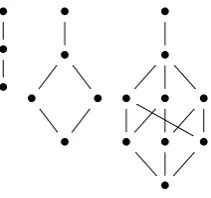
Figure 1. Three inverted lollipops
theorem. We remind the reader of the following well-known modal axioms:
K (ϕ→ψ)→(ϕ→ψ)
Dual ¬♦ϕ↔¬ϕ
T ϕ→ϕ
4 ϕ→ϕ
.2 ♦ϕ→♦ϕ
The modal theoryS4.2is the smallest class of formulas containing all substitution instances of the above axioms and closed under modus ponens and necessitation (in other words, the smallestnormal modal logiccontaining the above axioms). As usual, a preorder is a set P with a reflexive and transitive relation ≤; preorders carry a natural equivalence relation ≡defined by x ≡y : ⇐⇒ x≤ y ≤ x. The ≡-classes are calledclusters. Taking the ≡-quotient of a preorder enforces antisymmetry and makes the preorder into a partial order. We call a preorder a pre-Boolean algebra if its≡-quotient is a Boolean algebra. A preorder (P,≤) is called directed if for anyx, y0, y1∈P ifx≤y0 andx≤y1, then there is az∈P withy0≤zand y1≤z; it isconnected if for any x, y∈P there is a finite sequence (z0, ..., zn) such thatz0 =x,zn =y and for anyi < n, we have
eitherzi≤zi+1orzi+1≤zi; we say that a clusterC⊆P ismaximal if forv∈C
andw≥v, we have w∈C; and we say that a clusterC⊆P isthe top cluster
if for anyv ∈P and w∈C, we have thatv ≤w. Clearly, a preorder that has a top cluster is directed; conversely, if a preorder is directed and connected and has a maximal cluster, then this is the top cluster. Furthermore, we say that a preorder is topped if it has a top cluster consisting of exactly one node; it is
sharp if it is topped and remains directed after removal of the largest element; and, finally, it is an inverted lollipop if it is topped and after removal of the top element, the remainder is a pre-Boolean algebra. (Cf. Figure 1 to see three inverted lollipops and to get an idea why we chose that name.)
A(Kripke) frame is a relational structure (W, R) consisting of a set of nodes (or states or possible worlds) and a binary relation on them. A Kripke model
(i.e., the submodel ofMthat consists of all nodes that can be reached from w
by a finite path via the relationR).
If (W, R) is a frame, a modal assertion is valid for (W, R) if it is true at all worlds of all Kripke models having (W, R) as a frame. IfC is a class of frames, a modal theory is sound with respect to C if every assertion in the theory is valid for every frame inC. A modal theory iscomplete with respect toCif every assertion valid for every frame inC is in the theory. Finally, a modal theory is
characterized byC if it is both sound and complete with respect toC [13, p. 40]. We remind the reader of the technique calledfiltration (cf. [7, pp. 267-268]): if
M= (W, R, V) is a Kripke model and Γ is a subformula-closed set of formulas, we can define an equivalence relation∼ΓonW by saying thatu∼Γvif and only ifuandvagree on the truth values of all formulas in Γ. We defineWΓ:=W/∼Γ and
VΓ(p,[w]∼Γ) :=
V(p, w) ifp∈Γ, 0 otherwise, and say that a Kripke modelM0= (W
Γ, R0, VΓ) is afiltration ofMwith respect
toΓ if for allψ∈Γ andw∈W, we haveM, wψif and only ifM0,[w] ∼Γ ψ. Theorem 1 (Filtration Theorem). For every Kripke model M = (W, R, V)
and every subformula-closed set of formulasΓ, there is a filtrationM0 = (W
Γ, R0, V0)
of Mwith respect to Γ. One such filtration is the minimal filtrationdefined by U R0V if and only if there are u∈U and v∈V such that u R v. Furthermore, ifΓ was finite, then so is WΓ.
We also remind the reader of the technique ofcanonical models(cf. [1, Chapter 4.2]): If Λ is a normal modal theory, then we can construct thecanonical model
(WΛ, RΛ, VΛ) satisfying all of the formulas in Λ whereWΛis the set of maximal Λ-consistent sets of formulas,RΛ is thecanonical accessibility relation, andVΛ is thecanonical valuation.
Theorem 2 (Canonical Model Theorem). Any normal modal theoryΛis
com-plete with respect to its canonical model. That is, for anyϕ6∈Λ, there is a node w∈WΛ such that¬ϕ∈w.
It is easy to see that if Λ ⊇ S4.2 is a modal theory, then the Kripke frame of its canonical model must be reflexive, transitive and directed (i.e., a directed preorder). Furthermore, it is well-known that the class of finite directed preorders characterisesS4.2; Hamkins and the second author have observed that the class of finite pre-Boolean algebras characterisesS4.2 [10, Theorem 11].
We now go beyondS4.2and introduce the following axiomTopas ♦((ϕ↔ϕ)∧(¬ϕ↔ ¬ϕ));
this formula is equivalent overS4.2 to the negation of thecofinal subframe for-mula for the one element frame of a single reflexive node.1 The modal theory
S4.2Topis defined to be the smallest normal modal theory containingS4.2 and
Top.
1A cofinal subframe formula for a finite frameF= (W, R) is a formulaϕ
Lemma 3. Every Kripke model on a finite directed preorder is bisimilar to a
Kripke model on a finite pre-Boolean algebra.
This argument is implicit in the proof of [10, Theorem 11], but since the bisim-ulation was not explicitly given in [10], we include the proof here. Remember from [10, p. 1802] that a partial order is called abaled tree if it has a maximal element and the order after removing the maximal element is a tree. We observe that baled trees are lattices, and so least upper bounds of finite sets of nodes exist. A preorder is called a baled pretree if its≡-quotient is a baled tree. In baled pretrees, we still have least upper bounds, but they are only defined up to
≡-equivalence, so the least upper bound of any finite subset of a baled pretree is a cluster.
Proof. LetM= (W,≤, V) be a Kripke model on a finite directed preorder. By unravelling as in the proof of [10, Lemma 6.5], we can assume without loss of generality that (W,≤) is a baled pretree.
We start by considering the case where (W,≤) is a baled tree. Letr be the root of F, S := F\{r}, and write S = {s0, ..., sn−1}. Let B be the Boolean
algebra of all subsets ofS. For each nonemptya⊆S, letwa be the least upper
bound of a and w∅ := r. We define a valuation on B by V0(a, p) = 1 if and only if M, wa p, and with this, M0 := (B,⊆, V0). This means that in M0,
eacha∈Blooks like the nodewa in M. It is straightforward to check that the
relationB⊆W×Bdefined by (w, a)∈Bif and only ifw=wa is a bisimulation
betweenMandM0.
Now, if (W,≤) is a baled pretree, then the argument is similar except that we may have clusters of ≡-equivalent nodes. We let R be the root cluster,
S = {S0, ..., Sn−1} the set of clusters other than the root cluster and B the
Boolean algebra of subsets of S. For each A ∈ B, let wA be the least upper
bound ofS
A⊆W. As mentioned above,wAis not a node inW, but a cluster.
We now copy this clusterwA toA. The rest of the proof remains the same. a
Lemma 4. Every Kripke model on a frame that is a finite topped preorder is
bisimilar to a Kripke model on a frame that is a finite sharp preorder.
Proof. Let (W,≤) be the finite topped preorder that is the frame of our Kripke model and lettbe its largest node. Build a Kripke model by adding an extra node t0 above t which has the same valuation as t. It is easy to see that the two models are bisimilar, where the bisimulation is the identity on all the nodes which are nott, andtin the old model is matched to bothtandt0 in the
new model. a
Lemma 5. Every Kripke model on a frame that is a finite sharp preorder is
bisimilar to a Kripke model on a frame that is a finite inverted lollipop.
Proof. If (W,≤) is the finite sharp preorder underlying the Kripke model and
t its largest element, then (W\{t},≤) is a finite directed preorder. By Lemma 3, this suborder is bisimilar to a pre-Boolean algebra, and therefore the entire
frame is bisimilar to an inverted lollipop. a
2. the class of sharp preorders,
3. the class of inverted lollipops.
Proof. In all three cases, soundness is easy to check. It is sufficient to show completeness for the class of finite topped preorders: if this is established, then the completeness with respect to the class of sharp preorders follows from Lemma 4; this in turn implies completeness with respect to the class of inverted lollipops by Lemma 5. So, let us focus on completeness for the class of finite topped preorders: letϕ be a formula which is not inS4.2Top. Let M= (W, R, V) be the canonical model ofS4.2Top.
By Theorem 2, let w ∈ W be a node such that ϕ 6∈ w and let MΦ = (WΦ, RΦ, VΦ) be the minimal filtration of M[w] with respect to the finite sub-formula-closed set
Φ ={ψ|ψis a subformula ofϕ}.
By Theorem 1,MΦ is a finite, rooted, connected, and directed preorder andϕ is not valid in (WΦ, RΦ). SinceMΦ is finite, connected and directed, it must have a top cluster. So, it is sufficient to show that this top cluster consists of one element.
Elements ofWΦare∼Φ-equivalence classes ofS4.2Top-maximal consistent sets of formulas. Suppose towards a contradiction that there are two distinct elements of the maximal clusters, t∈WΦ. Sinces6=t, there must bev, w∈W such that
v∈sandw∈t, and ψ∈Φ such thatM, vψand M, w¬ψ, and hence by Theorem 1,MΦ, sψandMΦ, t¬ψ.
SinceMΦ S4.2Top, the ψ-instance of Topis true at every node of MΦ, so in particular ats:
MΦ, s ♦((ψ↔ψ)∧(¬ψ↔ ¬ψ)). Thus, we finduwiths R usuch that
MΦ, u(ψ↔ψ)∧(¬ψ↔ ¬ψ). (*)
Since s was in the maximal cluster, so is u, and thus s, t, and u are all R Φ-accessible from each other; but now (*) implies thatsand tmust agree withu
(and hence with each other) about the truth value ofψwhich they do not. a §3. Modal logics of set-theoretic model constructions. In the follow-ing, we denote the language of propositional modal logic with a countable set of propositional variables byL and the first-order language of set theory by L∈. In [10, 11], the crucial idea for the analysis of the modal logic of forcing and the modal logic of grounds was that an assignment of sentences ofL∈to the proposi-tional variables yields a translation of all formulas inL into sentences ofL∈by interpretingas “in all forcing extensions” or “in all grounds”. These two cases are rather special since the meta-quantifiers “for all forcing extensions” and “for all grounds” are expressible in L∈.2 In general, this is not true and thus the translations for other relations between models of set theory do not give formu-las inL∈. The natural setting for this is second-order set theory. In this paper,
2In the case of “for all forcing extensions”, this is just the Forcing Theorem [15, Theorem
we emulate second-order set theory by restricting our attention to transitive set sized models ofZFCinside a fixed meta-universeV. We write tsmst(M) for the
L∈-formula stating thatM is a transitive set modellingZFC.
In this situation, fix an assignment T assigning a sentence of L∈ to every propositional variable and let Γ be an arbitrary L∈-formula in two free vari-ables. By recursion in the surrounding set-theoretic universe V, we define for any transitive set sized modelM ZFC,
M TΓ p:⇐⇒ M T(p),
M TΓ ϕ∧ψ:⇐⇒ M TΓ ϕandM TΓ ψ, M TΓ ϕ∨ψ:⇐⇒ M TΓ ϕorM TΓ ψ,
M TΓ ¬ϕ:⇐⇒ notM TΓ ϕ, and
M TΓ ϕ:⇐⇒ ∀N((Γ(M, N)∧tsmst(N))→N TΓ ϕ). For every transitive setM ZFC, we can now define
MLΓM :={ϕ∈ L; for all assignmentsT, we haveM TΓ ϕ} and
MLΓ :=\{MLΓM; tsmst(M)}.
We define two particular cases of Γ:
IM(M, N) :⇐⇒ N ⊆M∧OrdM = OrdN and
G(M, N) :⇐⇒ ∃B∈N∃G(N “Bis a complete Boolean algebra”, GisB-generic overN, and M =N[G]).
By general forcing theory, we have that G(M, N) implies IM(M, N), but more is true:
Proposition 7. Let M0, M1, and M2 be transitive set sized models of ZFC.
If IM(M1, M0),IM(M2, M0), andG(M2, M0), then G(M2, M1).
In order to prove Proposition 7, we need the following well known theorem due to Grigorieff [15, Lemma 15.43]:
Theorem 8 (Grigorieff). Let M0 be a model ofZFC. Let B∈M0 be a
com-plete atomless Boolean algebra. LetH be M0-generic forB andM0[H] the cor-responding generic extension. Let M1 be an inner model of M0[H] such that
M0⊆M1⊆M0[H]. Then there is a complete atomless Boolean subalgebra Cof Bin M0 such that M1=M0[C∩H].
Proof of Proposition 7. Let M0, M1, and M2 be as in the statement. Theorem 8 gives that G(M1, M0), and the Boolean algebra witnessing this is a complete atomless Boolean subalgebra of the Boolean algebra witnessing G(M2, M0). By [15, Exercise 16.4], this implies G(M2, M1). a
Proposition 9. Let Γbe a relation between models of set theory. 1. If Γis reflexive, then Tis valid for MLΓ.
2. If Γis transitive, then 4 is valid for MLΓ.
3. If Γis directed, then .2 is valid for MLΓ.
4. If Γis topped, thenTop is valid for MLΓ.
Proposition 10. The relationIMis reflexive and transitive. For any
transi-tive set sized modelM ZFC, the relationIMrestricted to the generated subframe of M is directed and topped. Hence,S4.2Top⊆MLIM.
Proof. It is easy to see that reflexivity and transitivity hold. Since every relation that is topped is directed, we only need to show that IM restricted to the generated subframe of M is topped: for this, consider LM which is equal toLOrdM (whereLis the constructive universe inside our ambient set-theoretic universe). The modelLM an inner model of every transitive set model of height
OrdM. a
Since it makes our definitions considerably easier, from now on, assume that the (possibly class-sized) relation Γ is reflexive and transitive.
Definition 11. Let (F,≤F) be a Kripke frame. A Γ-labellingofFfor a model
of set theoryW is an assignment to each nodewinF a set-theoretic statement Φwsuch that
1. The statements Φw form a mutually exclusive partition of truth in the
multiverse of W generated by Γ. That is, ifW0 is in the multiverse of W
generated by Γ, thenW0 satisfies exactly one of the Φw.
2. AnyW0 in the multiverse ofW generated by Γ in which Φwis true satisfies
♦ΓΦu if and only ifw≤F u.
3. Ifw0is an initial element of F, thenW Φw0.
The formal assertion of these properties is called the Jankov-Fine formula for
F (cf. [10]). The next theorem, which is from [9] (which itself generalises a result from [10]), is our main technique to calculate upper bounds forMLΓ.
Theorem 12. Suppose thatw7→Φwis aΓ-labelling of a finite Kripke frameF for a model of set theoryW and thatw0is an initial element ofF. Then for any
modelM based on F, there is an assignment of the propositional variables to set theoretic assertions p7→ψp such that for any modal assertion ϕ(p0, p1, . . . , pn),
(M, w0)ϕ(p0, p1, . . . , pn)iffW ϕ(ψp0, ψp1, . . . , ψpn).
In particular, any modal assertion that fails at w0 in M also fails in W under
thisΓ-interpretation. Consequently, the modal logic ofΓoverW is contained in the modal logic of assertions valid in F.
We use so-calledcontrol statementsin order to prove the existence of labellings as in Theorem 12. In [10] and [9], the notions of buttons and switches were introduced; here, we need conditional variants of these.
Let M be a transitive set such that M ZFC. A pure Γ-button over M is a sentence σ of L∈ such that for every assignment T with T(p) = σ, we have that M T
Γ ♦pand M TΓ (p→p). We say thatσ is unpushed inM if
We say that τ is called a Γ-σ-switch over M if, for any transitive set M0 ZFC∧ ¬σ such that Γ(M, M0), there are transitive sets N and N0 such that
N ZFC∧ ¬σ∧τ andN0 ZFC∧ ¬σ∧ ¬τ. Equivalently, for any assignmentT
such thatT(p) =σandT(q) =τ, we haveM T
Γ (¬p→♦(¬p∧q)∧♦(¬p∧¬q)). A statement τ is called a pure Γ-σ-button over M if, for any assignment T
such thatT(p) =σand T(q) =τ, we have M TΓ (p→q)∧((¬p∧ ¬q)→
♦(¬p∧q))∧(q→q).
A finite familyS ={s0, ..., sn, b0, ..., bm} of Γ-σ-switchess0, ...,sn and pure
Γ-σ-buttons b0, ..., bm over M is called independent if for any transitive set M0
ZFCsuch that Γ(M, M0) the following hold:
1. for any 0≤i≤n, ifM0 ¬σ, then there are transitive setsN andN0such that Γ(M0, N), Γ(M0, N0),N
ZFC∧ ¬σ∧si, N0 ZFC∧ ¬σ∧ ¬si, and
for anyc∈ S\{si}, M0c if and only ifN c if and only ofN0c;
2. for any 0≤i≤m, if M0 ¬σ, then there is a transitive setN such that Γ(M0, N),N ZFC∧ ¬σ∧bi, and for any c∈ S\{bi},M0 c if and only
ifNc.
We omit Γ from the notation when it is clear from the context.
Theorem 13. Let Γ be a formula defining a reflexive and transitive relation between transitive setsN ZFC, and letM be a model ofZFCsuch that there is an unpushed pure button σ inM. Suppose that there are arbitrarily large finite families of mutually independent unpushed σ-buttons and σ-switches over M. Then any inverted lollipop can be labelled overM, and hence the valid principles of MLΓM are contained withinS4.2Top.
Proof. We show the first part. The second part then follows from the con-junction of Theorems 6 and 12.
LetLbe a frame which is an inverted lollipop. LetF be the quotient partial order of L under the natural equivalence relation. Then F is a finite Boolean algebra with a single extra node on top; in particular, F is a topped partial order. Therefore, the partial order of non-maximal elements ofF is isomorphic to the power set algebra℘(A) for some finite setA. We fix such a setA.
With each elementa∈F which is not maximal, there is associated a cluster
wa
1, wa2, . . . waka of worlds ofL. By adding dummy nodes to each cluster, we may assume that there is some natural number m such that for each non-maximal
a∈F, the sizeska of the complete clusters at nodeaare the same, and equal to
2m. Also, suppose thatF has size 2n+ 1, that is, the size ofAisn, so there are
natoms in the Boolean algebra of non-maximal elements ofF. We can therefore think of the Boolean algebra of non-maximal elements of F as the worlds wja
where a⊆ A, and j <2m, with the order obtained by wja ≤wci if and only if
a ⊆c. Also, since F consists exactly of this pre-Boolean algebra and a single extra node above every element of it, we can consider F as being made up of worldswa
j wherea⊆A, andj <2m, with the order obtained bywja≤wci if and
only ifa⊆c, and a nodetwithwa
j ≤t for eachaandj.
Associate with each element i ∈ A an unpushed pure σ-button bi such that
the collection {bi | i ∈ A} form a mutually independent family with m-many σ-switchess0, s1, . . . sm−1. Forj <2m, let ¯sj be the assertion that the pattern
kth binary bit of j is 1). We associate the nodewa
j with the assertion
Φwa
j =¬σ∧(
^
i∈a
bi)∧s¯j,
and we associate the nodet with the assertion Φt=σ. Clearly, we can assume
that all of the switches are off. Now, if W is a model in the multiverse of Γ generated by M, and W Φwa
j, then by the mutual independence of buttons and switches combined with our remark that pushing these buttons cannot push the buttonσ, we see thatW Φwc
r if and only if a⊆c.
Also, for any model W in the multiverse of M generated by Γ, if W ¬σ, then as σ is itself a button, it follows that W ♦Φt. Therefore, if W Φwa
j, then W Φt. Also, since all of these buttons and switches are off in M, we
haveM Φw∅
0. Thus, we have provided a Γ-labelling of this frame forW, hence demonstrating that we can label all inverted lollipops. The result follows. a
§5. The modal logic of inner models. In [19], Reitz constructed a bot-tomlessmodel in which there is a class-sized descending sequence of grounds and which is not a set forcing extension of the constructible universeL. Furthermore, we know that in this model, the relation G is reflexive, transitive and directed. This was used in [11] to calculateMLG in that model to beS4.2; we are reusing parts of this proof in our main result.
Definition 14. Letκbe a regular cardinal. The forcing poset Add(κ) which adds aCohen subset of κis the following:
1. p∈Add(κ) if pis a function and there is a γ < κ such that dom(p) =γ
and ran(p)⊆ {0,1}.
2. Ifp, q∈Add(κ), thenp≤qifp⊆q.
Definition 15. Let SuccL denote the class of infinite successor cardinals in L. Define inLthe following (class-sized) partial order with Easton support:
P:=
Y
γ∈SuccL
Add(γ).
That is,p∈Pif
1. pis a class function such that dom(p) = SuccL; 2. For eachγ∈SuccL,p(γ)∈Add(γ);
3. For each suchp, for each regular cardinalγ,|{λ∈SuccL|p(λ)6= 0}∩γ|< γ
(the class{γ∈SuccL|p(γ)6= 0} is called to be thesupport ofp). The ordering is defined byp≤q ifp⊆q.
Also, for eachp∈Pand eachγ∈SuccL, we can decomposepinto three parts: p<γ =p[0, γ);
Using this decomposition, for each γ ∈SuccL, we can decompose P into three parts:
P<γ ={p<γ|p∈P}; Pγ ={pγ |p∈P}; P>γ ={p>γ|p∈P}.
It is clear thatP∼=P<γ×Pγ×P>γ.
Theorem 16. Assume V=L. Let γ be an infinite successor cardinal. Let
Qγ:=P<γ×P>γ. Then forcing with Qγ does not add a Cohen subset ofγ.
Proof. Since P>γ is clearly ≤ γ-closed, we only need to show that forcing
with P<γ does not add a Cohen subset ofγ. Suppose towards a contradiction
that this is not so. LetL[G] be a generic extension byP<γ such that S∈L[G]
is a Cohen subset ofγ. Therefore, for eachα < γ, S∩α∈L. UsingGCH, it is easy to see that|P<γ|< γ.
Recall that for a regular uncountable cardinalδ and transitive setsM ⊆N
that are models ofZFCof the same height,M is said to have theδ-approximation property inN if for every cardinalκsuch that cf(κ)≥δand every ⊆-increasing sequence inN of sets hXα|α < κifromM, its unionS{Xα;α < κ} ∈M. By
[21, Lemma 4], we know thatLhas theγ-approximation property inL[G]. But then,S=S
α<γ(S∩α), andhS∩α|α < γiis a⊆-increasing sequence of
lengthγof elements ofL, and hence,S∈L, which is a contradiction. Therefore, forcing withP<γ does not add any Cohen subsets ofγ. a
Fix any transitive setM ZFC, considerPto be defined inLM, and letGbe
LM-generic for
P, and let R :=LM[G]. Ifγ is an infinite successor cardinal of
LM, we writeG>γ:=G∩P>γ. Let
τR:=∀κ∈SuccLM∃G⊆κ(Gis anLM-Cohen subset of κ) and
σR:=∀B[(Bis a complete atomless Boolean algebra)→(kτRk
B6= 1B)].
Clearly, R τR and for any N with IM(R, N) we have that G(R, N) if and only ifN ¬σR. So,σR expresses that a model where it is true is a ground of R. Hence, if N σR is an inner model ofR, then by Proposition 7, no further
inner model ofN can be a model of ¬σR. Hence, σR is a pure IM-button (and
unpushed inR).
Lemma 17. Let N be a ground of R. Then in LM, there is an infinite
suc-cessor cardinal γ such that N ⊇LM[G
>γ]. In particular, LM[G>γ] is a ground (and hence, an inner model) of N.
Proof. Towards a contradiction, suppose this is not so. Let Q ∈ N be a
forcing poset and let H be Q-generic over N such that R = N[H]. For some
infinite successor cardinalγ large enough, letxbe a name forG>γ. Letp∈Q
be such that
p“xisP>γ-generic overLM”.
By assumption, G>γ is a function of size OrdM which is not inN, but in a
decide only a set sized initial segment of G>γ. However, inN, for everyβ > α,
there is ar≥psuch thatrdecidesG>γ(γ, β). Therefore, we can form a strictly
increasing chain of length OrdM = OrdN of conditions inQ, thus contradicting
that it is a set inN. a
Lemma 18. InR, there are arbitrarily large finite independent families ofσR
-switches andσR-buttons. Consequently,MLIMR=S4.2Top.
Proof. We use control statements from [11, Theorem 6]. Letbnbe the
state-ment “there is noLM-generic subset ofℵLM
n ”. Partition the successor cardinals
in LM above ℵω into ℵ0-many classes, hΓnin∈ω such that each class contains
unboundedly many cardinals. Enumerate each class as Γn ={γαn |α∈Ord M
}. Letsn be the statement “the leastαsuch that there is anLM-generic subset of γn
α is even”. In [11, Theorem 6], it was shown that these are G-switches which
in our setting means that they are IM-σR-switches. We use Theorem 16 to see
that the family of thebn andsn is an independent family of IM-σR-buttons and
IM-σR-switches. As mentioned above,σR is a pure button; so we can appeal to
Theorems 13 and 6 to see that we are done. a
This, together with Proposition 10 gives us our main theorem:
Theorem 19. If there is a transitive setM ZFC, then MLIM =S4.2Top.
REFERENCES
[1]Patrick Blackburn, Maarten de Rijke,andYde Venema,Modal logic, Cambridge Tracts in Theoretical Computer Science, vol. 53, Cambridge University Press, Cambridge, 2001.
[2]Alexander Chagrov and Michael Zakharyaschev, Modal logic, Oxford Logic Guides, vol. 35, Clarendon Press, 1997.
[3]Leo Esakiaand Benedikt L¨owe,Fatal Heyting algebras and forcing persistent sen-tences,Studia Logica, vol. 100 (2012), no. 1-2, pp. 163–173.
[4]Sy Friedman, Saka´e Fuchino, and Hiroshi Sakai, On the set-generic multiverse, 2012, Submitted.
[5]Gunter Fuchs,Closed maximality principles: implications, separations and combina-tions,The Journal of Symbolic Logic, vol. 73 (2008), no. 1, pp. 276–308.
[6] ,Combined maximality principles up to large cardinals,The Journal of Sym-bolic Logic, vol. 74 (2009), no. 3, pp. 1015–1046.
[7]Valentin Goranko and Martin Otto, Model theory of modal logic, Handbook of modal logic(Patrick Blackburn, Johan F. A. K. van Benthem, and Frank Wolter, editors), Studies in Logic and Practical Reasoning, vol. 3, Elsevier, 2007, pp. 249–330.
[8]Joel David Hamkins, Some second order set theory, Logic and Its Applications. Third Indian Conference, ICLA 2009, Chennai, India, January 7-11, 2009. Proceedings
(R. Ramanujam and Sundar Sarukkai, editors), Lecture Notes in Computer Science, vol. 5378, Springer, Berlin, 2009, pp. 36–50.
[9]Joel David Hamkins, George Leibman,andBenedikt L¨owe,Structural connections between a forcing class and its modal logic,to appear in the Israel Journal of Mathematics.
[10]Joel David HamkinsandBenedikt L¨owe,The modal logic of forcing,Transactions of the American Mathematical Society, vol. 360 (2008), no. 4, pp. 1793–1817.
[12]Joel David HamkinsandW. Hugh Woodin,The necessary maximality principle for c.c.c. forcing is equiconsistent with a weakly compact cardinal,Mathematical Logic Quar-terly, vol. 51 (2005), no. 5, pp. 493–498.
[13]George E. Hughes and Max J. Cresswell,A new introduction to modal logic, Routledge, London, 1996.
[14]Tanmay C. Inamdar,On the modal logics of some set-theoretic constructions, Mas-ter’s thesis, Universiteit van Amsterdam, 2013, ILLC Publications MoL-2013-07.
[15]Thomas Jech,Set theory, third millennium ed., Perspectives in Mathematical Logic, Springer-Verlag, 2003.
[16]Richard Laver,Certain very large cardinals are not created in small forcing exten-sions.,Annals of Pure and Applied Logic, (2007), pp. 1–6.
[17]George Leibman, Consistency strengths of modified maximality principles, Ph.D. thesis, City University of New York, 2004.
[18] ,The consistency strength of MPCCC(R), Notre Dame Journal of Formal Logic, vol. 51 (2010), no. 2, pp. 181–193.
[19]Jonas Reitz,The ground axiom,Ph.D. thesis, City University of New York, 2006. [20]Colin Jakob Rittberg, The modal logic of forcing, Master’s thesis, Westf¨alische Wilhelms-Universit¨at M¨unster, 2010.
[21]W Hugh Woodin, Jacob Davis,andDaniel Rodr´ıguez,The HOD dichotomy, Ap-palachian set theory: 2006-2012(James Cummings and Ernest Schimmerling, editors), Lon-don Mathematical Society Lecture Notes, vol. 406, Cambridge University Press, 2012, pp. 397– 419.
(T. Inamdar)SCHOOL OF MATHEMATICS, UNIVERSITY OF EAST ANGLIA, NORWICH RESEARCH PARK, NORWICH NR4 7TJ, UNITED KINGDOM
E-mail: [email protected]
(B. L¨owe)INSTITUTE FOR LOGIC, LANGUAGE AND COMPUTATION, UNIVERSITEIT VAN AMSTERDAM, PLANTAGE MUIDERGRACHT 24, 1018 TV AMSTERDAM, THE NE-THERLANDS
(B. L¨owe)FACHBEREICH MATHEMATIK, UNIVERSIT ¨AT HAMBURG, BUNDESSTRASSE 55, 20146 HAMBURG, GERMANY