Contents lists available atScienceDirect
LWT - Food Science and Technology
journal homepage:www.elsevier.com/locate/lwt
E
ff
ect of drying and extrusion processing on physical and nutritional
characteristics of bilberry press cake extrudates
Evelina Höglund
a,∗, Lovisa Eliasson
a, Gabriel Oliveira
b, Valérie L. Almli
c, Nesli Sozer
d,
Marie Alminger
baRISE Research Institutes of Sweden, Agrifood and Bioscience, Box 5401, 40229 Göteborg, Sweden
bChalmers University of Technology, Department of Biology and Biological Engineering, 412 96 Göteborg, Sweden cNofima AS, P.O. Box 210, 1431 Ås, Norway
dVTT Tecnhical Research Centre of Finland Ltd, Tietotie 2, Espoo, Finland
A B S T R A C T
Mild drying and extrusion processing of side streams from berry juice production can enable retention of va-luable compounds in the food chain and reduce waste production. The aim of this study was to evaluate the applicability of using hot air (HA) and microwave assisted hot air (MWHA) drying combined with extrusion for conversion of bilberry press cake into value-added extruded food products. Bilberry press cake was dried at 40 °C by HA and MWHA drying to a moisture content of 17 g/100 g. A twin screw extruder (average feed rate 72 g/ min, temperature profile 135-128-89-69 °C) was used to extrude products containing organic wholegrain rye flour and 10% or 25% dried bilberry press cake powder. A consumer panel (n = 15) evaluated four extrudates on hedonic and Just-About-Right (JAR) scales, with a main focus on texture properties. The results indicate that different drying techniques implied a difference in processing time (40% reduction with MWHA drying). However, the retention of total phenolics and physical characteristics of extruded snacks containing bilberry powders were independent of drying techniques. In sum, powder of bilberry press cake can be incorporated in cereal based extruded snacks with enhanced phenolic content and potential for palatable sensory properties.
1. Introduction
Berries are perishable seasonal products and the shelf-life of fresh berries is normally short. In general, half of fresh fruit and vegetable production is lost before consumption (Gustavsson & Stage, 2011). To increase the commercial value and reduce waste it is reasonable to process berries into more stable products. Drying is a commonly used preservation method for fruits and vegetables, enabling extended shelf life as well as formulation of fruit and vegetable based products (Jangam, Law, & Mujumdar, 2010). In the juice industry, the press cake left after juice extraction may account for approximately 30 g/100 g of the dry solids of the berries (Kryeviciute, Kraujalis, & Venkutonis, 2016). Hence, the side streams from berry juice production may be upgraded into value-added products to achieve sustainable production chains. Grzelak-Blaszczyk, Karlinska, Grzeda, Roj, and Kolodziejczyk (2017)studied utilization of strawberry press cake and concluded that it can be used as a food additive high in protein,fibre and polyphenol content which contributes to improved sustainability of the fruit in-dustry. Bilberries (Vaccinium myrtillus L.), wild growing berries in
northern Europe and North America, are naturally rich in polyphenols such as anthocyanins (Mikulic-Petkovsek, Schmitzer, Slatnar, Stampar, & Veberic, 2015) which have been reported to contribute to prevention of a number of diseases such as type 2 diabetes and cardiovascular diseases (Pojer, Mattivi, Johnson, & Stockley, 2013). After extraction, the press cake is composed of mainly skins and seed and with them a large part (58 g/100 g) of the phenolic compounds present in the ber-ries (Dinkova et al., 2012). Dried press cakes from juice production also contains dietaryfibre (ca 68 g/100 g), protein (ca 15 g/100 g) and lipids (Struck, Plaza, Turner, & Rohm, 2016). Berries and berry press cake can be dried and milled into stable and convenient powder products, which can be further used as ingredients in the food industry (Figuerola, 2007), such as in extruded snacks and cereals. The addition of bilberry press cake to extruded cereals and snacks brings addedflavour as well as higher nutritional value, as the majority of the existing extruded snacks on the market have high carbohydrate, sugar and lipid content and poor nutritional value.
The choice of processing methods and conditions has large impact on the characteristics of fruit and vegetable products such as
https://doi.org/10.1016/j.lwt.2018.02.042
Received 11 October 2017; Received in revised form 11 January 2018; Accepted 15 February 2018 ∗Corresponding author.
E-mail address:[email protected](E. Höglund).
Available online 17 February 2018
0023-6438/ © 2018 Elsevier Ltd. All rights reserved.
microstructure,flavour and micronutrient retention, textural properties etc (Van Buggenhout et al., 2012). Hot air (HA) drying is a technique commonly used for berry preservation. Microwave assisted hot air (MWHA) drying, on the other hand, uses microwaves together with hot air to increase drying efficiency and decrease drying time. The drying mechanism is different from HA drying since the microwaves penetrate the product and create internal temperature increase. The latter may affect the microstructure of the dried products and hence,flavour and micronutrient retention. Drying processes using different methods have previously been reported to have significant effects on the degradation of bioactive compounds in berries (Zielinska & Michalska, 2016). Dried berry materials may be further used as food ingredients in for example extruded products. Extrusion processing is a continuous short time high shearing technology, which consists of subsequent series of mixing, forming, puffing and drying processes. It is a useful tool to design ex-panded ready-to-eat foods (snacks, cereals, etc.) or to modify food in-gredients. The extrusion process leads to irreversible changes such as denaturation of proteins and formation of starch-lipid, protein-lipid and protein-protein complexes (Sozer & Poutanen, 2013, pp. 256–272). The aim of this study was to evaluate the applicability of pre-treatments using HA and MWHA drying combined with extrusion for conversion of bilberry press cake into value-added extruded food products.
2. Materials and methods
2.1. Raw material
Bilberry (Vaccinium myrtillus L.) press cake, produced by cold pressing without enzymatic treatment, was supplied by Kalix Syltfabrik AB (Kalix, Sweden). The bilberry press cake contained skin and seeds and had a moisture content of 75.6 g/100 g ± 0.5 g/100 g, and was stored in the dark at−40 °C until use. The press cake was thawed in closed, opaque containers at 20 °C overnight (15 h) prior to drying.
2.2. Drying and milling
Bilberry press cake was dried at 40 °C in the absence of light by HA drying and MWHA drying to a moisture content of 17 g/100 g. The target moisture content of 17 g/100 g was chosen to achieve a powder that was dry enough to be included in an extrusion formula, but at the same time the drying time was kept as short as possible to limit energy consumption in a manufacturing process and avoid extensive losses of phenolic compounds and aroma. After drying, the material was stored in sealed polyamide/polyethylene plastic pouches in the dark at−40 °C until milling. In order to obtain enough dried material for extrusion trials HA and MWHA drying was carried out in two batches, conducted on two subsequent days. After drying, the batches were mixed before milling. The HA drying was realized in a conventional hot air oven (Garomat 142 Electrolux, Stockholm, Sweden), where two trays (size 21 × 30 cm) with approximately 1250 g bilberry press cake in each were placed in the middle of the oven. The fan of the oven created an air velocity of 6.1 m/s. The MWHA drying was performed according to the procedure and system described byKerbstadt et al. (2015). In brief, 1250 g bilberry press cake was loaded in the microwave cavity (TIVOX Automation AN, Tidaholm, Sweden) that was connected to an air heating unit with a fan (HONEYWELL INU control AB, Borås, Sweden) resulting in an air speed of 0.8 m/s in the middle of the cavity. The microwave power, of maximum 1000 W, was supplied by Magdrive-1400 (Tivox, Tidaholm, Sweden), with wavelength of approximately 0.12 m at a frequency of 2450 MHz. To keep the desired treatment temperature, the microwave power was regulated automatically by the software MagDrive c3.1 (Tivox Maskin AB, Tidaholm, Sweden) de-pendent on the sample temperature that was measured byfibre optic temperature probes (Neoptix Inc., Quebec, Canada). The dried press cake was milled using a coffee mill (Ascaso i-I, Ascaso, Barcelona, Spain). The milled material was stored in sealed polyamide/
polyethylene pouches in the dark at−40 °C until further analysis or shipment to the sites for micronutrient analysis or extrusion.
2.3. Moisture content, water activity and particle size distribution
Moisture content of bilberry press cake, dried material, and dried and milled material were measured gravimetrically in a vacuum oven (Sanyo Gallenkamp, Loughborough, UK). The analysis was done in triplicates by drying of approx. 2.5 g sample at 80 °C and 900 mbar in aluminum dishes until constant weight. The water activity was mea-sured in triplicates using an Aqua Lab 4 TE (Decagon Devices, Pullman, Washington, USA). Determination of the particle size distribution of the powder was done by a vibratory sieve-shaker (Analysette 3, FRITSCH, Idar-Oberstein, Germany) with sieves of mesh sizes 250μm, 500μm, 710μm and 1250μm. The sieve shaking was run for 10 min at an am-plitude of 1.5 mm and with an interval of 10 s. Particle size analysis was done in duplicate with about 20 g of powder each time.
2.4. Extrusion
Extruded puffs were prepared by substituting organic wholegrain ryeflour (Fazer Mills, Finland) with 10% and 25% bilberry press cake powders. A reference extruded puffwas prepared by using only organic wholegrain ryeflour. A twin screw extruder (APV MPF 19/25, Baker Perkins Group Ltd, Peterborough, UK) with an average feed rate of 72 g/min and temperature profile of 135-128-89-69 °C was used, to-gether with a co-rotating twin screw feeder (K-Tron Soder, Niederlenz, Switzerland). The die diameter and screw speed were 3 mm and 360 rpm for all extrusion trials. Water feed rate was set to 3.7 g/min only for wholegrain ryeflour and the rest of samples were extruded without any water addition as thein situ moisture content of berry powder was sufficient for extrusion processing. The moisture content of the feed materials were 11 ± 0.07 g/100 g, 11.6 ± 0.02 g/100 g and 12.5 ± 0.01 g/100 g, for organic wholegrain ryeflour, wholegrain rye flour supplemented with 10% and 25% billberry press cake powder, respectively. Specific mechanical energy (SME) is an important process parameter used to describe processing conditions and was calculated with Eq.(1).
(Hu, Hsieh, & Huff, 1993):
⎜ ⎟
⎛ ⎝
⎞ ⎠
= ∗ ∗
SME kWh kg
w w
τ Z Q
100 r
r
(1) whereωis the screw speed (in rotations per minute, rpm),ωris the maximum screw speed of the extruder used (500 rpm),τis the torque (in percent), Zris the maximum power capacity of the extruder (2 kW) and Q is the feed rate (in kilogram per hour). Extruded products were collected continuously from the die exit after manually cutting to a 20 cm length with scissors and dried immediately in an oven for 10 min at 100 °C. Extrusion processing was performed in duplicate.
2.5. Stereomicroscopy
For the stereomicroscope imaging of the radial cross-sections of the extrudates, the samples were cut into 10 mm pieces with an electric saw (Power ST-WBS800, Taiwan Sheng Tsai Industrial Co. Ltd., Taiwan) and examined under a SteREO Discovery. V8 stereomicroscope with an Achromat S 0.5 × objective (Carl Zeiss MicroImaging GmbH, Göttingen, Germany) and imaged using a DP-25 single chip colour CCD camera (Olympus Life Science Europa GmbH, Hamburg, Germany) and the CellˆP imaging software (Olympus).
2.6. Macrostructural analysis
samples were obtained. The measurements were made from 20 re-plicates from each extrusion treatments using the method described by Alam et al. (2014).
Expansion rate was calculated with Eq.(2):
= D × D
Expansion rate (%) e 100%
d (2)
whereDeis the average diameter measured at three different points of
the extrudate sample (mm) andDdis the diameter of the die (3 mm).
Specific length was calculated with Eq.(3):
= L m
Specific length (m/kg) e
e (3)
whereLeis the length of the extrudate sample (m) andmeis the mass of
the sample (kg). Piece density was calculated with Eq.(4):
= ×
× ×
Piece density m
π D L
(kg/m ) 4
( ) e
e e
3
2 (4)
whereme is the mass of the sample (kg),De is the average diameter
measured at three different points of the extrudate sample (m) andLeis
the length of the extrudate sample (m).
2.7. Textural properties
Mechanical properties of extrudates were analyzed by uniaxial compression test using a texture analyser (Texture Analyser TA-HDi, HD3071, Stable Micro Systems, United Kingdom) equipped with a 30 kg load cell and a cylindrical 36 mm aluminium probe. Samples of 10 mm length were cut and equilibrated at a relative humidity (RH) of 43% at 21 °C. The samples were deformed at 70% strain with a test speed of 1 mm/s. The force-deformation (f-d) curve was obtained to assess the mechanical characteristics of the extrudate samples. Each measurement was performed with 20 replicates. Texture Exponent software v.5.1.2.0 (Stable Micro Systems, UK) was used to obtain values of actual and smoothed curve length, area under the f-d curve (A), number of peaks, crushing force (A/distance of compression) and hardness (Fmax).
Different approaches were used to describe the crispiness of extrudates, such as crispiness work (Cw, Eq.(5)) and crispiness index (Ci, Eq.(6)). High crispiness was accompanied by lowCwand highCivalue, whereas low crispiness corresponded to highCwand lowCivalue (Alam et al., 2014; Sibakov et al., 2015).
Crispiness work was calculated with Eq. (5)(Van Hecke, Allaf, & Bouvier, 1998):
=
C A
N
(N mm)
w (5)
whereAis the area under the f-d curve (N mm) andNis the number of peaks.
Crispiness index was calculated with Eq. (6)(Heidenreich, Jaros, Rohm, & Ziems, 2004):
= ×
C L
A F
i N
mean (6)
whereLNis the normalized curve length (length of actual curve/Fmax),A
is the area under the f-d curve (N mm) andFmeanis the sum of the actual
force values divided by the number of peaks (N).
2.8. Dietaryfibre analysis of extrudates
Insoluble, soluble and total dietaryfibre contents of extrudates were determined according to Megazyme rapid integrated total dietaryfibre assay procedure (K-RINTDF 09/16 Megazyme, Ireland) combining key attributes of AOAC Official Methods 2002.02, 985.29, 991.43 and 2001.03. Duplicate test portions of each sample (1 g) were incubated with pancreatic α-amylase (PAA) and amyloglucosidase (AMG) for 4 h at 37 °C, thus non-resistant starch was solubilized and hydrolysed
intoD-glucose and maltose. The reaction was terminated by adjusting pH to 8.2 and heating to 95 °C to inactivate both PAA and AMG. Proteins in the samples were denaturated and digested with protease. After this step soluble, insoluble and accordingly total dietary fibre contents were determined as described in detail in the Megazyme assay procedure.
2.9. Total phenolic content
The extractions and measurements of phenolics were made ac-cording to methods for extraction and analyses described byHoward, Clark, and Brownmiller (2003)andBarnes, Nguyen, Shen, and Schug (2009), with some modifications. Frozen extruded snacks consisting of ryeflour with and without added bilberry powders were freeze-dried and ground to smallest possible particle size using a mortar. Triplicate samples (0.2 ± 0.015 g) were extracted in screw-cap tubes with me-thanol/water/Trifluoroacetic acid (70:30:1 (v/v)). The samples were vortexed for 15 s followed by sonication for 2 × 5 min and incubation for 30 min (60 °C, 100 rpm). After cooling on ice the tubes were vor-texed again for 15 s and centrifuged at 5000 g for 5 min at 4 °C. Su-pernatants were collected and the remaining pellets were re-dissolved in 5 ml extraction solution. After vortexing for 15 s and sonication (2 × 5 min) and centrifugation (5000 g, 5 min, 4 °C) the 2 supernatants were combined. The phenolic content of the extracts was determined spectrophotometrically with Folin-Ciocalteu's reagent against a stan-dard curve of gallic acid and measuring absorbance at 765 nm2on a Safire plate reader (TECAN) with Magellan software. The results are expressed in mg gallic acid equivalents in g of dry weight (mg GAE/g). The dry weight was determined by duplicate measurements on a dry matter analysis scale.
2.10. Consumer evaluation
The four extruded samples containing bilberry powder were eval-uated using a convenience consumer panel of 15 participants, three men and 12 women between 20 and 60 years old recruited among colleagues external to the project at Chalmers University of Technology. This panel was used with the aim to perform a feasibility study, an-swering the needs of early stages in a product development process. The low number of consumers involved may not be used to draw conclu-sions from a representative statistical point of view, but to provide in-itial insights on the perceived texture variations and palatability of the extruded samples. The samples were coded with 3-digit random num-bers and presented together with a score-card in a randomized balanced order to each participant (MacFie, Bratchell, Greenhoff, & Vallis, 1989). For each sample, a 9-point hedonic rating scale (1 = extremely bad, 5 = neither good nor bad, 9 = extremely good) wasfirst used to eval-uate overall liking, appearance, taste and texture. Then, a Just-About-Right (JAR) scale (Lawless & Heymann, 2010) was used to provide a subjective quantitative evaluation of specific texture attributes: crisp-ness, porosity, stickiness and hardness (1: Far from [crispy] enough, 5: Just about right, 9: Far too [crispy]). Drinking water was provided for mouth rinsing between samples. All samples were presented in blind condition, i.e. without any information about processing or ingredients content.
2.11. Statistical methods
only 15 consumers joined the feasibility study, significance testing in this case is very conservative. No significant effects were detected at a 5% level and one effect was detected at a 10% level. In order to report on favourable directions to follow in future product development phases, focus will be made on reporting the largest size effects as well as results at a significance level of 20%.
3. Results and discussion
3.1. Characteristics of dried bilberry press cake
Bilberry press cake qualified as a suitable raw material for drying and subsequent processing since the skin of the berries had already
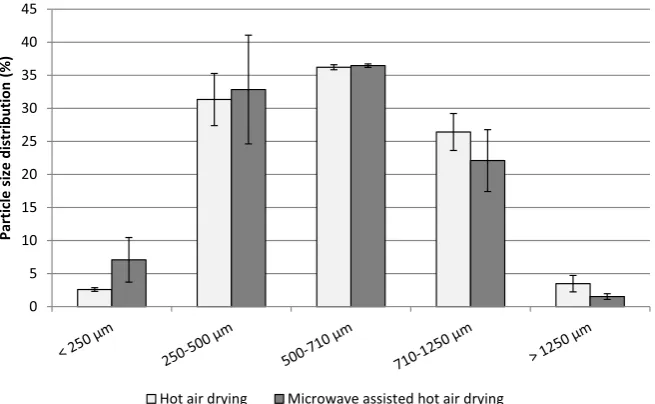
[image:4.595.135.463.55.257.2] [image:4.595.37.290.328.438.2]been broken facilitating water removal, and due to low sugar levels after juice separation which reduced stickiness of the berry material. Moisture content, water activity and total phenolic content of the dried materials is presented inTable 1. HA drying of bilberry press cake at 40 °C resulted in the longest drying time (360 min) while for MWHA drying the drying time was 215 min. Hence, MWHA drying enabled a 40% reduction in drying time compared to HA drying. While HA drying consists of heating from the outside towards the core by convection and conduction, microwave drying is based on internal temperature rise due to electromagnetic heating. In the present study, MWHA drying was used, which is a combination of the two drying techniques. This re-sulted in more efficient drying than HA drying alone, which reduced the drying time. Also, the additional internal drying achieved using mi-crowaves may have influenced the microstructure of the berry material. After milling, there was an indication that the MWHA dried material contained a larger fraction of small particles than the HA dried material (Fig. 1), which may be due to structural differences between the two materials. The total phenolic content decreased significantly during drying, to a similar extent for both drying techniques. Although the MWHA drying reduced the total drying time, thefinal content of total phenolics was similar in both materials. This may be due to that heat sensitive phenolics were lost early in the drying process, and prolonged drying (as in the case of HA drying) did not cause further polyphenol losses. However, thermal degradation of polyphenols is in general more common at higher temperatures, as demonstrated by Michalska, Wojdylo, Lech, Lysiak, and Figiel (2017) for black current pomace powder where drying at temperatures ranging from 50 to 90 °C resulted in a linear decrease in total phenolics but with minor effects at 50 °C. Blueberry polyphenol oxidase, which in the presence of oxygen causes Fig. 1.Particle size distribution of the dried and milled bilberry press cake. No values were significantly different (p < 0.05) based on Tukey's test.
Table 1
Characteristics of the bilberry press cake (mean ± standard deviation). Values followed by the same letter in the same line were not significantly different (p < 0.05) based on Tukey's test.
Bilberry material characteristics
Moisture content (g/100 g)
Water activity Total phenolic content (mg/g DW)
Press cake 75.6 ± 0.5a – 216.1a± 5.3
Hot air drying, not milled
18.9 ± 2.1b – 60.4b± 2.6
Microwave hot air drying, not milled
17.8 ± 1.0b – 58.4b± 0.3
Hot air drying, milled 16.9 ± 0.1b 0.757a± 0.003 61.9b± 0.5
Microwave hot air drying, milled
17.0 ± 0.2b 0.755a± 0.004 62.0b± 2.8
Table 2
Characteristics of the extruded snacks (mean ± standard deviation). Values followed by the same letter in the same line were not significantly different (p < 0.05) based on Tukey's test.
Extruded snack characteristics
Rye Rye + 10% Hot air dried
bilberry powder
Rye + 10% Microwave assisted hot air dried bilberry powder
Rye + 25% Hot air dried bilberry powder
Rye + 25% Microwave assisted hot air dried bilberry powder
Degree of expansion (%)
360 ± 12c 295 ± 8b 298 ± 8b 246 ± 4a 246 ± 7a
Specific density (kg/ m3)
198 ± 9a 246 ± 12bc 245 ± 14c 329 ± 12ab 335 ± 16bc
Hardness (N) 48 ± 4a 53 ± 2bc 57 ± 5c 51 ± 3ab 55 ± 7bc
Crispness work (N/ mm)
2.5 ± 0.3a 3.0 ± 0.5bc 3.0 ± 0.3bc 2.8 ± 0.5ab 3.5 ± 0.5c
Crispness index 1.7 ± 0 × 10−3b 1.3 ± 0 × 10−3a 1.2 ± 0 × 10−3a 2.5 ± 0 × 10−3c 1.7 ± 0 × 10−3b
Total phenolic content (mg/g DW)
[image:4.595.39.556.626.745.2]degradation of major polyphenolic compounds has been reported to show activity over a wide temperature range (25–65 °C). In the current study drying at 40 °C may have enabled enzymatic degradation during the initial drying steps (Siddiq & Dolan, 2017). Subsequent milling of the dried press cakes did not affect either the moisture content or the total phenolic content.
3.2. Characteristics of bilberry-wholegrain rye extrudates
The addition of bilberry press cake powders to the wholegrain rye based formulation caused a significant decrease in the degree of ex-pansion of the wholegrain rye extrudates, indicated by an increase in the specific density from 198 kg/m3 (wholegrain rye) to 245 and 335 kg/m3, respectively for 10% and 25% bilberry press cake addition (Fig. 2, Table 2). The dietary fibre (DF) content of extrudates was 23.7 g/100 g (8.5 g/100 g soluble, 15.2 g/100 g insoluble), 25.8 g/100 g (9.1 g/100 g soluble, 16.7 g/100 g insoluble), and 27.9 g/100 g (9.4 g/ 100 g soluble, 18.5 g/100 g insoluble), respectively for wholegrain rye, 10% and 25% bilberry press cake added samples. Addition of bilberry press cake powder to wholegrain ryeflour significantly increased the insoluble DF, which went through only minor structural changes during extrusion and acted mainly asfiller particles that led to structural an-isotropy (Fig. 2). A similar phenomenon was observed in the literature when other fruit press cakes (eg. apple, blackcurrant) were utilized as DF sources in starch based extrudates (Karkle, Alavi, & Dogan, 2012; Mäkilä et al., 2014; O'shea, Arendt, & Gallagher, 2014; Wang et al., 2017). Addition of DF resulted in inferior structural and textural re-sponses in extrudates as increasing the DF content led to lower ex-pansion, high density, less crispy but rather hard products (Alam et al., 2014, 2017). More than 5–10 g/100 g cherry or grape press cake ad-dition levels caused adverse structural and textural effects (Altan, McCarthy, & Maskan, 2008; Wang et al., 2017). Insoluble DF was shown to alter the glass transition of the melt due to high hydrophilicity and increased water absorption (O'shea et al., 2014). Specific me-chanical energy refers to the level of energy per mass unit that is transferred to the material by mechanical input during extrusion. The SME value was 0.27, 0.17 and 0.13 kWh/g for wholegrain ryeflour, 10% and 25% bilberry press cake supplemented ryeflour, respectively. The gradual decrease in SME values might be related to the gradual increase in moisture content (from 11 to 12.5 g/100 g) with the in-crease in bilberry press cake addition amount (from 0 to 25%) but also with the gradual reduction in starch content whilst increasing the bil-berry press cake and in turn insoluble dietaryfibre content. Extrudate expansion is strongly influenced by biopolymer interactions and melt rheology (Sozer & Poutanen, 2013, pp. 256–272). In order to achieve a well-expanded extruded matrix, the shear viscosity of the melt should
be low enough for growth of air cells and further expansion, but high enough to inhibit collapse of air cells (Pai, Blake, Hamaker, & Campanella, 2009). The incorporation of inert insoluble particles such as the IDF in bilberry press cake might have reduced the starch viscosity at constant melt temperature. This might led to reduced mechanical starch transformation in the extruder due to reduced SME which will further result in dense, hard and less crispy textures.
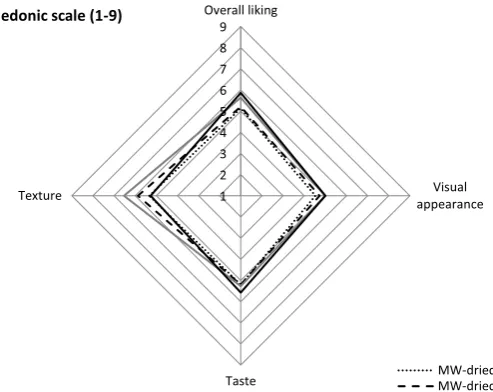
The addition of bilberry press cake powder increased both the hardness and crispiness work regardless of addition level. The crispiness index was the highest for 25% HA bilberry press cake powder (Table 2). Differences in microstructure between HA and MWHA dried press cake may have affected the melt properties during extrusion processing. The consumer evaluation reports variations in texture corresponding to the above physical measurements (Fig. 3). On average, extruded products with addition of 10% bilberry press cake powder were described to have a more enjoyable texture (mean score 6.2 on the 9-point hedonic scale) than products with addition of 25% bilberry press cake powder (mean score 5.3) (Fig. 3a). More specifically, 10% addition of bilberry press cake powder resulted in properties of porosity and hardness closer to the consumers' ideal point on average. These samples presented a more porous (mean JAR score 5.5; p = 0.20), less crispy (mean JAR score 5.7, p = 0.08) and less hard (mean JAR score 4.7; p = 0.13) texture than for the extrudates with 25% addition of bilberry powder (porosity mean JAR score: 4.1, i.e. somewhat not porous enough; crispy mean JAR score: 5.4; hardness mean JAR score: 5.9, i.e. somewhat too hard) (Fig. 3b). Consequently, the decrease in degree of expansion and increase in density, which was proportional to bilberry press cake powder addition, was perceived by the consumers as decreased porosity and increased hardness. Attribute stickiness showed very little variation between samples, with an overall mean of 5.6 on the JAR scale (Fig. 3b). Visual appearance and taste were moderately acceptable for all extrudates with average scores around the hedonic scale's mid-point (Fig. 3a). However, the extrudates from HA process scored slightly better in overall liking (mean score: 5.8; p = 0.16), than did the ex-trudates with MWHA process (mean score: 5.2) (Fig. 3a). HA drying also tended to be preferred to MWHA drying in terms of visual ap-pearance (p = 0.17) and to lead to lower crispness perception (p = 0.11). All in all, the bilberry press cake enriched extrudates were considered moderately palatable by the subjects and the concept of a healthier cereal based snack was regarded as positive. Due to the very small size of the panel, the directions of preferences reported here are only indicative and supportive of the feasibility study. Further con-sumer tests targeted at the market population will be necessary in fu-ture stages of the product development process. At this stage, the re-lationship between the panel's evaluations and the processing parameters are valuable inputs for further texture management of Fig. 2.Stereomicroscope images of radial sec-tions of the extrudates. Reference wholegrain rye
puffed extrudates containing berry materials. Lipids in berry seeds may cause problems with oxidation in products, which could be more pro-minent in the extrudates with high bilberry press cake addition levels. However, no negative effects on taste or overall liking were seen for extrudates with 25% addition compared to 10% addition. The press cake contained large amounts of seeds. Some of these seeds were broken during milling, but many stayed intact (visual observation). Although extrusion processing of bilberry press cake caused a sig-nificant reduction in the total phenolics content; it also caused a dra-matic increase in total phenolics of puffed extrudates in proportion to the addition level (Tables 1 and 2). The overall decrease in total phe-nolics might be a result of decarboxylation due to combined high temperature and moisture during extrusion (Brennan, Brennan, Derbyshire, & Tiwari, 2011). The total phenolic content was slightly higher in extruded snacks with MWHA dried bilberry powders com-pared with snacks containing HA dried bilberry powders (p < 0.05). The observed differences in total phenolic content may be related to
different extractability of phenolic compounds due to microstructural differences between HA and MWHA dried press cake.
4. Conclusions
[image:6.595.156.403.64.260.2]on the sensory characteristics and health-beneficial compounds re-maining in bilberry press residues and extrudates are needed.
Acknowledgements
The authors acknowledge the financial support for this project provided by transnational funding bodies, being partners of the FP7 ERA-net project, CORE Organic Plus, and with cofunds from the European Commission.
References
Alam, S. A., Järvinen, J., Kirjoranta, S., Jouppila, K., Poutanen, K., & Sozer, N. (2014). Influence of particle size reduction on structural and mechanical properties of ex-truded rye bran.Food and Bioprocess Technology, 7, 2121–2133.
Alam, S. A., Pentikäinen, S., Närväinen, L., Holopainen-Mantila, U., Poutanen, K., & Sozer, N. (2017). Effects of structural and textural properties of brittle cereal foams on mechanisms of oral breakdown and in vitro starch digestibility.Food Research International, 96, 1–11.
Altan, A., McCarthy, K. L., & Maskan, M. (2008). Twin-screw extrusion of barley-grape pomace blends: Extrudate characteristics and determination of optimum processing conditions.Journal of Food Engineering, 89, 24–32.
Barnes, J. S., Nguyen, H. P., Shen, S., & Schug, K. A. (2009). General method for ex-traction of blueberry anthocyanins and identification using high performance liquid chromatography–electrospray ionization-ion trap-time offlight-mass spectrometry.
Journal of Chromatography A, 1216, 4728–4735.
Brennan, C., Brennan, M., Derbyshire, E., & Tiwari, B. K. (2011). Effects of extrusion on the polyphenols, vitamins and antioxidant activity of foods.Trends in Food Science & Technology, 22, 570–575.
Dinkova, R., Shikov, V., Mihalev, K., Velchev, Z., Dinkov, H., & Mollov, P. (2012). Changes in the total anthocyanins and polyphenols during processing of wild berries into freshly pressed juice.Proceeding of BIOATLAS 2012 Conference(pp. 254–259).. Figuerola, F. E. (2007). Dehydration of berries. In Y. Zhao (Ed.).Berry fruit Value-added
products for health promotion. Boca Raton: CRC Press.
Grzelak-Blaszczyk, K., Karlinska, E., Grzeda, K., Roj, E., & Kolodziejczyk, K. (2017). Defatted strawberry seeds as a source of phenolics, dietaryfibre and minerals.LWT Food Science and Technology, 84, 18–22.
Gustavsson, J., & Stage, J. (2011). Retail waste of horticultural products in Sweden.
Resources, Conservation and Recycling, 55, 554–556.
Heidenreich, S., Jaros, D., Rohm, H., & Ziems, A. (2004). Relationship between water activity and crispness of extruded rice crisps.Journal of Texture Studies, 35, 621–633. Howard, L. R., Clark, J. R., & Brownmiller, C. (2003). Antioxidant capacity and phenolic content in blueberries as affected by genotype and growing season.Journal of the Science of Food and Agriculture, 83, 1238–1247.
Hu, L., Hsieh, F., & Huff, H. (1993). Corn meal extrusion with emulsifier and soybean fiber.LWT - Food Science and Technology, 26, 544–551.
Jangam, S. V., Law, A. S., & Mujumdar, A. S. (2010). Basic concepts and definitions. In S. V. Jangam, C. L. Law, & A. S. Mujumdar (Vol. Eds.),Drying of foods, vegetables and fruits: Vol. 1, (pp. 1–30). Singapore.
Karkle, E. L., Alavi, S., & Dogan, H. (2012). Cellular architecture and its relationship with mechanical properties in expanded extrudates containing apple pomace.Food Research International, 46, 10–21.
Kerbstadt, S., Eliasson, L., Mustafa, A., & Ahrné, L. (2015). Effect of novel drying tech-niques on the extraction of anthocyanins from bilberry press cake using supercritical carbon dioxide.Innovat. Food Sci. Emerg. Technol. 29, 209–214.
Kryeviciute, N., Kraujalis, P., & Venkutonis, P. R. (2016). Optimization of high pressure extraction processes for raspberry pomace inot lipohilic and hydrophilic fractions.
The Journal of Supercritical Fluids, 108, 61–68.
Lawless, H. T., & Heymann, H. (2010). Acceptance testing.Sensory evaluation of food(pp. 325–347). New York: Springer.
MacFie, H. J., Bratchell, N., Greenhoff, K., & Vallis, L. V. (1989). Designs to balance the effect of order of presentation andfirst-order carry-over effects in hall test.Journal of Sensory Studies, 4, 129–148.
Mäkilä, L., Laaksonen, O., Diaz, J. M. R., Vahvaselkä, M., Myllymäki, O., Lehtomäki, I., et al. (2014). Exploiting blackcurrant juice press residue in extruded snacks. LWT-Food Science and Technology, 57, 618–627.
Michalska, A., Wojdylo, A., Lech, K., Lysiak, G. P., & Figiel, A. (2017). Effect of different drying techniques on physical properties, total polyphenols and antioxidant capacity of blackcurrant pomace powders.LWT - Food Science and Technology, 78, 114–121. Mikulic-Petkovsek, M., Schmitzer, V., Slatnar, A., Stampar, F., & Veberic, R. (2015). A
comparison of fruit quality parameters of wild bilberry (Vaccinium myrtillus L.) growing at different locations.Journal of the Science of Food and Agriculture, 95, 776–785.
O'shea, N., Arendt, E., & Gallagher, E. (2014). Enhancing an extruded puffed snack by optimising die head temperature, screw speed and apple pomace inclusion.Food and Bioprocess Technology, 7, 1767–1782.
Pai, D. A., Blake, O. A., Hamaker, B. R., & Campanella, O. H. (2009). Importance of extensional rheological properties onfiber-enriched corn extrudates.Journal of Cereal Science, 50, 227–234.
Pojer, E., Mattivi, F., Johnson, D., & Stockley, C. S. (2013). The case for anthocyanin consumption to promote human health: A review.Comprehensive Reviews in Food Science and Food Safety, 12(5), 483–508.
Sibakov, J. K., Kirjoranta, S., Alam, S. A., Kokkonen, H., Jurvelin, J. S., Jouppila, K., et al. (2015). Effect of oat bran fractions on extrudates made of defatted oats.Food and Bioprocess Technology, 8, 445–458.
Siddiq, M., & Dolan, K. D. (2017). Characterization and heat inactivation kinetics of polyphenol oxidase from blueberry (Vaccinium corymbosum L.).Food Chemistry, 218, 216–220.
Sozer, N., & Poutanen, K. (2013). Fibre in extruded food products. In J. A. Delcour, & K. Poutanen (Eds.).Fibre-rich and wholegrain foods - improving quality. Cambridge: Woodhead Publishing.
Struck, S., Plaza, M., Turner, C., & Rohm, H. (2016). Berry pomace - a review of pro-cessing and chemical analysis of its polyphenols.International Journal of Food Science and Technology, 51, 1305–1318.
Van Buggenhout, S., Ahrné, L., Alminger, M., Andrys, A., Benjamin, M., Bialek, L., et al. (2012). Structural design of natural plant-based foods to promote nutritional quality.
Trends in Food Science & Technology, 24, 47–59.
Van Hecke, E., Allaf, K., & Bouvier, J. (1998). Texture and structure of crispy-puffed food products part II: Mechanical properties in structure.Journal of Texture Studies, 29, 617–632.
Wang, S., Kowalski, R. J., Kang, Y., Kiszonas, A. M., Zhu, M. J., & Ganjyal, G. M. (2017). Impacts of the particle sizes and levels of inclusion of cherry pomace on the physical and structural properties of directs expanded corn starch.Food and Bioprocess Technology, 10, 394–406.