“EFFECTS OF PLYOMETRIC AND CORE STABILITY EXERCISE ON PHYSICAL PERFORMANCE OF BADMINTON PLAYERS”
- A COMPARATIVE STUDY
REGISTER NO:271750141
ELECTIVE:PHYSIOTHERAPY IN SPORTS
A DISSERTATION SUBMITTED TO THE TAMILNADU Dr. M.G.R MEDICALUNIVERSITY, CHENNAI,
AS PARTIAL FULFILLMENT OF THE MASTER OF PHYSIOTHERAPY DEGREE
CERTIFICATE
Certified that this is the bonafide work of Miss. D.Pooja of K.G. College of Physiotherapy, Coimbatore submitted in partial fulfilment of the requirements for the Master of Physiotherapy Degree course from the Tamil Nadu Dr.M.G.R. Medical University under the Registration No:271750141 for the MAY 2019 Examination.
Place:
A Dissertation on
“EFFECTS OF PLYOMETRIC AND CORE STABILITY EXERCISE ON PHYSICAL PERFORMANCE OF BADMINTON PLAYERS”
- A COMPARATIVE STUDY Has been submitted in partial fulfillment for the requirement of the Master of
Physiotherapy degree, MAY 2019.
“EFFECTS OF PLYOMETRIC AND CORE STABILITY EXERCISE ON PHYSICAL PERFORMANCE OF BADMINTON PLAYERS”
- A COMPARATIVE STUDY
Under the guidance of,
Principal: ………... Dr. B. ARUN, MPT, Ph.D Principal,
K.G. College of Physiotherapy, K.G. Hospital, Coimbatore - 641035.
Guide: ………
Mr. PUNITHA KUMAR, MPT, Professor,
K.G College of Physiotherapy, K.G Hospital,
Coimbatore-641035.
A DISSERTATION SUBMITTED TO THE TAMILNADU Dr. M.G.R MEDICAL UNIVERSITY, CHENNAI,
AS PARTIAL FULFILLMENT OF THE MASTER OF PHYSIOTHERAPY DEGREE
ACKNOWLEDGEMENT
With the immense pleasure and love, I owe my first and foremost thanks to GOD, the merciful and the passionate, for providing me the opportunity to step in this world, for showering his blessings and who has always been my source of strength and aspiration and has guided me in all endeavors leading to the completion of this project.
With great privilege, I would like to express my sincere thanks to Padmashree Dr. G. Bakthavathsalam, Chairman, and K.G. Hospital for providing a wonderful friendly environment and the necessary infrastructure to cultivate knowledge.
With sincere gratitude, I would like to thank Mrs. Vaijayanthi Mohandas, CEO of education, and K.G. College of Health Sciences for her enthusiasm and concern for the well-being of the students.
With sincere gratitude, I would like to thank Prof. V. Mohan Gandhi, MPT, CEO of Rehabilitation, K.G Hospital for his constant and unwavering encouragement devotion and support.
I express my gratitude to Dr. Mohan Raj, MPT, PhD, Vice-Principal, K.G College of Physiotherapy for instilling the professional attitude of discipline and for his support.
It gives me immense pleasure to express my gratitude in thanking my guide Mr. Punitha Kumar, MPT, Professor, K.G College of Physiotherapy for his judicious piece of information’s, expert suggestion and incessant reassurance during every stage of this study.
I sincerely thank my coordinator Prof. C.H. Anand Chellappa, MPT, Professor, K.G. College of Physiotherapy for his valuable suggestion and help.
I would like to thank Mr. J.Suresh, M.P.Ed, M.Phil, physical educator, K.G College Of Physiotherapy for helping me in organizing the subjects and providing the necessary equipments in a good set up to complete my dissertation.
I would like to thank all the faculties of K.G College of Physiotherapy for their priceless help and support in cultivating education and special skills in me which stands significant for my career.
I would like to thank all my subjects for having consented to participate in this study forgoing all suffering.
My deep humble sense of gratefulness to my parents for providing me with the opportunity to be where I am. I extend my thanks to all my family members for their everlasting and heartfelt love they have given me. You have been my biggest critics throughout my entire personal and professional career.
CONTENTS
S.NO CHAPTER PAGE NO
I. INTRODUCTION 01
1.1 Need for the study 06
1.2 Aim of the study 07
1.3 Objectives of the study 07
1.4 Key words 07
1.5 Hypothesis 08
II. REVIEW OF LITERATURE 09
III. METHODOLOGY 24
3.1 Study design 24
3.2 Study setting 24
3.3 Study duration 24
3.4 Sampling technique 24
3.5 Selection Criteria 25
3.6 Outcome parameter 26
3.8 Variables 27
3.9 Orientation of the subject 27
3.10 Study Procedure 28
3.9 Statistical tools 33
IV. DATA ANALYSIS AND INTERPRETATION 35
V. DISCUSSION 54
VI. SUMMARY AND CONCLUSION 59
VII. LIMITATIONS AND RECOMMENDATIONS 60
VIII. BIBLIOGRAPHY 61
LIST OF TABLES
S.NO
TITLE
PAGE NO
1.
PAIRED ’t’ TEST- PRE-TEST AND POST-TESTVALUES OF GROUP A- 10 METER SHUTTLE RUN
36
2.
PAIRED ’t’ TEST- PRE-TEST AND POST-TESTVALUES OF GROUP B-10 METER SHUTTLE RUN
38
3.
UNPAIRED ’t’ TEST POST-TEST VALUES OF GROUPA AND GROUP B- 10 METER SHUTTLE RUN
40
4.
PAIRED ’t’ TEST- PRE-TEST AND POST-TESTVALUES OF GROUP A- ILLINOIS AGILITY TEST
42
5.
PAIRED ’t’ TEST- PRE-TEST AND POST-TESTVALUES OF GROUP B - ILLINOIS AGILITY TEST
44
6.
UNPAIRED ’t’ TEST POST-TEST VALUES OF GROUP A AND GROUP B - ILLINOIS AGILITY TEST46
7.
PAIRED ’t’ TEST- PRE-TEST AND POST-TESTVALUES OF GROUP A- Y- BALANCE TEST
48
8.
PAIRED ’t’ TEST- PRE-TEST AND POST-TESTVALUES OF GROUP B - Y- BALANCE TEST
50
9.
UNPAIRED ’t’ TEST POST-TEST VALUES OF GROUP A AND GROUP B - Y- BALANCE TESTLIST OF GRAPH
S.NO
TITLE
PAGE NO
1.
MEAN PRE-TEST AND POST-TEST VALUES OFGROUP A- 10 METER SHUTTLE RUN
37
2.
MEAN PRE-TEST AND POST-TEST VALUES OFGROUP B-10 METER SHUTTLE RUN
39
3.
MEAN POST-TEST VALUES OF GROUP A ANDGROUP B- 10 METER SHUTTLE RUN
41
4.
MEAN PRE-TEST AND POST-TEST VALUES OFGROUP A- ILLINOIS AGILITY TEST
43
5.
MEAN PRE-TEST AND POST-TEST VALUES OFGROUP B - ILLINOIS AGILITY TEST
45
6.
MEAN POST-TEST VALUES OF GROUP A AND GROUP B - ILLINOIS AGILITY TEST47
7.
MEAN PRE-TEST AND POST-TEST VALUES OFGROUP A- Y- BALANCE TEST
49
8.
MEAN TEST- PRE-TEST AND POST-TEST VALUESOF GROUP B - Y- BALANCE TEST
51
9.
MEAN POST-TEST VALUES OF GROUP A AND GROUP B - Y- BALANCE TEST1
I.
INTRODUCTION
Badminton is one of the most popular sports played all around the world. It
is a racket sport that is either played by individuals or a team of two opposing each
other against a divided net to score point. It was developed from a childhood game
called battledore and shuttlecock. Badminton was called “Poona” in India in 18th
century. The Duke of Beaufort launched Badminton officially in 1873.Badminton
House in Gloucestershire is the base for International Badminton Federation 1934.
Badminton players need to conduct various patters of movements during the
game which includes specialized twists, jumps, footwork, swings to strike the
shuttlecock and keep it moving back and forth on the court. Thus, the game is
characterized by a changing temporal structure with actions of short period and
high or medium intensity coupled with a short resting time.
Badminton players need to be quick and agile around the court. Muscle
strength, muscular endurance, power, speed, agility, flexibility, balance and
coordination are the important components for a player.
Badminton requires a specific physical conditioning in terms of motor and
action controls; coordinative variables such as reaction time, foot stepping and
static or dynamic balance, which are essential motor demand in this sport.
2
unique movement techniques and relatively small field strength supported by
physical condition, mental attitude, courage, intelligence and technical skills of
players as well as tactical efficiency (Heang et al., 2006)
Agility is classically been defined as simply the ability to change direction
rapidly (Elliot et al., 1994) but also as the ability to change direction rapidly and
accurately (Barrow et al.,1971).
Agility is one of the important components in badminton. Agility is needed
to maintain balance when performing maneuvers quickly and accurately. Agility in
badminton is associated with the ability of the athlete to move and move around in
maintaining the position of the shuttlecock, so there is a need for accuracy and
speed of reaction in changing direction, changing direction quickly requires leg
muscle power, which exercises involving rapid jumps are able to stimulate muscle
to increase power (Vaczi et al., 2011)
Agility includes whole body change of direction as well as rapid movement
and direction change of limbs (Lancaster et al., 1985). A multi-planar or multi
directional skill that combines acceleration, explosiveness, and reactiveness
(Moreno et al., 1995)
Balance is an ability to maintain a base of support with minimal movement
3
position. Indeed, balance is the ability to maintain dynamic integration of interior
and exterior forces during motor action tasks (J.C Yomker et al., 2007)
Balance is usually considered a static process and in fact is a comprehensive,
dynamic three-dimensional process contains multiple neural pathways. Badminton
is a dynamic equilibrium process which involves loss of balance after landing.
Thus players need body coordination and dynamic balance (M.Kong et al., 2017)
In this changing scenario, fitness training and injury prevention, programs
incorporating spinal muscular training, including core strengthening and stability
exercises have become popular because the core is considered to be the anatomical
and functional (Haapasalo et al., 2007)
During performance of sports skills, a stable core provides a foundation
upon which the muscle of the upper and lower extremities can accelerate body
segments and transfer force between distal and proximal body segments (Samson
et al., 2007). Previously Core stability exercises were widely used for the
prevention and rehabilitation of injuries of the lower back and lower extremities.
(Willardson et al., 2007) Recently core stability training has been purported to
enhance athletic performance, but the literature has not supported these and, in fact
reported a small effect on performance (Mokha et al., 2008). However the use of
4
The core musculature includes muscles of the trunk and pelvis that are
responsible for maintaining the stability of the spine and pelvis and are critical for
the transfer of energy from larger torso to smaller extremities during many sport
activities (McManus AM et al., 2005) Thus it is theoretically believed that if the
extremities are strong and the core is weak the decrease in muscular summation
through the core will result in less force production and inefficient movement
patterns. The core stability in athletics dynamically control and transfer large force
from the upper and lower extremities through the core in order to maximize the
performance and promote efficient biomechanics (Hibbs et al., 2008)
Plyometric exercise has been used in all area of sport to increase muscle
strength and explosive power. Plyometric exercises consist of eccentric movements
which are then followed by concentric contraction in the same muscle group.
Muscle strength training can contribute to increase acceleration, strength and limb
power (Vaczi et al., 2011)
Plyometric exercise program involves repetitive jumping, running, and
explosively altering motion. These movements are the components that can help in
improving agility because it exploits the adaptation of stretch shortening cycle
through the neuromuscular system in helping to increase leg muscles power so
5
athletes in all types of sports to increase strength and explosiveness (Chu et al.,
1998).
Plyometric consists of a rapid stretching of a muscle immediately followed
by a concentric or shortening action of the same muscle and connective tissue
(Earle et al., 2000). The muscles capability of generating high force is dependent
on its contractile history and can be acutely enhanced following voluntary
contraction at maximal or near maximal intensities (Bishop D et al., 2009)
Shuttle run test measures agility and speed while running between two lines
10m apart to pick up small blocks. It tests the speed, body control and the ability to
change direction. The participant sprints to the opposite line and then picks up a
block runs back and places it on the starting line. Then turning without a rest they
run back to collect the next block. The time taken to complete the two rounds is
recorded.
Illinois agility test the individual starts by lying face down by the first cone.
Staring at cone 1 he is required to run to cone 2 which is placed at a distance of
10meters away from the first. He then runs 10 meters to cone 3. At this point the
individual has to weave around cones 3,4,5,6. After this he has to go through 5,4,3
6
Y Balance test is a simple yet reliable test used to measure dynamic balance.
The athlete is asked to balance on one leg whilst simultaneously reach as far as
possible with the other leg in three separate directions: anterior, posterolateral and
posteromedial. Therefore the test measures the athlete strength, stability and
balance in various directions. The Y balance test score is calculated by summing
the 3 reach direction and normalizing the results to the lower limb reach.
1.1 NEED FOR THE STUDY
Agility and balance are the main components for the enhancement of
physical performance and for preventing injury in badminton players.
The main purpose of the study is to compare the effect of plyometric and
core stability on agility and balance in badminton players.
Plyometric and core stability plays an important role in improving the level
of fitness in badminton players.
Most of the studies suggest that there is improvement in agility and balance
in players who underwent plyometric and core stability training programme. There
are not much studies comparing the effect of both plyometric and core stability
7
This study is to find out the improvement of agility and balance on
plyometric and core stability and also to compare the training with the physical
performance.
1.2 AIM:
To find out the effect of plyometric versus core stability exercises on agility
and balance in badminton players
1.3 OBJECTIVES:
To find out the effect of plyometric on agility and balance in badminton
players
To find the effect of core stability exercises on agility and balance in
badminton players
To compare the effect of plyometric and core stability exercises on agility
and balance in badminton players
1.4 KEY WORDS:
Agility
Balance
8
1.5 HYPOTHESIS
NULL HYPOTHESIS:
There is no significant difference between plyometric and core stability
exercises for agility and balance in badminton players.
There is a significant difference between plyometric versus core stability
exercises for agility and balance in female badminton players
ALTERNATE HYPOTHESIS:
There is a significant difference between plyometric and core stability
exercises for agility and balance in female badminton players.
There is a significant difference between plyometric versus core stability
9
II REVIEW OF LITERATURE
MICHAEL PHOMSOUPHA et al., 2015
Badminton is one of the most popular sports in the world with a highly
demanding with an average of 90% of the players maximum heart beat, 60 – 70% of aerobic system and approximately 30% of anaerobic system, with greater
demand on the alactic metabolism with respect to lactic anaerobic metabolism.
P. CINTHUJA et al., 2015
Explosive power of lower limbs, upper body strength and endurance in
females increased with level of performance while in males the explosive power of
lower limbs, upper body power, agility, and speed increased with level of
performance but aerobic endurance decreased. Duration of training sessions was
significantly related to flexibility of shoulder, agility in female and upper body
strength and endurance in male players. Speed, endurance and upper body strength
were increased with duration of practice session.
JANUSZ JAWORSKI et al., 2016
Initial stage of training process, sports skill level is determined by a
comprehensive fitness. At the next stage, it largely depends on body size and
efficiency of moving on the court and a wide set of variables that determine
10
maximal anaerobic power of the upper limbs, wrist mobility and a complex of
coordination abilities with higher degree of motor organization
KIBLER et al., 2006
Suggested that core stability as the control of the position and motion of
trunk over the pelvis which allows optimum production of motion over the
terminal segment in integrated kinetic chain activities, this stabilizes the spine
mechanics and delivers shear force to the lower segment which in turn improves
agility for the players. While applying core stability exercises the length dependent
pattern occurs in the muscle, which increases stability around one joint, and are
mediated by gamma afferent input and involve reciprocal inhibition of muscle to
provide stiffness around a joint. Force dependent pattern integrate activation of
multiple muscle to move several joints and develop force, and are mediated by
Golgi tendon receptors. Core stability training integrates activation of multiple
segments which provides force generation leads into strong proximal stability and
distal mobility. Higher core stability performance leads to improve synchronization
of motor units and lower of neural inhibitory reflexes, so that these training
provides better control of the intersegmental motion of the spine. As a result the
11 BIPASA SETH et al., 2016
Badminton game performance was significantly related to coordinative
abilities. Selected coordinative abilities in this study versus side step jump,
dynamic balance, hand reaction, foot reaction were significantly related to
badminton game performance. Significant relationship was found between
badminton game performance and the badminton strokes variable. Selected
technique variable in this study versus short service, long service, forehand clear
and backhand clear strokes were significantly related to badminton game
performance.
MEHMET FATIH YUKSEL et al., 2015
Racket sports such as table tennis, tennis, badminton and squash require a
combination of psychological stability, tactical analysis, motor coordination as
well as strong physical and physiological attributes. These demands make the
sports particularly challenging for athletes at different levels. According to the
results of the study, eight weeks of badminton training improves balance
performance of pubertal children. Apart from the close relationship between
12 TARIK OZMEN et al., 2016
Core strength training on core endurance, dynamic balance and agility in
adolescent badminton players were evaluated with Star Excursion Balance Test,
Illinois Agility Test, and the core endurance tests. There were significant increases
in directions of Star Excursion Balance Test and core endurance tests. The Core
strength training resulted in significant gains in directions of the Star Excursion
Balance Test and core endurances in adolescent badminton players.
IBRAHIM HAMED et al., 2017
Core training two times per week for six weeks as relatively the period of
training in current study provided an improvements in trunk flexor, extensor
endurance and right lateral endurance. 6 weeks core strength training resulted in an
improvement at the total reached distance of the dynamic Balance Star Excursion
Balance Test in adolescent badminton players, who participated in training
programme, 6 core exercises for three sessions per week. The core endurance test
scores of adolescent badminton players showed highly significant at post-training
when compared to the pre-training.
HASSAN SADEGHI et al., 2013
The core is comprised of the lumbo-pelvic-hip complex and is activated first
prior to gross body movements. Core stability can improve strength of hip and
13
Dynamic balance is influenced by core exercises and was measured in this study
using SEBT, which showed increase in direction.
URS GRANACHER et al., 2012
Nine weeks of progressive core instability strength training resulted in
significant improvement in muscle strength of the trunk flexors, extensors, rotators
and lateral flexors, a significantly enhanced spinal mobility, and significant
improvement in dynamic balance (stride velocity) and functional mobility (Time
Up &Go test). It proved the feasibility and effectiveness of a progressive Core
Instability Strength Test on measures of trunk muscle strength, spinal mobility,
dynamic balance and functional mobility in healthy older adults.
NICOLE L. KAHLE et al., 2009
Dynamic balance is a key component of injury prevention and rehabilitation
in sports. Training the core muscles has been hypothesized as an intervention for
improving balance. The effects of a core stability program on dynamic balance as
measured with the Star Excursion Balance Test before and after a 6-week
intervention period. During the 6-week period, the exercise group performed a core
stability program, whereas the control group refrained from any new exercise.
Maximum excursion distances improved for the exercise group, compared with the
14
improve dynamic postural control during treatment and rehabilitation of athletic
injury.
MICHELLE A. SANDREY et al., 2013
The 6-week core-stabilization-training program designed to benefit track and
field athletes resulted in significant improvements in medial and antero-medial
reach directions and core endurance. Meaningful clinical improvement pretraining
to post training was evident. Furthermore, progression based on exercise difficulty
is certainly one possible way for any type of track and field athlete to use
supplemental strength training and dynamic movements in unstable environments
with added resistance to optimize dynamic-postural stability and core endurance.
SAMSON et al., 2007
Tennis is a sport that involves multidirectional movement patterns that
challenge the ability to maintain dynamic stability. Tennis players need a stable
core to effectively perform upper and lower extremity movements. The core
stabilization program emphasizes on the eccentric and isometric muscle actions
that are believed to enhance dynamic postural control. Five-week training study
program produced positive effects on dynamic postural control, and that
continuation of the program for a longer period of time will provide further benefit
15
which the muscle of upper and lower extremities can accelerate body segments and
transfer force between distal and proximal body segments.
BASHIR et al., 2018
The effect of core training on dynamic balance and agility among junior
athletes plays an important role. Core training can be incorporated safely with
players who train regularly to improve their dynamic balance and agility, which
can lead to better performance.
JOHN HILL et al., 2011
Core stability and plyometric training have become common elements of
training programs in competitive athletes. Core stability allows stabilization of the
spine and trunk of the body in order to allow maximal translation of force to the
extremities. Plyometric training is more dynamic and involves explosive-strength
training. Integration of these exercises theoretically begins with core stabilization
using more static exercises, allowing safe and effective transition to plyometric
exercises. Both core strengthening and plyometric training have demonstrated
mixed but generally positive results on injury prevention and rehabilitation of
16
TAMARA C. VALOVICH MCLEOD et al., 2009
Agility training, balance and proprioception, plyometric, and functional
strengthening were able to improve the static and dynamic balance, as measured
with balance tests. Balance improvements and possible performance enhancement
through participation in a neuromuscular-training program may increase athlete
compliance, which may afford them the benefits of these programs as a means of
injury prevention.
JOHN SHAJI ET AL., 2009
Dynamic stretching is a useful addition to plyometric for the athletes who
require repetitive jumping activity and agility. Dynamic stretching, or passive
continuous motion, is effective for decreasing passive muscle stiffness. Dynamic
stretching may decrease muscle stiffness by breaking the stable bonds between
actin and myosin filaments or by increasing muscle temperature. Movement
without holding at end range of motion, may not reduce neuromuscular sensitivity,
but help to enhance coordination and proprioceptive sensation. Plyometric training
is more effective in improving vertical jump performance in the stretch shortening
cycle jumps, as it enhances the ability of subjects to use the elastic and neural
benefits of the stretch shortening cycle. There was overall improvement in agility
score which received plyometric training program is consistent with the result of a
17
RODRIGO RAMIREZ-CAMPILLO et al., 2015
Unilateral, bilateral, and combined unilateral & bilateral plyometric were
used in young soccer players. Plyometric groups show a statistically significant
increase in performance, with a small-to-moderate to increased strength and power
of legs’ extensor muscles and these changes could be attributed solely to neuromuscular adaptations. It may be that these neuromuscular and strength-power
adaptations had an effect on the biomechanical factors related to kicking
performance, such as maximum linear velocity of the toe, ankle, knee, and hip at
ball contact, which may have cumulatively or individually contributed to a higher
ball kicking velocity.
GREGORY D. MYER et al., 2006
Plyometric and Balance training are effective at increasing measures of
lower extremity neuromuscular power and control as well as decreasing leg
dominance. However, the balance component may be more important to improve
single limb force attenuation strategies. A combination of Plyometric and Balance
training may further maximize the effectiveness of preseason training for female
athletes.
MAAMER SLIMANI et al., 2016
8 weeks of systematic application of Plyometric are necessary to improve
18
Training (<8 weeks) has the potential to enhance a wide range of athletic
performance (i.e. jumping, sprinting and agility) in children and youth amateur
players. Short-term Plyometric on non-rigid surfaces (i.e. aquatic, grass or
sand-based Plyometric Training) could elicit similar increases in jumping, agility and
sprinting performance as traditional Plyometric Training. Thus, the present review
indicates a greater effect of Plyometric Training alone on jump and sprint (30 m
sprint performance only) performances than the combination of Plyometric
Training with sprint/strength training.
LIM JOE HEANG et al., 2012
Plyometric training programme is able to improve agility over duration of
6-weeks in badminton players. Technical training, pattern running and reactive
training can improve agility. Badminton training programme emphasizes
performing the correct movements, performing acceleration, decelerations and
sharp changes of direction can be used as a training strategy in other sports as well.
M. FROHLICH et al., 2014
Plyometric training applied improved jump power or jump height, while its
influence on the technical component of the forehand overhead smash in the sense
of a spatiotemporal improvement is rather negligible. This would mean that the
influence of the optimal technique applied to the forehand overhead smash in the
19
improvement. Additional plyometric training can positively influence the
performance of junior athletes of badminton squad in terms of various jump
parameters, such as squat jump and drop jump.
RAOUF HAMMAMI et al., 2016
Sequencing four weeks of balance training prior to four weeks of plyometric
training in 12-13 year old male elite soccer players resulted in superior
performance enhancements compared to plyometric prior to balance training.
Plyometric provided significantly greater improvements in the reactive strength
index, absolute and relative leg stiffness, and a trend for the Y balance test.
Sprinting, change of direction, agility and jumping among other power related
activities additionally improved, during the subsequent 4 weeks of balance
training.
KARIN VASSIL et al., 2011
Squat, plyometric and squat & plyometric showed that the squat group
increased 3.30 cm in vertical jump, the plyometric group increased 3.81 cm and the
squat-plyometric group increased 10.67 cm along with an increase in vertical jump
the speed force also tend to increase thus results indicate that combined training
can be more effective than plyometric training alone. Plyometric exercises are
20 S. RAMESHKANNAN et al., 2014
8-weeks of plyometric on agility of male handball players, Plyometric
training show improved performance in agility tests either because of better motor
recruitment or neural adaptations. Plyometric training, when used with a
periodized strength-training program, can contribute to improvements in vertical
jump performance, acceleration, leg strength, muscular power, increased joint
awareness, and overall proprioception
HAMID ARAZI et al., 2011
The combined resistance and sprint/plyometric training can be the reason of
sprint improvement, by facilitates the neuromuscular system into making a more
rapid transition from eccentric to concentric contraction. Biomechanical analyses
of sprinting have shown that sprints greater than 50 m may depend upon elasticity
of the plantar flexor muscles to a greater extent than do shorter sprints, which
consist mostly of acceleration. Sprints of at least 100 m consist of 3 phases:
acceleration, constant velocity (or maximum speed), and deceleration. The
acceleration phase is highly dependent upon reaction time and the athlete's ability
to generate force and power during propulsion
SELVAM RAMACHANDRAN et al., 2014
The short term two weeks plyometric training program combined with
21
vertical jump height and agility and no changes in muscle girth and isometric
muscle strength. Dynamic stretching protocol was used and is also reported to have
improvements in agility and sport performance and helped to prevent injuries
associated with short term plyometric training
VICENTE-RODRIGUEZ et al., 2011
Interrater reliability and criterion-related validity 10-m shuttle run indicated
that manual measurements by a trained rater, using a stopwatch, seem to be a valid
method to assess speed and agility fitness testing in adolescents.
ROBERT G. LOCKIE et al., 2014
Field-sport athletes who are faster over 10 m exhibit greater leg power and
relative strength, while absolute leg strength and power, and performance in a
10-m sprint and T test (a test involving linear sprinting, lateral shuffling, and
backward running) in male basketball players. Thus the change of-direction-speed
branch of the model in that both leg strength and leg power contribute to planned
agility
DIMAS SONDANG IRAWAN et al., 2017
Agility can be achieved by improving balance and strength of lower limb.
Plyometric exercise can increase power of lower extremity. A gradual, progressive,
22
Agility performance was measured by Illinois Agility Test.6 Weeks Progressive
Plyometric Training improves overall agility in badminton players and could
become training design to improve skills
LTC SCOTT W et al., 2013
Y-Balance Test is reliable in obtaining screening setting by multiple raters
across a 48-hour period. Y- Balance Test scores shows good reliability,
measurement stability was improved when averaging 3 trials. Considering that 6
practice trials and 3 test trials are recommended to reduce a learning effect on the
Y- Balance Test
PAUL P. GORMAN et al., 2012
Y- Balance Test is reliable between sessions and between raters. Additional
analyses revealed no gender or bilateral differences for any of the normalized reach
directions or the composite scores in this limited sample. Y- Balance Test is an
appropriate tool to be used as a clinical measurement of balance performance.
GARRETT F. COUGHLAN et al., 2012
A difference in reach-direction distance was observed between theStar
Excursion Balance Test and Y- Balance Test, with no differences noted in the
posteromedial and posterolateral directions. Postural-control strategies used in
completing the tests appear to influence reach performance. It is applicable for
23
these dynamic balance tests. Reach values and research established for the Star
Excursion Balance Test in athletic, healthy, and injured populations may not be
transferrable to Y-Balance Test performance. We are also the first to report on
such values for the Y-Balance Test in a healthy athletic male group.
MICHELE A. RAYA et al., 2013
The moderate correlation between the T-Test, and Illinois Agility Test was
expected because all three tests measure the construct of agility with components
such as balance, posture, coordination, power, and speed. The Illinois Agility Test
assess multiplanar agility by assessing how quickly an individual is able to
complete a course consisting of a prone to standing transfer, multiple forward
movements, three 180° turns, and forward weaving through stationary cones over a
60 m course.
YOUNES HACHANA et al., 2013
Measurement of speed, to a large extent, may differentiate the variance in
agility and leg power (jump height) profiles between male team sport athletes in
our study. The Illinois Agility Test is a reliable test for assessing speed in male
team sport athletes. Its performance is independent of acceleration and power of
24
III. METHODOLOGY
3.1 STUDY DESIGN:
Pre test and post test e
xperimental study design3.2 STUDY SETTING:
The study was conducted at the Therapeutic Gymnasium K.G Campus,
Saravanampatti, Coimbatore
.
3.3 STUDY DURATION:
Study duration was 6 weeks.
3.4 SAMPLING TECHNIQUE:
The sample size was determined based on a pilot study 10 participants were
divided randomly into two equal parts, and the main part of the study was
conducted on them. The mean and SD for the parameters for his pilot study with
α= 0.05 and 90% power were used to calculate the sample size of N=30.
A total of about 30 recreational badminton players who fulfilled inclusive
and exclusive criteria were selected by simple random sampling method, out of
25
3.5 CRITERIA FOR SELECTION OF SUBJECTS:
INCLUSION CRITERIA:
Active recreational badminton players
Age group 18 – 25 years
Both male and female players were selected
Body mass index of players was between 18-24
Playing badminton for more than 1 year were selected
Players who play badminton for 4 days per week
Not involved in any formal abdominal/ core training program or plyometric
training program.
EXCLUSION CRITERIA:
Who had low back pain during last 1 month
Participation in any formal core training and balance training program
Having lower limb fracture in the last four months
Any chronic ligament sprain.
Trauma to lower limb and any neurological disorder having balance
impairment
26
3.6 OUTCOME PARAMETER:
AGILITY
Shuttle run
Illinois agility test
BALANCE
Y- Balance test
3.7 OPERATIONAL TOOLS:
Stop watch
Cones
Tape
Swiss ball
27
3.8 VARIABLES:
INDEPENDENT VARIABLE:
Plyometric
Core stability exercises
DEPENDENT VARIABLE:
Agility
Balance
3.9 ORIENTATION OF THE SUBJECT:
Before the study was conducted, all the participants have read and signed a
consent form which informed them about the study procedure, their rights and
contradiction of the study. There were asked to inform if they feel any discomfort
during the study.
Each player was asked to complete a questionnaire outlining any history of
28
3.10 PROCEDURE:
30 subjects were recruited for this study and were divided into two groups of
15 members each using random sampling. They underwent different training
program. Prior to the training session the players were subjected pretest evaluation
of agility and balance using 10meters shuttle run, Illinois agility test and
Y-Balance test(Appendix – III, IV & V )
GROUP A:
Players under this group underwent normal warm up and stretching before
entering into the training session.
Training Plyomeric drills Set* Reps Intensity Week 1:
Side to side ankle hops 2 * 15 Low
Standing jump and reach 2*15 Low
Front cone hops 5*6 Low
Week 2:
Side to side ankle hops 2*15 Low
Standing jump 5*6 Medium
29
Double legs hops 5*6 Medium
Week 3
Side to side ankle hops 2*12 Low
Standing jump 5*6 Low
Lateral jump over barrier 2*12 Medium
Double legs hops 3*8 Medium
Lateral cone hops 2*12 Medium
Week 4:
Diagonal cone hops 4*8 Low
Standing long with lateral sprint 4*7 Low
Lateral cone hops 2*12 Medium
Single leg bounding 4*7 High
Lateral jump single leg 4*6 High
Week 5:
Diagonal cone hops 2*7 Low
Standing long with lateral sprint 4*7 Medium
Lateral cone hops 4*7 Medium
Cone hops with 180degree turn 4*7 Medium
30
Lateral jump single leg 2*7 High
Week 6:
Diagonal cone hops 2*12 Low
Hexagonal drill 2*12 Low
Cone hops with change of direction
sprint
4*6 Medium
Double leg hops 3*8 Medium
Lateral jump single leg 4*6 High
GROUP
–
B
Randomly selected players underwent warm up and stretching prior to the
training session.
Core strengthening exercises concentrated mainly on transverse abdominus
(TrA) and multifidus (MF) muscles.
TRAINING CORE STRENGTHENING EXERCISE SETS*REPS Week 1 & 2:
1. TrA& MF muscle contraction:
31
Prone lying position 3*15
Quadruped position 3*15
Standing on single limb 1*10
Crook lying with leg movements 2*10
2. Bridging 3*15
3. Quadruped exercise with foot and hand lifts 3*15
4. Wall squarts 3*15
5. Seated medicine ball rotation 3*15
Week 3 & 4
TrA& MF contraction
Cycling 3 *15
Seated on swiss ball 3 *15
Multidirectional lunges 2*10
Squarts with swiss ball 3 *15
Superman 2*10
Week 5
Planks Modified planks 3 *10
Front planks 3*10
32 TrA& MF contraction :
Diagonal curls on swiss ball 3 *15
Twist on swiss ball 3*15
Week 6:
Stability ball: Front Planks 2*10
Back bridge 2*10
Theraband resisted shoulder movements
seated
3*15
Prone hip-knee flex – ext 2*10
Twist on swiss ball with 1 Kg medicine ball 10 reps
Stability trainer standing twists with 1 Kg
medicine ball
33
3.11 STATISTICAL TOOLS:
Statistical analysis was done by using student‘t’ test. Paired‘t’ test was used to find out the improvement within the group. Unpaired‘t’ test was used to find out the difference between two groups.
Formula of paired ‘t’ test: the paired t-test was used to compare the Pre and Post
test values of Group A and Group B.
S=
t=
where,
d = difference between the pre-test versus post test
= mean difference
n = total number of subjects
s = standard deviation
34 Formula of unpaired’t’ test:
The unpaired ‘t’ test was used to explore between Group A and Group B.
S =
T =
Where,
= total number of subjects in Group A
= total number of subjects in Group B
=difference between pre-test versus post-test of Group A
=mean of Group A
=difference between pre-test versus post-test of Group B
= mean of Group B
35
IV. DATA ANALYSIS AND INTERPRETATIONS
Baseline treatment and post experimental treatment values of pain and
physical performance were subjected to statistical analysis.
Paired ‘t’ test were used to assess the difference between pre treatment and post treatment in both the group.
Independent ‘t’ test were used to assess difference between post treatment measures of all the group including control group to evaluate any difference in the
36
TABLE
–
I
PRE TEST AND POST TEST VALUES OF
10M- SHUTTLE RUN
GROUP A
–
PLYOMETRICS
S.NO GROUP – A MEAN STANDARD
DEVIATION
‘t’ VALUES
1. Pre test 3.59 0.61
10.19
2. Post test 2.79 0.6
The table shows the test value of Group A is 10.19 which was greater than
37
GRAPH
–
I
PRE TEST AND POST TEST VALUES OF
10M
–
SHUTTLE RUN
GROUP A
–
PLYOMETRICS
3.59
2.79
0 0.5 1 1.5 2 2.5 3 3.5 4 4.5 5
PRE TEST POST TEST
38
TABLE
–
II
PRE TEST AND POST TEST VALUES OF
10 M- SHUTTLE RUN
GROUP B
–
CORE STABILITY
S.NO GROUP - A MEAN STANDARD
DEVIATION
‘t’ VALUES
1. Pre test 3.22 0.62 11.02
2. Post test 1.85 0.51
The table shows the test value of Group B is 11.02 which was greater than
39
GRAPH
–
II
PRE TEST AND POST TEST VALUES OF
10M
–
SHUTTLE RUN
GROUP B CORE STABILITY
3.2
1.85
0 0.5 1 1.5 2 2.5 3 3.5
PRE TEST POST TEST
40
TABLE
–
III
UNPAIRED ‘T’ TEST VALUES
GROUP A & GROUP B
S.NO POST TEST MEAN STANDARD
DEVIATION
‘t’ VALUES
1. GROUP-A 2.79 0.6 4.66
2. GROUP-B 1.85 0.51
The table shows the test value of Group A and Group B is 4.66 which was
41
GRAPH
–
III
UNPAIRED ‘T’ TEST VALUE
GROUP A & GROUP B
2.79
1.84
0 0.5 1 1.5 2 2.5 3
GROUP-A GROUP-B
42
TABLE
–
IV
PRE TEST AND POST TEST VALUES OF
ILLINOIS TEST
GROUP A
–
PYLOMETRICS
S.NO GROUP - A MEAN STANDARD
DEVIATION
‘t’ VALUES
1. PRE-TEST 23.83 2.06 8.71
2. POST-TEST 20.37 2.5
The table shows the test value of Group A is 8.71 which was greater than the
43
GRAPH
–
IV
PRE TEST AND POST TEST VALUES OF
ILLINOIS TEST
GROUP A
–
PLYOMETRIC
23.83
20.37
18 19 20 21 22 23 24 25
PRE TEST POST TEST
44
TABLE
–
V
PRE TEST AND POST TEST VALUES OF
ILLINOIS TEST
GROUP B- CORE STABILITY
S.NO GROUP - A MEAN STANDARD
DEVIATION
‘t’ VALUES
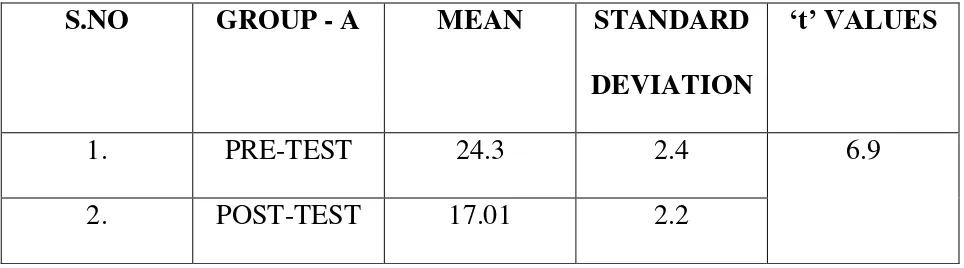
1. PRE-TEST 24.3 2.4 6.9
2. POST-TEST 17.01 2.2
The table shows the test value of Group B is 6.9 which was greater than the
[image:55.612.66.548.258.392.2]45
GRAPH
–
V
PRE TEST AND POST TEST VALUES OF
ILLINOIS TEST
GROUP B
–
CORE STABILITY
24.3
17.01
0 5 10 15 20 25 30
PRE TEST POST TEST
46
TABLE
–
VI
POST TEST VALUES OF
ILLINOIS TEST
GROUP A & GROUP B
S.NO POST TEST MEAN STANDARD
DEVIATION
‘t’ VALUES
1. GROUP-A 20.3 2.5
3.8
2. GROUP-B 17.01 2.2
The table shows the test value of Group A and Group B is 3.8 which was
47
GRAPH
–
VI
ILLINOIS TEST
GROUP A & GROUP B
20.3
17.01
15 16 17 18 19 20 21
48
TABLE
–
VII
PRE TEST AND POST TEST VALUES OF
Y- BALANCE TEST
GROUP A
–
PLYOMETRIC
S.NO GROUP - A MEAN STANDARD
DEVIATION
‘t’ VALUES
1. PRE-TEST 58.18 5.5 5.81
2. POST-TEST 59.95 4.9
The table shows the test value of Group A is 5.81 which was greater than the
49
GRAPH
–
VII
PRE TEST AND POST TEST VALUES OF
Y- BALANCE TEST
GROUP A
–
PLYOMETRIC
58.18
59.95
57 57.5 58 58.5 59 59.5 60 60.5
PRE TEST POST TEST
50
TABLE
–
VIII
PRE TEST AND POST TEST VALUES OF
Y- BALANCE TEST
GROUP
–
B- CORE STABILITY
S.NO GROUP – A MEAN STANDARD
DEVIATION
‘t’ VALUES
1. PRE-TEST 59.1 5.14 5.98
2. POST-TEST 74.4 9.5
The table shows the test value of Group B is 5.98 which was greater than the
51
GRAPH
–
VIII
PRE TEST AND POST TEST VALUES OF
Y- BALANCE TEST
GROUP B- CORE STABILITY
59.1
74.4
0 10 20 30 40 50 60 70 80
PRE TEST POST TEST
52
TABLE
–
IX
POST TESTS OF Y- BALANCE TEST
GROUP A VERSUS GROUP
–
B
S.NO POST-TEST MEAN STANDARD
DEVIATION
‘t’ VALUES
1. GROUP-A 59.9 4.95
5.22
2. GROUP-B 74.47 9.55
The table shows the test value of Group A versus Group B is 5.22 which was
53
GRAPH
–
IX
POST TEST VALUES OF
Y- BALANCE TEST
GROUP A & GROUP B
59.9
74.4
0 10 20 30 40 50 60 70 80
54
V DISCUSSION
Badminton is one of the most popular sports played all around the world.
Badminton players need to be quick and agile around the court. Muscle strength,
muscular endurance, power, speed, agility, flexibility, balance and coordination are
the important components for a player.
Badminton requires a specific physical conditioning in terms of motor and
action controls; coordinative variables such as reaction time, foot stepping and
static or dynamic balance, which are essential motor demand in this sport.
(M.Phomsoupha et al., 2015)
Agility is one of the important components in badminton. Agility is needed
to maintain balance when performing maneuvers quickly and accurately ( Vaczi et
al.,2011).Balance is the ability to maintain dynamic integration of interior and
exterior forces during motor action tasks (E.Bressel et al., 2007)
During performance of sports skills, a stable core provides a foundation
upon which the muscle of the upper and lower extremities can accelerate body
segments and transfer force between distal and proximal body segments (Samson
et al., 2007). Plyometric consists of a rapid stretching of a muscle immediately
followed by a concentric or shortening action of the same muscle and connective
55
The main purpose of the study is to compare the effect of plyometric and
core stability on agility and balance in badminton players.
Most of the studies suggest that there is improvement in agility and balance
in players who underwent plyometric and core stability training programme. But
there are not many studies comparing the effect of both plyometric and core
stability training.
A total of about 30 recreational badminton players who fulfilled inclusive
and exclusive criteria were selected by simple random sampling method, out of
them 15 were allotted in Group A and 15 in Group B.
Prior to the training both the groups underwent warm up and stretching.
Group A underwent plyometric whereas Group B underwent core stability
exercises. Agility was tested using 10m Shuttle run and Illinois test whereas
balance was tested with the use of Y-Balance test both prior to the intervention and
after 6weeks of training session.
Statistic analysis was done using SPSS, Paired ‘t’ test was used to find the difference within the group and Unpaired ‘t’ test was used to find the difference between the groups.
56
greater than the tabulated ‘t’ value of 2.145. Table III shows the Unpaired‘t’ test value of 10meters shuttle run of Group A and Group B is 4.66 which was greater
than the tabulated ‘t’ value 2.048 Which shows that there was significant improvement in Group B when compared to Group A.
Dimas Sondang Irawan et al., 2017 has the same effect in their study and
suggest that plyometric movement are components that can help in improving
agility because it exploits the adaptation of stretch-shortening cycle through the
neuromuscular system in helping to increase leg muscle power so agility
improvement can be achieved.
Table IV shows the paired‘t’ test value Illinois test of Group A, is 8.71 and Table V shows the paired ‘t’ test value of Group B is 6.9 which was greater than the tabulated ‘t’ value of 2.145. Table VI shows the unpaired‘t’ test value Illinois test of Group A and Group B is 3.8 which was greater than the tabulated ‘t’ value 2.048 which shows that there was significant improvement in Group B when
compared to Group A.
After the training of core stability and plyometric this study demonstrates
57
Kibler et al 2006 supports this result stating that core stability training
integrates activation of multiple segments which provides force generation leads
into strong proximal stability and distal mobility.
Higher core stability performance leads to improve synchronization of motor
units and lower of neural inhibitory reflexes, so that these training provide better
control of the intersegmental motion of the spine. As a result the immediate
response of action in lower extremities was improved.
Table VII shows the paired‘t’ test value Y-Balance test of Group A is 5.81 and Table VIII shows the paired ‘t’ test value of Group B is 5.98 which was greater than the tabulated ‘t’ value of 2.145. table IX shows the Unpaired‘t’ test value Y -Balance test of Group A and Group B is 5.22 which was greater than the tabulated
‘t’ value 2.048 Which shows that there was significant improvement in Group B when compared to Group A.
Kibler et al., 2006 suggested that core stability as the control of the position
and motion of trunk over the pelvis which allows optimum production of motion
over the terminal segment in integrated kinetic chain activities.
Samson et al., 2007 has the same effect in their study and suggest that the
core stabilization program emphasizes on the eccentric and isometric muscle
58
provides a foundation upon which the muscle of upper and lower extremities can
accelerate body segments and transfer force between distal and proximal body
segments.
While applying core stability exercises the length dependent pattern occurs
in the muscle, which increases stability around one joint, and are mediated by
gamma afferent input and involve reciprocal inhibition of muscle to provide
stiffness around a joint.
Force dependent pattern integrate activation of multiple muscle to move
several joints and develop force, and are mediated by Golgi tendon receptors.
With the support of the above study, this study recommends that,
individually, the side plank and side raises must be performed with proper form,
technique, and endurance, before the athlete is advanced to the combination
exercise. The combined exercise is intense and requires coordination of the various
core muscle groups on opposite sides of the body. This study has warranted the
effects of core exercise on the dynamic balance.
Thus this study concludes that the Group which underwent core stability
exercises tends to show significant improvement in agility and balance in
59
VI SUMMARY AND CONCLUSION
The purpose of the study is to find the effect of Plyometric and Core stability
exercise and to compare the effect of Plyometric versus Core stability exercise in
agility and balance in recreational badminton players. 30 subjects were selected
and divided into 2 groups using simple random sampling.
Group A subjects underwent Plyometric whereas Group B underwent Core
stability exercise for 6 weeks. Agility was measured using 10m Shuttle Run and
Illinois test. Balance was measured using Y-Balance test.
This study rejects the null hypothesis and therefore suggests that core
stability improves agility and balance in badminton players than plyometric.
Therefore this can be implemented in treatment protocol for further studies
60
VII LIMITATION & RECOMMENDATION
LIMITATION:
Study was done with the use of small sample.
This study only focuses recreational badminton players.
This study focuses on two training techniques only
This study only includes few parameters for intervention.
Certain factors such as climatic condition, nutritional factors,
psychological factors and activities of daily living could not be controlled
during the study.
RECOMMENDATION
Further studies can be conducted:
Increasing the sample size
Using different training programs combined with plyometric and core
stability exercise.
Similar studies can be performed on other sports also
Similar studies can be performed in elite athletes
Further studies can use other outcome parameters for interventions.
61
VIII BIBLIOGRAPHY
1. Angela E. Hibbs, Sports Medicine, December 2008, Volume 38, Issue 12, pp
995–1008
2. Anoop Aggarwal , International Journal of Therapy and Rehabilitation Vol. 17,
No. 5Research, 29 Sep 2013
3. Baechle T.R., Earle R.W. (2000) Essentials of strength training and
conditioning. 2nd edition Champaign, IL: National Strength and Conditioning
Association
4. Bipasaseth et al., Determination factors of badminton game performance.
International Journal of Physical Education, Sports and Health 2016; 3(1):
20-22
5. Bruce Elliott, Robert Marshall &Guillermo Noffal Pages 159-165 | 15 May
2007
6. Chu D.A. (1998) Jumping into plyometrics. Champaign, IL: Human Kinetics
7. Dimas Sondang Irawan et al., 2017, Six Weeks Progressive Plyometrics
Training on Badminton Player’s Agility Advances in Health Sciences Research (AHSR), volume 2, 2017
8. Draper, J.A., and M.R. Lancaster. The 505 test: a test for agility in the
62
9. Eadric Bressel, EdD,* Joshua C Yonker, MS, LAT, ATC,† John Kras,
EdD,* and Edward M Heath, PhD, Journal of Chengdu Sport University, 2012
10.Garrett F. Coughlan et al, A Comparison Between Performance on Selected
Directions of the Star Excursion Balance Test and the Y Balance Test Journal
of Athletic Training 2012
11.Gregory D. Myer et al., Journal of Strength and Conditioning Research, 2006,
20(2), 345-353
12.Haapasalo H, Parkkart J, Kannus P, Natri A. Knee injuries in leisure time
physical activities: a prospective one year follow-up of a finish population
cohort. International Journal of Sports Medicine 2007; 28: 72-77,Volume 12
Issue 3, May 2007
13.Hamid Arazi et al., February, The effect of aquatic and land plyometric training
on strength, sprint, and balance in young basketball players Journal Of Human
Sport & Exercise Issn,2011.
14.Hannah E, Issue 7,Journal of Strength and Conditioning Research: October
2009 - Volume 23 - Issue 7 - p 2137-2143
15.Hassan Sadeghi et al., The Effects of Core Stability Exercise on the Dynamic
Balance of Volleyball Players, International Journal of Applied Exercise
63
16.Ibrahim Hamed et al., The Effect of Core Stability Training on Dynamic
Balance and Smash Stroke Performance in Badminton Players International
Journal of Sports Science and Physical Education, 2017; 2(3): 44-52
17.Janusz Jaworski et al., Identification of determinants of sports skill level in
badminton players using the multiple regression model. Human movement
2016, vol.17(1), 21 – 28
18.Jeffrey M. Willardson Physical Education Department, Eastern Illinois
University, Charleston, Illinois 61920, Journal of Strength and Conditioning
Research, 2007, 21(3), 979–985 2007
19. John Hill et al., Review and Role of Plyometric and Core Rehabilitation in
Competitive Sport, Current Sports Medicine,by the American College of Sports
Medicine, 2011
20.John Shaji et al., Comparative Analysis of Plyometric Training Program and
Dynamic Stretching on Vertical Jump and Agility in Male Collegiate Basketball
Player, Al Ame en J Med Sci 2 (1 ) :3 6 -4 6, (2009)
21.Karin Vassilet al., 2011, The effect of plyometric training program on young
volleyball players in their usual training period, 11-14 December 2011.
International Network of Sport and Health Science. Szombathely, Hungary.
22. Kim M. Samson et al., A Core Stabilization Training Program for Tennis
64
23.KONG Ming-min, LIU Qing (Chengdu Sport University, Chengdu
610041,China), 2017
24.Lim Joe Heanget al., International Journal of Applied Sports Sciences, Vol. 24,
No. 1, 18-24, 2012
25.LJ Heang, WE Hoe, CK Quin, LH Yin - International Journal of
Physiotherapy, vol 24, pg no 18-24, 2012
26. LTC Scott W et al., 2013, Y-Balance Test: A Reliability Study Involving
Multiple Raters, 2011 American Physical Therapy Association, Combined
Sections Meeting, New Orleans, LA, February 2011
27.M. Frohlich et al., 2014, Training effects of plyometric training on jump
parameters in d and d/c-squad badminton players journal of sports research, ,
1(2): 22-33, 2014
28.MaamerSlimani et al., Journal of Human Kinetics volume 53/, 231-247, 2016
29.Márk Váczi et al., Volume 36: Issue 1,13 Apr,17–26, 2013
30.Mehmet FatihYuksel et al., Effects of Badminton Training on Physical
Parameters of Players. Anthropologist, 21(3): 542-547,2015
31.Michael Phomsoupha et al., The Science of Badminton: Game Characteristics,
Anthropometry, Physiology, Visual Fitness and Biomechanics April, Volume
65
32.Michele A. Raya et al., Comparison of three agility tests with male
servicemembers: Edgren Side Step Test, T-Test, and Illinois Agility Test,JRRD
Volume 50, Number 7, Pages 951–960, 2013
33.Michelle A. Sandrey and Jonathan G. Mitzel et al, Improvement in Dynamic
Balance and Core Endurance After a 6-Week Core-Stability-Training Program
in High School Track and Field Athletes Journal of Sport Rehabilitation, 2013,
22, 264-271, Human Kinetics, Inc, 2013
34.Moreno E. Developing quickness part 2. Strength and Conditioning. 1995;
17:38-39J Athl Train,Jan-Mar; 42(1): 42–46, . 2007.
35. Nicole L. Kahle et al., Core Stability Training in Dynamic Balance Testing
Among Young, Healthy AdultsAthletic Training & Sports Health Care, Vol. 1
No. 2 2009
36.P. Cinthuja et al., Physical fitness factors of school badminton players in Kandy
district European Journal of Sports and Exercise Science, 2015, 4 (2):14-25
37.Paul p. Gorman et al., 2012, upper quarter y balance test: reliability and
performance comparison between Genders in active adults journal of strength
and conditioning research 2012 national strength and conditioning association.
66
39.R. Barry Dale PhD, PT, ATC, Kim M. Samson MS, ATC, PES1 , Michelle A.
Sandrey PhD, ATC2 , Allison Hetrick MEd, ATC,Human kinetic journal,
Volume: 12 Issue: 3 Pages: 41-4
40.Raouf Hammami et al., 2016, Sequencing effects of balance and plyometric
training on physical performance in youth soccer athletes 2016 National
Strength and Conditioning Association
41.Robert G. Lockie et al., 2014 , International Journal of Sports Physiology and
Performance, 2014, 9, 766-771
42.Rodrigo ramírez-campillo et al., Journal of Strength and Conditioning
ResearchEditorial Review Board, 2015
43. S.Rameshkannan et al., 2014 International Journal of Physical Education,
Fitness and Sports ISSN: 2277: 5447 | Vol.3.No.4 |December 2014
44.Sato, Kimitake; Mokha, Monique, Journal of Strength and Conditioning
Research: January 2009 - Volume 23 - Issue 1 - p 133-140
45. Selvam Ramachandran et al., Effects of Short-term Two Weeks Low Intensity
Plyometrics Combined With Dynamic Stretching Training in Improving
Vertical Jump Height and Agility on Trained Basketball PlayersIndian J Physiol
Pharmacol 2014; 58(2) : 133–136