Abstract: Nowadays, gamification is a term of video game elements in non-gaming systems which served for more important purposes such as education, psychology simulation, health research, and therapy. Video games can function as a necessary tool in the development of psychological science, which greatly caters for the needs of psychologists and those in other fields. This research seeks to investigate whether the designed purposed a video game prototype can improve the cognitive capability of preschool children and validate by using expert judgment validation and its implementation The method applied in this research is by designing and developing a computer gaming system prototype called as “Rhino Hero” as a stimulator of preschoolers’ cognitive ability which is being verified by experts and implemented as substantiation. Results of analysis on the expert judgment validation and implementation of the “Rhino Hero” video game shows that in general, the children’s cognitive competence has consequently improved in terms of Verbal IQ, Performance IQ, and Full-Scale IQ scores.
Index Terms: cognitive stimulation, preschoolers, video game.
I. INTRODUCTION
The last few years have witnessed the phenomenon of gamification that swift the development of serious games [1]. Video games are made not only for amusement but also for more serious purposes such as education, simulation, health research, and therapy [2], [3]. Examples of serious games such as games used in cognitive impairment therapies [4], [5] for relaxation during medical care such as cancer treatment [6], psychological assessment/observation scenarios with several therapeutic purposes which focus on early/preschool childhood issues [7], [8].
The psychology of gaming has become a tool needed for the development of psychology, as it is expected that e-psychology environment (the working environment of a psychologist that employs electronic equipment including a computer). This medium fulfill the psychologists needs in all areas of psychology[9]. Play is do something freely without coercion, external pressure or obligation [10]. Playing is very appealing towards children especially in this modern era. Its tend to persuade people to believe in its significant preschoolers educational contribution. Hence, a video game can be used as a play and learning facility for children and thus fulfill its important role in stimulating their creativity.
However, the usage of video games as cognitive stimuli
Revised Manuscript Received on April 07 ,2019.
Endah Sudarmilah, Informatics Department, Faculty of
Communication and Informatics, Universitas Muhammadiyah Surakarta, Surakarta, Indonesia.
Adila Firdaus Binti Arbain, Software Engineering Department, Faculty
of Computer Science and Information Technology, Universiti Tun Hussein Onn Malaysia, Johor Bahru, Malaysia.
[11], [12] for early-age/preschool children [8] remains scarce due to suboptimal use of digital facilities such as games in the context of psychology, particularly in educational curriculum. This situation serves as rationale for this study on video games as cognitive stimulator for early-age/preschool children.
The article structure discuss the background in the introduction, method describes the methodology in developing the "Rhino Hero" game and the experiment of cognitive intervention. Cognitive interventions at preschoolers are presented in results and discussions and shows the finding in conclusion.
II. METHOD
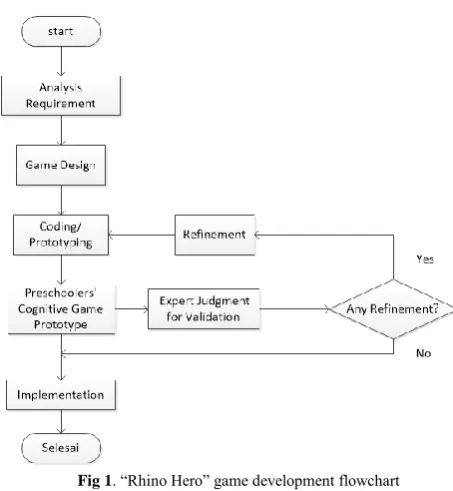
The research method picks up from that of the author’s previous study on a cognitive game for preschoolers [13], [14] which has been validated by prior expert judgment [15]. The procedure is detailed in the flowchart presented by Fig 1.
Fig 1. “Rhino Hero” game development flowchart
Concept of "Rhino Hero" game is designed based on the requirements which have been elicited during requirement analysis, which is then developed from the prototype that have been validated by the expert jugdement before implemented it among preschoolers.
This paper discusses the outcomes of the game’s cognitive intervention on preschoolers. This intervention aims to stimulate growth in the
cognitive capability of
Using Gamification to Stimulate the Cognitive
Ability of Preschoolers
[image:1.595.311.538.399.645.2]children, which is measured by means of a pretest and posttest as illustrated in Fig 2. Pretest and postest are cognitive testing which have been conducted by the children before and after they have been stimulated by the games.
[image:2.595.47.291.106.255.2]Fig 2. Data collection of stimulation results
Table 1. Experiment measurement design
The game intervention implementation scenario, as depicted in Table 1, is carried out by preparing three classes, namely the control class, standard class (intervened with the “Learn with Dora” game) and experiment class (intervened with the “Rhino Hero” game). All three groups are subjected to the pretest and posttest. The pretest and posttest data are gathered by a psychologist to obtain the cognitive ability levels of early-age/preschool children in detail using the third edition of the Wechsler Preschool and Primary Scale of Intelligence (WPPSI-III) testing tool [16] with its 10 subtests. Each class receives three children as experiment subjects with the criteria of five to six years of age, going to the same school (to level cognitive learning/stimulation outside the game), and having a cognitive competence within the range of average intelligent quotient (IQ) according to Wechsler (110-89) [17].
These sets of criteria are the intervention of the game as cognitive stimulation for preschoolers, given to the standard and experimental classes only, repeated through eight meetings [18] with a duration of approximately 35 minutes per session.
Data resulting from the cognitive ability assessment are analyzed with non-parametric statistical analysis and the Kruskal-Wallis test comparing between pretest and posttest outcomes from every WPPSI-III subtest component to measure the impact level of stimulation on each cognitive component and in general. The Kruskal-Wallis comparative test looks at the mean ranks of each class to identify differences in results between the pretest and posttest. The
non-parametric Kruskal-Wallis test is chosen due to the small sample from each class, which is thus statistically not normally distributed and bears comparable components from more than two categories independent of each other [19], [20].
III. RESULTSANDDISCUSSIONS A. Cognitive Stimulation by Video Game
Video games can be used by children to play and learn which contribute to the significant value of the playing process in learning and enhancing their creativity. These notions are reinforced by a statement [21] which elucidates the correlation between computer games, children’s cognitive capability and their learning process. The subjects of the learning process are children with their respective ability levels supported by computers with reliable features and speedy access that enable the operation of the game as the object. The output of this learning/stimulating process is the improved cognitive capability of the children. Of the cognition processes conveyed by Piaget aside from memory, thought, symbols, reasoning, and problem solving is child perception [22]. The video game system, particularly the user experience, is strongly influenced by the basic psychology and background of the user, including one’s perception [23].
B. Related Work
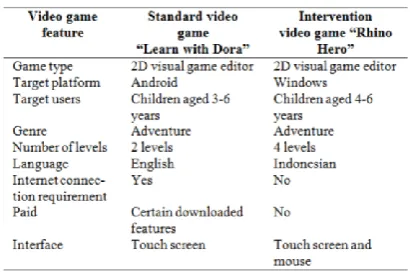
In this research, comparisons of features between the “Rhino Hero” video game used for the intervention and the “Learn with Dora” video game which serverd as the benchmark for the game built in this study. Both games share the same type and genre as two-dimensional (2D) adventure games. The distinction between them lies in the target platform, number of levels, language, internet connection requirement, and consequences of access. Both games are targeted for preschool age users. Detailed information of these comparisons is provided in Table 2.
Table 2. Cognitive comparisons of the video games
In general, standard video games and video game interventions have features that are game types, target users, genres and similar interfaces. However, both video games have different platforms, number of levels, languages and internet connections. this is because intervention video games are deliberately designed to determine the cognitive
enhancement of
[image:2.595.75.266.298.423.2] [image:2.595.323.529.521.659.2]C. Intervention of the Game as Cognitive Stimulation for Preschoolers
Results of the video game intervention are specified over every cognitive component of preschoolers with details as follows.
Information
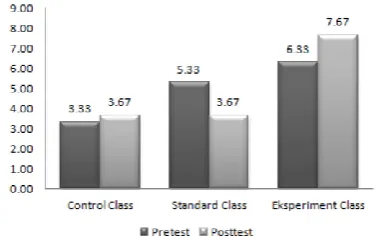
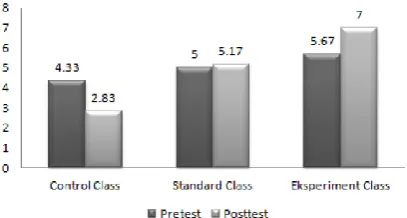
The Kruskal-Wallis mean ranks of this cognitive component indicate that the experiment class had a positive trend in weight (+2.17) at the posttest compared to at the pretest. This establishes the position of the experiment class above the other two classes in regard to increase in this cognitive ability, as shown in Fig 3. Meanwhile, the mean rank of the control class declined while the standard class stay stagnated.
Fig 3. Result of intervention on the Information cognitive component
Vocabulary
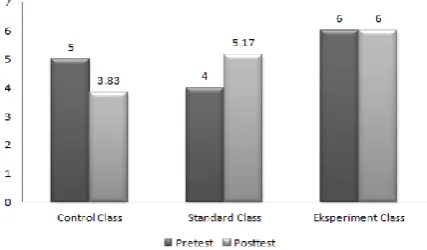
The Kruskal-Wallis mean ranks of vocabulary reveal that the experiment class also enjoyed a weight boost (+2.00) between the pretest and the posttest. This elevates the rank of the experiment class from second place at the pretest to the first after the posttest, as seen in Fig 4. In this respect, the control class suffered a considerable drop (-3.17), whereas the standard class also boasted a rise although not as high as that of the experiment class.
Fig 4. Result of intervention on the Vocabularycognitive component
Arithmetic
The Kruskal-Wallis mean ranks of arithmetic demonstrate that the experiment class achieved a positive development (+0.50) between tests, maintaining its top spot in respect of this cognitive component over the other classes as displayed
in Fig 5. In this intervention, the control class also gained an increment whilst the standard class had a notable decrease.
Fig 5. Result of intervention on the Arithmetic cognitive component
Similarities
The Kruskal-Wallis mean ranks of this cognitive component unveil a weight improvement (+1.34) in the experiment class between the pretest and posttest, signifying that the experiment class remained the best in this context. Fig 6 also discloses that the control class’s mean rank went down while the control class’s climbed up, though insignificantly.
Fig 6. Result of intervention on the Similaritiescognitive component
Comprehension
The Kruskal-Wallis mean rank of the experiment class for this cognitive component did not show any change in weight (0.00) between both tests. On the other hand, Fig 7 points out that the control class experienced a dip whereas the standard class’s mean rank slightly went up.
Fig 7. Result of intervention on the Comprehensioncomponent
Animal House
For Animal House, the Kruskal-Wallis mean ranks uncover a remarkable weight gain
[image:3.595.324.524.80.212.2] [image:3.595.65.271.253.382.2] [image:3.595.329.518.332.451.2] [image:3.595.62.274.536.677.2] [image:3.595.323.526.567.692.2]and pretest, lifting the class from the lowest to the highest position in terms of this cognitive ability. As described in Fig 8, both the control and standard classes had a decrease, but that of the latter was much more significant (-3.00).
Fig 8. Result of intervention on theAnimal House component
Picture completion
The Kruskal-Wallis mean rank of the experiment class for this component in fact slightly declined (-0.67) at the posttest in comparison to the pretest. As illustrated in Fig 9, its position did improve although still second to the standard class. Similarly, the mean rank of the control class fell whilst that of the standard class rose considerably.
Fig 9. Result of intervention on thePicture Completion component
Mazes
No change was found in the Kruskal-Wallis mean rank of the experiment class on this cognitive component (0.00) at the posttest compared to at the pretest, even though the class remains at the top. Meanwhile, as Fig 10 shows, the control class underwent a decline in mean rank whereas the standard class experienced a rise.
Fig 10. Result of intervention on the Mazes cognitive component
Geometric design
In terms of geometric design, the Kruskal-Wallis mean ranks indicate that the experiment class obtained a positive trend (+3.00) between the posttest and pretest, promoting the class from third place at the pretest to first place at the posttest for this cognitive ability. Fig 11 also unveils that both the control and standard classes in this case had subsiding mean ranks, although that of the former went down much more significantly (-2.50).
Fig 11. Result of intervention on the Geometric Design component
Block design
It transpired that the Kruskal-Wallis mean rank of the experiment class for this cognitive component was the same as that of the standard class at the pretest and posttest, both undergoing a downward trend (-0.67). Both classes also dropped to second spot, overtaken by the control class which conversely gained a weight increment of +1.00, as displayed by Fig 12.
Fig 12. Result of intervention on the Block Design component
Verbal IQ score
The Verbal IQ score is the combination of five cognitive verbal skills of preschoolers, namely information, vocabulary, arithmetic, similarities and comprehension. The Kruskal-Wallis mean rank of the experiment class for the Verbal IQ score reveals an upward trend (+0.50) from the pretest to the posttest, keeping the experiment class above the control class and the standard class. Fig 13 also depicts a fall for the control class in this intervention and an increase for the standard class.
Performance IQ score
The Performance IQ score is the amalgamation of five cognitive performance skills
of preschoolers, consisting of the Animal House, picture
[image:4.595.68.264.106.235.2] [image:4.595.324.531.151.287.2] [image:4.595.72.263.360.478.2] [image:4.595.326.527.424.550.2] [image:4.595.60.274.608.733.2]geometric design and block design. The Performance IQ Kruskal-Wallis mean rank of the experiment class demonstrated a positive development (+0.83) between the pretest and posttest, as seen in Fig 14, establishing the experiment class as the best for this cognitive capability compared to the other classes. In this intervention, the control class took a dip while the standard class reasonably improved.
Fig 13. Result of intervention on the Verbal IQ score component
Fig 14. Result of intervention on the Performance IQ score component
Full Scale IQ score
The Full Scale IQ score denotes the overall scale of cognitive ability, including verbal and performance skills. In general, the cognitive competence of the experiment class augmented in mean rank with a value of +1.33, confirming the experiment class as the overall best over the control and standard classes, as pictured in Fig 15. In the meantime, the control class had a reduced mean rank (-1.50) whereas that of the standard class very slightly increased (+0.17).
Based on the results have been illustrated in Fig 3 to 15 of each cognitive component in preschoolers, it can be summarized that the general mean rank weight of the experiment class enhanced by majority mean rank values exceds those of the standard and control classes. Based on the ten cognitive components observed, six yielded positive outcomes, two indicated static results, and two gave slightly negative ones (-0.67). It is important to note from these outcomes that with the intervention of the “Rhino Hero” game, the Verbal IQ, Performance IQ and Full Scale IQ scores simultaneously rose by +0.50, +0.83 and +1.33 points, respectively. The specific data are provided in Table 3 and 4. The mean rank increment values of cognitive competence in each class reflect the dynamics of cognitive components in children when assessed during pretest and posttest. A positive value (+) signifies that the cognitive component of children in the class improved between the posttest and pretest. On the contrary, if the value is negative (-), the cognitive component of children in that class abated during posttest when compared with the same component in the pretest.
Detailed interpretation of data from the intervention with the video game “Rhino Hero” on children compared to that with the standard video game “Learn with Dora” on every cognitive component discloses that only six components had positive progresses or were successfully stimulated, namely information, vocabulary, arithmetic, similarities, Animal House and geometric design. Two cognitive skills of the children, comprehension and mazes, did not experience any changes, as reflected by their static ranks. The cognitive abilities of children in picture completion and block design even suffered negative trends, implying failed stimulation.
Although the cognitive skills of comprehension and mazes did not change in the experiment class, the standard class enjoyed positive growth in both respects. Analysis attributes these findings to the fact that the “Learn with Dora” video game played by the standard class boasts prominent conversation/comprehension and maze components. It should therefore be considered to strengthen these two components in the video game design of “Rhino Hero”, along with the other components with negative figures, picture completion and block design.
Nevertheless, the overall cognitive competence of the children was positively stimulated in relation to their Verbal IQ, Performance IQ and Full Scale IQ scores. This becomes a distinguishing point from past research investigating the correlation of games to children’s cognitive academic skills [6], [7], spatial intelligence [8] or attitudes and creativity [9] separately.
However, though “Rhino Hero” has generally provided positive cognitive stimulation, the Verbal IQ score increase it engendered remains below that prompted by “Learn with Dora”. This suggests that “Rhino Hero” needs to upgrade its stimulation on this part.
[image:5.595.66.273.139.264.2] [image:5.595.63.275.300.430.2] [image:5.595.66.270.606.715.2]Table 3. Profile of ranking and mean rank increments of cognitive components in preschoolers
Table 4. Profile of ranking and mean rank increments of IQ
.
IV.CONCLUSION
In conclusion, out of the ten preschool cognitive components observed in this study, six components have positive results (In-formation, Vocabulary, Arithmetic, Similarities, Animal House and Geometric Design), two components stagnated (Comprehension and Mazes) and the last two components (Picture Completion and Block Design) had moderately negative trends (-0.67). The most important finding to note is that “Rhino Hero” game intervention prompted the Verbal IQ, Performance IQ and Full Scale IQ scores to respectively enhance by +0.50, +0.83 and +1.33. These outcomes insinuate that the “Rhino Hero” video game improves the general cognitive competence of children in regard to Verbal IQ, Performance IQ and Full Scale IQ.
ACKNOWLEDGMENT
This work is supported by the Informatics Department, Faculty of Communication and Informatics of Universitas Muhammadiyah Surakarta (UMS).
REFERENCES
1. A. Szczesna, J. Grudzinski, T. Grudzinski, R. Mikuszewski, and A. Debowsk. The psychology serious game prototype for preschool children,” IEEE 1st International Conference on Serious Games and Applications for Health (SeGAH) 2011;1–4.
2. K. Schreiner. Digital Games Target Social Change. IEEE Comput.
Graph. Appl. 2008; 28(1):12-17.
3. E. Sudarmilah, U. Fadlilah, H. Supriyono, F. Y. A. Irsyadi, Y. S. Nugroho, and A. Fatmawati. A review: Is there any benefit in serious games?. AIP Conference Proceedings 2018; 1977.
4. A. A. Navarro-Newball, D. Loaiza, C. Oviedo, A. Castillo, A. Portilla,
D. Linares, and G. Álvarez, “Talking to Teo: Video game supported speech therapy. Entertain. Comput., 2014; 2(4): 401-412.
5. N. Robb, A. Waller, and K. Woodcock. The Development of TASTER,
a Cognitive Training Game Using Human-Centered Design, Tailored for Children with Global and Specific Cognitive Impairments. International Conference on Games and Virtual Worlds for Serious Applications (VS-Games) 2015; 1–2.
6. J. Vasterling, R. A. Jenkins, D. M. Tope, and T. G. Burish. Cognitive
distraction and relaxation training for the control of side effects due to cancer chemotherapy. J. Behav. Med. 1993; 16(1): 65–80.
7. D. Clements. Young Children and Technology | Investigations in
Number, Data, and Space®. 2013. [Online]. Available:
http://investigations.terc.edu/library/bookpapers/young_children_tec h.cfm. [Accessed: 25-Mar-2013].
8. V. Nacher, F. Garcia-Sanjuan, and J. Jaen. Interactive technologies for
preschool game-based instruction: Experiences and future challenges. Entertain. Comput. 2016; 17:19-29.
9. A. Drigas, L. Koukianakis, and Y. Papagerasimou. A Web Based
E-Learning and E-Psychology Modular Environment. 2006; 168–174.
10. E. B. Hurlock. Child Development, 6th ed. New York: Mc. Graw Hill,
Inc. 1978.
11. S. Golestan, A. Mahmoudi-Nejad, and H. Moradi. A Framework for
12. C. P. Kreutzer and C. A. Bowers. Making Games for Health Engaging: The Influence of Cognitive Skills. Games Health J. 2016; 5(1):21-26.
13. E. Sudarmilah, A. Susanto, R. Ferdiana, and N. Ramdhani.
Developing a game for preschoolers: What character, emotion and reward will tend to hack preschoolers? International Conference on Data and Software Engineering (ICoDSE). 2015: 89–92.
14. E. Sudarmilah, A. Susanto, R. Ferdiana, and N. Ramdhani.
Preschoolers’ cognitive game prototype. International Conference on Applied System Innovation (ICASI), 2017; 1875–1878.
15. E. Sudarmilah, U. Fadlilah, A. Susanto, R. Ferdiana, N. Ramdhani, and P. I. Santosa. Expert Judgment on Preschoolers ’ Cognitive Game Prototype. Int. J. Pure Appl. Math. 2018; 118(20): 539–544. 16. I. S. Baron and K. A. Leonberger. Assessment of Intelligence in the
Preschool Period. Neuropsychol. Rev. 2012; 22(4): 334–344.
17. E. O. Lichtenberger. General measures of cognition for the preschool
child,. Ment. Retard. Dev. Disabil. Res. Rev. 2005; 11(3): 197–208.
18. S. Walker, Learning Theory and Behaviour Modification. Methuen,
1984.
19. J. D. Spurrier. On the null distribution of the Kruskal–Wallis statistic. J. Nonparametr. Stat. 2003; 15(6): 685–691.
20. J. P. Meyer and M. A. Seaman. A Comparison of the Exact
Kruskal-Wallis Distribution to Asymptotic Approximations for All Sample Sizes up to 105. J. Exp. Educ. 2013; 81(2): 139–156.
21. D. Martinovic, C. I. Ezeife, R. Whent, J. Reed, G. H. Burgess, C. M.
Pomerleau, Y. Yang, and R. Chaturvedi. Critic-proofing’ of the cognitive aspects of simple games. Comput. Educ. 2014; 72: 132–144.
22. J. Piaget, Psychology of Intelligence. Taylor & Francis e-Library, 2005.
23. R. Bernhaupt, Evaluating User Experience in Games: Concepts and
Methods. 2010.
AUTHORSPROFILE
Endah Sudarmilah, graduated from doctoral
degree on Department of Electrical Engineering and Information Technology, Universitas Gadjah Mada. She has been employed as lecturer in Informatics
Engineering Department. Muhammadiyah
University of Surakarta, Indonesia. She joined the group of Informatics Engineering Researcher in this institution. Her interest is software engineering that special field is Game Development.
Adila Firdaus Binti Arbain She has been employed