Identification of Readiness of Developing
University to Apply Information and
Communication Technology (ICT) in Teaching
and Learning
Sholeh Hidayat1, Aan Hendrayana2, and Heni Pujiastuti2 *
1Instructional Technology Department, Universitas Sultan Ageng Tirtayasa, Indonesia 2Mathematics Education Department, Universitas Sultan Ageng Tirtayasa, Indonesia
Abstract. The integration of Information and Communication Technology (ICT) in learning is kind of innovation in education. Several studies have shown that the application of ICT is able to improve students' competence and satisfaction with subject studied and enhancing the ability of both subjects and graduate levels. A developing university must be able to apply ICT in teaching and learning. One of a developing university in Indonesia is Universitas Sultan Ageng Tirtayasa (Untirta). The subject of this research is a student of Faculty of Teacher Training and Education of Untirta. The main purpose of the research is to know the readiness of lecturer and college student in using ICT integrated into the learning process. Based on research it is known that both of lecturers and students have the readiness to adopt integrated ICT in the learning process. The main problem that arises from lecturers is the lack of lecturers' skills in using technology. While the problems that arise from students is the need for a free internet connection. Therefore, the university has to provide the training for the lecturers and provide free connections for the students.
Keywords: Integrated ICT, Readiness, Lecturer, College student, Untirta
1 Introduction
The integration of Information and Communication Technology (ICT) in learning is kind of innovation in education. Several studies have shown that the application of ICT is able to improve students' competence and satisfaction with subject studied [1] and enhancing the ability of both subjects and graduate levels [2]. Although there is a critical view of the use ICT [3] and also needs to be discussed in the technical application of it [4], using ICT remains a priority in learning and teaching. The research involved preservice teacher indicates that there are no differences in pre-service teachers' attitudes and behavioral intentions towards the use of ICT for teaching and learning [5]. Therefore, continuous ICT integration will improve the quality of teaching and learning [6, 7, 8].
In developing integrated ICT should consider several factors that affect the effectiveness of ICT in learning. ICT integration into societies and schools. ICT infrastructure, ICT content into school programs [9]. In other words, the related challenge
of linking the design of appropriate educational content to the learning process was recognized as one of providing learners with interesting, relevant and transformative contexts to link reflection and practice [10].
In addition to the above survey research, many studies that discuss the advantages that can be a higher education when applied ICT [11]. However, not many are looking at losses obtained if ICT is applied. Some of the findings of the losses derived from the application of ICT in higher education, among others: (1) the lack of lecturers make progress monitoring study and the characteristics of student learning is difficult in monitoring, (2) there is a lot of irrelevant information, (3) feedback from lecturers is limited, and (4) the performance of students in practice are not measured well [12, 13]. The study on these losses is the quickness of the presence of lecturers and their interactions. The point is the use of ICT and the presence of lecturers can simultaneously make a profit to be optimal for higher education. Therefore, research that takes advantage of ICT to find a solution to minimize losses from the application of ICT is wide open. ICT development that accommodates the needs of the above is to develop teaching materials is integrated with the presence of the lecturer. Integrative teaching materials can be video conferencing (interactive video), video, simulations, interactions, chat, text, and materials evaluation.
Thus, the students are expected to have experience in applying ICT in the learning, so that they have competencies to learn. This is in line with purposes of higher education, it should be able to produce graduates who are able to adapt to the needs of the times. Graduates of educational institutions should have the ability; 1) to adapt to changes more quickly than before, 2) adapting the work to be created later, 3) resolve problems that may arise later, and 4) using the latest technology.
In harmony with these needs, a developing university must be able to apply ICT in teaching and learning. One of a developing university in Indonesia is Universitas Sultan Ageng Tirtayasa (Untirta). It has the goal of producing quality graduates, educated, trained, and skilled according to the needs of stakeholders. This means that Untirta always continues to strive to provide graduates according to the needs of stakeholders. Efforts are being made to achieve the objectives set out in any of the missions Untirta, which develops information technology systems that can stimulate the establishment of the college superior, independent, creative, innovative, and competitive. As a manifestation of the mission including by organizing an effective learning process and qualified. Therefore, the mission poured Untirta Research Master Plan (URMP) is one of the strategic plans is there needs to be a research-based instructional innovation of ICT [14].
Base on explanation before, this study aims to identify the readiness of the university to apply ICT in teaching and learning.
2 Research Method
We use research and development (R & D) method to develop an ICT system in teaching and learning for this developing university. The approach of research in education including 10 steps, namely: Preliminary Study, Planning Research, Development Design, Preliminary Field Test, Revised Results of Field Test, Main Field Test, Revised Result of Main Field Test, Feasibility Test, Revised Final Results of Feasibility, and Dissemination and Implementation Final Products [15]. Nevertheless, to identify the readiness of the university to apply ICT in teaching and learning, we use survey method. The instruments used in data collection in this study is in the teacher and student questionnaire and also interview.
of linking the design of appropriate educational content to the learning process was recognized as one of providing learners with interesting, relevant and transformative contexts to link reflection and practice [10].
In addition to the above survey research, many studies that discuss the advantages that can be a higher education when applied ICT [11]. However, not many are looking at losses obtained if ICT is applied. Some of the findings of the losses derived from the application of ICT in higher education, among others: (1) the lack of lecturers make progress monitoring study and the characteristics of student learning is difficult in monitoring, (2) there is a lot of irrelevant information, (3) feedback from lecturers is limited, and (4) the performance of students in practice are not measured well [12, 13]. The study on these losses is the quickness of the presence of lecturers and their interactions. The point is the use of ICT and the presence of lecturers can simultaneously make a profit to be optimal for higher education. Therefore, research that takes advantage of ICT to find a solution to minimize losses from the application of ICT is wide open. ICT development that accommodates the needs of the above is to develop teaching materials is integrated with the presence of the lecturer. Integrative teaching materials can be video conferencing (interactive video), video, simulations, interactions, chat, text, and materials evaluation.
Thus, the students are expected to have experience in applying ICT in the learning, so that they have competencies to learn. This is in line with purposes of higher education, it should be able to produce graduates who are able to adapt to the needs of the times. Graduates of educational institutions should have the ability; 1) to adapt to changes more quickly than before, 2) adapting the work to be created later, 3) resolve problems that may arise later, and 4) using the latest technology.
In harmony with these needs, a developing university must be able to apply ICT in teaching and learning. One of a developing university in Indonesia is Universitas Sultan Ageng Tirtayasa (Untirta). It has the goal of producing quality graduates, educated, trained, and skilled according to the needs of stakeholders. This means that Untirta always continues to strive to provide graduates according to the needs of stakeholders. Efforts are being made to achieve the objectives set out in any of the missions Untirta, which develops information technology systems that can stimulate the establishment of the college superior, independent, creative, innovative, and competitive. As a manifestation of the mission including by organizing an effective learning process and qualified. Therefore, the mission poured Untirta Research Master Plan (URMP) is one of the strategic plans is there needs to be a research-based instructional innovation of ICT [14].
Base on explanation before, this study aims to identify the readiness of the university to apply ICT in teaching and learning.
2 Research Method
We use research and development (R & D) method to develop an ICT system in teaching and learning for this developing university. The approach of research in education including 10 steps, namely: Preliminary Study, Planning Research, Development Design, Preliminary Field Test, Revised Results of Field Test, Main Field Test, Revised Result of Main Field Test, Feasibility Test, Revised Final Results of Feasibility, and Dissemination and Implementation Final Products [15]. Nevertheless, to identify the readiness of the university to apply ICT in teaching and learning, we use survey method. The instruments used in data collection in this study is in the teacher and student questionnaire and also interview.
This research requires a series of steps that is long enough. From the tenth step, the research step that has been done is step 1. The 9 until 10 steps in the phase of research that
is being and will be done. Part of the research development phase is the readiness analysis of research subjects so that will be input on the product to be made. The subject of this research is the sampling of lecturers and students in one faculty. The sample is taken by using cluster random sampling.
3 Results and Discussion
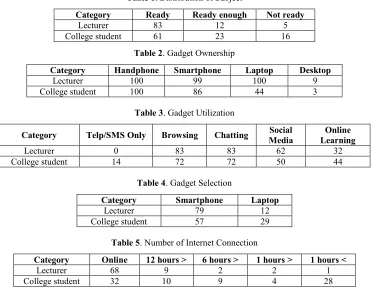
[image:3.482.57.429.212.507.2]From survey which conducted 100 lecturers at the Faculty of Training and Education and 100 college students, the results are shown in Table 1, Table 2, Table 3, Table 4, and Table 5.
Table 1. Distribution of Subject
Category Ready Ready enough Not ready
Lecturer 83 12 5 College student 61 23 16
Table 2. Gadget Ownership
Category Handphone Smartphone Laptop Desktop
Lecturer 100 99 100 9 College student 100 86 44 3
Table 3. Gadget Utilization
Category Telp/SMS Only Browsing Chatting Media Social Learning Online
Lecturer 0 83 83 62 32 College student 14 72 72 50 44
Table 4. Gadget Selection
Category Smartphone Laptop
Lecturer 79 12 College student 57 29
Table 5. Number of Internet Connection
Category Online 12 hours > 6 hours > 1 hours > 1 hours <
Lecturer 68 9 2 2 1 College student 32 10 9 4 28
From the 100 lecturers given questionnaires, as many as 83 people admitted ready to organize online learning, 12 admitted quite ready, and 5 people said not ready. After being examined, the lecturers who were not ready were those who were in the 50's. Their unfamiliarity is natural because when they took bachelor degree, the computer was not so well known in Indonesia. If time backward, lecturers aged the 50s and pursued a bachelor degree in 1987. At that time computer technology with GUI (Graphic Unit Interface) is not well known.
more on economic factors and just a special case. There are two interesting findings on this data. Firstly, almost all professors have smartphones. Secondly, all lecturers have personal computers in the form of laptops and very few have desktops. Advanced search results, lecturers who have a desktop tend to rarely use it, while active lecturers use the desktop because it still works well. Those with a desktop do not want to replace it with a new one if it breaks. Interestingly, these two findings are the realization that the need for gadgets that have mobility, in short on the packaging, and save energy consumption.
Another interesting finding is that both lecturers and students prefer to use smartphones for internet connection needs. This shows that in the future applications are made applications that are adaptive to smartphone technology or in other words based smartphone operating system or at least accessible by smartphone.
Related to the intensity of internet access, Lecturers dominant online, while students tend to spread. The results of interviews on lecturers obtained the answer that they are required to go online for work needs. Meanwhile, the students' reasons are very diverse and there is a tendency on lifestyle reasons. Apart from that, there are demands on students to get an internet connection for free, especially when on campus.
4 Conclusions
In general, lecturers and students have the readiness to adopt integrated ICT in the learning process. The main problem of the lecturers is the skill in the utilization of technology. The platform to use for e-learning is an app that has a smartphone operating system. The main obstacle of the student is the internet connection for free becomes the main requirement. For that, the effort of the institution for lecturers that is, many provide training and conditioning so that lecturers have demands and awareness in order to use gadgets for online learning needs. In college students, institutions only need to provide free connections because the laboratory is limited and the usage is overwhelming. The university effort by providing alternative connections with the third party is quite helpful but has not solved the problem since the online learning activities are 24 hours.
Acknowledgment
We would like to thank the Ministry of Research, Technology and Higher Education of Indonesia for the research grant (Penelitian Unggulan Perguruan Tinggi). Also similarly to the Institute of Research and Community Service, Universitas Sultan Ageng Tirtayasa who helped the process of research implementation.
References
1. N. Olmedo-Torrea, O. F. Vidala, J. L. Castillob, F. B. Rodríguez, Proc. Soc. and Behav. Sci. 237, 737-744 ( 2017 )
2. N. Pheeraphan, Proc. Soc. and Behav. Sci. 103, 365 – 373 ( 2013 ) 3. S. Livingstone. Oxf. Rev. of Edu. 38 (1), 9-24 (2012)
4. N. Tvenge, K. Martinsen, S. S. V. K. Kolla, Proc. CIRP 54, 101-106 ( 2016 )
5. T. Valtonen, J. Kukkonen, S. Kontkanen, K. Sormunen, P. Dillon, E. Sointu, Comp. & Edu. (2014)
6. I. N. Umara , A. S. A. Hassan. Proc. Soc. and Behav. Sci. 197, 2015 – 2021 ( 2015 ) 7. M. . Webb. Int. Jour. of Sci. Edu. 27(6), 705–735 (2005)
more on economic factors and just a special case. There are two interesting findings on this data. Firstly, almost all professors have smartphones. Secondly, all lecturers have personal computers in the form of laptops and very few have desktops. Advanced search results, lecturers who have a desktop tend to rarely use it, while active lecturers use the desktop because it still works well. Those with a desktop do not want to replace it with a new one if it breaks. Interestingly, these two findings are the realization that the need for gadgets that have mobility, in short on the packaging, and save energy consumption.
Another interesting finding is that both lecturers and students prefer to use smartphones for internet connection needs. This shows that in the future applications are made applications that are adaptive to smartphone technology or in other words based smartphone operating system or at least accessible by smartphone.
Related to the intensity of internet access, Lecturers dominant online, while students tend to spread. The results of interviews on lecturers obtained the answer that they are required to go online for work needs. Meanwhile, the students' reasons are very diverse and there is a tendency on lifestyle reasons. Apart from that, there are demands on students to get an internet connection for free, especially when on campus.
4 Conclusions
In general, lecturers and students have the readiness to adopt integrated ICT in the learning process. The main problem of the lecturers is the skill in the utilization of technology. The platform to use for e-learning is an app that has a smartphone operating system. The main obstacle of the student is the internet connection for free becomes the main requirement. For that, the effort of the institution for lecturers that is, many provide training and conditioning so that lecturers have demands and awareness in order to use gadgets for online learning needs. In college students, institutions only need to provide free connections because the laboratory is limited and the usage is overwhelming. The university effort by providing alternative connections with the third party is quite helpful but has not solved the problem since the online learning activities are 24 hours.
Acknowledgment
We would like to thank the Ministry of Research, Technology and Higher Education of Indonesia for the research grant (Penelitian Unggulan Perguruan Tinggi). Also similarly to the Institute of Research and Community Service, Universitas Sultan Ageng Tirtayasa who helped the process of research implementation.
References
1. N. Olmedo-Torrea, O. F. Vidala, J. L. Castillob, F. B. Rodríguez, Proc. Soc. and Behav. Sci. 237, 737-744 ( 2017 )
2. N. Pheeraphan, Proc. Soc. and Behav. Sci. 103, 365 – 373 ( 2013 ) 3. S. Livingstone. Oxf. Rev. of Edu. 38 (1), 9-24 (2012)
4. N. Tvenge, K. Martinsen, S. S. V. K. Kolla, Proc. CIRP 54, 101-106 ( 2016 )
5. T. Valtonen, J. Kukkonen, S. Kontkanen, K. Sormunen, P. Dillon, E. Sointu, Comp. & Edu. (2014)
6. I. N. Umara , A. S. A. Hassan. Proc. Soc. and Behav. Sci. 197, 2015 – 2021 ( 2015 ) 7. M. . Webb. Int. Jour. of Sci. Edu. 27(6), 705–735 (2005)
8. K.D. Su, Computers & Education 51, 1365–1374 (2008)
9. S. Capuk, A. Kara, Proc. Soc. and Behav. Sci. 191, 56-62 ( 2015 ) 10.C. Richards, Tech. Pedag. and Edu, 15 (2), 239-255 (2006)
11.U. Toro, M. Joshi, M, Int. Jour. of Innov. Manag. and Tech. , 3(1), 20-23 (2012) 12.S. Telebian, H. M. Mohammadi, A. Rezvanfar, Proc. Soc. and Behav. Sci. 152, 300 –
305 (2014)
13.Y. Perbawaningsih, Proc. Soc. and Behav. Sci. 103, 717-724 (2013)
14.Universitas Sultan Ageng Tirtayasa [Untirta], Rencana Induk Penelitian, Lembaga Penelitian dan Pengabdian Masyarakat Untirta, Serang, (2013)