Practice-Centered e-Science:
A Practice Turn Perspective on Cyberinfrastructure Design
Tyler Pace
Indiana University 919 E 10th Street Bloomington, IN 47408 USA
Shaowen Bardzell
Indiana University919 E 10th Street Bloomington, IN 47408 USA
Geoffrey Fox
Indiana University901 E 10th Street Bloomington, IN 47408 USA
ABSTRACT
Cyberinfrastructure is a rapidly growing area of global research and funding with a history of emphasizing the role technology will play in changing scientific work practices. This paper proposes a practice-theoretic perspective that is informative to cyberinfrastructure research and design. To illustrate the relevancy of a practice-theoretic perspective to cyberinfrastructure, this paper presents a critical review of 160 cyberinfrastructure research papers and reports published in the last decade through a perspective of embodied practice. After relating common cyberinfrastructure research themes through a focus on embodied practice, we propose a series of early implications for design aimed at incorporating the lessons of embodied practice into the design and development of future cyberinfrastructure applications.
Categories and Subject Descriptors
H5.m. Information interfaces and presentation (e.g., HCI): Miscellaneous.
General Terms
Design, Human FactorsKeywords
Cyberinfrastructure, embodied practice, practice turn
1.
INTRODUCTION
Cyberinfrastructure, or e-science, is a rapidly growing area of global research and funding [5]. Essentially, cyberinfrastructure refers to the ―infrastructure of distributed computer, information, and communication technologies‖ [29] supporting a transformation in the sciences towards large scale, collaborative data driven enterprises. Recent vision statements of cyberinfrastructure highlight the potential for cyberinfrastructure to serve as a ―harbinger of a broader impact … on the conduct of knowledge-based activities‖ [3]. Furthermore, cyberinfrastructure based communities ―offer the potential for a new wave of global-scale collaboration across multiple disciplines, geography, and institutions‖ that serve to ―empower a revolution in what science
explores, how it is done, and who participates‖ [3].
As noted in the earliest vision statements, collaboration is at the heart of cyberinfrastructure [5]. The many complexities of large scale data sharing and the growing mandate to design and build more usable, accessible and diverse cyberinfrastructure tools are subjugated to the overarching goal of enabling, promoting and increasing effective collaboration in the sciences. At its core, scientific collaboration is primarily a social and organizational issue rather than a technological one [10, 32, 40, 4]. Therefore, research in cyberinfrastructure is in no small part concerned with the ways in which scientists as users incorporate cyberinfrastructure into their professional practice.
1.1
The Embodied “Practice Turn” in Design
According to Fernaeus et al. the ―practice turn‖ in design serves to challenge conventional assumptions about ―what we value in people‘s interaction with technology‖ [22]. These assumptions include the ―divide between digital and material, input and output, and the relationship between the context and the interactive system‖ [22]. As such, the practice turn in human-computer interaction (HCI) draws on theories of phenomenology [19], pragmatism [33], and ethnomethodology [16] to ―overcome the dualist notion of knowledge and action‖ born from the ―engineering and cognitive psychology legacy‖ of HCI.
As noted by Fernaeus et al., a ―central dimension in practice-oriented perspectives‖ is the rejection of separating the mind from physical and social contexts [22]. Rather, Fernaeus et al. (citing Lave [31]) note that ―‘cognition‘ observed in everyday practice is distributed – stretched over, not divided among – mind, body, activity, and culturally organized settings (which include other actors).‖ Given this more expansive view of cognition and experience, the practice turn brings to the fore a ―strong ambition towards a participant‘s perspective on action and interaction with technology‖ [22]. Furthermore, the participant‘s perspective ―emphasizes that designers … should attempt to understand how an activity is viewed by the participants‖ and to ―document how … participants go about doing and organizing … what aspects of the technology they are oriented towards, what they make central and peripheral, and how they make the activity meaningful for themselves and their peers‖ [22]. From a designer‘s perspective, the practice turn ―suggests that one often should be able to look beyond the usage of a particular technology and instead focus on the process of meaning making and social interactions, and how the technology plays a part in such processes.‖
In the analysis of cyberinfrastructure literature presented in this paper, we aim to demonstrate the utility of a practice turn
Permission to make digital or hard copies of all or part of this work for personal or classroom use is granted without fee provided that copies are not made or distributed for profit or commercial advantage and that copies bear this notice and the full citation on the first page. To copy otherwise, or republish, to post on servers or to redistribute to lists, requires prior specific permission and/or a fee.
perspective in situating existing cyberinfrastructure research while also revealing some new directions for cyberinfrastructure research and design.
2.
METHOD
The study presented in this paper represents the review of 160 academic books, articles, and technical reports on cyberinfrastructure and e-science published since the year 2000. Our literature search extended back to 2000 in order to accommodate a few key, preliminary works that informed the now seminal 2003 NSF report on Revolutionizing Science and Engineering through Cyberinfrastructure [5]. The NSF report is considered by many to mark the ―beginning‖ of the modern cyberinfrastructure research program and served as an appropriate place to start our literature search.
Articles for this project were pulled from conferences and journals in HCI (e.g., ACM CHI, ACM GROUP), computer supported cooperative work (e.g., ACM CSCW, ECSCW, JCSCW), computer-mediated communication (e.g., JCMC), and computer engineering (e.g., IEEE E-Science). It is not our goal to fully encapsulate the last 10 years of cyberinfrastructure research from these multiple, related domains (such a task would be foolish in the space provided), but rather we present a cross-sectional representation of the common cyberinfrastructure research questions and outcomes of the last decade as seen from an embodied practice point of view. Similar approaches to conducting cross-sectional literature reviews have been used to great success within HCI [8].
This work does not represent an externally validated content analysis, taxonomy or other type of categorization of the cyberinfrastructure literature. Rather, we are using an interpretive and critical approach to analyze the literature based on constructs from embodied practice in addition to utilizing the expertise of the researchers in the cyberinfrastructure, CSCW and HCI domains. Bos et al [12] used a similar approach for evaluating cyberinfrastructure research when developing a taxonomy of collaboratories. While the contributions of Bos et al‘s taxonomy of collaboratories has been invaluable to our understanding of the breadth of cyberinfrastructure in practice, we aim to complement their technological and functionally oriented taxonomy of the types of cyberinfrastructure with a practice turn focused analysis of cyberinfrastructure research that reveals less about the different types of cyberinfrastructure projects and more about the ways in which cyberinfrastructure may benefit from the proposed practice turn in interaction design.
3.
THE PRACTICE TURN IN
CYBERINFRASTRUCTURE
In this section, we apply the ideals of the practice turn in HCI to research conducted under the auspices of cyberinfrastructure. We emphasize the use of Fernaeus et al.‘s framework for embodied practice in HCI design to analyze our body of cyberinfrastructure research. The work of Fernaeus et al. is highlighted because they present a timely and usable framework that meaningfully summarizes the practice turn ideas in HCI design. Our work is not meant to directly extend Fernaeus et al.‘s practice turn framework, but rather to appropriate their interpretation of the practice turn in HCI design and analyze cyberinfrastructure research through those ideals.
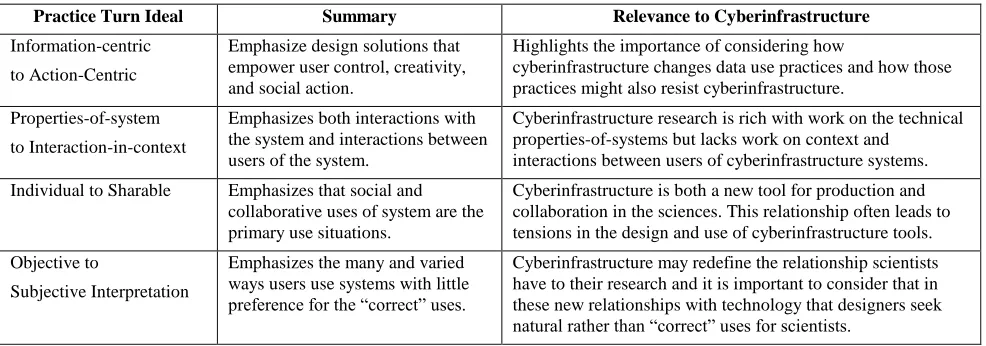
As demonstrated by Fernaeus et al., the practice turn includes a ―conceptual shift‖ among four ―ideals.‖ In this context, an ideal is understood as ―directions or goals that are strived towards and argued for when designing‖ [22]. The shifting ideals highlighted by Fernaeus et al. include the following:
Information-centric to action-centric
Properties-of-system to interaction-in-context
Individual to sharable
Objective to subjective interpretation
Each of the practice turn ideals will be discussed in kind in the following sub-sections.
3.1
Information-centric to Action-centric
Moving from an information-centric to an action-centric view of cyberinfrastructure design entails focusing on ―representational forms as resources for action‖ [22, emphasis original]. Through an action-centric perspective, it is not just ―information or data‖ that is ―considered to be moved between people and devices.‖ Instead, an action-centric view suggests that artifacts, including those produced in the name of cyberinfrastructure, have ―deeper social and personal purposes in a shared, collaborative space‖ within which users interact. As such, the action-centric perspective emphasizes design solutions that empower ―user control, creativity, and social action with interactive tools‖ [22, emphasis original].
Klemmer et al. also not the importance of an action-centric perspective in interaction design. For Klemmer et al. professional practice and cognition (including scientists) is developed and exercised in no small part through the application of tacit knowledge expressed via ―action-centered skills‖ [30]. The action-centered skills undertaken by professionals are often highly visible and in their visibility helps to coordinate the work of others. As noted by Klemmer et al. concerning the work of [25], paper medical records are an example of a highly visible and action-centric artifact. For experienced users, paper medical records are more than mere vessels of information. Instead, through the process of handling the medical records, medical personnel ―gain richer insight into the history of the patient‘s interaction with [the] hospital—pencil means a note is tentative, worn means that a record has seen a lot of use, etc‖ [30]. While paper medical records do contain a great deal of information, the nuanced practices surrounding the handling of the records serve to reveal a more tacit understanding of the patient‘s history.
As with the paper medical records, an action-centric perspective of cyberinfrastructure reveals the importance of designing for practices of data use and access (action-centric skills) in addition to data storage requirements (information-centric). The ways in which data is created, used, and accessed via cyberinfrastructure is already a popular area of research [2, 1, 3, 20, 23, 14]. Broadly speaking, research on data use and access in cyberinfrastructure tends to fall into one of the following categories:
A preference for open rather than closed data standards [2, 5].
Designing for the annotation or tagging of data. [1, 20, 23].
[image:3.612.327.548.184.314.2] The ability to store and use many different types of data. [1,14].
However, despite the many research efforts in the area of data use in cyberinfrastructure mediated work, there are relatively few investigations of the way cyberinfrastructure is changing established data use practices and how those practices might be resistant to the goals of cyberinfrastructure development ([14] presents some early work in this area). As pointed out by the practice turn perspective, the ways in which data/representations are used in professional settings are nuanced, tacit and often highly resistant to change. Research in cyberinfrastructure design is just recently coming to realize the importance of our action-centric relationship to data use in the sciences and the implications of that relationship for the design of future cyberinfrastructure tools.
3.2
Properties-of-system to
Interaction-in-context
Shifting from a design orientation emphasizing the properties-of-system to an orientation of designing for interaction-in-context suggests how frequent interactions with systems can ―naturally become a part of … ordinary interaction patterns‖ [22]. Interaction-in-context highlights how some of the ―most important aspects of an activity may lie outside of the actual interaction with the system‖ thereby producing an ―expanded space for using technology‖ provided by the physical and social contexts of the users [22]. As a result, interaction-in-context provides a general shift away from looking solely at system functionality (i.e., properties-of-system) to include a view of ―what users will be able to do in the setting in which the interactive system plays a part‖ (i.e., interaction-in-context) [22]. A consequence of this view is to emphasize how systems are designed to support user interactions with system resources, to account for user actions within social groups, and to envision how users might interact socially around the system. Ultimately, viewing interaction-in-context suggests that designers need to ―consider both interaction with the system and interaction between participants‖ in our design efforts [22].
An example of interaction-in-context can be found in the eMoto messaging system [27]. Users of eMoto send SMSs between phones, but in addition to text, the messages also contain colorful shapes and animations. These shapes and animations are designed to allow eMoto users to express a wide range of felt emotions. Given the inherent ambiguity of the content of eMoto messages, the affective information expressed via the eMoto system is only valuable in the larger social and physical contexts of the users. eMoto messages only make sense ―against a background of knowing the other person‖ in order to make sense of the unique combination of textual and visual information conveyed in an eMoto message. However, on the other hand, eMoto messages were always already familiar because recipients of the messages were also users of the eMoto system. Together, this means that the ―meaning of the messages is not given by the system‖ but rather by ―the interpretation given by the‖ users who were using eMoto ―in ways that make sense to them.‖
As demonstrated through Fernaeus et al.‘s description of interaction-in-context and the eMoto example, designing for and
supporting a shared context and mutual awareness is in many ways essential to successful social and collaborative uses of interactive systems. However, research on cyberinfrastructure systems regularly notes the difficulties of designing for interaction-in-context. In terms of cyberinfrastructure, issues of interaction-in-context are perhaps made most prominent when cyberinfrastructure is leveraged to create contexts of work and establish awareness among members of collaborative research teams [3, 9, 24, 44].
Figure 1: Example eMoto messages with a combination of text and emotive backgrounds [17].
The turn towards a practice centric and interaction-in-context view of cyberinfrastructure presented in this paper highlights the need to better support ―situational awareness‖ among cyberinfrastructure users as a means for establishing and reaffirming contexts of interaction. For Sonnenwald, situational awareness is developed through the sharing of the following [40]:
Contextual information that relays the broadest physical context within which work is happening.
Process information that relays current and relevant work tasks and processes.
Socio-emotional information that relays interpersonal information about collaborators.
Sonnenwald also notes potential design features that can enhance situational awareness and interaction-in-context [40].
The amount of system control given to users and the extent to which they can modify the system environment.
The richness of the sensory data presented by the system to the user.
The ability of the user to limit and control distractions caused by using the system.
The level of realism exhibited by the system (i.e., the extent to which information in the system is consistent with the ―objective‖ world).
expanding on the properties-of-systems). As such, researchers rapidly create, merge, and share new tools as more disciplines and scientists explore the possibilities for cyberinfrastructure. However, in the fervor to develop more technically advanced and proficient cyberinfrastructure tools, many applications are produced with virtually no commitment to user centered design processes that aim to better situate system interactions with user contexts [2, 9, 46].
As noted in a key report on the potential and pitfalls of cyberinfrastructure use in the UK [9], one of the biggest challenges in the adoption of cyberinfrastructure ―will remain ease of use … and poor human-computer interfaces‖ and interactions. The report highlights that attempts to improve or study interactions-in-context (via ―bolted on‖ interfaces) after extensive development of the properties-of-system are unlikely to be successful. However, preferencing technical over ―human … development‖ is the ―current norm … in this field‖ which will require a ―paradigm shift in attitudes‖ and the employment of ―user-focused design methodologies if there is to be a breakthrough in this area.‖ This report reinforces the difficult decisions groups face when choosing, developing and operating within cyberinfrastructure. Poorly designed cyberinfrastructure that ignores the relevance of interaction-in-context is likely to remain undesirable.
Current cyberinfrastructure research is rich with discussions and visions for the future properties-of-systems, however, only recently has the relevance of the interactions-in-context with cyberinfrastructure come to some prominence. However, the desire to investigate interactions-in-context for cyberinfrastructure is tempered by the reality of the difficulties in applying user centered design strategies to cyberinfrastructure development [46].
3.3
Individual to Sharable
For Fernaeus et al. one of the ―dominating themes‖ of the practice turn in HCI is the ―concern for designing for collaboration, sharing and social interaction‖ [22]. The interaction ideals of shared interactions shift from ―studying and designing interfaces for individual activity, to focus on systems that can be interacted with by several users simultaneously.‖ Qualities of sharable systems can be expressed in terms of the ―social, affective and collaborative activities‖ that they foster. However, Fernaeus et al. note that while the emphasis on sharable systems is new and growing, if we look at the artifacts and systems already around us that ―collaborative, social, and causal use is seldom a problem or something that occurs only occasionally.‖ Rather, social and collaborative uses of interactive systems are often ―the natural mode of being‖ with artifacts. As such, the practice turn proposes a ―reformulation‖ of our design spaces to emphasize ―how social and collaborative aspects are not viewed as extraordinary use situations‖ [22].
An example of the movement from individual to sharable design can be found in the ―Participate-in-the-Action‖-board or PITA-board project [28]. In short, the PITA-Board is an electronic chessboard modified to recognize and respond to a variety of RFID tagged objects (including electronic pens for sketching/annotating). The most prominent use case of the PITA-Board was for the purpose of the collaborative re-design of public transportation routes. Community members and transportation officials were tasked with the re-design of bus routes and used the
[image:4.612.336.534.174.318.2]PITA-Board with an overlay of satellite maps to collaboratively manipulate the current bus route and imagine mutually desirable alternatives [28]. Successful use of the PTIA-Board was attributed to the ―system constraints‖ that required ―coordination and sharing of resources‖ which fostered ―cooperation and structure[d] group processes‖ [28]. These constrains included the size of the PITA-Board, a purposefully limited number of interactive objects, and shared control of the PITA-Board display.
Figure 2: The PITA-Board for shared urban planning and design [38].
The PITA-Board helps to highlight the value in designing for sharable rather than individual interactions. Cyberinfrastructure research often tackles the issue of sharable and individual work in terms of the imperative to share vast amount of data as part of the value proposition of cyberinfrastructure itself.
The sharing of vast amounts of data is fundamental to the design of cyberinfrastructure [3, 5]. However, early cyberinfrastructure research notes the difficulty of resolving the varying social interests surrounding data use in the sciences. Accordingly, research into the technical and organizational solutions of the management of data via cyberinfrastructure tends to fall into two broad categories. First, there are concerns about how to meaningfully collect, share and analyze data in situations ranging from small co-located groups to disciplinary and multi-institutional collaborations. Second, cyberinfrastructure reveals or reinforces the fundamental role data plays in shaping scientific communities and practice.
While sharing large amounts of data creates issues of data integrity and storage, perhaps the most commonly reported issue in regards to data sharing is the problem of metadata. Creating and maintaining data for personal use is very different from creating data for group use due to the need to share not only data but context [1, 20]. Without context, data is practically meaningless [6, 34]. As individuals, scientists develop a tacit understanding of their data through their interactions-in-context [14]. However, when asked to share their data with diverse and remote colleagues it becomes a significant collaboration and technical challenge to determine what contextual information is required to maintain data value [1]. Additionally, sharing data at larger institutional and organizational levels entails the broader social problems of determining and attributing intellectual property [13] as well as abiding by informed consent and other ethical guidelines for anonymization of research data collected from human subjects [14, 34].
Improving and facilitating scientific collaboration is one of the great promises, goals, and achievements of cyberinfrastructure. However, the rapid growth and increasingly pervasive use of cyberinfrastructure across many disciplines reveals the necessity to revisit the collaborative and social implications of cyberinfrastructure. Our limited understanding of the complexity of sharing diverse data sets across many scientific disciplines remains a significant barrier to cyberinfrastructure design and adoption.
3.4
Objective to Subjective Interpretation
Fernaeus et al. note that a common argument for the practice turn in interaction design suggests that the manifestations of our designs ―potentially allow users to make use of experiences from interaction with other … objects, allowing the resources to blend into existing activities in a natural way‖ [22]. Citing Sengers and Gaver [39], Fernaeus et al. demonstrate how designers have conceptualized the challenge of subjective interpretation of interactive systems as ―staying open to interpretation.‖ Designers should not ―have only one preferred interpretation in mind of how their system should be taken into use.‖ Instead, users should ―be allowed to engage in multiple possible interpretations of a technology.‖ As an ideal for the design of interactive system, moving from objective to subjective interpretations entails a focus in that is ―not primarily to postulate what characterizes a ‗good‘ or usable system, but to understand how users make meaning … and what aspects they orient themselves towards and use in their specific … practices‖ [22].
[image:5.612.360.515.72.202.2]A frequently used example of the move to subjective interpretation in the design of interactive systems is that of the Drift Table [39]. The Drift Table is a coffee table with a ―built-in porthole that allows people to slowly ‗drift‘ over the English countryside.‖ As noted by Sengers and Gaver, the Drift Table is intended to ―open new design spaces for technologies.‖ However, in opening new spaces for subjective interpretation, the Drift Table was ―faced with the challenge that users are not likely to come to the system ready to understand it.‖ Initial reactions to the drift table were mixed with many users attempting and failing to ascertain the ―objective‖ features, functions and interactions of the table. However, after some exposure to the Drift Table, users began to develop and appreciate their own subjective experiences, interactions, and relationship with the table.
Figure 3: The Drift Table [18].
The Drift Table serves to remind us that the goals of interactive systems might be ―not to communicate a single correct interpretation, but to avoid communicating an incorrect one‖ [39, emphasis original]. In terms of cyberinfrastructure, scientists do not orient their practices to the purportedly ―correct‖ or ―objective‖ purposes of cyberinfrastructure, but rather situate themselves in relation to cyberinfrastructure in increasingly nuanced and practice driven (i.e., subjective) ways. This subjective interpretation of cyberinfrastructure is demonstrated, in part, via the means by which scientists relate themselves towards data and how they position themselves towards the proposed value of cyberinfrastructure itself.
The ability to access data is a critical point of entry into a scientific community [6, 10, 11]. In some fields, like earthquake engineering, data is generated in local laboratories as a result of conducting experiments. However, in space physics, scientists often rely on data from remotely located instruments, other scientists, or public sources. Obtaining access to data not only provides access to a scientific community, but it also positions a scientist within the socio-political hierarchy of their discipline [6, 14]. For many disciplines, having one‘s ―own‖ data is ―better‖ than relying on public or borrowed data. Access to data (whether creating it or gathering it from a shared instrument) entails a certain amount of political and/or financial resource. Epistemological, political and pedagogical (i.e., training of graduate students) practices all come to bear on how scientists relate to their data. However, CI research often reduces the question of data to issues of storage or representation thereby neglecting the complex social practices surrounding data creation and use in the sciences [6, 11, 14].
The practice turn in interaction design highlights the extent to which interactions with technology are subjectively and not objectively interpreted by users. Viewing cyberinfrastructure under the lens of subjective interpretations of technology reveals the importance of designing for the many types of relationships that scientists have with data both as individual researchers and as members of broader scientific communities. Cyberinfrastructure has the potential to redefine the relationship scientists have with data and thereby redefine the very experience, value and process of their work and its relation to the larger disciplines.
4.
DESIGN IMPLICATIONS
Fernaeus et al. propose some early implications for design based on the practice turn interaction design. While their design insights are broadly applicable to interaction design, we propose the following amended design insights that better reflect the position of cyberinfrastructure in the broader practice turn of HCI design.
4.1
Design to Encourage Participation
As discussed earlier, the practice turn in interactive systems design suggests a move to an action-centric rather than information-centric perspective. Fernaeus et al. note that a key dimension of the action-centric perspective is the ability to design for shared control over ―computational actions‖ in addition to the sharing of data [22]. In doing so, interactive systems become ―most appropriately understood as resources for shared activity rather than as representations of shared information‖ [22]. Additionally, designing for shared control implies equality in access and participation which is a major area of cyberinfrastructure research.
For all the benefits in computational speed and data analysis offered by cyberinfrastructure, the original vision guiding the development and funding of cyberinfrastructure is that of multi-disciplinary scientific collaboration [5]. One means for designing for shared control and equal participation in collaborations via cyberinfrastructure is to support a diversity of telecommunication tools that facilitate a variety of forms of participation with the cyberinfrastructure system. Research into the telecommunication needs of scientists engaged in collaboration via cyberinfrastructure reveals that providing a wide range of synchronous and asynchronous communication and collaboration tools improves the likelihood of successful collaboration and
involvement with the cyberinfrastructure system [26, 32, 44]. Telecommunication tools that support scientific collaboration are quite varied and include tools for identifying peers and time scheduling as well as (virtual) spaces for work and social interaction. A sufficient diversity in telecommunication services is more likely to meet the varying participation requirements and encourage participation among the many types of working groups that use any given cyberinfrastructure system [32].
Additionally, supporting a diversity of telecommunication services via cyberinfrastructure addresses several of the ―practice turn‖ ideals previously identified in this paper. Telecommunication diversity is intrinsically related to the ability to develop and participate in action-centric relationships with cyberinfrastructure. Furthermore, offering an array of telecommunication services maximizes the opportunities for scientists to articulate their own subjective relationship and practices with the cyberinfrastructure system. Finally, a variety of telecommunication services fosters the development of interaction-in-context and enhanced awareness as different telecommunication technologies each embody their own strengths and weaknesses with regard to the maintenance of situational awareness.
Another means to design for and encourage participation in cyberinfrastructure projects is to develop cyberinfrastructure applications that closely reflect existing work practices (i.e., those practices that were in place before the move to cyberinfrastructure) and require little new training [20, 34, 43]. Additionally, the amount and accessibility of documentation and support staff related to the cyberinfrastructure application and its use is a major factor that influences the choice to participate in and benefit from a cyberinfrastructure opportunity [43, 36].
However, a recent report warns that documentation prepared in a domain specific language (usually computer science) may be perceived as unfamiliar or entirely incomprehensible to cyberinfrastructure users from other disciplines [43]. Potential disconnects between the language and availability of support systems and the domain knowledge of the scientist user can create situations where scientists feel that they are treated with contempt (by the system or the operating organization) because of their ―lack of knowledge‖ [43] in regards to the cyberinfrastructure system. Providing tools and support systems that encourage or
Practice Turn Ideal Summary Relevance to Cyberinfrastructure
Information-centric
to Action-Centric
Emphasize design solutions that empower user control, creativity, and social action.
Highlights the importance of considering how
cyberinfrastructure changes data use practices and how those practices might also resist cyberinfrastructure.
Properties-of-system
to Interaction-in-context
Emphasizes both interactions with the system and interactions between users of the system.
Cyberinfrastructure research is rich with work on the technical properties-of-systems but lacks work on context and
interactions between users of cyberinfrastructure systems.
Individual to Sharable Emphasizes that social and collaborative uses of system are the primary use situations.
Cyberinfrastructure is both a new tool for production and collaboration in the sciences. This relationship often leads to tensions in the design and use of cyberinfrastructure tools.
Objective to
Subjective Interpretation
Emphasizes the many and varied ways users use systems with little preference for the ―correct‖ uses.
[image:6.612.61.554.71.244.2]Cyberinfrastructure may redefine the relationship scientists have to their research and it is important to consider that in these new relationships with technology that designers seek natural rather than ―correct‖ uses for scientists.
motivate a familiar and understandable type of use (e.g., by mimicking tools already used outside of cyberinfrastructure) help scientists to overcome the participatory hurdles posed by cyberinfrastructure.
A practice turn perspective of design reminds us of the necessity of designing to encourage participation in interactive systems. This design goal is perhaps even more important when applied to systems as comprehensive and complex as cyberinfrastructure. Early strategies to design for participation include offering many channels for interacting with cyberinfrastructure applications, designing cyberinfrastructure that resembles established technologies, and developing support documentation that is understandable by and accessible to scientists from a broad range of disciplines.
4.2
Appropriate Data/Metadata as a Resource
for Action
Fernaeus et al. highlight the ―dualism between objective and subjective interpretations‖ of the representations inherent to interactive systems [22]. For Fernaeus et al., ―any representation should be seen as a social agreement‖ wherein ―users can be part of different communities‖ using the system, able to interpret the shared representations in ways that are ―meaningful to their current practices‖ [22]. Additionally, representations themselves ―should not be understood to contain and pre-imposed meaning‖ but rather the ―process of rendering … data meaningful instead have to involve users‘ interactions.‖ This implies that data ―has an instrumental rather than representational function, i..e, focusing on what users can do with information rather than what the information ‗objectively‘ stand for‖ [22].
In terms of cyberinfrastructure, data and metadata are major resources for action. As previously discussed, data is in many ways the foundation of a discipline and a scientists identity/role within that discipline. However, we often fall short on designing metadata structures that are capable of supporting robust data types, annotations, and visualizations across the sciences.
It is well established that data is the foundation of scientific collaboration [6, 10, 11, 42]. As such, scientists orient their varied and nuanced professional practices around data itself. However, cyberinfrastructure encourages new relationships with data that have a major impact on how scientists identify with their work [10, 11]. Despite the homogenizing force of cyberinfrastructure, data is not created or treated equally across scientific disciplines. Therefore, it is critical to understand how data itself is subjectively situated and used in different disciplines [6, 14]. As a brief example, in scientific communities data can serve as an interpreted point of differentiation between sub-disciplines (e.g., between theoretical and experimental physics), as a point of entry for communities of practice, and as a means for obtaining and maintaining power and status [6, 45].
The success and value of many CI environments depends on the ability to collect and share data in ways that are both highly transportable (an objective, engineering practice) and disseminative (a subjective, social practice) [1, 10, 14]. However, current efforts to create metadata structures that meet the demanding and sometimes conflicting goals of data transportation and dissemination often fall short [14, 34]. As such, there is still a need to further explore the social practices around data use, to move beyond our reliance on metadata, and to improve our
understanding of data abstractions and the relationships scientists have with those abstractions more broadly [6, 45, 42].
Designers have a responsibility to consider the ways that cyberinfrastructure interact with and promote certain types of data over others. Recent research into data use in cyberinfrastructure highlights a preference for already digital quantitative data (e.g., output from a computerized lab instrument) over non-digital qualitative data (e.g., a physical sculpture in a university museum) [14]. Data types that lend themselves to technically and financially inexpensive incorporation into cyberinfrastructure tools may become the preferred types of data on the grounds of objective usability rather than subjective desirability [14]. Human collaborators and not technologies should remain the primary agents in the socio-political process of reconciling the complex issues of data management in cyberinfrastructure.
Taking a practice turn perspective on data and metadata as one of the foundations of cyberinfrastructure demonstrates the value of appropriating representations as resources for action. Scientists are already appropriating data/metadata as a resource for action in their work. However, the role cyberinfrastructure plays in influencing this appropriation and the resulting ethical implications of this influence are not well understood.
4.3
Acknowledge Cyberinfrastructure and
Non-Cyberinfrastructure Contexts
As noted by Fernaeus et al., ―systems designed for social and collaborative activity require a fundamental move towards new ways of looking at ‗interfaces‘ in relation to computational and interactional processes.‖ Likewise, the ―shared activity around computational systems always entails social interaction outside of the immediate context of interacting with the system‖ [22]. Reorienting our design perspective to the broader context of our interactions with systems suggests that ―many of the interface actions become ‗offline‘ and directed to the social … setting‖ rather than ―to the software on the computer.‖ Accordingly, designs directed ―towards the computer as well as ‗offline’ socially oriented action‖ [22, emphasis original] help focus our view on ―interaction-in-context, where offline activities are regarded to play as much [a] part in the ‗user interaction‘ as do actions with more immediate effects‖ on the system [22].
For cyberinfrastructure, it is understood that tracking activity from cyberinfrastructure to non-cyberinfrastructure contexts is important for facilitating collaboration and use. However, the practice turn reveals the need to mirror this relation and also track activity from non-cyberinfrastructure to cyberinfrastructure contexts. In other words, developing cyberinfrastructure that supports external access (e.g., access to cyberinfrastructure resources outside of the primary application channel) may facilitate and improve the use of cyberinfrastructure environments [6, 9].
Based on a survey of CiteSeer users, Farooq et al determined that lightweight and flexible notification systems help alleviate the problem of limited attention in scientific work. Additionally, using common communication technologies such as IM, email and RSS to externally communicate about activities that take place inside the cyberinfrastructure context promotes more user integration with and access to the cyberinfrastructure system [15].
Scientists are highly focused on work related to their primary research interests and can only find limited time for general collaborative ―awareness activities‖ such as tracking citations or finding new papers [21]. Notification systems supported by cyberinfrastructure can help improve a scientist‘s awareness of a broader range of non-cyberinfrastructure activities while also permitting more flexible and appropriate means for establishing and maintaining a context of work, especially when not actively engaged in work conducted in or through the cyberinfrastructure itself.
The necessity of supporting a shared context and situational awareness in collaboration is a well established point of cyberinfrastructure research [2, 3, 9, 37, 40, 44]. However, the practice turn perspective presented in this paper presents the need to support and develop for multiple contexts of activity which may or may not be entirely supported by the cyberinfrastructure application. Not all members of a scientific collaboration are involved in all possible projects which lead to conflicts when group members with different sets of contexts assert and act on different priorities. Additionally, issues of multiple and competing contexts are heightened in scientific collaboration due to ensuing issues of disciplinarity and trust [37, 44].
Designing for multiple and simultaneous contexts is a recent and developing idea in CSCW and cyberinfrastructure research. However, early work in the area suggests that flexible and dynamic calendar systems and improved activity awareness systems may help transmit meaningful information regarding the complexity of contexts in scientific practice [37]. Offering flexible calendaring and awareness systems allows collaborators to become more actively engaged in the reconciliation and/or construction of shared contexts that foster more efficient, desirable, and productive group interactions [37].
The practice turn view of cyberinfrastructure highlights the benefits of designing for cyberinfrastructure systems that are capable of establishing interactions-in-context both with and beyond the cyberinfrastructure itself.
5.
CONCLUSION
The work presented in this paper represents the conclusion of our study of a decade of cyberinfrastructure literature published in HCI, CSCW, CMC and computer engineering disciplines.
However, this paper does not represent an attempt to summarize the state of the art in cyberinfrastructure research. Instead, we conducted a critical analysis of cyberinfrastructure research through the practice turn perspective primarily developed in the domains of embodied and tangible computing [22]. By using the practice turn ideals as a critical lens for analyzing cyberinfrastructure research, we aim to begin a discussion of the important role of embodied practice in the design, development, and use of cyberinfrastructure tools. This approach is valuable to cyberinfrastructure researchers and designers because it serves to decenter the technology laden discussion of cyberinfrastructure research while revealing the complex ways in which embodied practice and cyberinfrastructure influence each other.
After presenting our practice turn perspective of cyberinfrastructure research, we offered a series of design implications for cyberinfrastructure researchers and developers. These design implications highlight the ways in which users‘ construct their cyberinfrastructure environment, use the environment in their everyday interactions-in-context, and how users‘ appropriate cyberinfrastructure as part of their subjective, social and professional processes.
Finally, our practice turn perspective of cyberinfrastructure research serves to highlight a new direction of research that incorporates the goals of cyberinfrastructure (i.e., data sharing, collaboration) with the values of embodied practice. There are many possible research questions to consider in this new domain and we conclude by suggesting the following questions as a starting point for research investigating the practice turn in cyberinfrastructure.
How do we design for cyberinfrastructure as a resource for action rather than as a new or alternative means for data representation and manipulation?
What role do offline and physical contexts play in the use and evaluation of cyberinfrastructure tools?
In what ways can we design for cyberinfrastructure applications that provide the flexibility and robustness required to blend their use into a wide range of social and professional practices?
How might we design for the constantly changing circumstances of everyday practice in order to acknowledge users‘ subjective and personal ways of interacting with cyberinfrastructure?
In what ways can we design cyberinfrastructure applications that encourage participation from a wide variety of disciplines and professional contexts?
Design Implication Cyberinfrastructure Design Opportunities
Design to Encourage Participation Diverse telecommunication options, Design applications that reflect existing work practices, Commit to usable and user-centered designs
Appropriate Data/Metadata as a Resource for Action
Investigate data/metadata structures, Design for data transportation and dissemination, Design for all types of data (digital, physical, qualitative, etc.)
Acknowledge Cyberinfrastructure and Non-Cyberinfrastructure Contexts
Support diverse and accessible means for system and activity notifications, Design for multiple contexts of work
What role do data and metadata structures play in facilitating data practices that encourage and/or discourage the technological transportation of data as well as the social dissemination of information?
How do we design for cyberinfrastructure systems that work with and not against work conducted outside of the context of the cyberinfrastructure environment?
6.
ACKNOWLEDGMENTS
Work on this project was sponsored in part by NSF OCI grant #OCI-0928542.
7.
REFERENCES
[1] Adolphs, S., Bertenthal, B., Boker, S., Carter, R., Greenhalgh, C., Hereld, M., Kenny, S., Levow, G., and Papka, M.E. 2007. Integrating cyberinfrastructure into existing e-Social Science research. In Proc. of the Intl. Conference on e-Social Science (Ann Arbor, USA).
[2] Assunção, M. D., & Buyya, R. 2005. A Case for the World Wide Grid: Interlinking Islands of Grids to Create an Evolvable Global Cyberinfrastructure. In IEEE Intl. Conf. on e-Science and Grid Computing (Melbourne, Australia).
[3] Atkins, D.E. 2005. Cyberinfrastructure and the Next Wave of Collaboration. EDUCAUSE Australia Conference 2005 (Auckland, New Zealand).
[4] Atkins, D.E. 2005. Transformation through
Cyberinfrastructure-Based Knowledge Environments. In (Eds.) Dutton, W.H., Kahin, B., O‘Callaghan, R., and Wyckoff, A. Transforming Enterprise: The Economic and Social Implications of Information Technology. The MIT Press, Boston, USA.
[5] Atkins, D. E., Droegemeier, K. K., Feldman, S. I., Garcia-Molina, H., Klein, M. L., & Messina, P. 2003.
Revolutionizing Science and Engineering through Cyberinfrastructure: Report of the National Science Foundation Blue-Ribbon Advisory Panel on Cyberinfrastructure. National Science Foundation, Washington, DC., USA.
[6] Birnholtz, J. P. and Bietz, M. J. 2003. Data at work: supporting sharing in science and engineering. In Proc. of ACM Conference on Supporting Group Work (Sanibel Island, USA). GROUP‘03. ACM, New York, NY, 339-348. DOI= http://doi.acm.org/10.1145/958160.958215
[7] Blanke, T. and Dunn, S. 2006. The Arts and Humanities e-Science Initiative in the UK. In Proc. of the 2nd IEEE Intl.
Conference on E-Science and Grid Computing (Washington, D.C., USA). DOI=
http://dx.doi.org/10.1109/E-SCIENCE.2006.134
[8] Boehner, K., Vertesi, J., Sengers, P., and Dourish, P. 2007. How HCI interprets the probes. In Proc. of the SIGCHI Conference on Human Factors in Computing Systems (San Jose, USA). CHI‘07. ACM, New York, NY, 1077-1086. DOI= http://doi.acm.org/10.1145/1240624.1240789
[9] Borda, A., Careless, J., Dimitrova, M.F., Michael, F., Jeremy, H., Paul, G., Stéphane, P., Caroline, S., Michele and Wiseman, N. 2006. Report of the Working Group on Virtual
Research Communities for the OST e-Infrastructure Steering Group. Office of Science and Technology, London, UK,
[10] Borgman, C. 2007. Scholarship in the Digital Age. The MIT Press, Boston, USA.
[11] Borgman, C. L., Bowker, G. C., Finholt, T. A., & Wallis, J. C. 2009. Towards a virtual organization for data
cyberinfrastructure. In Proc. of the 9th ACM/IEEE-CS Joint Conference on Digital Libraries (Austin, USA). ACM, New York, NY, 353-356. DOI=
http://doi.acm.org/10.1145/1555400.1555459
[12] Bos, N., Zimmerman, A., Olson, J., Yew, J., Yerkie, J., Dahl, E., and Olson, G. 2007. From Shared Databases to
Communities of Practice: A Taxonomy of Collaboratories. Journal of Computer-Mediated Communication, 12, 2, article 16. http://jcmc.indiana.edu/vol12/issue2/bos.html
[13] Burk, D. 2007. Intellectual Property in the Context of e-Science. Journal of Computer-Mediated Communication, 12, 2, article 13. http://jcmc.indiana.edu/vol12/issue2/burk.html
[14] Carlson, S., and Anderson, B. 2007. What Are Data? The Many Kinds of Data and Their Implications for Data Re-Use. Journal of Computer-Mediated Communication, 12, 2, article 15. http://jcmc.indiana.edu/vol12/issue2/carlson.html
[15] Dolby, P., Pearce, N., Fish, A., Van Ark, T., Crouchley, R., Allan, R. 2007. Supporting the Uptake of Cyberinfrastructure in the Social Sciences and the Challenges Faced. In Proc. of the Intl. Conference on e-Social Science (Ann Arbor, USA).
[16] Dourish, P. 2001. Where the Action Is: The Foundations of Embodied Interacton. The MIT Press, Boston, USA.
[17] eMoto. 2010. Accessible from
http://www.sics.se/~petra/eMoto/. Retrieved May 20, 2010.
[18] EPSRC. 2010. Accessible from
http://www.equator.ac.uk/index.php/articles/1026. Retrieved May 20, 2010.
[19] Fällman, D. 2004. In Romance with the Materials of Mobile Interaction: A Phenomenological Approach to the Design of Mobile Information Technology. Doctoral Thesis. ISSN 1401-4572, RR.03-04, ISBN 91-7305-578-6, Umea University, Sweden.
[20] Faniel, I. 2009. Unrealized Potential: The Socio-Technical Challenges of Large Scale Cyberinfrastructure Initiative. University of Michigan School of Information, Ann Arbor, USA.
[21] Farooq, U., Ganoe, C. H., Carroll, J. M., & Giles, C. L. 2009. Designing for e-science: Requirements gathering for collaboration in CiteSeer. International Journal of Human-Computer Studies, 67, 4, 297-312. DOI=
http://dx.doi.org/10.1016/j.ijhcs.2007.10.005
[22] Fernaeus, Y., Tholander, J., & Jonsson, M. 2008. Towards a new set of ideals: consequences of the practice turn in tangible interaction. In Proc.s of the 2nd International ACM Conference on Tangible and Embedded Interaction (Bonn, Germany). TEI‘08. ACM, New York, NY, 223-230. DOI= http://doi.acm.org/10.1145/1347390.1347441
Computer Supported Cooperative Work, 15, 4, 257-279. DOI= http://dx.doi.org/10.1007/s10606-006-9027-y
[24] Han, D. and Hwang, S. 2008. e-Science Workbench: an Approach to Build Domain-Specific Problem Solving Environments. In Proc. of IEEE Intl. Conf. on E-science (Washington, D.C., USA). eScience‘08. DOI=
http://dx.doi.org/10.1109/eScience.2008.24
[25] Heath, C. and Luff, P. 1996. Documents and professional practice: ―bad‖ organizational reasons for ―good‖ clinical records. In Proc. of the 1996 ACM Conference on Computer Supported Cooperative Work (Boston, USA). CSCW‘96. ACM, New York, NY, 354-363. DOI=
http://doi.acm.org/10.1145/240080.240342
[26] Hinz-Hoare, V. 2007. Designing a Collaborative Research Environment for Students and their Supervisors (CRESS). August 12, 2007. Available: arXiv:0708.1624/
[27] Höök, K. 2006. Designing familiar open surfaces. In Proc. of the 4th ACM Nordic Conference on Human-Computer
Interaction (Oslo, Norway). NORDICHI‘06. ACM, New York, NY, 242-251. DOI=
http://doi.acm.org/10.1145/1182475.1182501
[28] Hornecker, E. 2005. A Design Theme for Tangible Interaction: Embodied Facilitation. In Proc. of the 9th European Conference on Computer Supported Cooperative Work (Paris, France). ECSCW‘05. Springer, 23-43.
[29] Jankowski, N. W. 2007. Exploring e-Science: An Introduction. Journal of Computer-Mediated Communication, 12, 2, article 10.
http://jcmc.indiana.edu/vol12/issue2/janakowski.html
[30] Klemmer, S., Hartmann, B., and Takayama, L. 2006. How bodies matter: five themes for interaction design. In Proc. of the 6th ACM Conference on Designing Interactive Systems (University Park, USA). DIS‘06. ACM, New York, NY, 140-149. DOI= http://doi.acm.org/10.1145/1142405.1142429
[31] Lave, J. 1988. Cognition in Practice: Mind, mathematics and culture in everyday life. Cambridge University Press.
[32] Lee, C., Dourish, P., & Mark, G. 2006. The human infrastructure of cyberinfrastructure. In Proc. of the ACM Conference on Computer Supported Cooperative Work (Alberta, Canada). CSCW 2006, ACM, New York, NY, 483–492. DOI=
http://doi.acm.org/10.1145/1180875.1180950
[33] McCarthy, J. and Wright, P. 2004. Technology as Experience. The MIT Press, Boston, USA.
[34] Meyer, E.T., Schroeder, R., and Dutton, W.H. 2008. The Role of e-Infrastructures in the Transformation of Research Practices and Outcomes. In Proc. of iConference 2008, Los Angeles, USA.
[35] Myers, J.D., and Dunning, T.H. 2006. Cyberenvrionments and Cyberinfrastructure: Powering Cyber-research in the 21st Century. In. Proc. of the Foundations of Molecular
Modeling and Simulation Tools (Blaine, USA).
[36] Neeman, H., Severini, H., and Wu, D. 2008. Supercomputing in plain english: teaching cyberinfrastructure to computing novices. SIGCSE Bulletin, 40, 2, 27-30. DOI=
http://doi.acm.org/10.1145/1383602.1383628
[37] Nomura, S., Birnholtz, J., Rieger, O., Leshed, G., Trumbull, D., and Gay, G. 2008. Cutting into collaboration:
understanding coordination in distributed and
interdisciplinary medical research. In Proc. of the ACM Conference on Computer Supported Cooperative Work (San Diego, USA). CSCW‘08. ACM, New York, NY, 427–436. DOI= http://doi.acm.org/10.1145/1460563.1460632
[38] PitA-Board Project. 2010. Accessible from
http://l3d.cs.colorado.edu/systems/EDC/Pita-Board/. Retrieved May 20, 2010.
[39] Sengers, P. and Gaver, B. 2006. Staying open to interpretation: engaging multiple meanings in design and evaluation. In Proc. of the 6th ACM Conference on Designing
Interactive Systems (University Park, USA). DIS‘06. ACM, New York, NY, 99-108. DOI=
http://doi.acm.org/10.1145/1142405.1142422
[40] Sonnenwald, D. H. 2006. Collaborative Virtual
Environments for Scientific Collaboration: Technical and Organizational Design Frameworks. In (Eds.) Schroeder, R., and Axelson, A.S., Avatars at Work and Play. Springer, Dordrecht, Netherlands.
[41] Sundström, P., Ståhl, A., & Höök, K. 2005. eMoto: affectively involving both body and mind. In Ext. Abs. of ACM Human Factors in Computing Systems (Portland, USA). CHI‘05. ACM, New York, NY, 2005-2008. DOI= http://doi.acm.org/10.1145/1056808.1057078
[42] Strömqvist, S. 2006. Educating the Humanities for e-Science. In Proc. of the IEEE Intl. Conference on E-Science and Grid Computing (Amsterdam, Netherlands).
eScience‘06. DOI=
http://doi.ieeecomputersociety.org/10.1109/E-SCIENCE.2006.56
[43] Voss, A., Mascord, M., Fraser, M., Jirotka, M., Procter, R., Halfpenny, P., Fergusson, D., Atkinson, M., Dunn, S., Blanke, T., Hughes, L., and Anderson, S. 2007. e-Research infrastructure development and community engagement. UK e-Science All Hands Meeting, Nottingham, UK.
[44] Walsh, J. P., & Maloney, N. G. 2007. Collaboration Structure, Communication Media, and Problems in Scientific Work Teams. Journal of Computer-Mediated
Communication, 12, 2, article 19.
http://jcmc.indiana.edu/vol12/issue2/walsh.html
[45] Wouters, P. and Beaulieu, A. 2006. Imagining E-Science beyond Computation. In (Ed.) Hine, C., New Infrastructures for Knowledge Production: Understanding E-Science. Information Science Publishing, Hershey, PA, USA.
[46] Zimmerman, A., & Nardi, B. A. 2006. Whither or whether HCI: requirements analysis for multi-sited, multi-user cyberinfrastructures. In Ext. Abs. of ACM Human Factors in Computing Systems (Quebec, Canada). CHI‘06. ACM, New York, NY, 1601-1606. DOI=
![Figure 1: Example eMoto messages with a combination of text and emotive backgrounds [17]](https://thumb-us.123doks.com/thumbv2/123dok_us/8131197.242297/3.612.327.548.184.314/figure-example-emoto-messages-combination-text-emotive-backgrounds.webp)
![Figure 2: The PITA-Board for shared urban planning and design [38].](https://thumb-us.123doks.com/thumbv2/123dok_us/8131197.242297/4.612.336.534.174.318/figure-pita-board-shared-urban-planning-design.webp)
![Figure 3: The Drift Table [18].](https://thumb-us.123doks.com/thumbv2/123dok_us/8131197.242297/5.612.360.515.72.202/figure-the-drift-table.webp)