Distributed High Performance Grid Information Service
Mehmet S. Aktas1, 2, Geoffrey C. Fox1, 2, 3
, Marlon Pierce1 1 Community Grids Laboratory, Indiana University
501 N. Morton Suite 224, Bloomington, IN 47404 {maktas, gcf, mpierce}@cs.indiana.edu http://www.communitygrids.iu.edu/index.html 2 Computer Science Department, School of Informatics, Indiana University
3 Physics Department, College of Arts and Sciences, Indiana University
Abstract. We introduce a distributed high performance Grid Information Ser-vice Architecture, which forms a metadata replica hosting system to manage both highly-dynamic, small-scale and relatively-large, static metadata asso-ciated to Grid/Web Services. We present an empirical evaluation of the pro-posed architecture and investigate its practical usefulness. The results demon-strate that the proposed system achieves high-performance and fault-tolerance with negligible processing overheads. The results also indicate that efficient de-centralized Grid Information Service Architectures can be built by utilizing publish-subscribe based messaging schemes.
1
Introduction
Information Services address the challenging problems of announcing and discover-ing resources in Grids. Existdiscover-ing implementations of information services present several challenges. Firstly, most of the existing approaches to Information Services have centralized components and do not address high performance and fault-tolerance issues [1, 2]. Secondly, previous solutions do not address distributed information management requirements of dynamic Grid/Web Service collections such as efficient request distribution and replica-content placement strategies [2]. Thirdly, in order to optimize performance in metadata access, information services should be able to relocate metadata to nearby locations of interested entities. Therefore, we see a great-er need for a system to facilitate resource discovgreat-ery in pegreat-er-to-pegreat-er/grid sgreat-ervice- service-oriented architecture based applications. In order to address these challenges, we designed, built and evaluated a Grid Information Service called Hybrid Grid Informa-tion Service (Hybrid Service) which forms a replica hosting system. This paper focus-es on the experiencfocus-es gained in dfocus-esigning and building a replica hosting system for the Hybrid Service.
pre-vious solutions do not answer the research problem at hand. Section 2 also discusses various concepts and paradigms that are taken into account in designing a solution addressing the research problem. Section 3 gives a brief overview of the centralized version of the Hybrid Service. Section 4-8 presents the Hybrid Service as the replica hosting system. Section 4 discusses the decentralized architectural design details of the system. Section 5-8 discusses important aspects of the replica hosting system design. Section 9 analyzes the performance evolution of the prototype of the Hybrid Service replica hosting system. It presents benchmarking on distribution, fault-tolerance and consistency enforcement aspects of the system. Section 10 contains the conclusions and future research directions.
2
Background
Web Services may have complex characteristics and interact with one or a set of ser-vices. Service descriptions expressing these characteristics must be capable of accu-rately representing these services. We use the term “context” to define all available information associated with a Web Service. For the purposes of our research, context is a piece of information (metadata) describing behavior, environment and characte-ristics of a service. Thus context encapsulates not only activities that service is in-volved in but also the service itself as an entity. As the context describes the activities of services as in workflow, it is dynamic, session-related metadata and short-lived. Context contains information shared between multiple participants of Web Service interactions. It has information such as unique ID and shared data. It allows a collec-tion of accollec-tion to take place for a common outcome. It includes user profiles, prefe-rences, application specific metadata, information regarding sessions and their partic-ipating entities. Dynamic session information, i.e. context, travels within the SOAP header blocks among the participating entities within the same activity. From this point forward, we will be using context and service metadata interchangeably, as they both refer to the information associated with a service.
Context has dynamic characteristics, as it indicates volatile behavior of Grid/Web Services. Moreover, context may have changing user demands over time and it needs to be reallocated based on changing user demands and locations. This requires a Grid Information Service that can meet with tight response-time requirements of dynamic Grid/Web Service collections and that can support optimization techniques in metada-ta access and move the highly requested memetada-tadametada-ta to where they wanted.
envi-ronments under several mainstream categories based on the ways they tackle with the research issues in sub-processes of metadata management: a) architectural design for storage handling b) formation of underlying networks.
Analysis of service metadata management research based on architectures: Ex-isting service metadata discovery architectures can be broadly categorized as centra-lized and decentracentra-lized by the way they handle with service information storage. In centralized approach, there is a central look-up mechanism where all services are dependent on one node. Mainstream service discovery architectures like JINI [3], Salutation [4], and Service Location Protocol [5] have been developed to provide discovery of remote services residing in distributed nodes in a wired network. Their architectures are based on a central registry for service registration and discovery.
Limitations: The centralized registry approach presents a single point of failure. This approach does not provide the quality of services, such as fault-tolerance, needed to address metadata management requirements of dynamic Grid/Web service collec-tions.
the DHT approach does not take into account changes in the client demands and load balancing. The Bittorent approach and Amazon S3 storage service that utilizes the Bittorent protocol have the following limitations. First, the overhead involved in transferring small size data (e.g. in the order of kilobytes) is big. For example, the total required bandwidth for necessary protocol messages for downloading a small size data is high. Second, the tracker is a performance bottleneck and a single point of failure in the network. Thus, the performance of a Bittorent network depends on the capacity of the tracker. In addition, if the tracker fails, it is not possible for peers to locate each other.
Discussion: As the centralized registry approach presents a single point of failure and does not provide fault-tolerance, the decentralized approach is more preferable. Pure decentralized storage models such as peer-to-peer service discovery architectures have focused on the concept of distributed hash tables (DHT). This method may pro-vide better performance as the database operation messages are routed fast, however, it still does not provide the same performance to handle dynamic metadata as centra-lized database does. In this research, we take as a design requirement that the pro-posed system should support a) high performance by utilizing optimized request dis-tribution techniques, b) fault-tolerance by increasing the availability of metadata, and c) peer-to-peer message distribution strategy by utilizing a classic middleware ap-proach; publish-subscribe based messaging system.
Metadata management research based on formation of underlying networks:
Another way of classifying service discovery architectures could be based on the formation of the network and the way of handling with discovery request distribution.
In traditional wired networks, network formation is systematic since each node joining the system is assigned an identity by another device in the system [10, 11]. Example wired network discovery architectures such as JINI [3] and Service Location Protocol [5] focus on discovering local area network services provided by devices like printer.
broadcast-driven approach has a disadvantage, since it utilizes significant network bandwidth, which in turn creates a large load on the network. The advertisement-driven approach does not scale, as the network nodes may have limited storage and memory capability. The WS-Discovery approach is promising to handle metadata in peer-to-peer compu-ting environment; however, it has the disadvantage of being dependent on hardware multicast for message dissemination. Discussion: Metadata discovery solutions de-signed for ad-hoc networks are appropriate for Grid and peer-to-peer computing envi-ronments, as these solutions do not have any constraints on resource dissemination in the network. Among these solutions, the WS-Discovery approach is promising as it employs a pure peer-to-peer approach where the messages (advertisement/discovery) are broadcasted in the system. Inspired by WS-Discovery approach, we take as a requirement that the proposed system should employ a broadcast-based metadata discovery approach. Each message should include a unique identifier distinguishing the peer, which initiated the request. On receipt of a message, only the nodes that have the requested information should reply with a response message. Moreover, we also take as a requirement that the proposed system should employ an advertisement-driven approach for advertising the existence of network nodes. Apart from the WS-Discovery approach, the proposed system should use a software multicast based mes-sage dissemination for request distribution, metadata and network node advertise-ments.
super-cluster, which is in turn part of a super-super-cluster and so on. The organiza-tion scheme of this scenario forms a communicaorganiza-tion between peers that increases logarithmically with geometric increase in network size. The NaradaBrokering soft-ware is the most appropriate solution for our design decision, since its entities, i.e. brokers, specify constraints on the quality of service related delivery of events. It provides a substrate of Quality of Services (security, reliability, etc.). In turn, this enables various capabilities to the system such as order, duplicate elimination, reliable message delivery, security and so forth. Note that these capabilities are not inherently part of publish-subscribe paradigm.
Information security issues: As the context metadata may not be open to anyone, there is a need for an information security mechanism. In distributed systems, manag-ing information security deals with managmanag-ing access rights. One widely-used ap-proach to management of access rights is the capability-based access control [23]. This approach is used to give each user a list of capabilities. A capability is consi-dered as a token where the holder of that token is given the access rights related with the metadata. A user can only access the metadata if he/she has sufficient access rights. An example implementation of this approach is discussed in [24]. Another approach is the use of protection domains. In this approach, the system grants the request and carries out the operation by first checking with protection domain asso-ciated with that request [25]. The protection domain has also been used as roles. In the role-based access-control approach the user enters the system with a specific role which may be associated with the position of that user. The role of user determines the protection domain of that user and the system grants the incoming request based on the user’s role [26]. Another approach suggests combining the protection domain approach with groping metadata. In this approach, the system groups the metadata based on the operations that can be carried out on them. When a request is made with an operation on a metadata, the system checks with both the corresponding metadata-group that the metadata belongs to and the protection domain associated with that request in order to grant the request [27]. In this study, we leave out the investigation and leveraging of research in the information security area as future work. We con-centrate on the distributed system aspects of the system.
Sivasubramanian et al [28] give an extensive survey on designing and developing replica hosting environments, as does Robinovich in [29], paying particular attention to dynamic replication. As the nature of some of the targeted metadata domains of this research is highly dynamic, we focus on replica hosting systems that are handling with dynamic data. These systems can be discussed under following design issues: a) distribution of client requests, b) selection of replica servers for replica placement, and c) consistency enforcement.
Distribution of client requests is the problem of redirecting the request to the most appropriate replica server. Some of the existing solutions to this problem rely on the existence of a DNS-Server [29, 30]. These solutions utilize a redirector/proxy server that obtains physical location of a collection of data-systems hosting a replica of the requested data, and choose one to redirect client’s request.
Replica placement is another issue that deals with selecting data hosting environments for replica placement and deciding how many replicas to have in the system. Some of the existing solutions that apply dynamic replication, monitor various properties of the system when making replica placement decisions [29, 31]. For instance, Radar [32] replicates/migrates dynamic content based on changing client demands. Spread [31] considers the path between the data-system and the client and makes decisions to replicate dynamic content on that path.
introduces versioning where a version number is part of the data identifier, so that the client can only fetch the updated data (with a given identifier) from the corresponding data hosting system.
Discussion: The proposed architecture should differ from previous solutions for web replica hosting systems, as the intended use is not to be a web-scale hosting environ-ment. Table 1 shows a summary of the useful strategies that we take as a design re-quirement for our implementation design. As for the request routing mechanism, we think that, broadcasting access requests would be the most appropriate request distri-bution solution considering the dynamic characteristics of the metadata domain. Some of the existing solutions to dynamic replication [29, 30] assume all data-hosting serv-ers to be ready and available for replica placement and ignore “dynamism” both in the network topology and in the data. In reality, data-systems can fail anytime and may present volatile behavior, while the data can be highly updated. Thus, to capture such “dynamism”, we take as a requirement that the proposed system should broadcast the requests to the nodes holding the data under question. For message dissemination, the system should employ a pure peer-to-peer approach, which is based on publish-subscribe based messaging schemes to achieve a multi-publisher multicast mechan-ism.
As for the replica placement methodology, we consider providing an architecture, which would allow both partial and full replication to take place with negligible sys-tem processing overheads. We also consider both permanent and server-initiated replication as appropriate strategies for the proposed system. The permanent-replication could provide a minimum required fault tolerance, while the server-initiated replication could improve responsiveness of the system.
Design Issue The design requirements of the proposed system
Replica-content placement
copies of a context should be kept permanently for fault tolerant reasons (permanent replication)
copies of a context should be kept temporarily for a time period during which the context is in demand to improve performance (server-initiated replication)
Request routing client’s request should be broadcasted to those nodes holding the context in question (broadcast-based request dissemination)
Consistency enforcement updates should be carried out on a single server (primary-copy approach) - every update request should be assigned a synchronized timestamp, which can later be used for ordering among the updates
copies of a context can be inconsistent with each other; however, they should be consistent from a client’s perspective.
[image:9.595.124.484.145.320.2]whole content of a context should be broadcasted by the primary-copy to the redundant permanent-copy holders
Table 1 Summary of the replication and consistency enforcement strategies that we take as a requirement for the proposed system implementation.
3
Overview of the Hybrid Grid Information Service
We designed and built a Hybrid Grid Information Service (Hybrid Service) to support handling and discovery of metadata associated to Grid/Web Services in Grid applica-tions. The Hybrid Service is an add-on architecture that interacts with the local infor-mation systems and unifies them in a higher-level hybrid system.
Client
TUPLE SPACE API
TUPLE POOL ( JAVA SPACES) UNIFORM ACCESS INTERFACE
Request processor Access Control Notification
A HYBRID GRID INFORMATION SERVICE IN-MEMORY STORAGE
INFORMATION RESOURCE MANAGER
PUB-SUB NETWORK MANAGER
HYBRID SERVICE NETWORK CONNECTED WITH PUB-SUB
SYSTEM Resource
Handler
DB1
Resource Handler
DB2
……
…
Extended UDDI
WS-Context
Figure 1 This figure illustrates the Hybrid Service interacting with a client. The dashed box indicates the Hybrid Service. It is an add-on architecture that runs one layer above information service implementations (such as the extended UDDI XML Metadata Service (our implementation of UDDI Specification) and WS-Context XML Metadata Service (our implementation of WS-Context Manager component of the WS-WS-Context Specification)) to handle metadata associated to services. It utilizes an Information Resource Management abstraction layer to interact with lower layer Information Services. The Hybrid Service forms a Replica Hosting System to enable discovery, request distribution, replication and consistency enforcement across the network. It utilizes a Pub-Sub Network Manager component to interact with the other network nodes.
[image:10.595.180.405.229.416.2]The detailed discussion on internal architectural design of the Hybrid Service is the focus of another paper. In this paper, we only discuss the replica hosting environment aspects of the Hybrid Service such as discovery, request distribution, dynamic and permanent replication and consistency enforcement across the network nodes.
4
Hybrid Service Replica Hosting System Architecture
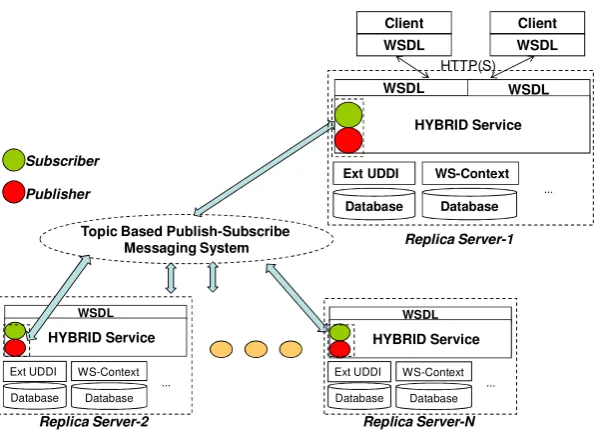
We identify three fundamental issues of designing a replica hosting system: replica-content placement, request routing and consistency enforcement. Replica replica-content placement has to do with creating a set of duplicated data replicas across the nodes of a distributed system. Request routing has to do with redirecting a client request to the most appropriate replica server. Consistency enforcement deals with ensuring data coherency across replicas in the system. Figure 2 illustrates the decentralized version of the architecture.
Subscriber
Publisher
Replica Server-2 Replica Server-N
Topic Based Publish-Subscribe Messaging System
HTTP(S)
WSDL Client
WSDL Client
WSDL WSDL
Database
Replica Server-1
Database
Database
WSDL
HYBRID Service
WSDL
HYBRID Service HYBRID Service
Ext UDDI
Database WS-Context
...
Database Ext UDDI
Database WS-Context
...
Ext UDDI WS-Context
[image:12.595.131.429.145.362.2]...
Figure 2 Distributed Hybrid Services. This figure illustrates N-node decentralized Hybrid Service from the perspective of a single Hybrid Service (Replica Server-1) interacting with two clients.
Replica placement issue consists of two sub-problems: replica server placement and replica content placement [28]. The former issue deals with the problem of finding suitable locations for replica servers, while the latter issue handles with selecting replica servers that should host a data. This study researched the latter problem, which concerns with the selection of replica servers that must hold the data under considera-tion. Replication can also be categorized by the manner in which replicas are created and managed. One strategy is permanent replication: replicas are manually created, managed and kept permanently. This strategy is mostly used for fault-tolerance rea-sons. Another strategy is server-initiated (dynamic) replication: replicas are created, managed and kept based on changing user behavior. This strategy is mostly used to enhance system performance. The proposed system utilizes both permanent replica-tion and dynamic replicareplica-tion techniques. The permanent replicareplica-tion is used to provide fault-tolerance in terms of availability. Permanent copies are used to at least keep the minimum required number of replicas for the same data. The dynamic replication technique is used for performance optimization. It enhances performance by replicat-ing data onto servers in the proximity of demandreplicat-ing clients that in turn reduces access latency.
re-quested metadata is located in N locations, the initiator sends N separate messages, one to each server. This approach requires each server to keep and maintain the state of the metadata system which is an expensive operation. In broadcast communication, the request initiator sends only one message and the underlying broadcasting facility takes care of the delivery of the message. Note that broadcasting a message to N serv-ers is no more expensive than unicasting N messages. The proposed system introduces efficient request distribution capabilities by employing a broadcast based request distribution. If a query cannot be granted locally and requires external metadata, the request is broadcasted to only those nodes hosting the requested metadata in the net-work at least to retrieve one response satisfying the request. This way the service is able to probe the network to look for a running server carrying the right information at the time of the query.
Consistency enforcement is considered as a contract between the system and the users to ensure data coherency across replicas in the system. To enforce consistency, the proposed system employs the primary-copy approach, i.e., updates are originated from a single site, to ensure all replicas of a data to be the same. Tanenbaum classifies this approach as primary-based remote-write protocol [23]. This approach ensures that the primary-copy of a metadata holds up-to-date version of the context under consid-eration. All update operations are carried out on the primary-copy replica server and the updates are propagated to the permanent-copy holders by the primary-copy.
5
Service Discovery
The Hybrid Service has a multicast discovery model to locate available services. In this model, the communication between network nodes happens via message ex-changes. These messages are Server-Information Request and Response messages.
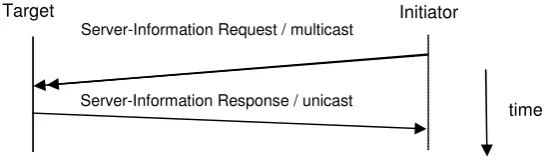
Server-Information Request and Response messages: A Hybrid Service node adver-tises its existence when it first joins the network with a message, the Server-Information Request. The purpose of the Server-Server-Information Request message is two-fold. First purpose is to inform other servers about a newly joining server. Second purpose is to refresh the replica-server-information data structure with the updated information (such as proximity and server load information) every so often. This message is broadcasted through publicly known topic to every other available net-work nodes. The proximity between the initiator and the individual netnet-work nodes is calculated based on the elapse-time between sending off the Server-Information Re-quest and receiving the Server-Information Response message. The Service-Information Response message is sent back by unicast over a unique topic to the in-itiator. This message also contains the server load information of the responding net-work node.
Service Discovery Model: Each Hybrid Service network node subscribes to the mul-ticast channel (publicly known topic) to receive Server-Information Request messag-es. On receiving this request message, each node sends a response message, Server-Information Response message, via unicast directly to the newcomer Hybrid Service. This way, each node makes itself discoverable to other nodes in the system at the bootstrap. Each Hybrid Service node constructs a replica-server-information data structure about other available replica servers in the system. This data structure con-tains information about decision metrics such as server load and proximity.
Figure 3 - Message exchanges for Hybrid Service Discovery Model. Each newcomer node sends out a multicast probe message to locate available services in the network. Each target node responds with a unicast message to make themselves discoverable. This figure illustrates the interaction between the initia-tor server and the target network nodes for service discovery model.
6
Replica-content placement
In a distributed system, data is replicated to enhance reliability and performance. Replica content placement is a replication methodology that deals with replicating newly inserted data onto other servers, which are capable for storage. After replica-tion, there may only be two types of copies of a context in the system: permanent and server-initiated (temporary). A permanent copy of a context is used as a backup facili-ty to enhance reliabilifacili-ty. A server-initiated copy is created temporarily and used to enhance system performance. For the permanent-copy of a context, the Hybrid Ser-vice subscribes to a unique topic to receive access/update request concerning the context under consideration. For the server-initiated copy of a context, the Hybrid Service does not subscribe to a topic to minimize the number of messages exchanged for request distribution. The server-initiated copies are only used to enhance the sys-tem performance. The Hybrid service uses messages to provide replica-content placement. These messages are Context Storage Request and Response messages.
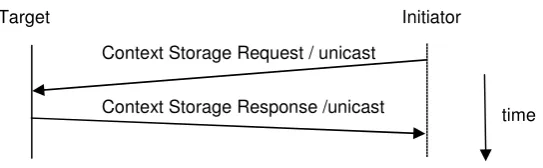
Context Storage Request and Response messages: A Hybrid Service node advertises the need for storage with a request message, the Context Storage Request. The pur-pose of the Context Storage Request message is two-fold. First purpur-pose is to assign handling of the storage operation to those Hybrid Service nodes that are selected based on the replica-server selection policy. The second purpose is to ask another Hybrid Service node to replicate or take over maintaining a context to enhance the overall system performance. Note that with this message, the system is able to relo-cate/replicate contexts in the proximity of demanding clients. It is used in dynamic replication process and enables relocation/replication of contexts due to changing client demands. The Context Storage Request message is unicast over a unique topic to the selected replica server(s). By listening to its unique topic, each existing node receives a Context Storage Request message, which in turn includes the context under consideration. On receipt of a Context Storage Request message, a Hybrid Service
Initiator Target
Server-Information Request / multicast
[image:15.595.155.431.155.235.2]node stores the context and sends a Context Storage Response message to the initia-tor. The Hybrid Service stores the context either as a permanent-copy or server-initiated (temporary) copy based on whether the context is being created for fault-tolerance reasons or performance reasons. The purpose of the response message is to inform the initiator that the answering node hosts the context under consideration. This message is also sent out by unicast directly to the initiator over a unique topic. By listening to this topic, the initiator receives response messages from the nodes that handled the storage request.
Decision metrics: The Hybrid Service uses some measurements to decide on replica-content placements. It takes both server load and proximity decision metrics into account when making replica-content placement decisions. The server load metric is a decision metric, which may be represented with multiple factors. We used the follow-ing two factors: a) topical information (i.e. number of unique topics, which the Hybrid Service subscribe to) and b) message rate (i.e. number of messages, issued by end-users, within a unit of time). If the number of topics, which a Hybrid Service sub-scribes to, is high, it is likely that the Hybrid Service will receive high number of access/update messages. If the message rate on a given Hybrid Service is increased, its performance will start dropping down. Therefore, we take into consideration the topical and message rate information as server load metrics. Each node can estimate its own server load based on these two factors. Server load is periodically recorded and it reflects the average load of a Hybrid Service at a given time interval. Note that, each nodes keeps decision metrics information about other nodes in the system. The server load information is obtained periodically by sending a Server-Information Request message to other available network nodes in the system. The proximity me-tric is the decision meme-tric, which is used to indicate the distance in network space between Hybrid Service instances. The proximity metric information is obtained periodically by sending ping requests (Server-Information Requests) to the available network nodes in the system through publish-subscribe system topics. The latency in the ping request gives the proximity information between the two Hybrid Service instances.
Figure 4 - Message exchanges for Storage (Replica content placement). This figure illustrates the interac-tion between the initiator server and the target network nodes to complete replica-content placement.
Our replica server selection policy takes into account two decision metrics: server load and proximity. To enforce our selection policy and select replica servers for replica-content placement, we adopt the replica selection algorithm introduced by Rabinovic et al [29] and integrate it with our implementation. The replica server se-lection process is repeated on target replica servers, until the initiator selects prede-fined number (minimum-fault-tolerance-watermark) of replica servers for replica-content placement. The initiator Hybrid Service chooses the best-ranked server among the selected replica-servers as the primary-copy to enforce consistency.
Once the replica-server selection is completed, the initiator sends unicast message (Context Storage Request message) to the selected replica-servers. On receipt of a storage request, a replica server stores the context as a permanent-copy, followed by sending a response (acknowledgement) message directly to the initiator (via unicast). The newly-selected primary-copy holder receives its Context Storage Request mes-sage with a flag indicating that it is the primary-copy holder of that context. Note that, the purpose of storing permanent-copy is for fault-tolerance. The number of perma-nent replicas is predefined with minimum-fault-tolerance-watermark in the configura-tions file and will remain the same for fault-tolerance reasons. We also utilize the dynamic replication methodology, which is discussed in the next section. This is a performance optimization technique that may move/replicate permanent-copies of a replica onto servers if it is only beneficial for client proximity. This way, the system improves its responsiveness in terms of minimizing the access latency, as the copies of a replica are moved onto servers where the requests are originated.
Dynamic replication: In order to take into consideration sudden changes in client demands, we use dynamic replication as a performance optimization technique. Dy-namic replication deals with the problem of dyDy-namically placing temporary replicas in regions where requests are coming from. This is a push-based replication methodolo-gy where a dynamically generated replica is pushed (replicated/migrated) onto a rep-lica server. Such reprep-licas are also referred as push caches [34]. Dynamic reprep-lication decisions are made autonomously at each node without any knowledge of other
cop-Initiator Target
Context Storage Request / unicast
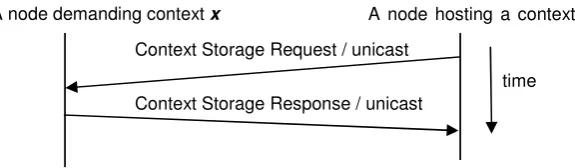
ies of the same data. In our implementation, we adopt the dynamic replication metho-dology introduced by Rabinovich et al [29]. This methometho-dology introduces an algo-rithm, which is used for the Web Hosting Systems, which maintain widely distributed, high-volume, rarely updated and static information. The dynamic replication algo-rithm by Rabinovich et al considers two issues: a) a replication can take place to re-duce the load on a replica server and b) a replication can take place due to changes in the client demands. Our main interest is to provide an optimized performance by replicating temporary-copies of contexts to replica servers in the proximity of de-manding clients. To this end, we only focus on the second issue, which concerns with creating replicas if it is only beneficial for client proximity.
Figure 5 - Message exchanges for Dynamic Replication/Migration. The dynamic replication/migration process replicates/migrates data if the demand exceeds certain thresholds. This figure illustrates the interac-tion between a hosting server and demanding server to complete replica placement/migrainterac-tion for context x.
Each Hybrid Service S runs the dynamic replication algorithm with certain time inter-vals (dynamic-replication-time-interval) and re-evaluates the placement of the con-texts that are locally stored. It checks the local Hybrid Service if there are concon-texts that can be migrated or replicated onto other servers in the proximity of clients that presented high demand for these contexts. It does this by comparing the access re-quest count for each context against some threshold values. If the total demand count for a replica C at a Hybrid Service S (cntS (C)) is below a deletion-threshold(S, C)
and the replica is a temporary-copy, that replica will be deleted from local storage of Hybrid Service S. If, for some Hybrid Service X, a single access count registered for a replica C at a Hybrid Service S (cntS(X, C)) exceeds a migration-ratio, that service
(service X) is asked to host the replica C instead of service S. (Note that the migration-ratio is needed to prevent a context migrate back and forth between the nodes. In our investigation, we chose the migration-ratio value as % 60 based on the study intro-duced in [29]). This means service S wants to migrate replica C to service X which is in the proximity of clients that has issued enough access requests within the prede-fined time interval (dynamic-replication-time-interval). In this case, replica C will be migrated to service X. To achieve this, a Context Storage Request is sent directly to service X by service S. On receipt of a Context Storage Request, service X creates a permanent copy of the context, followed by sending a Context Storage Response message. If the total demand count for a replica C at service S (cntS (C)) is above a
replication-threshold(S, C), then the system checks if there is a candidate Hybrid
Service, which has requested replica C. If, for some Hybrid Service Y, a single access
A node hosting a context
x
Context Storage Request / unicast
Context Storage Response / unicast A node demanding context x
[image:18.595.163.451.287.371.2]count registered for a replica C at service S (cntS(Y, C)) exceeds a replication-ratio,
that service (service Y) is asked to host a copy of replica C. (Note that, in order dy-namic replication to ever take place, the replication-ratio is selected below the migra-tion-ratio [29]. In our investigation, we chose the replication-ratio value as % 20.) This means service S wants to replicate replica C to service Y that is in the proximity of clients that has issued access requests for this context.
7
Consistency enforcement
At any given snapshot of the Hybrid Service network, the system may contain tempo-rary and permanent of copies of a context. On one hand, tempotempo-rary copies are kept for performance reasons. On the other hand, permanent-copies are kept for fault-tolerance reasons. Each Hybrid Service assigns/creates unique topics for each individual per-manent-copy (to receive access and update requests), while it creates no topics for the temporary copies (to avoid flooding the network with access messages). This creates an environment where the system may have different versions of the context, as the temporary copies are not updated. To achieve consistency from the target applications perspective, the Hybrid Service introduces different models to address consistency requirements of different applications. The first model is mainly for read-mostly ap-plications. For these applications, different copies of the context are considered to be consistent and the Hybrid Service allows clients to fetch any copies of the context (permanent or temporary). The second model is for the applications where the update-ratio is high and the consistency enforcement is important. In this case, the Hybrid Service requires the applications to subscribe unique topics of the metadata that they are interested. This way, these applications will be informed of the state changes happening in the metadata immediately after an update occurs. In this model, the primary-copy holder broadcasts the updates through the unique topic corresponding to the metadata under consideration.
We divide the implementation of consistency enforcement into two categories: “up-date distribution” and “up“up-date propagation”. The “up“up-date distribution” deals with how the Hybrid Service implements an update operation that take place on the distributed metadata store. The “update propagation” deals with how the Hybrid Service imple-ments the methodology for propagation of updates. To achieve consistency enforce-ment the Hybrid Service uses messages. These messages are Primary-Copy Selection Request and Response messages, Primary-Copy Notification message, and Context Update Request and Propagation messages.
Service node only to those servers holding the permanent-copy of the context under consideration. The purpose of the Primary-Copy Selection Request message is used to select a new primary-copy host if the original is considered to be down. The Primary-Copy Selection Request message is disseminated over a unique topic corresponding to the metadata under consideration. We use the metadata key (UUID) as the topic, which all nodes, holding the permanent-copy of the metadata, within the system sub-scribe to. By listening to this topic, each existing node receives this message. On receipt of a Primary-Copy Selection Request message, each node responds with the Primary-Copy Selection Response message directly to the initiator node. The purpose of this message is to inform the initiator about the permanent-copy of the context under consideration and give some information (such as hostname, transport protocols supported, communication ports) regarding how other nodes should communicate with the answering node. The response message is sent out by unicast directly to the initiator over a unique topic. By listening to this topic, the initiator receives the re-sponse message from the answering node.
Primary-Copy Notification message: A Hybrid Service node uses a Primary-Copy Notification message to notify the newly selected primary-copy holder. This Notifica-tion message is disseminated by unicast directly to the newly selected node. By listen-ing to its unique topic, each existlisten-ing node may receive a primary-copy notification message, which in turn includes the assignment for being the primary-copy of the context under consideration. Each primary-copy holder of a given context subscribes to a unique topic (such as UUID/PrimaryCopy) to receive messages aimed to the primary-copy holder of that context.
Context Update Request and Propagation messages: A Context Update Request mes-sage is sent by a replica server to the primary-copy host to ask for handling the up-dates related with the context under consideration. This message is sent out via un-icast by the initiator Hybrid Service node directly to the primary-copy host over a unique topic. By listening to this topic, the primary-copy-host receives the context update request message. A Context Update Propagation message is sent by the prima-ry-copy host only to those servers holding the context under consideration. This mes-sage is sent via multicast to the unique topic of the metadata immediately after an update is carried out on the primary-copy to enforce consistency. By listening to this topic, each existing permanent-copy holder node receives a Context Propagation message, which in turn includes the updated version of the context under considera-tion.
facil-ity. By utilizing this capability, we give sequence numbers to published data to ensure an order is imposed on the concurrent write operation that take place in the distributed data store. Based on this strategy, a write operation could take place on a data item, only if the timestamp of the updated context was bigger than the version number of the most recent write. This ensures that write/update requests are carried out on a data item x at primary-copy host s, in the order in which these requests are published into the distributed metadata store.
Figure 6 - Message exchanges for update operation of a context. This figure illustrates the interaction between the initiator server and the primary-copy host node of context x.
An update operation is executed offline, i.e., just after an acknowledgement is sent to the client. The update distribution process is executed to perform updates on the pri-mary-copy holder of a context. If the pripri-mary-copy host is the initiator node itself, then the update is handled locally. If the primary-copy host is another node, then the update is forwarded to the primary-copy holder. The initiator service sends a message, Context Update Request, by unicast directly to the primary-copy-host for handing over the update handling of a context. The Context Update Request message means that the initiator node is interested in updating the primary-copy replica. This message is sent via unicast offline of the publication request. This message includes the up-dated version of the context under consideration. On receipt of a Context Update Request message, first, the primary-copy host extracts the updated version of the context from incoming message. Then, it updates the local context if the timestamp of the updated version is bigger than the timestamp of the primary-copy. After the up-date process is completed, a Context Upup-date Propagation message is sent to only those servers holding the permanent-copy of the context under investigation. The purpose of the Context Update Propagation is to reflect updates to the redundant cop-ies immediately after the update occurs. On receipt of a Context Update Propagation message from the primary-copy, the initiator Hybrid Service node changes the status of the context under consideration from “updated” to “normal”. If there is no response received from primary-copy host within predefined time interval (timeout_period) in response to Context Update Request, the primary-copy host is decided to be down. In this case, the initiator node should select a new primary-copy host. After a new prima-ry-copy host is selected, the aforementioned update distribution process is re-executed.
We utilize synchronized timestamps to label published metadata. This allows us to impose an order on the actions that take place in the distributed metadata store. In our
Initiator
Context Update Request / unicast
[image:21.595.145.430.238.324.2]implementation, we combine the synchronized timestamps with the primary-based consistency protocol approach. Based on this strategy, each published context is given a synchronized timestamp. An update operation could take place on a data item, only if the timestamp of the newly published update is bigger than the version number of the most recent update. This way, all write operations can be carried out on the prima-ry-copy host, in the same order they were published in to the system. However, this approach has also some practical limits, as the update rate is bounded by the time-stamp accuracy of the synchronized timetime-stamps. To achieve ordering among the dis-tributed updates, we use NTP protocol based synchronized timestamps provided by the NaradaBrokering software timing libraries [35].
Update propagation: In a distributed data-system, an update propagation process can either be initiated by the server which is in need for the up-to-date copy and wants the pull updates from primary-copy host (pull methodology) or by the server that holds the update and wants to push to other replica servers (push methodology) [36]. In our prototype implementation, we utilized push methodology for update propagation and multicast technique for dissemination of updates. Based on this methodology, when-ever an update occurs the primary-copy immediately reflects the changes to the re-dundant copies in order to keep them up-to-date. Updates can be distributed in two ways: unicast and multicast [23]. In unicast update propagation, the primary copy server sends its updates to replica holders by sending separate messages. In multicast update propagation, it sends its updates using an underlying multicasting facility, which in turn takes care of sending messages to the network. For dissemination of updates, we use the multicast approach and publish the update to the unique topic corresponding to the metadata. This way, the system is able to send the updates only to those permanent-copy holding servers.
Figure 7 - Message exchanges for Primary-Copy Selection process. This figure illustrates the interaction between the initiator server and the target network nodes to complete the primary-copy selection process. Time arrow is down.
Say, a Hybrid Service node finds out that a primary-copy of a context is down. In this case, the initiator broadcasts a Primary-Copy Selection Request message to only those servers holding the context to select the primary-copy host. On receipt of a Primary-Copy Selection Request message, each replica-holding server that maintains a “per-manent” copy of the context under consideration, issues a Primary-Copy Selection Response message. Here, the purpose of a Primary-Copy Selection Response message is to inform the initiator that the answering node contains a permanent copy of the context under investigation. On receipt of the Primary-Copy Selection Response mes-sages, the initiator obtains the information about nodes carrying the permanent copy of the context. Then the initiator selects the best replica server based on a replica server selection process, which is described earlier, as the primary-copy server. In this case, A Primary-Copy Notification message is sent to the selected server indicating that it is selected as the new primary-copy host for the context under investigation. On receipt of a Primary-Copy Notification message, the permanent-copy holder becomes the primary-copy holder and subscribe the unique address (/UUID/PrimaryCopy) corresponding to the primary-copy of the context under consideration.
8
Access request distribution
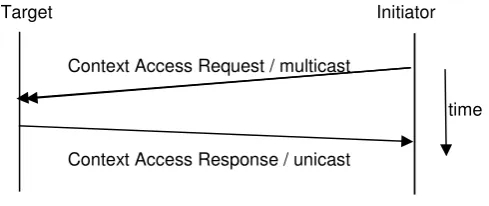
On receipt of a client’s inquiry request, a Hybrid Service node looks up for the re-quested context within local storage. If the context exists in local storage, then the inquiry is satisfied and a response message is sent back to the client. If the inquiry asks for external metadata, the system performs the request distribution (access) process, which is discussed in the next section in length. The communication between network nodes for request access distribution happens via message exchanges. These messages are Context Access Request and Response messages.
Context Access Request and Response messages: A Hybrid Service node advertises the need for context access with the Context Access Request to the system. The pur-pose of the Context Access Request message is to ask those servers, holding the
con-Initiator Target
Primary-Copy Selection Request /multicast
Primary-Copy Selection Response / unicast
Primary-Copy Notification / unicast
[image:23.595.158.438.149.256.2]text under demand, for query handling. This message is disseminated to only those nodes holding the context under consideration. This is done by multicasting the mes-sage through the unique topic corresponding to the metadata. (Note that we use UUID of the metadata as topic). By listening to this topic, each node, holding the context under consideration, receives a Context Access Request message, which in turn in-cludes the context query under consideration. On receipt of a Context Access Request message, each Hybrid Service sends a Context Access Response message, which contains the context under demand, to the initiator. This message is sent out by un-icast directly to the initiator over a unique topic. (Note that we use IP address of the initiator as topic to send responses via unicast back to the initiator). By listening to this topic, the initiator receives the response messages from nodes that answered the access request.
[image:24.595.184.429.455.558.2]Request distribution: The prototype implements a request distribution methodology, which is based on broadcast dissemination where the requests are distributed to only those servers holding the context under consideration. This approach does not require keeping track of locations of every single data located in the system. It makes use of copies of a data that are not frequently accessed and kept only for fault-tolerant rea-sons. In turn, this improves the responsiveness of the system. In this scenario, the initiator node issues a Context Access Request message to the multicast group, if the client’s access request is not satisfied in the local storage. This message contains minimum required information (such as context key) regarding the context in de-mand. The Context Access Request means that the initiator node is interested in dis-covering the qualified replica servers that may contain the requested context and an-swer with a response.
Figure 8 - Message exchanges for context access. This figure illustrates the interaction between the initiator and a target node hosting the context for request distribution. Time arrow is down.
On receipt of a Context Access Request message, a replica-holding Hybrid Service issues a Context Access Response message. The purpose of a Context Access Re-sponse message is to send a reRe-sponse with the context satisfying the query. (Note that, each server keeps track of the count of access requests and the locations where access requests come from for each context. In turn, this enables the system to apply dynam-ic repldynam-ication process and adapt to sudden bursts of client demands coming from a
Context Access Request / multicast
Context Access Response / unicast
Initiator Target
remote replica. This is why, if the access request is granted, each server registers the incoming access request in the access-demanding-server-information data structure and increments the total access-request-count of the context under investigation.) On receiving first Context Access Response message, the initiator Hybrid Service node, obtains the context that can satisfy the query under consideration. Then a response message is sent back to inquiring client. The initiator only waits for responses that arrive within the predefined timeout value. If there is no available Hybrid Service node that can satisfy the context query within the timeout duration, the access process ends and a “not found” message is sent to the client.
9
Prototype Evaluation
A performance evaluation study was conducted to investigate the performance and stability of the prototype of the centralized version of the Hybrid Service Architecture [37]. This study concluded that once can achieve noticeable performance improve-ments for standard inquiry/publish operations by simply employing an in-memory storage mechanism. The study also showed that the Hybrid Service can scale up to high number of message rates without degrading the system performance. This paper presents an analysis and evaluation of the distributed Hybrid Grid Information Service Architecture.
In this section, we investigate the performance of the prototype of the Hybrid Service Replica Hosting Architecture in order to understand its practical usefulness. To this end, the following research questions are being addressed:
• What is the cost of the access request distribution in terms of the time re-quired to fetch a copy of a data (satisfying an access request) from a remote location?
• What is the effect of dynamic replication in the cost of the access request
distribution in terms of the time required to fetch a copy of a data?
• What is the cost of the storage request distribution for fault-tolerance in
terms of the time required to create replicas at remote locations?
• What is the cost of consistency enforcement in terms of the time required to carry out updates at the primary-copy holder?
Summary of Machine Configurations
Location Processor RAM OS
gf6.ucs.indiana.edu
Bloomington, IN, USA
Intel® Xeon™ CPU (2.40GHz)
2GB total GNU/Linux (kernel release 2.4.22)
complexity.ucs.indiana.edu Indianapolis, IN, USA
Sun-Fire-88, sun4u sparc SUNW
16GB total SunOS 5.9
lonestar.tacc.utexas.edu
Austin, TX, USA
Intel(R) Xeon(TM) CPU 3.20GHz
4GB total GNU/Linux (kernel release 2.6.9)
tg-login.sdsc.teragrid.org
San Diego, CA, USA
Genuine Intel IA-64, Itanium 2, 4 processors
8GB total GNU/Linux
vlab2.scs.fsu.edu
Tallahassee, FL, USA
Dual Core AMD Opteron(tm) Processor 270
[image:26.595.130.465.145.283.2]2GB total GNU/Linux (kernel release 2.6.16)
Table 2 Summary of the machines used in decentralized setting experiments
We wrote all our code in Java, using the Java 2 Standard Edition compiler with ver-sion 1.5. In the experiments, we used Tomcat Apache Server with verver-sion 5.5.8 and Axis software with version 2 as a container. The maximal heap size of the JVM was set to 1024MB by using the option –Xmx1024m. The Tomcat Apache Server uses multiple threads to handle concurrent requests. In the experiments, we increased the default value for maximum number of threads to 1000 to be able to test the system behavior for high number of concurrent clients. As backend storage, we use MySQL database with version 4.1. We used the “nanoTime()” timing function that comes with Java 1.5 software.
Analyzing the results gathered from the experiments, we encountered some outliers (abnormal values). These outlier observations are numerically distant from the rest of observation data. The cause of the outliers is mainly the external effects, i.e., prob-lems with network and server, as these outlier observations were not seen on the in-ternal timing observations measuring only the system processing time. Due to out-liers, the average may not be representative for the mean value of the observation times. This in turn may affect the results. For example, these outliers may increase the average execution time and the standard deviation. In order to avoid abnormalities in the results, we removed the outliers by utilizing the filtering methodology. In Z-filtering, first, the average and standard deviation values are calculated. Then a simple test is applied. [abs(measurement_i-measurement_average)] / stdev > z_value_cutoff. This test discards the anomalies. After first filtering is over, the new average and standard deviation values are calculated with the remaining observation times. This process was recursively applied until no filtering occurred.
metadata size and volume: We chose average values for the size and volume of the metadata which were used in the simulation from a real life application Pattern Infor-matics in which the Hybrid Service is used. To this end, this metadata sample has a fixed size of 1.7Kbyte and the volume of the metadata is a thousand.
dynamic-replication-time-interval: In order to provide dynamic replication, metadata
instances in a Hybrid Service are replicated in replica-hosting environment in a dy-namic fashion within certain time intervals (dynamic-replication-time-interval). The trade-off in choosing the value for dynamic-replication-time-interval is similar to the one for backup-time-interval. If the dynamic-replication-time-interval is chosen to be too small, then the system performance will be affected. If this time interval is too big, then the system will not adapt well to changes in client demands such as sudden bursts of request that come in from an unexpected location. (Rabinovich et al intro-duced an extensive study on choosing values for the dynamic-replication tunable parameters. In our investigation, we chose the simulation parameters relying on their study in [29].)
minimum-fault-tolerance-watermark: To provide a certain level of fault-tolerance,
we use a minimum-fault-tolerance-watermark indicating minimum required degree of replication. The trade-off in choosing the value for minimum-fault-tolerance-watermark is the following. If the value is chosen to be high, then the time and system resources required completing replica-content placement and keeping these replicas up-to-date would be high. If the value is chosen to be too small, then the degree of replication (fault-tolerance level) will below.
timeout-period: The tunable timeout-period value indicates the amount of time that a
Hybrid Service node is willing to wait to receive response messages. The trade-off in choosing this number is the following. If the timeout-period is too small, the initiator of a request will not wait enough for the context access responses coming from a multicast group. For example, if there are two replica servers, one in U.S. and the other in Australia, the query initiator located in U.S. may miss the result coming from the node located in Australia with a small timeout-period. If the timeout-period is too big, then the query initiator may have to wait for a long time unnecessarily for some information that does not exist in the replica-hosting environment.
deletion-threshold: If a temporary-copy (server-initiated) of a context is in low
replication-threshold: If a context is in high demand and its demand count is above a
replication-threshold, then the context is replicated as a temporary-copy. If the repli-cation-threshold is selected to be too high, then the system will not adapt well to high number of client demands. If the replication-threshold is too low, the system will try to create temporary replicas at every remote replica where small number of requests comes in. This may cause unnecessary consumption of system resources. (Rabinovich et al [29] discusses the dependency between replication and deletion thresholds that in turn indicates that the value of replication-threshold must be selected above deletion-threshold. In our investigation, we chose the replication-threshold value based on the study introduced in [29].)
simulation parameters values
metadata-size 1.7 KBytes
metadata-volume 1000
time-out value 10000 seconds
replication-threshold 0.18 requests per second
deletion-threshold 0.03 requests per second
minimum-fault-tolerance-watermark 3
dynamic-replication-time-interval every 100 second
Table 3 Simulation parameters for the experiments
Distribution experiment: In this experiment, we conducted various testing cases to investigate the cost of distribution. We measured the cost of distributing access re-quest into remote servers separated with significant network distances.
NB node Hybrid
Service instance
Hybrid Service instance
Bloomington, IN 3 different instance located 3 different remote locations:
1 - Indianapolis, IN
2- Tallahassee, FL
3- San Diego, CA
Hybrid Service instance
Hybrid Service instance
Bloomington, IN 3 different instance located 3 different remote locations:
1 - Indianapolis, IN
2- Tallahassee, FL
3- San Diego, CA NB
node
NB node
Figure 9 The design of the distribution experiment. The rounded shapes indicate NaradaBrokering nodes. The rectangle shapes indicate Hybrid Service instances located at different locations. The first test was conducted with one broker where the broker is located before the Hybrid Service instance in Bloomington, IN, while the second test was conducted with two broker nodes each sitting on the same machine before the Hybrid Service instance.
[image:29.595.153.401.152.359.2]Figure 10 The Distribution Experiment Results between Bloomington and Indianapolis - Each point in the graph corresponds to average of 1000 observations.
Figure 11 Time spent in various sub-activities of the request distribution scheme of the Hybrid Service
one broker two brokers latency
bloomington-indianapolis 3.59 4.79 2.42
bloomington-tallahassee 3.55 4.78 36.05
bloomington-san diego 3.63 4.92 66
Table 4 Statistics for Figure 11. Overhead of request distribution. Average timings in milliseconds.
0 1 2 3 4 5 6 7 8
0 5 10 15 20 25
T
im
e
(
m
s
)
Every 1000 observations
Bloomington - Indianapolis Access Distribution Chart
Average - Latency
STDev - Latency
Average - One Broker
STDev - One Broker
Average - Two Brokers
STDev - Two Brokers
0 10 20 30 40 50 60 70
bloomington-indianapolis bloomington-tallahassee bloomington-san diego
T
im
e
(
m
s
)
[image:30.595.126.464.384.563.2]Dynamic replication experiment: In this experiment, we conducted a testing case to investigate the performance of dynamic replication. We used the dynamic replication for performance optimization to replicate temporary copies of contexts to where they wanted. In this experiment, we simulated a workload, where we have a thousand metadata in the Hybrid Service instance located at Indianapolis, IN. In this testing case, metadata from the Indianapolis instance was requested randomly by the Hybrid Service instance located at Bloomington. If the remote metadata is replicated to local site, the system simply obtains the data from local in-memory storage. We conducted two testing cases to answer the following questions: a) What is the cost of access distribution to fetch copies of a context from the remote location (Indianapolis), when the dynamic replication is disabled, b) What is the cost of access distribution to fetch copies of a context from the remote location (Indianapolis), when dynamic replication is enabled.
NB node Hybrid
Service instance
Hybrid Service instance
Bloomington, IN Indianapolis, IN
Test-1 Distribution with Dynamic Replication Disabled
Test-2 Distribution with Dynamic Replication Enabled NB
node Hybrid
Service instance
Hybrid Service instance
[image:31.595.174.425.333.384.2]Bloomington, IN Indianapolis, IN
Figure 12 The design of the dynamic replication experiment. The rounded shapes indicate NaradaBrokering nodes. The rectangle shapes indicate Hybrid Service instances located at different locations. In the first testing case, dynamic replication capability is disabled. In the second testing case, dynamic replication capability is enabled.
[image:31.595.175.425.437.484.2]
Figure 13 The results of the dynamic replication experiment.
Fault-tolerance experiment: In this experiment, we conducted various testing cases to investigate the cost of fault-tolerance when moving from centralized system to a decentralized replica hosting system. In particular, we performed our testing cases to answer following questions: a) What is the cost of replica-content placement for fault-tolerance in terms of the time required to create replicas at remote locations?, b) How does the system behavior change for continuous, uninterrupted replica-content place-ment operations?. To answer these questions, we conducted two testing cases: The first test was conducted with one broker when the broker was located before the Hy-brid Service instance at Bloomington, IN. The second test was conducted with two brokers each sitting on the same machine before the Hybrid Service instances. In this experiment, we increased the fault tolerance level gradually and measured end-to-end latency for replica-content placement.
0 1 2 3 4 5 6 7
0 5 10 15 20 25
L
a
te
n
c
y
(
m
s
)
Every 100 second
Dynamic Replication Performance Chart - Distribution between Bloomington, IN and Indianapolis, IN
Average -Distribution with Dynamic Replication STDev -Distribution with Dynamic Replication Average -Distribution
Hybrid Service instance
Hybrid Service instance
Bloomington, IN
NB node NB node
Hybrid Service instance NB node
Hybrid Service instance NB node
Indianapolis, IN
Tallahassee, FL
San Diego, CA
Hybrid Service instance
Hybrid Service instance
Bloomington, IN
NB node
Hybrid Service instance
Hybrid Service instance
Indianapolis, IN
Tallahassee, FL
San Diego, CA Test - 1
Test - 2
Figure 14 The design of the fault tolerance experiment. The rounded shapes indicate NaradaBrokering nodes. The rectangle shapes indicate Hybrid Service instances located at different locations. In the first testing case, we measure the end-to-end latency for varying number replica-content creation with only one broker. In the second case, we repeat the same test with two brokers.
[image:33.595.159.440.144.380.2]Figure 15 Fault Tolerance Experiment results when one replica is created at Indianapolis, IN. Each point in the graph corresponds to average of 1000 observations.
Figure 16 Time spent in various sub-activities of the replica-content creation scheme of the Hybrid Service.
one broker two brokers end-to-end latency
1 replica (Indianapolis) 4.02 5.27 2.43
2 replicas (Indianapolis–Tallahassee) 4.54 5.67 36.05
3 replicas (Indianapolis–Tallahassee –San Diego) 5.13 6.24 65.90
Table 5 Statistics for Figure 16. Overhead of replica-content creation. Average timings in milliseconds.
0 1 2 3 4 5 6 7 8 9
0 5 10 15 20 25
T im e ( m s )
Every 1000 observations
1 replica creation at remote location: Indianapolis, IN
Average - Latency
STDev - Latency
Average - One Broker
STDev - One Broker
Average - Two Brokers STDev - Two Brokers 0 10 20 30 40 50 60 70
1 replica creation (Indianapolis) 2 replica creation (Indianapolis, IN -Tallahassee, FL)
3 replica creation (Indianapolis-IN, Tallahassee-FL, San
Diego-CA) T im e ( m s )