Analysis of the seaport value chain as a method
for assessing its strategic potential
Andrzej Montwiłł1,*
1 Faculty of Engineering and Economics of Transport, Maritime University of Szczecin, 71-051 Szczecin, Wały Chrobrego 1-2, Poland
Abstract. The aim of the paper is to describe the analysis of the seaport value chain as a method for assessing its strategic potential. This potential is understood as the port's ability to develop and improve its competitive position in sectors that are defined as part of the assessment of this potential. In the paper, key aspects of the seaport value chain analysis were described in the form of a summary of previous research on this subject. The seaport is understood as a system in which a number of interpenetrating processes for passengers, freight, means of transport and enterprises are carried out. To better illustrate key aspects of the value chain analysis, examples of selected processes implemented at seaports were used. Next, the paper presents the results of research interpreting the impact of various internal factors on the efficiency of the port value chain that translates into its strategic potential, where the issue was repeated using specific cases. In the final part of the paper, based on previous research, the significance of the analysis of the seaport value chain to assess the strategic potential of the seaport was pointed out. Moreover, in this part of the paper the chosen case was used to indicate the level of applicability of the research carried out.
1.
Introduction
The modern system of the global economy forces enterprises to operate in a specific way, where the key issue is positioning the company's products on a given market in such a way that, in a given segment, the enterprise, or rather its product, obtains a competitive advantage. It can be a global market, a regional market or a local market. In the subject literature related to business management and building a competitive advantage, two issues are usually highlighted: profit and competitive advantage in the market in terms of the entire enterprise [1]. And while in the case of enterprises, or rather global capital groups, this approach may seem right, the author believes that this approach is too schematic.
It seems that the modern global economy should rather address the problem of competitiveness to specific products or groups of products or specific markets. This can be perfectly illustrated with seaports, where the largest of them are currently the most complex socio-economic structures operating in a cluster system. However, seaports are also spatially and structurally small organizations that are perfectly competing, thanks to a selected market offer, on selected markets, building a competitive advantage on them. From here it can be concluded that the approach to the competitiveness of economic entities or
*Corresponding author: [email protected]
complex multi-stakeholder socio-economic structures should be an individualized approach considered not only in the global system but in regional or local systems.
The aim of the paper is to describe the analysis of the seaport value chain as a method for assessing its strategic potential. This potential is understood as the port's ability to develop and improve its competitive position in sectors that are defined as part of the assessment of this potential The conducted research confirmed the need for an individual approach to the problems of seaport competitiveness, indicating that the size of the port, in the context of cargo traffic, does not have to be a key factor in improving its competitiveness on a given market of port services.
2. Methodology
The research process, the purpose of which was to assess the usefulness of the seaport value chain value analysis to assess its strategic potential, was based on a methodology consisting of three main stages [2]. The first stage was aimed at analyzing the functioning of modern seaports where the key issues of seaport organization, the functions and related areas and areas of activity in each of them were identified in the cognitive process. The area of analysis also included issues that qualify ports for a particular generation reflecting the cargo prevailing in port traffic, the level of cooperation of seaport users and the significance of the seaport in the network arrangement of supply chains. This stage of research included, on the one hand, the author's many years of experience related to work in the port sector, and on the other, research methods such as document examination, analysis and criticism of the literature, case analysis and observation.
The second stage of the research process focused on the processing of collected material, grouping facts about the evolution of seaports and the genesis of this evolution in the last decades, defining the connections between individual port processes as well as institutions and enterprises creating a joint organizational and functional structure. The basic method used at this stage was the method of analysis and logical construction in the part concerning the analysis, which allowed to organize the collected material regarding the functioning of seaports.
The third stage of research process was focused on modeling, based on previously collected and ordered materials, the value chain of the seaport as the basic method of the overall analysis of the strategic potential of the seaport. Using the research method, which is the analysis and logical construction (also called the “mind experiment” method) through the analysis and synthesis process, a research thesis has been proved. This thesis provided that the classically used analysis of the enterprise value chain to determine its strategic potential [3] can be used for seaports, where the sequence of port processes is usually carried out by a number of companies, often unrelated capital, whose proper cooperation creates added value in the value chain of the seaport. In the third stage of the research process, analysis of key success factors based on the 80/20 rule [4] was also used as an auxiliary method for determining the strategic potential of the seaport.
3. Results
3.1. The generation of the seaport is a key factor in the complexity of its value chain
complex multi-stakeholder socio-economic structures should be an individualized approach considered not only in the global system but in regional or local systems.
The aim of the paper is to describe the analysis of the seaport value chain as a method for assessing its strategic potential. This potential is understood as the port's ability to develop and improve its competitive position in sectors that are defined as part of the assessment of this potential The conducted research confirmed the need for an individual approach to the problems of seaport competitiveness, indicating that the size of the port, in the context of cargo traffic, does not have to be a key factor in improving its competitiveness on a given market of port services.
2. Methodology
The research process, the purpose of which was to assess the usefulness of the seaport value chain value analysis to assess its strategic potential, was based on a methodology consisting of three main stages [2]. The first stage was aimed at analyzing the functioning of modern seaports where the key issues of seaport organization, the functions and related areas and areas of activity in each of them were identified in the cognitive process. The area of analysis also included issues that qualify ports for a particular generation reflecting the cargo prevailing in port traffic, the level of cooperation of seaport users and the significance of the seaport in the network arrangement of supply chains. This stage of research included, on the one hand, the author's many years of experience related to work in the port sector, and on the other, research methods such as document examination, analysis and criticism of the literature, case analysis and observation.
The second stage of the research process focused on the processing of collected material, grouping facts about the evolution of seaports and the genesis of this evolution in the last decades, defining the connections between individual port processes as well as institutions and enterprises creating a joint organizational and functional structure. The basic method used at this stage was the method of analysis and logical construction in the part concerning the analysis, which allowed to organize the collected material regarding the functioning of seaports.
The third stage of research process was focused on modeling, based on previously collected and ordered materials, the value chain of the seaport as the basic method of the overall analysis of the strategic potential of the seaport. Using the research method, which is the analysis and logical construction (also called the “mind experiment” method) through the analysis and synthesis process, a research thesis has been proved. This thesis provided that the classically used analysis of the enterprise value chain to determine its strategic potential [3] can be used for seaports, where the sequence of port processes is usually carried out by a number of companies, often unrelated capital, whose proper cooperation creates added value in the value chain of the seaport. In the third stage of the research process, analysis of key success factors based on the 80/20 rule [4] was also used as an auxiliary method for determining the strategic potential of the seaport.
3. Results
3.1. The generation of the seaport is a key factor in the complexity of its value chain
Contemporary seaports are multifunctional socio-economic structures composed of the functional segment and the spatial segment. The functional segment includes the administrative and management sphere and the operational and service or operation-service-production sphere (in the situation when the production function is implemented in the port space). The administrative and management sphere is composed of: the managing entity (port management), responsible for the development of the sea port and state institutions responsible for the legal aspects of port processes implemented for: means of sea transport and means of land transport (railway, road, inland waterway, transmission ) and cargo in export and import. The operational and service sphere (operational, service and production) is created by enterprises implementing services for means of transport (mentioned above) and cargo on a commercial basis as well as enterprises involved in production (in the case of a developed production function). The aforementioned areas of the seaport create a series of connections necessary for the efficient implementation of economic processes taking place in the port area. A significant part of these connections is the effect of applicable legal provisions imposing the obligation to carry out economic processes on the state administration, managing entities, port users. The rest result from the organization of the port and civil-legal relations between the managing entity and its users.
The spatial segment of the sea port consists of: waters and areas with the necessary infrastructure. These are elements of technical port utilities that determine its potential handling, distribution, logistics and industrial capabilities. These are also, what is very important, elements of the transport infrastructure of the state, which are subject to the "rigors" of state interests in the transport policy segment. Hence, the turnover of port infrastructure and land real estate within the boundaries of seaports is subject to many legal regulations and is prohibited in many countries. The above is due to the fact that coastal areas are treated by the states as strategic areas for their development and security.
There are many definitions of seaports in the literature. According to Grzelakowski A. and Matczak, from the economic point of view, the seaport is: “a spatially large economic area located at the interface of the land with the sea with a complex structure of activity, mainly of a transport, commercial and industrial character, prepared in terms of technical and technological, organizational and administrative, and legal and economic aspects for servicing sea and land means of transport as well as performing other transport, logistics, forwarding and commercial activities, entailing the necessity of their comprehensive service in the transport chain and the supply chain.” [5]. In turn, according to the author of the article, the seaport is a socio-economic space, with multifaceted impact on the surrounding environment, that combining in transport processes, thanks technical and technological equipment, sea with land, where are realized interpenetrating, interdependent and related, objective and spatial functions related to with trade and movement of people. [6]
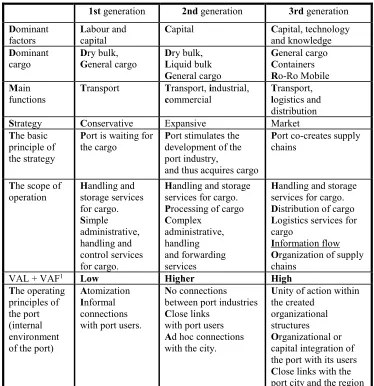
The seaport definitions presented above indicate its multifunctional character, where the key to its development is the effective implementation of processes for the means of transport, cargo and passengers that are part of the network of supply chains. Processes carried out both in the services sector and in the production sector. What is also important is that the greater the range of services, complemented by production, is implemented in the space of a seaport and the higher the level of cooperation of its users, the greater its strategic potential. The level of generation of the seaport is an expression of evolution in the development of ports that translates into their competitive position. Currently functioning seaports belong to different generations (from 1st to 3rd, where part of the third generation ports are transformed into seaports of the 4th generation) [7][8]. Table 1 presents key elements decisive for including the port in a given generation.
Table 1. The key elements determining the competitive position of a seaport
1st generation 2nd generation 3rd generation
Dominant
factors Lcapital abour and Capital Cand knowledge apital, technology
Dominant
cargo DGryeneral cargo bulk, DLiquid bulk rybulk,
General cargo
General cargo
Containers
Ro-Ro Mobile
Main
functions Transport Tcommercial ransport, industrial, Tlogistics and ransport, distribution
Strategy Conservative Expansive Market
The basic principle of the strategy
Port is waiting for
the cargo Pdevelopment of the ort stimulates the port industry,
and thus acquires cargo
Port co-creates supply chains
The scope of
operation Hstorage services andling and for cargo.
Simple administrative, handling and control services for cargo.
Handling and storage services for cargo.
Processing of cargo
Complex administrative, handling and forwarding services
Handling and storage services for cargo.
Distribution of cargo
Logistics services for cargo
Information flow
Organization of supply chains
VAL + VAF1 Low Higher High
The operating principles of the port (internal environment of the port)
Atomization
Informal connections with port users.
No connections between port industries
Close links with port users
Ad hoc connections with the city.
Unity of action within the created
organizational structures
Organizational or capital integration of the port with its users
Close links with the port city and the region 1. VAL – Value Added Logistics, VAF – Value Added Facilities
Table 1. The key elements determining the competitive position of a seaport
1st generation 2nd generation 3rd generation
Dominant
factors Lcapital abour and Capital Cand knowledge apital, technology
Dominant
cargo DGryeneral cargo bulk, DLiquid bulk rybulk,
General cargo
General cargo
Containers
Ro-Ro Mobile
Main
functions Transport Tcommercial ransport, industrial, Tlogistics and ransport, distribution
Strategy Conservative Expansive Market
The basic principle of the strategy
Port is waiting for
the cargo Pdevelopment of the ort stimulates the port industry,
and thus acquires cargo
Port co-creates supply chains
The scope of
operation Hstorage services andling and for cargo. Simple administrative, handling and control services for cargo.
Handling and storage services for cargo.
Processing of cargo
Complex administrative, handling and forwarding services
Handling and storage services for cargo.
Distribution of cargo
Logistics services for cargo
Information flow
Organization of supply chains
VAL + VAF1 Low Higher High
The operating principles of the port (internal environment of the port)
Atomization
Informal connections with port users.
No connections between port industries
Close links with port users
Ad hoc connections with the city.
Unity of action within the created
organizational structures
Organizational or capital integration of the port with its users
Close links with the port city and the region 1. VAL – Value Added Logistics, VAF – Value Added Facilities
Table 1 presents the key elements determining the generation of a seaport, and thus the form of operation of its functional segment. Segment determining the manner and scope of operation of the seaport, functions performed in its space, and thus the range of services and the importance of the port in the network supply chain. It can be considered that third generation seaports act as logistics centers [9] or logistic platforms, as illustrated in Figure 1. Ports of this generation, where we distinguish three main areas (fields) of activity,
[image:5.482.74.406.120.304.2]presented in the referenced figure, are characterized by the implementation of a wide range of processes as part of the objective functions: transport, industrial, commercial and logistic-distribution.
Fig. 1. Seaport as a logistic platform
[image:5.482.64.428.425.602.2]In seaports of the 3rd generation, being logistic platforms, where a number of processes are carried out simultaneously in the framework of a network of many supply chains, we distinguish three key areas of activity. These areas can be assigned to individual objective functions and thus a specific range of processes (services and production) within which added value (VAL and/or VAF) is created. In Table 2, o functions are assigned to key areas of seaport activity.
Table 2. Correlation of key areas of seaport activity and objective functions Objective functions:
Transport
function Industrial function Commercial function Logistics and distribution function Key fields of activity
Maritime logistics
centres (MLC) basic auxiliary Industrial park
(IP) auxiliary basic auxiliary Inland logistics
centres (ILC) basic auxiliary basic
Logistics platform (MLC + IP + ILC =
LP)
basic basic auxiliary basic
As shown in the research, the generation of a seaport is a key factor affecting the complexity of its value chain, which is the result of the level of development of objective functions, and the range of processes (services and production) in each function.
3.2. The value chain as a tool to analyze the strategic potential of the seaport. The problem of the value chain as a tool for the general analysis of activities (essential and auxiliary) important for the enterprise's effectiveness in the context of building their competitive advantage on the market was taken by, among others, M. Porter. He pointed out that the value chain is a strictly defined sequence of various company activities that are implemented as part of its operation, creating a common system of values [10]. Importantly, M. Porter recognized the company's value chain as one of the important factors of the company's strategic approach to creating added value in the course of ongoing processes, combining both the company's values and the resources it owns. As J. Borowski points out, M. Porter, as the creator of the new theory of strategic management, connected positional theory and resource theory, combining their achievements and considering the value-enhancing activities and its value chain as crucial for the company's competitiveness [11].
The value chain is widely taken up by many authors in the context of the scientific approach. It should be pointed out, however, that the majority of scientific considerations and assessments concern the value chains of manufacturing enterprises. This issue is much less often addressed in the context of service enterprises and very rarely in the context of the value chain of complex multi-entity economic structures such as seaports, integrated logistics centers or network supply chains. Hence, in the research process aimed at assessing the usefulness of the value chain analysis to assess the strategic potential of the seaport, it was necessary to create a specific value chain for seaports. Classic chains were used for this purpose, starting from the one formulated by M. Porter. The value chains of enterprises in the tourism sector or the TSL sector were also analyzed. Based on, among others, the definition of the value chain by A. Stabryly [12], the author of the article attempted to define the value chain of the seaport, considering that it is a sequence of horizontally and vertically related executive processes (for passengers, cargo, means of transport) and management processes (organizational, technical and legal) implemented by connected with each other organizational and functional areas of the seaport, where during these processes, the value added for the customer determining the competitive position of the seaport is created, depending on the degree of development of the objective functions. Based on the above definition, which is consistent with the definitions of the enterprise value chain previously formulated by many authors, a model of the seaport value chain was created. This model takes into account the postulate of M. Porter on the strategic character of this tool [10] in creating a development strategy, in this case, a seaport. And the same is not limited to internal processes, but includes aspects of external environment analysis and strategic positioning of a seaport on a given market of port services.
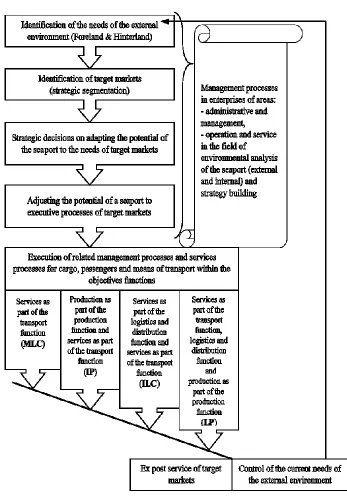
Figure 2 presents the scheme of the value chain of the seaport, where we can distinguish the stage related to the positioning of the seaport on the market of port services and adjusting its potential in the area of management and performance to the needs of selected markets located on the foreland or hinterland of the seaport. These activities are related to the organizational, technical and legal adaptation of the port to the handling of cargo, passengers and means of transport moved in land-sea transport chains between selected markets on the foreland and hinterland of the seaport.
As shown in the research, the generation of a seaport is a key factor affecting the complexity of its value chain, which is the result of the level of development of objective functions, and the range of processes (services and production) in each function.
3.2. The value chain as a tool to analyze the strategic potential of the seaport. The problem of the value chain as a tool for the general analysis of activities (essential and auxiliary) important for the enterprise's effectiveness in the context of building their competitive advantage on the market was taken by, among others, M. Porter. He pointed out that the value chain is a strictly defined sequence of various company activities that are implemented as part of its operation, creating a common system of values [10]. Importantly, M. Porter recognized the company's value chain as one of the important factors of the company's strategic approach to creating added value in the course of ongoing processes, combining both the company's values and the resources it owns. As J. Borowski points out, M. Porter, as the creator of the new theory of strategic management, connected positional theory and resource theory, combining their achievements and considering the value-enhancing activities and its value chain as crucial for the company's competitiveness [11].
The value chain is widely taken up by many authors in the context of the scientific approach. It should be pointed out, however, that the majority of scientific considerations and assessments concern the value chains of manufacturing enterprises. This issue is much less often addressed in the context of service enterprises and very rarely in the context of the value chain of complex multi-entity economic structures such as seaports, integrated logistics centers or network supply chains. Hence, in the research process aimed at assessing the usefulness of the value chain analysis to assess the strategic potential of the seaport, it was necessary to create a specific value chain for seaports. Classic chains were used for this purpose, starting from the one formulated by M. Porter. The value chains of enterprises in the tourism sector or the TSL sector were also analyzed. Based on, among others, the definition of the value chain by A. Stabryly [12], the author of the article attempted to define the value chain of the seaport, considering that it is a sequence of horizontally and vertically related executive processes (for passengers, cargo, means of transport) and management processes (organizational, technical and legal) implemented by connected with each other organizational and functional areas of the seaport, where during these processes, the value added for the customer determining the competitive position of the seaport is created, depending on the degree of development of the objective functions. Based on the above definition, which is consistent with the definitions of the enterprise value chain previously formulated by many authors, a model of the seaport value chain was created. This model takes into account the postulate of M. Porter on the strategic character of this tool [10] in creating a development strategy, in this case, a seaport. And the same is not limited to internal processes, but includes aspects of external environment analysis and strategic positioning of a seaport on a given market of port services.
Figure 2 presents the scheme of the value chain of the seaport, where we can distinguish the stage related to the positioning of the seaport on the market of port services and adjusting its potential in the area of management and performance to the needs of selected markets located on the foreland or hinterland of the seaport. These activities are related to the organizational, technical and legal adaptation of the port to the handling of cargo, passengers and means of transport moved in land-sea transport chains between selected markets on the foreland and hinterland of the seaport.
In the process of adapting the port to the needs of selected markets in the area of cargo and passenger shipment, strategic decisions are made regarding the scope of planned processes and, consequently, decisions on the development of specific objective functions and port generation. Hence, in the value chain of the seaport (Figure 2), four variants of its functionality are indicated, depending on what functions are developed, which is the result of previous strategic decisions about the range of executive processes available in a given port for customers from previously selected markets ( strategic segmentation).
Fig. 2. The value chain of the seaport
which creates a specific added value. Thus, depending on the level of development, the seaport may function as:
1. Maritime logistics centres (MLC) where the basic function is the transport function.
2. Maritime logistics centres (MLC) + Industry Park (IP), where the basic functions are: transport and production functions.
3. Maritime logistics centres (MLC) + Inland logistics centres (ILC) where the basic functions are: transport, logistics and distribution functions.
4. Logistics Platform (LP) where the basic functions are: transport, logistics, distribution and production functions.
The evaluation of the correlation between the number of various port processes realized within particular objective functions and the value of created value added carried out in the research process unambiguously indicates a proportional relationship between these two numbers. It is not a directly proportional relationship because the number of variables that this proportionality depends on is significant. Examples of variables are: load structure [13] or the efficiency of operations of individual enterprises operating within the functional sector of the seaport [14]. Nevertheless, this dependence is a fact. The greater the number and variety of port processes for cargo, passengers and means of transport, the greater the added value created in the space of the seaport. In the case of seaports, there can be distinguished three types of added values [13] [14]:
− value-added logistics (VAL) which is generally created as part of basic services for cargo; here we can distinguish cargo port services (MLC) and cargo logistics services (ILC),
− value-added facilities (VAF) which is created as part of services for sea and land transport and as additional cargo and intermodal transport units (ITU) services which are an essential complement to basic cargo services (MLC and ILC), − value-added in production processes (VA) which is the difference between the
value of production and the value of all expenditures incurred in production processes by manufacturing enterprises operating within the seaport.
The model of the seaport value chain presented in Figure 2, taking into account various forms of its operation (MLC / MLC + IP / MLC + ILC / LP), allows to determine the strategic potential of a given port. The strategic potential is measured by the size of tangible resources (technical infrastructure, suprastructure and other technical equipment of the seaport) and intangible resources (employees, know-how, organization of cooperation of port enterprises, principles of cooperation of seaport areas) that limit the seaport's ability to carry out a range of processes for cargo, passengers and means of transport as well as the effectiveness of these processes, measured by the value of the added value arising in its space. Strategic potential, as indicated in the model (Figure 2) also allows for continuous adaptation of the functional area of the seaport to changing needs on selected target markets. Within the research it was found that the key factors determining the strategic potential of a seaport are:
1. Quantitative and qualitative handling capacity (transshipment, storage and other services and activities in the land and sea operation) of selected target markets, cargo (strategic segmentation).
2. Dominant cargo categories in port operation with their structure affecting the possible range of forwarding and logistics services and the potential size of VAL / VAF.
3. Quantitative and qualitative ability to provide forwarding and logistics services for land and sea and land-land cargo (logistic services for cargo as part of supply logistics or distribution logistics).
4. The range of offered cargo forwarding and logistics services, including the capacity of port operators to manage stock in the supply and distribution processes that are part of the supply chains.
5. Range of services (quantitative and qualitative criterion) for transport and intermodal transport units and other maintenance services for port users.
6. Quantitative and qualitative ability to produce and process manufacturing enterprises operating within the seaport.
7. Principles of cooperation of the port (functional segment) in the context of efficiency of port processes (e.g. speed of handling of means of transport, where the speed of loading/unloading of vessels or customs and phytosanitary procedures determining the time of cargo flow, especially containerized and rolling cargo, by the port is crucial) .
8. The speed of reaction of the port (functional segment) to changes in the port environment, in particular in the target markets, which aims to adapt the port's potential to new expectations of target markets.
9. The total value of the possible value added stream (VAL + VAF + VA) created in the seaport, indicating the functional segment's ability to invest in the development of the quantitative and qualitative capacity of the port to service more sophisticated target markets [13].
Presented key factors determining the strategic potential of the seaport can be described by means of a value chain, the model of which was proposed in the research process. It is obvious that the proposed model is of a general nature. The evaluation of the strategic potential of a given port requires the specification of the value chain and giving it characteristics of specificity for the analyzed case. Such simulations of an individualized value chain were used to analyze selected seaports in Europe. The aim was to confirm the usefulness of this method of studying seaport resources to assess its strategic potential. This part of the research also uses (auxiliary) analysis of key success factors based on the 80/20 rule [4], which allowed to choose in the analysis of selected European seaports the factors that decided on their competitive advantage in European port services sector markets.
4. Main conclusions
References
1. T. L. Whleelen, J. D. Hunger, Strategic Management and Business Policy Toward Global Sustainability International Edition (Thirteenth Edition), Pearson (2012). 2. J. Apanowicz, Metodologia ogólna, W.D.P. „BERNARDINUM", (2002),
https://wsaib.pl/images/files/E-Publikacje/MO.pdf.
3. G. Gierszewska, M. Romanowska, Analiza strategiczna przedsiębiorstwa, PWE (2017).
4. R. Koch, The 80/20 Principle The Secret of Achieving More with Less,
NICHOLAS BREALEY PUBLISHING, (1998),
http://leadershipcoachingblog.com/wp-content/uploads/2012/03/the-80-20-principle-to-achieve-more-with-less-effort1.pdf.
5. A. Grzelakowski, M. Matczak, Współczesne porty morskie. Funkcjonowanie i rozwój. Wyd. Akademii Morskiej w Gdyni (2012).
6. A. Montwiłł: The Role of Seaports as Logistics Centers in the Modelling of the Sustainable System for Distribution of Goods in Urban Areas, Procedia Social and Behavioral Sciences 151 (2014), pp. 257-265.
7. Port marketing and the challenge of the third generation port, UNCTAD TD/B/C.4/AC.7/14, Geneva (1991)
8. S. Szwankowski, Funkcjonowanie i rozwój portów morskich, Wyd. Uniwersytetu Gdańskiego, (2000),
9. Assessment of a seaport land interface: an analytical framework. Report by the UNCTAD secretariat. UNCTAD/SDTE/TLB/MISC/2004/3
10. M. E. Porter, Przewaga konkurencyjna. Osiąganie i utrzymywanie lepszych wyników, Helion, (2006).
11. J. Borowski, Łańcuch wartości jako nowa teoria zarządzania strategicznego, Optimum. Studia ekonomiczne nr 2 (62) (2013), s. 11-25, http://repozytorium.uwb.edu.pl/jspui/bitstream/11320/637/1/02_Jerzy%20BORO WSKI.pdf,
12. A. Stabryła, , Zarządzanie strategiczne w teorii i praktyce firmy, PWN, (2000). 13. Port reform Toolkit, Second Edition, Module 3, Alternative Port Management
Structures and Ownership Models, The World Bank (2007).
14. D. Bernacki, Usługi wartości dodanej jako element koncepcji logistycznej portu morskiego, Logistyka 4/2012.