Abstract: This paper presents a novel technique to Indian sign language detection for automated learning to develop an interface towards elimination of communication gap between vocally disabled and common individual. In the approach of sign language detection, learning approach, decision making and processing overhead are of major concern. In this paper, a representation of sign language symbol for automated sign language detection and decision making is proposed. The proposed system is evaluated on hand based symbols of Indian sign language.
Keywords : Automated learning, Indian sign language, Region bound approach.
I. INTRODUCTION
Sign language is the only mode of communication for vocally disabled people to communicate with the external world. The mode of sign language generated is dependent on the way of its representation, where only hand gesture or hand and lip movements are combined together to communicate. As Sign language is the only mode of communication in this domain, people need to be trained for understanding the sign language in order to provide means for effective communication. The vocally disabled folks are given courses in language towards sign language generation to communicate with each other. However, for a normal individual it is hard to understand sign language since no exposure or courses are given in this reference and this leads to limited communication between vocally disabled individual and common individual. This arise the need of a converter system which acts as interface to transform captured sign language to understandable character automatically.
Towards the development of such system, various systems have been proposed in the past. Besacier et al [1] present a survey specialized in computerized speech consciousness for sign language. The definition of sign languages and the objective associated to them are first defined. The contributions made in automatic sign recognition are proposed. Examples of past initiatives and future trends when coping with sign languages are outlined. A temporal dynamics of the generation of sign and the analysis of sign language for ISL is outlined in [2]. In [3], an Indian sign language system is proposed based on Conditional Random field (CRF). This approach works efficiently for complex backgrounds. Their approach uses robust and efficient hand segmentation
Revised Manuscript Received on September2, 2019.
Sarita D. Deshpande, Department of I.T., Progressive Education Society’s Modern College of Engineering, Pune, India
Yashwant V. Joshi Department of E & Tc., Shri Guru Gobind Singhji Institute of Engineering and Technology, Nanded, India
algorithm for the purpose of achieving better recognition rate. A real time simulation software WEBOTS is used for performing the classified gesture. A continuous ISL gesture recognition system is proposed in [4]. In this approach, both hands are used for gesture activities. Discrete wavelet transform (DWT) is
used for feature extraction whereas hidden Markov model (HMM) is used for gesture recognition. In paper [5], Darwish et al proposed Human–computer interaction (HCI) system capable to perform gesture recognition from the ISL. In this, Neural Network (NN) is used for recognition. In addition, it is also proposed that quantity of finger pointers and the space of fingertips from the centroid of the hand can be used together with Principal component analysis (PCA) for robustness and efficient results.
In [6] a fusion approach for classification operation is defined. The approach classifies the hand gesture based on the different capturing units and tries to implement on the hardware level with a lower complexity. The approach integrates different classifier units, such as KNN, SVM, and MLP for language detection and classification operation. The approach is performed in two level of operation with a coarse classification based on a single classifier unit, and a fusion based approach for combined approach. In [7], an approach is proposed for ISL application through facial expression. Face shape features are applied using Bayesian framework. SVM and HMM are used for tracking of face shape constraints. In [8], a procedure is proposed that considers hand gestures for recognition of Indian signed Language. The proposed approach recognizes the signs even in the dynamic nature. This approach uses a simple web camera to capture the hand gestures. Artificial neuron network (ANN) is used for recognizing the various signs and also translating them into voice and text format.
In [9], a video based sign language recognition system is proposed. In this approach, the videos are captured when the signer performs hand gestures. Next, hand frames are segmented and the features of hands are extracted. This is a three step algorithm. This approach works effectively for motion tracking, edge detection and skin color detection. To convert human signed language to Voice with human gesture understanding and motion capture, Microsoft discovered the Kinect – a motion capture gadget.
Indian Sign Language Automated Learning
using Region Bound Algorithm
In [10] an approach is proposed to develop an electronic instrument that can translate the sign language into speech to provide the communication between the mute people with general public. They developed a database for different signs which are recognized by signs world atlas.
For a vision-based approach, a system is defined in [11]. This approach performs an automatic translation of ISL to speech signal for impaired personals. In this approach, the sign language is captured using camera units of a mobile device, and image-based processing is carried out to obtain a speech signal output. In his case, the audio signal is derived from a predefined vocabulary dataset. The hardware realization of such application gives a minimization in hardware requirement and process on recognition for all alphabets (A-Z) and all numeral form 0-9. [12] defines a process of recognition applied over British sign language. The process develops a mapping approach of sign matching and developing phonological mapping for decision and picture representation. In [13] the process of gesture recognition is carried out over Arabian sign language (ASL). The approach process the video sample and recognizes the hand region for which then a motion feature is extracted used as a representative feature for sign language recognition. The identification of hand is done using color space and skin detection model and classification is of the given input pattern is based on their correlation coefficients.
In [14] a sign language recognition using the face and arm interface is suggested to automate Indian sign language detection. They have proposed a model for automation in sign language recognition, where a tool is suggested for Indian sign language recognition which is developed using XML platform called SiGML. A new mode of sign language generation is suggested in [15] which considered child behavior for automation. This approach uses the behavior mode as a learning parameter for sign language detection. The suggested system has come up with a picture book of large volume of children utterance as a training model. CW-SSIM-based-algorithm for matching 3-D facial range images is considered in [16] which shows the use of the CW-SSIM index to quantify images similarity for various image processing tasks. In all these suggested approaches, the need of feature representation and its usage for automation is crucial. Additional details such as facial expression, electrical pulse and stereo mode gesture can be added for recognition. However the processing overhead is large. As in real time usage this overhead may not be optimal for low resource standalone device such as mobile phone or PDA device, a low complexity coding is needed. Taking this objective into account, a new approach of Indian sign language recognition based on region bound curvatures and region bound area is put forth in this paper.
The rest of the paper is organized as follows. Section 2 discusses fundamentals of sign language detection. The system outline for sign language transformation is enunciated in section 3. Section 4 and 5 present the approach of region bound feature representation and regions coverage and its representation to classification respectively. Section 6 discusses experimental results. The paper is concluded in section 7.
II. SIGNLANGUAGEDETECTION
The common man interfacing, multiple regions or countries nitration get limited, and learning of multiple sign language is then needed. This developed an additional overhead for computer interface system for sign language representation, where an automated learning system is de3wvleoepd to achieve the objective of communication between two personals. The advancement in pattern recognition and digital database interface, with high-resolution display units, this requirement is upcoming to fulfill the gap. This has become an active research part in context to computer-human interaction system.
III. SYSTEMOUTLINE
Speech is a generic mode of communication to express the thoughts. Sign language helps to establish communication between common people and hearing impaired people. Sign language is a visual language consisting of various signs, gestures, finger spelling and facial expressions. It is the most common and natural means of communication for the hearing-impaired (HI) people. The common language used by the impaired community is the sign language. Various gestures, finger spelling, and expressions are defined for the sign language representation. Due to a lack of speaking ability, the heard impaired (HI) community was cut out of the rest world to communicate or express their ideas. However, with the development of new technology, this gap is narrowed. New devices and interacting units are realized to minimize the communication gap to provide the interaction of disable person to all other via sign language and their interaction system. In the approach to sign language detection, the basic approach is to derive a descriptive feature for given gesture and pass it to train the given dataset so as to achieve a classification. A system outline for the automation of the proposed work for sign language detection is presented in figure 1.
The system presents a decision model for the recognition of given cue symbol (sign symbol) and pre-processes the image to get a normalize image sample. The pre-processing unit normalizes the image using histogram normalization. The image illumination variation is eliminated using the histogram energy thresholding, where the distribution of energy above a limiting margin in brought to the normalized level. The normalized images are elevated from external effects of illumination and noise effect. The equalized image is then passed for feature representation, where a region bound feature based on bounding contour and curvature peak relevance feature are extracted. The features are used as a representative feature for sign symbol. However to overcome the spatial similarity issue the second feature of region bound are is also introduced. The two feature descriptors together, define the external and inbound description of the given hand region. These features are used as a training feature to the sign language, which is then used for classification, using a multi-class SVM classifier. The representative feature for the proposed system is outlined in the next section.
Fig. 1: System outline for sign language transformation
IV. REGIONBOUNDFEATUREREPRESENTATION
Region bound feature representation is done for hand description. The region bound feature is developed in 3 phases
Phase 1: The given image is passed for edge region
prediction using Edge descriptor.
Phase 2: A close bound contour is derived using a forward
march algorithm.
Phase 3: The curvature of the closed bound contour is developed and peak bond feature are selected.
This process results in a closed contour, however these representative features are of large count. To reduce the representative feature overhead, a peak curvature feature representation is suggested.
Algorithm 1: Forward March Algorithm
For the extraction of the new feature value, it is processed as a convolving parametric representation of edge region with Gaussian value. The Gaussian defines the variation in edge region which is randomly varied from a small to a large value for extracting the curve plane noise in the contour extraction. The curvature based representation makes the edge shape approach robust to attack under rotation, scaling and
the defining features are invariant in nature and make suitable to process on feature extraction under any scaling or rotation affect. The contour extraction process is defined to be an increasing level abstraction with the evolution of curve. To derive a curvature plane from the derived contour of an image the extraction of the curvature based on geometrical coordinates of extracted contour (i(p), j(p)) for the extracted contour region is defined as,
(1)
The curvature derived from the planar curve for the extracted contour region. The curvature representation can be defined over a normalized plane for a normalizing arch length N, defined by,
(2)
Given a planar curve,
(3)
Where N is the normalized arc length parameter, the evolved format of that curve is then defined by,
(4)
Here, and
(5) is the Gaussian with σ width defined by,
(6)
The proposed algorithm of region bound curvature representation is summarized in algorithm 1.
Algorithm 2: Region bound curvature representation Gaussian for each coordinate is
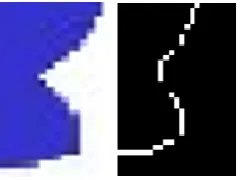
[image:4.595.99.223.101.191.2]given by, Fig. 2: Detected edge region for a given symbol
Algorithm: Forward March Algorithm
Step 1 Locate the initial seed for contour
tracing based on the horizontal and vertical tracing of the image.
Step 2 The first encountered pixel value
in the two direction tracing is taken as seed to initialize tracing.
Step 3 In reference to the initial seed,
eight directions neighbour must be scanned to detect the next forwarding pixel, scanned in anti-clock direction.
Step 4 The process of tracing is defined
as, for a pixel coordinate (i,j), tracing order is defined as
(i+1,j), (i,j+1), (i-1,j),
(i,j-1), (i+1,j+1), (i-1,j-1), (i+1,j-1), (i-1,j+1)
Step 5 On encountering the next pixel as
forwarding pixel, the current pixel is recorded as current seed and the step 3, 4 and 5 is repeated.
Step 6 The process is iterated until the
[image:4.595.65.269.551.682.2]initial seed is reached.
Fig. 3: Issued Orientation weight value for contour tracing
Algorithm: Region bound curvature representation
Step 1 Read Input image
Step 2 Transform the image to a 2-level
representation (1/0)
Step 3 Perform forward march algorithm to
derive the contour region.
Step 4 Derive curvature k defined as,
Step 5 Evolve the curvature by applying
Gaussian smoothening factor σ
Step 6 Repeat the steps for all the curvature
smoothened and buffer the curvature in K.
Step 7 Find threshold limit defined by,
Where, L is truncated tolerance value
Step 8 for the computed threshold value, the
coefficients were selected using the condition given as,
(7)
(8)
The planar curve for a is given as,
(9)
here, (10)
(11)
(12)
(13)
V. AREAFEATURE
The proposed approach represents the descriptive feature of region bound representation of cue symbol. To address the spatial semantics issue, in addition to the defined feature, closed bound area region is defined as well. The region bound area is defined as a closed area under a curve.
In the proposed approach, for bounded region contour, the regions with value of ‘High’ are treated as an area region. The density of the area filling in addition to the derived curvature peaks are then treated as a learning feature for a support vector machine (SVM). The region bound area feature is defined as,
Where, C is defined as the closed bound contour. The area under the curve is defined as a aggregative sum of the region, subjected to the condition of coefficient bound into the closed contour region (C). The two feature set (K, A) is then passed as a training parameter to the classification system. The features are used as a learning feature to derive a classification. For each of the trained character from A-Z and 0-9 numeric, the training set is derived, defined as
where, is region bound curvature feature and is the region bound area feature. These features are considered as a learning knowledge parameter to SVM system. A multi class SVM model is developed for the classification of the given cue symbol to its corresponding recognition. The experimental results obtained from the proposed system are discussed in next section.
VI. EXPERIMENTALRESULTS
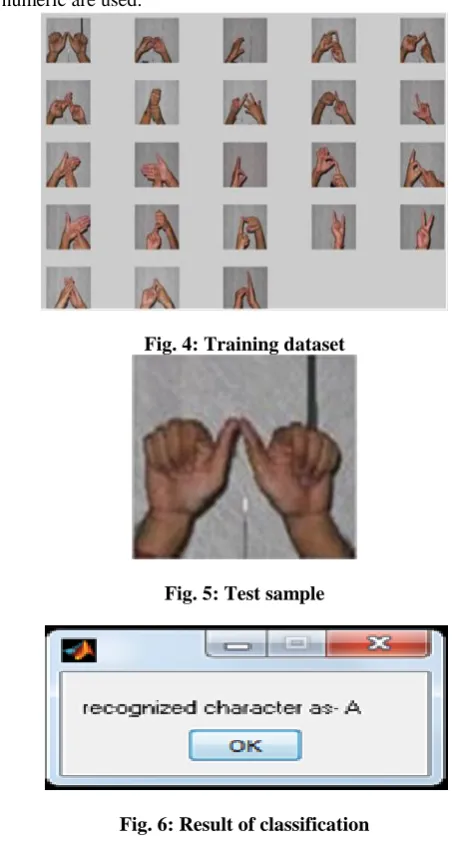
To evaluate the operation performance for the proposed system, a set of cue symbols from A-Z characters and 0-9 numeric are used.
[image:5.595.55.294.87.648.2]Fig. 4: Training dataset
Fig. 5: Test sample
[image:5.595.304.533.325.751.2]Fig. 7: Given test sample of ‘G’ as cue sample
Fig. 8: Result of classification
The training data set used is delineated in Fig. 4. Fig. 5, 6, 7 and 8 shows the observations derived for the proposed system. The proposed system is evaluated for the classification performance where the retrieval efficiency is measured in term of recall and precision rate. The recall and the precision factors are calculated using equations (15) and (16). Recall is defined as a ratio of number of relevant image retrieved over, total number of relevant image present. The Precision is derived as a ratio of number of relevant images retrieved to the total number of images retrieved.
(15)
(16)
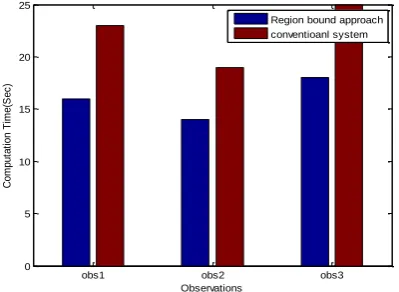
The computational time required for proposed approach is given in Fig. 9. The observed computation time is about 30 sec lesser than that of conventional shape oriented coding. The reduction in the number of processing coefficients in turn reduces the search time, and hence the search time taken is observed to be lesser. Though additional time factor is observed for feature extraction during coding over N-feature, process it is not much affected during recognition process.
obs1 obs2 obs3
0 5 10 15 20 25
Observations
C
o
m
p
u
ta
ti
o
n
T
im
e
(S
e
c
)
Region bound approach conventioanl system
Fig. 9: Comparison of computational time
0 0.1 0.2 0.3 0.4 0.5 0.6 0.7 0.8 0.9 1 0.2
0.3 0.4 0.5 0.6 0.7 0.8 0.9 1 1.1 1.2
FPF
T
P
F
[image:6.595.319.513.61.213.2]Region bound approach conventioanl shape system
Fig. 10: TPF v/s FPF for the proposed system
obs1 obs2 obs3
0 0.5 1 1.5 2 2.5 3 3.5 4 4.5
Observations
P
ro
c
e
s
s
in
g
O
v
e
rh
e
a
d
(
%
)
[image:6.595.319.523.110.443.2]Region bound approach conventioanl system
Fig. 11: Processing Overhead
The ROC curve for the developed system is presented in Fig. 10. The True positive factor for the proposed approach is observed to be 0.12 units more than conventional approach. The True positive factor is evaluated with respect to the accuracy in detecting the action model for a given cue sample.
The comparative analysis of the processing overhead for number of pixels under different test sample is illustrated in Fig.11. The minimization of the overhead is observed due to minimization in feature coefficients.
VII. CONCLUSION
An efficient feature description for sign language detection and retrieval for Indian sign language is developed. The approach defined a new system model for Indian sign language detection based on region bound features of a given cue sample. The cue samples are defined into two proposed feature descriptor of region bound curvature feature and region bound area features. The minimization in feature count reduces the processing overhead, and the selection of peak curvature element minimizes the error possibility in image schematicity case. The observed qualitative feature reflects the improvement achieved developed system over the conventional model.
REFERENCES
[image:6.595.66.266.611.757.2]2.P. M. Mahajan, J. S. Chaudhari, “Review of Finger Spelling Sign Language Recognition”, International Journal of Engineering Trends and Technology , Vol. 22 Number 9, April 2015.
3.W. W. Kong, S. Ranganath, “Towards subject independent continuous sign language recognition: A segment and merge approach”, Pattern recognition, Elsevier, 2014.
4.M. K. Bhuyan, M. K. Kar and D. R. Neog, "Hand pose identification from monocular image for sign language recognition," IEEE International Conference on Signal and Image Processing Applications (ICSIPA), Kuala Lumpur, 2011, pp. 378-383.
5.S. M. Darwish, M. M. Madbouly, M. B. Khorsheed, “Hand Gesture Recognition for Sign Language: A New Higher Order Fuzzy HMM Approach”, International Journal of Engineering and Technology, Vol. 8, No. 3, March 2016.
6.H. Yang, S. Lee, “Robust sign language recognition by combining manual and non-manual features based on conditional random field and support vector machine”, Pattern Recognition Letters, Vol. 34, Issue 16, 1 December 2013, pp. 2051-2056.
7.D. Dahmani and S. Larabi, "User-independent system for sign language finger spelling recognition" Journal of Visual Communication and Image Representation, 2014, pp. 1240-1250.
8.S. Das, A. Talukdar, K. Sarma, “Sign Language Recognition Using Facial Expression”, Procedia Computer Science, Vol. 58, 2015, pp. 210-216. 9.S. Rajaganapathy, “Conversation of Sign Language to Speech with
Human Gestures”, Procedia Computer Science, Vol. 50, 2015, pp. 10-15. 10. S. M. Shohieb, H. K. Elminir, A. M. Riad, “SignsWorld Atlas; a
benchmark Arabic Sign Language database”, Journal of King Saud University – Computer and Information Sciences, Vol. 27, Issue 1, January 2015, Pages 68-76.
11. V. K. Kumar, R. H. Goudar, V. T. Desai, “Sign Language Unification: The Need for Next Generation Deaf Education”, Procedia Computer Science, Vol. 48, 2015, pp. 673-678.
12. D. Vinson, R. L. Thompson, R. Skinner, G. Vigliocco, “A faster path between meaning and form? Iconicity facilitates sign recognition and production in British Sign Language”, Journal of Memory and Language, Vol. 82, July 2015, pp. 56-85.
13. M. S. Abdalla, E. E. Hemayed, “Dynamic Hand Gesture Recognition of Arabic Sign Language using Hand Motion Trajectory Features”, Global Journal of Computer Science and Technology Graphics & Vision, Vol. 13, Issue 5 , 2013.
14. K. Kaur, P. Kumar, “HamNoSys to SiGML Conversion System for Sign Language Automation”, Procedia Computer Science, Vol. 89, 2016, pp. 794-803.
15. H. Uehara, M. Baba and T. Utsuro, "Utilizing texts of picture book reviews for extracting children's behavioral characteristics in language acquisition," 2016 IEEE/ACIS 15th International Conference on Computer and Information Science (ICIS), Okayama, 2016, pp. 1-6. 16. M. P. Sampat, Z. Wang, S. Gupta, A. C. Bovik and M. K. Markey,
"Complex Wavelet Structural Similarity: A New Image Similarity Index," in IEEE Transactions on Image Processing, Nov. 2009, vol. 18, no. 11, pp. 2385-2401.
AUTHORSPROFILE
Mrs. S. D. Deshpande is working as an Assistant Professor and HOD of Information Technology at PES’s Modern college of Engineering, Pune since 2007. She also worked as Lecturer in Shree Tuljabhavani college of Engineering, Tuljapur (1996-2007). She completed her Bachelor of Electronics Engineering in 1990 from Basweshwar college of Engineering, Latur and Masters of Electronics Engineering in 2000 from Government college of Engineering Aurangabad. She teaches the courses of Electronics and circuit Design, communication Engineering, Digital Communication, Signal and Image Processing, Information and Security. She also presented two papers in International Conferences. She is a member of IEEE and a life member of ISTE.
Prof. Y. V. Joshi is working as Professor of Electronics and Telecommunication Engineering at SGGS Institute of Engineering from July 2001. Prior to this he was Assistant Professor (1993 to 2001) and Lecturer (1986 to 1993) at the same department. He worked as Director, Walchand College of Engineering, Sangli (2009 to 2013) on lien from SGGS Institute of Engineering and Technology, Vishnupuri, Nanded. He also worked in various capacities such as Head of Department (2002-2004), Dean( Academics) (2004-2006), Dean ( Resource