Children’s Social Care Innovation Programme Evaluation Report 05
Developing a
regional dynamic
purchasing system
Research report
October 2016
2
Contents
List of figures 4
Executive Summary 5
The project 5
The evaluation 5
Key Findings 6
Implications and recommendations for policy and practice 7
Overview of the project 9
What was the project intending to achieve? 9
Brief summary of existing research 9
Context for this innovation 10
Overview of the evaluation 11
Evaluation questions 11
Methodology 11
Key Findings 13
To what has extent has this innovation achieved its intended outcomes? 13 What lessons have been learned about the barriers and facilitators to this innovation? 18
Introduction 18
Partnership working 18
Impact on the Innovation Programmes’ objectives and areas of focus 22
Introduction 22
Improved value for money 23
Improved outcomes for children, young people and families 23
Increased collaboration 25
Stimulating new solutions 26
Implementing and replicating the regional Dynamic Purchasing System 26
Limitations of the evaluation and future evaluation 28
Limitations and appropriateness of the evaluation approach 28
Capacity building for future evaluation 28
Plans for further evaluation 28
Capacity & sustainability of the innovation. 30 Conditions necessary for this innovation to be embedded 30 Future development of the innovation and wider application 30
Appendix 1: Theory of Change 31
Appendix 2: Engagement of Local Authority Project Team Members 32
Appendix 3: Participants in the evaluation 33
Appendix 4: List of all documents reviewed: 35
Public documentation 35
Internal documentation 35
Appendix 5: Research Topic Guides 38
Parent & carer topic guide – focus group 38
Young people topic guide – focus group 40
Introduction 40
Your understanding of the project 41
The placement process 41
The South East Together Regional Dynamic Purchasing Project 41
Overall views 41
Project Team Member Interview topic guide 42
Introduction 42
Understanding the need for a regional dynamic purchasing system (DPS) 42
Project deliverables 42
Provider Interview Topic Guide 45
Introduction 45
Your involvement and understanding 45
Partnership working 45
The partnership has been developing the following workstreams: 45
Thinking about the project overall 46
4
List of figures
Figure 1: Stakeholders rated the impact that the project has had on 6 key areas 6 Figure 2 SET Project Team views regarding the achievement of project deliverables 14 Figure 3: Project team members rated the impact that the project has had on 6 key areas
22 Figure 4 Theory of Change for South East Together Regional Dynamic Purchasing
Project 31
Figure 5: Breakdown of attendance by local authority for each Project Team meeting 32
Figure 6 Project Team Members 33
Figure 7 Providers Involved in Interviews 34
Figure 8 List of partners 38
Figure 9 List of partners 40
Executive Summary
The project
The South East Together (SET) project explored the viability of establishing a Regional Dynamic Purchasing System1 (DPS) to support the commissioning and procurement of
placements in Independent and Non-Maintained Special Schools (INMSS) and independent children’s homes. 6 main partners are involved: West Sussex (lead), Brighton & Hove, East Sussex, Kent, Surrey and the South London Consortium2. The project aims to build on existing or in-progress initiatives which the partners had begun developing prior to April 2015, and which are focused on improving the commissioning of specialist provision.
The evaluation
As the SET project did not anticipate influencing outcomes or value for money in it’s first year, this study has evaluated the implementation and process. It explores:
• The extent to which the regional Dynamic Purchasing System has been established to time, budget and original specification
• What worked well, what didn’t work well and what could have been improved in relation to the establishment of a regional Dynamic Purchasing System
• The extent to which the Dynamic Purchasing System has the potential to impact on a series of issues relating to efficiency, collaboration, innovation, value for money, and improved outcomes
• To what extent could a regional Dynamic Purchasing System be rolledout or applied elsewhere?
• How might it be best to evaluate the regional Dynamic Purchasing System once it is established and implemented?
5 key methods have been employed: a document review, interviews with SET project team members, provider engagement, parent / carer engagement, young people engagement. The Appendices to this report provide full details regarding which stakeholders were engaged and the tools which were used in the fieldwork.
1“The Dynamic Purchasing System is a procedure available for contracts for works, services and goods
commonly available on the market. As a procurement tool it has some aspects that are similar to an electronic framework agreement, but where new suppliers can join at any time”Crown Commercial Service (2015) The Public Contracts Regulations 2015 – Dynamic Purchasing System.
2 A SEN commissioning consortium comprising the London Boroughs of Bexley, Bromley, Croydon,
6
Key Findings
Completion of project deliverables
Overall, the evidence suggests that the project has achieved or partially achieved the anticipated project deliverables. The exception to this is the revision of the national contracts, the timescales for which have slipped, although the work is due for completion in the summer of 2016.
[image:6.595.92.497.341.592.2]Influencing Innovation Programme’s objectives and areas of focus
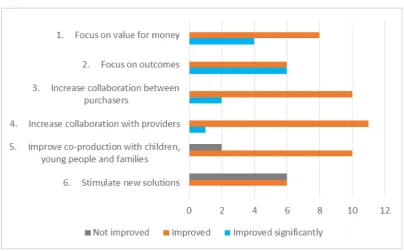
Figure 1 below summarises project team members’ opinions regarding the Innovation Programme’s objectives and areas of focus. These self-reported results suggest that improvements have been made in most areas as a result of Innovation Programme’s investment. However, there are some dissenting views regarding improved co-production and stimulating new solutions.Figure 1: Stakeholders rated the impact that the project has had on 6 key areas
Viability of the DPS
Whilst there are some challenges regarding this type of partnership working (see
“Lessons Learned” below), the evidence suggests that there is no technical reason why a regional (or national) DPS approach could not be expanded.
some partners will engage, but it is unlikely that all partners will engage. Final decisions are expected in March 2016.
Lessons learned
This evaluation finds 3 main lessons have been learned from the SET DPS development process over the last 12 months:
The importance of consistent engagement from delivery partners: The most
important learning from the project identified by the majority of SET team project workers was the need to establish clear frameworks for partnership working. The research finds that some partners were unable to back-fill posts which meant that their project workers were less able to engage than was desirable. Equally, project board members were unable to attend meetings consistently which meant that some decisions were delayed. The need to focus on shared understanding of project aims: The research also finds that ensuring all stakeholders have a clear understanding of the project’s overall aims may have helped the project to develop even more effectively.
The importance of effective stakeholder engagement: Feedback regarding the
engagement of stakeholders (providers, parents, young people) is mixed, which suggests that some aspects of the resulting products may require further development once they have been piloted.
Implications and recommendations for policy and practice
Over the last 12 months, the SET project team have undertaken an ambitiousprogramme of work and made important developments in a number of areas. In
particular, they have improved our understanding of partnership working, commissioning for outcomes, value for money, cost benchmarking and data analysis in relation to a regional DPS. There is also evidence to suggest that they will succeed in revising the national contracts.
Overall, this research finds no technical reasons why a regional or even national DPS could not be developed. According to the available evidence this approach ought to have a positive impact on value for money, and has the capacity to affect outcomes positively. However, this not a straightforward concept to deliver. There are a number of important implications for policy and practice which would need to be considered should further collaborative commissioning approaches be developed. These include:
• Collaborative working needs to be promoted and effectively resourced. Partners need to properly understand the time commitment required
8
• Stakeholders must be involved in the development of such initiatives and the approach to engagement must be flexible to ensure that all those who have a relevant view are able to share it effectively
Overview of the project
What was the project intending to achieve?
The South East Together (SET) project is exploring the viability of establishing a Regional Dynamic Purchasing System3 (DPS) to support the commissioning and
procurement of placements in Independent and Non-Maintained Special Schools (INMSS) and independent children’s homes. Six main partners are involved, i.e. West Sussex (lead), Brighton & Hove, East Sussex, Kent, Surrey and the South London Consortium4. The project aims to build-on existing or in-progress initiatives designed to
improve commissioning of specialist provision.
There was no expectation that this project would influence outcomes for children during its first year. The project is exploring the viability of a Regional DPS approach with a view to influencing outcomes and overall value for money in future years, if implemented. The intended activities for the year are explained in Figure 2 below (see p13).
Brief summary of existing research
There are few relevant studies which address the extent to which collaboration between local authorities, using DPS approaches, is likely to deliver improved outcomes or value for money, especially in the context of children’s social care. It is worth, however, highlighting 2 interesting studies:
• A model to test the ideal size of LAs (based on inspection scores, national
performance indicators public confidence and a value for money index) has been developed by Cardiff University and has influenced decisions across Wales and England regarding the need to re-organise local authority boundaries in order to achieve efficiencies. Its main finding is that there is no ideal size for a local authority, but notes that larger authorities have lower administration costs5.
• A 2011 report investigating the impact of dynamic purchasing systems highlights a number of challenges in their use, but firmly concludes that they are of value to LAs:
3“The Dynamic Purchasing System is a procedure available for contracts for works, services and goods
commonly available on the market. As a procurement tool it has some aspects that are similar to an electronic framework agreement, but where new suppliers can join at any time”Crown Commercial Service (2015) The Public Contracts Regulations 2015 – Dynamic Purchasing System.
4 A SEN commissioning consortium comprising the London Boroughs of Bexley, Bromley, Croydon,
Merton, Wandsworth, Lewisham, Sutton, Richmond Upon Thames and the Royal Boroughs of Greenwich and Kingston Upon Thames.
10
“this purchasing technique allows the contracting authority, through the establishment of a list of tenderers already selected and the opportunity given to new tenderers to take part. To have a particularly broad range of tender as a result of the electronic facilities available, and hence to ensure optimum use of public funds through broad competition.”6
Context for this innovation
The project is a partnership between 6 Local Authority (LA) partners: West Sussex County Council (Lead), East Sussex County Council, Kent County Council, Surrey County Council, Brighton and Hove and South London Consortium. Prior to the project, partners have been developing a number of relevant initiatives, which have contributed to the work.
These initiatives include an existing DPS across West Sussex and Kent for
commissioning places in INMSS; a framework agreement in place across West Sussex and Brighton & Hove for procuring foster care and children’s home provision; and the development of a framework for INMSS across the South London Consortium. The purpose of the current project is to explore the feasibility of establishing a DPS across all 6 partners, covering placements in INMSS, specialist children’s’ homes and foster care.
6 Ozbilgin, I and Imamoglu M (2011) The impact of dynamic purchasing systems in the electronic public
Overview of the evaluation
Evaluation questions
The evaluation questions were as follows:
• To what extent has the regional Dynamic Purchasing System been established to time, budget and original specification? Why?
• What worked well, what didn’t work well and what could have been improved in relation to the establishment of a regional Dynamic Purchasing System? Why? Specific issues to explore are likely to include effectiveness of levers, barriers and lessons learned.
• To what extent will the Dynamic Purchasing System have the potential to impact positively on the following issues, if implemented:
• More efficient and effective commissioning decisions and procurement processes?
• Improved outcomes for children, young people and families? • Improved value for money?
• Increased collaboration between purchasers? • Increased collaboration with providers?
• Stimulating new solutions to address the difficulties faced by targeted children, young people and their families?
• To what extent could a regional Dynamic Purchasing System be rolled-out or applied elsewhere? What are the main lessons learned?
• How might it be best to evaluate the regional Dynamic Purchasing System once it is established and implemented?
Methodology
5 methods have been employed in this research. The Appendices to this report provide more details regarding the documents reviewed, research tools and participants.
• Document review: Cordis Bright analysed project-related documentation in January 2016, including minutes of the project team and project board meetings • SET Project Team interviews: Cordis Bright undertook semi-structured interviews
with 13 people who were involved in delivering the project
12
exercise with providers attending the CLA (Children Looked After) provider forum meeting on 12th February 2016
• Parent / carer engagement: A focus group with parents who had engaged with the SET development project was held on 5th February 2016. 9 parents attended, some of whom had already had experience of the pilot DPS in West Sussex7
• Young people engagement: A focus group was held on 3rd February 2016, involving 4 young people who had engaged with the SET development project
7 The original evaluation plan aimed to administer a questionnaire to parents/carers. With this in mind, a
Key Findings
To what has extent has this innovation achieved its intended
outcomes?
Introduction
The SET DPS project is a development stage project, which does not seek to deliver improved outcomes for children within the lifetime of this evaluation. The evaluation therefore focuses on issues of implementation, process and output. We asked:
“To what extent has the regional Dynamic Purchasing System been established to time, budget and original specification?”
We have analysed results from the document review, project team interviews and
provider interviews to draw relevant conclusions. Overall, the evidence suggests that the project has achieved or partially achieved all the goals it has set itself. The exception to this is the revision of the national contracts, the timescales for which have slipped, although the work is due for completion in the summer of 2016.
Summary of achievements
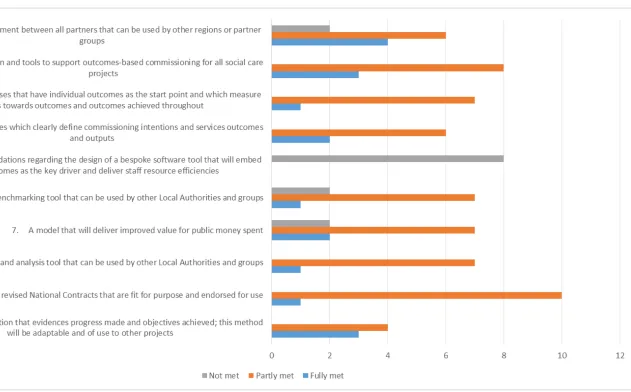
Figure 2 below shows the project deliverables agreed with the Department for Education (DFE) and the extent to which project team members believe these deliverables have been achieved. For all project deliverables, the majority of project team members agree that the objective would be partially met by March 2016. For 4 project deliverables (those numbered 18, 59, 6 and 10 below), opinions regarding achievement were relatively
diverse. These issues will be explored in more detail on p15 onwards.
An analysis of project documentation suggests that progress towards these deliverables has been closely monitored by the Project Board which may have helped ensure the project stayed broadly on track.
8 This includes governance arrangements, financial risks, operational and delivery arrangements,
stakeholder engagement methods, training programmes for staff and templates for Agreements and operational processes.
9 This is in order that more resource can be deployed to the management of awarded contracts to ensure
Children’s Social Care Innovation Programme Evaluation Report 05
Achievements in key work areas – more detail
Introduction
This section highlights the specific project deliverables about which research participants shared the most important reflections. Providers’ opinions regarding project
achievements were focused on the areas in which they had been most involved namely (i) developing outcomes and (ii) revising the national contracts. The report therefore addresses provider and project team feedback on these points first, before analysing project team feedback in relation to (iii) developing the cost-benchmarking tool, (iv) developing the data analysis and collection tool and (v) exploring legal and procurement challenges.
Developing outcomes
As noted above, 3 project team members believe the work to develop outcomes has been fully met, with the remaining project team members indicating that the work is partly met. Provider opinions mirrored this finding, with the majority of providers considering the work to be either fully or partially fit for purpose. However, 3 (out of 19) providers indicated that the results were not suitable for use.
Provider opinions can be summarised as follows:
• A majority of providers welcomed the opportunity to consider and influence the outcome framework with one explaining that the work should help them to “focus on what our organisational outcomes are and how to achieve them”
• Providers reported that the good practice framework examples and indicators explored in the workshops provided useful ideas and tools for providers to implement in their own organisations.
• A minority of providers expressed reservations regarding the time commitment and potential administration of the new outcomes framework
• One provider reported that they found “the SET outcome framework confusing and complicated”, for example, in referring to “resilience as a personal resource”, which they felt meant that “it won't qualify for the national contract”
• Two providers, who were involved in the delivery of fostering and residential provision, indicated that the outcome framework would be unsuitable for their type of services. They were of the opinion that the outcome framework assumes a linear progression which is more suitable for school or education-based
interventions.
16
Revising the national contracts
Stakeholders recognise the value of revising the national contracts. Project team members reported that project management and sequencing considerations meant that this important piece of work had to be focused towards the end of the project timeline. Unfortunately, the timescales have slipped further and the revised contracts are expected to be delivered in summer 2016 rather than March. Other than timescales, project team members reported no significant anxieties with this piece of work and expect to be able to deliver the required results.
Providers welcomed the proposals to revise the national contracts, which they believe will reduce their administrative burden. However, providers’ concerns regarding the
outcomes framework (see above) are also relevant for the national contracts work, as we understand the outcomes framework is intended to be used in tandem with the revised national contract.
In addition, 3 providers expressed concerns about the extent to which the contract negotiations will progress smoothly from this point forward. One explained:
“I expect most of it will be fine, but there will be a few key issues where it will be very difficult to find compromise”
Two others explained that it may be unreasonable to expect SET to negotiate a contract on a national basis. Instead, they felt there needed to be “a national lead with an
independent facilitator” and wider involvement and ownership on a national basis so as to gain approval from the national steering group.
Overall the evidence suggests that the national contracts work has slipped and may still encounter some challenges. However, there is a commitment from all parties to make the required revisions which will be helpful in overcoming any obstacles.
The cost-benchmarking tool
As noted previously, project team members offered very varied opinions regarding the extent to which the cost-benchmarking tool requirement has been met. A majority of project team members were able to highlight benefits, indicating that it had given them more insight about costs within their authority and the wider region. One cited the tool as one of the project’s key successes.
However, a minority highlighted a number of areas where the tool was less useful, for example, the lack of externally-gathered or independent benchmarks and the limited dataset on which the information was based.
The data analysis and collection tool
The majority of project team members indicated that the tool had achieved its brief of informing their work at a regional level and helped to understand some of “the relative benefits of working together in future”. However, one project team member reported that the benefits outlined in the final report were “not clear, quantifiable or robust enough” and that the project would benefit from further work to understand the full range of costs and benefits involved in establishing a regional DPS.
On balance, the evidence suggests that the data analysis and collection tool has met the project’s requirements.
Exploring legal and procurement challenges
The majority of project team members felt that this work had progressed well. As part of this some project, team members emphasised the complexity of this work -“15 LAs each with a different interpretation of the law”,- but, despite this, project team members were of the opinion that the following factors had led to effective results:
• the role of a legal representative on the project team • the existing legal relationships between certain partners
• And the sessions with procurement and legal teams to discuss reconciling legal and procurement challenges
The results have yet to be tested (through the contract negotiation process and the rolling out of a regional DPS, should this proceed) but, overall, the evidence suggests that
18
What lessons have been learned about the barriers and
facilitators to this innovation?
Introduction
As part of the evaluation, we asked:
“What worked well, what didn’t work well and what could have been improved in relation to the establishment of a regional Dynamic Purchasing System?”
We have analysed results from all 5 of the methodologies to draw relevant conclusions. Key areas of learning which emerged from the evidence related to partnership working and partner engagement.
Partnership working
The majority of project team members reported that the SET partnership had worked together effectively. Examples of effective practice included:
• The sharing of knowledge and expertise in a collaborative way at project team meetings and with providers
• The development of a common outcomes framework in partnership, facilitated by the New Economics Foundation (NEF)
• The production of a meeting schedule by the project lead which shows historic and future meetings, including details of who attended and what was discussed
• Commitment and drive of individual project team members
The rest of this section explores the areas for improvement which were noted by project team members and other stakeholders.
The need for all delivery partners to engage consistently
The most important learning for the project, identified by the majority of project team members was the need to develop clear frameworks for partnership working and governance structures in order to enable consistent engagement, responsibility and accountability.
• Project board: Project team members and providers highlighted the fact that “the
project board has not had consistent representation from all participating LAs”. This was described by project team members as “slowing the process down” as it meant that decisions could not be made and that “old ground needs to be covered each time”. This finding is reinforced by the document review which shows that whilst all partners attended the first project board meeting in June 2015, only 3 partners were represented at the second project board meeting in November 2015 (West Sussex, East Sussex and South London Consortium). The minutes show, for example, that a discussion over local authority provision had to be deferred to the next meeting due to lack of attendance from key LA partners.
• Providing a sufficient level of resourcing to the project team: Both project team members and providers indicated that the difficulties in back-fillingproject workers’ posts meant that they were unable to devote as much time to the SET DPS project as had been originally envisaged. In spite of these challenges, the project team minutes show that a consistent core of attendees have contributed to project team meetings (please see Appendix 2 for a summary). This finding is also reinforced by a review of monitoring returns to the Department for Education. One of the most prevalent challenges noted in these monthly returns was the need for better project resourcing from individual LAs.
• Organisational buy-in: The majority of project team members reported that the partnership operated in a way that was a combination of systematic processes and individual-led practice. For most, this was seen as inevitable as while there were “terms of reference and working agreements in place”, “there's always going to be an element of personality”. While project team members reported several benefits to the role of individuals in achieving project successes, they also recognised disadvantages in terms of a reliance on individual officers’ goodwill rather than organisational buy-in. The extent to which progress relied on
individual motivation and drive, may be a consideration for the replicability of the DPS model in other regions or nationally.
Underpinning these findings is the fact that project team members consistently reflected that under-estimating the time commitment required had caused challenges:
“The first three months were lost…it takes a long time to set things up” “With hindsight, we should have started some tasks much sooner” “We under-estimated the tasks and time required”
Shared understanding of project aims
20
However, a majority of providers were of the opinion that SET’s main goal was to achieve an outcomes-based approach to commissioning. One provider described this as a shift away from:
“Easy to measure input or output indicators which don’t show a causal relationship to outcomes, to instead seeing the difference the spend has made to children’s lives”.
This difference in understanding naturally varies according to which aspects of the wide-ranging DPS project individual stakeholders were engaged with. However, a minority of project team members and providers reported that this difference in understanding has caused some confusion. As a result, project team members have been diverted from their key tasks in order to spend time clarifying and reassuring stakeholders regarding the overall intentions.
Sharing information
The project team established a data sharing protocol. However, a majority of project team members reported that it remained difficult to pool information regarding
expenditure, numbers of children being supported and use of different providers across the SET region, because the approaches to data collection varied so significantly across different LAs. Project team members suggested that there needed to be “better
clarification of data expectations at the outset” and “a greater focus on requiring partners to deliver more complete sets of quality responses”, particularly in relation to the cost-benchmarking and data collection tools.
Wider partner engagement
Providers, young people and parents report mixed opinions regarding the effectiveness of their engagement in the project. Providers and young people were positive on the whole, although areas for improvement are noted below. Parents were generally less positive about their experience.
Providers
The majority of those who had been closely involved in the project indicated that they appreciated the opportunity to get involved in the work in a meaningful way and felt they had been engaged effectively. One described the approach as:
“An exemplary piece of work in terms of engagement with wider stakeholders…providers really appreciate being involved at an early stage of development”
However, 2 providers expressed concerns, for example “they don’t take on board any feedback and learning from us”.
• Ensure that workshops are less theoretical and more focused on operational practice
• Provide more notice of meetings and information regarding agendas and intended outcomes so that providers can ensure the right person can attend
• Provide follow up information for people that missed consultation meetings and provide alternative options for involvement, such as online surveys, to allow for scheduling difficulties
Children and Young People
All 4 young people felt they had been well engaged through the consultation workshop on outcomes, particularly in terms of feeling “listened to”. They highlighted a couple of areas for improvement:
• 2 of the young people reported that the methods of engagement used in the workshop, could have been more appropriate for their age (over 16 years old) • The young people reported that they had not yet had feedback on how their ideas
had been used, which they would find helpful
Parents
Overall the parents did not report a positive experience of being engaged in the outcome development workshops10. Their particular concerns related to not feeling listened to and
feeling that their knowledge and experience as parents was not valued sufficiently. One parent felt that they were “just there to tick a box that they had been consulted”.
For example, parents reported that they had a more holistic idea of children's social and emotional needs, whereas providers were mainly focused on educational attainment. Parents were unsure of the extent to which their views regarding social and emotional needs were taken into account in the outcomes framework.
Parents also felt that the venues, timings and accessibility of workshops could have been improved. The majority reported that it may have been better to undertake the
consultation through an existing forum where they felt comfortable: attendance would have been higher and their views could be considered more carefully.
10 It is important to note that the project team made us aware of some extremely positive and un-prompted
22
Impact on the Innovation Programmes’ objectives and
areas of focus
Introduction
The Innovation Programme is interested to understand the extent to which the Dynamic Purchasing System has the potential to impact positively on the following issues, if implemented:
• More efficient and effective commissioning decisions and procurement processes • Improved outcomes for children, young people and families
• Improved value for money
• Increased collaboration between purchasers • Increased collaboration with providers
• Stimulating new solutions to address the difficulties faced by targeted children, young people and their families
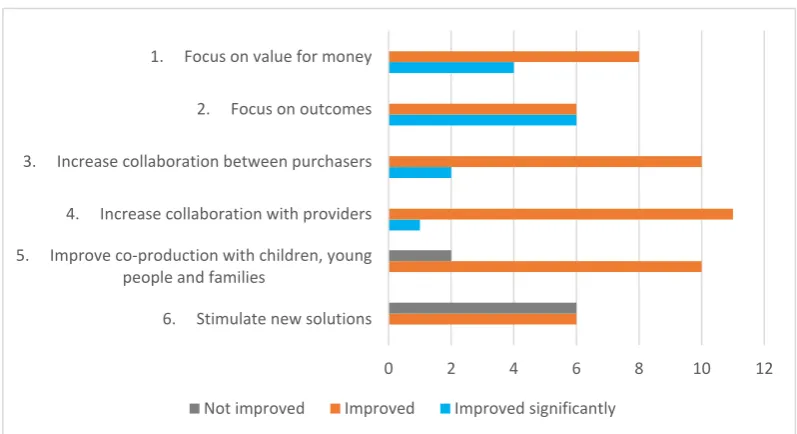
[image:22.595.102.501.502.719.2]Figure 3 below summarises project team members’ opinions regarding these issues. It suggests that improvements have the potential to be made in most areas as a result of the Innovation Programme’s investment. However, there appear to be some dissenting views, regarding improved co-production and stimulating new solutions. Further analysis of these issues is provided below.
Figure 3: Project team members rated the impact that the project has had on 6 key areas
0 2 4 6 8 10 12
6. Stimulate new solutions 5. Improve co-production with children, young
people and families
4. Increase collaboration with providers 3. Increase collaboration between purchasers 2. Focus on outcomes 1. Focus on value for money
Improved value for money
11Project team members reported that the project had enabled them to consider value for money more effectively than in the past. A majority of project team members and
providers perceived that this project would “explore value or money commissioning” and
“better value for money for the public purse”.
The most common reason which project team members gave for trying to develop a regional DPS was the fact that it should enable a better use of resources across LAs, through economies of scale and more efficient working practices and processes. In particular, when it comes to reducing the administration burden of monitoring providers and placements as it is not possible for each LA to “effectively scrutinise providers”. One project team member reported that “currently [LAs] don’t have the staff resource to do things independently”.
Overall, project team members were of the opinion that the proposed approach should make each placement more efficient because there would be secure and swift access to a wider range of providers and a reduction in spot purchasing.
6 out of 13 project team members also outlined that a regional DPS should result in more efficient processes for providers as they could deal with one contract and one set of reporting requirements across 15 LAs. 2 project team members felt that this would mean providers were able to pass on cost savings, on account of these efficiencies, to
commissioners, resulting in greater value for money.
5 out of 19 providers also highlighted the development of a common regional Dynamic Purchasing System to source, identify and purchase placements in a more streamlined way as a key aim SET were seeking to achieve.
Improved outcomes for children, young people and families
Project team members and providers are generally of the opinion that this innovation has the capacity to improve outcomes for children, young people and families. One of the most common findings from the interviews with project team members was that they felt the project had enabled them to think much more effectively about an outcome-focused approach to commissioning. That said, the evidence suggests that young people and parents are less certain about whether the DPS will tackle the issues that they consider most important for improved outcomes.Further information about the views of different groups in this regard is provided below.
11 This section addresses issues of improved value for money, as well as the question of more efficient and
24
Project Team Member opinions
A majority of project team members suggested that outcomes would be improved, as they were of the view that a regional DPS would:
• enable a greater focus on commissioning for outcomes
• create more scope for the inclusion of the voice of children and young people and co-production with parents as the systems and processes become more
rationalised
Provider opinions
The majority of providers reported that the key intention that SET was seeking to achieve was to move to a model of commissioning based on outcomes for providers, individuals and the community. One provider described this required change as a shift away from:
“Easy to measure input or output indicators which don't show a causal relationship to outcomes, to instead seeing the difference the spend has made to children’s lives”.
Young people’s opinions
Young people highlighted a number of issues which they believed would improve their overall experience and contribute to better outcomes. It is likely that a regional DPS could contribute to improving these issues, although they are much more likely to be addressed by operational teams within each LA:
• Social workers and other professionals need to listen to young people and have a better understanding of their individual needs, in order to take into account their perspectives on an appropriate placement
• The communication by social workers and other professionals to children and young people about their placement, particularly in terms of the length of their placement, and information regarding other people living at the placement has an impact on how settled they feel and their overall wellbeing
Parents’ opinions
Parents highlighted important improvements which they would like to see in order to improve outcomes. Once again, the DPS may contribute to improving some of these issues, but they are more likely to be addressed by operational teams within each LA. That said, it will be important to ensure that the DPS does not inadvertently lead to a deterioration in these factors:
• Assessment: the assessment process needs to include a face-to-face meeting with the individual child and their parents. For example, a majority of parents reported that out of date information regarding their child's needs or statement were put on the DPS, resulting in inappropriate placement offers
• Focus on cost and finances: parents also reported concerns around the overt focus of the regional DPS on cost and finances with not enough emphasis on the needs of individual children
• Parental engagement: the majority of parents reported that the approach to parental engagement could be improved as they reported a culturally embedded hierarchy of knowledge and experience, which did not take seriously parent's views
Increased collaboration
Between purchasers
As explored on p18 above, it remains to be seen how many partners will ultimately engage in the proposed regional DPS. However, project team members consistently report that the project has improved collaboration among LA purchasers, with more consistent approaches to sharing data, specifying outcomes and exploring legal and procurement challenges in place as a direct result of this project. One project team member attributed this to the DfE’s involvement which:
“Provides a high profile focus which has kept people around the table”.
With providers
A minority of project team members also reported that there had been significant improvement in collaboration with providers:
“Providers start off expecting to be ‘told’ what to do”, whereas the SET approach brings
“commissioners and providers together to agree the overall change they want to make for children and young people”.
2 project team members felt that the approach taken by SET had not been “true co-production…as it is working within a pre-determined structure”. Instead, there has been
“elements of co-design”.
As noted on p20 above, a majority of providers were satisfied with the approach to engagement and collaboration. However, they acknowledged the inherent challenges in co-production and collaborative working:
“The industry is mainly made up of small schools, who have very dedicated staff
26
so we are being asked to provide a high level of information…..in a small organisation it is a major distraction”.
Stimulating new solutions
As noted in Figure 3 above, project team members are cautious about the extent to which the project can stimulate innovation. The main concerns can be summarised as:
“SET are restricted with solutions with regards to procurement regulations in terms of contractual arrangements”, meaning that the majority of the project is “business as usual”.
Implementing and replicating the regional Dynamic
Purchasing System
The evidence suggests that there are no technical reasons why the DPS could not be implemented in the SET region, in other regions or nationally. However, the evidence suggests it can be very challenging for different LAs to form reliable working agreements and working relationships with each other.
The majority of project team members and providers felt that a DPS was viable in the SET region. However, 6 project team members and 4 providers outlined caveats in their answers or obstacles that would need to be overcome.
The main caveat outlined was the uncertainty over whether there was a business case for a full SET DPS. Providers and project team members perceived that some LAs were considering opting-out of the final agreement, and there was uncertainty regarding the minimum required scale for the project to be viable. For example:
“If [LA name removed] pull out, it’s probably still viable, but it would be better if they stayed involved”.
The primary obstacle to overcome, identified by project team members, was the need for individual LAs to compromise and “give up some systems and ways of doing things”. A minority of providers also noted that key issues (such as a common IT system and different political agendas across the region) may yet make formal collaboration impossible.
The majority of project team members and providers reported that there is no reason why a DPS would not be viable in other regions, particularly in regions where there are
28
Limitations of the evaluation and future evaluation
Limitations and appropriateness of the evaluation approach
This evaluation has been limited by the timescales in which it has operated. Whilst it is helpful to understand the strengths and weaknesses of the development process, there has been no opportunity to investigate changes in outcomes or value for money which might arise from the Innovation Fund’s investment.As a process evaluation, the approach has worked reasonably well, with project team members, providers, young people and parents being clear in their opinions and generous with their time.
Capacity building for future evaluation
The future of this project remains uncertain. It is not yet clear whether the project will continue in any form beyond March 2016 (although there is a strong likelihood that at least some of the partners will establish some form of inter-authority DPS). As such, no specific resource has been made available to evaluate the project going forward. The evaluation recommendations which follow are based on the assumption that the budget and resource will be very limited.
The evaluation approaches and tools developed to date are being made available to the project team so that they can use them in future if appropriate. However, once the DPS is underway, we recommend a slightly different evaluation focus.
Plans for further evaluation
Recommended evaluation aims
Assuming the project proceeds, we recommend that the evaluation aims from March 2016 are:
• To what extent are outcomes being improved as a result of the regional DPS? • To what extent are efficiencies being made?
These aims should be relatively straightforward to monitor, will provide insight into the extent to which the DPS is working and are developed from key messages which emerged from the process evaluation, as follows:
• Project team members were anxious to ensure that future evaluation approaches are proportionate and do not divert significant funds away from “other pressing financial concerns”
• Measuring the extent to which provider, commissioner, community and individual level outcomes have been achieved
• Ensuring that the perspectives of parents, carers, children and young people are included
It would also be helpful to assess value for money (in addition to efficiencies achieved), however, we suspect that this type of analysis cannot be achieved within a limited or non-existent evaluation budget.
Recommended evaluation approaches
We recommend that a baseline evaluation is established as soon as possible after March 2016, and then repeated on an annual basis. These evaluations should, we suggest, include:
• An assessment of progress against outcomes, in accordance with the New Economics Foundation’s outcomes framework. A reliance on this data set should ensure that:
• Children’s, young people’s, carers’ and parents’ views have been incorporated
• Evaluation activities and burden are kept to a minimum, as this is data which providers and the project tean will need to gather routinely
• An annual assessment of LA budgets spent on INMSS, SEN Children’s Homes and Foster Care placements, to include administrative and support functions. Ideally, providers would also be invited to share data regarding reducing expenditure as a result of streamlining the procurement processes, but this is likely to be difficult to achieve.
• An annual assessment of the number of placements which are made via the DPS, and those which are made through other means. If significant or increasing
30
Implications and Recommendations for Policy and
Practice
Capacity & sustainability of the innovation.
The evaluation evidence suggests that the SET DPS project has achieved or partly achieved all its objectives, with the exception of the national contracts revision, which is expected to be delivered in the summer of 2016.
For this project, the question of capacity and sustainability hinges on whether or not the partners involved in the SET DPS development project agree to continue its development and implementation after March 2016. The evaluation evidence suggests that it is likely that some partners will engage, but it is unlikely that all partners will engage. Final decisions are expected in March 2016.
Conditions necessary for this innovation to be embedded
This report finds that effective partnership working and provider engagement are important conditions for this type of innovation to be embedded. There is also asuggestion that the DfE’s oversight of this project has helped to ensure that partners stay engaged and focused. Specific conditions of effective partnership working and partner engagement include:
• The need for consistent engagement and involvement from all partners and sufficient time / resource to be devoted to the project
• The need to have clarity regarding a shared understanding of the project and its activities
• Project team members’ ability to give up certain approaches or considerations to ensure the project as a whole can succeed
• The need for appropriate engagement approaches (e.g. materials which are suitable for the audience, effective communication and feedback)
Future development of the innovation and wider application
Whilst the partnership working challenges discussed above are problematic, theAppendix 1: Theory of Change
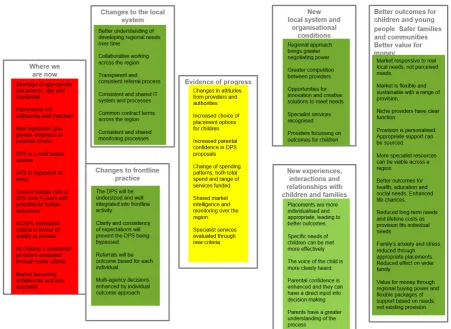
Figure 4 below outlines the Theory of Change for this project. It shows:
• the improvements which this project seeks to achieve.
• the ways in which the project intends to make these changes.
[image:31.595.68.520.252.581.2]• the evidence which will show whether or not improvements have been made.
32
[image:32.595.107.482.191.501.2]Appendix 2: Engagement of Local Authority Project
Team Members
Figure 5 below provides more detail about which partners were able to attend each project meeting. It shows that 4 partners attended every project meeting (between May and December).
Figure 5: Breakdown of attendance by local authority for each Project Team meeting
Meeting (2015)
West Sussex
East Sussex
Kent South London Consortium
Surrey Brighton and Hove
May x x x x x
June x x x x x x
July x x x x x x
September x x x x x x
October x x x x x
November x x x x x
[image:32.595.106.482.193.501.2]Appendix 3: Participants in the evaluation
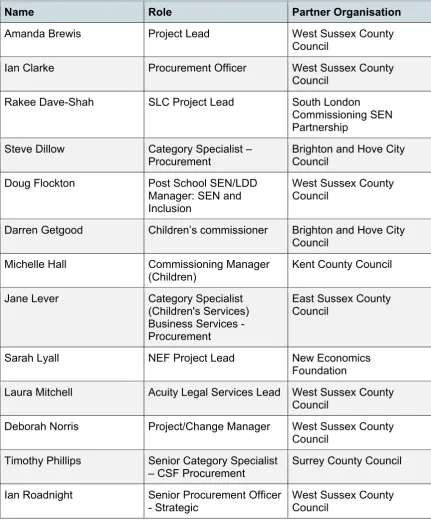
[image:33.595.58.490.137.661.2]Figure 6 below lists the project team members who took part in this evaluation.
Figure 6 Project Team Members
Name Role Partner Organisation
Amanda Brewis Project Lead West Sussex County Council
Ian Clarke Procurement Officer West Sussex County Council
Rakee Dave-Shah SLC Project Lead South London Commissioning SEN Partnership
Steve Dillow Category Specialist –
Procurement Brighton and Hove City Council Doug Flockton Post School SEN/LDD
Manager: SEN and Inclusion
West Sussex County Council
Darren Getgood Children’s commissioner Brighton and Hove City Council
Michelle Hall Commissioning Manager
(Children) Kent County Council Jane Lever Category Specialist
(Children's Services) Business Services - Procurement
East Sussex County Council
Sarah Lyall NEF Project Lead New Economics Foundation
Laura Mitchell Acuity Legal Services Lead West Sussex County Council
Deborah Norris Project/Change Manager West Sussex County Council
Timothy Phillips Senior Category Specialist
– CSF Procurement Surrey County Council Ian Roadnight Senior Procurement Officer
- Strategic West Sussex County Council
34
Figure 7 Providers Involved in Interviews
Name Role Organisation
Christina Brandi Registered Manager Action for Children Phil Champion Contracts Manager Hesley Group
Sue Collins Director of Business
Services St Joseph's Specialist School & College Terry Connolly Chief Executive Officer Radius Trust
David Cook Chief Executive Officer Cornerways
Claire Dorer Chief Executive Officer National Association of Independent Schools & Non-Maintained Special Schools (NASS)
Mike Frampton Bursar & Clerk to the
Governors and Trustees Moor House School & College
Harvey Gallagher Chief Executive Officer Nationwide Association of Fostering Providers
Richard Greenwell Managing Director Outcomes First Group
Sarah Hawke Proprietor/Responsible
Person Owlswick School
Helen Hewitt Chief Executive Officer Chailey Heritage Foundation
Judy Packham Director and Placements
Officer Time Out Fostering Jackie McFall Head of Education Liaison
Service Young Epilepsy
Paul Sellars Chief Executive Officer Mayfield Children’s Home
Jonathan Stanley Chief Executive Officer The Independent Children's Homes Association (ICHA)
Marie Tucker Independent Consultant Nationwide Association of Fostering Providers
Appendix 4: List of all documents reviewed:
Public documentation
Crown Commercial Service (2015) The Public Contracts Regulations: Dynamic Purchasing System. Retrieved from:
https://www.gov.uk/government/uploads/system/uploads/attachment_data/file/417942/Gu idance_on_Dynamic_Purchasing_System.pdf (Accessed: 04/02/2016)
Office of Government Commerce (2008) Guidance on Dynamic Purchasing Systems in the Procurement Regulations. Norwich: Office of Government and Commerce
Internal documentation
12Cordis Bright (December, 2015) South East Together cost benchmarking tools for INMSS and Children’s Homes: Overview and analysis
Cordis Bright (January, 2016) What the data tells us about the relative benefits of establishing a regional DPS report for South East Together
National Fostering Contract for Independent Fostering Agency Placement Schedules 1 to 6 (2011)
National Residential Contract for the Placement of Children and Young People in Residential Care Homes Schedules 1 to 6 (2011)
National Schools and Colleges Contract for the Placement of Learners and Young People with High Needs in Day and Residential Schools and Colleges Schedules 1 to 6 (2013)
New Economics Foundation (September, 2015) Commissioning for outcomes and co-production presentation
New Economics Foundation (September, 2015) Towards a common outcomes framework for Looked After Children: Workshop with Fostercare Providers
New Economics Foundation (October, 2015) Towards a common outcomes framework for Looked After Children: Workshop with Residential Providers
New Economics Foundation (October, 2015) Workshop with young people from the Children In Care Council: Towards a common outcomes framework for LAC
36
New Economics Foundation (October, 2015) Towards a common outcomes framework for children and young people with Special Educational Needs and Looked After Children workshop presentation
New Economics Foundation (October, 2015) Workshop with special school providers and parents presentation: Towards a common outcomes framework for children and young people with SEN and LAC
New Economics Foundation (October, 2015) Core project group meeting presentation: Towards a common outcomes framework and measurement approach
New Economics Foundation (November, 2015) Towards a common outcomes framework: Indicators Development Workshop
New Economics Foundation (November, 2015) Commissioning for outcomes and co-production with South East Together report
Regional Dynamic Purchasing System Project Board Meeting Minutes, June, 2015 Regional Dynamic Purchasing System Project Board Meeting Minutes, November, 2015 Regional Dynamic Purchasing System Project Team Meeting Minutes, May, 2015
Regional Dynamic Purchasing System Project Team Meeting Minutes, June, 2015 Regional Dynamic Purchasing System Project Team Meeting Minutes, July, 2015
Regional Dynamic Purchasing System Project Team Meeting Minutes, September, 2015 Regional Dynamic Purchasing System Project Team Meeting Minutes, October, 2015 Regional Dynamic Purchasing System Project Team Meeting Minutes, November, 2015 Regional Dynamic Purchasing System Project Team Meeting Minutes, December, 2015 South East Together Gantt Project Plan, June, 2015
West Sussex County Council (2015) Information Sharing Agreement relating to the South East Together Regional Dynamic Purchasing System (DPS) Project
West Sussex County Council (2015) Agreement for the Provision of Project Worker Services to the Regional Dynamic Purchasing System (DPS) Project
West Sussex County Council (April, 2015) Department for Education Monthly Return report
West Sussex County Council (July, 2015) Department for Education Monthly Return report
West Sussex County Council (September, 2015) Department for Education Monthly Return report
West Sussex County Council (October, 2015) Department for Education Monthly Return report
West Sussex County Council (May, 2015) Department for Education Quarterly Return report
West Sussex County Council (August, 2015) Department for Education Quarterly Return report
38
Appendix 5: Research Topic Guides
Parent & carer topic guide – focus group
Introduction
Thank you very much for taking part in this discussion today. We think it will last about 1 hour. We would like to find out how well you have been involved in the development of South East Together’s Regional Dynamic Purchasing Tool (we’ll explain what all this means shortly).
The discussion today is anonymous and confidential. We’ll write up the results of the discussion in our report, but we’ll make sure it is phrased so that it’s not possible to work out who said what. These sessions work best when people listen respectfully to each other’s contributions and agree not to repeat or discuss any of the issues after the meeting. Does that sound ok?
I also need to let you know that if anyone says something that makes me concerned for their safety, or the safety of someone else, I will need to report the relevant authorities. I will, however, always try to discuss this with you first.
Finally, it’s important to say that you don’t all need to agree! We’re keen to hear different opinions. So if someone says something but you have a different view or experience, please let us know!
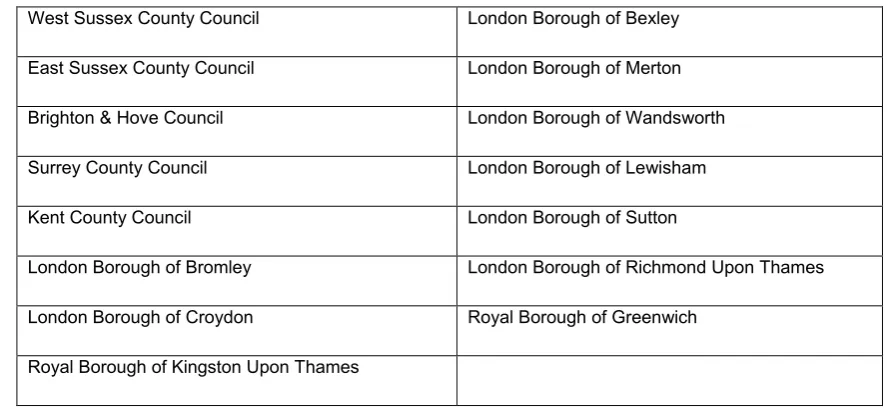
What is South East Together? As Figure 8 shows, this is a partnership between 15
[image:38.595.69.513.524.728.2]local authorities:
Figure 8 List of partners
West Sussex County Council London Borough of Bexley
East Sussex County Council London Borough of Merton
Brighton & Hove Council London Borough of Wandsworth
Surrey County Council London Borough of Lewisham
Kent County Council London Borough of Sutton
London Borough of Bromley London Borough of Richmond Upon Thames
London Borough of Croydon Royal Borough of Greenwich
They are working together to try and share skills, expertise and costs when it comes to finding placements for children and young people who need to make use of Independent Non-Maintained Schools, Specialist (disability) Children’s Homes and Specialist
(disability) Fostercare agencies.
What is a regional dynamic purchasing system?This is an administrative system
which should make it easier, and quicker for parents and local authorities to find good quality placements which are offering the right outcomes for individual children & young people, whilst also keeping an eye on costs.
Your understanding of the project
a) Are you aware of this work? Which aspects have you been involved in? (e.g. workshops with the New Economics Foundations to think about outcomes for children & young people?).
The placement process
a) What has been your experience of finding a suitable placement? What worked well and what worked less well?
b) What are the 3 most important things to improve or change about the placement process?
The South East Together Regional Dynamic Purchasing Project
a) Based on your knowledge of this project, what improvements (or problems) do you think it will offer?
b) What did you think of the project’s attempts to find out your opinion and get you involved? What worked well? What worked less well?
c) In your opinion, how well were your views taken on board?
d) How would you liked to have been involved? Were there any barriers to your involvement that you feel could have been addressed? Eg, childcare costs, transport, accessibility, timings/venue, BME/diversity
Overall views
a) Do you have any other comments to share?
40
Young people topic guide – focus group
Introduction
• Thank you very much for taking part in this discussion today. We think it will last about 1 hour. We would like to find out how well you have been involved in the development of South East Together’s Regional Dynamic Purchasing Tool (we’ll explain what all this means shortly).
• The discussion today is anonymous and confidential. We’ll write up the results of the discussion in our report, but we’ll make sure it is phrased so that it’s not possible to work out who said what. These sessions work best when people listen respectfully to each other’s contributions and agree not to repeat or discuss any of the issues after the meeting. Does that sound ok?
• I also need to let you know that if anyone says something that makes me concerned for their safety, or the safety of someone else, I will need to report the relevant authorities. I will however always try to discuss this with you first. • Finally, it’s important to say that you don’t all need to agree! We’re keen to
hear different opinions. So if someone says something but you have a different view or experience, please let us know!
What is South East Together? As 9 shows, this is a partnership between 15
[image:40.595.73.511.462.666.2]local authorities:
Figure 9 List of partners
West Sussex County Council London Borough of Bexley
East Sussex County Council London Borough of Merton
Brighton & Hove Council London Borough of Wandsworth
Surrey County Council London Borough of Lewisham
Kent County Council London Borough of Sutton
London Borough of Bromley London Borough of Richmond Upon Thames
London Borough of Croydon Royal Borough of Greenwich
Royal Borough of Kingston Upon Thames
What is a regional dynamic purchasing system? This is an administrative system which should make it easier, and quicker to find good quality, placements which are offering the right outcomes for individual children & young people, whilst also keeping an eye on costs.
Your understanding of the project
a) Are you aware of this work? Which aspects have you been involved in? (e.g. workshops with the New Economics Foundations to think about outcomes for children & young people?)
The placement process
a) What was your experience of moving to the place that you live at the moment? What worked well and what worked less well?
b) Thinking about this experience, what are the 3 most important things to improve or change?
The South East Together Regional Dynamic Purchasing
Project
a) What did you think of the project’s attempts to find out your opinion and get you involved? What worked well? What worked less well?
b) In your opinion, how well were your views taken on board?
c) How would you liked to have been involved? Were there any barriers to your involvement that you feel could have been addressed? Eg, transport,
accessibility, timings/venue, BME/diversity, age, methods of involvement
Overall views
a) Do you have any other comments to share?
42
Project Team Member Interview topic guide
Introduction
Thank you for participating in this discussion. We anticipate it will take around 45 minutes. As one of the people who has had an input into the South East Together Regional Dynamic Purchasing Project, we are very interested to hear your views about your experience. Your name will be listed as a contributor to the research but no comments will be attributed to you. I hope you will feel able to share your opinions candidly. If you are unable to comment on particular issues, please let us know and we will move on to the next question.
Understanding the need for a regional dynamic purchasing
system (DPS)
a) In your opinion, why is a regional DPS needed?
b) How will it affect or improve the existing arrangements in place for purchasing services from Independent Non-Maintained Schools, Specialist (disability) Children’s Homes and Specialist (disability) Fostercare agencies?
Project deliverables
[image:42.595.53.491.537.781.2]Please review the following project deliverables (a list is provided in Figure 10 below) and comment (as far as you are able) on the extent to which each one will be in place by March 2016. Please tell us whether you consider each deliverable as having been “fully met”, “partially met” “not met at all” or “don’t know”. We will be interested to hear your reasons for reaching these conclusions.
Figure 10 Project deliverables agreed at the outset
Project deliverables
1. A working Agreement between all partners that can be used by other regions or partner groups which includes governance arrangements, financial risks, operational and delivery arrangements, stakeholder engagement methods, training programmes for staff and templates for Agreements and operational processes.
2. Information and tools to support outcomes-based commissioning for all social care projects.
3. Operational processes that have individual outcomes as the start point and which measure progress towards outcomes and outcomes achieved throughout.
Project deliverables
5. Recommendations regarding the design of a bespoke software tool that will embed outcomes as the key driver and deliver staff resource
efficiencies (so that more resource can be deployed to the management of awarded contracts to ensure outcomes are delivered, monitoring quality and taking action as and when appropriate).
6. Cost benchmarking tool that can be used by other Local Authorities and groups
7. A model that will deliver improved value for public money spent. 8. Data collection and analysis tool that can be used by other Local
Authorities and groups.
9. Set of revised National Contracts that are fit for purpose and endorsed for use.
10. Method of evaluation that evidences progress made and objectives achieved; this method will be adaptable and of use to other projects. 11. Evidence to propose the consideration of a national DPS in the future
Thank you. The questions which follow are designed to gather more insight where possible. Depending on your role and level of involvement, you may have no opinion on some of the issues. Equally, you may have already explained your answers as part of the previous question. In these cases, we will move to the next question.
In your opinion, to what extent has the DfE’s investment improved
South East Together’s ability to:
a) Focus on value for money b) Focus on outcomes
c) Increase collaboration between purchasers d) Increase collaboration with providers
e) Improve co-production with Children & Young People & Families f) Stimulate new solutions
Partnership working
a) How effectively has the partnership worked together? Please provide examples of effective practice and areas for improvement
b) To what extent has the partnership operated systematically? Are there systems and processes underpinning its activities, or are its activities personality-led? c) How replicable is this partnership? Could other regions work in this way, or are
44
Specific workstreams
Please tell us how effectively the following workstreams have been developed. In each case, we would like to understand
a) what has worked well,
b) what could be improved in the future
c) whether the results are likely to be fit for purpose
Workstreams
• Development of outcomes
• Developing the cost benchmarking tool.
• Developing the data analysis and collection tool
• Developing recommendations for a bespoke software tool • Exploring legal and procurement challenges
• Process of revising the national contracts
Thinking about the project overall
• What have been its key successes?
• What is the most important learning?
• Do you think a regional DPS is viable in the South East Together Region?
• Do you think it would be viable in other regions?
Evaluation approaches
Provider Interview Topic Guide
Introduction
Thank you for participating in this discussion. We anticipate it will take around 45 minutes. As a provider of Independent Non-Maintained Special Schools, Specialist (disability) Children’s Homes and / or Specialist (disability) Fostercare services in the South East Together region, we are very interested to hear your views regarding the successes and challenges associated with this work. Your name will be listed as a contributor to the research but no comments will be attributed to you. I hope you will therefore feel able to share your opinions candidly. If you are unable to comment on particular issues, please let us know and we will move on to the next question.
Your involvement and understanding
• According to your understanding, what is it that South East Together are seeking to achieve?
• In what ways have you helped or been involved so far?