DEVELOPING DATABASE MARKETING STRATEGIES FOR CONSUMER MARKETS: A CROSS-INDUSTRY, THEORY-BUILDING STUDY
Hoda McClymont
The University of Southern Queensland
Track: Personal Selling and Sales Management
Keywords: database marketing, product strategies, promotion strategies
Abstract
The adoption of database marketing by firms has increased rapidly in many industries. Indeed, with increasing costs of marketing and fragmentation of markets, database marketing is overtaking mass marketing. The aim of this paper is to develop a framework for database marketing strategies that will help marketers and marketing researchers to better understand this mode of marketing. This paper uses interview research to build a theory about types of marketing strategies that are most suitable for implementation using a customer database. The findings of the research show that while cross-selling is an important promotional strategy in database marketing, prospecting is not. Furthermore, only two of the product strategies identified in the mainstream marketing literature, that is, new product development for customers and product modifications for customers, are frequently used in database marketing. The other two strategies of new product development for prospects and product modifications for prospects are not used by most firms. Furthermore, while the promotional strategy of cross-selling was popular, prospecting was not. It was concluded that organisations use their database to implement certain strategies because the data is available to do so and because it is the most effective way to implement a strategy. Other strategies are not implemented because they are not appropriate for an organisation’s operations, or because they believe that their existing non-database strategies are effective, rather than for reasons related to the database itself.
Introduction
The adoption of database marketing by firms has increased rapidly in many industries (DeTienne & Thompson 1996; Styles & Uncles 1998; Palmquist & Ketola 1999). Its popularity stems from its ability to break markets down into segments and concentrate on only those customers who have shown interest in the organisation’s products and services, thereby decreasing the cost of marketing (Paltschik & Storbacka 1992).
1994; Berry 1998; Howe 1998; Bhattacharyya 1999; Kassing 2002; Schaefer & Zang 2002), there appears to be no comprehensive discussion of which types of promotional strategy are most appropriate for database marketing.
Hence the aim of this paper is to develop a framework which incorporates the range of databases marketing strategies that may help marketers and marketing researchers to understand this area of marketing more clearly. In other words, the research problem is: What product and promotion strategies can be developed and implemented using customer databases and why?
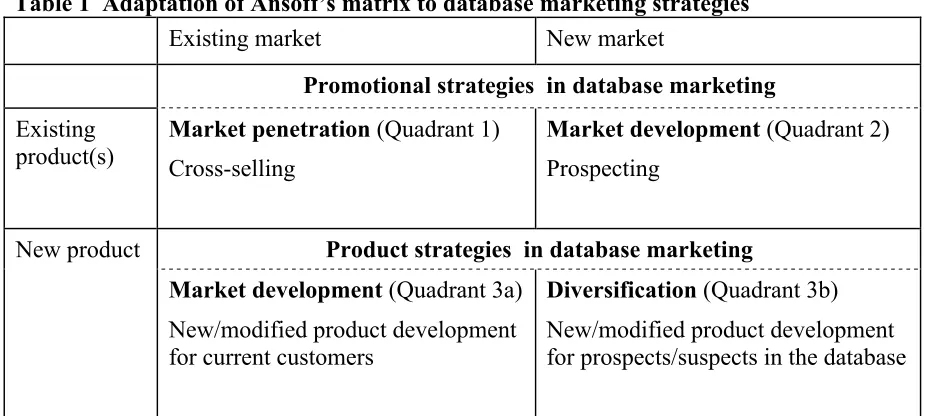
Developing a theoretical framework for database marketing strategies. Given the limited literature about types of product strategies in database marketing, it was necessary to base the initial stage of this research on product strategies identified through the mainstream marketing literature. Therefore, Ansoff’s (1957) product-market matrix was used to identify the types of mainstream product strategies that could be investigated in relation to database marketing. Furthermore, since Ansoff’s matrix also touches on promotion strategies, it is only logical to apply this matrix to categorise existing promotion strategies in database marketing.
Promotion strategies in database marketing. Promotion strategy is a core application of database marketing (Gunaratne 1998) and can be broken down into two major strategies of cross-selling (Kim & Kim 1999; Opperman 1999; Kassing 2002) and prospecting (Howe 1998; O’Malley 1998; Drozdenko & Drake 2002). Cross-selling is equivalent to Ansoff’s market penetration strategy (quadrant 1, table 1) because it involves offering existing customers related or unrelated products (Gunaratne 1998).
[image:2.595.64.527.518.726.2]Secondly, the prospecting strategy in database marketing is equivalent to Ansoff’s market development strategy (quadrant 2, table 1) which refers to selling existing products to prospects/suspects. Prospecting can be carried out by mailing offers to existing prospects on the database (Drozdenko & Drake 2002); by buying mailing to preferred customer segments; or by modelling and profiling potential customers based on household and census data. (Opperman 1999)
Table 1 Adaptation of Ansoff’s matrix to database marketing strategies
Existing market New market
Promotional strategies in database marketing Existing
product(s)
Market penetration (Quadrant 1) Cross-selling
Market development (Quadrant 2) Prospecting
New product Product strategies in database marketing
Product strategies. Next, consider product strategies in database marketing. Customer databases can be used either for new product idea generation or for research or testing of the idea (Master 2000). That is, customers are contributors to the product development process (Davenport, Harris & Kohli 2001).
The bottom two quadrants of the Ansoff matrix can be used to represent product strategies in database marketing. That is, the product development strategy (quadrant 3a) can be translated into new product development for database customers and the diversification strategy is translated into new product development for prospects/suspects (quadrant 3b). Two other sub-strategies of modified products for customers and modified products for prospects/suspects were also added to quadrants 3 and 4 respectively. This addition was made because the definition of a new product includes modified products (Master 2000).
In summary, database product and promotion strategies may be broken down into two promotional strategies and four product strategies. Promotional strategies include cross-selling and prospecting. Product strategies include new products for customers in the database; new products for prospects in the database; modified products for customers in the database; and modified product for prospects in the database.
Research methodology
Given the substantial gaps in the literature, sufficient information did not exist to allow for the testing of the research problem using a quantitative methodology. As a result, this research relied on exploratory methodologies using convergent and case interviews to develop and confirm theory about the research problem (King 1994). Firstly, five convergent interviews (also known as in-depth interviews) were conducted with one academic, three direct
marketing consultants and an industry practitioner. The convergent interviewing process was very structured although the content of each interview remained unstructured to allow for the flexible exploration of the subject matter without determining the answers (Dick 1990). The results of the convergent interviews were used to develop a preliminary framework for further investigation using case research.
Next, case research was undertaken to confirm/disconfirm the theoretical framework developed previously. The investigation aimed to confirm or disconfirm the theoretical framework by investigating which strategies were most suitable for database marketing from a practitioner’s perspective. Therefore, case research was justified because this research involved an investigation of a pre-paradigmatic body of knowledge about a dynamic phenomenon (Yin 1994), and it investigates a contemporary phenomenon. A total of 11 interviews were conducted with managers of firms (cases) in nine industries. This number of cases was used because it was not possible to obtain more interviews. The names of the 11 firms have been disguised in order to maintain confidentiality. Therefore, in the analysis, organizations are referred to by the name of the industry in which they operate such as the Financial1, and Publishing 1. All firms in this study were established, well known
Table 2 Summary of individual cases (firms) selected for in-depth interviews Case name/
industry type (i)
Channel type (ii)
Primary product type and examples thereof (iiv)
Head office (iv) Consumer Goods Retailer Goods - furniture, clothing, accessories,
electrical goods and diner.
USA
Fast Food Franchise Service – pizza, garlic bread and coke. USA Publishing 1 Direct Goods - books, special interest magazines
videos, CDs and DVDs.
USA
Publishing 2 Hybrid system
Goods – special interest magazines. USA
Automobile Wholesaler Goods – construction equipment, marine, aircraft and industrial engines, and motor vehicles.
Sweden
Financial 1 Direct Service - lending, insurance, investment. USA Financial 2 Direct Service - lending, insurance, investment. Australia Telecommunicati
on
Hybrid system
Service - entire range of telephone, mobile and internet communication services.
Australia
Charity Direct Services – medical research facility fundraiser attached to hospital.
Australia
Photography Direct Service – photo processing and augmented goods.
Australia
Art Direct Goods – decorative art collectables. USA
Source: Cases selected for this research
Discussion of findings
The findings of this research relate to two issues: which strategies do database marketing firms use, and when are certain strategies more/less appropriate to use. The results of the interview for the first research issue revealed that the most frequently implemented database strategies included selling across (promotion strategy), new product development and product modification for customers (product strategy). A total of seven firms implemented the first two strategies and six firms implemented the third strategy.
In contrast, the least frequently implemented database marketing strategies were prospecting (promotion strategy) and new product development and product modification for prospects (product strategies). Only one firm, developed new products for prospects and only two firms implemented the other two strategies through the database.
Prospecting for new customers. Prospecting was implemented through the database by only two firms. One firm (Charity) noted that the database was used because customers’ names can be obtained from other service sectors of a firm’s parent organisation, such as patients in a hospital who may want to contribute to the charity’s research efforts because it affects their wellbeing: ‘we could also have prospects on the database … for example, people like patients at this hospital’ (Charity). Another firm noted that a database was used for prospecting because segments were developed using geodemographic data. Therefore, a database is required to undertake geographic segmentation procedure and to subsequently store information on targeted segments.
Cross-selling. The second marketing strategy that can be derived through the customer databases is cross-selling. The interviews showed that information is augmented to gauge derived information such as customer profitability through segmentation methods. ‘Through segmentation, we target the most profitable customers and customise our product/service and communications based on what we know about them…’ (Publishing 1)
New product development for customers. New product development for customers was implemented through the database because the customer was perceived to be an important contributor to the entire process. In all cases, the customer database was used either for new product idea generation or for research or testing of the idea. For example, Publishing 2 researches all of its customers who are active or lapsed to assist in new product development. The integration of the internet in database marketing processes provides for seamless customer feedback to be used to identify new product/services and new ways of marketing them.
Reasons why strategies were implemented without databases or were not implemented at all. Even though this research revealed that some strategies were more popular than others, none of the strategies were undertaken by all firms. Therefore, it was concluded that a firms’ characteristics (for example, its place in the distribution channel), the nature of its operations and firms’ existing non-database strategies being satisfactory may explain why some firms do not implement certain strategies through the database. These reasons are summarised in table 3. For example, product modification for customers was not a popular database marketing strategy for the Fast Food firm because products can be easily modified (customised) for customers during the order and purchase process without a database.
Table 3 Reasons sub-strategies were not implemented through the database Reasons for not pursuing a strategy with
the database C ros s-se ll in g N ew p rod u ct d eve lop m en t for c u st om er s N ew p rod u ct d eve lop m en t for p ros p ec ts P rod u ct m od if ic at ion for c u st om er s P rod u ct m od if ic at ion / p ros p ec ts
Database consists of donors not customers √
Database not required for walk-in orders √ √
Modifications are market-driven rather than customer driven
√
All database customers are included in campaign and not only a database segment
√
Head office is not in Australia
No reason √
Irrelevant for product type √
Sophisticated modelling requirements √
NPD is not a usual occurrence √
Firm is a wholesaler not manufacturer √ (Australian) customer database is not large
enough
√ √
Number of prospects on the database is not high enough and therefore not profitable enough
√
Purchased lists are used for prospecting because the database doesn’t have sufficient information on prospects
√
Source: analysis of field data
Conclusions
List of references
Ansoff, I 1957, ‘Strategies for diversification’, Harvard Business Review, Sep-Oct, p. 114. Berman, K 1994, ‘Database marketing: a new secret weapon’, Folio: The Magazine for Magazine Management, vol. 22, no. 19, pp. 185-187.
Berry, M 1998, The New Integrated Direct Marketing, Brookfield VT, Gower, Hampshire. Bhattacharyya, S 1999, ‘Direct marketing performance modelling using genetic algorithms’, Journal of Computing, Summer, vol. 11, iss. 3, pp. 248-257.
Cooke, S 1994, ‘Database marketing: strategy or tactical tool?’, Marketing Intelligence and Planning, vol 12, no. 6, pp. 4-7.
Coviello, NE, Brodie, RJ, Danaher, PJ & Johnston, WJ, 2002, ‘How Firms Relate to Their Markets: An Empirical Examination of Contemporary Marketing Practices’, Journal of Marketing, Jul., vol. 66, iss. 3, viewed: 10 Jun. 2003. Available from Business Source Elite, EBSCOHOST.
Davenport, TH, Harris, JG & Kohli, AK 2001, ‘How do they know their customers so well?’, MIT Sloan Management Review, Winter, vol. 42, iss. 12, pp. 63-76.
Dick, B. (1990) Convergent Interviewing, Version 3, Chapel Hill, Brisbane.
DeTienne, KB, Thimpson, JA 1996, ‘Database marketing and organizational learning theory: towards a research agenda’, Journal of Consumer Marketing, vol. 13, no. 5, pp. 12-34. Drozdenko, RG, Drake, PD 2002, ‘Optimal Database Marketing’, Journal of Marketing Research, Nov. 2002, vol. 39, iss. 4, pp. 499 - 501, viewed Jul 24 2003. Available: Academic Search Premier, EBSCOHOST.
Drozdenko, R & Drake, PD 2002, Optimal Database Marketing: Strategy Development and Data Mining, Sage Publications, London.
Finnegan, DE 1996, ‘Client prospecting using database technology and research’ Trusts & Estates, Nov., vol. 135, no. 12, pp. 43-44.
Graham, JR 1998, ‘Creating the prospect-driven company’, American Salesman, 8, Aug., vol. 43, no. pp. 3-10, viewed 15 Sep. 1997. Available from Infotrac/SearchBank.
Gunaratne, KA 1998, ‘Database marketing – a dream comes true’ Paper presented to the Australia New Zealand Marketing Academic Conference’, Otago, Dec.
Howe, D 1998 ‘The cross-sell connection’, Banking Strategies, vol. 74, no. 6, pp. 120-125. Hughes, AM 1996, The complete database marketer: second-generation strategies and techniques for tapping the poser of your customer database, Irwin Professional Publication, Chicago.
Hall, MF, Press, I, Ganey, R & Hall, D 1997, ‘Hello, I must be going’, Bank Marketing, vol. 29, vol. 4, pp. 30-35.
Kassing, J 2002, ‘Increasing customer retention: profitability isn’t a spectator sport; it takes work and a good database’, Financial Services Marketing, Mar-Apr, pp. 32-37.
King, E 1996, ‘The use of self in qualitative research’, in Handbook of Qualitative Research Methods for Psychology and Social Sciences, ed., J. Richardson, BPS Books, Leicester, U.K. Kim, B & Kim, S 1999, ‘Measuring upselling potential of life insurance customers:
application of stochastic frontier model’, Journal of Interactive marketing, Autumn, vol. 13, no. 4, pp. 2-9.
Master, H 2000, Database Marketing Segmentation for Strategy Development in Australian Industries, PhD thesis, The University of Southern Queensland, Toowoomba, Australia. McEwan, D 1994 Growing your Business with Database Marketing, Longman Australia Pty Ltd, Hong Kong.
Morrall, K 1994, ‘Strategies to retain business customers’, Bank Marketing, vol. 26, no. 8, pp. 64-69, viewed July 10 1997. Available from Business ASAP International,
Infotrac/SearchBank.
O’Malley, L 1998, ‘can loyalty schemes really build loyalty’, Marketing Intelligence & Planning, vol. 16, no. 1, pp. 10-15.
Oggenfuss, CW 1998, ‘Ratcheting – up retention’, Bank Marketing, vol. 30, no. 5, pp. 28-37. Oppermann, M 1999, ‘Database marketing by travel agents’, Journal of Travel Research, vol. 37, no. 3, pp. 231-247.
Palmaquist, J & Ketola, L 1999, ‘Turning data into knowledge’, vol. 11, iss. 1, viewed 16 Dec. 2002. Available from Business Source Elite, EBSCOHOST.
Paltschik, M & Storbacka, K 1992, ‘Monitoring the customer base to achieve profitability’, Marketing and Research Today, Aug., pp. 155-165.
Reichheld, FF 1996, ‘Learning from customer defections’, Harvard Business Review, vol. 74, no. 2, pp. 56-57.
Shaffer, Z & Zhang, J 2002, ‘Competitive one-to-one promotions’, Management Science, September, vol. 48, iss. 9, pp. 1143- 1161.
Styles, C & Uncles, M 1998, ‘Marketing management in Australia – joint MI/UNSW survey’, Professional Marketing, Feb/Mar, pp. 32-33.