ANDDAVID I. WATKINS3
Department of Biological Sciences, University of South Carolina, Columbia, South Carolina 292081; Department of Biology,
East Carolina University, Greenville, North Carolina 278582; and Wisconsin Regional Primate Research Center,
University of Wisconsin, Madison, Wisconsin 537153
Received 28 February 2001/Accepted 27 May 2001
Tat-specific cytotoxic T cells have previously been shown to exert positive Darwinian selection favoring
amino acid replacements of an epitope of simian immunodeficiency virus (SIV). The region of thetatgene
encoding this epitope falls within a region of overlap between thetatandvprreading frames, and
nonsynony-mous nucleotide substitutions in thetatreading frame were found to occur disproportionately in such a way
as to cause synonymous changes in thevprreading frame. Comparison of published complete SIV genomes
showed Tat to be the least conserved at the amino acid level of nine proteins encoded by the virus, while Vpr was one of the most conserved. Numerous parallel amino acid changes occurred within the Tat epitope
independently in different monkeys, and purifying selection on thevprreading frame, by limiting acceptable
nonsynonymous substitutions in the tat reading frame, evidently has enhanced the probability of parallel
evolution.
The phenomenon of viral proteins encoded by overlapping reading frames has attracted the attention of evolutionary bi-ologists since its discovery (4, 9, 11, 12, 15). One question of evolutionary interest raised by this phenomenon is how natural selection can act simultaneously on two different protein prod-ucts encoded in different reading frames by the same DNA sequence. Recently, we reported evidence of positive Darwin-ian selection exerted by the host immune system on a portion of the Tat protein of simian immunodeficiency virus (SIV) (1). The portion of the Tat protein which is subject to positive selection is encoded by a reading frame that overlaps that encoding the Vpr protein (Fig. 1). In the present paper, we examine in further detail natural selection on the Tat and Vpr proteins in order to understand how natural selection in one reading frame affects the evolution of a protein encoded by an overlapping reading frame.
The region of the Tat protein subject to positive selection is an 8-amino-acid peptide epitope presented to cytotoxic T cells (CTL) by rhesus monkeys (Macaca mulatta) possessing a class I major histocompatibility complex molecule known as Mamu-A*01. Allen et al. (1) studied the evolution of this region in an experimental system involving Mamu-A*01-positive (A*01⫹)
animals and Mamu-A*01-negative (A*01⫺) controls. Because
both groups of monkeys were infected with the same viral inoculum, it was possible to compare the evolution of the Tat epitope in the two groups. In virus from A*01⫹monkeys, there
was an enhanced rate of nonsynonymous nucleotide substitu-tion, leading to variant forms of the epitope that were exper-imentally shown not to be bound by the Mamu-A*01 molecule
(1). No such evidence was found in the case of A*01⫺controls
(1). The results of this study provide perhaps the most con-vincing evidence to date of CTL-driven selection on a virus. Because this is a particularly well understood example of pos-itive selection at the molecular level, it provides an excellent opportunity for studying the evolution of an overlapping read-ing frame in the presence of such selection.
Holmes and colleagues (5) presented evidence that natural selection, presumably exerted by the host immune system, can lead to convergent or parallel amino acid substitutions in the hypervariable V3 loop of the envelope glycoprotein gp120 of human immunodeficiency virus type 1 (HIV-1). However, this conclusion was based on phylogenetic analyses of sequences collected from a single patient; and because only a short gene segment was sequenced, the reliability of phylogenetic infer-ences in this case is unclear. There is considerably stronger evidence of parallel evolution of HIV-1 in response to phar-macological agents; for example, parallel amino acid changes in the HIV-1 protease have been documented for different patients treated with the same protease inhibitors (2). In gen-eral, the existence of convergent or parallel evolution at the amino acid sequence level has been controversial (3), although in recent years a number of purported cases have been de-scribed in the literature (for a review, see reference 6). Be-cause this study involved the evolution of SIV in separate, noninteracting monkey hosts, it provides an opportunity for an unequivocal demonstration of parallel evolution in a protein under positive selection.
MATERIALS AND METHODS
A total of 18 rhesus monkeys, 10 A*01⫹(here designated A to H and J and K) and 8 A*01⫺, were infected with a molecularly cloned virus, SIV
MAC239(16).
After 8 weeks of infection, a 98-codon segment of the SIVtatgene was amplified and sequenced; this segment overlaps a 50-codon segment of thevprreading
* Corresponding author. Mailing address: Department of Biological Sciences, University of South Carolina, Columbia, SC 29208. Phone: (803) 777-9186. Fax: (803) 777-4002. E-mail: [email protected].
7966
on November 9, 2019 by guest
http://jvi.asm.org/
frame. The 98 codons oftatinclude the codons encoding the peptide STPESANL known to be bound and presented by the Mamu-A*01 molecule to CTL (1). A total of 159 such sequences from infected monkeys were compared with 19 sequences from the inoculum. For further details of sequencing and immuno-logical methods, see the work of Allen et al. (1).
In order to compare the evolution of these regions in experimentally infected monkeys with that in other SIV populations, we also analyzed six complete SIV genomes available in the GenBank database: three fromCercocebus torquatus
hosts (AF077017, L03295, and M31325), two fromMacaca nemestrina(U79412 and M83293), and one each fromMacaca arctoidesandM. mulatta(M83293 and U72748, respectively). These represent all available SIV genomes including complete coding sequences for all nine protein-encoding genes. Coding se-quences for the nine genesgag,pol,vif,vpx,vpr,tat,rev,env, andnef(Fig. 1) were aligned at the amino acid level using the CLUSTAL W program (19). In com-puting pairwise distances among a set of sequences, we did not include any site at which the alignment postulated a gap in any sequence in the set, so that a comparable data set was used for each comparison.
The number of synonymous substitutions per synonymous site (dS) and the
number of nonsynonymous substitutions per nonsynonymous site (dN) were
estimated by the method of Nei and Gojobori (13). This method is known to overestimatedSand slightly underestimatedNwhen there is a significant
tran-sitional bias at twofold degenerate sites; as a consequence, alternative methods that incorporate an estimate of the transition/transversion ratio (R) at such sites have been proposed elsewhere (10, 20). However, such methods require a reli-able estimate of R, which requires data for a large number of sites. An unbiased estimate of R can be obtained by comparing fourfold degenerate sites in phylo-genetically independent comparisons (7). Fourfold degenerate sites are prefer-able for estimating R, since only at these sites are the effects of transitional bias and purifying selection not confounded (7). The sequences from the experimen-tal study were short, while in the case of complete SIV genomes, the number of sequences was small. Furthermore, overlapping reading frames add an additional complication to the estimation of R even at fourfold degenerate sites. Because nonsynonymous transversions typically cause more radical amino acid changes than do nonsynonymous transitions, purifying selection will in many cases act more strongly on the former. Therefore, in the case of overlapping reading frames, the effects of transitional bias and purifying selection are confounded even at fourfold degenerate sites. Because it was impossible to incorporate all these factors into the estimation ofdSanddN, we used the unmodified Nei and
Gojobori method (13), following the recommendation of Nei and Kumar (14) that a simple method is preferable when complex factors influence the pattern of nucleotide substitution. Such a simple method has the advantage of making fewer assumptions than do alternative methods, and if there is a transitional bias, the unmodified Nei and Gojobori method provides a conservative test of the hypothesis of positive selection (14).
In the experimental study, because sequences from each monkey were inde-pendent, meandSanddNwithin hosts and between samples and the inoculum
were compared byttests. In comparisons of complete genomes, standard errors of meandSanddNwere computed by the bootstrap method (14).
RESULTS
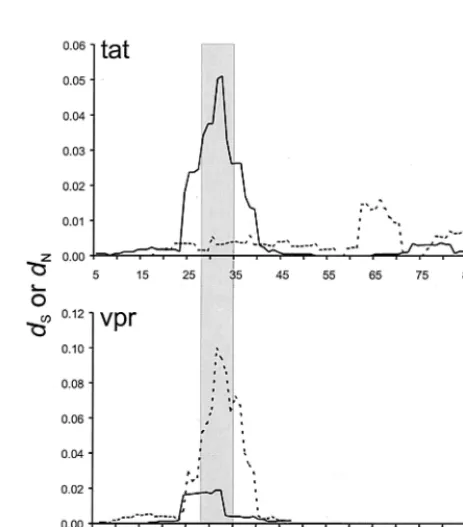
Selection ontatandvpr.Figure 2 illustrates the mean ofdS
anddN for comparisons between samples from A*01⫹
mon-keys and the inoculum in a sliding window analysis oftatand
vprreading frames. In thetatreading frame, a strong peak in
dN was observed in the region of the STPESANL epitope,
while in thevprreading frame, there was a corresponding peak
in dS in the same region (Fig. 2). Table 1 summarizes the
means ofdSanddNin epitope and nonepitope regions in both
tatandvprreading frames. In comparisons of thetatreading frame of samples from infected monkeys with that of the viral inoculum, the meandN for A*01⫹monkeys significantly
ex-ceeded the meandSin the STPESANL epitope but not
else-where in the gene (Table 1). No such pattern was seen in the STPESANL epitope in the case of A*01⫺monkeys (Table 1).
Likewise, in comparisons within samples from A*01⫹
mon-keys, meandNsignificantly exceeded meandS(Table 1). Again,
no difference was seen in the case of A*01⫺monkeys (Table
1).
In thevprreading frame, in A*01⫺monkeys, no significant
difference between mean dSand mean dNwas seen either in
[image:2.612.120.481.73.163.2]the nine codons overlapping the STPESANL epitope or in the remainder of the gene (Table 1). However, in A*01⫹monkeys,
FIG. 1. Schematic map of the SIV genome, showing the nine proteins encoded.
FIG. 2. Mean numbers of synonymous (dS) and nonsynonymous (dN) nucleotide substitutions per site in comparisons of tatandvpr reading frames in a sliding nine-codon window in comparisons be-tween samples from Mamu-A*01⫹ monkeys and the inoculum. The
vertical bar marks the location of the STPESANL epitope in Tat.
on November 9, 2019 by guest
http://jvi.asm.org/
[image:2.612.315.547.410.674.2]meandSwas significantly greater than meandNin the region
corresponding to the STPESANL epitope (Table 1). Thus, positive selection favoring amino acid changes in the STPESANL epitope of the Tat protein in virus infecting A*01⫹monkeys evidently resulted in a burst of synonymous
changes in thevprreading frame (Fig. 2; Table 1).
This finding was further analyzed by considering all possible nonsynonymous changes that might occur in the STPESANL epitope. There were 49 such possible changes, of which 32 would also cause a nonsynonymous change in thevprreading
frame, while the remaining 17 would cause a synonymous change in thevprreading frame. Of the 32 possible nonsyn-onymous changes intat that are also nonsynonymous in vpr, only 4 were actually observed in the viral sequences from A*01⫹monkeys. On the other hand, 9 of 17 possible
nonsyn-onymous changes intat that are synonymous invprwere ob-served. The difference between observed and expected is highly significant (P⫽0.0002; Fisher’s exact test). This result shows that positively selected nonsynonymous changes in the
[image:3.612.312.550.99.204.2]tat gene occurred disproportionately in such a way as not to change the amino acid sequence of Vpr.
Table 2 shows mean dS and dN for comparisons of nine
protein-encoding genes among six complete genomes. The genes were found to differ with respect to both meandSand
meandN(Table 2). MeandNwas lowest in thepolgene and
highest in thetatgene (Table 2). Four genes, one of which was
vpr, had meandNsignificantly lower than that oftat(Table 2).
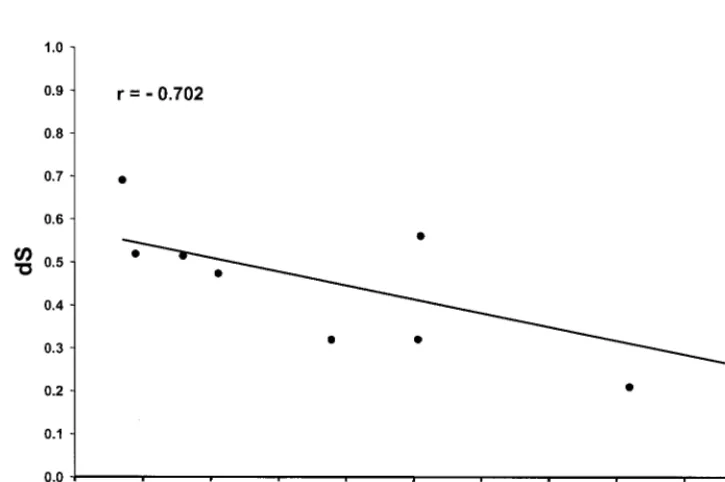
FIG. 3. Plot of meandSin each SIV gene for comparisons among six SIV genomes versus the proportion of overlap of the coding region with other genes. The line shown is the linear regression liney⫽0.574⫺0.321x.
Within 0.5⫾0.5 0.9⫾0.3 0.6⫾0.2 0.4⫾0.1 A*01⫹ Vs inoculum 0.4⫾0.4 5.6⫾0.4***††† 0.4⫾0.1 0.1⫾0.0 Within 0.8⫾0.8 7.2⫾1.1***††† 0.5⫾0.2 0.2⫾0.1
vpr
A*01⫺ Vs inoculum 0.4⫾0.3 1.5⫾0.7 0.7⫾0.4 0.2⫾0.1 Within 0.9⫾0.6 1.2⫾0.6 0.9⫾0.4 0.4⫾0.2 A*01⫹ Vs inoculum 9.3⫾1.6†† 2.0⫾0.5** 0.3⫾0.1 0.1⫾0.0 Within 13.9⫾2.7†† 2.2⫾0.6** 0.6⫾0.2 0.3⫾0.1
aIn thetatreading frame, the epitope region encompasses the eight codons
aligned with the STPESANL epitope. In thevprreading frame, it encompasses nine codons overlapping those eight codons intat. **,P⬍0.01; ***,P⬍0.001, both by paired samplettests of the hypothesis that meandS⫽meandN. ††,P⬍
0.01; †††,P⬍0.001, both byttests of the hypothesis that meandSor meandN
in Mamu-A*01⫹animal data equals the corresponding value in Mamu-A*01⫺ animal data.
tat 81.9 20.9⫾3.8 14.3⫾1.7
rev 100.0 35.7⫾6.3* 12.3⫾2.2
env 15.9 51.4⫾2.9*** 9.1⫾0.6
nef 21.1 47.4⫾5.0*** 13.1⫾1.3
a*,P⬍0.05; **,P⬍0.01; ***,P⬍0.001, by tests of the hypothesis thatd S
ordNequals the corresponding value fortat.
on November 9, 2019 by guest
http://jvi.asm.org/
[image:3.612.53.293.109.247.2] [image:3.612.122.485.463.704.2]On the other hand, meandSwas highest inpoland lowest intat
(Table 2). Differences among genes with respect todNare most
plausibly explained by differences in the strength of purifying selection on the protein. Differences among genes with respect to dScan evidently be explained to a considerable extent by
differences among genes with respect to overlap with other genes. For the nine genes of SIV, when meandSwas plotted
against the proportion of overlap with other genes, there was a significant negative relationship (r⫽ ⫺0.702;R2⫽49.3%;P⫽
0.035) (Fig. 3). Thus, the genes with the greatest extent of overlap had the lowest meandSvalues, presumably as a
con-sequence of purifying selection in the overlapping reading frame, and nearly 50% of the difference among loci with re-spect todSwas explainable by differences with respect to
over-lap with other genes.
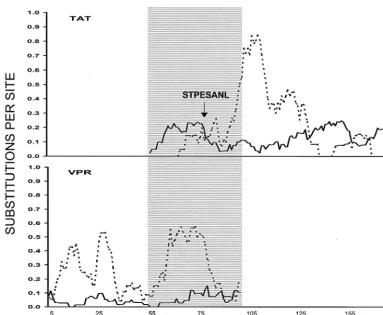
A sliding window analysis ofdSanddNover the completetat
andvprgenes from the six complete SIV genomes showed that, in the region of overlap betweentatandvpr,dSwas relatively
low in thetatreading frame, whiledNwas relatively high (Fig.
4). Conversely, in thevprreading frame, the region of overlap showed a substantial peak indS(Fig. 4), presumably a
conse-quence of the highdNin thetatreading frame.
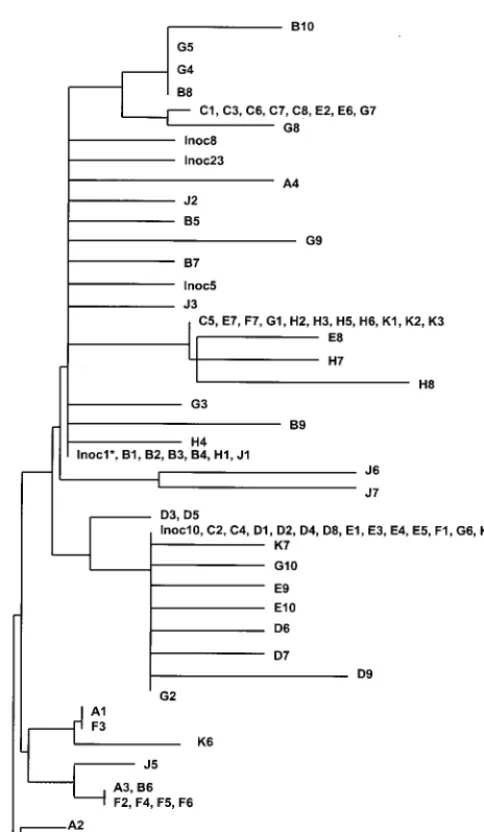
Parallel changes in the Tat epitope.Figure 5 shows a
phy-logenetic tree of sequences from the inoculum and from viral samples taken from A*01⫹monkeys. This phylogenetic tree
showed very poor resolution, and clusters within the tree fre-quently included sequences derived from different monkeys.
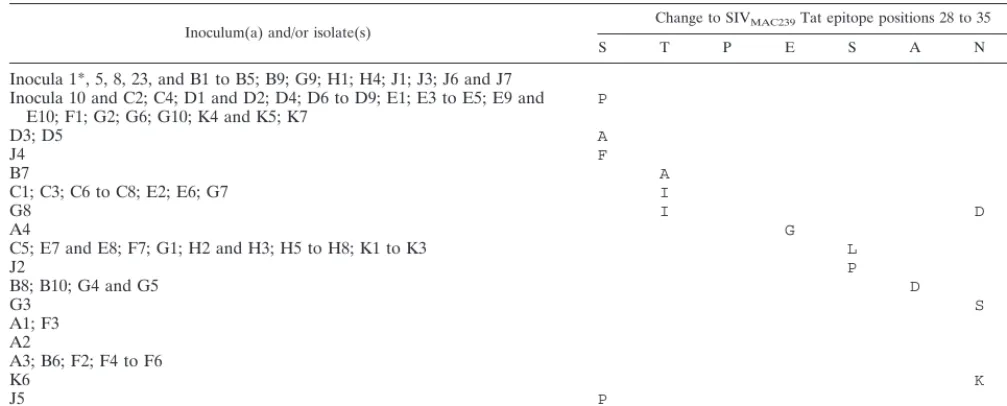
Thus, it seems that in this case phylogenetic analysis did not accurately reflect the evolutionary relationships among SIV sequences. As illustrated in Table 3, the same amino acid replacements occurred independently in the epitope region in different monkeys. It was evidently this independent or parallel occurrence of the same amino acid replacements in the epitope that caused misleading clustering pattern in the phylogenetic tree.
Amino acid replacements in Tat were classified as parallel if they occurred independently in the viral populations within at least two A*01⫹monkey hosts; the remainder were classified
as nonparallel. A minimum of 27 amino acid replacements occurred in the Tat epitope in all A*01⫹monkeys; of these, 19
(70.4%) were parallel between populations with at least one other host. By contrast, of 11 amino acid replacements ob-served in tat outside the epitope, none were parallel. The difference between epitope and nonepitope regions with re-spect to the proportions of parallel and nonparallel amino acid replacements was highly significant (P⫽0.007; Fisher’s exact test). Thus, parallel evolution of amino acid replacements oc-curs disproportionately in the portion of Tat that is under positive selection.
DISCUSSION
Our results show that, in a region of the SIVtatgene subject to positive selection driven by host CTL recognition, nonsyn-FIG. 4. Plot of meandS(dotted line) and meandN(solid line) in nine-codon sliding window across thevprandtatgenes. The arrow shows the location of the STPESANL epitope, and the shaded area shows the region of overlap between the two reading frames.
on November 9, 2019 by guest
http://jvi.asm.org/
[image:4.612.110.493.71.385.2]onymous nucleotide changes occurred in such a way as to cause predominately synonymous changes in the overlapping vpr
reading frame. Positively selected amino acid changes known to eliminate binding by the host class I major histocompatibil-ity complex (1) were able to occur in thetatreading frame with minimal change in the protein encoded by the overlappingvpr
reading frame. In comparisons among SIV genomes, thevpr
gene showed evidence of stronger purifying selection than did thetatgene, as evidenced by lower meandNinvprthan intat
(Table 2). The region overlap between the two genes was characterized by a higher meandNintatthan invprand by a
high meandSinvpr(Fig. 4). The peak of synonymous
substi-tution in this region of vpr evidently was at least in part a consequence of nonsynonymous substitution in the same re-gion oftat. Thus, this example shows that natural selection is able to favor amino acid residue replacements in one protein while simultaneously maintaining conserved and presumably
functionally important residues in another protein encoded by an overlapping reading frame. This portion of the Vpr protein corresponds to the N-terminal portion of a relatively unstruc-tured C-terminal domain directly following an amphipathic
␣-helix believed to be involved in Vpr dimerization (18). Al-though certain experimentally induced mutations in this region of HIV-1 did not affect dimerization (18), the relatively lowdN
values in this region of SIV (Fig. 2 and 4) suggest that it is subject to functional constraint in SIV.
One of the most useful techniques for studying the effects of natural selection at the molecular level is the comparison of the numbers of synonymous (dS) and nonsynonymous (dN)
nucleotide substitutions per site (6). In most organisms, differ-ences among genes with respect to dN are much more
pro-nounced than differences with respect to dS. This occurs
be-cause differences indNreflect differences with respect to the
[image:5.612.217.459.66.482.2]strength of purifying selection, which may vary substantially FIG. 5. Phylogenetic tree of sequences from Mamu-A*01⫹monkeys (individual monkeys are designated A to H and J and K) and inoculum
(Inoc) sequences. The asterisk indicates a number of additional identical sequences. The phylogeny was constructed by the neighbor-joining method (17) on the basis of the number of nucleotide substitutions per site estimated by the method of Jukes and Cantor (8).
on November 9, 2019 by guest
http://jvi.asm.org/
among different proteins. Differences indSreflect mainly
dif-ferences in mutation rate among genes, and these difdif-ferences are usually not very substantial. In the case of SIV, however, the extent of variation indSamong genes is nearly as great as
the extent of variation indN. For the values in Table 2, the
ratio of the highest to lowestdNvalues is 4.6, while the ratio of
the highest to lowestdSvalues is 3.3. The coefficient of
varia-tion indNvalues is 49.3%, while that indSvalues is 34.0%. This
is a very high level of variation in dSamong genes.
Further-more, a high proportion of this variation (nearly 50%) is ex-plainable by the extent of overlap with other genes (Fig. 3). Thus, even in the absence of positive selection, the existence of substantial overlap among genes has a major effect on the evolution of SIV.
In spite of the reduction of the observed rate of synonymous substitution due to overlapping reading frames, comparison of
dSanddNshowed robust evidence of positive selection on the
STPESANL epitope of Tat. The mean value of dN in the
epitope region oftat(Table 1) was 9 times as great as mean
dSin within-sample comparisons and 14 times as great as mean dSin comparisons with the inoculum (Table 1). Thus, even ifdS
were increased by a factor of 3.3, representing the ratio ofdSin pol to that intat(Table 2), meandN would still substantially
exceed meandSin the epitope region.
In the literature of molecular evolution, it is customary to distinguish between, on the one hand, convergent or parallel evolution and, on the other hand, chance occurrence of the same substitution in two or more independent lineages (14). It is assumed that true convergent or parallel evolution implies natural selection (3). In practice, however, it may be very difficult to distinguish between selectively driven and chance events of parallel amino acid replacement. The present case is exceptional in that there is independent evidence, derived from both the pattern of nucleotide substitution and immunological evidence of changes in peptide binding as a result of mutations (1), that natural selection has operated on thetatgene of SIV infecting A*01⫹monkeys. In addition, the same amino acid
replacements were seen to occur independently in viral popu-lations inhabiting separate hosts (Table 3). Furthermore, sev-eral of these replacements are relatively radical amino acid changes from the point of view of the chemical properties of amino acids, particularly S3L, A3D, and L3R (Table 3). The present study thus provides a particularly well docu-mented example of parallel evolution at the amino acid level under positive Darwinian selection.
Indeed, it seems likely that the existence of overlapping reading frames has enhanced the occurrence of parallel amino acid changes in this case. Although amino acid changes in the Tat epitope are selectively favored in virus infecting A*01⫹
monkeys, only a subset of possible changes were actually ob-served. The fact that nonsynonymous changes in tat which cause synonymous changes invprare observed disproportion-ately suggests that only a limited number of such changes will be permitted by purifying selection on the vpr gene. If the number of acceptable amino acid replacements in Tat is lim-ited, the probability of parallel evolution will in turn be greater than that under standard amino acid substitution models.
ACKNOWLEDGMENTS
This research was supported by NIH grants GM34940 to A.L.H. and RR00167 and AI36466 to D.I.W. David I. Watkins is an Elizabeth Glaser Scientist.
REFERENCES
1.Allen, T. M., D. H. O’Connor, P. Jing, J. L. Dzuris, B. R. Mothe´, T. U. Vogel, E. Dunphy, M. E. Leibl, C. Emerson, N. Wilson, K. J. Kunstman, X. Wang, D. B. Allison, A. L. Hughes, R. C. Desrosiers, J. D. Altman, S. M. Wolinsky, A. Sette, and D. I. Watkins.2000. Tat-specific cytotoxic T lymphocytes select for SIV escape variants during resolution of primary viraemia. Nature407: 386–390.
2.Crandall, K. A., C. R. Kelsey, H. Imanichi, H. C. Lane, and N. P. Salzman. 1999. Parallel evolution of drug resistance in HIV: failure of nonsynony-mous/synonymous substitution rate to detect selection. Mol. Biol. Evol.16: 372–382.
3.Doolittle, R. F.1994. Convergent evolution: the need to be explicit. Trends Biochem. Sci.19:15–18.
[image:6.612.51.555.86.289.2]4.Hein, J., and J. Støvlbæk.1995. A maximum-likelihood approach to analyz-ing non-overlappanalyz-ing and overlappanalyz-ing readanalyz-ing frames. J. Mol. Evol.40:181– 189.
TABLE 3. Amino acid replacements in Tat epitopea
Inoculum(a) and/or isolate(s) Change to SIVMAC239Tat epitope positions 28 to 35
S T P E S A N L
Inocula 1*, 5, 8, 23, and B1 to B5; B9; G9; H1; H4; J1; J3; J6 and J7 Inocula 10 and C2; C4; D1 and D2; D4; D6 to D9; E1; E3 to E5; E9 and
E10; F1; G2; G6; G10; K4 and K5; K7
P
D3; D5 A
J4 F
B7 A
C1; C3; C6 to C8; E2; E6; G7 I
G8 I D
A4 G
C5; E7 and E8; F7; G1; H2 and H3; H5 to H8; K1 to K3 L
J2 P
B8; B10; G4 and G5 D
G3 S
A1; F3 R
A2 Q
A3; B6; F2; F4 to F6 P
K6 K R
J5 P P
J8 F Q
aIsolates from infected monkeys are identified by a letter (for the monkey) and a number.
on November 9, 2019 by guest
http://jvi.asm.org/
Press, New York, N.Y.
9.Krakauer, D. C.2000. Stability and evolution of overlapping genes. Evolu-tion54:734–739.
10. Li, W.-H.1993. Unbiased estimation of the rates of synonymous and non-synonymous substitution. J. Mol. Evol.36:96–99.
11. Miyata, T., and T. Yasunaga.1978. Evolution of overlapping genes. Nature 272:532–535.
12. Mizokami, M., E. Orito, K. Ochba, K. Ikeo, J. Y. N. Lau, and T. Gojobori. 1997. Constrained evolution with respect to gene overlap of hepatitis B virus. J. Mol. Evol.44(Suppl.):S83–S90.
13.Nei, M., and T. Gojobori.1986. Simple methods for estimating the numbers
for reconstructing phylogenetic trees. Mol. Biol. Evol.4:406–425. 18. Schu¨ler, W., K. Wecker, H. de Rocquigny, Y. Baudat, J. Sire, and B. P.
Roques.1999. NMR structure of the (52-96) C-terminal domain of the HIV-1 regulatory protein Vpr: molecular insights into its biological func-tions. J. Mol. Biol.285:2105–2117.
19. Thompson, J. D., D. G. Higgins, and T. J. Gibson.1994. CLUSTAL W: improving the sensitivity of progressive multiple sequence alignment through sequence weighting, position-specific gap penalties, and weight matrix choice. Nucleic Acids Res.22:4673–4680.
20. Zhang, J., H. F. Rosenberg, and M. Nei.1998. Positive Darwinian selection after gene duplication in primate ribonuclease genes. Proc. Natl. Acad. Sci. USA95:3708–3713.