Enhanced
P
-Sensitive
K
-Anonymity
Models for Privacy Preserving
Data Publishing
Xiaoxun Sun
∗, Hua Wang
∗, Jiuyong Li
∗∗and Traian Marius Truta
∗∗∗∗Department of Mathematics & Computing, University of Southern Queensland, Queensland, Australia. ∗∗School of Computer and Information Science, University of South Australia, Adelaide, Australia. ∗∗∗Department of Computer Science, Northern Kentucky University, Highland Heights, KY, USA.
E-mail:{sunx, wang}@usq.edu.au;[email protected];[email protected];
Abstract. Publishing data for analysis from a micro data table containing sensitive attributes, while
maintaining individual privacy, is a problem of increasing significance today. Thek-anonymity
model was proposed for privacy preserving data publication. While focusing on identity disclosure,
k-anonymity model fails to protect attribute disclosure to some extent. Many efforts are made to
en-hance thek-anonymity model recently. In this paper, we propose two new privacy protection models
called(p, α)-sensitivek-anonymity and(p+
, α)-sensitivek-anonymity, respectively. Different from
previous thep-sensitivek-anonymity model, these new introduced models allow us to release a lot
more information without compromising privacy. Moreover, we prove that the(p, α)-sensitive and
(p+
, α)-sensitivek-anonymity problems are NP-hard. We also include testing and heuristic
generat-ing algorithms to generate desired micro data table. Experimental results show that our introduced model could significantly reduce the privacy breach.
1
Introduction
With the rapid growth in database, networking, and computing technologies, a large amount of personal data can be integrated and analyzed digitally, leading to an increased use of data-mining tools to infer trends and patterns. This has raised universal concerns about protecting the privacy of individuals.
Many data holders publish their micro data for different purposes. However, they have difficulties in releasing information which does not compromise privacy. The traditional approach of releasing the data tables without breaching the privacy of individuals in the table is to de-identify records by removing the identifying fields such as name, address, and social security number. However, joining this de-identified table with a publicly available database (like the voters database) on attributes like race, age, and zip code (usually called quasi-identifier) can be used to identify individuals.
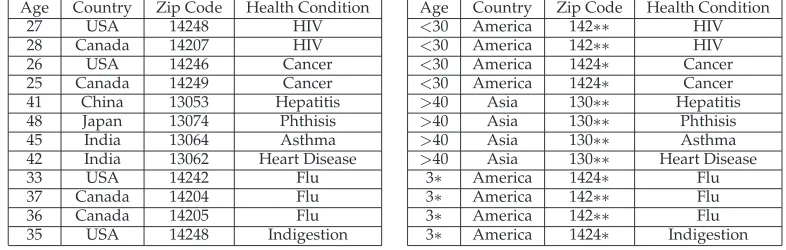
Age Country Zip Code Health Condition
27 USA 14248 HIV
28 Canada 14207 HIV
26 USA 14246 Cancer
25 Canada 14249 Cancer
41 China 13053 Hepatitis
48 Japan 13074 Phthisis
45 India 13064 Asthma
42 India 13062 Heart Disease
33 USA 14242 Flu
37 Canada 14204 Flu
36 Canada 14205 Flu
35 USA 14248 Indigestion
Table 1: Micro data
Age Country Zip Code Health Condition <30 America 142∗∗ HIV <30 America 142∗∗ HIV <30 America 1424∗ Cancer <30 America 1424∗ Cancer >40 Asia 130∗∗ Hepatitis >40 Asia 130∗∗ Phthisis >40 Asia 130∗∗ Asthma >40 Asia 130∗∗ Heart Disease
3∗ America 1424∗ Flu
3∗ America 142∗∗ Flu
3∗ America 142∗∗ Flu
[image:2.612.101.494.72.197.2]3∗ America 1424∗ Indigestion
Table 2: a 2-anonymous view of Table 1
view corresponding to it. The sensitive attribute (Health Condition) is retained without change in this example.
In the literature ofk-anonymity problem, there are two main models. One model is global recoding [5, 8, 16, 13] while the other is local recoding [1, 16]. Here, we assume that each at-tribute has a corresponding conceptual generalization hierarchy or taxonomy tree. A lower level domain in the hierarchy provides more details than a higher level domain. For exam-ple, Zip Code 14248 is a lower level domain and Zip Code 142∗∗is a higher level domain. We assume such hierarchies for numerical attributes too. In particular, we have a hierar-chical structure defined with{value, interval,∗}, where value is the raw numerical data, interval is the range of the raw data and∗is a symbol representing any values. General-ization replaces lower level domain values with higher level domain values. For example, Age 27, 28 in the lower level can be replaced by the interval (27-28) in the higher level (See Table 2).
In recent years, numerous algorithms have been proposed for implementingk-anonymity via generalization and suppression. Samarati [13] presents an algorithm that exploits a bi-nary search on the domain generalization hierarchy to find minimalk-anonymous table. Sunet al.[14] recently improve his algorithm by integrating the hash-based technique. Ba-yardo and Agrawal [3] presents an optimal algorithm that starts from a fully generalized table and specializes the data set in a minimalk-anonymous table, exploiting ad hoc prun-ing techniques. LeFevreet al. [8] describes an algorithm that uses a bottom-up technique and a priori computation. Funget al. [5] present a top-down heuristic to make a table to be releasedk-anonymous. As to the theoretical results, Meyerson and Williams [11] and Aggarwalet al. [1, 2] proved the optimalk-anonymity is NP-hard (based on the number of cells and number of attributes that are generalized and suppressed) and describe approxi-mation algorithms for optimalk-anonymity. Sunet al. [15] proved thatk-anonymity prob-lem is also NP-hard even in the restricted cases, which could imply the results in [1, 2, 11] as well.
num-ber of elements that are grouped in the same cluster. In this paper, we focus on the using generalization and suppression.
While focusing on identity disclosure, k-anonymity model fails to protect attribute dis-closure [7]. Several models such asp-sensitivek-anonymity [19], l-diversity [10],(α, k) -anonymity [22] andt-closeness [9] were proposed in the literature in order to deal with the problem ofk-anonymity. The work presented in this paper is highly inspired by [19]. The main contribution of [19] is to introduce thep-sensitivek-anonymity property, which requires, in addition tok-anonymity, that for each group of tuples with identical combina-tion of quasi-identifier values, the number of distinct sensitive attributes values must be at leastp. However, depending on the nature of the sensitive attributes, evenp-sensitive prop-erty still permits the information to be disclosed. We identify in this paper situations when p-sensitive property is not enough for privacy protection and we propose two solutions to overcome this identified problem:(p, α)-sensitive and(p+
, α)-sensitivek-anonymity mod-els and the heuristic algorithms to enforce these properties.
The rest of paper is organized as follows. We introduce some basic concepts and p-sensitivek-anonymity model in Section 2. Enhancedp-sensitivek-anonymity models are discussed in Section 3. Hardness results with respect to the enhanced models are discussed in Section 4. Algorithmic issues are presented in Section 5 and the experimental results are analyzed in Section 6. Finally, we conclude the paper in Section 7.
2
Problem Definitions
LetT be the initial micro data table andT′be the released micro data table. T′consists of
a set of tuples over an attribute set. The attributes characterizing micro data are classified into the following three categories.
•Identifier attributesthat can be used to identify a record such as Name and Medicare card.
•Quasi-identifier (QI) attributesthat may be known by an intruder, such as Zip code and Age. QI attributes are presented in the released micro data tableT′as well as in the initial
micro data tableT.
•Sensitive attributesthat are assumed to be unknown to an intruder and need to be pro-tected, such as Health Condition or ICD9Code1. Sensitive attributes are presented both in
TandT′.
In what follows we assume that the identifier attributes have been removed and the quasi-identifier and sensitive attributes are usually kept in the released and initial micro data ta-ble. Another assumption is that the value for the sensitive attributes are not available from any external source. This assumption guarantees that an intruder can not use the sensi-tive attributes to increase the chances of disclosure. Unfortunately, an intruder may use record linkage techniques [21] between quasi-identifier attributes and external available information to glean the identity of individuals from the modified micro data. To avoid this possibility of privacy disclosure, one frequently used solution is to modify the initial micro data, more specifically the quasi-identifier attributes values, in order to enforce the k-anonymity property.
Definition 1. (Quasi-identifier)A quasi-identifier (QI) is a minimal setQof attributes in micro data tableT that can be joined with external information to re-identify individual records (with sufficiently high probability).
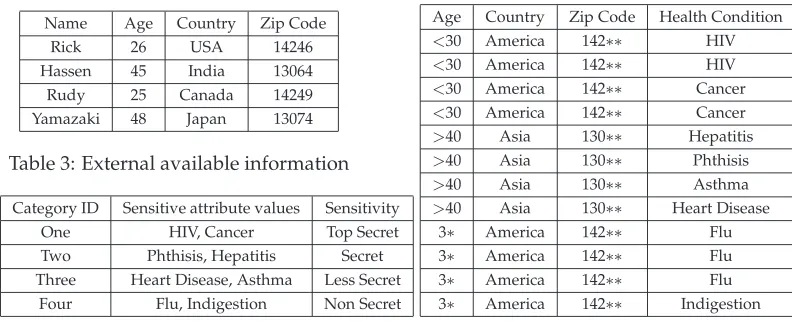
Name Age Country Zip Code
Rick 26 USA 14246
Hassen 45 India 13064
Rudy 25 Canada 14249
[image:4.612.99.495.69.230.2]Yamazaki 48 Japan 13074
Table 3: External available information Category ID Sensitive attribute values Sensitivity
One HIV, Cancer Top Secret
Two Phthisis, Hepatitis Secret Three Heart Disease, Asthma Less Secret
Four Flu, Indigestion Non Secret
Table 4: Categories of Health Condition
Age Country Zip Code Health Condition <30 America 142∗∗ HIV <30 America 142∗∗ HIV <30 America 142∗∗ Cancer <30 America 142∗∗ Cancer >40 Asia 130∗∗ Hepatitis >40 Asia 130∗∗ Phthisis >40 Asia 130∗∗ Asthma >40 Asia 130∗∗ Heart Disease
3∗ America 142∗∗ Flu
3∗ America 142∗∗ Flu
3∗ America 142∗∗ Flu
3∗ America 142∗∗ Indigestion
Table 5: 2-sensitive 4-anonymous Micro data
Definition 2. (k-anonymity)The modified Micro data tableT′ is said to satisfyk-anonymity if
and only if each combination of quasi-identifier attributes inT′occurs at leastktimes.
A QI-group in the modified micro dataT′ is the set of all records in the table containing
identical values for the QI attributes. There is no consensus in the literature over the term used to denote a QI-group. This term was not defined whenk-anonymity was introduced [13, 17]. More recent papers use different terminologies such as equivalence class [22] and QI-cluster [18].
For example, let the set{Age, Country, Zip Code}be the quasi-identifier of Table 1. Table 2 is one 2-anonymous view of Table 1 since there are five QI-groups and the size of each QI-group is at least 2. Sok-anonymity can ensure that even though an intruder knows a particular individual is in thek-anonymous micro data tableT, s/he can not infer which record inTcorresponds to the individual with a probability greater than1/k.
Thek-anonymity property ensures protection against identity disclosure, i.e. the identifi-cation of an entity (person, institution). However, as we will show next, it does not protect the data against attribute disclosure, which occurs when the intruder finds something new about a target entity.
Still consider the modified 2-anonymous table (Table 2), where the set of quasi-identifier is composed of{Age, Country, Zip Code}and Health Condition is the sensitive attribute. As we discussed above, identity disclosure does not happen in this modified micro data. However, assuming that external information in Table 3 is available, attribute disclosure can take place. If the intruder knows that in the modified table (Table 2) the Age attribute was modified to ‘<30’, he can deduce that both Rick and Rudy have Cancer, even he does not know which record, 3 or 4, corresponds to which person. This example shows that even if k-anonymity can well protect identity disclosure, sometimes it fails to protect against sensitive attribute disclosure.
To deal with this problem in privacy breach, thep-sensitivek-anonymity model was in-troduced in [19]. A similar privacy model, calledl-diversity, is described in [10].
Definition 3. (p-sensitivek-anonymity)The modified micro data tableT′satisfiesp-sensitivek
-anonymity property if it satisfiesk-anonymity, and for each QI-group inT′, the number of distinct
values for each sensitive attribute occurs at leastptimes within the same QI-group.
ID Age Country Zip Code Health Condition Category ID
1 <40 America 1424∗ HIV One
4 <40 America 1424∗ Cancer One
9 <40 America 1424∗ Flu Four
12 <40 America 1424∗ Indigestion Four
5 >40 Asia 130∗∗ Hepatitis Two
6 >40 Asia 130∗∗ Phthisis Two
7 >40 Asia 130∗∗ Asthma Three
8 >40 Asia 130∗∗ Heart Disease Three
2 <40 America 1420∗ HIV One
3 <40 America 1420∗ Cancer One
10 <40 America 1420∗ Flu Four
11 <40 America 1420∗ Flu Four
Table 6:(2+,2)
-sensitive 4-anonymous Micro data
in protecting against attribute disclosure, it still has some shortcomings. Following through, we show thatp-sensitivek-anonymity is insufficient to preventSimilarity Attack.
Similarity Attack: When the sensitive attribute values in a QI-group are distinct but similar sen-sitivity, an adversary can learn important information.
Sometimes, the domain of the sensitive attributes, especially the categorical ones, can be partitioned into categories according to the sensitivity of attributes. For example, in med-ical data sets Table 1, the Health Condition attribute can be classified into four categories (see Table 4). The different types of diseases are organized in a category domain. The at-tribute values are very specific, for example they can represent HIV or Cancer, which are both Top Secret information of the individuals. In the case that the initial micro data con-tains specific sensitive attributes like Health Condition, the data owner can be interested in protecting not only these most specific values, but also the category that the sensitive val-ues belong to. For example, the information of a person affected with Top Secret needs to be protected, no matter whether it is HIV or Cancer. If we modify the micro data to satisfy p-sensitivek-anonymity property, it is possible that in a QI-group withpdistinct sensitive attribute values, all of them belong to the same pre-defined category. For instance, the val-ues{HIV, HIV, Cancer, Cancer}in one QI-group in Table 5 all belong to Top Secret category. To avoid such situations, we introduce our new enhancedp-sensitivek-anonymity models, which are aware of not only protecting specific sensitive values.
3
Enhanced
P
-Sensitive
K
-Anonymity Models
LetS be a categorical sensitive attribute we want to protect against attribute disclosure. First, we sort out the values ofS according to their sensitivity, forming an ordered value domainD, and then partition the attribute domain intom-categories(S1, S2,· · ·, Sm), such
thatS=∪m
i=1Si,Si∩Sj=∅(fori6=j) andSlis more sensitive than theSk (for1≤l≤k).
For example, Consider the Health Condition S={HIV, Cancer, Phthisis, Hepatitis, Heart Disease, Asthma, Flu, Indigestion} in Table 1, it has been partitioned into four categories according to the sensitivity of the diseases (Table 4), where S1 (Top Secret) is the most
Furthermore, in order to measure the distance between two categories (attributes) and the degree that sensitive attribute values contribute to one QI-group, we introduce the following ordinal metric system.
LetD(S)denote a categorical domain of an attributeSand|D(S)|be the total number of categories in domainD(S). The normalized distance between two categoriesSiandSjof
the attributeSwithSi≤Sjis:
d(Si, Sj) =
|Sl|Si≤Sl< Sj|
|D(S)| −1
The distance between two sensitive attribute values is equal to the distance between the categories that they fall into. Moreover, we put an ordinal weight to each category to rep-resent the degree that each specific sensitive attribute value inScontributes toS.
LetD(S) ={S1, S2,· · ·, Sk}denote a partition of categorical domain of an attributeSand
letweight(Si)denote the weight of categorySi. Then,
weight(S1) = 0,
weight(Si) =ki−−11; 1< i < k
weight(Sk) = 1,
(1)
Note that the weight of the specific sensitive value is equal to the weight of the category that the specific value belongs to. The weight of the QI-group is the total weight of each specific sensitive values that the QI-group contains.
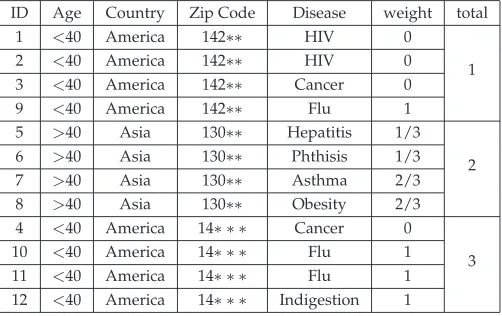
We illustrate these concepts by taking Table 6 as an example. Given the partition of sen-sitive attribute values as shown in Table 4 and four corresponding values setA={Cancer, Phthisis, Asthma, Flu}. The distance between Cancer (S1) and Flu (S4) is 3/3=1, while the
distance between Phthisis (S2) and Asthma (S3) is 1/3. According to (1),weight(S1) = 0,
weight(S2) = 1/3andweight(Asthma) = 2/3,weight(F lu) = 1, the total weight ofAis 0+1/3+2/3+1=2.
Definition 4. ((p, α)-sensitivek-anonymity)The modified micro data tableT′satisfies(p, α)
-sensitivek-anonymity property if it satisfiesk-anonymity, and each QI-group has at leastpdistinct sensitive attribute valueswith its total weight at leastα.
Table 7 is a(3,1)-sensitive 4-anonymous view of Table 1, since there are at least three dif-ferent values in each QI-group and the least total weight of the QI-group is 1. We can easily see that the(p, α)-sensitivek-anonymity model can well protect sensitive information dis-closure as well when compared with previousp-sensitivek-anonymity model.
Definition 5. ((p+, α)
-sensitivek-anonymity): The modified micro data tableT′satisfies(p+, α)
-sensitivek-anonymity property if it satisfiesk-anonymity, and each QI-group has at leastpdistinct categoriesof the sensitive attribute and its total weight is at leastα.
Table 6 is a (2+,2)-sensitive 4-anonymous view of Table 1. As you can see, for
ID Age Country Zip Code Disease weight total
1 <40 America 142∗∗ HIV 0
2 <40 America 142∗∗ HIV 0
3 <40 America 142∗∗ Cancer 0 1
9 <40 America 142∗∗ Flu 1
5 >40 Asia 130∗∗ Hepatitis 1/3 6 >40 Asia 130∗∗ Phthisis 1/3 7 >40 Asia 130∗∗ Asthma 2/3
2
8 >40 Asia 130∗∗ Obesity 2/3 4 <40 America 14∗ ∗ ∗ Cancer 0 10 <40 America 14∗ ∗ ∗ Flu 1 11 <40 America 14∗ ∗ ∗ Flu 1
3
12 <40 America 14∗ ∗ ∗ Indigestion 1
Table 7: (3, 1)-sensitive 4-anonymous Micro data
4
Hardness Results
Optimalp-sensitivek-anonymity problem is NP-hard as discussed in [19]. Now, we show that optimal(p, α)and(p+, α)
-sensitivek-anonymity problems are also NP-hard. Theorem 1:(p, α)-sensitivek-anonymity problem is NP-hard for a binary alphabet (P
={0,1}). Proof: The proof is by transforming the problem of EDGE PARTITION INTO 4-CLIQUES [6] to the(p, α)-sensitivek-anonymity problem.
EDGE PARTITION INTO 4-CLIQUES: Given a simple graphG= (V, E), with|E|= 6m for some integerm, can the edges of G be partitioned intomedge-disjoint 4-cliques?
Given an instance of EDGE PARTITION INTO 4-CLIQUES. Setp= 2,α= 6andk= 12. For each vertexv∈V, construct a non-sensitive attribute. For each edgee∈E, wheree= (v1, v2), create a pair of recordsrv1,v2 andr˜v1,v2, where the two records have the attribute
values of bothv1andv2equal to 1 and all other non-sensitive attribute values equal to 0,
but one recordrv1,v2 has the sensitive attribute equal to 1 and the other recordr˜v1,v2 has
the sensitive attribute equal to 0.
We define the cost of the (2, 6)-sensitive 12-anonymity to be the number of suppressions applied in the data set. We show that the cost of the (2, 6)-sensitive 12-anonymity is at most
48mif and only ifEcan be partitioned into a collection ofmedge-disjoint 4-cliques. SupposeEcan be partitioned into a collection ofmdisjoint 4-cliques. Consider a 4-clique C with vertices v1, v2, v3 and v4. If we suppress the attributesv1, v2, v3 and v4 in the
12 records corresponding to the edges inC, then a cluster of these 12 records are formed where each modified record has four∗s. Note that the(p, α)-sensitive requirement can be satisfied as the frequency of the sensitive attribute value 1 is equal to 6. The cost of the (2, 6)-sensitive 12-anonymity is equal to12×4×m= 48m.
[image:7.612.173.424.71.229.2]Algorithm: Local-recoding Algorithm
1. fully generalize all tuples such that all tuples are equal. 2. letP be a set containing all these generalized tuples 3. S← {P};O← ∅.
4. repeat 5. S′ ← ∅
6. for allP ∈Sso
7. specialize all tuples inPone level down in the generalization hierarchy such that a number of specialized child nodes are formed.
8. unspecialize the nodes which do not satisfy(p, α)-sensitivek-anonymity by moving the tuples back to the parent node.
9. if the parentPdoes not satisfy(p, α)-sensitivek-anonymity then. 10. unspecialize some tuples in the remaining child nodes so that
the parentPsatisfies(p, α)-sensitivek-anonymity 11. for all non-empty branchesBofP, doS′←S′∪ {B}
12. S←S′
13. ifPis non-empty thenO←O∪ {P}
14. untilS=∅
15. returnO.
0). Suppose the twelve modified records contain four∗s in attributesv1,v2,v3andv4, the
records contain 0s in all other nonsensitive attributes. This corresponds to a 4-clique with verticesv1,v2,v3 andv4. Thus, we conclude that the solution corresponds to a partition
into a collection ofmedge-disjoint 4-cliques. Corollary 1: (p+
, α)-sensitive k-anonymity problem is NP-hard for a binary alphabet (P
=
{0,1}).
Distortion Ratio: The cost of recoding is given by theDistortion Ratioof the resulting data set and is defined as follows. Suppose the value of the attribute of a tuple (record) has not been generalized, there will be no distortion. However, if the value of the attribute of a tuple is generalized to a more general value in the taxonomy tree, there is a distortion of the attribute of the tuple. If the value is generalized more (i.e. the original value is updated to a value at the node of the taxonomy near to the root), the distortion will be greater. Thus, the distortion of this value is defined in terms of the height of the value generalized. For example, if the value has not been generalized, the height of the value generalized is equal to 0. If the value has been generalized one level up in the taxonomy, the height of the value generalized is equal to 1. Lethi,j be the height of the value generalized of attributeSi of
the tupletj. The distortion of the whole data set is equal to the sum of the distortions of all
values in the generalized data set. That is, distortion=P
i,jhi,j. Distortion Ratiois equal to
the distortion of the generalized data set divided by the distortion of the fully generalized data set, where the fully generalized data set is the one with all values of the attributes are generalized to the root of the taxonomy tree.
avoiding privacy breach, we could compare theDistortion Ratioof these two models in the experimental study section.
5
The Algorithms
5.1
Global Recoding
We extend an existing global-recoding based algorithm called Incognito [8] for both(p, α) -sensitivek-anonymity and(p+
, α)-sensitivek-anonymity models. Incognito algorithm is an optimal global-recoding algorithm for thek-anonymity problem. It has also been used in [19] for thep-sensitivek-anonymity problem. [8] and [19] make use ofmonotonicity property in searching the solution space. The searches can be made efficient if a stopping condition is satisfied. The stopping condition is that, if tableT′ is satisfied with the privacy
require-ments, then every generalization ofT′is also satisfied with the privacy requirement.
The algorithms for generating(p+, α)
-and(p, α)-sensitivek-anonymous tables tables, are similar to [8, 19]. The difference is in the testing criteria of each candidate in the solution space. [8] tests for thek-anonymity property and [19] tests thep-sensitivek-anonymity. Here, we check the(p, α)-sensitivek-anonymity and(p+, α)-sensitivek-anonymity
prop-erties.
5.2
Local Recoding
The extended Incognito algorithm is an exhaustive global recoding algorithm which is not scalable and may generate excessive distortions to the data set. Here we propose a scal-able local-recoding algorithm. In this section, we present a top-down approach to tackle the problem. The idea of the algorithm is to first generalize all tuples completely so that, initially, all tuples are generalized into one QI-group. Then, tuples are specialized in it-erations. During the specialization, we must maintain(p, α)-sensitivek-anonymity and
(p+, α)-sensitivek-anonymity. The process continues until we cannot specialize the tuples
anymore. The code for(p, α)-sensitivek-anonymity is described in Algorithm 1. The al-gorithm for(p+, α)-sensitivek-anonymity is similar to Algorithm 1, the only difference is
to test(p+, α)-sensitivek-anonymity property in Line 9 and 11. For ease of illustration, we
present how the algorithm works for(p, α)-sensitivek-anonymity for a quasi-identifier of size 1.
Gender Zipcode Disease
Male 4351 HIV
Male 4351 Flu
Female 4351 HIV
Female 4352 Flu
No. Zipcode Disease
1 4351 HIV
2 4351 Flu
3 4351 HIV
4 4352 Flu
No. Zipcode Disease
1 4351 HIV
2 4351 Flu
3 435* HIV
[image:9.612.110.483.492.552.2]4 435* Flu
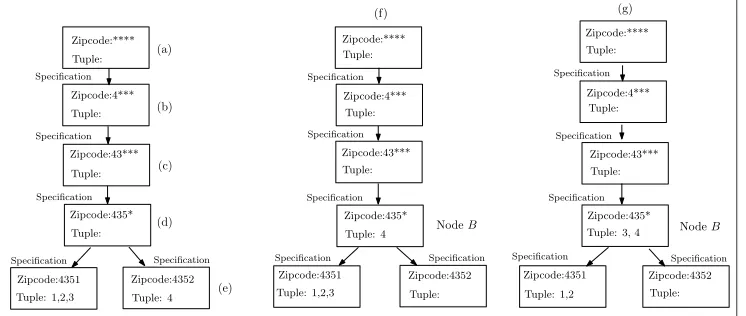
Zipcode:**** Tuple: Tuple: Tuple: Tuple: Zipcode:4*** Zipcode:43*** Zipcode:435* Specification Specification Specification Specification Zipcode:4351 Tuple: 4 Zipcode:4352 Tuple: 1,2,3 Specification Zipcode:**** Tuple: Zipcode:43*** Tuple: Specification Zipcode:4*** Tuple: Specification Specification Zipcode:435* Tuple: 4 Zipcode:4351 Tuple: 1,2 Zipcode:4352 Tuple: Specification Specification Zipcode:**** Tuple: Specification Zipcode:4*** Tuple: Specification Zipcode:43*** Tuple: Specification Zipcode:435* Tuple: 3, 4
Specification Specification Zipcode:4351 Tuple: 1,2,3 Zipcode:4352 Tuple: (a) (b) (c) (d) (e) (f) (g)
[image:10.612.114.487.73.231.2]NodeB NodeB
Figure 1: Algorithm for|QI|=1
respectively. Next, we can further specialize the tuples into the two branches as shown Figure 1(e). Hence the specialization processing can be seen as the growth of a tree.
If each leaf node satisfies(p, α)-sensitivek-anonymity, then the specialization will be suc-cessful. However, we may encounter some problematic leaf nodes that do not satisfy(p, α) -sensitivek-anonymity. Then, all tuples in such leaf nodes will be pushed upwards in the generalization hierarchy. In other words, those tuples cannot be specialized in this pro-cess. They should be kept unspecialized in the parent node. For example, in Figure 1(e), the leaf node with Zipcode = 4352 contains only one tuple, which violates(p, α)-sensitive k-anonymity. Thus, we have to move this tuple back to the parent node with Zipcode = 435*. See Figure 1(f).
After the previous step, we move all tuples in problematic leaf nodes to the parent node. However, if the collected tuples in the parent node do not satisfy(p, α)-sensitivek-anonymity, we should further move some tuples from other leaf nodesLto the parent node so that the parent node can satisfy(p, α)-sensitivek-anonymity whileLalso maintain the(p, α) -sensitivek-anonymity. For instance, in Figure 1(f), the parent node with Zipcode = 435* violates(p, α)-sensitive k-anonymity. Thus, we should move one tuples upwards in the nodeBwith Zipcode = 4351 (which satisfies(p, α)-sensitivek-anonymity). In this exam-ple, we move tuple 3 upwards to the parent node so that both the parent node and the node Bsatisfy the(p, α)-sensitivek-anonymity.
Finally, in Figure 1(g), we obtain a data set where the Zipcode of tuples 3 and 4 are gen-eralized to 435* and the Zipcode of tuples 1 and 2 remains 4351. So the final allocation of tuples in Figure 1(g) is the final distribution of tuples after the specialization. The results can be found at the right in Table 8.
6
Experimental Study
The main goals of the experiments are to study theSimilarity Attackon real data and to in-vestigate the performance implications of the new introduced(p, α)-sensitivek-anonymity and(p+, α)-sensitivek-anonymity approaches in terms of distortion ratio and execution
time.
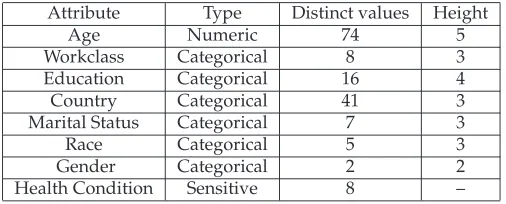
Attribute Type Distinct values Height
Age Numeric 74 5
Workclass Categorical 8 3
Education Categorical 16 4
Country Categorical 41 3
Marital Status Categorical 7 3
Race Categorical 5 3
Gender Categorical 2 2
[image:11.612.172.425.70.172.2]Health Condition Sensitive 8 –
Table 9: Features of Quasi-identifier with Sensitive Attribute
Irvine Machine Learning Repository [12], which has become the benchmark of this field and was adopted by [8, 10, 5]. We used a configuration similar to [8, 10]. We eliminated the records with unknown values. The resulting data set contains 45222 tuples. Seven of the attributes were chosen as the quasi-identifier. We add a column with sensitive values called “Health Condition” consisting of{HIV, Cancer, Phthisis, Hepatitis, Obesity, Asthma, Flu, Indigestion}to the extracted data and randomly assign one sensitive value to each record of the extracted data by. The random technique works in the following way. First, assign a number to each sensitive attribute, i.e.,{1:HIV, 2:Cancer, 3:Phthisis, 4:Hepatitis, 5:Obe-sity, 6:Asthma, 7:Flu, 8:Indigestion}. Second, for each tuple (record), generate a random number from 1-8. Then, assign the corresponding sensitive attribute value to the tuple. For example, for the first tuple in the data set, if the random number is 5, then this record has the sensitive value “Obesity”. Table 9 provides a brief description of the data including the attributes we used, the type of each attribute data, the number of distinct values for each attribute, and the height of the generalization hierarchy for each attribute. The implementa-tion of Incognito is available athttp://www.cs.cornell.edu/database/privacy/
code/l-diversity/incognito-ldiversity.tgzand we modified this
implemen-tation so that it produces(p, α)- and(p+, α)
-sensitivek-anonymous tables as well. All the experiments are run under Windows XP on a machine with 2.0GHz Pentium 4 processor and 1GB RAM. The algorithms were implemented in Java.
Similarity Attack: We use the first 7 attributes in Table 9 as the quasi-identifier and treat Health Condition as the sensitive attribute. We divide the 8 values of the Health Condition attribute into four pre-defined equal-size categories, based on the confidentiality of the values (See Table 4). Any QI-group that has all values falling in one category is viewed as vulnerable to the similarity attack. We usep-sensitivek-anonymity algorithm [19] to generate allp-sensitivek-anonymous tables. In total, there are 21 minimal tables and 13 of them suffers from the Similarity attack. In one table, a total of 916 records can be inferred about their sensitive value class. We also use the(p, α)- and(p,+, α)
-sensitivek-anonymity algorithm to generate all 30 and 28 minimal tables, and found that only 7 and 3 of which are vulnerable to the similarity attack, respectively(p= 2, k= 4, α= 2).
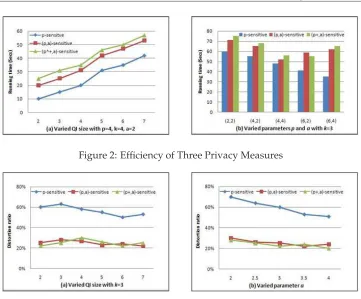
Figure 2: Efficiency of Three Privacy Measures
Figure 3: Distortion Ratio of Three Privacy Measures
than(p, α)-and(p+, α)-sensitivek-anonymity; the difference gets larger whenαincreases.
Distortion ratio: Results of distortion ratio are shown in Fig. 3. From Fig. 3(a), it is easy to see that the distortion ratio increases with the quasi-identifier size. This is because when the quasi-identifier contains more attributes, there is more chance that the quasi-identifier of two tuples are different. In other words, there is more chance that the tuples will be generalized. Thus, the distortion ratio is greater. On average, the distortion ratio of p-sensitivek-anonymity model results in almost three times bigger than that of(p, α)-and
(p+, α)-sensitivek-anonymity models. In Fig. 3(b), whenαincreases, the distortion
ra-tio decreases. Intuitively, if αis greater, there is less requirement of metric α, yielding fewer operations of generalization of the values in the data set. Thus, the distortion ratio is smaller.
7
Conclusion
p-sensitivek-anonymity is a novel property that, when satisfied by micro data sets, can help increase the privacy of the respondents whose data is being used. However, as shown in the paper, to some extent, this property is not enough for protecting sensitive attributes. In this paper, we proposed two enhanced p-sensitivek-anonymity models against Simi-larity Attack, namely (p, α)-and(p+
model.
Acknowledgements
Thanks for anonymous referees for their valuable suggestion on improving the paper. This research was funded by Australian Research Council (ARC) grant DP0774450 and DP0663414.
References
[1] G. Aggarwal, T. Feder, K. Kenthapadi, R. Motwani, R. Panigrahy, D. Thomas and A. Zhu.
Anonymizing tables.In Proc. of the 10th International Conference on Database Theory (ICDT05),
pp. 246-258, Edinburgh, Scotland.
[2] G. Aggarwal, T. Feder, K. Kenthapadi, R. Motwani, R. Panigrahy, D. Thomas, A. Zhu.
Approxi-mation algorithms fork-anonymity.Journal of Privacy Technology, paper number 20051120001.
[3] R. Bayardo and R. Agrawal. Data privacy through optimalk-anonymity.In Proceedings of the
21st International Conference on Data Engineering (ICDE), 2005.
[4] J. Domingo-Ferrer and V. Torra, Ordinal, continuous and heterogeneousk-anonymity through
microaggregation. Data Mining and Knowledge Discovery. v11. 195-212.
[5] B. Fung, K. Wang, P. Yu. Top-down specialization for information and privacy preservation.In
Proc. of the 21st International Conference on Data Engineering (ICDE05), Tokyo, Japan.
[6] M. R. Garey, D. S. Johnson. Computers and Intractability: A Guide to the Theory ofN P
-Completeness. San Francisco. Freeman, 1979.
[7] D. Lambert. Measure of disclosure risk and harm.Journal of Official Statistics, vol 9, 1993, pp.
313-331.
[8] K. LeFevre, D. DeWitt and R. Ramakrishnan. Incognito: Efficient Full-Domaink-Anonymity.In
ACM SIGMOD International Conference on Management of Data, June 2005.
[9] N. Li, T. Li, S. Venkatasubramanian.t-Closeness: Privacy Beyondk-Anonymity andl-Diversity.
ICDE 2007: 106-115
[10] A. Machanavajjhala, J. Gehrke, D. Kifer, and M. Venkitasubramaniam.l-Diversity: Privacy
be-yondk-anonymity. In ICDE, 2006.
[11] A. Meyerson and R. Williams. On the complexity of optimalk-anonymity.In Proc. of the 23rd
ACM-SIGMOD-SIGACT-SIGART Symposium on the Principles of Database Systems, pp. 223-228, Paris, France, 2004.
[12] D. J. Newman, S. Hettich, C. L. Blake and C. J. Merz. UCI Repository of Machine Learning
Databases,available at www.ics.uci.edu/-mlearn/MLRepository.html, University of Califonia, Irvine,
1998.
[13] P. Samarati. Protecting respondents’ identities in micro data release.IEEE Transactions on
Knowl-edge and Data Engineering, 13(6):1010-1027. 2001
[14] X. Sun, M. Li, H. Wang and A. Plank. An efficient hash-based algorithm for minimal k
-anonymity problem.in Thirty-First Australasian Computer Science Conference (ACSC2008), CRPIT
vol 74, pp: 101-106, Wollongong, Australia.
[15] X. Sun, H. Wang and J. Li. On the complexity of restrictedk-anonymity problem.The 10th Asia
Pacific Web Conference(APWEB2008), LNCS 4976, pp: 287-296, Shenyang, China.
[16] L. Sweeney. Achievingk-Anonymity Privacy Protection Using Generalization and Suppression.
[17] L. Sweeney.k-Anonymity: A Model for Protecting Privacy.International Journal on Uncertainty Fuzziness Knowledge-based Systems, 10(5), pp 557-570, 2002
[18] T. M. Truta, A. Campan and P. Meyer. Generating Micro data with p-sensitivek-anonymity
Property.SDM 2007: 124-141
[19] T. M. Truta and V. Bindu, Privacy Protection: p-sensitivek-anonymity propertyInternational
Workshop of Privacy Data Management (PDM2006), In Conjunction with 22th International Confer-ence of Data Engineering (ICDE), Atlanta, 2006.
[20] K. Wang, P. S. Yu, and S. Chakraborty.: Bottom-up Generalization: A Data Mining Solution to
Privacy Protection.The fourth IEEE International Conference on Data Mining (ICDM2004)249-256.
[21] W. E. Winkler. Advanced Methods for Record Linkage,Proceedings of the Section on Survey
Re-search Methods, American Statistical Society, 467-472
[22] R. Wong, J. Li, A. Fu, K. Wang.(α, k)-anonymity: an enhancedk-anonymity model for privacy