Rochester Institute of Technology
RIT Scholar Works
Theses Thesis/Dissertation Collections
5-12-2016
Eba Playful Experiences
Lara Cardoso Goulart
Follow this and additional works at:http://scholarworks.rit.edu/theses
This Thesis is brought to you for free and open access by the Thesis/Dissertation Collections at RIT Scholar Works. It has been accepted for inclusion in Theses by an authorized administrator of RIT Scholar Works. For more information, please [email protected].
Recommended Citation
Eba Playful Experiences
by Lara Cardoso Goulart
A Thesis submitted to the Faculty of the College of Imaging Arts and Sciences for the degree of Master of Fine Arts in Industrial Design
Master of Fine Arts Degree Industrial Design
School of Design
College of Imaging Arts and Science Rochester Institute of Technology
Stan Rickel Chief Advisor
Graduate Director Industrial Design and Associate Professor School of Design
Dana Wolcott
Associate Advisor | Lead Innovation Coach
Simone Center for Student Innovation and Entrepreneurship
Melanie Martinik
Associate Advisor | Visual Arts–All Grades MST Teacher Art Education
Peter Byrne Administrative Chair School of Design
Lara Cardoso Goulart MFA Industrial Design Candidate
Thesis Committee Approvals
. .
. .
Abstract
This thesis is a study of the impact of busy lifestyles on children’s education, considering play-time. Eba Playful Experiences is the result of applied design methodology to solve the lack of play between children and parents, taking into account their routine and needs.
The research includes the study of the importance of play and the problems caused by its absence. The process contains user understanding considering children’s stages of physical, social and cognitive development. The project involves learning from different areas of study: product and interaction design, child psychology and business.
Eba Playful Experiences is an online company based on a subscription business model. Every month, a kit of craft materials and suggested activities is delivered to the family’s home, so parents do not have to plan ahead for a fun and creative project. Each monthly edition comes with three kinds of activities designed for children from 3 to 7 years old; that adapts to the family’s’ routine.
Acknowledgments
My deepest gratitude to Stan Rickel, who expands the boundaries of education and inspire us to be more than our best self.
I appreciate all the great advice and wonderful support of my committee members Melanie Martinik and Dana Wolcott, and also to my teacher Dan Harel. This project wouldn’t be the same without you.
Thanks to my mom, dad, sisters, Scooby, cousins, aunts, uncles, and grandparents, who were always present, no matter the distance. The way that I grew up, all the memories of my child-hood, the idea for this project, these all come from you.
My special thanks to Vinicius for his lovely support and for being my daily motivation and inspiration to keep doing my best. Having you with me makes all the difference.
Thanks to my classmates who made a two years program last forever in my heart. I would like to say particular thanks to Kurtis and Julia for taking our professional pictures (despite it being little compared to all they do for us).
I would like to show my gratitude to my Brazilian friends, in special to Gabriela, André, and Mariana, who were my step family.
I appreciate the valuable voluntary feedback of 116 people who responded to my online survey: 42 mothers, 11 fathers, 20 aunts, two uncles, seven grandmothers, two grandfathers, one godmother, one godfather, three cousins, six professionals, three sisters, one friend, 17 unknown.
I acknowledge the financial support from the CAPES Foundation, Ministry of Education of Brazil, Brasilia – DF, Zip Code 70.040-020, under grant 88888.075884/2013-00.
Content
Introduction 1
1. Play 4
1.1 Definition of Play 4
1.2 The Elements of Play 6
1.3 Patterns of Play 6
1.4 The importance of Play 9
1.5 Parenthood in child’s play 13
1.6 Play and Technology 14
2. User Understanding 16
2.1 Children 16
2.1.1 Child-centered Design Requirements 20
2.2 Parents 21
2.2.1 Survey with parents 22
3. Field Research 29
3.1 The Strong Museum for Play 29
4. Competitor analysis 32
4.1 Kiwi crate (USA) 32
4.2 Arte surpresa and Box Joanninha (Brazil) 33
5. Design Development 35
5.1 Ideation 35
5 .2 Solution 38
5.2.1 What is in each eba kit? 39
6. Marketing 42
6.1 Branding 42
6.2 Website 51
7. Business Plan 53
8. Future Advancements 58
9. Conclusion 59
10. Bibliography 60
11. Appendices 65
List of Figures
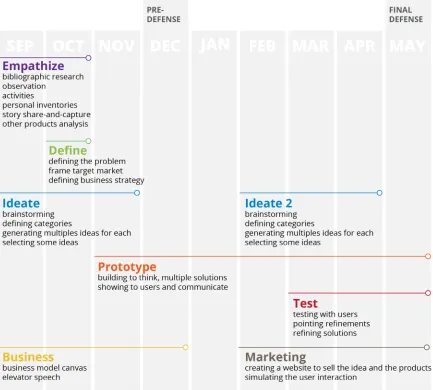
Figure 1. Timetable 3
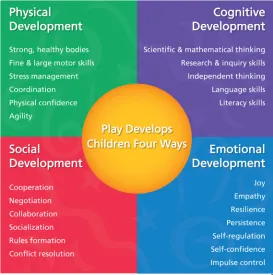
Figure 2. Children Development by Play 10
Figure 3. Age of Respondents 24
Figure 4. Hours of interaction respondent-child 24
Figure 5. Time that children spend playing at home 25
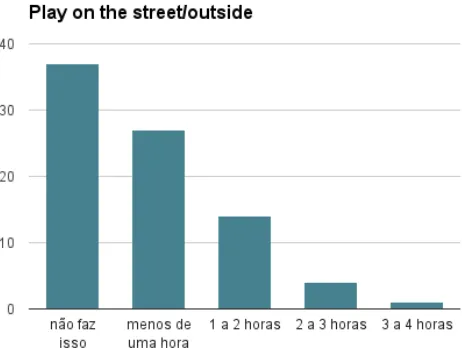
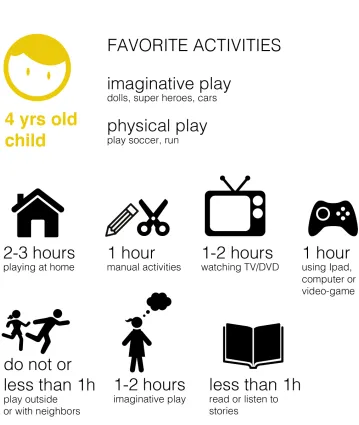
Figure 6. Children play less than an hour or do not play outside 25 Figure 7. Time spend in each type of play for a typical 4 years old child 26 Figure 8. What parents/caregivers think about the time they play with children 27 Figure 9. Parents/caregivers opinion on getting a monthly craft kit 27 Figure 10. How much parents/caregivers would pay for a monthly craft kit 28
Figure 11. Kiwi Crate, “Fun with Flight” 32
Figura 12. Arte Surpresa Box 34
Figure 13. Ideation mind map 36
Figure 14. Ideation mind map (continuation) 37
Figure 15. Eba kit themed “dinnertime” 38
Figure 16. Inside each kit: “Quick Start”, “Long Playtime”, and “Explore the City” 39
Figure 17. Brand Deck 42
Figure 18. Chosen concepts: Playful, Experimental, Emotional 43
Figure 19. Ideation of names 44
Figure 20. Initial logo ideation 45
Figure 22. Logo and tagline 46
Figure 23. Typefaces 47
Figure 24. Official Colors 48
Figure 25. Illustrations from human figure to animals characters 49
Figure 27. Illustrations demonstrating familiar affection 50
Introduction
It is known that many educational problems are born in a home environment because of the lack of communication between parents and kids. Parents are very busy, but they would like to spend more time with their children. They recognize this is important for children rear-ing and human development. Considerrear-ing that parents’ free time is very short, it has to be harnessed efficiently. On the other hand, kids need attention and care. They love to play with their parents, but the family does not have a variety of activities in mind to perform.
Play stimulates children’s social, motor and mental development. It is a powerful way to teach values and behavior to children, which will have impacts in the future. Toys can be used to promote symbolic communication. According to Lightfoot (2013), symbols are efficient tools to educate children, because they control the natural impulses and stimulate cognitive func-tions.
There are multiple toy options available in the market. Most of them are much desired when they are in the stores. However, this emotional attachment to children lasts less than the toys’ lifespan or the child’s developmental stage does not match with the expectations of this particular toy anymore. Because of that, toys are discarded or rendered obsolete even if their physical conditions endure longer. It causes further issues, related to consumerism mindset and sustainability.
Do-it-yourself philosophy comes to rescue hands-on activities in order to valorize the process of making and the whole system that made it possible. This method involves motor and men-tal development, and the final product gives the feeling of pride.
Objectives
The project will be guided by concepts regarding fun, education, and psycho-social develop-ment. This project aims to be non-gender specific, which means that although having different interests, all kids will have the same materials to play. In the long-term, this may impact the reduction of sexist thinking in favor of egalitarian opportunities for genders. The research will be conducted considering the Brazilian context, more specifically, the city Brasilia. As being a planned city, geo-localization might be applied to induce interaction between kids from the same neighborhood.
All goals are listed below:
* To stimulate children skills to crafts; * To boost creativity;
* To provide more time for play, spending parents time efficiently; * To consider child development and age stages;
* To stimulate thinking about how things are made;
* To create a deeper connection to the things that are made by themselves; * To stimulate interaction between children, relatives and environment;
* To create a business to monthly provide those tools (boxes) as subscriptions.
Methods of investigation and implementation
In order to design centered on the user, design thinking methods was applied. During the process, different methods were implemented, to extract the most accurate information from the target market.
The d.school of Stanford suggests the Bootcamp Bootleg kit, which incorporates the steps: Empathize, Ideate, Define, Prototype, Text, Repeat!. Those phases happened simultaneously and many times throught the design process.
In order to gather all the information and report the deliverables to the professors and com-munity, I used a blog (laragoulart.com/mythesisproject). Because of that, the feedback is open to all who are interested in the project, which is a valuable tool when designing focused on the user.
[image:12.612.97.530.252.642.2]Timetable and milestones (Sep/2015 – May/2016)
1. Play
1.1 Definition of Play
I sometimes compare play to oxygen – it’s all around us, yet goes mostly unnoticed or unappreciated until it is missing. (Brown, 2010, p6)
The research started with bibliography research on theories of play. There was a previous tacit knowledge about play, considering life experience and natural curiosity about the topic from the researcher. The initial concept that people usually have is that play is something not seri-ous, and it is mostly done by children. However, theorists show that play is essential for our survival and development as individuals. Through play, we experiment with interactions that are useful throughout our entire life; we develop our physical, social and cognitive skills.
Play is biologically natural; it rises before our consciousness or capacity to speak. As a primal activity, it is a genetic birthright (Steve Keil, 2011) evolved by our curiosity to explore the world, connecting our hands to our brain.
Stuart Brown (2010) considers cultural entertainment, like art, drama, sports and music as a product of play. Through those activities, adults play. It means that play is associated with the experience and the satisfaction that it creates, not restricted to a particular place or action.
Play has many different applications and connotations. The definition of play in the context of this project follows the same line of reasoning as presented by the National Institute of Play. Stuart Brown (2010), the founder of this Institute, in his book “Play”, defends that play is so diverse and preconscious that it is difficult to define. He lists some properties of play:
* Apparently purposeless; * Voluntary;
* Inherent attraction; * Freedom from time;
All topics considered, we can conclude that play it is done for its own sake, it is self-motivated and not mandatory. It is fun and make us feel excited, it makes us lose the sense of time, it is free from our own judgment. It does not follow a rigid script as it is developed while it is oc-curring, and there is always the feeling of “keep playing”, even if it requires changing the rules or taking a break.
By contrast, some theorists point to a negative side of play. Brian Sutton-Smith believes that play is not always innocent so that it may lead to aggressive or violent actions, like bullying or physical assault. Stuart Brown, on the other hand, argues that, because there is a continuous desire to keep playing, people tend to adjust their level to the opponents so the game does not stop, what he calls “automatically self-handicapping”. So for him, what is known as the “dark side” of play is actually an artifact used to deal with difficult emotions, but in fact, this is not play.3
This said, for the purpose of this project, it is considered that players may experience nega-tive situations while playing, but its overall benefits and learning might help them overcome difficulties in a more active and creative way, tending to lead to more harmonious social interactions. This also shows the significance of play in teaching us how to deal with real-life situations.
Play as a state of mind
As seen beforehand, it is hard to define play because of so many different applications. Among the scholars, play is related to an action, an interaction, an activity, a disposition, and a context (Thomas S. Henricks – American Journal of Play, volume 8, number 1). Henricks also defines play as an experience.
Following that reasoning, Brown presents play as a state of mind, the emotional state in which we are immersed when playing. It is intrinsically motivated and provides a feeling of satisfac-tion and pleasure. He points that the attunement between infants and parents are the base of this state of mind.
Stepping out of a normal routine, finding novelty, being open to serendipity, en-joying the unexpected, embracing a little risk, and finding pleasure in the height-ened vividness of life. These are all qualities of a state of play. (Brown, 2010, p173)
Players are seen as individuals who are able to overcome difficulties with grace. Playing with each other, might cause discordance and someone may be hurt, for example when joking about something too personal. However, when those interactions occur while in a playing state of mind, these hurts are surpassed and prevented in future situations.
1.2 The Elements of Play
Scott Eberle (2014) from The Strong National Museum of Play presents six elements that are involved in every play, not necessary in this order:
* Anticipation: anxiety that expects play, followed by curiosity; * Surprise: the happy feeling of discovering the unexpected; * Pleasure: enjoying the moment and feeling good;
* Understanding: incorporating new ideas and acquiring knowledge from the game; * Strength: the power of knowing something else;
* Poise: being grateful for having a balanced experience.
All those elements will be used as guidelines and requirements for the outcomes of this proj-ect. The final solution must provide anticipation, surprise, pleasure, understanding, strength, and poise to the users – parents, caregivers, and children.
1.3 Patterns of Play
Attunement Play
This type of play is probably the first type of play in life. It is regarding the emotional contact between the players. It starts with the eye contact between baby and parents when this con-nection generates a response from the right cerebral cortex, responsible for emotional control, which translates to a smile and joy.
Body Play & Movement
Body play is the pattern seen in animals as a result of their evolution. They emit play signals by moving their tail, jumping, or just having fun finding their balance.
By moving our bodies, we learn about the world and ourselves. Body play lights up the brain and nourish learning promotes discovery and teach us how to be flexible and overcome barri-ers. This type of play is also used as a first stage to get into the state of play, for example, in the context of a group dynamic, in order to get people more creative.
Rough-and-tumble play involves body contact and may be related to violent behaviors. Brown shows the importance of that for the maintenance of social awareness, cooperation, fairness, and altruism. In childhood, rough-and-tumble play teaches about social practices, like give-and-take and it is associated with impulses control in later years. In adulthood, this type of play manifests in tensions caused by games and sports. This physical contact may also be replaced by verbal jousting, like teasing, kidding or joking.
Object Play
This type of play is stimulated by toys and objects, that immerses people in a playful state, lighting up curiosity and providing a hand-brain connection that progresses cognitive skills.
of understanding and solving complex problems, which is essential to achieving success in adulthood.
Social Play
When people play and interact with each other, they learn principles for living in society, which is essential to create a sense of belonging. Mutual play teaches about empathy, which is crucial during the preoperational stage of development (3 to 6 years old), so children learn how to care and share feelings of another. Through social play, we experience some basic prin-ciples for community living, like giving-and-taking, taking turns and expressing feelings.
Imaginative and Pretend Play
Imaginative Play is a mix of reality and fantasy, which allows us to be a different self. It starts around the age of two by changing narratives according to toddler’s imagination and creating their own sense of their mind. The psychologist Cyntia Lightfoot (2013) highlights the im-portance of make-believe play to develop the ability of children to regulate their actions.The benefits of this pattern of play are the development of emotional resilience and creativity, em-pathy, understanding of others and personal coping skills. Imaginative play is also imperative to a work context because it allows people to see a problem from a different perspective.
Brian Sutton-Smith shows the importance of make-believe play to the modern society, where symbolic language is so present in computers, software, and technologies. In imaginative play, the things are representations of real artifacts, which helps with understanding associations and intangible concepts.
Storytelling-Narrative Play
Creative Play
It regards the use of play characteristics to innovate and create for business and technology. It emphasized the importance of play at any age because it shapes our brain and help to deal creatively with established patterns, especially at work. Creative Play is being applied to many methodologies at innovative companies, like IDEO, a Design and Innovation Consulting Firm.
Free Play
In addition to those patterns proposed by the National Institute for Play, Sutton-Smith (1974) also considers free play as an important category. Free Play happens naturally for children who are used to play. However, if they are not stimulated to play during their young ages, they will not know how to engage in that state of mind.
Children play freely when there are no given rules and when they have to create and manage that by themselves. Psychologists consider it very valuable for children because they have to create social life in their play, learning useful principles for their lives. Sutton-Smith says that until about the age of ten, children tend to spend as much time as arguing the rules as they do in playing. The conflicts and group management are important learning experience.
The most important principle in all this is that you teach this kind of play by playing. You do not talk about it. You do not say “What do you want to play?” or “What shall we do now?” That is fatal. (Sutton-Smith, How to Play with your Children, p112)
1.4 The importance of Play
Figure 2. Children Development by Play
Physical Development
Play is associated with physical development because it develops the muscles, bones, motor skills and coordination. Through play, children experience some movements that would be useful in the future. Stuart Brown also relates the physical challenges that play brings with important decisions at work, for example. He affirms that the principles that are learned while playing might come to mind during negotiations or important life decisions. He also points some evidence that play might increase the immune systems making our bodies stronger against diseases.
Cognitive Development
Neuroscientific studies show the correlation between three-dimensional play and the devel-opment of the cerebellum and frontal lobe, which is responsible for cognition. The Neurosci-entists Sergio Pellis and Andrew Iwaniuk and the biologist John Nelson reported the relation-ship between playtime and brain size for mammals, confirming that the animals with larger brains (compared to their body sizes) were the most playful ones.
Studies with animals proved that play makes them smarter and more adaptable. Stuart Brown translates that to the human context as creativity and innovation and affirms that people who were growing up playing are more willing to “see solutions” for significant challenges.
Besides, through our imagination and storytelling, we create new connections between neu-rons and brain centers and we strengthen existing weak ones, developing a complex mind and enhancing learning itself.
Stuart Brown also points to the importance of play to become a master in any subject. For him, the pleasure and fun provided by play are essential for connecting for so long a person to a discipline to bring her to mastery. Without joy, people will lose interest before achieving this level.
Social Development
Play teaches children how to live in a social environment. Fundamental learnings, like empa-thy, collaboration and conflict resolution can be learned with play practice. By playing, we in-quire knowledge about the environment and the rules of interacting with friends and others.
Emotional Development
The emotional benefits of play regards to the state of mind that it provides. Play seems to be a tryout for other things in life, in a safe scenario without threatening, so it modulates deep fears and insecurities.
Fantasy play also develops our capacity to re-create ourselves throughout life, engaging us in the process of finding different ways of being and seeing different solutions for our personal problems.
Resilience and persistence are also important takeaways from play, where we learn how to deal with life’s wins and losses with grace, making us optimistic for new challenges.
Can play change the world?
As seen in the previous topics, play has always been associated with biological adaptation and evolution of many species. Once we understand the importance of play for children and adults, it is possible to assume that play also has impact on our society and culture.
Steve Keil, in his TEDx Talk “A manifesto for play, for Bulgaria and beyond” (2011), shows the solution for a stagnated society like Bulgaria. He affirms that play is the catalyst to revolution-ize the way people work and live in there and in other countries.
Keil (2011) points out the economic reasons for considering play as a key transformative force. In Bulgaria, it is predominant the mechanized work started in Industrial Revolution in the XIX Century. However, the new world requires creativity and adaptability, which comes from innovative and playful minds.
Another important reason why play may bring significant changes to the world is regarding social improvement. It stimulates cooperative socialization and foster empathy and caring for others, making each other more willing to communicate and solve problems without violent actions.
Play also can promote a better world by raising motivated and positive individuals, with new levels of mastery and imagination. It may also help to cope with global adversities, preparing humans to deal with ambiguity and fatalism.
1.5 Parenthood in child’s play
The study considers the busy lifestyles that families have and the importance of parents and children playing together.
The benefits of parents that are convinced that play is essential for life is not only restricted to themselves. If this is nurtured in their home, the environment will be favorable to encourage natural play from children, which may be contagious to adults if they are open to that.
Parents tend to keep their children busy with school and extra activities to provide more education and give anything that they couldn’t have in their childhood. However, this excess may overwhelm young minds, who needs free time to organize their thoughts, discover by themselves and develop their own understanding and critical thinking. A child who is always following the busy schedule does do not face the necessary leisure that brings creativity.
Certainly, parents and mentors are pivotal, but the self that emerges through play is the core, authentic self. (Brown, 2010, p107)
Stuart Brown defends play as the main path for self discovery. Time for play has to be includ-ed in children’s routine, and parents have the role of monitoring and keeping a safe environ-ment. Playing all together as a family is also relevant to mold children’s behavior and keep track in practice what they are learning and reproducing.
motivation will come from internal feelings of competence and satisfaction, which does not happen if parents and teachers force performance as an obligation.
Stuart Brown points that play is very natural for children, but adults need celebratory and ritual play, like wedding and birthday parties so they can have an “excuse” to immerse in the state of play while other work activities are pending.
Work tends to be a refuge for parents and an excuse for play deprivation. What is missing from that is the connection between play and labour. A responsible adult should enjoy life and have work that excites him/her.
If we are not completely full of ourselves or too serious, we can see that we can do a better job of helping our children be more joyful if we help ourselves remember how to play. If we are open to some self-evaluation, and do so with a lightness about our life opportunities, we will actually find a way to play.(Brown, 2010, p122)
Likewise, Sutton-Smith (1973, p113) argues that the long-term effect on children’s learning is greater if we teach parents how to play with their kids. The advantages of that are many: it increases empathy, makes children and relatives enjoy each other more, and brings families closer. All those benefits are transferred to other relationships, inducing the little ones to be friendlier and happier with other children and increase positive socialization.
However, living in a society requires learning how to deal with the struggle and the unpleas-ant. The sociologist Émile Durkheim supports that through play parents and children can face life’s threatening events. An adult-oriented teasing play would be favorable to introduce children to more complicated situations.
1.6 Play and Technology
According to a survey conducted by the Highlights Magazine (2014), 62% of children com-plain that parents are distracted when they try to talk to them. When asked about its cause, 51% of the answers pointed to technology (phones, TV, laptops). The editor in chief Christine Cully, affirms that it is necessary to find those little moments between children and parents focused only on their interaction, without any distraction.
The Brazilian Magazine Crescer shows that the situation in Brazil about technology and par-enthood may be more alarming. A study conducted by AVG (online security company) point-ed that 71% of the Brazilian parents assume to check too much their smartphones, comparpoint-ed to the 54% global average. 87% of their children agreed with that information, which may show a negative impact of technology on family’s interaction.
2
.User Understanding
As seen previously, activities dedicated to children and parents/caregivers have to promote mutual growth. This project targets parents who have children from 3 to 7 years old. Taking from a broader perspective, the target market also embraces grandparents with grandchildren in the same age group.
2.1 Children
Preoperational Stage of Development
This project is designed for children in their Preoperational Stage, nomination created by Jean Piaget (1951-72) in his theory of developmental stages. He refers to individuals between two and seven years old, who actions and reasoning are very concrete.They are very sensorial and require manual activities (touching and visual) to develop physically, socially and cognitive-ly. Before 6 – 7 years old, children don’t understand principles like conservation of number, mass, liquid, and weight. They hadn’t developed notion of classification (categorization), plan-ning (when playing games or maze activities) and metacognition (think about and regulate one’s thoughts).
The target market for this project is children from 3 to 7 years old, because it involves a lot of materials and small components, so young toddlers could have the hazard of swallowing them.
Children from 3 to 4 years old
At this age, they have developed gross motor skills and are able to skip, jump and run smooth-ly. They are also capable of using pencils, paints, crayons for drawing, which shows that small-er movements are refined. They can also build blocks and play with threads.
This is the peak period for pretend play and curiosity about all things around. They like to pretend to be adults, playing as mom and dad, doing routine activities. They also accept parents pretending to be a child. In terms of social living, they are more efficient in dressing, eating, toileting, and talking. They enjoy some indoor activities with toys like hammer and nail set, trucks and dolls, sorting boxes, paper cutting, design matching, but they are more interested in exploring new places and discovering new things (about plant, trees, animals or growing things).
When telling fairy tales they are also able to start telling their own story highlighting the remarkable facts to them. A good exercise is trying to make up your own story or acting out together. It is very important to cultivate the magic fact of the stories. The happy end helps them believe in a good world where they feel safe and protected. Also toys, miniatures, and pretend appliances are very helpful to stimulate the dialogue of this imaginative play.
In general at this age children’s imaginative play is helped by having such minia-ture toy worlds to play with. If children are not particularly imaginative, such toys help. For children who are already very imaginative, toys are not quite so neces-sary; they can make their own toys out of anything. (Sutton-Smith, p123)
Despite the fact that they are not ready to understand board and card games, they enjoy play-ing with the pieces and rollplay-ing marbles. In addition, they don’t deal very well with losses yet, so they don’t appreciate competitive games unless they win or at least draw. At this age is more important to cultivate games where they can have fun and trust the playmates, which help building courage at later age.
A few moments of shared play may be sufficient for the announcement that they have a “friend”. (Sutton-Smith, 1974, p113)
Group play brings the milestone of this age: managing play construction, where they have to define all playmates’ role and decide what they do together. According to Sutton-Smith, It is easier for them to do central-person play, when someone dictates the rules. But they always desire to be the main person, because are very egocentric at this age, so taking turns and playing with other children develops social interactions. Managing play is a big problem for children in their preoperational stage, so they might spend more time arguing than playing; this interaction is crucial for creating social rules and learning how to deal with others.
Children from 4 to 5 years old
Around 4 to 5 years old, it is the initiation for being an independent person, as most of the children go to kindergarten or nursery school, so they spend a considerable time without their parents or relatives. They worry about getting along with others and also care about their friends opinions about them.
It brings challenges regarding being a responsible self out of home. They also feel uncomfort-able on being the central person and acting a role for others to see, so fantasy and dramatic play can be stimulated through the use of puppets, dolls, or characters.
Children are now used to their families routines and requirements and they have established their limitations and needs. They understand that they should behave well in public.
They now enjoy activities that loses their control of their bodies, like whirling until feeling dizzy, rolling down slopes, swinging, sliding. Cooperative play, like dancing and singing to-gether is relevant to give the sense of social unity.
“The very great step forward in this year is the invention of the imaginary charac-ter.” (Sutton-Smith, 1974, p143)
Now children are able to use their imagination to be a different self. They can pretend to be anything, from existing creatures to unreal monsters. It expands play, because now they can be in any context, where only imagination can bring them.
Children from 5 to 7 years old
The milestone for children from 5 to 7 years old is make-believe play with the use of imagi-nary object and situations.
Certainly between five and seven children can do imaginary actions, react to imaginary objects, be imaginary people doing routine things, provide and imag-inary setting, show emotion, and in some cases be completely fantasy people. (Sutton-Smith, 1974, p 153)
At this age, they are able to elaborate dramatic play. However, they still feel embarrassed of showing their talents to others. A good solution for that is having a safe place where this imaginative play begins. When the child practices and repeats some activities they feel more comfortable to expose that.
Like children in younger ages, from 5 to 7 years old they are still dependent on a center-per-son orientated, which means that an adult or older child can start playing, telling the rules and bringing the materials.
They organize their social play into the fitting roles of our society, so each player has a “profes-sion”: doctor and patient, cop and robber, mom and dad, seller and buyer, etc.
Sometimes, they can expand it and have two different roles per person. In terms of social development, they maintain stronger friendships.
write and read their names and some text. Their reasoning is more developed, as they can explain narratives or happened situations.
2.1.1 Child-centered Design Requirements
Considering the differences and milestones for each year, it is noticeable that a 7-year-old kid knows a lot more than the 3-year-old. These four-year gap are crucial for their development. Lightfoot (2013) shows that the size of our brain is up to 90% of the total size when we are five years old. So how to design for all those children?
The answer relies on the do-it-yourself method, which emphasizes the process and is driven by the maker. Some structure will be provided, with materials and suggested games, but the solution will be open to adapt to individual needs. Of course that it will attend some basic requirements, like safety and age appropriate activities, but the experience for each player will be single.
The younger kids might need more parental attention to play while the older ones might prefer to make everything on their own or with other friends. It does not exclusively happen during playtime, so this closer relation with parents may lead to other attention needy situ-ations. Also, it gives flexibility to families to decide rather their children needs more help or more independence.
It is important to mention that the most expected result is to include playtime into families’ routine aiming to provide more communication and strengthen their relationships. So it is predicted that the three-year-old child will make something different from the seven-years-old, even if they are given the same tools and materials. That is the beauty and adaptability of play.
User-centered requirement specifications
* Incorporate routine activities, like cooking, traveling, taking care of the house. * Promote discovery and exploration.
* Induce social interaction, not competition.
* Provide the initial structure to start, because managing play is tough for preopera-tional stage kids.
* Stimulate make-believe, which encourages determination and success in later ages. * Encourage fantasy and drama play around everyday themes, like house, professions, and life.
* Provide materials to make a creative mess.
* Create a space where imaginary things can happen, so children feel safe and free to be inventive.
* Introduce new materials and tools gradually.
* Allow repetition and practice. When it leads to mastery, the activity is combined with other skills to make something more complex.
* Avoid providing duplicates kit for children who play together so that they can com-plement each other.
It is important to mention that the most expected result is to include playtime into families’ routine aiming to provide more communication and strengthen their relationships. So it is predicted that the three-year-old child will make something different from the seven-years-old, even if they are given the same tools and materials. That is the beauty and adaptability of play.
2.2 Parents
The path to achieving these aims may be countless. Diana Baumrind (1971,1980), cited by Lightfoot (2013), summarized the parenting styles in three: authoritative, authoritarian and permissive parenting patterns.
For this project, we encourage activities and interactions to stimulate the Authoritative Par-enting Pattern, where parents set up high expectations for their children, but they understand that kids also have needs and rights. Conflicts are solved with verbal explanations and reason-ing, love and care. In this environment, children tend to be more responsible, self-controlled and with a good knowledge of social rules.
It is important to mention that, by considering “parents”, it includes all main caregiver, who is responsible for raising the child. In some cases, it is the uncle, aunt, grandmother, grandfather, godmother, godfather, a relative, etc.
Size of the market
The size of the market was validated by data from IBGE (Brazilian Institute of Geographic and Statistics) and DataPopular research. My customer segment is parents, grandparents or caregivers who have children from 3 to 7 years old. The minimum income for my segment is R$4,591 Brazilian Reais/month (= US$2,000), so it incorporates classes A and B. There are 14 million children in Brazil from 3 to 7 years old. 10% represents the total of children at this age range from economical classes A and B. We can consider that the average number of children per family (classes AB) is close to 1. So the total amount of children from 3 to 7 years old from classes AB in Brazil is 1,4 million. The approach of this company starts with the beta city Brasilia. In this area, there are 210,453 children from my segmented age range; 34% are from classes AB, so the total number of children ages 3 to 7 in Brasilia is 71,554. It is important to mention that, by measuring the size of the market based on a number of children, we consider that parents, grandparents, and caregivers would be the buyers. Indirectly, this company also provides creative playtime to children in need, by sending a free box to foster care institutions for every box that we sell.
In order to get customer understanding, I conducted a survey with 97 people who interact with children from 3 to 7 years old. The biggest challenge about that was how to get responses from people in Brazil, so I decided to do an online questionnaire.
According to the book Universal Methods of Design, by Bella Martin and Bruce Hanington (2012), questionnaires are simple tools to get people’s information about their characteristics, behaviors, attitudes, perceptions, feelings and thoughts. This method is self-reporting, quanti-tative or qualiquanti-tative, exploratory and evaluative.
The online questionnaire has the advantage of permitting to include different media (videos, sounds, pictures). The survey was elaborated using Google Docs. The questions were seeking information about people’s routine, activities, and feedback about DIY toys. The market and need also needed to be validated.
I sent a survey with some objective and subjective questions and included a video of me show-ing a box/toy from a similar company in the US (Kiwi Crate). I consulted the statistics André Ramos and Gabriela Olinto to make sure that the survey was adequate in order to meet my needs for validation.
I posted the survey on Facebook, in groups with similar interests (educational toys, mothers in Brasilia). The number of responses exceeded my expectations, and I got many positive feedbacks about the idea, which gave me more excitement to move forward with that and make it real for people in Brazil.Results
The survey validated the target market. The majority are people from 22.5 to 45 years old. There is also a significant representation of older adults, from 52.5 to 67.5 years old, who are grandparents.
Figure 3. Age of Respondents
[image:33.612.197.423.479.644.2]When asked how long people usually interact with the child, we got two different scenarios: a major part which spends five or more hours with the kids and another portion which interacts less than one hour per day. From that, it is possible to conclude that we have two adult user profiles: (1) people who live with children from 3 to 7 years old, and (2) people who usually spend some time with them. Both are considered consumers because their relationships are close enough to be likely that they would purchase a monthly surprise to the child.
Figure 4. Hours of interaction respondent-child
One remarkable point regards to the environment. The majority of children spend their days doing indoor activities. Outdoor activities are barely part of their routine. It was an alarm-ing point consideralarm-ing all the benefits that play in different environments can bralarm-ing regardalarm-ing exploration and discovery of the world.
Figure 5. Time that children spend playing at home
Figure 6. Children play less than an hour or do not play outside
[image:34.612.193.424.428.608.2]Figure 7. Time spend in each type of play for a typical 4 years old child
Figure 8. What parents/caregivers think about the time they play with children
In the survey, I included an one minute video of myself showing a Kiwi Crate box, its materi-als and activities (see Competitor Analysis in section 4). Then I asked how getting one of that kit every month would be. The results showed a lot of potential for this project, as most of the parents/caregivers say that they would like to help their child to play with the box. Only 6% disagree and think that kids could play with that by themselves.
Figure 9. Parents/caregivers opinion on getting a monthly craft kit
Kids always want to play more than I play I think we have enough playtime
other I would like to play more if I had time
My kids would play a lot with that I would like them to play with the box by themselves
Other
I would like to help my child to play with the box
[image:36.612.190.482.482.624.2]Through the survey, we could get notion of price. Most of the respondents said that they would pay between R$30 and R$40 Brazilian Reais (between $10 and $15 American Dolars) for a monthly craft kit.
Figure 10. How much parents/caregivers would pay for a monthly craft kit
Besides quantitative questions, the questionnaire included the qualitative query. It was very useful to get people’s opinion and broader comments and suggestions. The first impressions, when I showed the video with the Kiwi Crate box, was very positive. 98% of the respondents approved the concept and confirmed the need for hands-on toys. The highlights were related to the fact that this kit provides variety, creative and challenging monthly activities. Parents/ caregivers also pointed the fact that children can make their own toy with simple recyclable materials as an advantage, compared to digital toys (tv shows, tablets). They recognize that this kind of games can bring mental development and more interaction.
3. Field Research
3.1The Strong Museum for Play
On November 7th, 2015 we went to a Field Trip to the National Strong Museum of Play to observe children’s interactions with the environment and relate their behavior to what we are studying in the Child Development in Art class. This experience provided me observations of families’ interaction and learning on different kinds of play.
As soon as we enter the museum, there is the Abraham Maslow quotes: “Almost all creativ-ity involves purposeful play”. That is basically what the museum provides: exploration and discovery to children in order to develop their creativity and self-learning by having fun. Furthermore, the fun interactions do not restrict to young people; adults also enjoy their experiences either interacting with their children or remembering meaningful toys and plays from their childhood that are in the gallery. In general, the museum reminds me Montessori’s philosophy, because she supports the idea of brain development provided by play when it links sensory-motor, cognitive, and social-emotional experiences.
Close to the entrance, there is a six-feet aquarium with sea fishes. The colors and movements from the corals and fishes call attention. For me it was expected to see children so interested on that, because they naturally love animals. But what surprised me was that some children were trying to connect the pictures from the information panel to the live fishes. I also wit-nessed a child calling the fish “Nemo”, affirming Piaget’s theory that children think symboli-cally in their preoperational stage and they start building their memory with associations.
to draw on the paper stripe”, and getting her positive feedback “That looks nice!”, but also the mother imposing limits to her daughter worried about her safety “Watch out the scissors, you will cut your fingers”.
In the Adventureland, there is also a huge giant, which can have their arms and mouth move-ments controlled by the child. The ability to manipulate the giant and also make him talk with children’s owns voice makes this toy a very personal object, which is a characteristic very appreciated to children. Piaget’s theory for the preoperational stage (2-6 years old) emphasize how egocentric they are, so this could be a reason for why they like toys which imitates their voices and actions.
Going upstairs towards to the National Toy Hall of Fame, there were chain-reaction machines. There was a treadmill powered by a tricycle controlled by the child, which would lead marbles to a maze. I observed a young child “pedaling” the tricycle with his hands while his father was trying to teach him how to manipulate that associating this toy to real-word experience “If you ever going to ride a bike, you have to learn how to do that with your feet”.
On the second floor, there is a big exposition of tradition and new dolls, teddy bears and action figures. In this area, there is a house and a pet care center. One aspect that caught my attention in the previous areas of the museum is that the activities were very dynamic and children were switching from one to another in a short frame of time. However, in this house and pet center area, I observed that children were spending more time, what I assumed they were imitating real life. It reminded me Montessori schools, where teachers stimulate concrete sensorial learning letting young children experience activities respecting how much time they need for that.
The mini Wegmans at the museum also simulates adults’ life, where children can go to buy groceries and work at the market. Imaginative play was very present in this area, as I saw kids creating their narratives behind the scenario, involving other people and their parents.
In conclusion, the Museum is a flexible space that allows all kinds of play for children with many different interests. Taking families to places like that helps to build learning through experimentation and discovery. It is also a very useful resource for researchers and educators who creates children-centered activities.
4. Competitor analysis
4.1 Kiwi crate (USA)
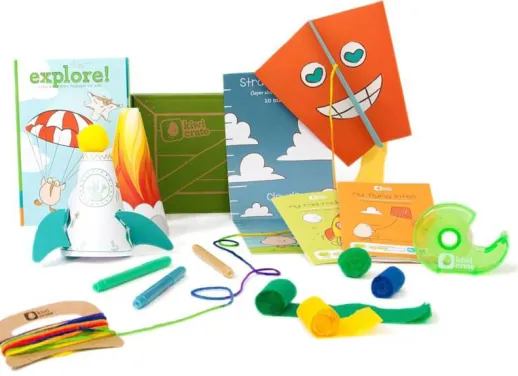
[image:41.612.187.446.297.485.2]When I first started this project, I looked for similar ideas in the US, and I found Kiwi Crate, an online company who sends monthly creative boxes with supplies, kid’s educational craft and DIY projects, and a magazine with activities. It is designed for children from 5 to 8 years old, but they also have other brands: Koala Crate (3 to 4 years old), Doodle Crate (9 to 16 years old), and Tinker Crate (9 to 16+ years old).
Figure 11. Kiwi Crate, “Fun with Flight”
Each box has a unique theme and comes with two different craft activities, where children can build something with the materials and play. The magazine Explore brings some comics, activities and recipes.
I subscribed to Kiwi Crate for ten months and got in my house these themes: Frozen Fun, Busy with Bugs, Backyard Adventure, Interesting Insects, Science of Color, Lemonade Stand, Day at the Lake, Woodland Creatures, Treasure Hunt, Shadow and Light.
be curious to open the box to find out what is the theme of the month. Talking about the themes, it was great to see that they correlates to the current season, so I got the “Frozen Fun” in February, when was very snowy. The first edition came with a “Welcome” card, with a pair of scissors to be used with the next projects and also with a “year path”, full of blank spots to be completed by stickers throught the year (one sticker per month comes in the box).
I also looked for online reviews about the Kiwi Crate. Parents and children are very interested on the content of this kit; they report a lot of focus and determination from the kids to make the projects. There is also happiness and attachment to the thing that they made. One parent reported that his child gave a name to his glowworm and also asked if he could take that to his bed at night. The biggest issues reported by parents against Kiwi Crate relates to the subscrip-tion. Some people find the kits pricy ($19.95 per month) so they suggest asking grandparents to gift the kids for Christmas or Birthday. Other people reported having problems to cancel the contract, being that a critical point for them.
4.2 Arte surpresa and Box Joanninha (Brazil)
Arte Surpresa and Box Joanninha are two companies that produces craft kits to families in Brazil, very similar to what Kiwi Crate offers in the US.
Arte Surpresa comes with two activities and the supplies, except for the magazine. Some of the themes are also very similar. It costs R$39.90 Brazilian Reais plus shipping fee. which would be equivalent to $18 dolars total. This is also a monthly subscription plan, and offers discount in long-term contracts (for six months).
Figura 12. Arte Surpresa Box
Analysing the competitors was very useful to see the reaction of people to that. Experiencing myself the Kiwi Crate gave me the sensation that my users will have and I deliver Eba to their houses. The online reviews and homemade videos about Arte Surpresa and Box Joanninha put me closer to the opinions of the Brazilian market.
5. Design Development
5.1 Ideation
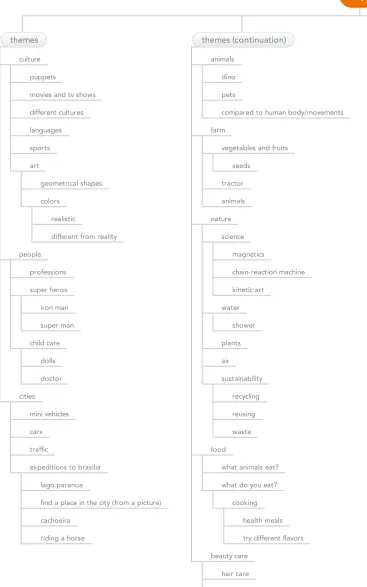
Ideation consists on generating multiple concepts in order to select and refine some ones for the final solution. For this project, the ideation aimed to generate themed activities to be played by children from 3 to 7 years old and their parents/caregivers.
This project was such inserted in my life that the ideation phase did not restrict to a certain timeframe or method. Ideas came from analyzing existing toys, reading lists of awarded edu-cational toys, reading online reviews and families’ complains, studying developmental stages, reading kids books as the ones from Dr. Seuss. The literature and field research at the Museum of Play gave me good insigths for this project. Also, this deep immersion on the topic brought me back to my childhood memories. I applied some of my favorite games and activities creat-ed by myself, my sisters and cousins.
As seen in the previous literature research, play happens so naturally that it can be found anywhere. The ideation also embrances that, looking for inspiration in any everyday event. Brainstorming suddenly happened when I was looking for different uses for existing materials and objects. In addition, a lot of ideas came from taking some places in the city, like cinema, restaurants, parks, landmarks and thinking about the activities we could do there.
I used a mind map from Mind Meister to compile the ideas. This method is very flexible, allows edition any time, and gives a broad view of the notes, which facilitates editions and correlations. The fact that this mind map was online and stored in a cloud folder helped me to keep it updated with my ideas through the process, not restricted to the place I was working.
I compiled the ideation in three categories:
* Themes: appealing themes to children * Activities: what actions they could be doing
The next step was combining the three collums (theme, activities and developmental skill) to come up with the content in each Eba kit. The process based primarly on the themes; follow-ing that, I skimmed the other collums tryfollow-ing to create a connection between them. Havfollow-ing a list of action verbs helped to imagine the narrative of playing instead of designing only the toy, which contributed to creative solutions that emphasizes the experience and interaction.
5 .2 Solution
[image:47.612.119.513.363.566.2]The solution is a combination of product and service. Eba is an online company based on sub-scription business model. Each month, an unique kit of craft materials and suggested games is delivered to families’home, so parents do not have to plan ahead a fun and creative project. Eba brings playtime to children and parents’ daily life.
Figure 15. Eba kit themed “dinnertime”
5.2.1 What is in each eba kit?
Each monthly kit comes with some craft materials and suggested activities to bring playtime to the family, when they can freely interact together and have fun. There is a unique theme ev-ery month, designed for children from 3 to 7 years old and their parents. When you open the box, there is a booklet with the theme, guidelines to start using the materials and information for the parents on what to expect in terms of family interaction and child development.
The materials vary from paper, cardboard, plastic, natural, stickers, wood, foam, fabric, metal sheets, rubber, etc, to promote hands-on learning on different touches, textures and properties (elasticity, stiffness, consistency, etc).
[image:48.612.94.523.378.538.2]The monthly suggested activities are designed to adapt to the families’ routine, so they can play according to the time available each day. Eba will provide the “Quick Start”, the “Long Playtime” and the “Explore the City” activities.
Figure 16. Inside each kit: “Quick Start”, “Long Playtime”, and “Explore the City”
The Quick Start is very simple to set up, it does not require planning or much time avail-able. It intents to transform a daily occurence (like having lunch, going to school, waking up, brushing teeth) in a fun moment. It promotes communication and interaction between children and parents. Stepping outside from the routine is also benefitial to stimulate a self-re-flexion on how people deal with those daily tasks that may end up being repetitive and boring.
when they are more available. The activity promotes creative and role play. It also gives free-dom to be recriated by the child with their imagination by adding other existing toys.
Explore the City promotes discovery and exploration of new places in the city. Families can go out together and feel part of their community. Eba will have partners in the city to make this easily happen, by including coupons, tickets or samples to stimulate children and parents to discover a new place, that could be a restaurant, a zoo, a museum, a library, a cinema, a park, a foster house, a playground, a mall, a community, etc.
5.2.2 Themes and narratives
Considering the previous ideation on themes, developmental aspects and actions, I defined monthly kits that incorporate routine activities and play around everyday events. The period of the year is also relevant to define when each kit is delivered, so it takes in consideration Brazilian holidays and celebrations, school vacation and climate.
For the first year, the themes will be broader and more general, which means that it will in-clude places and activities that could be done in any city, like going to the park, to a restaurant or to a cinema. Gradually, when we create more solid partnerships in the city, the kits can be more site specific, suggesting to visit a landmark for example.
Quick Start
Dinnertime
dinner as picnictalk about relatives
Family Stories
Long Playtime Explore the City
restaurant owner go out for dinner
Super Heroes
Travelling
Movie Time
Detective
Hunting
be a hero (masks)
find at home! color + shape
train with friends strings + clother-peg + box for toys
pop corn launcher
paper parachute with toys and messages
top of a skyscraper or tower (handmade binoculars)
find the “tic tac” with secret messages
find in a park
make your suitcase car window with characters
spin movie cine drive-in, cinema, movie outside
gentle massage finger-tips textures
Sleeping time
pijama party! sleeping outside – with accessories to make a tent
Sounds
balloon, wristle, rubber band, suction cup, mouth, cardboardbuild instruments and play
6. Marketing
6.1 Branding
The Business Dictionary defines “Branding” as:
The process involved in creating a unique name and image for a product in the consumers’ mind, mainly through advertising campaigns with a consistent theme. Branding aims to establish a significant and differentiated presence in the market that attracts and retains loyal customers. (Business Dictionary)
In order to get a consistent set of visual elements that represents an idea, this process involved the creation of a name, logo, tagline, official colors, illustrations and packaging.
The initial step used the Brand Deck, which is a simple tool to help defining what you are and what you are not. It was created by Scott Thomas and funded by a Kickstart campaign in 2015.
[image:51.612.196.435.503.688.2]By the end of this method, I got nine cards that represented the main concepts of my solution: fun, playful, surprising, crafted, experimental, emotional, imaginative, energetic, curious.
[image:52.612.91.542.197.346.2]As written in the instructions, the fewer number of cards you can get at the end, the better. So I decided to narrow it down.
Figure 18. Chosen concepts: Playful, Experimental, Emotional
The final selected cards represents the brand’s core attributes. They are:
Playful: it cover the concepts “fun”, “imaginative”, “energetic”, “surprising” and “curious”, which are elements presented in playful situations.
Experimental: it regards to the product, materials and suggested activities. It incorporates the “crafted” characteristic also, because the product will be open-ended, which requires man-ual work and experimentation, where the process is high-valued.
Emotional: it relates to all the connection promoted between the players (children-parents, children-children, children-environment). It is also associated with anticipation, curiosity and surprise brought by the monthly subscribed kits.
Naming
Figure 19. Ideation of names
The ideation started from references to Tupi (native indian Brazilian language) and primitive Brazilian toys. The most outstanding names were “Peteca” and “Pipa”:
Peteca: this is a shuttlecock-like object used for centuries in games. It is handmade out of a leather pad with feathers stuck into it. This denomination was discarded after finding many other companies with this name (associated with sports and toys).
Petecar: it is an action verb, would suggest the idea of making a mess and playing. However, some informal dictionaries relates this word to sexual connotation, so it was rejected.
Pipa: it is a toy made of wooden sticks and lightweight paper, which flies according to the wind direction (kite). This word was also discarded because it might have sexual connotation.
Eba is the name that best aligns to our requirements. It is an onomatopoeia used by children and adults to express happiness and joy (examples: “Eba! Today is Friday” or “Eba! You are in town, I can see you!”). The name is easy to be pronounced by children and adults, no matter their native language. The letters E, B and A are first letters of these Portuguese words: Experi-mentar, Brincar, Aprender (translation: experience, play, learn).
Visual Identity
The Eba visual identity is composed by logo, tagline, official typography, official colors and illustrations.
[image:54.612.207.430.376.678.2]The logo is based on the Trebuchet typeface. With the use of a Bamboo Tablet, I did handwrit-ing lines on the top of the font guidelines.
Figure 21. Logo definition
The final design express energy, freedom, and happiness. The terminations look like hands, which suggests manual work and people participation. There is a small and a large “hand”, which refers to children and parents involvement.
Tagline
To promote a better understanding of the logo when seen for the first time, there was defined a tagline, which appears right on the bottom of the logo. The tagline in English is “Playful Experiences”, refering to the core value. In Portuguese, the tagline is composed by the three keywords “experimentar”, “brincar”, “aprender” (translation: experience, play, learn).
Typography
Some typefaces were chosen to be part of the Eba Visual Identity:
Annie Use Your Telescope:
an open font by Kimberly Geswein. This cute and playful handwrit-ting typeface simmulates the child writhandwrit-ting. It should be used in short sentences, like titles or quotes. This typeface seems smaller and less legible when compared to other serif or sans serif fonts, so it should be applied in bigger sizes.Open Sans: it is a sans serif font designed by Steve Matteson. It has great legibility and offers different weights, which varies from Light 300 to Extra Bold 800. It is applied in the tagline, website and most of the prints.
Minion Pro: it is the serif typeface designed by Robert Slimbach chosen to be used in long texts because of its high readability. It has various weights from Regular 400 to Bold 700, with Regular, Italic, Medium, Medium Italic, Semibold, Semibold Italic, Bold and Bold Italic.
A
nnieU
seY
oUrT
elescope(18
pT)
abcdefghijklmnopqrstwxyz (14pt)
ABCDEFGHIJKLMNOPQRSTWXYZ
Minion Pro
abcdefghijklmnopqrstwxyz (12pt) ABCDEFGHIJKLMNOPQRSTWXYZ
Open SanS
abcdefghijklmnopqrstwxyz (12pt) ABCDEFGHIJKLMNOPQRSTWXYZ
abcdefghijklmnopqrstwxyz
abcdefghijklmnopqrstwxyz
abcdefghijklmnopqrstwxyz
[image:56.612.92.542.395.731.2]abcdefghijklmnopqrstwxyz
Official Colors
The colors also follows the core concepts of Eba: playful, experimental, emotional. Regarding the requirements, it needed to express energy and happiness, being visual attractive for chil-dren and parents. The initial thought was using primary colors, because they remind child-hood and do not associate to any gender specifically.
The process involved references research on Pinterest (keywords: visual identity, child, kids, packaging), a lot of experimentation (constrast, application with the logo, printed colors), and the use of color wheel (Adobe Color CC).
After many color combinations, we decided to go with three analogous warm colors and two cold colors to complement with. We are still working with the primary yellow, blue and red, but in different tones, which makes it more appealing to the buyers too (adults).
[image:57.612.89.541.394.651.2]Color codes: #9F1D51, #258E8D, #F15B4E, #FBB040, #98D09C, #EEF6EB (almost white).
Illustrations
The development of some illustrations to go with the visual identity arose from the need of emphasizing the familiar affect.
The initial idea was to use human figures to make the drawing. However, due to the multiple derivations and family compositions today, we decided to not attach this project only to the traditional family representation (mother, father, children). The solution was to symbolize affect through the use of other creatures. So we chose animals, which are very appreciated by children and plays the role of representing emotional attachment. Also, most of the male and female species would look similar in a drawing, so we could keep this non-gender specific.
[image:58.612.93.541.335.686.2]For the style, it reminds children’s drawing by the use of simple shapes as a base (oval for ani-mals body) and unfinished pencil lines as the main technique to delimited the figures.
Figure 26. Evolution on the drawing style
Some illustrations had been developed to be used on the posters, presentations, website, prints, and packaging. The first one symbolizes the physical, social, emotional and cognitive development. The lions, bunnies, elephants, birds, dears, sheeps and pigs shows familiar affec-tion.
[image:59.612.146.477.323.631.2]6.2 Website
[image:60.612.91.541.297.522.2]The website is the online platform with comercial and social main functions. It is design for parents/caregivers to easily access informations about the product and to subscribe to re-ceive eba kits at home. Besides that, the website will have an online community where people can share their creations and pictures of their family playtime, inspiring other families. For a future application, through this section Eba will promote neighborhood events to stablish collaboration and connection.
Figure 28. Website home page layout
The layout incorporates the main concepts of our branding: playful, experimental, emotion-al. The use of illustrations refers to child’s drawings and families’ relationship. Large pictures enhances the interaction provided by play and gives a hint of what the product is.
The “Join” page brings information about the subscription plans with prices. By selecting one option, it goes to the online store.
7. Business Plan
Elevator Speech and Business Model Canvas
The Business started during the Fall 2015 in the Applied Venture Creation class, ministered by Rich Notargiacomo, Richard DeMartino and Dana Wolcott, who was also my coach and had closer attention to this project. Throughout the semester, the business gained a lot of improve-ment, especially in its definition, financial plan, and logistics. The Elevator Speech was created and after many modifications, now the business can be explained in 1 minute:
“Have you experienced a child more excited to play with cardboard boxes than actual toys? That was me in my childhood. I used to make up my play, and always wanted to include mom and dad. Well, when they were available. Parents are much busier today. Studies show that they play in average less than 1 hour with their children – while checking their smartphones. We want to recover playful time for parents by providing the tools. Using subscription business model, our company delivers to families’ home convenience and creativity by sending a kit of craft material and suggested games, considering 3 to 7 years old developmental stage. With this do-it-yourself play, we provide to the families a great time togeth-er! With our social program, we send a free box to a child in need for every box that we sell. Let us be part of YOUR children’s education because we believe they are OUR future.”
At the start of the semester, there was no financial plan. Defining the cost structure, key activi-ties, key partners and revenue streams helped to make a financial projection. The survey with the customers showed the price that they were willing to pay and allowed to build TAM and SAM.
In terms of customer understanding, the progress was bigger than expected. The survey with a hundred people in Brazil validated the need of the business and extracted some information about the type of toys, subscription model and activities that families do.