Rochester Institute of Technology
RIT Scholar Works
Theses
Thesis/Dissertation Collections
5-1-2018
Terra: The Earthen Refrigerator
Priyanka Bambarkar
Follow this and additional works at:
https://scholarworks.rit.edu/theses
This Thesis is brought to you for free and open access by the Thesis/Dissertation Collections at RIT Scholar Works. It has been accepted for inclusion in Theses by an authorized administrator of RIT Scholar Works. For more information, please [email protected].
Recommended Citation
TERRA
THE EARTHEN REFRIGERATOR
Priyanka Bambarkar
A Thesis Submitted in Partial Fulfillment of the Requirements for the Degree of Master of Fine Arts in Industrial Design
Rochester Institute of Technology College of Imaging Arts & Sciences School of Design
Thesis Committee Approval
Dan Harel
Date Adjunct Professor, Industrial Design
School of Design, CIAS, Rochester Institute of Technology [email protected]
Stan Rickel
Date Associate Professor, Industrial Design
School of Design, CIAS, Rochester Institute of Technology [email protected]
Mindy Magyar
Date Assistant Professor, Industrial Design
School of Design, CIAS, Rochester Institute of Technology [email protected]
Alex Lobos
Date Graduate Director, Associate Professor, Industrial Design School
Abstract
This thesis consists of the study of reducing the overuse of technology in a modern household for a healthier lifestyle.
“ The kitchen is the most important and expensive room in any household.” - Dan Harel.
It has many appliances and even though not always really appreciated, it does have technologically advanced gadgets. These gadgets were designed for convenient cooking and effective kitchen time usage.
One such appliance which has gained tremendous appreciation is the refrigerator. The refrigerator in general has undergone change over time and has evolved. Initially, satisfying the basic need of food storage and preservation to now satiating psychological and societal status, it has come a long way.
Terra – The Earthen Refrigerator was designed as a modern take on the traditional evaporative cooling technique. It is a refrigerator that does not require electricity, is sustainable and environment friendly. It encourages the user to eat freshly cooked meals by storing less in quantity which leads to less wastage of food products. It also promotes frequent restocking which enables the user to buy local which promotes local businesses.
Keywords: refrigerator, evaporative cooling, earthen refrigerator, kitchen appliance
Acknowledgments
My deepest gratitude to my mentors Dan Harel, Stan Rickel, Mindy Magyar and Alex Lobos who expanded the boundaries of education and inspired me to believe in myself.
I appreciate all the advice and wonderful support from Peter Pincus and Kyle in helping me prototype the concept.
I thank my Mamma, Pappa, Siddhi, cousins, aunts, uncles, grandparents, friends and well-wishers who helped me, supported me emotionally, mentally and financially in my endeavour and were always present for me, no matter the time and distance.
My special thanks to Atul, for his support. This friendship makes all the difference.
I thank all my classmates who made a two years program last forever in my heart. They became more than just classmates, a professional family.
Content
Introduction 1
Objective 1
1. Background 2
1.1 Kitchen
1.2 Food Storage and Preservation 1.3 Refrigerator
2 3 3
2. Concept of Terra 4 2.1 Evaporative cooling process
2.2 Evaporative cooling process for Terra- The earthen refrigerator
2.3 Material selection 2.4 Experiment 1 2.5 Experiment 2
2.6 Problems face during experiments and its solutions 4 4 5 6 7 10
3. Research and Strategy 12 3.1 Target market
3.2 Market Research 3.3 Benchmarking 3.4 Design Strategy
12 12 13 14
4. Form Development 15 4.1 Ideation
4.2 Final design 4.3 Components 4.4 Proportion 15 16 16 19
5. Benefits 20
5.1 Promoting healthy habits 20
6. Manufacturing, Maintenance and Use 22 6.1 Manufacturing
6.2 Cleanliness and Maintenance 6.3 In Use
22 22 23
Conclusion 24
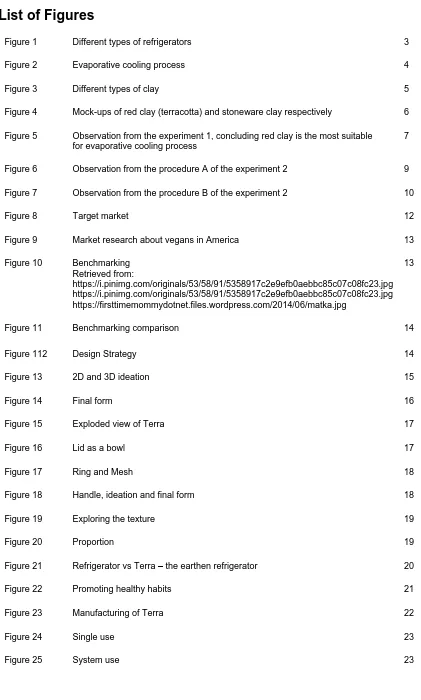
List of Figures
[image:7.595.73.494.66.766.2]Figure 1 Different types of refrigerators 3
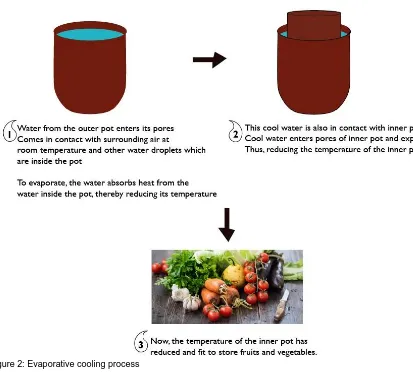
Figure 2 Evaporative cooling process 4
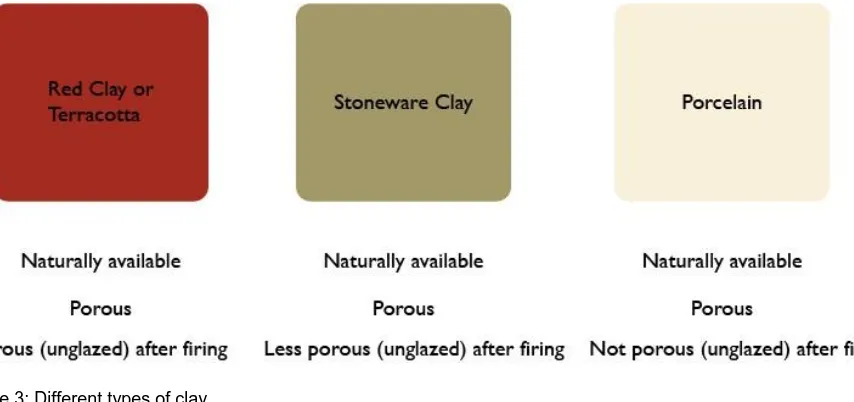
Figure 3 Different types of clay 5
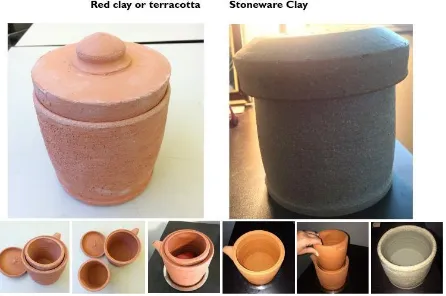
Figure 4 Mock-ups of red clay (terracotta) and stoneware clay respectively 6
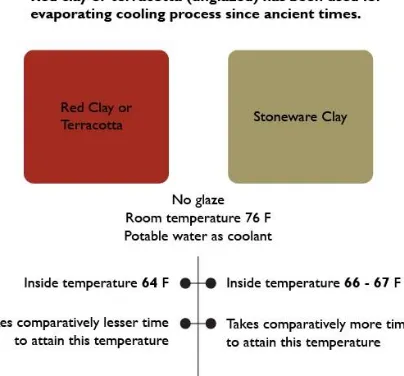
Figure 5 Observation from the experiment 1, concluding red clay is the most suitable for evaporative cooling process
7
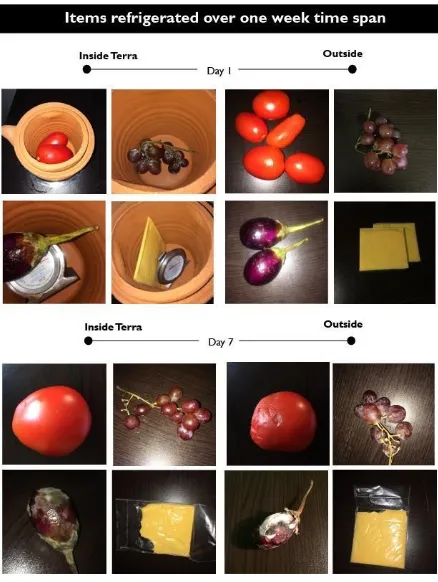
Figure 6 Observation from the procedure A of the experiment 2 9
Figure 7 Observation from the procedure B of the experiment 2 10
Figure 8 Target market 12
Figure 9 Market research about vegans in America 13
Figure 10 Benchmarking Retrieved from:
https://i.pinimg.com/originals/53/58/91/5358917c2e9efb0aebbc85c07c08fc23.jpg https://i.pinimg.com/originals/53/58/91/5358917c2e9efb0aebbc85c07c08fc23.jpg https://firsttimemommydotnet.files.wordpress.com/2014/06/matka.jpg
13
Figure 11 Benchmarking comparison 14
Figure 112 Design Strategy 14
Figure 13 2D and 3D ideation 15
Figure 14 Final form 16
Figure 15 Exploded view of Terra 17
Figure 16 Lid as a bowl 17
Figure 17 Ring and Mesh 18
Figure 18 Handle, ideation and final form 18
Figure 19 Exploring the texture 19
Figure 20 Proportion 19
Figure 21 Refrigerator vs Terra – the earthen refrigerator 20
Figure 22 Promoting healthy habits 21
Figure 23 Manufacturing of Terra 22
Figure 24 Single use 23
Introduction
In today’s world we are overwhelmingly surrounded by technology. For example, at any moment if we enter a restaurant, we will find a couple of people or more, sitting on the chairs and either waiting for their food or ordering their food but at the same time we will find most of them are constantly using their cell phones. This overuse of technology is making our life dependent, which compels me to think whether technology was really invented for our convenience without considering its effects in the long run. The advancement of technology along with reduction in cost is the reason for the ‘use and throw’ approach of human behaviour. Technology affects us all, in physical, emotional and mental health. We have become anxious, restless and we increasingly lack patience.
The kitchen is the most important room in any household. Typically, the space is divided into four categories such as Food, Activities, Material and Technology. All these categories and the entire kitchen space is influenced by our culture. The refrigerator has become one of the most essential equipment in majority of the kitchens all over the world.
As per an article by Hunker, every kilowatt-hour of electricity used results in the emission of 2.34 lbs. of carbon dioxide gas into the atmosphere, according to the University of Northern Iowa. The refrigerator, then, can cause as much as 550 lbs. of CO2 pollution every month.
According to an article “23% of American homes have 2 (or more) fridges” by Heather Long on CNN Money in 2016,
“Americans love refrigerators. They even give them a nickname: "fridge." Almost 100% of homes have a refrigerator, according to the government data. It's the most popular home appliance. But here's an even more telling stat about the American love affair with this appliance: nearly 1 in 4 U.S. homes have two (or more) fridges. Second fridge comes in handy to entertain often.
The U.S. Energy Information Administration has been tracking refrigerator use by Americans because older fridges need a lot of energy to run. "Open your refrigerator door and you summon forth more light than the total amount enjoyed by most households in the 18th century," wrote bestselling author Bill Bryson in his book "At Home," which chronicles the changes in domestic life.”
Objective
The objective of this thesis is to take a step back and explore the benefits of practices from the past that were forgotten in favour of convenience. To introduce a companion in our kitchens that will improve our quality of life and try to reduce our dependency on technology.
1. Background
1.1 Kitchen
The kitchen space started its transformation in mid-nineteenth century. The metamorphosis started taking place in 1875 where interaction with industrial thinking indicated the kitchen as a workplace in which human body was carved and integrated with new machinery within traditional activities. In late nineteenth century, with emerging industrial culture, cooking was studied in its repetitiveness. A conventional activity of feeding oneself was adapted to a more productive process, to find efficient solutions. Along with function, aesthetics started playing a vital role. Already in mid nineteenth century, gas was supplied through nozzles and pipes and was used to stoke burners and ovens in middle class homes. But it was not until 1905 that household objects such as pots and boilers etc were transformed into terminals, via cords and sockets for electricity. From 1927 to 1938, design research transformed the kitchen into the future equivalent of a person who carries out various roles involved in food preparation. The quest was to achieve mechanical efficacy. Until 1945 kitchen witnessed mechanical reinforcement, but technological elaboration accelerated by the end of Second World War. Kitchen submitted itself to consumerism in United States for the desire to leave the tragedies of war. In 1950s, kitchen did not undergo much change except addition of equipment for heat, wash and mince etc. In 1963, a kitchen was designed to be mobile, independent and not connected to architectural location (Celant, 2015).
The above chapter made it clear that the kitchen went through a series of changes over past 175 years for the pretext of necessity, aesthetics, functionality and consumerism etc. Some changes were required for betterment of life and some were just marketing agendas helping capitalism. The kitchen is a place which involves so many activities. Kitchens influence cultures and cultures influence kitchens. For example, in India it is difficult to find a dishwasher in every household. In fact, finding a dishwasher even in a rich household is a rarity. It is common to find maids and house help for such activities. Similarly, in Japan, oven is not a common kitchen appliance because traditional Japanese food is not baked. A colleague from Finland mentioned that drying racks inside the cabinet are commonly found and welcomed. When I was enlightened with this information, I wasn’t surprised because I remember my family did not have modular trolleys in kitchen for storage, we had a drying rack for utensils just above the sink.
The book “Kitchen and Bath Design Principles: Elements, Form, Styles” By Nancy Wolford, Ellen Cheever, NKBA (National Kitchen and Bath Association) mentions that if one sees a Chinese kitchen, one will observe colours such as red (with a hint of orange) and black, tall cabinets for storage and tiles with Chinese motifs and patterns, classic plain white ceiling and Chinese porcelains, etc manifesting the fact that cultures impact the space for humans (Wolford, 2015).
Another beautiful series of blogs on internet “Kitchen of the Future” by New York School of Interior Design and one of its article “Cultural Differences in Cooking: The Adaptability of the Kitchen of the Future.” said that
“One major aspect of the universal appeal of any Kitchen of the Future should be how it responds and adapts to the cuisines of global cultures, rather than simply be structured to a Western, or French, style of cooking.”
The moral of the story is that kitchen is a place where culture resides more than anywhere else in the entire house. The kitchen is a place which involves social activities for some cultures and for other cultures it is a sanctity. It is a place where food is worshiped in some cultures. A place where physical activities happen in the process of food preparation and lot of consideration takes place for the entire family.
1.2 Food Storage and Preservation
Food is the first physiological need according to Maslow's hierarchy of needs. Since ancient times humans have been trying to store or preserve food for longer duration. Changes in weather, climatic conditions and geographical factors affect food supply and demand. Humans have been trying to increase the shelf life of food products so that they last longer. Some of the ancient methods of food storage and preservation were as follows: Pits of ice and snow, Sun drying and preserving, Cellar or wells, Earthen pots, Ice Box and Refrigerator.
1.3 Refrigerator
According to an article by CNN in 2016, one of the largest energy consuming devices in the kitchen is the refrigerator. Imagine unplugging the fridge and how dramatically it affects our life.
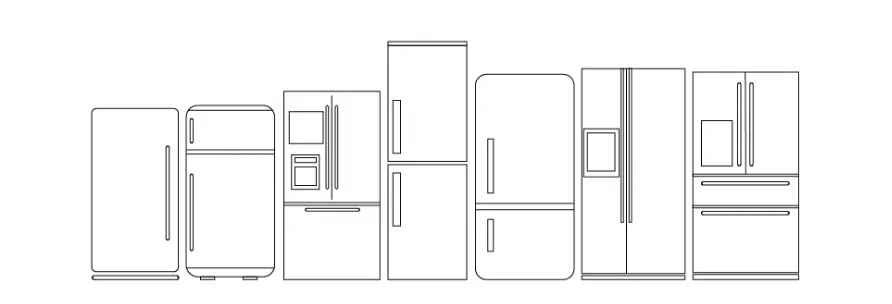
In 1911, the first refrigerator for the household use was manufactured. Since then refrigerators have become an integral part of human lives. Refrigerators were initially designed with single door and now they are designed with multiple doors and features and they keep getting bigger.
If one wonders what people do with so much fridge space, look no further than social media app Instagram. There are over 340,000 Instagram photos right now with the hashtag "fridge." People (mostly Americans) can't wait to show the world how they decorate their fridge with magnets and art or how they fill their fridge with beer or vegetables.
[image:10.595.79.525.410.562.2]
Figure 1: Different types of refrigerators
American fridges are big, especially compared to what's used in Europe, Japan and elsewhere in the world. Nearly all U.S. fridges have at least two doors. Less than 5% are considered "small" (under 14 cubic feet).
2. Concept of Terra
Approximately, one third of the world lives without electricity. In 2008 an article “A Refrigerator that runs without electricity” talked about a Nigerian teacher who came up with an idea of a fridge which does not require electricity. Another such example is, Mitticool, it is an Indian company (rural entrepreneurship) which was formed after Gujarat earthquake in 2001. This company has come up with many environmentally friendly and pocket friendly solutions helping millions of people. These inventions not only use fewer resources and were sustainable, but also retain the original taste of the food and its components and increase shelf life of fruits and vegetables using less energy.
2.1 Evaporative cooling process
The process of liquid water evaporating from a surface, which decreases surface’s temperature, is called evaporative cooling process. Water has a large enthalphy of vaporization which is also known as the (latent) heat of vaporization or heat of evaporation. Enthalphy of vaporization is the amount of energy (enthalpy) that must be added to the liquid substance, to transform a quantity of that substance into a gas.It means that the amount of energy that must be added to a certain quantity of water, to transform that quantity into vapour (Cengel and Boles, 2004).
2.2 Evaporative cooling process for Terra- The earthen refrigerator
[image:11.595.82.495.380.752.2]Water absorbs heat from other or surrounding surfaces, when it absorbs enough heat, it evaporates making other or surrounding surfaces cooler but taking the extra heat along with it. This results into the decrease in amount of heat and thus decreases in temperature of the surface.
Water between the inner pot and outer pot of Terra, enters the pores of the material which is terracotta. The water in the pores act as heat exchange medium between surrounding air at room temperature and water in the pot. Water inside the pot convects heat to the water in the pores and surrounding air to evaporate, reducing the temperature of the surrounding air and water inside the pot. This cooled water inside the pot helps keep fruits and vegetables fresh in Terra- The earthen refrigerator.
2.3 Material selection
Material selection was crucial in developing Terra. As terra was centred to be an environmentally friendly product, the materials used to make the product had to meet the same criteria. The material for inner pot, outer pot and lid had to be able to perform evaporative cooling process. Therefore, porosity of material was taken into consideration as the most crucial factor.
During ancient times, in the eastern and middle eastern part of the world, evaporative cooling was used to store food for longer duration and to increase its shelf life by reducing the process of oxidation. Single fired and unglazed clay was widely used for this process. Clay is naturally available, sustainable, is porous after firing, chemically inert and light in weight.
[image:12.595.92.519.296.497.2]
Figure 3: Different types of clay
Figure 4: Mock-ups of red clay (terracotta) and stoneware clay respectively
2.4 Experiment 1
Aim: To determine a better material for evaporative cooling process between red clay and stoneware clay.
Apparatus:Mock-up containers of red clay and stoneware clay, potable water and thermometer.
Procedure:Apparatus was kept at normal room temperature (76 F/ 24.44 C) in a kitchen environment. Potable water was filled in each of the mock-up containers of stoneware clay and red clay. Temperature of the water was measured using thermometer every 4 hours.
Observation:After about 8 hours the small change in temperature was observed.
Result: After 8 hours the temperature of water began to change. It kept changing for next 12 to 16 hours. After 24 hours the final temp of water in red clay and stoneware clay mock up were 64 F and 67 F respectively, as it is seen below in the figure 5. Stoneware clay took a longer duration compared to red clay to cool down.
Conclusion:
Red clay attains temperature lower than stoneware clay and in lesser time. Hence it is a preferred material for evaporative cooling process. This only manifests the fact that red clay has been used since ancient times for evaporative cooling process.
Figure 5: Observation from the experiment 1, concluding red clay is the most suitable for evaporative cooling process
2.5 Experiment 2
Aim: To determine the efficiency of evaporative cooling process.
Apparatus:Mock-up red clay container (Terra), potable water, fruits, vegetables and thermometer.
Setup: The experiment was divided into two parts. Apparatus was kept at normal room temperature (76 F/ 24.44 C) in a kitchen environment. Potable water was filled in between the outer and inner containers of Terra. Temperature inside the inner red clay container was measured using thermometer every 4 hours.
Procedure A:The water between the inner and outer containers of Terra acts as a coolant. Fruits and vegetables such as eggplant, tomato, grapes were considered to perform the experiment and, American cheese too was considered for this experiment.
The duration of the experiment was one week. The experiment was conducted in the following manner, example, one tomato was placed inside the inner red clay container of Terra and another tomato was placed outside at room temperature. Observation were noted daily for 7 days and at the end of duration of the experiment a final reading was noted for the tomatoes. Similarly, the experiment was repeated for each item individually.
[image:14.595.94.498.84.460.2]Observation A: After 7 days, the tomato kept inside Terra was still fresh while the tomato kept outside at room temperature had stated decomposing. Similarly, eggplant, grapes and American cheese which were placed inside Terra were fresh after 7 days and the item kept at room temperature had started to decompose. Figure 6 below depicts the observations of this part of the experiment.
Procedure B: The entire setup is similar to the procedure A except the duration of this experiment is two weeks. So, all the items considered for this experiment were under observation for 14 days. Items considered for procedure B are tomatoes and green bell peppers. For example, green bell pepper was placed inside the inner container of Terra for 14 day and other green bell pepper was kept outside at the room temperature. Observations were made daily and at the end of the experiment that is after 14 days the green bell peppers were observed for the final reading. Similarly, tomatoes too underwent the experiment.
Observation B: After 14 days, the green bell pepper inside Terra was observed as fresh and the ones kept at the room temperature had started to decompose. The result was identical for tomatoes, where the one inside Terra being fresh and the one outside had begun to decompose. Figure 7 below depicts the observations of this part of the experiment.
Result: The items placed inside the Terra for the duration of one and two weeks did remain fresh. Thus, manifesting the fact that evaporative cooling process works efficiently. There were some other issues that came into the light during the experiment which will be addressed in the later part of the paper.
Figure 7: Observation from the procedure B of the experiment 2.
2.6 Problems faced during experiments and its solutions
While performing the experiment 2, few issues came into light. These issues needed to be fixed for Terra to be efficient. The problems were as follows:
1. A layer of condensed water was formed at the bottom of the inner container of Terra. This layer was formed as the coolant water penetrated the pores of the inner container. The temperature inside the inner container was lower than the outside temperature. Hence, the water was condensed at the bottom.
This condensed layer of water came directly in contact with the fruits and vegetables and caused decay and reduced the shelf life of the produce.
2. Evaporative cooling process ideally requires dry atmosphere. During experiment it was observed that the atmosphere inside the inner container of Terra had excessive humidity. This humidity led to early food spoilage.
For example, during the experiment, an eggplant was spoilt within 7 days when kept inside Terra. 3. The empty inner container floated when coolant water was added in the outer container of Terra.
Solutions implemented were as follows:
2. To reduce the humidity inside the inner container of Terra use of Desiccant was highly encouraged. The two suggested desiccants were as follows:
i) Silica gel
Silica gel is affordable and easily available. It is also easy to handle and non-toxic. Silica gel is easy to reuse.
ii) Bentonite clay
Bentonite clay is also affordable and easily available. It is easy to handle and is non-toxic. Bentonite clay though is difficult to reuse.
3. As the inner container of terra was floating due to the coolant water in the outer container, another component ‘Ring’ was added to the final design. Images of Ring can be seen in the chapter 4 – Form Development.
3. Research and Strategy
3.1 Target market
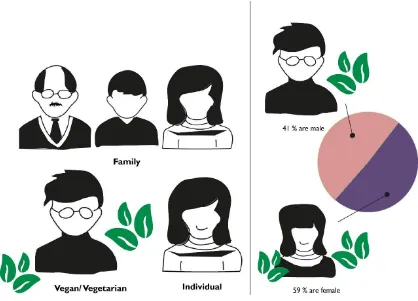
The target market for Terra were individuals and families which were vegetarian or vegan.
• According to the research conducted by Vegetarian Times in 2008, 59% of females in USA were following a vegetarian diet and 41% males too.
• The number of consumers following a vegan diet has notably increased in many industrialised countries, according to an article by Appetite in 2016.
[image:19.595.111.529.236.537.2]• The American Dietetic Association states that well-planned vegetarian diets are healthy and nutritionally adequate, and they may be beneficial in prevention and treatment of some illnesses, according to the journal of the American college of nutrition.
Figure 8: Target market
3.2 Market Research
The proportion of individuals choosing to follow a vegan diet has increased in recent years. The choice was made for different reasons, primarily concern for animals (ethics) and health, which may impact both specific food choices and other lifestyle behaviours linked to health outcomes as per an article by Appetite in 2015.
Figure 9: Market research about vegans in America
3.3 Benchmarking
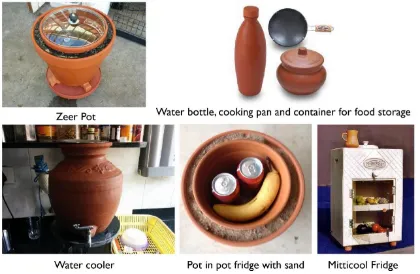
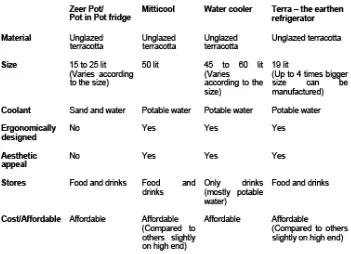
There were few products already in the market using the evaporative cooling process. Figure 10 below represents few such products around the world. Zeer pot is from Egypt, water cooler and Mitticool fridge are from India.
[image:20.595.76.496.467.741.2]Figure 11: Benchmarking comparison
3.4 Design Strategy
The principle strategy was to design a product for reducing overuse of technology in a modern household for a healthier lifestyle. The design strategy was focused to appeal the targeted market of vegans and vegetarians in the USA. It also focused on encouraging the promotion of healthy
lifestyle and improve the local businesses. The goal was to design a product which will bring back the good old technique of food preservation in a present-day kitchen at an affordable price. A product that required no plugging.
The strategy was to design a product that is sustainable, easy to maintain and repair. A product that reduces energy consumption and was affordable. Following the strategy mentioned in figure 12 below, the final form of Terra was developed. The design strategy was focused to help Terra to be easily manufactured and mass produced with aesthetic appeal and ergonomics.
4. Form Development
4.1 Ideation
[image:22.595.82.523.159.680.2]The final form of Terra came into existence in an iterative process. Many 2D and 3D sketches were made to develop a functional, elegant and sleek form. Figure 13 below, showcases the ideation process.
4.2 Final design
Design of Terra was based on many factors such as ease of handling, ease of cleaning and maintenance, ease of assembling and dismantling, etc. The final form of Terra was rendered and prototyped. Figure 14 below shows the rendered version as well as the actual working prototype of Terra in use.
[image:23.595.74.524.138.645.2]Figure 14: Final form
4.3 Components
Terra was made up of six components. Figure 15 below, represents the exploded view of Terra with its components. The components were as follows: Inner pot, Outer pot, tap, Lid, Ring and Mesh.
Inner pot: This component was responsible to store the fruits and vegetables.
Outer pot: This component was responsible for storing potable water which was also the coolant that maintains the inner temperature of Terra.
Figure 15: Exploded view of Terra
Lid: The lid served a dual purpose. It enclosed everything inside Terra from the top and, when turned upside down it acted as a bowl. Figure 16 below showcases the dual functionality of the lid.
[image:24.595.75.433.409.717.2]Ring and Mesh: The component ‘ring’ and component ‘mesh’ were added to the final design of Terra
[image:25.595.73.470.163.431.2]to solve two of the problems observed during the experiment 2 (chapter 2). Ring maintained a stable position of the inner container of Terra and prevented it from yawing when empty. Mesh separates the condensed layer of water in the inner container from the fruits and vegetables inside Terra.
Figure 17: Ring and Mesh
Handle
:
The inner container of Terra required a handle for ease of cleaning and maintenance. Figure 18 below shows the ideation and final concept of the handle. [image:25.595.82.497.521.743.2]Texture: Many textured designs were explored before finalising the outer texture for Terra. Since evaporative cooling process was mostly practiced in the eastern cultures, most of the textures drew inspiration from their cultures. Paisley or Koiri shape was selected and slightly modified with a dot at the centre to represent that the outline of paisley was metaphorically Terra and the dot inside it was representing food stored inside Terra.
Figure 19: Exploring the texture
4.4 Proportion
A prototype of the small size of Terra was made and used. A small size of Terra which is 15-inch-tall and 10-inch in diameter can store one gallon of water. Which means it was suitable for single person use and need to refill the potable water which was also the coolant, once a day. This size can store fruits and vegetables enough for one week for an individual. The above information was inferred from using the prototype in a regular household.
5. Benefits
There were many benefits of Terra over a regular refrigerator. From keeping the fruits and vegetables naturally fresh to requiring no electricity to work, Terra has wide range of benefits.
Nonetheless there were few shortcomings of Terra over a regular refrigerator. These shortcomings have made Terra suitable for the target market that was already been chosen. Terra is most suitable for the vegan and vegetarian individuals and families. Terra could not store milk, dairy products and cooked meat for over one day. Terra is not effective to store raw meat. Figure 21 below, lists down the benefits and drawbacks of a regular refrigerator and Terra.
[image:27.595.74.554.224.657.2]Figure 21: Refrigerator vs Terra – the earthen refrigerator
5.1 Promoting healthy habits
Enabling the user to eat fresh, without preservatives and waste less. This positively affects the local businesses.
[image:28.595.78.530.106.572.2]
6. Manufacturing, Maintenance and Use
6.1 Manufacturing
Terra was simple to mass produce. It can be manufactured via two processes. The two processes were: 1. Wheel pottery process
For many years in the past, red clay has been used for making wheel pottery. The form of Terra enables it to be manufactured via wheel pottery process. Jeff Barton, a professional potter from Texas, estimated that on an average 30 Terras can be made in one day.
2. Mold making and casting process
In the present day red clay slips are available. Hence, Terra can be manufactured by slip casting process too. The initial investment will include a good quality mold. After that multiple pieces can be manufactured per day.
Terra after being manufactured by either of the above-mentioned processes will be assembled and then distributed to various channels.
[image:29.595.81.529.314.582.2]
Figure 23: Manufacturing of Terra
6.2 Cleanliness and Maintenance
Terra was easy to maintain and clean
.
Following were the step for cleaning Terra.• Soak the components in boiling water for 15-20 minutes or fill the components with boiling water for 15-20 minutes.
• Use a clean brush to scrub the surfaces.
• No other chemicals or soap were required for cleaning purposes. • Let it air dry.
6.3 In Use
Terra can be used singularly or in a system. Depending on an individual’s needs or a family’s needs one or more Terras can be used in any household. The images below showcase Terra in use. For demonstration of Terra please watch this video: https://www.youtube.com/watch?v=gNpiLQqDKxU
[image:30.595.95.527.140.411.2]Figure 24: Single use
[image:30.595.96.528.446.728.2]Conclusion
The aim of this thesis was to find a solution to one of the life’s needs that does not come with a plug and an instruction book. The concept of Terra manifested the idea of the refrigeration and preservation without the consumption of electricity.
Terra is an elegant, efficient and sustainable refrigerator, perfectly capable to storing and preserving fruits and vegetables naturally. It restored the original taste of the items stored inside it. By the end of this thesis Terra had become more than an idea, it was now a product. The Terra prototype which was developed for research purposes has found a place for daily use in my life through the progression of this thesis.
The idea behind Terra emerges perfectly when it’s a part of your daily use. The user was motivated to buy in small quantities, buy regularly and locally. Users were encouraged to cook fresh and eat fresh. Local businesses were promoted, and so was the purchase of fresh fruits and vegetables from local farmers and stores. This improved the lifestyle of an individual and potentially of the entire community. This thesis opens the platform for discussion for ideas, concepts and products like Terra, that consume less energy and are sustainable, to be introduced as a regular object satisfying the user’s needs. This thesis has brought to attention that not everything needs to be using tremendous amount of energy. Not every product or means to satisfy the user’s needs must be complicated and expensive.
Bibliography
Celant, Germano. “Domestic Avatars.” In Kitchens and Invaders. Electa, 2015.
Cengel, Yunus and Boles, Michael. “Properties of Pure Substances.” Thermodynamics – An Engineering Approach. McGraw-Hill Education, 2004.
“Cultural Differences in Cooking: The Adaptability of the Kitchen of the Future.” Kitchen of the future, New York
School of Interior Design. Last modified May 9, 2015.
https://kitchenofthefuture.wordpress.com/2015/05/09/crosscultural-adaptations-of-the-kitchen/
Da Silva,Bibiana. “Advantages & Disadvantages of Appliances.” Hunker.com.
https://www.hunker.com/13409289/advantages-disadvantages-of-appliances (accessed March 12, 2016).
Janssen, Meike, Claudia Busch, Manika Rodiger, Ulrich Hamm. “Motives of consumers following a vegan diet and their attitudes towards animal agriculture.” Appetite. Volume 105 (2016): 643-651. Accessed November 15, 2016. https://www.sciencedirect.com/science/article/pii/S0195666316302677
Kahleova, Hana and Pelikanova, Terezie. “Vegetarian Diets in the Prevention and Treatment of Type 2 Diabetes.”
Journal of the American College of Nutrition. Volume 34 (2015): 448-458. Accessed April 18, 2016. http://www.tandfonline.com/doi/full/10.1080/07315724.2014.976890?src=recsys&
Long, Heather. “23% of America homes have 2 (or more) fridges.” CNN.com. http://money.cnn.com/2016/05/27/news/economy/23-percent-of-american-homes-have-2-fridges/ (accessed February 01, 2016).
Mackintosh, Craig. “A refrigerator that runs without electricity.” Permaculture Research Institute. August 11,2008. https://permaculturenews.org/2008/08/11/a-refrigerator-that-runs-without-electricity/
Radnitz, Cynthia. Beezhold, Bonnie and DiMatteo, Julie. “Investigation of lifestyle choices of individuals following a vegan diet for health and ethical reasons.” Appetite. Volume 90 (2015): 31-36. Accessed July 20, 2016. https://www.sciencedirect.com/science/article/pii/S0195666315000732
“Vegetarianism in America.” Vegetarian Times.
https://www.vegetariantimes.com/uncategorized/vegetarianism-in-america (accessed February 09, 2016)