Complete Citation: Brodie, Ian (2007). Using urban surface composition to model stormwater suspended solids: a case study of the effect of rainwater tanks. In Proceedings of the 2007 Queensland Stormwater Industry Association Stormwater Management Conference, SIA Queensland.
(Mimicking Nature - Evolution or Revolution in Stormwater Management, 19-21 Sept 2007, Twin Waters, Australia.).
Accessed from USQ ePrints http://eprints.usq.edu.au
Using urban surface composition to model stormwater suspended solids: A case study of the effect of rainwater tanks
Ian Brodie, Faculty of Engineering and Surveying University of Southern Queensland, Toowoomba
Abstract
Pollutant load estimation is often required to evaluate stormwater management issues associated with water quality and urban development. Land use (e.g. residential, commercial) is commonly employed as a base to spatially
characterize the pollutant generation from urban areas. This paper demonstrates an alternative approach of using the composition of surface type (e.g. road, roof, grassed) within urban catchments to define suspended solids loads in runoff. A case study is provided involving an evaluation of the potential effect that
widespread adoption of rainwater tanks may have on the suspended particle concentration of residential urban runoff. A surface based approach provides a fundamental understanding of the main contributors to stormwater pollutant load generated from urban catchments.
Keywords
Urban runoff; impervious surfaces; suspended solids; stormwater management; non-point source pollution.
1. Introduction
The generation of pollutant loads from urban areas is often computed based on the spatial composition of various land uses found within the catchment. The application of land use to estimate pollutant loads is common practice as this data directly relates to a management question that is frequently posed: “What is the expected change in stormwater quality if land use within a catchment is modified?” At a broad catchment scale, using various land uses such as
residential, commercial, rural and forest to define stormwater pollutant generation is a simple and convenient approach.
There is also an emerging trend of applying Water Sensitive Urban Design (WSUD) practices distributed throughout a catchment in preference to a smaller number of large ‘end-of-pipe’ systems such as constructed wetlands and
detention basins. These distributed practices can be applied at a lot scale (0.1 to 1ha) and may receive stormwater runoff from a discrete surface such as a road or roof. In this situation, stormwater loads estimated based on specific land
surfaces, rather than generically defined land use, would be obviously required to effectively assess the performance of these often small-scale measures.
The Australian Runoff Quality guidelines (Wong, 2006-Chapter 3) outlines the limitations of using land use and offers a method to estimate stormwater loads from ungauged urban catchments using surface composition data (from Phillips and Thompson, 2002). The approach uses runoff discharge rates (ML/ha) and pollutant Event Mean Concentrations (EMC – mg/L) specific to individual types of surfaces to derive annual pollutant loads (kg/ha) for ungauged urban catchments.
This paper uses a similar approach to estimate suspended particle loads from a hypothetical ‘Residential’ catchment located in South East Queensland. The method uses surface runoff EMCs measured for a sequence of storm events monitored over a 13-month period from 2004 to 2006.
A case study is also provided to further demonstrate the use of urban surface modelling in evaluating stormwater management issues. The purpose of the case study is to highlight the increased understanding of catchment pollutant
generation able to be gained from a surface-based approach. The case study is an evaluation of the effect that widespread adoption of rainwater tanks may have on the suspended particle concentration of residential urban runoff.
2. Determination of suspended particle concentration in stormwater
Water quality studies have typically selected Total Suspended Solids (TSS) as the primary determinant of suspended particle concentrations in urban runoff. The TSS method (APHA et al. 1998 and others) originated to analyze
wastewater samples and was intended to measure the particle mass remaining in suspension after an initial settling step. The suitability of TSS in
non-wastewater sample analysis, such as storm runoff, natural waters and river flows, has been the subject of considerable research particularly by the U.S. Geological Survey (e.g. Knott, et al. 1992; Gray, et al. 2000).
Based on this work by USGS, it was confirmed that the use of the Suspended Sediment Concentration (SSC) method provides a more accurate determination than the TSS method of suspended material in surface water samples (USGS, 2000). A comprehensive discussion on the limitations of the TSS laboratory method versus the SSC method can be found in Kayhanian, et al. (2005).
threshold has been used in previous studies and guidelines (Lloyd & Wong, 1999; WSDOE, 2002).
To distinguish from TSS, particles less than 500μm in size are referred to as Non-Coarse Particles (NCP) in this paper.
3. NCP data and spreadsheet
3.1 NCP data for urban surfaces
The case study analysis utilises stormwater monitoring data collected from five urban surfaces located in Toowoomba over a 13-month period from December 2004 to January 2006. Details of the data collection are provided by Brodie and Porter (2006). The surfaces include a galvanized iron roof, a concrete carpark, a bitumen road, a bare soil plot and a grassed backyard area. A passive sampling device was specifically designed and hydraulically tested to capture a flow-proportional runoff sample from each surface during storms (Brodie, 2005).
The data obtained for each surface included the NCP event mean concentration (EMC – mg/L), NCP load (mg/m2) and runoff volume (kL) for a sequence of 36 storms events. Individual storm rainfalls ranged from 2.5mm to 64.25mm in depth. The cumulative rainfall for the storms was 659mm, substantially lower than the average annual rainfall of 945mm recorded for Toowoomba. As evident in Figure 1, the below average rainfall can be attributed to the low occurrence of minor rainfalls less than 10mm.
0 20 40 60 80 100 120
0 20 40 60 80 100
Daily Rainfall (mm)
A
ver
age R
ai
nday
s E
xc
eede
d
(d
ays)
Average annual 1980-2003
[image:3.612.97.444.441.596.2]Monitored 2004-2006
Figure 1: Rainday exceedence curves for average annual rainfall conditions (1980-2003) and the monitoring period from December 2004 to January 2006.
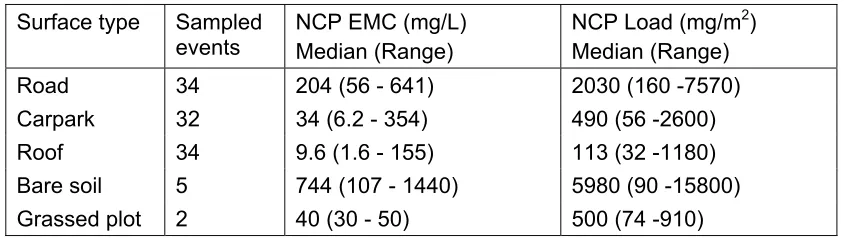
Table 1: NCP EMC and load statistics for monitored surfaces Surface type Sampled
events
NCP EMC (mg/L) Median (Range)
NCP Load (mg/m2)
Median (Range) Road 34 204 (56 - 641) 2030 (160 -7570) Carpark 32 34 (6.2 - 354) 490 (56 -2600) Roof 34 9.6 (1.6 - 155) 113 (32 -1180) Bare soil 5 744 (107 - 1440) 5980 (90 -15800) Grassed plot 2 40 (30 - 50) 500 (74 -910)
3.2 NCP spreadsheet based on urban surfaces
A basic spreadsheet model was developed to predict the NCP load for an urban catchment in response to a sequence of storms. In this case, the storm sequence incorporated the 36 monitored storms during the period from December 2004 to January 2006. The measured NCP load/m2 and runoff volume of each surface for each event formed the inputs to the analysis. To estimate NCP loads for an urban area, the measured loads were simply factored by the total area (in m2) represented by each type of surface and then summed.
Some measured data was missing from the storm sequence due to equipment failure. To fill in missing data, a mass balance model by Brodie (2007) was incorporated into the spreadsheet to simulate NCP loads generated from the impervious surfaces (roof, road and carpark). Missing NCP load data from pervious grass bare soil areas were estimated based on linear regressions fitted against the measured loads for these surfaces (refer Brodie, 2007 for details).
4. Analysis of Residential land uses
Two types of Residential land use were considered for analysis; ‘Low Density’ and ‘High Density’. The relative proportions of roof, grass, carpark (represented mainly by off street vehicle driveways and parking areas) and road surfaces were selected to reflect typical conditions found in each land use. It was assumed that each land use is well established with no bare soil areas.
[image:4.612.88.512.72.191.2]The surface composition of both land use types are summarised in Table 2. The Low Density residential area is a hypothetical example of ‘traditional suburban’ areas within many Australian cities and includes 700m2 lots with occupancy of 2.6 persons/household and a gross density of 10 house units/ha (Mitchell, et al. 2005). The impervious surfaces within the traditional suburban land use equates to 42%. By comparison, impervious surfaces represent 71% coverage of the hypothetical High Density residential area, which is assumed to have a density of 40 house units/ha on small lots. It was assumed that the impervious surfaces are fully directly connected to the stormwater drainage system.
Table 2: Adopted surface composition (%) for hypothetical Residential land uses
Surface Low Density1 High Density2
Carpark 10 14
Road 12 15
Grass 58 29
Total impervious 42% 71%
Notes: 1. Based on 10 lots/ha; 2. Based on 40 lots/ha
[image:5.612.88.510.59.135.2]The adopted surface compositions were modelled as hypothetical 1ha areas in the spreadsheet model and analysed for the Toowoomba storm sequence. Loads and stormwater volumes from the individual surfaces were derived for each storm and summed to provide the total land use loading. NCP EMCs were then calculated from the load and volume predictions. Results compiled for the Residential areas are summarised in Table 3.
Table 3: Results of NCP load analysis for hypothetical Residential land uses based on Toowoomba December 2004 to January 2006 storms, on a per hectare basis
Statistic Low Density High Density
Total runoff volume for 36
storms1 (kL/ha) 3180 4695 (+48%
2)
% Contribution of each surface to total runoff (Roof -Carpark-Road-Grass)
39%-19%-23%-18% 56%-18%-20%-6%
Total NCP load for 36 storms (kg)
174 214 (+23%2)
% Contribution of each surface to total NCP load (Roof -Carpark-Road-Grass)
7%-16%-63%-14% 12%-18%-64%-6%
Mean EMC (log transformed) 60 48 (-20%2)
EMC Range 15-317 13-278
Notes: 1.Total rainfall = 659mm; 2. Percentage change from Low Density Residential value
Total runoff from the High Density land is predicted to be 48% higher than the Low Density land, in line with the increased imperviousness. The roof area
contributed the highest proportion of runoff (39-56%), but generated relatively low NCP loads (7-12%). The most significant contribution (60+%) to NCP load was made by the road area. The total NCP load for High Density land is 23% more than the load produced from the Low Density land.
It is interesting to note that the High Density mean EMC is 20% less than the Low Density value. This is because the increase in runoff volume from the High Density land exceeds the increase in NCP mass load. In other words, a dilution effect is present in that the runoff volume generated from the surface in response to rainfall is proportionally larger than the NCP mass washed from the surface.
amounts of NCP during storms. It is also consistent with research by
Goonetilleke et al. (2004) who monitored runoff from a number of Gold Coast residential areas and found that the TSS concentrations from town house and duplex development were lower than the values recorded for the lower density detached housing on large suburban lots.
0 10 20 30 40 50 60 2. 5-3 3-6 6-10 10-15 15-20 20-25 25-40
40-50 >50
Rainfall (mm) N C P Lo ad C ont ribu tio n (k g) 0 400 800 1200 1600 2. 5-3 3-6 6-10 10-15 15-20 20-25 25-40
40-50 >50
Rainfall (mm) R uno ff C ont rib ut ion (k L) 0 40 80 120 160 200 2. 5-3 3-6 6-10 10-15 15-20 20-25 25-40
40-50 >50
Rainfall (mm) M ean N C P E M C ( m g/ L)
HD Residential LD Residential
Figure 2: Plots of NCP load contribution, runoff contribution and mean NCP EMC for various rainfall ranges for hypothetical High Density Residential (HD Residential), Low Density Residential (LD Residential), High Density Residential with rainwater tanks (HD Res +Tanks) and Low Density Residential with rainwater tanks (LD Res + Tanks)
To further demonstrate the differences between the hypothetical Residential areas, the total NCP load (kg), total runoff volume (kL) and mean EMC (mg/L) generated by the subsets of storms within different rainfall ranges were
computed. These calculations provide a measure of the contribution that is made by rainfall events of varying magnitude within the sequence of storms. The results are plotted as Figure 2. The High Density area is predicted to generate more runoff for the full range of storm rainfalls, as is generally the case for NCP load except for storms exceeding 40mm rainfall. For these events, the NCP loads from the Low Density and High Density areas are of similar magnitude.
5. Analysis of the effect of rainwater tanks on the NCP concentration of Residential runoff
A considerable amount of research has been undertaken on the water supply benefits of installing rainwater tanks. Reductions in mains water use up to 85% can be achieved with tank sizes between 5 to 15 kL, provided that dual water supply is incorporated and the roof water is used for indoor purposes (Coombes, et al. 2002a; Mitchell, et al. 2005). As a specific example, the installation of two 2.2kL rainwater tanks with mains water trickle top up at a small cottage in Newcastle, Australia was found to have resulted in a 45% reduction in mains water use during a drought (Coombes, et al. 2004).
The capture of roof water for domestic use reduces the amount of runoff
discharging from a housing allotment. An 80% reduction in the one year average recurrence interval peak stormwater discharge was predicted if 10 kL rainwater tanks were adopted in the Parramatta region of New South Wales, Australia (Coombes, et al. 2002b). As a consequence, the use of rainwater tanks is a common WSUD feature. However, minimal research has been conducted on the potential quality effects of removing roof water as a component of urban runoff generated from residential catchments.
Roof runoff water has a low NCP concentration but volumetrically is a major component of urban stormwater. As demonstrated by the analysis of a hypothetical Residential areas provided in Table 3, roof runoff constitutes approximately 39-56% of the stormwater volume but only 7-12% of the NCP load. The extraction of roof water from the stormwater flow may result in less dilution of the more highly concentrated particle sources, especially roads, causing a net increase of NCP concentration.
To check the significance of this aspect, the spreadsheet analysis of the
roof runoff. The analysis was performed on a per hectare basis and a number of assumptions were made, consistent with an assessment of roof water storage requirements for various Australian cities by Mitchell et al. (2005):
Household use of roof water was based on a constant demand of 50 L/person/day with an average 2.6 persons/household. The household demand is based on toilet flushing and some additional component of non-potable indoor use. Based on the assumed lot densities, this demand equates to 1.3 kL/ha/day for the Low Density area and 5.2 kL/ha/day for the High Density area.
The tank storage was set at 10 kL/household, or 100 kL/ha, for the Low Density area. Due to space constraints on individual lots, a smaller tank storage of 5 kL/household, or 200 kL/ha was adopted for the High Density area. It was assumed that there was no mains water top up of the tanks.
The roof water contribution to urban stormwater is the overflow from the tank storage. The tank overflow volume was computed for each storm event and the overflow NCP concentration was assumed to be equivalent to the roof runoff concentration. This is a conservative assumption as particle settling is expected to occur within the tank storage.
A rainwater tank storage and overflow algorithm was included in the
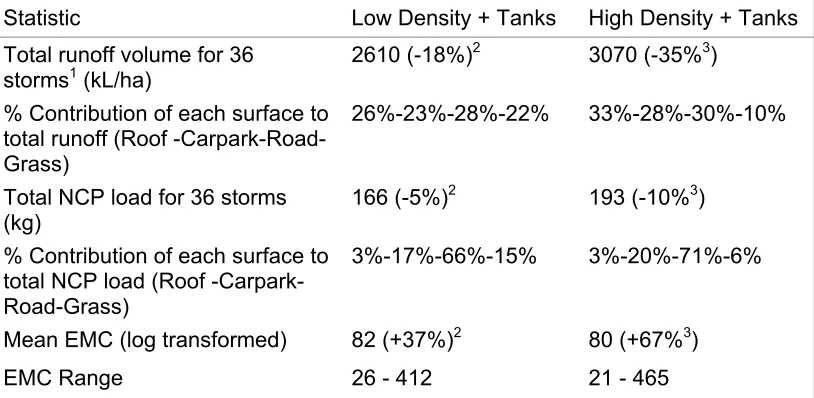
[image:8.612.94.501.490.689.2]spreadsheet. This algorithm used a mass balance approach to determine the tank stored water volume (or overflow) accounting for tank capacity, roof runoff volume and household demand. The simulation results are provided in Table 4. Capture and use of the roof water reduced the total stormwater volume by 18% for the Low Density area and 35% for the High Density area. The tank scenarios were predicted to capture 46% of the Low Density area roof runoff and 62% of the High Density area roof runoff.
Table 4: Results of NCP load analysis for hypothetical residential land uses with rainwater tank strategies based on Toowoomba December 2004 to January 2006 storms, on a per hectare basis
Statistic Low Density + Tanks High Density + Tanks Total runoff volume for 36
storms1 (kL/ha) 2610 (-18%)
2 3070 (-35%3)
% Contribution of each surface to total runoff (Roof -Carpark-Road-Grass)
26%-23%-28%-22% 33%-28%-30%-10%
Total NCP load for 36 storms (kg)
166 (-5%)2 193 (-10%3)
% Contribution of each surface to total NCP load (Roof -Carpark-Road-Grass)
3%-17%-66%-15% 3%-20%-71%-6%
Mean EMC (log transformed) 82 (+37%)2 80 (+67%3)
EMC Range 26 - 412 21 - 465
The introduction of tanks is predicted to reduce the total runoff generated from the Residential areas by 18-35%, depending on the tank scenario and density of development. As the roof runoff has low NCP concentrations, the reduction in the total particle load for the residential area with rainwater tanks is minor (5-10%). Substantial increases (37-67%) in the mean NCP EMC are predicted and as indicated in Figure 1, this outcome is due to higher runoff concentrations predicted for storms less than 40mm rainfall. For minor, but more frequent
rainfalls of less than 15mm, the predicted NCP EMCs are at their highest. During these storms, the tank storage captures a greater proportion of the roof runoff and the particle load from the other surfaces is thus less diluted than otherwise would be the case for the no rainwater tank scenario.
6. Conclusions
This paper demonstrates that describing urban catchments by their surface composition, rather then by a more generic land use is a useful approach. The benefit of this approach, as highlighted by the case study analysis, is a greater understanding of the main contributors to stormwater pollution and how WSUD measures such as rainwater tanks may modify the overall stormwater pollutant response of an urban catchment.
The hypothetical analysis indicates that the widespread application of rainwater tanks to harvest roof water may change the stormwater runoff generated from residential areas. A significant increase in the NCP concentration of urban runoff is predicted, especially for minor, relatively frequent rainfalls less than 15mm. The magnitude of the predicted effects due to rainwater tanks are indicative, as it is specific to the densities of residential development, the relative compositions of various urban surfaces and the historical sequence of storm events adopted as part of the case study analysis. Further research into these effects is
recommended.
References
American Public Health Association, American Water Works Association, Water Pollution Control Federation, 1998. Standard Methods for the Examination of Water and Wastewater. Washington D.C.
ASTM (2002) Standard Test Method for Determining Sediment Concentration in Water Samples. American Society for Testing and Materials Designation D 3977-97, Reapproved 2002
Brodie, I. (2005), Stormwater Particles and Their Sampling Using Passive Devices, Paper presented to 10th International Conference on Urban Drainage, Copenhagen, Denmark, 21-26 August 2005
Brodie I.M. (2007), Investigation of Stormwater Particles Generated From Common Urban Surfaces. PhD thesis, Faculty of Engineering and Surveying, University of Southern Queensland.
Coombes, P.J., Kuczera, G., and Kalma, J.D. (2002a), Economic Water Quantity and Quality Results From a House With a Rainwater Tank in the Inner City, Paper presented to 27th Hydrology and Water Resources Conference, Melbourne, Australia
Coombes, P.J., Kuczera, G., O’Loughlin, G.G., and Lees, S. (2002b), Rainwater Tank Options for Stormwater Management in the Upper Parramatta River
Catchment, Paper presented to 27th Hydrology and Water Resources Conference, Melbourne, Australia
Coombes, P.J., Spinks, A., Evans, C., and Dunstan, H. (2004) Performance of Rainwater Tanks at an Inner City House in Carrington NSW During a Drought, Paper presented to WSUD2004 Cities as Catchments Conference, Adelaide, Australia
Goonetilleke, A., Thomas, E., Herngren, L., Ginn, S. and Gilbert, D. (2004). Urban Water Quality: Stereotypical Solutions May Not Always be the Answer. Paper presented to WSUD2004 Cities as Catchments Conference, Adelaide, Australia
Gray J.R., Glysson G.D., Turcious, L.M., and Schwarz, G.E. (2000),
Comparability of Suspended Sediment Concentration and Total Suspended Solids Data. USGS WRIR 00-4191, US Geological Survey
Kayhanian, M., Young, T.M., and Stenstrom, K., (2005), Limitations of Current Solids Measurements in Stormwater Runoff. Stormwater – The Journal for Surface Water Quality Professionals, July/August 2005.
Knott, J.M., Sholar, C.J., and Matthes, W.J., 1992. Quality assurance guidelines for the analysis of sediment concentration by U.S. Geological Survey sediment laboratories. U.S. Geological Survey Open-File report 92-33.
Lloyd S.D. and Wong T.H.F., 1999. Particulates, Associated Pollutants and Urban Stormwater Treatment. In: Proc. 8th Inter. Conf. on Urban Storm Drainage, Sydney, Australia.
Mitchell, G., McCarthy, D., Deletic, A.B., and Fletcher, T. (2005) Development of Novel Integrated Stormwater Treatment and Re-Use Systems: Assessing
Storage Capacity Requirements. Institute for Sustainable Water Resources, Monash University, Melbourne
Phillips, B.C., and Thompson, G. (2002) Virtual Stormwater Management
U.S. Geological Survey, 2000. Collection and Use of Total Suspended Solids Data. Office of Water Quality Technical Memorandum 2001.03, November 27, 2000.
Washington State Dept. of Ecology, 2002. Guidance for Evaluating Emerging Stormwater Treatment Technology – Technology Assessment Protocol Ecology (TAPE). Publication 02-10-037, October 2002.
Wong, T.H.F. (Ed.), (2006) Australian Runoff Quality: A Guide to Water