The Future of Irrigation Technologies and Practices is Here Now
Steven R Raine
Cooperative Research Centre for Irrigation Futures & National Centre for Engineering in Agriculture, University of Southern Queensland, Toowoomba, 4350, Australia.
Introduction
Irrigation industry growth over the last 100 years has been principally based around expanding irrigation areas and increasing the capture and use of water resources. However, with the exception of potential new irrigation areas in northern Australia, future industry growth will increasingly be based on the potential to improve volumetric efficiencies and agronomic water use productivity. While there has recently been significant national interest around investments in off-farm infrastructure, it is clear that there will also need to be substantial investment in on-farm technologies and practices. This paper discusses the major drivers for irrigation sector change and the areas of technology and practice investment which will be required for the irrigation industry to survive and prosper in the future.
Irrigation in Australia and drivers for change
Irrigation is currently the major water user in the Australian economy, with ABS (2005) estimates showing that agriculture applied 10,404 gigalitres of water (67% of water consumption) to 2.4 M ha in 2002–03. Irrigation related farm gate output is worth more than $10 billion per annum with 26% of gross economic value for all agriculture coming from irrigation on less than one percent of the agricultural land area (NLWRA, 2001). Surface applications systems are used on 57% of the irrigation area with the predominant forms being bay irrigation of pastures and lucerne and furrow irrigation of cereals, cotton and sugarcane (ABS, 2005). Travelling gun and large mobile irrigation machines (e.g. centre pivots and lateral moves) are currently used on 21% of irrigated land while drip irrigation is predominantly used in the horticulture and grape sectors on less than 9% of the irrigated land area.
It is always difficult to predict the future with any degree of accuracy. However, it is clear that irrigation will remain a key component of the Australian agricultural sector. Similarly, there are a number of resource management and market issues which will clearly drive future irrigation investment and management including:
• reduced water resource access both in terms of the volumes available for agricultural production and the reliability of supply;
• reduced skilled labour availability and increased labour costs;
• increasing energy costs;
• increased market demand on quality and traceability of produce;
• increased competitiveness for commodity crops; and
• increased regulatory requirements to demonstrate resource stewardship.
In many irrigated areas, the future is already here with these drivers influencing industry investment and development. This suggests that both the effect of these drivers and the industry response will in most cases be incremental, although the speed of change will vary depending on regional and crop market conditions. Current and future industry responses to these drivers will include an increased focus on, and use of:
• water trading and range of water products offered within the water market;
• routine monitoring, reporting and control (including automation) at a range of scales;
• strategies to reduce volumetric losses at a range of scales;
• on-farm storages to improve water capture, recycling and system buffering;
• improving application systems to provide flexibility in crop management and water control;
• supplementary irrigation strategies in commodity crops; and
• agronomic quality indicators to optimise economic water use productivity.
Factors influencing irrigation performance and technology adoption
The key drivers for on-farm irrigation change are profitability, lifestyle (e.g. is there a quicker or easier way) and asset maintenance/protection benefits. Irrigation design and management decisions are the result of a complex interaction of many variables which are rarely consistent between individuals. For example, irrigation management is often expected to maximise efficiencies and minimise the labour and capital requirements of the particular irrigation system without adversely affecting the growing environment for the plant. The strategies to improve water use efficiency (WUE) and productivity revolve around the central themes of reducing losses out of the system (i.e. evaporation, deep drainage, run-off), increasing the effectiveness of stored soil moisture and rainfall during the season, increasing crop growth rates, yield or quality, and reducing crop evapotranspiration during non-critical periods (i.e. deficit and/or partial root zone drying). The most effective strategy will be dependent on the individual farm, crop and management constraints. While agronomic benefits (i.e. yield/quality increases) are commonly a major focus for irrigation performance improvements, water savings at the farm or field scale may be obtained by maximising the pre-season soil moisture storage, minimising evaporation losses, minimising crop transpiration while maintaining agronomic and economic goals, maximising net effective precipitation during the growing season, improving the application efficiency of the irrigation application system, and reducing deep percolation to only that necessary for leaching. Hence, the choice of application system and management strategy adopted will greatly influence the agronomic and volumetric performance of irrigation.
Given the range of factors that impact on irrigation performance it is not surprising that industry benchmarking across a wide range of crops show high regional, farm and field level variability in both volumetric and crop water use efficiencies. This range of performance levels highlights the potential for efficiency gains that may be made using existing technologies. However, there are a wide range of farm specific factors which impact on performance and it is important to realise that no single technology and management practice will be appropriate for all growers in all environments. Hence, as with most things in life, one size does not fit all! It should also be noted that there are a range of obstacles to the adoption of many common irrigation technologies (Stirzaker, 2005) including:
• irrigators do not see the importance of the technology. They commonly have limited data on the water they actually use, or should use, and there are few accessible champions that they can learn from;
• the entrenched culture is resistant to change, and inherited knowledge or the status quo is often seen as adequate;
• little confidence that investing in new technologies actually pays off;
• the presence of structural barriers make it hard to change (e.g. schemes where water is not available on demand, limitations to farm layout, poor distribution uniformities and labour shortages); and
Opportunities for improving irrigation performance
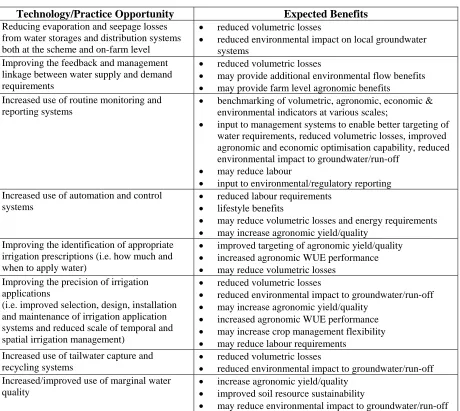
[image:3.595.69.529.324.735.2]While there is much discussion around changing the allocation of water resources and the potential impact on the irrigation industry, there is still significant potential to improve both the production and profitability of the on-farm irrigated sector through better volumetric and agronomic performance. Hence, where market conditions remain favorable, it will be improvements in volumetric efficiencies and agronomic responses which will drive industry expansion. There are a wide range of irrigation technologies and practices which are either already available or just around the corner. The major opportunities for technological intervention and the associated benefits are outlined in Table 1. The Australian irrigation industry currently leads the world in a number of areas including the (a) use of continuous, multi-depth soil moisture monitoring systems for irrigation scheduling, (b) use of commercial services to improve surface irrigation performance, (c) use of deficit irrigation strategies and supplementary irrigation in areas with highly variable rainfall, and (d) evaluation of performance and sustainability issues surrounding precision irrigation systems. However, while some of the underlying technologies are already commercially available, there are also areas where further work is required to both develop and package appropriate solutions.
Table 1. Technology and practice opportunities for improving irrigation performance
Technology/Practice Opportunity Expected Benefits
Reducing evaporation and seepage losses from water storages and distribution systems both at the scheme and on-farm level
• reduced volumetric losses
• reduced environmental impact on local groundwater systems
Improving the feedback and management linkage between water supply and demand requirements
• reduced volumetric losses
• may provide additional environmental flow benefits
• may provide farm level agronomic benefits Increased use of routine monitoring and
reporting systems
• benchmarking of volumetric, agronomic, economic & environmental indicators at various scales;
• input to management systems to enable better targeting of water requirements, reduced volumetric losses, improved agronomic and economic optimisation capability, reduced environmental impact to groundwater/run-off
• may reduce labour
• input to environmental/regulatory reporting Increased use of automation and control
systems
• reduced labour requirements
• lifestyle benefits
• may reduce volumetric losses and energy requirements
• may increase agronomic yield/quality Improving the identification of appropriate
irrigation prescriptions (i.e. how much and when to apply water)
• improved targeting of agronomic yield/quality
• increased agronomic WUE performance
• may reduce volumetric losses Improving the precision of irrigation
applications
(i.e. improved selection, design, installation and maintenance of irrigation application systems and reduced scale of temporal and spatial irrigation management)
• reduced volumetric losses
• reduced environmental impact to groundwater/run-off
• may increase agronomic yield/quality
• increased agronomic WUE performance
• may increase crop management flexibility
• may reduce labour requirements Increased use of tailwater capture and
recycling systems
• reduced volumetric losses
• reduced environmental impact to groundwater/run-off Increased/improved use of marginal water
quality
• increase agronomic yield/quality
• improved soil resource sustainability
It seems likely that a mix of technological and management solutions will be required to improve performance across the range of scales involved in the irrigation industry. Inevitably, the physical characteristics of the system at one level impose some constraints on the range of options available at more localised levels. For example, water supply policies or constraints at the regional or scheme level will have a direct influence on farm level irrigation design criteria (e.g. requirement for on-farm storage, size of pumps/channels, attractiveness of recycling systems) and management (e.g. scheduling) practices. Hence, where scheme level characteristics are the main barrier to the adoption of improved on-farm practices, there is a need for off-farm investment in infrastructure, services and skills to create the pre-conditions for on-farm change.
Investing for the future
It is time to deliver at an industry level on the potential for on-farm improved irrigation performance. It is certainly at the farm level that the majority of Australian water is consumed and converted into marketable produce. Hence, it is the farm level which is the engine room of the irrigation sector and without major change at this level there will be significant constraints to future industry growth and returns.
Surface irrigation will remain the dominant form of irrigation application in Australia for the foreseeable future and there are significant opportunities to improve the performance of these systems. However, there will also be a growing interest in the labour, control and crop management benefits derived from conversion to low pressure irrigation systems. In either case, there will need to be a significant investment in on-farm irrigation infrastructure and practices to meet the demands of the future. While much of this investment will be financed by irrigators themselves, what is the role for public contributions towards (a) improving the availability of information and tools to reduce the risks, uncertainty and complexity of alternative investments identified as adoption obstacles and (b) co-investments in on-farm infrastructure on the basis of social (e.g. jobs, economic activity, regional development) and environmental (e.g. groundwater & riverine water quality/quantity) dividends derived from on-farm change?
Many of the issues facing irrigators are generic. For example, the performance of on-farm storage and application systems is completely independent of the crop being grown. Market pressures are also forcing many irrigators to become more crop “mobile”. However, there is little cross-sectoral investment in on-farm irrigation research. The collection and prioritization of industry levies on the basis of crop commodity sectors has resulted in a weak political presence for the irrigation industry and fragmented irrigation research. Despite more than a decade of a national irrigation research fund (e.g. National Program for Sustainable Irrigation) and the recent creation of a national irrigation research entity (i.e. the Cooperative Research Centre for Irrigation Futures), current research investment into on-farm water use productivity issues at the national level is less than $3 million per annum. Is this investment adequate to build and sustain the industry capacity necessary to enable irrigators to make informed investment decisions and to capture the full benefits of improved performance? With the irrigation support industries (e.g. equipment manufacturing, supply and financial sectors) set to be beneficiaries from on-farm irrigation performance investments and sector growth, what role should they play in assisting the industry to make these changes?
Conclusions
provide the basis for improvements in irrigation performance are already understood. The Australian irrigation industry is certainly leading the world in some areas. However, the range of on-farm water use efficiency and productivity currently observed across the industry suggests that there are significant opportunities for improvement. There is a need to increase the capacity to support on-farm irrigation investment as well look for the next level of productivity improvements. Without significant cross-sectoral private and public investment in developing the appropriate industry support mechanisms, the Australian irrigation industry will struggle to remain competitive and will fail to deliver the full economic, social and environmental benefits from water reform.
References
ABS (2005). Water Use on Australian Farms 2002-03. Cat. No. 4618.0, Australian Bureau of Statistics, Canberra.
NLWRA (2001). Australian Agricultural Assessment 2001: Volume 1. National Land and Water Resources Audit, Commonwealth of Australia, Canberra.